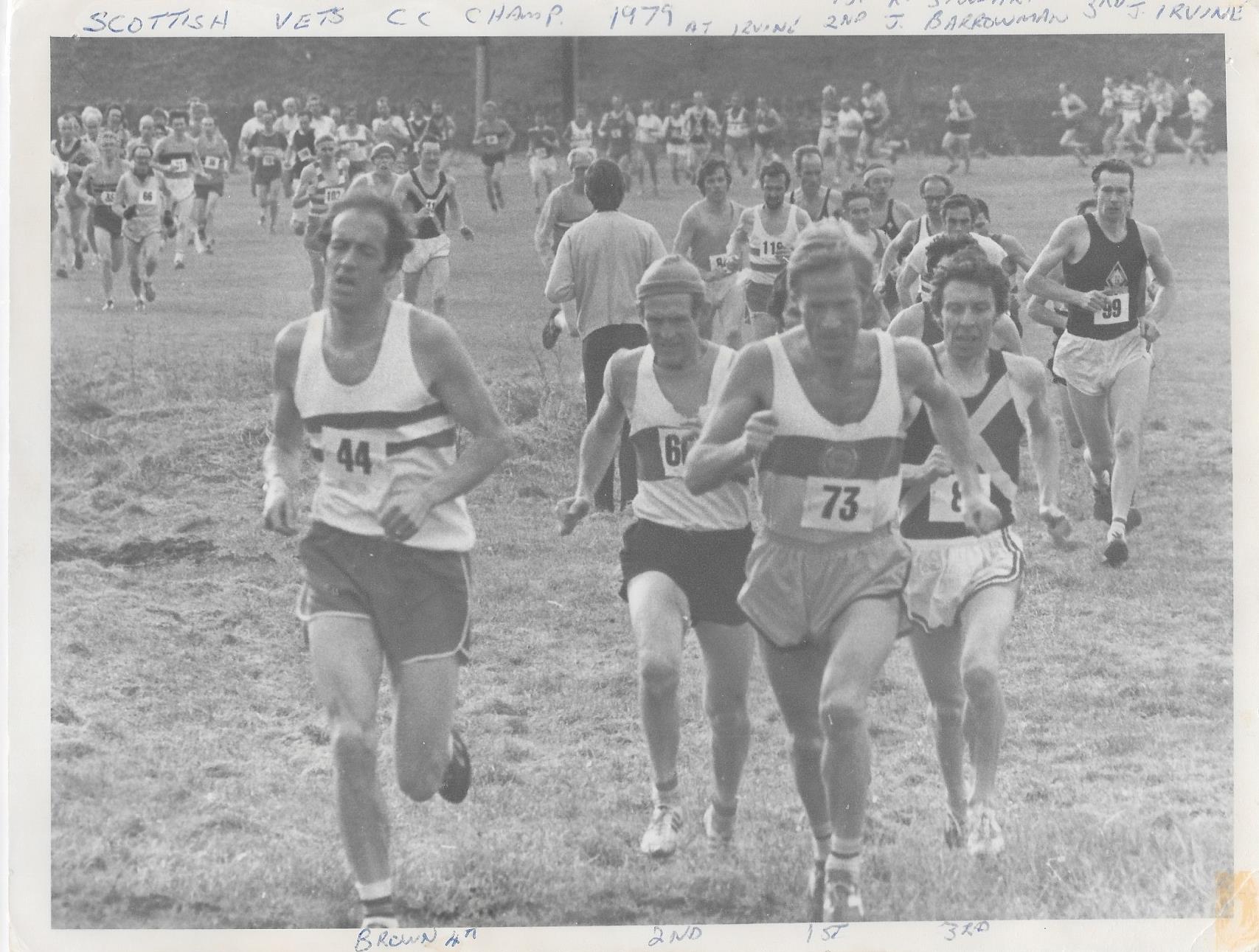
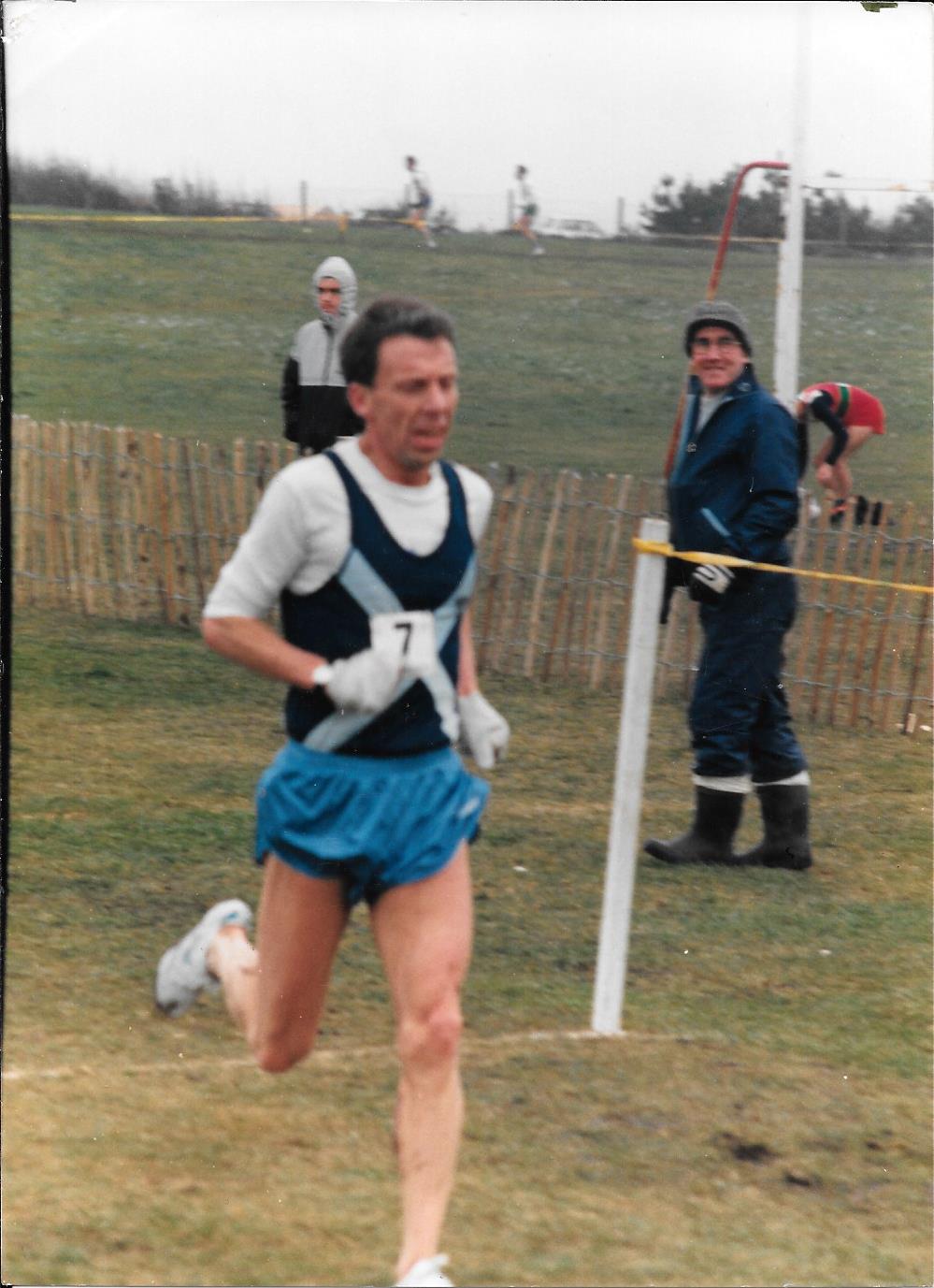
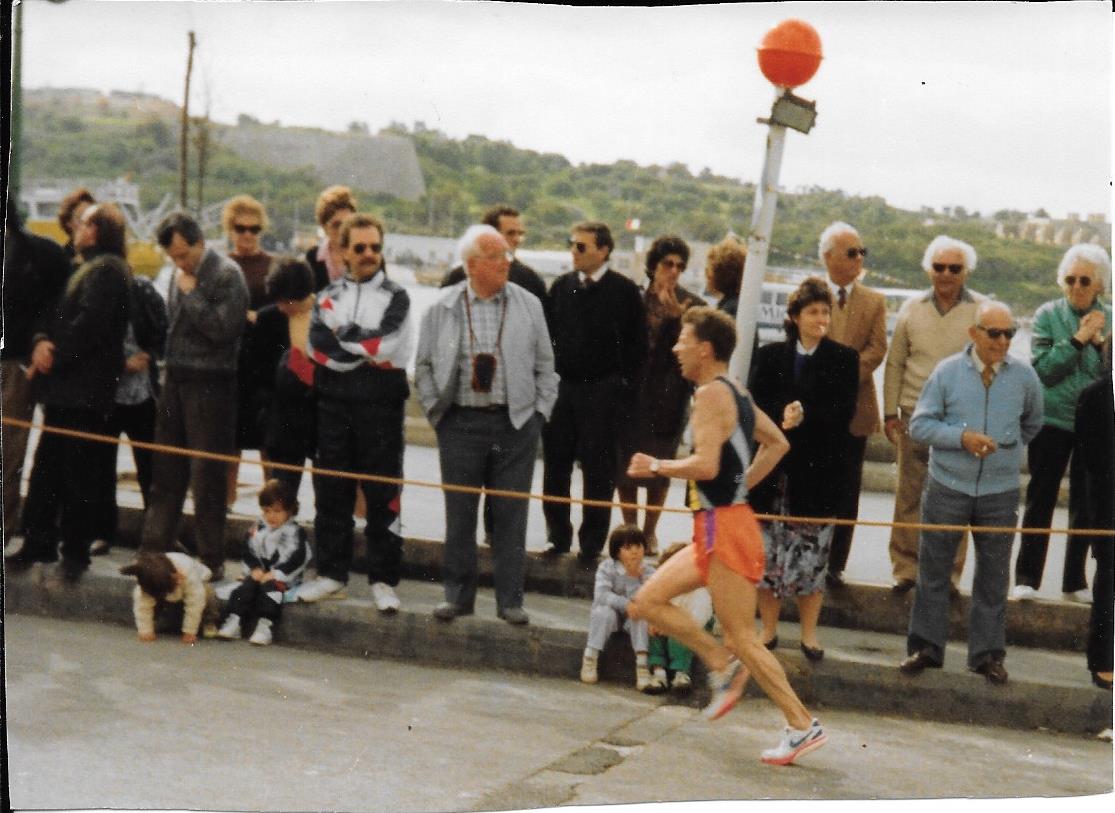
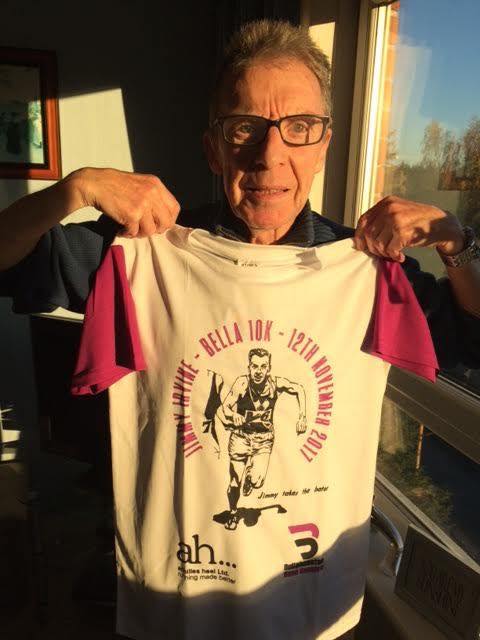
Who’s Who of Scottish Distance Running: C

 This page covers endurance athletes whose surname begins with the letter C, who were active between 1945 and 1990.  There will be omissions – if you think some athlete should be added. let us know.   If there are corrections or additions that we need to make, let us know of these too and we will do them as quickly as possible.
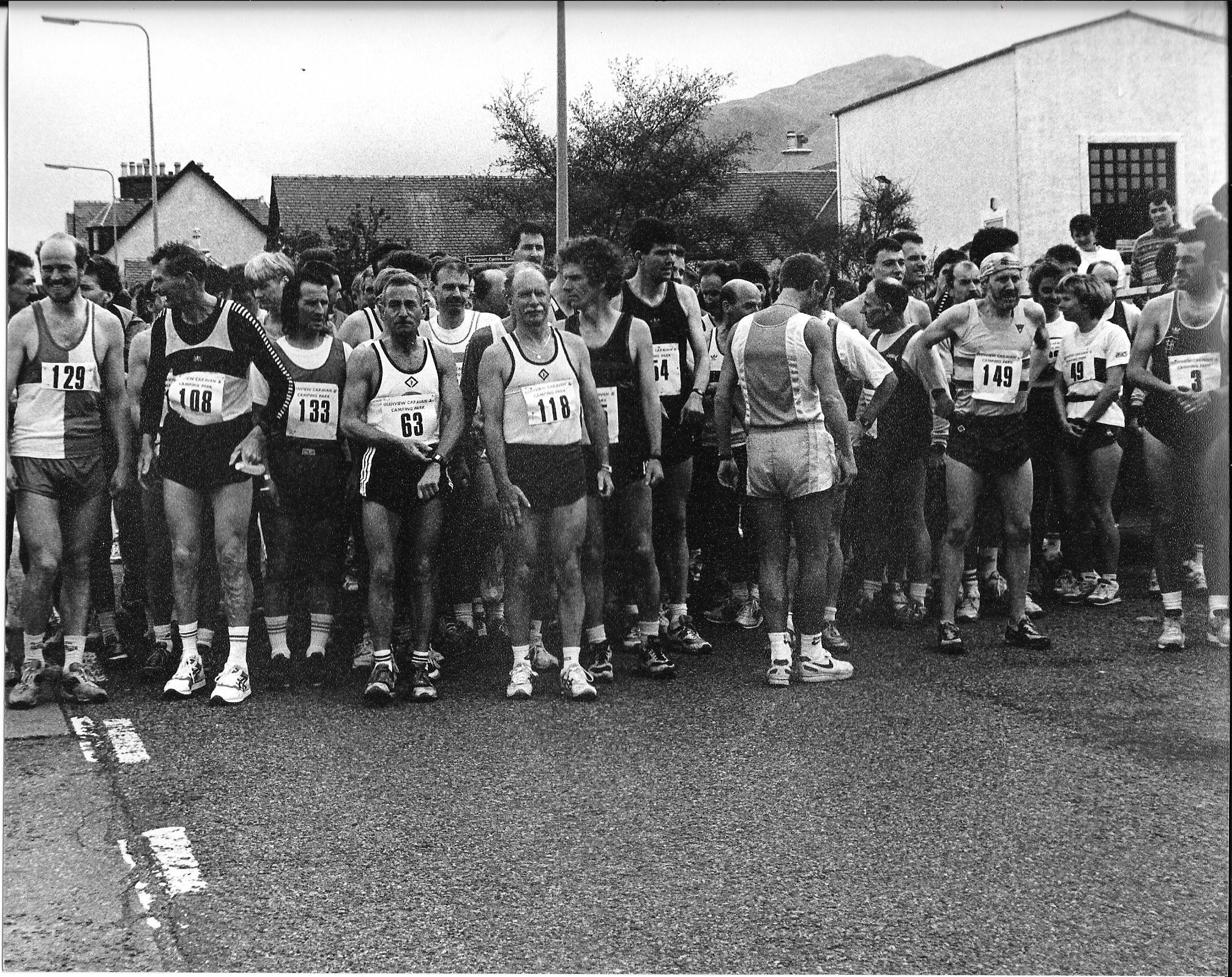
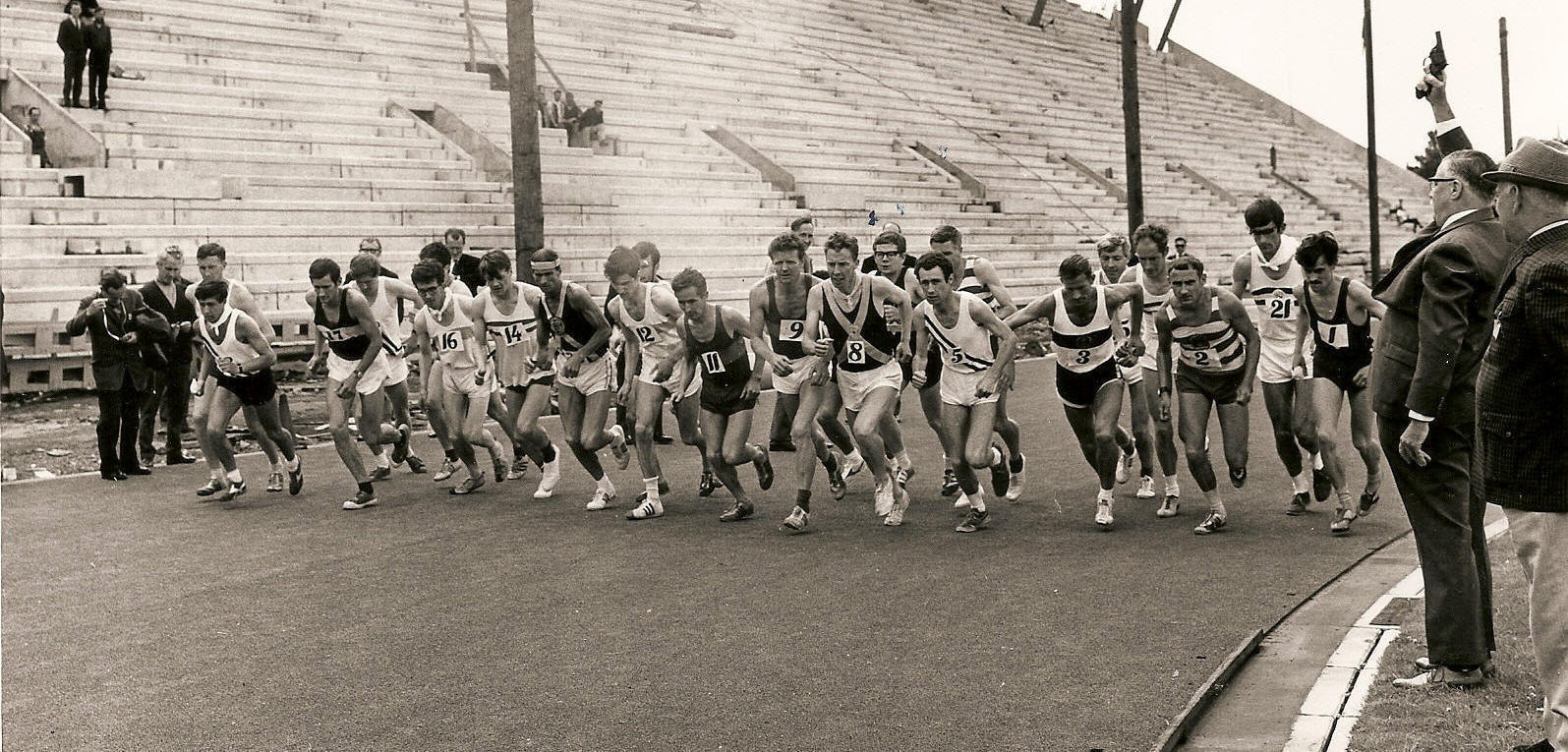
Start of Lochaber Marathon

William Cairns (Dumbarton AAC)

3000m S/chase:  9:30.6  1972;  10 Miles: 53:02.4  1972;   Marathon 2:38:53  1982

Billy Cairns was a contemporary of Colin Martin, Graeme Grant, Jack Brown, Bobby Mills, Bob Chapman and Hugh Elder.   He represented Dumbarton in the 1960’s and 70’s over the country (in all the main championships), on the roads (McAndrew and Edinburgh to Glasgow relays, etc) and on the track where his main event was the steeplechase.  He was also a key member of the team that pioneered the Glasgow to Fort William relay which started in George Square and wound its way through the north and west of the city before joining what is now the West Highland Way: the remainder of its route diverged from the WHW in many places making it a much tougher event than the plain Milngavie to Fort William currently followed.

RC “Bobby” Calderwood (Victoria Park AAC) 

BOBBY CALDERWOOD was a very fine runner as can be seen by his two runs in the International Cross Country Championships in 1956 and 1957 – in ’56 he was first Scots counter when he finished in 41st position..  

After running as a Youth and Junior Bobby’s first run in the Senior National was in 1956 when he was second club counter when he crossed the line in ninth place.   In ’57 he was eighth and again in the victorious squad, in ’58 he was nineteenth to be a counter in the gold medal team for the third consecutive year.   There were medals in the following three years but not as bright – ’59 saw him in thirty fifth and second team, ’60 saw another thirty fifth place and bronze and in ’61 it was seventy third for more bronze.

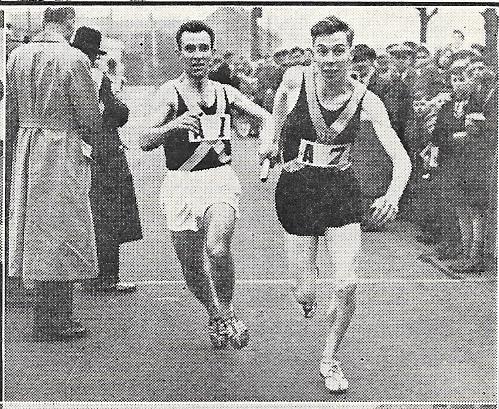
As for the Edinburgh to Glasgow, there were another four golds and three bronzes for Bobby.   In 1952 a very young Bobby was second on the first stage in the winning team and although he missed the event in 1953, he made up for it with finishing first on the first stage in 1954 to set the team on its way.   He missed out again in 1955 and then in 1956 he was again second on the first stage as part of another gold medal team performance.    1957 was to be his final gold medal when he again ‘won’ the first stage for the second time.   In ’58 he ran the first stage in the team that finished third but unfortunately the records don’t show the individual times below the winning club.   In 1959 he was third fastest on the long sixth stage to see the team finish third.   The team started to disintegrate at that point and although the team of the 1960’s would prove to be very good by 1960 the team could only finish twelfth with Bobby sixteenth on the first stage that he had dominated six years just a short time before.  

Adrian Callan (Springburn Harriers, Shettleston Harriers) – see full profile

TBP Callaghan (Monkland Harriers)  – see full profile

Tommy was a runner first, then a coach and administrator of high quality at Monkland Harriers.   As a runner he was a steady, reliable athlete who paced his races carefully.   As a coach he worked with really top class athletes such as Ron McDonald and Jim Brown.

Alexander Cameron (Edinburgh University, Edinburgh Southern Harriers)

6 Miles: 31:29.2   1968; marathon   2:33.23   1975

Big Sandy Cameron is one of the most popular runners in the country.   He was described by Alistair Blamire as “loyal cross-country team player and 2:30 marathon man.”   Although he ran for Edinburgh University with Martin Craven (and they both won team bronze medals in the 1961 Junior National XC), he is known to be an Edinburgh Southern Harrier through and through. Sandy was in the ESH veteran team that won the Scottish Masters XC title in 1980. He secured individual M65 bronze in 2007.

He ran in pretty well every event on the calendar from the Mamore Hill Race in Kinlochleven, and the Three Peaks in England, to the Lochaber Marathon at Fort William and the Edinburgh to North Berwick. He also raced the Scottish Marathon Championship most years from 1967 to 1982 (in 1975 he finished ninth) and was still running 2.35 as a veteran. Serving the club through several waves of talented runners at a time when ESH was the strongest club in the land, his contemporaries were such as Ken Ballantyne, Martin Craven, Fergus Murray, Don Macgregor, Gareth Bryan-Jones, John Robson, Allister Hutton and Colin Youngson.   He ran in one Edinburgh to Glasgow race (1967), but turned out in the National almost every year.   If anybody represents all that is best about the Scottish club man and distance runner, it is Sandy Cameron.

Angus Cameron (Edinburgh Southern Harriers)

Marathon:  2:42:29   1971

Duncan Cameron (Dundee Hawkhill Harriers, Army)

880y:  1:57.0    1966;  Mile:  4:20.5   1962

Evan Cameron (Edinburgh Southern Harriers)  –  see full profile

Hamish W Cameron (Aberdeen University, Victoria Park AAC, Forres Harriers)

Marathon:  2:43:16   1974

Hamish just kept on running steadily while others slowed and, as a veteran, gained revenge on many athletes who used to be faster than he was. For AU, he took part twice in the E to G. He ran several times for Scotland in the British and Irish Masters XC International. For many years, he was the invaluable Secretary of Forres Harriers and also organised the North Cross-Country League. In addition, he appeared in the final of ‘Mastermind’!

Keith Cameron (Pitreavie AAC, Edinburgh AC)

400m:   49.1   1981;  800m: 1:51.63   1982

Robert Cameron (Central Region AAC, Bridgend)  – see full profile

Brian Campbell, Hamilton Harriers, Clydesdale Harriers – see profile at the Three Amigos

Eddie CAMPBELL, St Mary’s Fort William, Lochaber AC.

Eddie remains a legendary figure, especially in Fort William, and had countless friends. When the Ben Nevis race restarted after the war, in 1951, he finished second, but went on to win three times and lead Lochaber to the team title on several occasions. Eddie completed this arduous event 44 times; and, counting training runs, reckoned he had reached the top of Britain’s highest mountain on 1200 occasions. Eddie was also a keen road runner, taking part in umpteen Scottish Marathon Club races, often linked to Highland Games, all over Scotland. He finished the 1955 Scottish Marathon championship, under the first-class standard time. Eddie won the 1958 North of Scotland Cross-Country title and finished second in the Goatfell event and third in the Cairngorm race. In later years, Eddie initiated many events: Lochaber Marathon and Half Marathon, Glasgow to Fort William Relay, Fort William to Inverness Relay, Aonach Mor and Lairig Ghru races; and, in his own inimitable fashion, often presented all the prizes.

Iain Campbell (East Kilbride, Clemson University [USA], Metropolitan Police)

5000m: 14:02.0  1985;  10,000m:  29:51.67   1984

Iain, a whole-hearted, gutsy athlete, ran well for Scotland in the 1978 World Junior XC; and again in 1979, when he finished first Scot in a very good tenth place. For East Kilbride, he took part in the E to G. Many years later he represented his country again in the British and Irish Masters 5 Nations International XC championship, finishing just outside the medals in the M45 and M50 age groups.

Iain Campbell (Dundee Hawkhill Harriers)

Iain featured in Dundee teams that won several important medals: gold in the 1989 E to G, when he was fastest on Stage 5, and silver in 1990; gold in the 1990 Six-Stage Road Relay and again in 1994; and gold in the 1991 Scottish XC Relay.

Ian Campbell (Edinburgh Southern Harriers) (10/12/59)

400m:  49.70   1988;   800m:  1:52.0  1989

Ian Campbell (Edinburgh Southern Harriers)  (16/12/65)

400:  49.21   1985;  800m:  1:50.8   1985

J Campbell (Shettleston Harriers)

Campbell was a young senior when he appeared on the scene.   He showed tremendous talent and determination and in the 1961 E to G, he was fastest on Stage Three, gaining three places and moving into the lead which his team never lost.   Unfortunately for Scottish athletics he died suddenly very soon after that and his talent could not be appreciated on the wider Scottish stage.

Roderick Campbell (Octavians)

S/chase:  9:42.4   1964

Ronald Campbell (Glasgow University)

880y:  1:67.2   1962

R Carey, (Annan & District AC, Border Harriers)

Rob was a very good runner and steeplechaser indeed.   Tall and powerfully built, he was member of Annan & District at the same time as such as Mike Carroll, and for a period, Steve Ovett.   His peak period was between 1984/84 and 1986/87.   In the national junior cross-country championships of 1985 he finished tenth, just 4 seconds down on Steven Begen of Springburn Harriers and a year later he was second in the same championship – 12 seconds down on Begen and 25 seconds in front of Tom Hanlon.   This earned him selection for the ICCU World Junior Championships.   He got the better of Began the following year when they were both first year seniors – Carey was 31st and Begen 66th.    He also ran well on the road and won or was placed in many a race in the Borders and south east of the country, in addition to running on the second stage of the Edinburgh to Glasgow in 1989.   As a steeplechaser he was ranked number six in Scotland in 1986 with a best of  9:14.45; a year later, as a member of Border Harriers, he was seven seconds faster with 9:07.59 which ranked him eighth; and in 1989, still with Border Harriers, he was timed at 9:10.0 and  ranked seventh.
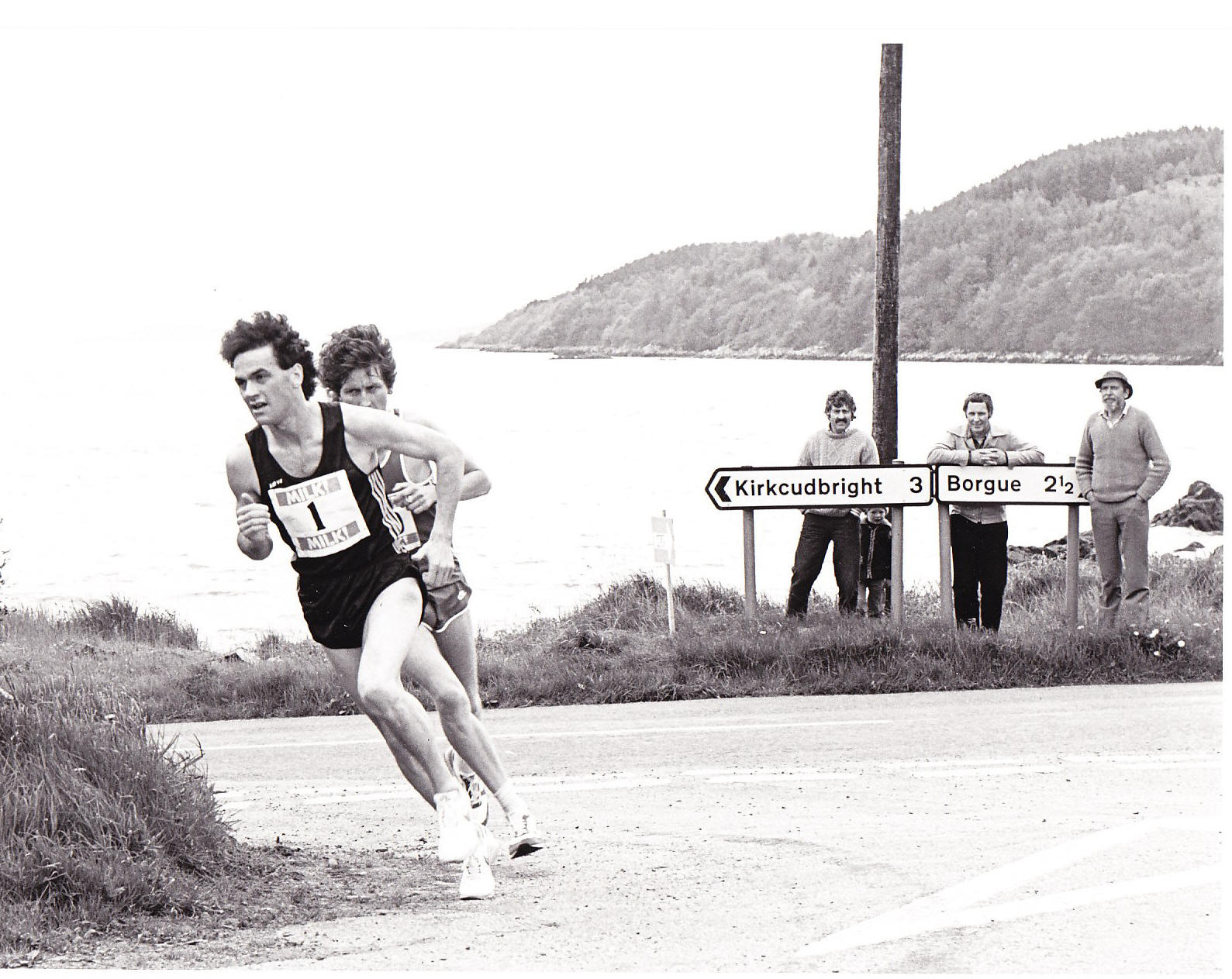
Mike Carroll followed by Graham Crawford

George Carlin  (Clydesdale Harriers)

A talented runner who ran well on the roads, over the country and on the track.   George also ran well on the hills and was part of several award winning teams in the 1970’s and 80’s.   He was a 2:25 marathon runner and a 9 minutes + steeplechaser.   On the country he won many team medals of all three colours – gold, silver and bronze.

Michael Carroll (Annan and District) – see full profile

3000m:  8:17.9   1989;  5000m:  14:15.3   1989;   10000m: 29:22.5   1989;  Mar  2:19:18   1993.

Jack Carcas (Edinburgh AC)

Jack was one of the original members of Edinburgh AC in 1962 and was mentioned in Jim Alder’s autobiography as one who had an effect on his life.   Jack Carcas originated in the North East of England and has to his credit a very fast time in the Morpeth to Newcastle in the New Years day race. He may have other performances which are not known in Scotland.   He ran in all major races including the Edinburgh to Glasgow and the National cross-country championship.   

Albert Carse (Braidburn AC, Edinburgh AC)

Mile:  4:17.4   1965;  Two Miles:  9:17.5   1965;   Three Miles: 14:05.0   1965;   3000m S/chase:  9:58.4   1961

Bert Carse was a member of Braidburn AC when it merged with Edinburgh Harriers, Edinburgh Eastern and Edinburgh Northern to form Edinburgh AC in 1962.   He was a very good athlete and, apart from the steeplechase pb noted above, most of his best running was done as a member of the new club for whom he ran in road and cross-country races as well as in the various leagues and championships on the track.   He ran the first stage of the E-G in 1962 – their first year in the race.   In 1963 he ran the second stage and moved the club from 13th to 11th, in ’64 he picked up  one place on the second, in ’65 he ran the fastest time on the second stage moving from sixth to second – faster than Alex Wight, Alex Brown, Joe Reilly and all the rest.   That was the last time he ran in the race.   Cross-country he was twelfth in the National in 1965, one second behind Craig Douglas, having been 54th the year before.    Bert emigrated to Perth, Australia.   

David Carter, St Andrews University

David (in 5th place) was the best runner in the team which won gold medals in the 1958 Scottish National Junior XC championships; in 1959 he secured an individual bronze medal – the second team counter was future Olympian Donald Macgregor in 7th – and the team finished second. In the 1959 E to G, St Andrews University achieved a good 7th place. 

Peter Cartwright, Falkirk Victoria Harriers, Clydesdale Harriers 

Brian Carty  (Shettleston Harriers) – see full profile

Brian ran his first marathon in Glasgow in 1982 at the age of 39 and clocked 2:40.  By the spring of 1983 he was a Shettleston Harrier and that year he was fourth in the Jimmy Scott race, third in the Motherwell Marathon in 2:32:57, fourth in the SAAA Marathon in 2:33:45, before finishing his season with 2::26:15 for fifth place in the Inverclyde Marathon in August.   The high spot of his career however had to be on 1st June, 1986 when he won the SAAA Marathon championship.  Brian also ran over the country with some distinction. He was part of Shettleston veteran teams that won the Scottish Masters XC title in 1985 and 1985; and secured individual M40 silver in 1987.

Steve Cassells, Aberdeen AAC

Steve was in the Aberdeen team which won the 1976 Scottish Junior National XC. He was a great clubman, for many years training hard and regularly, and raced frequently on country and road – preferring the half marathon.

David Causon, Garscube Harriers

David was a long serving and loyal member of Garscube Harriers who turned out faithfully in every race he could including club, county, district and national championships.   He was also a member of the Scottish Marathon Club and one of the first to join the Scottish Veteran Harriers Club to which body he donated a marathon trophy.

David Cavers (Teviotdale Harriers)

5000m:  14:45.8   1991;  10000m:  3000, S/chase:   9:20.67   1989;  Marathon:  2:16:06   2008

Dave Cavers was a most remarkable cross-country runner, who also completed one very good marathon.   He had ten victories in the East District Cross-Country League and had many contributions to Teviotdale’s best team performances.   In addition he was East District Cross-Country champion six times between 1992 and 2001.   However it is Dave’s record in the Senior National that is most amazing in its high quality and consistency.   Between 1989 and 2001 he was second, fourth twice, fifth twice, seventh, eighth twice, ninth, tenth twice, twelfth and fourteenth.   If only Scotland had not been excluded from competing as a separate nation in the IAAF World Cross-Country!   Dave’s silver medal in 1999 was won at Beach Park, Irvine, when he was defeated by Bobby Quinn but finished in front of Tommy Murray, Phil Mowbray and Tom Hanlon.   When he was fourth in 2000, the three in front were also very high quality GB Internationals – Quinn, Murray and Glen Stewart.

Bob Chapman (Dumbarton AAC)

Bob was a Royal Navy officer stationed on the Clyde in the late 60’s early 70’s who joined Dumbarton AAC while he was there.  A very good runner on whatever surface he was competing, he helped the club to several team medals.

Richard Charleston (Wolverhampton & Bilston, EAC)

1983 1500m 3.46.7; 1984 5000m 14.03.74; 1983 3000m Steeplechase 8.46.27

Richard was part of the EAC team which won the 1984 Scottish 6 Stage Road Relay. In 1985 he became Scottish Half Marathon champion. He featured in the Scottish rankings between 1982 and 1989. Undoubtedly Richard was at his best on the track: winning the Scottish Steeplechase title in 1982 and 1986 and finishing second in 1983. He ran the Steeplechase for Scotland 8 times; including a 12th place finish in the 1986 Commonwealth Games.

Dougie Childs   (Greenock Glenpark Harriers)

Doug was a good regular member of many Glenpark teams racing well for them on the country in County, District and National championships, on the track in inter club events as well as in the Edinburgh to Glasgow relay and all the classic road races (McAndrew, Nigel Barge, GU Road Race.

Bruce Chinnick, (Wales), Forres Harriers, Aberdeen AAC

1990: 3000m 8.22.0; 5000m 14.21.72; 10,000m 30.09.5

Bruce won the North District XC title in 1986 and 1987 and was also a tough competitor on the road, with a half marathon best of 65.38. He ran the E to G for the North District Select.

Joseph Clare (Aberdeen, Royal Navy, Blackheath)

Six Miles: 30:38.6   1968;   10 Miles:  51:15.6   1968;  Marathon: 2:18.43   1968

Joe was a tall, powerful, very reliable athlete who trained for a while in Aberdeen with International runners Alastair Wood and Steve Taylor. He won the North District XC title in 1969. Royal Navy AC (Phil Hampton, Joe Clare and Danny McFadzean) won first team prizes in the 1969 Boston Marathon. Joe’s marathon best time was set while winning the 1968 Inverness to Forres Marathon. Earlier that year he had won a silver medal in the Scottish 10 Miles Track championship. In 1970, on his debut, he was victorious in the famous London to Brighton ultra-marathon. For Aberdeen AAC, in the Senior National, he contributed to team silver in 1968; and he added E to G bronze in 1967 and silver in 1968. He was part of the AAAC ten man squad that broke the John o’Groats to Land’s End Relay record in 1973.

Graham Clark , Spango Valley AAC– see full profile

Talented Scottish distance runner who ran for Scotland in the international cross-country race but died tragically early.

J Clark, Clyde Valley
In the Scottish Masters XC championships, he won M60 titles in 1983 and 1985; and added a silver medal in 1986.

James Clark (Shettleston Harriers)

James finished 12th in the 1948 Senior National XC and Shettleston won the team title; which they did again in 1949 and 1950. 

Robert G Clark (Edinburgh University)

440y:  51.2   1961;   880y:  1:55.2   1961;  Mile:  4:16.2   1961 

A member of Clydesdale Harriers before going to Edinburgh University, Robert already had a good athletics career as a track and cross country runner behind him when he arrived in the Capital.   He won SAAA gold as a member of the Clydesdale 4 x 440 yards team that won the SAAA Championships in 1960 and individually was second in SAAA 880 yards in the same year.   Robert had a good athletics career at University including winning the Scottish Universities Mile in 1860.   He represented the University with distinction on the road and over the country as well as on the track.  

Roy Clark (Royal Navy, Clydesdale Harriers)

An ultra distance runner who was posted to Faslane in the 1960’s and joined Clydesdale Harriers.   He ran in the Edinburgh to Glasgow 45 miles race as well as many club races including the County, District and National Championships.

HB (Ben) Clegg (Edinburgh Southern Harriers)

Two Miles   9:28.0  1962; Three Miles  14:25.0   1963;   30:17.0   1963.

You can see from the times above recorded on grass and cinders that Ben was a considerably good runner.   His talent was not limited to the track – he ran in three Edinburgh to Glasgow relays picking up three bronze medals, and in three senior national cross country championship races where he won bronze in 1962, silver in 1963 and gold in 1964.   ESH won again the following year but by then Ben had moved on and would not run in another National.

David Clelland, (St Modans AC and Falkirk Victoria)

David won silver medals in the Scottish Two Miles Steeplechase track championships in 1950 and 1951; and bronze in 1946 and 1952. For St Modans, he ran the E to G in 1950 and 1951, then switched to Falkirk Victoria Harriers, running the great race four more times, gaining ‘most improved medals’ not only in 1953 (11th) but also 1954 (5th). Much later he won bronze medals in the M50 Scottish Veterans Cross-Country championships – in 1979 and 1981.  He ran for Falkirk Victoria for a few years in the late 50’s where he represented the club in the E-G, before returning to St Modan’s where he ran again in the Edinburgh to Glasgow in 1961

Frank Clement  (Bellahouston Harriers, Strathclyde U) – see full profile

R Climie (Bellahouston Harriers)

In the E to G, he won three team bronze medals: in May 1949, November 1949 and 1952. In the Senior National, he gained two team silver medals in 1948 and 1949.

Ian Cloudsley (Shettleston Harriers)

Ian was a very good Junior who was third in the Junior National in 1954/55 which was won by team mate Graham Everett.   He also ran in two Edinburgh to Glasgow Relays: in 1955 on the first stage when he was third on the first stage for the winning team; and in 1956 he ran on the eighth stage for the team that finished second.  

Fraser Clyne (Aberdeen AAC) – see full profile
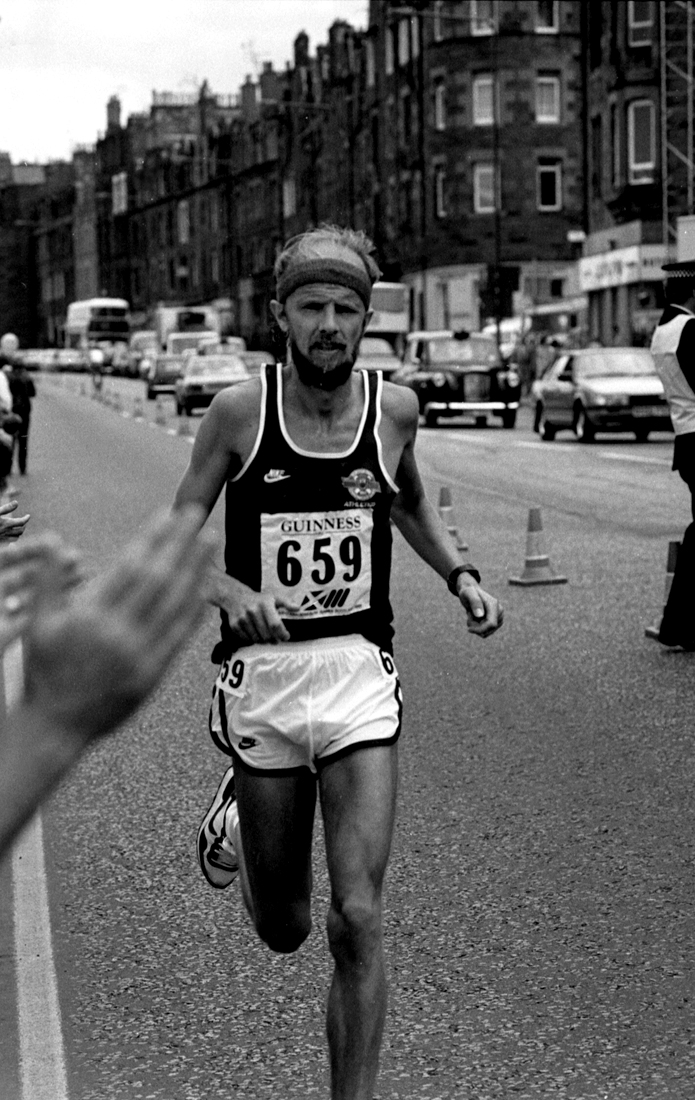
Fraser Clyne

Thomas Cochrane (Beith Harriers, British Army, Portsmouth AC)

Two Miles:  9:16.0   1964;   Three Miles:  14:22.8   1966;  300m S/chase:  9:31.2   1966

Tommy Cochrane was a very talented athlete indeed: had he run for a more fashionable club with increased competition opportunities, he would have been even more successful than he was.   He won the South Western District cross-country championship seven times and when the District was amalgamated with the Western District he was given the trophy to keep.   He ran in the International Cross-Country in both 1963 and 1964 after finishing ninth and sixth in the domestic championship.   Tom moved to Bournemouth where he carried on his athletics and became a well known coach.  

P Coleman (Falkirk Victoria)

Marathon:  2:23.03   1982.

Ron Coleman (Dundee Hawkhill Harriers)

Two Miles:  9:23.0   1964;  Three Miles:  14:08.0   1965;   Six Miles:  29:57.4   1965;   Marathon:  2:28:94   1965

Ron Coleman was a very important figure in athletics in Dundee as well as wider afield in Scotland.   First and foremost a runner and a loyal member of Dundee Hawkhill Harriers.   When the club first ran in the Edinburgh to Glasgow in 1961 and won the ‘most meritorious’ medals Ron ran on the difficult sixth stage.   He went on to run in another seven relays on stages 1, 2 and 6.   He also ran on the country in all major championships.  Ron was a really good long-distance road runner, for example winning the challenging Spean Bridge to Fort William race in 1962. He was 6th in the 1964 Ben Nevis Race.

TC Coleman, West Kilbride AAC

Coleman was a very good runner with the short-lived West Kilbride club.   They had many excellent runners and won several championship races.   He was fifth in the Youths’ (U17) age group of the national in 1949 wen the club won the team race, in ’50 he was fourth in the same race, and in 1952 as a Junior he was unplaced.  In 1953 as part of n incomplete Junior team he was tenth in the National.

On the track he had individual success – in June 1949 he won the SAAA Junior Mile title from Tommy Lambert of Bellahouston, a feat he repeated in 1950 winning comfortably from Alex Breckenridge of Victoria Park.   

Joe Connaghan (Spango Valley)

Joe was a good runner in his own right with some very good performances to his credit but is just as well known as the father of the two outstanding brothers mentioned below.   

Peter Conaghan (Spango Valley)

5000m:   14:24.0   1984

Peter was the older of the two brothers (their father Joe was a late convert to the sport and was a good runner too).   Peter ran in the IAAF international cross country championships in 1984 after finishing eighth in the national.   He continued to run well in the national and also ran in the Edinburgh to Glasgow for his club.   

Stephen Conaghan  (Spango Valley)

5000m:  14:37.0    1986;   10000m:  31:28.66   1987

Stephen was also a talented athlete who ran well on all surfaces and was part of teams which won prizes and medals in County, District and National championships as well as open races.
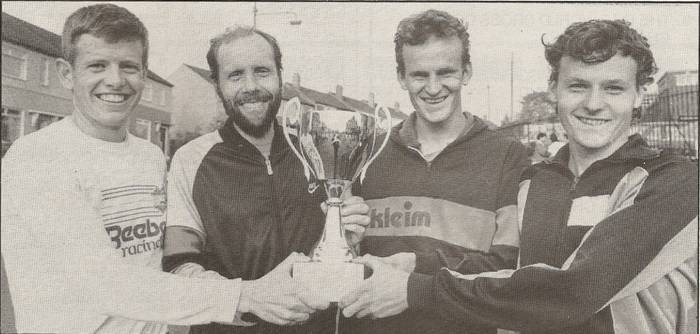
Winning team in 1986 McAndrew Relay: Chris Robison, Lawrie Spence, Peter and Stephen Conaghan


Jimmy CONN, Lochaber AC
Between 1952 and 1960, Jimmy ran 9 successive Ben Nevis Races, finishing in the top ten 7 times, with his best position 3rd (in 1952 and 1960). He contributed to four team victories. In his centenary book – “The Ben Race” – Hugh Dan MacLennan wrote of Jimmy “He must go down as the finest runner (certainly from Lochaber) who never won the ultimate accolade”.

Joseph Connolly   (Bellahouston Harriers) – see full profile

S Connelley (Springburn)

Marathon: 2:35:40   1980

John Convery (Ayr Seaforth, Edinburgh AC)

440y:  50.2   1962;  880y:  1:51.8   1970

John Convery was a very good 880 yards runner over quite a long period running for Ayr Seaforth and then for Edinburgh AC.  he  was born in Northern Ireland ,and then lived in Ayrshire before moving to Edinburgh.  Mainly a track man he did run in the Edinburgh to Glasgow on the third stage in 1964, 1965, 1966, 1967, 1969, 1971 (when he moved the team from tenth to fourth) , 1972 (fastest time on the stage) and 1973 (second team and silver medal).   John did not run as frequently over the country although he ran in the National often.  And in 1972 he was a team with Jim Alder, the Wight brothers, Matheson and Dave Tyler which was good enough to win another team silver

Brian Cook (Dundee Hawkhill Harriers)

Brian contributed to gold medals in the 1990 Six Stage Road Relay and silver in 1989; and to silver in the 1990 E to G.

J Cook (Garscube Harriers)

In the early/mid 1960’s Garscube Harriers had two outstanding young athletes in Ricky Wood and James Cook.   James was the younger of the two and he won the 1967 National Youth Cross-Country title, earning selection for the Scottish Junior cross-country team.   A year later, as a first year Junior he was eighth in the National, sandwiched between A McKean and T Patterson of Shettleston, he was again selected for the Junior International.team .  He ran in the 1968 Edinburgh to Glasgow.

Dave Cooney (Cambuslang Harriers)

was a good solid club runner in the early and mid 70’s who contested all the championships – county, district and national – for his club as well as running in the Edinburgh to Glasgow 6 runs; stages 1, 4, 5, 6, 7) and most of the open road races.  Later in his career he became the club’s team manager for track as well as cross-country.   He was the cross-country team manager through all the years when Cambuslang made their bg break through to the top echelons of Scottish endurance team running.

Frank Cooney (Cambuslang Harriers, Dumbarton AAC)

Frank with his brother Dave was a familiar sight on the road racing scene in the early 70’s and raced on country and road over the winter, turning out in the Edinburgh to Glasgow (3 times on stages 1 and 8) as well as the championships.   When teaching in Dumbarton he joined the Dumbarton AAC for whom he turned out over several season.

Jim Cooper (Springburn Harriers)

Jim Cooper, known to most as ‘Cooperman’, was a long serving member of Springburn Harriers. He ran in the Edinburgh to Glasgow 10 times between 1981 and 1992, six of them on the tough sixth stage.  In 1985, Springburn had finished 9th in the E to G and secured medals for the most meritorious unplaced performance and Jim ran on the sixth stage that day.   He was also part of the team that won the 1988 Scottish 6 Stage Road Relay, and a year later, added a silver medal in the 1989 Scottish Cross-Country Relay. He ran everywhere that his club required him to run – road or cross-country, and in a lot of individual races over the summer.   While he continued to carry on running without a break, and extended his range to include the marathon (2:28:34 in 1991), he became a qualified coach with the club.

Ross Copestake (Dundee Hawkhill Harriers, Birchfield Harriers, Wolverhampton and Bilston AC)

1500m:  3:47.2   1983;  Mile:  4:04.6   1983;   3000m:  7:57.3   1983;   5000m:  14:26.7   1988;  3000m S/chase  9:05.2  1983

Ross first came to the notice of athletics followers as a cross country runner.   Winning the Youths’ (U17) championship in 1980,he was selected for the IAAF cross-country championships as a junior.   Working his way through the Junior ranks and the first year as a senior, he was fourth in the 1984 national behind Muir, Hutton and Clyne and was selected for the international in the senior age group; the following year he was third behind Muir and Robson and in front of Braidwood, Dingwall and Haskett ; and in 1987 he was eighth and in both years he ran for his country in the international.   Strangely for one so quick on the track and so gifted over the country, he only ran two Edinburgh to Glasgow Relays – first of all in 1981 and then not again until 1988 although his contemporary through the age groups, Richie Barrie, turned out every year.   

Alan Coutts (Greenock Wellpark Harriers) 

5000m:  14:51.6   1978;   10000m:  30:41.6   1980

Alex Coutts (Strathclyde University)

10000m:  32:06.8   1975

John Cowan (Bellahouston)

Marathon:  2:24:09   1985

John Cowan (Victoria Park, Clydesdale and Cambuslang)

John Cowan was always a very good runner: as a Boy (U15) and Youth (U17) with Victoria Park he was part of a very good team that won medals at County, District and National level and his school, (Braidfield) was always involved in athletics too.   As a Senior man with Clydesdale Harriers he showed a lot of promise but, after moving across to the south side of Glasgow he joined Cambuslang Harriers whom he helped to several team medals.

Fred Cowan, Bellahouston Harriers

Freddy joined Bellahouston around 1950 from the West of Scotland Harriers and he became a very good 880y track runner winning quite a few handicaps best around 1-56, he was also a good distance runner although a bit inconsistent.   One of his outstanding runs was winning the first leg in 1956 in the Edinburgh – Glasgow beating Bobby Calderwood in a sprint finish.  He still trains and runs in the Vets track  Fred was a reliable member of the Bellahouston teams in the very late 50’s/early 60’s period with two silver medals to show for his efforts in the Edinburgh to Glasgow Relay.   He still trains and runs in the vets track  champs. he will be 85 years old this year (2018)

Douglas Cowie (RAF, Forres Harriers)

Marathon:  2:21.14  1986

Doug was a very determined, well organised runner who was influenced by former RAF team-mate Steve Jones (British record holder for the marathon). Doug’s training – for cycling, duathlon and triathlon, as well as running – was impressive, so he seldom became injured. He ran marathons for Scotland in Home-countries contests; and often took part for Scotland in the British and Irish Masters International Cross-Country. As a coach, he had considerable success at Forres, and one of his athletes ran for GB in the World Junior Cross.
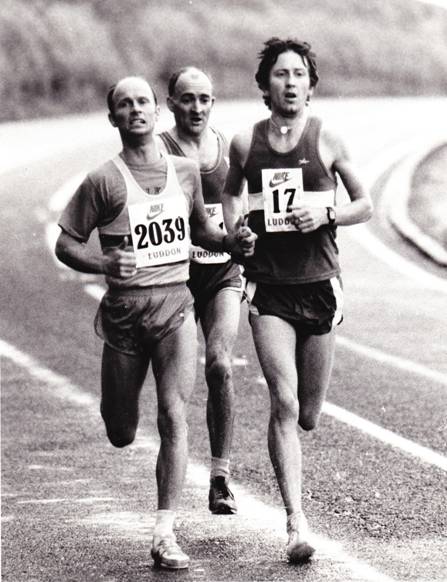
Hammy Cox (2019), Graham Crawford (17) and Alex Gilmour.

Hamilton Cox (Greenock Glenpark Harriers, Spango Valley AAC) – see full profile

Martin Coyle (Spango Valley)

10000m:  33:23,4     1978

Thomas Coyle (Edinburgh Southern Harriers)

5000m:  14:36.0   1971; 10000m: 31:52.0   1971;   3000m S/chase:   9:28.6   1971;  Marathon:  2:26:39   1971

Tommy was part of the ESH team which won the E to G in 1969.

William Coyle (Shettleston Harriers)

800m: 1:54.8   1988;  1500m:  3:50.51   1990;   3000m: 8:06.2  1992;  5000m: 14:18.1   1997; 10000m: 29:59.8   1997;  3000m S/chase:  9:10.7   1991;  Marathon:  2:32:54

Billy Coyle came in to the sport in the early 1980’s and coached by Bill Scally he followed Bill’s example and did what his club needed him to do.   The range of personal bests goes from to 1997 and he was still running and racing well into the 21st century.   Billy ran well in the Edinburgh to Glasgow Relay and over the country too, helping his club to many gold, silver and bronze medals.

Anthony Coyne (Falkirk Victoria, Bellahouston, Shettleston) – see full profile

1500m: 3:51.72   1986;  3000m: 8:24.6   1990;  10000m  31:21.8   1992;  marathon:  2:19:16  1984

Archie ‘Baldie’ Craig (Bellahouston Harriers) –

Archie won the SCCU Championship in 1913 and ran in seven international cross-country championships between 1913 and 1924.   He was the father of Archie Junior and George both of whom, like their father, ran for Scotland.   Although his running career was entirely with Bellahouston Harriers, he later moved to Shettleston Harriers where he was a coach.   When he was President of the SAAA in 1937/38 though it was as a member of Lochwinnoch AC – a small club in Renfrewshire that provided many runners for Bellahouston Harriers, the most notable of whom was Harry Fenion.

Archie Craig, jnr  (Shettleston Harriers)– see profile

Archie Craig junior ran in the cross-country international in 1938 and ’39.

George Craig (Shettleston Harriers) see full profile

George was the younger of the two sons of Archie Craig and ran in the international in 1948, ’49 and ’50.

Martin G Craven (Edinburgh University, Edinburgh Southern Harriers, Kendal) – see full profile

Two Miles: 9:12.0  1963;  Three Miles: 13:56.6   1963;  5000m: 14:32.6   1972;  Six Miles: 29:47.4  1963;  10000m: 29:55.4   1973;   10 Miles: 49:19.6  1973;   Marathon: 2:18:38

Graham Crawford (Springburn Harriers, Glasgow University) – see full profile

1500m: 3:50.7   1984; 3000m: 8:10.7   1984;  5000m: 14:11.3   1985.

John Crawford (Victoria Park, Glasgow University)

Six Miles: 31:09.0   1967;    3000m S/chase: 10:03.2   1969.

Stewart Crawford (Victoria Park, Glasgow University)

3000m S/chase: 9:45.2   1972

Ray Cresswell (Aberdeen AAC)

1500m:  3:50.19   1989;  3000m:  8:24.82  1989;  5000m: 14:46.06   1989;  10000m:  31:22.77   1992; 3000m S/chase: 9:14.46   1989.

Ray Cresswell   always had considerable talent and as a Junior ran 1500m in 3:58.4.   In the Edinburgh -Glasgow, he was part of a winning team in 1986 and 1988 (when he was fastest on Stage Three, moving from third to first.)   In addition he won bronze medals in the 1988 National (twentieth finisher) and the 1989 Six-Stage Relay.  
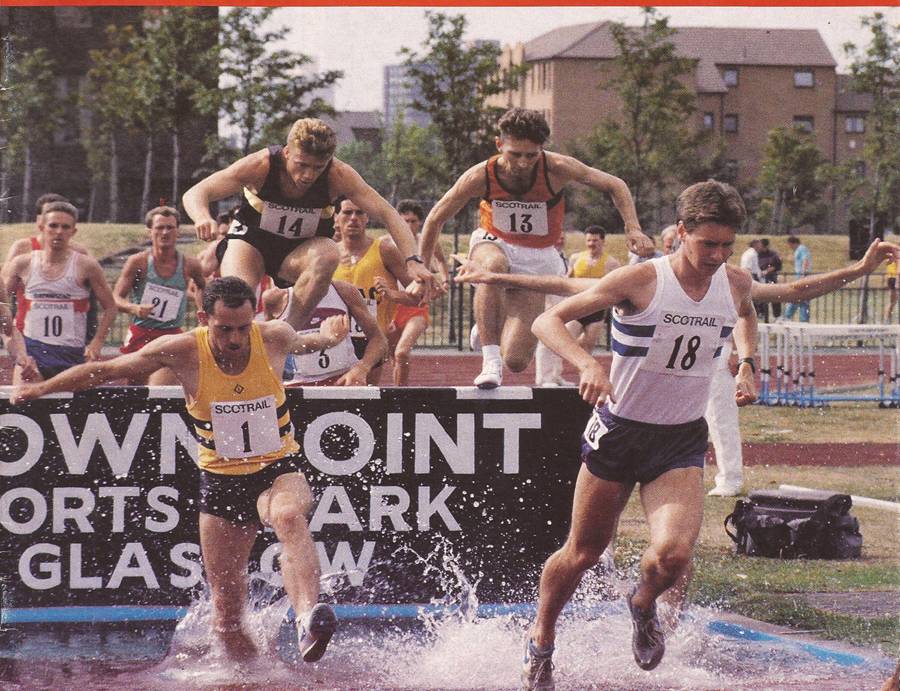
Graeme Croll (1)

Graeme Croll (East Kilbride, Cambuslang)  – see full profile

Marcus Crolla  (Grimsby)

Two Miles: 9:49.o 1959;  Three Miles:  14:08.8  1960

Stephen Cromar, Dundee Hawkhill Harriers
Stephen first won a medal in the Scottish Masters XC championship in 1996 – silver behind Pitreavie’s John Linaker. Since then, Stephen has only once been defeated in this annual event: winning the M60 title in 2002; M65 gold four years in succession (2004-2007); the M70 championship in 2009 and 2012; and M75 in 2017 and 2018. Only Ian Leggett (M70 – 2011) managed to edge Stephen out of first place. The Dundee Hawkhill Harrier ran well for Scotland several times in the British and Irish Masters XC International, including 9th M65 in 2005; and M65 team silver in 2007.

Stephen Cullen, Garscube Harriers

Arguably, Stephen symbolised the club runner of the 1945 – 90 period better than any other.   Stephen trained hard, raced hard and did whatever his club needed him to do.   He ran in all cross-country championships as well as all of the open races at one time or another; he ran in the Edinburgh to Glasgow as well as in all the classics – the McAndrew, the Nigel Barge, the University Road Race, etc.   I was surprised to see that he hadn’t been ranked as a steeplechaser at any point.   He is, of course, still running but also coaching and helping others in the club.

Iain Cumming (Pitreavie)

400m:   49.28   1989;  800m:  1:52.2   1988

Alan Currie, Maryhill Harriers

Alan was a talented athlete who won the West District Junior Cross-Country championship on a wet afternoon in Kilmarnock in 1989.   Second was Ian Tierney of East Kilbride, third was Scott Murray of Kimarnock.   Unfortunately Alan’s extremely long legs, ideal for steeplechasing, were injury prone and he missed the national championships where Ian Tierney was second and Scott Murray was third.   The injury problem unfortunately put paid to his career far too early.

Alan Currie  (Dumbarton, Edinburgh University, Edinburgh Southern)

1500m: 3:46.96  1983;  Mile: 4:05.9   1984:   3000m: 8:13.0   1985

Alan was a bit overshadowed by younger brother Alistair but was a very good athlete in his own right –  look at the times posted in the 1980’s above.   Like Alistair he ran road and cross-country as well as track.

Alistair Currie  (Dumbarton, Loughborough, Newham and Essex) – see full profle

800m:  1:49.01   1985;   1500m: 3:49.43   1985;  Mile:  3:59,29   1985;   2000m: 5:20.91 i   1987;   3000m: 7:53.39   1989;  5000m: 14:11.20   1989;   3000m S/chase:  9:01.7   1991

Hugh Currie
Hugh ran for Bellahouston Harriers as a young man; but concentrated on climbing and became a member of the Creag Dhu Mountaineering club. He was very fit when he came into the sport as a veteran (with the Allander club in the late 1970s) and set the M65 record for the London Marathon. In the Inverclyde Marathon he established two British age group records for the marathon: M60 in 2.47.33 (1985 – later, Bill McBrinn ran a little faster); and M65 in 2.51.39 (a record which was still Hugh Currie’s in 2018).

Martin Currie (Central Region)

800m: 1:54.33      

Andy Curtis (Livingston) won the Scottish Hill Running title in 1984, 1985 and 1987.


Who’s Who of Distance Running: F

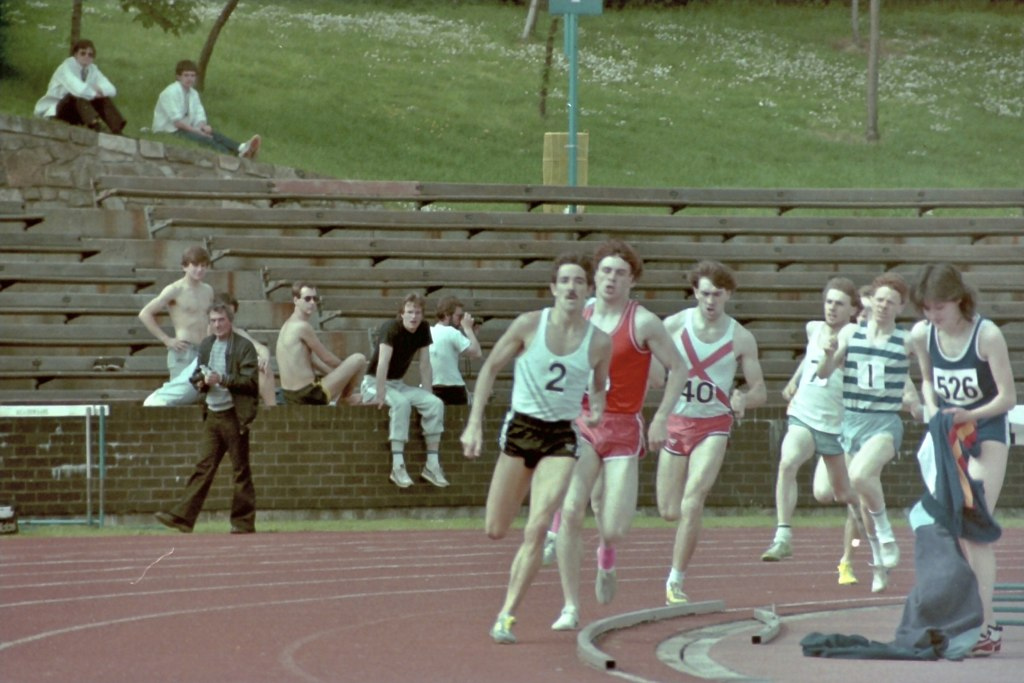
Paul Forbes (2)

John FAIRGRIEVE Heriot Watt University, Edinburgh AC

3000m Steeplechase: 9.34.0 (1968)

John was a well-liked and respected athlete who contributed to EAC’s successes on track and cross country. In the Senior National XC they won team bronze in 1969 and silver in 1970; and in the E to G they finished 5th in the 1965 event (to be awarded ‘most improved’ medals) and 4th in 1970. He went on to be a cheerful, supportive and well-organised SAAA official, and a popular manager, for example supervising Scottish team international trips to foreign and home countries marathon contests.

Gerard FAIRLEY (2.10.53) Kilbarchan

5000m: 14.52.8 (1982) 10,000m: 31.09.0 (1984) Marathon: 2.24.33 (1983)

Still sub-32.00 for 10,000m in 1996, aged 42, Gerry won a European Veteran 5000m title. He ran the E to G many times for Kilbarchan, including 1983, when they finished 9th.

David FAIRWEATHER (11.07.44) Law & District, Cambuslang H

Marathon: 2.24.49 (1983); 2.36.02 (1995 – aged 51).

Previously a cyclist, as a senior between 1973 and 1982, Davie ran the E to G for Law & District. Then he became a very successful Scottish international veteran athlete, not only on road but also hill and cross country. He secured British and Scottish titles. Perhaps his finest run was in 2000 at Navan, Ireland, when he won the M55 age group in the annual British and Irish 5 Nations International Masters XC.

Colin FALCONER (26.03.52) Springburn, Coventry Godiva

3000m: 8.23.0 (1973) 5000m: 14.31.6 (1973)

Colin was very talented and most successful when young. In 1970 he won Junior titles in the Midland District and National XC championships before finishing an excellent 5th (and first Scot) in the International Junior. He went on to win two Scottish vests in the International Senior. In the E to G, Colin represented Springburn in 1971, when they finished fourth; and 1973 (7th) when was fastest on the prestigious Stage 2.

Mark FALLOWS (8.02.62) Edinburgh/City of Edinburgh

800m 1.51.86 (1991) 1500m 3.45.96 (1993)

From 1987 onwards, Mark was a promising middle-distance runner, who became a Scottish international athlete, indoors and out. He won a bronze medal in the 1992 Scottish indoors 1500m championship. In the 1990 E to G, he contributed to Edinburgh finishing fourth. 

Colin FARQUHARSON Strathclyde University, Clyde Valley AC, Aberdeen AAC, Hunter’s Bog Trotters

5000 14.39.4 (1981)

A cheerful, sociable man, Colin was most successful as a younger athlete, for example playing his part in Strathclyde University winning team gold in the 1979 National Junior XC. Then he joined Clyde Valley AC, and in 1980 National Junior secured team silver. That year Colin was part of the CV outfits that won: National Senior XC Relay gold; and National Senior 6 Stage Relay silver. In the 1981 Senior National XC, his team finished third. After a spell with Aberdeen, Colin, an unconventional guy, fitted in perfectly with the cavalier Trotters. In the E to G, he ran for them eight times between 1990 and 1999, including ‘most improved’ in 1990 and team bronze in 1996 and 1999.


Allan Faulds (34) leading the field at Westerlands

J Emmet FARRELL (Maryhill Harriers) – see full profile

Many athletes had their careers ruined by the outbreak of war in 1939: none more so than Emmet Farrell.   Scottish Cross-Country champion, track champion, cross-country internationalist, he was the complete distance runner.   He won the Cross-Country title again in 1948 – ten years after his first success.   Read the full profile and its attachments and make your own assessment.

Allan FAULDS (30.01.41) Glasgow University, St Modans, Stirling, Exeter, Clydesdale, Perth, Fife) – see full profile

2 Miles 9.20.0 (1968) 3 Miles 14.09.6 (1965) 3000m Steeplechase 9.29.8 (1965) 10,000m 30-54.4 (1970)   

Allan led Glasgow University Hares and Hounds to National Junior team gold in 1962. In the E to G, Glasgow U finished third in 1962 (with Allan on the important 6th Stage) and sixth in 1963.

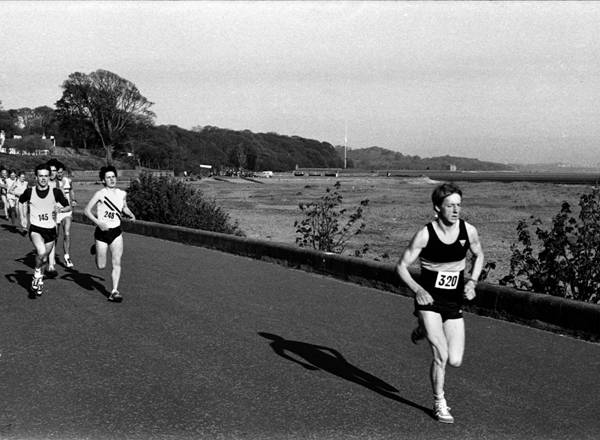
Peter Faulds  (320)

Peter FAULDS (6.06.62) Falkirk Victoria Harriers

3000m Steeplechase 9.19.69 (1985)

Peter, being cheerful and enthusiastic, fitted well into the marvellous Falkirk Vics squad, masterminded by Jim Dingwall and Willie Day. From 1982 onwards, Peter ran many times in the E to G, as they improved from 7th to 3rd (1985) until, on a famous widely-applauded occasion, they won that great race in 1990. In 1991 he ran the fastest time on Stage Three. The 1982 Six Stage Relay produced silver medals; and the 1985 National Senior XC silver again.

Henry ‘Harry’ I. FENION (2.07.30) Lochwinnoch, Bellahouston Harriers see full profile

6 Miles 31.04.6 (1959)

The first Scottish Athletics Yearbook was produced in 1959, too late to record the highlights of Harry’s very successful career. In the E to G, Bellahouston Harriers improved from 3rd (1956) to 2nd (1957) to victory in 1958. They were second in both 1959 and 1960 (when Harry was fastest on Stage Three). In the National Senior XC, Harry won individual gold in 1957 (when Bellahouston secured team silver medals, as they did in 1958.) In 1957, Harry also won the Scottish Marathon championship – a unique double triumph. On the track, he finished third in the 1954 6 Miles championship; and third in the 1958 Marathon. Harry Fenion won three Scottish vests in the International XC; and ran for Scotland in the 1958 Commonwealth Games Marathon in Cardiff.

Harry FENION, Jnr  Greenock Glenpark Harriers

Son of the above who was a good solid club runner who represented his club faithfully in road and cross-country events and championships as an individual and team member.


Andrew T. FERGUSON see full profile

In “Scottish Athletics”, his 1982 Centenary History of the SAAA, John Keddie mentions Andrew Ferguson “a young Scot from Paisley” who had been running well in England. In 1946, he had been impressed by the performances of the great Sydney Wooderson. In the 1950 AAA Championships “he was caught up in a fast Three Miles race won eventually by the Belgian L. Theys, and placed third in a time of 14 minutes 11.6 seconds, which at that time was the fastest by a Scot, and 5th fastest ever by a U.K. athlete. It was also, surprisingly, the only time that a Scot was placed in the first three in the AAA Three Miles before 1967.”

John FERGUSON Ayr Seaforth

3000m Steeplechase 9-32.0 (1970)

In 1968 and 1969, John finished first Junior in the South-Western District XC championship. In 1970 he secured Junior National XC individual silver. His cross-country success continued when he won the Senior title in the 1972 South-Western event; and in January 1973 finished second in the Scottish Inter-Counties XC. When Ayrshire AC qualified for the E to G in 1976 (12th), John was given the classy 2nd Stage.

Martin M. FERGUSON (17.09.64) Edinburgh AC, City of Edinburgh

From 1986 to 2010, Martin was a consistently good, durable runner at distances including: 3000m Steeplechase (9.17.0); 5000m (14.28.07); 10,000m (30.43.6); and marathon (2.26.45). He finished second in the Scottish Marathon championship in 2000 and 2001, as well as third in the 2002 race; and third in the 2001 Scottish 10,000m. Between 1984 and 2002 (the last ever event) Martin missed only two E to G Relays, running 17 in all. He was usually given the responsibility of the toughest Stages: Two or Six. In 1987 Edinburgh won team silver medals; and in 1998 City of Edinburgh were sixth and were awarded the ‘most improved’ prize. In cross-country, Martin was in the team which finished second in the 1983 Junior National Cross-Country championships. In 2003, City of Edinburgh won team silver in the Senior National Cross-Country.

David FERRY, Cambuslang

David contributed to: team gold in the 1983 Junior National Cross-Country, when he finished sixth; and team silver in three 1984 championships – the Senior National Cross-Country, Six Stage Road Relay and E to G.

Brian FINLAYSON, Forth Valley Harriers, Lochaber AC
Brian was a good cross-country runner who became a superb hill runner. In 1970, while still in his early 20s, he finished climbing all the Munros to become the 97th completist. In the gruelling Ben Nevis Race, he finished second three times – 1971, 1972 and 1974. That last year, Brian won the Isle of Jura Fell Race. In 1975, he won Goatfell, Ben Lomond and the Half Nevis, and finished third in the British Fell Running Association awards. In 1977, Brian became North of Scotland cross-country champion.

T FINLAYSON, Hamilton Harriers

Finlayson, described as a ‘lithesome type of runner’ won a race for Under 17’s held in Lanarkshire in 1950 and went on to take the National Youths’ title leading his team into third place.   The following year he won the same title but this time the Hamilton team won the race from Gala Harriers.   In 1952 he moved up to the Junior age group and finished second in the National with the club team fourth.   In ’53 he was again second – behind the outstanding Alex Breckenridge of Victoria Park.   He ran in the Edinburgh to Glasgow in 1951 on the first stage where he finished ninth, in ’52 he ran on the second stage and moved up from 7th to 6th.   

James FINN, Monklands

He won the Scottish National Youth Cross-Country titles in 1960 and 1961; and ran the 1962 International Junior XC Championships for Scotland, finishing in a fine 16th place. He was third counter for the Scottish team and, along with Lachie Stewart (10th) and Alasdair Heron (11th) won prestigious bronze medals behind England and Morocco. 

Eric FISHER (31.05.46) Edinburgh AC – see full profile

Marathon 2.27.03 (1977)

Eric, a friendly reliable, popular man, was a good club runner who improved considerably at his peak. In the E to G, which Eric ran several times, his club went from 5th in 1969 to 2nd in 1977, when he was second-fastest on the 8th and final stage. In the marathon, after setting a personal best in 1977, he won a bronze medal in the 1978 Scottish Marathon championship. Eric Fisher went on to become a successful Coach to many athletes.

Robert G. FITZSIMMONS (16.08.64) Bellahouston, Kilbarchan

800m: 1.52.55   1500m: 3.44.86i   3000m: 8.06.2   5000m: 14.17.62

Between 1985 and 1998, Robert Fitzsimmons achieved a great deal. He won several Scottish championship medals: indoor 3000m gold in 1987, followed by outdoor 1500m bronze; indoor 3000m silver in 1992, and then triumphed in the outdoor 1500m; indoor 3000m gold in 1993, before AAA indoor 3000m bronze. Robert was a Scottish international athlete at 1500m He ran the E to G, first for Bellahouston and later for Kilbarchan, often contesting Stages 2 or 6. Two team medals were secured with Kilbarchan: bronze in 1997 and silver in 1998. Back in 1984 Robert had been in the Bellahouston squad that finished third in the Scottish 6-Stage Relay.

Andrew FLEMING Cambuslang

Marathon 2.32.47 8 (1966)

Andy Fleming wore the Scottish vest in the 1958 International cross-country championships. He also ran the E to G for Cambuslang every year from 1957 to 1960. Then in 1966 he achieved a bronze medal in the Scottish Marathon championship. His team-mate Gordon Eadie, who Andy advised on training and tactics, won the title, so it was an excellent day for Cambuslang.

James A FLEMING

Motherwell YMCA Harriers

James won the Scottish One Mile title in 1948 and that year became a Scottish 1500m international athlete. In 1949 he represented his country in the International Cross-Country championships.

Peter FLEMING (5.01.61) – see full profile

Bellahouston, Wolverhampton & Bilston, Reebok Racing Club, Racing Club Edinburgh, Mizuno Racing Club, Phoenix Racers

1500m: 3.48.69 3000m: 8.08.5 5000m: 13.51.20 10,000m: 29.03.36 Marathon: 2.13.33

Between 1982 and 2004, Peter Fleming enjoyed a very successful running career. As his personal bests show, he was extremely versatile. He was a Scottish International athlete, on the track (5000m) and in many marathons in Britain and the rest of Europe. Bronze medals were secured in Scottish championship events: 5000m in 1987 and 10,000m in 1990. His first individual marathon victory was in the 1983 Glasgow event, which included an international team contest. In the Scottish annual rankings, he was first in the 10,000m twice and five times in the marathon. In the Scottish Six-Stage Relay, he won team gold with Bellahouston in 1985 and with Racing Club Edinburgh in 1990. Then there was Scottish XC Relay silver with Bellahouston in 1983, and gold medals in 1992 (Reebok RC) and 1995 (Leslie Deans RC). In cross-country, Peter’s Bellahouston team won Junior National bronze in 1981; Senior National silver in 1987; and LDRC won gold in 1996. The E to G brought team silver in 1983.

JC FLOCKHART (Shettleston) see full profile

Flockhart’s carer was mainly before the War with the victory in the ICCU Cross-Country championship in 1937 the undoubted high spot.  A quiet unassuming man he ran for a short time after the hostilities ended with good results.   In the first two E-G races, he won two gold medals with fastest time on the second leg in April 1949.   In the National he ran in the first four after the War finishing sixth in ’48 and again in ’49, winning a total of three gold medals from four runs.  He also added international vests in 1946, ’47, ’48, 49, finishing seventh in 1948.   An amazing man altogether – read his full profile.

Charles ‘Claude’ W. FOLEY (1940-1997) Pitreavie

6 Miles 31.05.2 (1960) Marathon 2.44.35 (1959) 3000m Steeplechase 10.01.6 (1960)

Claude was a team-mate of the illustrious John Linaker. In 1960 Claude won a bronze medal in the Scottish 3 Miles championship. He was 6th in the 1959 Scottish Marathon championship and ran well in several Scottish Marathon Club road races. Claude also did well in the Ben Nevis Race – his best position was 8th in 1957. In 1959, Pitreavie ‘A’ – John Linaker 2nd, Claude Foley 10th and W. Lindsay 24th, won the Ben Nevis team trophy.


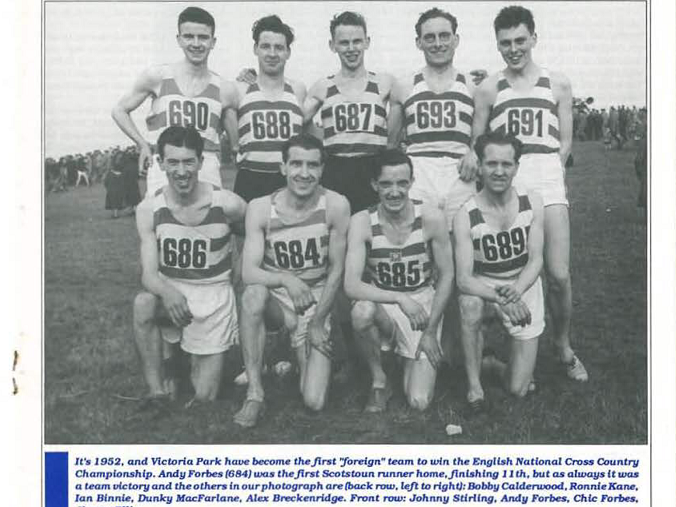
Andy and Chic Forbes middle of the front row for the team that won the English national

Andrew FORBES (9.10.15) Victoria Park  – see full profile

3 Miles 14.34.4 (1959) 6 Miles 31.04.0 (1959) Marathon 2.44.21 (1968)

As his date of birth indicates, Andy Forbes was a veteran athlete when these Scottish ranking performances were recorded. This immaculate, modest, respected and popular gentleman had in fact been one of Scotland’s finest ever runners. His crowning achievement was a silver medal in the 6 Miles race in the 1950 Commonwealth Games, but his Scottish Championship gold medal haul was very impressive indeed. Andy won four Scottish 3 Mile titles; and set two National records at the distance. He was a Scottish International track athlete on several occasions. In the Senior National XC, he won the title twice and Victoria Park won team gold three times. Andy ran for Scotland in the International XC championships six times – and finished first Scot twice. He was in three winning E to G teams. Then he went on to achieve success as a veteran. His full profile really must be read!

Charles ‘Chic’ FORBES (Victoria Park, Irvine AC)

Chick was the younger brother of Andy and was a key member of the great Victoria Park team of the 1950’s winning medals of all colours in the National Cross Country Championship and the Edinburgh to Glasgow. In the Senior National between 1950 and 1961, Chick won eight team medals with Victoria Park AC: 4 gold, two silver and two bronze. In 1952 he finished 5th and was unlucky not to be selected to run for Scotland in the International XC.

In the E to G, between May 1949 and 1962, Chick was in VP teams that won four gold medals, three silver and one bronze. He was fastest on Stage Five (November 1949 and 1951; and fastest on Four in 1952.

Undoubtedly Chick Forbes was a marvellous team stalwart in this, Victoria Park’s most successful distance running era.

The standard of Scottish endurance running in the 50’s is not really appreciated in the 21st century, but Chick would have been a welcome addition to the current Scottish scene.   Latterly he lived in Irvine and joined the local club where his experience and intelligence were well used.   An easy going, mild mannered man, he really was a very good runner indeed.

Paul FORBES (20.11.56) Edinburgh ACsee full profile

400m 47.69 800m 1.45.66 1500m 3.49. 3000m Steeplechase 9.07.4

Between 1974 and 1987, Paul Forbes, an outspoken, unpredictable but very talented runner, enjoyed an excellent career. His total of 22 Scottish international appearances, at 400m, 800m, and 4x400m Relay, is just three short of the all-time record. He was also a full GB international runner. Against stern opposition, Paul won the Scottish 800m title twice (1983 and 1986), was second three times and third once. In addition, he was second in the 1975 Steeplechase championship. He was third in the 1980 AAA 800m; won the 1982 UK title and in that championship also secured silver (1980) and bronze (1978). In the annual Scottish rankings, he was first in the 800m four times and once in the 400m. Paul Forbes took part in the Commonwealth Games in 1978, 1982 and 1986, representing Scotland in 800m (semi-finalist; 8th in the final; and 7th in the final) and 4x400m (6th; 4th; and 4th). In addition, Paul ran for Scotland in the 1975 International Junior XC; and helped EAC to team silver medals in the 1983 Scottish Six-Stage Relay.

Hugh FORGIE (7.04.56) Law & District

800m 1.53.1 (1977) 1500m 3.48.0 (1980) 1 Mile 4.11.7 (1980)

Hugh was a Scottish 1500m international runner; and won silver in the 1979 Scottish 1500m championship.   He also won silver in the British indoor 1500m behind Seb Coe.  In 1976 his team secured silver medals in the Junior National XC; and in 1981 finished third in the Scottish Cross-Country Relay championship. They were a respectable 8th in the 1982 E to G.

Joe FORTE, Haddington and East Lothian Pacemakers
Joe was H.E.L.P.’s most consistent athlete. His best performance was winning the inaugural Dunfermline Half Marathon.   In 1982 he ran a marathon in 2.36.20. Joe ran the Edinburgh to Glasgow relay five times in succession between 1987 and 1991.

John ‘Jackie’ FOSTER Edinburgh Southern Harriers

Marathon 2.32.38 (1959) Marathon 2.34.06 (1979, aged 45)

Jackie was a great character who, at a time when advice was limited, trained ‘long slow distance’ and once tried to remove ‘fear of distance’ by running 20 miles three days before a marathon. Some of his memories are recalled in ‘A Hardy Race’ on this website. Jackie’s finest achievement was winning a bronze medal in the 1959 Scottish marathon championship. He also ran the E to G three times, with his team’s best position being 4th in 1958. Jackie was second in the season-long Scottish Marathon Club championship (1959) and was awarded a rare First Class certificate. 

William B. B. FOTHERGILL (23.06.50) Glasgow University, Victoria Park, Ilford

3000m Steeplechase 9.18.0 (1975)

Willie, a consistently useful steeplechaser (who won the 1974 West District title) and cross-country runner, was a cheerful, sociable young man with an abundance of hair. He and team-mates including the talented but unpredictable Willie Sheridan (who later founded Westerlands AC) celebrated (in style) Glasgow University H & H successes, including three E to G Relays, in which their best position was 7th in 1972.

Hugo FOX (12.01.21-1974) Shettleston – see full profile

In the Scottish Marathon championship, Hugo Fox of Shettleston Harriers won bronze in 1955, silver in 1957, was the winner (and a Cardiff Commonwealth Games representative) in 1958 and retained his title in 1959, when he was ranked first in the inaugural Scottish rankings. Hugo, a very tough and determined man, had been a keen club cyclist but retired from the sport when he married in 1952 – and took up running to keep fit a year later. By the late 1950s, Hugo was working a five-day week in the heat and dust of a foundry, plus two nights a week overtime, as well as training up to 130 miles a week. In the E to G, Shettleston finished third in 1957, when Hugo was fastest on Stage Eight; second in 1958; and won gold medals in 1959, when Hugo maintained their lead on Stage Six. In the Senior National cross-country championships, the team title was won twice in succession (1954-1955).

Peter FOX (22.03.62) Dundee University, Clyde Valley, Motherwell, Dundee Hawkhill 

1500m 3.57.5 (1982) 3000m 8.19.6 (1989) 5000m 14.17.0 (1985) 10,000m 29.54.57 (1988) 3000m Steeplechase 9.32.0 (1984) Marathon 2.31.55 (1992)

For Clyde Valley AC, in the 1980 Junior National XC, Graham Williamson won with Peter Fox second. He ran for Scotland in two International Junior championships. In the 1982 Senior National, CV won team silver medals. They had already been second in the 1980 Scottish Six-Stage Road Relay. In 1986 Peter Fox, running for Motherwell YMCA, won the West District cross country title. With Dundee Hawkhill, in the Scottish Six-Stage Relay, he won bronze in 1989 and gold in 1990. In 1991 Peter’s team finished second in the National Senior XC. The E to G was also a successful event for Peter Fox: team bronze with CV in 1983 (when he was fastest on Stage Four); and gold medals for DHH in 1989, when Peter ensured victory on Stage 8.

Douglas FRAME (22.09.55) Glasgow University, Law & District

1500m 3.58.3 (1977) 3000m 8.15.2 (1980) 5000m 14.06.3 (1985) 10,000m 29.19.50 (1984)

Between 1977 and 1991 Douglas carved out a successful athletic career. He was a Scottish international on track (3000m) and cross country (1983 World XC). In Scottish championships, he was second in the 1984 10,000m (and third in 1980), as well as third in the 1982 5000m. For Law & District, he was in the team which won silver medals in the 1976 Junior National XC. In the E to G, which Douglas ran several times, his club’s best placing was 8th in 1982, when he was fastest on the prestigious Stage Six.

David FRANCIS Cupar & District, Fife AC

Marathon: 2.33.24 (1978) Dave was the friendliest, most enthusiastic man, and a stalwart for Fife AC. Between 1975 and 1982 he featured in the annual Scottish marathon rankings; but was more successful as an ultra-distance runner, especially in the Two Bridges 36 and the Edinburgh to Glasgow 50.

Cliff FRANKS   Greenock Glenpark Harriers

Cliff was a good runner in all of the endurance surfaces – he ran in the National, on the track where he specialised in the steeplechase and was indeed ranked at national level, and on the roads – before he moved to England.

Charles J. FRASER Edinburgh Eastern Harriers, Edinburgh Southern Harriers

3000m Steeplechase 9.49.2 (1959) 6 Miles 31.59.0 (1964) 2.30.05 (1962)

Charlie Fraser (born November 1932) ran for Edinburgh Eastern Harriers three times in the E to G: in 1956, when they finished sixth and he was given the responsibility of the Second Stage; in 1957; and in 1958, when he was fastest on Stage One. On the track, he achieved a bronze medal in the 1957 Scottish 6 Miles championship. For ESH, Charlie ran the E to G in 1960, when he was second fastest on Stage One; won team silver in 1961, when he contested Stage Six; in 1962 for another silver; and bronze in 1964. Charlie Fraser won two bronze medals in the Scottish Marathon championship, in 1960 and 1962.

David J. FRITH (27.01.51) Aberdeen

3000m Steeplechase 9.15.3

Between 1982 and 1985, David was consistently under 9.20 for this demanding event.

Who’s Who of Distance Running: B

There are athletes who played a part in Scottish athletics between 1945 and 1990 who are not on this page – if you know of any, please let us know.  Similarly anything that should be added or corrected, tell us and it will be done as soon as possible 

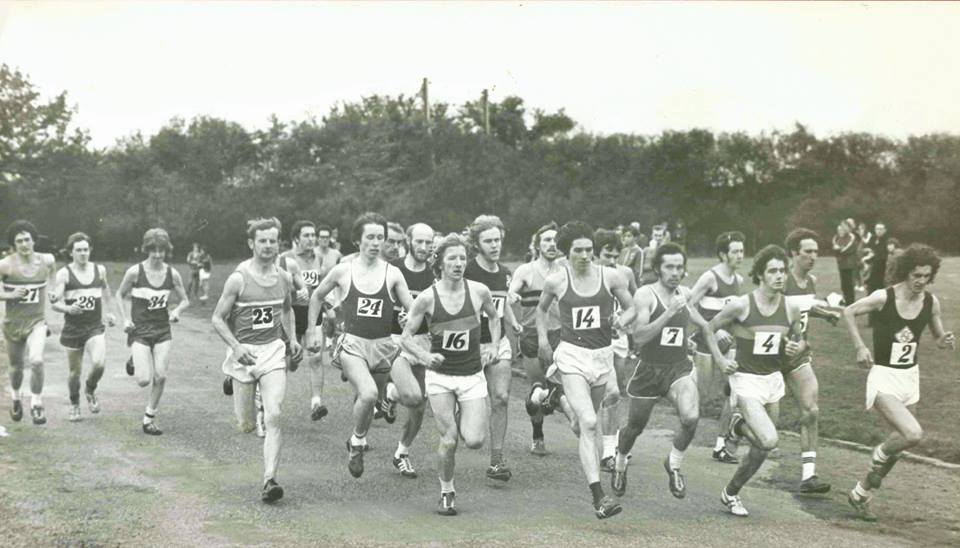
Roy Baillie wearing 14 and Jim Burns wearing 4

Nigel Bailey (Edinburgh University, Edinburgh Southern Harriers)

800m: 1:56.8  1975;   1500m: 3:54.5  1974;   5000m:  14:46.6  1974;   3000m S/C: 9:12.0 1975

Nigel Bailey came up from England and was a popular athlete who ran consistently well for ESH for a period in the mid 70s. He competed in 1,500m, 5,000m and steeplechase as well as road running. In the Senior National cross country championships he won three team silver medals from 1974 to 1976, with a highest individual placing of 25th. He is in the results for the National, Edinburgh – Glasgow relay etc and ran for ESH in British League events in the summer.

Ray Baillie (GUAC) 

Mile:  4:17.1  1962;  Three Miles:  14:41.0   1963

Baillie was a key member of the very good Glasgow Universities squads of the 1960’s along with runners like Calum Laing, Doug Gifford, Allan Faulds and Brian Scobie.   He ran in several Edinburgh – Glasgow relays being part of the team that won bronze in 1963 – the first University team to win medals in the race.   As a junior he was in the team that finished third in the National Junior in 1960/61, won the same race in 1961/62  and third in 1962/63 and fourth senior team in 1963/64.   

GUAC: Ray Baillie, centre, back row

Roy Baillie  (Bellshill YMCA, Clyde Valley)

400m: 50.0  1976;    800m: 1:51.1  1976;  1500m  3:56.2  1978

2nd SAAA 800  1977,  2nd SAAA i600m  1974,  2nd i600m 1975,   3rd i600m 1976

After starting his career running with Bellshill YMCA he joined the new Clyde Valley team in 1974.    Best known on the track as an 800m runner, one of Tommy Boyle’s earliest coaching successes, with a second place finish in the SAAA championships in 1977.  He was also very useful over the country, being a member of the Clyde Valley team which won the inaugural SCCU cross country relay championships, along with Jim Brown, John Graham & Ronnie MacDonald, as well as two medals in the E-G.

Donald Bain (Falkirk Victoria Harriers, Mandale)

10000m  31:16.8  1990;   3000m S/c:  9:20.1  1986;  Marathon:  2:24:56  1992

Donnie was a regular member of the very good Falkirk team of the 1970’s and 80’s along with Jim Dingwall, Willie Day, John Pentecost and Willie Sharp.   He ran in all the regular races – District and National Championships and in the Edinburgh to Glasgow relay.   Note the following as an example of his ability:

  •  fastest on Stage Seven in the 1983 E-G.  
  • He was twenty second (and first finisher from Falkirk Victoria) in the 1984 National Cross-Country when his team won bronze medals.  
  • Third counter in the Victoria team that won silver in the 1985 National.  
  • He won E-G gold medals, in 1984, when he was second fastest on Stage One; and also 1990.
  • Another silver was gained in the 1992 E-G when he ran the last stage.

Jack BAIRD, (Shettleston Harriers, Dumbarton AAC)

Jack was a good middle distance runner of the 1960’s who specialised in the 880y and was one of the group of four Dumbarton runners who could all run inside two minutes for the half mile distance – not many clubs had two, DAAC had four.

Crighton Baker (Cupar & District, Fife)

3000m S/c:  9:42.5  1974;   10000m: 33:06.8  1976

Terry Baker (RNAS Lossiemouth, Aberdeen AAC)

Terry was North District Cross-Country champion in 1968. In the 1967 E to G he ran the last leg and, in a terrific sprint against Shettleston’s Henry Summerhill, brought Aberdeen into a dead heat for silver medals.

Geoffrey Ballantyne (Glasgow School of Sport)

800m  1:56.4  1974

Jim Ballantyne (Springburn)

Marathon: 2:35:51   1971


Ken Ballantyne  (Edinburgh Southern Harriers) – see full profile

880:  1:53.2  1965;   1500m: 3:51.6  1966;  Mile:  4:01.1  1965;   Two Miles:  9:00.0  1965;   Three Miles:  14:05.8  1967;  5000m:  14:39.8  1970;  6 Miles: 29:52.6   1969; 

1st SAAA Mile 1964; 2nd SAAA Mile  1961; 3rd SAAA Mile  1960;  1965; 1966

John Ballentine (R.A.F., Aberdeen AAC)

Marathon: 2:34:57 1979

John joined Aberdeen as a veteran and soon proved to run very fast for his age. In the Scottish Masters XC championships he won M50 bronze in 1993. However, his best events were on the track, and he won M50 Scottish titles and British medals. John’s long-lasting AAAC club M50 records, set between 1992 and 1994, include: 1500m indoors in 4.23.23; 3000m indoors in 9.29.15; and 5000m outdoors in 16.23.26

Eddie Bannon, Shettleston Harriers – see full profile

One of the country’s finest all round distance runners in the 1950’s including five SCCU Championships and seven international races for Scotland in the ICCU  Championships, as well as outstanding runs in the Edinburgh to Glasgow eight man relay and the national championships.

Paul Bannon (Shettleston, Glasgow University, Memphis University (USA) – see full profile

Alistair Barrie (Dundee Hawkhill Harriers)

Three Miles: 14:39.6     1964;  Six Miles  31:17.0

Alistair, along with such as Ron Coleman, Alan Beattie and Harry Bennett,  was a regular member of teams in the 1960’s including the National and Edinburgh to Glasgow where he ran the second stage three times.   The word stalwart is much misused these days and usually just means ‘long service and good conduct’.   Reliable evidence says that Alistair was really a tireless worker for ‘The Hawks’ in all aspects.   

Richard Barrie (Dundee Hawkhill Harriers, Dundee University)

1500m:  3:49.3 1984;  Mile: 4:10.58  1984;  3000m S/c:  9:34.0  1990; 10000m:  30:42.51  1986

Richie Barrie was a  talented runner who never gave less than his best.  Road and cross-country saw him as part of every team that Dundee University and Hawkhill turned out but he was happiest on the track competing in open meetings, championships and in the various leagues which his clubs contested.   Having run in the team throughout the 80’s, when at times it was well down the field,  he must have been delighted when DHH won gold in the prestigious E to G; in 1990 he added team silver.

Hugh Barrow  (Victoria Park AAC, Sale Harriers) – see full profile

100y:  10.6   1961;   220y:   24.0  1962;   440y:   52 sec 1962;  660y:  75.3   1969;   880y: 1:50.3   1962;   3/4 Mile:  3:00.5 (Scottish record)   1965; 1500m:   3:45.3   1967;   Mile:  4:01.0  1968 (Furth of Scotland record);  2000m:  5:16.6   1966 (Scottish record);   3000m:   8:21  1969;   two miles: 8:51.4   1964;  three miles:  13:52.8;   5000m: 14:26.0   1971;   1965; six miles:  29:28.0   1969;   20000m: 1:11:50.02  1980;   30000m:  1:51:06   1979;   Marathon:  2:35:01   1979.


What a picture!   From the left:  –  Pat McLagan, Hugh Barrow Harry Gorman, Tom Patterson, Brian Goodwin, Dick Wedlock, Lachie Stewart, Eddie Knox. 

John Barrowman, Garscube Harriers

Johnny was a regular member of all Garscube teams running in County, District and National Championships was well as all the classics – the McAndrew, the Nigel Barge, the GU Road Race, etc.   He ran the E to G five times between 1958 and 1970. As a veteran he won M40 silver in the 1979 Scottish Masters Cross-Country championship; and another silver in a Scottish Masters 10,000m track race.

John Joe Barry, (St Machans AC)  IRE  – see full profile

John Joe was an Irishman who lived in Lennoxtown in 1948/49 and ran for the local athletic club.   An Irish internationalist, he set many records including a world’s best for one and a half miles.   He ran in all the big races – championships, open races at Cowal and the like, invitation races at Ibrox and was very popular with other runners and with the spectators.

Graeme Bartlett (Forres Harriers)
Graeme won the Ben Nevis Race in 1993. He ran for Scotland in the World Mountain Running Trophy (in Edinburgh 1995), finishing 4th counter when his team won superb silver medals. He won many Scottish hill races and set records. Graeme contributed to many team victories for Forres Harriers, including the North District championships and the cross-country relay.

Alan Beaney (Springburn Harriers)

Alan was one the first runners coached by legendary Springburn coach Eddie Sinclair who won many individual and team medals at County, District and National levels over the country.   Alan was selected for two Junior ICCU International championships – in 1968 and 1969 when he finished 31st and 38th respectively.   In 1967 he was fourth on the first stage of the Edinburgh to Glasgow, and in 1968 he was third on the same leg.  On the country as an U20 he was second in the national in 1969.

Ronald Beaney (Springburn H, Glasgow University)

1500m:  4:01.2   1969

Springburn Harriers had three sets of brothers at the same time in the 1960’s – the Beaneys, the Pickens and the Lunns.   Ronald won many medals and trophies of all colours as a Youth and Junior athlete.  Although he ran well at University he never really developed his career as a senior athlete thereafter. 

Alan Beattie (St Andrews University, Dundee Hawkhill)

880y: 1:57.8   1961;  Mile:  4:19.8 1962

As can be seen from his times Alan was a good runner on cinder and grass tracks – so good in fact that he won many races including the Scottish Universities half mile title.   He ran with a very group of Dundee athletes such as Ron Coleman, Alistair Barrie and Fergus Murray.   

Andrew Beattie  (Luton, Shaftesbury Barnet, Cambuslang)

3000m: 8:20.6;  5000m: 14:21.2  1988;  10000m  29:44.11  1987;  3000m S/chase  9:10.8   1984;  Marathon:  2:18.28  1987

As can be seen from his times above, Andy Beattie was a good class athlete who travelled up from London several times every year to compete for Cambuslang. He ran cross-country for Scotland; and gained a Scottish road running vest in 1992, when he finished second (and first Scot) in the Luton Marathon, which was that year’s Home Countries International match.   A good track man he was outstanding on the road and over the country: in the Edinburgh to Glasgow he ran the fastest time on his stage no fewer than four times helping the team to gold, silver and bronze medals.   He also won gold, silver and bronze over the country and it was a big loss when he died well before his time. 

David Beattie, Dundee Hawkhill Harriers

Dave finished second on Stage One of the 1989 E to G, when DHH won team gold medals. Earlier that year he had contributed to bronze in the Scottish Cross-Country Relay.

Stephen Begen (Springburn) – see full profile

5000m: 14:32.0   1985

Stephen was a quite outstanding runner as a Youth and Junior who ran twice for Scottish juniors in the ICCU Championships (1984 and 1985), and once for the senior men’s team in 1986.   Always well up and challenging the leaders he collected many of the top ‘scalps’ until he retired from the sport too early: see his full profile for the story.

Denis Bell (H.E.L.P., Scottish Hill Runners)
Denis was a fine hill runner who took part in events all over the United Kingdom.   He ran marathons in Edinburgh, Galloway and Snowdonia. He ran for Scotland in the World Mountain Running Trophy in 1988 (when his team finished an excellent 4th) and 1989.  In 1995 he won the Carnethy 5 miles Veteran title. Denis ran the E to G in 1988.   After his running career was over, he became a top class organiser and administrator working as Scottish team manager in many international events and being involved in the organisation of the Alternative Hill Running Championships and the Uphill only series.

J Bell (Inverness Harriers)

He won two North District Cross Country titles: Youth (1984) and Junior (1985). Then he ran the 1986 World Junior Cross-Country for Scotland.

Rod Bell, Dundee Hawkhill Harriers

Rod was a strong runner who was particularly good at the half marathon distance, at which he recorded several wins. He finished a close second in the 1991 Dundee Marathon, recording 2.26.10. In 1988 Rod ran for Scotland in the Anglesea 4 Nations Marathon. For DHH, he took part in the 1991 E to G, when they finished 5th.

Harry Bennett (Dundee Hawkhill) 

Harry was a solid club distance runner who was better known as a coach – in fact he was the first coach that Liz Lynch (McColgan) had when she started running in the 1970’s.

Maurice Benyon (Law)

5000m:   14:48.7   1977

Maurice Benyon ran for Law and District  at the time when membership included such top quality runners as Jim Thomson, John Myatt, Willie Nelson, Doug Frame, Jim Johnstone.   He represented the club in cross-country championships as well as in the Edinburgh to Glasgow relay as a good club standard runner.

Michael Berisford   (Sale)

Other than SAAA championships, Berisford never ran in Scotland.   He had a Scottish qualification and represented the country in the Empire Games.  He was also the first Scot under 4 minutes for the Mile.  He never ran in the national or the E-G.   His record is as follows:

800m:  1:52.0    1960;  880y: 1:51.5   1961;  1500m:  3:43.7  1961;    Mile: 3:59.2   1962;  Two Miles:  9:05.0   1959;  Three Miles: 14:09.0    

1962 European Games: 1500m 8th final;  1958  Empire Games  Mile  6th.  1962 Empire Games  Mile.   AAA’s Championships: 1962:  2nd AAA i 1000m;  SAAA: 1961  880y  1st;  1962  1 Mile 1st.

Ben Bickerton (Shettleston Harriers) 

Ben Bickerton ran for Shettleston between 1943 when he joined the club and 1952 when he stopped running.   He returned as a veteran in the 1970’s and won more titles but we will come to that.   Joining the club in 1943, he won the unofficial Scottish Youth’s Cross Country Championship in 1944 before going on National Service to Aldershot with the Royal Artillery.   While there he won the Southern Command Mile Championship and then came second in the British Army Mile championships.   He came out of the Army and in 1949 won the SAAA Two Miles Steeplechase Championship and a year later won the SAAA Six Miles title.      He ran in five Edinburgh to Glasgow Relays and came away with two gold and three silvers – not bad.   He ran in the London to Brighton 12 man relay twice.  Strangely, he only ran the National twice – in 1950 when he was fourth and second counter in the winning team, and 1951 when he was seventh and first counter in the third placed team.   

Ian Binnie (Victoria Park AAC)  – see full profile


Steve Binns (Falkirk Victoria Harriers) was a top class English international runner who lived in Scotland in the early/mid 90’s and ran for Falkirk Victoria Harriers in the E-G in 1992, 1993 and 1994.

Tony Bird  (Greenock Wellpark Harriers)  

Marathon:  2:27:04  1982

George Black (East Kilbride)

Marathon:  2:36:31   1982

George Black (Fife AC) – see full profile

M Black (Bellahouston Harriers)

Marathon:  2:46:58  1976

Neil Black (Morpeth Harriers, Bellahouston Harriers)

1984: 1500m 3.48.57

Neil ran for Bellahouston in: the 1982 Senior National XC, when he finished 12th; the 1982 E to G, when the club won silver medals and Neil was fastest on the prestigious Stage Two; and the 1983 E to G, when he was fastest on Stage 5 and the club was fourth. After injury curtailed his athletic career, he became a highly-rated physiotherapist; and is currently the Performance Director at UK Athletics.

Ramsey Black (Bellahouston Harriers)

Ramsey Black joined Bellahouston Harriers from Kilbarchan and was a good runner from the start.   In the 1956 Junior National Cross-Country, Bellahouston won the team title, with Ramsey 10th.   In the 1958 E to G, which his team also won, Ramsey was fastest on Stage Eight. He had previously won silver in 1957.  In the Senior National Cross-Country, Ramsey secured team bronze in 1959 and silver in 1960, when he was 13th.   A good friend of Harry Fenion, he lived in Elderslie after he retired.

William Black ( Maryhill Harriers)

880y:  1:54.5  1959;  Mile:  4:21.0  1961.

Bill Black was a very good half-miler indeed who won many races on the track but never won a national championship medal.   Also a good cross-country and road runner:  eg 3rd on the first leg of the E-G, 15 seconds behind stage winner N Ross (ESH) and 6 seconds ahead of  Clark Wallace in fourth.   A much better than average all-round endurance athlete, he was an even better track runner.

R Blades, Clyde Valley AC

He finished 7th in the 1982 Junior National XC and led his team, including Tom McKean, to gold medals.

Robert Blair (Glasgow Police, Strathclyde Police, VPAAC)

3000m S/c:  9:45.2  1972;  10000m  31:53.0  1972;  Marathon:  2:30:06   1981

Bobby Blair (born 5/2/1948) was a real club stalwart who could be relied on for many years to deliver good runs in races on any surface. Since he tended to be quiet, he could easily be underrated and surprise more glamorous athletes with tactical awareness and an effective kick to the finish.  Bobby ran for Glasgow Police, Strathclyde Police and Strathclyde University but Victoria Park was his main club and his career is a model for success through perseverance. For example a marathon may have taken him 2.51.07 in 1969 but only 2.30.06 by 1981 – you can often win marathons in such a time nowadays. He ran the steeplechase in 9.45.2, competing in track leagues, and 10,000m in 31.53, although he must have been worth must faster on the road.

His record in the Edinburgh to Glasgow Road Relay was lengthy and unusual. In 1967 he made his debut – for Strathclyde University – and the team  won medals for the most meritorious performance in twelfth place. Then he ran Stage Six for Glasgow Police from 1972-74. After that he appeared for Victoria Park AAC in at least ten races on a variety of stages and nearly always held his place or gained one.  The highlights for Bobby were in 1978 and 1980. In the former, he defended second place on Stage Seven and his team won silver medals. In the latter – and this is the performance that spectators will remember to this day – he took over in second place on the final stage, only thirteen seconds in front of ESH’s Ian Steel, who had won the National CC Senior Boys title in 1978 and who, in 1981 and 1982, went on to run twice in the IAAF World Junior CC. So it was rising young star against experienced club Trojan. Neither could do anything about current senior international Gordon Rimmer (Cambuslang) who charged past them both to claim silver medals, but Steel quickly caught Blair and then expected to run off to third place. Alas for the youngster’s hopes. Bobby simply sheltered behind him, avoided the headwind and waited, and waited, until he delivered a devastating burst, Ian wilted and the older man raced home 32 seconds clear to secure bronze.

Robert Blair, junior (Victoria Park)

3000m S/c:  9:42.3  1989

Robert was also a good runner with appearances in the County, District and National championships as well as the Edinburgh to Glasgow to his credit.   He also had the distinction of running in the same Edinburgh to Glasgow team as his father on consecutive legs.

JRA Blamire (Shettleston, Edinburgh University, Edinburgh Southern Harriers)

Alistair Blamire leading Ian Binnie on the first stage of the E-G


James A Bogan (Glasgow University, Victoria Park AAC)

Mile:  4:18.2  1963;  Three Miles:  154:655.0   1960;   3000 s/c:  9:40.4   1966.

  A member of Victoria Park AAC Jim was a steeplechaser during the track season and when Lachie Stewart set the SAAA 3000m steeplechase title, Jim was one of the early pacemakers.   The steeplechase was to prove his best event and he was ranked among the top men in the event almost every year in which he competed seriously with a best of 9:40.4 in 1966.   His best Mile time was 4:18.2 and for Three Miles he is credited with 14:55.0 in 1960.

In 1960 Jim in thirteenth place led the University Junior team to third place in the National Cross-Country Championship.   He joined some of the men who would make up the really good team of later years and which was second in the Scottish Junior Cross-Country Championships in 1961.   Douglas Gifford (9), Bogan (13), Baillie (22) and Shepherd (23) were the counting runners.   In his third year in the Junior age group he was in the team which won the Junior championship giving him the complete set of gold, silver and bronze for the National team race.    

In the Edinburgh to Glasgow relay in 1959 he was ninth on the first stage for the team that finished thirteenth.   In 1960, he ran on the first stage for the team that was placed third – he was twelfth on the first stage before Calum Laing brought the University up to fourth, from which position the others worked their way up to third.    In 1961 he was fourth fastest on the third stage, bringing the team from twelfth to sixth – six places was really something in the E-G.     When the University team was third in the Edinburgh to Glasgow in 1962, Jim Bogan ran on the third stage again and although dropping one place it was from first to second after Calum Laing’s fastest time on Stage Two, so there was no disgrace in that!      In 1963 he ran the last stage and picked up one place from seventh to sixth with again the fourth fastest of the afternoon.   By 1964, many of the top men had moved on but Jim was still there, running the last stage he maintained fifteenth position.   No fair weather runner he was out for the team again in 1966 running the very difficult second stage and held on to seventeenth place.    By 1967 the team had slumped to nineteenth and Jim ran the seventh stage picking up from twentieth to nineteenth.   That was to be his last run in the race.

He stayed on as a member of the staff of the University and became President of the University Hares & Hounds.   In that capacity he was responsible for many innovations – the key one being the University Road Race every year in November.   He stayed as a member of Victoria Park too as a recreational runner and it came as a shock to us all when he died following a road accident while on holiday in Grenoble in July 1988.   An excellent athlete, he was very easy to get on with and was popular with all athletes regardless of club or generation.    

Roger Boswell (Lochaber) 

Marathon:  2:38:13   1978

Roger was, like most of the Lochaber club, in the main a very good hill runner although he did run on the roads and over the country too.   

David Bowman (Clydesdale Harriers) – see full profile

David was a decent road runner who became invaluable to the development of the Scottish Marathon Club from the early 1950s, rising to become Captain and then President’

John Bowman  (Inverness)

800m: 1:54.6  1987;   1500m:  3:50.06   1989;  5000m  14:50.10   1991.

John was a loyal member of Inverness Harriers who competed at all distances and on all surfaces.   Little known outside the North of Scotland, he was a talented runner who won many races over some top talent – eg the very well known Alan Reid was beaten more than once and in 1991 by only one second in the North of Scotland cross-country championships. There were also a number of Northern District Track championships.  On his rare forays to the south he demonstrated his ability by collecting several good scalps in races such as the inter area matches at Cumbernauld House

Jack R Boyd  (Ayr Seaforth, Glasgow University) – see full profile

Robert (Bobby) Boyd,  Clydesdale Harriers

Bobby was a good, tall, long striding miler who could also race well over the country.   After the War (he had been an RAF man) he ran well enough to win prizes on the track at meetings all over the central belt but his best moments were on the country and his best season that of 1946/47.   That season started with fastest time in the Midland District championships relay when he was faster than all the top guns who turned out; Shettleston, Bellahouston, Victoria Park all had their best runners forward but Bobby was the surprise.   He continued to run well and confirmed his talents when he won the Midlands District Championship that same season.   Unfortunately he had a serious accident at work when he dropped a large metal die on his foot and although he kept on running he was not the force he had been before.   He went on to coach in the club amd it was under his guidance that the team was third in the National of 1955.

Tommy Boyle, Bellshill YMCA

Tommy was a runner for Bellshill as a youngster, after a very brief spell with Motherwell YMCA, who won BB battalion championships, won the Lanarkshire 880 yards championship , ran in the inter-counties, won the Scottish YMCA cross-country championships and as a consequence ran in the international in Ireland.   He went on to become one of Scotland’s best ever middle distance coaches working with many unsung athletes before his first quality runner (Ray Baillie) and then world class athletes such as Tom McKean and Yvonne Murray.


English Inter-Counties, 1969: Mike Bradley (4) and Lachie Stewart (3)

Michael J Bradley  (Paisley H, Springburn H)

880y:  1:56.6   1968;  1500m: 3:49.9   1969;  Mile:  4:10.3   1969;   3000m:  8:09.2  1969;  Two Miles:  8:50.0  1970 (8:40.2 i  1970);  Three Miles:  14:25.4  1966;  5000m: 14:03.4  1969.

3rd SAAA 1500  1969

Michael was one of five brothers who ran for the Paisley team in the early 1960’s along with men like Pat McAtier, Miles Rafferty and Tommy Thomson.   He showed real class at track middle distance traces as his pb’s above show.   His first  Edinburgh to Glasgow was in 1964 when he was 19th on the first leg (brother Eddie ran on the fourth stage) for Paisley Harriers, the following year he was nineteenth on the second stage, then there came the transformation.   In 1966 he was third on the first stage ahead of such as Peter Duffy, Ian Binnie, Mike McLean, Duncan Midddleton and George Brown.    It was a vast improvement.   The following year, on the second stage he moved the team up one place but that meant taking two minutes out of the runner in front!   There was no Paisley team in the race in 1968 and by 1969 he had moved to Springburn for whom he won the first stage in 1969.   He would run more E-G’s for Springburn.  But the track was his real forte and he turned out for several Scottish selects as well as Scottish teams.  

Patrick Bradley  (Paisley Harriers)

Six Miles:  31:14.4  1961

George Braidwood (Bellahouston, Speingburn Harriers) – see full profile


Alex Breckenridge (Victoria Park AAC) – see full profile


Jim Brennan (Maryhill Harriers) – see full profile


Campbell Brierley (Victoria Park)

800m:  1:53.30   1989

John Brierley (VPAAC)

Marathon:  2:39:46   1980

John was a cyclist who took up running rather late on.   His children were members at Victoria Park AAC and that was where he started.  Described as /an absolute fanatic; he trained at the Allander Sports Centre as one of the Allander Auld Runners and was a big friend of Hugh Currie.   His best single season might well have been 1979 when he ran well in Balloch-Clydebank (12+) in 72:16, Clydebank-Helensburgh (16+) 1:43:53, Edinburgh – North Berwick (22.6) 2:16:36, SAAA Marathon 2:47:01 and Glasgow International Marathon in 2:40:15.  –   he was an M50 vet at the time.

Paul Briscoe, Dundee Hawkhill Harriers

Paul ran often in the E to G; contributed to team silver in the 1990 Scottish XC Relay; and won the 1989 Dundee Marathon.

Joe Brolly (Shettleston Harriers, RAF)

800m:  1:55.5  1974;   1500m:  3:53.9   1973

Joe was a very good runner as a Boy (U15) and Youth (U17) on the track (SAAA U20 1500m title in 1969) and over the country, whose carer as a senior was disrupted when he went into the RAF.

David Brookes  (Garscube Harriers)

David was a very good runner who ran for Garscube Harriers before and after the Second World War – good enough to run on the second and sixth stages, – and then went on to be an early  member of the Scottish Marathon Club.  He covered virtually all the SMC races as well as road races all over Scotland and in the 1970 Commonwealth Games.   In the Senior National Cross-Country, David won several team medals: gold in 1926; silver in 1931; and bronze in 1928 and 1935. He ran the E to G six times (from the very first one in 1930); and Garscube secured silver medals in 1935; and bronze in 1931. In the 1936 Scottish Athletics championships, David was second in the Track Ten Miles; and third in the Six Miles. He was a founder member (and on the committee for many years) of the Scottish Marathon Club and Dunky Wright said that David had been a good road runner, along with himself and Donald McNab Robertson. Praise indeed!

Alex P Brown (Motherwell YMCA, Law and District AAC) – see full profile

Andrew Brown (Motherwell YMCA)

Andrew Brown, father of Andy and Alex,  was a good class runner over the country and on the road both before and after the War.   An early member of the Scottish Marathon Club he ran in several of the SAAA marathons in the early 50’s.  When he was in the same team as Andy, eg the 1950 Edinburgh to Glasgow,the programme and result sheet referred to him as A Brown and Andy as A Brown, jnr.

Andrew H Brown  (Motherwell YMCA, Law and District)- see full profile

Andrew Brown (Westerlands, Clyde Valley)

Marathon:  2:2:31:44   1981

David Brown (Stirling University)

800m:  1:53.9   1987

Frank Brown (Victoria Park AAC)

1500m:  4:00.00  1974;   5000m: 14:58.0  1975

Frank Brown was a very good runner indeed who ran for Bellahouston Academy as a schoolboy.  He first appeared on the winter scene in season 1973-74 when he ran the third stage of the Edinburgh to Glasgow relay and turned in the fastest time.   He ran two more E-G’s, both on the first stage, where he was ninth in 197-75 and eighth in 1975-76.   After three or four seasons, he joined the Hong Kong Police Force and was lost to Scottish athletcs.

George Brown (Edinburgh University, Edinburgh Southern)

880y: 1:57.2  1959;  Mile: 4:12.7  1959;  Two Miles: 9:12.8   1967;  Three Miles: 14:24.0   1967;  Marathon:  2:35:58    1971.

 Described as real gentleman and a durable athlete George ran for ESH in the Edinburgh to Glasgow winning gold, silver and bronze medals in the company of such as Fergus Murray, Donald Macgregor, Martin Craven, Allister Hutton and Gareth Bryan-Jones.   In the Senior National he first won a team medal (bronze) in 1961.   Over the next decade, a succession of consistent performances brought him a total of nine medals:   two gold (1964 when he was twelfth finisher, and 1970), five silver and two bronze.   In the E-G he featured in ESH teams that won gold (1973), silver (1962, 1963) and bronze (1964, 1971).   On the track, George ran a mile in 4:12.7, and three miles in 14:24.   Much later, in 1979, 1980 and 1983, ESH obtained team gold in the Scottish Veterans Cross-Country championships and George Brown, predictably, was one of their counters.   An excellent athlete and all round endurance runner.

Ian Brown (Stirling, Falkirk Victoria)

5000m:  14:51.9   1977  

Ian had a good career as a Youth and especially as a Junior running well in the age group championships of  1975, ’76, ’77 and ’78.   He ran for Scotland in the IAAF World Junior Cross-Country Championships of 1977 and 1978 (when he was first Scot home in 17th place). Ian was East District Junior XC champion in 1977 and 1978. In the E to G, he contributed to team bronze in 1976.

Jim Brown (Monkland, Borough Road College, Clyde Valley) – see full profile

Jack Brown (Dumbarton)

880y: 1:56.0  1965

Best known as a half-miler, Jack was a popular, good class all-round athlete who could compete in several field events as well as sprinting and endurance running on the track.  Jack and Bobby Mills were a formidable double act for the club in inter-club track competition, and when Col;in Martin was added in, they were a hard club to beat.   Jack ran for his club on the country (all events from county to national championships) and on the road (E-G) as well as on the track.   Once he had finished competing he became an official SAAA handicapper and was one of the principal organisers of the Milngavie Highland Games.

Paul Brown (Bellahouston)

3000m S/c: 9:45.3  1975

Tom Brown  (St Modan’s)

800m: 1:56.6  1964;  Mile:  4:13.1   1964

In the late 1950s and especially in the 1960’s St Modan’s was a club to be reckoned with on the country with runners such as George Jackson, Hamish McHattie, Joe McGhee and many others.   Tom was running at the same time as another very good middle distance runner, Walter Eadie, and they won many trophies as part of the club team through the age groups.  In the SCCU Championships of 1963, Tom was 5th Youth ahead of Duncan Middleton, Dick Wedlock; in 1964 he was fifth with the team placed second.   Walter went on to study at Strathclyde University before emigrating to Canada.  Tom just disappeared from the scene at that time.  

George Brownlee (Edinburgh Southern Harriers)

880y:  1:55.4  1961;  Mile: 4:11.8   1962;  Two Miles: 9:23.4  1963;  Three Miles:  14:32.0   1963

2nd SAAA Mile  1963

Starting as a Senior Boy (U15) George won the Eastern District Boys title in 1959 and followed this up with the Youths championship in both 1960 and 61 and was only defeated for the Junior titles by the emergence of Craig Douglas of Teviotdale.   Nationally he won the cross-country title in 1958/59, 8 seconds ahead of Lachie Stewart and two years later was second in the U17 national behind Jim Finn of Monkland.  His best cross-country run as a Junior was probably in 1963 when he was ninth, narrowly missing international selection.  In 1965 he was twenty seventh senior – third counter in the team that won gold.   Brownlee also ran in the Edinburgh to Glasgow Relay and won both silver and bronze medals.   A very good track runner he had a wide range of events, see the pb’s noted above.   

Joe Bruce (Edinburgh Southern Harriers)

3000m S/c: 10:55.8  1959 

Joe was a good athlete whose career was cut short by injury but he went on to be a very good, well liked and trusted official. In 1969, he became Captain of the Scottish Marathon Club, an invaluable road running organisation which he influenced for years.

Gareth Bryan-Jones (Edinburgh University, Edinburgh Southern ) – see full profile

John Bryant (Edinburgh Southern)

3000:  8:36.2  1970;   5000m: 14:37.4;   1970;  3000m S/c: 9:47.0   1969

Bryant had been an Oxford blue in the steeplechase and was working in Edinburgh for the Edinburgh Evening News and lived in ‘The Zoo’ with the Edinburgh students in 1966/67.   He joined Edinburgh Southern Harriers and ran in the E-G in 1967 and 1969 when he won a gold team medal; he also ran in the National in 1968 where he won a team bronze.

Alex Bryce (Central Region, Falkirk Victoria)

400m:  49.89   1988;   800m:  1:51.5   1978

Danny Buchan, Aberdeen AAC

Danny was a talented young runner and his best performance took place in 1976, when he finished 15th in the Scottish Junior National XC and Aberdeen won team gold medals. He ran the E to G in 1974, 1975, 1976 and 1977.

James Burns  (Monkland Harriers, Shettleston Harriers,  Law and District AAC)

800m 1:56.0  1976;  3000m:  8:27.0  1977;   2000m S/c: 5:54.6   1976;  3000m S/c:  9:02.3   1978; 10000m  32:11.9  1978

Jim had a very good career in the sport.   His most successful season was 1975 when he was selected for the Scottish team in the IAAF Cross-Country Championships after finishing 5th in the Junior National.   Jim ran for Shettleston in all the major team events winning gold in the Edinburgh to Glasgow Relay in 1976.   He left the club in 1982 for Law and District AAC after rendering Shettleston sterling service.

Ian Burns  (Larkhall Harriers)

Ian (7th) and his brother Willie (4th) were the backbone of the club when the team won the SCCU Junior Men’s championships in 1970.   Other club runners that day were D McBain (11th) and Jim Sorbie (16th).

Willie  Burns (Larkhall YMCA Harriers)

He ran well for Scotland in the 1970 and 1971 International Junior Cross-Country Championships, finishing 19th and 20th respectively. In 1970, Larkhall won team gold medals in the Scottish Junior National XC, easily defeating Shettleston Harriers.   Willie was a good distance runner whose career was very short.

Andrew Burnside (Maryhill Harriers) 

Andrew was a fine runner who represented his club on the road in all the main races – McAndrew Relay, Nigel Barge, and of course the Edinburgh to Glasgow.   He also ran over the country in District and National championships.   His main claim to fame however may have been when he was  third in first SAAA Marathon Championship in July 1946 behind Donald Robertson and Dunky Wright making it a Maryhill 1-2-3.

John Burton, Shettleston Harriers

The first post-war E to G took place in May 1949. John was fastest on Stage 3 for the winning team; and in November 1949 repeated this feat, as did Shettleston. In 1950, 1951 and 1952, Shettleston finished second to Victoria Park. In the Senior National XC, he secured a team bronze medal in 1951.


Who’s Who of Distance Running: The letter A

This picture includes Ronnie McDonald, Frank Clement, Lachie Stewart, Jim Brown. Norman Morrison, Dick Wedlock, Colin Falconer and Alistair Blamire

The years between 1945 and approximately 1990 were a golden age of Scottish distance running on the track, over the country and along the roads.  The improvement in terms of quality and maybe especially in terms of depth was continuous with large numbers of quality athletes being produced.   It was also a time when those who took part in the sport enjoyed high esteem in the eyes of the public as well as of other athletic disciplines.   This is seen in varioous ways such as the holding of the national marathon championship at the annual Scottish track and field championships and the many international track and field events at which major international stars competed in middle and long distance races.   The main stars in the Scottish athletics firmament such as Tom McKean, Frank Clement, Ian McCafferty, Lachie Stewart, Fergus Murray and Donald Macgregor are well known but  such was the standard that many quality athletes never saw a Scottish vest or a championship medal and the compliment of calling a runner “a good solid club runner” really meant something.   This and the following pages are an attempt to give some of these athletes the credit that is their due.   As far as ranking athletes are concerned please note that all will be short but –

*Some will be listed because they were really outstanding and they will have a link to an individual profile;

* some will be for very good club runners who, although of above average ability, were not of international calibre;

* there will also be a sprinkling of runners who were well known to other runners and aficionados, who never won anything but who were part of the scene and helped make it what it was;

*  and others might not have a star career but will have gone on to be top class officials/administrators (such as Ewan Murray). or become very good coaches (eg Tommy Boyle);

and also that –

there are also some athletes on the annual ranking lists who will be omitted alogether: English, Irish, Wesh, etc will be ignored unless they lived and competed in Scotland, whereas others who competed for Scotland in a significant Games despite not meeting the above criteria, will be listed.

To begin with we will note those listed on the annual rankings as listed on Arnold Black’s excellent website www.scotstats.net.   Additional information has been gleaned from Ron Morrison’s official road running and cross country website, Colin Shields’s book “Whatever the Weather”, Arnold Black and Colin Shields’s book “The Past is a Foreign Country”, ‘The Scots Athlete’,  and ‘Scotland’s Runner’.

Dealing with the topic in alphabetical order, we start, naturally with the letter A.

John Adair (Bellahouston, Linlithgow)

Personal Bests:   1500m: 3:56.6     1971;   3000m:  8:38.0     1970;   3000m S/chase:   10:08.8     1969;   Marathon: 2:24:25     1985.

Jack Adair was a popular member of Bellahouston Harriers in the late 60’s/early 70’s who later moved to Linlithgow.   Mainly a track runner with a talent for long distance he proved to be a good marathon runner when with Linlithgow in the early 1980’s.   While with the Glasgow club, he ran cross country and in the Edinburgh to Glasgow for a number of years.   He still returns to Bellahouston Presentations and Dinners along with Frank Clement who also moved to Linlithgow.

Bob Adam (Falkirk Victoria Harriers)

Bob was a regular member of the team in the 1970’s which included such as Willie Day, Willie Sharp, John McGarva and Andy Pender.   He ran in the Edinburgh to Glasgow relay four times (winning team bronze in 1976) and was also a scoring runner in both District and National championships.

Allan Adams (Dumbarton)  – see complete profile

In the 1995 Scottish Masters XC, Allan led Dumbarton to victory in the team contest.

Bill Adams, Shetland, Aberdeen AAC

Bill, a Lerwick postman, was one of those tenacious, durable runners who seemed to improve, relatively speaking, with age. His favourite event was the half marathon and, by the age of 65 in 2012, he had run an incredible total of 400, all over Europe, winning many races and umpteen veteran prizes. Bill’s fastest time was 70.20, set while securing M45 silver in the 1993 British Masters half marathon championship. A week earlier, after a very close battle, he had finished third, only 12 seconds behind the winner, in the Scottish Masters half marathon event. Bill represented Shetland twelve times in the Island Games and helped his team to win half marathon silver medals. Running for Scotland in the 1992 British and Irish Masters XC International, he contributed to M45 team gold medals.

Gilbert Adamson, West Kilbride ASC

West Kilbride was a short lived club in the South Western District that was remarkably successful.   Adamson was probably their most successful athlete.  In 1948 he was second in the National Youths race to Harry Fenion of Lochwinnoch Harriers.  He won the Youth title in 1949 from John Stevenson of Greenock Wellpark, leading his club to  first place in the team race.; and the Junior championship in 1950.   A year later and he won the District Cross-Country championship but could not repeat the national victory – he was second to Eddie Bannon of Shettleston.

Adamson was also a useful track runner who ran the steeplechase as well as the longer distances on the flat. In 1949, while still a Junior he was third in the SAAA Senior Championships in the event. 1950 was probably his best year and the highlights were in national championships, international honours and invitation races. On 24th June, he ran in the SAAA Championships at Hampden Park where he was second in the Three Miles to Tommy Tracey of Springburn.   On the first Saturday in August he finished third in the invitation Two Miles behind American Horace Ashenfelter and Freddie Green of the AAA’s, and one week later he ran in the steeplechase in the triangular international against England/Wales and Ireland at the White City  where he finished third behind Disley and Howell (both E/W).

Neil Agnew  (Monkland Harriers, Clyde Valley AAC)

Neil was a good club runner who ran for Clyde Valley in the 70’s and 80’s,  winning two gold medals  in the Edinburgh to Glasgow, as well as racing in the National Cross-Country Championships and Road Relays.

Charles Aithie (Aberdeen U, Edinburgh, Oxford U)

Personal bests: 800m:  1:55.1     1977;  3000m S/chase: 9:20     1977   400m hurdles: 58.4   1973

Charles was a cheerful, athletic, talented young runner at Aberdeen University around 1970. Although lightly trained, he was fast on the track (800m/1500m) and also showed promise over the cross-country.  He must have done post-grad work at Edinburgh and Oxford. He ran the 9.20 steeple in May 1977, under Oxford University. He may well have won a blue – if not he could not have been far off it.

Charles Aitken (Greenock Wellpark Harriers)

Aitken was a solid club runner on the roads and over the country in the 50’s and early 60’s .   He ran in the Edinburgh to Glasgow nine times and in many cross-country teams at county, district and national level.   The teams included such as the Stevenson brothers, Bill Stoddart, Frank Whitley and George King.

Jim Alder (Morpeth, Edinburgh AC) – see complete profile

WT Allan (Edinburgh University, ESH, Kettering)

Personal bests:  3000m: 8:44.2     1969;   5000m:  14:59.2     1969;   10000m:  31:02.0     1971;   3000m S/chase  9:13.0    1968

Willie started off as a long jumper but became a very successful long dstance runner while at Edinburgh University.   He won several honours in cross-country and road team competition while at Edinburgh University.   These included team victory in the Edinburgh to Glasgow Road Relay in 1965 (where he was third fastest individual on the third leg), third team in the Scottish Junior Championships in 1966, first team in the Scottish Universities Championships in 1967 and first team in the Scottish Senior Championships in the same year. In 1969, running for ESH, Willie won another team gold.  Willie’s main event on the track was the steeplechase in which he was Surrey champion in 1970 and a best time of 9:13.0 set at the Scottish championships in 1968.  After graduating, Willie moved to England and went on to have a very successful career as a veteran, running for England and winning a British Masters XC title.  At his peak Willie ran 80-90 miles per week in training, this included a long run of 16 miles on a Sunday, two fartlek sessions a week and twice daily training on five days.

David N Anderson  (Greenock Wellpark Harriers)

Marathon:  3:09:19     1968

David was a stalwart of all endurance events including the marathon and ultra-marathons such as the Edinburgh to Glasgow point-to-point (he also ran in the Edinburgh to Glasgow relay for his club).   

G Anderson (Bellahouston Harriers)

A very good cross-country runner, he ran for Scotland in the International CC Championships in 1947.

Robert Anderson (Cambuslang) – see complete profile

Andy Arbuckle (Monkland Harriers) 

A long-serving member of Monkland after the War who was a good all-round distance runner on the roads and over the country. He ran for Scotland in the 1951 International XC Championships; and for Monkland took part in the E to G four successive times between 1949 and 1952.

Ross Arbuckle (Aberdeen, Cambuslang, Keith) 

Personal bests:  800m:  1:53.5     1979;  1500m: 3:50.2     1988; 3000m:   8:11.21 i   1989

Ross represented Cambuslang Harriers for much of his career, but he started out with Aberdeen and ran for Scotland in the 1980 World Junior Cross-Country.   Previously he had shown outstanding talent on the track as an Under-17 Youth (800m in 1:56, 1500m in 4:01.1 and 3000m in 8:42).   As a senior he improved to 1:53.5 and 3:55.8.   Ross won the three senior team medals with AAAC: bronze in the 1981 E-G; silver in the 1981 Six-Stage Relay and bronze in the 1982 National Cross-Country.   With Cambuslang, he went on to win team gold in the 1988 National (thirteenth finisher), a full set of medals in the Cross-Country Relay, including gold in 1987, and bronze in the Six-Stage Relay.   To this day he continues to be a modest, popular but very successful veteran athlete.   He won several team gold medals in the National Veterans Cross-Country, and frequently represented Scotland in the annual Masters Home Countries Cross-Country International.  

Richard Archer (St Andrews U) Eng

800m:  1:49.9     1985;   1500m  3:46.2     1985;  3000m:   8:01.5     1988;  5000m:  14:31.60     1988 

Archer was a student at St Andrews University from 1985 to 1988 inclusive.   His times are quite outstanding and he was placed 2nd in the SAAA 1500m in 1987,  and 2nd in the SAAA indoors 800m in the same year.

Ian Archibald – see complete profile


George Armstrong Haddington East Lothian Pacemakers
George improved steadily as a veteran runner. In the Scottish Masters Cross-Country championships he secured M50 bronze in 1990; and then won the title in 1992. He added M55 bronze in 1995; and M65 silver in 2008. For Scotland, he ran several times in the annual British and Irish Cross-Country International. A bit of an iron man, George completed over 140 marathons.

David Arnott (Pitreavie)

800m: 1:53.1     1988 and 1991;   1500:  3:50.4   1988

In 1987, David won the East District Junior XC title and later ran for Scotland in the World Junior XC Championships. Then he ran the E to G.

Ronnie Arthur (Greenock Glenpark Harriers)

A good half-miler on the track Ronnie had a good career as a Junior and young senior racing in District and National cross-country championships as well as in the Edinburgh to Glasgow relay.

Jim Ash   Beith Harriers

Jim was a good runner who seemed to come from nowhere as a veteran in the early 1980’s.   His best was probably in 1983 when he ran the distance in 2:30:56.   He was also a very good cross-country runner.

John Asher (Glasgow University)

Three Miles:  14:45.1    1968

Stuart Asher (Fife AC)

Marathon:  2:28:57   1990

Stuart had just turned 40 when he set his marathon personal best, by winning the 1990 Dundee Marathon. He had been a good hill runner. In the (all-veteran) Alloa to Bishopbriggs 8-Man Road Relay, Fife AC won easily in 1990, setting a new course record, with Stuart fastest on his stage.

Des Austin (VPAAC) – see full profile

James Austin (Clydesdale)   

3000m: 8:28.5    1994;  5000m:  14:52.7   1994;   10000m:  30:53.2     1993;   3000m S/chase:  9:05.32     1994

James came into the sport as an under 15 in 1980 and was a useful half miler/miler running cross-country and Edinburgh to Glasgow as soon as he was eligible.   It was only when he took up steeplechasing serviously in about 1988 that he drew himself to national attention.   A district and are representative over the country he won two SAAA medals for the ‘chase – second in 1996 and third in 1997 – and he gained a Scottish vest on the track over 5000m.

Simon Axon (Aberdeen, HBT) Wal

5000m: 14:38.1   1985;  Marathon:  2:19:53    1986

Simon Axon   was a Welsh Junior Cross-Country International who moved to Scotland and ran for Inverness Harriers before going to live and work in Aberdeen, and to join AAAC.   He made his debut for North District in the 1984 E-G finishing fifth in a high quality Stage One.   In 1985 he turned out for Aberdeen in the same race and was given the responsibility of tackling the long Sixth Stage for the team which finished sixth.   In the 1986 Aberdeen team,   Simon moved up three places to fifth on the difficult second stage, sixteen seconds behind the fastest time.   Eventually Aberdeen AAC won by over a minute.   In 1988, Aberdeen led from Stage Three onwards and Simon kept a healthy lead on Stage Seven which was just as well because the last leg runner had developed hamstring problems and only finished 21 seconds ahead.  That was a second gold medal for Simon Axon and he added a bronze in 1989 when he moved past ESH on the final leg.   In 1988 Simon was twenty second in the National Cross-Country in the team that finished third.

He ran very well at longer distances too.   He completed the 1986 London Marathon in 2:19:53.   In 1987 he not only won the Inverness Half Marathon (65:44) in April, but also  reduced his best time at Gateshead to an impressive 64:25 in June.   Over 10K, he won the Aberdeen 10K in 1989 and 1990.

The Steve Taylor/Gordon Pirie connection

THE GORDON PIRIE LETTERS


Between October 1954 and 1963, Aberdeen AAC’s Stephen Taylor (usually called Steve), received letters from Gordon Pirie, the great British international distance runner. Despite living mainly in Surrey, Gordon gave Steve coaching advice and suggestions for training sessions. During 1960-1962, Steve was second in the Scottish Mile Championship, twice won the Scottish 3 Miles title and ran for Scotland three times in the International Cross-Country Championship and several times on the track. Steve frequently gave a great deal of credit to Gordon Pirie for helping him to become a much better athlete, although it is fair to say that he did not always continue trying some of the hardest work-outs that Gordon suggested – and ignored his advice never to train with Alastair Wood!

(Gordon’s father Alick Pirie was a Scottish international cross-country runner. Gordon was born in 1931 in Leeds, but three years later the family moved to Coulsdon, Surrey. Alick ran for South London Harriers and later became Secretary.

SLH remained Gordon’s club for many years – he was a very good cross-country runner, winning the English National championships three times in succession, from 1953 to 1955 (when SLH also won the team title).

During his illustrious career, Gordon Pirie (who trained extremely hard, including heavy mileage) represented England in the 1953 International XC and later that year won the very first Emsley Carr Mile (see youtube). Then in 1955 he won the BBC Sports Personality of the Year award. During that year he had beaten Emil Zátopek, the triple gold medallist in distance running at the 1952 Olympics.

Gordon represented Great Britain in 3 Olympics (1952, 1956, 1960), in both 5000m and 10,000m, winning 5000m silver in 1956.  He set World Records in 3000m (twice), 5000m, 6 Miles and 4x1500m relay. His faster WR for 3000m was 7:52.7; and for 5000m 13:36.8, both marks being set in 1956.

Gordon Pirie went on to win the British Orienteering Championships in its first two years, 1967 and 1968, and also represented UK at the 1966 World Orienteering Championships. He became a successful coach and physio. Overall, he was an unforgettable, irrepressible character.)


Gordon’s first letter, which was replying to a tentative request for advice from 16-year-old Steve, was sent on 21st October 1954. It is worth quoting in full.

“Dear Stephen Taylor,

                                    Thanks for your letter of 16th August last. Please accept my apologies for this late reply.

My ideas on your training are as follows:

  • Run by time, not distance
  • Running part of training must be continuous
  • Exercises must therefore precede or follow
  • Run over fields in preference to track

To put these ideas into a training schedule, I suggest that you run between 30-60 mins. The first (15 to 20) mins must be steady relaxed running in complete tracksuit. You must be nice and warm when you finish this. Then, the next 15-20 mins, run fast sprints for your own enjoyment, over about 50 yards to 300 yards. Jog between – about 400 yards slowly. Go at this as you feel. If you feel as mad as a March hare, run them at a terrific sprint! In not, just fast. You should do about 6 or 8 of these in this time. Then the last few minutes (10-15) run as at first in complete track suit, just a steady pace for a good sweat. Afterwards do your P.T. (Physical Training exercises) if you feel like it. Run only 3 or 4 days a week like this. Any other days just jog only 20 mins in tracksuit if you feel like training.

Some rules to follow:

  • Never run fast sprints or race when you have a cold.
  • Do not run at all if you have a temperature (Flu or similar things) and don’t run for three days after you feel O.K. This prevents any overworking of the heart as does rule 1.
  • If the weather makes you cold when running the fast and slow training, then you must put on your tracksuit and keep warm. Training is no good if the body is cold!
  • Always be fresh and enjoy training. If you have had an extra late night at a party, just jog the next day.

Try this out and see how you go,

                                                            Yours Truly, Gordon Pirie”. (a clear, flourishing signature.)

(WELL, what a thrill it must have been for Steve to receive such a note from his hero! Gordon comes across as polite, sensible and helpful, without a hint of “superiority” and condescension. Nowadays, his advice to a young runner still sounds wise.)


The next letter I have chosen is from 15th February 1955.

“Dear Stephen,

                        Thanks for your letter. The races you run are pretty stiff so don’t say “only 5th”. That’s pretty good! Just keep plugging on and you will find that the results will follow. The longer it takes, the more satisfaction you will get when you do win.

This team packing is really a bad thing. The best way for a team to win is to have every member run his best. This means that they do not necessarily run in together. No two runners are the same. No, the best way to do your best is for you all to try your hardest in training and in racing. This will give you the best results, I can assure you.

As for your feeling exhausted after one race and not the other. The weather (barometric pressure, temperature and humidity), whether you slept well beforehand, how much you warmed up and trained the week before, would make all the difference.

If you keep a diary of your training with every detail (did I tell you in my other letter?) then you can check back and see whether there was any difference in the training you did and the way you felt. Otherwise it is difficult to give a reason.

Hoping to hear how you get on Saturday week, Yours, Gordon.

p.s. Best of luck!”


On October 10th 1959, Gordon wrote the following.

“Dear Stephen,

Glad to hear from you again and to see that you are doing very well.

You sound a little depressed by your progress but I would say that you are doing excellently. Just look back and think how you have improved over the last four years!

Also I must point out that at the age of 20 I ran 4 mins 14.4 secs for the mile, 14.03 for 3 miles and 29.32 for six, but with plenty of competition and really good tracks to do it on. If you were in London you would do a better time on all these distances.

You must put your head down and keep at it. You only need to run for one and a half hours at the very longest or ten miles every day. I would suggest something like this:

Monday – 7 and a half miles steady run.

Tuesday – 10 miles fast/slow (i.e. not too fast).

Wednesday – 6 miles steady.

Thursday – 10 miles fast/slow

Friday – Rest or jog 30 mins.

Saturday – Competition or 10 miles f/s.

Sunday – One and a half hours running.

Don’t do more than this because it isn’t necessary. Just think about becoming stronger.

Think about all the fellows up and down the country who will be training and they are racing you!

Don’t forget to write now and again, Yours, Gordon Pirie.

p.s. Don’t race longer races !!”

(Although, at this time, Steve had become a good cross-country runner, who was to run the International for Scotland three times from 1960-1962, his main focus was the track – firstly the Mile and subsequently Three Miles, which was to be his Scottish Champion distance.)

13th January 1960 is date of the next selected letter.

Gordon mentioned: “Now it seems as if you are really blossoming and that the hard work you have been putting in the last few years is to be really justified in the next season.

Basically, the tendon trouble is quite easily cured but take care not to have your shoes too tight at the top of the heel – nor too high and impinging on the Achilles itself. This is a common cause of many Achilles troubles.

I always nick my shoes at each side of the heel so that the top band of my shoes does not dig in. Try it and keep training as before. If your tendons are really sore, get a cobbler to put on quarter inch hard wedge heels under the sole of your training shoes. That should help as well!

Let me know more specific details, Yours, Gordon.”

(A sixty-page book by Gordon and John Gilbody, which is available free as a word document on the internet, has the marvellous title of ‘Running Fast and Injury Free’. Do seek it out – I did so when I had chronic calf injuries about 13 years ago, and advice in this book has allowed me to continue running as an older veteran.)


On 10th April 1961, Gordon wrote a friendly and detailed letter, which concerned interval training.

“Dear Steve,

                        Just a brief note. Do NOT train twice a day. Do NOT train with Alastair Wood. Do NOT do too much training and Do Not employ short intervals – nothing less than 70 secs efforts. Always take long interval recoveries between flat out runs over a quarter of a mile. Only two, three or four flat out runs over short distances, say 300 metres or 600 metres.

TAKE A REST on Friday and Monday. Do plenty of gymnastics to strengthen abdomen. Sit-ups and mobility exercises.

Whenever over-tired, rest or just jog a little.

If you want a rough guide for interval training, here are some schedules for you to benefit from.

Up to 30 repetitions. 110 yards in 15 secs, interval of 70 secs jogging.

(Warm-up every day for 40 minutes, fairly strongly).

Up to 20 reps. 220 yards in 32 secs, interval 80 secs jogging.

Up to 15 reps. 440 yards in 68 secs, interval 85 secs of jogging.

Faster Training. Warm-up 40 mins.

2 to 4 x 330 yards flat out (42 to 38 secs). Jog 15 minutes between.

2 to 4 x 660 yards flat out (94 to 84 secs). Jog 15 minutes between.

TRY:

Sunday 660 yards fast.

Monday – Rest

Tuesday 110 or 220 reps

Wednesday 440 reps

Thursday 330 fast

Friday – Rest

Saturday Race or run two miles strongly.

Yours, Gordon. KEEP ME INFORMED”


On 12th February 1962, Gordon wrote the following.

“Dear Stephen, Thanks for the letters, I am very bad for leaving you in the air regards training.

I don’t like your training and I am not surprised you have gone down with ‘athlete’s cold’ – that’s what I call it – so many over-trainers suffer from these same symptoms when they train too much or too fast.

Here is my recipe – follow it more or less, making allowances for the weather and your condition.

Mon – Run easy pace (7 mins mile) for 1 to 1 and a half hours.

Tues – Interval running. (Warm-up 15 mins slowly.) 30×100 metres in 15 secs. Interval jog very slowly for one minute.

Wed – As for Monday.

Thurs – Interval running. 15x400m, 68-70 secs. Interval jog 70 secs slowly.

Fri – Run easy (7 min mile) for one hour.

Sat – Race yourself (or opponents). Alone run 3 miles or 6 miles. (I do from 17 mins to 13.30; and 34 mins to 28 and a half, according to form).

Sunday – Interval 30x200m, 32 secs, slowly jog 65 secs.

Try this and stop messing about with weights and circuit stuff.

All the best, Yours, Gordon.”


On 12th October 1963, Gordon wrote the following.

“Dear Stephen, I hope that you are still training.

I suppose you saw that Mike Wiggs did 13 minutes 58.4 seconds for 5000 metres – his first race for one year. We believe that we have become pretty skilled at working training out and I am very anxious to help you to reach greater heights.

How about it?

Looking forward to hearing from you,

Yours sincerely, Gordon Pirie.”

On 23rd November 1964, Gordon sent Steve a postcard from San Sebastian.

“How are you getting on?

Drop us a line since I have some more ideas on your training. You could quite easily get in the European Champs with the correct training from now.

Look forward to hearing from your, Gordon Pirie.”


After Steve replied, Gordon wrote the following on 11th November 1963.

“Re training, you must firstly have a period of easy training – nothing else.

Work it like this:

Sunday – Jog 3 hours (22 miles – awfully slow)

Monday – Jog one and a half hours (11-12 miles)

Tuesday – Jog 2 hours (14-15 miles)

Wednesday – Jog one hour (8 miles)

Thursday – Jog 2 hours (as above)

Friday – Jog one hour

Saturday – Jog 2 hours.

Do this for four weeks.

Then add on Monday – interval 440, start with six, work up to 20, at 70 secs and as you get better down to 67.

Same again for Fridays.

Add also Saturday – do a three miles timed run, starting 15.30 (even pace throughout), increasing to 14 minutes.

Let me know how you progress, Yours, Gordon.”

NoW BARR’S

As has been said the sponsorship provided by the News of the World to all inter-city relays that they supported in the various regions of Britain was exceptional.   Buses, limousines, elaborate dinners and great results services were all part of the package; but the race itself was beautifully organised with banners at and one mile before changeovers, start and finish banners prominently displayed, numerous officials including some who were mainly track and field men pressed into service, four sets of wonderful medals and so on.   This all came to an end in 1965 when it was decided that they could not keep the races going on that scale, it was costing them too much. 

There were some differences in the production.   The most immediate was the lack of limousines, a reduction in the number of coaches (from 9 to 4) and an altered programme.   The programme, which still had the News of the World name at the very top of the front page, went from the elaborate shiny papered version with a page of photographs and reports on the other regional inter city races to a specifically Scottish one.   The new programme produced for the 19th November 1966 race had

  •  the list of officials on the front page – 40 in total including 2 recorders, 2 timekeepers and 2 judges at every changeover, 2 mobile judges, clerk of the course and three assistant clerks of the course, and four coach officials, medical officer, official trainer and others;
  • pages 2, 3, 4, 5 and 6 listed the competing clubs in alphabetical order, with their club colours noted,  and all 20 runners from each club listed with their race number;
  • page 7 listed every competing club with their best ever time for the race and the year in which it was set, plus the intermediate stage records, the name of the runner who set it and the year of the performance;
  • page 8 was the intimations page and noted the awards o be presented, the criteria for the award of the most meritorious medals (‘to the unplaced team who gave the most meritorious performance’), and a note of who would decide on that performance.   In 1966 the panel would consist of LG Kapelle, ES Murray, G Dallas, D McSwein and a fifth official to be selected from R Bacchus, A Falconer or W Lawn as available.

So, other than the pictures, the content was pretty well the same.   The race went on like this until 1977 when the News of the World stopped their sponsorship altogether.   

The race was too important to Scottish endurance running for it to be allowed to go.   It was arguably, along with our teams being included in the world cross-country championships, the most important event on the calendar for raising the standard of the event.  The Union itself took on the job and they organised their first race in 1978.    The coaches were now down to three, the programme was diminished even further.   It was now a five page document, each sheet printed on one side only.

  •   Page 1 had the Scottish Cross-Country Union crest and title at the top, followed by the list of officials.   One difference from past years was that the first six names were those of the officers of the Union from President down to Assistant Secretary before the race officials were mentioned.   There were two judges, two recorders and two timekeepers for each stage listed, referee, recorders, four mobile judges and (new job) traffic controllers, clerk of the course as before and the page finished with the names of the organising committee.
  • Page 2, 3 and part of 4 had the lists of teams, club colours and runners with numbers;
  • Page 4 also had a map of the alteration to the route at Baillieston lights on the seventh stage;
  • Page 5, as befits a document produced by the Union, had the Rules for the race, there were twelve, including 1.   the race will be run under the rules and laws of the Scottish Cross-Country Union …  12.  Failure to observe the foregoing rules may render the offending Club liable to disqualification)    and the Union Bye-laws  (eg persons following the race by private car or bus: 1.   Must not part within 880 yds of the first take over; 2.   must not park within 220 yds of any of the other take overs; 3.  must not travel in front, alongside or behind any of the runners, at or near the same speed of the runner; 4.  must not in any way obstruct the free movement of traffic on the roads;  5.  must not park on a “clearway”)   of which there were four 

But they could not go on doing the organising.  It was too much for the Union on its own which, to be fair to them, already had considerable running costs and expenses that had to be met.   It was decided that after the 1979 race, the event would cease.  Consternation, upset, anger and all sorts of emotions quickly came to the surface.   

Step forward Des Yuill.   Des was a runner with Maryhill Harriers who had become a top class official and Des worked with Barr’s Soft drinks company, and a man with a real understanding and feeling for cross-country and road running, and the participants.   He also had a manager who was interested in sport and they often spoke of their own involvement in their own sports.   Des spoke to the manager in the course of one of these regular conversations and was asked what it would take.   Sums were done, estimates made and the Barr’s sponsorship of the Edinburgh to Glasgow eight stage relay started as far as the runners and clubs were concerned in 1980, but as far as Des, the SCCU and Barr’s were concerned it was after a lost of hard work to ensure the seamless transition.


Copies of all types of Edinburgh to Glasgpw Programmes can be found  here


University Track and Field

Scottish Universities have a big part to play in the history and development of Scottish athletics – they had strong athletics clubs and fixtures before the SAAA appeared on the scene and they have been part of athletics ever since.   The intention of this page is to have a look at the state of the sport in Scottish universities by taking five year segments.   It is in no way a comprehensive history of university athletics through the ages.   There is too much detail for that.  It is a look at how the sport was developing and who the main characters were.  Links to various periods are below.

In the beginning: 1871 – 1873    University Athletics 1875 – 1879   

University Athletics 1950 – 54      University Athletics 1955 – 1959     University Athletics 1960 – 64       University Athletics 1965 – 1969  

University Athletics 1970 – 74

REVIEW OF ‘THE GREEN MACHINE’ – THE STORY OF EDINBURGH UNIVERSITY HARE AND HOUNDS 1960-1970

REVIEW OF ‘THE GREEN MACHINE’ BY ALISTAIR BLAMIRE

“The Green Machine”    by   Alistair Blamire   

Alistair Blamire was a very good distance runner indeed whether you are talking of track, road or country.   He is consequently well versed in the ways of athletes. Note that the Inter-Scholastic Under-14 300 yards championship was won in 1928 by JRA Blamire, and in 1930 by G Blamire in 41.6 seconds.   Talent runs in the family.   A profile of Alistair and a look at his athletic career can be found  here 

The standard of Scottish athletics in the ’60s was high but nowhere higher than in Edinburgh where the Southern Harriers and Athletic Clubs were doing great things – the real story however had to the one about the University Hare & Hounds team.   Universities have, by their very nature varying degrees of success from year to year with continuity being hard to achieve.   Students come and students go.   But when the team of the late 60’s on into the early 70’s not only attained a higher standard than ever before, but maintained it year after year for slightly longer than a decade, it really was something to be proud of.   

Colin Youngson wrote the profile referred to above so when Alistair’s book on the fantastic Edinburgh University running ‘machine’ was published, who better to review it.   He writes –

This new publication is highly recommended to anyone interested in the history and development of distance running, particularly by serious top-class Scottish amateur athletes in the 1960s and 1970s, an era which produced so many fine performances which remained unequalled by Scots until very recently.

This is mainly ‘The story of Edinburgh University Hare and Hounds 1960-1970’.   However, the frame of reference ranges from the 1920s to nowadays, and cites worldwide influences.   Simply reading the excellent index is a pleasure, since it lists so many names, events and places which are significant to runners with a keen interest in their sport.
The foreword is by Donald Macgregor (a leading competitor in the 1972 Olympic Marathon), who had often trained with the classy green-vested runners of Edinburgh University – when they included in their number two other Olympians (Fergus Murray and Gareth Bryan-Jones) and athletes who took part in Commonwealth Games, ran for Great Britain and Scotland, broke records and achieved victories in championships and important races in Scotland and other parts of Britain.

Alistair Blamire was one of their stars – he represented Britain in the steeplechase and was often a Scottish international cross-country runner – and writes with elegant precision about the historical context for the great success of EUH&H.   A major chapter is about the career of Fergus Murray who, learning from the training ideas of Percy Cerruty and Arthur Lydiard, improved to world class and inspired many clubmates to train very hard and emulate his success.

The book includes fascinating details about prominent Edinburgh Harriers and their individual and team achievements. They poured tremendous energy into training and racing but often found a little more to celebrate afterwards!

Impressive statistics are also provided; as well as forty interesting black and white photographs of teams and races. The overall effect is a detailed insight into: the end of the amateur period, when Scottish distance runners were highly rated in Europe; and their personalities, rivalries and social lives.

Young athletes nowadays will learn a lot about how to improve their running; older, nostalgic readers will appreciate insider anecdotes and Alistair Blamire’s crystal-clear perspective on an important era in Scottish Athletics

To order a copy of ‘The Green Machine’ please send a cheque for £12, payable to Alistair Blamire, and a note of your full address, to Alistair Blamire, 97/5 East London Street, Edinburgh, EH7 4BF. A copy will be posted to you as soon as possible.

(Review by Colin Youngson, who – at Aberdeen University in the 1960s – was frequently crushed by, and later on – as an Edinburgh Southern Harrier in the 1970s – competed less unsuccessfully with, many of the fine runners honoured in this admirable book.)


Inverclyde

The picture above is of Inverclyde at Largs – that is all that we ever called it and it was used by Scottish Athletics for all sorts of courses and gatherings.   Its history is interesting and I noticed an article in the ‘Glasgow Herald’ of 2nd July, 1958, about it.   It reads: 

“Inverclyde, the national recreation centre which has been established at Largs under the George VI Foundation, is already in use although its official opening ceremony is not until Monday when the Queen will visit it.    Formerly a hotel and before that a private residence, the house stands at the foot of the hills on rising ground that overlooks the Firth of Clyde with its islands and peninsulas.   

There are pleasant lounges, a dining room, and a room, previously a small ball room, which has been converted into a lecture room.   When I peeped into it the chairs were filled by rows of older boys listening to a lecture on sprinting.   The Warden, John Blaine, showed me a timetable for the schoolboys athletics course, a four day course costing £5.   From 4:30 on Thursday their time was laid out for them until six o’clock on the Monday.   Three meals and a nightcap of cocoa and biscuits were sandwiched between lectures on such subjects as relay racing and the problems of rotation in space and practical work appropriate to the lectures.   In the evenings there were discussions and films of championships and Olympic Games.  The bedrooms used by students are single and for twos and threes.   Efforts are made to let friends share rooms.   There is accommodation for about seventy.   

Down to the basement we went to see the kitchen quarters where cooks were making soup in a great cauldron, real soup made with stock, carrots, turnips and onions; soup for champions.   The basement as well as holding the kitchen and suchlike has also showers for students.    The men’s showers are austere, the women’s prettily tinted in leaf-green with curtains in a darker shade.   A feature is that the students can gain access to the showers by a door from outside and save them coming in the main entrance and going downstairs.   

We crossed to the Sports Hall which has been built near the house.   It is the largest of its kind in Scotland, heated electrically, and has a beautiful Canadian maple wood floor.   We went up to the balcony where we watched the same schoolboys being put through their paces by the National Athletics Coach for Scotland, Tony Chapman.   As I watched them pounding round and round the hall I thought it was as well the cooks fully understood the art of making good soup.   

“Is the coach resident?” I asked John Blaine.   “No, he comes for the courses.   These boys come from schools all over the place, from Inverness to Dumfries.”   “Do schoolgirls ever come?”   “Yes, I have a booking for August for schoolgirls.”   

School courses are in a minority.   Most students are men and women.   There is a great variety of courses and sports coaching holidays, including athletics, lawn tennis, archery, golf, pony trekking, badminton, sailing, fencing, basketball, judo, bowling, women’s hockey, and one called “Family Sports Holiday” for parents and children of 14 years and older.   Some coaches are resident and some come for particular courses.  

Now for the frictionless table.   It is an invention of Tony Chapman’s which he uses in demonstrating throwing.   John Blaine sat down on a seat like a piano stool with his feet on another below him.   In his hands he held two balls the size of bowls and he laid his hands on his lap.  Then he kicked off energetically and spun round and round while I grew dizzy watching him.   As the contraption slowed down he shot out his arms, his hands holding the balls.   This gave an impetus and off he went spinning round again.   his must be where the frictionless part comes in.   Anyway it was a relief to me when he slowed down again and became one man instead of twenty.    

Inverclyde is a great place and I hope it will produce many Olympic champions, although that is not its object.   Its object as the brochure states is to encourage people to take part in games and sportsand all forms of physical recreation.”

And that is where the article ends.   Written by Elizabeth Orr Boyd it was not as you can see a sports feature but it describes the house and location perfectly as well as pointing out the range of activities undertaken in 1958.   When we first visited it, it fulfilled many functions for athletics.

Like many another, my first sight of Inverclyde was as a budding coach.   With fees paid to the SAAA by the club, I travelled down on the Friday evening to Larges – enjoying the journey but with a little anxiety about who else would be there from other clubs, who the staff would be and what would be required.   After winding my way up through the housing estate from the main road until I reached the main gate, there was the drive up between the sports fields to the main building.    It was very impressive with broad stairs leading up to the main entrance – I had never seen so much as a photograph of the place before that.   Floors carpeted, very well furnished, photographs of sportsmen and women of all disciplines and doors opening right and left with the corridor round te back to some of the accommodation but stairs leading up to the original bedrooms.   

Those coming to such an establishment felt that they were worth something: the course was not in another secondary school, Sports hall or such as was the norm.  It was solid, comfortable, dignified and all that you would want to give those attending, whether athletes or coaches a sense of being of value and being valued.   The sense of space, the range of facilities available and staff on the premises were appropriate and almost luxurious. 

On coaching courses those attending would meet in the big lecture theatre downstairs with the banked seats and perfect acoustics to be given the schedule for the duration of their stay, questions would be taken and the week or week-end off to a perfect start.  What was available?

  •  There were rooms for each group and as an example, the Brisbane Lounge was at the front of the building with big bay windows, comfortable seating, carpeting, ornamental ceiling as well as the potential for video presentation in addition to flipchart and OHP (state of the art at the time).   When not used as a lecture room it was a comfortable lounge area.   
  • A quiet area?   Progressive relaxation and visual imagery needed such and there were several quiet, almost totally soundproof areas that could be used.
  • Were access to an outdoor area  required, well, there were plenty of playing fields.   One national coach insisted on every Assistant Club Coach trying every discipline on the calendar.   Ian Cosgrove from Kilbarchan, a very good sprints coach indeed, refused to do the sprint hurdles and when asked why by the aforesaid national coach, said that his pb for the high jump was 3’0″ and each hurdle was 3′ 6″!   There was enough grass for several coaches to take their squads out and train well away from the others.
  • You needed a Gym?  There was one of those, there was also a Games Hall complete with spectator gallery which could be divided up to accommodate more than one group.

Steve Cram with a group of Under 23’s at Inverclyde, 1995

Athletes include Grant Graham, Allan Adams, John McFadyen, Ewan Calvert, Phil Mowbrey, Mark Govan, Andy Young, Susan Hendry, Julie McDevitt, Gillian Fowler and coaches include Alex Naylor, Duncan McNeill, Bill Parker, Kenny McVey, Bill Smith, Mike Johnston and John Keddie

In return of course the attendees had to behave like responsible adults.   One of the options for relaxation after the day’s darg was to go down into Largs to one of several pubs or restaurants.  The Anchor was the one favoured by staff on coaching courses.   The building was locked up at night at midnight.   Residents had to be in by midnight.   Several  didn’t quite make it and had to spend the night in their cars in the car park.

Inverclyde was also used as a meeting place such as the times when a visitor came to talk to or instruct a small group of Scots athletes – eg Steve Cram came up in the mid 90’s to talk to a group of Under 23 athletes from all over Scotland.    The intention was to make the session inspirational as well as educational and Steve came up on the Friday and had dinner with Brian McAusland (Group Coach for endurance events), Grant Graham (GB Indoor 1500m champion) and John Keddie (the administrator from Scottish athletics).   On the Saturday, Steve was interviewed by Hugh Barrow, BMC member number one, he then took some questions from the assembled athletes and coaches before going for an hour’s run before lunch.   He then spoke about his own career and passed on some thoughts on training and racing.   There were more questions from those attending – many more than in the morning because the initial feeling of awe had passed!   After a wee presentation by Susan Hendry on behalf of the athletes, we all went on our way.   The Centre was ideal for such a venture because of the nature of the place, the fact that there were no rubber-neckers peering in windows or watching what was going on and the accommodation was first class.  

 Games teams  often met up as part of the pre-Games programme for training, plebty of room for indoor and outdoor training plus weight rooms, gyms, etc and the privacy was a key element of this.   

Jim Irvine

Jim taking over from Harry Fenion in the Edinburgh to Glasgow, 1958

Jim Irvine was born on 15th February 1935, first appeared in the national cross-country championships on 1st March 1952 at the age of 16  and has only ever run for one club – Bellahouston Harriers.   He assisted the club to win gold, silver and bronze medals on the road and over the country locally, at District level and nationally.  Jim was a real runner in the traditional Scottish fashion, racing almost every weekend all winter – he turned out in the McAndrew Relays, the District relays, the County relays, the Glasgow University road race, the Edinburgh to Glasgow relay, the Nigel Barge New Year race, the County championship and all the other major championships.  And that was almost every year for several decades.   He was unfortunately never selected for an international team – representative matches were very few and far between in the 1950’s and 60’s – but still managed to perform at a high level for twelve months a year for many years.  Every sport needs men like Jimmy, men who are becoming harder to find.  His career deserves to be looked at quite closely.   

The winter competition season was  quite well structured although there were fewer races than now.   Jim ran in them all though: the McAndrew relay  was always on the first Saturday in October, then there were the County and District Relays before the eight man Edinburgh to Glasgow on the third weekend in November and maybe County championships in December.   The Beith New Year’s Day relay was followed by the Nigel Barge road race on the first Saturday of the New Year, then the District Championships and the National Championship at the end of February or start of March ended the domestic season.    We will concentrate on the main championships and relays.

Jimmy remembers his Uncle, Harry K. Duff, who was a real character and a great inspiration. Harry won medals in the E to G, while he was running for Plebeian Harriers. In 1933 he ran the last leg and his team won gold. In 1935 it was bronze and Harry set the fastest time on the third leg. He gained another bronze in 1936, when he ran the third leg again. In the 1934 Senior National XC, Plebeian finished first equal on points with Dundee Thistle, but lost the title on countback – so Harry gained a silver medal. Harry Duff was a very good runner. He joined the Army when WW2 started and Jimmy doesn’t think he ran after the War, although Uncle Harry used to tell fascinating stories about ‘The Great Plebs’.

Jimmy, himself, joined Bellahouston Harriers in July 1950 as a sprinter but was told that he had a good style for distance running.   The advice was good for, in his very first race, he won a team medal in the Renfrewshire cross-country championship.   And as he says himself, “that was that!”   As we all know now he went on to have a great career in the sport.   He also pays tribute to two men in particular – Gibby Anderson (a Bellahouston cross-country international) and Bob Climie who gave him some good advice – as having a marked influence on his subsequent progress in the sport.   

As far as the rest of Scotland was concerned, he first appears in the results in season 1951/52 when he ran in the Youths age group in the national championships at Hamilton Racecourse just two weeks before his seventeenth birthday.   Racing over two and a half miles he finished forty fourth and was a non-scoring member of the Bellahouston squad.   The following year, on 28th February, in the same age group, he raised his position to twenty fifth but was still not a counting runner: but we only need to look at his contemporaries in the club age group at the time: for instance, Joe Connolly, who would win Scottish titles on the track and country and run in Empire Games, was 13th.   His first taste of national success was the following year when on 27th February, 1954, Jim as a first year in the Junior men’s age group was a member of the team that finished third.    A year later, on 26th February, 1955, he went one better and finished 18th in the Junior National and won silver as a member of the second placed team.    Earlier that season he had run well in the District Relays when he was third fastest in the Bellahouston Harriers B Team.   

Jim running in the Open Mile at Ibrox in August 1955: he finished second

Summer 1955 was a good one on the track for Jim.   At the  Falkirk FC Sports at the end of July he ran in the Mile wherte he finished first on the tight grass  track (the track was inside the goal posts and had very tight bends) in 4:16.5 in front of Sinclair of Falkirk Victoria Harriers and Clark Wallace of Shettleston.   Then in the Rangers Sports at Ibrox on the first Saturday in August he was second in the Open Mile race behind Mulroney of Cambuslang Harriers.   

By now he was a regular member of every club team and on 5th November, 1955, he was third fastest runner in the B team at the Midland Relays at Stepps.   This was important because one of the biggest races of the year was the eight stage Edinburgh to Glasgow relay and every man jack in every club running in the race worked very hard to make the club team for the race.   Jim had made it for the first time and on the third Saturday in November he was the man to run the seventh stage of the relay from the Airdrie War Memorial to Barrachnie.  The team was just out of the medals in fourth place, 61 seconds behind Springburn after almost four hours running, but it was Jim’s first run in the premier road race of the winter. On his leg, Jim held the position from the chasing runner – but he opened the gap from 13 to 45 seconds.    There was no team entered from Bellahouston in the Midland District championship in January so the next race was the National where he was still a Junior.   This time he finished eleventh and won an SCCU gold medal as part of the winning team.   The team was J Connolly 4, G Nelson 5, R Black 10, J Irvine 11.  A total of 32 points against Shettleston’s 65, a convincing victory, and it should be noted that all four had been in the Edinburgh to Glasgow team.            

Summer 1956 saw Jim running in the Mile and Two Mile team races on the track and again he finished second in the Mile at Ibrox in August – this time beaten by club mate Nelson whose time was 4:15.1.                        

Winter season 1956/57 started as ever in October but the first sign of Jim Irvine in any of the major championships was in the national in March 1957 where he ran for the first time as a Senior.   The race was won by his team mate Harry Fenion, the team was second and Jim finished 33rd to be fifth scoring runner, picking up another SCCU silver medal to dd to his collection.   That summer Jim showed that he was a very good road runner although, thanks to the standard in the event in Scotland at the time (Alex McDougall, Hugo Fox, AC Gibson and Harry Fenion among others) he had to wait until the Carluke Games on 10th August to pick up an award – actually two awards.   The report in the Glasgow Herald said that Brown had allowed young Irvine to make all the running until half a mile from the finish when he went ahead and won by 5 seconds from John Kerr of Airdrie with Jim third, a further 3 seconds behind.   Beaten by less than 10 seconds by a local runner who was also an international cross country man.   It must have been hard to take but young Jim took first handicap prize as well as third place.  Looking back, he reckons that it was maybe his best ever race.   Then it was back to the country for the winter.

He started the winter with a run in the first team over the four man Victoria Park McAndrew Relay at Scotstoun on 5th October when the squad of Fred Cowan, Bert Irving , Harry Fenion and Jimmy was tenth.   The following week saw Bellahouston Harriers have their three mile trial and Jim was again third man behind Gordon Nelson and Joe Connolly – he was only 2 seconds behind Connolly.  In the Renfrewshire Championships the following week, the club emerged victorious and as the Glasgow Herald put it: “Bellahouston Harriers were never seriously challenged”.   The first team this time was Connolly,  Nelson, Black and Irvine and they won by 61 seconds.   Second in the Midland District Relay at the start of November, The next race was the biggest road race of the winter.   

Edinburgh to Glasgow, 1957, seventh stage

Jimmy’s second Edinburgh to Glasgow came in November when he again ran on the seventh stage for the team that finished second.   Jim had third fastest time on the day and he did well to drop only 2 seconds to the chasing Shettleston runner – he had taken over 44 seconds up and crossed the finishing line 42 seconds in front of him.   In the National on 1st March 1958 he was 37th finisher and a member of the team that finished second: another SCCU silver for the trophy cabinet.

Bellahouston was a track team of note at this point but occasionally a road race was contained within a track contest.   On 10th May, 1958, for instance, in the inter-club contest with Edinburgh Southern Harriers at Fernieside, Harry Fenion won a 10 miles road race in 54:29 with Jim second.   Max points for Bellahouston!   For the rest of te summer, in addition to the road racing calendar there were the inter-club plus track team races at the various sports and highland games for the endurance runners to compete in.   With Bellahouston’s strength in depth – Joe Connolly, Des Dickson, and others – places in the inter-club mile and three mile races were scarce but Jim turned out when he was asked to do so.   However, while he was not in the top three too often on the track, he ran well on the road – for instance on 26th July he won the 14 mile road race at Gourock Highland Games in just over 71 minutes from Gordon Eadie (Cambuslang) and Cyril O’Boyle (Clydesdale).   Then on 9th August at the Carluke Games (where the course involved a steep down hill and then climb back up into Lanark, followed by the same stretch of road on the way back) he was third behind Andy Brown (Motherwell) and Harry Fenion (Bellahouston).     Jim was actually a talented road runner with many very good runs to his credit.   The principal sports meetings were at Renfrew (Babcock & Wilcox), Gourock, Carluke, Strathallan, Shotts and Dunblane and all had road races ranging in distance from 12 at Carluke to 20 at Strathallan.   Jim’s record included victories at Babcock’s (14 miles), Gourock (14) and Cumnock (10)  with several second places (Gourock was one Games where he usually did well) and had a third at Shotts (19).  

The District Relays in season 1958/59 were held on 1st November at Stepps and Jimmy was not running that afternoon but the Bellahouston team won from the more fancied Victoria Park and Shettleston teams.   Not only did they win but they had two teams in the top eight while VPAAC had two in the top nine and Shettleston two in the top eleven.   Individually they had four men in the top nine times – Dickson, Fenion, Connolly and Irving against VPAAC’s  two (McLaren and Kerr) and Shettleston’s one (Everett).   

Despite missing this race, things were going really well for the young Jim Irvine who was selected for the eight man team after the club trial the following Saturday.   “Bellahouston Harriers six mile trial for Saturday’s Edinburgh to Glasgow relay race was won by J Connolly whose time was 27 min 37 sec.   W Goodwin, who was second, and D Dickson and H Fenion who were third equal, finished with the same time.   It is likely that, in addition to these four the following will represent the club – R Penman, R Black, J Irvine and R Irving.”   

The ‘International Athlete’ previewed the race as follows: “Despite the fact that the winning of the 10 post-war races has been monopolised between Victoria Park (7 times) and Shettleston (3 times) , it would seem that Bellahouston Harriers will be generally favoured to win, in light of the latter club’s great wins with an all-round balance of strength in the VP and Midlands relays.   Whoever wins, it will be a great struggle.”   

For once, the pundits were right – Bellahouston Harriers had won the McAndrew Relay and the Midlands Relay fairly comfortably, and they went on to win the eight-man inter-city relay.   Jim ran the third stage and pulled the team up from third to second, passing Victoria Park’s runner and running 28 second faster.   It is difficult to express today how important and high-profile the race was but it really was in the eyes of many, as important as the National Championships themselves.   The Glasgow Herald gave it a lot of coverage, and the report on the actual race is as follows: 

Edinburgh Eastern Harries led at the end of the first leg to Maybury Cross with a fine effort by C Fraser.   He beat RC Calderwood (Victoria Park) and W Goodwin (Bellahouston).    Over the next leg of six miles, J McGhee (Shettleston Harriers) took his team from sixth to first place with a best time for the course of 30 min 58 sec.   Victoria Park and Bellahouston were second and third respectively.   Over the four-mile leg to Wester Dechmont T Kelly of Shettleston finished 30 sec ahead of Bellahouston with Victoria Park third, a further 28 sec behind.   To Armadale (5.75 miles) J McLaren (Victoria Park) put in a splendid run and overtook H Fox (Shettleston), the present Scottish marathon champion, and H Fenion (Bellahouston), a former champion.   His time was 30 min 35 sec.   

In the run to Forestfield (5.5 miles) R Penman (Bellahouston) improved two places, putting his team in the lead.   Only four and three seconds separated the first three teams, and now it was clear that no other club could offer any challenge for the fourth team – Edinburgh Southern Harriers – was about a mile behind.   J Connolly (Bellahouston), AJ Wood (Shettleston) and I Binnie (Victoria Park) took over on the leg to Airdrie (7 miles).   Binnie failed to make any impression on the leaders; indeed he lost considerable ground and finsihed 1 min 31 sec behind Connolly.   The race was still close between Bellahouston and Shettleston, however, for Wood was only 20 yards behind.   Connolly and Wood equalled the fastest time for the leg of 33 min 39 sec.

 In the run to Barrachnie (5.5 miles)  D Dickson took over for Bellahouston, GE Everettfor Shettleston and A Forbes for Victoria Park.   Dickson beat Everett and returned a time of 29 min 09 sec.   Forbes did well to clock 29 min 14 sec which was faster by 9 sec than Everett’s time.   Bellahouston were now in a winning position and R Black easily won the last leg to Glasgow Royal Exchange.”

It was a remarkable race: the team that won (places in brackets) was:  Willie Goodwin (3rd), Bert Irving (3rd), Jim Irvine (2nd), Harry Fenion (3rd), Dick Penman (1st*), Joe Connolly (1st*), D Dickson (1st*), R Black (1st*).    The star indicates fastest time on the stage.      Four best stage times for the second half of the race and the pressure on all runners must have been intense.   

Edinburgh to Glasgow, 1958, third stage: Jim had just passed J Taylor, VPAAC

It was back in the old routine after that with the club championship at the start of December and in the Renfrewshire championships on 13th December, Bellahouston won five of the six races being contested.   In the senior race. there were six in the first seven home with Jim being seventh scoring runner.   The club was really flying in ’58/’59 and they started the New Year with a victory in the Nigel Barge team race at Maryhill where their counters were Goodwin, Connolly and Dickson.   On 24th January, Jim was twenty sixth and a scoring runner at Strathleven, Dumbarton where the team was second to Shettleston in the Midlands championships.  All over Scotland on 14th February club championships were held and in the Bellahouston event, Jimmy was third behind Connolly and Fenion.   Both were of course Scottish champions, international athletes and Empire Games runners – the club standard at the time was high and third place was a very good result.   On 28th Feb, 1959, the national cross-country championship was held at Hamilton and Jim finished 33rd.   Bellahouston was third team, with the scoring men being Irving 3, Connolly 7, Dickson 17, Irvine 33, Black 45 and Penman 52.   It had been a quite outstanding season for the club – and another very good one for Jimmy.   

Summer 1959 continued with the usual mix of road running and track and field competition.    The meetings mentioned above all had a track programme, mainly handicap events, that usually included a two miles scratch team race in which clubs were required to provide four to run,  three of whom were to be scoring runners.   It was not unusual for an athlete, after his main race to ‘double up’ and do another handicap.   Bellahouston did well at most of these events, and were often winners, particularly at the Babcock’s meeting which had a trophy (the Empire Trophy) for the club with most points.   As for the handicaps. the biggest meeting of the 50’s and early 60’s was the Rangers Sports at Ibrox where the very best athletes the world could offer competed in the invitation events and home Scots would contest the handicap events.   Jim was second in the Mile at Ibrox twice.   He also had a first at Falkirk Sports at Brockville Park, down the Clyde at Ardeer Sports and even a third at Cowal.   Cowal was always at the start of August with a crowd of thousands – after Rangers Sports wound up in the very early 60’s it was far and away the biggest open meeting.    In travelling to and competing in all these events, Jim was the typical harrier: maybe more successful than most though.   He says that he particularly liked the two miles team races.    Almost every distance runner in the country ran at least some of the track races and the real endurance men, like Jim, mixed them with the road races.     He ran every distance on the track from mile to marathon, with the track races invariably being on cinder or grass tracks.   His personal best times were:

Mile: 4:33;  Two Miles:  9:33;   Three Miles:   14:51;   Six Miles:   31:07.       


Jimmy (10) with Ian Leggett (12) and Brian Goodwin (11) at the British Civil Service Championships at Pitreavie.

They won the team race

 The 1959/60’s McAndrew Relay was held on 3rd October and although Bellahouston did not retain the trophy, their teams were third and fourth.   Jim was in the B team that was fourth while the A team was only one second behind the second placed Victoria Park.   The Midland District relay was held again at Stepps on 7th November and Jim was again in the B team.   The strength of the club was in evidence again in the Renfrewshire County Championships on 24th October when their teams finished first, second and third with club men recording the three fastest individual times.   Jim was in the second team again and the competition going on for places in the E-G relay was so ferocious that Bert Irving, who had been third in the National the previous winter running for the third team – he was close behind Joe Connolly at the end of the first stage in second place.   Jim was not selected that year for the eight-stage where the team was second.   On 23rd January, 1960, at Renton, Dumbarton, he finished thirty second in the Midland championship and was a non counting runner for the second placed Bellahouston team.    Six weeks later on 5th March he ran in the national championships but was again a non scoring runner.                 

Jim was also of course running on the track for the club and as an individual in matches such as that between Bellahouston and Ayr Seaforth at Ayr in May, in the open and invitation  team races at the various sports meetings (such as the two miles race at Cowal where the club was second).   The meeting at Ardeer Sports ground in Stevenston in Ayrshire was a popular one and on 9th July Jim won the Mile handicap race in 4:10.5 seconds.   Later that summer, 1960,  he covered the twenty four laps of six miles in 31:07.1 to be ranked eleventh in Scotland.   

Jim finishing third in the Mile at Cowal. 1960 

  Whatever the problems had been that year, they were well clear by season 1960/61.  On 5th November at Stepps  he was in the  C team, second fastest and in a time that would have taken seconds from that recorded by the B team.   He did not run that year in the News of the World relay.   On 21st January at Renton in the Midland championship he was 18th with the team finishing fourth.   His ‘comeback’ was complete when in the national at Hamilton, he finished eighteenth to be the first Bellahouston runner home.   The team was just outside the medals in fifth place.

 In 1961/62 the venue for the Midland relay was changed from the basically flat Stepps course to Kings Park in Stirling; it was a course with lots of ups-and-downs, hard, downhill, rocky, ankle twisting slopes, marshy stretches and with a long, fast good grassy finish.   Jim ran the first stage for the B team which finished eleventh.   On to the Edinburgh to Glasgow where he ran the third stage for the team that was fourth.   The first of the two big championships, the District, was on 20th January, 1962, at Strathleven Estate in Renton and there were 130 finishers.   Jim was 24th and fourth counter for the third placed Bellahouston team.   The last championship was the national, held on 2nd March and Jim finished 34th of the 190 finishers and the team was ninth this time. 

1962/63 began with a McAndrew Relay race in which neither Bellahouston nor Shettleston made the first six: a notable enough feat for the papers to mention the fact.   Came the 20th October and in the Renfrewshire relays, Bellahouston won the race but for the first time in several years only had one team in the first three.  They were less than half a minute ahead of Paisley Harriers.   Late November saw Jim Irvine tackle a new stage of the Edinburgh to Glasgow – he ran the fourth stage on a day of snow.   For the first time ever, the race was run on a snow covered course.  It had snowed heavily overnight and at intervals along the route there were cars which had been abandoned by their owners the night before.   Nevertheless Jim did his bit: taking over from Tommy Mercer in twelfth place, he handed over in eleventh for the team that eventually finished twelfth.   In the District championship in January he was twenty sixth for the team that finished fifth.   

On October 12th, 1963,  Bellahouston Harriers held their club Craig Cup three miles races and that year, the winner was Brian Goodwin from Fred Cowan and Jim Irvine who was only 30 seconds behind the winner.   The following week the club retained their Renfrewshire relay title from Greenock Wellpark with a team consisting of Cowan, Irvine, Dickson and Goodwin.   Jim then ran on the second stage in the District relays for the team that finished sixth.   The Edinburgh to Glasgow team finished one place up on the previous year – 11th – with Jim back on his favourite seventh stage.   There were no medals this year in either the Midland (sixth team) or National (ninth).         1964/65 was not a good one either in terms of championship success – fourteenth team in the Edinburgh to Glasgow where Jim ran on the fourth stage, he missed the District championships, and in the National he was thirty third in the tenth placed team.         

The Renfrewshire title remained in the club in 1965 when the team of Mike McLean, Irvine, Goodwin and Wood won by over a minute from Greenock Wellpark Harriers.   Unplaced in the District Relays in Stirling, Bellahouston Harriers finished tenth in the Edinburgh to Glasgow.   Back on the seventh stage, he pulled in two Places (Teviotdale Harriers and Strathclyde University) when going from twelfth to tenth, with the team finishing tenth.   The club was outside the top six in the District Championships in January and eleventh in the National that year.

Jim was a member of the team that on the county relay title at Paisley,  but he did not run in the Edinburgh to Glasgow in season 1966/67.  He   was fifty fifth in the Midland championship in an unplaced team, and was a member of the team which was sixteenth in the national. 

Team performances started to pick up again in 1967/68 when Jim, not in the first team for the McAndrew or Renfrewshire relays,  ran on the third leg for the A team in the District championships which finished eleventh at East Kilbride.   However, such was his form at this point that he was asked by the club to run the sixth stage of the Edinburgh to Glasgow relay.   Against all the big guns on the longest stage of the relay (7 miles) Jim held on to the ninth place that he was given not losing a single place.   The team was tenth to finish.   In the Midland championships in January he was in the team that finished fifth.     In ’68/69 he ran the sixth stage of the Edinburgh to Glasgow again where he held eighth position only to see the club finish tenth again.   The Midland District championships on 18th January was the date when Bellahouston Harriers won SCCU medals for the first time in a long time, the team finishing third, only ten points behind second team, Shettleston Harriers.   Jim was fifty third finisher.   The national in 1969 was held on a snow covered Duddingston Golf Course in Edinburgh with steeplechase barriers set up as artificial barriers for the runners.   On a five lap trail, there were many drop outs but Jimmy finished 80th in the Bellahouston team that was ninth.       Jim’s summer road running continued and on 10th May, 1969, he ran in the Shettleston Marathon and finished ninth in 2:36:52 in a race won by Sandy Keith of Aberdeen in 2:29:22.   

Jim  continued to train and compete but the club successes of the earlier years were difficult to emulate in a sport which was growing more clubs, and where competition was more and more intense.  Success in athletics goes in cycles and at this point Bellahouston was between the two great teams – the one of the 50’s and early 60’s (Fenion Connolly, and company) and the outstanding group of young road runners (Fleming, Daly, Coyne, Braidwood, Getty et al) of the 7’s and 80’s.

Start of the 1969 SAAA Marathon: Jimmy Irvine is number 8 in the middle of the line-up

The results over the next few years w

In 1969/70 Jim missed the Midlands relay but he ran the third stage in the Edinburgh to Glasgow where the team was 15th.    There were no Bellahouston Harriers teams for the Midland District championships at Lenzie or the National at Ayr Racecourse.    In the following year he ran on the third leg for the A team which was seventh in the District relay, third stage for the club in the E-G and the team was again seventh.    In 1971/72 the team was 13th in the Edinburgh to Glasgow with Jim on the fourth stage this time and in the National Jim was second club finisher in 74th place with only five club men completing the course.   The next year’s Edinburgh relay saw Jim on the eighth stage for the team that finished eighteenth.    In 1973/74 Jim ran for the B team on the third stage and in the Edinburgh to Glasgow, he was out on the longest stage in the race – seven miles of it from the Forestfield Inn to Airdrie against some of the cream of Scottish distance talent – where he did well to limit the loss  to two places in the team that was fifteenth.   

Meanwhile he was back in the national rankings for the marathon with 2:41:21 in 1970 which ranked him 22nd for the year.   In 1973 he ran 2:50:55 to be ranked 34th and in 1974 his best was 2:43:29 (34th) in the SAAA Championships at Meadowbank on 22nd June 1974.

Having worked with the club through the difficult years – along with others such as Brian Goodwin and Iain Kerr  –  he saw the start of the upturn in 1974 when Frank Clement became eligible for the team.   The Edinburgh to Glasgow team was sixth in November 1974 with Jim again on the eighth stage.   The team was just three seconds ahead of Aberdeen AAC with Jim holding on to finish just three seconds ahead of Graham Laing.   Club mate Jim Russell describes the run thus:

“In the 1974 Edinburgh to Glasgow Bellahouston had built up a gap over Aberdeen of 3 minutes 33 seconds by the third changeover. Aberdeen then started to close the gap on each of the following stages till they got to the final changeover. 18 year old Graham Laing took over chasing a 64 second gap to Jimmy Irvine 39 year old and running his 16th and final E-G. Graham gradually closed the gap along the Edinburgh Road and Alexandra Parade till as they approached the Wills factory he was on Jimmy’s shoulder. Instead of going straight past Graham who must have been feeling the effort he had put in to close the gap ran with Jimmy and as they turned off the Parade he asked “How far to go”. The reply from Jimmy was silence. Down the hill they went together and as they reached the corner at the bottom Graham asked again “How Far”. Again the reply was silence. On they went and as they turned on to High Street Graham again asked the question and again the reply was silence. Down High Street they went and as they started to turn the final corner onto Ingram Street Jimmy sprinted as hard as he could and told Graham “600 yards”. Having taken Graham by surprise Jimmy opened a gap and hung on for all he was worth along the busy street eventually coming home 3 seconds ahead. A case of experience and craftiness over youth.”    [Incidentally when Jim my himself read this story his comment was that he remembered it well and he should not have run in it at all.   He had been feeling ill all week – and he was ill for two days after it!]

Unfortunately this was to be his last eight stage relay run: his first had been in 1955 and there are not many who competed at that level over a 20 year period.   

Scottish Vets Championships: Irvine 1979.   1st: Bill Stoddart (73) of Greenock Wellpark; 2nd John Barrowman of Garscube (behind Stoddart’s right shoulder); 3rd Jim Irvine of Bellahouston (behind his left shoulder). On the far left is George Brown (44) of Edinburgh Southern Harriers who finished fourth and led his team to victory, in front of Bellahouston.

There are several gaps in the profile above and Jimmy was asked to fill them in for us in a mini-questionnaire.    The questions and replies are below.

How about your career as a veteran?   I was third in the Scottish over 40 cross-country championship twice and was in the first team at Malahide Park in Dublin as an Over 60.   On the track, my personal bests as a veteran were 4:27 for 1500m, 9:27 for 3000m, 15:56 for 5000m, 33:20 for 10000m, on the road pb’s were 1:13 for the half marathon and 2:43:48 for the marathon.  

When did you actually stop running?  I stopped running after my knee operation in 2006 but carried on jogging to keep fit , then tripped and fell and broke my hip 2015 and have not run since .

British Vets Cross-Country; Irvine Beach Park.   Jim was 15th O/60

Did you have a favourite race?   The Edinburgh to Glasgow: a great race.   Favourite leg: seventh where I held the club record until it was changed.   

You ran in many very good Bellahouston Harriers teams from the one that won the E-G in the 1950’s to the wonderful young team of Peter Fleming, George Braidwood, Andy Daly, Graham Getty, etc, in the 1980’s.  What do you think was the best club team that you have seen or been a member of?

The 80’s team was full of talented runners and should have won the Edinburgh to Glasgow.   But they didn’t so it has to be the team of 1958.   

Did you have a favourite sports meeting in summer?   There were so many good meetings but the favourites had to be the Rangers Sports (Ibrox), the Police Sports (Ibrox), Glasgow Transport Sports (Helenvale, Glasgow) and, of course, Cowal Highland Games.   Jimmy served as club captain, not once but several times, and when he was asked for comments on his career as a coach and as a runner, he said: “I was a coach for a few years after I broke my hip and feel that I was quite successful as a coach.   As a runner, I could have been better if I had more time to train harder but work got in the way with overtime working and so on.   In our day work came first, which is why I chose to be a low mileage runner although I worked hard at it when I had the time.   

What can you tell us about your training?   Summer time: I did mostly interval work.  Fast and slow , Joe Connolly would do 24 x 440 in 68 seconds, and I would normally do between 10 and 12 on  Tuesday at the track;  we would do 6 x 880 in 2-20 on other nights or  1000y reps.   We based our training at 4-40 pace for most intervals . 

In the winter we did not do a lot of speed work only on a Sunday on Pollok golf course.  The rest of the week was tempo type running over 4 to 7 miles.   It was simple stuff compared to modern day training.  Once I started doing road races I would do a long run on the SATURDAY up at  Stanaline,  Rouken Glen with the vets pack covering up to 14 miles.

Many young runners at the time had two years out to do National Service.  How did your running progress at that time?  When doing National Service, Ken Norris was in charge of our training.   I felt that this was when I started to run better times on track and country.   We won the English North Eastern Junior Cross-Country Championship as ‘The Royal Signals’ , then were third team in the Northern Counties Championship.   Pat Mc Parlane of Springburn was our leading runner in both races.  “

[Note: Ken Norris was an English cross-country international and Olympic runner who was fifth in the 1956 Olympics ahead of such as Dave Power Gordon Pirie, Alain Mimoun and Herbert Schade in a time of 29:21.6.   Jim was training with a top class runner.]

Finally, we asked him  what he thought he had gained from running and he simply said:   “Lots of friends, travel, team mates – and met Sandra.”


In the Malta Half Marathon, 1992, at age 57 : 1:18:29

Jimmy with the T Shirt for the 2017 Jimmy Irvine 10K Road Race