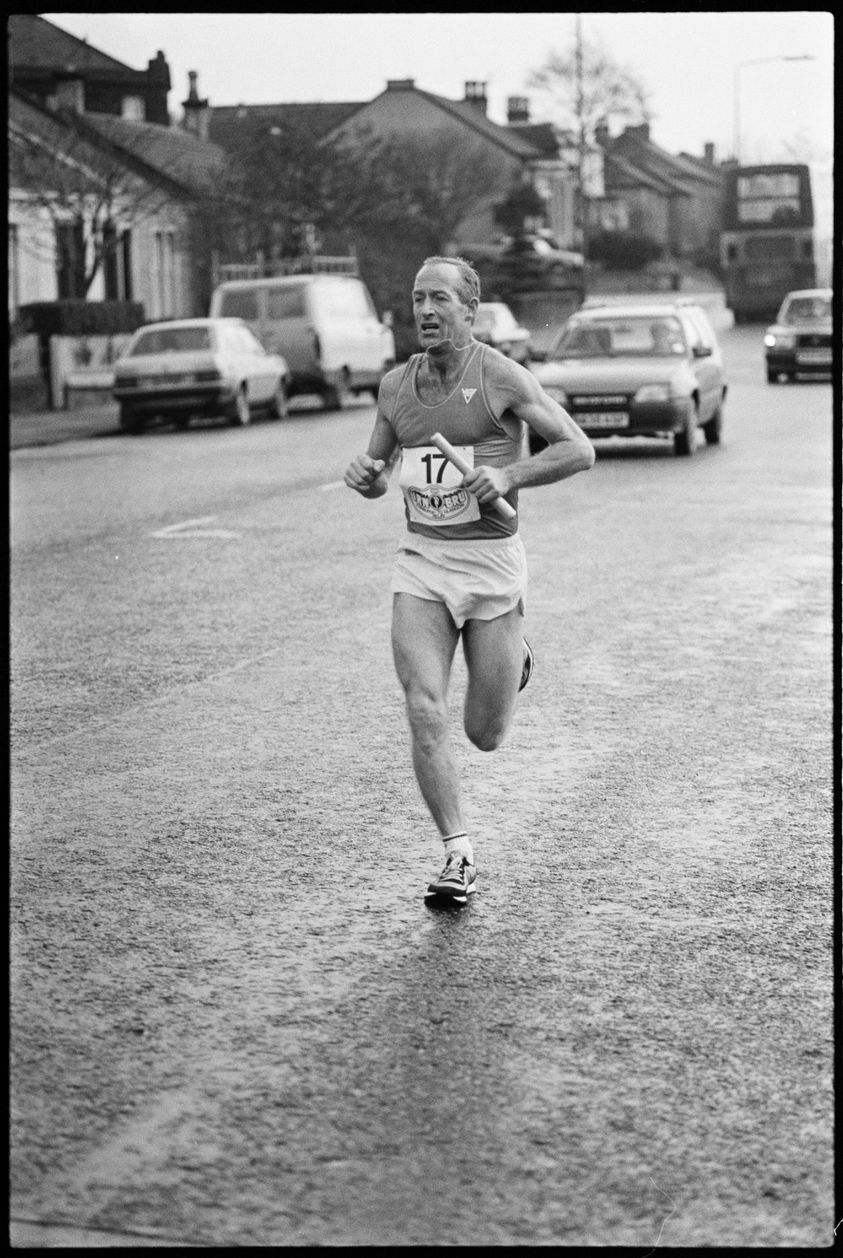
Bert Irving

.

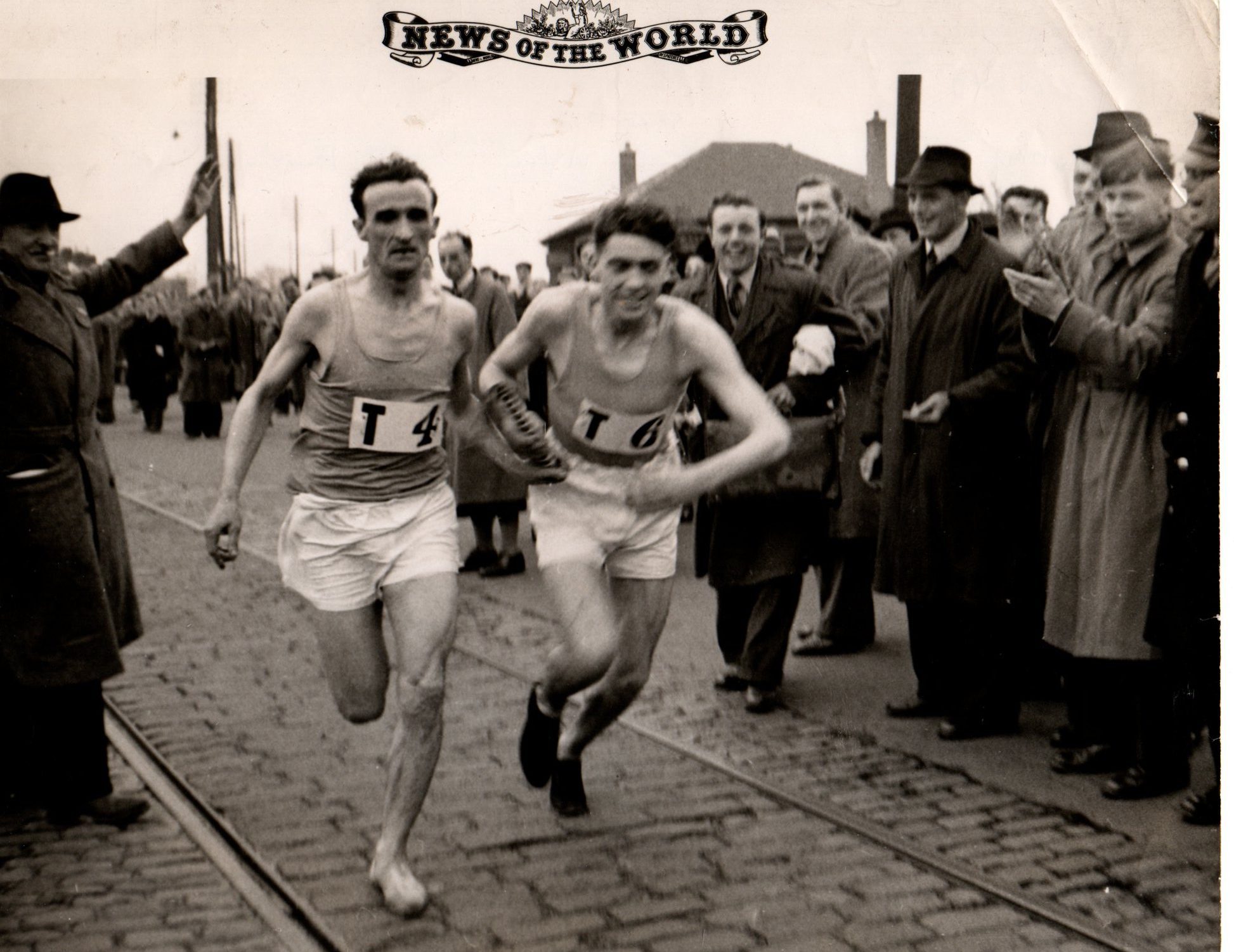
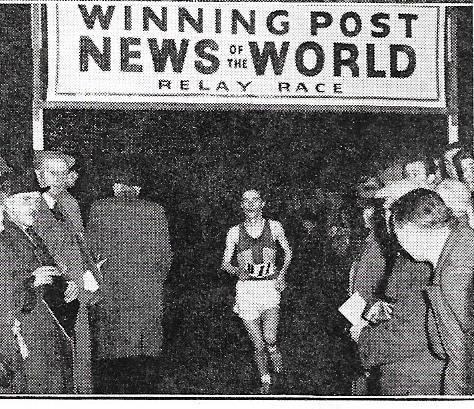
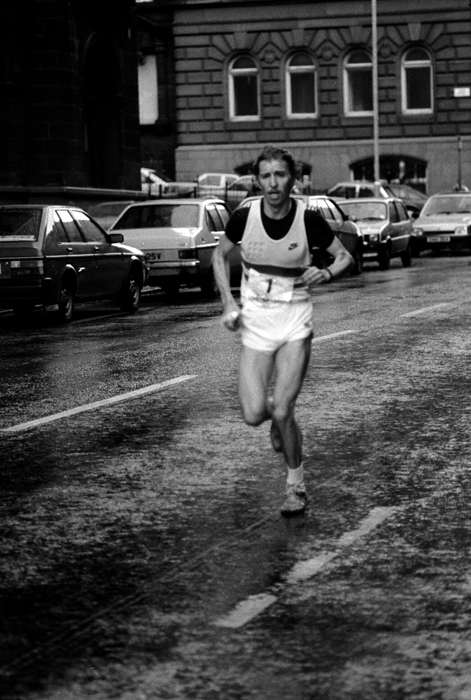
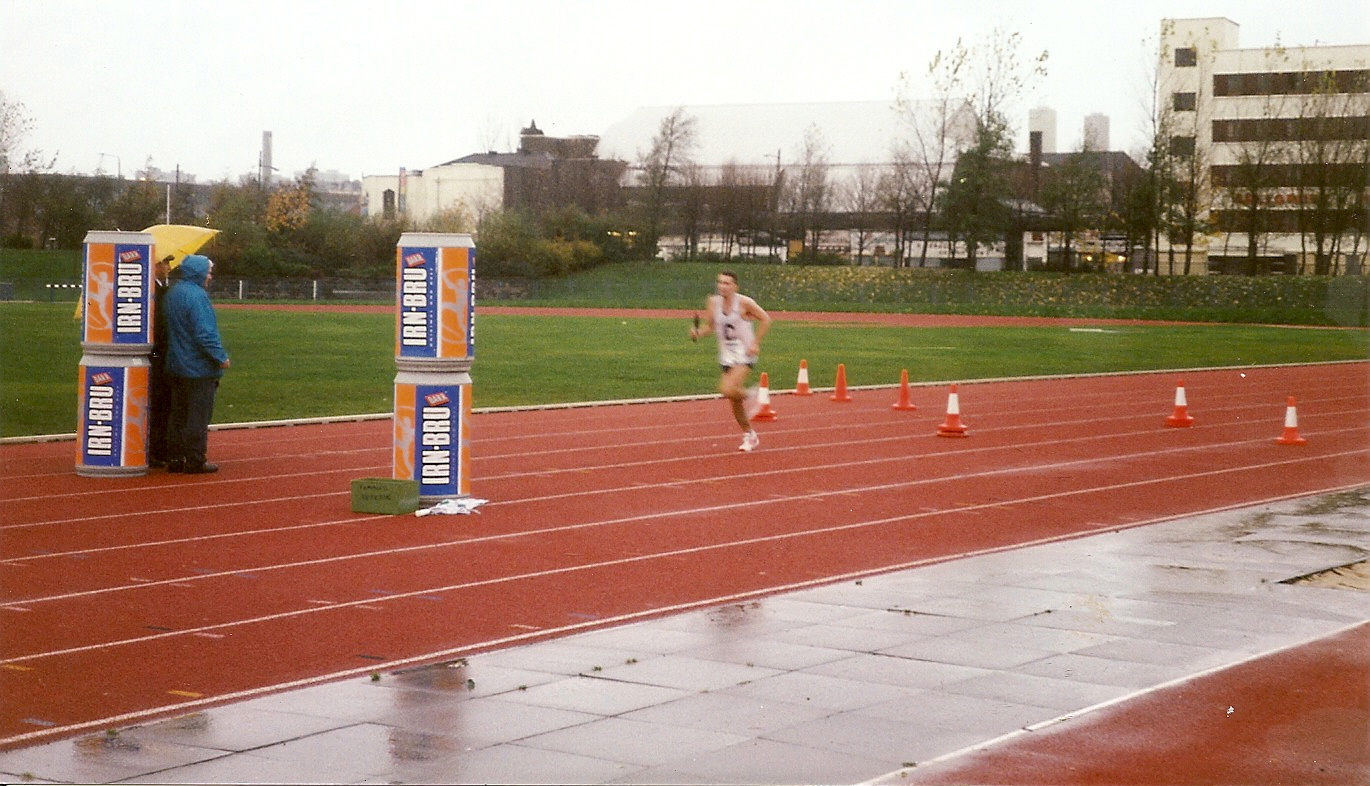
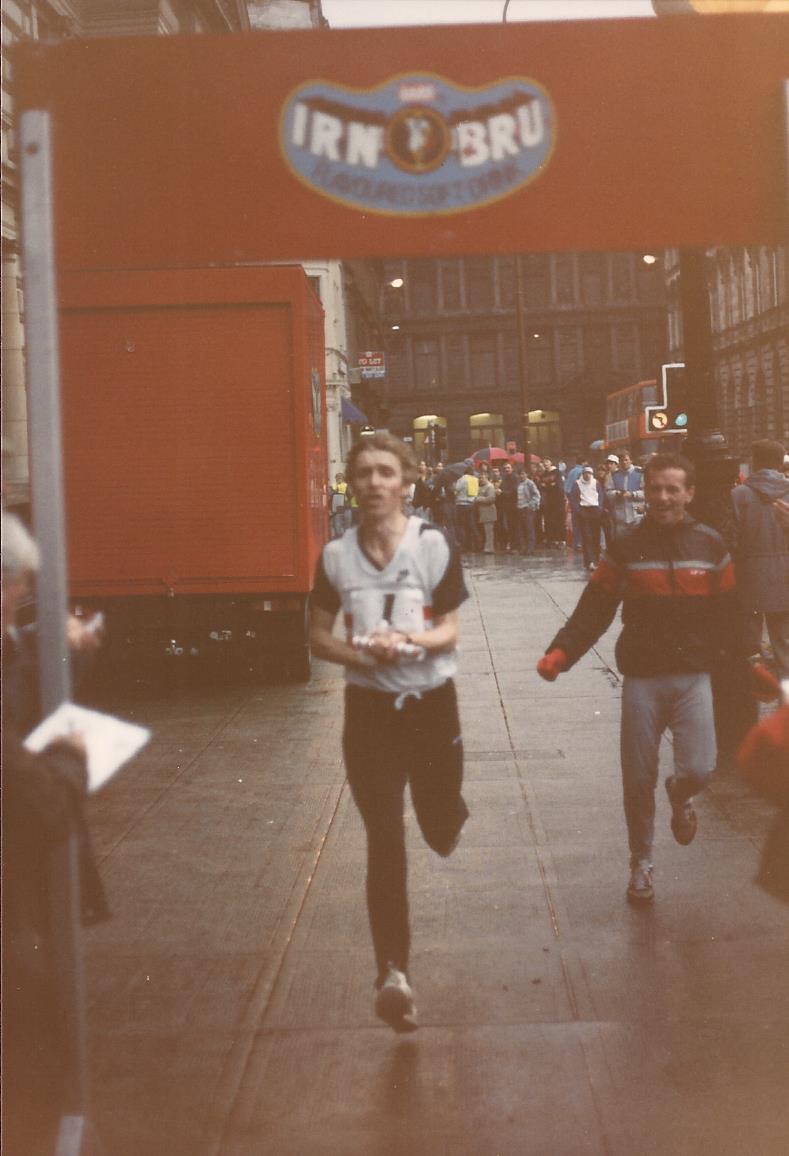
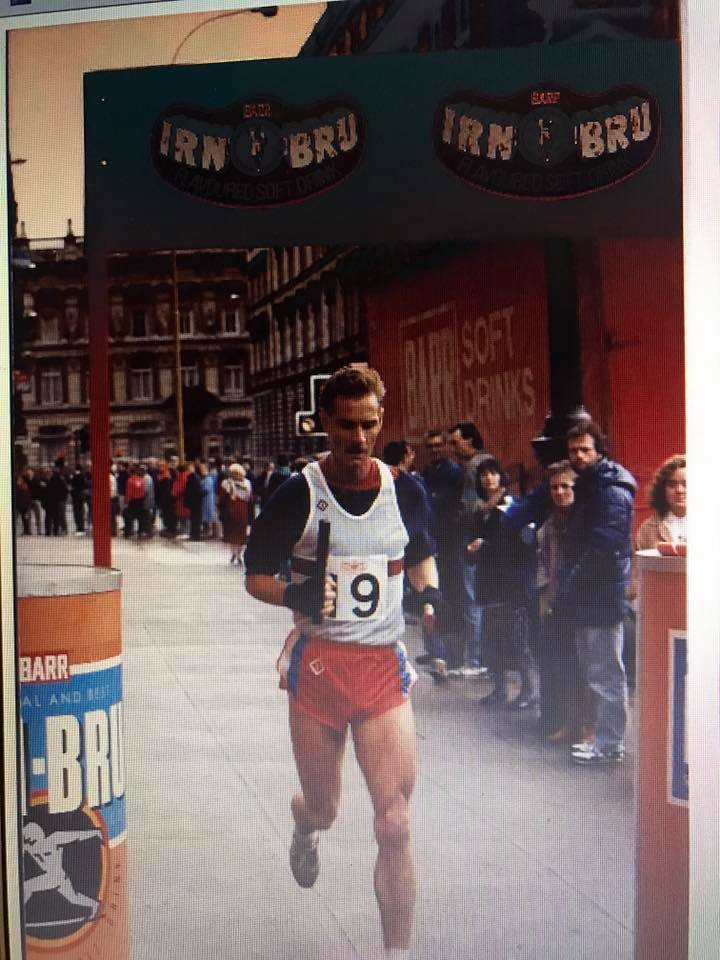
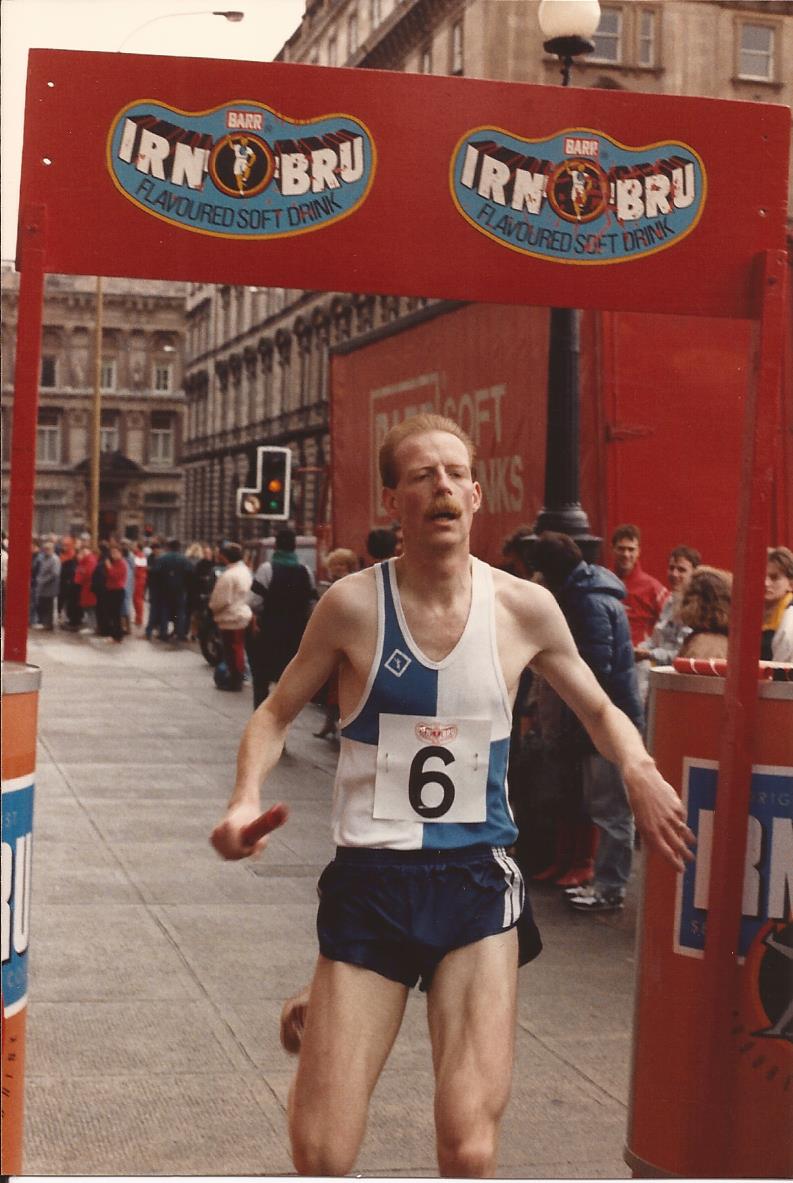
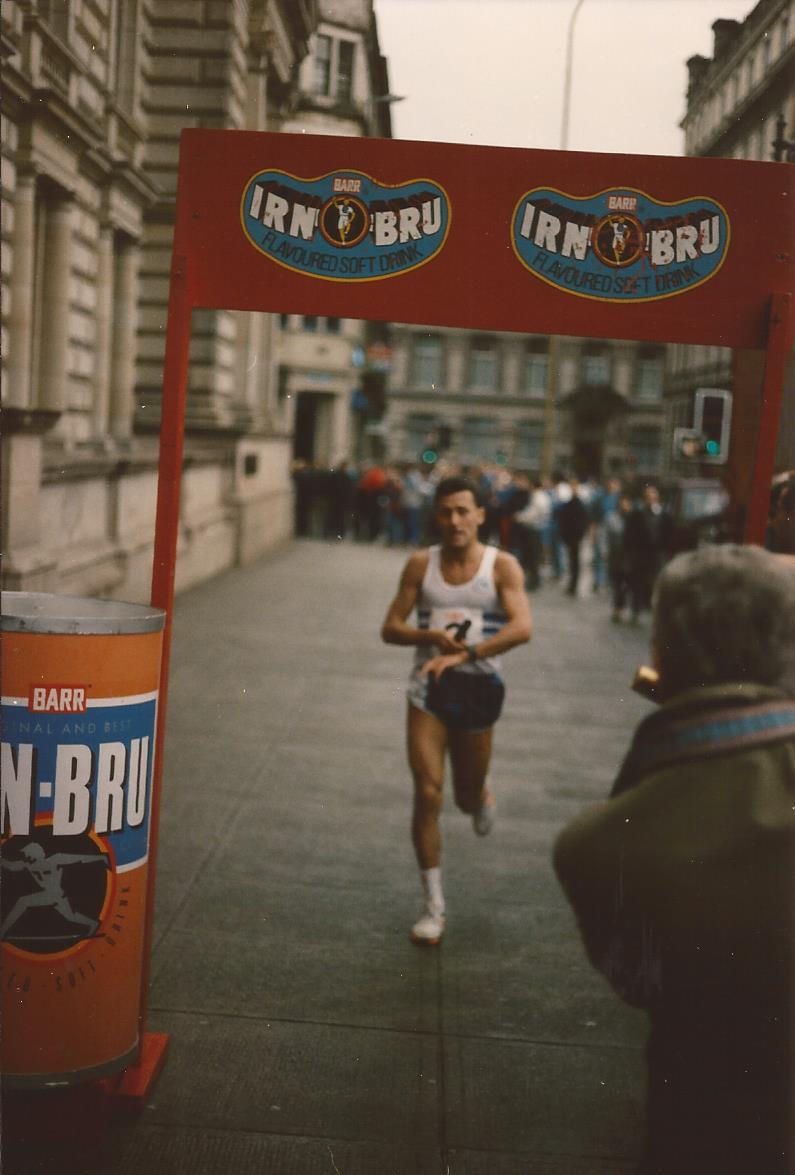
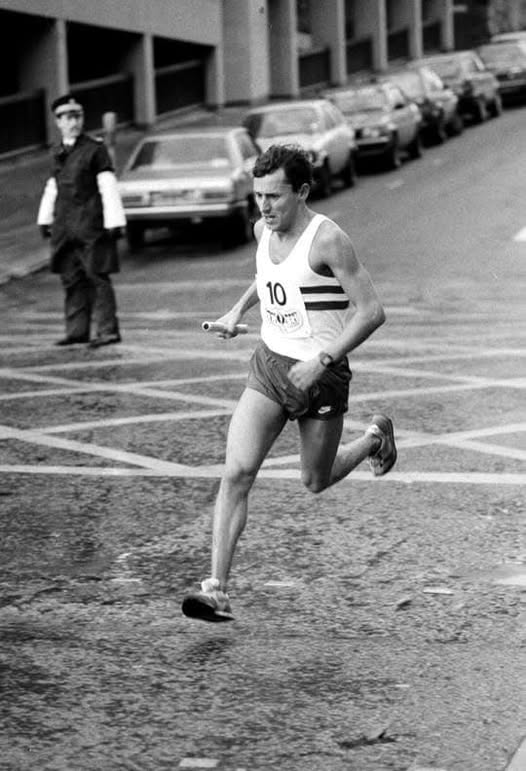
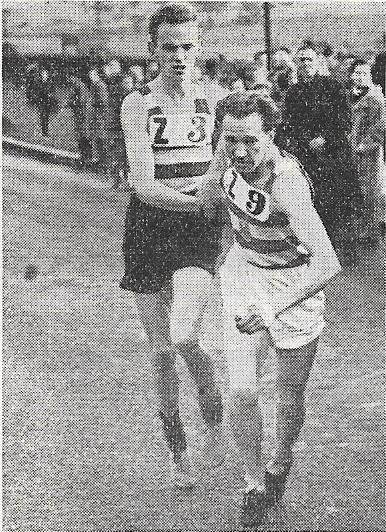
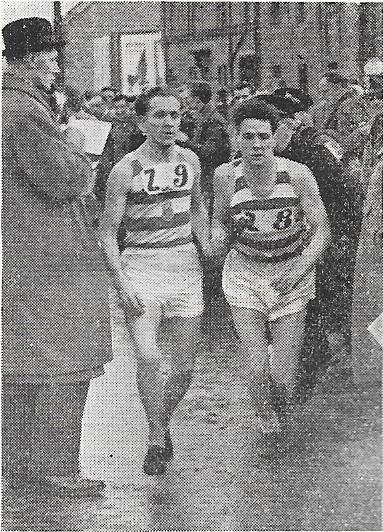
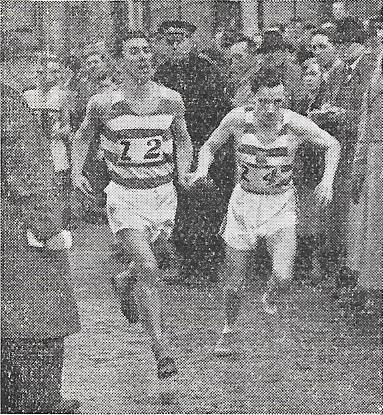
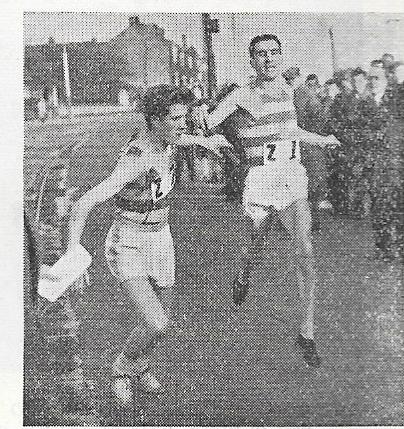
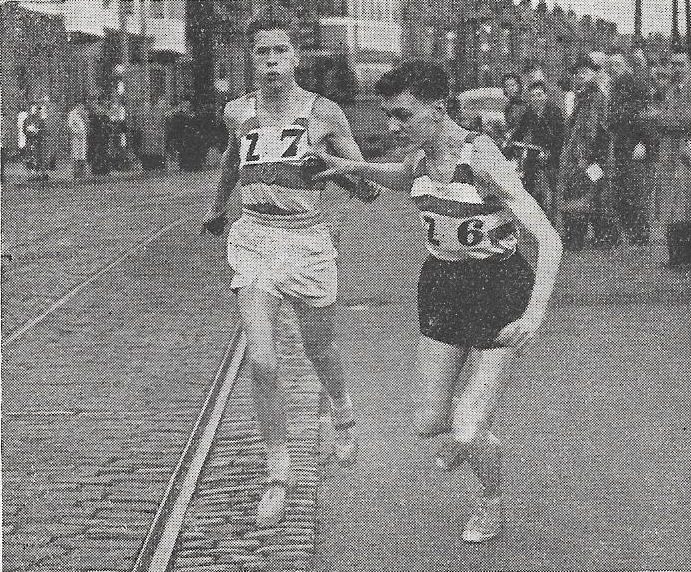
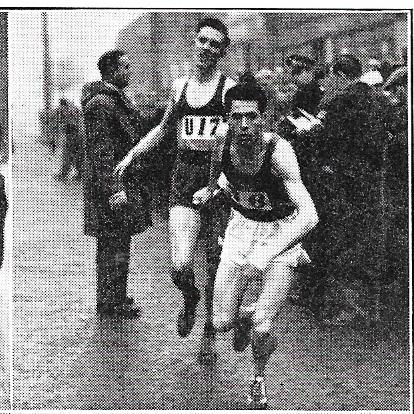
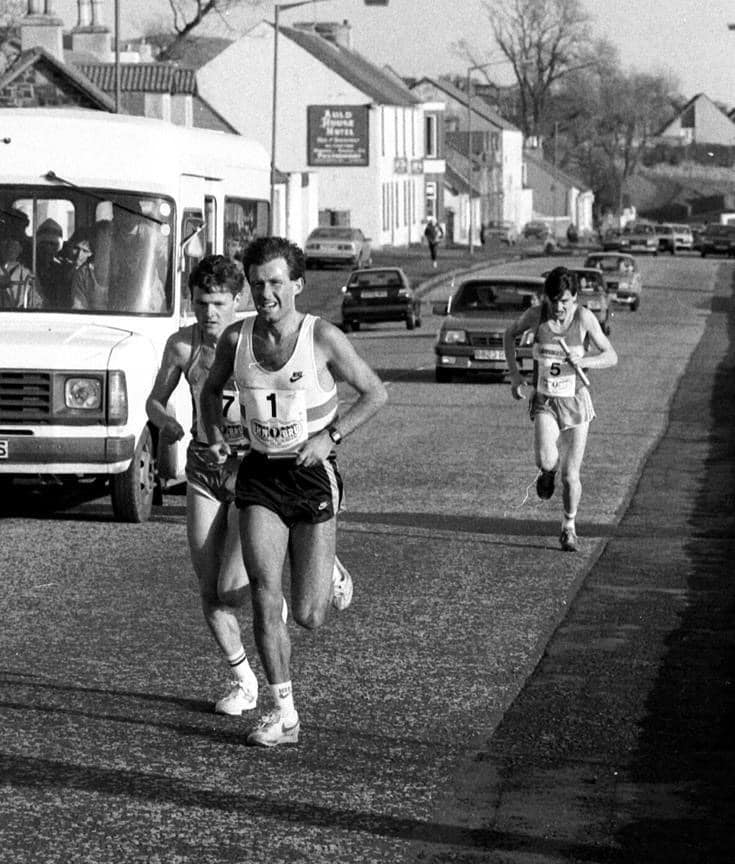
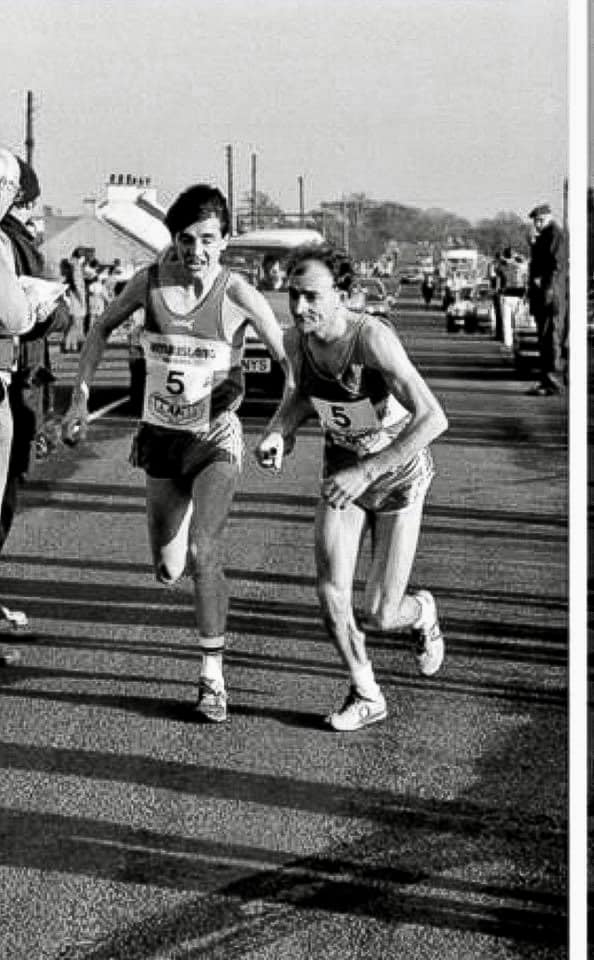
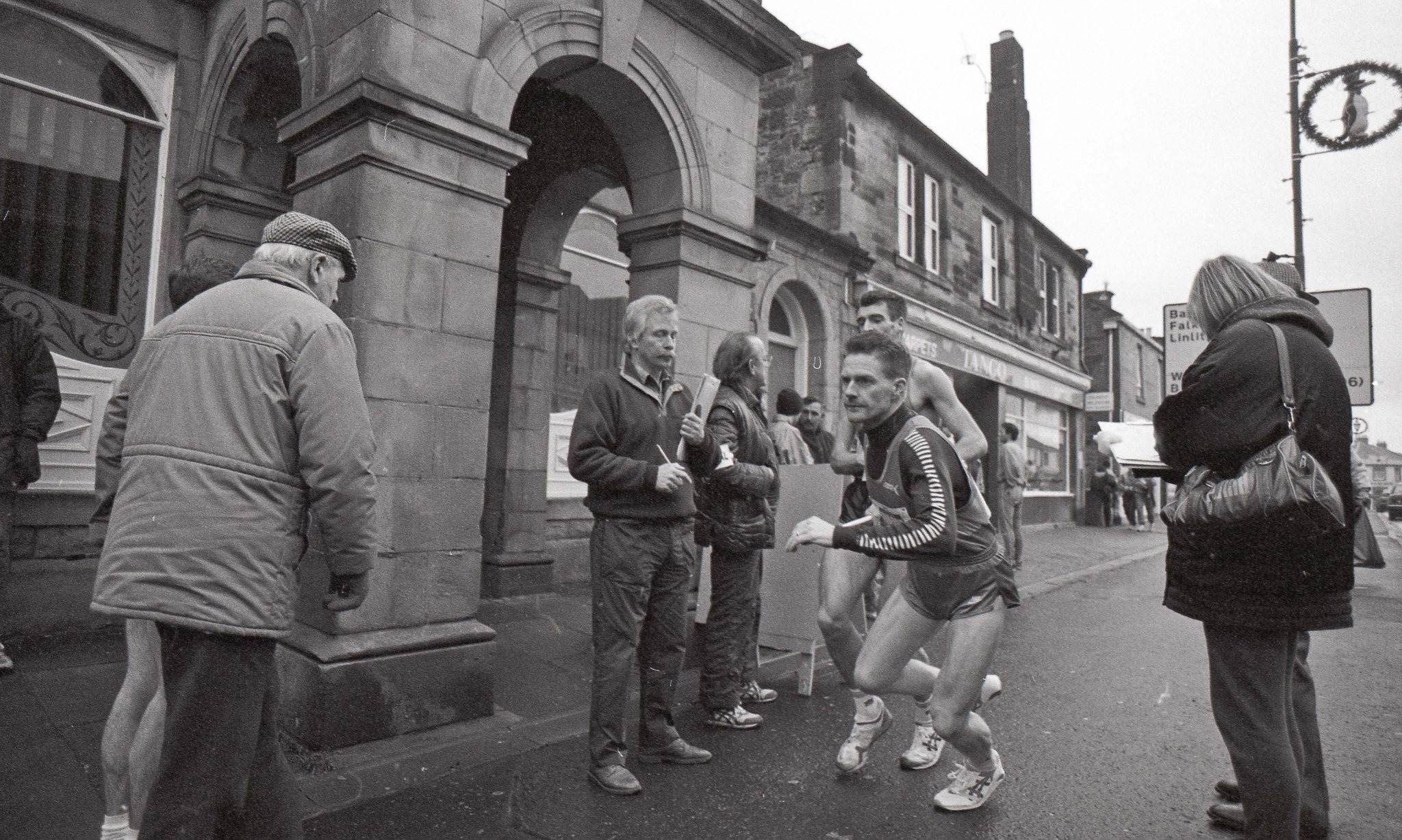
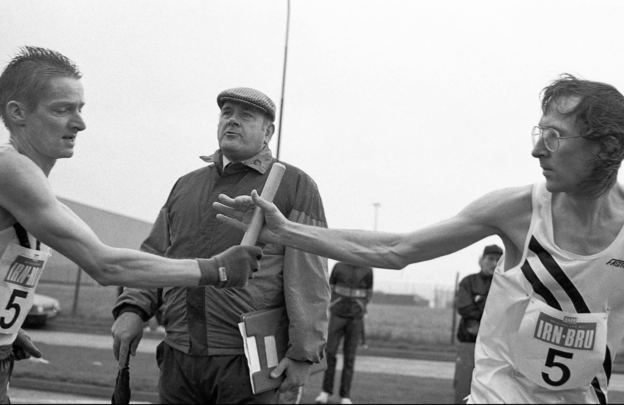
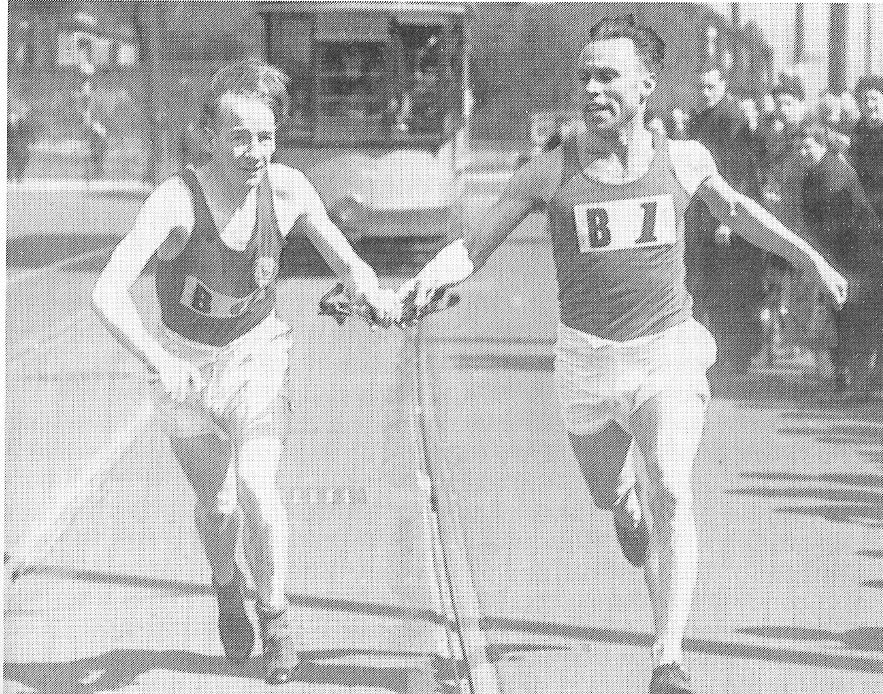
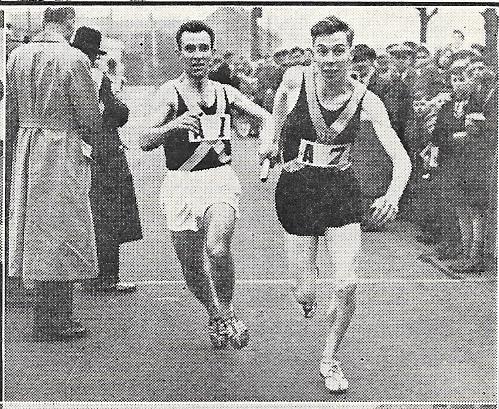
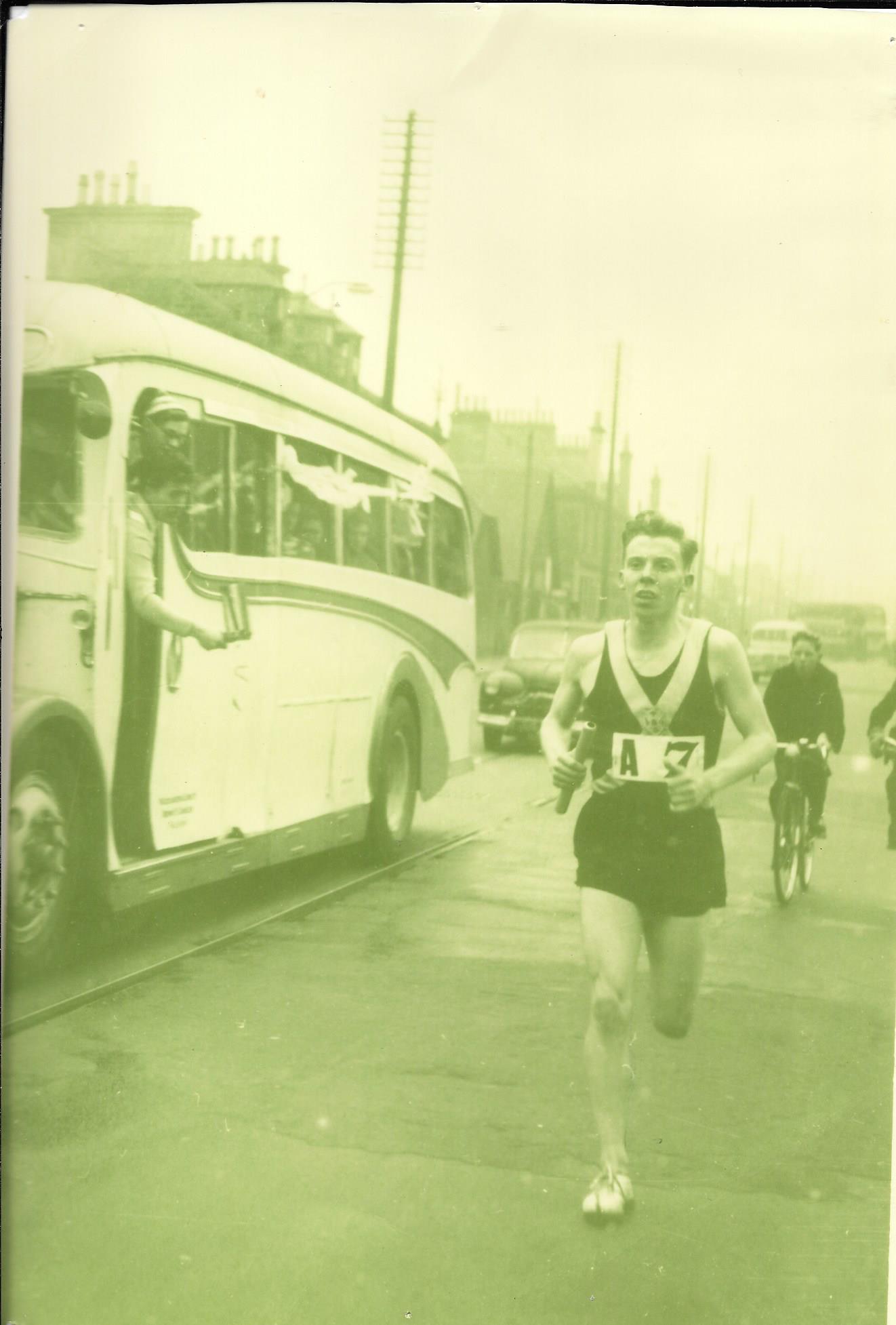
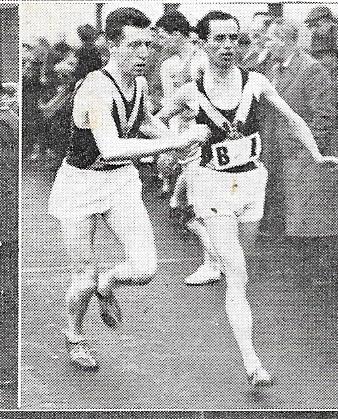
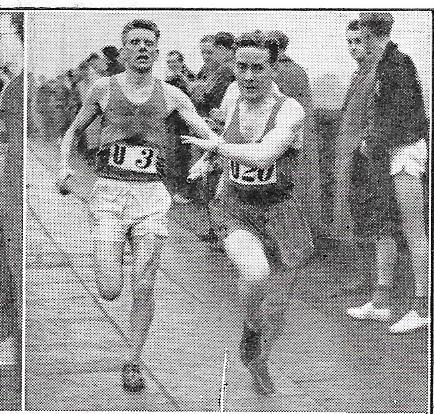
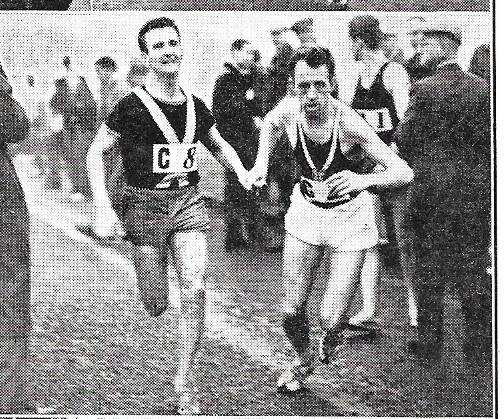
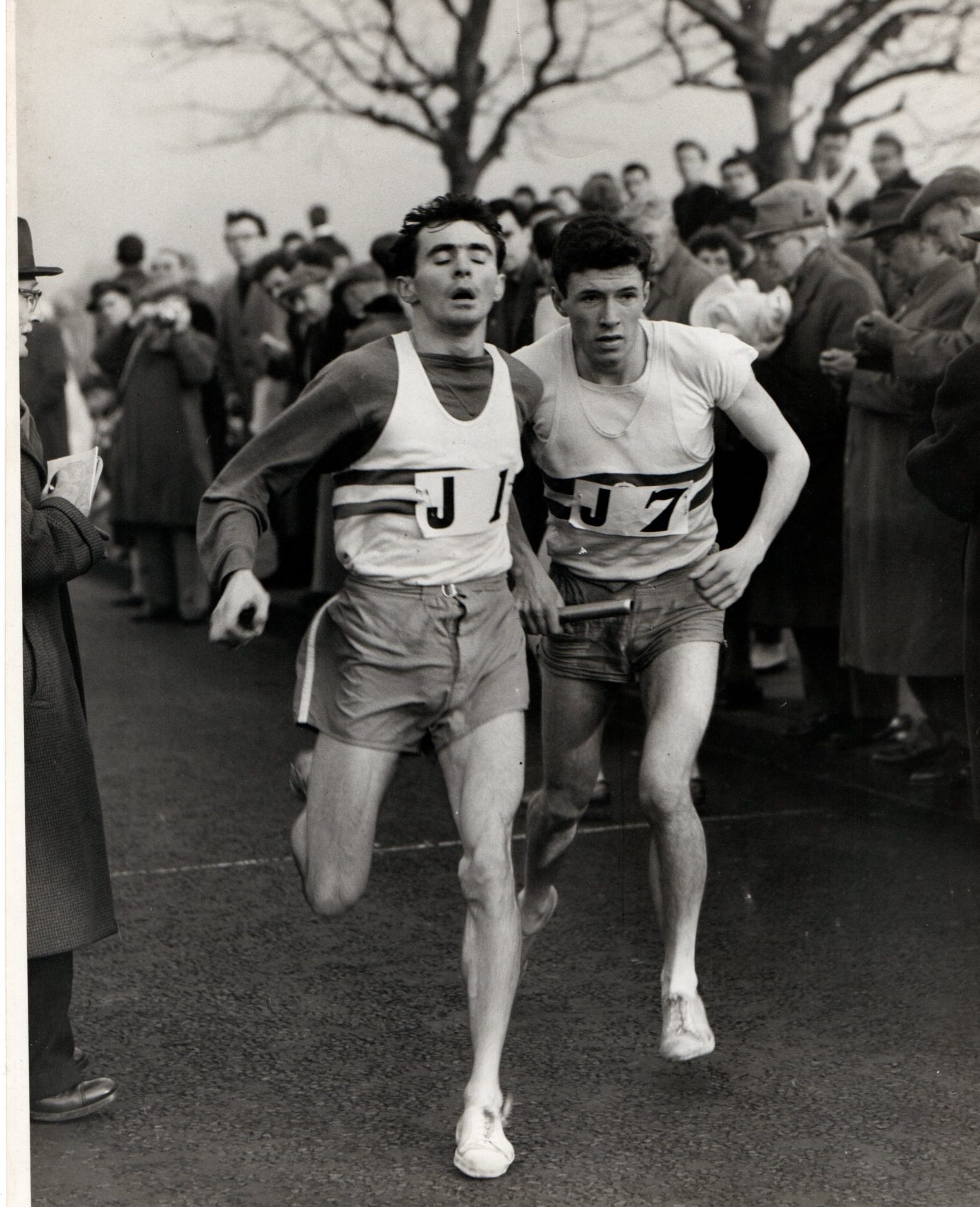
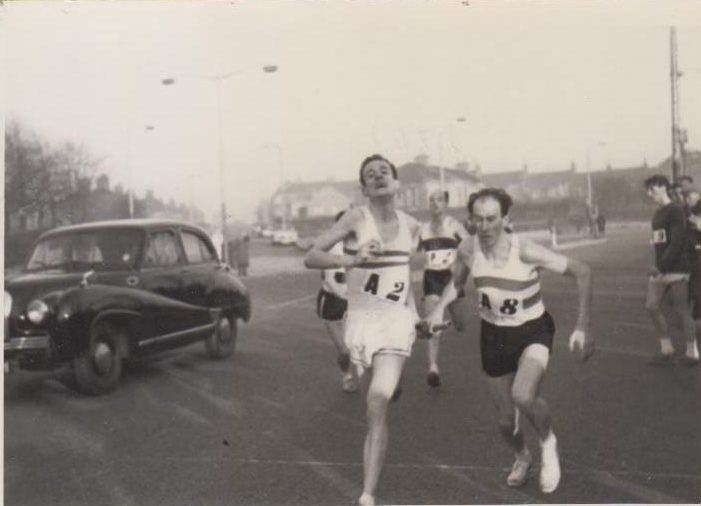
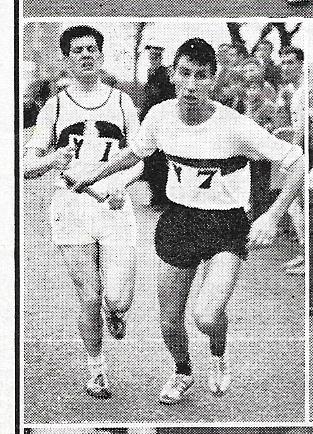
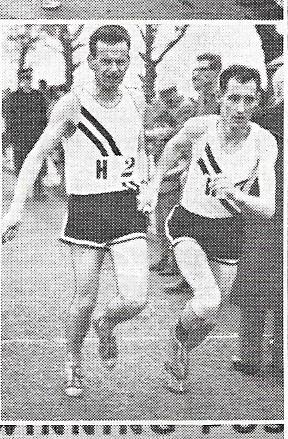
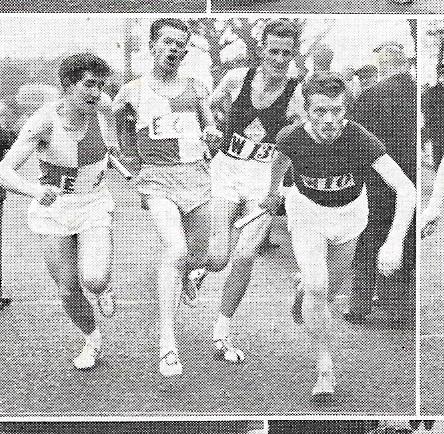
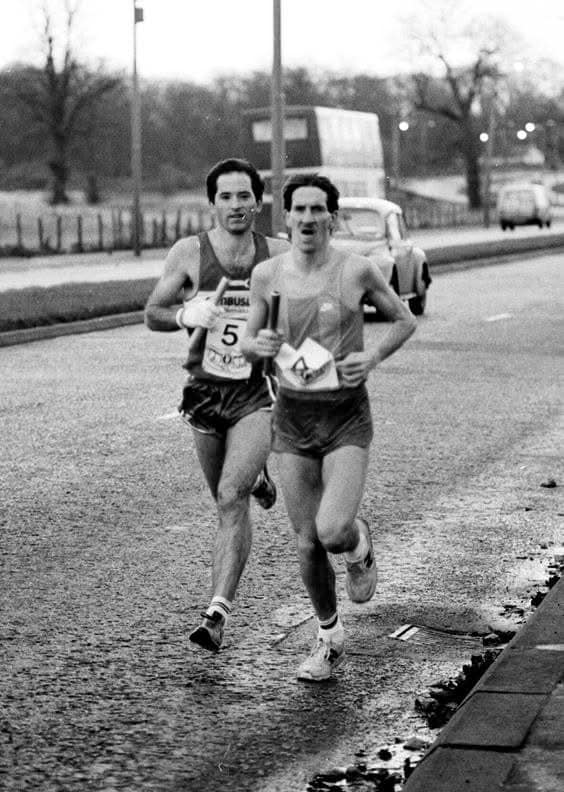
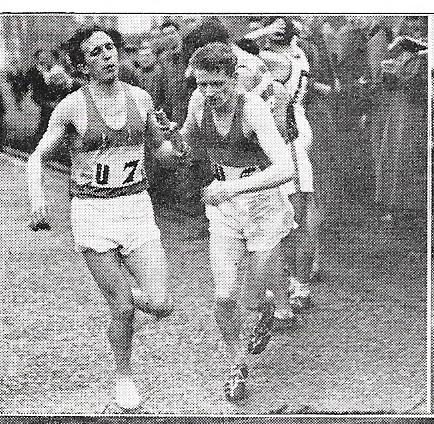
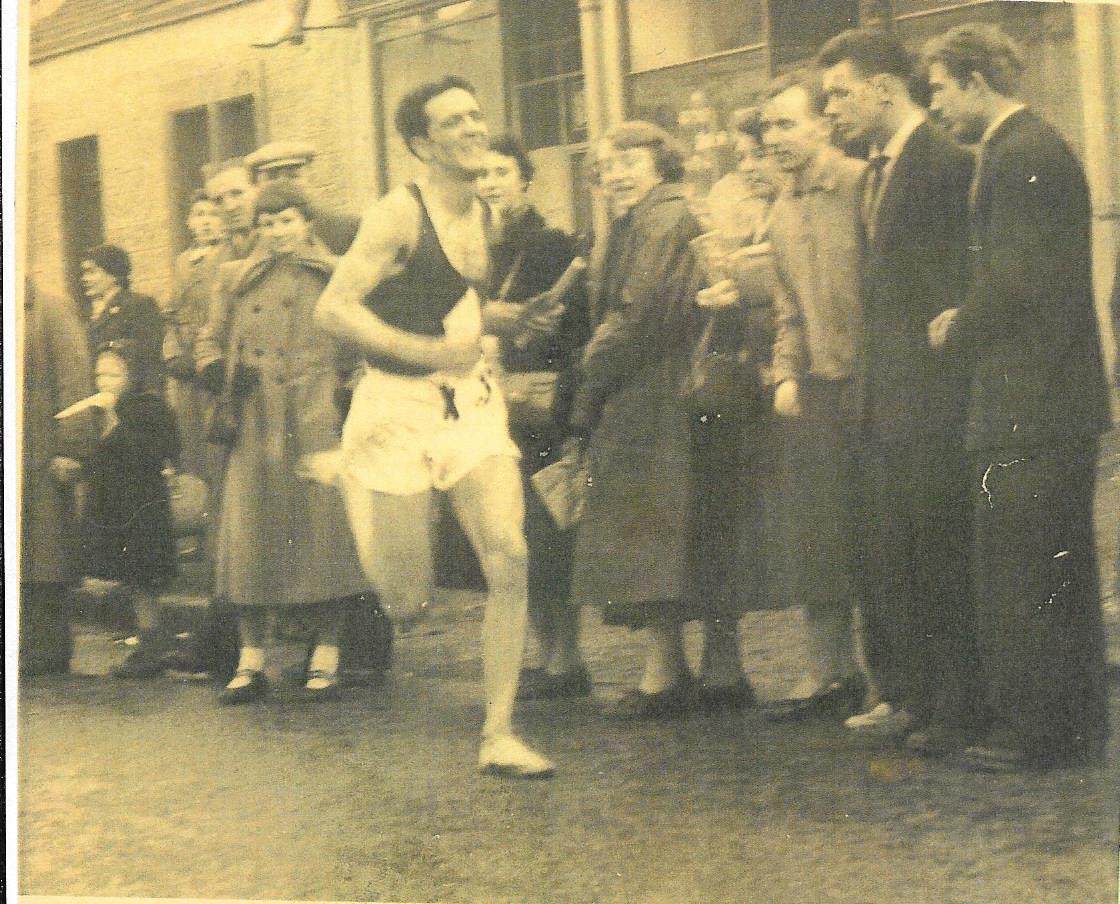
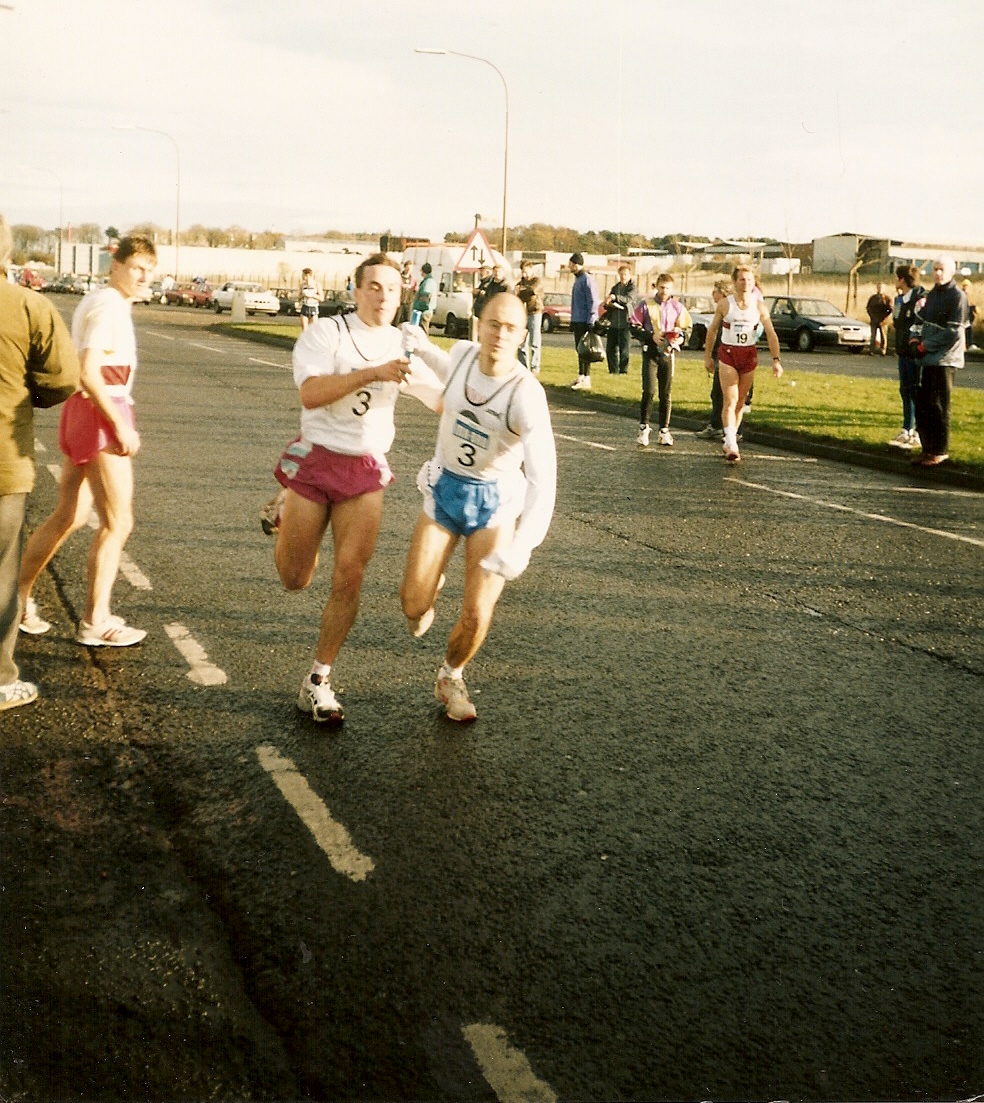
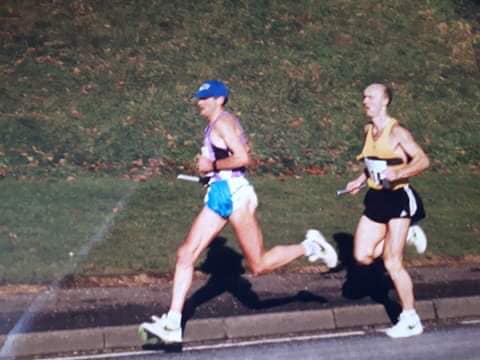
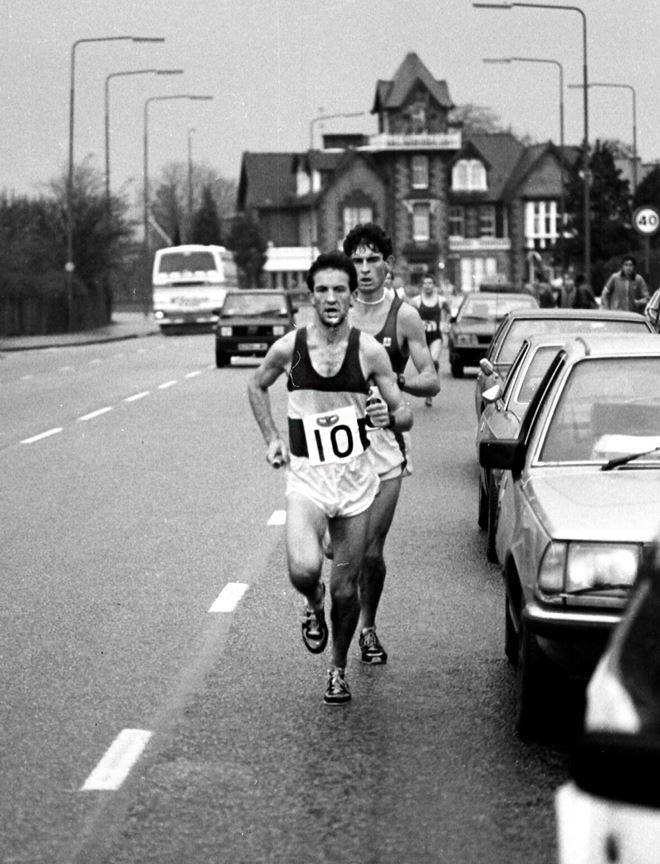
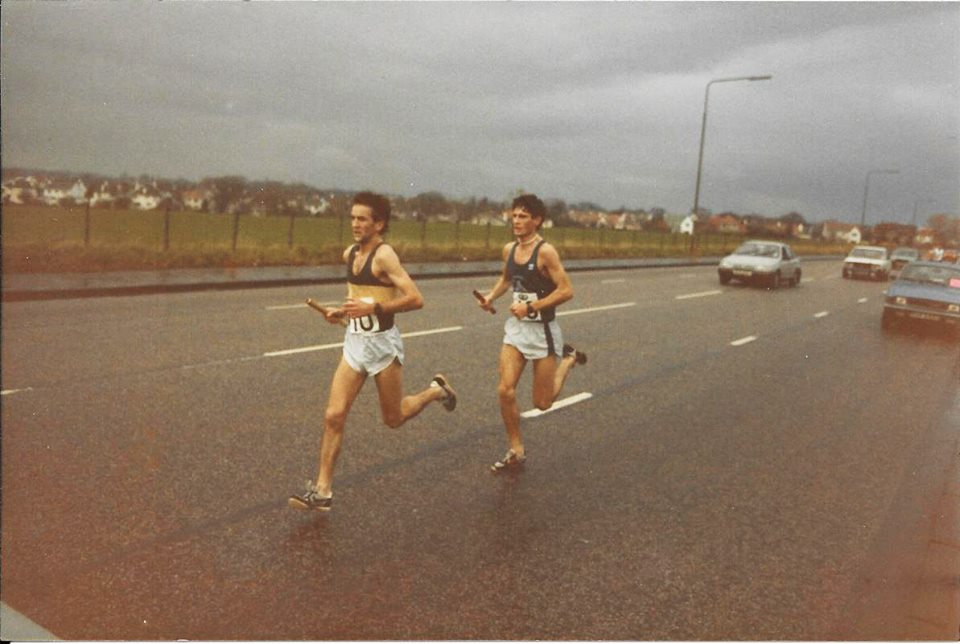
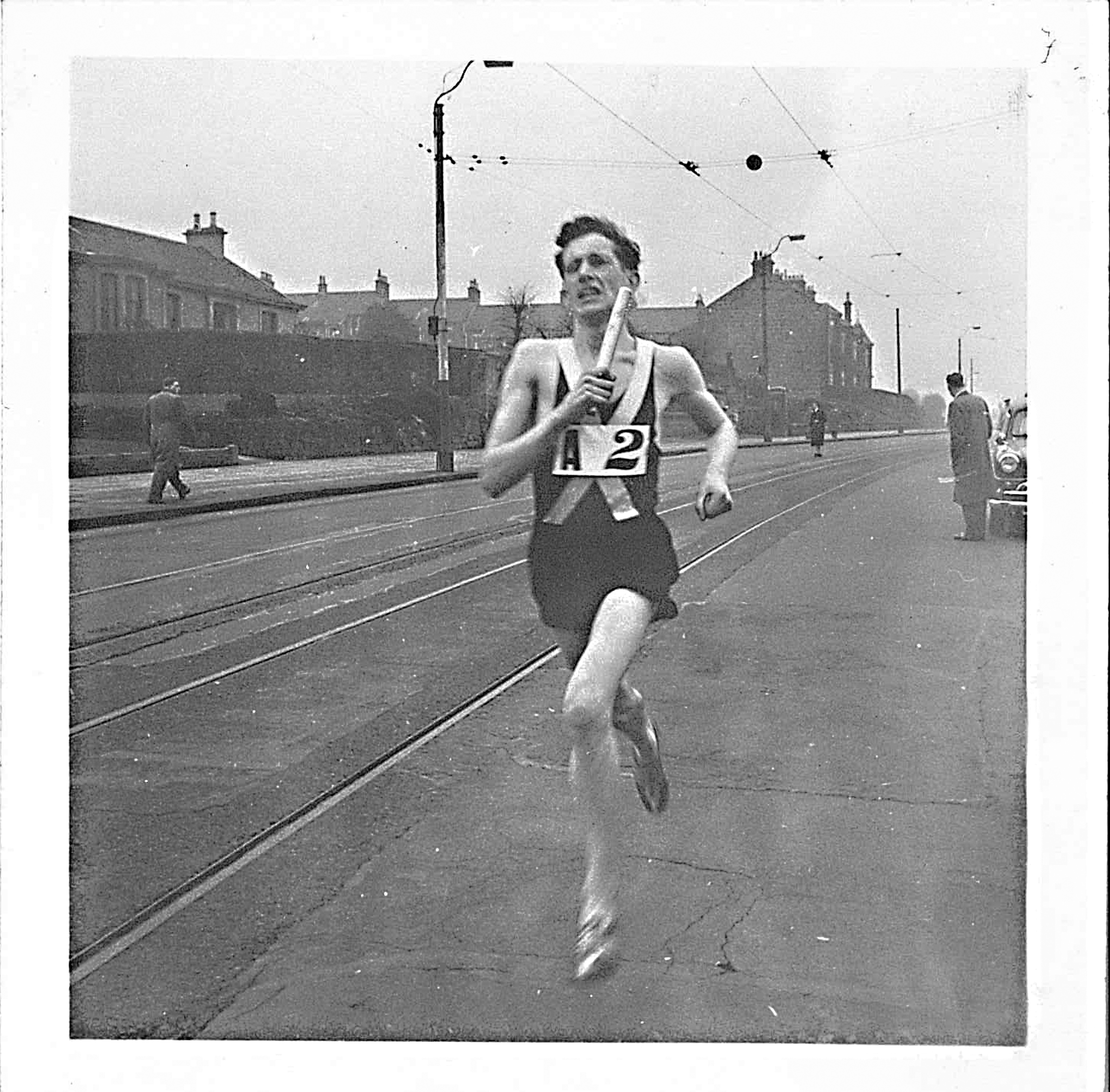
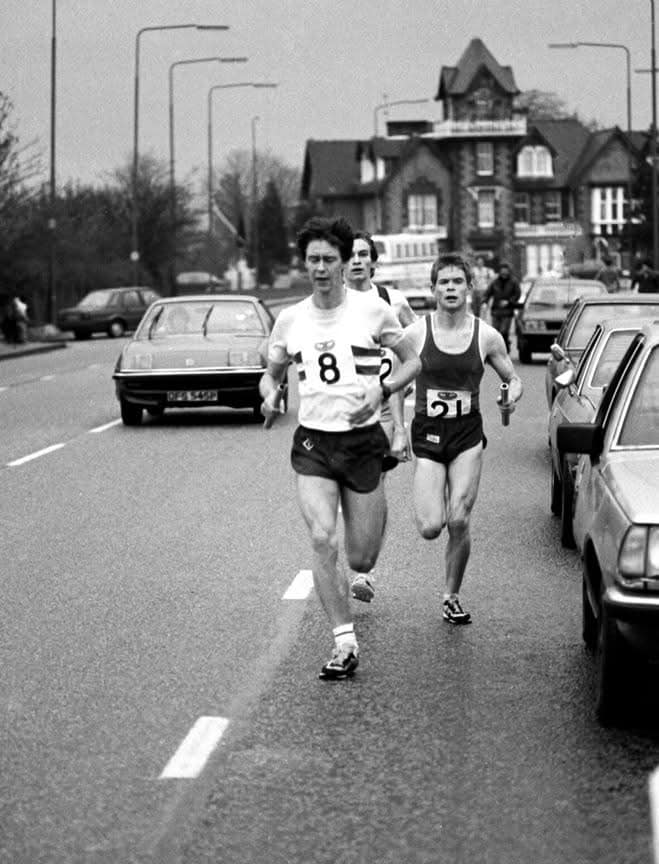
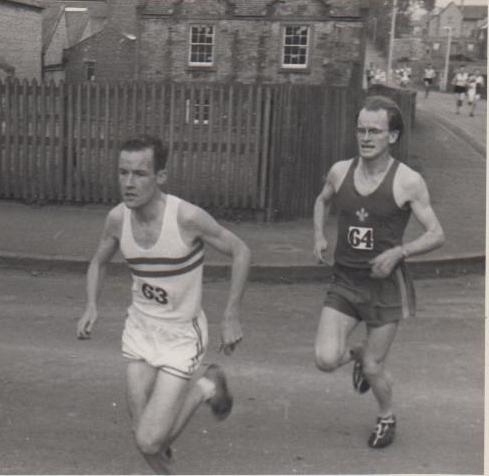
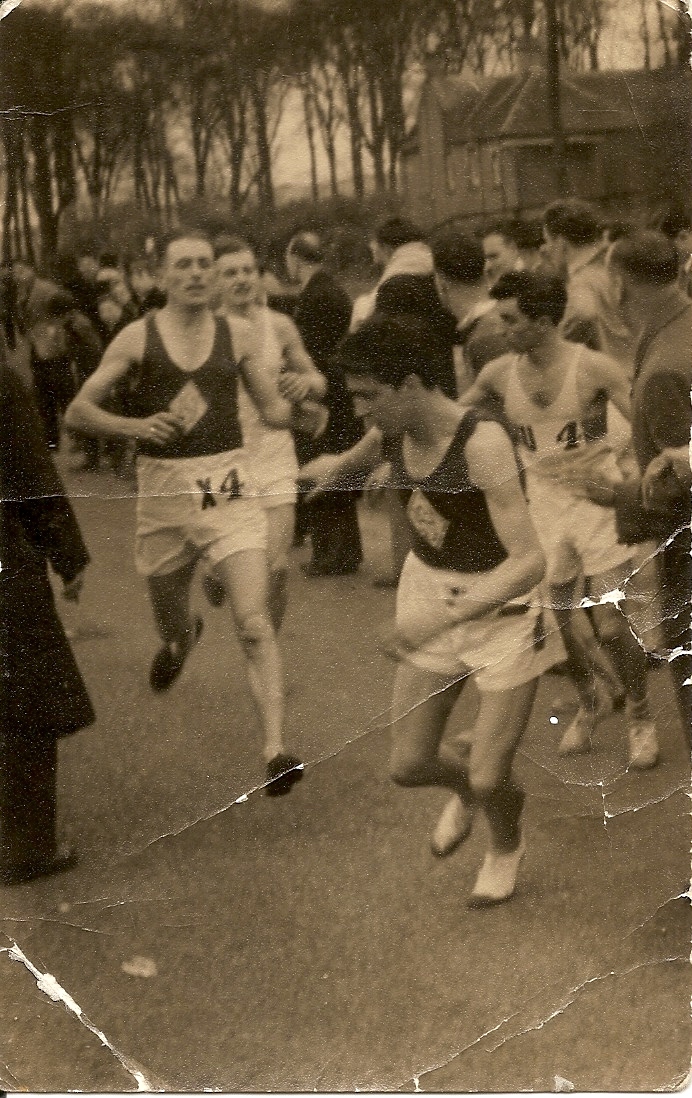
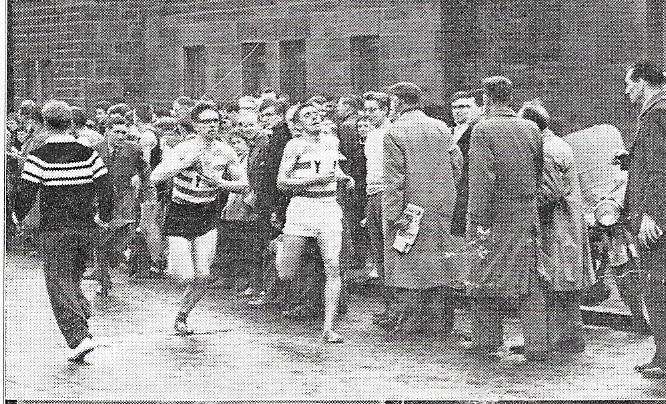
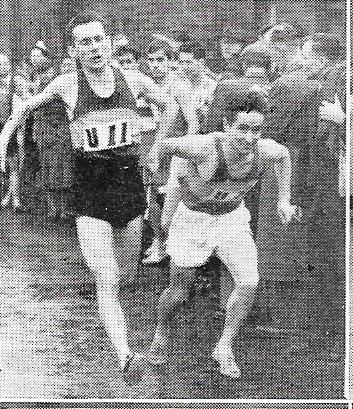
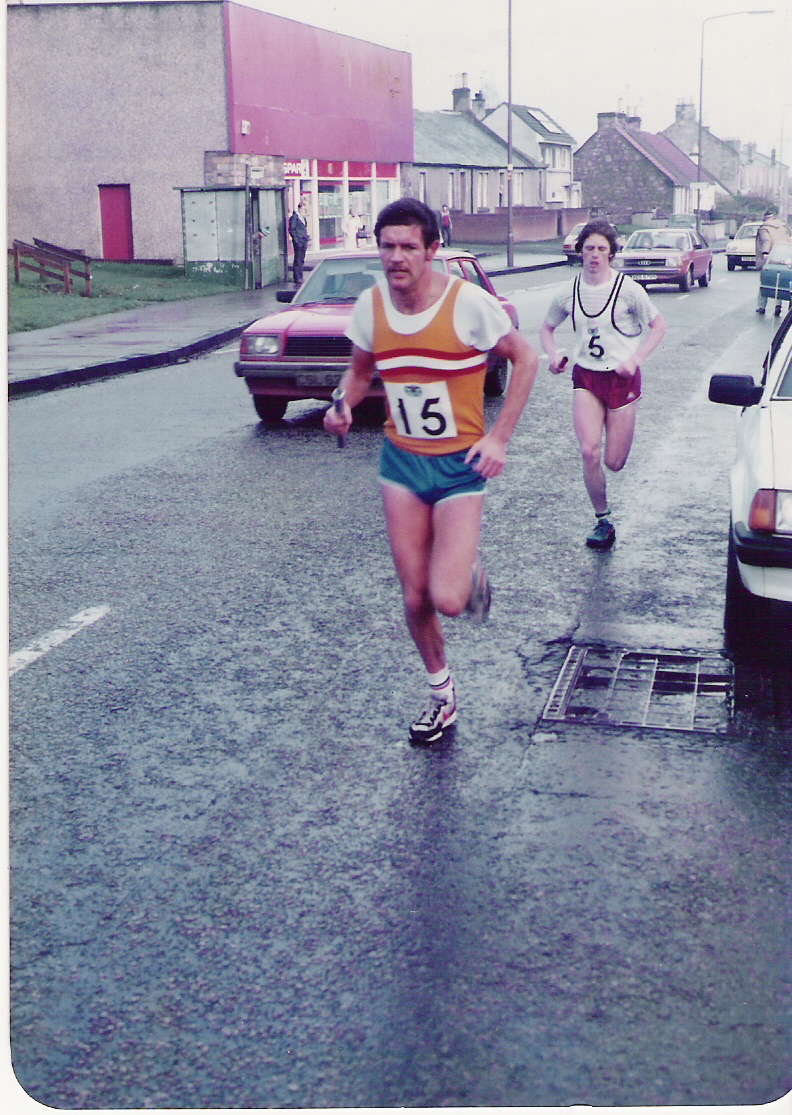
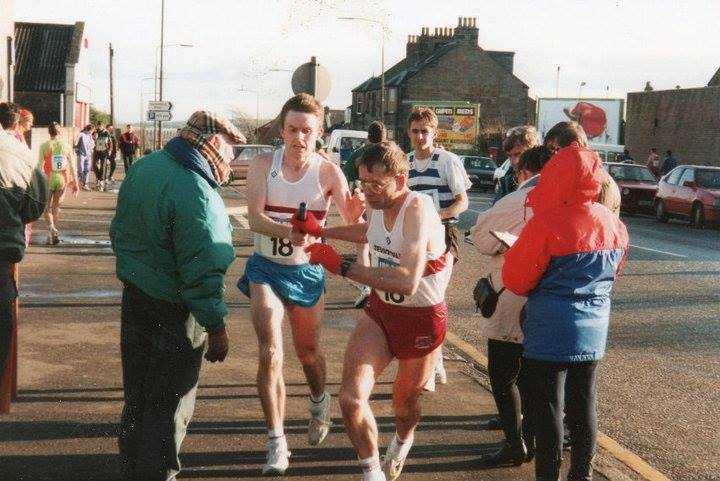
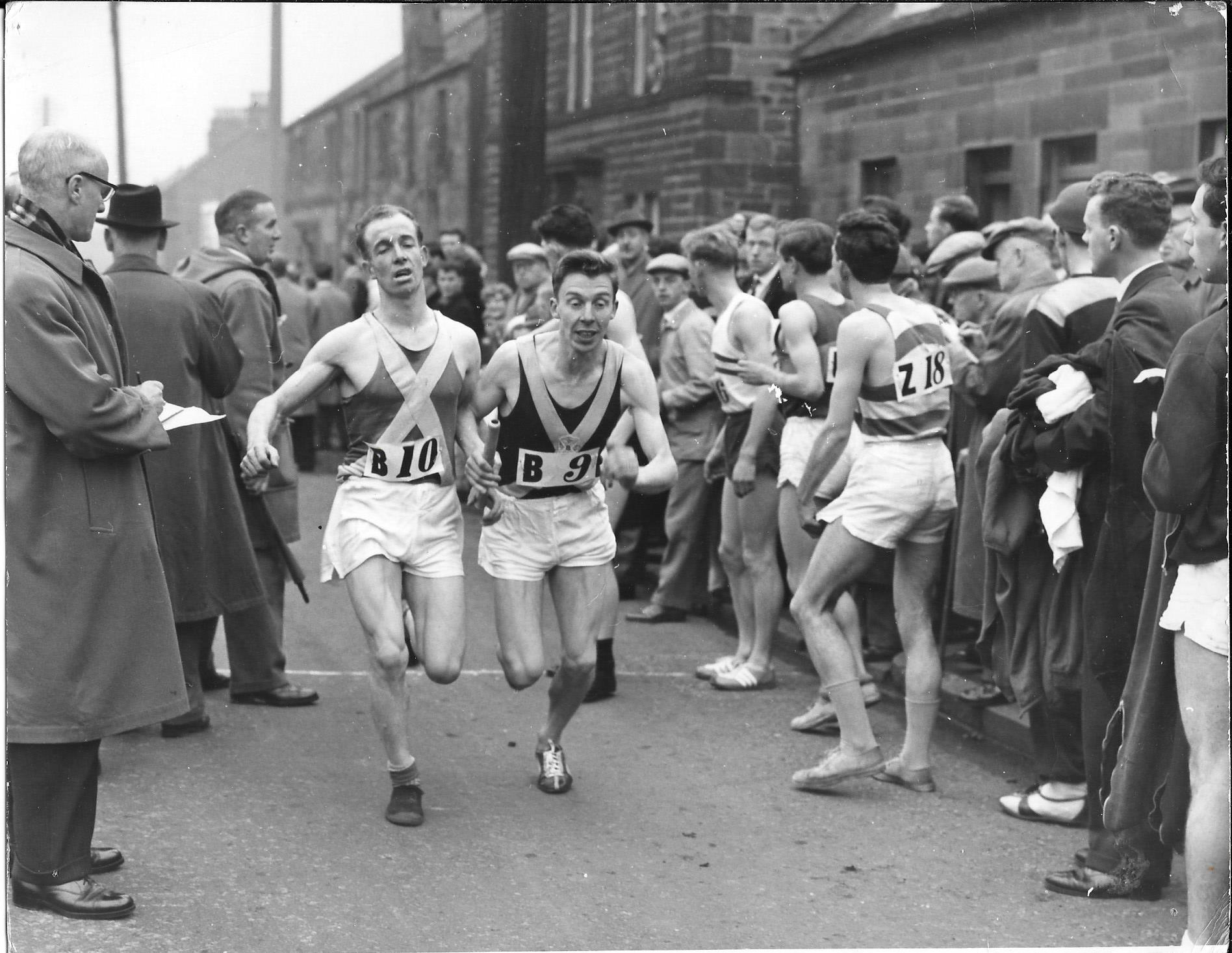
Bert Irving, B10, hands the Edinburgh to Glasgow baton to Jim Irvine, while Victoria Park, Shettleston and Edinburgh Southern Harriers look anxiously for their runners to come in sight.

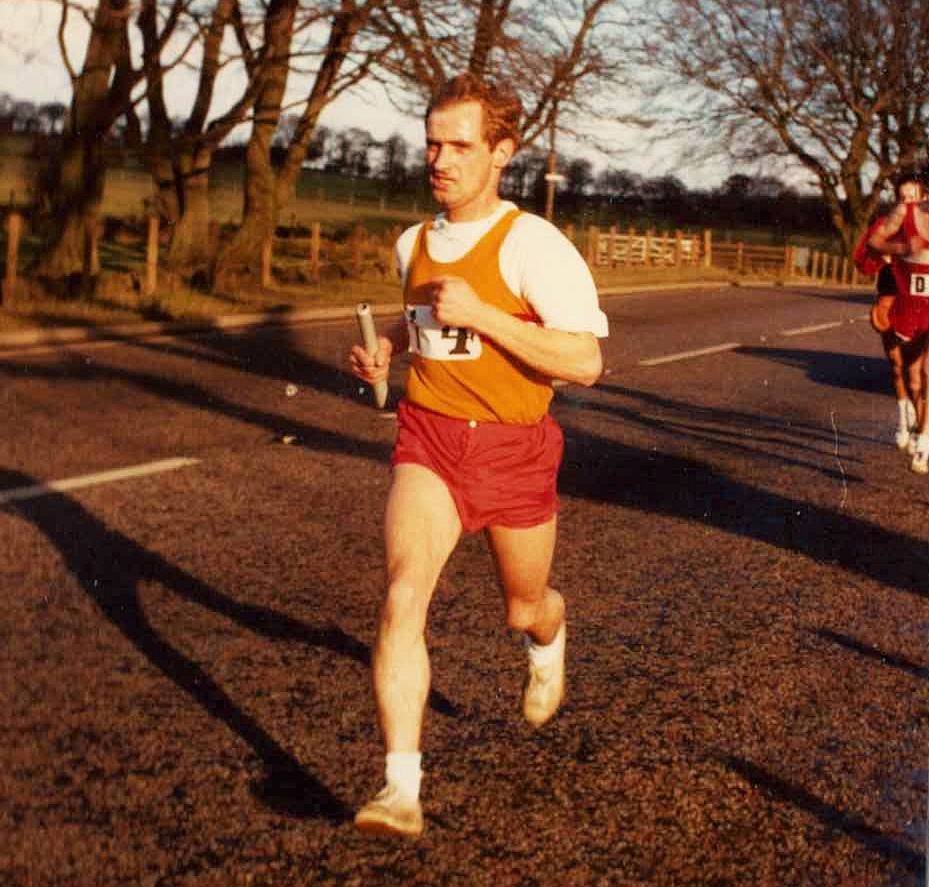
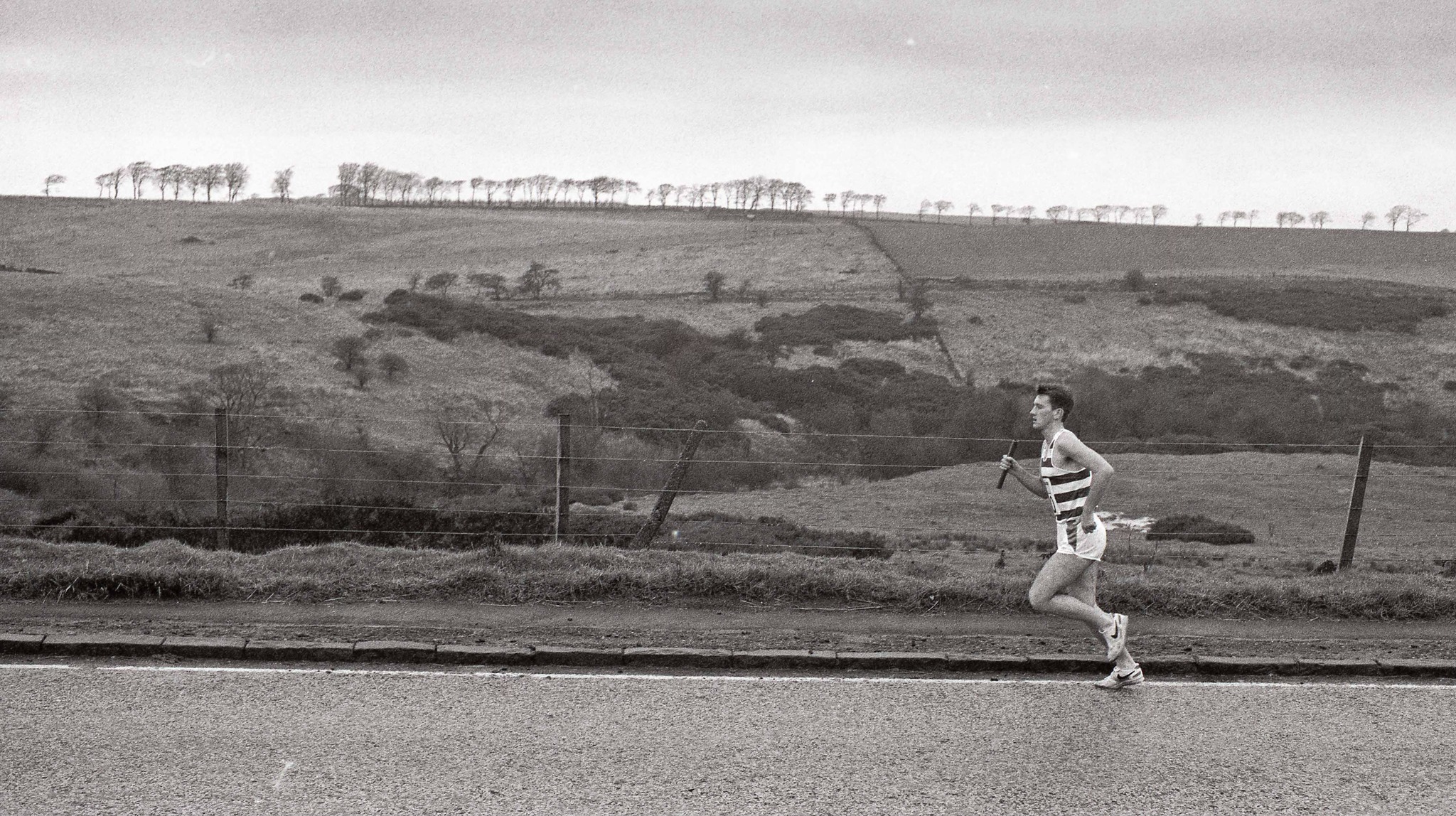
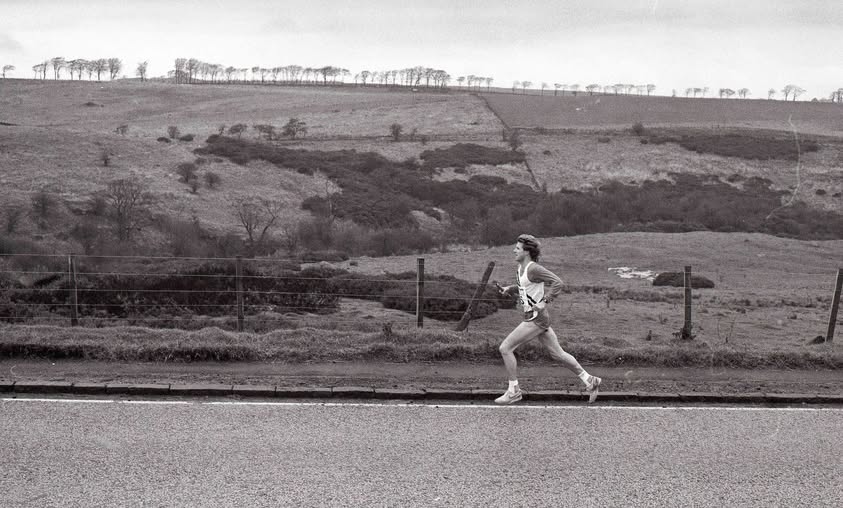
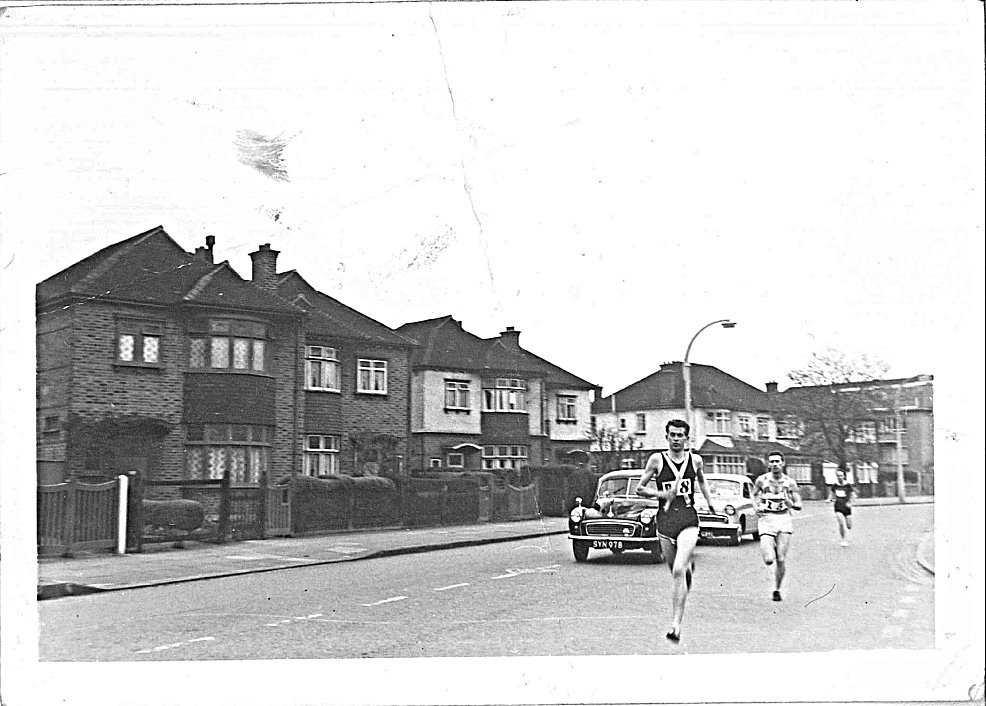
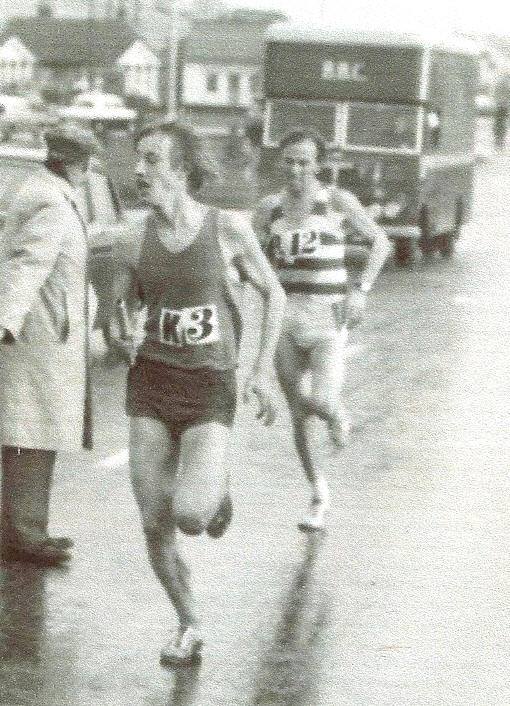
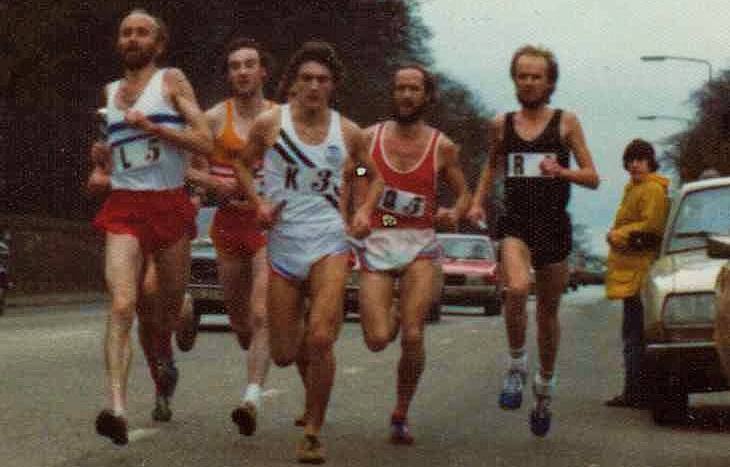
Bert Irving was one of the country’s best distance runners at a time when the country was blessed with a host of talented men.   When Bert was running the top teams in the country were Shettleston Harriers, Victoria Park AAC and Bellahouston Harriers and there was not a lot between them.  Individuals such as Ian Binnie, and Andy Forbes of Victoria Park, Joe McGhee and Graham Everett at Shettleston, Joe Connolly and Harry Fenion in his own Bellahoston Harriers club plus a whole host of runners such as Alastair Wood of Aberdeen were there doing battle.   Bert was different – he didn’t live in any of the big cities so facilities were scarce, he consequently didn’t have a pack to train with which was also a decided disadvantage.   But he did have two things that all top sportsmen must have – the desire to do well and targets to aim at.   He lived in one of the least accessible parts of Scotland – Drummore in Galloway – at a time when there were very few cars on the road and public transport, while available, was complicated and required several changes en route.   And of course, he was blessed with a talent for the sport.   

There was no mention of ‘R Irving, Stranraer’ in any year up to season 1956/57 when he appeared in the South Western District Championships as finishing sixth in the Senior event.   He was the only Stranraer runner, and the club had no teams out in any age group for many years up to that point.   By the time of the National at Hamilton that season he was a Bellahouston Harrier and a scoring member of the team that finished second.   The club runners in order of finishing were 1st.   Harry Fenion,  2nd.   Joe Connolly,   22nd Dick Penman,   23rd  Bert Irving,   33rd Jim Irvine,   44th.  Des Dickson    From then on there was only ever one club associated with Bert Irving.   Strangely enough he did not do much track running although in the SAAA Championships on 21st June he ran in the 6 miles, where he was fourth in 31:50.6 behind Andy Brown, Joe Connolly and Charlie Fraser (30:54.2).   His winter season began with the Edinburgh to Glasgow relay in November where he ran the fifth stage and turned in the second fastest time for the team which finished second.   Then on January 25th, 1958, he ran in the Midland District Championship where he was  15th.   The club team again finished second.   They then ran in the most prestigious race in the calendar – the Scottish National championship at Hamilton.  Places this time were 6th.   Connolly;  8th.  Fenion;  9th.  Dickson;   15th Nelson,   20th Irving,  38th Irvine.   Individual positions were different but the team position was again second.

By 1958/59 Bellahouston was a club whose young team had matured and whose top runners were a match for any on the road or over the country.  When the first major championship of the season came up, the Midland District relay, they won it.   Colin Shields in his official history of the Cross-Country Union says: “Bellahouston Harriers, who had been so near success in past years, finally achieved the break through they deserved.   They won the Midland relay for only the second time in the history of the race as Des Dickson (Bellahouston) and Bill Kerr (Victoria Park) led the field on the opening lap.   The Bellahouston runners Bert Irving, Harry Fenion and Joe Connolly ran away from their rivals to win by 250 yards.”   

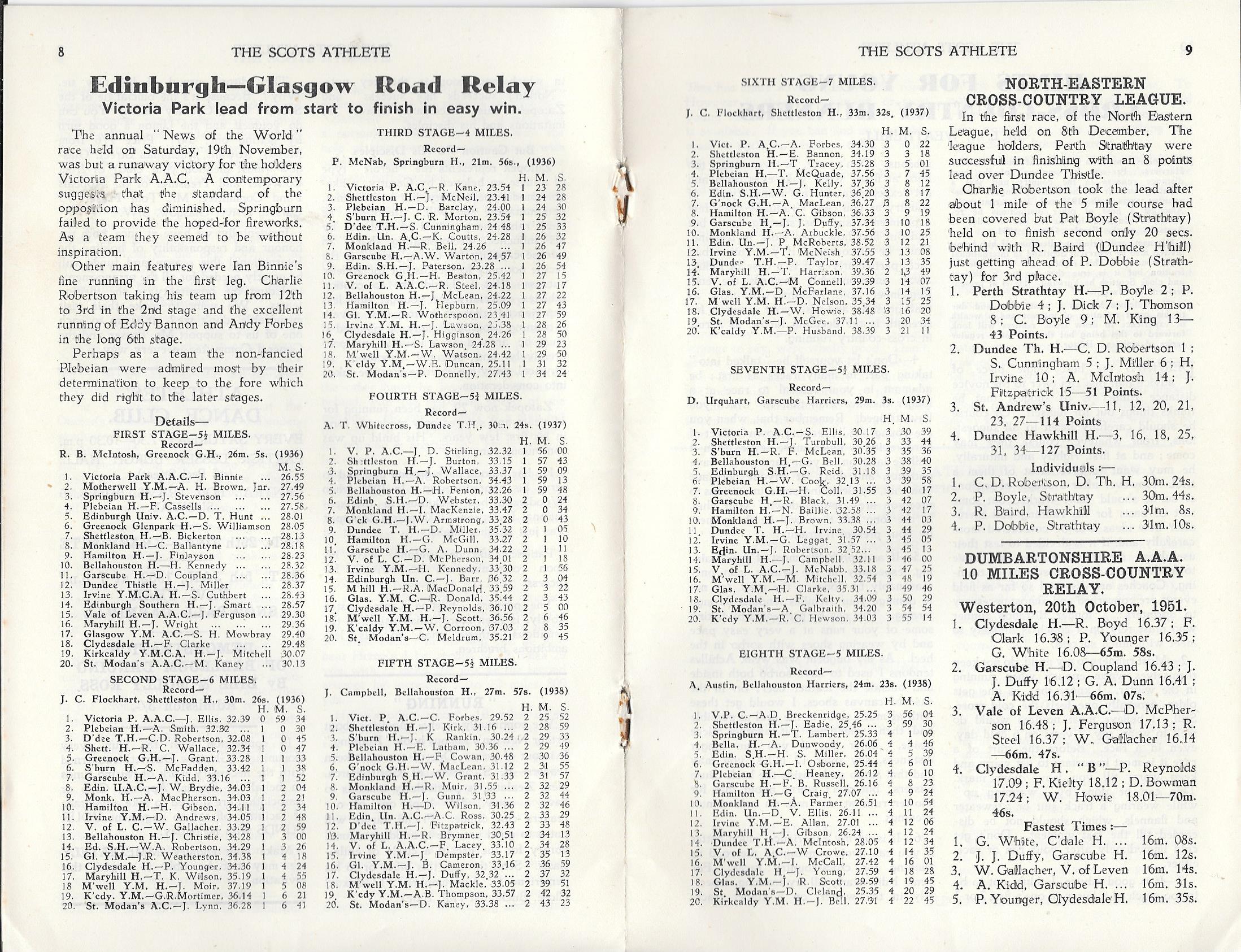
Less than a month later, in November, the club confirmed their outstanding form when they won the Edinburgh to Glasgow eight stage relay.    Shields again:   “Bellahouston Harriers, whose young team had finished second and third in the preceding years, completed their full set of medals when upsetting the post-war monopoly set up by Victoria Park and Shettleston Harriers.   Their first victory since 1938 was not achieved easily as Victoria Park and Shettleston exchanged the lead over the first half of the race.   Once Dick Penman took the lead on the fifth stage and Joe Connolly kept Bellahouston’s lead after a struggle with Alastair Wood (Shettleston) and Ian Binnie (Victoria Park)  on the long sixth stage, good runs by Des Dickson and Ramsay Black brought Bellahouston home to victory in 3 hours 49 minutes 29 seconds, fully 250 yards ahead of Shettleston Harriers.”    It was a triumph to savour – the Victoria Park team in particular had been the team to beat on the roads with their many top class runners seeming to prefer the road to the mud, while Shettleston was arguably the better team over the country with both teams seeming to monopolise the major championships between them   Bert ran on the very tough second stage where took over third and kept the team in close contention by holding the position and handing over in third.

At the start of 1959, the club was second to Shettleston in the District championship , beaten by only nine points before the major championship of the season.    In the National at Hamilton on 28th February the Bellahouston team finishing order was   3rd  Irving;   7th  Connolly;   17th  Dickson;   33rd  Irvine;  45th Black;   52nd  Penman and the team finished third.   The Glasgow Herald merely reported the facts as follows.

“AJ Wood (Shettleston Harriers and RAF) was in excellent form on Saturday in the national senor nime mile championships at Hamilton and won by 33 sec. from J McLaren (Victoria Park AAC) with R  Irving (Bellahouston Harriers) third, six yards behind McLaren.   The holder of the title, AH Brown Motherwell YMCA was eleventh, nearly two minutes behind the winner.”

This excellent run earned Irving selection for the international held that year at Pontcanna Field, Cardiff where he finished 60th.     
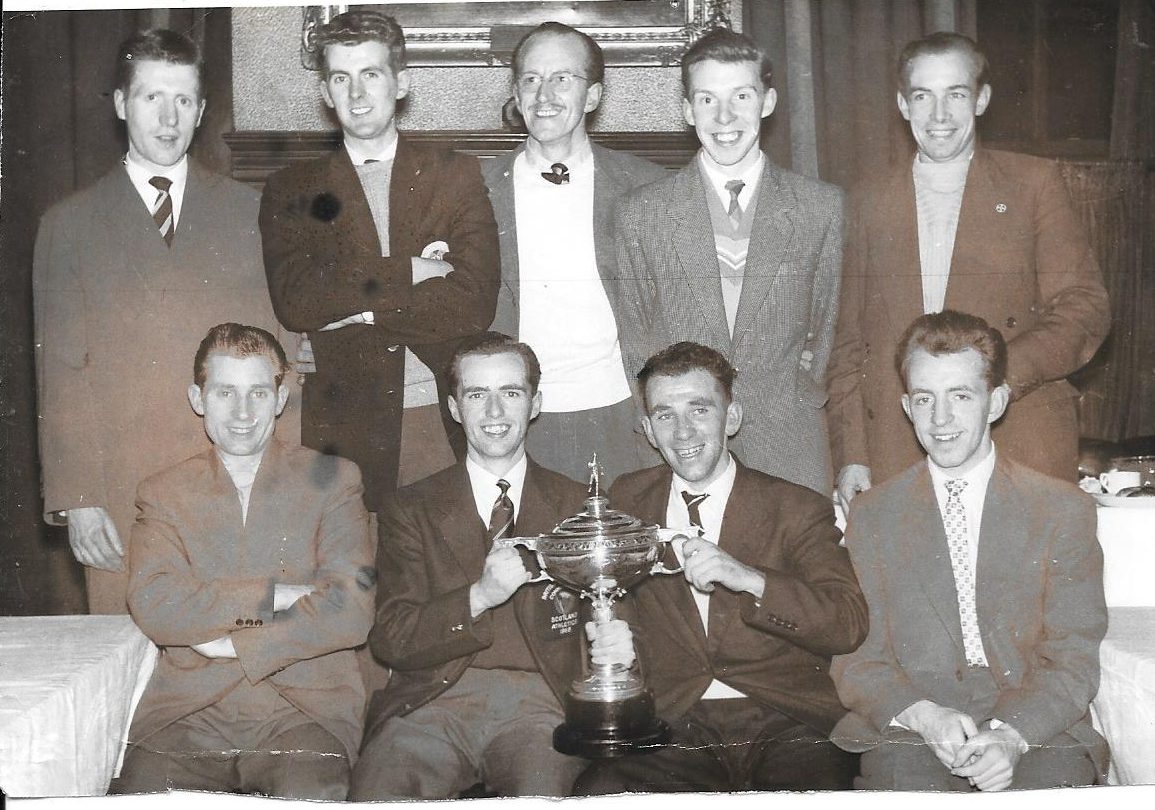
 

The winning Edinburgh to Glasgow team consisted of Goodwin, Irving, Irvine, Fenion, Penman, Dickson, Black.   Bertie is on the right in the back row.

Into season 1959/60 and he missed the McAndrew Relay at Scotstoun and the club three miles championship but when Bellahouston Harriers had the first three teams in the Renfrewshire relays, Bert Irving was in the third team.   It was a cautious selection and not a reflection of the selectors estimate of his abilities.   The winning team was composed of Cowan, Penman, Fenion and Docherty, the second team was W Goodwin, Dickson, Irvine and Wilson, while the third team was Irving, Fraser, Gordon and McLean.    But times don’t lie and Bert Irving had the third fastest time – he was quicker than three of the first team, only Harry Fenion being faster, and Willie Goodwin in the second team was one single second quicker than Irving.   Despite the absence of any track times from that summer, he had lost none of his sharpness.   In the Edinburgh to Glasgow they finished only six seconds slower than in 1958 but were second to Shettleston.   Bert ran on the second stage – the stage where almost all of the top runners ran – and after taking over in seventh place from Goodwin and pulled up three places to fourth for the club.   Over the country the next big championship was the Midland District at Renton in Dunbartonshire.    Graham Everett won for Shettleston with the top Bellahouston men being Joe Connolly (third) and Bert Irving (fifth) leading the club to second place.   The National championship was held at Hamilton again and there were two cub men in the first half dozen:    Connolly was fourth, and Irving fifth.   The rest of the counting runners for the club were Black 13th,   Gordon 18th, Mercer 37th and Dickson 40th and the result of the team race was a second place behind Shettleston,  Bert’s run won him his second international vest with the international being held  over the same course at Hamilton.   On the day Bert finished 41st and was a scoring runner for the Scottish team.

The winter of 1960/61 saw even less of Irving than the previous year – he missed the short relays including the Renfrewshire race where the club had first and second teams, and then he also missed he Edinburgh to Glasgow in November and the District championships in January 1961.

Nor was he out in the National at Hamilton.    The team position was fifth which was indeed a creditable position in the premier national cross-country championship but it was the first time for some years that they had finished out of the medals.   Finishing positions were Connolly 1st,   Irvine 18th,  Black 38th,   Gordon 76th,  Wilson 121st, Wright 128th.    It had been a winter of disappointment for Irving, and for the Bellahouston team, given that he missed all significant races between October and March. 

In season 1961/62 his first appearance was in the Edinburgh to Glasgow Relay where the debates of where to run each man to get the best out of them and what was the best order for the team, bearing in mind the oppositions’s possible placings.   Bellahouston, in 1961, ran Joe Connolly on the first stage where he crossed the line first – six seconds clear of Brownlee (ESH) and Binnie (VPAAC).   Arguably their best man was used first.   Bert Irving, possibly the next best runner but who had not run a serious race since the international in 1960, was next up.   Taking over in the lead, he kept first place and handed over three seconds up on Motherwell’s John Linaker who had come through from thirteenth to second.   After the stage positions were third, third, third, fifth, fourth and fourth.   The runners all ran well but the question has to be asked as to why the top two men were first and second when normal practice would have put them second and sixth.   Bert however repaid the confidence placed in him by running the third fastest time on this fiercely competitive part of the race.

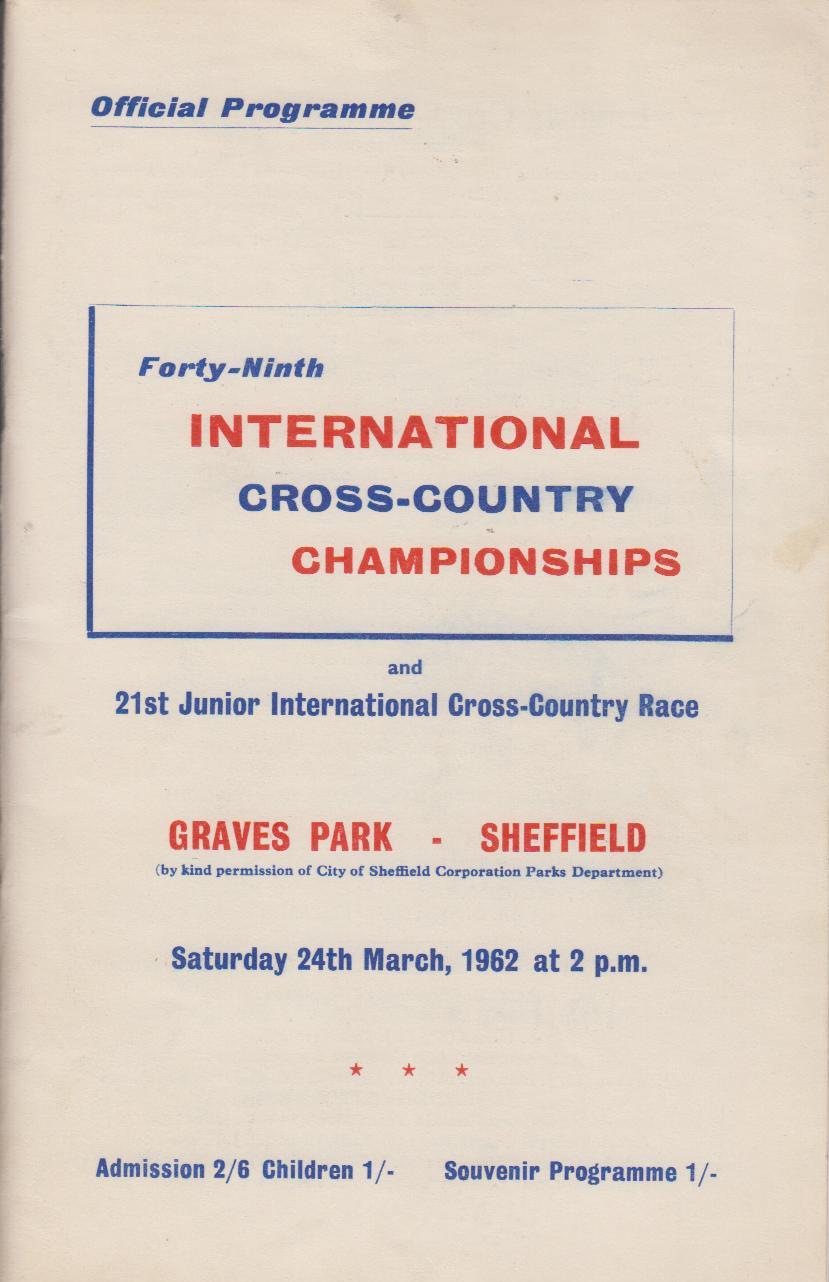
He next appeared in a race on 20th January, 1962, in he Midland District Championship at Strathleven where he finished sixth leading the team to third place behind Motherwell and Shettleston.   In  the National at Hamilton    the Bellahouston finishing order was   6th. Irving,   33rd Wilson,    34th Irvine,    39th Dickson,    49th Penman,    70th McDonald  with the team finishing seventh.   This run of course qualified him for the international to be held at Graves Park, Sheffield where he was  58th finisher.

The following season of 1962/63 was again diminished by the absence of Bert who ran in none of the major championships.   Living as he did in the far South West of Scotland there was little chance for us to find out what his problem was: he must have been injured to miss as much of the season as he did.  The 1962 race was to be his last International vest.  However, came the following winter he was again in action.   If he ran in the McAndrew, Renfrewshire or Midland District relays, it was not in the first team.   Came he Edinbugh to Glasgow in November, he was on stage four of the relay and moved the team up from 16th to 15th.   That was to be the only major race for him that season as he didn’t run in any of the other championships..
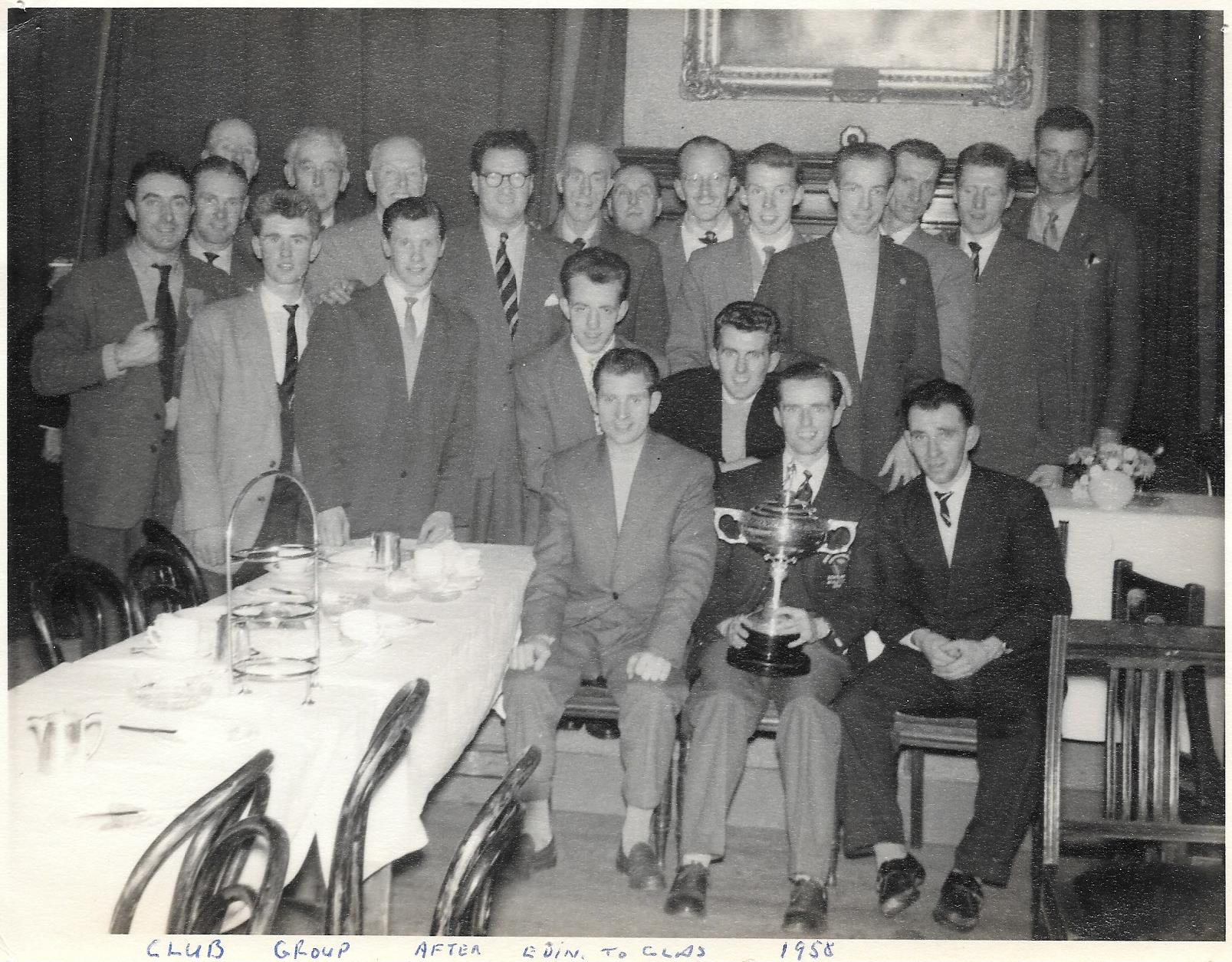
Bert was to have no more international appearances and he did less racing after that date although he did turn out for the team for many more years yet. 

His 1964 winter started on 21st November in the Edinburgh to Glasgow where he ran the second stage sandwiched between Brian Goodwin in eighth place and Mike McLean in eleventh.   Bert himself dropped three places but on that stage, they were all to good men.   In winter 1965/66 he ran the second stage of the relay yet again and took over in fifteenth place which he improved to twelfth.  The team actually finished tenth that year.  With the team finishing eleventh in the national, Bert does not appear in the top 78 runners and maybe didn’t run at all that year.    In the 1966 Edinburgh to Glasgow he was yet again on the second stage and held on to the twelfth place he took over in for the club which finished tenth that year.   

*

One of Bert’s team mates, Jim Irvine, who was a class runner himself and won medals of all colours in every single cross country championship available to him, has been in touch with one of Bert’s friends in Galloway, Mr Alex Peebles who says

I’ve just spent an interesting hour with an old local retired joiner here in Drummore. His name is Jackie Alexander. He was a boyhood and lifelong friend of Bertie Irving.
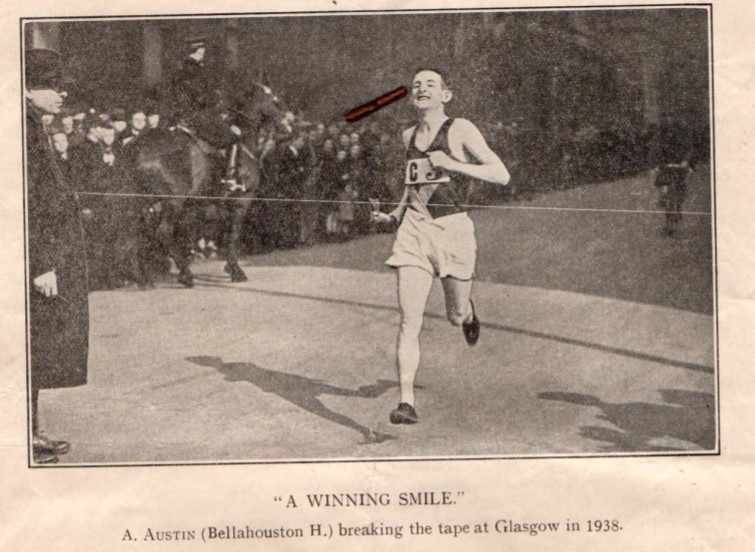
Jackie confirms that Bertie was in the Black Watch for his national service and did a three year stint. It was being in the army that started his interest in sport in general and running in particular.
Bertie was a member of Stranraer Harriers and it may have been a Mr Roberts or Robertson who recommended him to Belahouston Harriers. Jackie used to accompany Bertie on his trips up to Glasgow and remembers being met by a Mr Davy Corbett, they stayed at his house in Glasgow. Jackie remembers Bertie doing very well around 1959. Bertie was and stayed an all round sportsman all his life. He played football for Drummore village in the then very competitive Summer Leagues, winning a very competitive cup final for the Nathan Lowe cup in 1958.
Bertie also played Tennis and Table Tennis and as he grew older was a staunch member of the village Bowling Club. During this time he worked for the Co-Op Insurance company not the Prudential or the Pearl. He married Mattie McClean (a relative of mine I’ve just found out, we share an Aunt) they had one child a girl called Linda. Linda is now Mrs Dickson and lives in Dumfries but I do not know her address. Bertie’s other interests were gardening and keeping hens. In his later years he had very bad hip problems (probably the running!)
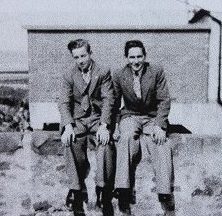
Attached is a photo of the two pals Bertie and Jackie as teenagers in Drummore. Jackie has a great memory and remembers some of the names from that time mentioned in the Belahouston web page.
There was the story that went around for several years that he only ran three races a year – the E-G, the National and the International which had a lot to do with the difficulties of getting to races.   That Bert was a  top class athlete there can be no doubt – but could he have been better?   
 
Living in Galloway presented some problems for a serious runner.
First, he had to train on his own while the opposition could train regularly with other runners, the Tuesday and Thursday pack runs were often testing affairs where the athletes pulled the best out of each other and many good tips were passed on in the course of these runs.   
Second, it was also harder to get to races.   What did runners gain from regular racing?   They learned how to race, how to work harder and also a bit about the opposition.   
Third, he also had to spend time travelling to races – it is one thing to jump on to a bus for 20 minutes or half an hour to get to a race, it is totally different to have to spend hours at a time to get to a venue.   
 
Bert had these difficulties of training alone and travel to races yet managed to keep his motivation and challenge the best in the country despite them.   He was liked and respected by everyone that I ever spoke to.   Bert Irving was one of a kind.

Edinburgh to Glasgow: Stage Eight

T Ross to Eddie Bannon, April 1949

1957: Chic Forbes finishes for Victoria Park

1958: Black finishes for Bellahouston

1960: Tom Malone finishes for Shettleston Harriers

1961: Wotherspoon finishes for Shettleston

1964: John Poulton finishes for Motherwell YMCA

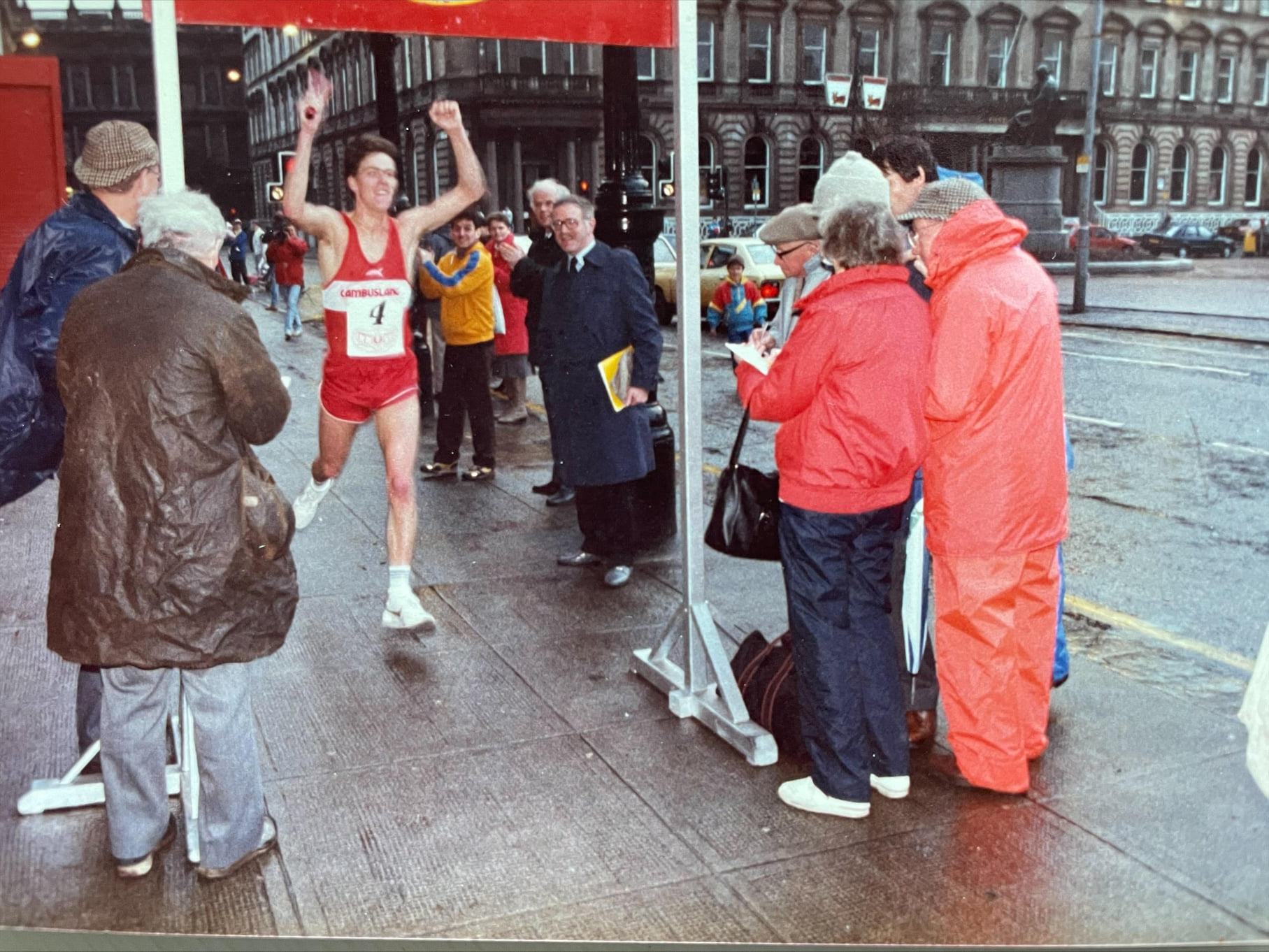
Jim Orr, Cambuslang, 1987, first team.

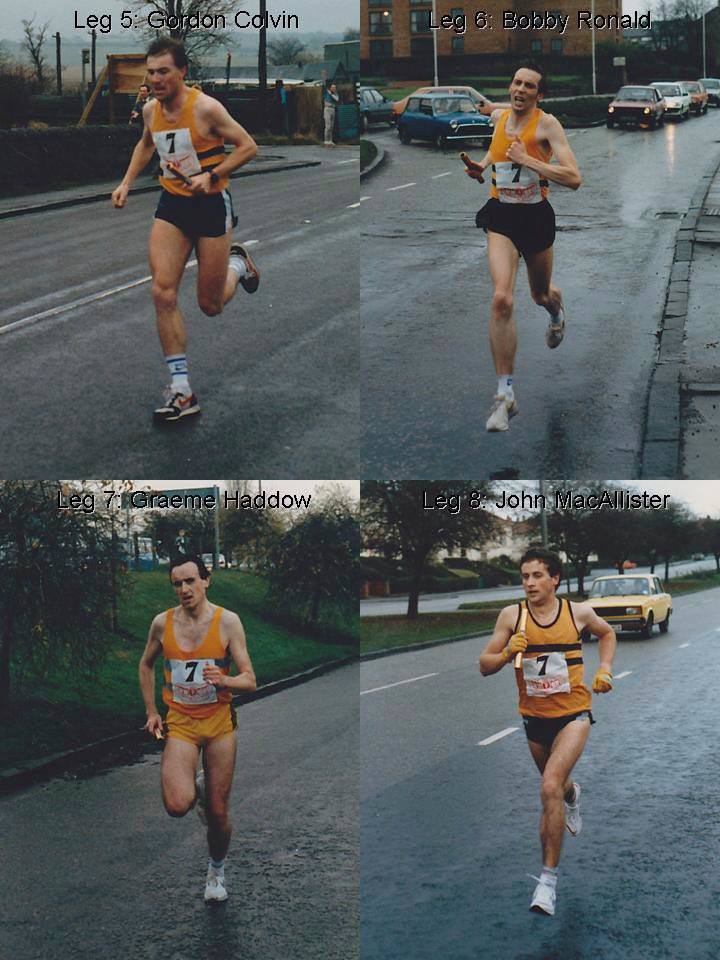
John McAllister, East Kilbride AAC, 1987 

Aberdeen team, 1988


1990: John Pentecost crossing the line for the winning Falkirk Victoria Harriers team


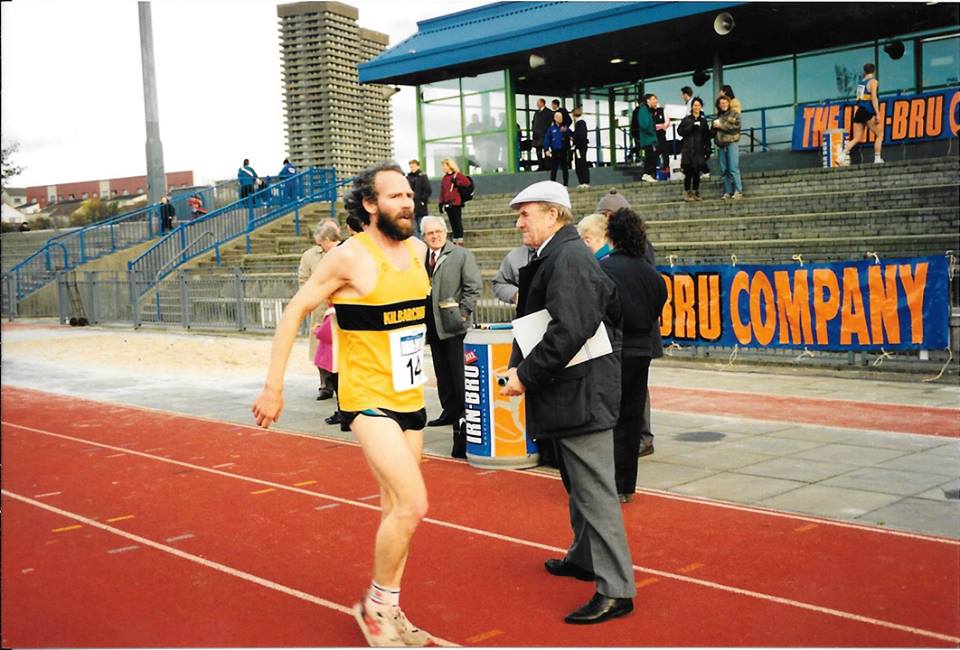
Gerry Fairley, Kilbarchan, finishing and handing the baton to Harry Quinn, in Crown Point arena, 2001


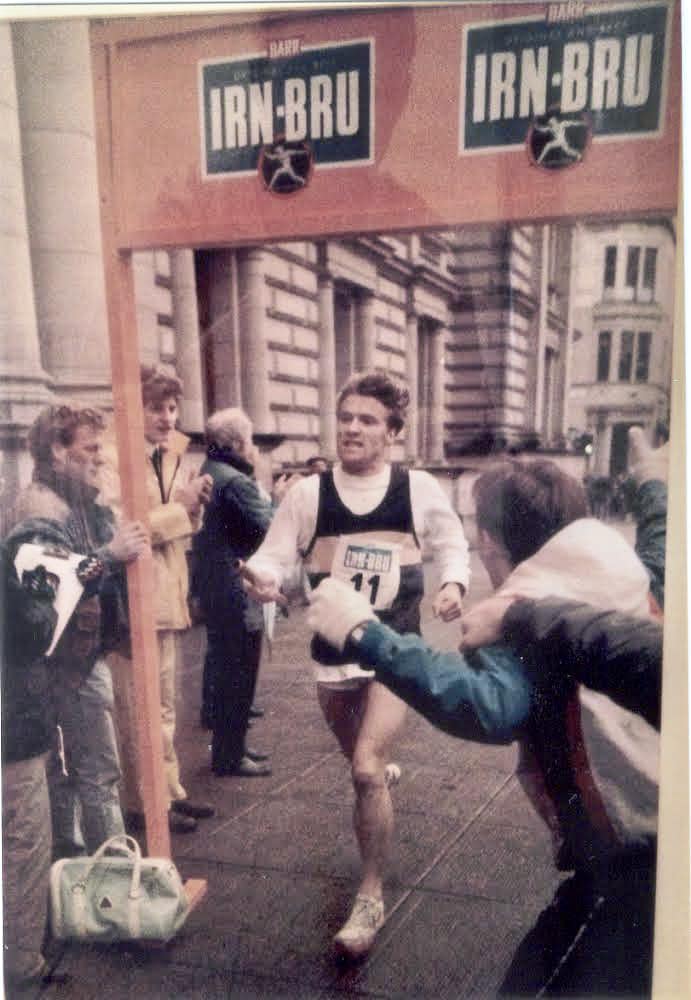
Colin Youngson, final stage, 1986

Derek Halpin, Clydesdale, 1997

1988: Colin Youngson leading the field in

Ian Elliott, Edinburgh Southern Harriers

Charlie Haskett, Dundee Hawkhill Harriers

Alan Robson, Racing Club, above and below

..

Edinburgh to Glasgow: VPAAC Win 1951

Shettleston Harriers won two Edinburgh to Glasgow races on the trot before Victoria Park took over to become the dominant force in the race for the 1950’s.   With seven wins in eight years plus one second and two thirds in a decade when Scottish club running was at a real high with VPAAC, Shettleston, Bellahouston and Edinburgh Southern all operating at a high level their feat in the eight-man relay – four man teams were the norm with six men required for the District and National championships – showing gnuined strength in depth.   This was their first victory of many.

Ian Binnie to Jim Ellis at the end of stage one

Ellis to Ronnie Kane at the end of the second stage

Johnny Stirling to Chic Forbes at the end of the fourth stage

Andy Forbes to Syd Ellis at the end of the long sixth stage

Ellis gives Alex Breckenridge a lead of over 3 minutes at the start of the last leg.

The club went on to win in 1950, 1951, ’52, ’53, ’54, ’56 and ’57 with second place in 1955 and thirds in 1958 and ’59 

Edinburgh to Glasgow: Stage Five

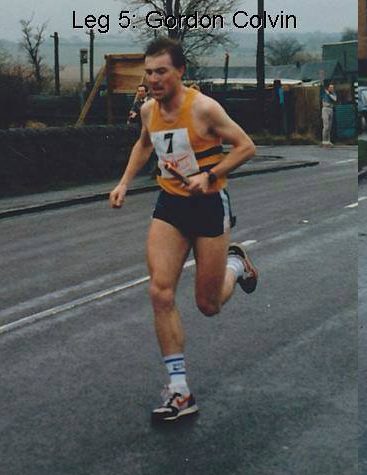
Many runners, clubmen and supporters concentrated on the long leg (six), the champions leg (two) and maybe four – but then the first stage was vital if you were gpoing to be a contestant, and three was one where a lot of ground could be lost on what was the shortest leg of the race – very few looked at five in any detail.  The fifth stage was fairly long (5 miles plus) but was without any doubt the most exposed of them all.   If there was a wind, you got it all the way, and in one year there was a bit of a gale blowing and I remember getting in to the bus at the end of the stage followed by a student from one of the university teams gasping, “That wind!   Oh!   That wind.   What a wind.   Oh that wind!”   When it snowed, as it did at least once, the leg was one of the toughest any of us had experienced.

Shettleston’s Ben Bickerton to Harry Howard in April 1949: start of fifth

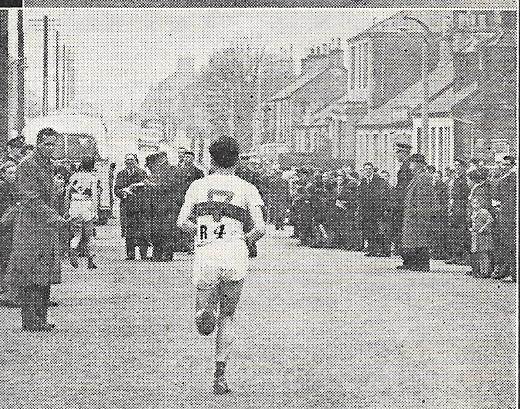
1957: the Armadale changeover, B4 being the Irvine YMCA runner

1959: George Meikle to John Hamilton for Teviotdale

Henry Summerhill to Graham Everett (Shettleston) in 1960


Roden to Moody for Teviotdale in 1961


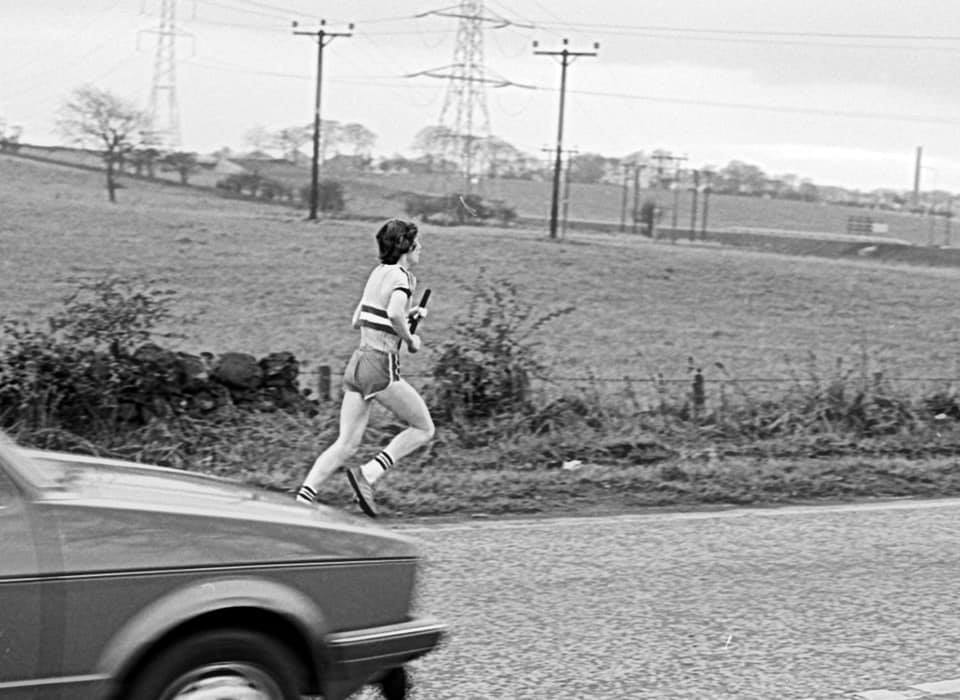
Davie Simpson, Law and District in 1975

Chic Forbes (VPAAC) to Ian Binnie at the end of Stage 5

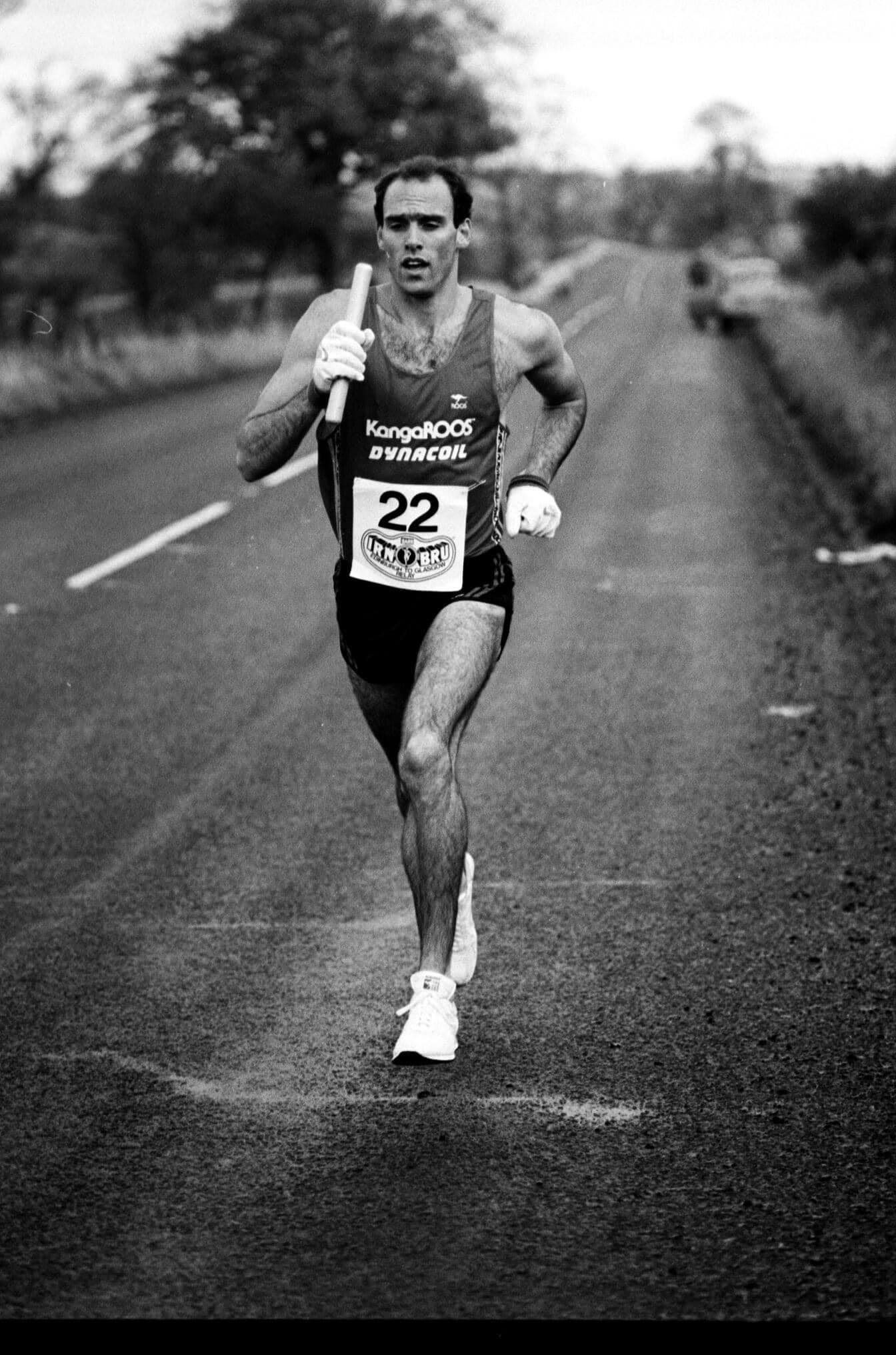
1985: Tom Graves, Kangaroos (a travelling group of US runners)

The excellent black and white pictures below are of course by Graham MacIndoe

1985: Alistair Douglas (Victoria Park AAC)

1985: Derek Easton (Falkirk Victoria)

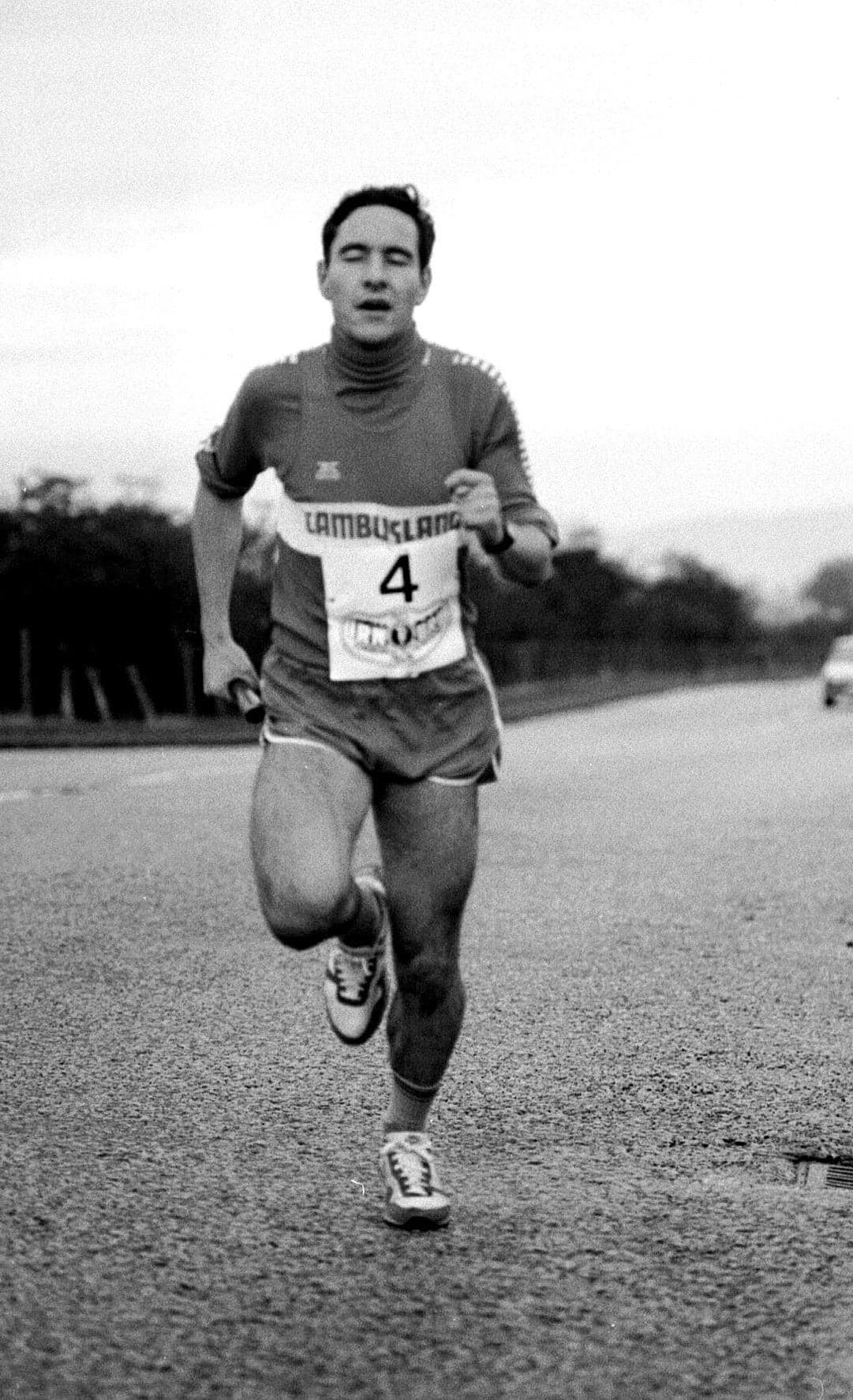
1985: Colin Donnelly (Cambuslang)

1985: Keith Lyall (Edinburgh Southern Harriers)

1986: Laing (AAAC), Connaghan (Spango Valley), Thomson (Cambuslang)

Charlie Thomson finishing stage 5, to Alex Gilmour for Cambuslang

The next four are by Roddy Simpson, as shown on Scottish Running in the 80’s Facebook page, and are of the 1992 Race.

Allan Adams running for Victoria Park AAC

J Garland of Edinburgh AC

The changeover at Armadale: David Cameron of Shettleston to Tony Coyne

Same change over: Hawkhill’s B Pattieson to Matt Strachan


Edinburgh AC changeover

2001


Edinburgh to Glasgow: Stage Seven

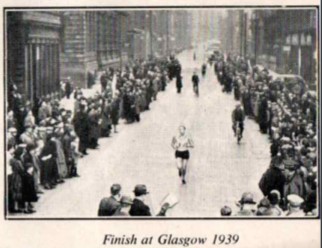
1939: Emmet Farrell to Archie Peters at the start of stage seven after running the fastest time on six.

1957: Harry Fenion, Bellahouston, to Jim Irvine

1957: Jim Irvine: note the bus with the open door and team mates shouting – one even has a rickety!


1958: Joe Connolly, Bellahouston, to Des Dickson

1959: Hugo Fox to Robert Wotherspoon for Shettleston

Gordon, Bellahouston, to Black in 1960

1960, A Ross to K Ballantyne (ESH) at the sixth to seventh changeover.   Ballantynes was knocked down on the seventh and never made the finish.   Taken to hospital but released.


1961: Steve Taylor (AAAC) to Alex Howie after running third fastest long stage

Douglas to Meikle for Teviotdale in 1964

Henderson, EAC, to Prior at Airdrie in 1964

Dundee Hawkhill and Springburn side by side at the changeover in 1964

Graeme Grant (Dumbarton AAC) in 1967

Davie Lang (Cambuslang) and E McKee (Spango Valley) 1986

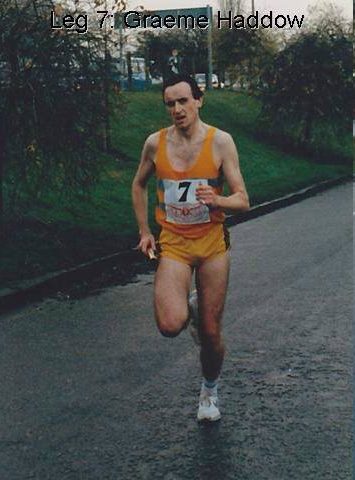
Graeme Haddow, East Kilbride, 1987

M Johnston (Edinburgh Athletic Club) in 1994

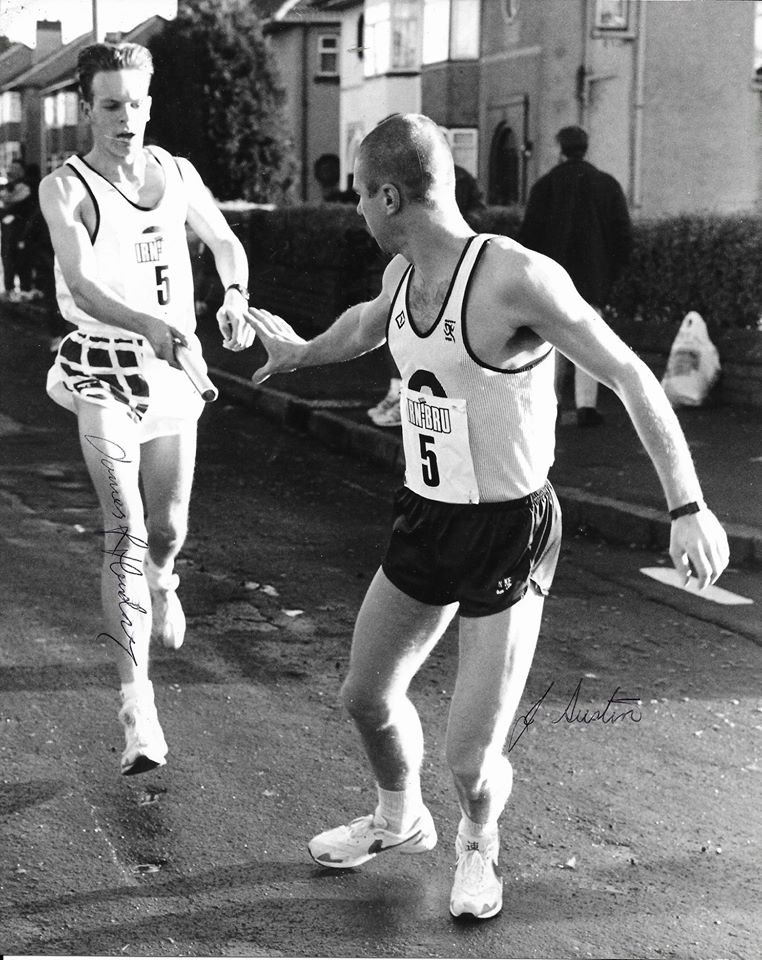
Jamie Hendry to James Austin (Clydesdale Harriers): seven to eight

Bobby Young, Clydesdale Harriers, from Ian Taylor, Carnegie


Edinburgh to Glasgow: On the Cover

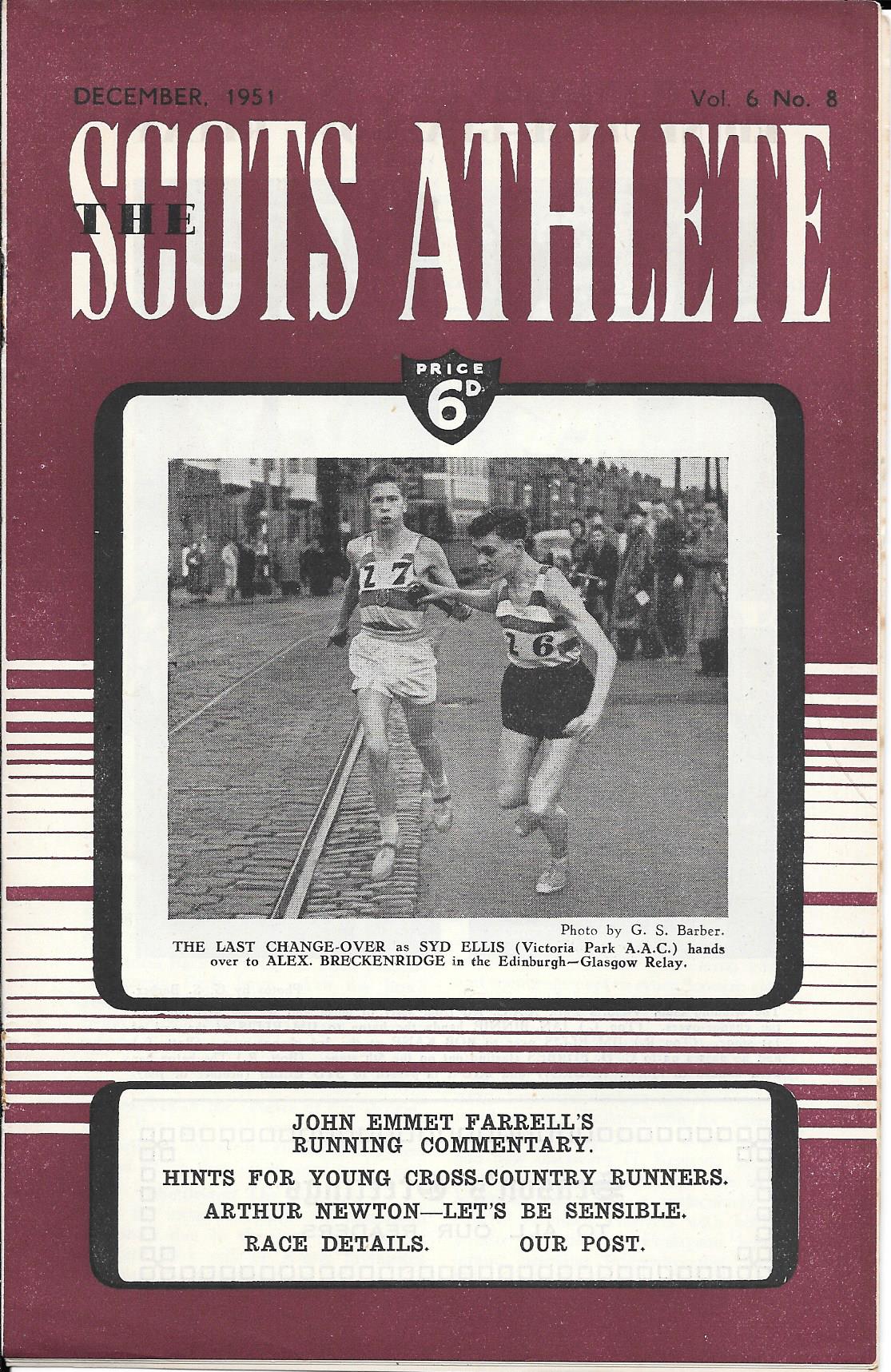
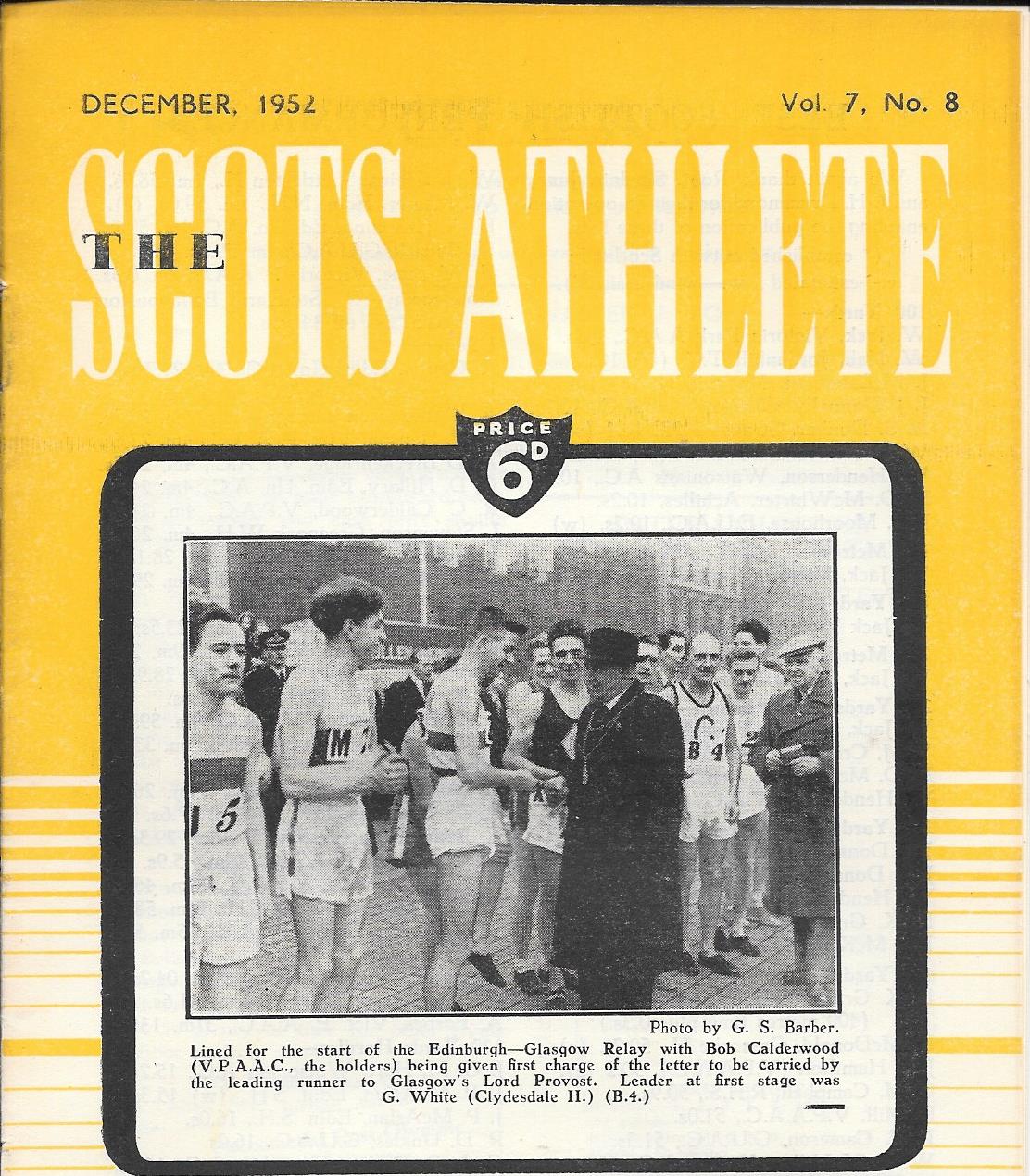
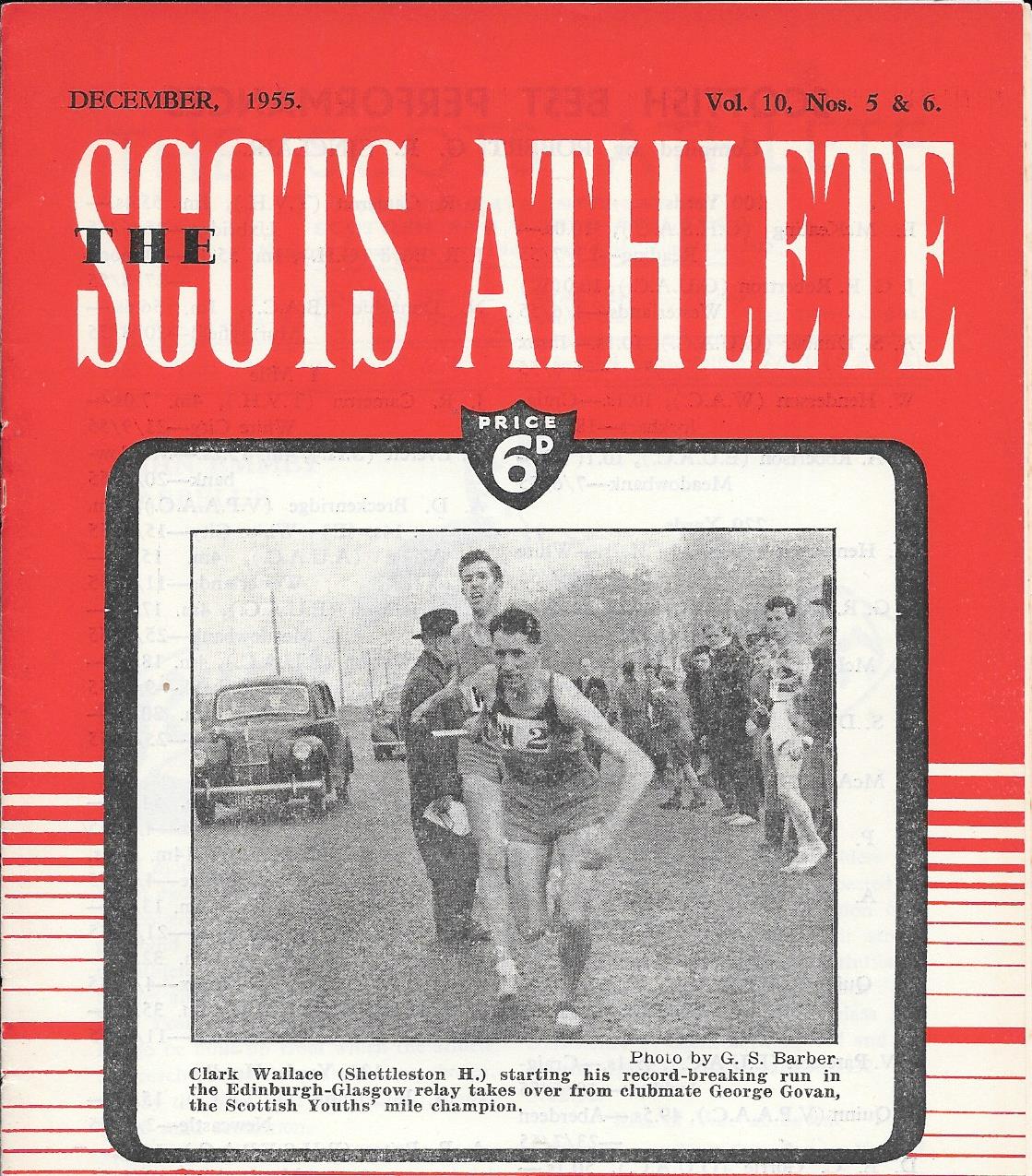
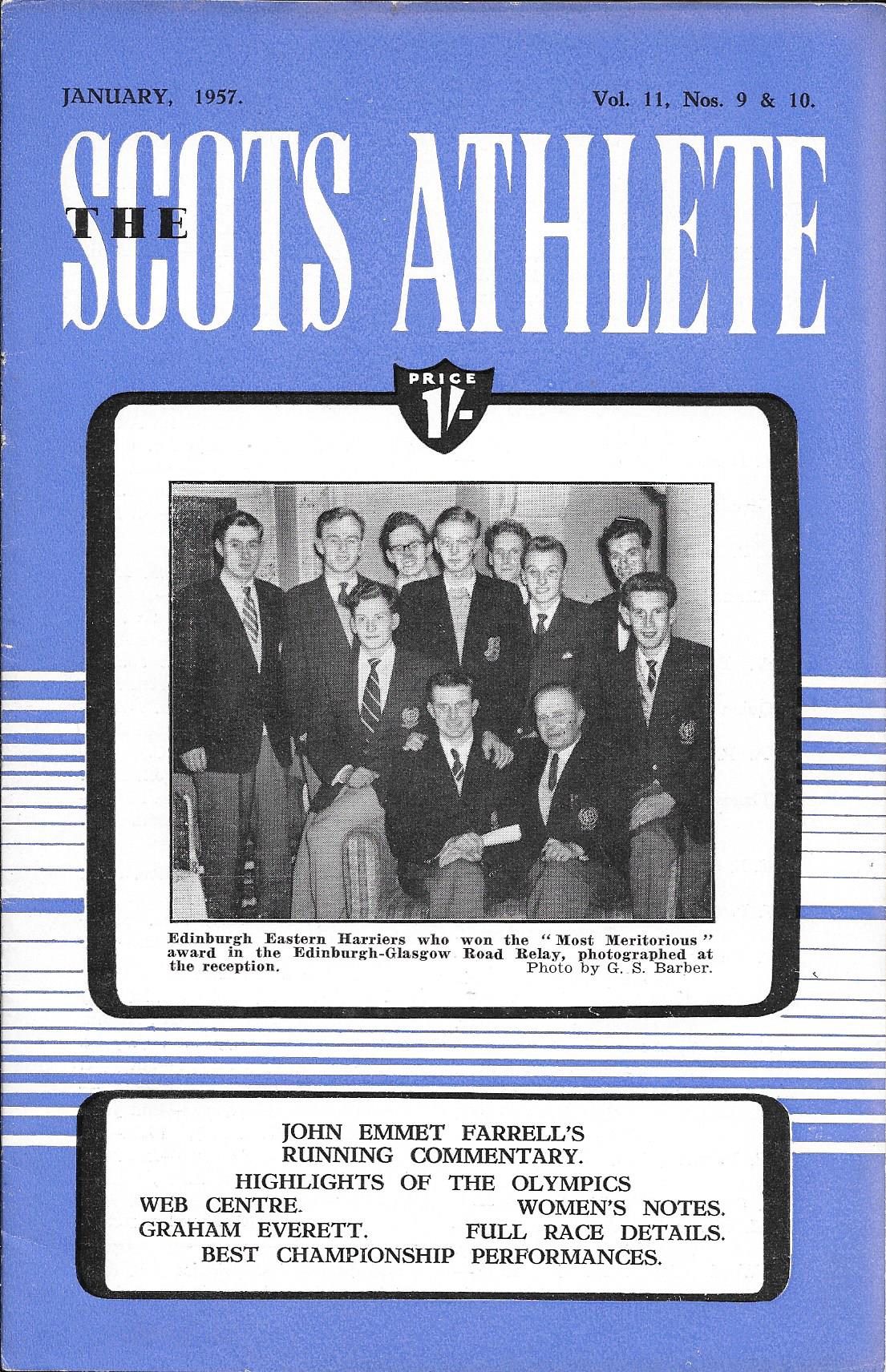
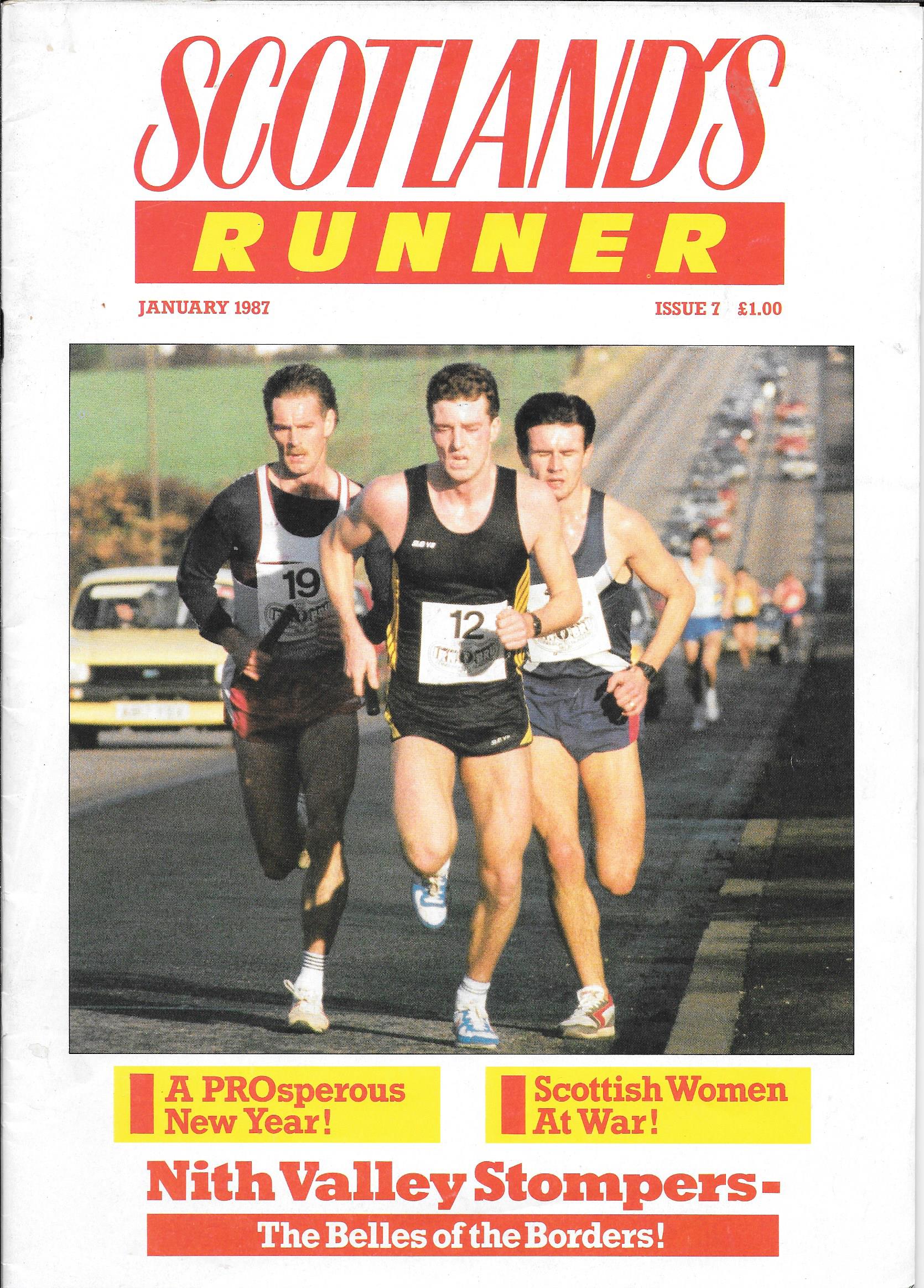
For all that the race was a genuine classic, and given the number of magazines which  covered the sport for several years at a time, there were few front covers which featured the race.   We start with four from the ‘Scots Athlete’ magazine.

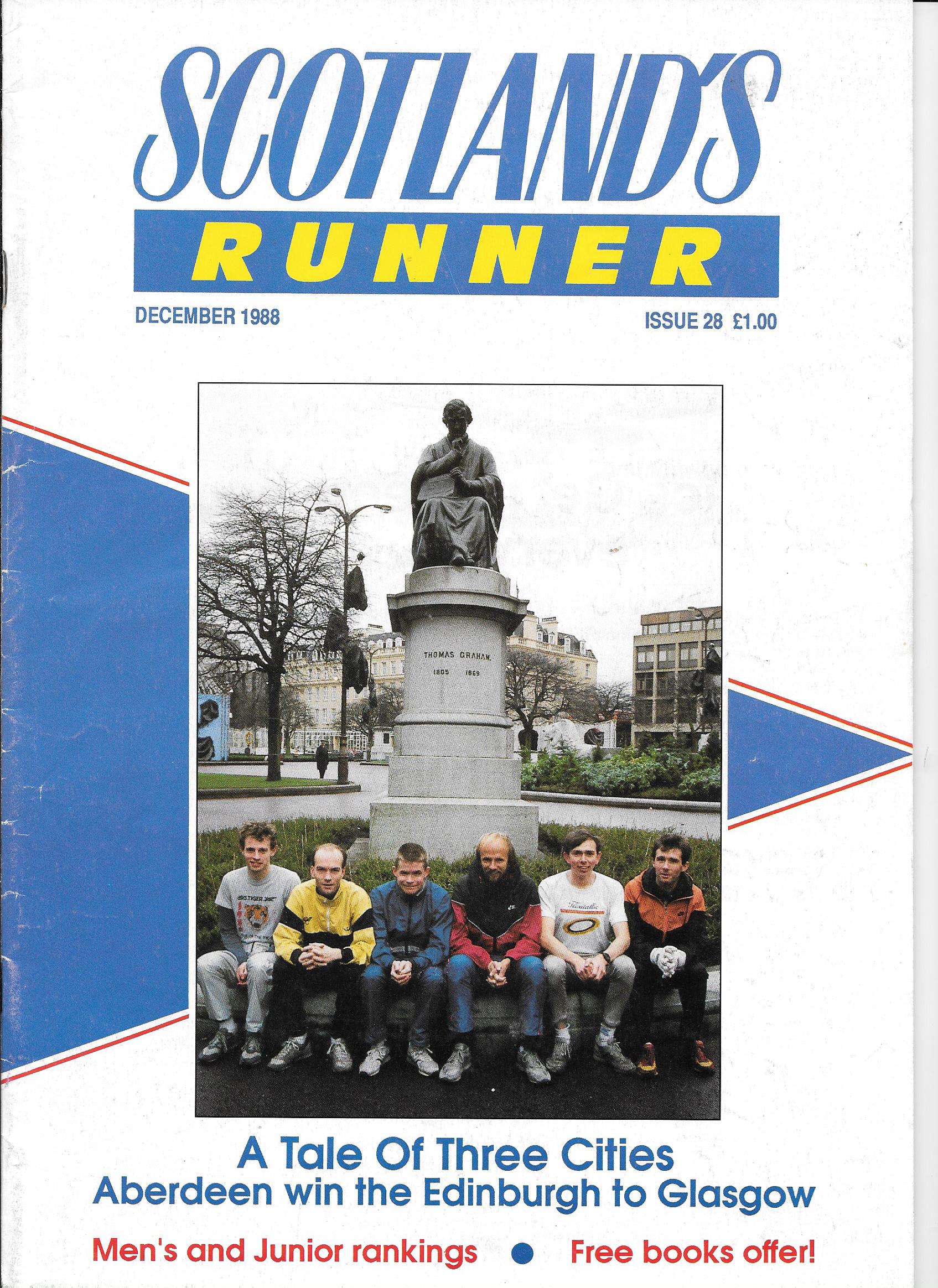
… and a couple from  “Scotland’s Runner”


Edinburgh to Glasgow: Stage Four

Stage Four was another difficult one and, arguably, the toughest after the second and sixth stages.    Partly because the standard of runners was often higher than on legs other than two and six .   Clubs tried to maximise the contribution from their strongest runners by putting them on the longest stages OR by placing them strategically along the route.   After a good run on Stage Two, Stage Four had to be good to repair immediately any loss of position on Three (the shortest) before the notoriously open, exposed and often very windy fifth leg where picking up places would be difficult.   All legs were difficult in this marvellous event, but some were a wee bittie more difficult than others!

1958: Kelly to Fox, Shettleston at the changeover from three to four

Tom O’Reilly, Stage Four, 1954

Alex Miller, Law and District, on Stage Four in 1974

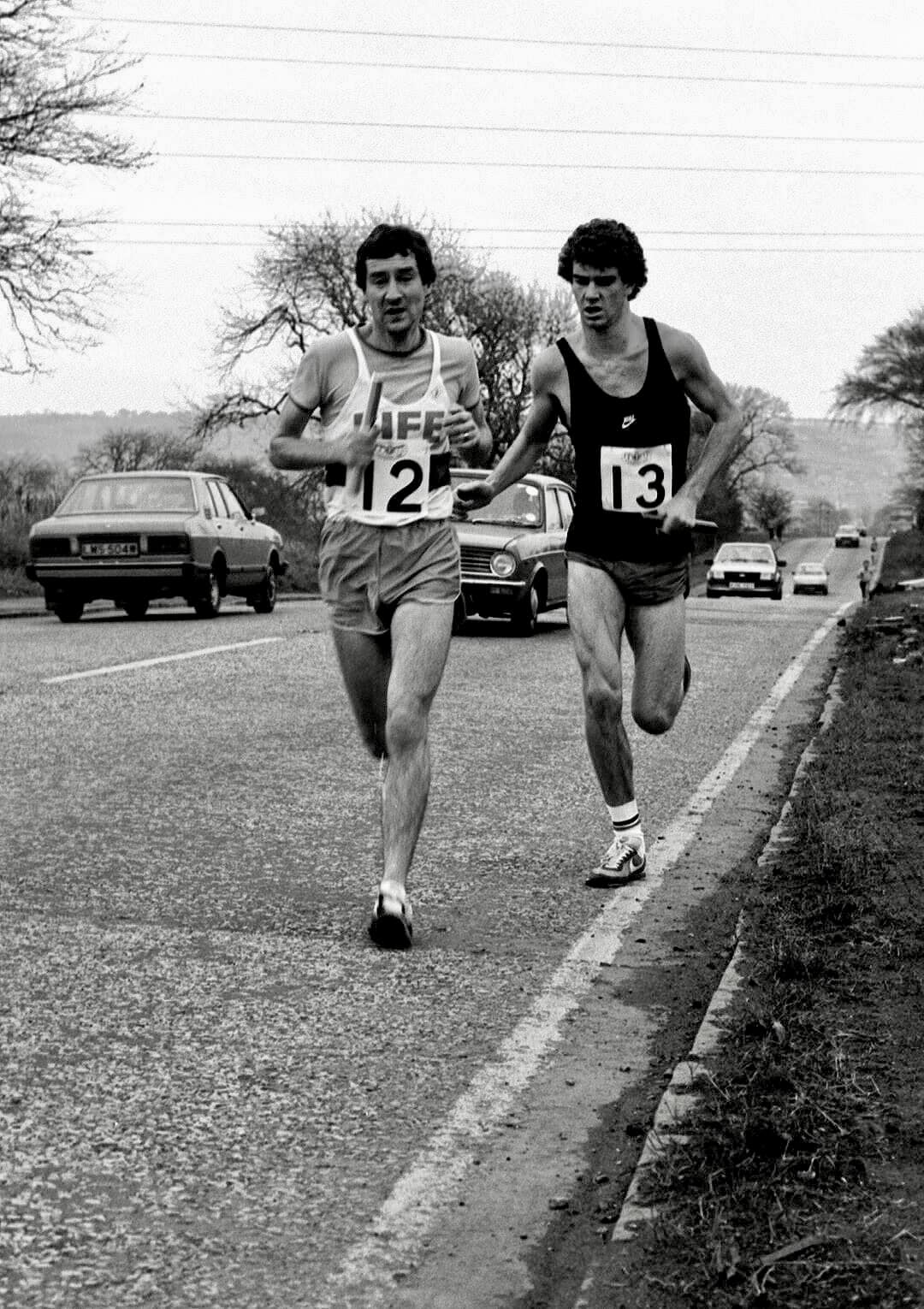
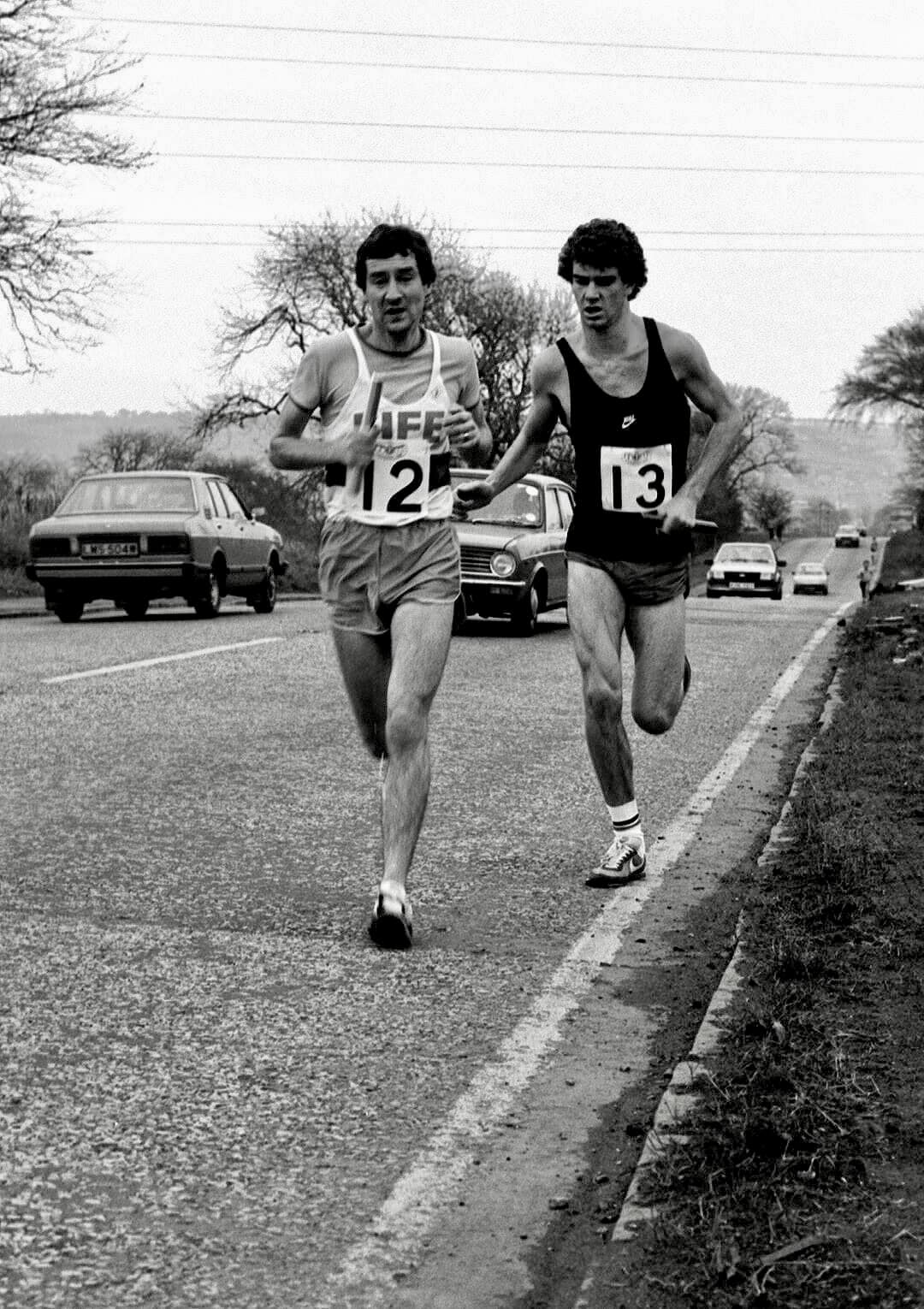
1983: Ian Graves (Fife – 12) and Tom Gillespie (GUAC – 13)

Graham Getty, Bellahouston Harriers, 1984

1983, Tom Gillespie (13  GUH&H) and Ian Graves (12 Fife AC)

Jim Orr to Eddie Stewart, Cambuslang, 1983

Alex Gilmour 1984

Brian Carty, Shettleston, 1985

Doug Runciman, Cambuslang Harriers, 1994

Shane Daly to Kheredine Idessane at the start of fourth stage, 1997

Kheredine Idessane, Clydesdale, 1997

Scott Cohen, Robert Fitzgerald, 1998

Edinburgh to Glasgow: Some First Stage Pictures

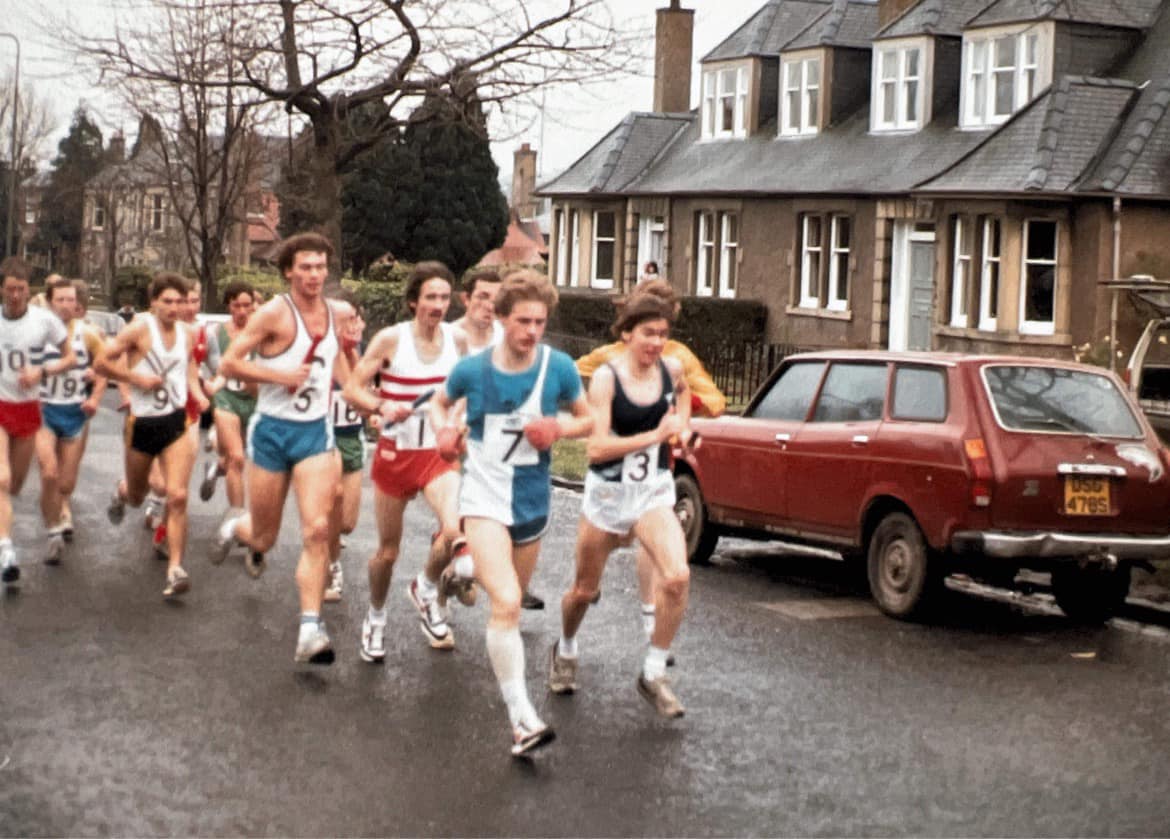
Donnie Bain (FVH) and Adrian Callan (Springburn)

Same race: Dougie Bain and Adrian Callan (Springburn)

1958: Billy Goodwin (Bellahouston) and George White (Clydesdale)

Gordon Nelson, Bellahouston, 1958

1959: Billy Goodwin (Bellahouston) and J Ewing (Victoria Park)

Alistair Blamire, (EU H&H) leading Ian Binnie (VPAAC)  in 1965

1976

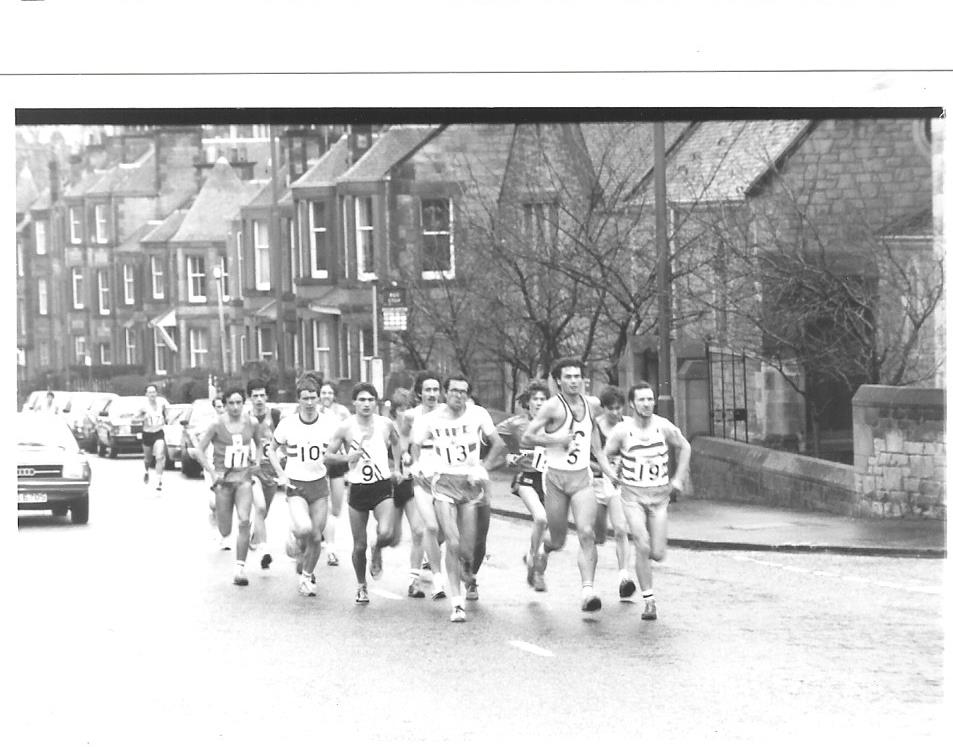
Both above from 1982: 19 Tommy Wiseman, 5 Robert McWatt, 13 Donald Macgregor, 9 Nigel Jones, 


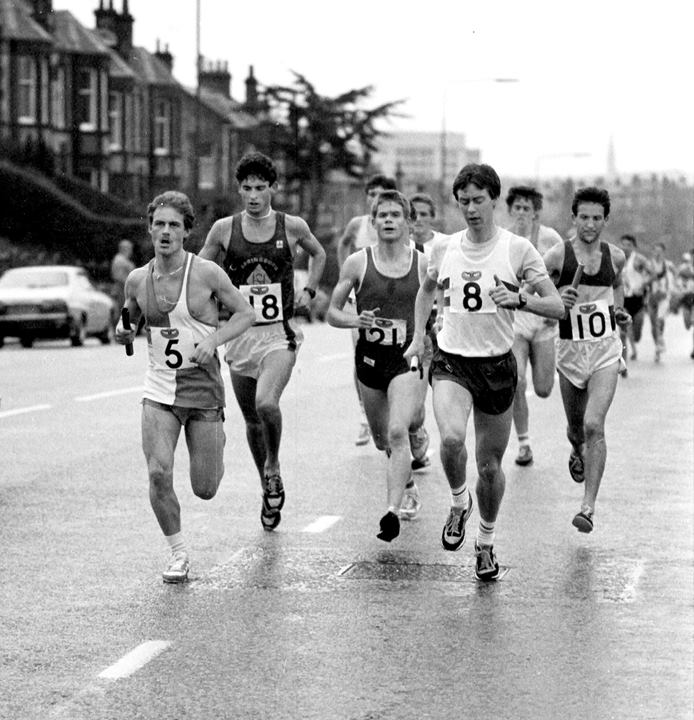
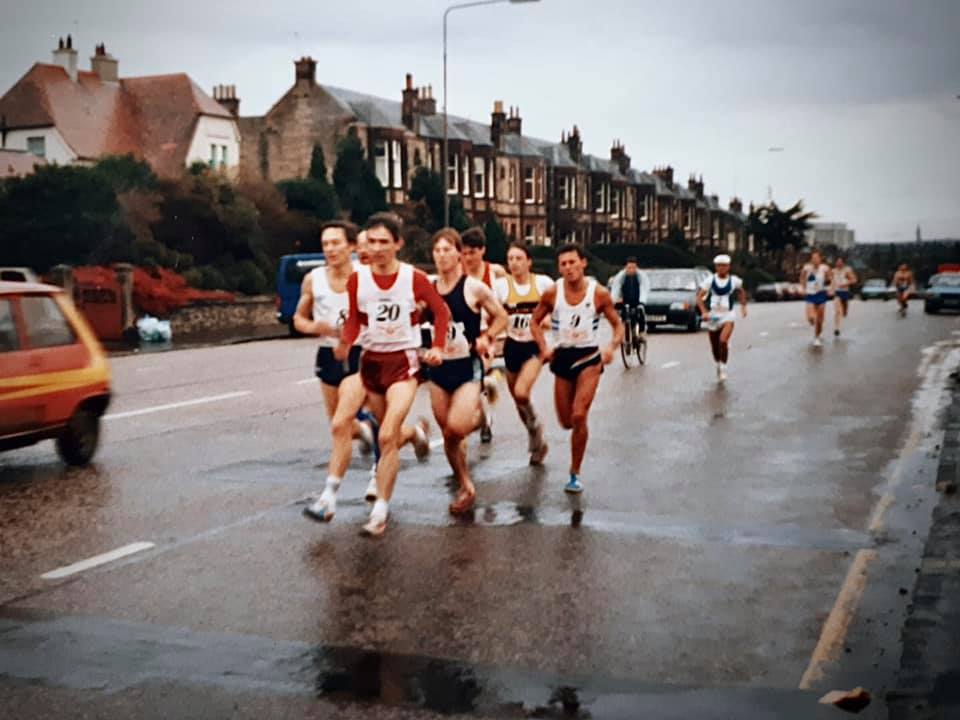
1984: Hugh McKay (5), Adrian Callan (18), Simon Axon (21), Iain Steele (8), Donnie Bain (10) and Alan Currie

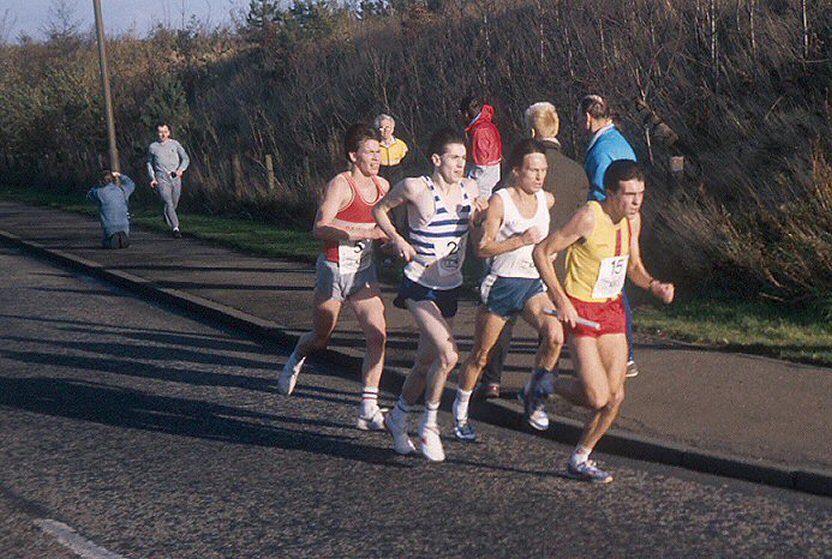
Paul Dugdale, Adrian Weatherhead, Mark Wallace (VPAAC) and Jim Orr ,Cambuslang, 1986

Ian Steel (ESH *) and Simon Axon (North District 21)   1986

First stage: 1987

Lachie Stewart and David McMeekin on the first stage in 1987

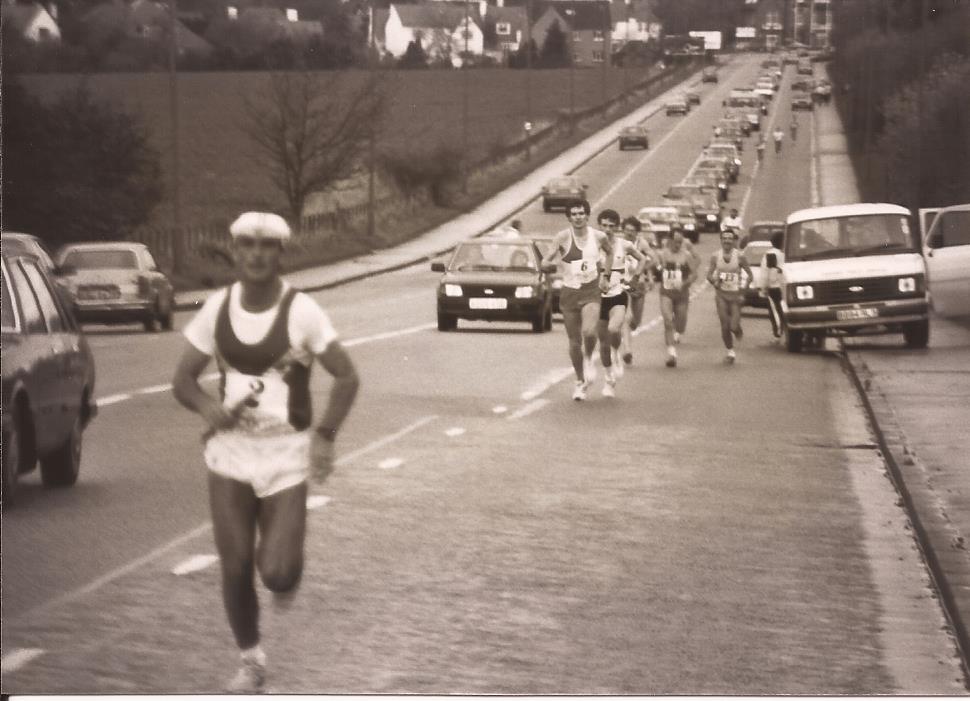
At the end of stage one the long drag up from the Barnton Roundabout to the top and the ‘One Mile to Go’ sign really sorted out the field.   This is the view supporters got when looking back down for their runner.

Andy Daly had broken away from the group he was running with at this point

Withe Andy gone, Ian Archibald leads the chasing group with Jim Dingwall dropping off.

1984

1990: Great shot posted by A Laird on Graham’s website

1986


Steve Taylor’s Memorabilia


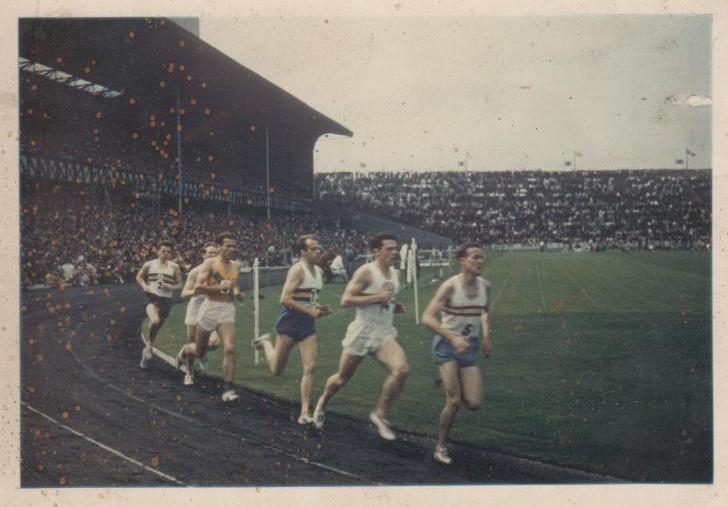
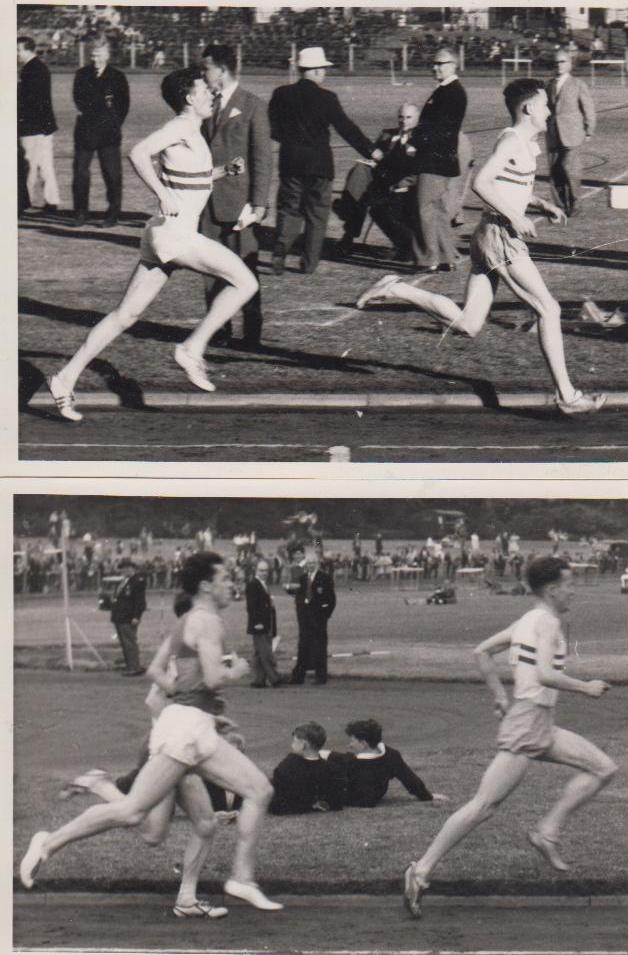
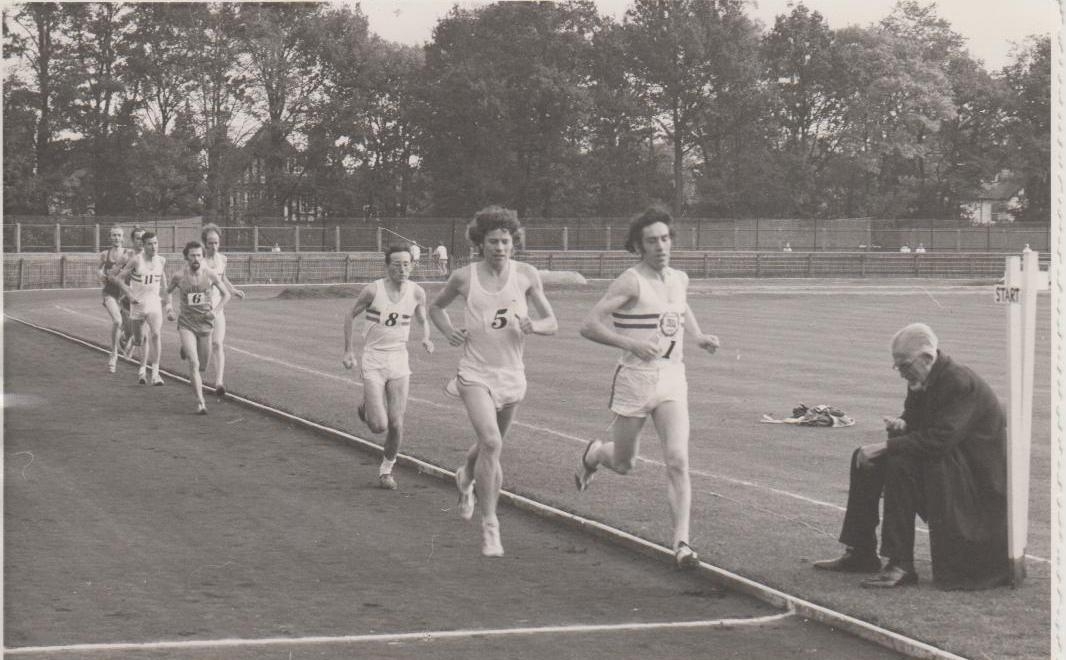
Steve Taylor leads Graham Everett, Derek Ibbotson, Laszlo Tabori, Ken Wood and Stan Taylor  at Ibrox in the Mile in 1960

Looking at athletics memorabilia is fascinating: we learn not only about the events in which an athlete has been competing but also about the wider field of athletics at that time.   Scottish athletics in my lifetime has undergone any changes but none more so that in the type of competition offered to the athletes or to the range of competition either.   We have Andy Forbes’ programmes and cuttings elsewhere on the site and what we have here are some of the photographs and programmes from Steve Taylor’s collection.

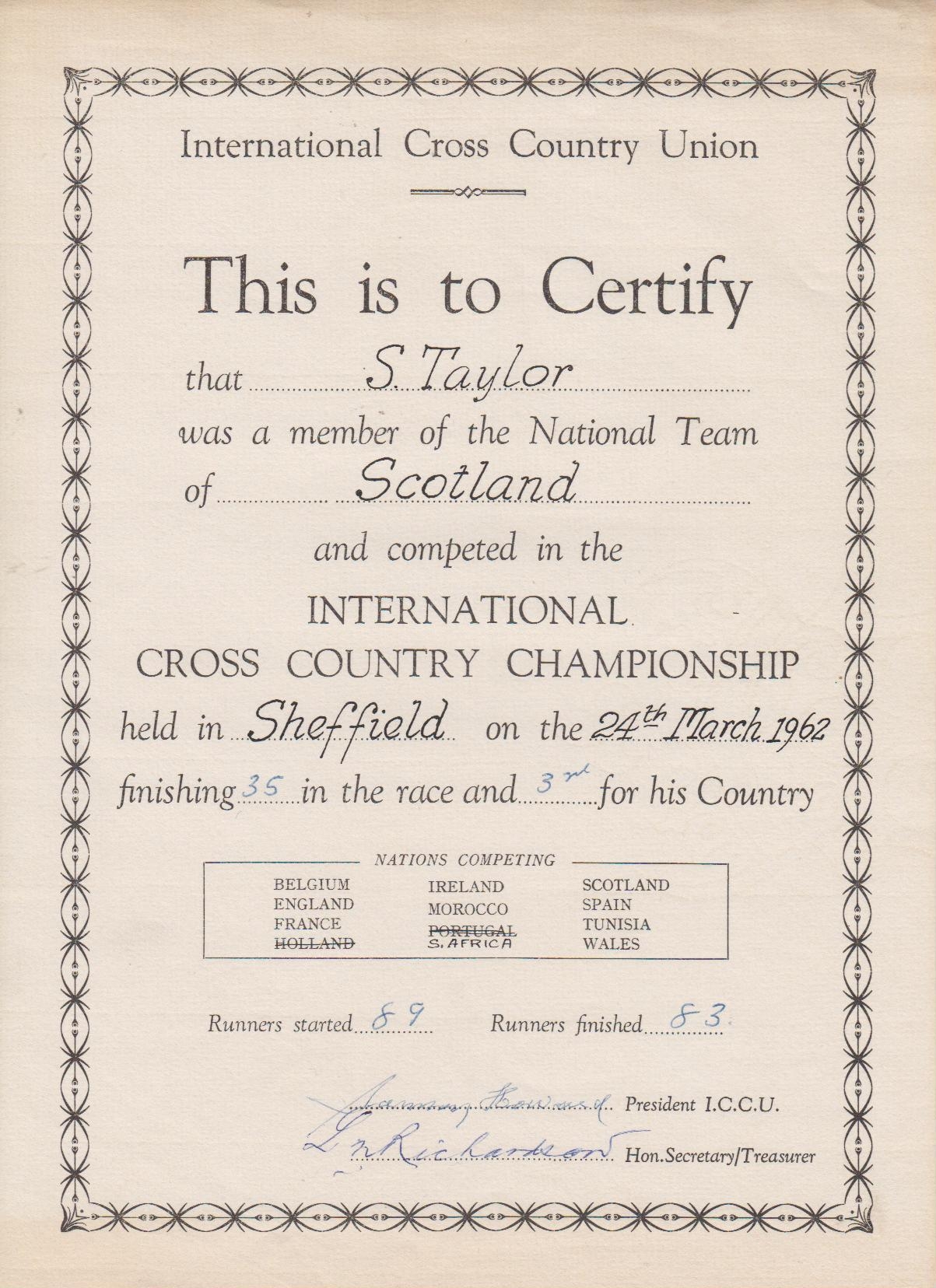
Certificate for thirty-fifth place in the International Cross-Country in 1962: He was third Scot

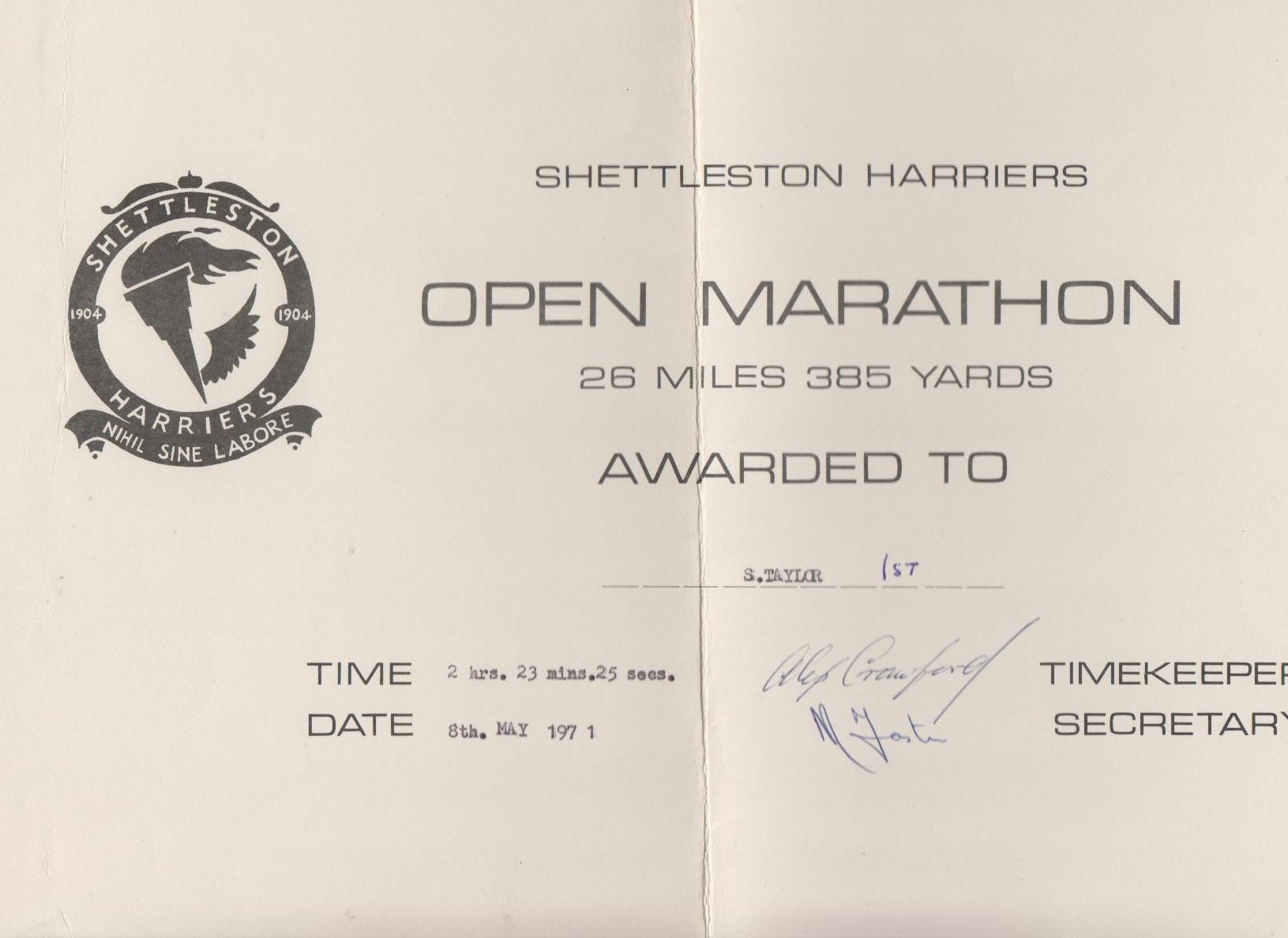
Certificate received after winning Shettleston Marathon in 1971

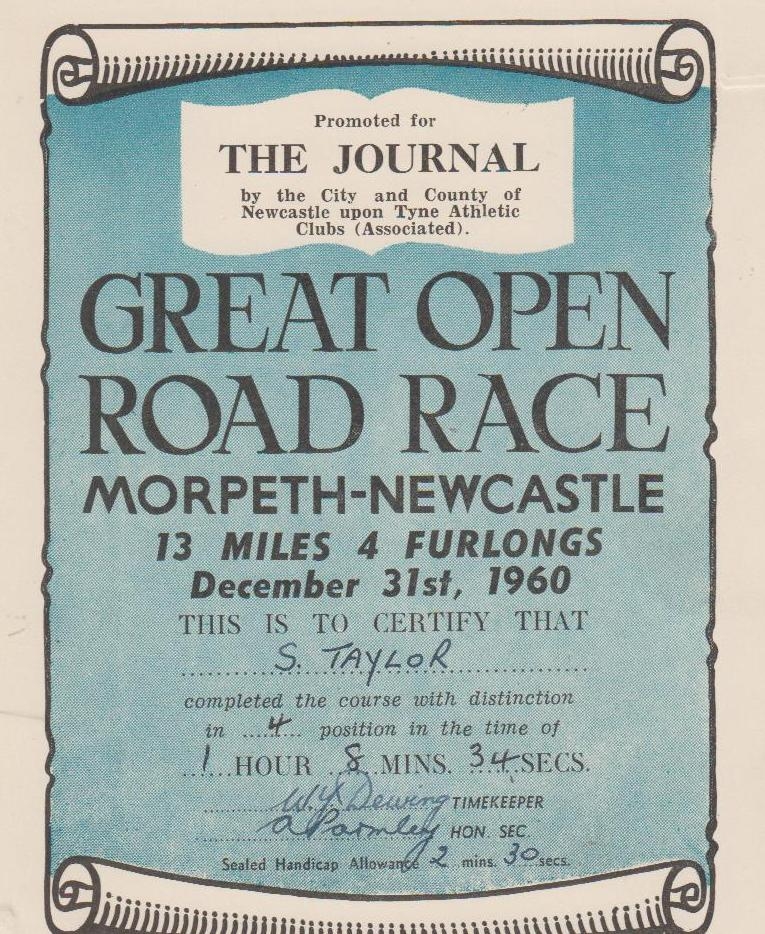
Certificate for fourth place in Morpeth to Newcastle, 1960

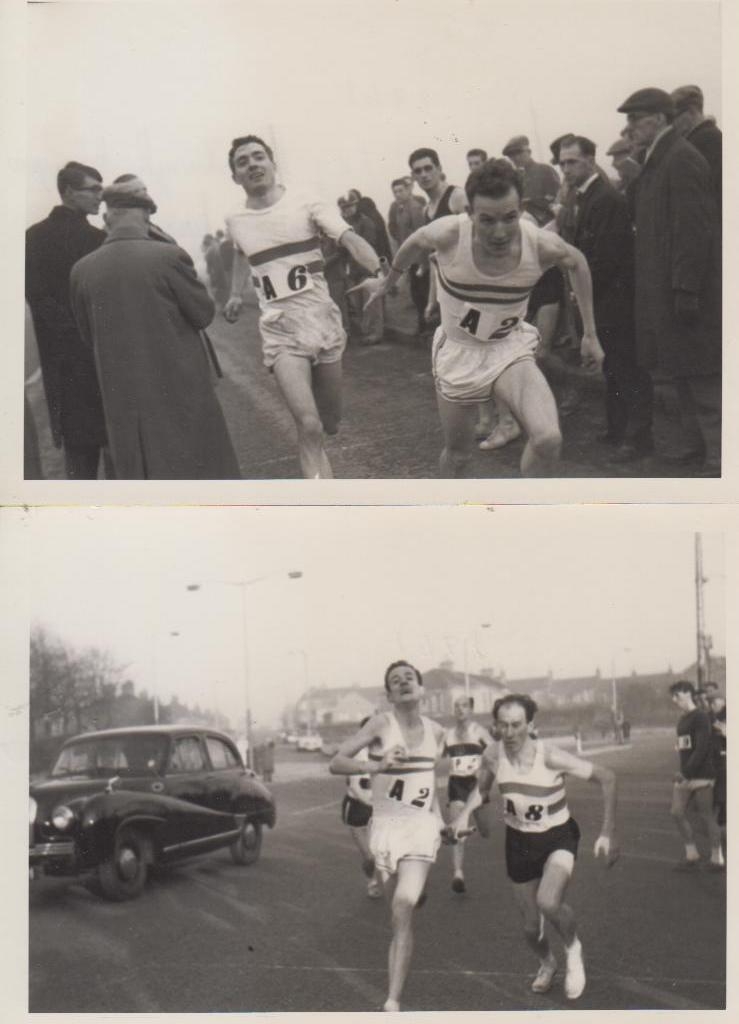
1961 E-G for Aberdeen AAC: Top Duffy to Taylor, Below Taylor (3rd fastest on stage 6) to Howie

SAAA Mile, 1960: Top leading Ken Ballantyne in the Heat; below leading Graham Everett in the Final (Steve was second)

En route to victory in the Carry Cup Trophy Race (Aberdeen v Dundee Cross-Country)

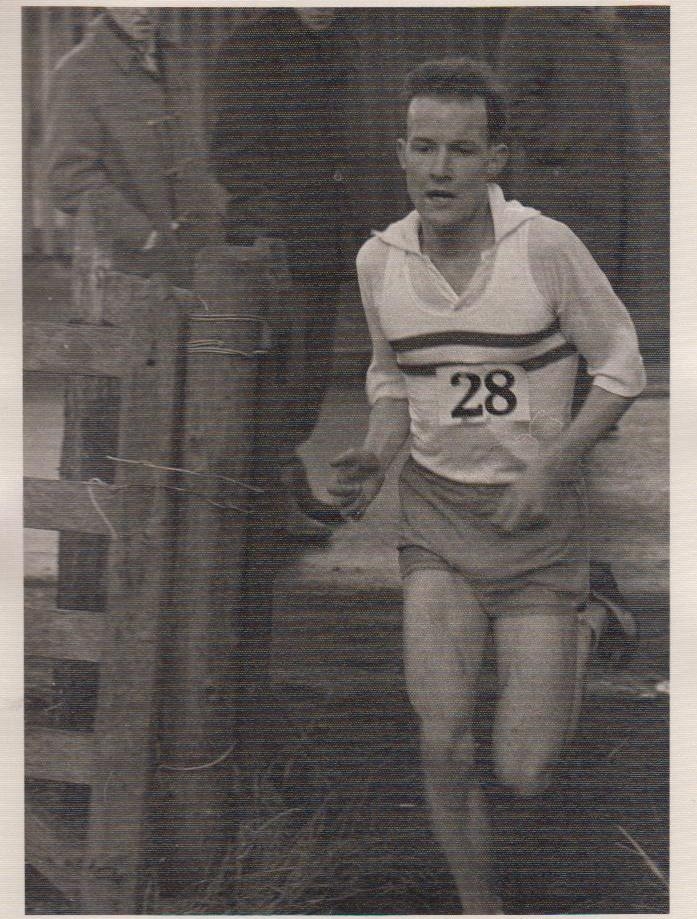
North East CC League, Dundee 1961.   Leading from Alastair Wood

Joe McGhee at Hamilton Race course before the SCCU Champs, c 1957

1972, Walton on Thames.   RRC 20 miles track race shortly after the start. Jim Alder (1) set a new UK best of 1.40.50. Steve (11) finished 5th.

Don Ritchie, the future ultra running great, was 6th. Don is just in front of Steve in this photo. In front of Don is Ian Macintosh (6), who won the 1978 SAAA marathon


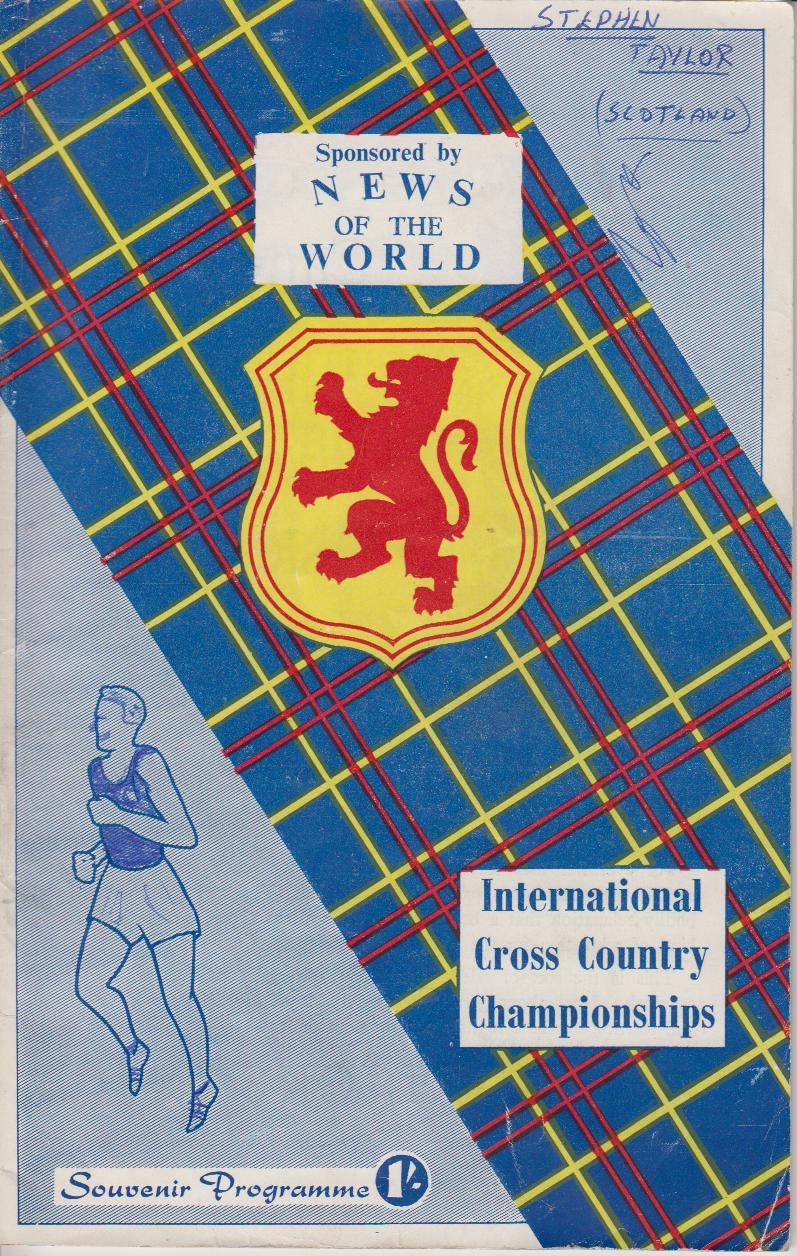
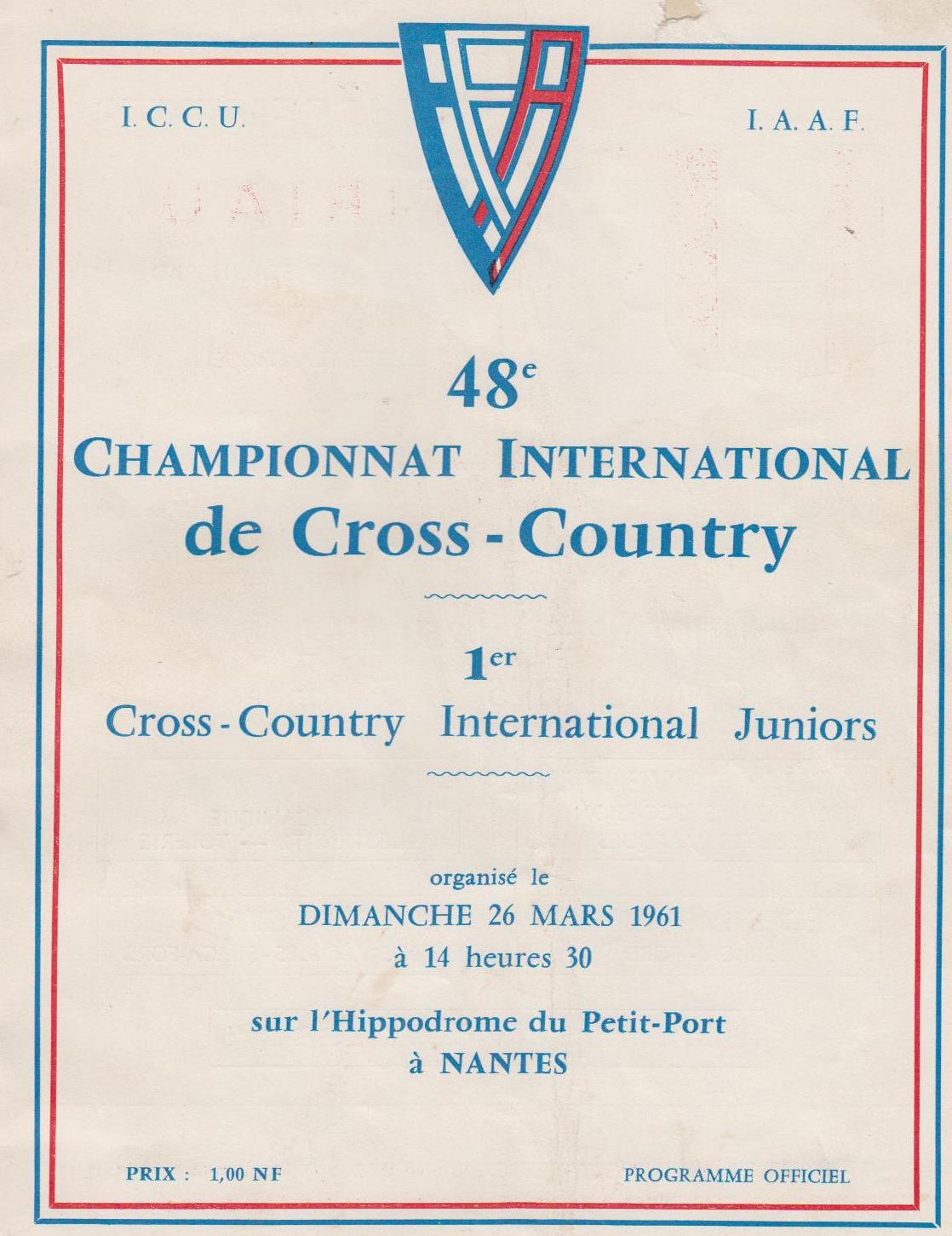
This programme front cover is for the 1960 International at Hamilton Park Racecourse.

.

.

.

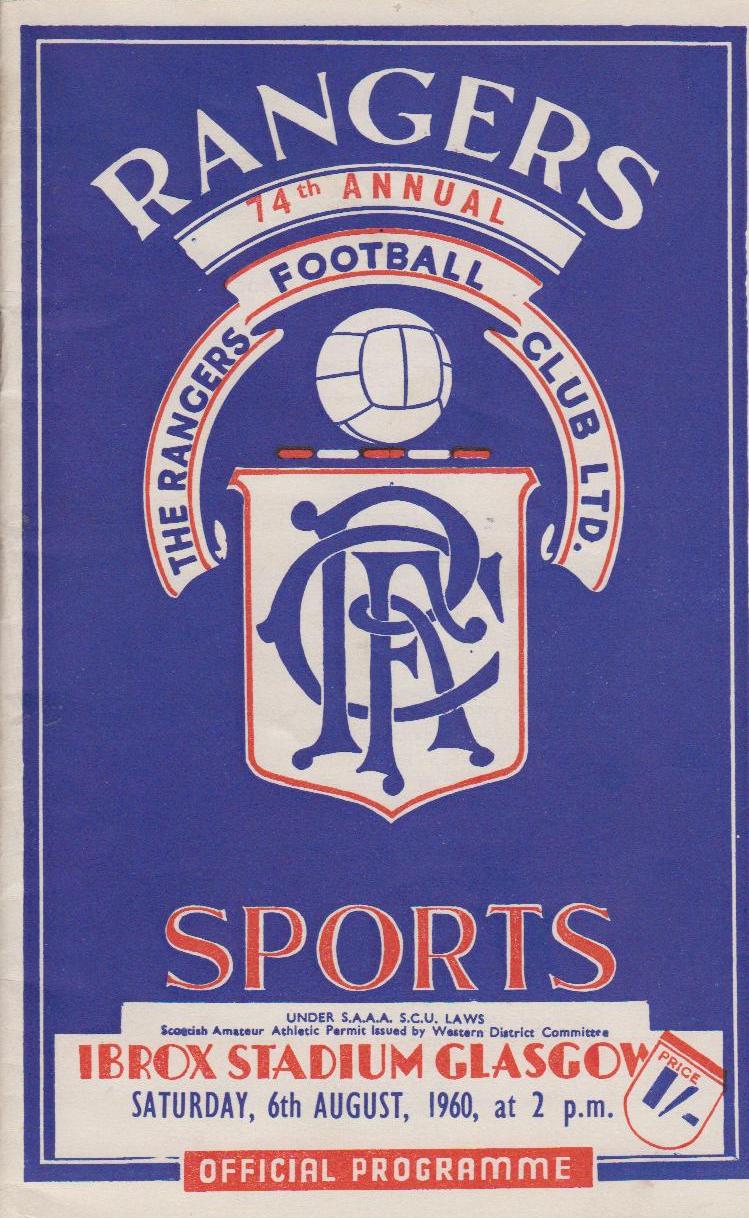
The Rangers Sports was a wonderful meeting with top athletes competing on the same track and sharing the dressing rooms with the regular Scottish runners who were competing in handicap races.

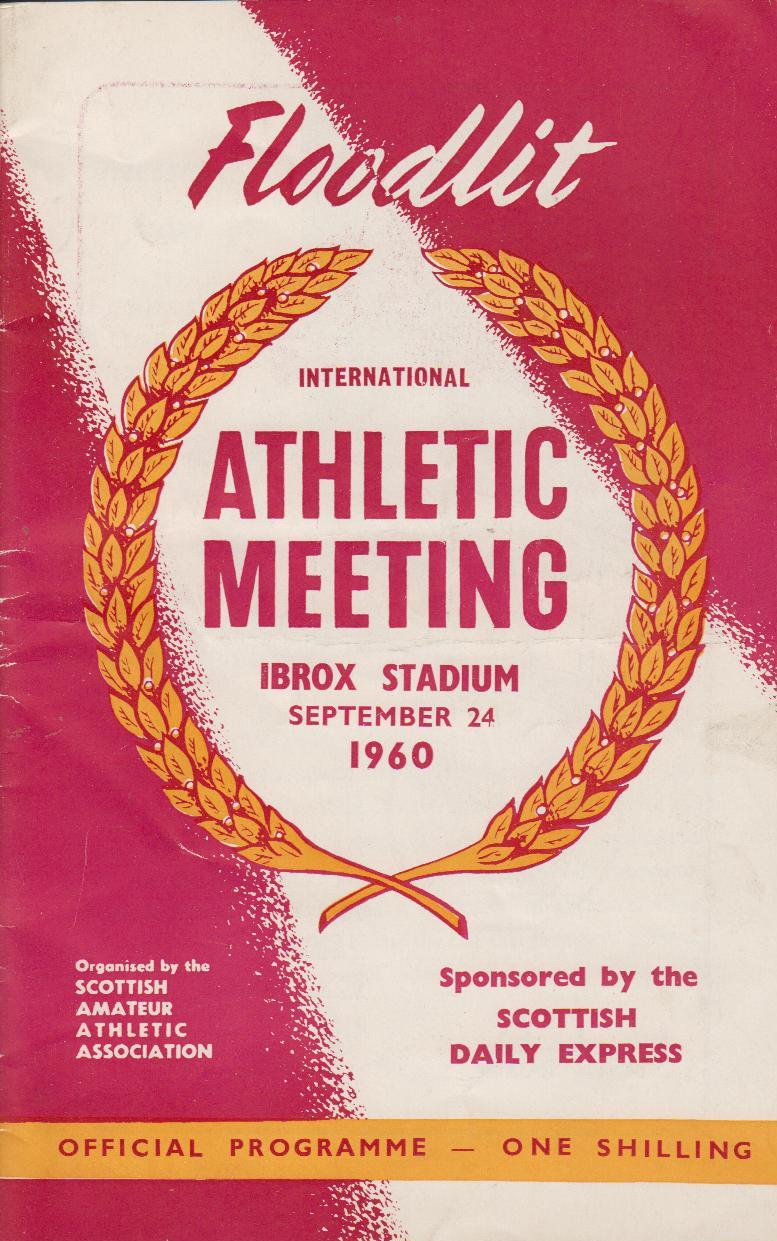
This is a particularly interesting one in that it was one of the very first floodlight meetings in Scottish athletics.   Many of the runners from the just-finished Rome Olympics.   There were many athletics meetings originating in the 1920’s where Olympic athletes came to Glasgow after the meeting before returning home: one of my first meetings was in broad daylight but included such as Lindy Remigino, Herb McKenley, Arthur Wint and others on their way home from Helsinki.   These days have gone but it must have been a wonderful experience for Steve to run at such a meeting.  
Colin says: “In 1960 many Olympic stars came to Glasgow.   Steve had watched them in Rome and here he was the pacemaker in the Mile!   Bill Dellinger (who in 1964 was third in the Olympic 5000m) won in front of Graham Everett, Laszlo Tabori and Mike Beresford, with Steve 5th in front of Max Truex (USA) etc. The three miles featured – in finishing order –  Albie Thomas (Aus), Gordon Pirie, Nyandika (the first successful Kenyan), Frank Salvat and Alastair Wood. The 440 yards featured Otis Davis (1960 Olympic 400m gold), Robbie Brightwell and Mal Spence. The Women’s sprints included Australia’s 1956 Olympic 100m/200m (and 1964 400m) victor Betty Cuthbert. Steve also collected some autographs and, for my own collection, I have printed out folk like Thomas, Tabori, Dellinger, Truex, Derek Ibbotson plus several top Scots and English.”
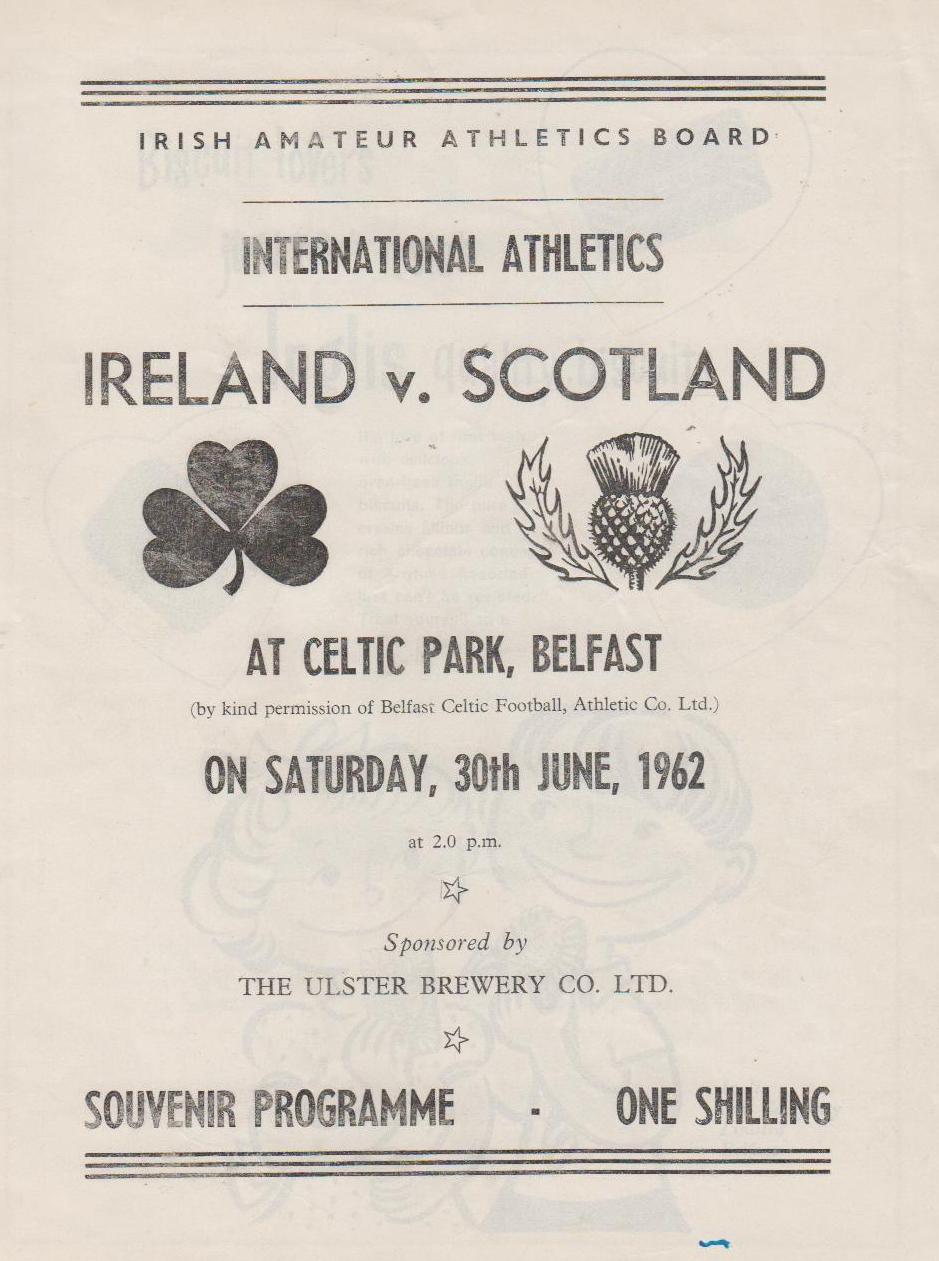
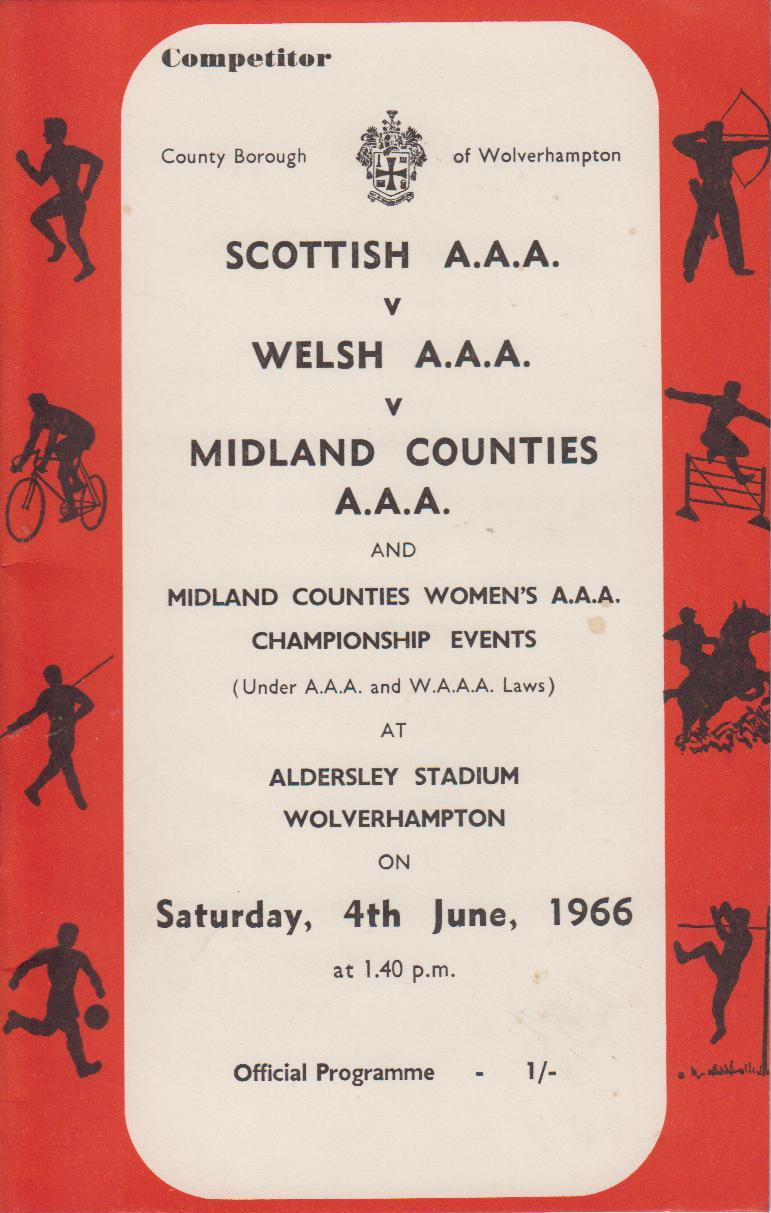
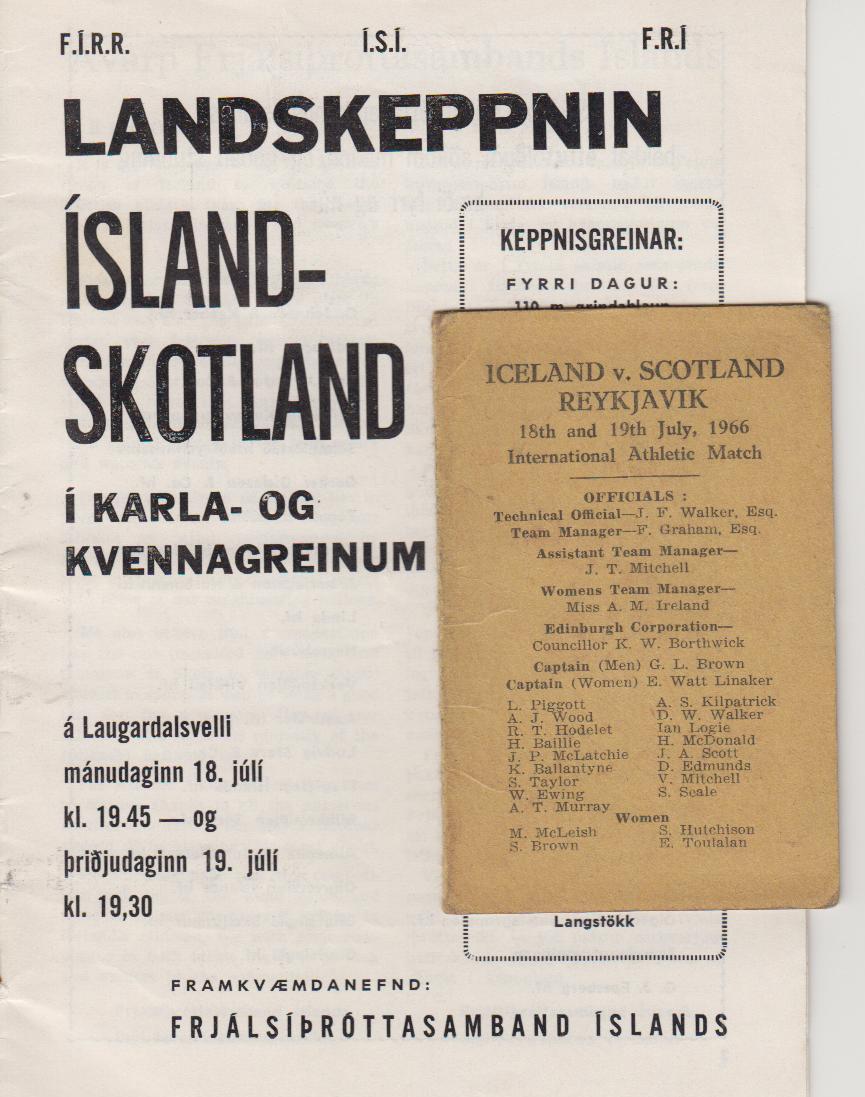
There were often such international fixtures against the smaller nations such as Iceland and the other Scandinavian countries and they were great occasions for the athletes, and the spectators but it seems that there are no facilities for such fixtures in the twenty first century.

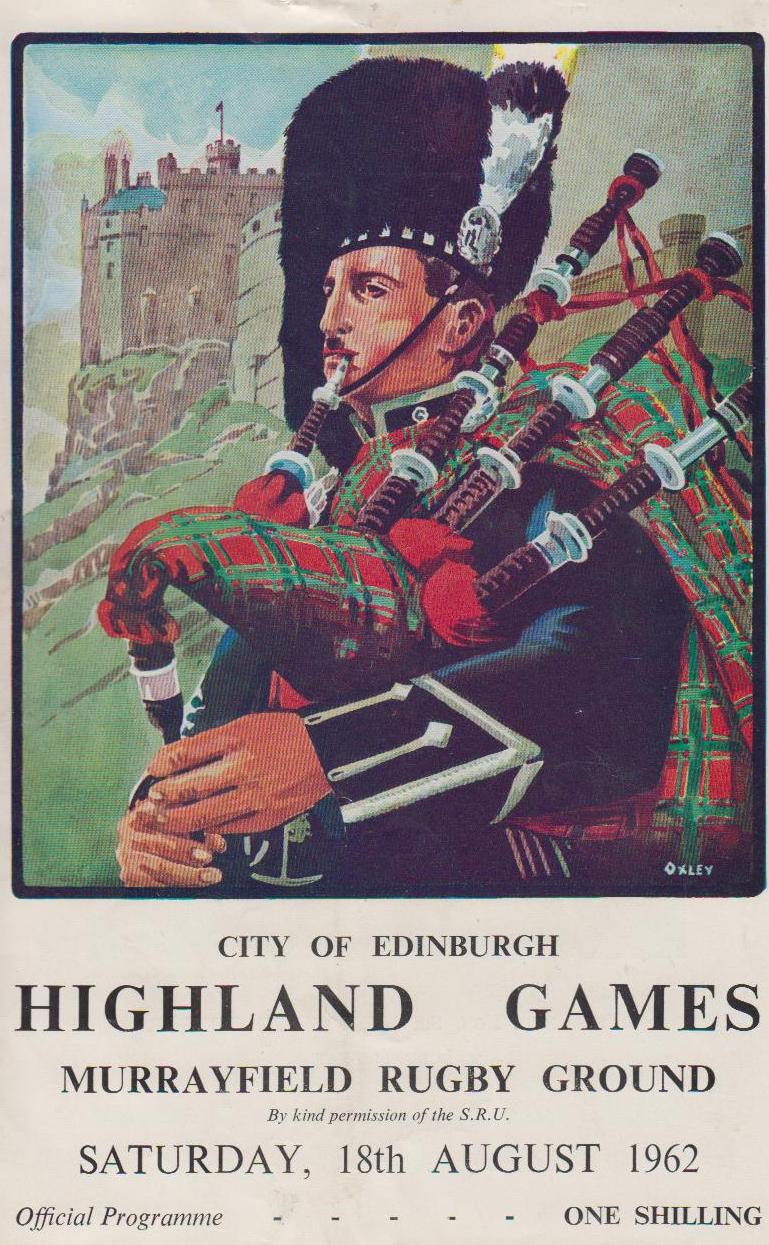
The Edinburgh Highland Games, traditionally held on the short, grass track at Murrayfield, also attracted the very best athletes and there were some surprisingly good times run in dire conditions there.

.

.

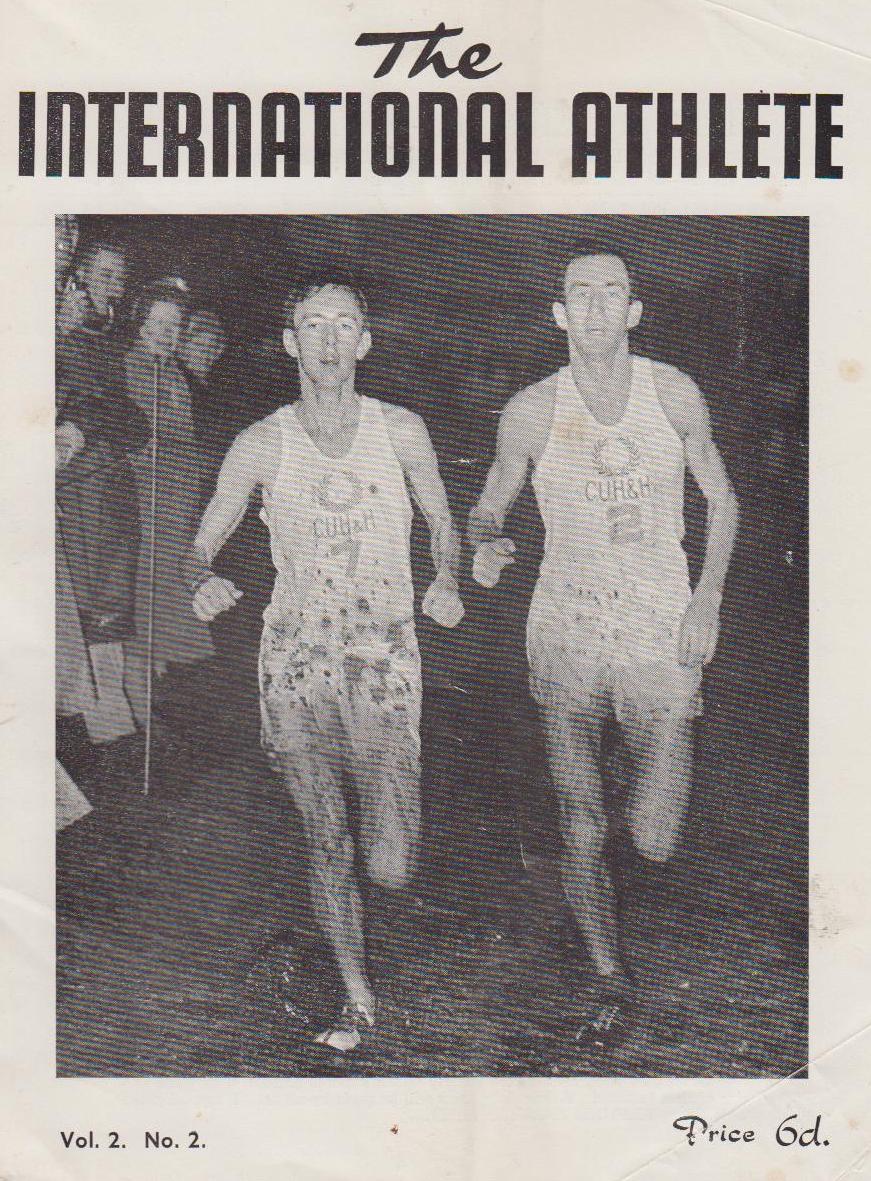
This was one of a series of attempts to have a dedicated athletics magazine in Scotland.   This one was edited and produced by Walter Ross as a successor to the first rate ‘Scots Athlete’ magazine.

The two athletes pictured, both running cross-country for Cambridge University, are Mike Turner and Herb Elliott, the legendary Australian miler.


.


Edinburgh to Glasgow: Stage Three

Stage three was always the shortest, no matter how many times the trail was tweaked.   Described as ‘undulating’ there was certainly a switchback element to the road covered but the finish was ferocious – the ‘Mile to go’ sign led on to a long down hill stretch which encouraged the enthusiastic runner to really push hard before it came as a wee shock to his system to find a long uphill drag to the changeover opposite the farmer’s barn-cum-temporary toilet.   Photographs below from the Jim Irvine, Scots Athlete, Graham MacIndoe and the Andy Fair pictures were submitted to Graham MacIndoe’s site by, I believe, Andy himself.


John Stevenson (Springburn) receiving the baton in 1954

John Stevenson, running the third stage

Passing the baton at the end of the stage

Eddie Bannon (Shettleston) in 1955

Pat Moy, Vale of Leven, to Bob Steele at the start of three

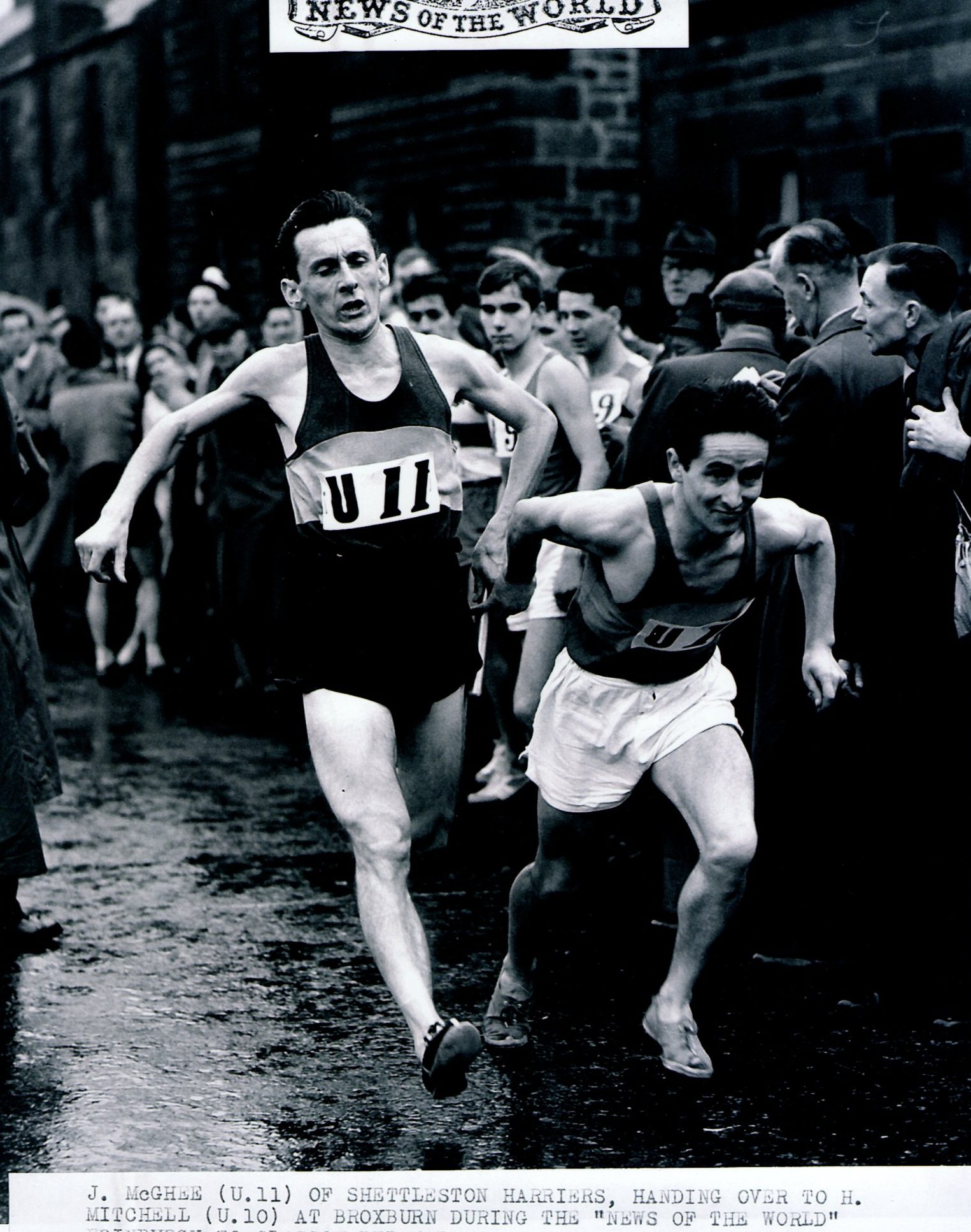
1958: Jim Irvine has just passed J Taylor, VPAAC


1959: Des Dickson, Bellahouston, at the start of three

1959: Hugh Mitchell takes over for Shettleston at the start of stage three

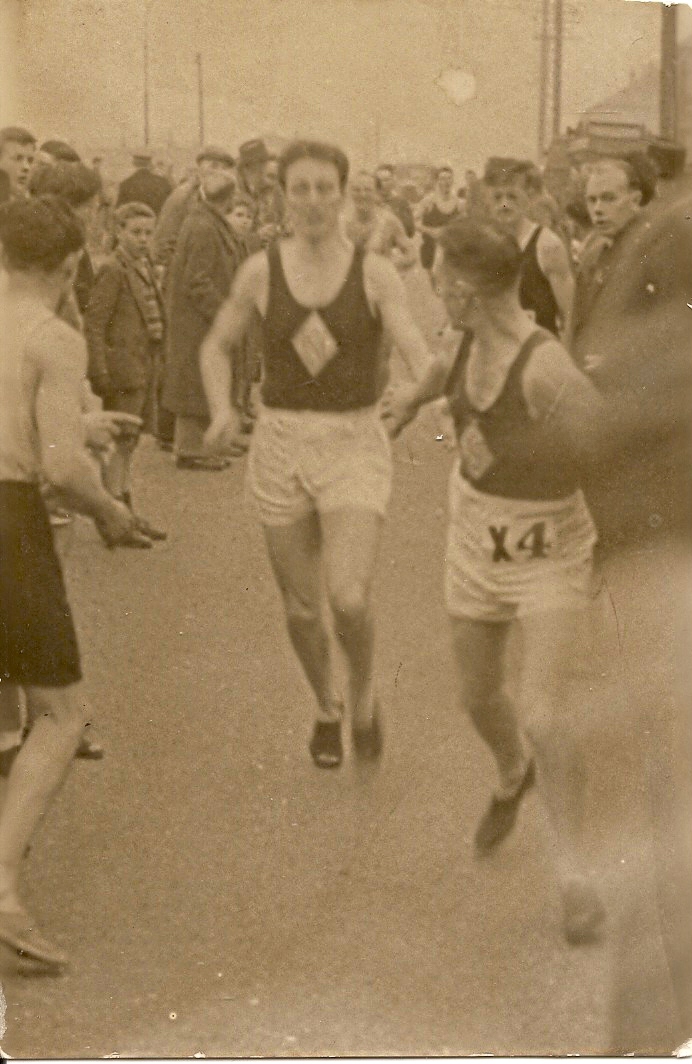
Bert Irving (Bellahouston Harriers) to Jim Irvine at the second changeover in 1961

Ronnie Kane (VPAAC) hands over to John McLaren at the end of stage 3 in 1955


Fergus Murray (EU H&H, fastest on Stage Two) to G Evans at the start of Stage 3 in 1964

George White, Clydesdale, 1956

Joe Clare, AAAC, 1967

Neil Thin, ESH, 1984

Pat Morris starts Stage Three, taking over from Eddie Stewart in 1984

Colin Youngson finishing stage three, aged 51, and handing over to Mark Johnston for Metro Aberdeen

Hugh Forgie, Law and District, leading Paul Ross, Clydesdale

Joe Forte, Haddington ELP

Ewan Calvert, Clydesdale, 1997

Andy Fair, Teviotdale

Andy Fair at Broxburn changeover to B Knox

Scott Cohen, Leslie Deans, 1993

Shane Daly, Clydesdale, 1995