Early Days in Athletics

Alistair at Braemar

EARLY DAYS IN ATHLETICS

By Alastair Macfarlane

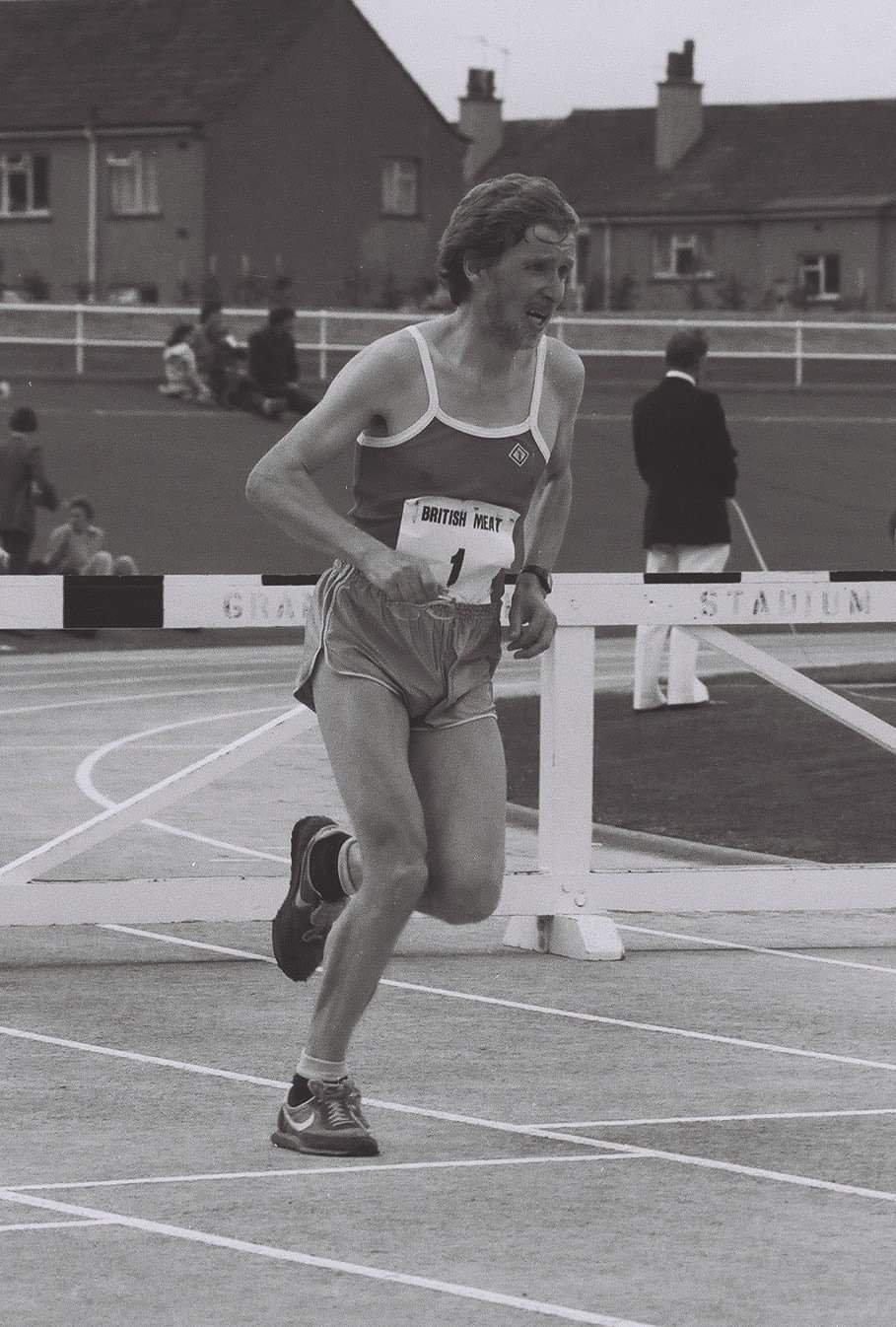
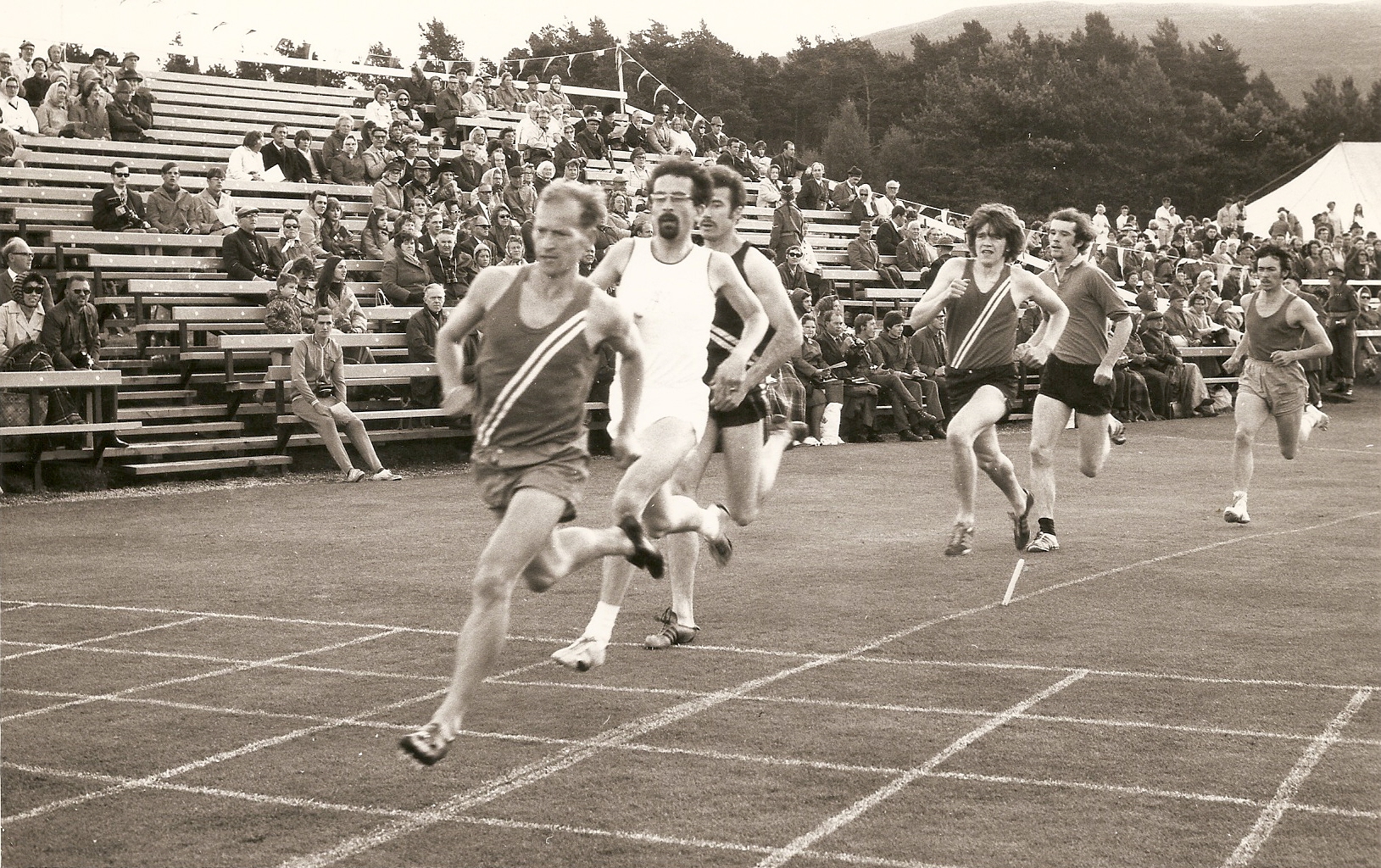
Alastair, in white, running at Braemar

Anyone familiar with Scottish athletics, marathon running and this site will immediately recognise Alistair Macfarlane as a top class runner whether on the track, over the country or on the roads.  A former Scottish champion, he has never run a national marathon championship and failed to finish in the first three.   As a professional athlete in his earlier days he paced Alan Simpson to a British record as well as winning much more than his share of races all over Britain.   He wrote the following article for the Scottish Veteran Harrier Club’s magazine in early 2015 and it is well worth reprinting here.   Read and enjoy!

The editor, obviously pretty desperate for some words to fill an empty page, has looked in my direction to ask me to reflect on the early days of my running career, especially during a period that couldn’t happen today.

I started running at school in Stirling and was soon invited to join the local club, St Modans AAC, a club no longer in existence but nevertheless a club of some standing in the sixties and early seventies. Club colleagues during my period in membership included Mike Ryan who was to go on and win Olympic and Commonwealth medals in the marathon while representing New Zealand, George McLachlan, a GB decathlon international and Scottish Steeplechase champion Charlie Meldrum.

The adventure began at Hamilton Racecourse, the venue for the National Cross Country Championships in 1963. In dreadful, frozen underfoot conditions I picked up a National silver medal in my very first race. Okay it was a team medal and I was fourth counter in a race won by future Commonwealth silver medallist Ian McCafferty, but I wonder how many people can say they won a National medal in their first race. Over the next couple of years as I moved into my late teens, being the weakest in my age group, and not making much progress I became a bit disillusioned. Sensing this, a chap called Willie Scott who trained with the club but was a professional runner took me under his wing and advised me to become a professional. Many people in the sport today won’t understand what this meant in the sixties. Unlike today there was a clear distinction between the amateur and professional codes. There was a huge and thriving circuit of Games, mostly in Fife, the Borders and the Lake District where money prizes were on offer. Anyone who took part in any these of these meetings was deemed by the Scottish Amateur Athletic Association, the then governing body of the sport in Scotland, and the IAAF, to be a professional and not allowed to be a member of a club in SAAA membership. And this exclusion even extended to those who had earned money from other sporting pursuits; many people will have heard of John Tarrant, ‘the Ghost Runner’ who had earned a few pounds in a boxing booth. Rangers’ players Willie Johnston and Sandy Jardine were decent sprinters on the pro circuit while Hibs and Stirling Albion winger George McNeill was possibly the fastest man ever produced by Scotland. All of these athletes were denied the opportunity to compete in amateur athletics and in McNeill’s case to represent his country.

However having decided to start competing on the professional circuit I was in for a bit of a culture shock. Highland and Border Games were mostly track and field competitions and perhaps 90% were held on a handicap basis. Handicap running produces a mind-set in some people where they will try less than their best in the smaller events in an attempt to build a good handicap then having built a good handicap will pounce to win a big money race. So deceiving the handicapper in order to build a better handicap almost becomes a sport in itself. In addition betting was not only allowed but was a major part of meetings.  Although many meetings offered big money prizes, especially in the sprints, the real money was to be made from the bookies.

As a naive 19 year old newcomer to all this, I certainly found it a new world. My amateur club background along with my natural competitive spirit meant that I went into every race trying to do my best regardless of any future loss of handicap. There wasn’t a lot of money at stake in my early days; in my first race at Blackford Highland Games I finished third in the mile to win £2 and a couple of weeks later at Pitlessie, I took home 12/6 (62.5p) for third in the half mile. (Note the pre metric race distances). After a couple of seasons of doing reasonably well and picking up some prize money, but much more importantly, picking up valuable experience in how to race on the track, I started to make a bigger impact in 1968, going to some of the biggest  meetings at places like Hawick, Jedburgh, Peebles and Selkirk and winning. A new face appearing on the scene that year was GB International Alan Simpson, Britain’s top miler who had finished 4th in the 1964 Olympic 1500metres and was silver medallist behind Kenya’s Kip Keino in the 1966 Commonwealth Games. We became friends, trained together and stayed at each other’s house. Another ‘name’ to show up was former world mile record holder Derek Ibbotson but by this time he was well past his best and was never a serious threat in races. But the highlight of the pro runner’s season is undoubtedly the New Year Gala, nowadays held at Musselburgh Racecourse but in my time still held at the charismatic Powderhall Stadium in Edinburgh. This is the big one; the meeting for which most runners try to preserve a decent handicap, because of the big prizes on offer. Having had a good season during the previous summer I was back marker in the mile at the New Year meeting of 1969. Having only just qualified for the final after finishing a distant 2nd in the heat, I managed to get up in the last few strides to win and take the £80 first prize.

That effectively was the end of my career as a professional runner, the next couple of years taken up with getting married and moving house a couple of times. I had never lost touch with the amateur club scene and started training with Springburn Harriers, whose club Coach was Eddie Sinclair, a former Scottish 3 mile Champion,  against whom I had raced on the pro circuit, and decided to see how far I could go in the sport by attempting to be re-instated as an amateur.   This had been achieved only once previously to my knowledge, by John Robson, later to become a star at 1500 metres on the International stage. However for me that proved to be no easy task. My applications for reinstatement were rejected  on two occasions and it was only after two years  of trying that I was given the green light and I was officially an amateur again. How times have changed over the last 40 years with people now able to make fortunes from the sport!

I was reinstated initially as a ‘National’ amateur, meaning I was unable to compete in International competition, a condition somehow overlooked when, having reached a decent standard, I was selected to represent Scotland in an International marathon in Tullamore, Ireland. I suppose this indicates that incompetence from our governing body is not a new phenomenon! However after I had pointed out their error the SAAA made application to the IAAF on my behalf and I was reinstated internationally and went on to represent Scotland a few times.

My time as a professional runner brought few regrets and many happy memories; I had the pleasure of competing at the same time as and seeing at close quarters people like George McNeill, Stuart Hogg, later to become a fitness coach to some of the country’s top football teams, the multi-talented John Freebairn, for many years for many years a member of  the SVHC committee, and John Steede, still a member of SVHC and in his day an awesome sight as he hit top speed!

After reinstatement a whole new chapter opened up for me as I turned from track racing to the roads and competed against some of the best endurance runners Scotland has produced, people like the late Jim Dingwall, our Newsletter editor Colin Youngson and Olympian Donald Macgregor, but that’s maybe a story for another day.

Back to Alastair Macfarlane     Back to Front Page

Colin’s Top 50

Colin Evan

1975 SAAA Marathon 2.16.50. Championship record. Meadowbank, Edinburgh. 1ST after battle with Sandy Keith


1975 E to G First Stage 26.00 record (never broken). ESH 1st in a record time.

1992 Five Nations International Veterans XC Belfast. 1st M45 by a minute. Scotland won team event.

1982 SAAA Marathon 2.18.02. Grangemouth. Won by eight minutes after ‘persuading’ Jim Brown to drop out.

1981 SAAA Marathon 2.20.42. Meadowbank. 1st after leading all the way and a struggle with Donald Macgregor.

1975 representing BAAB in Berchem Marathon, Antwerp. Second by seventeen seconds to Danny McDaid (Eire) after a good fartlek tussle. Max Coleby nine seconds down. Britain won the team award.

1983 E to G. AAAC 1st. Self second-fastest on glory leg after tremendous struggle to hold off Peter Fleming.

1986 E to G. AAAC 1st. Self fastest on Last Stage. No bother!

1975 East District 10,000m Meadowbank. 2nd to Jim Dingwall after a real fight. 29.33.4.

1975 Two Bridges 36 2nd. 1st Scot 3.29.44. Almost three minutes behind the fast-starting Cavin Woodward but raced away from Mick Orton up the Forth Bridge whaleback.

1983 Glasgow Marathon 4th and second Scot to winner Peter Fleming. Scottish two-man team beat England, Wales, Eire, N.I.

1992 Barnsley Vets 10k Road 6th and 1st M45 in AAA/BVAF event.

1999 World Vets XC Chester-Le-Street 7th M50. G.B. won team gold.

1977 E to G fastest on Stage Three. 20.18 record.

1973 Swedish Winter Marathon Championship 1st. ‘Scottish Teacher Causes A Sensation!’ Minus five centigrade. Snowing.

1993 Bruges European Vets 25k. First Briton in race. 3rd M45 bronze medal. G.B. team silver.

1975 AAA 12 Stage Relay. Sutton Park, Birmingham. ESH 2nd to Gateshead. Self 14.16 third fastest on short stage, 18 seconds slower than Brendan Foster.

1980 London to Brighton 54 and a quarter. 7th 5.52.04

1975 SAAA Track 10 Carluke. 2nd to Doug Gunstone. 49.00.8.

1983 Westland Marathon, Maasluis, Holland. 2.17.33 6th.

1993 BVAF Marathon at Stone. M45 gold.

1989 SAF Vets XC at Balgownie, Aberdeen. 1st by 24 seconds from Charlie MacDougall – Mum, Dad and Brother spectating. AAAC team gold.

1989 BVAF XC at Sunderland. 2nd, 12 seconds behind Andy Holden.

1989 SVHC Vets Indoors at Kelvin Hall. 3000m gold 8.58.7 British Veterans M40 record.

2003 BMAF Indoors at Kelvin Hall. 3000m M55 gold.9.56.91.

1993 Morpeth to Newcastle 14.1m. 1.15.25 first class standard. 1st M45/M40 by only three seconds from Jimmy Bell.

1981 European Clubs XC 29th, 1st for ESH.

1981 East Districts XC 2nd just behind Fraser Clyne.

1989 Scottish Vets / Lochaber Marathon. Race winner.

1990 Tom Scott 10 mile road, Law to Motherwell. 1st SVHC Championships 49.31.

1974 ESH 1st Team, course record in Allan Scally Relay. 90.45.

1997 SAF Vets XC Relay at Dundee. Metro gold.

1995 BVAF XC at Irvine. M45 gold.

1999 BVAF 10,000m at Meadowbank, Edinburgh. M50 gold.

1979 Edinburgh to North Berwick 21+ 1.52.13 record. 1st hard to hold off Sandy Keith.

1979 Lesmahagow Half 69.21 record. Very hilly. 1st from Evan Cameron.

2000 SAF Vets XC at Cumnock. M50 gold (three-in-a-row) by seven seconds from Charlie MacDougall. Really tough.

1988 Great Scottish Run / Glasgow Half 67.39 1st Vet.

1987 Inverness Half Marathon. 66.29 2nd to Simon Axon. Beat Frank Harper and Graham Laing.

1987 Black Isle 10k 30.02 1st Vet on 40th Birthday.

1986 Dundee Marathon winner.

1973 Stockholm Marathon winner. Absolutely even pace for both halves. The easiest marathon personal best time.

1985 Aberdeen Marathon 2nd. 1st for Scotland team.

1988 Moray Half 69.18. Race winner / 1st Vet.

1971 Scottish Universities v Irish Unis v U.C. Louvain. Belfield, Dublin. 1500m 4.01 , 3rd. Shaven grass track. Wet. Led till straight.

1972 Kingsway Relays, Dundee. 13.32. Fastest individual.

1974 ESH Fernieside Relays. Fastest individual, six seconds in front of young Allister Hutton.

1974 Frykstaloppet, Sweden. 25k 78.30 record. Race winner.

1973 (75,76,77,78) Drymen to Scotstoun 15+ Race winner. Dunky Wright trophy, presented by the man himself.

1991 SAAA Vets Track. Grangemouth. 5000m gold in 15.24.8 after duel with Tom Graham and Phil Dolan.

1973 Scottish Inter-Counties XC, Irvine. 1st from John Ferguson and Ron Macdonald. Golf course with tarmac stretch alternative!

1974 SAAA 10 miles track, Meadowbank. 1st from Martin Craven, despite dodgy hamstring and windy day.
          COLIN YOUNGSON: RUNNING SUMMARY


Team golds in: Scottish National XC; Edinburgh to Glasgow Relay; National Six-Stage Relay; National XC Relay; Scottish Veterans XC; SVHC Eight-Stage Relay; SAF Veterans XC Relay.

Member of AAAC’s record-breaking John O’Groats to Land’s End Relay teams in 1973, 1974 and 1982.

8 British Veterans golds: International and National XC; Road; Indoor Track; Outdoor Track. Distances from 3000m to Marathon.

BAAB Marathon representative in Antwerp 1975.

British ‘Masters’ Team medals in Euro and World Vets.

Scottish International 10,000m in Reykjavik 1975.

Eleven Scottish International Marathon vests.

Scottish first team for Gateshead International XC 1975.

Scottish Universities representative in XC and Track.

16 Scottish ‘Masters’ XC International vests in seven age groups (M40-M70). (Individual medals in three age groups.)

1965-66 Full Colours, Aberdeen Grammar, Athletics,XC, Cricket.

1969-71 Double Full Blue, Aberdeen University: XC; Athletics.

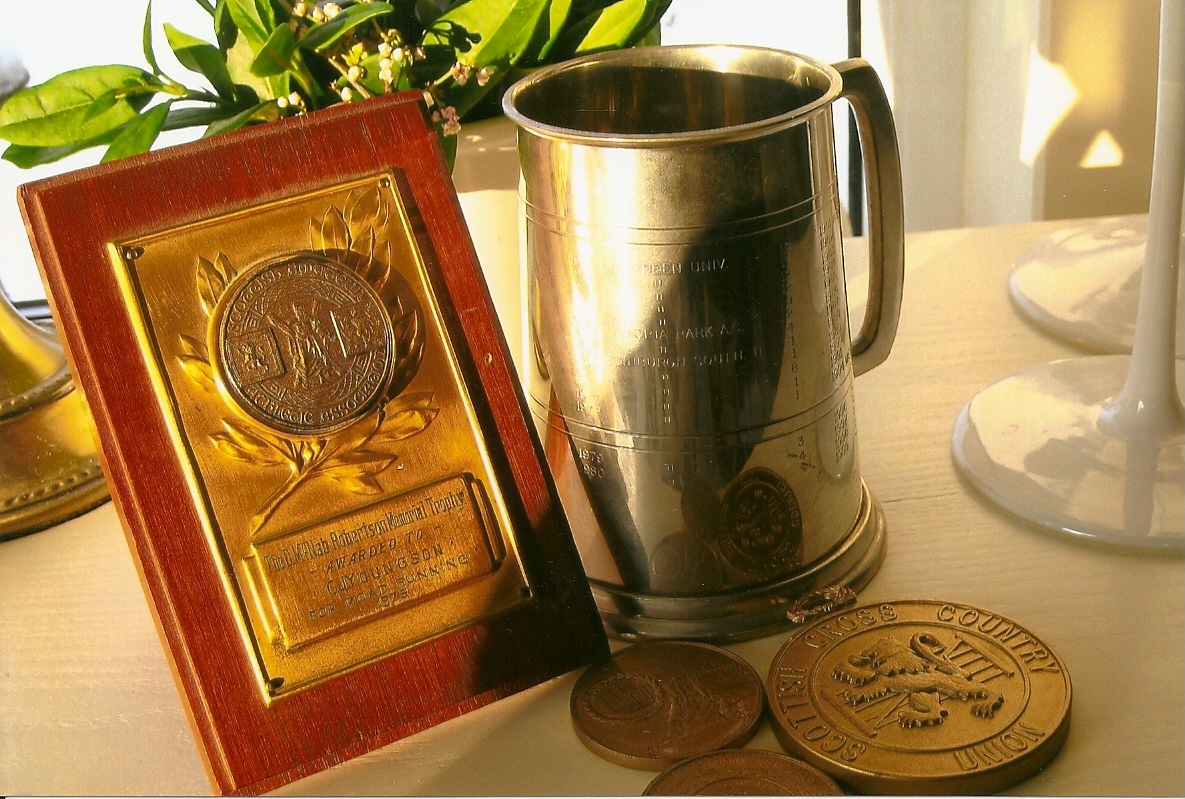
1975 Donald McNab Robertson Trophy for Best Scottish Road Runner of the year.

1991 J.F.Walker Award from Scottish Marathon Club.

1991 SCCU presentation for 25th E-G. (Ran 30 by 1999; 13 medals; 7 golds; 7 stage wins.)

1993 Aberdeen City Veteran Sports Personality.

Ran for: Aberdeen Grammar School 1965-66; Aberdeen University 1966-71; Victoria Park AC 1971-3; Fredrikshof Idrottsforeningen (Stockholm) 1973-4; Aberdeen AAC 1974 and 1981-93; Edinburgh Southern Harriers 1974-81; Metro Aberdeen Running Club 1993-2008; Forres Harriers 2009-.

76 ‘Scottish Titles’ to June 2013: Senior; Team; Veteran.

40 marathons sub-2.30; 9 sub-2.20.

10 SAAA Marathon medals: 3G; 3S; 4B.

27 medals in 20 successive Scottish Veterans XC: 11G (7 ind.); 11S (5 ind.); 5 ind. Bronze.

1965-2020: 56 seasons in succession of running at least one Scottish championship per year.


Personal Bests:

800m 1.58; 1500m 4.01; 3000m 8.26 (or 8.28);

5000m 14.26 (or 14.29); 10,000m 29.33.4;

10 miles track 49.00.8; Half Marathon 66.29;

Marathon 2.16.50.


Seldom can an Aberdonian have squeezed more from a teabag of talent.         Colin James Youngson (born 27/10/1947).

[Some teabag, some talent!]

Colin’s Marathons

Date Venue Time Date Venue Time Date Venue Time Date Venue Time
1969 Inverness* 2:41:13 1979 SAAA M’bank 2:19:48 1985 Westland 2:19:22 1995 London 2:49:45
1970 Harlow 2:34:00 Tullamore, Eire 2:30:42 SAAA M’bank 2:23:46 1999 Dunfermline 2:55:43
1972 SAAA M’bank 2:26:45 Aberdeen 2:27:44 Aberdeen 2:23:58
Helsinki 2:32:18 1980 Westland, Holland 2:21:29 1986 Dundee 2:20:03 Ultras
1973 SAAA M’bank 2:24:01 SAAA M’bank 2:24:56 Aberdeen 2:27:26 1975 Bridges 2:30
Stockholm 2:22:28 1981 Westland 2:18:54 Glasgow 2:22:42 1980 Bridges 2:35
Vintermaran 2:26:07 SAAA M’bank 2:20:42 1987 Lochaber 2:26:17 Brighton 2:46
1974 SAAA M’bank 2:21:36 Glasgow 2:19:12 Aberdeen 2:29:21 2:43
Inverness 2:33 1982 Belfast 2:24:01 1988 Boston 2:29:51 1984 E-G 50
Harlow 2:21:06 SAAA G’mouth 2:18:02 Aberdeen 2:28:28 1986 Lairig
1975 SAAA M’bank 2:16:50 Aberdeen 2:21:03 Stone BVAF 2:29:15 1995 Speyside 3:33:04
Berchem, Belgium 2:21:08 Glasgow 2:22:13 1989 Lochaber 2:29:40 1996 Speyside 3:29:27
1976 Rotherham 2:27:58 1983 Westland 2:17:33 Aberdeen 2:31:23
Marathon** 2:46 SAAA M’bank 2:28:46 1990 Aberdeen dnf Totals
1977 SAAA M’bank 2:19:35 Glasgow 2:19:18 1992 Lochaber 2:36:22 55 Marathons
Enschede, Holland 2:32:57 1984 Barcelona 2:26:04 1993 London 2:37:14 7 Ultras
1978 SAAA M’bank 2:46 Albi, France 2:29:49 Stone BVAF 2:36:18

Sandbach

2:23:07

SAAA Aberdeen

2:23:36

1994

London

2:39:10

Abbreviations:  Inverness* Inverness – Forres    Marathon**  Marathon to Athens   Bridges  –  Two Bridges 36   Brighton   –  London to Brighton 54

E-G 50  –  Edinburgh to Glasgow straight through.   Lairig  –   Lairig Ghru 28,     Speyside  –  Speyside Way 50K

A quick count through the results indicates that there were 13 first places, 12 seconds and five thirds as well as many commendably high placings in championships and big city marathons.   What can’t be denied is this list of achievements:

55 Marathons

7 Ultras

10 Scottish Championship Medals

2 British Veterans Medals

2 Scottish Veteran Medals

 11 Scottish Vests

1 British Vest

Colin’s SAAA Marathon victories

Colin Evan

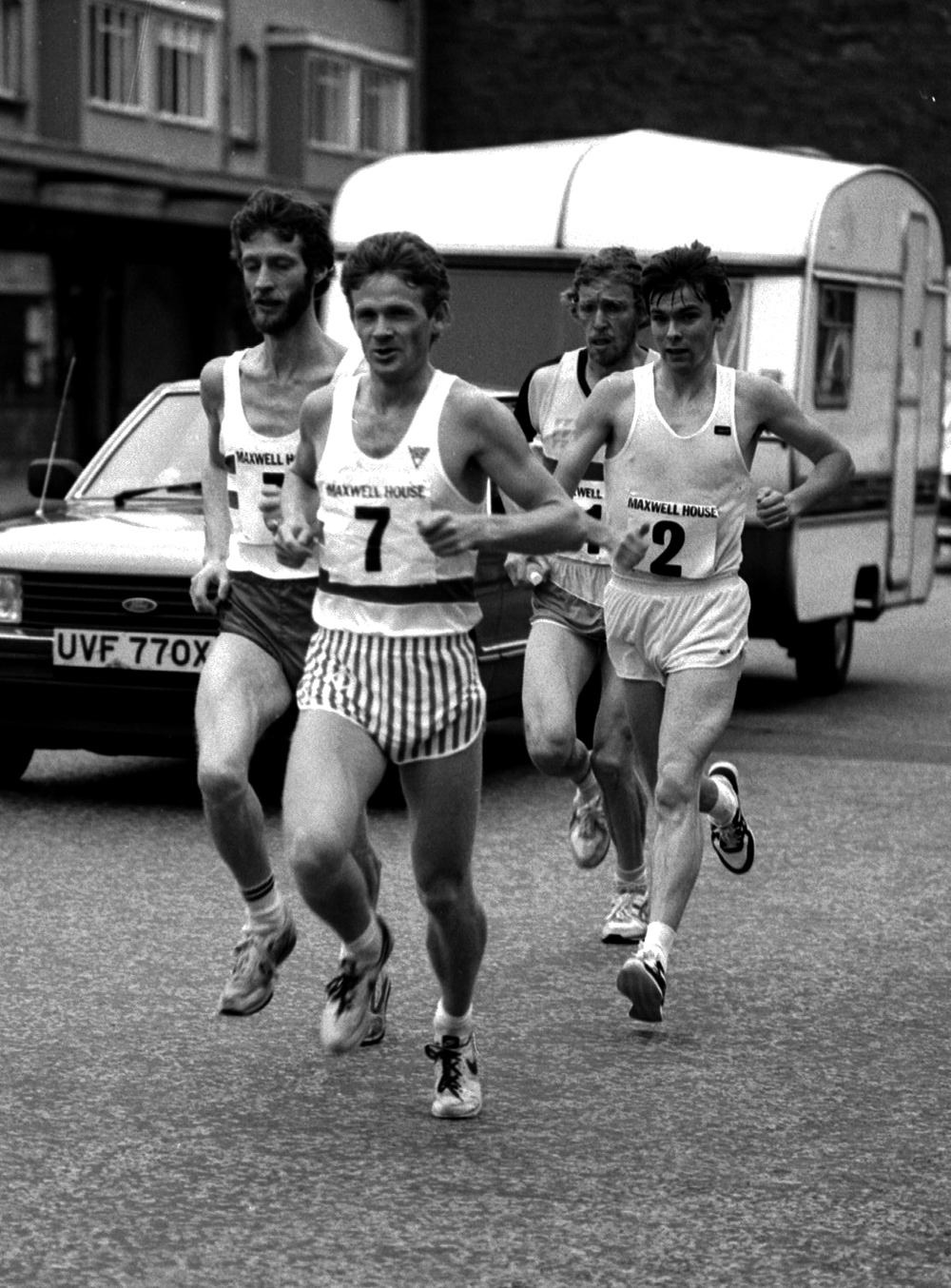
Colin Youngson leading Evan Cameron

Colin Youngson has an amazing record as a road runner – a good man on the track and over the country, he was outstanding on the road with his stage records and medals won in the Edinburgh to Glasgow relay and his ten medals in the SAAA Championships.   It was also at a time when the SAAA marathon was held as an event in its own right and in combination with the track championships so there was no chance of it being mixed up in a field of 1000+ with the attention focused on soldiers dressed as hippos or some celebrity passing through.   Nor, maybe more important as far as I am concerned, were there any guest runners from Africa, Asia or the Americas.   It was a Scottish championship and the runners and spectators could concentrate on the race.   The man running into the stadium at the end was the winner and not a guest, there for the money.   The common reason given for allowing/encouraging non-Scots into the championships is that they raise the standard of competition – but that argument does not hold water as far as the marathon is concerned: the standard of Scottish marathon running seems to have declined in proportion to the size of the field.  People like Colin Youngson, Don Macgregor, Jim Alder, Fergus Murray and all the rest could be seen plying their trade in times faster than most and in races more dramatic than most.   Colin has written the following account of his three SAAA marathon victories and it is an interesting read.


Sandy Keith was, in the mid-1970s, a major marathon rival and I trained with him on long runs near Edinburgh only when I felt good, since he was basically stronger than me.    I defeated him three times in the Scottish Marathon – in 1974, 1975 and 1982. However he beat me in 1977 and was the superior marathon runner from 1976 to 1979.

My training at this time included three key weekly sessions. Monday meant The Meadows: four laps including no less than sixteen repetitions – short or long, on the flat, uphill or downhill on tarmac paths.  Wednesday was a nine-mile pavement fartlek through Colinton with a series of testing longer efforts. Saturday was race day in the 1970s but, no matter what state you were in, the Sunday run was compulsory – a basic sixteen miles from The Meadows through Colinton Dell and out the old railway line to Balerno (and then back). The route might be extended via the reservoirs and Bonaly Tower.   Anything between 16 and 25 miles might be covered (the latter with a sadistic little final lap of The Meadows, pretending not to be exhausted, until you parted from your companions/rivals with a cheery wave, turned a corner, and struggled wearily home. If you added some recovery running or a few hill reps on the intervening days, you had about eighty miles of excellent training in the hilly city – worth a hundred in the flat south?

Saturday 28th June 1975, Meadowbank Stadium, Edinburgh.

It was a warm, sunny day, and Sandy Keith took the initiative from the start, racing away down the hill to Portobello into a slight headwind.   Only Colin tucked in behind and tried to relax. It seemed a hard way to start 26 miles!   Sandy’s ambition was to win a marathon from start to finish, from the front – and how he tried! Five miles in 25.30, ten in 51.30, the turn in 67.30.   As the pair, on their return journey, passed ex-champions Alastair Wood and Donald Macgregor, who were approaching the turning point, Wood muttered that the young fools would destroy each other.   Macgregor warned that they were about two minutes ahead already!

Since there was now a pleasant following breeze, and to show that he was feeling good in spite of Sandy’s efforts, Colin moved alongside and they ran together for the next five miles.  Then, at nineteen, as the route swung into a lay-by for a drink station, an official was clumsy in handing up Sandy’s cup of water    Sandy swore, quite uncharacteristically, hesitated for the drink, and Colin, seeing that his rival was feeling the strain, simply surged away for a full mile, down the Wallyford hill. 20 miles in 1.43.45.   A nervy glance back revealed a decent gap, fifteen seconds, and it was head down again and flat out for Musselburgh and Portobello. The pace was still fast, but tiredness and worry set in. To win the Scottish Marathon was Colin’s main ambition in the sport, and now it was a case of hanging on grimly.  Up the long hill to Jock’s Lodge and then, at the twenty-five mile mark, Youngson’s right leg suffered cramp.  Would Keith catch up, so near to the finish? Keeping the limb as straight as possible, Youngson bashed onwards, to the stadium and round the track. No sign of Sandy until the final bend was reached and it was safe to negotiate the straight and break the tape.

What a relief for Colin Youngson, who felt sure that he must have broken the 2.20 barrier at last, but was very surprised to find that Jim Alder’s championship record had been broken by 21 seconds.    Finishing times were: Colin Youngson (Edinburgh Southern Harriers 2.16.50; Sandy Keith (Edinburgh Athletic Club) 2.17.58; Alastair Wood (Aberdeen AAC) 2.21.14; Davie Wyper (West of Scotland) 2.25.44; Gordon Eadie (Cambuslang) 2.25.48; Alistair Blamire (ESH) 2.26.20; Ian Trapp (EAC) 2.28.26; Mike Logue (Victoria Park AAC) 2.29.56.

After the race, Alastair Wood said, “Well done, Colin. I think you’re at your peak now.”    To which Colin replied that he felt there was a little more to come.   But in fact Alastair did turn out to be right since this remained Colin’s fastest time ever.   Still, the rest of the season produced further success: second to Allister Hutton (1990 London Marathon winner) in the 10,000 metres track race for Scotland against Iceland in Reykjavik; second behind ‘ultra’ great Cavin Woodward in a fast ‘Two Bridges’ 36 miler; and a close second to Olympian Danny McDaid of Eire in the international marathon in Berchem, Antwerp.   This was Colin’s only race representing Great Britain, and he and Max Coleby won the team race. At the end of the 1975 season Colin Youngson was presented with the Scottish Amateur Athletics Association ‘Donald McNab Robertson Memorial Trophy’ as Scottish Road Runner of the year.

Saturday 20th June 1981, Meadowbank Stadium, Edinburgh.

The course was completely new, and not as fast as the ‘Commonwealth Games’ one.  The route was London Road, Seafield Road East, Seafield Road, Lower Granton Road; two loops round West Harbour Road, Cramond Esplanade, turn left at the Cramond Hotel, Glebe Road, Lauriston Farm Road, West Granton Road; and then right for Granton, Seafield Road, turn right up Craigentinny Avenue, and right again for the stadium.

Colin Youngson, who had moved north to teach in Kemnay, Aberdeenshire, and had changed clubs from ESH to Aberdeen AAC, was fit and confident.   On a warm, sunny day, he started fast and led a group of eight down the hill towards Portobello and then left towards Granton. After a little hesitation, he surged at five miles (25.17) and the group broke up, with Donald Macgregor (Fife AC), Doug Gunstone and former champion Alastair Macfarlane (both Springburn Harriers) chasing hard.   Olympian Donald Macgregor was by now SAAA event coach for the marathon, but it is not true that he shouted advice to everyone within earshot – e.g. “Slow down!”

The lead was slender, only six seconds between Youngson (50.42) and Gunstone, who was running with Macgregor at ten miles.  By halfway (68.36) it was eleven seconds; and by fifteen (77.06) 16 seconds, with Macfarlane another twelve seconds down, and gaining.

The twenty mile point was reached in 1.44.40 by Colin Youngson, who was really feeling the mental strain of leading by so little for so long.   By then the gap was up to 34 seconds – not at all a comfortable lead.   So Youngson put his head down and ran flat out for three miles, to stretch away from Macgregor and Macfarlane, who had moved into third place.   Colin was about a minute ahead with a couple of miles to go, but slowed down on purpose while plodding up the steep hill of Craigentinny Avenue, so that he could gain some physical and mental resilience to fight, if Donald’s famed strong finish proved a threat.   At 25 miles (2.12.58) the time gap was 54 seconds.

Eventually it was a relieved but exultant Colin Youngson who hung on to win in 2.20.42 from Donald Macgregor (2.21.31); Alastair Macfarlane (2.22.25); Doug Gunstone (2.26.52); Evan Cameron (ESH 2.27.23); Tommy Wiseman (Victoria Park 2.27.57); Dave Lang (Elgin AAC 2.28.28); and Donald Markie (Falkirk Victoria Harriers 2.29.32).

Doug Gillon, in the Sunday Standard, described the three medallists as ‘ageing but speedy war-horses, mounting the rostrum’. (Colin was 33, Donald 41 and Alastair 35).

Saturday 10th July 1982, Grangemouth Stadium

This took place on an out and back course from Grangemouth Stadium.   A calibrated wheel was used to ensure that the correct distance was run.  Only thirty competitors turned up, but they included a number of good athletes.  Conditions were warm and humid.

Colin Youngson of Aberdeen AAC had been running fast in training, including six or ten mile time-trials in his 80 miles per week.   He had reduced this to 50 two weeks before the race, and had then experimented , running a fairly hard 21 on the Sunday, followed by the protein ‘diet’, a ten mile run at 7 a.m. on Monday and a carbohydrate-packed breakfast.   Thus the tough part of the regime had lasted only 20 hours!   No running on Tuesday and Wednesday, a three mile ‘digestive’ jog/stride on Thursday and Friday, and off to the start.

In the dressing room he encountered Jim Brown (Scottish 10,000m record holder and GB International), who declared his intention of running two hours twelve minutes!    Colin had great respect for his younger rival, who had defeated him easily on countless occasions over the country and in shorter road and track fixtures.   It was agreed that they would share a sensibly brisk pace to ten miles, in under 52 minutes.    Then Jim would make his bid.   Colin started quite fast, and led for two miles.   Thereafter they went to the front for one mile each, into the breeze.   Five miles passed in 26.27, which seemed wrong – rather slow for the pace they seemed to be setting.   At this point Sandy Keith completed the trio.    By ten miles, on target 51.49, the watch indicated a speed-up but the tempo had in fact remained much the same, although Sandy had slipped back to 53.00 and was running with Craig Ross, a 2.21 man.

For the next three miles to the turn, Youngson simply sheltered behind Brown and waited for him to surge away.   Nothing happened.   Half-way was reached in 67.21; with Ross in 69.10; Keith 69.32; Peter Wilson and Gerry Fairley (Kilbarchan) 71.40.   At the front, nothing continued to happen, and the breeze was now helping progress.   Fifteen miles (78.11) saw the duo 2.16 in front of Ross.

Gaining in confidence due to the steady, fairly comfortable pace, and feeling that, although it was hard to imagine Jim Brown beatable, he ought to be tested, at least, Colin Youngson prepared to try.   As his stopwatch reached 1.30, he moved to the middle of the road and ran absolutely flat out for the next half mile. A look behind revealed a fifty yard gap!    Another hard half mile – and there was no one in sight!    Jim Brown, perhaps feeling that his target time was unattainable, had dropped out.

An unsympathetic but delighted Youngson later wrote in his diary “Bashed on slightly less hard”. 20 miles took 1.45.14; Ross 1.50.24; Keith 1.50.38; Wilson 1.51.56; John Lamont (Aberdeen AAC) 1.52.47. Craig Ross had to stop shortly afterwards. The last two miles felt tough to Youngson, since he was striving to beat 2.20 and could see neither the stadium nor a race steward to point the way.    However both appeared, and as Colin panted up to the entrance, there was previous winner Jim Dingwall leaning against the wall. Jim glanced at a stopwatch and said, “Still only 2.16 – should get a decent time if you hurry.”    So there was no steady lap of the track, waving modestly – just a red-faced maximum effort which resulted in a narrow failure to break 2.18.    Still, it was Colin Youngson’s second-fastest time (2.18.02), and one of the bigger winning margins.    Second was Sandy Keith (EAC 2.26.34); third Peter Wilson (Aberdeen AAC 2.27.01); fourth John Lamont (Aberdeen AAC 2.28.59); and fifth Andy Stirling (Bo’ness 2.30.17).    Another good Aberdeen performance – even Sandy Keith used to be a club member

Then and Now

TWO BATON RELAYS COMPARED

2 Batons CJY runs

Colin Youngson has had the honour of being asked to carry the baton for two Commonwealth Games – 1970 and 2014.   The situation was vastly different, the selection was stricter, more was required of the baton bearers and the publicity was much less.    He has written of his experiences for the magazine of the Scottish Veteran Harriers Club and with his permission it is reproduced here.


1970 EDINBURGH COMMONWEALTH GAMES – QUEEN’S MESSAGE RELAY

Instructions were strict. At all times runners must obey Police Officers! White shorts must be worn by all runners and escorts, though club vests may be worn! Girl Guides may wear uniform! On our section, we saw neither Police, Escorts nor Girl Guides!

The Scottish Association of Boys’ Clubs organised the relay. Several formal letters were sent out to ensure it all went smoothly and to thank us afterwards. On Wednesday 15th July 1970, Aberdeen University Amateur Athletic Club runners were assigned a stretch from Holburn Street at Ruthrieston Road, past Aberdeen City Boundary to Balquharn Dairy, before Boys’ Brigade, Sea Cadets and Aberdeen AAC carried on to Montrose, en route for Meadowbank Stadium, Edinburgh on Thursday the 16th of July, when the Games were to open. I was 22 years young.

We were to take over at precisely 14.16 hours and maintain seven-minute miles for five miles. Easy!

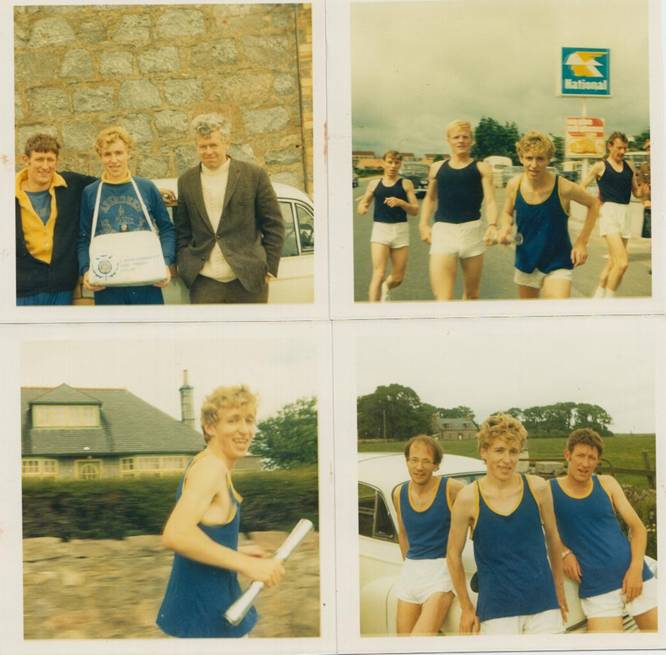
Someone took eight photos of our participation. Bob Masson, Ian Hughes (the driver) and I posing in AUAAC gear, displaying a split-new Commonwealth Games kitbag. Taking over from stern-looking runners from a boxing club. Bob, Mike Partridge and I running along, brandishing the beautiful shining silver baton, a streamlined stylised thistle. Staging a hand-over at walking pace. Me grinning as I dodge up a side-street and pretend to abscond with the baton, unscrew it and steal the Queen’s message. Mike laughing as he watches me disappear off-route. More immature giggling as I pass the baton to him. After the next volunteers took over, the three of us (wearing regulation white shorts) getting our breath back while leaning on Ian’s car. If only all the relay runners had such fun!

My friend Innis Mitchell tells me that he ran with the 1970 baton for Victoria Park AAC, along a remote stretch of road in the West of Scotland. Apparently the schedule was really demanding and he remembers that one of his faster team-mates suggested that a slower colleague should only be allowed to carry the baton very briefly indeed, in order to avoid the disgrace of arriving late for the handover to the next relay squad!

2 Batons

Right after my relay contribution, in time to watch nearly all the athletics, Donald Ritchie and I travelled down from Aberdeen on the train and stayed with a former team-mate in the AU Hare & Hounds Club, Paul Binns, and his wife Ceri. They lived in Corstorphine, so Donald and I took the bus right across the Edinburgh to Meadowbank every day.

I have a first-day cover with the three ‘British Commonwealth Games’ stamps, featuring running, swimming and cycling. My cheap camera took only three action photos of the Commonwealth Games athletics: a distant shot of some race; Mike Bull’s winning pole vault; and the joyously chaotic closing ceremony, when athletes of all nations mingled and celebrated together. All the way round the track, spectators could get very close to the action. Tickets were inexpensive and we could often get into the grandstand. I do not remember any officious types or security killjoys.

Every day, fresh programmes in booklet form were on sale. I still have three and must have seen lots of events, since the results are handwritten. Most Scottish fans had the same highlights. Lachie Stewart’s victory in the 10,000 metres [as the last lap bell rang, I just knew that his famous (only in Scotland!) fast finish would ensure a gold medal for his country, although my heart sank for my hero Ron Clarke, who had achieved so much throughout his career, but was always to be denied first place in a major championship.] The 5000m: incredible that Kip Keino should be beaten; the wonderful sight of two Scots battling for supremacy (but once again, I was secretly supporting the second man, Ian McCafferty – could he not have maintained his sprint rather than, apparently, easing over the line behind the skinhead Anglo-Scot, Ian Stewart, who battled every step of the way to victory?) The marathon: Ron Hill’s white string vest ‘miles’ in front, setting a European Record, topping the 1970 world rankings and probably running the fastest marathon ever, over a properly-measured course. But what I remember most is the head-shaking exhaustion of our Scottish hero, defending champion Jim Alder, as he struggled for breath and forced himself round the track to salvage a silver medal, while young Don Faircloth of England swiftly pursued him to finish only fifteen seconds behind and win bronze. However I also possess a copy of ‘The Victor’ comic, which was published at the very same time, to read that the winner of the CG marathon in Edinburgh was actually Alf Tupper, who set a new British record after eating a big bag of chips at half-way!

There were only cheers for every competitor from every corner of the Commonwealth – no insults or booing. It was friendly, enthusiastic and the greatest of occasions for spectators. Athletes who were determined to take part and tried to fight through injury received only support and sympathy. Rainbow memories. Although I have been a spectator at one European Indoor Athletics Championship (1974, in Gothenburg, Sweden) and the three International or World Cross-Country Championships held in Scotland (1969 Clydebank; 1978 Glasgow; and 2008 Edinburgh) I have never bothered to travel to the Olympics. Too much hassle; better on television; and anyway, it could never compare to Edinburgh 1970!

2014 GLASGOW COMMONWEALTH GAMES – QUEEN’S BATON RELAY

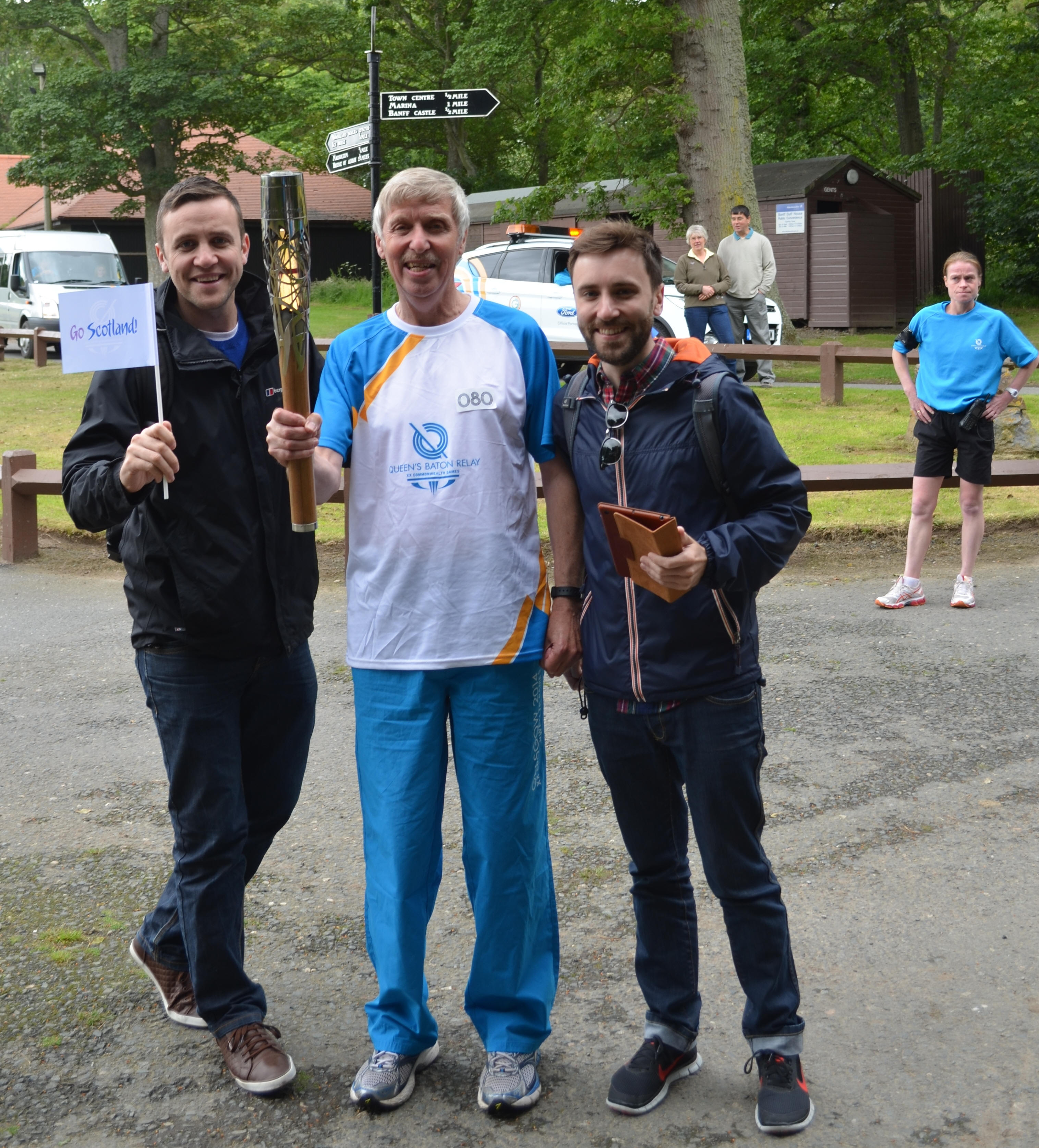
My son Stuart nominated me to be a “batonbearer” and I was accepted, possibly because I had been a “running role model” for many years in Aberdeenshire, as a fairly successful Scottish distance runner and a secondary school teacher who had advised young athletes. The whole nature of the event had changed drastically (as had society, during the previous 44 years). Now the relay was meant to be a way of giving towns and cities across Scotland a taste of the Commonwealth Games and celebrating local folk who had contributed to their communities in a variety of ways. Most of the 4000 selected had been long-time coaches or charity workers, and as a selfish old runner, I felt rather unworthy.

A package arrived, containing my uniform – a tasteful white, blue and yellow tee-shirt and startlingly bright ‘heritage blue’ trousers – plus detailed instructions. On Sunday the 29th of June I should report to Duff House, Banff, at 1 p.m., bringing my passport to confirm identity. The short stretch of path assigned to me would be just before Duff House (nothing to do with Homer Simpson’s favourite beer, but a lovely Georgian building set in parkland).

The organisation seemed terribly complicated: officials, security people, shuttle buses, police motorcyclists and even a media bus. The “Factsheet” contained a marvellously exaggerated article, all about the excitement of this “experience of a lifetime”. As the previous runner approaches “you feel the anticipation building – your hands meet – you are now holding the baton! This is your moment in history.” Crowds will be waving and cheering and taking photos as you jog or walk towards “the next baton bearer nervously waiting for you to handover the baton. You greet them warmly and cheer them on their way as they set off for their own time in the spotlight.” Afterwards, assuredly, you will want “this feeling of exhilaration and achievement to last forever.”

Hmm! Hard not to be just slightly cynical. So how did it pan out for me? Well I must say that every QBR team member I met was cheerful, helpful and friendly. The other three batonbearers in my shuttle bus were the same, and we had a good laugh as we waited for the convoy to arrive from Turriff – 20 minutes late. I was concerned to notice that my companions were wearing box-fresh pure-white trainers, whereas I had only shoved on my favourite old running shoes – just as well these had been sprayed with deodorant! Motivating music boomed out, including Bruce Springsteen’s ‘Born To Run’ and the Proclaimers ‘500 miles’ – ironic or what? Our section was heavily wooded, which made the live BBC coverage fail to transmit at times. The previous runner had to negotiate quite a few speed-bumps, which I was glad to avoid, because of my dangerously ground-scraping shuffle. I was delighted that Stuart and Andrew, two of my three sons (the other one having the thin excuse of living in Sydney) had driven up from Aberdeen, along with our friend Alex, and plenty of photos were taken, along with a rather funny shaky mini-video of me plodding slowly but happily along for an arduous minute over what was barely 150 metres. There was a bit of a crowd, that seemed to be enjoying the odd spectacle, and Duff House made a splendid backdrop as I passed the baton to the next man.

In fact, the brief Baton bearer experience was indeed fun and will make a pleasant humorous family memory.

Batonbeforebestboys1


Jamie Reid

Jamie Reid 1

The Scottish Marathon Championship in the 2000’s has been dominated by two men  ; one is Simon Pride (2000, 2001, 2004 and 2006) and the other is Jamie Reid (2002, 2003 and 2007).    Jamie is the archetypical endurance runner, slightly built, quiet and undemonstrative, racing frequently winter and summer his manner and demeanour are those of most successful Scottish marathon men.    And like most successful marathon runners he runs on all surfaces – track, cross-country, ultra distance and hills as well as on the roads.   The growing trend these days of road runners shunning other endurance challenges is unfortunate when you look at how the greats of the event trained and competed.   His quiet manner manner. and possibly the reduced profile of marathon running in the country, have meant that Jamie is not as well known as he should be.   To put this right we have two contributions: the first article below is by an admirer of Jamie’s Colin Youngson, no mean marathon man himself, and the second is Jamie’s own account as told in replies to a questionnaire.   The second is particularly revealing and informative.

JAMIE REID

By Colin Youngson

Jamie Reid won the Scottish marathon title three times: in 2002, 2003 and 2007.   In addition he won silver medals in 2005 and 2006.   Overall he was the most successful Scottish marathon runner (along with his rival Simon Pride) in the ‘noughties’.  He first appears in the Scottish athletics results in 1998 when his time for the 3000 metres steeplechase was a respectable 9:49.62.   Next year he ran 10K in 31:01, a half-marathon in 67:09 and a full marathon in 2:25:39.   He also competed in the Edinburgh to Glasgow Relay three times for Law and District AAC, running Stage One in 1998 and Stage Six in 1999 and 2001.   In 2000 after finishing a fine ninth in the Scottish Cross Country Championship, his 10K Road time was reduced to 30:49 and his marathon time (at London) to a lasting personal best of 2:21:16.   Four weeks earlier he had taken the very last UK Inter Counties 20 Mile Championship at Spenborough in 1:47:59 running for the West of Scotland.

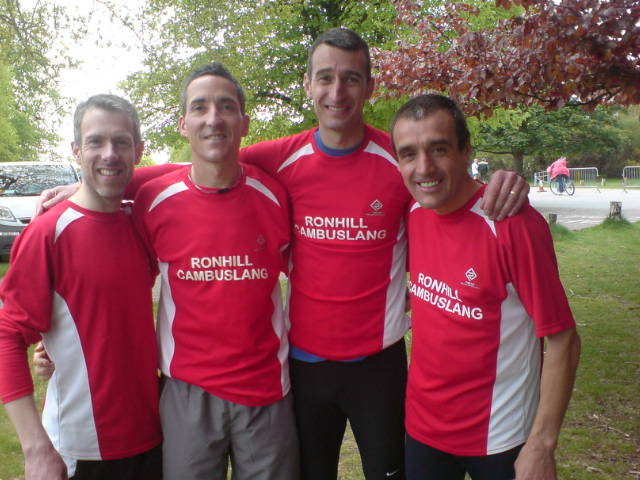
A very good year for Jamie Reid was 2002 when he ran 5000m in 14:35.43, 10000m in 30:16.66, 10 miles in 49:46 and a half marathon in 67:07.   A fine performance was on 28th April in the Lochaber Marathon, Fort William, when he ran right away from the rest of the field to win his first Scottish title in 2:21:46, just outside Simon Pride’s course record.   During the summer he took his one and only Scottish track title winning the 10000m gold at Grangemouth on a Wednesday evening in 31:14.31.   He then switched clubs from Law and District AAC to Ronhill Cambuslang Harriers.    This has resulted in many team medals for Jamie Reid:

  • National Cross Country relay gold in 2003
  • National Six Stage Relay titles in 2005 and 2007, plus
  • Silver in 2003 and
  • Bronze in 2008

In 2003 he reduced his ten mile time to 48:51 but in the Moray marathon in Elgin on the last day of August over a much slower course he retained his Scottish title in 2:34:08, still three minutes ahead of his closest rival.

A year later Jamie was still under 70 minutes for the half-marathon, yet he also ventured successfully into the world of ultra-marathon racing.   After a fairly close battle with the other medallists, he recorded the good time of 3 hours 10 minutes 53 seconds to win gold at the Scottish 50K road Race Championships at Glenrothes in May.    2005 featured battles between two Cambuslang Harriers team-mates.   At the end of May over the testing Dunfermline half marathon course, Jamie Reid won the Scottish title in 71:24, just 44 seconds in front of Robert Gilroy.   However in August Robert got his own back at the Edinburgh Marathon (incorporating the Scottish Championships) when he won gold in 2:26:42 leaving Jamie with silver in 2:30:51.   The Baxter’s Loch Ness Marathon in 2006 was a great race.   Kenyan Zachary Kihara only just won in 2:22:23 with Simon Pride second, 2:22:23 and Jamie third in 2:24:04.   In addition Simon won his fourth Scottish Marathon gold medal and Jamie his second silver one.   Jamie Reid gained revenge in the 2007 Moray Marathon at Elgin which was also the Scottish Marathon Championship.   On a difficult course he engaged in a tremendous struggle with Simon Pride eventually winning his third title by 35 seconds in 2:33:11.   Earlier that year he produced an excellent fifth place in the Scottish Cross Country Championships leading Cambuslang to silver in the team contest.

Then in 2008 Jamie continued his good cross-country form  with ninth in the National leading Cambuslang to team gold.

To sum up,  so far  Jamie Reid has had a very good distance running career.   To win a UK Inter Counties Championship, six individual Scottish Senior titles and another two silver medals is outstandingly consistent.   Add to these five team golds, two silvers and a bronze!   His resolve to concentrate on championship performances is extremely unusual for a Scottish performer in the twenty first century.   He should be a good role model for aspiring marathon runners in the next decade.

In 2010, Jamie recovered from a major injury and started running well once again.   In the Scottish Masters Cross-Country Championships in Forres he launched his veteran career in style.   Fourth place in the race placed him second M35 and second counter for the winning team.   Then his Cambuslang M35 team made a successful raid south to win the British Masters Athletic Federation Road Relay in Birmingham.

Jamie R 2

The successful BMAF team – Jamie on the left.

The Jamie Reid story has several chapters to go yet!

*****

JAMIE ANSWERS THE QUESTIONNAIRE

What Started You Running?   My first ever organised race was for 1st Cambusnethan Boys Brigade Company in the Wishaw Battalion Cross Country Championships in January 1985 at Cleland Estate.   It was in the Junior event (P7, S1 and S2 school tears) and I finished from memory in fourteenth place as a P7.   I played a lot of football and was always on the go so I had a decent general all round fitness.   Running races was just a once a year thing for me and the next year I managed to get sixth place I think, in the same event which was enough to get me selected to represent Wishaw in the Scottish Boys Brigade Cross Country Championships in Caird Park, Dundee in March 1986,   This was a big event and I managed to come home in around 50th place.   I enjoyed it and felt that if I began to do some training I could win the Wishaw Championships the following year, and it was this that kick-started my interest in running.   I did manage to win the Wishaw event in January ’87, qualifying me for the Scottish BB Championships again, this time at Falkirk.    I trained a bit for it, but was too inexperienced and was up into second place by halfway but faded to about twentieth.   However I remember reading the programme and and spotting that Allister Hutton had once won a Scottish BB Cross-Country title and this fired my ambition ot get my name on the winner’s list some day – unfortunately the best I ever managed was second.   The following year, 1988, I competed for my school in the Lanarkshire Schools Cross-Country Championships finishing fourth, and then in the Lanarkshire Schools 1500 metres on the track winning in 4:30.1 which was a championship record at the time.   It was after this that I joined Law & District AAC.

Marathon Training.   Originally this was built on the Lydiard principal of three long days a week, and this was the basis for three of my four fastest marathons including my PB.   Monday and Friday were almost always easy days when I jogged for  five miles.   Tuesday, Wednesday and Thursday I ran five miles in the morning from my parents home in Cleland to my workplace in Motherwell, carrying my breakfast and some change to buy a newspaper to read at lunchtime.   On a Tuesday and Thursday evening I would run home usually for 95 minutes – called it 14 miles – with a steady 10 miles on a Wednesday night.   This was the pattern when not specifically preparing for a marathon.      During the last ten weeks or so before a marathon I would increase the Tuesday and Thursday runs to 18, 12 and 18 respectively.   In the last five to six weeks, I generally added some reps of five minutes fast with short recoveries, one to two minutes, on the Wednesday evening run.   Saturday morning was the long run day, up and around the farm roads around Cleland, reaching the exposed moorlands around the Blackhill TV transmitter, and down the ClydeValley in the other direction.   This was usually anything from 150 to 190 minutes, covering anything from 22 to 28 miles.   Sunday was usually a steady 10 miles.   I always preferred the Saturday long run as I could relax afterwards for the remainder of the weekend – I always had a sense of dread for the long Saturday runs and also for the midweek two hour runs as I didn’t enjoy them at all.

So much so that I decided to drastically revise my training in the autumn of 2001 in an attempt to gain an improved performance.   I had run a disappointing 2:29 at Berlin in September 2001 with a background similar to the above though with more speedwork and track sessions in the last eight weeks.   Therefore in an attempt to qualify for the Manchester Commonwealth Games (sub 2:18 was required) I aimed for London 2002.   Training was seven to eight miles number stride fartlek (from Ron Hill’s autobiography) on a Monday.   Tuesday and Thursday were both strong paced morning runs of  4.5 miles (to work) and another strong paced nine miles at night.   Wednesday was 4.5 miles light fartlek in the morning with nine miles at night including 3 x (5 minutes fast with 2 minutes slow).   Friday was an easy five miles.   Saturday was mostly and easy four miles in the morning with a race in the afternoon, or just a session with a faster paced long run on the Sunday of about 18 – 22 miles.   This resulted in a disjointed season due to various injuries (missing the National Cross-Country), but the performances  were decent when I managed to get consistent training behind me in the spring.   I decided to miss London as I felt I was not ready, due to the time missed through injury, and entered Lochaber instead as it was two weeks later giving me a further two weeks of training.

These were essentially my two different training approaches with results of 2:21:16 and 2:21:46 respectively for my fastest marathons.   The former approach was consistently around a hundred miles a week with the latter 89-90 (though with injury this averaged around 50 – 60 in the three months beforehand.

Favourite Race Memories.   The first was my debut marathon at Inverclyde in 1998, the second was winning the UK Inter-Counties 20 Mile Championship at Spenborough in 2000 and my most recent marathon win – Elgin 2007.

  1. My first marathon was the Scottish Championships at Inverclyde in September, 1998 in which I struggled badly.   During the early part of that summer I had managed some pb’s on the track including an 8:30 3000m and a 15:16 5000m.  I had been using a heart rate monitor for all of my runs and had begun to focus on three long runs a week which brought my fitness on well.   I managed to get regular midweek runs of 90 minutes with a week-end run of 2.5 hours or so.   I planned to do my first marathon with this schedule in mind and pencilled in a few races.    Beforehand I caught a cold, around four weeks prior to the race, then began easy jogging.   I had to miss some of the planned races, but nine days before did a two mile race at Dunfermline which was disappointing.   On the day of the race, I was pretty nervous.   I had driven around the course a few weeks earlier, so I knew there were a few loops round Greenock early on, followed by a run out to Port Glasgow, then turn back, passing the finish area at about 15/16 miles and heading out on the road to Largs before turning back at about 21 miles.   I set myself the target of 6-minute miling and was on this pace for the early miles without any significant problems, other than some blisters.   These would soon become the least of my worries!   I took the pace fairly steady as I had read many stories of the final miles turning into a disaster, but I was respectful of the distance.   The leaders were a few minutes in front but I wasn’t concerned with them.   I had not taken on many drinks as I struggled to get any water from the plastic cups.

All seemed to be going fairly well as I hit the turn at around 20 –  21 miles when I remained on course for my target of 2:37.   Soon after this however I hit the dreaded wall with a large thud.   The next few miles were becoming increasingly difficult and at 23 miles I had to walk.   I was raising money for the St Andrew’s Hospice in Airdrie and had a lot of sponsorship so I was determined to finish.   After a minute or two of walking, I just envisaged going for a three mile route from home and thought to myself whatever pace it takes get to the finish.   People whom I hadn’t seen since the start line were now passing me and I was absolutely spent.   My final position in the race I could now do nothing about.- it was all I could do just to finish.   I eventually crossed the line in a very painful 2:49.   the satisfaction afterwards was tinged with disappointment by failing so badly during the last few miles.   When I got home, I gathered several running books together and made notes of all the areas where I believed that I had gone wrong.

My diet at that time was based firmly on the notion that carbohydrates were everything and with hindsight this caused several problems.   Any time I caught the cold, this turned into a nasty bug which lingered for several weeks with a deterioration in performance resulting.   Despite trying everything from resting completely for a week at the first sign of a cold, to jogging for three miles a day, nothing helped.   It was only after this marathon that I became aware that I was very much lacking in protein.  As soon as I corrected this imbalance,  I suffered fewer colds and, encouragingly, no loss of performance afterwards.   I had planned for three weeks of complete rest afterwards so I was itching to get back into competition again.   In my second marathon a year later after taking on board the lessons learned, I managed to take twenty four minutes from that first attempt.

  1. In 1999 after running 2:25:39 in my second marathon (Dunfermline to Edinburgh), and taking nearly 25 minutes from my pb, I targeted London in April 2000.   I decided to repeat the build-up of my earlier run and do a hard 20 miles four weeks beforehand.   Checking the fixture lists, I could see that the *UK Inter Counties 20 Mile Road Race Championships in Spenborough, Yorkshire, was exactly four weeks beforehand.   I therefore contacted Scottish Athletics indicating my wish to be entered as part of the West of Scotland team, which I was.   Unfortunately, however, I was the only member of the team, with no other Scots being entered.   As the race was on a Sunday, I decided to go down the evening before with my parents and stay in a hotel reasonably close to the race.   Late Saturday afternoon, I checked the oil and water in the car before setting off.   Just before crossing into England, I notices smoke coming from my exhaust and shortly afterwards the temperature of the engine rose dramatically before a loud bang came from under the bonnet – promptly followed by the car shuddering to a halt.   As we inspected the engine it quickly became apparent that I had forgotten to put the oil cap back on!   So sitting about five miles south of Carlisle, in a car with a blown engine, and a 20 mile race the next day, some quick thinking was necessary.   A call to the breakdown company was first.   They arrived promptly, towed the car to their local garage, advising of the damage and consequences, before dropping my parents and myself at Southwaite Services.   The hotel room was cancelled and fortunately my brother Fraser was able to drive down from Hamilton and pick us up, eventually dropping us off at home around 1:00 am on Sunday.   With the race at 12 noon and wanting to be there for 11:00 am, a decision had to be made on whether to go to the race.  Getting there meant leaving home around 6:30 am, giving little time for sleep, breakfast, etc, but with my Dad sharing the driving I was able to sleep some of the journey down, getting there shortly after 11 am.

Despite having run 2:25 for the Dunfermline to Edinburgh marathon around five months earlier, and having got in a good level of training during that time, I was pretty nervous at the start.   I noticed a profile of the course on a wall and noted that the first half of the course was tougher than the second.   The race was over some very  undulating short and long laps with some of the biggest hills I’ve encountered in a road race.   Decision was made – a steady start was essential.   If the rest of the guys were to beat me, then good luck to them.   The race started and finished on the track and after hitting the roads, the early pace was strong.   The sun was out and there was a strong breeze in the exposed areas of the course.    Between miles four and eight I went through a bad patch mentally and physically where the leaders got away from me leaving me trailing by a minute.   I had only managed to get half a cup of water – I hadn’t practised taking drinks from plastic cups before (my own fault) and didn’t want to contravene any laws by taking a drink from my parents who were driving around the course.   My time at 10 miles was exactly 55 minutes and I was lying back in about eighth place.   Slowly over the next few miles I began to pick up, passing some of the guys from Yorkshire and  gaining on the leaders.   As I got up to around fourth or fifth a car kept coming up alongside me asking which county I was from – they were obviously part of a county who had a chance of winning a team title.   I took umbrage at this – why should I interrupt my concentration and my breathing just to satisfy their curiosity – and just gave them a look.   They continued to drive alongside for a bit asking again and again, but I didn’t respond.   Now I was really gaining in confidence as I moved into a medal position and I was catching second place.    By 17 miles I was in second place and catching the leader – slowly but surely.   At a steep downhill I knew I would catch Ian Fisher of Otley Harriers and did so at 19 miles – I think he got a shock.   I managed to get past and pull clear for a 14 second win crossing the line in 1:47:59.    I had a sense of deep satisfaction from coming through the field and getting the win.   An old friend of my Dad’s, a former teaching colleague at Larkhall Academy, Ajid Singh, had managed to finish the race in between three and a half and four hours – not bad for someone in his 70’s – and sent up a nice letter afterwards with some local press cuttings with details of the race describing the winner as ‘the diminutive Scot’.   Ian Fisher was to gain revenge four weeks later, as he pipped me at London clocking 2:20:27 to my 2:21:16.

  1. My most recent  Scottish title was at Elgin in 2007 where I had my first marathon victory over Simon Pride.   The previous day, my girlfriend Roisin and I had driven north as she was competing in a a six-a-side shinty tournament near Inverness for her club, Tir Connail Harps from Glasgow.   I spent the afternoon watching the tournament, drinking diluting juice and eating large amounts of cake!   Afterwards we drove to a B&B in Elgin where we checked in and went out for a meal.   We settled for some pizza and relaxed talking about the shinty that afternoon and the race the next day.   I wasn’t really nervous as I wasn’t expecting much as recent races hadn’t gone particularly well.   I had hit the over-training button again as I had logged a tremendous mileage (maximum of 144 miles per week), switching to this after my best ever fifth place at the National Cross-Country Championships in February.   It hadn’t improved me, only made me worse.   Never mind, I entered the marathon, hoped for a solid run and then I could look forward to the autumn relays – my favourite part of the season.   The morning of the race we had coffee in the hall after picking my number up.   I saw that Simon Pride was entered, along with Adam Reid from Peterhead and David Gardner from Kirkintilloch whom I knew fairly well.   Early pace was slow as the four of us settled down and let the countryside pass by.   The day was warming up and there was little wind.   I managed to get some drinks from Roisin as the race progressed, with the pace beginning to pick up as we passed Burghead    (c14 miles).   Simon and David pulled away and I knew it was too fast for me.   In the distance I could see Simon moving ahead of David, but as we neared Lossiemouth, I could see I was gaining some ground.   The sun by now was shining fiercely and I could sense a silver medal.   I managed to pass David in Lossiemouth offering words of encouragement to each other, and I now looked to see how far ahead Simon was.   He was out of sight.   Still, always believe – funny things can happen in the marathon.   I finally caught sight of him as we entered the woods around 20 miles and I checked his lead in seconds.   I can’t remember exactly but it must have been at least a minute.    After a mile or so, I checked again – it was now around six or seven seconds less.   A quick calculation in my head told me it would be close if we maintained the same pace, so I pushed on.   Three miles to go, I could see Simon more clearly now and I calculated I could catch him by the end if we both maintained the same pace.   Roisin was at this point in the car and she drove quickly back to the finish.   Every step was taking me closer to Simon now and the Scottish title was back in my head.   What will happen when I catch him?   How much has he left?   Is he tiring or just unaware that I’m coming through?   I caught Simon just as we entered the outskirts of Elgin, around a mile to go, and I decided to give it a push on to try to discourage any attempt to try to stay with me.   Thankfully for me it worked and I went on to win in 2:33:11 with Simon not far behind and David taking bronze – marathon title Number Three!   A slow time for all three of us, and perhaps highlighting the dropping standard, but it was one of the few marathon races I’ve run which had been tactical and a real ‘race’.     I knew that Simon had been past his best, and neither David nor I had been at our best, but it remains a very happy day for me.   The rest of the day was spent celebrating with ice-creams in Lossiemouth before driving south to Aniemore where we spent the night and I stuffed myself with burger and chips, washed down with chocolate fudge cake and ice cream!

Jamie R 4

That’s as honest and informative a series of answers as any that has appeared in any questionnaire, either here or in any of the running magazines: I also find it interesting that  one of his most memorable races is one where he did not run at all well and the details of training are always fascinating for other runners and coaches to see.    As a triple Scottish Champion Jamie Reid is well worth his place in any list of national marathon stars.

Rab Heron

Robert Heron, (Rab north of the border; Rob south), showed early promise in 1966 at seventeen years of age. Running for the winning team, Dundee Hawkhill Harriers, this stocky red-haired athlete won the East District Youths Cross Country Championship. In addition that year, he was in the top eight in the Scottish Schools CC in Perth ; and in the summer, when the Scottish Schools held their track championships at Westerlands, Glasgow, he finished the mile third in 4.29, three seconds behind Robert Linaker but well in front of the fourth-placer, Colin Youngson, from Aberdeen Grammar School.   Rab became a student at St Andrews University and was chosen in November 1966 to run for Dundee Hawkhill Harriers on Stage 4 of the Edinburgh to Glasgow Relay. He also ran this race for them from 1968-1971; before switching to Aberdeen AAC, winning silver in 1972 and bronze in 1973.

Rab and Colin maintained an occasional rivalry (and were always evenly matched, ending up only seventeen seconds apart in the Scottish all-time marathon rankings, although Rab was the superior ultra-runner). At this early stage in their careers, Youngson finished ahead of Heron in the 1968 Scottish Universities 3 miles track championship, but Rab outsprinted Colin in a 1969 inter-university cross-country fixture. That year, Rab represented Scottish Universities against a Scottish Cross Country Union select.

By 1972, Rab Heron, by now a keen writer and also a rock-climber, was studying Librarianship at Robert Gordon’s Institute of Technology in Aberdeen. From Sunday the 9th to Thursday the 13th of April that year, he took part in Aberdeen AAC’s first attempt at the John o’Groats to Land’s End ten-man relay. Unfortunately the team finished half an hour outside the record. However Rab, who was paired with Colin Youngson, revealed a masochistic sense of humour and seemed almost to enjoy the exhausting, frustrating experience, which might explain his later successes in ultra-distance running! Rab later made his marathon debut with fourth in the SAAA event (2.35.19).

In early April 1973, a much fitter Rab was paired with the inimitable Alastair J. Wood in AAAC’s successful second Jogle, which this time broke Reading AC’s record by half an hour. Here are extracts from the Journal of Robert Heron.

“Our Van (Number One) takes over about the Lybster area from 2.50 to 4.50 p.m. and goes to not far short of Brora. Alastair and I both go well, high exposed roads hail-swung and wind-blown, warm, black showers. Berriedale Braes we demolish in 200 metre sections – blithe as bastards. Wood gets most of the other hills, but doesn’t mind. Watching him bowl along, you are conscious of greatness. 24 miles in the two hours, a hard session, but we are buoyed up and absorb it well.”“We take over once more. The next few runs are fast. Through black, snow-deep Inverness-shire – Kingussie, Newtonmore, Dalwhinnie (the link-car hovering silent and menacing and white as the proverbial albatross) – our van’s headlights throwing black running-men shapes all over the trees and bushes and hills. Quietly crunching we advance to Drumochter Pass, a green dawn breaking behind us over the hills on the left. Knife-cold. A panorama of snow-hills rolls beside and in front of the woolly-hatted Wood. At or near the summit we change-over. Eat, drink, wash and try to sleep. A good session again.”

(Much later, in Devon) “In a lay-by, at this early hour, trying half-heartedly to warm up, only one hour for this last run before preparations for the final ‘sprint’. Behind us a big red sun rises sluggishly out of cloud, a sponge soaking up blood, misty with distance and cold; in short, a beautiful morning. We run to 8 a.m. through Taunton and into Tiverton, winding country road and light work-going traffic. A rustic roadman calls “only ninety-seven mile” and I grin.”

“Through Penzance. The link-car takes me through a one-way system to take over lest the van is held up, while Gordon Casely on his bike leads the runner through. It works, Joe Clare heaves into sight and I run for the last series of hills. Joe and I alternate at around 100 metre intervals till Wood and Innis Mitchell arrive – when they do, we demolish the last of the hills and it’s all over bar the running of it. We are so close now, we know we’re going to do it, it’s all been worth the effort and the constant friction with the co-ordinators, the tired legs are gone, replaced by fine prancing limbs, we can turn round and do it all again going north. For fifteen minutes we go out and try to show the other five how to sprint. Wood does the last of these hilarious orgies of speed. John stops the already stinking van (brake rubber) a last time, we file out and run together, hold hands, the others join in. Casely is blowing up his bagpipes, there is a little cheering, we run en masse right to the main door of the Lan’s End Hotel, elated. I am tired, Steve Taylor is emotional, I shake hands with Colin, embrace Steve, pat Martin Walsh’s leg, there’s a photographer, an alderman and his wife. Wood is elsewhere, we don’t speak, it doesn’t matter. Bill Donald arrives chanting “seven o nine fifty-eight” or something, which doesn’t matter either, we did it the hard way, now it’s past, finished.”

That toughest of training sessions quickly led to the fastest time Rab ever achieved for a marathon. He gives full credit to the Jogle as being the main factor behind this new level of fitness. In winning the Edinburgh to North Berwick race on the 12th of May, simply running away after the five-mile point, he took an amazing eighteen minutes off his PB in recording 2.17.07, which topped the 1973 Scottish rankings. Second and third in that race were another two Aberdeen AAC Jogle runners: Steve Taylor (2.23.17) and Graham Milne (2.24.18).

Later, on the 23rd of June, in the SAAA Marathon over the 1970 Commonwealth Games course, starting and finishing at Meadowbank Stadium, Rab finished third in 2.21.15, behind Donald Macgregor (2.17.50) and Jim Wight (2.18.24) both of whom were selected for the Christchurch Commonwealth Marathon in early 1974. Rab had averaged 80 miles per week in training for six months. After the leading pair moved away at 20 miles, he was left to run in alone, his nylon Reebok marathon shoes bruising a foot and producing a big blood blister on a little toe. Liberal smearings of nappy rash cream were effective in preventing painful friction in other sensitive areas – such as his wide-mesh, heavy-duty cotton string vest from Millets!

In late June1974, Rab Heron’s wife Marjory gave birth to their second son, in the early hours the day before the SAAA Marathon in Edinburgh. Rab remembers the headwind on the way out, with the leaders sheltering behind Sandy Keith. After the turn, Rab and Don Macgregor eased away. “We ran together, trying tactical bursts every now and then, until 23 miles or so, when the wily Don finally got away to win.Afterwards, in the pub opposite Meadowbank, I saw Scotland being eliminated from the World Cup.” Donald Macgregor won in 2.18.08, with Rab Heron running  2.19.18 for his silver medal, well in front of his AAAC team-mates, Colin Youngson and Sandy Keith. Rab had been averaging 90 miles in training, including fartlek and repetition running three or four times a week.

In August 1974 he made his debut in the Two Bridges 36 mile race (from Dunfermline, over the Kincardine and Forth Road Bridges, and finishing in Rosyth).    Rab came in a valiant second (3.32.04), to Jim Wight of EAC (3.26.31), who back in January, had run in the Christchurch Commonwealth Games marathon. In his first ultra, Rab had maintained a steady pace with his experienced friend Alastair Wood.   Athough unable to catch Jim Wight, they had beaten other stars like Don Ritchie, Don Macgregor and Mick Orton. Then Rab moved away to defeat Alastair by 39 seconds! Aberdeen AAC naturally won the team award.

Rab had a great record in the Two Bridges classic, with four second places. He recorded very good times: 3.24.22 in 1978, behind top ultra-distance athlete, Cavin Woodward; 3.25.34 in 1979, behind Andy Holden, a British international at cross-country, steeplechase and marathon; and 3.26.54 in 1980, behind Holden’s 3.21.46, which was the fastest time ever recorded in the 28 editions of this excellent event. Rab was undoubtedly one of Britain’s very best ultra-runners.

Not long afterwards, Rab and his family moved south to Bognor Regis. In 1975 he ran 2.20.40 in the AAA Marathon in Stoke. Unfortunately, in 1976 his running was impeded by constant injury.

Battling back to fitness in 1977, and now representing Brighton and Hove AC, he decided to give a local event a real go, to check whether it was worth continuing with the sport. Well, he certainly went on to prove that it was! On the 25th of September, he stood on the start-line, next to Big Ben, for the famous London to Brighton 52 and a half mile race. His rivals included another ex-Aberdeen AAC athlete, Donald Ritchie (now Forres Harriers) and his main challenger, former winner Cavin Woodward (Leamington).

The Road Runners Club magazine report of this race is fascinating. Woodward, as usual, set off fast, but could not draw away from five others, including Rab Heron. By ten miles, Rab had moved into the lead in “an incredible 56.04”, more than 40 seconds clear. He held this gap to 20 miles and was well ahead of Alastair Wood’s 1972 record schedule (marathon time 2.29.52). By thirty miles, Rab had a lead of one minute but by 40 he was beginning to flag a little, and on the notorious rise of Dale Hill he was eventually overtaken by Don Ritchie. The Forres athlete finished strongly in 5.16.05, the fourth fastest of all time, with Rab Heron “who had led for so long” coming in “a very gallant second in 5.19.47, the 7th fastest of all time, having had a wonderful debut run in this classic race”. Cavin Woodward was third in 5.23.36.

Nowadays, still keen on rock-climbing and also caving, Rab has retired with his wife to live in West Yorkshire and to enjoy work part-time in the mobile library service.

*

What follows is Rab’s own account – humorous and inspiring it is a first-class account of how an athletics career developed.

1964  –  1970        Building          40-50 miles per week

Born in Dundee in December 1947, I went to Morgan Academy in 1960 and ran my first race at the school sports in June 1961 – the one mile open handicap.  Six years’ worth of boys lined up, with the first year receiving a lap start on the sixth formers.  This handicapping was over-generous and from the gun I found myself alone and in front and stayed there – dead easy.  However, my sporting career began as a swimmer with Dundee’s Arnhall SC  –  dabbling with cross-country at school because I couldn’t get into any football team (I REALLY wanted to be Willie Henderson or Charlie Cooke).  Things became more serious after my first road race in April 1964 when the school entered a team for the second Dundee-Newtyle race for youth groups and I was included.  This was my fifth race but I had already developed the tactic of starting slowly and gradually coming through.  Dead last up the long steady hill at the start of the nineish mile journey, running with team-mate Allan McClue (previous winner in 1963) we began to eat through the field.  Leaving Allan, with one bold guy still ahead, I caught the fading leader at the top of the long fast descent to the finish and found myself alone again.  Running freely, enjoying the feeling, I finished in 48:40 taking 70 seconds off the record.  I also sustained my first injury (to my right hip) and a bad case of jockstrap rub which necessitated my wearing a pair of my mum’s silk drawers to the evening dance and presentation.  With more regular training, basically group fartlek, and steady running, often solo, I further reduced the record to 45:25 in 1965, leading from the start  –  the last year the race was held.

A report on the 1964 race appearing in one of the local papers prompted Ronnie Coleman, a stalwart of Dundee Hawkhill Harriers, to write to me offering fame and stardom as a club member.  I succumbed, joined the Hawks, and condemned myself to a life of pain, misery and disappointment.  This was enlivened by my association with a fine bunch of young laddies who, in different combinations, formed a successful youth team.  Norrie McGowan, Vic Cammack, Iain Graves, Roy Robertson and myself won every relay we entered in 1965, Eastern district team champions, but failed to win the National, finishing third.  We were all to some extent under Coleman’s wing, and he took a personal interest in what I was doing so that I never felt I was groping in the dark when it came to training.  He would always leaven his advice with a qualifying “but please yourself”.  And he instilled in me an appetite for repetitions up hills, long and short, which stayed with me all the way.  As did the pure enjoyment of running laps in parkland or woodland settings like my beloved Camperdown Park, (one of the first places I went training with Ronnie Coleman), Balgay Cemetery and Victoria Park in Dundee  –  plenty hills to toil up and long downhills to stretch out on.  The bigger world of junior, then senior athletics, revealed me as an undistinguished club runner for the Hawks and St Andrews University.  Running for Scottish Universities vs Scottish Cross Country Union in December 1966 in Edinburgh I finished second last  –  a feat replicated in 1969 in the same city, but representing the Union.  I did, however, win St Andrews cross country championship four years in a row, and gained a double blue in athletics and cross country.  During the St Andrews sojourn I trained regularly with a bloke called Donald Macgregor, who was always helpful with advice, and good company when he decided to stay with you rather than disappearing up the road if he was feeling good.  And Fergus Murray was another to bounce ideas off and provide regular encouragement.

I married Marjory Radcliffe in 1970 and entered a period of more focused effort.  Another Hawk, Harry Bennett, no longer with us, was qualifying as a coach at the time and without being formally coached myself, simply having discussions and exchanging ideas I began to think more about training.  Also, I would go for regular long slow runs, mostly off-road, with Phil Kearns , during which we would natter about training and racing.  Incidentally, Phil, a PE teacher in Dundee, taught a wee lassie called Liz Lynch, coached her for a while before giving the role to a now fully-qualified Harry Bennett  –  and the rest is history.


1971  –  1986        Consolidating        70-80 miles per week


Moving to Aberdeen for a year in 1971 to attend RGIT School of Librarianship brought me into closer contact with the late Alastair Wood.  I became a second claim member of Aberdeen AAC at this point, becoming first claim by 1972.  Hitherto the bulk of my training was simply steady running, enough to win Spean Bridge-Fort William in June 1971, and finish second to Wood at Alves-Forres in October.  Many previous conversations with Phil Kearns had concerned preparing for and running a marathon.  Talking to Wood and others like Steve Taylor and Donald Ritchie began to sow the seed of racing marathons.  In Aberdeen in October 1971 I introduced a pre-breakfast run of five miles to my routine  –  “to train the brain, not the body” quoth Wood  –  raising the weekly mileage from about forty to about eighty.  In December at the Hawks’ road championship I missed Kenny Grant’s record for the five miles by one second over a toughish course.  Meanwhile, something, somewhere, had put the idea into Steve Taylor’s head of having a crack at a north-south relay record for a ten man Aberdeen team, and I volunteered for JOGLE in April 1972.  I did not enjoy myself initially, having to run through a cold and finding it hard (as we all did) on non-recovering muscles.  However, buoyed up by cellmate (rather van-mate) Colin Youngson’s ebullience and humour I rediscovered a rhythm and stuck it out, and we managed to set a north-south record, narrowly missing the absolute best time.

Just over a month later I won an open 5000m on the new Balgownie track (15:12.8) apparently setting a stadium record because Andy McKean’s winning Scottish Universities time had been slow because of tempestuous conditions.  I hope that my mark has been comprehensively slaughtered, and rightly so.  My reputation has never been based on middle distance running.  Third at Spean Bridge-Fort William behind Sam Downie and Willie Day was my preparation for the SAAA marathon, my debut in June 1972.  This was won by Wood, myself fourth behind a distant Colin Youngson in 2:35:19.  I put my listless performance down to it being a week after final exams at RGIT.  Heavy legs, reluctant brain, long stretches of boring soreness  –  was it always going to be like this?  I finished the year as part of the disqualified AAAC team finishing second in Edinburgh-Glasgow (Ian Stewart being ruled ineligible).  And 22nd for SCCU vs SUSB at St Andrews.  “A bit nippy for you” quoth Doug Gunstone, referring to the fast flat course.By now living in Arbroath, I joined the JOGLERs again in April 1973.  Partnering Wood and feeling altogether more energetic, I was much happier than the first foray.  We set an absolute record of 79 hours 8 mins.  More significantly for me, five weeks later I won Edinburgh-North Berwick in 2:17:07, my wife and nine month old son Robert cheering me on. This was the start of regularly using the bleed-out/carbohydrate loading diet until I got fed up with it in the mid 1980s.  The only ill-effect was a monstrous blister on the sole of my right foot which Jimmy Mitchell hacked away at post-race with the bluntest surgical scissors he could find.  I never realised that Steve Taylor in second place had been so badly affected.  I was healed and ready for the SAAA marathon in June and put in a workmanlike if uninspired performance, finishing third behind Macgregor and Jim Wight.  This was also the trial for the Christchurch Commonwealth Games and I missed out with the wild card selection of Lachie Stewart to fill the third marathon slot  –  he failed to finish; I’m not bitter.  By the way, our second son, Stuart, was born in the early hours of the morning of the day before the race.  Four days before the race I had been playing on a boulder in Glen Clova, warming up to go climbing with my old mate Jim Braid  –  the thought suddenly hit me that a fall could affect my chances in Saturday’s race.  From then on, running became the priority, and I would not tie a rope on for another twenty years.  A third with a legal AAAC team in Edinburgh-Glasgow closed that year, where the bulk of the racing had been undistinguished track meetings in the NE and Scottish leagues.

In February 1974 I had my best National finishing 28th at Coatbridge, with AAAC third team.  I lined up for the SAAA marathon honed and bronzed  –  honed anyway  –  and despite high confidence could not overcome The Don, finishing second in a pleasing 2:19:18.  People who didn’t know me  knew my name.  I did overcome him in August in the Two Bridges  –  sounding almost apologetic when I caught him on the Forth Bridge and he told me he’d blown up.  I caught Wood too and stayed with him until just before the finish where he let me in ahead of him to finish second behind Jim Wight in 3:32:04.  Third at Walton-on-Thames in a Road Runners Club 30 mile track race behind Mick McGeoch and Ritchie brought the curtain down on distance running.  I had a bad first leg in Edinburgh-Glasgow, AAAC seventh team  –  this being my final race as a Scottish domicile.  Bognor Regis here we came.

At Bognor Regis College of Education I was almost adopted by Goff Hine, lecturer in PE and interested in exercise physiology, who from the beginning took an avuncular interest in my running and used me oft-times as a lab rat in physiological testing.  He introduced me immediately to a young first-year PE student, Mike Gratton, of future London and Commonwealth marathon fame  –  I taught him all he knows.  We trained together, mainly long steady runs on Sundays, for the next three years of his course, and became Brighton & Hove AC team mates.  In February 1975 we were members of a four man road relay squad who took the Round Butlins race record from a team that had included David Bedford and Brendan Foster, and two others.  We must have had greater depth with Dennis Dorling and Bob Pateman of whom you will not have heard..

My introduction to big English road races was the Finchley 20 in April.  A four-lap hilly course, Trevor Wright winning easily, myself seventh in 1:44:55.  Then the AAA marathon at Stoke in June, where I ran with the Don for the last five miles, and failed to get under 2:20 just ahead of him in fourteenth place.  I also picked up a niggly groin injury which persisted throughout 1976, though I helped Brighton to a team win in the Southern Counties cross country championship in January at Parliament Hill, finishing fourth scorer in 32nd.  Getting over the injury, I then fractured my ankle jumping a stile on a Boxing Day run.  By February 1977 I had recuperated enough to help Bognor College win a third Butlins relay in a row  –  which turned out to be the finale for this fine wee event.

At some point I decided it would be a great idea to test my recovery from all the troubles by doing London-Brighton, so after second in the Sussex 10000m championship in Bognor in May I set to work knowing I had the best part of five months to get myself ready.  Alternating weeks of 100 miles fairly easy and 80 miles fairly hard, alternating hard and easy days building up to two hard days and an easy day, and a regular Sunday run of 25 miles over a hilly course  –  I got my body, and my mind, into good fettle.  Come the day I went off too fast, of course, but by the time I was dead only Ritchie could catch me and it was downhill all the way to the finish  –  not that that makes any difference.  I nearly burst into tears when I miss a drinks station  –  just as well Marjory is in the car feeding me drinks every mile and a half.  You don’t see the sea until you actually turn on to Brighton seafront, then the sweet relief.  5:19:47.  I didn’t have a qualifying time in order to enter and was allowed entry on past form and my assurance that I was fit  –  I think I did OK.  You used to get a bath that would have served as a sarcophagus for any self-respecting pharaoh, where you could lie and drink tea with six sugars (not stirred because you didn’t like it too sweet) and watch the tendrils of blood coil upwards from mangled toenails.  And electrical activity in the muscles that would still have them gently twitching two to three days post-race.  I know what to do next time I’ve got a bad injury  –  I’ll get ready to do London-Brighton and lose to the best ultra-distance runner on the planet.  The really satisfying part was being able to carry the strength forward into the Portsmouth 5 in December to finish fifth in 25:05, “like a bounding stag” quoth an unknown Navy runner.

In May 1978 I won the Chichester-Portsmouth in 1:25:28 with a tactical move involving very narrow single lane roadworks and getting in front of a bus to keep a buffer between myself and the chasers.  By the time they could start to work together to nail me I had a cushion that would not yield.  At the Poly marathon in June I ran OK for third in 2:22:31.  And in the Two Bridges in August I tried to run away from the field, but was caught by the irrepressible Cavin Woodward.  My time of 3:26:22 was nothing if not workmanlike.  And London-Brighton in September was a disaster.  While leading having opened a considerable gap I was crippled with stomach cramps and diarrhoea, the pain of which, I was told later by a physiologist, would have diverted blood away from the working muscles to the area affected by pain.  The strain of regularly shitting streams of cocoa behind the shelter of my support car’s open door became too much and my legs stopped working anyway.  I got to about 38 miles and then called it a black day.

The 1979 Sussex 20 championship at Worthing saw a very small field set out to run the four very flat laps in misty rain and wind.  At the end of the first lap I moved gently to the front to do some of the work only to see a brash Iain Beauchamp, newly elected to the British Marathon Squad, go bounding past as if to punish and belittle my temerity.  His cocky gait got my goat and, acting on impulse, I took the lead again with destructive intent, hit him hard, and opening a gap quickly , kept it that way to the end in 1:48:21  –  the first of my three wins in this championship.  I have only hazy memories of the Isle of Wight marathon in May.  My diary says that Martin Knapp won it, and that I was third in 2:25:50, the course hilly but not impossibly so.  Another date with the Two Bridges saw Andy Holden win ahead of me in August, my time being 3:28:05.  Then, suffering the after-effects of a heavy cold and coughing my way down the road, with piles as well, and having had a big toenail removed four days before, London-Brighton developed into a really slow drag.  Despite having developed a certain callousness to fatigue, and an ability to suffer that made my mother wince, after leading for a lengthy period and trying to hold myself together calmly, my legs were not up to it and I gave in to the attacks of Allen Kirik (USA) and Martin Daykin.  My 5:47 was still a disappointment  –  and serious intentions notwithstanding, I never returned to the Brighton road again.

In 1980 I left Brighton & Hove AC for Bognor Regis & Chichester AC and began an involvement in the Southern athletics league lasting eleven years, doubling in 1500 and 5000m.  My personal highlight was being nominated Captain for the day at Ealing in 1982, and feeling morally obliged to support the team by filling spots in the 200m and steeplechase  –  cometh the pressure, cometh the man.  I returned to the Two Bridges to record my fourth runner-up spot behind Andy Holden again  –  I hadn’t planned this race until we took a last-minute family holiday in Scotland and I thought I’m going to be there anyway …  And 3:26:54 wasn’t bad going, I suppose.  Again, despite serious intentions, that was the finale for me.  To round off the year, feeling fragile, I ran SLH 30, mainly because it was there.  Don Faircloth, record holder, made light work of the four laps of leafy suburb around Old Coulsdon.  I got myself into a stupefied state to finish second and had to be helped back to the changing rooms  –  my wife on one arm, a guy called Andy (over the moon because he was helping Rab Heron to walk after a race) on the other.  You needed to get out more, Andy, and I needed more mileage.

Subsequent injuries and a meniscectomy in January 1982 brought a fallow period for road running, but I did manage to win the Sussex 10000m championship barefoot on the grass track at Bishop Otter College Chichester, where I worked in the library, in 1981 and 1982.  I came back to the road properly in March 1983 in the Sussex 20, now having become an open race attracting a field of four hundred plus (26 had lined up in 1979).  A fevered three miles in 15:02 set the pattern for a torrid four laps.  As the field gradually melted away from the front and Martin McCarthy (later to run 2:11 in London) eased away in the third lap, I put myself into the gap and prepared to die stoically.  The bold leader stayed away, I stayed clear with desperate men behind me for second in 1:45:02.  So to the first Dundee marathon  in April 1983  –  my first race in my home town since the Kingsway relays in 1974.  Macgregor was rampant, I was off the pace languishing in about sixth place in the drizzle.  Around twenty miles a lone wee auld wifie says “Come on Rab  –  Lochee’s waiting for you!”  Galvanized, the surge I produced brought me up to third in 2:21:26.  I would never race in Scotland again.  At this point, after having trained almost exclusively alone since Mike Gratton graduated and left Bognor in 1977, I ran into, first, Trevor Swann, then later Dave Parsons, both of whom became regular training mates on thirteen to seventeen mile Sunday runs.  Also, the pair of them helped immeasurably when I was really struggling to stay motivated during and after injury.  Lads  –  you are not forgotten.

I won my third county road championship at Worthing in March 1984  –  1:44:47, a personal best behind Martin McCarthy again and again in similar circumstances.  Weathering the storm of the early pace, watching them drop away, watching McCarthy go then going into the gap, defending my territory, legs caving in trying to sprint for the line.  I had been experimenting with sessions on grass doing 6×5 minutes fast, 3 minutes slow, or 10×3 minutes fast, 1 minute slow as well as my usual hilly or undulating laps, which seemed to be working well.  From this point on, however, I began to be trammelled by niggling groin injuries, but had two busy years.  I was helped through this period by Ken Scutt, a physiotherapist who practised at the bottom of my road, keeping me going on and off for sixteen years.  I ran the Gosport marathon in March 1985 at Fareham, finishing a tired third in 2:31.  Winning at Worthing in September in 2:28:07  –  an attack on the only hill (a railway flyover) saw me enjoy running alone for the last twelve miles.  And second at Harlow in 2:22:14 in October.  Back to Gosport for second in 2:26:38 in April 1986.  Second on the Isle of Wight in May in 2:31:22.  And, injury becoming chronic, signing off with second at Worthing in September in a painful 2:32:11.  After which all engines stopped, and I began a period of trying to get well.


1988  –  1991         Restoring        50-60 miles per week


I don’t have a diary for 1987.  I was directed to what was considered to be the best NHS sports injury clinic in the south at Southampton General.  Other than establishing that I had many problems associated with the lower back, nothing positive was to be gleaned.  Fortunately I was then to meet a young PE student at college in Chichester, Sue Lanham, herself a promising middle distance runner, who directed me towards her osteopath brother-in-law in Woking.  Ron Johnston’s initial consultation pinpointed a tilted pelvis which responded well to manipulation and a lengthy period of rehabilitation.   Johnston was to bring me back from the dead (his words) more than once  –  a larger than life wee man.  By Easter 1988 I could resume jogging , gently, on grass.  To ensure gentleness and restraint my wife and daughter, Emma, insisted on accompanying me for several weeks, acting as an automated braking system.  By September I was able to win my first race on grass as a veteran at the Parklands races in Chichester.  And more tellingly, my first road race coming back , first vet in the Portsmouth 5 in December (39th overall).  At this point I began to experiment with back to back Saturday and Sunday runs of thirteen to fifteen miles, straight out of bed, running only on Maxim taken before leaving the house.  This was an idea adapted from conversations with Peter Keen (to become head of British cycling, and now performance director of UK Sport) at that time a lecturer in sports sciences at college.  Later, I had another idea pinched from Chris Boardman’s book on cycling involving sprinting uphill to exhaustion  –  the theory was rock-solid, the practice was definitely not enjoyable, and was subsequently abandoned.

I ran my only half marathon in June 1989 to further test the recovery.  My attitude previously was half a marathon was only half a challenge.  The Rother Valley half was run on the Graffham estate of Lord Young, who took on the starter’s role, letting off an elegant shotgun that was worth more than our family home.  Fourth overall and first vet indicated that things were on the right track.  The jigsaw was completed at Harlow in October, which was the only race I ever started with a clear plan.  On a day of howling cool wind the plan was to stay away from the early pace, then see what could be done later.  At the end of a short five mile lap the leaders were out of sight.  Starting the first of two ten mile laps I was joined by Noel Thatcher, a partially-sighted paralympian, who was going to stop at fifteen miles and was happy to share the work with me.  He was training to be a physiotherapist so we had a blether about injuries and I warned him about obstacles in our path  –  and, on a sudden, at the end of that first long lap, lo!  the leaders, and the weight of the wind.  Bidding Noel cheerio and thanks I crossed the gap and blended in.  Other than a muttered “Where did he come from?” there was no other reaction.  Sensing reluctance to change the pace on the part of the group I upped it myself into the wind, gradually reducing a group of eight to myself and two others.  Up an incline, into stronger gusts, alone, two miles to go, the cycle escort says “Nobody’s going to catch you.”  2:34:06, plan works, first vet and outright winner.  In the car on the way home I waited for the old familiar pains in the groin to come seeping back like they had always done three to four years earlier.  They didn’t.  What turned out to be my last marathon was at St Albans in December 1990.  I was fifth overall, first vet in 2:30:45.  I had good results from simple carbohydrate loading and using Maxim before and during the event.  This knowledge was never developed in competition , until adapted for the later north-south relays.  I also ran my last Southern league 5000m in June 1991 but continued with road relays with Chichester Runners (which had absorbed Bognor & Chichester AC).  For example at the Southern vets at Aldershot in September 1991 I ran the first leg for the A  team, followed by the fourth leg for the B team.  Similarly in March 1995 at the county championships in Horsham I ran the second leg for the vets, then the second leg for the seniors forty minutes later.

 1992  –  1998        Declining        30-40 miles per week

Early in 1992 word began to circulate around Bognor’s small band of mature runners that Len Jones, (now no longer with us) who had lost all three of his wives to cancer, was planning a fund-raising event for Cancer Research Campaign.  A north-south relay was proposed, and at the first meeting when my previous experience was revealed my brains were extensively picked.  When asked what actually running it was like I could do no better than quote the late A.J. Wood  –  “Good at the beginning and good at the end  –  a bit of a drag in the middle.”  As my father had driven a support van in the second Aberdeen effort, I asked my younger brother Tom if he would like to be involved.  He said yes, and was recruited as driver/reserve runner.  Thus our vehicle was to be crewed by the Fabulous Heron Boys and the Krazee Gang which came together on three occasions  –  north-south in May 1992 reaching Land’s End in 5 days 1 hour 11 minutes  –  south-north in May 1995 reaching John o’ Groats in 5 days 1 hour 9 minutes  –  south-north-south in October 1997 finishing in 10 days 5 hours 8 minutes.  Of the days in the mobile lunatic asylum I recall much pain from the recurring injuries in the pelvic area, much laughter, serious internecine warfare , and a wee brother who smiled all the time as he did half my stints as a good reserve should.  The liberal use of glucose polymer powder was a major factor in recovery, and in alleviating the muscular soreness that had bedevilled Aberdeen’s JOGLEs.  So liberal that we were sticking to the floor of the van as if velcroed to spilled solution.

I ran my last race at Rushmoor Arena, Aldershot, in May 1998  –  my favourite relay course for the National vets’ championships.  I did the fourth leg in 21:35 gaining 6 places on a day when the best anybody else could do was keep the status quo and Chichester finished thirtieth team.  I met Mike Gratton and we had a wee run together around a couple of laps.  We did not talk about old times.  The sun shone, there were hundreds of runners about, all over forty, most of them having a really good time.  I never dreamed that this would be the finale, but the thought had crept into my head as I warmed up that I was here to do a job for the lads  –  there were no butterflies, no buzz of anticipation, no qualms of trepidation, I was totally calm.  I went out on the road and did the work for the team as efficiently as I could, not for medals or prizes but to squeeze the very best performance out of my body that could be managed on that day.  And the cheering and the shouting might just have been for me.  Who knows?

Al Howie

aL hOWIE 1

Al Howie racing in 1981

Al Howie is not a name known to many, even of the distance running fraternity in Scotland, and his name was passed to us by William Sichel.    Colin Youngson decided to pursue the reference and contributes some of what he has discovered below.

“Al Howie is another Scot who got away – by emigrating and becoming a great Canadian-Scot ultra-marathon runner.   William Sichel, our best current very long distance specialist, states that he is heavily motivated by trying to improve on Al’s impressive performances.   Arthur ‘Al’ Howie was born in 1945 in Ayrshire.   Having emigrated to Toronto, he started running as a hobby in 1974 ‘to get rid of the aggravation from quitting a three-pack-a-day smoking habit’.   By 1978 he had moved to Victoria, British Columbia, and started training for long runs, including many between cities.   His racing career was from 1979 to 1999.  

The Wikipedia summary of Al’s feats is as follows.   ‘He has won more than fifty marathons, ultramarathons and multi-day races in over two decades, including the 1991 Trans Canada Highway run (7295 kilometres) in the record time of 72 days and 10 hours.   A brass plaque on Victoria’s Mile Zero Marker commemorates this athletic event for which he raised 750 thousand dollars for a fund for children with special needs.   Two weeks after running across Canada, he won the Sri Chinmoy 1300 miler in New York, improving on his own world record time.   Both the Trans Canada run and the 1300 mile race qualified for the Guinness Book of Records.’

Very early in his running career, Al began running from city to city, partly as long distance training, partly to save costs and often for charities.   He would put his clothes on the bus, run to the city, change his clothes, put his bags back on the bus and carry on!  

Al Howie mentions as his great influences: Don Ritchie, Emil Zatopek, Yiannis Kouros (the great Greek runner) and Hilary Walker (an English woman who has broken world ultra records.)   His funniest running experience was learning to tie his shoe laces without stopping during a world record non-stop run!        Sadly his most memorable discovery is that even very good runners can have serious health problems – he himself overcame a brain tumour but since 1995 has been suffering Diabetes 1.  

The Wikipedia article on Al Howie   (http://en.wikipedia.org/wiki/Al_Howie)   is absolutely fascinating.   It gives details of amazing feats of endurance and includes several quotations from the man himself, which show him to be eccentric, clever and incredibly tough.   His initial reaction to diabetes was to continue his rigorous training regimen, saying “Running towards the horizon of human endurance on synthetic insulin is exploring an uncharted universe.   Once again I’m a pioneer in the aerobic universe, this time in the diabetic galaxy.”

Al Howie 2

Colin is right, the entry is very good and has a lot of detail.    The ironic thing is that for all the information contained therein, for all the wonderful athletic feats he has accomplished or been part of, there is wide coverage in the world at large but here in Scotland, his name is hardly known.   Good as the Wiki article is, there is a more personal article about him in a Sri Chinmoy report from 1989 which you can find here and the article below is from ‘Scotland’s Runner’ of April, 1989 and is of a visit with Adrian Stott.  click on the image for a larger version.

Al died in June, 2016 and the excellent Obituary by Jack Davidson can be found   here

Simon Pride

Simon Pryde

Simon as pictured in a Tourist Brochure

Simon Pride has won the Scottish Marathon Championship four times representing three different clubs in the twenty first century at a range of venues and has a remarkable record over all the endurance distances from10K to 100K.    What follows was in the main written by Fraser Clyne with additional information from Colin Youngson.

Simon Pride was born on 20th July, 1967 in Swansea.   he represented Wales in 800m and 1500 metres as a youngster and was in the same schools international team as world champion hurdler Colin Jackson.   His promising running career took a back seat after he left school to join the Army at 17.   Four years later he moved to Fochabers in Moray, Scotland where he settled with his wife Linda and took a job as a roofer and sheet metal erector.   Running remained a casual but enjoyable pastime until a frightening and nearly catastrophic industrial accident changed Pride’s outlook on life.   He explained “One day a nail was fired through my thigh bone just above the knee.   It was probably the turning point as I thought my running days could well be over.   Not only did the incident make me change jobs (he became a postman), at also shook me up into a training frenzy.   For too long I had taken my running for granted.   Within four months I had won my first GB vest.

Pride found international success in the world of ultra distance running.   His first 100K in 1996 produced a Scottish championship bronze medal.     The following year he was ninth in the European year and by 1998 he had a top six finish in the World Championships to his credit (6:59:38).   Simon benefited from the wisdom of world 100K record holder Don Ritchie who lived relatively close by in Lossiemouth.   The Keith and District athlete’s greatest triumph came in May 1999 in France where he won the world title with a UK road best of 6 hours 24 minutes 05 seconds.   It was a superb performance which took the  ultra-marathon world by surprise.

Even more surprising was Simon’s decision a year later not to defend the world title.   “I need a break from ultras” he said at the time.   He decided to concentrate on marathons for a while and when the opportunity for a Scottish title on his home patch presented itself, Pride was in no mood to miss out.

He was determined to win the Scottish title in 2000 – and equally keen to break the course record of 2:25:38 set eight years earlier by Fraser Clyne.  he achieved both with plenty to spare.   Running on his own for almost the whole way he took advantage of the perfect conditions to stop the clock in 2:21:17.   It was the quickest winning performance in the championships since 1984, the biggest winning margin  ever and just14 seconds outside his personal best set in London four months earlier.

OTHER INFORMATION

In 1998 Simon won the prestigious, and sadly missed, Two Bridges Race (35 miles 495 yards) from Dunfermline over the Kincardine and Forth Bridges finishing in Rosyth.   His time was three hours twenty nine minutes.   Simon always maintained  not only endurance but also speed in his training – long mile intervals with short recoveries, and tempo runs or fartleks, often on undulating forest tracks.   After winning North of Scotland Road and Cross Country titles and placing in the top ten at Scottish Cross Country championships, as well as personal bests for 10K and marathon in his build up, in March 1999 Simon Pride came close to breaking the world record for 40 miles track when winning the well respected annual event in Barry, Wales, with a time of 3:53:55 which was a race record.   This was a key part in the preparation for   his amazing achievement on 15th May 1999 when, as Adrian Stott wrote, “He stormed to the gold medal at the IAU World  100K Championships at Chevennes-en-Paillier in France.   Living only a few miles from Don Ritchie in Moray, Pride had been inspired and guided by the training and racing attitude of his illustrious compatriot.   In an exciting last 10K he prevailed over the Frenchman Thierry Guichard by a mere 21 seconds!   His time is still a Scottish (and GB) record.”    later Simon received the John Jewell Medal for 1999 which is presented annually by the Road Runners Club for the most outstanding annual road running performance at any distance from 10K upwards by a British athlete.   In addition he was Scotland’s Athlete of the Year.

Simon’s concentration from 2000 onwards on the marathon distance paid dividends.   He recorded an excellent personal best of 2:16:27 in the 2001 London event and represented his adopted country, Scotland, in the Manchester Commonwealth Games marathon in 2002 finishing sixteenth. On the road, Simon earned four Scottish International vests as well as six GB ones.

After a brief return to ultra running when he finished third in the 2004 European 100K Championships in Faenza, Italy, Simon’s running reverted once more to shorter distances.   Marathon victories include Belfast, Dublin, Lochaber and the Loch Ness event.   he was Scottish Marathon Champion four times, in 2000, 2001, 2004 and 2006 (variously representing Keith, Metro Aberdeen and Forres Harriers).   In addition he has won umpteen 10K’s, 10 milers and half marathons as well as the M35 title in the Scottish Masters Cross Country Championships.   Simon Pride is talented, versatile, brave and tough  and his finest achievements (all as a Scotsman) have been absolutely outstanding.

                                                   Simon Pride – Marathon Career Record    

No Date Venue Position Time Winner (Club) Time
  1 28 April 1996 Fort William         3 2:40:24 John Duffy (Shettleston) 2:29:03
  2 06 September 1998 Elgin         1 2:29:04  
  3 25 April 1999 Fort William         1 2:24:24  
  4 16 January 2000 Houston (USA)       10 2:21:35 Stephen Ndungu (Kenya) 2:11:28
  5 16 April 2000 London       33 2:21:00 Antonio Pinto (Portugal) 2:06:36 ER
  6 03 September 2000 Elgin (SAAA)         1 2:21:17  
  7 30 October 2000 Dublin         1 2:18:49  
  8 12 January 2001 Dubai (UAE)       14 2:20:03 Wilson Kibet (Kenya) 2:13:36
  9 22 April 2001 London       17 2:16:27 Abdelkader El Mouaziz (Morocco) 2:07:11
10 02 September 2001 Elgin (SAAA)         1 2:28:34  
11 29 October 2001 Dublin         8 2:17:37 Zacharia Mpolokeng (South Africa) 2:14:03
12 06 May 2002 Belfast         1 2:22:21  
13 28 July 2002 Manchester (Comm)       16 2:23:56 Francis Robert Naali (Tanzania) 2:11:58
14 28 September 2003 Loch Ness         2 2:23:52 Tomas Abyu (Salford) 2:20:59
15 27 October 2003 Dublin         5 2:18:52 Onesmus Nzioka (Kenya) 2:17:03
16 29 February 2004 Seville (ESP)         8 2:19:42 Nelson Lebo (Kenya) 2:11:13
17 25 April 2004 Fort William (SAAA)         1 2:21:21  
18 29 August 2004 Elgin         1 2:36:49  
19 03 October 2004 Loch Ness         1 2:27:58  
20 25 October 2004 Dublin       19 2:29:01 Lezan Kipkosgei (Kenya) 2:13:08
21 02 October 2005 Loch Ness         1 2:30:15  
22 23 April 2006 Fort William         1 2:27:57  
23 03 September 2006 Elgin         1 2:39:53  
24 01 October 2006 Loch Ness (SAAA)         2 2:22:25 Zachary Kihara (Kenya) 2:22:17
25 30 October 2006 Dublin       11 2:23:06 Aleksey Sokolov (Russia) 2:11:39
26 02 September 2007 Elgin (SAAA)         2 2:33:46 Jamie Reid (Cambuslang) 2:33:11

                                                           Simon Pride – Ultra Career Record        

No Date Venue Pos Time Winner (Club) Time
  1 14 April 1996 Speyside Way 50 km trail 1 3:11:00  
  2 21 July 1996          Edinburgh ACP/UK 100 km 3 8:01:38 Stephen Moore (Hertford & Ware) 7:17:16
  3  22 Sept 1996 Glenrothes (SAAA) 50 km 2 3:08:56 Terry Mitchell (Fife) 3:02:27
  4 02 March 1997 Barry 40 miles track 1 3:54:24  
  5 06 April 1997 Speyside Way 50 km trail 1 2:59:18  
  6 31 May 1997 Del Passatore (ITA) Euro 100 km 9 7:10:25 Alexsei Kononov (Russia) 6:47:35
  7 20 July 1997 Edinburgh ACP/UK 100 km 2 7:14:13 Stephen Moore (Hertford & Ware) 7:04:22
  8 13 September 1997 Winschoten (NED) World 100 km 17 6:57:09 Sergey Yanenko (Ukraine) 6:25:25
  9 01 March 1998 Barry 40 miles track 1 4:01:32  
10 12 April 1998 Speyside Way 50 km trail 1 3:19:59  
11 19 June 1998         Torhout (BEL) Euro 100 km 13 6:57:28 Grigoriy Murzin (Russia) 6:23:29
12 29 August 1998 Two Bridges 35.5 miles 1 3:27:40  
13 18 October 1998 Nakamura (JAP-World 100 km) 6 6:59:38 Grigoriy Murzin (Russia) 6:30:06
14 07 March 1999 Barry 40 miles track 1 3:53:55  
15 11 April 1999 Speyside Way 50 km trail 1 3:02:20  
16 15 May 1999 Chavagnes-en-Paillers (FRA-World 100km) 1 6:24:05 UK record (road)
17 16 June 1999 Comrades 89.9 km (down) 33 6:09:21 Jaroslaw Janicki (Poland) 5:30:10
18 14 April 2002 Speyside Way 50 km trail 1 3:07:27  
19 13 April 2003 Speyside Way 50 km trail 1 3:11:56  
20 11 April 2004 Speyside Way 50 km trail 1 3:02:15  
21 29 May 2004 Del Passatore (ITA) Euro 100 km 3 6:48:48 Maro Ardemagni (Italy) 6:31:45


Alan Reid

AR%20Aberdeen%205K%20Two[1]

Alan in the Aberdeen 5K: others include Paul Evans (3), and Steve Cram (in black) 

Alan Reid was born on the 19th of April 1966. From an early age he showed considerable running talent – especially speed – and was a ferocious front-runner, although he was, just occasionally, known to ‘blow-up’. It took a few years to develop tactical awareness, and then, for more than two decades, Alan was usually the best cross-country runner in the North of Scotland and also ran for his country. He was also successful on the road and eventually represented Scotland and Great Britain as an ultra-distance runner, in International 100k races, including the World Championships. His bravery is unquestioned, because of his boldness in races and frequent battling through injury. In addition he is friendly, cheerful and eccentric!

As a Youth, he ran cross-country for Coasters AC, which was based in Banff. Donald Ritchie, the great ultra runner, remembers him asking for advice about whether to wear spikes or studs on the notoriously hilly and stony Lochaber AC course. Studs were recommended, of course. Alan won the 1985-6 under-20 title in the North District Cross Country League. This must be one of the toughest, traditional CC leagues in Britain. Even nowadays, the courses feature tussocky grass, deep mud, snow, ruts, tree-roots and hills and frequently traverse burns and even icy rivers. Weather conditions are often wintry and, as they say, seriously challenging. It’s not compulsory to be mad when you tackle these events…… At least six races take place each season, in venues including Keith, Elgin, Forres, Nairn, Inverness, Caithness and East Sutherland, and the points accumulated in an athlete’s best four races count towards the championship. (In the earlier part of Alan’s career, you had to complete five of the six races.) Over the years, Alan Reid won a great number of races, usually by large margins, and finished second or third in most of the others. He won the senior title for the first time in 1988. His last triumph was in 2011. Altogether, representing Coasters or Peterhead Running Club, Alan accumulated an amazing total of thirteen North League championships. In addition he won the North District CC championships five times; and won the Aberdeen Hydrasun CC ten times. In addition he ran well in the Scottish National CC, with a best placing of 16th in 1994 as well as 22nd and 23rd.

Alan Reid ran internationally for Scotland on several occasions, starting as a Junior in the 1985 Inter-Area contest at St Andrews. As a Senior he represented his country twice at Mallusk, Northern Ireland, and also in Durham and at the UK World Championship trials at Bellahouston Park, Glasgow. In 1989, running for North District, he won the Inter-District CC, beating amongst others the illustrious Tommy Murray.

In the Edinburgh to Glasgow Road Relay, Alan represented North District eight times in succession, between 1987 and 1994. Although the team was never better than tenth, he had particularly good runs on the two most prestigious stages: Six (in 1989) and especially Two – he gained five places in 1992, 1994 and 1993, when he was third-fastest to Alan Puckrin and Bobby Quinn, in front of luminaries like  John Sherban, Graeme Croll and Peter McColgan. Then in 2001, on Stage Two yet again, Alan ran for etro Aberdeen RC. His team finished 5th and won the medals for most meritorious performance.

When I search through my own training/racing diaries, Alan Reid is mentioned frequently. In the late 1980s, he served his apprenticeship in events like the Peterhead 4, the Seagull 5k and the Buckie 10k, and was still beatable. When he first came south to race in Aberdeen, there were many good quality city athletes who may have sniggered in a condescending manner as this raw, red-headed young man shot off like a misguided missile down the promenade after the start, only to be overhauled later by the likes of Fraser Clyne and Chris Hall. In 1990 Alan and I were part of an Aberdeen AAC team which did well to finish fifth in the Scottish Six-Stage Relay at Livingston. Alan never quite got rid of his habit of arriving only just before the race started or even afterwards! Undaunted, he always charged off anyway despite the lack of a warm-up. Yet in the 1990s he developed into the fastest guy in the North-East as well as the North. (Alan asserts that once he certainly did do a warm-up: 22 miles before winning the Keith 7 and a half miles (mainly off-road) race in front of Mick Flynn!)

Alan’s track career is less well remembered, but demonstrates speed and durability. He ran for North District (and won North championships) at every distance from 800m to 10,000m, including the steeplechase. The 5000m was won eight times and the 10,000m (PB 30.30) ten times. In addition he took part in the 4x400m relay. At the long-established Forres Highland Games in 1992, Alan won the 400m, 800m, 1500m and 3000m in one afternoon! (He twice won this 3k wearing a kilt,) In addition he won many local hill races. He says that he never concentrated on one event but simply wanted to do everything!

Alan Reid won many road races, including  three victories in the Inverness Half Marathon; the 1995 Aberdeen Half Marathon, and the Aberdeen 10k (1995 and 1996). His triumphs in the latter event must have been particularly sweet. Alan had been second in 1992 and 1994 (when he also secured a silver medal in the concurrent Scottish 10k championship). Then in 1995 (as third-placed Fraser Clyne wrote in the 2011 history of Aberdeen’s premier road race) he achieved “a runaway victory, showing no mercy as he blitzed through the streets and opened up a big lead which stretched to 73 seconds by the finish in beautiful Duthie Park”. A year later, Alan retained his title with another front-running performance, eighteen seconds clear of an elite group including Ross Arbuckle, Frankie Barton, Mike Carroll, Simon Pride and Fraser Clyne.

A%20Reid%20Elgin%2010K[1]

In the Elgin 10K

Of course Alan frequently ‘cleaned up’ in local 10k races, such as Buckie, Elgin, Fraserburgh and Peterhead, plus the Lossiemouth Turkey Trot (and North of Scotland 10 mile championship). He won the Moray Marathon in 1995 and completed the arduous West Highland Way Race in 2008. Furthermore, wearing a heavy-duty Seaforth Highlanders outfit, he claimed the World Kilted Running Title at the Balmoral 10k! (Previously, at the Fettercairn 10k he had run 33.25 wearing the same kilt.) Alan reckons that he won this ‘true Scot’ World championship five times.

Alan started to experiment with ultra-distance races, starting with the 1994 inaugural Speyside Way 50k. He established a good lead but 2.11.50 marathon runner Fraser Clyne (Metro Aberdeen RC) came through at 26 miles to finish first in a record 3.02.07. Fraser mentions that Alan zoomed away recklessly from the start and was in front by 3 minutes at 10k and 6 minutes by 20k. After struggling in second, Alan maintained that someone must have given Clyne a lift in a car! (In 2000, Alan did win the Speyside Way race, finishing in 3.12.20, well in front of a very good ultra runner, William Sichel, who recorded 3.26.54.)

Progress was evident when Alan won two Scottish 50k road titles in Glenrothes. These victories took place in 1999 (when he also won the arduous 28 mile Lairig Ghru race) and 2000. In the latter Alan recorded 3.07.42. In the fifteen race history of the event, only Fife’s Terry Mitchell recorded a faster time. Alan Reid had also won the famous Two Bridges Race in 1999, four and a half minutes clear of Andy Eccles of Wigan Phoenix. (Alan had been five minutes clear by ten miles and nine minutes in front at the marathon distance, but although he lost ground late on, he was always in control of the race.) Then in 2000, racing in the British and Scottish 100k championship on the Heriot Watt Campus, Edinburgh, Alan Reid finished second (7.27.24) to four-time-winner Steven Moore of Hereford AC and England. (In fact, as first Scot, Alan should have been awarded the Scottish title.) This event also included the Anglo-Celtic Plate International contest (England v Scotland v Northern Ireland v Wales), and the Scottish three-man team finished second to the Auld Enemy by the slim margin of nine minutes (over 300 kilometres!)

AR%20Barry%2040%20Miles%20Track[1]

Alan in the Barry 40 miles track race

In March 2001, Alan Reid travelled from Banff in cars belonging to Donald Ritchie and then Adrian Stott to the well-established Barry 40 miles track race in Wales and then back home again. (Don eventually reached Lossiemouth at 4.30 a.m. on the Monday, slept for less than four hours, then drove to his work!) Don says that he thoroughly enjoyed Alan’s company. The Barry 40 organiser Mick McGeoch relates that Alan won comparatively easily, leading as usual from gun to tape, having run the first of 160 laps in a swift 74 seconds, which unsurprisingly remains a record for the event! Alan’s times illustrate his tactics: 56.43 at 10 miles; 1.56.09 at 20 miles; 3 hours exactly at 30 miles. His winning time was 4.11.45, in front of experienced GB Internationals Ian Anderson (4.19.29) and Chris Finill. When Don Ritchie suggested that Alan might modify his racing strategy, the latter replied that he felt better running fast from the start. Alan remembers this as an especially satisfying win.

Alan Reid’s peak ultra performance came in on 20th May 2001 when he won the British 100k championship (and became the first Scot to win the annual Anglo-Scottish Plate International title) in Moreton-in-Marsh, Gloucestershire. Alan recorded a very good time of 7.13.30, and was followed in once again by Ian Anderson (7.17.18) and Chris Finill. In 2002, at the same venue, despite starting with a torn calf, Alan was third in the British 100k championship. In total, he won gold, silver and bronze in this important event. (Since 2001, only Craig Stewart (Forfar), in 2011, has emulated Alan by winning the Anglo-Celtic Plate title for Scotland.)

AR%20British%20100K[1]AR%20British%20100K%20three[1]

Alan in the British 100K in 2001

 Alan Reid was chosen to represent Great Britain in three World 100k Championships (2000, 2001, 2002) in Holland, Brittany and Belgium. He finished two but unfortunately was pulled out of the third, despite that fact that he was still struggling on. Overall, Alan gained three GB vests and represented Scotland eight times. In championships he won 96 medals: 80 North District; 4 Inter-District; and 12 National, including 53 gold medals.

In 2008 Alan decided to have a go at the West Highland Way Race, which he completed very respectably in 19 hours. Earlier that year he had completed a rather unusual 33 mile training run as part of an effort to get fit for the WHW. The event was the Peterhead to Fraserburgh 16.5 mile Beach Run in January. Unfortunately he missed the start by 10 minutes, but ran it anyway, in a decent 2 hours 13 minutes. It was cold and wet, he felt dizzy and he was a bit demotivated since he had no chance of catching the leaders. However he had a good excuse! At 6 a.m. that morning Alan had run from Fraserburgh to Peterhead. It was quite dark and the tide was too far in, so he had to head inland and run on unfamiliar fields. In the gloom he fell into a couple of drainage ditches and collided with barbed wire more than once. Alan summed up the whole experience as ‘a good work-out’! (In fact he completed that exhausting session several times!)

Alan Reid’s career has been long, successful and unusual. He has many great racing performances to look back on with considerable satisfaction. Alan says that his ultra success was down to the fact that ‘I don’t give up very easily’. Too true! Unfortunately he began to suffer all sorts of chronic leg injuries and then a bad car crash in 2011 forced him out of the sport, we all hope temporarily. If anyone can come back fighting, Alan Reid will be that man!

AR%20Aberdeen%205K[1]

In the BUPA Aberdeen 5K: Alan (19), Khalid Skah (1)

Back to Front Page