Alan Reid

AR%20Aberdeen%205K%20Two[1]

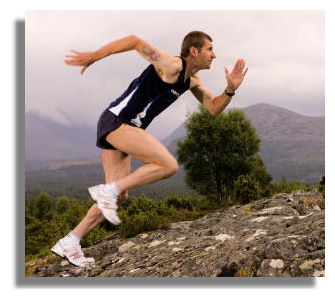
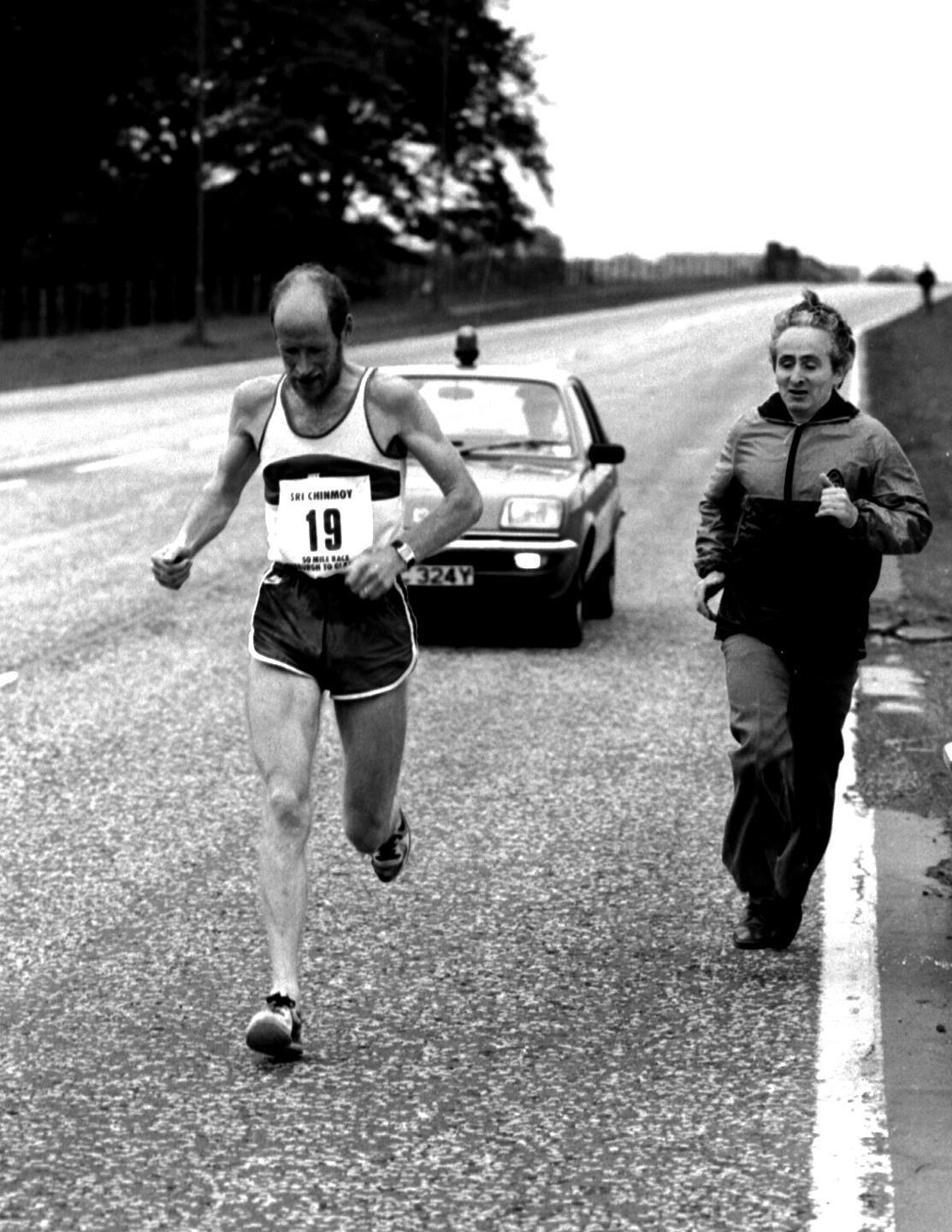
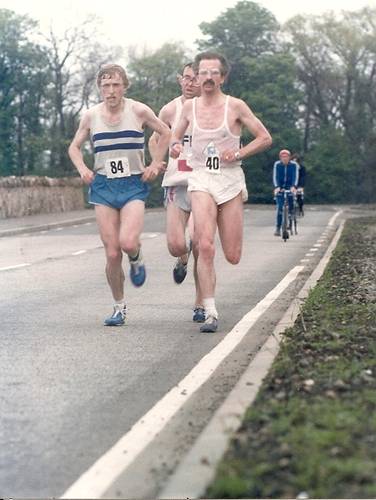
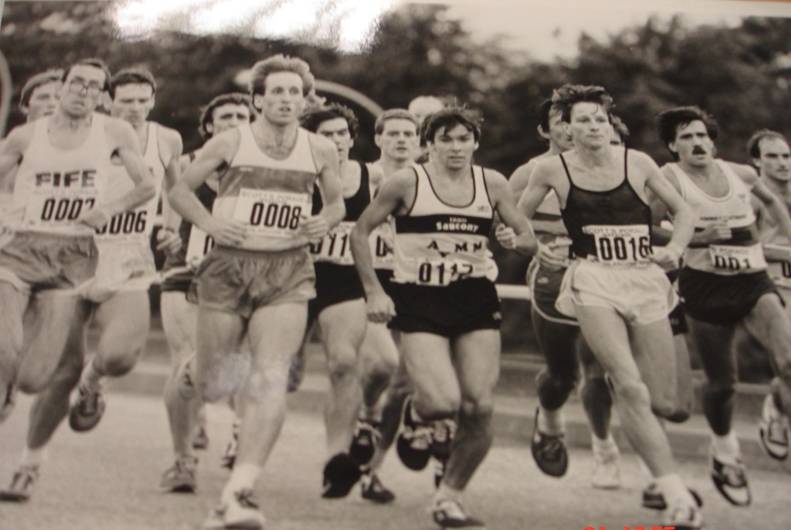
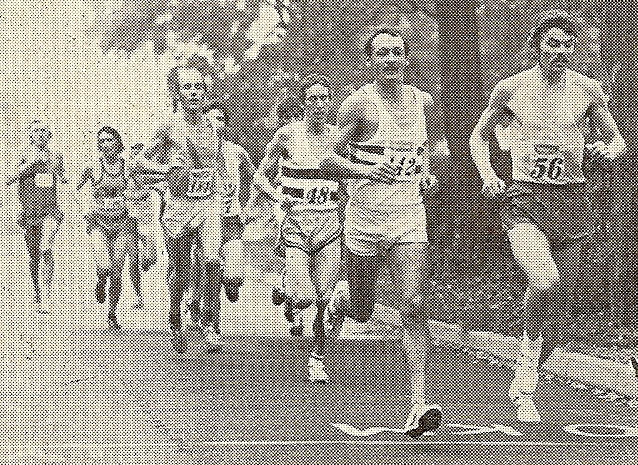
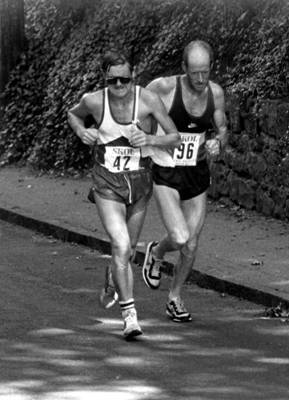
Alan in the Aberdeen 5K: others include Paul Evans (3), and Steve Cram (in black) 

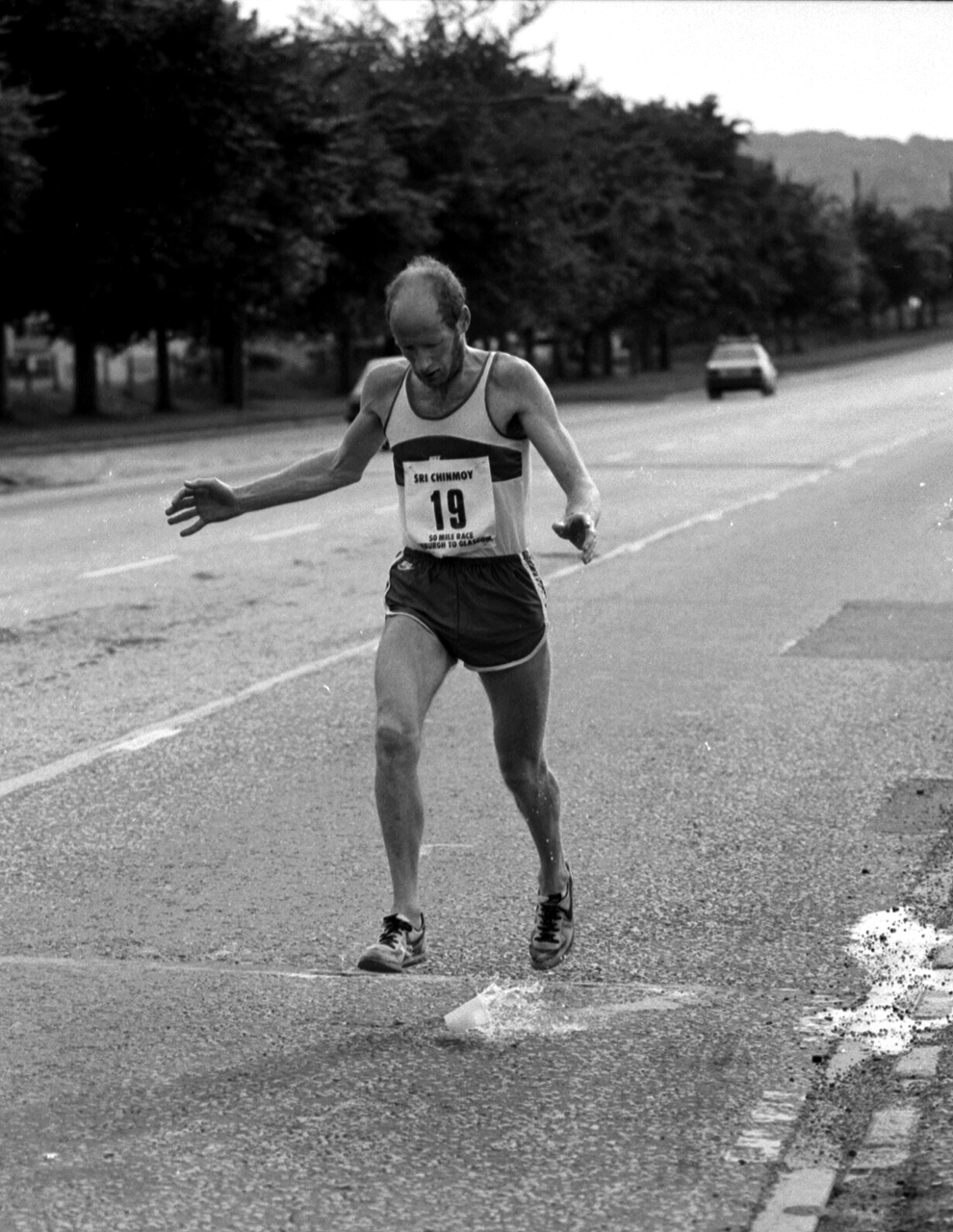
Alan Reid was born on the 19th of April 1966. From an early age he showed considerable running talent – especially speed – and was a ferocious front-runner, although he was, just occasionally, known to ‘blow-up’. It took a few years to develop tactical awareness, and then, for more than two decades, Alan was usually the best cross-country runner in the North of Scotland and also ran for his country. He was also successful on the road and eventually represented Scotland and Great Britain as an ultra-distance runner, in International 100k races, including the World Championships. His bravery is unquestioned, because of his boldness in races and frequent battling through injury. In addition he is friendly, cheerful and eccentric!

As a Youth, he ran cross-country for Coasters AC, which was based in Banff. Donald Ritchie, the great ultra runner, remembers him asking for advice about whether to wear spikes or studs on the notoriously hilly and stony Lochaber AC course. Studs were recommended, of course. Alan won the 1985-6 under-20 title in the North District Cross Country League. This must be one of the toughest, traditional CC leagues in Britain. Even nowadays, the courses feature tussocky grass, deep mud, snow, ruts, tree-roots and hills and frequently traverse burns and even icy rivers. Weather conditions are often wintry and, as they say, seriously challenging. It’s not compulsory to be mad when you tackle these events…… At least six races take place each season, in venues including Keith, Elgin, Forres, Nairn, Inverness, Caithness and East Sutherland, and the points accumulated in an athlete’s best four races count towards the championship. (In the earlier part of Alan’s career, you had to complete five of the six races.) Over the years, Alan Reid won a great number of races, usually by large margins, and finished second or third in most of the others. He won the senior title for the first time in 1988. His last triumph was in 2011. Altogether, representing Coasters or Peterhead Running Club, Alan accumulated an amazing total of thirteen North League championships. In addition he won the North District CC championships five times; and won the Aberdeen Hydrasun CC ten times. In addition he ran well in the Scottish National CC, with a best placing of 16th in 1994 as well as 22nd and 23rd.

Alan Reid ran internationally for Scotland on several occasions, starting as a Junior in the 1985 Inter-Area contest at St Andrews. As a Senior he represented his country twice at Mallusk, Northern Ireland, and also in Durham and at the UK World Championship trials at Bellahouston Park, Glasgow. In 1989, running for North District, he won the Inter-District CC, beating amongst others the illustrious Tommy Murray.

In the Edinburgh to Glasgow Road Relay, Alan represented North District eight times in succession, between 1987 and 1994. Although the team was never better than tenth, he had particularly good runs on the two most prestigious stages: Six (in 1989) and especially Two – he gained five places in 1992, 1994 and 1993, when he was third-fastest to Alan Puckrin and Bobby Quinn, in front of luminaries like  John Sherban, Graeme Croll and Peter McColgan. Then in 2001, on Stage Two yet again, Alan ran for etro Aberdeen RC. His team finished 5th and won the medals for most meritorious performance.

When I search through my own training/racing diaries, Alan Reid is mentioned frequently. In the late 1980s, he served his apprenticeship in events like the Peterhead 4, the Seagull 5k and the Buckie 10k, and was still beatable. When he first came south to race in Aberdeen, there were many good quality city athletes who may have sniggered in a condescending manner as this raw, red-headed young man shot off like a misguided missile down the promenade after the start, only to be overhauled later by the likes of Fraser Clyne and Chris Hall. In 1990 Alan and I were part of an Aberdeen AAC team which did well to finish fifth in the Scottish Six-Stage Relay at Livingston. Alan never quite got rid of his habit of arriving only just before the race started or even afterwards! Undaunted, he always charged off anyway despite the lack of a warm-up. Yet in the 1990s he developed into the fastest guy in the North-East as well as the North. (Alan asserts that once he certainly did do a warm-up: 22 miles before winning the Keith 7 and a half miles (mainly off-road) race in front of Mick Flynn!)

Alan’s track career is less well remembered, but demonstrates speed and durability. He ran for North District (and won North championships) at every distance from 800m to 10,000m, including the steeplechase. The 5000m was won eight times and the 10,000m (PB 30.30) ten times. In addition he took part in the 4x400m relay. At the long-established Forres Highland Games in 1992, Alan won the 400m, 800m, 1500m and 3000m in one afternoon! (He twice won this 3k wearing a kilt,) In addition he won many local hill races. He says that he never concentrated on one event but simply wanted to do everything!

Alan Reid won many road races, including  three victories in the Inverness Half Marathon; the 1995 Aberdeen Half Marathon, and the Aberdeen 10k (1995 and 1996). His triumphs in the latter event must have been particularly sweet. Alan had been second in 1992 and 1994 (when he also secured a silver medal in the concurrent Scottish 10k championship). Then in 1995 (as third-placed Fraser Clyne wrote in the 2011 history of Aberdeen’s premier road race) he achieved “a runaway victory, showing no mercy as he blitzed through the streets and opened up a big lead which stretched to 73 seconds by the finish in beautiful Duthie Park”. A year later, Alan retained his title with another front-running performance, eighteen seconds clear of an elite group including Ross Arbuckle, Frankie Barton, Mike Carroll, Simon Pride and Fraser Clyne.

A%20Reid%20Elgin%2010K[1]

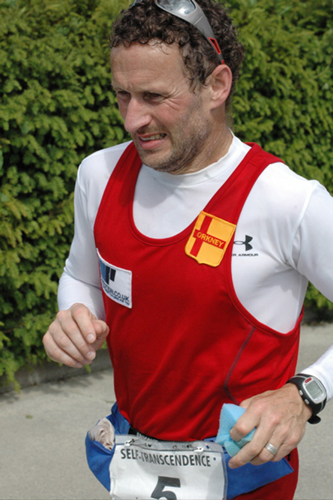
In the Elgin 10K

Of course Alan frequently ‘cleaned up’ in local 10k races, such as Buckie, Elgin, Fraserburgh and Peterhead, plus the Lossiemouth Turkey Trot (and North of Scotland 10 mile championship). He won the Moray Marathon in 1995 and completed the arduous West Highland Way Race in 2008. Furthermore, wearing a heavy-duty Seaforth Highlanders outfit, he claimed the World Kilted Running Title at the Balmoral 10k! (Previously, at the Fettercairn 10k he had run 33.25 wearing the same kilt.) Alan reckons that he won this ‘true Scot’ World championship five times.

Alan started to experiment with ultra-distance races, starting with the 1994 inaugural Speyside Way 50k. He established a good lead but 2.11.50 marathon runner Fraser Clyne (Metro Aberdeen RC) came through at 26 miles to finish first in a record 3.02.07. Fraser mentions that Alan zoomed away recklessly from the start and was in front by 3 minutes at 10k and 6 minutes by 20k. After struggling in second, Alan maintained that someone must have given Clyne a lift in a car! (In 2000, Alan did win the Speyside Way race, finishing in 3.12.20, well in front of a very good ultra runner, William Sichel, who recorded 3.26.54.)

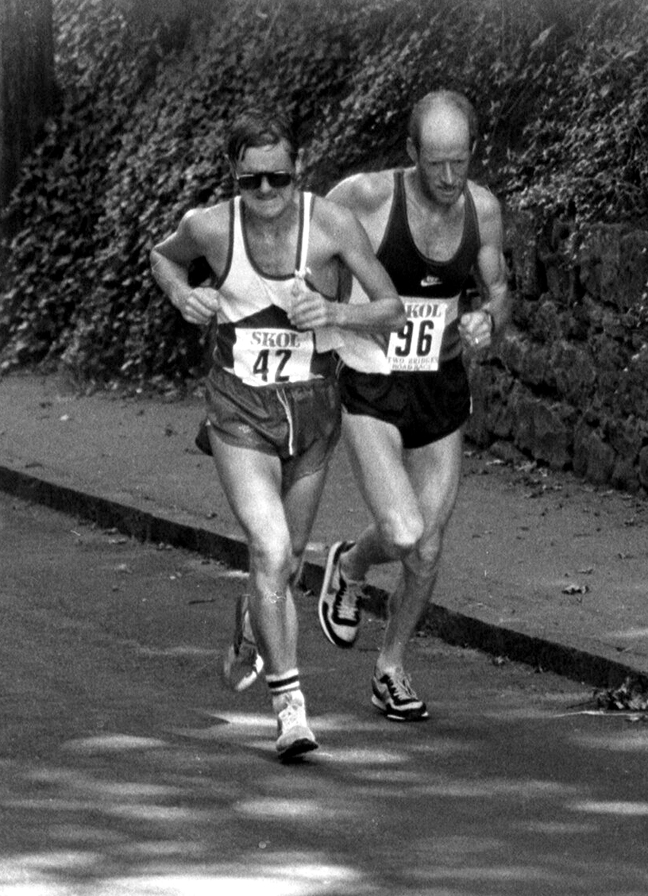
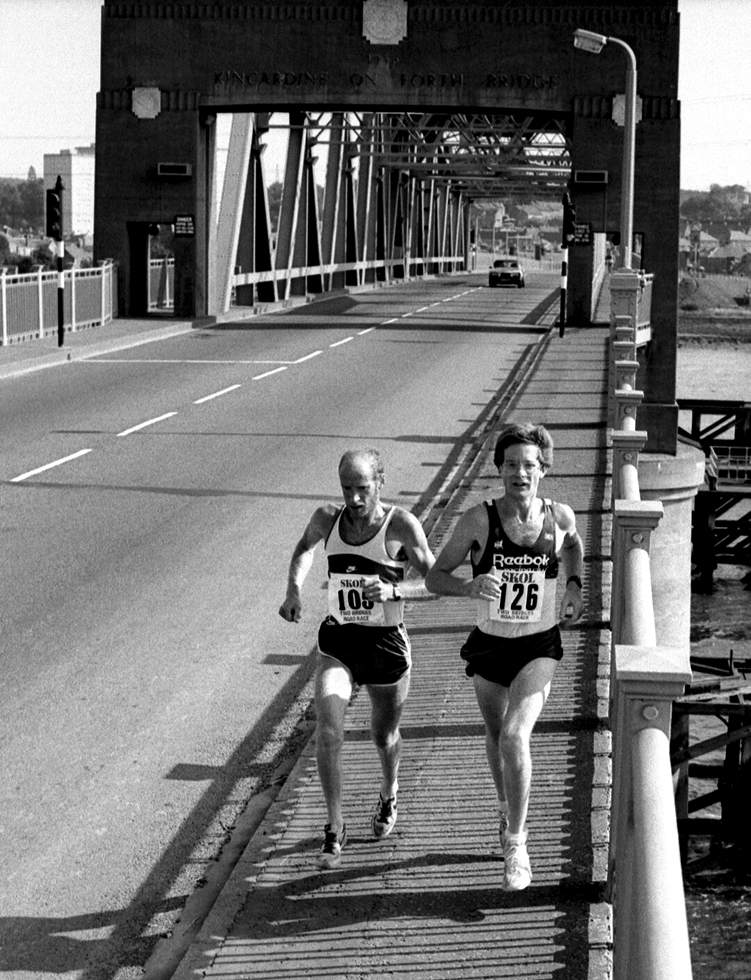
Progress was evident when Alan won two Scottish 50k road titles in Glenrothes. These victories took place in 1999 (when he also won the arduous 28 mile Lairig Ghru race) and 2000. In the latter Alan recorded 3.07.42. In the fifteen race history of the event, only Fife’s Terry Mitchell recorded a faster time. Alan Reid had also won the famous Two Bridges Race in 1999, four and a half minutes clear of Andy Eccles of Wigan Phoenix. (Alan had been five minutes clear by ten miles and nine minutes in front at the marathon distance, but although he lost ground late on, he was always in control of the race.) Then in 2000, racing in the British and Scottish 100k championship on the Heriot Watt Campus, Edinburgh, Alan Reid finished second (7.27.24) to four-time-winner Steven Moore of Hereford AC and England. (In fact, as first Scot, Alan should have been awarded the Scottish title.) This event also included the Anglo-Celtic Plate International contest (England v Scotland v Northern Ireland v Wales), and the Scottish three-man team finished second to the Auld Enemy by the slim margin of nine minutes (over 300 kilometres!)

AR%20Barry%2040%20Miles%20Track[1]

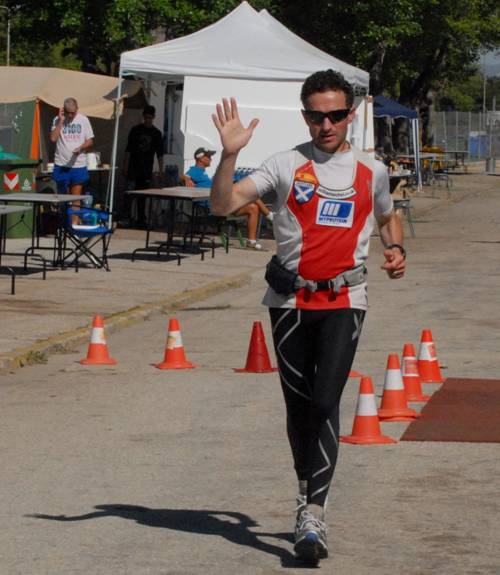
Alan in the Barry 40 miles track race

In March 2001, Alan Reid travelled from Banff in cars belonging to Donald Ritchie and then Adrian Stott to the well-established Barry 40 miles track race in Wales and then back home again. (Don eventually reached Lossiemouth at 4.30 a.m. on the Monday, slept for less than four hours, then drove to his work!) Don says that he thoroughly enjoyed Alan’s company. The Barry 40 organiser Mick McGeoch relates that Alan won comparatively easily, leading as usual from gun to tape, having run the first of 160 laps in a swift 74 seconds, which unsurprisingly remains a record for the event! Alan’s times illustrate his tactics: 56.43 at 10 miles; 1.56.09 at 20 miles; 3 hours exactly at 30 miles. His winning time was 4.11.45, in front of experienced GB Internationals Ian Anderson (4.19.29) and Chris Finill. When Don Ritchie suggested that Alan might modify his racing strategy, the latter replied that he felt better running fast from the start. Alan remembers this as an especially satisfying win.

Alan Reid’s peak ultra performance came in on 20th May 2001 when he won the British 100k championship (and became the first Scot to win the annual Anglo-Scottish Plate International title) in Moreton-in-Marsh, Gloucestershire. Alan recorded a very good time of 7.13.30, and was followed in once again by Ian Anderson (7.17.18) and Chris Finill. In 2002, at the same venue, despite starting with a torn calf, Alan was third in the British 100k championship. In total, he won gold, silver and bronze in this important event. (Since 2001, only Craig Stewart (Forfar), in 2011, has emulated Alan by winning the Anglo-Celtic Plate title for Scotland.)

AR%20British%20100K[1]AR%20British%20100K%20three[1]

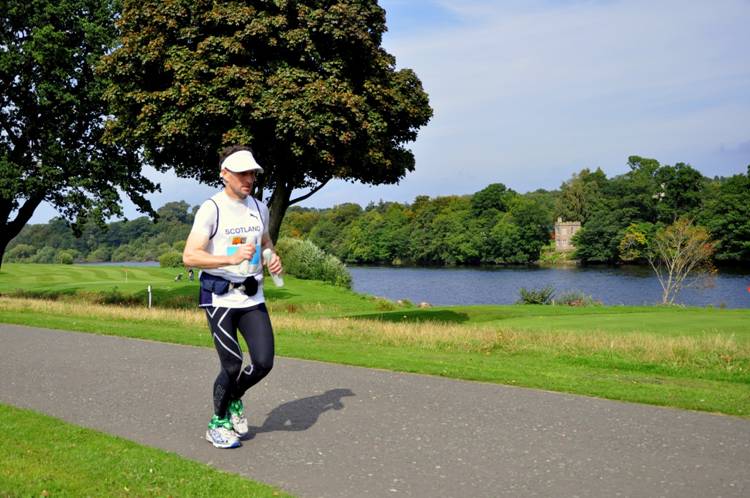
Alan in the British 100K in 2001

 Alan Reid was chosen to represent Great Britain in three World 100k Championships (2000, 2001, 2002) in Holland, Brittany and Belgium. He finished two but unfortunately was pulled out of the third, despite that fact that he was still struggling on. Overall, Alan gained three GB vests and represented Scotland eight times. In championships he won 96 medals: 80 North District; 4 Inter-District; and 12 National, including 53 gold medals.

In 2008 Alan decided to have a go at the West Highland Way Race, which he completed very respectably in 19 hours. Earlier that year he had completed a rather unusual 33 mile training run as part of an effort to get fit for the WHW. The event was the Peterhead to Fraserburgh 16.5 mile Beach Run in January. Unfortunately he missed the start by 10 minutes, but ran it anyway, in a decent 2 hours 13 minutes. It was cold and wet, he felt dizzy and he was a bit demotivated since he had no chance of catching the leaders. However he had a good excuse! At 6 a.m. that morning Alan had run from Fraserburgh to Peterhead. It was quite dark and the tide was too far in, so he had to head inland and run on unfamiliar fields. In the gloom he fell into a couple of drainage ditches and collided with barbed wire more than once. Alan summed up the whole experience as ‘a good work-out’! (In fact he completed that exhausting session several times!)

Alan Reid’s career has been long, successful and unusual. He has many great racing performances to look back on with considerable satisfaction. Alan says that his ultra success was down to the fact that ‘I don’t give up very easily’. Too true! Unfortunately he began to suffer all sorts of chronic leg injuries and then a bad car crash in 2011 forced him out of the sport, we all hope temporarily. If anyone can come back fighting, Alan Reid will be that man!

AR%20Aberdeen%205K[1]

In the BUPA Aberdeen 5K: Alan (19), Khalid Skah (1)

Back to Front Page


Willie Sichel

image002

Scottish athletics has been fortunate over recent years in having had a series of top flight ultra distance runners.    William Sichel is one of the finest and what follows is Colin Youngson’s tribute to him.

William Sichel, the International Ultra Distance Runner from Sanday, Orkney, has a career record markedly different from those of Don Ritchie, Rab Heron and Simon Pride, the other three ultra distance runners featured on this website.   They concentrated on ‘shorter ultras’, mainly from 50km to 100 km although Don also broke world records for 100 miles, 12 hours and 200 km, and ran well in the 24 hours event.   Willie Sichel, by comparison, has also broken records from 48 hours all the way up to the amazing distance of 1000 miles on the road in less than 14 days.

This is only a brief introduction to William Sichel’s own website: www.williamsichel.co.uk  which is comprehensive and fascinating.   It includes references to the history of ultra running; newsletters; blogs; training advice; links to Twitter, YouTube and Facebook; information about his sponsors; many details about his yearly running progress and umpteen fine performances (often record-breaking), and much more!

His Running CV is as follows: “William started ultra running in 1994 and has set multiple ultra distance records at World, British and Scottish level, including age-group records, classic event records and Guinness World Treadmill Records (Full details available on the site).   Unusually he won his debuts in the 100km, 24 hour, 72 hour, 6 day and 7 day events.   Furthermore he has won international events in the UK (five times), Netherlands, USA (twice), Switzerland, Monaco (twice), Greece and Germany.   In the Athens 1000 Mile World Cup Race held in March 2010, William was runner-up in an M55 world record of 13 days 20 hours 8 minutes and one second.   He also became the oldest British person ever to have completed 1000 miles in under 16 days.   In addition he set intermediate age-group world records at 6 days and 1000 kms.   The last time a British runner of any age completed a 1000 mile race in under 16 days was 1991.”

image004

William in Athens 2010.

Below are just some of William Sichel’s personal bests are as follows

Marathon:   2:38:17 (1995)

100km:   7:07:49 (1996)

12 Hour (Track):   141.50km/87.92 miles (2001)

24 Hour (Road):  246.70km/153.30 miles (2000)

48 Hour (Indoor):   344.267km/213.92 miles (2007) Scottish Record

6 Days (Track):   857.07km/532.56 miles (2008)

1000km (Road):   7 days, 23 hours, 45 minutes, 43 seconds.   (2010)

1000 Miles (Road):   13 days, 20 hours, 8 minutes, 1 second (2010)

Spartathlon:   33 hours, 14 minutes, 20 seconds (2005) Scottish Record

Badwater:   31 hours, 36 minutes, 12 seconds (2006) British Record

.

William Sichel, a former table tennis international, has represented Great Britain 11 times since 1996 in 100km and 24 hours events.   His ambition is ‘Project 60@60‘ – to have set 60 ultra distance records before his 60th birthday on October 1st, 2013.   Details are at his website, address above.He is undoubtedly Scotland’s finest current ultra- distance runner.

That’s Colin’s introduction and the website in question is remarkable in the range and depth of coverage as well as giving some insight into the mind and attitude of this quite outstanding competitor.   Below is a photograph of William taken by David Hall of him running at Perth in 2010.   Note the two ‘running sticks’ that he has in his hands – he has been using them for two years now (2011) and the rationale can be found here.

image006


Don Ritchie

We have a complete list , courtesy of Mich McGeoch, of Don Ricthie”s marathons (98 in total) and ultra marathons (134 in total) separately rather than in the middle of the profile.   It’s such an amazing list that it deserves to stand out on its own to be admired and wondered at.  Amazine.   Go here  –  Don Ritchies Marathon and Ultra Record
donrunning

I have to thank Colin Youngson for this portrait of Don Ritchie – if we are talking of unsung heroes of Scottish Athletics then he has to be at or near the top of the list.   For a Scot to set a world record is rare, for a Scot to set as many as Don has is totally unique.   In fact for most of the population it is unheard of! 

Donald A. Ritchie of Lossiemouth, Moray, Scotland, has undoubtedly been the greatest ultra distance runner the world has ever seen. This was the verdict in 1995 of Andy Milroy, a journalist who knows more about this branch of athletics than anyone. Milroy compared Don’s achievements with those of past greats like Charles Rowell, George Littlewood and Wally Hayward; and with his contemporaries Yiannis Kouros and Bruce Fordyce. On the basis of the length of his world class ultra running career and his amazing accomplishments, Donald Ritchie is considered to have been the very best. Unconvinced? Look at these statistics.

WORLD BEST TRACK PERFORMANCES

Date Event Time Location

29/04/1977 50 km 2:51:38 Epsom

25/09/1977 150 km 10:37:47 Crystal Palace

25/09/1977 100 miles 11:30:51 Crystal Palace

30/06/1978 100 km miles 6:18:00 Hartola, Finland

28/10/1978    50 miles 4:53:28 Crystal Palace

28/10/1978    100 km 6:10:20 Crystal Palace

10/03/1979    50 km 2:50:30 Altrincham

16/06/1979  100 miles road 11:51:11 Flushing Meadow, N.Y.

16/10/1982    40 miles 3:48:35 Copthall, London

12/03/1983  50 miles   4:51:49  Copthall, London

30/10/1983    200 km 16:32:30 Coatbridge

04/02/1990    200 km indoors 16:31:08 Milton Keynes

3-4/02/1990   24 hours indoors  Distance 166.243 miles 267.543 km I.A.U. World  Championships, Milton Keynes

26/10/1991 200 km 16:19:16 Copthall

Consider also: scores of Veteran World Best Performances, several British vests (despite these not being available for ultra runners until 1990, when Don was 45 years old); U.K. Championships at 24 hours and 100 1cm; Scottish marathon vests; his part in the record-setting Aberdeen AAC John 0’ Groats to Lands End relay in 1982 (77.26.18); his heroic solo record for the same 844 mile journey in 1989 (10 days 15 hours 25 minutes); and winning eleven marathons, three Two Bridges 36 miles races and two 53 miles London to Brighton races, not to mention many events abroad.

Donald’s honours include being ‘Runners World’ ultra athlete of the year; the subject of a ‘World of Sport’ documentary; a guest at a Royal Garden Party; and the final accolade — his M.B.E. in 1995.     Just a few of so many tributes can be included on this website.
Don Ritchie E to G 1984 with Hugh...

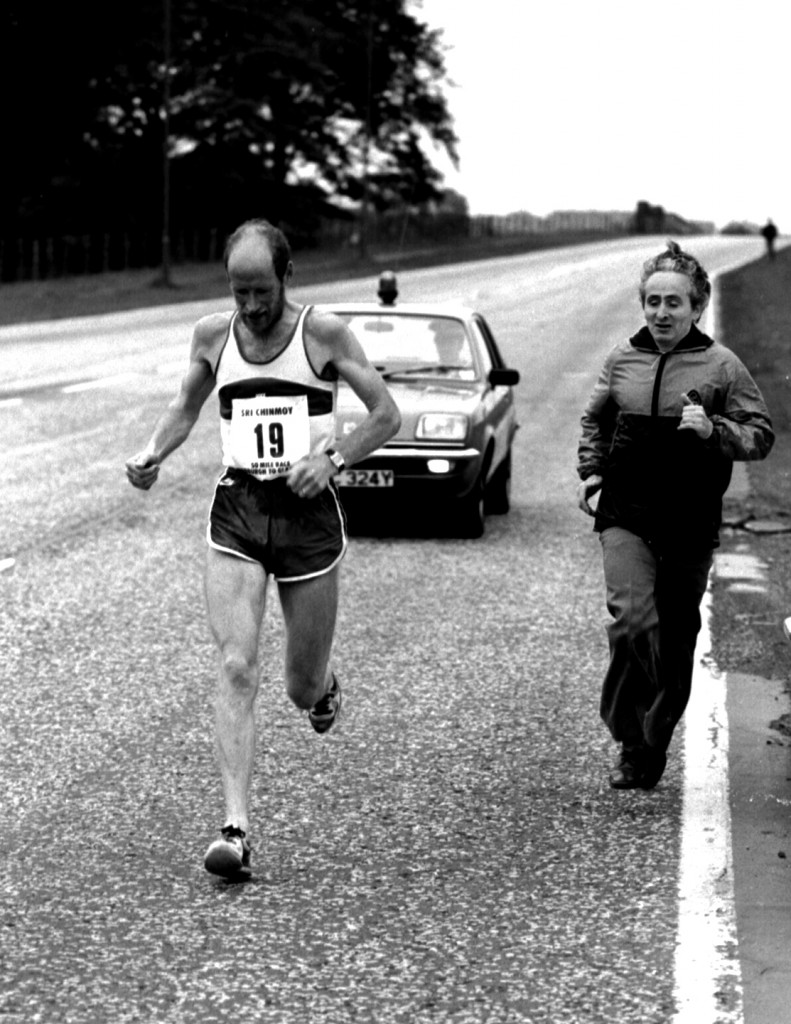
Donald in the Edinburgh to Glasgow Ultra

First in 1995 by Dave Cooper, a fine ultrarunner himself and past editor of the prestigious Road Runners Club Magazine.

“It gives me great pleasure to offer congratulations to the possessor of the cleanest pair of heels in the business, Don Ritchie, on behalf of the RRC Council and all our members, for receiving the Member of the British Empire Medal in the Queen’s Birthday Honours List.   The quiet man from Elgin has been a great ambassador for the sport for many years and his superb array of world record performances and steely determination on road and track is in sharp contrast to his modest self-effacing demeanour.  

A side of his character that especially appeals is his sense of humour. The following vignette will serve as an example. In the introduction to his article on Training, in Andy Milroy’s “Training for Ultras”, Don writes “To run an ultramarathon, you require a good training background, and a suitable mental attitude, i.e. you must be a little crazy. A certain type of mentality seems to be advantageous. I think you require to be a calm, determined, patient person with a high toleration for prolonged discomfort and a high capacity for delayed gratification.”

He has worn with distinction the Great Britain vest for the 24 hours and also the Blue Riband ultra, the 100 km, for as many years as they have been available to ultra-runners, and continues to do so at the age of over 50.

It only remains for me to wish Don, his wife Isobel and his children, the best of health, happiness and prosperity, and long may he continue to thrill us with record- breaking performances.”
Don Ritchie drops drink E to G 1984

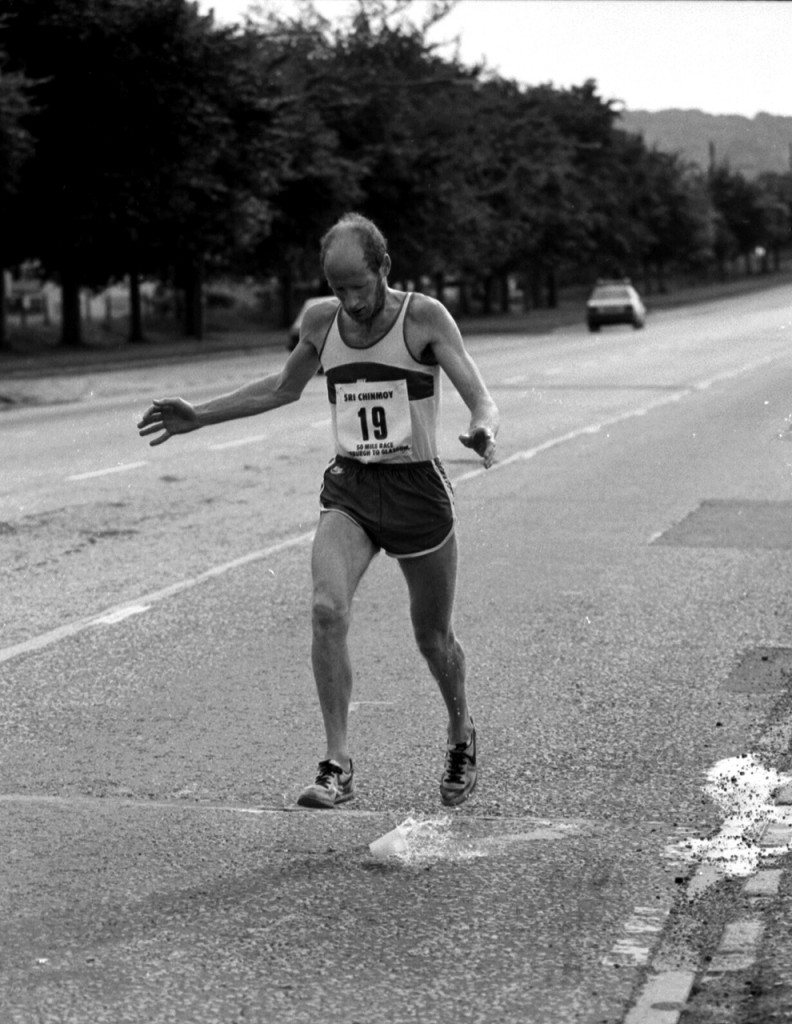
Don drops drink in the E-G Ultra 1984

Then from 1989 by Glen Elliot, the chairman of the still-flourishing Moray Marathons road races.

RITCHIE, THE CHAMPION OF CHAMPIONS”

“The agony and the ecstasy of long-distance running”. Don Ritchie, this quiet unassuming Moray athlete, never realised how true that description could be until a few years ago, when he set the first of his world records on the Epsom track.  

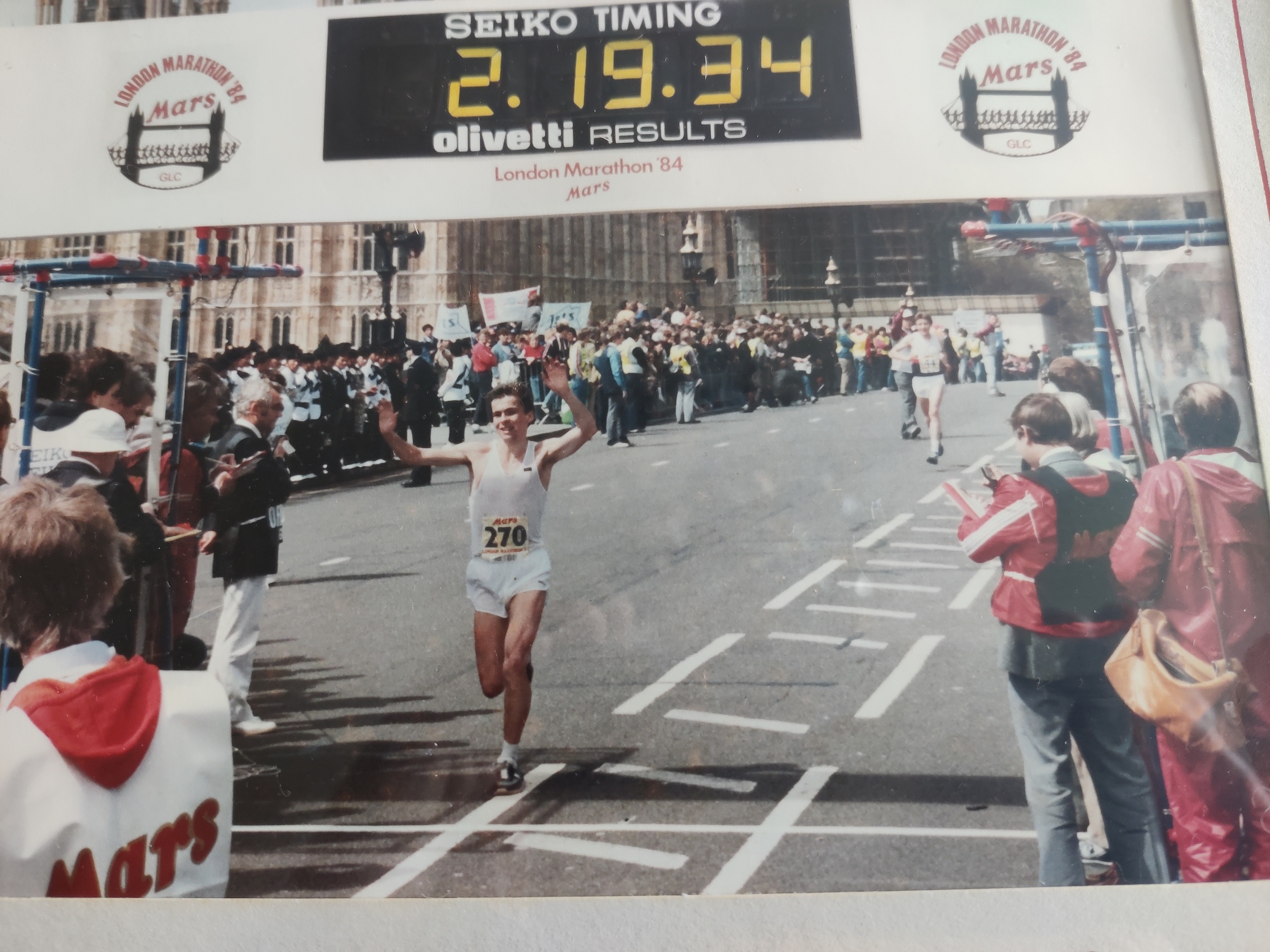
Don, a member of Forres Harriers, now holds a string of world records set around the globe. He is an electronics lecturer at the Moray College of Further Education and is without doubt one of the greatest ultra-distance runners of all time. He regularly dips under 2 hours 30 minutes for the marathon (he set a personal best time of 2.19.34 in the London Marathon) but his forte is certainly his ability to keep up a relentless pace over greater distances.  

It is difficult to pick out any specific record (he holds so many!) but his 100 miles race at Crystal Palace in the late 70s still staggers the ultra-distance fraternity — he covered the 100 miles in 11 hours 30 minutes 51 seconds, a phenomenal pace of under 7 minutes per mile — yes for every mile. Although this remarkable athlete still rates his other record achieved at the same venue of 100 kilometres in 6 hours 10 minutes 20 seconds (under 6 minutes per mile!) as one of his best performances.

Possibly his finest achievement came in the 100 miles road race at Flushing Meadow Park in New York. The humid conditions and intense competition looked like testing this irrepressible Moray man, but again with the single-mindedness of a true champion, he produced another world best performance to win. In recognition of another magnificent achievement, Don was presented with prestigious trophies by the famous New York Road Runners Club and the Sri Chinmoy Club.

Don has survived many bumps and scrapes in his illustrious running career and many close friends feared the worst when, in the summer of 1988, he was sent crashing to the ground at the start of the Lincolnshire 100 kin road race. The Moray man sustained a broken kneecap which would have finished most athletes, but typical of Don and his fighting spirit, he started all over again with a period of recovery and then back to pounding the roads around Moray. To prove to himself and his followers that he was back in business, Don entered the gruelling 24 hours race in Glasgow’s Kelvin Hall Sports Arena — yes, he did it again and established wore records. Don was the only athlete to run/jog non-stop throughout the 24 hours, establishing new Scottish records for 40 miles, 50 miles, 100 miles, 200 km, 12 hours and of course 24 hours distance running.

The Iron Man of Scottish Athletics has blazed a path in ultra-distance running in America, Spain, Italy and many far-flung places, but he never forgets to support numerous local events. Don can be seen lining up with many ‘lesser mortals’ in the Moray Marathon, and he always has a sympathetic ear for his fellow athletes, novices, and fun runners alike. Don may be excused for being biased, but having run all over the world he still finds the Moray countryside an ideal setting for his arduous training schedule. He covers up to 160 miles a week through many forests, beaches and quiet country roads.”
don ritchie E to G. photo - g macindoe

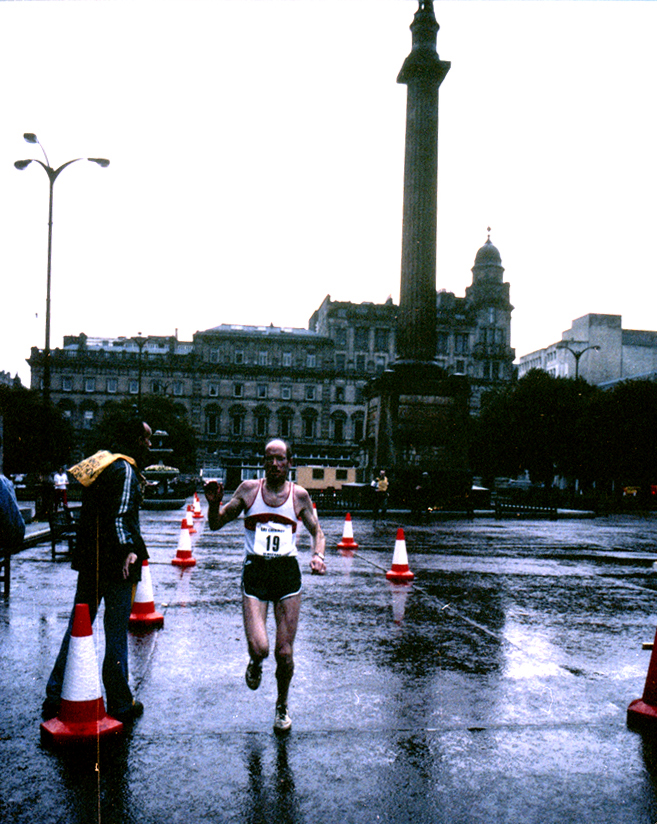
Donald winning the 1984 E-G

Next, two of Donald’s friends write about their memories of him. Firstly, Donald Gunn.

“I have known Donald Ritchie for nine years now and have on a number of occasions joined him on Sunday morning runs — along with Mick Francis.    Invariably Don’s “just over 22 miles” usually turned out to be 25 to 28 miles. Mick and I always added an extra half hour to our estimated running time, before we set out.    It was on these therapeutic runs that Don’s character would reveal itself For two hours little was said — only comments regarding the weather or our present state of fitness, and then just as Mick and myself were starting to get tired and having to concentrate on keeping up with Don’s pace, he would start telling jokes. We reckoned the idea was to encourage us to forget the extra miles still to come.

I found Don to be always calm and collected when things were not going his way. This was certainly the case in Santander, Northern Spain, October 87.

The event was a 100 km race. Mick Francis and I intended competing as part of a week’s holiday. Although we were staying in the same hotel as Don, he was to arrive the evening before the race. 10 p.m. came and still no sight of him. A little later a tired Don appeared. Unfortunately there had been a mix-up with transportation from Bilbao airport to the hotel, with the result that poor Don had to find his own way, which involved a long train journey with standing room only. All this and the beginning of a sixty-two and a quarter mile race only a few hours away.

Most people would have been fuming at being let down by the organisers, especially before a big event, but not Don Ritchie. “Just one of these things” was his comment. We managed to find him some fruit to eat that night before he slumped into bed. Hours later he set off with the leaders and took the lead at times. The temperature was in the mid-eighties, quite a change from Lossiemouth in October. Eventually the Spanish champion Domingo Catalan finished a few minutes ahead of Don — but what a gallant try. To cap all this, only a fortnight later in a 250 km race in Italy, Don held the lead for 12 hours before finishing 5th.  To race two such distances with little mental or physical recovery seemed remarkable to me.

In the following years I was again witness to ultra-distance feats. At Kelvin Hall Don ran non-stop for 24 hours to set a Scottish Indoor record of 144 miles and 1009 yards. The following year (1989) his JOG-LE triumph left Mick Francis and myself gasping. We accompanied him and attended to his needs during his record- breaking run. Inclement weather, which included gale force winds for one full day, a heavy cold and stomach pains didn’t deter Don from cheerfully starting on his 70 to 90 mile-a-day stints, after only 4 hours sleep and sometimes less.

He never complained at any of the inconveniences that came his way — helping to push the support van out of a muddy caravan park one cold and dark morning, or once again in the early hours having to explain to the traffic police just outside Perth what we were doing.

There were other lighter moments during the run, such as one sunny morning during the latter stages, when I ran over to the side of the road Don was running on, to ask which drink or kind of food he wanted for one of his regular snacks, which were always done on the run.  Due to a combination of the cold he had caught at the start of the venture and sheer fatigue, his voice had all but disappeared, so Don whispered something which was barely audible. Another few yards on I repeated the question. Ah! A butty! It sounded like. Off I trotted back to the van, avoiding the traffic. I spread a nice big home-made jam butty, sprinted down the road to catch him up again. No, he waved — he didn’t want my offering and hoarsely whispered something. Sorry, Don, can’t quite catch what you’re saying. Again he shouted — which can only be described as a whisper. Yes! I caught it this time. So off I went again and returned with a peeled banana. Wrong again — he waved his arm. This time I was going to get it right. So running alongside as close as possible without tripping him, I heard the whisper above the noise of the traffic: IT S A LOVELY DAY.

Another amusing incident occurred during one of our massage and stretching sessions which I gave Don (at the end of each running session) in the back of our van. He was particularly tired and kept on falling asleep, which presented a problem. Some of the stretches required him to indicate precisely at which moment to stop the stretch so as to avoid injury. So I started to repeat the words “more, more”, listening for the ‘grunt’, at which point I would hold his leg for around thirty seconds. Unknown to us, there was small bunch of local teenagers outside the van, which was parked in a corner of the village square. We then realised what the youngsters found so funny. Because Don was lying on his back, all they could see was his naked legs sticking up above window level and me stripped to the waist because of the heat in the van. The only conversation that could be heard was “more, more”!  

Although Don is usually a very quiet character, Mick and I did once glimpse an emotional man.  

This occurred during the final moments of his triumph. On finally reaching the Land’s End finishing mark, he suddenly sprinted towards the cliff edge! My God! Mick and I thought, what on earth is he doing? Then he punched he air, like a footballer on scoring an all-important goal. The normally unmoved Don was cheering and had just run an extra 50 metres to make sure of his tremendous achievement.”
Doncav

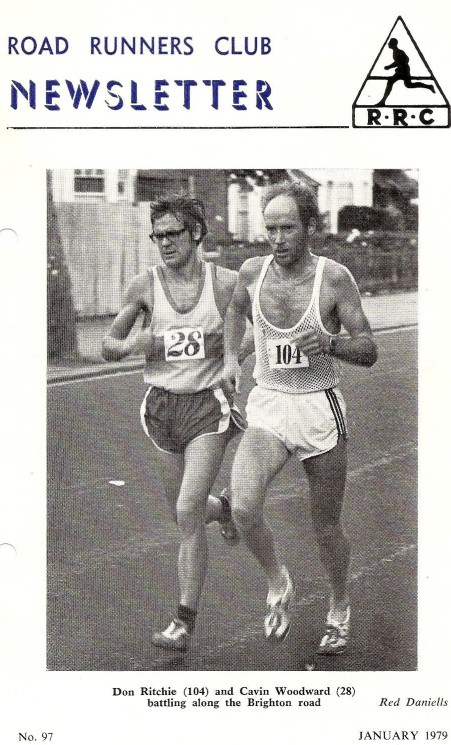
1983 Two Bridges: with Cavan Woodward on the Killer Hill at 22 Miles


And now, Colin Youngson.

“Saturday 25 June 1967 — a windy, warm and at times wet day for the Scottish Amateur Athletic Association Championships at Grangemouth Stadium. I was just finishing my first year at Aberdeen University, and trailed in 16th in the 3 miles event. Yet two memories from that occasion linger in my memory: Aberdeen’s Bill Ewing just defeating Gareth Bryan-Jones in the Steeplechase (and almost giving me a heart attack by stopping suddenly at the 220 yard mark — in actual fact the race finished on the back straight); and my first realisation that quiet unassuming Donald Ritchie wasn’t a bad long distance runner.  

The photograph in my imagination shows Alastair Wood lounging against a wall beside the entrance to the track. He is sipping a cup of tea, having won the marathon several minutes ago (in 2.21.28) and has been sufficiently unruffled by his exertions to take an interest in the progress of a protégé.  Before Wood strode into the stadium to record his fourth (of six) Scottish Marathon victory, spectators had been left in suspense. The last news that we had, at the ten mile point, was that Wood had set a fast pace and that his (fairly obscure) Aberdeen clubmate was hanging on, with the dangerous Wight brothers from Edinburgh AC following close behind. Alastair had won literally by a mile. Had the brave unknown paid the penalty for his boldness? We need not have worried. Red-faced, perspiring but resolute, Donald swung into view past a mildly congratulatory Wood, and claimed his silver medal. It had been tough, but he could take the strain.

A year afterwards Donald (‘Don’ came later) began to make a greater impact on my competitive nature. The inimitable, wittily grumpy but charismatic Wood (an Oxford University ‘blue’ to whom we both owe a debt of gratitude) had convinced Donald not only to train 120 miles per week, but also to go to Aberdeen University. Of course this meant that I had to race against him every week — and more often or not he beat me! We ‘enjoyed’ quite a rivalry. Occasionally on a fast surface or on the track I got revenge — but when it came to mud or distance he was much better. I couldn’t understand how his body could soak up the miles; and he thought I was a lazy so-and-so.

What other memories of Don Ritchie come to mind?

His introduction to University ‘social life’. The contrast between silent sober pre-race Don, strong determined racing Don, and extremely talkative if incoherent less-sober Don being restrained from jumping out of a train window! Luckily he calmed down after those early personality switches.  

A University 10,000 metres championship, on a muddy gale-torn King’s College grass track. I tried fartlek until half-distance in a vain attempt to shake off the sound of his relentless footfall and noisy regular puffing — before simply giving up and dropping out while still in front!

My first marathon (the Inverness to Forres on a hot day in July 1969) when I finished third in 2.41.13. Alastair Wood was first in 2.27 but when Donald tried to stick with him this time he blew up! I spotted him on the horizon at about 16 miles, passed him at 18 and he actually dropped out at 23! How often did Don ever break down? Must be human after all.

One summer Donald and I went hill-walking together for a few days near Glencoe. It was not a stroll — we positively zoomed up to the peaks before his hill- runner’s legs cruised away from me downhill. It was good fun, but his nerve for the dangerous sections was far greater than mine. This phlegmatic courage has been vital in dealing with crazy events like 24 hour races or the solo End-to-End run.  

In the summer of 1972 the two of us decided to have a holiday in Finland, visiting clubmate Charlie Greenlees, his wife-to-be Maria and their friends. Being poor, we decided to hitch-hike; and being patriotic, we thought innocently that we’d wear kilts to attract lifts. I borrowed my Dad’s kilt, but Don had to buy one, for eight pounds, from an ex-army store. He chose a Black Watch kilt which was made of a cloth so coarse that it rubbed the red hair off his thighs! (Rare sensitivity in such a tough guy.) However we secured one lift from about Newcastle to Hull. After the ferry deposited us at Gothenburg, the same lift continued to the other side of Sweden. And after the second ferry, over to Turku in Finland, the same lift took us to the forest outside Helsinki, where we camped for the night! The lure of the kilt (or Don’s legs?)  

In Finland we took full advantage of the exotic foreign food, living off Baltic herring and local potatoes — in other words a cheap, wholesome, typical North-East Scotland diet. We finished 6th and 8th in the Finnish Olympic Marathon trial (Donald suffering a ‘pit-stop’). And I remember one very hot day when, despite or because of the kilts, we failed to attract a lift in rural Finland and, carrying heavy backpacks, were forced to walk twenty miles along the road. To prevent heat exhaustion, we bought chilled milk from shops along the way, drinking at least ten pints each!  

After I left university, Donald’s form over ‘short’ distances reached its peak — he won the Scottish Universities’ Cross-Country title and was an excellent 11th in the ‘National’. How many people realise he was that fast? Previously, I remember him beating Wood, Ewing and Steve Taylor in a track three-miler, much to their disbelief.. Later on he seemed to lose his speed over ten kilometres (thank goodness), due of course to the strain of training for ultras.  

But what a career he has had! Don’s best marathon time is a speedy 2:19:34, but he was wise to specialise in ultra distance. His success has been breathtaking. It may be partly due to diet — energy drink, slabs of soda bread (which acts like radiator sealant to his system!) and secret recipe home-brew afterwards, merely to aid recovery. He seems to have a tremendous physical and mental resilience, treating pain only as inconvenience. Although at one stage I had the edge on him in marathons, when we lined up together before the 1984 Edinburgh to Glasgow 50 miles road race, and he suggested that I keep him company for a few miles, I had no hesitation in declining! Sure enough he won by more than half an hour and, despite cautious pacing, I struggled in a wrecked third placer. He is different class, an all-time world great. And it couldn’t happen to a more deserving fellow. I like, admire and respect Donald and am proud to be a friend. Does he have any enemies? I doubt it.

In 1982 Aberdeen AAC made their third attempt on the ten-man relay record from John O’Groats to Land’s End (the JOGLE). I was fortunate enough to be paired with Don in the fourth dormobile. We had an excellent couple of drivers and the trip was almost stress-free (apart from physical exhaustion, of course). As you can imagine, Donald was calm, relaxed — and a totally reliable running machine. We had a great time. In my ‘Running Shorts’ book is one story ‘Shap Summit’, which attempts to describe our shared experience as Jogle runners, engaged in an unusual ultra- distance event.”
2 bridges - Killer Hill - 22 miles

In the Two Bridges, 1984

The best article is this last long one! Unsurprisingly it was written by Donald himself, about a gruelling Italian ultra-marathon. Just imagine yourself trying (and failing) to emulate him!

“ ITALIAN JOB

In March 1979 I received an invitation from Giors Oneto to participate in a 101.5 km race from Firenze (Florence) to Faenza. As I had not visited Italy before, I readily accepted the invitation to this race to be held on a Saturday near the end of May. To reach Faenza from Firenze the Appenines have to be crossed, and the race was named ‘Del Passatorie’ after a bandit who operated in those mountains. Passatorie from what I gather was a Robin Hood sort of character.

The arrangement for this race was that I should organise my own travel, and would be reimbursed in Faenza. Following some correspondence with Giors I established that there was no airport in Firenze, so I would have to fly to Milan then take the train.

Arrangements were made for travel and soon departure date arrived. From Elgin the train to Aberdeen was followed by a bus to the airport and then the flight to London. This part of the journey had already occupied some six hours. Next there was the flight to Linatie airport at Milan. From there I got a bus into the city and managed to locate the Central Station. By now it was 8 p.m. and I found that the next train to Firenze was at 9.30 p.m.

My next priority was to get some food, so I headed off to see what I could find. A restaurant provided spaghetti something de Mar which I deduced should be some seafood. It turned out to be spaghetti mixed with a sauce containing a sort of shellfish hotch-potch including the shells. There was quite a variety of shells, some of which, including the razor and mussel, I recognised. Some had edible bits inside, or at least remains, but mostly they were empty. I also found bits of chopped-up octopus tentacles in there. It was quite a change from Luigi’s fish and chips at home. Once I had reduced this course to shells only, I finished off with some excellent ice cream and fresh strawberries.  

Suitably refuelled, I returned to the station, purchased my ticket and carefully located the correct train. Although it was half an hour before departure time the train was packed and there were people in every corner. Train travel was inexpensive here so I expect this accounted for the popularity. I resigned myself to a long stand in the stifling heat.


We got underway exactly on time, and the draught through the open windows, caused by the train’s motion, reduced the discomfort caused by the heat. Eventually after a tedious journey Firenze was reached. It was now half past midnight and I had to find my hotel. Clutching the letter from Giors with the name of the hotel on it, I sallied forth. There were several police in and around the station, but they did not seem the type you ask directions from: they were wearing bullet-proof waistcoats and carrying sub-machine guns. Later I found one with only a pistol so I asked him. He could not speak English and I could not speak Italian but despite this he was able to indicate the general direction to go in. Further directions were sought from one of several painted ladies I passed and I found the hotel or at least a door with the sign ‘Melegano’ above it. What a relief; I had been travelling since 6.30 a.m. and it was now 1 a.m.


After repeated bell ringing the door was unlocked and opened by a sad- looking man with a very pale complexion, who was wearing a striped nightshirt and spectacles with very thick lenses. I showed him the letter, he looked at it and then said, “No English”, which I took to mean he could not understand or speak English. He did have a few words of English, such as ‘Hotel full’ and ‘you tomorrow’. It was clear that he was not going to invite me in or suggest any alternatives. As he closed and locked the door, I thought to myself ‘this is another fine mess I have got into’.


I decided the best thing to do was to return to the Railway Station and make use of the waiting room. The station is a very grand building with marble floors and many marble pillars supporting marble arches and the roof.  Even the benches in the waiting room were marble. It was fairly crowded in there but I got a bit of bench. Some people were stretched out on the benches sleeping soundly and snoring profusely; others were in sleeping bags on the floor; while some played cards, smoked and drank wine.


During the remainder of the night, I managed to doze off a couple of times. At about 7 a.m. there was a stir as the cafeteria at one side of the room began to open up. It took me some time to establish the system for obtaining some food. You had to go to the cash desk and pay for the items you wished to have. You then get a receipt which you present to the assistant behind the service counter. She then hands over the required item without having to touch the unhygienic money. I managed to get the equivalent of a buttery roll and a cup of coffee. 

 I could now relax a little, knowing my kit was on the bus and that my support was organised, so I went off to find some shade from the blazing sun. The temperature was about 32 degrees centigrade.

There was quite a carnival atmosphere with a band playing traditional music, and a group performing with huge whips which they cracked loudly.

I found some shady steps and sat down and began sipping from my pre-race bottle. While packing for the trip at home, I found that I was short of a few drinks bottles so I took whatever was available, including an empty half-bottle labelled Smirnoff Vodka. This served as my pre-race container.  

A reporter from one of the Italian Athletics magazines recognised me and began to ask for some information such as: how would I run in the race? How had I prepared? What did I think about Firenze? What did I think about Vito Mileto? Etc. As I had never heard of Mileto, he explained that this was the winner of the race last year and the year before that. Finally he asked what I was drinking on such a warm afternoon. Being in a rather flippant mood by now, I just pointed to the label on the half-bottle containing the colourless glucose polymer solution. He noted it down in his pad with a rather puzzled look on his face. Perhaps he thought it was a refinement of the carbohydrate loading diet.  

Once he had exhausted his questions and gone, I made my way to find a toilet, for a final pre-race check. These were hard to come by, but I managed to use the facilities in a café off the Piazza. On emerging from the café, a reporter with a camera crew from a local TV station recognised me and wanted to interview me. I was reluctant as it was now only fifteen minutes before departure time, but agreed when it was pointed out it would only take a few minutes. About five minutes later, the interview completed, I made my way to the start line, and observed that there appeared to be a lot less runners in the Piazza now. I reached the front row with a couple of minutes to spare. Ahead was the lead car containing the starter, who was standing so that his torso was protruding through the sun roof. He was holding a stopwatch in one hand and a raised flag in the other. On either side of the car were police motor cyclists who kept revving the engines of their Moto Guzzis impatiently. As the 4 p.m. start time grew closer and closer, the tension heightened as a sixty second countdown was started and the revving became more vigorous and more frequent. Suddenly the tension was released as the flag dropped and we surged forward, after the speeding car and the motor cyclists.  

After about 2 km I was joint leader with a tall thin Italian, and we continued to pull away from the rest. Just before the climb out of the city began at around 5 km, I was surprised to overtake some runners wearing race numbers. They were jogging and as we continued the 900 feet zigzag up to Fisole, we passed increasing numbers of these joggers. I could not understand how this had occurred. At first I thought that somehow we had gone off course and ended up doing a loop, and were now passing through the field. I abandoned this notion and decided that the less serious runners, who just wanted to complete the course before the cut-off time, midday tomorrow, had set off a little early. By the time I reached Fisole at 10 km, I must have passed about 1500 runners struggling on the stiff climb. My cyclist met me there and he gave me my first drink with an anxious look. “Prima fifteen minutes,” he said. “No, I am Prima,” I said. He repeated his information, and I suddenly realised that it was not only the joggers who had got underway prematurely.

I was furious, and immediately increased my pace. In my early days, I used to run handicap races: quarter, half and mile races at Highland Games, but I never dreamed that I would do a 101.5 km handicap race. The course now undulated and on sections I could see runners, not so many now, various distances ahead. As I caught these up one by one, it was obvious that they were not joggers. I began to think that my pace may be suicidal in the warm conditions, but these thoughts were ignored, and I continued my anger-driven charge.  

After Vetta le Croci at 23 km, and a height of 1560 feet, the route descends into the next valley, and there was some shade. At about 30 km I caught and passed one of the French runners. “You have a problem?” he asked as I swept past. I did not attempt to explain and simply grunted yes.  

In Borgo San Lorenzo at 35 km it seemed like the entire population had come out to cheer the runners on. The main street appeared to be completely full of people, but as one approached they moved apart, providing a metre-wide path to run along through theft cheering midst. What an inspiring atmosphere they created. I had never experienced anything like it before.     

On leaving Borgo, the climbing began again, a short sharp incline and then a gradual rise into the Appenines where the real hill climbing started. I could see the road ahead zigzag up the mountainside, terrace upon terrace. Now the sun was much lower in the sky and often blocked by the surrounding hills. I caught the Gennari brothers running together, and they shouted some encouragement as I passed. My cycling second was pleased with my progress, and kept calling me Daniel. He pointed up to the road a couple of terraces above, and indicated that there was the Prima. Next I caught and passed the Canadian, Chovinard, as we neared the top of the pass, at Colla di Casaglia, which was at 3000 feet.  

The top of the pass is at 52 km, and the remaining 49.5 km to the finish is almost entirely downhill, steep at first then gradual, until the flat plain is reached 5 km before Faenza. I let rip on the first downhill and soon caught the second, a Czechoslovakian, and gained on the leader, who was accompanied by a posse of cyclists, motor scooterists and others on mopeds.

I caught the leader, Vito Mileto, and swept past into the lead with about 45 km to run. I was running strongly, although my feet were very sore from the hot road and my quads were becoming very painful. Every 2 km there were marker boards indicating the distance to the finish, which I found quite comforting. As darkness fell at about 8 p.m., the entourage of bicycles, motor cycles, mopeds, scooters and cars, which I had acquired on assuming the lead, provided plenty of light, but too much company. The continual blowing of horns, general noise and exhaust fumes, especially from the two-stroke engines, became increasingly annoying, as I became more tired.  

We came to a level crossing with the barriers down, but some of the cyclists rushed ahead and opened them bodily. I had enough sense to check that the train was not too close before running across the rails. I passed through more towns, and it seemed that all the inhabitants had turned out to cheer the brave runners. There were bonfires and bands playing, which all contributed towards producing a really stimulating atmosphere.

A car with a TV film crew would draw alongside me every now and again, to make some recordings with the aid of some powerful spotlights. I was longing to be finished, but I had to be patient and just keep working away. At last I reached the final five kilometres of the race with the lights of Faenza clearly visible. Crowds of people lined the route over the last couple of kilometres, all cheering loudly. I actually had to jog the last 100 metres, as the TV crew had difficulty making its way through the crowds. At the finish, one had to run up a ramp on to a stage, so that one could be presented to the huge crowd gathered in the floodlit square. It was a marvellous few moments, which I will always treasure.

My feet were very painful, and my quads were not much better, so I requested some medical assistance. I was helped to the room where the medics had set up their centre.

After some foot repair work, I requested some aspirin to dull the discomfort I was experiencing. A couple of minutes later, a doctor appeared, bearing a fairly large syringe. This did not look like any aspirin I had ever seen, so I informed him that I wanted aspirin, not an anaesthetic. He assured me that it was indeed aspirin. I decided that I wasn’t feeling that bad after all and declined the medic  

After a shower, I was taken to the Hotel Vittoria, and on passing through the square I could see that a whole ox had been roasted on a spit. People were queuing to purchase roast beef rolls with salad, along with cups of red wine. At the hotel I consumed a large quantity of strawberries and ice cream, plus a few beers before trying to sleep.

The prize presentation was scheduled for midday on Sunday. Before this I got a note of the results: my time was 6.52.23; Mileto was next in 7.7.05; and Chauvinard third in 7.10.41. The times were good despite the heat; even the Italians said it was warm.

I bought some newspapers to see if there were race reports. One paper had a full page report on the race and had the headline: ‘Ad Uno Scozzese Amante delta Vodka Ia Centro Chilometri del Passatorie’. This and a further mention in the report referred to my pre-race bottle. I wondered how many Italian ultra runners would try this ‘method’ before their next 100 km.  

Prize presentation took place in the square, on the finishing stage in front of a large crowd, which had gathered to show their appreciation of the runners’ efforts. My award was a ceramic plaque, about one metre by three-quarters of a metre, portraying Passatorie in three dimensions. The other prize from the main sponsors, the wine company of the region, was one hundred bottles of wine: fifty each of Trebbiano and Sangiovese.  

This was rather unexpected, and I began to ponder how these might be transported back, or, alternatively disposed of.  With Giors Oneto’s help, the latter option was more feasible. The method of disposal was not novel, but was satisfactorily accomplished. 

‘Del Passatorie’ had been an unforgettable experience and a ‘good adventure’. All I had to do now was get back to Lossiemouth for work at 9 a.m. on Tuesday.”


Donald gave another very good interview to the RRC Magazine and he recently passed a copy to Colin Youngson who has sent it on for reproduction here.  He also wrote about his solo JOGLE of 1989 and it’s quite a story.   What he went through!   He’s a good writer and it is a good article.   The links are at the foot of the page.

Back to Front Page        Don’s Autobiography: The Stubborn Scotsman      Don’s RRC Interview          The 1989 Solo Jogle


DON RITCHIE: VETERAN CHAMPION
After my dear friend Donald died suddenly in June 2018, many impressive tributes and obituaries were published on both sides of the Atlantic. He was rightly celebrated as a modest, friendly, incredibly tough Scotsman who had been the greatest 20th Century ultra-distance runner, certainly in track or road events between 50km and 24 hours indoors. Do check online to learn more about Donald’s peak performances between 1977 and 1979 (when his age was 32-34).

For the SVHC Newsletter, I thought it would be appropriate to mention highlights of his ‘Masters’ running career.

In the M35 category he won important 100km titles, set Track World Records for 40 miles, 50 miles and 200km, ran two sub-2.20 marathons, represented Scotland (aged 39) at that distance and won the Two Bridges 36-mile road race.

Before his retirement from running in 2011, Donald secured another ten Scottish vests (four for marathon and six for 100km) and 17 British vests (eleven 100km and six 24 hours). His last Senior International appearance (aged 56) was in 2000.

His achievements, in Veteran age-groups from M40 to M55, were outstanding. Although he could do no better than 4th in the 1985 Scottish Masters cross-country and first M45 in the 1992 Lochaber/SVHC marathon, as an ultra-runner, Donald reigned supreme.

In the M40 category, he ran the 1985 London Marathon in 2.21.26; won 100km races in Lincolnshire and Turin; triumphed in the 1986 Two Bridges; won overall silver (and M40 gold) in the very first (1987) IAU World Championships 100km in Belgium; and was victorious in the Italian Del Passatorie classic (101.5 km) and the Moray Marathon. In 1988, Donald set 7 Scottish Indoor Track Records (from 40 miles to 144 miles 1009 yards) in the Kelvin Hall 24 hours race. In April 1989, he set a new record for the gruelling John o’Groats to Land’s End solo run: 846.4 miles in 10 days 15 hours 27 minutes.

As an M45, he had a marvellous race in the 1990 Road Runners Club 24 hours indoor event in Milton Keynes, winning the AAA, GB and International titles with a new World Record of 166 miles 425 yards (setting other new marks en route at 100 miles and 200km). Then Donald finished first in several other races: Lochaber Marathon, John Tarrant Memorial 50 miles, Lincolnshire 100km, Two Bridges 36 miles and Santander (Spain) 100km. Unsurprisingly, also in 1990, Donald had no difficulty in becoming the inaugural Scottish 100km track champion, establishing World M45 records. Aged 46, he secured his first GB vest in the IAU World Cup 100km in Duluth, USA.

More M45 achievements followed. Donald was first Veteran in the 1991 Madrid 100km; second GB team counter, contributing to bronze medals, in the Del Passatorie 100km World Cup; finished outright victor in the West Highland Way Race and the Tarrant 50 miles; and first Veteran in the Santander 100km. He became British 24 Hours outdoor track champion with a personal best of 166 miles 1203 yards, which was also an M45 World Best (at 100 miles, 200km and 24 hours).

By 1992, Donald had been awarded all the major Scottish Athletics trophies including the 1991 Donald McNab Robertson Trophy; and the 1992 George Dallas Memorial Trophy. That year he won the British 100km championship and retained his AAA 24 hours title. Then he finished first Veteran in the European 100km championships; and won the first Scottish 100km road championships at Riccarton, near Edinburgh. In 1993 he was second in the UK National 100km and also the AAA 100km. 1994 included 3rd place (and first M45) in the West Highland Way.

At M50, Donald continued to run well most of the time. In the 1994 Commonwealth Games demonstration 100km, which took place in Victoria, Canada, he was individual bronze medallist and first M50, contributing to Scottish team silver behind the host nation. In 1995, he set an M50 record in the Barry 40 miles track race; became European M50 champion over 100km; secured Scottish 100km M50 gold; for GB was first M50 in the IAU World Cup 100km in Holland; and set M50 World Track Records (for 50 miles and 100km) in a 24 Hours race in England.

Then on 5th December 1995, Queen Elizabeth presented Donald Alexander Ferguson Ritchie with the M.B.E. (Member of the British Empire) for services to Running and Charity.

In 1996, Donald was Scottish Captain for the 100km Anglo-Celtic Plate and won individual and team silver medals. Then diabetes was diagnosed and his running suffered. Nevertheless, he was second M50 in the European 100km.

In 1998, Donald was third M50 in the European 100km; and first GB counter in the IAU European 24 hours. In 1999 he was first M50 in the Speyside Way 50km; and the Scottish 50km championships; as well as running well for Scotland (5th overall) in the Dublin 100km Anglo-Celtic Plate.

In 2000, Donald set an M55 record in the Speyside Way 50km; and was second Veteran in the Scottish 50km. He was first M55 in the Flanders 100km and the Moray Marathon. He became M55 champion in the World Veterans 100km in Holland; and won his age group in the London to Brighton 55 miles road race. Then he was second GB finisher in the European 24 Hours in Holland and contributed to team bronze medals.

In 2001, Donald won his age group in the Barry 40 miles track. In 2002, he was first M55 in the London to Brighton. By the end of that year he was still averaging more than 100 miles training per week. His final win took place in 2003, when he won the Sri Chinmoy Track 24 Hours race in England.

Despite enduring several worsening health problems, Donald kept trying to run until 2011; and then during the last seven years travelled world-wide with his wife Isobel.

Donald Ritchie’s whole career training diaries (1962-2011) cover a thousand pages and note every mile run: an amazing total of 208 thousand 100.8 miles. Truly phenomenal!

Inevitably, this great athlete has been inducted into the Scottish Athletics Hall of Fame.

by Colin Youngson

Don Ritchie – Marathon Career Record                                            

No Date Venue Position Time Winner (Club) Time
  1 23 April 1966 Shettleston         5 2:43:25 Alastair Wood (Aberdeen) 2:24:00
  2 28 May 1966 Glasgow (SAAA)         5 2:45:58 Charlie McAlinden (Babcock & Wilcox) 2:26:31
  3 09 July 1966 Inverness-Forres         3 2:29:08 Alastair Wood (Aberdeen) 2:13:45        
  4 13 May 1967 Shettleston         3 2:29:59 Alastair Wood (Aberdeen) 2:23:02
  5 24 June 1967 Grangemouth (SAAA)         2 2:27:48 Alastair Wood (Aberdeen) 2:21:26
  6 08 July 1967 Inverness-Forres         2 2:35:00 Alastair Wood (Aberdeen) 2:16:16
  7 11 May 1968 Shettleston         3 2:34:13 Alastair Wood (Aberdeen) 2:25:27
  8 22 June 1968 Grangemouth (SAAA)         2 2:32:25 Alastair Wood (Aberdeen) 2:21:18
  9 27 July 1968 Cwmbran (AAA)       33 2:44:23 Tim Johnston (Portsmouth) 2:15:26
10 22 June 1969 Edinburgh (SAAA)    DNF   Bill Stoddart  (Greenock Wellpark) 2:27:25
11 12 July 1969 Inverness-Forres    DNF   Alastair Wood (Aberdeen) 2:27:44
12 25 October 1969 Harlow                                 9 2:24:38 Alastair Wood (Aberdeen) 2:19:15
13 11 April 1970 Shettleston         2 2:25:44 Pat Maclagan (Victoria Park) 2:22:03
14 16 May 1970 Edinburgh (SAAA)       11 2:26:28 Jim Alder (Morpeth) 2:17:11
15 24 October 1970 Harlow       16 2:30:52 Alastair Wood (Aberdeen) 2:17:59
16 08 May 1971 Shettleston         2 2:23:31 Steve Taylor (Aberdeen) 2:23:25
17 26 June 1971 Edinburgh (SAAA)         4 2:28:39 Pat Maclagan (Victoria Park) 2:21:17
18 04 September 1971 Enschede (NED)       13 2:28:54 Bernie Allen (Windsor) 2:16:54
19 23 October 1971 Harlow                   6 2:29:13 Dave Holt (Hercules Wimbledon) 2:18:22
20 13 May 1972 Edinburgh-North Berwick         1 2:24:26  
21 08 July 1972 Inverness-Forres         1 2:33:00  
22 25 July 1972          Helsinki (Finnish Champs)         8 2:33:37 Reino Paukkonen (Finland) 2:18:49
23 07 July 1973 Inverness-Forres         2 2:27:10 Alastair Wood (Aberdeen) 2:22:29
24 01 September 1973 Enschede (NED)         9 2:25:37 Ron Hill (Bolton) 2:18:06
25 27 October 1973 Harlow (AAA)    DNF   Ian Thompson (Luton) 2:12:40
26 04 May 1974 Rugby (AAA)         6 2:28:27 Jeff Norman (Altrincham) 2:19:37
27 22 June 1974 Edinburgh (SAAA)    DNF   Don MacGregor (Fife) 2:18:08
28 01 December 1974 Barnsley    DNF   John Newsome (Wakefield) 2:24:25
29 30 August 1975 Enschede (NED)       73 2:54:38 Ron Hill (Bolton) 2:15:59
30 08 May 1976 Rotherham (AAA)       45 2:29:30 Barry Watson (Cambridge) 2:15:08
31 22 July 1978 Pietarsaari (FIN)         9 2:29:39 Jorma Sippola (Finland) 2:20:57
32 13 May 1979 Coventry (AAA)       31 2:35:10 Greg Hannon (Northern Ireland) 2:13:06
33 21 October 1979 New York (USA)     154 2:36:43 Bill Rodgers (USA) 2:11:42
34 28 September 1980 Aberdeen       20 2:42:53 Graham Laing (Aberdeen) 2:19:33
35 27 September 1981 Aberdeen       15 2:30:33 Max Coleby (England) 2:21:29
36 24 October 1981 Black Isle              2 2:33:38 Dave Geddes (Garscube) 2:29:58
37 18 July 1982 Thurso         1 2:30:53  
38 15 August 1982 Elgin         1 2:29:36  
39 19 September 1982 Aberdeen         7 2:24:00 Gerry Helme (England) 2:15:16
40 23 October 1982 Black Isle              1 2:24:28  
41 17 April 1983 London (AAA)       90 2:19:35 Mike Gratton (invicta) 2:09:43
42 26 June 1983 Loch Rannoch         5 2:28 George Reynolds (Aberdeen) 2:24:09
43 17 July 1983 Thurso         4 2:37:04 Dave Clark (Verlea) 2:20:34
44 14 August 1983 Elgin                  1 2:36:11  
45 18 September 1983 Aberdeen                            9 2:25:20 Kevin Johnson (England) 2:19:01
46 22 October 1983 Black Isle         1 2:26:07  
47 29 April 1984 Dundee         5 2:19:58 Don MacGregor (Fife) 2:18:16
48 13 May 1984 London (AAA)       73 2:21:33 Charlie Spedding (Gateshead) 2:09:57
49 15 July 1984 Thurso         1 2:31:25  
50 12 August 1984 Elgin         1 2:29:19 Don Ritchie (Forres) 2:29:17
51 16 September 1984 Aberdeen                            9 2:26:35 Mark Burnhope (England) 2:19:36
52 21 April 1985 London (AAA)       77 2:21:26 Steve Jones (RAF) 2:08:16
53 28 April 1985 Dundee         7 2:26:35 Murray McNaught (Fife) 2:20:25
54 19 May 1985 Motherwell         4 2:28:04 Charlie MacDougall (East Kilbride) 2:26:53
55 11 August 1985 Elgin    DNF   Graham Flatters (Dundee Hawkhill) 2:41:15
56 15 September 1985 Aberdeen                          38 2:57:43 Dave Catlow (England) 2:22:54
57 20 April 1986 London (AAA)     211 2:30:43 Toshihiko Seko (Japan) 2:10:02
58 25 May 1986 Aberdeen         9 2:36:53 Ray Maule (England) 2:22:56
59 10 August 1986 Elgin         1 2:36:45  
60 21 September 1986 Glasgow       25 2:26:50 Kenny Stuart (England) 2:14:04
61 01 November 1986 Black Isle         1 2:28:38  
62 24 May 1987 Aberdeen       11 2:34:27 Ian Corrin (England) 2:27:42
63 09 August 1987 Elgin         1 2:31:50  
64 31 October 1987 Black Isle         4 2:42:31 Rod Bell (Dundee Hawkhill) 2:35:18
65 24 April 1988 Lochaber (SAAA)         2 2:30:26 Colin Martin (Dumbarton) 2:30:09
66 22 May 1988 Aberdeen       11 2:29:50 Hammy Cox (Scotland) 2:21:15
67 29 October 1988 Black Isle                            2 2:34:56 Mike Ryan (Dundee Hawkhill) 2:34:30
68 28 May 1989 Aberdeen       11 2:41:42 Ian Bloomfield (England) 2:22:30
69 06 August 1989 Elgin                  4 2:44:54 Charlie McIntyre (Fraserburgh) 2:31:58
70 22 April 1990 Lochaber         1 2:34:01  
71 27 May 1990 Aberdeen (SAAA)         7 2:31:00 Chris Tall (England) 2:23:32
72 05 August 1990 Elgin                  5 2:35:47 Erik Seedhouse (City of Hull) 2:28:29
73 03 November 1990 Black Isle                            2 2:37:55 John Duffy (Shettleston) 2:31:16
74 21 April 1991 Lochaber         3 2:30:40 Jim Cooper (Springburn) 2:28:34
75 12 May 1991 Dundee         6 2:32:03 Hugh Mackay (Fife) 2:26:03
76 04 August 1991 Elgin                  2 2:46:13 Ron Kirkton (Milburn) 2:38:18
77 02 November 1991 Black Isle                            4 2:45:45 Fraser Clyne (Aberdeen) 2:27:18
78 26 April 1992 Lochaber         3 2:38:42 Colin Youngson (Aberdeen) 2:36:23
79 02 August 1992 Elgin (SAAA)           15 2:54:45 Fraser Clyne (Metro Aberdeen) 2:25:38
80 31 October 1992 Black Isle                            2 2:42:08 Andy Stirling (Bo’ness) 2:36:15
81 02 April 1995 London (AAA)     551 2:46:45 Dionicio Ceron (Mexico) 2:08:30
82 23 April 1995 Lochaber         9 2:42:47 John Duffy (Shettleston) 2:31:19
83 03 September 1995 Elgin         8 2:43:51 Alan Reid (Fraserburgh) 2:34:43
84 01 September 1996 Elgin    DNF   Allan Stewart (Moray RR) 2:37:15
85 07 September 1997 Elgin    DNF   Fraser Clyne (Metro Aberdeen) 2:29:37
86 06 September 1998 Elgin       16 3:08:54 Simon Pride (Keith & District) 2:29:04
87 25 April 1999 Lochaber       15 2:55:17 Simon Pride (Keith & District) 2:24:24
88 08 August 1999 Gateshead (World Vets)       90 2:59:24 Tony Duffy (Bolton) 2:23:25
89 05 September 1999 Elgin         7 3:04:30 David Lancaster (Rowntrees York)2:46:37
90 30 April 2000 Lochaber       10 2:53:43 David Rodgers (Lochaber) 2:28:53
91 20 August 2000 Glasgow       61 2:58:25 Wilson Cheruiyot (Kenya) 2:22:45
92 03 September 2000 Elgin (SAAA)           11 2:57:18 Simon Pride (Keith & District) 2:21:17
93 28 April 2002 Lochaber (SAAA)   3:31:08 Jamie Reid (Cambuslang) 2:21:46
94 27 April 2003 Lochaber   3:15:41 John Duffy (Shettleston) 2:41:22
95 06 July 2003 Perth (AUS)       62 3:26:21 Sandy Burt (Australia) 2:42:21
96 31 August 2003 Elgin (SAAA)           52 3:32:27 Jamie Reid (Cambuslang) 2:34:08
97 29 August 2004 Elgin       53 3:35:30 Simon Pride (Metro Aberdeen) 2:36:49
98 24 April 2005 Lochaber     241 4:06:32 John Duffy (Shettleston) 2:42:15


DON RITCHIE – ULTRA CAREER RECORD


No Date Venue Pos Time Winner (Club) Time
  1 22 August 1970 Two Bridges 36.2m 7   3:50:50 Phil Hampton (Royal Navy) 3:41:18
  2 24 August 1974 Two Bridges 36.2m 5   3:36:58 Jim Wight (Edinburgh AC) 3:26:31
  3 29 September 1974 London – Brighton 52.7m 3   5:24:54 John Newsome (Wakefield) 5:16:07
  4 02 November 1974 Walton-on-Thames track 30 m 2   2:49:33 Mick Molloy (Ireland) 2:44:47 WR
  5 19 June 1976 Lairig Ghru 28 trail DNF   Andy Pratt (RAF) 3:12:40
  6 30 April 1977 Epsom 50 km track               1   2:51:38 World Best
  7 25 June 1977 Hillingdon 50 km track 1   2:51:42  
  8 27 August 1977 Two Bridges 36.2m    2   3:28:34 Cavin Woodward (Leamington) 3:27:10
  9 25 September 1977 London – Brighton 52.9m    1   5:16:05  
10 15 October 1977 Crystal Palace Track 24 hours DNF   Tom Roden (SLH) 156m 439y

Don Ritchie 100 miles 11:30:51 WR

11 30 June 1978 Hartola (FIN) 100 km    1   6:18:00  
12 29 July 1978 Woodford-Southend 40 miles    2   3:59:35 Cavin Woodward (Leamington) 3:50:14
13 26 August 1978 Two Bridges 36.2m    5   3:32:49 Cavin Woodward (Leamington) 3:24:45
14 01 October 1978 London – Brighton 53.5m    1   5:13:02  
15 28 October 1978 Crystal Palace Track 100km    1   6:10:20 WR
16 10 March 1979 Altrincham Track 50 km    1   2:50:30 WR
17 28 April 1979 Ewell Track 40 Miles    1   3:54:07  
18 26 May 1979 Del Passatore (ITA) 101.5 km    1   6:52:33  
19 15 June 1979 Flushing Meadows (USA) 100 ml    1 11:51:11  
20 30 September 1979 London – Brighton 54.3m  DNF   Allan Kirik (USA) 5:32:37
21 27 October 1979 Crystal Palace Track 24 hours  DNF   Dave Jones (Blackburn) 153m1143y
22 06 April 1980 Niort (FRA) 50 km    3   3:05:44 Martin Daykin (Gloucester) 2:58:47
23 04 May 1980 Torino-St Vincent (ITA) 100 km    1   6:35:00  
24 24 May 1980 Del Passatore (ITA) 101.5 km    1   6:54:14  
25 07 June 1980 Oulu (FIN) 50 miles  DNF   Risto Laitinen (Finland) 5:03:16
26 04 April 1981 Niort (FRA) 50 km    2   2:55:29 Pattrjk Macke (Grantham) 2:53:05
27 30 May 1981 Del Passatore (ITA) 101.5 km  DNF   Vito Mileto (Italy) 6:53:15
28 10 October 1981 Copthall / RRC Track 24 hours  DNF   Mark Pickard (Epsom & E) 163m 1249y
29 29 May 1982 Del Passatore (ITA) 101.5 km  DNF   Luciano Ceni (Italy) 7:29:53
30 19 June 1982 Altrincham Track 24 hours  DNF   Dave Cooper (Cambridge) 147m 1083y
31 11 July 1982 Pistoia-Abetone 53 km   11   4:05:15 Sergio Pozzi (Italy) 3:30:58
32 25 September 1982 Santander (ESP) 100 km    1   6:28:11  
33 16 October 1982 Copthall / RRC Track 100 km  DNF   Peter Sugden (Reading) 7:07:22

Don Ritchie 40 miles 3:48:35 WR

34 12 March 1983 Copthall / RRC Track 50 miles    1  4:51:49 WR
35 28 May 1983 Del Passatore (ITA) 101.5 km  DNF   Mauro Cillia (Italy) 6:57:08
36 27 August 1983 Two Bridges 36.2m    1  3:34:39  
37 25 September 1983 London – Brighton 53.6m    3  5:24:23 Bruce Fordyce (South Africa) 5:12:32
38 29 October 1983 Coatbridge Track 24 hours  DNF   Dave Cooper (Cambridge) 151m 1098y

Don Ritchie 200km 16:32:30 WR

39 25 February 1984 Manx Airlines 40 miles road    1  3:53:14  
40 03 June 1984 Edinburgh-Glasgow 50 miles    1  5:03:44  
41 24 June 1984 Lincolnshire 100 km    1  6:48:15  
42 25 August 1984 Two Bridges 36.2m    2  3:34:47 Barry Heath (Royal Marines) 3:31:46
43 07 October 1984 London – Brighton 53.5m    2  5:28:27 Barry Heath (Royal Marines) 5:24:15
44 24 November 1984 Coatbridge Track 24 hours    3 136m1390y Dave Cooper (Cambridge) 148m 247y


45 23 February 1985 Manx Airlines 50 kms road    3  2:56:39 Jeff Norman (Altrincham) 2:53:21
46 23 June 1985 Lincolnshire 100 km    1  6:47:40  
47 13 July 1985 Solihull Track 24 hrs  12 116m 528y Martin Daykin (Gloucester) 152m 713y
48 03 November 1985 Geneva (SUI) 100 km DNF   Vaclav Kamenik (Czech) 6:23:49
49 01 March 1986 Manx Airlines 50 kms road    3  3:06:48 Jeff Norman (Altrincham) 2:53:26
50 04 May 1986 Turin-St Vincent (ITA) 100 km    1  6:36:02  
51 22 June 1986 Lincolnshire 100 km    1  7:02:46  
52 23 August 1986 Two Bridges 36.2m    1  3:36:37  
53 04 October 1986 Santander (ESP) 100 km    2  6:47:49 Domingo Catalan (Spain) 6:32:09
54 28 February 1987 Manx Airlines 50 kms road    2  2:57:00 Jeff Norman (Altrincham) 2:55:15
55 30 May 1987 Del Passatore (ITA) 101.5 km    8  7:47:08 Jean Marc Bellocq (France) 6:52:42
56 20 June 1987 Tourhout (BEL) 100 km (World)    2  6:40:51 Domingo Catalan (Spain) 6:19:35
57 29 August 1987 Two Bridges 36.2m    3  3:41:19 Charlie Trayer (USA) 3:36:27
58 03 October 1987 Santander (ESP) 100 km    2  6:43:58 Domingo Catalan (Spain) 6:36:32
59 16 October 1987 Cagliari-Sassari (ITA) 254 km    5 25:28:51 Milan Furin (Czech) 23:59:11
60 27 February 1988 Manx Airlines 50 kms road    2  3:02:47 Jeff Norman (Altrincham) 2:58:27
61 28 May 1988 Del Passatore (ITA) 101.5 km    4  6:56:03 Normano Di Gennaro (Italy) 6:37:10
62 19 June 1988 Lincolnshire 100 km DNF   Paul Taylor (Woodstock) 7:41:45
63 19 November 1988 Kelvin Hall Indoor Track 24 hrs    1 144m 1009y  
64 25 June 1989 Paris (FRA) 100 km (World)  13 7:21:32 Bruno Scelsi (France) 6:47:06
65 16 July 1989 Hereford 50 miles    3 5:43:14 Martin Daykin (Hereford C) 5:27:55
66 26 August 1989 Two Bridges 36.2m    9 3:55:07 Mick McGeoch (Les Croups) 3:36:02
67 07 October 1989 Santander (ESP) 100 km    2 6:51:14 Luis Saraiva (Portugal) 6:46:10
68 03 February 1990 Milton Keynes Indoor Track 24 hrs    1 166m 425y World Indoor Best: 100ml, 200km, 24hr
69 01 April 1990 Madrid (ESP) 100 km    5 7:11:49 Luis Saraiva (Portugal) 6:48:34
70 03 June 1990 Holme Pierrepoint 100km (AAA)    1 6:46:29  
71 24 June 1990 Livingston Track 100km (SAAA)    1 6:46:10  
72 15 July 1990 Hereford 50 miles    1 5:29:50  
73 22 July 1990 Lincolnshire 100 km 1 7:12:17  
74 25 August 1990 Two Bridges 36.2m    1 3:38:00  
75 06 October 1990 Santander (ESP) 100 km    1 6:40:23  
76 27 October 1990 Duluth (USA) 100 km (World)  10 7:11:14 Roland Vuillemenot (France) 6:34:02
77 07 April 1991 Madrid (ESP) 100 km    4 6:54:10 Valmir Nunes (Brazil) 6:35:41
78 25 May 1991 Del Passatore (ITA) 100 km (World)    8 7:13:26 Valmir Nunes (Brazil) 6:35:36
79 02 June 1991 Holme Pierrepoint 100km (AAA)    3 6:56:55 Erik Seedhouse (City of Hull) 6:42:02
80 21 June 1991 Tourhout (BEL) 100 km    5 6:52:09 John Paul Praet (Belgium) 6:33:51
81 30 June 1991 Lairig Ghru 28 miles trial  10 4:06:32 Ben Preece (Aberdeen) 3:27:45
82 06 July 1991 West Highland Way 95 miles trial    1 19:44:11  
83 21 July 1991 Hereford 50 miles    1 5:40:15  
84 24 August 1991 Two Bridges 36.2m    2 3:41:28 Andy Stirling (Bo’ness) 3:41:04
85 05 October 1991 Santander (ESP) 100 km    5 6:49:13 Valmir Nunes (Brazil) 6:36:53
86 26 October 1991 Copthall Track 24 hrs (AAA)    1 166m 1203y  
87 16 February 1992 Palamos (ESP) 100 km (World)  39 7:34:21 Konstantin Santalov (Russia) 6:23:35
88 05 April 1992 Madrid (ESP) 100 km  14 7:44:49 Konstantin Santalov (Russia) 6:42:22
89 03 May 1992 Barcelona (ESP) 100 km    9 6:57:31 Konstantin Santalov (Russia) 6:22:28
90 31 May 1992 Holme Pierrepoint 100km (AAA)    1 6:51:54  
91 19 June 1992 Tourhout (BEL) 100 km  15 7:12:33 John Paul Praet (Belgium) 6:24:46
92 12 July 1992 Hereford 50 miles    2 5:56:15 Tony Lenagan (Wigan Phoenix) 5:45:26
93 08 August 1992 Birmingham 24 hrs track (AAA)    1 161m 1521y  
94 29 August 1992 Two Bridges 36.2m  11 4:00:52 Peter Baxter (Pitreavie) 3:47:48
95 12 September 1992 Winschoten (NED) 100km (Euro)    7 6:52:20 John Paul Praet (Belgium) 6:16:41 WR
96 27 September 1992 Edinburgh 100 km (SAAA)    1 7:01:27  
97 03 October 1992 Barcelona-Madrid Stage Race DNF   Konstantin Santalov (Russia) 40:39:29
98 27 February 1993 New York 100 km (US Champ)    9 7:53:23 Valmir Nunes (Brazil) 6:45:35
99 01 May 1993 Basel (SUI) 24 hr (European) DNF   Nikolai Safin (Russia) 164m
100 22 May 1993 Holme Pierrepoint 100km (AAA)    2 7:09:40 Greg Dell (Vale of Aylesbury) 6:58:50
101 29 May 1993 Feltham 24 hours (AAA)    2 129m 932y Mike Aris (Ealing & S) 142m1205y
102 27 June 1993 Lake Saroma (JAP) 100 km  14 8:02:38 Toshiro Kashihara (Japan) 6:43:14
103 08 August 1993 Torhout (BEL) 100 km (World) DNF   Konstantin Santalov (Russia) 6:26:26
104 03 April 1994 Speyside Way 50 km trail    6 3:31:06 Fraser Clyne (Metro Aberdeen) 3:02:07
105 21 May 1994 Szeged (HUN) 24 hour (Euro)    9 138m 340y Janos Bogar (Hungary) 162m 508y
106 18 June 1994 West Highland Way (short)    3 14 hr 46min Brian Davidson (Citadel) 13 hr 41 min
107 31 August 1994 Victoria (CAN) 100 km    3 7:29:46 Stefan Feckner (Canada) 6:54:31
108 22 October 1994 Tooting Bec 24 hours track    1 147m 314y  
109 05 March 1995 Barry 40 miles track    2 4:21:34 Robin Gardner (Woodstock) 4:17:46
110 16 April 1995 Speyside Way 50 km trail    3 3:26:25 Peter Baxter (Pitreavie) 3:23:11
111 27 May 1995 Chavanges (FRA) 100km (Euro)  18 7:16:17 Jaraslov Janicki (Poland) 6:28:36
112 17 June 1995 West Highland Way 95 miles trail    3 20:46:43 Dave Wallace (Harmeny) 17:43:30
113 30 July 1995 Edinburgh 100 km (SAAA)    3 7:34:30 Stephen Moore (Hertford &W) 7:17:47
114 16 September 1995 Winschoten (NED) 100 km (World)  37 7:09:49 Valmir Nunes (Brazil) 6:18:09
115 14 October 1995 Tooting Bec 24 hours track  21 62m 1116y Mike Aris (100 km Assoc) 132m 765y

Don Ritchie: 50mile 5:37:17 and 100km 7:07:29 World M50 bests

116 22 June 1996 West Highland Way 95 miles trail    7 22:11:24 Dave Wallace (Harmeny) 18:36:22
117 21 July 1996 Edinburgh 100 km (Anglo CP)    2 7:38:15 Stephen Moore (England) 7:17:16
118 25 August 1996 Cleder (FRA) 100 km (Euro)  64 8:11:20 Jaraslav Janicki (Poland) 6:33:39
119 02 March 1997 Barry 40 miles track    5 4:23:28 Simon Pride (Keith & District) 3:54:24
120 20 July 1997 Edinburgh 100 km (SAAA) DNF   Stephen Moore (Hertford &W) 7:04:22
121 11 October 1997 Tooting Bec 24 hours track    9 112m 1489y Jaroslav Kocourek (CZE)150m 1727y
122 12 April 1998 Speyside Way 50 km trail  10 3:58:32 Simon Pride (Keith & District) 3:19:59
123 10 May 1998 Greenwich 100 km (Anglo CP)    3 7:41:28 Stephen Moore (England) 6:57:33
124 19 June 1998 Torhout (BEL) 100 km (Euro)  50 7:59:38 Grigoriy Murzin (Russia) 6:23:29
125 19 July 1998 Edinburgh 100 km (SAAA) DNF   Mark Guichard (100 km Assoc) 7:50:35
126 29 August 1998 Lille (FRA) 24 hour (Euro)  11 145m 804y Lucien Taelman (Belgium) 166m 583y
127 12 September 1998 Winschoten (NED) 100 km(World Vets)  37 8:53:10 Andrzej Magier (Poland) 6:59:50
128 18 October 1998 Nakamura (JAP) 100 km (World)  48 10:43:42 Grigoriy Murzin (Russia) 6:30:06
129 07 March 1999 Barry 40 miles track  23 5:19:56 Simon Pride (Keith & District) 3:53:55
130 11 April 1999 Speyside Way 50 km trail  13 3:44:44 Simon Pride (Keith & District) 3:02:20
131 09 May 1999 Glenrothes 50 km (SAAA)  11 3:34:48 Alan Reid (Peterhead) 3:12:48
132 19 June 1999 Dublin 100 km (Anglo Celtic P)    5 7:35:29 Stephen Moore (England) 6:56:27
133 18 July 1999 Edinburgh 100 km (SAAA) DNF   William Sichel (Moray RR) 7:32:19
134 25 September 1999 Verona (ITA) 24 hour track (Euro)    5 138m 399y Yiannis Kouros (Guest) 163m 1y
135 05 March 2000 Barry 40 miles track    6 4:44:09 Chris Finill (Harrow) 4:21:57
136 16 April 2000 Speyside Way 50 km trail  10 3:43:32 Alan Reid (Peterhead) 3:12:20
137 14 May 2000 Glenrothes 50 km (SAAA)    7 3:33:04 Alan Reid (Peterhead) 3:07:42
138 16 June 2000 Torhout (BEL) 100 km  18 8:05:10 Farid Ganiev (Russia) 6:33:19
139 09 September 2000 Winschoten (NED) 100 km (World)  61 7:54:45 Pascal Fetizon (France) 6:23:15
140 01 October 2000 London-Brighton 55.0m    8 7:07:03 Sarel Ackermann (RSA) 5:56:50
141 21 October 2000 Uden (NED) 24 hour track (Euro)  17 136m 1476y Lubomir Hrmo (Slovakia) 161m 185y
142 04 March 2001 Barry 40 miles track    9 4:53:07 Alan Reid (Peterhead) 4:11:45
143 03 March 2002 Barry 40 miles track  16 5:31:50 Mikk Bradley (Watford) 4:20:03
144 07 April 2002 Moreton-in-Marsh 100 km (AAA)  18 11:12:15 Dennis Walmsley (Bourton) 7:07:39
145 12 May 2002 Glenrothes 50 km (SAAA)  11 4:05:49 Terry Mitchell (Fife) 3:16:18
146 06 October 2002 London-Brighton 54.1m  23 8:12:20 Brian Hennessey (Crawley) 6:00:57
147 20 October 2002 Crystal Palace Track 100 miles DNF   Oleg Kharitonov (Russia) 11:28:03
148 02 March 2003 Barry 40 miles track  20 5:38:03 Brian Hennessey (Crawley) 4:13:10
149 11 May 2003 Glenrothes 50 km (SAAA)  14 4:09:02 Dennis Walmsley (Bourton) 3:08:37
150 31 May 2003 Apeldoorn (NED) 24 hour   81m 630y Etienne Van Acker (Belgium) 157m 446y
151 27 September 2003 Verona (ITA) 50 km   4:17:44 Mario Fattore (Italy) 3:06:00
152 11 October 2003 Tooting Bec 24 hours track    1 117m 951y  
153 07 March 2004 Barry 40 miles track  17 6:05:29 Brian Cole (Royal Marines) 4:08:16
154 09 October 2004 Tooting Bec 24 hours track  19 84m 1504y Ken Fancett (Beckenham) 133m 801y


Don Ritchie’s Interview

don ritchie E to G. photo - g macindoe

Don Ritchie finishing the E-G Point to Point

The following article and interview was given to Colin Youngson by Don Ritchie and we thank him for it.   It is a fascinating insight into the man and as it says, his book will surely have to be published.

Back to Don Ritchie

Don Ritchie finishing the E-G Point to Point

The following article and interview was given to Colin Youngson by Don Ritchie and we thank him for it.   It is a fascinating insight into the man and as it says, his book will surely have to be published.

Back to Don Ritchie

Don Ritchie Solo Jogle

Don R Two Btidges 1984

Donald in the 1984 Two Bridges

The seed of the ambition to run from the most Northerly point on the island of Great Britain, John O’Groats, to the Southern extremity, Land’s End, was sown in my mind many years ago. On long Sunday runs in the late 60’s with Alistair Wood and Steve Taylor, we used to periodically discuss the possibility of an “end to end” relay run. Enthusiasm for the relay grew, and in April 1972 I was part of the eight man Aberdeen A.A.C. team which completed the John O’Groats to Land’s End (J.O.G.L.E.) run, estimated at 867 miles, in 80 hours, 25 minutes, some 45 minutes outside the record set by Reading A.C. in1967. Using the experience gained, Aberdeen A.A.C. improved on Reading’s record by 23 minutes, the following April, but I was not able to participate in this “adventure”. The idea lived on, and in April 1982 I was part of a very strong Aberdeen A.A.C. team, which reduced the record to: 77 hours, 26 minutes and 18 seconds.

Since then the idea of a solo run grew steadily stronger, until in June 1986, I decided to plan an attempt during our two-week Easter Holidays from School and College in 1987. Both of my parents had died of cancer: my father in 1985, and my mother in 1986, so the time seemed right to attempt the run, and raise funds for cancer research, through sponsorship. After months of planning, my attempt began at 7.00am on the 5th April at Land’s End. I had decided to start there, to make use of the prevailing wind, which in April is from the West, and the “homing pigeon” effect. My support team consisted of: Graham Milne, co-ordinator for the run, Peter Chalmers, in charge of navigation, Mike Francis, who looked after my requirements on the road, and Malcolm Morgan, (magic Morgan), the head physiotherapist from Dr Gray’s Hospital in Elgin.

I set a schedule for ten days, and my strategy was to run for one hour, and then walk for five minutes, before running another hour, continuing in this fashion until 1.00pm, when I would take a break of one hour. The afternoon and early evening would be similar. On the first day I finished in the town of Lifton, having covered 83 miles in 12 hours, 44 minutes of running and walking.

Next morning I set off in pouring rain which was miserable. Mike and I got lost in Taunton, which wasted time and energy. I ended the day in Bridgwater, having covered 80 miles, plus 1 mile in the wrong direction. Day three started well; the sun was shining, the road was flat for about 16 miles, and I felt quite good. However many miles later in the early evening between Monmouth and Hereford my attempt floundered. I was running down a steep hill before St. Weonards when suddenly a severe pain developed in my lower left leg, making further running impossible. Treatment from Malcolm that evening proved ineffective. Next day was a miserable experience; walking, or rather, limping along at less than 4 miles per hour. At Hope under Dinmore, which I reached in the late afternoon I abandoned the attempt, after consultation with Malcolm, who could see no chance of the injury improving. Later the injury was diagnosed as a stress fracture in tibia.

I made a complete recovery from this, and wanted to try the J.O.G.L.E. run again. However, before committing myself, I wanted to give my leg a good test, so I accepted the invitation to run in the Cagliari to Sassari race of 254Km in Sardinia, on 17th October. I completed the run in 25hr 28min 51s, with no leg problems, apart from the normal one of not being able to move them quickly enough.

Having passed this test I decided to make a second attempt, starting on the 11th of July from Land’s End. Everything was set up for the attempt, so it was a bitter blow to all involved when the attempt had to be postponed on the of 19th June. On this day, soon after the start of a 100Km race in Lincoln, I collided with another runner and fell very badly, onto the pavement. I fractured my left patella, and had to endure the next three and a half weeks with my left leg in plaster, from groin to ankle. Following the plaster removal, after daily physiotherapy and muscle strengthening exercises, I regained full bending movement in my knee, but my leg looked rather like a stork’s. I was able to start jogging on 7th August, and progressed to full training by 12th September. I wanted to test my knee to see if I could contemplate another J.O.G.L.E. run the following Easter. I ran the Black Isle marathon on 29th September in 2-34-56 with no ill effects, except increased discomfort and ache in my knee for a few hours after the race. Then on 19/20th November I ran in the indoor (200m track) 24hr race in the Kelvin Hall, Glasgow, and managed 144miles 1009yds. My knee was no problem during the run, but did swell with fluid for a few days after.

I decided that I was sound enough to plan another attempt for 1989, again in our two-week Easter Holidays from School and College; this time I planned to go from John O’Groats. My reasoning was; it is much easier to get to John O’Groats from Lossiemouth, my home, and in the event of my knee giving out, which I thought might happen after three days if at all, it would not be so far to get home. There was, however, more likelihood of head winds going this way. I set up the attempt to begin on the first of April at 12noon (no longer an April fool), which was the first day of our two weeks Easter holiday from School and College. My support team consisted of: Isobel, my wife, Donald Gunn and Mike Francis, both team mates from Forres Harriers, George Stewart, plus Claire and Anna, our family. Isobel assisted by George was to tow our caravan, provide meals, wash kit, and make a video record of parts of the run when she got a chance. Mike took responsibility for route finding and keeping the logbook, while Donald was to administer massage after each running session. They would also both collect names and addresses for the witness book, as required by the Guinness Book of Records, should I break the record, as planned.

As on my previous attempt I decided to use my run to raise funds for the Cancer Research Campaign. Sponsor forms were distributed to Lossiemouth High School by; Izzy, to Moray College by me and others given to family and running pals to elicit donations.

On my first attempt two years earlier the ‘confirmed’ record for the end-to-end was 12 days 1 hour and 59 minutes, by Ken Craig, a Scot living in South Africa, who ran between 29th August and 10th September 1984. Fred Hicks had claimed to complete the run of 876 miles between the 20th and 30th of May, 1977 in 10 days 3 hours and 30 minutes. The Guinness Book of records included his claim before introducing requirements for documentary evidence: log book and record of ‘sightings’. Since then the record for the run had been improved on two occasions. On the 28th of June 1988, Al Howie from Saltcoats in Ayrshire, but who lived in Victoria, Canada, completed his run from John O’Groats to Lands End in 11 days, 3 hours and 18 minutes. This improved the existing record by 22 hours and 41 minutes. In a letter to Albert Middleton, the manager of the Co-op in Buckie, who had given Al food for his run, he said ‘Beside the running the main problems were the traffic and the ever changing weather’. Richard Brown, although primarily a race walker, had used a combination of race walking and running to reduce the record time to; 10 days 18 hours and 23 minutes, so this was the time that I had to attempt to beat.

One of Isobel’s pupils, Julie Walker, was eager to help with fund raising and through her enthusiasm, her father, Stuart Walker, who operated a taxi service in Lossiemouth, agreed to be the ‘link’ person. I arranged that at the end of each day’s run, either Mick or Donald would telephone Stuart with information on my current progress. Stuart would then pass this information to appropriate contacts when they telephoned for ‘latest information’

On Friday the 31st of March, after work we set off for Golspie, where we were to stay at Donald’s parent’s holiday cottage. Mike and Donald drove a minibus, supplied by our main sponsor, “The Macallan” whisky distillers. I had all the seating removed except that for the driver and passenger, so that it could easily carry all our provisions, kit and a bicycle, and also so that I could lie out in it for massage.

Overnight Mike developed severe toothache, so he and Donald set out early to try to find a dentist in Wick, while we made our way to John O’Groats some time later. My plan was to ease into the run by starting with a half day, and would run to Brora. At John O’Groats it was bitterly cold, and a strong South East wind blowing, so a wet suit, hat and gloves were necessary. Mike and Donald arrived about 30 minutes before noon, having found a dentist in Wick, who fixed Mike’s tooth for free as his contribution to our run, which by was known as “Ritchie’s Run 89”.

Nine friends and supporters turned up before the start, to wish me luck and see me off, which I greatly appreciated. I planned to start to start exactly on the 12 noon time signal from a B.B.C. radio station, but I selected the wrong station on the car radio in the excitement, and there was no time signal, so my actual departure time was 12.02.

I set off to cheer and was soon alone, tackling the first of many hills, running into a strong head wind in this very exposed region, and I wondered what the next ten days would bring. To try to minimise stress, and hopefully avoid injury I had decided that I would not run for more than three hours in a session, and that I would have at least 30 minutes break between sessions. I intended to run 3 times 3 hour sessions, followed by 2 times 2 hour sessions, plus whatever else was necessary to complete the target mileage if it was practical. During the 30minute rest I would change kit, and shoes if necessary, take food and drink, and receive a massage and stretching routine from Donald. Malcolm Morgan had demonstrated the techniques on me a few weeks before, while Donald and Mike observed, and Isobel made a video recording for reference. To gain skill, we think that Donald practiced massaging his girlfriend’s legs.

After I had covered about three miles, Donald and Mike began running alternate miles with me, to try giving me some protection from the wind, on the exposed road to Reiss. Soon Wick was reached, and we passed through with some encouragement from local people. I stopped at Thrumster for my first rest period, which passed quite slowly, but I was sure that this would not be the case later in the run. I continued down the undulating A9 road, which afforded some spectacular views of cliffs, sea and mountains. At the Berriedale Braes I was very cautious of the steep descent, fearful that excessive jarring might provoke another stress fracture, so I walked down the steepest part, a practice I would continue on all future steep downhills. The climb from Berriedale was O.K., and there were several other stiff climbs, before the descent to Helmsdale at sea level again. From there the road is almost flat, and I could see the lights of Brora, eleven miles away. This section appeared to take a long time to complete; it was quite annoying seeing the lights, which did not appear to be getting any closer. I finished in Brora at 10.45pm, having covered 65 miles.

I had difficulty sleeping that night, and was feverish. In the morning I was choked up with a cold; the cold, which had been threatening over the past week, had developed into a class one cold. After breakfast we returned to Brora, and I began running from last nights stop at 6.10a.m. The wind was not a problem until the high exposed ground from the south end of Loch Buidhe to Bonar Bridge. Going over the Struie hill was very hard as the wind was so strong at times that I had difficulty staying on my feet. I was glad when the descent to the Cromarty Firth began, as there were trees either side of the road, offering some protection.

Shortly before crossing the bridge over the river Averon, a sharp pain on the front of my left patella developed, and I worried that this might signal the start of problems with this knee. However, applying some freeze spray eased it considerably, and eventually it faded away and I forgot about it.  Raymond Cameron and members of the Minolta Black Isle A.C. joined me a couple of miles before I rejoined the A9, and ran with me in relays from there to the Kessock Bridge at Inverness. It cheered me up to have this enthusiastic support, and they also helped to shield me from the wind. At Kessock Bridge, Colin Bailey had arranged a group of veteran Inverness Harriers, to run with me from the bridge to within a few miles of Slochd summit. Again they were a big help against the wind, and in lifting my morale. It became colder, and by Slochd summit there were flurries of sleet. I was tired and anxious to see the turn off for Carrbridge, where I was to stop. I reached there at 10.05p.m, having covered 84.7 miles, and feeling very tired. It had been a hard day with the wind and hills.

Donald drove us to the Caravan Park in Aviemore, where we were to spend the night and we all appreciated the hot showers. Next morning was frosty as I set off from Carrbridge at 6.05 a.m. I felt comfortable, and it was peaceful running along the B9125 road rather than the A9; I would have plenty of it and its traffic later in the day. The day developed into a pleasant morning, with no wind, and the sun was out, which was quite encouraging. My first three hours took me to Kingussie, only 19.5 miles, but I had come to accept this as the norm if I am to avoid injury, and complete the task. After Newtonmore I rejoined the A9, and after about 4 miles, I had company from Graham Milne, who had driven up from his parent’s home in Pitlochry. It was good to have his company to my next stop at Drumochter pass. By now Isobel had arrived, and the hot soup she offered was very welcome. Peter Scott a club mate of Graham’s, who was involved in the planning of the previous attempt, also arrived. He and Graham became my support team until Pitlochry, while Donald and Mike went ahead to Graham’s parents for a meal and some much needed sleep. Peter ran with me on my next three-hour session, and then Graham took over again until we reached Pitlochry, where a refreshed Mike and Donald resumed their task.

About one mile after rejoining the A9, after the Pitlochry section, I could see a figure running towards me, and on getting closer I recognised that unmistakable running style; it was Ian Moncur. I knew he was pleased to see me, as he began jumping up and down, waving his arms in the air and shouting at the top of his voice, “where the hell have you been?”. I had asked Ian prior to the run if he would like to run a section, and he readily agreed, so earlier in the day I had asked Graham to telephone him to let him know my location, so that he could plan a meeting. Unfortunately Graham gave him a very optimistic estimate of my arrival time at Ballinluig, so he had expected to meet us some three hours earlier. Ian ran with me for two hours, down to Dunkeld turn off, by which time it was quite late. I left the A9 soon after to go to Bankfoot, where we finished at 11 pm, with a total of 81.8 miles for the day. In view of this late finish, Mike suggested, what I had also been considering; that I start one hour earlier in the mornings.

There were no hot showers at our night stop, at Scone Palace Caravan Park near Perth, so we did without. Next morning I began running at 5.12am, and only covered 17.5 miles in the first session to Glenfarg. I was coping with the run, but getting weaker daily, and certainly not adapting to it, as some people suggested would happen. My cold had progressed into bronchitis, which was rather worrying.

Adrian Stott from Edinburgh joined me about five miles before my next stop at Hill of Beath. It cheered me up a lot to have his company. I developed a nose-bleed, the first of many, so I had to run along spattered in blood, and with a wad of toilet tissue in my nostril to stop the flow; just another nuisance. As we approached the Forth Road Bridge, snow began to fall, and there was a very strong East wind. Isobel passed us on the bridge, and so was able to video us coming off the other side. Adrian ran with me round the Edinburgh Bypass, which was very busy, and extremely nerve racking to run on, due to the fast and heavy traffic. We were both very relieved to get off and head for Penicuik. I observed at my next toilet stop, in some roadside cover, that as the day before, there was evidence of intestinal blood loss; something else to try and remedy. Adrian left us at Leadburn Inn, with best wishes for our “history in the making” event, and a flask of fresh tea plus a £5 donation from the Inn staff.

More snow fell on my next session down to and through Peebles, where I missed the most direct route onto the B7062 road. With the drop in altitude the snow turned to sleet. Somewhere on the narrow road, as mike and I ran along in the light from the van behind us, the lights suddenly veered to the right. Mike and I turned to see what had happened and saw that the van was off the road on the right hand side. Donald had fallen asleep while driving at such a slow speed. Thankfully there was no ditch and we were able to get the van back onto the road. I finished by Traquair House at 10.26pm, having covered 80.6 miles. It was quite a long drive to the Caravan Park at Tushielaw Inn, made difficult due to the snow on the B709 road, as we followed it over the hills. Again there were no hot showers, and it was after midnight by the time we had finished our ‘evening’ meal.

Later that morning, at 4.00am, we had to push the Macallan Van off the site, as the tyres were slipping on the slushy and muddy grass. I began running from last night’s stopping place at 5.16am, and soon faced a long climb over to the A708 junction, and then another climb, over to Tushielaw.  The roads had a covering of snow, and it was quite therapeutic running through this quiet countryside, apart from sheep, as dawn broke.

Mike and Donald took turns at driving and sleeping, so that they would be fresher later in the day. I followed the meandering B709 on to Eskdalemuir, then down into Langholm, and we left the hills behind us, as the flat country around the Solway Firth spread out before us. I crossed the English border in the late afternoon, which gave me a morale boost.

Apart from my bronchitis, and intestinal blood loss, I was now beginning to get stomach pains, despite regular eating. I worried that I might be developing an ulcer. Also the inside of my mouth was very sensitive, almost raw, so it was an effort to eat; especially anything hot or with salt in it. I pondered possible courses of action to combat this problem. I had already given up quit dilute orange squash in favour of water, or tea or electrolyte drink after the second day. I noticed that my sore mouth was aggravated, by eating bread and jam, so I decided to eliminate sugar from my diet to see if this would help. I ate the dry wholemeal bread along with an electrolyte drink, and a banana every hour. Within a day of this regime my stomach pains vanished, and there was no longer evidence of intestinal bleeding. The inside of my mouth, however remained raw.

I passed through Longtown and approached Carlisle along a very busy A7; it was the rush hour. I was very tired and I flopped into the van at my next stop at the North side of Carlisle. Following this rest stop, Donald guided me through Carlisle and onto the A6 road, which I followed as darkness fell. Mike accompanied me with a torch, to our finishing point at the Northern outskirts of Penrith, reached at 11.11 p.m. This gave me 81 miles for the day.

Next morning I started at 5.11am, and felt comfortable on the run up to Shap fell. I did not like the steep descent after Shap summit, and I had to go very cautiously to avoid putting to much stress on my legs. Mike joined me as I approached Kendal to guide me through, before dashing off to buy another pair of shoes from Pete Bland’s shop. I was extremely tired by this time, and covered only 16.9 miles in this, my second session, which finished about two miles South of Kendal. During my massage in the rest period, I kept falling asleep and going straight into a dream. Donald did very well in his massaging sessions, but we soon used up all the massage oil, so Johnson’s baby oil was used, but this caused some hairs to get pulled out on the insides of both thighs, causing boils to occur there. These were another source of irritation. Next we tried “crisp-n-dry” cooking oil, which worked well, but it left a pungent sickly smell on any kit contaminated with it, and on the air bed used for massage, which was also Donald’s night bed.

I put on lighter shoes to see if this would help matters, as I pushed on to Carnforth and Lancaster. I felt very weak, and wondered how much longer I could keep going. My concern grew so I decided that I would run less than was planned, so that I could finish earlier and get to bed earlier. I finished at 9.27pm in Preston town centre, having covered 72.4 miles.

Next morning I got underway at 5.20am, and followed the A49 to Wigan and onto Warrington. I felt a bit fresher, but still managed only 17.3 miles in my first session. After Stretton I ran through some attractive countryside, and just after mid-day logged 500 miles. During the afternoon I had another nosebleed, and this became a regular occurrence until the end. Rather than stop I stuffed a pieces of toilet paper up my nostrils to stem the flow of blood. I finished the day at Wem at 9.25pm, with another 73.1 miles added to the total. My plan w, was to run at least 70 miles a day to the finish, instead of my planned 80 miles, as the latter was proving too stressful and might promote a breakdown.


My 5.02 am start the following morning was my earliest, but I felt tired, and covered just 16.7 miles in my first three hours session. It was frustrating to be going so slowly, but at least I was still running, and had no injuries. The owners of Lower Lacon Caravan Park at Wem, Shropshire, where we had stayed the previous night waived their charge as their contribution to our charity.

Going through Shrewsbury I passed by the Lion Hotel, where we had stayed in 1987 following the abandonment of my first attempt. I passed through some attractive countryside as I followed the A49 to Church Stretton and Ludlow.

The weather became quite warm in the afternoon sunshine, and I was tempted to put on shorts, but I discovered that it was not quite warm enough on stopping. It was rather pleasant, running from Ludlow through Richards Castle and Luston to Leominster along the quiet B4361. Passing through Leominster I felt some twinges in my right calf, and I began to worry that this might be the start of an injury. After a few more occurrences, they did not reoccur, which was a relief. I passed Hope under Dinmore, where my previous attempt finished, and my thoughts returned to that miserable day two years ago, when I was very downcast. Hereford was reached at dusk, and then ran on and up the long climb to the A466 turn off. I finished at 11.07pm, North of St. Weonards, with a total of 73.6 miles, for the day.

At 05.08 am next morning, I started quite aggressively, and gave thanks that I was still running, as I passed the spot where my stress fracture had happened two years previously. Monmouth was passed through, and my run down the Wye valley, early on this Sunday morning was pleasant. I reached the Severn Bridge at about 11am, and weather conditions were quite warm again. In Bristol, Mike and I navigated to the Clifton Suspension Bridge; only to discover that the road we were to have taken down to the riverside was closed. I decided to go over the bridge and go down on the other side, assuming that we could find a bridge at river level, and cross back to rejoin our route. This was a mistake, because, despite our city map, we got disorientated, in fact thoroughly lost, and wasted time going in the wrong direction. However, we asked directions from local people, and after clambering over a couple of fences, and a railway line we regained our route.

By my next stop, on the climb out of Bristol, on the A38, I had only covered 12.2 miles in the last three hours session. During the next session, the road was very busy; I assumed that it was people returning to Bristol, after a Sunday afternoon outing. Mike’s sister, Hilary joined us after Bristol, and assisted Isobel locate our night’s Caravan Park, and get set up ready to receive us later. Once over the Mendip hills, the road became flat, just like the batteries of our torch. Rain began to fall, so I splashed along holding a torch, which was almost useless. Mike fetched the batteries from the rear light of the bicycle, but they soon faded also. Despite this I managed to avoid damaging myself, in any potholes in the roadside. I was aiming for Bridgwater, and eventually reached the outskirts, where I stopped for the day. It was 11.25pm, and I had covered 71.8 miles.

Next morning I got going at 05.01 am, and made my way through Bridgwater and on to Taunton. In my first session I covered 17.4 miles, which was quit encouraging considering my poor condition. Tiverton was next, then a very hilly section across to Crediton. As I was still concerned about excessive leg stress, I choose to walk on steep downhill sections. I decided to try four three-hour sessions, rather than switch to two-hour sessions. On the next session I had a sharp pain on the left front side of my chest, which was aggravated by swinging my left arm, in my normal running action. I had to run along with my left arm folded against my chest to ease the pain. I thought that I must have pulled a muscle; due to all the coughing I had been doing over the past few days, because of my bronchitis. Then I wondered what a collapsed lung felt like. When I mentioned my new problem to Donald, who had arrived to accompany me over the remaining few miles to Oakhampton, he suggested that it was probably indigestion. I took this to mean, “stop feeling sorry for yourself and get on with the run”. I reached Oakhampton at 8pm, in a very tired condition, with only 14.7 miles covered in the last three hours. I had a 66-minute rest before continuing with Mike and a rejuvenated torch, towards Lewdown where I finished at11.18pm, with 74.2 miles added to the total. I was now 88 miles from the finish, so the next day should be the final one.

I began my last day at 05.18am, with a sense of excitement and apprehension. My chest pain of the previous day had gone, but I was concerned that something may go wrong even at this late stage of the run. After about an hour into the run a headwind began to blow, and rain followed. Amazingly quickly, the wind became a gale and the rain became torrential. I battled on against the elements, the gale increasing in ferocity, as I climbed onto Bodmin moor. In my first three-hour session I only covered 15.4 miles. On my next session I was concerned that some of the gusts of wind would blow me into the path of a truck, or some other vehicle, so I asked Donald to drive the van ahead of me, so that I could get some protection, and so maintain a straight course. By the Bodmin Bypass the rain had ceased, but the wind was still strong. This second session yielded only 15.3 miles, and an even poorer 15.00 miles were achieved on the next. I changed into lighter shoes for my fourth session, and felt that I was running better, and covered 16.6 miles. However on the next, a two-hour session, I only managed 9.7 miles, finishing at the St. Ivel factory at Hayle at 11.08pm. I began my final session at 11.47pm, knowing that I had to complete the remaining 16.2 miles in 6hr 38min, to break Richard Brown’s record. By now the wind had died, and it was a peaceful night with a clear sky, and a near full moon. On reaching Penzance, not thinking clearly, I took the Bypass road rather than go through the town, which turned out to be a mistake, as I appeared to complete a large semicircle, involving some nasty climbs. As I left the Bypass, a signpost indicated 9.5 miles to Lands End; at least I was almost there, but I was very tired and it seemed to take ages to reach Sennan, where I could smell the sea. As I ran towards the finish a floodlight came on, to allow the B.B.C. South West camera team to record the finish. I stumbled and almost fell on a speed control ramp in the road, and I was confused as Lands End was completely different from what it had been like two years earlier. There were new buildings, but I eventually found the hotel on the cliff top, and the “official” signpost, where I finished at 3.27am.

At last it was over! I had finished the journey of 846.4 miles, on foot, in 10 days 15 hours and 25 minutes, a mere 2 hours, 56 minutes faster than Richard had achieved. I was very relieved to that we got through it, without any mishap to myself or my support crew and my family. After hugs all round, we opened the bottle of Champagne, given by Albert Middleton, and drank to our successful project. I was very grateful to Mike and Donald for their dedicated and uncomplaining attention throughout each long day and to Isobel for her unfailing support. They each contributed a great deal to the success of the run.

Once the camera crew had signed our witness book we made our way to Lower Treave Caravan Park at Crows-an-wra. It was about 4.30 am before we got to bed; normally we would be preparing to start another day’s run at this time. I found it difficult to sleep, as had been the case throughout the run, and got up at 9.00am. It was wonderful, not to have to go and run!


Later after making various telephone calls we returned to Lands End, to see in daylight the new developments, and to sign the “End to End” book. Mike and Donald set off for home in the afternoon, as Mike had to get a flight to Boston for the marathon; he had a unique preparation for it.

Isobel and I and the girls stayed another night at Crows-an-wra; the girls enjoyed watching the tortoise in the site owners garden. While there, a stream of yellow liquid suddenly poured from my nose, as though someone had turned on a tap. Isobel on seeing this commented that it was my brains running out, which we both found appropriately funny, and we ended up with a ‘fit of the giggles’.

It took us four days to get back to Lossiemouth, and we arrived home on Sunday the sixteenth of April in the early evening. I had then to prepare for my return to work next day. We were certainly not refreshed after our Easter vacation. My weight on Monday the seventeenth of April was 9 stone, 7 pounds, which is around 7 pounds below normal; so since I had been snacking almost continuously, during waking hours, since I finished, I estimate that my weight may have been down to 9 stones.

The aftermath of the run was not what I expected; I was not injured, just very weak, and my health/immune system had broken down. Apart from the continuing bronchitis, I had swollen glands either side of my neck, and my pulse was always ten beats above normal. My G.P. prescribed antibiotics and they worked sufficiently well, for me to resume running on the first of May. I had difficulty sleeping, for about five weeks after finishing the run. I would be very restless, and keep thinking it was time to get up and get ready to run, or I would dream that I was running, and getting lost.

Being an optimist I had entered for the Lochaber marathon on 23rd April, and the first British Athletics Federation and Road Runners Club 100Km championship, on the seventh of May, prior to my run, but I had to withdraw from both events. My poor health continued throughout the summer; each time I began to train hard, I picked up another infection. I had seven courses of antibiotics, plus two decongestant mixtures, before I began to get back to normal in early September. I felt stronger each week, from then, and I knew I had recovered when I ran 6-51-14 in the Santander 100Km, in Spain, in October.

In association with my run, my many helpers and I raised £5666.85, for cancer research, of which £2900 went to the Moray branch of the Cancer Research Campaign and £2766.85 was donated to the Breast scanner appeal for Elgin. This made the run all the more satisfying. I have great respect for anyone who completes the ‘End to End’ journey on foot, as I know how difficult it is.

Postscript.

There were several record attempts since 1989, and most petered out after three or four days. Richard Brown, whose record I had broken, sent me a card, saying ‘congratulations on your record, enjoy it until I get it back’. I thought that he was joking, but years later I realised that he was not.

On Saturday the thirteenth of May, Isobel and I drove overt to the A9 and met Richard Brown on the old A9 North of Kingussie. He was in excellent spirits and walking strongly and aiming to cover eighty miles a day by combining running and fast walking. I cycled with him until beyond Slochd Summit. There was quite a heavy snow shower on the section after Aviemore.

His support team consisted of two camper vans, with the following crew in one: Doug Aitken, the organiser/route finder and driver, Cyril the cycling attendant and James the physiotherapist, an unemployed graduate, who also looked after the cooking and meals. In the other van there were: Don Thompson, Amos Seddon and another walker/cyclist.

The two vans worked in 4-hour shifts and Richard had an attendant walker or cyclist with him at all times to carry drinks of ‘Leppin’ and provisions. The on-duty van continually leapfrog him from one lay-by to the next convenient grass verge, so that they were never more than half a mile away. In this way Richard could get food on request and any additional clothing required to cope with the changing weather. This is the arrangement that I would have adopted if I had access to funds that would permit it, but I am proud of our successful ‘shoe-string’ adventure.

Richard was sleeping in his fresh kit and rising at 04:00 so that he could get out on the road by 04:15 and did not take a break until 12:00, when he would take 40 minutes or an hour for lunch. He then continued without a break until 23:30!

During this to time he alternated race walking with running. While I was there he did a little jogging before his lunch break, but after that he only walked because he was worried about a knee problem. However his walking pace of 4.25 to 4.5 miles an hour was sufficient to meet his schedule. I expected that he would reduce my end-to-end record by several hours and should be close to ten days. There was some talk that Richard and his wife Sandra, who was also embarked on her own L.E.G.O.G received some financial assistance from the distributors of the film ‘Forest Gump’, but I forgot to ask Richard about this.

Since my run in 1989 there had been some road improvements and one major advantage was that there was a bridge over the Dornoch Firth, which removed the need to climb over the ’Struie’ and the loop through Bonar Bridge.

On the 15th of May 1995 Richard completed the journey from Lands End to John O’Groats (L.E.J.O.G.) in10 days 2 hours 25 minutes, to set the current record. I know that the record should be under ten days, but who will accomplish this? A strong ultra runner with the time, and adequate financial backing, plus an experienced support crew, would be a good bet. I am occasionally tempted to plan another attempt to get the record back, and finish under ten days. Perhaps the desire will reach such a level that I will have to do something about it. Time will tell.


Back to Donald Ritchie

.

Alastair Macfarlane

“Alastair’s relentless leg speed was impossible to match”

image003

Alastair leading Colin Youngson and Don Macgregor in the 1979 SAAA Marathon Championship

I had the pleasure of training with Alastair for many years when we lived in Lenzie and the story of these great years can be read in the section on The Lenzie Lopers.   We travelled to many races together but during every event we were in different races – his at the head of the field and min halfway down the field against totally different opponents!    He was a great talent and fully deserved his victory in the marathon championship.    Alastair is here as a runner  but he has also been a first class official who always worked for the athletes – with his club, with the marathon club and now with the Scottish Veterans Club.     He is also the only marathon runner I know of with the record of “Run Four, Medalled in Four” SAAA Championships – in other words he never ran without being in the first three!

Year Time Place
1976 2:30:14 Third
1979 2:18:03 First
1980 2:27:21 Third
1981 2:22:25 Third

He was also what might be called a complete endurance runner – his personal best time from 800 metres up to the full marathon are very impressive and represent a wider range of talent than most marathon men.

What follows is in his own words and then there is a report from ‘A Hardy Race’.

I suppose it’s fair to say that my running career was in two distinct phases.   I started running at school in January 1963.   I was encouraged to run at school and very soon found that I could compare favourably with guys who were members of the local club, St Modan’s AC; a club no longer in existence but highly regarded at that time.   At that time, Mike Ryan, later to become an Olympic and Commonwealth Games medallist, international decathlete George McLachlan, and Scottish Steeplechase Champion Charlie Meldrum were all prominent club members.

My very first race was the National Cross Country Championships, held that year at Hamilton Racecourse.   In the Youths race, won by Ian McCafferty, I finished 40th and first counter in the team that took the silver medals.   My first race and I picked up a medal in a National Championship!   This business is easy!   However, having left school my commitment dwindled a bit although I had been doing some running with Willie Scott who ran in the professional highland games.   Willie convinced me that what I needed to do was to join him on the pro circuit.   At that time people like John Freebairn, Jimmy Bryce, Stuart Hogg and Eric Simpson, Arthur Rowe and the legendary Bill Anderson were all prominent competitors; and Olympics fourth placer Alan Simpson and former world mile record holder Derek Ibbotson were soon to join the pro ranks.   After a couple of years experience I improved sufficiently to become one of the top performers in the middle distance events.

Alastair, left, winning at Grasmere in 1968

Professional running in the Highland and Borders Games Circuits was all handicapped and runners brought up in the pro code were very careful not to expose too much to the handicapper.   However, my background was different and as an amateur with St Modan’s I was in the habit of giving 100% in every race.   That same background meant that I trained twelve months of every year which not all of my rivals could claim.   I started the 1968 season with a decent handicap and won most of the races I ran which meant that my handicap was severely reduced as the weeks went past.   However I had so much in hand that I was still able to win races from the back mark.   Some of the highlights of that summer of 1968 were mile victories at Hawick and Peebles, a half mile and mile double at Alva Games, and an invitation mile at Lauder where I prevailed after a race long battle with professional world mile record holder Michael Glen.   The biggest day of the season though came at the Grasmere Sports in the Lake District where I won my heat of the 880 yards and then the final and also the mile to be awarded the trophy for the athlete of the day, unheard of for a track runner where they take their fell running and wrestling so seriously.   Then to cap an eventful season came the New Year meeting at Powderhall.    In the 880 yards I finished fourth in the Final but in the mile the following day I had to work hard to qualify for the final in a distant second place.   For the final though, in spite of a heavy grass track, I was totally focused as I got up to win in the last few strides from the back mark.   For my efforts over the season I was awarded the Scottish Games Association’s Athlete of the Year Trophy.    My training at that time was mostly track based doing sessions like 20 x 220 yards (pre-metrication) in close to 30 seconds with 30 seconds recovery, 2 x 4 x 220 in 25/26 seconds with two and a half minutes recovery and ten minutes between sets, 6 x 440 in 55/56 with five minutes rest, and I would sometimes do a ‘long run’ of 5 – 7 miles.   In addition I did a lot of running at King’s Park Golf Course at Stirling, a lap of about 1.7 miles, very hilly over the first three quarters of a mile  then very fast, flat running to the finish.   Ideal running territory!

Alistair at Braemar

Alastair (in white) racing at Braemar

I moved to Lenzie in 1973 and feeling that my running could improve as an amateur, after three attempts was eventually re-instated as an amateur, and joined Springburn Harriers.   The club was strong at that time with Eddie Knox, Harry Gorman, Stewart Gillespie, etc, and I came under the influence of Bill Ramage.   Bill introduced me to twice a day running and convinced me to try racing over longer distances.   I ran the Balloch to Clydebank (a 12.25 miler in those days) in March 1974, though I had never run that far before even in training!   After a cautious first half I came through to finish seventh in a race won by Jim Dingwall.   A few weeks later I finished second to Willie Day in the Clydebank to Helensburgh 16 miler and followed up by winning the Lanarkshire 10 miles championship.   In May I took the West 10000 metre track title from Innes Mitchell in 31:20 and in June beat Sandy Keith to win the Spean Bridge to Fort William 10 miler in 51:11.   So things were falling into place for a stab at a marathon.   In September I won the 14 mile road race at Shotts Highland Games and in October ran 2:29:43 at the Harlow Marathon, a race dominated by the Scots as Jim Wight won with Donald McGregor third, Jim Dingwall fourth, Colin Youngson eighth and Alex Wight tenth.   I finished off the year in good company with a decent fourth place on the first leg of the Edinburgh to Glasgow Relay behind Messrs Youngson, Day and Alder.

I retained my Lanarkshire ten mile title in May 1975 and reduced my marathon PB to 2:25:00 at the AAA race in Stoke, then ran 47:56 for twelfth place in the high quality Brampton to Carlisle with on Hill second in 47:02.   I was never a fan of cross country but I had my best country run in the National at Drumpellier Park in February 1976 to finish twenty first, sandwiched between Peter Stewart and Willie Day. I finished fifth in the Tom Scott in 48:51 with Andy McKean, Dingwall, Doug Gunstone, by now my training partner, and Day ahead.   In May along with Doug, Bill and Brian McAusland, I travelled to Rotherham for the AAA’s marathon and took a few seconds from my best with 2:24:44.   Then in June I finished third in the West Districts 10000 metres track in another pb of 31:16.8 behind Dingwall and Day.   A week later in scorching hot weather I took third in the Scottish Marathon Championship with what turned out to be my career slowest time of 2:30:14 behind Donald and Doug.   Later that year I hit a decent bit of form as I finished first on the first leg of the E-G ahead of Mr Youngson.   Colin says that he wasn’t well that day but I am still extremely proud of that run given every club’s expectations for the race and the pressure and atmosphere surrounding it; certainly one of the highlights of my career.   The following week came another good run at the Brampton 10 miles as Ian Elliott got away from me in the last 600 metres, I was placed second with 48:04.   In January of 1977 I won the Springburn Cup which has become the Jack Crawford Cup but then came a dormant period as I coped with one injury after another.   However I managed to get back into some decent training early in 1979 and by the time of the Tom Scott was fit enough to dip under 50 minutes and take fifth place in a race won by Jim Brown.   Things were starting to fall into place and by the Clydebank to Helensburgh I won by over a minute from Tommy Wiseman, Martin Craven and Gerry Gaffney.   This victory gave me a big boost and two weeks later I won the Lanarkshire 5000 metres title in a pb of 14:50 from Hugh Wilson.   Then it was on to the big one: the Scottish Marathon Championship and although I was very nervous I couldn’t fail to be confident given my preparation.   And my confidence was justified as I took a huge chunk from my pb with 2:18:03 to beat the old masters, Donald and Colin!   I never felt in trouble in that race, the least painful marathon experience of my career and I felt sure that I could improve on it.    For my efforts that season the SAAA  presented me with the Donald MacNab Robertson Trophy for the Outstanding Road Runner of the Year.   Sadly, due to injuries I was not able to improve on that time but nevertheless I was still able to turn in some decent performances.   At the AAA’s Marathon at Milton Keynes in 1980, I ran 2:25:51 and in the Scottish Marathon in June I came with a late run to finish third in 2:27:21 behind Graham Laing and that man Youngson again.   In 1981 I made it four medals in four appearances in the Scottish marathon with another bronze in 2:22:25 with Colin winning and Donald second.   However a couple of more months before that year’s race came an event that would change the face of running in Britain, the first London Marathon.   Even with ‘only’ 7500 runners it was an unforgettable occasion and there was again a good Scottish representation as I ran 2:22:18.   In October as a try out for the Glasgow Marathon, to come the following year, an international invitation event was held over a four lap course in the city centre.   An Irishman finished first as I ran 2:21:01 for sixth place.   My final marathon came in the Dundee People’s marathon in April 1984.   I was in the leading group with Donald McGregor, Charlie Haskett and Murray McNaught who were to finish in that order, and Terry Mitchell until I got dropped at 18 miles.   However with the arrival of Donald Ritchie on my shoulder things picked up and we passed Terry and I was able to outsprint Donald for fourth place in 2:19:56.

My training over these years since turning to road running never altered too much: there was lots of consistent running but never huge mileage.   I would try to hit about 70 miles a week with a two hour Sunday run, a session of reps, usually on the track in midweek and a race at the weekend.   The rest of the time it was just running, often twice and sometimes three times a day.   Track session would include 20 x 200 continuous with a 200 jog recovery, a staple for me, 10 x 600 in 1:42/1:45 with a 200 jog  or  6 x 1 miles in 4:50/5:00 minutes with 400 jog.   I was always very fortunate to have Bill Ramage, Doug Gunstone and Brian McAusland as regular training partners, not only for the company on runs but for exchanging ideas and theories and for the general banter.  In addition our Sunday morning runs would attract runners from far and near to join us and for the track sessions Stuart Easton and Jim Evans would provide some additional quality.”

Coatbridge warm up (1)

Alastair (in green) and Doug Gunstone warm up at Coatbridge.

It is a very interesting account on a variety of levels – there are training details including rep speeds and recoveries, it tells the same tale as Allister Hutton and Jim Dingwall of the importance of spending some years on shorter faster distances and the inclusion of cross country and track in the marathon runner’s schedule is also highlighted.   He does mention that he won the Shotts 14 miles road race in 1974 and it is a race known throughout road racing circles in Scotland for the unusual presentation of a genuine silver groat to the winner, a groat being a coin worth four pence but taken out of circulation decades before the race was held.    Alastair’s, dated 1902, is shown below.

Alastair mentions the difficulties involved in getting re-instated as an amateur athlete: well do I remember some of it!    I was on the SAAA General Committee at the time of his application for international re-instatement and hardly missed a meeting but it so happened that when Alastair’s application came in I was absent.   It was turned down but when the next meeting came up in Edinburgh, I was there and raised the matter under Business Arising from the Minutes.   I had spoken to other Committee Members in advance and knew that they were in favour of reinstatement.   So when the time came I looked at the Secretary, Ewen Murray, and asked how much it would cost to have him reinstated.  I was told seven pence ha’penny (the cost of a stamp in those days!    Could we justify the request?   The answer was yes we could in that he had run well for years and competed as an amateur for years, there would be no problem.   So I proposed reinstatement, in the vote that followed no one voted against and it went through.   And not before time.

The story of his 1979 victory is told in ‘A Hardy Breed’ by Clyne and Youngson:   “The Scottish Marathon Championship from Meadowbank on the twenty sixth of May turned out to be a fine one.   After a year of injury free training and a blend of mileage and short or long repetitions, Alastair McFarlane was in very good condition having won the Clydebank – Helensburgh by over a minute and shortly afterwards set his fastest 5000 metres.   By five miles (26:20) the leading group contained Alastair McFarlane (Springburn), Don Macgregor, Colin Youngson, Ian Graves (Fife), Graham Milne (Aberdeen), Dave Lang (Fife) and good English fell runner Alan McGee (Bolton United Harriers).    Gerry Gaffney (Greenock Wellpark), making his debut, was there too.   The pace was steady due to a slight headwind.   Halfway (70:23) was reached with a pack of six: Macfarlane, Lang, McGregor, Youngson, McGee and Gaffney.  

According to Colin Youngson’s diary: ‘With the wind behind us, suddenly the pace of the return became suicidal – until legs dropped off!’   Gaffney and Lang were left behind by fifteen miles (80:30) and Alan McGee shortly afterwards.   Donald Macgregor slipped off the group at 18 miles and in the words of Alastair Macfarlane, ‘at a watering point opposite Musselburgh Race Course – around twenty (1:46:07) and a half miles, Colin went for a drink while I kept running.   So I was on my own, feeling good and running well, and knew that, although there were well over five miles to run, I would not be caught; a tremendous feeling to have in the later stages of a marathon when you are normally suffering a bit.’   Youngson simply remembers that on the day Alastair’s relentless leg speed was impossible to match – he really was in great form.   Macgregor, having paced himself more sensibly, passed Youngson but all three finished strongly to beat 2:20.  

The result was first Alastair Macfarlane relaxed and fresh in 2:18:03, second Donald Macgregor, two months from being a veteran, 2:19:15,  third Colin Youngson 2:19:48.   Then came Alan McGee in 2:21:26, Ian Graves 2:23:44, Gerry Gaffney 2:24:09, Graham Milne 2:26:26 and Martin Craven 2:29:29.”

There is a Gallery of Alastair’s photographs covering the race at www.anentscottishrunning.com/saaa-marathon-1979-2/

Alastair went on to be Secretary and then President of the Scottish Veteran Harriers Club and did his usual very thorough job.   He appeared at many races, and was always to be seen at vets championships with his camera taking photographs for the club magazine.   Later on he became Secretary of the Scottish Veteran Harriers Club and and again worked well for the benefit of the club and its members.  He also started coaching senior distance runners and has worked very successfully with runners of several clubs.

Alastair Macfarlane – Marathon Career Record                                                                                        

No Date Venue Position Time Winner (Club) Time
  1 26 October 1974 Harlow                             25 2:29:43 Jim Wight (Edinburgh) 2:16:28
  2 01 June 1975 Stoke (AAA)       23 2:25:00 Jeff Norman (Altrincham) 2:15:50
  3 08 May 1976 Rotherham (AAA)       27 2:24:44 Barry Watson (Cambridge) 2:15:08
  4 26 June 1976 Edinburgh (SAAA)         3 2:30:14 Don MacGregor (Fife) 2:24:12
  5 26 May1979 Edinburgh (SAAA)         1 2:18:03  
  6 03 May 1980 Milton Keynes (AAA)       39 2:25:51 Ian Thompson (Luton) 2:14:00
  7 21 June 1980 Edinburgh (SAAA)         3 2:27:21 Graham Laing (Aberdeen) 2:23:03
  8 29 March 1981 London       35 2:22:18 Dick Beardsley / Inge Simonsen 2:11:48
  9 20 June 1981 Edinburgh (SAAA)         3 2:22:25 Colin Youngson (Aberdeen) 2:20:42
10 18 October 1981 Glasgow         6 2:21:01 Jim McGlynn (Ireland) 2:18:24
11 29 April 1984 Dundee         4    2:19:56 Don MacGregor (Fife) 2:18:16

Memories of Early Running and Racing

Graham Getty

M3 GG 1

Running with the best:   Graham (112) with Don McGregor (002), Peter Fleming (0016), Jim Brown (001) and Andy Daly (extreme right)

When I was coaching a very good group of young athletes in Clydesdale Harriers in the 1970’s, I very quickly became aware of the high quality group forming at Bellahouston Harriers — the names of Peter Fleming, George Braidwood, Graham Getty and Andy Daly became very familiar and were among the first results I looked for on a Saturday afternoon.   Much later – well, in the early 1980’s – I was lucky enough to be working with an excellent group of senior 1500/5000/10000 metres runners at Coatbridge on Wednesdays.   Alex Gilmour approached me when I arrived one evening and said he had brought a new guy along, did I mind?    The track that night was kind of slippery so we went out on to the roads where there was a triangle which was just over a mile in distance.   The notion was to do five reps in a set time.    At the end of the first lap the group, usually well disciplined, arrived in a long straggle with Alex and Eddie Stewart right out in front and the new boy not far behind.    So I took Alex and Eddie to one side and asked them what they thought they were playing at.    It seems the new boy had forced the pace so much that it became a race!   So we finished the five reps after I had suggested to him that he sit in the pack for the remainder.    The new boy was Graham Getty acting like a Harrier – they are a competitive breed, Harriers, and on any first encounter they try to test the mettle of their future training companions.  However, after that night he settled in remarkably well, became a popular member of the group and did his share of the work.    When we made contact recently I asked him to complete a wee questionnaire for the website and he did so quite quickly and the results are below.

Graham Answers the Questionnaire

Name:   Graham Getty

Club:   Bellahouston Harriers

Date of Birth:   10/5/60

Occupation:   Accountant

Personal Best Times:   1500m   –   4:06;             3000m   –   8:38;          5000m   –   14:42;          10000m   –   30:43;        10 Miles Road   –   50:05;        Marathon   –   2:19:24

How Did You Get Involved in the Sport Initially?   Through my school (Hutchesons’ Grammar School).   During the winter, PE Classes were replaced by cross country runs around the rugby fields, culminating in the school championships at the end of the season..    I ran my first cross country run in 1971 at the age of eleven and won the Primary 7 Championship – relatively easy and much to my surprise.   From then on, I realised that Cross-Country was maybe something I could be good at!

As a result of my performances at school, I was encouraged to join the local running club – Bellahouston Harriers – which, at that time, was continually in the news through the performances of Frank Clement leading up to him representing Britain in the 1500 metres in the 1976 Olympic Games.   More success came at school, winning in 1973 the Year 2 and in 1976 the Year 5 championships, meaning that by the time I reached University in 1977 I was hooked as a runner!

Has Any Individual or Group had a Marked Effect on Either Your Attitude to the Sport or to Your Performance?   Yes!    Three Individuals plus one group.

  1. Individuals:
  • At school my PE teacher Alec Percy who told me to concentrate on my cross country running rather than rugby.   At the time I was very upset at his comments regarding my rugby playing skills….
  • Andy Daly, a great team mate of mine at Bellahouston Harriers.   Andy and I started running at the same time.    We spent hours and  hours training together, including while on holidays in Spain and Greece.    Nothing would come in the way of our training sessions.   Andy had a tremendous work ethic and I knew if I was to make the team at Bellahouston then I had to try to keep up with him.   While we were great mates, if there was one person I wanted to beat, it was Andy!    Unfortunately I rarely succeeded.
  • Brian McAusland:    I attribute my breakthrough in marathon running to Brian.   When I joined his squad of athletes, my pb was 2:24 and I felt I was stuck at that level.   Within a few months of joining his squad, I twice achieved my target of sub-2:20 in the space of five months: 2:19:34 in London in 1984 and 2:19:24 in Glasgow 1984)
  1. Group:   My team mates at Bellahouston Harriers from about 1975 to 1985.   A group of us just seemed to join the club at the same time and all of us straight from school:   George Braidwood/Peter Fleming/Andy Daly/Tony Coyne/myself.   Training and competing with guys of this ability drew the best out of me; I knew that if I didn’t run well in any one race, I wouldn’t be in the team for the next week.   Having such a strong squad of young athletes led to a successful Bellahouston Harriers.   Success bred success and then the group attracted more athletes including Alistair McAngus, Hammy Cox and Neil Black, making it even harder for me to ‘make the team’!    All I could do was train even harder.

What exactly Did You Get Out of the Sport?   I always loved being a member of a successful team – whether it be in winning National or District medals or winning a mug in a local race!   The more I won, the more success I wanted and the more I wanted to improve my times.   Wanting to be successful taught me many things I have taken with me outside athletics including that –

  • You don’t get success without hard work;
  • You could be more successful than those who had more natural talent than you but who did not apply themselves as well.
  • You can’t take short cuts!   There is no easy way to success!
  • You are only as good as your last race.

The sport also enabled me to travel and hence to get to know many people up and down the country.

Can You Describe Your General Attitude to the Sport?      Work Hard and Persevere!

What Do You Consider Your Best Ever Performance?   Probably the London Marathon in 1984 when I went under 2:20 for the first time (2:19:34) and when probably for the first and last time in my career I beat my team mate Peter Fleming!   I went through half way in about 69 minutes and finished feeling I had  a bit too much left in the tank.

I also have fond memories of my first marathon in 1980, one month after my twentieth birthday.   This was the British Students Championship which was incorporated into the Sandbach marathon.    I finished in 2:25, second in the Students’ Championships and eleventh overall.   I won the prize for the first novice.   I also remember subsequently getting a letter from the SAAA who reprimanded me for competing while under-age: the marathon limit in Scotland at that time was twenty one!   As a student in my third(and possibly final) year at University, I couldn’t understand how I could possibly go through my university career without being able to run in the Student Marathon Championships because I was too young!   For information, the winner of the Student Championships was Evan Cameron who went on to win the Scottish Championships in 1985 when I was third.

And the Worst?   My second marathon!    After the success of my first marathon in 1980, I thought that I should start my second one a bit more aggressively and that by doing so I could win the British Students Championships.   So I started far more quickly going through ten miles in under 52 minutes but not taking account of the very hot weather.   I finished the race outside the medals in 2:31 and had to go immediately to hospital  for treatment on my foot and suffering from sunburn on my shoulders.   During the race I had noticed that my shoe had changed colour, I thought I had stood on something – little did I realise that this was due to blood.    I had a huge piece of the sole of my foot hanging off – literally by a thread!   That race told me – you have to respect the marathon distance!   While 2:31 was still a pretty decent time, I also learnt that day the value of pace judgement.

What Goals Did You Have That Are Still Unachieved?   Now, as an ex-athlete due to injuries I look back at what more I could have achieved.   For sure I would like to have taken part in the Boston and New York Marathons; I always planned to do them ‘next year’.   The lesson I have learned from this is ‘take your chances when you have them – you may never get them again!’


The Edinburgh to Glasgow

The Bellahouston group of the time was particularly interesting because the success of the club’s road runners was built almost entirely on local runners who had grown up in the club and for whom it had been the only club they had ever belonged to.   It had been one of the very best clubs in the country in the 50’s winning seven sets of medals in the 1950’s (1 gold, 2 silver and 4 bronze) but despite a whole series of excellent runners such as Frank Clement they had only one one set of medals in the 60’s and none at all in the 70’s.    Although they only won one set in the early 80’s they had become a force to be reckoned with.   A solid team, finishing in the upper half of the select field for many years, they had been 7th in 1970, 13th in ’71, 18th in ’72, 15th in ’73, 6th in ’71, 10th inn ’75, 9th in ’76, 10th in ’77 when Frank Clement ran the first stage and George Braidwood ran the second stage in his first year of eligibility, 13th in ’78 when Andy Daly became eligible and 9th in ’79.   They ran for the team in various permutations until 1982 which was the first year that all five of the Young Turks turned out along with the added recruits Hammy Cox and Neil Black.    The team was fourth with the runners in order of running and their and places being:

Graham Getty 11th; George Braidwood 8th; Hammy Cox 2nd; Andy Daly 2nd; Neil Black 1st; Peter Fleming 1st; Tony Coyne 3rd and the erratic Alistair McAngus 4th.   In his excellent history of the race, Colin Shields says: Allister Hutton again turned in his usual good performance on Stage Two gaining eight places with the fastest time to establish a narrow 3 second lead over Clyde Valley.   A record run by Ian Elliott, bettering his own stage record by no less than 47 seconds, gave Southern a 77 second lead over Bellahouston for whom Andy Daly then caught up 46 seconds.   Neil Black then recorded the fastest lap to give Bellahouston a 31 second lead which was extended on Stage Six by Peter Fleming to 47 seconds.   The positions were drastically revised on Stage Seven, Craig Hunter ran a storming lap for Southern to hand over a 43 second lead over Edinburgh AC with Bellahouston another 13 seconds behind in third place.   The two Edinburgh clubs retained their positions on the final stage with marathon star Graham Laing gaining another set of medals for Aberdeen when making up almost three minutes on Bellahouston over the final stage.”.  

It was an excellent team run which, with more luck on the last stage, would have come away with medals.   However the complete team was out in the relay again the following year and finished second,   The team was – in running order – Tony Coyne 8th, Neil Black 1st; Hammy Cox 1st; Andy Daly 2nd; Graham Getty (with third fastest time on his stage) 2nd; George Braidwood 2nd; Alistair McAngus, with a much better run, 3rd; Peter Fleming 2nd.   Black, Cox and Fleming all had the fastest times on their stages.   Colin Shields wrote about it as follows in his book “Whatever the Weather”: “After a solid start Aberdeen were behind Southern and Bellahouston on stages one and two when Craig Ross, taking 30 seconds off the Stage Four record took them into a lead they were never again to lose.   This was Aberdeen’s only fastest stage time of the day but in good running conditions, Hammy Cox (Stage Three), Allister Hutton (Stage Six) and Peter Fleming (Stage Eight) all broke or equalled stage records.   Between stages 5 and 7 Peter Wilson, Fraser Clyne and Mike Murray added another 7 seconds to Aberdeen’s lead such that Colin Youngson, running in the race for the eighteenth time, took off with a lead of 34 seconds from Southern and 53 from Bellahouston.   In spite of a determined chase by Fleming who closed to within 20 seconds at one point, Youngson held on to bring Aberdeen to victory.   They recorded 3:35:30 – the second fastest time in the race rankings and over 20 minutes faster than Aberdeen would record in their next victory in three years time.

Bellahouston finished 40 seconds behind in 3:36:10 for third fastest of all time but good enough only for silver medals.   There was a solid backbone of youngsters in their team who had been in the club since young boys – Tony Coyne, Andy Daly, Graham Getty, George Braidwood, Alistair McAngus and Peter Fleming – and it says much for the Glasgow club that they achieved so much with home-reared talent.”

In 1984 a changed team finished fourth with the high being Peter Fleming’s fastest time on the last leg and the low being a disappointing run from Alistair McAngus on the sixth stage.    The team this time was Tony Coyne 15th; George Braidwood 5th; Hammy Cox 2nd; Graham Getty 2nd; Andy Daly 1st; Alistair McAngus 7th; Robert Fitzsimons 6th; Peter Fleming 4th.

These had been the really good years and the club slumped gradually from this high point.  Over the next few years the top men moved away from the club.   For business reasons Graham moved to London, Peter Fleming switched to Reebok Racing Club in Edinburgh, George Braidwood went on to Springburn when he moved to live in Bishopbriggs, Tony Coyne went to Shettleston Harriers and Robert Fitzsimons and Alistair McAngus went to Kilbarchan AAC, Neil Black left the country and Hammy Cox went back to Greenock.

A good measure of an athlete’s calibre is often their record in championships and other major races.   Their readiness to take part in team events is also worth looking at.   Many ‘big names’ are at times reluctant to compete in team events and there are examples of this all the way through athletics literature.   With that in mind, we can look at the attitudes and performances of Graham and his contemporaries through the late 70’s and 80’s.

Graham’s first National Cross Country Championship as a Youth (Under 17) was in February, 1977 at Glenrothes on a very snowy day and on what would normally have been a good running trail.   But it was cold, short spikes were not much use, trainers were worse and lots of the young – and some of the not so young – dropped out or were seen in tears at the finish.    Welcome to the world of cross-country, boys, where the race always went ahead.   The Bellahouston Harriers team was made up of Paul Brown (8th), Peter Fleming (13th), Andy Daly (15th), Graham Getty (19th) and George Braidwood (45th).   The team was second to Edinburgh AC with Graham Williamson winning.    It is interesting to note that the Fleming/Daly/Getty/Braidwood group was already in place and that they all went on to become significantly good seniors.   A year later in March 1978 on their home turf, they could have been expected to pick up medals of some sort but the team just missed out with fourth place.   The team consisted of Duncan McTavish (9th), Andy Daly (14th), Graham Getty (19th) and Paul Brown (22nd).

The step up to Under 20 level is a big one – there is often a tendency for Under 17 races to start with a rush, have a sleep in the middle and finish fast: the Springburn teams coached by Eddie Sinclair won so much because they forgot to have the sleep in the middle and ran fairly hard all the way.   The Bellahouston chaps were the same but nevertheless if the opposition have a wee sleep there is always the temptation to ease off just a bit.   Among the Seniors that is never the case – especially if the runner beside them is a first year U20!    Several of the Bellahouston Juniors ran that year in the team for the Edinburgh to Glasgow but Graham was not among them although Andy and Peter Brown ran well enough in the team which finished ninth.    In the National that year (1979), Graham had run for the Strathclyde University team that won the race when he finished in twelfth – Brian McSloy won the race, Colin Farquharson was nineteenth and Ian Smith was twenty second.

In 1980, the National was run at Irvine and Graham was fourth of the Bellahouston team that was third: he finished twenty fourth with Braidwood (3rd), McTavish (20th) and Daly (21st) in front of him.   Graham really knew he was a Senior when he ran the first of his Edinburgh to Glasgow relays in November.   The team was ninth and all the young lions were there.   Olympian Frank Clement ran the first stage (2nd), George Braidwood had a very good second leg to drop only one place to Ian Elliott of Edinburgh Southern Harriers, Andy Daly held third on the third stage before Peter Fleming dropped to sixth place on the fourth stage.   Graham was running on the open-to-the-elements fifth stage and picked up one place to hand over in fifth to Campbell Joss for the longest and very star-studded sixth leg.   He dropped to eighth and them Malky Steel dropped one place to be ninth when he handed over to Arthur McMaster who kept the place to the finish.  In summer 1980 Graham ran his first marathon.   It was at Sandbach in June where he was eleventh and second Scot (Evan Cameron was ninth less than a minute ahead ) in 2:25:46.   It was a very creditable outing indeed.

Came the Nationals in February 1981 and the Bellahouston team was third again.   With four to count the Bellahouston team was Andy Daly (8th), Peter Fleming (15th) , Graham in twenty fourth position and John Hendry.   That summer he was back on the marathon trail again  and again it was at Sandbach.   It was a bit disappointing after the previous year – this time he was forty fourth in 2:31:10.

The National in February 1982 was back at Irvine and by now Graham and his team-mates were first year Seniors.    There were 382 runners in the race and the team finished fifth with the runners being G Braidwood (10th), N Black (12th), Graham (35th), H Cox (37th) and A Daly (39th).   That summer he stepped up the number of marathons tackled and started with the SAAA championships at Grangemouth in July.   He was seventh in 2:33:37.   The next one was the Glasgow Marathon in October when he ran a personal best time of 2:25:38.   Not only was it a personal best but he lifted some notable scalps – eg Jim Alder was two places behind and others following him over the line were Willie Sheridan, David Wyper and Alan Partridge.   It was a good end to the season.

In the National at the end of the 1983 season the club was seventh of the thirty one clubs with 440 men completing the course.   Bellahouston runners were G Braidwood (2nd), A Daly (18th), G Getty (24th), F Clement (42nd), C Joss (85th) and T Coyne (96th).    It is interesting to see Frank Clement – whose career at the top had finished in about 1980 turning out for the team and doing so well.    In 1984 at Irvine, the team was fifth with the counting runners being G Braidwood eleventh, Peter Fleming twenty fourth, Graham Getty fortieth, Andy Daly forty fourth, and Alistair McAngus fifty eighth.   There was only one marathon that summer and it was again the Glasgow race and again there was a personal best attached.   He finished fifteenth in 2:24:24.    In 1984 there were two marathons again.   The first was the London Marathon in May when fifty fourth in 2:19:34.    His first time under 2:20 and to make it a wee bit sweeter, he was forty eight places ahead of team mate Peter Fleming!   He came back for the Glasgow Marathon in September when he was fourteenth in 2:19:24 (another personal best) ahead of many very good men once more.

In 1985, the team was tenth with the four top men being George Braidwood fourth, Tony Coyne forty ninth, Graham sixtieth and Tom Donnelly one hundred and twenty first.  There were two in 1985 as well: the first was the SAAA Marathon Championships in Edinburgh in June when he was third to win his first Scottish individual medal.   Evan Cameron won in 2:22:49, Colin Youngson was second in 2:23:46 and Graham was third in 2:24:13 – less than half a minute away from second!    He then went for the Glasgow marathon as a member of the select Scottish International team in September where he finished twenty fourth in 2:23:25.

In 1986 the Bellahouston team was again out of the medals with Graham finishing fifty seventh out of the 585 finishers.   The main Bellahouston finishers were George Braidwood nineteenth, Peter Fleming twenty seventh, Graham Getty fifty seventh and Tony Coyne seventy sixth.   That was Graham’s last National in Bellahouston colours – his next run was in 1989 and he turned out in Cambuslang Harriers colours.    However he did run another marathon that year – London in April.   This time he finished eighty fifth in 2:23:42.   This was to be his last marathon.   He had run ten with only two outside 2:30 but more than compensated for by two inside 2:20 plus a SAAA medal for the event!    A first class record.

In 1986 Graham went to live and work in London.    Never the most elegant of runners, the moment the English runners saw him in action they wanted him for their own club teams.   So they all made offers to try to entice him to join their club but he decided to join Shaftesbury Barnet Harriers and it turned out to be a good move.    They had several very good runners in their teams, they had lots of runners in their teams and they received invitations to and took part in all the big races on the calendar.   Graham proved a valuable addition to the club and raced more often than most of the big names.   He also won their club championship.   However, his first race – in 1986 – as in the Southern 12 Stage Relay where the team was first gave him a wee hint of what was to come.   The main races on the calendar were the Southern Championships, the Southern 12 Stage and the National 12 Stage Relays.    He also came back to Scotland from time to time to run in the National or the Edinburgh to Glasgow – but for Cambuslang and not for Bellahouston Harriers.   In 1987 he took part in many races but in the Southern Championships he was seventy third but the team was second and he took home a silver medal.   Later that year the team had been eighth in the Southern  and eleventh in the National 12 Stage Relays.   Although there were no marathons that year he did record a good 31:16.77 for the 10,000 metres on the track.   A year later he had brought this down to 30:43.66.   20 years later this time would have led the Scottish rankings.

He had started 1988 with a good run in the Southern Championships. where he was thirty second but although he had moved well up the field since the previous year, the club had slipped to fifth in what is a very competitive field.   Later in the year the team had moved up to fourth in the Southern 12 Stage but slipped to twenty sixth in the National.   It was all down to the availability of runners but Graham appeared regularly, raced as hard as he could and had become a valued team member.  In the Southern at the end of the winter – in 1989 – he was thirty eighth but the team had slumped to a lowly twenty seventh.   Their form in the long relays that year was no better – they were nineteenth in the Southern and did not run in the National 12 Stage.   Graham was running well but they had to get their best runners out.  In 1989 he was back in Scotland for the National – this time in the red and white of Cambuslang Harriers The race was at Hawick and he was twenty sixth in the winning Cambuslang team.   In November 1989 he again travelled north and ran the first stage of the Edinburgh to Glasgow where he finished sixth in the team that finished second.

He was back in Scotland in 1990 for the National Championships in February but although he ran well enough it was not enough to be a scoring runner for the winning Cambuslang team.  However he had already gone to the European Clubs Championship in Portugal in February where the team finished tenth with Graham sixty third.   Shaftesbury ran much better in the Southern Twelve Stage Relay in March to be third which ensured their place in the National 12 Stage the following month.  Graham came back up in November for the Edinburgh to Glasgow where Cambuslang finished sixth and ended his year with a victory in the Strathclyde University Past v Present match at Stepps.

We know about the team mates he had at Bellahouston but the list if members of Shaftesbury who were available to the club is equally impressive – Julian Goater (Team gold and silver in World Cross Country Championships in 1979 and 1982 plus individual 10000 bronze in the Commonwealth Games: he also has the distinction of the biggest winning margin in the National Cross-country (1981) of approx 2 minutes, Jim Espir (Sub-four miler, winner of both 1500m and 5000m at the Maccabiah Games in 1981), Dominic Bannister (Commonwealth Games Marathon, 2002, World Cross runner), John Sherban (Scottish and English International track and country), Joe Dunbar (top class track and cross-country runner) and many others.   There was also a runner called Mike Williams whom Graham rated very highly: he was certainly well placed in many of the Shaftesbury championship and team races.   Had they all been available all the time – as Graham was – the club would have been much more successful.

There were no races in Scotland in 1991 other than the Strathclyde University race at the year’s end which he won for the second year in succession.   The first championship however was the Southern Counties where he finished twenty eighth: Shaftesbury with Sherban and Bannister running, won the race.   Incidentally one of his team mates that day was Kirk Dumpleton (34th) whose main claim to fame is that as a young athlete he defeated both Ovett and Coe in the same race.   At the end of February in the English championships he was 133rd in the team that finished an agonising fourth  in a race with nine athletes per team to score.   In April at the Southern Counties 12 Stage the team was again fourth but with a no-doubt beefed up team they were second in the National 12 Stage.   An excellent result in a race of very high calibre on every stage, and  for Graham there was the added pleasure of running 14:32 for the fifteenth fastest times on the short stage which is still one of the fastest time run by any Shaftesbury Harrier, fifth on their all-time list.

1992 was his last really serious year as an athlete and he had good and bad news in the Southern Counties when he finished a lowly 106th and was a non-scorer in the winning team!    In February he ran in the Scottish Championships for the winning Cambuslang team and finished thirty fourth.   In the Southern Counties 12 Stage Relay the club won.    By April the team was down in fifth in the National 12 Stage and at the end of May he came back to Scotland for the Scottish Ten Mile Road Championship where he was eighth in 53:37.

Due to frequent injury and increasing business demands, he competed only ten times between 1993 and 1995 with the only championship being the English National in 1995 when he was well down the field.

Graham was a very good athlete who ran in many good teams with many outstanding runners and was always up there with them and I don’t think there was ever a star name in his team that he did not beat at one time or another.  As much as a runner he was a competitor.

Graham Getty – Marathon Career Record                        

No Date Venue Position Time Winner (Club) Time
  1 22 June 1980 Sandbach/British Students       11 / 2 2:25:46 Trevor Wright (Wolves & Bilston) 2:13:45

Evan Cameron 2.24.27

  2 21 June 1981 Sandbach/British Students       44 / 5 2:31:10 Andy Robertson (Army) 2:14:23

Dave Ellis 2.26.26

  3 10 July 1982 Edinburgh (SAAA)         7 2:33:37 Colin Youngson (Aberdeen) 2:18:02
  4 17 October 1982 Glasgow       24 2:25:38 Glenn Forster (Sunderland) 2:17:16
  5 11 September 1983 Glasgow       15 2:24:24 Peter Fleming (Bellahouston) 2:17:46
  6 13 May 1984 London (AAA)                    54    2:19:34 Charlie Spedding (Gateshead) 2:09:57
  7 30 September 1984 Glasgow       14 2:19:24 John Boyes (Bournemouth) 2:14:54
  8 23 June 1985 Edinburgh (SAAA)         3 2:24:13 Evan Cameron (Edinburgh SH) 2:22:49
  9 22 September 1985 Glasgow       24 2:23:25 David Lowes (Chester le Street) 2:15:31
10 20 April 1986 London (AAA)                         85 2:23:42 Toshihiko Seko (Japan) 2:10:02


Graham Laing

M3 GL 1

Graham Laing in the Edinburgh 10 in 1984

The London Marathon is one of the world’s biggest in numerical terms and best if you look at the performances of those at the head of the field.   However, were you to ask any Scottish marathon runner how many Scots had finished in the first five or six in the event’s history, you would certainly get Allister Hutton, maybe get Jim Dingwall and then there would be the guesses at John Graham, Peter Fleming and others.   Very few would come up with Aberdeen’s Graham Laing who was fifth in the first ever London Marathon, two places ahead of Jim Dingwall.   He was also among the most modest of champions – I remember after he had won the SAAA title in 1980 hearing a runner who had dropped out at ten miles telling him he would have won it himself if he hadn’t got blisters!   Not a word of congratulation did he utter and Graham listened quietly and went about his business.   What follows is an account of Graham’s career written by Colin Youngson and the training described therein is informative, educational and not for the faint hearted.

By the end of 1979 Graham Laing, born 1/11/56, had become Aberdeen AAC’s most successful distance runner having won the SAAA’s 10000 metres title plus his first marathon, the inaugural and rather hilly Aberdeen event when he defeated the redoubtable Jim Brown by 42 seconds after quite a duel in 2:21:40.

Graham started his career by going out running while at Robert Gordon’s College instead of playing rugby with which  he had become disheartened because of his light frame.   In his fifth year he became the first Gordonian to gain full cross country honours.   Before that he had joined Aberdeen AAC in 1970 after meeting the legendary Alastair Wood who saw his potential immediately.   One of his secondary school teachers was Graham Milne, later a 2:21 marathon runner.   Mr Milne helped young Laing develop his running at school  and from 1977 onwards was an important training partner.   The year before that, in 1976, Graham Laing (with  Fraser Clyne, Steve Cassells and Danny Buchan) had been in the AAAC team which won the SCCU Junior Cross Country title.   Graham Laing was enormously talented as a runner and made rapid progress with what looked like considerable ease.   Yet his training by 1980 was 80 miles a week in winter and 55 in summer.   he fitted in morning 7 mile runs before his work, one evening track session, three hill sessions, weights training and some more long runs during each week.   This regime, inspired partly by Frank Horwill and Mel Edwards, seems tough enough.   Sunday’s run was 16 – 20 miles with Fraser Clyne, Peter Wilson, Graham Milne and the rtest of the club’s strong squad at the time.   Monday was easier, Tuesday hill repetitions or up to 16 x 400 with 30 seconds recovery; Wednesday the club run which ‘sorted the men from the boys’, followed by a pint in the pub;  Thursday might be easier or or an ‘up the clock’ – one minute hard, one easy, two minutes hard, etc up to six minutes hard and then down again; Friday was an easy run; Saturday a race or two short fast runs.

Sadly, two months before the Scottish Marathon Championship in 1980 Graham’s Mum died.   She had wanted him to keep training and do his best and he certainly kept the promise.   He was twenty seconds clear of the field at the turn and, despite the headwind on the way back being brutally strong, Graham kept on extending his lead finishing on the Meadowbank track in 2:23:03, almost two minutes in front of Colin Youngson.   Graham finished “so happy for myself, Aberdeen AAC and of course for my Mum.”   And that was only the beginning.   Not only was Graham to be a vital component of AAAC’s winning Edinburgh to Glasgow winning team in 1983, 1986 and 1988, but he was to make his mark as a very good marathon man indeed.

In the first London Marathon in 1981 Graham made a great breakthrough by finishing fifth in 2:13:59   which was to remain his fastest time.   In April 1982 he was part of the club’s successful attempt to break their own John O’ Groats to Lands End ten man relay record.   850 miles were covered in an astonishing 77 hours 26 minutes and 18 seconds.   Graham remembers this as his most enjoyable running experience.   SAAA Marathon champions, past and future in the team included Alastair Wood, Colin Youngson, Graham Laing, Peter Wilson, George Reynolds and Fraser Clyne.   The other warriors were Don Ritchie, Graham Milne, Mike Murray and John Robertson.   Graham Laing seemed to be the only runner who didn’t suffer at all during this gruelling event – he bounced around happily at high speed, unintentionally infuriating lesser mortals.   Graham wrote. “To have ten runners from one club, so fit and eager to claim a world record, and to achieve our aim, was absolutely brilliant.   On the way north before the start we heard on the radio that the Argentinians had invaded the Falklands – but three days later we were the record holders and nothing else seemed to matter.”

The 1982 Commonwealth Marathon Trial was the AAA’s event in Gateshead on June 13th, 1982.   Jim Dingwall who had run in the 1978 Commonwealth event, battled throughout with Graham Laing.    John Graham was fourth (and first Scot) in  2:15:14 with Jim fifth in 2:15:30 and Graham sixth in 2:15:39.   The Scots chose John and the improving Graham Laing.   Jim was very unlucky and realised that there were financial restraints that prevented three marathoners being selected – and philosophised that fairness was not always to be expected in life.   He wished Graham well.

In the 12th Commonwealth Games in Brisbane, Australia, the marathon took place on the second last day, October 8th 1982.   Graham remembers socialising with Allister Hutton, Nat Muir, John Robson and the inimitable, wise-cracking John Graham who set a ferocious pace during training runs.   The actual race started at 6 am before the heat built up, and it seemed strange to complete a marathon before breakfast.   Obviously someone had learned from the cautionary tale of the 1954 event.   The holder, Gidamas Shahanga, and his Tanzanian teammate Juma Ikangaa broke away.    Rob de Castella of Australia led a chasing group comprising John Graham and Graham of Scotland plus Kevin Ryan of New Zealand.   They passed ten miles in 49:06 and halfway in 64:10 (40 seconds down on the Tanzanians).   After 25k, ‘Deek ‘ , who was very strong over the Queensland University hills, started to come through to a narrow victory over Ikangaa with the Scottish duo performing well to secure fourth and seventh places.   Unfortunately it had to be an Englishman, Mike Gratton, who passed John Graham in the last two miles.   With Jim Dingwall running, Scotland could have won the ‘team race’.The result was:   1.   Rob de Castella 2:09:28; 2.   Juma Ikangaa (Tanzania) 2:09:30; 3.   Mike Gratton 2:12:06; 4.   John Graham   2:13:04; 5.   Kevin Ryan (New Zealand) 2:2:13:42;  6.   Gidamas Shanga 2:14:25; 7.   Graham Laing  2:14:54; 8.   Ian Ray (England) 2:15:11. That brave battle was probably Graham’s finest performance.   Other good marathon times included 2:15:29 at Sandbach in 1981, and 2:14:20 at London in 1983 when he was nine seconds in front of his clubmate Fraser Clyne.   His 10000 metres personal best was in the Aberdeen Club Championships in 1983 when he dead heated with Clyne in a club record of 29:22.   Graham’s half marathon best (set in Holland) was an impressive one hour one minute!

Nowadays (2010) he still glides to and from work (as manager in the Inverness branch of Run4it.   Every year he takes part in the prestigious Inverness half marathon and usually wins his age group!

Colin describes the Commonwealth Games marathon as Graham’s finest race.   There were what might be called ‘predictors’ in his form before he went to Australia.    The previous season he had been second in the Scottish marathon rankings behind John Graham and he built on this in 1981.   His best 5000 metres was 14:33.9 that placed him sixteenth on the Scottish ranking lists,  he had two remarkably similar 10000 metres track races run in 30:08.0 and 30:08.8.   When he went to Australia he had a swift 3000 metres in 8:18.8 just thirteen days before the race itself.   The result of the marathon meant that John Graham and Graham Laing were first and second in the rankings for the second successive year.   It would have been three years in a row but in 1983 Jim Dingwall slipped in between dropping Graham (2:14:20) to third and his excellent 10000 metres time for the season is noted above.

Graham has himself written about the 1982 marathon for the now defunct ‘Marathon and Distance runner’ magazine.   You can access it  here

Graham Laing – Marathon Career Record

No Date Venue Position Time Winner (Club) Time
  1 16 September 1979 Aberdeen         1 2:21:40  
  2 21 June 1980 Edinburgh (SAAA)         1 2:23:03  
  3 28 September 1980 Aberdeen         1 2:19:33  
  4 01 February 1981 Beppu (JAP)       40 2:26:59 Shigeru Soh (Japan) 2:11:30
  5 29 March 1981 London         5 2:13:59 Dick Beardsley / Inge Simonsen 2:11:48
  6 21 June 1981 Sandbach         4 2:15:29 Andy Robertson (Army) 2:14:23
  7 13 June 1982 Gateshead (AAA)         6 2:15:39 Steve Kenyon (Salford) 2:11:40
  8 08 October 1982 Brisbane (AUS-Comm)         7 2:14:54 Rob DeCastella (Australia) 2:09:18
  9 17 April 1983 London (AAA)       22 2:14:20 Mike Gratton (Invicta) 2:09:43
10 19 June 1983 Laredo (ESP-Euro Cup)       34 2:20:16 Waldemar Cierpinski (East Ger) 2:12:26
11 18 September 1983 Aberdeen    DNF   Kevin Johnson (England) 2:19:01
12 23 September 1984 Montreal (CAN)       20 2:28:53 Jorge Gonzalez (Puerto Rico) 2:12:48
13 08 December 1985 Sacramento (USA)       22 2:22:08 Peter Butler (Canada) 2:10:56
14 21 September 1986 Glasgow         5 2:19:32 Kenny Stuart (England) 2:14:04
15 18 September 1987 Glasgow       64 2:38:09 Eamonn Tierney (Ireland) 2:19:09
16 23 April 1989 London (AAA)     221 2:32:53 Douglas Wakiihuri (Kenya) 2:09:03


Sandy Keith

SK 1

Alexander Keith (sometimes Alex but usually Sandy) was born on 23rd of January 1946. He was brought up in the remote community of Castletown, Caithness, not that far from John o’Groats. When he was 19, in 1965, he joined the RAF and took up running. In 1968 he ran for the RAF in the famous Boston Marathon, USA! Thereafter he became a regular member of the RAF cross country team and raced “track, road and country on almost every continent.”

In 1971 he joined Aberdeen AAC, although he was based at RAF Waddington, Lincolnshire, and also represented Huntingdon AAC. He worked as a Senior Aircraftsman (survival equipment fitter). April 1972 saw Aberdeen’s first attempt to break the 10-man John o’Groats to Land’s End relay record. Paired with Steve Taylor, Sandy showed great speed and durability. Spectators were awed when he positively zoomed down the steep Berriedale Braes. Despite the determined efforts of Sandy and his clubmates, the team narrowly failed in their quest. Even Sandy had strained leg muscles before the end. (See the Jogle section of this website.)

Statistics for 1973 show that Sandy ran 30.59.6 for 10,000m, to finish second in a Meadowbank track event. He improved his marathon time to 2.22.53 when finishing third, only three minutes behind winner Bob Sercombe, in the prestigious Polytechnic Marathon. Later that year he managed 2.23.07 in Harlow.   By 1974 he had moved to Edinburgh and joined EAC. Rab Heron has written about that year’s SAAA marathon, when “A fair-sized group of ruthless runners sheltered from the outward journey headwind, behind a protesting Sandy Keith. His pleas for clemency were met with mocking laughter and a comment that it served him right for being so big.” Unsurprisingly, Sandy slowed to 2.25 and fourth place. However just two weeks later he thrashed the bronze medallist, Colin Youngson, who had run 2.21 in the Scottish. In the Inverness to Forres marathon, Sandy was victorious in 2.26.28, while Colin could only manage 2.33.

Those two were rivals and occasional training partners that Winter and next Spring. Sandy could absorb a tougher weekly workload (over 100 miles); while Colin could only manage 80. However both trained very hard and were approaching their peaks. In the 1975 SAAA event in Edinburgh, Sandy raced fast from the front, allowing Colin some shelter into a slight headwind. However Colin broke away at 19 miles and managed to finish in a championship record of 2.16.50, while Sandy produced a fine PB of 2.17.58 to win silver.

By the end of the season, although the pair were ranked 5= in the British marathon merit rankings, Sandy had improved his best to 2.16.12, which made him fastest Scot of the year (and 53rd man in the world rankings). He never ran a faster marathon. In addition he had made his debut for Great Britain, finishing in 2.18.43 to secure an excellent 2nd to England’s Ron Hill in the Enschede marathon, Holland. His 10,000m time was reduced to 30.29.4.


                                                                                                      Sandy Keith (GB) an excellent second place to the great Ron Hill’s 2.15.59. in Enschede Marathon 1975

1976 was Olympic year, and Sandy Keith performed valiantly in the AAA trial event in Rotherham, on a hot day over a hilly course. He finished 6th in 2.19.02, having hung on as long as possible to the three men (Barry Watson, Jeff Norman and Keith Angus) who were selected for the Montreal Games. Sandy had to content himself with another British vest in a foreign marathon. On 31st July he was victorious in the Bollenstreek (Flower Bulb Region) marathon at Noordwijkerhout, Netherlands, in 2.21.43. Dutchman Co van de Weyden was second in 2.23.30. Newspaper photos show Sandy metres from victory and afterwards with his pursuer.

Three weeks later he had a go at the Two Bridges 36mile ultra, recording 2.29.42 at the marathon checkpoint. Former Comrades Marathon victor Mick Orton from Tipton Harriers finally won the race in 3.27.58. To cap an excellent season for Sandy Keith, the prestigious D McNab Robertson Memorial Trophy was awarded to him by the SAAA, along with the well-deserved title of Scottish Road Runner of 1976. 

The 1977 SAAA event in Edinburgh featured Jim Dingwall breaking the championship record once and for all: 2.16.05. Sandy finished third in 2.18.52. That was at the end of June. The virtually indefatigable Mr Keith raced three further marathons that season. On a blistering hot day, he ran 2.20.44 on 27th August for eighth in a top class international event in Enschede, Holland. Then 2.24.19 on 16th September; and 2.16.03 (short course) on 16th October, at the Cleveland marathon near Middlesbrough. Sandy finished second to Mike Critchley (2.13.28). However the course was deemed to be up to 1180 yards short. Still a fast run!

1978 must have been a disappointment to Sandy Keith. Once more he performed admirably in the trial for a major Games marathon; and once more he narrowly missed out on selection. This time the event was the AAA at Sandbach in May, when he finished well up in 2.18.15. Unfortunately only Jim Dingwall was selected for the Scottish team at the Edmonton Commonwealth Games. Nevertheless, Sandy raced two further marathons that year: 2.20.42 on the tenth of June at Snoek, in the Netherlands; and 2.20.01 on the 15th of October, when he was fourth at Cleveland, less than a minute behind the winner.

Sandy started 1979 with a relaxed but exotic run in Bermuda (2.30.34) on the 28th of January. After a serious build-up, he ran 14.41 for 5000m and then, eight days later on the 17th of June, produced yet another excellent result in Sandbach, finishing second in 2.17.39. In October came another speedy second place (2.18.08), in the very first Glasgow Marathon, only 23 seconds behind the fast-finishing Olympian, Barry Watson, after battling it out for 24 miles.    Thereafter, Sandy kept training hard, but avoided the marathon for a while. From 1976 he had been a prominent member of EAC teams who won three silver medals in the Edinburgh to Glasgow Relay. In addition his team won two gold medals and one silver in the Scottish National Cross Country Championships. Sandy’s finest run in this gruelling event was in 1978 at Bellahouston Park, when he finished 11th individual.

Another important ingredient of his ‘race training’ was annually blasting through a number of the traditional ‘shorter’ Scottish road races. Sandy won several, including the tough Fort William 10, the Perth 15, the Edinburgh to North Berwick 22 and the first two ‘Seven Hills of Edinburgh’ events in 1980 and 1981.   Evan Cameron (SAAA marathon winner in 1985) has written that, from 1979 onwards, “five days a week, the morning started with a very rapid 8 mile run with Sandy Keith. These runs were always conducted running side-by-side, neither one of us conceding an inch to each other. Sandy became a mentor to me, offering advice on race tactics and on the need to introduce speed and hill sessions to what had previously been a regime of one-paced runs. Our morning sessions really helped me build towards weekly targets – provided I rested physically while at my desk job during the day!”In 1982 Sandy made a brief comeback to marathon racing, although not at his previous high level.   However he did win silver once again (2.26.34) in the 1982 SAAA marathon in Grangemouth,; and ran 2.24.25 in the Glasgow marathon.

After moving down to Newcastle, Sandy did continue to race as an Elswick Harrier for a while over the country and on the roads but eventually retired from the sport. He is rumoured to be living in Galashiels nowadays, still looking very fit. Perhaps the veteran scene did not appeal and years of exceptionally hard training had dimmed his enthusiasm for racing. However he undoubtedly achieved his potential, while earning a reputation for strength and consistency as an international marathon runner. Sandy Keith is remembered with considerable respect by anyone who attempted to keep up with him at his impressive best!

Sandy Keith – Marathon Career Record

No Date Venue Position Time Winner (Club) Time
  1 10 May 1969 Shettleston         1 2:29:22  
  2 18 August 1973 Windsor         3 2:22:53 Bob Sercombe (Newport) 2:19:48
  3 27 October 1973 Harlow (AAA)       24 2:23:07 Ian Thompson (Luton) 2:12:40
  4 22 June 1974 Edinburgh (SAAA)         6 2:26:39 Don MacGregor (Edinburgh SH) 2:18:08
  5 06 July 1974 Inverness – Forres         1 2:26:28  
  6 28 June 1975 Edinburgh (SAAA)         2 2:17:58 Colin Youngson (Edinburgh SH) 2:16:50
  7 30 August 1975 Enschede (NED)         2 2:18:43 Ron Hill (Bolton) 2:15:59
  8 25 October 1975 Harlow         1 2:16:12  
  9 08 May 1976 Rotherham (AAA)         6 2:19:02 Barry Watson (Cambridge) 2:15:08
10 31 July 1976 Noordwijkerhout (NED)         1 2:21:43  
 U 21 August 1976 Two Bridges 36.2m         3 3:38:01 Mick Orton (Tipton) 3:27:58
11 05 June 1977 Edmonton (CAN)         3 2:24:26 Jack Foster (New Zealand) 2:22:06
12 25 June 1977 Edinburgh (SAAA)         3 2:18:52 Jim Dingwall (Falkirk Victoria) 2:16:05
13 27 August 1977 Enschede (NED)         8 2:20:44 Brian Maxwell (Can) 2:15:14
14 16 October 1977 Middlesbrough      (? distance)         2 2:16:03 Mike Critchley (Cardiff) 2:13:38
15 07 May 1978 Sandbach (AAA)       16 2:18:15 Tony Simmons (Luton) 2:12:33
16 10 June 1978 Sneek (NED)       13 2:20:42 Jan Fjaerestad (Norway) 2:14:01
17 16 September 1978 Berchem (BEL)         2 2:21:21 Herman Parmentier (Belgium) 2:20:20
18 15 October 1978 Middlesbrough                4 2:20:01 Malcolm Mountford (Stafford) 2:19:11
19 28 January 1979 Hamilton (BER)       10 2:30:34 Andy Holden (Tipton) 2:18:50
20 17 June 1979 Sandbach         2 2:17:39 Colin Kirkham (Coventry Godiva) 2:17:30
21 01 September 1979 Chemnitz (E GER)       10 2:24:16 Waldemar Cierpinski (East Ger) 2:15:50
22 14 October 1979 Glasgow         2 2:18:08 Barry Watson (England) 2:17:45
23 10 July 1982             Edinburgh (SAAA)         2 2:26:34 Colin Youngson (Aberdeen) 2:18:02
24 05 September 1982 Edinburgh         8 2:30:39 Dave Ellis (England) 2:21:09
25 17 October 1982 Glasgow       18 2:24:25 Glenn Forster (England) 2:17:16

Doug Gunstone

M3 DG 1

One of the most outstanding and least recognised endurance running feats in Scottish athletics was Edinburgh Athletic Club’s successful breaking of the world record for the 24 hour, 10 man x 1 Mile Relay.   The programme for the event which contained pen portraits of the athletes said that Douglas Gunstone (born 10/7/1950) was 24 years old at the time and a married Chartered Accountant.   Both Doug and his wife Palm were Scottish International Cross Country runners.   Doug also represented his country on track and road.   He admitted to training approximately 85 to 95 miles per week.   (There is more detail on this feat, including a link to a scientific study of the event, in the Marathon Stars section of this website in ‘The Wight Brothers’)

In fact Doug had enjoyed a fine running career from an early age.   His family had long been associated with  Dundee Hawkhill Harriers which was established in 1889.   His mother Eleanor has held almost every post in the SWCCU and SWAAA (notably as treasurer for many years) and has often been on international duty,  his younger sister Penny won the Under 15 Cross Country Championship in 1973, went on to run for Scotland and compete for Britain in the triathlon and his brother John was also a talented athlete.   Dundee and district  seems to have a tendency to produce athletic families, witness the Hasketts (Christine, brother Charlie and now his son Mark) and of course the McColgans!

Despite being an athlete of talent as became evident a year later, he did not appear in any ranking lists for Youth or Junior age groups in 1967 or 1968 so we take up the tale in 1969 as described by Colin Youngson in the following account.

***

In 1969 as a first year Junior, Doug finished twentieth in the Scottish Junior Cross Country Championship.   He then went on to London University and that summer, on the famous Motspur Park track, produced promising times for 1500 metres (4:01.5), 3000 metres (8:36.8), 5000 metres (15:13) and 10000 metres (31:45.4).   The latter two made ranked him second in the Scottish Junior rankings  and he was twentieth in the Senior 10000m rankings for the year .   Considerable progress was made in 1970.   Doug was sixth in the Scottish Junior Cross Country and represented his country in the ICCU Junior International where he finished twenty fifth and was a team counter.   On the track he ran 3000m in 8:23, 5000m in 14:16 and 10000m in 30:37.6 (at Durham),   He made his debut for DHH in the Edinburgh to Glasgow Relay and was third fastest on the fearsome stage two despite being only just 20 years old!   His time was only eight seconds behind the fastest – Dick Wedlock who had run in the  Commonwealth Games 10000 metres that year.   On the track, his times peaked early while he was studying in London and then at Cambridge.   ‘Blues’ were achieved at both universities.   His 3000m best in 1971 was 8:21.4 and in 1972 he ran 3:58.8 for 1500m, 14:06.8 for 5000m (sixth in the Scottish Championships) and 29:25.6 for 10000m.   He also competed for Highgate Harriers at this time.   In addition he was a close second to Andy Holden in the British Universities Championship 10000m in 1971.

 Undoubtedly his best distance was 10000m and he won Scottish bronze in 1973 and 1974 before winning gold in 1975.   Further medals came in this event came in 1977 (silver, just behind Jim Dingwall), and 1978 (bronze).   Even in 1979 he ran a fast 30:15 for fourth place.   An odd statistic was in 1977 when he finished second in both 5000m and 10000m in the WEST District Championships.   The Scottish Ten Miles Track Championship also suited Doug very well.   He won it twice, in 1973 (49:09.6) and again in 1975 (48:55.4) after a long battle with Colin Youngson (49:00.8), another former champion.    The picture below is of the finish of this race and shows the dire weather in which these times were recorded.   (Incidentally he had run a remarkable time of 47:47 for 10 miles on the road in the Tom Scott race when he was fourth in 1975)   Sadly the track event was discontinued after that despite the fact that Martin Craven had easily broken 50 minutes too.   Undoubtedly 1975 was one of his best ever years.

By 1974 Doug Gunstone had changed clubs to Edinburgh AC.   Dundee Hawkhill finished last in the E-G in 1972 and was not invited the next year despite fine runs by Doug on Stage Two.   In 1972 he was third fastest – only 67 seconds behind the legendary record run by Ian Stewart.   His subsequent Edinburgh to Glasgow performances were consistently impressive.   Team silver medals were won in 1974 (fastest on Stage Five), 1975 in the record time race won by Edinburgh Southern Harriers (only 21 seconds off the fastest on the long Stage Six), 1976, 1977 (fastest on Stage Four), and 1979.   He also turned out for Springburn Harriers (whom he joined in 1980) in 1980 and 1981 and for Fife AC in 1983, 1985 and 1989.   The Springburn connection turned out to be very successful and a good club team with Alistair McFarlane and a young Graham Crawford in particular picked up many an award.   This came about after he had been living in Lenzie since 1975 and there is more about Doug along with his thoughts on coaching and other matters on the Lenzie Lopers section of this website.    Alistair had met Doug for the first time when he was at the AAA’s marathon at Stoke in 1975 and only then found out that he was not only moving to Lenzie but to the very road that Alistair lived in.   It was natural that he would start training with Alistair, Doug and Brian on his arrival.   Alistair recalls that, unlike some others who came along, Doug never pushed it hard in training; it was just getting the work done.   He remarked to me more than once that one of the benefits of living in Lenzie at that time was that whatever you wanted – a fast six, a steady ten or twelve or a session of reps, there was someone who was looking for the same thing.   When he arrived in Glasgow he joined the Marathon Club committee and soon became Treasurer continuing to attend meetings after moving North to live in Broughty Ferry.   This came about when after a series of jobs in and around Glasgow, he was employed by Timex in Dundee where he had started in athletics.

On the country, Doug’s best position in the Scottish Senior National was eighth, which he achieved in 1972 and 1974.   In the earlier year he also finished eighty ninth in the notorious Arctic blizzard at Sutton Coldfield in the English National.   (His best position in this gruelling nine mile event was sixty fourth in 1976).   A major highlight was his selection for Scotland in the 1974 IAAF World Cross Country Championship.   He managed an honourable seventy ninth, a team counter in front of young Allister Hutton and Lawrie Spence and that older hero, Jim Alder.   Doug was an ever present in winning EAC teams in the Scottish National in 1974, 1975, 1976 and 1978.   He also won team bronze in 1977 and silver in 1979.   Up to then he was never lower than eighteenth position.   In addition he won medals in the Scottish Cross Country Relay Championships from 1974 to 1978: three silvers and two bronze.   Truly a man to rely on!   At the last count he had run in 42 (forty two) consecutive Scottish National Cross Country Championships.

His marathon running career started in 1976.   Even before then he had raced many of the traditional Scottish road races over odd distances.   At one time in the mid 70’s, Willie Day and Colin Youngson agreed that there were only three guys likely to win one of those – Doug was the other one!      Surely, they reasoned, a brief discussion and consideration of the fixture list could lead to them sharing out the races to avoid these tiresome tarmac battles!   A sign of good form was when Doug won the hilly Edinburgh University 10 in 49:57.   In the AAA and Olympic trial marathon at Rotherham on a very hot day over a tough course, Doug finished a very good fourteenth (third Scot) in 2:21:44.   Seven weeks later and on another roasting hot day, he was only a minute behind Donald Macgregor to win silver in the Scottish Championship (2:25:23).

GU Road Race 1978: Doug leads Nat Muir, Jim Brown, Jim Golder, John McGarva and Bill McKim up Cleveden Road well into the race.

In 1977 Doug had arguably his best marathon when finishing fifth in the AAA event at Rugby (2:19:07).   Subsequently he was invited to run another marathon at Tullamore, Eire.   Sandbach was the venue for the AAA Marathon and Commonwealth Games trial in 1978.   (Once again good form had been shown when Doug had run 48:57 for fourth place in the Tom Scott Ten Miles Road Race).   In the selection race, once again Doug finished third Scot (2:19:51).   The big occasion always brought the best out of him but he never really found a race with pleasantly cool conditions.

By 1980 Doug seemed to be slowing down a little.   Perhaps he had been so successful early on that his training became slightly less dedicated.   Still he finished fifth in the SAAA Marathon in 1980 and fourth in the same event in 1981 as well as running 2:24:42 in the London Marathon in 1981.

Colin was right in that Doug’s career started to taper a bit from about 1980 but he kept on running and enjoying his running.   By 2010 he had run in 42 consecutive National Cross Country Championships (and this does not include Schools or Universities events) – a fantastic record – but never seemed to resent or be disappointed that he was operating at a lower competitive level then before.    The run in 2010 was particularly noteworthy in that it was less than a year after a serious operation.   Between qualifying as a veteran in 1993 and 2010 he missed only five championship races as he moved through the age groups from M40 to the top end of M55.

Of course as well as running in the cross country championships, Doug was running in other road and cross country events.     There are those – sadly in the majority – who stop running and racing when there best days are over, who have to use Emmet Farrell’s phrase “shed their silk” as runners.   That is not Doug’s style: he loves running and all that goes with it.    For instance in summer 2000 he turned out in April in the St Andrews 5K, in May in the Blebocraigs 5 miles, the Auld Toon 10K and the Kinnoull Hill Race, in June in the Hill o’Tarvit Race, the Black Rock 5 at Kinghorn and the Ship Inn Sandy Slither at Elie, in July it was the Balgonie 10K and the Newburgh 5, in August he ran in the Mill Lum Race and the Strathmiglo Straddle.   The Mill Lum race was his first race as an over 50 veteran and the Fife AC website reports this as follows:  “Broughty Ferry member Doug Gunstone celebrated thirty three years in the sport contesting his first race as an Over 50 veteran.   The former Scottish Internationalist placed well up the field in 28th taking the Over 50’s award.”  At the start of the cross country season he turned out in the East District Cross Country Relays, then in the East District League at Livingston and the National Relays in October, then in November the Allan Scally Relays in Glasgow and in the Gauldry Gallop before ending the competitive year in December with the East District League match at Alloa, the Lita Allan race at Kirkcaldy and the Boxing Day Harriers v Cyclists race in Dundee.   That is about one year’s racing with the year selected about  halfway between his last run in the E-G and the present.    These of course are only the local races.

 His most recent marathons were in 2008 and 2009 when he ran in London for the AICR Cancer Charity and finished in 3:37:00 and 3:54.42..   This represents a much longer running career than almost all of his contemporaries from the 70’s and 80’s.   Certainly I can’t think of a longer one.

In retrospect, Doug Gunstone was a talented, consistent and successful runner with a considerable range.   Above all he was quiet, friendly, popular, respected and immensely modest.  Doug still holds two Dundee Hawkhill Harriers Junior age group records: the 3000 metres and 5000 metres with the times set in 1969 – and his son Neil also holds two DHH Junior age group records  – his are for the 2000 metres steeplechase (6:51.1)  and 3000 metres steeplechase (10:12.43).   There will be Gunstones on the Scottish running scene for some time to come.

M3 DG 3