Andy Daly

M3 AD 1

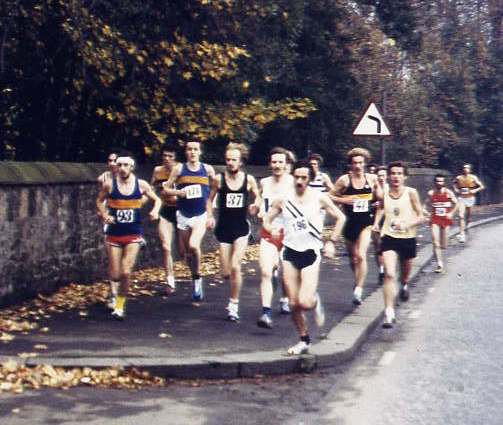
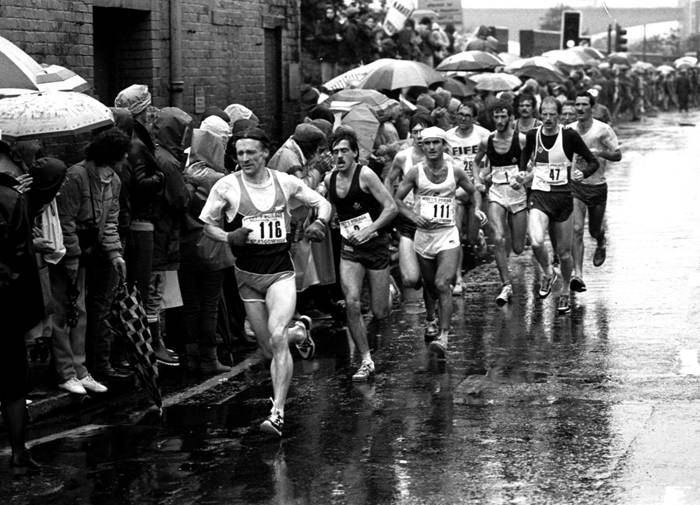
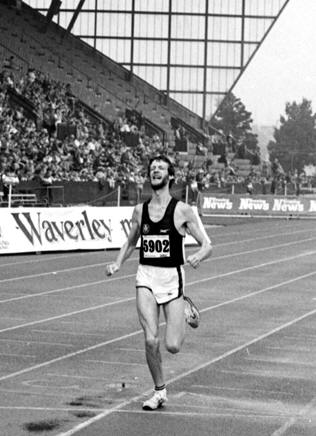
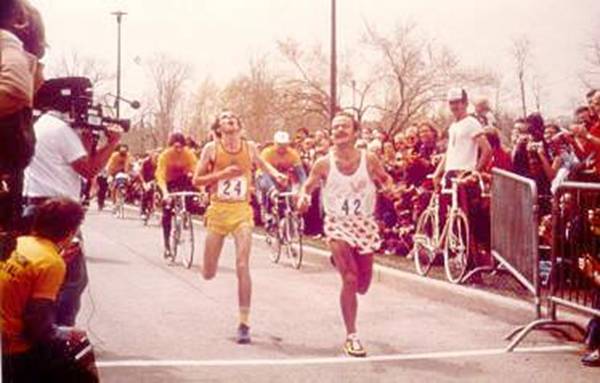
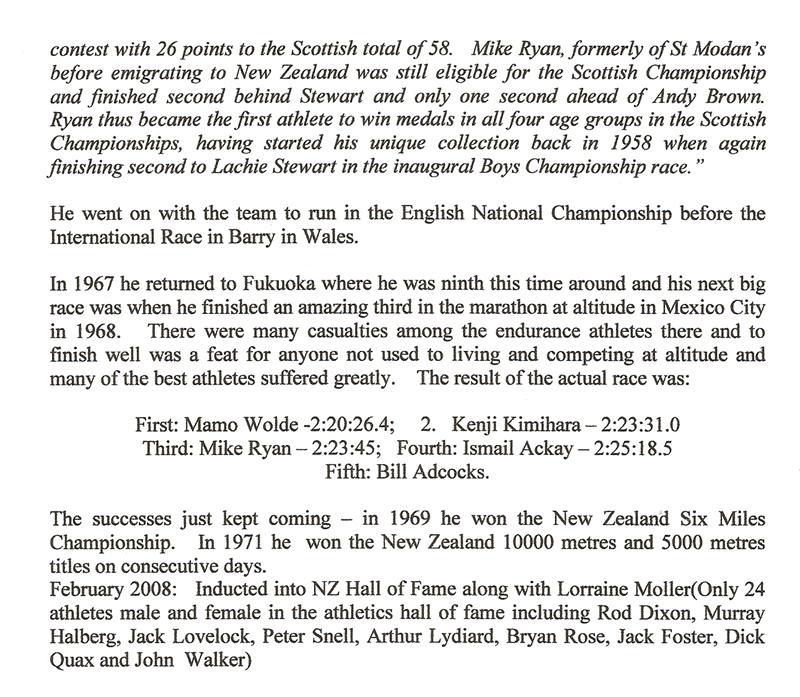
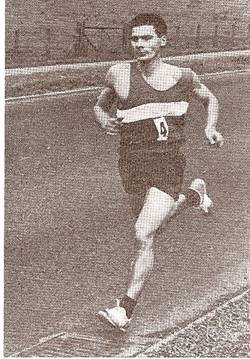
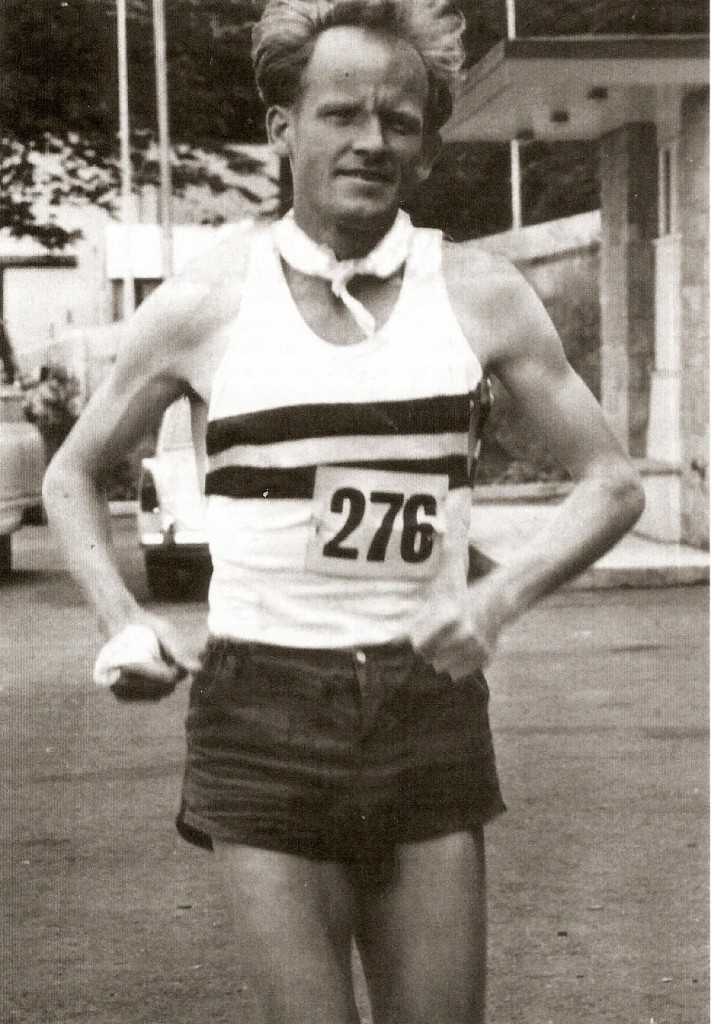
 Andy Daly (111) in the Glasgow Marathon, 1985

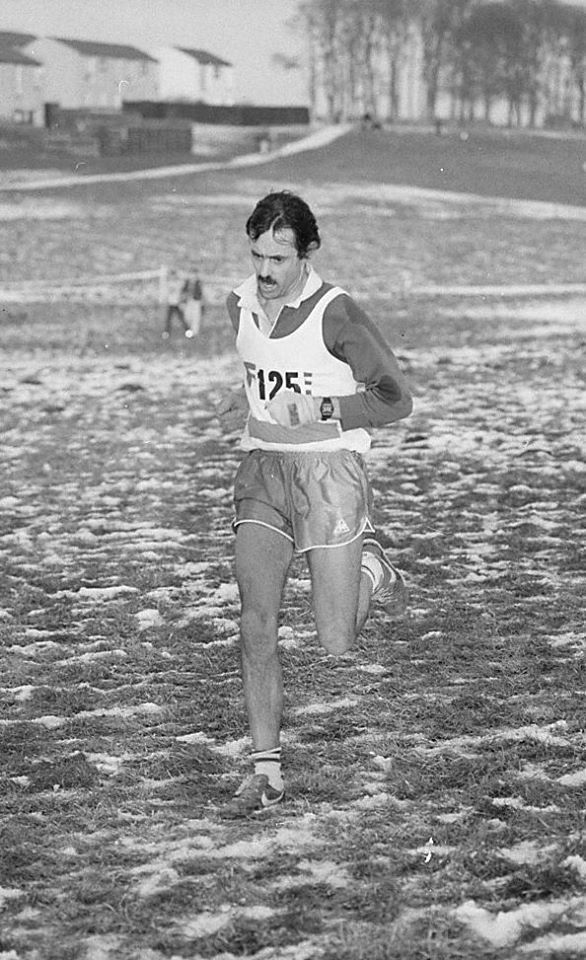
Andy Daly was one of the most likeable runners in Scottish marathon running in the 1980’s and one of the best performers in the marathon.   Having come up through the ranks as part of the great group of young Bellahouston Harriers Youths and Juniors teams (Graham Getty, George Braidwood and of course Peter Fleming) he was well known all over Scotland.    He was also a very hard trainer and there are several stories to corroborate that.

What follows is Andy’s reply to the Scottish Marathon Club questionnaire completed quite early in his career – in October 1983.

Name: Andrew Daly

Club:   Bellahouston Harriers

Date of Birth:   21/4/60

Occupation:   Civil Servant

List of Personal Bests:   5000 m:   14:44                Half Marathon:   65:31                 Marathon:   2:20:09

How did you get involved in the sport initially?      Started running at school and gradually became involved in the Harriers.

Has any individual or group had a marked effect on either your attitude to the sport or on your performances?   Basically the way Foster and Viren used to compete and run had a marked effect on my attitudes and hopefully my future performances in the sport.

What exactly do you get out of the sport?   Camaraderie and a general feeling of fitness and well being.

Can you describe your general attitude to the sport?   I love to compete a lot and do well but I am not too disappointed if I am beaten as long as I have given my best.

What do you consider your best ever performance?   Seventh, Glasgow Marathon, 1982, 2:21:41

And your worst?   I prefer to forget about bad races.

What goals do you have that are still unachieved?   To run a very fast marathon and still improve my times at 5000m, etc.

What has running brought you that you would not have wanted to miss?   The good friends I have made and the genial atmosphere at Bellahouston where everyone is willing to help each other no matter their standard.

Can you give some details of your training?   Training for a marathon.

Sunday:   20 miles;          Monday:   11.5 miles;          Tuesday:   am: 7.5 miles;   pm: speed session + 6.5 miles;          Wednesday: 11.5 miles;

Thursday:   am: 7.5 miles;   pm: endurance session + 6.5 miles;          Friday:   8.5 miles;          Saturday:    Race or 15 miles (maybe some fartlek thrown in.)

Total about 90 miles.


·         In 1982 Andy’s best time was the 2:21:41 quoted above to be ranked fifteenth Scot,

·          in 1983 he was fourteenth with 2:19: 30,

·         (the actual time had him sixth in Glasgow ; Peter Fleming won  with Colin Youngson two places in front of Andy in 2:19:18.   Fleming and Youngson won the team race (with Andy as a non counting runner) and defeated Wales and thumped England!)

·          in 1984 he was fifth with a pb of 2:18:01, when he won the Belfast Marathon.

·         in 1985 at the London Marathon he recorded 2:15:47 (which is still good enough to have him seventeenth on the Scottish all-time list)

·          and in 1986 he was eighth in 2:17:53 (which was one place and five seconds behind Peter Fleming.)

Andy Daly ran 7 sub-2.20 marathons and raced for Scotland in two international marathons (Barcelona and Glasgow) and one international half marathon (Stirling). On all three occasions, Andy’s Scotland team was victorious!

Andy was a remarkably talented and tough athlete.    In 1983 when I was accompanying George Carlin to the Essonne Marathon as part of Stuart Easton’s party, Andy came along.   He had just run in the Barcelona Marathon as part of the Scottish team that won the team competition and finished tenth in 2:20:09.   He had already committed himself to the Essonne trip and kept his word.   Clearly tired from the Barcelona trip he came to France where he finished the race in 2:24!   The team won the team race as well.   He had, to start with, doubted his ability to do himself justice in the race and had the idea of only doing one lap of the two lap course but being third at halfway he just kept on running and although he dropped  a few places was still in the first ten at the finish.  Two marathons in eight days with a total time of 4:44 is some feat!

Andy was a legend as far as hard training was concerned.

·         A ferocious trainer one of his best quotes was when a club mate once asked Andy how many miles he ran in a week, and the reply was “120 no counting two track sessions!”   The other tongue in cheek comment was that he was not a pleasant person to train with as he always did you in no matter what had been agreed beforehand.

·         On the Essonne trip, he turned up for the bus and when it got to London, the first thing he did was go for a run.   The following morning the bus was due to leave at 7:30 but had to wait for a bit until Andy got back from his run.   The bus got us to Essonne and the first thing he did was go for a run.   Even the morning after the marathon, he went for a run!   Normally folk ease up for a bit after a fast marathon!

·         There was the tale told by Brian Goodwin about the time Andy’s Mum phoned him (Brian) because Andy was very late coming home from his long Sunday run from the Bellahouston Sports Centre.   Brian was out in his car looking for Andy and when he finally came home the story was that he had finished his two hours plus run when he met Peter Fleming about to start his session.   So Andy just joined in and Brian reckoned that his run that day was in excess of four hours!

·         Then there is the story that after a Glasgow Marathon where he was disappointed with his 2:18 time so he went for an easy 10 miler at night in about 54 minutes and then  did a weights session in the gym where he broke the British Bench Press record for his weight category – something like 280 lbs!

 Maybe today’s Scottish marathon runners could do with a dose of the Daly spirit.

In reply to the “Where Are They Now?” question, Andy is still running seven days a week on the grass at Cartha.   If he decides to turn out as an M50 vet, the rest will have a serious battle on their   hands!

Andy Daly – Marathon Career Record                                        

No Date Venue Position Time Winner (Club) Time
  1 26 October 1980 New York (USA)     534 2:47:13 Alberto Salazar (USA) 2:09:41
  2 29 March 1981 London       60 2:24:23 Dick Beardsley / Inge Simonsen 2:11:48
  3 17 October 1982 Glasgow         7 2:21:41 Glenn Forster (England) 2:17:16
  4 13 March 1983 Barcelona (ESP)       10 2:20:09 Allan Zachariasen (Denmark) 2:11:05
  5 20 March 1983 Essonne (FRA)         5 2:24:07 Andras Jenkei (Hungary) 2:16:24
  6 11 September 1983 Glasgow         6 2:19:30 Peter Fleming (Bellahouston) 2:17:46
  7 07 May 1984 Belfast         1 2:18:05  
  8 30 September 1984 Glasgow         6 2:16.56 John Boyes (Bournemouth) 2:14:54
  9 21 April 1985 London (AAA)       21 2:15:47 Steve Jones (RAF) 2:08:16
10 22 September 1985 Glasgow    DNF   David Lowes (Chester le Street) 2:15:31
11 20 April 1986 London (AAA)                  36 2:17:53 Toshihiko Seko (Japan) 2:10:02
12 15 March 1987 Barcelona (ESP)         5 2:19:35 Par Wallin (Sweden) 2:13:59
13 18 September 1987 Glasgow         6 2:21:00 Eamonn Tierney (Ireland) 2:19:09
14 31 October 1988 Dublin         6 2:19:21 John Griffin (Ireland) 2:16:02
15 23 April 1989         London (AAA)       62 2:21:40 Douglas Wakiihuri (KEN) 2:09:03
16 28 January 1990 Hong Kong        6 2:33:52 Shang Y Cai (China) 2.25.14

Evan Cameron


EC Ed 84

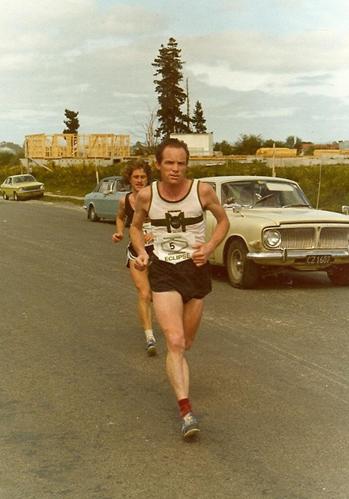
Evan Cameron finishing the Edinburgh Marathon in 1984

Evan Cameron was a very good all round distance runner.   When he started running well at a national level, it was a bit of a surprise to many of us in the West of Scotland as he had seldom raced in that neck of the woods.   It was not long before he was well known though and his career as an athlete is recorded below by his friend and rival Colin Youngson.

Evan Cameron was a versatile cross-country and marathon runner who trained exceptionally hard and made an impact on Scottish Athletics between 1977 and 1986, when he emigrated to Canada.   He was educated in Musselburgh and started running at Durham University in 1976. After his course finished in 1977 he ‘retired’ from athletics; but only a few weeks later found himself accepting a challenge while inebriated – to run the Scottish Marathon Championship wearing someone else’s number. His preparation lasted six days: ten miles for three days; and two miles for the last three! After the inevitable struggle he finished in 2.53, not bad considering.

That autumn he moved to Edinburgh to start work. Living in Marchmont he used to run round the Meadows three times a week. One evening he was chased by a runner (Colin Youngson) from Edinburgh Southern Harriers, who found it hard to catch up. Evan’s talent was obvious and he was invited to join the Sunday Balerno 16 mile training run. After suffering a few tough sessions, Evan gained fitness, joined ESH and started his steady improvement to International status.

By 1978 he had finished third in the demanding Edinburgh University 10, twice round the Braid Hills circuit. Mind you, he managed to beat Donald Macgregor amongst others because there was a thick carpet of snow and Evan had the wisdom to wear spikes for this particular road race! Before long it became clear that Evan’s defining characteristic as a runner was his enormous appetite for long, hard, fast training runs. Even Sandy Keith enjoyed an easier session now and again.

By 1980, Evan could run 120 miles per week for two consecutive months. This meant: Sundays 20 miles in the morning plus 4 miles extra in the evening; Mondays 8 miles to work and 12 home; Tuesdays 8 miles to work and another 8 home; Wednesdays 8 to work and in the evening 7 miles, including 8 fast 400s on grass; Thursdays 8 miles to and 10 miles from; Fridays 8 to and 4 from; Saturdays 15 miles, often including a race. Evan admits now that he might just have overdone it a little, and not tapered enough for races, but in general this exhausting schedule worked well for him.

From 1979 to 1985, Evan’s day started with what was very nearly a race – a very rapid 8 mile morning run with that other great trainer, Sandy Keith. Evan writes: “These runs were always conducted running side-by-side, neither one of us conceding an inch to each other. Sandy became a mentor to me, offering advice on race tactics and on the need to introduce speed and hill sessions into what had previously been a regime of one-paced runs. Our morning efforts really helped me to build towards weekly targets – provided that I rested physically while at my desk job during the day.”   Since both Sandy and Evan faded from the running scene before the late 1980s, some might say that they trained a little too hard – but both certainly enjoyed successful careers at the top before the workload became too much.

In the Edinburgh to Glasgow Relay, Evan won three medals with ESH. In 1979, when he ran Stage Four, his team finished third. They could only manage fourth in 1980, but Evan had been promoted to the longest Stage Six. 1981 produced a double triumph: not only did ESH strike gold, but also Evan Cameron was fastest on Stage Six, beating amongst others John Graham, Graham Laing and Lindsay Robertson. 1982 saw another ESH victory, with Evan holding on to second place, once more on Six. Southern were less successful (6th) in 1983, despite Evan’s fastest time on Stage Five. Then in 1984 they ended up 6th once more, with Evan holding on to second place on Six, before the last two runners slipped back.

More evidence of Evan Cameron’s prowess as a road runner was provided by his record in the National Six-Stage Relay. ESH had an early monopoly in this event and Evan always contributed well by running the fourth (long) stage. He won team gold in 1980, 1981, 1982 and 1983, before winning silver in 1985.

The Scottish Cross-Country Relay was a little short for Evan, but in 1981, along with Colin Hume, Allister Hutton and Ian Elliot, he was part of a winning ESH team.    In the National CC, Evan had a very consistent record over seven successive races, improving from 1980 to his peak in 1983 and then slowing a little before his swansong in 1986. His finishing places were: 28, 22, 14, 9, 15, 19 and 24. ESH won gold in 1980, 1982, 1983, 1984, 1985 and 1986, and silver in 1981.

Evan’s best run was undoubtedly in 1983, when he led his team to victory on a hilly, slippery, muddy course at the Jack Kane Centre in Edinburgh. He ended up ninth, in front of stalwarts like Graham Laing, Eddie Stewart, Paul Kenney, Graham Clark, Charlie Haskett, Cammie Spence, Brian Kirkwood, Rod Stone, Andy Daly, Craig Hunter, Ross Copestake, Adrian Weatherhead and Dave Logue. Evan was justifiably proud of his selection to run for Scotland in the IAAF World CC Championships. This took place over the vicious undulations of Gateshead’s Riverside Bowl. Although Evan found it very hard, he did manage to beat George Braidwood, who had been second in Edinburgh.

In the E to G, 6-Stage Relay, CC Relay and the National CC, Evan Cameron won a very impressive total of thirteen team gold medals, two silver and one bronze.

His consistently intensive training might suggest that Evan Cameron would be a ‘natural’ to succeed in the marathon but, possibly because he did not ease up before races, and over-cautious tactics, his progress was gradual.

In the 1979 Aberdeen Marathon, Evan finished 7th in 2.31.22, a decent time on a tough course. He ran for Scotland in the Home International at Aberdeen in 1980 (9th in 2.30.13) and 1981 (7th in 2.26.23). In the latter year, he also ran strongly in an international marathon in Holland and finished fifth in the Scottish Championship (2.27.23).

At the Commonwealth Games trial in June 1982 at Gateshead, over a hard, hilly route, Evan did well to produce a PB of 2.22.00. He reduced this to 2.20.33 at London 1983. Over a nasty course in the Scottish Marathon in 1984, he won a bronze medal in 2.29.30. Then came a breakthrough at that year’s Edinburgh Waverley Marathon, when Evan was second to Lindsay Robertson in 2.19.34.

Evan Cameron lined up for the 1985 Scottish Marathon with confidence. Sadly, this was to be the last time that the marathon was part of the Track and Field Championships.  The leading group ran away briskly from Edinburgh’s Meadowbank Stadium, down to Portobello into a strong headwind.   A group of four went clear: Evan Cameron (ESH), Colin Youngson (Aberdeen AAC), Graham Getty (Bellahouston) and Pat McErlean (Aberdeen AAC).   Indeed it was Pat, a 2.23 man who trained in Aberdeenshire with Youngson, who did most of the leading through three miles (15.52), although he had been dropped by seven seconds by five miles (26.29) and eventually slipped away.   Even sharing the headwind and coping with a series of small hills was tiring. Ten miles was passed in 53.54 and by eleven miles Graham Getty was off the pace.

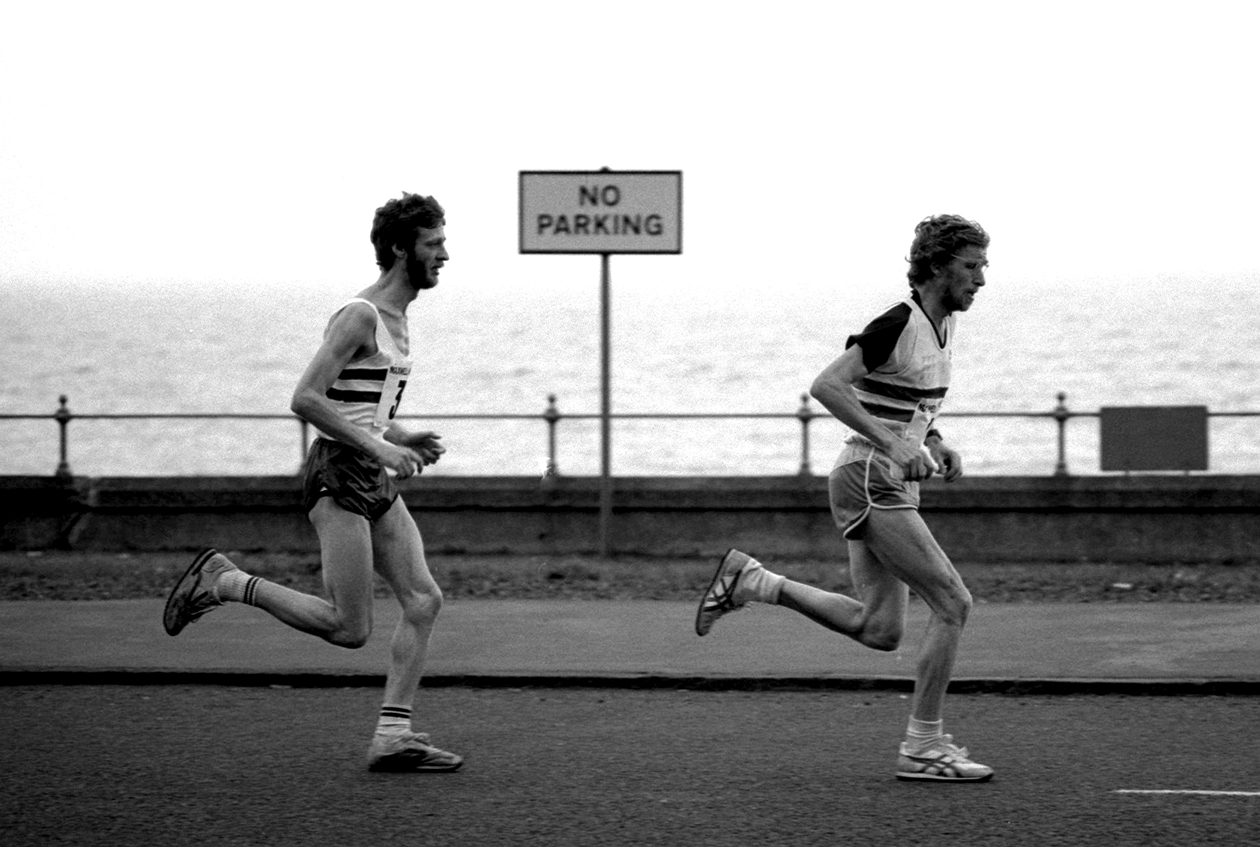
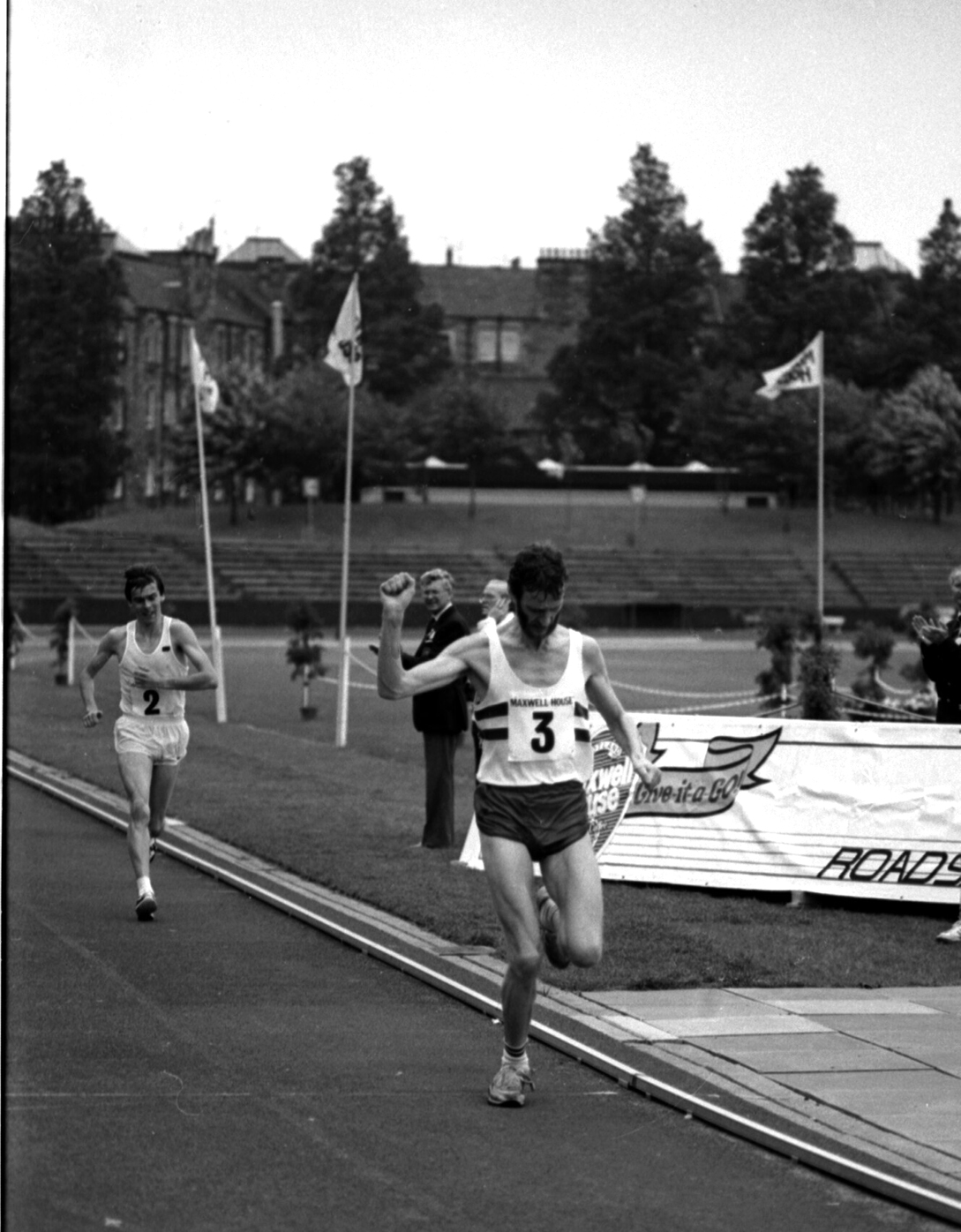
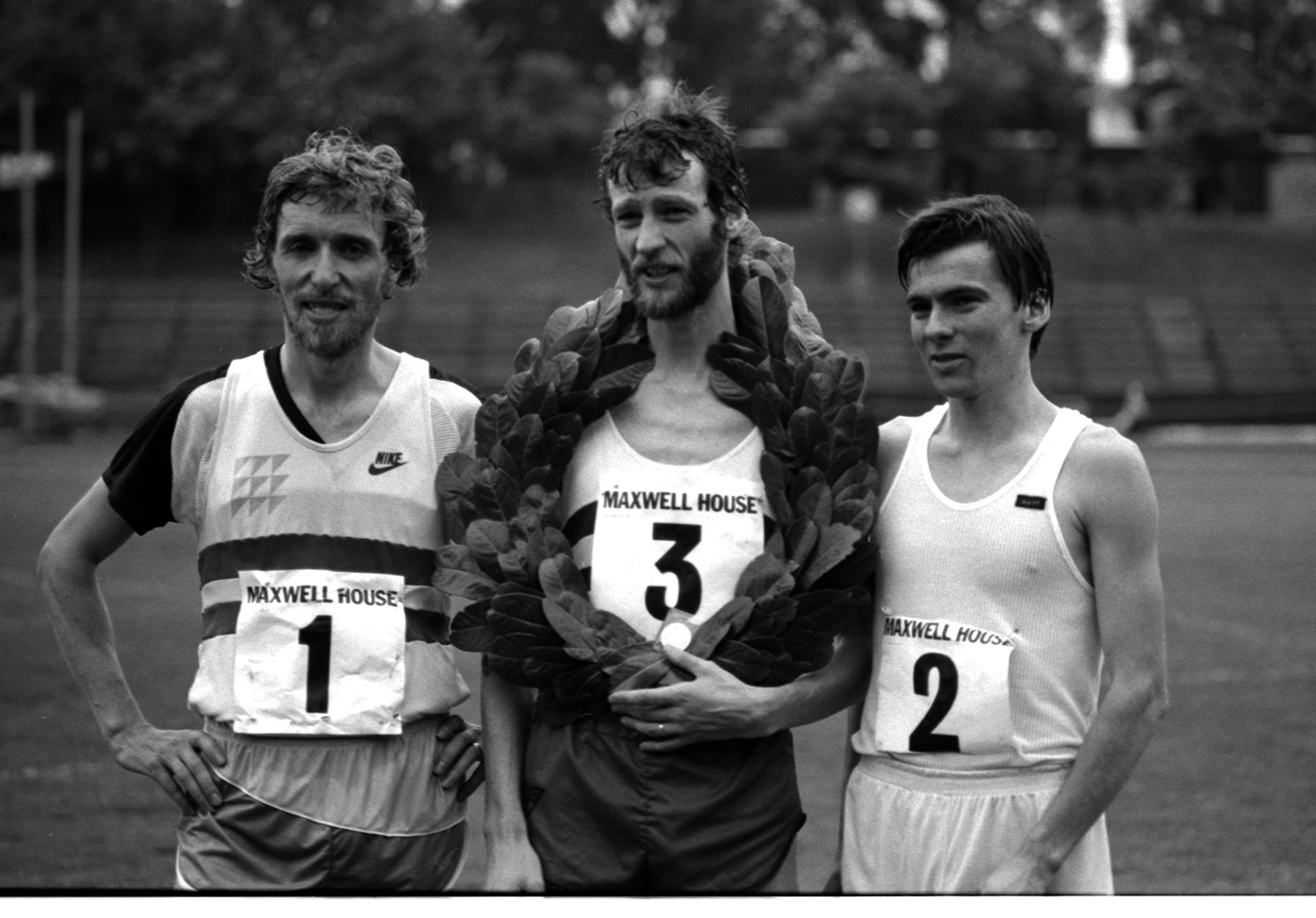
The turn was reached in 70.53, and with the wind behind, the pace increased to 5.10 miling.   Youngson hung on as best he could to Cameron’s determined running, but although Evan’s best was 2.19.34 and Colin had managed 2.19.22 in a Dutch race in April, on this occasion the younger man was superior.   After sixteen miles, Cameron ran a five minute mile and opened up an increasing gap on Youngson.   The leader passed 20 miles in 1.47.13, thirty seconds clear.  After 22 miles, both suffered fatigue, and it was Getty who began to close slightly.   At the finish, Evan Cameron was delighted to win his first individual Scottish title in 2.22.49, with Colin Youngson collecting his tenth and last Scottish marathon medal in 2.23.46 and Graham Getty winning bronze in 2.24.13. Fourth was E. Walker (Livingstone and District) in 2.31.26. Each competitor received a jar of instant coffee!     The pictures below tell the story of the race: Leading group of four at five miles, Cameron and Youngson at 13 miles, then there was one – Evan finishing first, and the first three: Youngson, Cameron and Getty.

M3 EC 2aM3 EC 2bM3 EC 2c

In 1986, Evan Cameron emigrated to Canada to raise a family, develop a busy and successful career, and very occasionally go out for a five mile jog, to prove that he could still actually run. He has every reason to be satisfied with a fine competitive record as a distance runner.


Paul Bannon

M3 PB 1

Paul Bannon (24) finishing second to Brian Maxwell in the National Capital Marathon in 1978

Paul Bannon was a considerably good athlete in his own right but will always be known to Scotsmen of a certain age as “Eddie Bannon’s boy”.  Just as his Dad had done, Paul started out with Shettleston Harriers and won many athletics honours in Scotland but he did what his father never did when he won a medal in a major Games.    This profile is of Paul and will concentrate on his own career in the sport.

Paul is first in the record books in 1969 as a Senior Boy (ie Under 15) athlete.   In that year he was sixth in the Senior Boys District Cross-Country Championships and then seventh in the National Championships as a member of the Shettleston Harriers team.   It is interesting to note that as he goes up the age groups he tends to finish further up the fields whereas some of his rivals followed the reverse path and ‘progressed backwards’.

In 1970 and 1971 he was in the Youths (Under 17) age group and won the club championship in both years.   In 1970 he was sixth in the District Championships and sixth again in the Nationals.   As a second year youth he he did not run in the District Championships and was third in the National Championship  1971 was also the year when he first ran in the Edinburgh to Glasgow Relay and running the fourth stage in the equal third fastest time of the day, brought the club from second to first – a position they held all the way to the tape.     At the end of 1971 he ran the second stage of the Midland relay and helped the club to second place, and ran third in the team that was third in the County relay.   he was also third stage runner in the club’s own Allan Scally Relays that finished third.

As a Junior in 1972 he was fifth in the combined Junior and Senior District Championships and second in the Junior National – needless to say, he also won the club champonship!    1972 was in fact a quite spectacular year for the young Bannon: as well as the championships noted above he was second in the European CCU Youths Championships, eleventh in the European Club Championships and thirteenth in the ICCU International Championships.    Domestically he also ran again in the Edinburgh – Glasgow relay but not in the blue and gold of Shettleston – he was to run that year for Glasgow University.   Good club man that he was, he confessed to feeling confused about who he was supposed to be shouting for!   He brought the University from seventeenth to eleventh – a brilliant run on that most difficult of stages – in the fifth fastest time behind Norman Morrison, Ian Stewart, Fergus Murray and Jim Dingwall.   In summer 1972 he showed what he could do on the track when he won gold at the AAA’s Junior Track Championships in the 3000m.

In 1973 he took up an athletics scholarship at Memphis State University in Tennessee.   It didn’t take too long for him to establish his credentials either.   A 3000m in 8:08.8 at Bloomington, NY in February 1974 was good and his best times in the States were to be 13:49.2 for 5000m in Knoxville, Tennessee, and 28:36.8 for 10000m in Des Moines, Iowa.   If you look up the athletics section of the Memphis University website, you will find that Paul Bannon is an all-time letterman from the 1973 – 1976 period, and the times quoted are still University records.   Furthermore, in the ‘Events No Longer Run’ list he is noted three times – for the Two Miles (9:00.0 in 1973), Three Miles (13:27.5 in 1974) and Six Miles (27:44.6 in 1975).   Having made his mark in Scotland, he now made a similar impact in Tennessee.

He came home in 1976 and was third in the SAAA 10000m.    His family moved to Toronto in 1976 and that was to be the start of another, even better athletics career for Paul Bannon.

Summer 1977 had been a good one for Bannon with victories in not one but two Canadian Track Championships:   He won the 5000m in 14:00.4 and the 10000m in 28:58.4   In the ‘Winnipeg Free Press’ of 10th September 1977 under the heading of “Scot Wins Road Race”, there was the story of how, running for the Toronto Olympic Club, he won the 20K Race at the Ontario Provincial Road Race Championships in a time of 62:41 which was 15 seconds clear of the second placer.   Two months later the headline in the same paper was “Winnipegger Wins Open Title” only this time the Scot was not the one in the headline – he finished sixth in the National Cross-Country Championships but as the paper said, “Scotsman Paul Bannon of Toronto actually finished sixth but is unable to compete for Canada internationally since he hasn’t been a resident long enough to qualify.”    The irony is that the International Championships that season (1977/78) were to be held in Bellahouston Park in Glasgow!

In May 1978 however he did have the requisite residential qualifications for selection to the Canadian team for the Commonwealth Games and ran in the marathon in Ottawa.   It was his first time in the event but he led for most of the way and it was only with three miles to go that Brian Maxwell (a Canadian living in California and third in the world in 1977) caught him and it was down to the last 75 yard sprint for the line before he got in front.   The winning time of 2:16:02 was a record – the picture at the top of the page shows how close it was.   He was selected with Maxwell and Jerome Drayton for the Commonwealth Games which were to be held in Edmonton.   How about that?   A Scot emigrates to Canada and misses out on selection for a World Championships in Glasgow but gets picked for a major Games in Canada!       Later that year, in July 1978 ‘The Lethbridge Herald’  reported on a 20K road race in Chicago where he finished second to Gary Bjorklund of America in 1:01:06.

In the race itself which was only his second marathon,  was held in a temperature of 21 degrees C with a humidity of 57%.   The race was won by Gidemas Shahanga of Tanzania in 2:15:39.8 with Canadian Jerome Drayton second in 2:16:13.5 and Paul Bannon third in 2:16:51.6.   Behind him were Kevin Ryan (NZ) in 2:17:15.3, Greg Hannon (Ire) in 2:17:25, Paul Ballinger (NZ) in 2:17:15.3.   Further down were Trevor Wright (England) 2:20:14.6, Stan Curran (England) 2:21:17.6 and Brian Maxwell (Canada) 2:21:46.3.    There were 30 finishers.   At 5km Jim Dingwall was equal with two others in 16:02 while the second group including Bannon and Ryan were timed at 16:03.    By 10K the leading group had all the main contenders and some others as well when it came through in 31:52.   The group stayed more or less together through 15 km (47:50), 20 km (63:49), 25 km (79:59 (Bannon and Ryan) with Singh, Drayton, Shahanga, Ruto and others very close up.   The first important break came in the 5km leading up to 30 km when Bannon covered that 5k in 15:43 which opened up a gap of 28 seconds on Kevin Ryan and Jerome Drayton with Shahanga fifth almost 75 seconds down.   By 35 km, Bannon’s lead was down to 19 seconds and Drayton was the man in second.   Times at 35 km: Bannon 1:52:05, Drayton 1:52:24, Ryan 1:52:47, Shahanga 1:52:55, Hannon 1:53:41.   Drayton went into the lead at 38km after 2:02 running time, Bannon offered no resistance and it looked as though Drayton would win.   he was however notorious for dropping out of races where he was very confident of winning such as the 1977 Boston Marathon.   After Drayton, Shahanga passed Bannon just after 39km and at 40km he was just 19 seconds down on Drayton.   40km splits:   Drayton 2:08:53, Shahanga 2:09:06, Bannon 2:09:22, Ryan 2:09:54, Hannon 2:10:15.   Drayton looked back at 41 km and saw Shahanga coming up fast and a minute or so later, just outside the stadium, the African passed him.   Shahanga was timed at 33 seconds for the final 200 metres.   He had done the distance from the 40km mark in 6:33.8 which works out at 4:50 miling pace.   The table below has the 5km splits for the first three

Distance Shahanga Drayton Bannon
5km 16:04 16:03 16:03
10km 16:12 15:49 15:49
15km 16:29 15:58 15:58
20km 15:46 15:59 15:59
25km 16:03 16:17 16:10
30km 16:22 16:17 15:43
35km 15:59 16:01 16:23
40km 16:11 16:29 17:17
+ 6:33.8 7:20.5 7:10.0

The Press described it as a ‘Race of Unknowns’.   Nobody knew anything about Shahanga – after the obligatory conference he was maybe 19 or 21 years old, he was one of 12 children, he was still at school, he always wanted to run  a marathon and might have run one in 1974 when he might only have been 15; in 1976 he did run one in 2:22:41 and also did a 10000m in 29:54.   And so on they went.   Of course Paul Bannon confused them as did Greg Hannon.   After all the confusion, very little press ink as spilled on the English runners!   The coverage in ‘The Lethbridge Herald’ in Canada was “Brill and Drayton miss gold medal chances.”    The Press never changes.   The ‘Athletics Weekly report however draws attention to another aspect of his selection.   I quote: “Paul Bannon, son of former Scottish cross-country star Eddie Bannon, could have represented his native land but opted for Canada as he did not expect the Scottish authorities to pay for his fare over in order to qualify.   He is eligible only for Britain at the 1980 Olympics as he will not have been resident in Canada long enough but says he will not be racing that year in order to concentrate on his accountancy exams.   A former AAA junior 3000m champion, his one previous marathon outing was in the Canadian trial race in May where he was beaten by Brian Maxwell in one of the closest finishes in marathoning history – 2:16:02.6 to 2:16:02.8.”   The picture below is of Paul being helped from the track after the race.

Bannon of course went on running although very little information filtered back to Scotland about it.    We do know that his next big marathon was in Vancouver.  On 1st May 1983 he took to the streets of Vancouver for the annual marathon and, described in the ‘Winnipeg Free Press’ as ‘Paul Bannon of Mississauga, Ont.’ he won from a field of 8000 runners in a time of 2:19:40.    It was his first marathon for three years and it is remembered as ‘the long marathon’ after a spotter at Brockton Point in Stanley Park  misdirected the runners for an extra 561 yards.   Nevertheless, Paul won!    In 1984 he ran in the Canadian Olympic Marathon Trials – the picture and comments quoted, received from Joe Small, tell the story.

M3 PB 2

MEN: 1.   David Edge, Burlington, Ont.   2:13:19          2.   Alain Bordeleau, Montreal   2:14:19          3.   Art Boileau, Eugene, Ore.   2:14:36         4.   Robert Englehutt, Dartmouth, N.S.  2:16:50          5.   Jeff Martin, Jordan Station, Ont.   2:17:39

  1. Tom Howard, Surrey, B.C.   2:18:18             7.  Muya Wachira, Ottawa   2:18:41               8.   Paul Bannon, Missisauga, Ont   2:18:51    9.   Rheal Desjardins, Montreal   2:19:25                   10. Stephen Pomeroy, West Vancouver   2:19:48

27 – Howard who hero mentioned 2:13 guy, a bit past his prime at that race.   29 – Martindill: big talent in everything up to the marathon but had some kind of breathing issues or something that would hamper him in the marathon – maybe oldster remembers 64-half marathon guy – 1:34 30km guy – did two sub-30 minute 10km road races in one day, didn’t finish that race.   No number – Dave Edge (made team), behind 29 needs no introduction – one claim to fame was practically coming to blows with Joe Sax for drafting off him the whole way at ATB.    No Number – Butler, tall guy next to Edge, needs no introduction – 2:10 guy who didn’t make the team.    3 – Dyon – owns Brooks, 2:14 guy – tough as nails – didn’t make the team.   8.   Bannon – 2:16 guy – became a priest later I think – I went by him at 20 miles in NY in 83 – he went out at some ridiculous pace there.   No number behind Bannon – Hughson – 2:13 guy a bit past his prime at that race.   10 – Don’t know – Pomeroy wild ass guess.   Team Adidas guy next to 10 – Maxwell – now deceased founder of Power Bar – 2:14 guy, didn’t make team

He is also listed at number seven with that Ottawa time in the Toronto Olympic Club’s list of their all-time marathon runners.   No small feat with guys like Drayton, Maxwell, Fonseca and Boychuk as club members.   The last we heard of Paul was that he had indeed become a priest in the Catholic Church.    We would welcome any new information about  him

Back to Marathon Stars


Alastair Wood

M2 AJW 1

Alastair Wood came to marathon running with a record of athletic achievement at all levels of the sport that might have justified him in retiring or stopping.   Instead he went on to become one of the great figures of Scottish and British distance running.   Among the many honours that were justly awarded to him was the Achilles Club gold medal.      The Achilles Club is an elite and exclusive athletics club composed only of students at Oxford and Cambridge Universities.   Founded in 1920 it has added a great deal to the sport and is known and respected all over the globe.   Since 1949, the Achilles Club has awarded annually two gold medals,  for the best performance by a club member on either Track or Field. Recipients of the Track award include Roger Bannister, Chris Chataway, Chris Brasher, David Hemery and Richard Nerurkar.   The only Scottish athlete to obtain this prestigious medal was Alastair Wood (Oxford University and later Aberdeen AAC), who won twice: in 1962 [when he was a close second (to that year’s European and Empire champion Brian Kilby) in the AAA Marathon; and a splendid fourth in the European Marathon]; and in 1966 [when he is reported to have run 2.16.06, and also set a new European record of 2.13.45 in the Forres marathon. For some obscure reason, the latter time has never been accepted by the SAAA, but was ratified by the AAA in 1967, and is now recognised by the Association of Road Running Statisticians (www.arrs.net) as the fastest time of the year in 1966]. Alastair was also narrowly pushed into second by Jim Alder in the AAA championships in 1967, with 2.16.21.    And yet the present generation of Scottish marathon runners know very little about him.

Like so many marathon men he began as a middle distance track runner.   Having been introduced to the sport at Elgin Academy, he really became involved when he went to Aberdeen University.   The 1952/53 AU ‘Athletics Alma’ reported, ‘A very useful half miler in A Wood has come forward this year.   he should with more training and competition soon break the two minute barrier.’   He himself doesn’t recall doing so, but without too much practising turning in a 4:30 mile and a 14:55 Three Miles.   In 1955 however he was third in the SAAA  Mile Championship, and after running a 4:15 on the grass track at Westerlands, came under the guidance of the Scottish National Coach, Tony Chapman.   After leaving University he went into the RAF and really began training in earnest.   In 1975 he won the SAAA Three Miles, in 1958 he won the Six Miles and in 1959 lifted both titles.   He had already in April ’59, become the second Scot to run under 29 minutes for the Six Miles when he turned in 29:40.8 in the English SCAAA race, and although not quite so fast set a new Scottish native record for the Three Miles of 13:39. 8 and ran Ten Miles in 49:24.8.   He also won the Six Miles in 1960 and 1961.   This feat of winning the title four times has only been equalled by Ian Binnie of all the Scottish distance runners.   The range of his ability can be seen from the 1960 season when he also ran a Scottish native record for the Three Miles of 13:39.8 and ran Ten Miles in 49:24.6.   By 1962 when he turned to marathon running he had six SAAA titles, set records ay 3, 4, 5 and 6 Miles and represented Great Britain at Three Miles, Six Miles and in the Steeplechase.

Over the country, Alastair began by winning the Scottish Universities Cross-Country title in 1956 for Aberdeen University at St Andrews.   Such was his progress that a mere three years later he won the Scottish title from John McLaren of Victoria Park.   he ony narrowly failed to retain it the following year in an epic race with Graham Everett which had Emmet Farrell writing in the ‘Scots Athlete’ saying that the running of the winner must rank among the greatest in the history of the race, almost equally brilliant was the form of the defeated champion, Alastair Wood.   This race was followed by another really exceptional run in the International Race held at Hamilton Racecourse in which the spearhead of the team was Wood, Everett and the AAA’s Three Mile Champion, Bruce Tulloh.   In the race itself, Alastair was seventh behind Rhadi, Roelants and Merriman, prompting Farrell to say, ‘Scotland, fifth out of eight teams, might have claimed fourth if  Everett and Tulloh had run with the distinction of Wood.’

In May 1962, Andy Brown had run a great 2:25:58 for the marathon and was favourite for the SAAA title.   In fact Alastair took exactly one minute from the time in winning the championship.   He went on to run second in the AAA’s event and gain selection for the team for the European championships in Belgrade.   He finished fourth in that race – a magnificent achievement in only his third marathon.   Despite being quoted after the race that he was bored with the distance and would run no more marathons, he was far from finished with the race.   A few only of the highlights of his subsequent career are set out here.AA title.   In fact Alastair took exactly one minute from that time in winning the race.   He went on to run second in the AAA’s event and gain selection for the UK team  for the European Championships in Belgrade that year.   He finished fourth in that race – a magnificent achievement in only his third marathon.   Despite being quoted after the race that he was bored with the distance and would run no more marathons, he was far from finished with the race.   A few only of the highlights of his subsequent career are set out here.

Year Race Time Place Comments
1964 SAAA  Championship 2:24:00 1st  
1965 SAAA Championship 2:20:46 1st  
  Shettleston Marathon 2:19:03 2nd  
1966 Inverness – Forres 2:13:45 1st GB and European Best
1967 SAAA Championship 2:21:26 1st  
  AAA’s Championship 2:16:01 2nd  
1968 SAAA Championship 2:21:18 1st  
1969 Harlow Marathon 2:19:15 1st  
1970 Harlow Marathon   1st  
1972 SAAA Championship 2:21:02 1st  
1974 World Veterans Champs 2:28:40 1st 0+  

These are only the very bare bones of his marathon career and say nothing of the many many first class races with which his diaries are filled.   The European best time of 1966 was never properly recognised and he had to live with the smear that it was a short course for some time.   The SAAA did however include it in their list of best times and they are not a body given to charity in matters of this sort.   Besides, did not his entire career up to this point indicate that he was indeed capable of this time?   His record of six Scottish titles is unequalled and it would be a brave man who forecast a similar one in the years to come.
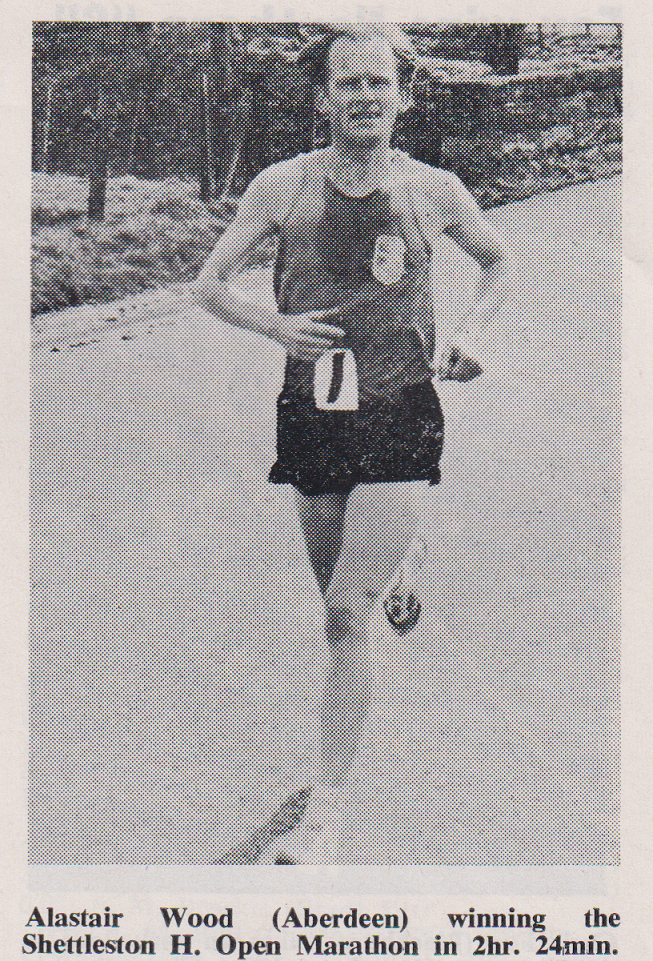
                                                                                                         1966

He has also run well in events beyond the marathon distance.   He is credited with Scottish Native Records at 15000m, 20000m and 25000m (sharing the last two with Don Macgregor) and for the two hours run.   Probably his best Ultra was in the London to BRighton in 1972 which he won in 5:14:31, a record which stood until 1978 and is still the third best of all time for the course.   It was after this rn that he was heard to comment that he felt his legs had been sewn on backwards!

Alastair’s career has been of such length, variety and quality that even a brief summary such as this makes awesome reading, but what of the man himself and his training methods and philosophy?   He was quoted in a Road Runners Club publication of 1965 as saying that if running meant the exclusion of all else, he would give up tomorrow.   Nevertheless, one who knows him well believes that running is one of the mainsprings of his life – although he abhors athletics bores.   Described as an intellectual runner (not in the sense of education endured but rather with respect to his attitude to the sport) his attitudes to training provoke not a little thought.   Underlying his attitude to training is his belief that training to runf ast, means running fast.   Beginning when he did in the late 50’s, he was totally interval trained up to 1960 and found that he could run well up to and beyond 10 miles on any surface.  It is inevitable that while he shares many doubts about the quantity of interval training done in its heyday, he should feel that it still has a great deal to contribute to any training scheme.   Any system is dangerous if taken to extremes and this is as true of long, slow distance as it is of interval training.

I would like to quote Alastair direct at this point.   ‘The answer to fast running at any distance is to devote a considerable amount of time to moving faster than you intend to race.   eg my best time for a mile is :10 but by a lot of hard work I got my ‘cruising speed’ up so that in one session I could run 3 x 1 Mile in 4:15 with a ten-minute recovery.’    Long runs?   ‘I agree you need one long run at least, but probably not more than two.   You also need a couple of interval/repetition sessions – reps over a relatuvely long distances (880y to Mile) and intervals of say 220y.   My fastest marathons came after only three to four weeks of interspersing fastish steady runs of up to 12 – 15 miles on the road with track work-outs of up to 60 x 220 in 33/34 seconds with very short jogs of about 35 seconds in between.   As far as the big mileages done now for longer races are concerned, the following comments from an acknowledged master are illuminating.   ‘I also discovered the invaluable practice of training every other day.   After all, you need some sort of carrot to do 60 x 220 if you are human!   So you could train as little as three or four days a week and simply jog a couple of miles to recover on the other days, particularly once you are fit and looking for races and preparing for a particular event.   This is exactly what I did when training for my one and only London to Brighton.   So we have the strange situation where the length of the race often exceeds the weekly mileage.’

When he turns his eye on marathon runners generally he feels that many get nowhere near their potential.   ‘If you are covering 80/100 miles per week, the way to improve your performance is to build in more contrasts in terms of fast/slow, long/short runs rather than run all the miles faster or try to increase your mileage.   Of course you must be psychologically prepared to live with much reduced mileages …’

In the ‘Athletics Alma’ quoted above it was said that he ‘trains hard on cigars and whisky and the three w’s.’   None of my informants believes that one.   As far as The Diet is concerned, his thoughts are that it definitely helped him in longer races such as the Two Bridges and the London – Brighton although for the marathon itself, the risk of the physical upsets plus the depressingly poor runs immediately prior to the race more than offset the negligible gains.

Described by one of his great rivals as ‘always cheerful and talkative before and after a race but very tough in competition, he also has a fair (and maybe idiosyncratic) sense of humour.   He has been seen after a particularly hard race pulling faces at a busload of competitors that would have won a gurning competition.   Running with a young Donald Macgregor in the SAAA marathon, Don’s ESH team mates were shouting the boy on at about three miles.   Alastair turned on the first time marathoner, smiled and said ‘Surely they don’t expect you to drop already?   He went on to ‘break’ the boy at about 19 miles and win.

Alastair Wood is still not finished with the marathon – who would bet against a sub 2:20 marathon with his record?   As one who has done a lot for the sport and who is not on record anywhere as indulging in any shady practices, as one who never took the money and ran, nor ran and took the money, he is a first class example for anyone taking up the sport.   If he is not one already, he should be made an honorary member of the Scottish Marathon Club.   Alastair Wood is a famous runner.

As I said that was written in 1983 and his thoughts on training could well form the subject for a week end seminar!   “The invaluable practice of training every other day” would not go down well with many – but does it have merit?  What is it?   “If you are covering 80/100 mpw then the way to improve your performance is build in more contrasts to your training.”   Discuss!    A wonderful man who was maybe not appreciated as he might have been by the Scottish administration of the day and whose knowledge was shamefully under utilised.

********************************

Alastair Wood was of course more than a wonderful athlete he was a motivator and his influence on his fellow Aberdonians has already been mentioned.   The following is an excerpt from an article in ‘Athletics Weekly’ by Ranjit Bhatia who knew and ran with him in 1959 and 1960.

“The athletics career of Alastair Wood makes one of the most interesting stories of our time.   I first met him in 1959 when he was serving with the RAF as a short service commission officer.   He was keen to keep up his running while with the Air Force and fortunately enough was posted to Halton, a station which had a reputation for producing outstanding athletes.   He was the only officer in the station athletics team and his amiable qualities made him very popular.   During the winter of 1958 he proved to be their most outstanding cross country runner and it was not surprising to find him dominating the cross country events during the summer track season that followed.  

Alastair left the Air Force the next year and joined Oxford University to do a post graduate course (he had graduated from Aberdeen University three years earlier).   From October 1959 until the time I returned to India I did most of my training with him, and in the process learnt a great deal about distance running from this ‘elderly’ (born 1933) and somewhat eccentric Scotsman.   He was much older than most of his contemporaries in the University Athletics Club and the three year stint in the RAF had left its mark on him.   But then he was so very much an extrovert and within a few weeks he managed to build up a large following amongst the distance running fraternity at Iffley Road.   But he and his wife Jean lived in a cottage nearly ten miles away from the centre and Alastair often ran to his lectures, and to the track for his afternoon work outs (“To save petrol”, he used to say).   Every day around three o’clock one would hear his characteristic call.   “Any of you clots here to train?    Come on you lazy English!   And you there from Poonah!”  

A training session with the Aberdonian was a unique experience.   He cursed everyone as he ran.   If someone attampted to slow down the pace, Wood was there to male sure that he went even harder.   By the end of the winter, Alastair Wood’s running group had acquired quite a reputation for themselves.   They won practically every team race in which they participated.   Came the 1960 International Cross Country Championships and no less than four of the seven members of the university cross country team won their International vests with Wood finishing seventh.

(This 1970 article goes on to mention Alastair’s track exploits and his switch to the marathon.   It finishes with the statement: “He continues to be Scotland’s most colourful distance runner.”)

*****************************

In the January 1987 issue of the ‘Scotland’s Runner’ magazine there was an interview of Alistair by one of his proteges and running mates from Aberdeen – Mel Edwards.   Mel is a quite outstanding athlete himself with many superb runs over the country, on road and track and also in the hills and freely admits that Wood was one of the inspirations behind his early career.   In fact he won what is probably the best cross country race I have ever seen when he defeated Ian McCafferty at Hamilton in the Scottish Under 20 Championship.   However we may speak of Mel separately at some stage but for now extracts from his article on Alastair are quoted here.

“Born in Elgin on January 13th, 1933, Wood went to Aberdeen University in 1954 and two years later won the Scottish Universities cross country title at St Andrew’s.   He excelled at athletics in the RAF in the late Fifties and went on to take 16 Scottish titles (including eight marathons).  His major Championship appearances were: 1958 Empire Games Three and ix Miles; 1962 European Championship marathon (fourth) and Empire Games marathon.   Other highlights were a 2:13:45 marathon. a London to Brighton record and the World 40 Mile Track Record (1970).

Edwards: You’ve had a long career in the sport, Alastair.   What are your most memorable performances?

Wood: Oddly enough the very early ones.   Just about the first thing I won was the Scottish Universities Cross Country at St Andrews.   I had to stop to tie a shoelace yet I still won by 300 yards.   That was the first occasion I really though I was a runner.   I went in for a mile race at Westerlands in summer 1955 with a personal best of 4:35 and found myself up against a couple of athletes who had been in Bannister’s first sub-four minute mile at Oxford the previous year.   Looking back I should have been overawed by these guys but in the event I took off and was still leading after three laps.   I was still in front with 100 yards to go and although I was passed I came down to 4:14 in that one race.  

E: You went into the RAF for a short service in the late Fifties. serving at Halton which had a reputation for producing fine runners?

W: Yes, I won the RAF cross country championships in 1957 and this pleased me very much as Derek Ibbotson who broke the world one mile record that year had been a previous winner.   The competition in England was invaluable.   I came up to Meadowbank that summer to do the Scottish six miles a distance I’d never done on a track before.   However with a 29 minute 10 second run including a 57 second last lap I managed to break Ian Binnie’s Scottish record by 0.8 seconds.

E:   Moving on to the Sixties, I think I’m right in saying that this was the period you were really at your peak?

W:   Yes, my fourth place in the European marathon in 1962 was a breakthrough in a competitive sense although not time-wise.

E:   I remember doing my first two hour run in Aberdeen on the morning of that race so that I could watch you on TV in the afternoon with a clear conscience!    But wasn’t 1966 an even more eventful year for you?

W:   That’s right, the Commonwealth Games were in Kingston, Jamaica and I went for marathon selection.   The only trouble was that I couldn’t get any guidance on the selection procedure.   The Scottish championships were at Westerlands in early June and I asked John Anderson – who was the National coach and advising me on my training –  if he could ascertain whether this was the race on which selection was to be based.   He couldn’t find anyone who could tell him but suggested that if the winner of the race was to be selected then I had to do it.   Anyway I was in excellent shape and travelled to Glasgow.   It was extremely hot and the tar was running on Great Western Road.   No one would confirm that the winner would gain selection so as the times were going to be slow I didn’t run as it would have done my chances of selection no good.

E:   The Polytechnic Marathon from Windsor to Chiswick was two weeks later and Jim Alder and yourself went for selection in that one?

W:   Yes, Again it was very hot but at least I knew that if I beat Jim I would almost certainly be picked.   We both suffered and Jim finished fifth and I was two minutes behind in eighth.   Jim deservedly gained selection and I was very ill with dehydration.   I was pretty demoralised and decided to retire.   This lasted all of ten days and although I couldn’t face long runs I got stuck into sessions 60 x 200 metres.  

About three weeks after the Poly I went North for the Inverness – Forres Marathon.   It was a cool day and I felt so good that I knew I was on a blinder.   I reached ten miles in under 50 minutes and then slowed deliberately because I thought I’d blown it.   I still came home in 2:13:45, a European record.   There was considerable disbelief about the time but the course had been measured by surveyors and the North of Scotland AAA.   Anyway, the next year the course started 200 yards or so back from the previous starting line, and although I found this one much harder I still did 2:13:45.

E:   What are your views on marathon selection as a result of these experiences?

W:  Basically the system should be objective enough to almost dispense with selection.   Have a rule and stick to it.   The American system in Track and Field of ‘First three’ in the trials might be ruthless but everyone knows what they have to do.

E:   Going on to training now, you’ve experimented with virtually every form there is.   Have you come to any conclusions?

W:   There is definitely a lot to be learned from trial and error.    Obviously if there is a perfect system it is the one which produces the most good runners, but some top class runners may have been even better on a different system.    However, in a nutshell, training fast helps you to run fast.   I don’t believe in the ‘something for nothing’ school of thought and reckon that interval training makes you faster than any other system.

E:   But it’s not just training of the body, is it?   I don’t think it’s far off the mark to say that you would psych yourself up for a race and that a lot of your best runs were through guts and a desire to do well.

W:   A fair point.   There’s no point in throwing the race away mentally before you’ve started.  

E:   What were your preparations for the London to Brighton and world 40 mile records in 1970?

W:   I trained only every other day and never more than 15 miles at any one time.   In a sense you could say that I did get ‘something for nothing’  with these two events because I wasn’t doing excessive mileage.   The London to Brighton in five hours eleven minutes was ten minutes faster than the previous year and I remember after the 40 miles record a guy from Capital Radio asking if I could improve on my time next year.   My comment on the likelihood of anyone being stupid enough to tackle it twice was not broadcast.”

There is more to the article than that and if you can get hold of a copy then it is worth reading.   Mel has done a good job and I was relieved to see that he had been given the same replies as I had where the same questions were raise – but he has more colour in his interview and asked some questions that are more insightful than some of mine.

Alastair’s record breaking run in the London to Brighton was mentioned in the interview and I would like to include this excerpt from an article by Bill Brown in The Road Runners Club Newsletter of January 1973 which I received from Colin Youngson.

“The weather now became even gloomier with patchy fog at Gatwick.   This could not have been very pleasant for the runners but it had little effect on the leaders who arrived at Crawley (thirty and three quarter miles)in the very fast time of 2:54:54, more than five minutes inside the record..   The leaders were Alastair Wood and Mick Orton with Cavin Woodward, two minutes slower, third.   Both Hensman and MacIntosh, fourth and fifth, were running faster than the previous best and Houk, sixth in 3:02, was only a few seconds slower.   Shortly after Crawley, Wood began to take charge of the race and soon opened up a large gap on the gallant Orton.   When Wood reached Bolney, nearly 39 miles from Big Ben, in 3 hours 43 minutes 30 seconds he was a good 9 minutes ahead of Orton who had a three minute lead on Woodward.   As usual there was now the customary speculation as to whether or not Wood was travelling too fast, and perhaps might not last the full distance.

The opinion of the two former winners, Tom Richards (1955) and Bill Kelly (1954)  was that there was no doubt that Wood was just the sort of runner to conquer the distance and the record.   Not even the famous Dale Hill seemed to have any effect on this talented runner, and so at Pycombe (46 miles) Wood’s time of 4:27:12 was no less than 10 minutes 48 seconds faster than Levick’s 1971 time.    More than six minutes passed before Orton passed this check, yet he too was four and a half minutes better than the record.

So on to the Aquarium Brighton, where after fifty two and three quarter miles Alastair Wood was timed in with the incredible time of five hours eleven minutes and two seconds to smash the record by ten minutes 43 seconds giving Scotland a win in this event for the first time.   The true worth of this time can be seen when it is realised that with an even time run at 10 mph (six minute miles) the journey would have taken five hours fifteen minutes.   Yet when I spoke to Alastair Wood afterwards he stated that he had had no feelings in his legs for the last twenty miles.   Congratulations on a magnificent run.   So far was he inside the record that the Mayor of Brighton did not get to the finish in time to welcome him in.   A good deal of sympathy must go to the rest of the runners.   Especially to Mick Orton ho ran a splendid race in a brilliant time (5:18:28) to be content with second place.”  

Alastair Wood – Marathon Career Record                                            

No Date Venue Position Time Winner (Club) Time
  1 23 June 1962 Edinburgh (SAAA)         1 2:24:58 CHAMPIONSHIP RECORD
  2 11 August 1962 Welwyn Garden (AAA)         2 2:26:35 Brian Kilby (Coventry Godiva) 2:26:15
  3 16 September 1962 Belgrade (SER-Euro)         4 2:25:58 Brian Kilby (Great Britain) 2:23:19
  4 29 November 1962 Perth (AUS – Comm)    DNF   Brian Kilby (England) 2:21:17
  5 18 May 1963 Shettleston                    1 2:25:50  
  6 15 June 1963 Windsor – Chiswick    DNF   Buddy Edelen (USA) 2:14:28 WR
  7 16 May 1964 Shettleston         1 2:23:16  
  8 27 June 1964 Edinburgh (SAAA)         1 2:24:00 CHAMPIONSHIP RECORD
  9 15 May 1965 Shettleston         2 2:19:03 Fergus Murray (Edinburgh Univ) 2:18:30
10 12 June 1965 Dumbarton (SAAA)         1 2:20:46 CHAMPIONSHIP RECORD
11 10 July 1965 Inverness-Forres         1 2:29:54  
12 21 August 1965 Port Talbot (AAA)         4 2:22:54 Bill Adcocks (Coventry Godiva) 2:16:50
13 03 October 1965 Kosice (SVK)         5 2:29:59 Aurele Vandendriessche (BEL) 2:23:47
14 23 April 1966 Shettleston         1 2:24:00  
15 11 June 1966 Windsor – Chiswick         9 2:28:29 Graham Taylor (Cambridge) 2:19:04
16 09 July 1966 Inverness-Forres         1 2:13:45  
17 13 May 1967 Shettleston         1 2:23:02  
18 24 June 1967 Grangemouth (SAAA)         1 2:21:26  
19 08 July 1967 Inverness-Forres         1 2:16:16  
20 26 August 1967 Nuneaton (AAA)         2 2:16:21 Jim Alder (Morpeth) 2:16:08
21 11 May 1968 Shettleston         1 2:25:27  
22 22 June 1968 Grangemouth (SAAA)         1 2:21:18  
23 27 July 1968 Cwmbran (AAA)         6 2:20:29 Tim Johnston (Portsmouth) 2:15:26
24 12 July 1969 Inverness-Forres         1 2:27:44  
25 25 October 1969 Harlow                                         1 2:19:15  
26 10 May 1970 Chemnitz (E.GER)    DNF   Jurgen Busch (East Germany) 2:14:42
27 16 May 1970 Edinburgh (SAAA)         5 2:19:17 Jim Alder (Morpeth) 2:17:11
28 13 June 1970 Chiswick         6 2:22:12 Don Faircloth (Croydon) 2:18:15
29 04 July 1970 Inverness-Forres         1 2:13:44  
30 23 August 1970 Toronto (CAN)         2 2:18:32 Jack Foster (NZ) 2:16:24
31 24 October 1970 Harlow         1 2:17:59  
32 13 June 1971 Manchester Maxol         8 2:16:06 Ron Hill (Bolton) 2:12:39
33 04 June 1972 Manchester Maxol       20 2:19:00 Lutz Philipp (West Germany) 2:12:50
34 24 June 1972 Edinburgh (SAAA)         1 2:21:02  
35 23 June 1973 Edinburgh (SAAA)    DNF   Don MacGregor (Fife) 2:17:50
36 07 July 1973 Inverness-Forres         1 2:22:29  
37 19 May 1974 Draveil (FRA-World Vets)         1 2:28:40 WORLD VETERAN CHAMPION
38 01 December 1974 Barnsley         2 2:26:15 John Newsome (Wakefield) 2:24:25
39 28 June 1975 Edinburgh (SAAA)         3 2:21:14 Colin Youngson (Edinburgh SH) 2:16:50
40 15 August 1976 Coventry (World Vets)         4 2:28:34 Eric Austin (Worcester) 2:20:51
41 23 September 1978 Viareggio (ITA-World Vets)         5 2:31:12 Gianpaolo Pavanello (ITA) 2:27:31
42 26 May 1979 Edinburgh (SAAA)       12 2:34:06 Alastair MacFarlane (Springburn) 2:18:03
43 16 September 1979 Aberdeen       10 2:35:47 Graham Laing (Aberdeen) 2:21:40
44 24 August 1980 Glasgow (World Vets)       15 2:28:35 Don MacGregor (Fife) 2:19:23
45 27 September 1981 Aberdeen       16 2:36:20 Max Coleby (England) 2:21:29
46 09 May 1982 London     249 2:33:35 Hugh Jones (Ranelagh) 2:09:24
47 15 August 1982 Elgin         2 2:35:02 Don Ritchie (Forres) 2:29:36
48 19 September 1982 Aberdeen       25 2:36:59 Gerry Helme (England) 2:15:16
49 14 August 1983 Elgin         2 2:39:33 Don Ritchie (Forres) 2:36:11
50 18 September 1983 Aberdeen                                  13 2:31:48 Kevin Johnson (England) 2:19:01
51 13 May 1984 London (AAA)   2:33:32 Charlie Spedding (Gateshead) 2:09:57
52 12 August 1984 Elgin         3 2:39:00 Don Ritchie (Forres) 2:29:17


Alastair Wood – Ultra Career Record              

No Date Venue Pos Time Winner (Club) Time
  1 23 August 1969 Two Bridges 36.2m 1 3:27:28  
  2 13 December 1969 Pitreavie Track 40 miles 1 3:49:49  
  3 19 August 1972 Two Bridges 36.2m 3 3:25:49 Alex Wight (Edinburgh AC) 3:24:07
  4 01 October 1972 London – Brighton 52.7m 1 5:11:02  
  5 01 June 1973 Comrades 88.2 km (down) DNF   Dave Levick (RSA) 5:39:09
  6 24 August 1974 Two Bridges 36.2m 3 3:32:43 Jim Wight (Edinburgh AC) 3:26:31
  7 12 April 1975 Two Oceans (RSA) 56 km 2 3:24:36 Derek Preiss (RSA) 3:22:01


We finish with a tribute to Alastair from his friend and fellow Aberdeen AAC runner Colin Youngson.

A Tribute To Alastair Wood

To me, Alastair was the runner hero, the inspiration, the adviser, the irrepressible outspoken character and the most stimulating of friends.   He may have been easily bored but he was never boring.   I knew him for thirty six years – certainly not long enough.   Very shortly after meeting him, I recognised that Alastair was rather unlikely to compliment anyone unless they really deserved it.   Many people were influenced by him, competed with him, admired him, suffered the lash of his sardonic tongue, learned simply to insult him right back, laughed with him and were glad to count him a friend.  

Alastair Wood, along with Steve Taylor, inspired so many successful distance runners for over twenty years.   This was mainly by example.   When Alastair Neaves approached Wood, mentioned that he hoped to switch from football to running and asked him for his advice, the reply was “Running is ten times harder than football.   Do yourself a favour – give up before you start – go to the pictures instead.”   Of course Ally Neaves accepted the implied challenge and started training in earnest.    I remember struggling to hang on to the pack during the Sunday fifteen mile run, which started from Woodie’s house.   Some days the pace was so fast that I was left behind before Hazlehead roundabout.   With perseverance my stamina increased and it was the same for so many others.   What a combination Wood and Taylor were.   Even after I could eventually defeat them in cross country, they could both run away from me on Sundays.  

What images stay with me?   Alastair Wood’s confidence; his tactical brain; that little half smile as he sped to fastest time on stage two of the 1968 Edinburgh to Glasgow relay.   His beautifully balanced economical style which was just perfect for the marathon.   Alastair winning the 1967 Scottish marathon title in Grangemouth, easing round the track, strolling to the track entrance, bantering with officials, sipping a cup of tea, and then applauding his protege, young Donald Ritchie who eventually came into the stadium to claim the silver medal.   During the final John O’Groats to Land’s End relay twenty years ago Woodie, the oldest runner, battled so hard to ensure that his Aberdeen A.C. team would break the record again.   It was tough, but so was he.   This might explain when, on one occasion as Donald and I took over from him and Mike Murray, since he thought erroneously that we were late, Mr Wood threatened me  with a particularly nasty personal operation if the tardiness were repeated.   I ran away rather fast.  

When he became ill, Alastair remained brave and uncomplaining, apart from the time, while he was recovering from the kidney operation, Steve and I made him laugh so much he was in agony from his stitches.

Only a few days ago , at Hogmanay 2002, I was lucky to spend an hour with Alastair.   We chatted about many topics – people, books, cricket, cycling and of course running.   He claimed cheerfully to be making a comeback and mentioned his plans for some rather dangerous speed training.   I mentioned that he was definitely to be included in a forthcoming book about Scotland’s greatest athletes.   He said this was just as well.   If he had been missed out, the author Colin Shields would have received a sharp letter of protest.   But although he knew his own worth, he was a modest man.   Fraser Clyne wrote accurately and well about Alastair’s achievements in the Press and Journal – although Woodie might have remarked that he missed out the double blue for Athletics and Cross Country at Oxford; and the ultra distance racing in South Africa.   I once suggested to Alastair that he had been a great runner; no, he replied, just a good one.   Very, very good in my opinion.

One of my favourite books features many fleet-footed athletes.   Its title is ‘Watership Down’.   When a rabbit dies, the others say ‘one of our friends has stopped running today.   Alastair finished his final session last Thursday.   I’m not surprised he pushed it a little too hard.   I will miss him a great deal.   He was an unforgettable person:  a great man.


Alastair Wood’s Two Finest Races       1966: Two Controversies involving Alastair Wood
   

Mike Ryan

M2 MR 1

Mike has had a fascinating career in athletics and it will take more than a page to do it justice so the plan is this.   I will start with a resume of his career as an athlete, go on to look at how he is regarded in New Zealand then report and quote from his own words in emails and phone calls.    The Mexican feat is of real interest to all endurance enthusiasts – how did he win a medal in the marathon when no other sea level athlete had won anything nor even done himself justice?    So that is covered in a separate section called Mike in Mexico.

M2 MR 2

M2 MR 3

That is a short review of his career.   If we want some statistics, well he never bothered about times because the race was the big thing for him.   There are of course several readily available from the records.   When he won the NZ 6 Miles Track Championship in 1969 – the year before Mexico – he ran 28:32.8 and in 1971 when he won both titles on consecutive days his 5000 time was 14:17.8 and his 10000 metres time was 30:23.4.   The long course cross country that he won was timed at 37:19.   Unfortunately the records generally for the 1960’s are hard to come by so I made contact through Tim Grose, a mutual friend, with UK Statistician Ian Hodge who replied as follows: “I can’t find too much on Mike in essence because I can’t find marathon rankings for most of the 1960’s coupled with the fact that the NZL website doesn’t give all time lists.   I would assume that his 2:14:05 to win the first Fukuoka Marathon in 1966 was the world’s leading time that year – it probably went into the top five all time.   It was the one NZ record that he set and it only lasted for a year.   He ran 2:15:21 for ninth in Fukuoka the next year (by a long way the world’s top marathon in those days) and he ran 2:19:21 for second in the NZL Championships in 1966 – these are the only sub 2:20’s I can find for him.   5k best of 14:00.8 in 1966, 6 Mile best a fine 27:43.8 in the NZL championships in 1968.   10K best of 29:06.0 in 1965.   Only notable time I can find in GB was a 9:09.8  Two Miles in Glasgow in 1961.”

That’s the best I have found so far but they are all considerably good times today and were quite outstanding in the 1960’s.

M2 MR 4

Racing in NZ 1969

There is a short but interesting entry in the New Zealand pages which covers his career from a different angle and it can be found at www.olympic.org.nz/AthleteProfile.aspx and I’ll quote some of it here.

“Quite why Mike Ryan’s performances have been so underplayed down the years is difficult to understand.   Perhaps the Waikato based Ryan missed out on some of the media attention because he did not live in a main city.   And perhaps because he won bronze medals not gold he did not capture the headlines.   Whatever the reason there is no doubt that Ryan was a marathon runner of the highest class.   He ran at two Games – the 1966 Kingston Empire Games and the 1968 Mexico City Olympics – and returned with unlikely bronze medals each time.  

Could there have been two more challenging runs?   In 1966 he had to contend with the torrid Jamaican heat that melted the chances of so many of the marathon field.   Two years later the altitude of Mexico City (situated 6000 feet above sea level) wrought havoc with the distance runners from sea level countrues.   African athletes dominated the distance events at Mexico City which makes Ryan’s marathon bronze all the more astounding.   While such great athletes as Australians Ron Clarke and Derek Clayton were destroyed by the altitude during these Olympics, Ryan ran with incredible grit and determination to earn his medal.

…………..[ After emigrating] once living in the Waikato, Ryan soon hooked up with John Davies who introduced him to the Arthur Lydiard training methods.   Davies helped Ryan build the endurance that would stand him in such good stead when pitted against the world’s best marathoners.   Ryan was much more versatile than is commonly acknowledged.   In 1967 he won the National Cross Country Championships and represented NZ at the world championships.   He won NZ titles at 5000 metres, six miles and 10000 metres and finished fifth in the 10000 metres at the first Pacific Conference Games in Tokyo in 1969.   But it was as a marathon runner that he achieved most.

Ryan’s Olympic medal was not without cost.  He maintains that the effort required to run so fast for so long at altitude affected his health for many years afterwards causing him to feel continually sapped of energy.”


What follows are some extracts from emails and a telephone conversation with Mike over December, January and February 2010.

He started running in School where he led a very active life and he also did a lot of biking and rock climbing.   At St Modan’s AAC he was coached by Jimmy Kielt who was a contemporary of Joe McGhee.   Jimmy had him doing a lot of repetition training and his aspirations were to beat runners such as Lachie Stewart, John Lineker, Fergus Murray and others.   In the early 1960’s he was invited to a squad day at Redford Barracks and a weekend at Inverclyde with potential Commonwealth Games athletes.   The group also contained Ming Campbell, Mike Hildrey and Fergus Murray among others.   When he left school he worked in the Alexander’s Bus Garage at Fallin before his brother got him a job in the Lake District as an athletics and climbing instructor.   At this time he was applying for a variety of jobs in various places including the Falklands before going to NZ and settling in Tokoroa which is small mill town with about 6000 inhabitants.   He was a hard and frequent racer and won several 3000 metres races.   Vladimir Kuts and the Press sisters were living there at that time.   He cannot over emphasise the influence of some of his friends at that time and mentioned in particular Bill Sutcliffe (with whom he made a journey to Everest Base Camp some years later and John Davies the former Olympic 1500 metres runner (two bronze medals) who was a very good coach and motivator who went on to coach Dick Quax and other international athletes including Lorraine Moller.   It was only a mill town but many people came or passed through from all over to train with the club.

The training he did was a routine season by season, year by year regime dictated by the racing programme.   “I never considered myself a marathon runner rather one who ran and enjoyed all disciplines.   I ran probably about 35 – 40 marathons.   However I was a frequent racer at other distances from 800 metres club nights to and through all distances on track, road and cross country.   Before the start of the cross country season we have some exacting ten man relays.   The track season from November to March is usually interval training – mainly but not solely on grass tracks.   The early part of this period would often consist of 100 metres shuttle dashes plus 200 and 400 repetitions – 20 – 30 with 200 metres recovery.   {see the section on Mike in Mexico}   There would also be a session of 3000 – 5000 fartlek.   This would be done as well as half to three quarters of an hour run before work in the morning.   There was a period when a third daily run on cross country was possible at lunchtime.   Throughout all training the execution of a long weekly Sunday run 0f two and a half horus would be done, even when we went away.   The wisdom of John Davies imparted to us in the early days was marked.   Collective training and racing were significant as well as socially edifying.   Early on under JD’s tutelage the companionship of group training, travelling and racing was not underestimated.   The competitiveness with each other, inspiration, advice, reassurance with resultant ambition pervaded the club.  

In NZ national representation is seen as a big thing and to compete internationally is seen as a significant honour – especially in a small town like Tokoroa.   While I enjoyed training racing was very important.   I relished the thought processes leading up to and the requirements of race day.   I had been a good racer back home and my greatest spur to success was to beat those who had previously beaten me. “

Jamaica: He travelled to Jamaica for the Commonwealth Games in 1966 with Jeff Julian who was the best marathon runner in NZ at the time.   Jeff was a rather negative type being openly negative even three days before the marathon and Mike Ryan picked up on that and other wee quirks and peculiarities.   In the race itself he reckons there was a big gap in ability between Alder and Adcocks and the rest of the field and he ran the race pretty well on his own.   In a small group the one forcing the pace dropped out at halfway and the two others soon dropped off as well.

Fukuoka:   Japan is in the Northern Hemisphere and the race is in the first week in December so many of the runners wear gloves – the temperature is around 8 – 10 degrees.   It is a good fast course, it is appreciated and supported by the local people and the level of competition all make it a good, fast competitive race.

Mike was always a competitive athlete who asked the question “How can I ….?”    and not “Can I …….?”

Mike made a point of getting into the heads of his opponents, playing wee mind games with them and as a man more interested in winning than in times, it seems to have been very successful.   But for me it was even more important that he psyched himself up and got the very best out of his abilities.   If you are interested in any of this then Barry Magee had a series of seminars for his runners and at one of them Mike spoke of the mental approach.   You can get access to them via the Wesley AC website at www.wesley.org.nz

John Kerr

M2 JK 1

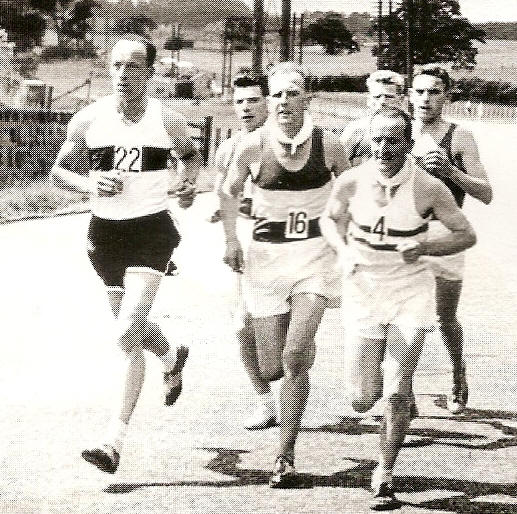
John Kerr (second from left, head showing between George King and Andy Fleming) in the 1957 SAAA Marathon.

John Millar Kerr, who between 1960 and 1962 won one gold medal and two silver medals in the Scottish Marathon Championships, ran for the Harriers in Airdrie, his birthplace in 1933.   He had been a cyclist and was known as ‘Jack’ to his fellow bikers although  his mother disapproved of the abbreviation.   Hugh Mitchell (Shettleston) twice a silver medallist (in 1964 and 1969) and a record breaker in the solo Edinburgh to Glasgow was another one of those cyclists and remembers that John had a low but very powerful running action.   Jackie Foster (who won a bronze medal in 1959) remembers him as ‘Johnny’ Kerr, and rather ‘fat’ for a runner,  probably weighing over eleven stones compared to the nine and a half of normal ‘scraggy’ competitors.   However his wonderfully positive attitude made him state that his extra weight was an advantage as he had something to lose, unlike ‘skinny rabbits’ like Jackie himself!   Johnny had a low shuffling stride and sweated profusely appearing to stretch his vest and nylon running shorts to the maximum.   When Jackie worried once about an apparently classy field of opponents, Johnny retorted “Nonsense.   They have just two legs each like you and I,” and went on to win.

One day the two of them were running in the Strathallan twenty miler on a red hot day with black bubbles of tar forming on the road.   They had broken away from the field at fifteen miles and Jackie was highly chuffed at still keeping up with Johnny and was looking forward to finishing second.   With about half a mile still to go, Jackie offered his rival one of the little refresher sweets he was carrying.   Johnny Kerr stopped still immediately and Jackie carried onto the track to win in two hours two minutes.   When Johynny did come on to the track a full five minutes later, he took off his peaked cap and jumped on it!   He told Jackie later that he could not believe him fresh enough to offer him sweets after such a gruelling run.   So, for once, Johnny’s strong self-confidence was broken – although Jackie never beat him again.

Johnny Kerr tended to race himself fit, starting in March.   By June 1956, running for Monkland Harriers, he had finished second in both the Dundee 13 and the Babcock and Wilcox 15 – and had joined the Scottish Marathon Club.   He raced frequently – up to 18 miles – and was a meritorious fifth in the Scottish Marathon Club overall championship that year.   In 1957, now representing Airdrie Harriers, he won the Springburn 12 on 25th May, defeating Hugo Fox, and a week later the Dundee Corporation 13.   However when he made his debut in the SAAA Marathon on 22nd June he found the extra distance hard and dropped back to finish eleventh in 2:20:56 (but inside the standard time of 2:55:00)    Undaunted he continued to race frequently and sheer consistency enabled him to win the SMC overall championship, pipping the first two in the SAAA Marathon,  Harry Fenion and Hugo Fox.   In 1958 he disappeared form the results sheets, perhaps because of injury.   However in 1959 he tried again finishing thi9rd in the Edinburgh to North Berwick 22.6 , before improving to fifth in the SAAA Marathon in a new personal best of 2:45:40, well inside the new 2:50 standard time.   On the 18th July he won the Kilwinning 10 in 52:25 beating Motherwell YMCA’s Tom Scott.A week later John was victorious in the Gourock Highland Games 14.   he finished fourth in the SMC overall championship for the McNamara Cup.

M2 JK 2

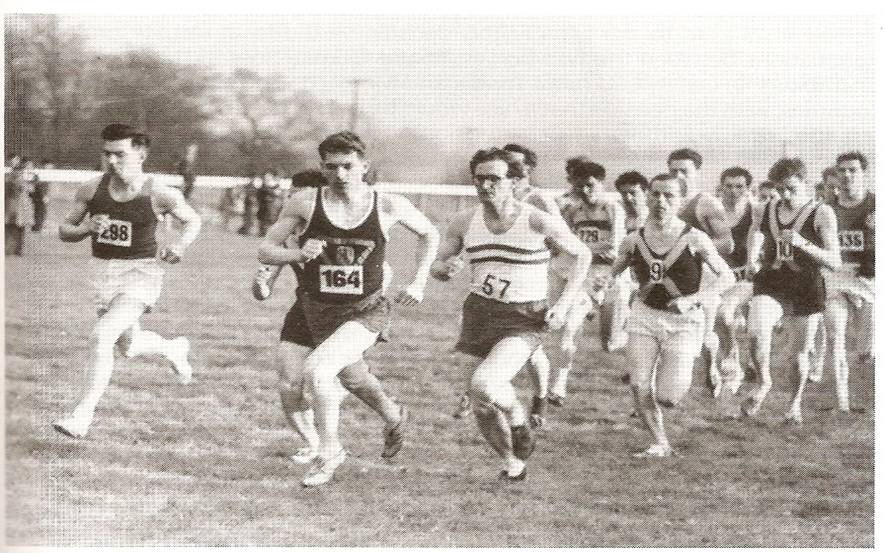
John Kerr (288), Andy Brown (164), Joe Connolly (9) in the National Cross Country at Hamilton

In 1960 he improved to second in the Edinburgh to North Berwick in May.   That year’s Scottish Marathon finishing at Old Meadowbank Stadium in Edinburgh, took place on another particularly hot, sunny day.   Gordon Eadie of Cambuslang Harriers, a durable athlete who represented Scotland in the International Cross Country Championships in 1961, broke the solo Edinburgh to Glasgow race, won another two marathon medals – silver in 1959 and 1966 – started cautiously and ran an even paced race, making steady progress and passing the leaders in the later miles to win convincingly in 2:36:40 from Johnny Kerr (2:40:55) and Charlie Fraser of Edinburgh Southern Harriers (2:41:26).

In 1961 John Kerr improved his fitness steadily when he was third in the Clydebank to Helensburgh 16.   June’s marathon route was Falkirk to Meadowbank and once again the weather was extremely warm.   Two weeks before the championship Bill McBrinn of Monkland Harriers (much later a world record holder for the M55 marathon) was second to Johnny Kerr in the Scottish Marathon Club 12 mile race.   On marathon day, 24th June, the press made Ian Harris favourite.   He ran for Beith and also the Parachute Regiment and had represented Scotland in the International Cross Country Championship that year.   Bill McBrinn however favoured John Kerr whose stamina was not in doubt since he had run ultras.   Four English runners had turned up, pooh-poohing the Scots’ chances and saying that they would all break 2:30.   The gun went and the favourites shot off.   Bill McBrinn ran steadily and drank water every five miles.   Hugh Mitchell was following the race on his bicycle and passed on information from the front of the race to Bill.   By Maybury Cross (20 miles) Bill was eleventh and shortly afterwards spotted two of the boastful Englishmen ‘lying on the road an another wrapped round a lamp-post!’   On Ferry Road Hugh shouted that Bill was up to seventh, by 24 miles he was fourth.   ‘They’re dropping like flies in the heat!’ shouted Hugh.   Just after that Bill could see Jimmy Garvie and Jim Brennan just in front of him.   They were staggering from side to side, trying to negotiate the long hill to Meadowbank.   This was all Bill needed to give him the will to run past them into second place.   Looking at a clock on a building, he saw it was four o;clock.   He knew that STV was covering the championships from that time so he ‘put on a bit of a face for the cameras’, and won a silver medal in his first marathon in 2:37:32.   The winner who had endured the heat and staved off the English challenge was John Kerr who recorded 2:36:06.   Bill wrote ‘two runners from the Monklands on the track at the same time and my son James (7) shouting me on from my Mum’s television!’   Third in 2:39:24 was EW Holmes of Burn Road Harriers, the sole surviving Englishman.    In July John recovered well to again win the Gourock 14, this time defeating Ian Harris of Beith Harriers. The official result sheet for themarathon is shown below

At the end of the 1961 season he was named Scottish Road Runner of the Year and awarded the Donald McNab Robertson Memorial Trophy.

Starting the 1962 season with another third place in the Clydebank to Helensburgh , John improved to second in the Edinburgh to North Berwick (behind Charlie Fraser of ESH)  and then on 26th May 1962, John M Kerr gave a hint of his true potential on a cooler day, when he recorded a fine 2:26:58 for second place in the Shettleston Marathon behind Andy Brown (2:25:58.)

When the Scottish marathon took place on 23rd June, 1962, a new course was devised although it did finish for the last time on the ash track of the so-called New Meadowbank Stadium in Edinburgh.   The race started outside the Stadium, went towards Dalkeith, worked its way back towards the coast through Cockenzie and so back into Edinburgh.   Although John Kerr did manage to revenge his earlier defeat by Andy Brown he had a new star to contend with – the illustrious Alastair Wood (Aberdeen AAC) who went on to be fourth in the European Marathon Championships in Belgrade that year.   Wood remembered the Scottish course as being very hilly with a headwind on the way back.   He battled with Andy Brown and John Kerr before breaking away at 18 miles.  Eventually a tired Alastair Wood broke the Championship record in 2:24:59.   Johnny Kerr of Airdrie Harriers was second, once again in the very good time of 2:26:58 and Charlie Fraser (ESH) was third in 2:30:05.    By the end of the season John Kerr had won the SMC overall championship easily in front of worthy opponents such as Andy Brown and Gordon Eadie.
In 1963 however John Kerr’s previous good form deserted him.   After his usual third place in the Clydebank to Helensburgh, he could only manage seventh, a disappointing 19 minutes behind Jim Alder in teh Edinburgh to North Berwick Road Race;  it seems likely that he retired from athletics soon after that to concentrate on coaching.   He was a Committee Member of the Scottish Marathon Club from 1963 to 1968.

Tragically John Kerr’s life was cut short on 22nd March, 1968 when he was only 34 years old.   He was a purification engineer on the River Clyde and, on a freezing winter’s day, he was taking samples near Bothwell Bridge when one of the ropes supporting the bosun’s chair snapped and suspended helplessly from the broken harness, he was immersed in icy water for at least half an hour.  The task was meant to be a two-man job but unfortunately his workmate had not arrived and John had decided to do the job on his own.   The fire brigade rescued him and he walked to the ambulance but died soon afterwards in Hairmyres Hospital from hypothermia and shock.   Jackie Foster wrote ‘A sad end for a really tough guy.’

The SMC AGM took place only five days later.   A wreath had been sent by the club to John’s funeral where many runners were present.   At the AGM a minute’s silence was observed and Dunky Wright, the President, was minuted as saying that John M Kerr had been a Senior Coach , a very able and willing worker, and in fact had been regarded as being the best young coach the SAAA had had in years .   “He was a very good friend.”

Johnny’s widow put up a memorial trophy which for many years went to the winner of the Airdrie 13.   Nowadays it is presented to the winner of the popular Monklands Half Marathon.

*****

As a young(ish) road runner myself in 1961 I followed the SAAA Marathon Championship from Falkirk to Edinburgh in Jimmy Scott’s minibus and it was a good race to watch with Ian Harris and John leading the field – Ian was said to be a PE Instructor in the Parachute regiment; he was said to run to work in the morning, do PE all day and run home again at night and in general he was built up as the favourite but he dropped out and John won. – He was a chunky figure and what is said above about him not looking like a marathon runner is on the mark.   His sheer white nylon shorts always seemed to be very tight and he had a stride length that was extremely short.    The older guys in the Marathon Club said that initially, when he first took up road running, he always went with the leaders and inevitably fell back as the race progresses.   However he went further with them every time out until he was with them all the way and eventually beating them.   It was a real shock when we read in the ‘Daily Record’ or ‘Evening Times’ of his death.   It saddened the whole road running community but he had been a great competitor, was well liked by all and his name is among the stars on the Donald McNab Robertson Trophy   – between Gordon Eadie and Alistair Wood.

Gordon Eadie

M2 GE 1

                                               Gordon heading for a record-breaking victory in the 1966 Edinburgh to Glasgow 45 miles

Gordon Eadie of Cambuslang Harriers (born 6th December 1934) won the Scottish Marathon Championship in 1960 having been second to Hugo Fox the year before.   He was far from a ‘one trick pony’ however with a long illustrious career that included excellent  racing on the road, over the country, on the track and in the hills.    Jackie Foster of Edinburgh Southern Harriers is quoted in Clyne and Youngson’s ‘A Hardy Race’ as being “one of nature’s true gentlemen, very modest and unassuming.”   I can corroborate that having met and raced against him – or rather behind him – in the late 1960’s and early 1970’s.

They go on in the book to say that he had “a very powerful build that made him look more like a boxer than a runner.   This may have been caused by his having worked as a coalman, perhaps having to carry many a hundredweight sack of coal up many four-storey Cambuslang tenements.   Rumour had it that Gordon worked one morning before a marathon!   Hugh Mitchell remembers that, if Gordon had been delivering coal on a Saturday morning, his form suffered.   Gordon himself makes no mention of such weight training but admits to having run 80 to 100 miles per week.   His longer runs were on the road (some including fartlek) and his easier efforts were over the country.  He wore a vest (with a jersey on top) and shorts.    Footwear was Adidas road shoes or a light pair of Fosters for racing.”

The first mention of Gordon Eadie in the Cambuslang Harriers history on their website is when he was a member of the team that was eleventh in the Edinburgh – Glasgow Relay and won the most meritorious medals – or rather ‘the medals for the most meritorious unplaced performance’.   Another member of that team was Andy Fleming who ran for Scotland in the International Cross Country International that year and they were key members of many a Cambuslang team for years to come.   In terms of the club championship Gordon won it for the first time in 1959.   It was also the year when he won his first marathon medal.

Back to ‘A Hardy Race’:   “In the 1959 Scottish Marathon Championship he remembers that the route was Falkirk to Meadowbank.    Hugo Fox, the holder and a good judge of pace, raced into an early lead from the start.   By half distance Hugo was several minutes in front; but by 20 miles, runners dropped away from the chasing pack and Gordon Eadie found himself alone in second and closing in on the leader.   However Gordon writes, ‘Hugo was one fox who wouldn’t be caught and finished on the track to win by over a minute.’   Hugo’s time was 2:28:57; Gordon was second in 2:30:00 and Jackie Foster third in 2:32:38.”

In 1960 he started the year by leading a Cambuslang team with Andy Fleming to win the silver medals in the inaugural Tom Scott Road Race.   His real triumph however was improving on his 1959 run and winning the SAAA Marathon Championship.   ‘A Hardy Breed’ again: “The 1960 Scottish Marathon, finishing once again at the Old Meadowbank Stadium, took place on a particularly hot, sunny day.   Gordon started cautiously and ran an even paced race, making steady progress and passing the leaders in the later miles to win convincingly in 2:36:40 from John Kerr (Airdrie Harriers) and Charlie Fraser (Edinburgh Southern)”.   He was awarded the Donald MacNab Robertson Trophy awarded by a committee consisting of three members of the Scottish Marathon Club and three members of the SAAA to the outstanding Scottish Road Runner of the year.  In the following cross country season (1960/61) he qualified for the Scottish International Cross country team where finished 50th to be counting member of the team.

Not content with running in the marathon he started on ultra distance running and in 1963 he won the Edinburgh – Glasgow 45 miles race and won by 37 minutes in a new course record of 4:51:17 on a day of rain plus a driving headwind.   (There is a detailed report of this race in the ‘Point to Point’ section of this website).   He won the event again in 1964.   Although he had to withdraw from the 1965 event, clubmate Andy Fleming won it.   He only had it for a year however because Gordon won it back again in 1966, taking ten minutes off his record time in the process.   He then went South of the Border where he won the Liverpool to Blackpool race which he won by 10 minutes.

There was another silver medal in the Scottish Marathon Championship in 1966 in a time of 2:28:18 and his club mate Andy Fleming was third in 2:32:47.    The race was run from Westerlands in Glasgow out to the Strathleven Estate in Vale of Leven and back up the Great Western Road Boulevard – the trail on which Ian Harris defeated Jim Alder in 1961.   On a warm afternoon the field included Charlie McAlinden (Babcock’s) who had originally been encouraged to run the marathon by Harry Fenion and who had won bronze in the Scottish Marathon in 1964 and been fifth in the AAA’s Championship in 1965.   Hugh Mitchell (Shettleston), Gordon and Andy Fleming from Cambuslang were there and Don Ritchie of Aberdeen was starting in his second marathon.   Hugh had been told that a 2:25 time would qualify the winner for the Jamaica marathon so he started out quite quickly accompanied by Charlie McAlinden with a small pack containing Gordon Eadie and Don Ritchie not far back.   At the halfway mark (Strathleven Estate) there was little change when they turned back to face the hills that had caused so much damage in 1961.   After keeping to a 2:23 pace, Hugh Mitchell had to drop back at 20 miles leaving Charlie on his own.   Charlie had an exra problem in that he did not drink at all on this hot day.   His friend Tony McManus (who also ran for Babcock’s) was meant to hand him a drink at 20 miles but that wasn’t allowed in the strict rules of the day – feeding points were at strict intervals and 20 miles wasn’t one of them!   At 24 miles – the point where Jim Alder was really suffering and passed by Ian Harris – Hugh Mitchell dropped out.   Gordon had started to make a real effort to catch the leader at about 20 miles and chased hard through 23 miles.   He moved into second behind Charlie McAlinden but the heat and the course was taking its toll and many were dropping out or dropping back.   Charlie found the energy to raise his game a bit in the last two miles to win in 2:26:31.

M2 GE 2

What a group of runners!   In front is Andy Fleming, number 13 is Willie Kelly and Number 1 is Gordon Eadie (all Cambuslang), number 2 is Charlie McAlinden (Babcocks), in the dark vest behind him is Brian Goodwin (Bellahouston Harriers), behind Kelly’s right shoulder is Bill Stoddard (Wellpark) and inside Eadie is Davie Simpson (Motherwell).   Picture probably taken at Gourock HG – does anyone know better?

Cross country internationalist, marathon champion and ultra distance record breaker, Gordon also had a go at the hills.   He ran the Ben Nevis race where he finished one place behind rival Ian Harris of Beith in fourth place – they were the only Scottish runners in the first ten, there were only three in the first fifteen because as well as the usual complement of Englishmen there were several teams of Gurkhas competing that year.   He had several good races with Harris – they were both in the International cross country team that year and they had crossed swords several times and Gordon had beaten Harris in the Strathallan 20 by four minutes to be second to Norman Ross of ESH with Harris third.

His career extended through the 1970’s and he was a member of many good and very good Cambuslang teams.   They returned to the Edinburgh to Glasgow in 1972 and finished twelfth and getting the most meritorious medals again.   In 1974 he again took part in the SAAA Marathon where he was fifth in 2:25:22 to be ranked tenth in Scotland.   (He had been twelfth in 1968 with 2:34:04,  fifteenth in 1969 with 2:31:07 and sixteenth in 1971 with 2:27:45).   He went on winning medals for the club as it improved from bronze to silver in the County and District championships  for the first time and the circle was completed when he again won the club Senior title in 1979 – 20 years after his first victory and after a quite remarkable athletics career.

Personal memories are of a cheery, friendly runner of great talent and courage.   No conceit – I have found that the really good runners never have any conceit and are sociable and helpful to others, it’s the ‘nearly good runners’ who tend to have the conceit – although he had more to be conceited about than most!   I even remember him running on the roads at Airdrie where the road race is a hard 13+ miles and returning to the stadium to turn out in the 5000 metres team race on cinders!    A wonderful man and a great credit to himself, his club and to Scotland.

Finally, a tale from Cambuslang Harriers about his training.    Apparently Gordon could not make the Sunday morning training runs so to accommodate him the other runners (Andy Fleming, Willie Kelly and others) agreed to do the run in the afternoon – they assumed that it had something to do with the physically demanding nature of his day job.   He always turned up in the afternoon and then they eventually found out what the problem was – he would go out for an 18 mile run in the morning, have a sleep then go out in the afternoon with the club!

There is much more about Gordon and Andy at the detailed history page at the Cambuslang website: www.cambuslangharriers.org/?=node/55


Ian Harris

M2 IH 1

Ian entering Westerlands at the end of the 1963 Marathon

Ian Harris won the SAAA Marathon Championship in 1963 and it came as a surprise to many in the Scottish athletics hierarchy.   And yet it shouldn’t have done because he had been a very good athlete for some time and had in fact run for Scotland in the cross country international in 1961.

Ian joined Beith Harriers as a Youth (ie Under 17) and his first training run was in a thunderstorm on a dark night.   Then on his first race at West Kilbride he tried to jump one of those Ayrshire barbed wire fences when he came off the road and cut himself badly but surprised everybody by coming in first.  Beith was a strong club at the time and he was a near contemporary of Tommy Cochrane who won the South West District  Cross Country Trophy so often that when the association folded up he was given the trophy to keep.   Incidentally his first Senior victory was in 1960, the year before Ian’s first win in the event.   Ian’s career included a victory in the South West District Cross Country Youth Championships in 1953 and victories in the Senior event in 1961 and 1963.    He had a third place in the Scottish Youth Cross Country Championships behind Peter McPartland (Springburn) and after finishing seventh in the SCCU Championships, ran for Scotland in the 1961 international cross country championships.   There are many tales of runners who have mishaps with two wheels – Mike Ryan had a motor bike that broke down on the way to the Ben Nevis, George White got a lift through to the start of his leg of the E-G on a motor bike that then knocked him down while he was running and Ian also had his tale of two wheels.   Team mate Tommy Cochrane tells of the time when he insisted on travelling through to the 1959 Edinburgh – Glasgow on his motor scooter.    He fell off it in the outskirts of Edinburgh on his way to the start of the second stage at Maybury Cross.   It is safe to say he ran a bit below par that day!

A track runner early in his career – middle distance races including the steeplechase –  the question is why did he take up marathon running?   One answer was in Alex Cameron’s column in the ‘Daily Record’  after he won the Gourock 14 mile road race in 1960:   “Twenty five year old Harris said: ‘I got fed up waiting for the mile at meetings.   It is always last and sometimes I was soaked before I even got started.   In this race you’re running for a good bit of time.   Next year I mean to go on to the marathon, this is only a build up for me'”   Well, that’s Alex Cameron but when I spoke to Ian he gave a lot of the credit to Tom Scott (of the Tom Scott Road Race).   At the New Cumnock Highland Games Tom was warming up for the road race and he remarked to Ian (who was getting ready for the mile to be held later at the meeting) that since he was training hard he should have a go at the marathon.   He was also encouraged by John Kerr who won the championship in 1963.    He also took part in a few hill races – he ran the Ben Nevis twice, Goatfell and Ben Lomond.   In the Goatfell he was second to Ian Donald by only seven seconds and then the following week he was second in the Ben Lomond race – again by seven seconds!

As was said above Ian started his road running career in the Gourock 14 Miles Road Race in 1960 immediately after an all night shift in his job as a baker. “Ian is a baker to trade.   Only the night before the Round-the-Cloch race he was on shift work.   When he came off duty Ian should have gone to bed.   Instead he decided to stay awake.   Few people at the Games realised Ian was running under such a self  imposed handicap.”   He won the race and it was after that that he was written up as a future marathon runner.  There was a group of very good and competitive road runners in Scotland at the time and his main rival was probably Gordon Eadie of Cambuslang who was second in the SAAA Marathon Championship in 1959 and winner in 1960.   True to his word Ian started running on the roads seriously in 1961.

In the 1961 season he had a series of very good runs that had made him favourite for the SAAA Marathon.      The year had started with a win in the local Beith New Year’s Day race where he beat Charlie Meldrum of St Modan’s and he went on to have a very good cross country season that led to him being selected to run for Scotland in the International Cross Country Championships.    The first race of the summer was the Scottish Marathon Club 10 Miles Track Race at Seedhill Park in Paisley.   It was a very close race with Ian finishing fourth in 54:42 behind the man who was to be one of his closest rivals, Gordon Eadie of Cambuslang Harriers, who won in 52:49, George Govan and Bob Wotherspoon both Shettleston Harriers in 54:18 and 54:34.    Next came the 16+ Miles of the Clydebank to Helensburgh Road Race which Ian won in 1:26:18 from Bobby Calderwood (VPAAC) in 1:27:28 and future marathon champion John Kerr of Airdrie.   On 6th May he ran in and won the Falkirk Invitation 12 mile road race in 71:01 from Bobby Calderwood in 71:14 and John Kerr in 73:10.   The distance was stepped up a bit on 13th May when he was third in the Edinburgh to North Berwick 22.6 miles road race in 2:14:09 – one second behind Jimmy Gibson of Maryhill and two minutes behind the winner, Terry Rooke of Middlesbrough.   The history of the Scottish Marathon Championships refers to Ian with “who ran well in hill races” and there is truth in it but it was not apparent on 3rd June when he was eighth in the Goatfell Race (2866 feet) in a poor 1:35:30.   A week later saw the SMC 12 Mile Road Race in Springburn and he was fourth again – this time behind John Kerr, Willie McBrinn and Jim Garvey of St Modan’s.     He started in the Babcock & Wilcox 14 Mile Road Race on 17th June and was forced to drop out.

M2 IH 2

The start of the 1961 marathon at Falkirk.   Ian is number 7, also in the picture are John Kerr, the winner, third from the left in white shorts, Willie McBrinn, second, walking across from left to right in all black and David Bowman, Clydesdale, among others.

The SAAA Marathon was held on 24th June and although ‘A Hardy Race’ by Clyne and Youngson reported that he was favourite all was clearly not well with Ian.   There had been three poor races – Goatfell, Springburn and Babcock’s did not augur well.   John Kerr won from Willie McBrinn and in 2:36:06 over a difficult trail from Falkirk to Edinburgh with ten runners dropping out including Jimmy Garvey, Terry Rooke – and Ian Harris.   He completed the season with a second place to John Kerr in the Gourock Highland Games 14 Mile Road Race.   The season had started so well ended in anti-climax.

Summer 1962 was not a good one.   After two races he disappeared off the Scottish Marathon Club radar and did not enter the SAAA Marathon.     And no wonder – he was by now in the Army and after a six month training he had joined the Paras and spent some time in Bahrein where he trained very hard.   The Para training is notoriously tough. I know that when I was doing National Service some of the others fancied themselves as hard men and applied for the transfer to the paratroops but they were all returned to the unit.   They didn’t have what it took.   Ian came back from Bahrein very fit early in 1963 and it showed in his summer season.

1963 started with a much better run in the Tom Scott 10 Miles when he was fifth in 50:36 – five minutes quicker than the previous year.   One week later he was back at the Clydebank to Helensburgh where he was seventh with Gordon Eadie, Andy Brown and John Kerr in the first three places.   The marathon championship was on 22nd June and over a very severe course indeed from Glasgow University’s Westerlands ground and held in conjunction with the SAAA Track & Field Championships.   Ian won the race by over six and a half minutes from Jim Alder but the impression given is that Alder lost it rather than Harris won it.   Judge for yourself, the splits for the race are in the table below.   What is it about warm weather marathons that make even seasoned, quality athletes get it wrong?   Jim Peters in Vancouver is the classic example and there are many others.    But Jim Alder was new to the event: he came to it with many good races to his credit that season including the English 20 Miles Championship.   But to drop his pace to about 6:40 per mile over the final six miles  is something that no one would have believed possible.   In this case it might have been the nature of the hills on the trail, or the length of the hills or even the gradients on some of them compounded by the weather.   But there it is!   And Ian Harris – also an experienced athlete but only having run one marathon before (in 1961 –  and he dropped out of that)  capitalised on it.   It was a course that went out from the University Sports Ground at Anniesland along the Great Western Road Boulevard which was basically flat and gently undulating as far as the outskirts of Clydebank but after the Kilbowie Road junction the hills start to kick in with a slight drop to the Auchentoshan Distillery before climbing to the hill above Gavinburn.   There is then a long down hill stretch to Old Kilpatrick followed by a fairly stiff climb and a long, long downhill run to the outskirts of Dumbarton, gently flat out to the Strathleven Industrial Estate before going back along the same road.   So the long, long downhill became a long, long uphill followed by a short drop and then the climb up to above Gavinburn, then the gentle climb up to Duntocher and back in to Glasgow along a road which had been undulating at the start suddenly developed hills.   For a marathon trail, there were many ‘graveyards’ which could spell disaster.   Ian Harris read the trail better and paced his race better.   The splits (Alder on left, Harris on right):

Distance Time Split Time Split
5 Miles 26:49 26:49 27:04 27:04
10 Miles 57:52 31:03 59:32 32:28
15 Miles 1:23:25 25:33 1:25:46 26:14
20 Miles 1:50:26 27:01 1:53:08 27:22
Finish 2:32:04 42:38 2:25:32 32:24

Alder says in his biography ‘Marathon and Chips’:    “There were several gradual but long uphill stretches on the way out … then the truth dawned!   I had a similar terrain to negotiate on the way home.”    Well, the reasonable man might ask, why didn’t he tailor his pace on the return journey accordingly?   The truth is that the marathon does funny things to your head (runners wanting to hit specific times at check points often write them on their hand or on a piece of paper pinned inside their shorts because thinking gets hard when you are out there), add the heat and the attitude at the time to drinking on the run, add the hills and add his inexperience and it would seem that there’s your reasons.   However Ian was also running his first marathon and he maybe did run it too cautiously early on but that was the better way to make a marathon debut in any conditions, in the prevailing weather on the day it was much better.   Proof?   The difference in the finishing time – all six and a half minutes of it – was built up over the final three miles or so.

Ian’s own memories of the race are the long hills and then being told that Alder was walking and when he caught him he ‘strolled’ past him.

Press coverage was excellent.   This is from the ‘Glasgow Herald’: “Discovery of the championships was undoubtedly 28 year old Ian Harris, Beith Harriers, a soldier serving with a parachute brigade in Aldershot.   He won the 26 miles marathon in two hours 25 minutes 32 seconds only half a minute outside the record.  A most commendable performance considering that it was his first attempt at the distance.   In addition to this his car broke down and he arrived only ten minutes before the line up.   For 22 miles he stayed behind the strongly fancied Anglo Scot Jim Alder who recently set up record time for twenty miles in England.   But Harris’s superb stamina enabled him to forge well ahead after 23 miles.   And he finished an easy winner to be garlanded with the laurel wreath.”

Beith Harriers Press Notes: “At the SAAA Championships held at Westerlands in Glasgow, Ian Harris of Beith won the marathon.   He is the first Beith Harrier to win an SAAA title.   Ian ran a splendid race.   He lay second to Jim Alder of Morpeth for most of the race.   At 20 miles he was two minutes down on Alder but came through strongly to pass Alder at about 24 miles and then went on to win the race by almost 7 minutes in a time of 2 hours 25 minutes 32 seconds.   This time was only 30 seconds outside the Scottish native record.   Our heartiest congratulations are due to Ian for this great win.”

The ‘Evening Times: “The marathon race went to Ian Harris (Beith) who was within one and a half miles of the finish when he took the lead from Anglo Scot Jim Alder to win in 2hr 25 min 32 sec – only half a minute outside the best-ever time for the distance.”

After a break his season restarted on 3rd August with the 20 Mile Road Race at the Strathallan Meeting when he was third.  The winner was Norman Ross of Edinburgh Southern in 1:51:18, Gordon Eadie was second in 1:52:32 and Ian was third in 1:56:07.   The first three had run together until the 15 mile point before Ross and Eadie surged away.   On 10th August he won the Aberfeldy 13 miler in 1:13:55 from Charlie McAlinden who would go on to win the SAAA Marathon in 1966.   The season ended with a remarkable run in the Ben Nevis Race when he was first Scotsman to finish when he crossed the finishing line in third place with Gordon Eadie one place behind.   There were only three Scots in the first fifteen, and six in the first 30.   The usual strong English contingent was there as was a large contingent from the Gurkhas.   Ian led the 1st Battalion of the Parachute Regiment to the first team award.

M2 IH 4

Ian, on the right, in his Army vest.

So what kind of training was he doing at the time?  Total mileage was about 120 miles a week, often more.   He would run the seven and a half miles to the barracks, do some training in the afternoon and then run back at the end of the day.   On a Sunday it was a long 15 to 20 miles run on his own and the week included plenty of fartlek.   he reckons that the country around Aldershot where he was based was very good for that type of session.   Again we have a marathon champion who is putting in many miles, doing speed training with a longer run at the weekend.   He must have been very talented but the volume of work speaks for itself.   Incidentally he is not in favour of runners training with their ipod or earphones on: your mind should be on what you are doing and where you are running.

What happened next?   Ian’s career continued mainly as an Army runner and as a member of Walton AAC when he was based in England with only occasional trips to Scotland such as 1964 when he won the South West District Championships at Greenock beating team mate Tommy Cochrane.   Incidentally the Committee at Beith Harriers must have had a bad case of the “If Only’s” at that time – Tommy Cochrane was doing terrific running at home but Ian and another Harrier Danny McFadzean, who was in the Royal Navy and one of the country’s very best marathon men at the time were only available occasionally.     There were also the many outstanding runs for Walton AC when he was at home in the Barracks at Aldershot such as the Chichester to Portsmouth 16 Miles Road Race when he was second in 1:24:27 to Dave Cooke of Portsmouth in a start studded field that included fellow Beith Harrier Danny McFadzean in tenth in 1:28:53.   An extract from the report in ‘Athletics Weekly’ says it all: “Over the last five miles Ian Harris put in a terrific effort and on entering the stadium at Alexandra Park  had pulled into third place, about 100 yards behind Dave Cooke who had a 40 yards lead on John Edwards.   Over the final 400 yards, Harris put in a super human effort and about 50 yards from the finish line caught John Edwards.   In the final run-in Harris just got the better of Edwards by one second and came within 7 seconds of  Dave Cooke who won with 1:24:20.   Harris’s last minute effort not only gained him second place but it also put paid to Portsmouth’s nineteenth attempt to win their own ‘Burtonia Team Trophy’, Walton getting the verdict on the position of their third scorer.”  

In 1964 he also won the Inter Services Marathon Championship and kept on running thereafter with racing almost weekly against the RAF and other Units.   The Paras team won the Army Cross Country Championships for nine consecutive years with Ian as a member of a very good squad.   He ended his serious running and racing career at the age of 36 but competed as a super vet in Germany where he did some running and racing again at the age of 47 for another five years and ran a 25K in a fast 1:30.     

And when I spoke to him in May 2010 and asked what race had given him most pleasure he said that it had been winning the Beith New Year’s Day Race back in the early 1960’s.

Alex Breckenridge

M2 AB 1

Alex Breckenridge winning the Junior National Cross-Country at Hamilton in 1953

When we all saw the 1960 Olympic Marathon on television or in the cinema with Abebe Bikila winning in the dark in Rome from Abdessalem Rhadi with Barry Magee finishing in third, we all thought, “I’d love to have been there, even to see it!”   Very few of us knew that a man who had run in the McAndrew Relays, the National at Hamilton and competed in his club’s Christmas Handicap was actually part of the field.    Alex Breckenridge, formerly of Victoria Park AAC, finished thirtieth in that, the most dramatic of all Olympic marathon races.    Like Paul Bannon and Mike Ryan, he was one that had got away.   Born in Buffalo, New York in America on 17th April, 1932, he had been brought up in Scotland but after a spell with VPAAC he went on a sports scholarship to the States returning for only one year before going back to the USA and joining the Marines.    He was one that we could ill afford to lose.    His career was so full both here in Scotland and in America that it is clearly impossible to cover it all.   This is only a hint at what was a wonderful athlete’s time in the sport.

There was an account of his introduction to the sport in the ‘Scots Athlete’ of June 1953 after he had won the Scottish Junior National cross-country championship and broken the national record for the Mile.   It read as follows:

“At last Scotland has a coterie of athletes taking the challenge of the ever-increasing standard of world athletics.   Whilst post-war athletics over the border and on the continent no less than other parts of the globe had an upsurge reflected in all-round brilliant performances, with the notable exception of high jumper Alan Paterson, home athletics remained in the doldrums.   With, as it were, Andrew Forbes as the harbinger and pointing the way, we now have a group: Eddie Bannon (Cross-country), Ian Binnie (3 and 6 miles), David Gracie (400 hurdles) and Alex Breckenridge (1 and 3 miles) reaching within the orbit of world ranking and recognition.   The latter, Alex Breckenridge the youngest of the group has jumped into major prominence only by virtue of his performances in recent weeks culminating (to date) in his great 4 mins 11.2 secs Mile at the Police Sports when finishing third but downing Dwyer (USA), Nankeville, Parker and Green (GB).   His progress merits our study.

The presentation here has a two-fold purpose.   Firstly as a tribute to the efforts of a most likeable, purposeful but modest athlete.   Secondly to inspire others to reach out to greater heights.   Perhaps this will be done by capturing the spirit of his drive and acknowledging the willingness for training work.   Like the vast majority he is a working fellow with no special privileges.   But he is imbued with a telling enthusiasm.   Like all true sportsmen, his approach is as open as a book, no ‘closed shop’ or secret training methods.   He is concerned to see our sport flourish.   What he can do, even by taking a completely  different road, you may better.   Only it can’t just be wished, you must try!  

His first real entry to the athletics arena was when he finished second to RC Calderwood (4 min 52) in 5 min 06 sec at Govan High School Sports in 1959.   A few weeks later he ran fourth (about 5 mins) in the Glasgow High Schools Mile to Fred Robertson (now Garscube) in 4 min 49 secs.   At this early stage, and as yet unattached, he was perhaps foretelling the characteristics that have featured his running recently.   This ambitious youth was not overawed by variety in distance.   His first open race was in Rangers Mile handicap (110 yards) and however unwise it may seem a fortnight later he entered and finished the Milngavie 10 miles road race.  

The cross-country season following he joined Victoria Park AAC.   He found cross-country racing hard going but was pleased at finishing  17th and last counting man in VP’s winning  team in the Scottish Youths Championship (1950).   With his training based on the lines followed by Andy Forbes, he became popularly known as ‘The Third Man’ in the track season reducing his handicap from 125 yards to 60 yards.   He had twelve places – ten thirds and two seconds.   Best mile time, 4 mins 39 secs.  

Cross-country 1950-51 saw him stepped with seniors in VP’s winning Midlands relay team.   He won his club’s junior and finished eighth, second team, in the National 7 Miles Cross-country.  

Track 1951, training four times a week – Tuesday, Thursday, Saturday and Sunday along the orthodox lines (schedule, time trials, etc).   He won a few handicap prizes and several two mile team prizes.   His mile time lowered to 4 min 31 sec but he failed to qualify for the mile final at the championships.   The following cross-country season he was out to do better.   He trained extra nights and extended his mileage.   But after all, he finished further back and he began to conclude that he was not meant to shine at the game though he could continue to be a useful team man.”  

Influenced largely by the work and results of clubmate Ian Binnie he changed to a completely new pattern of training in the 1952 track season.   He had just turned 20 years of age.   Orthodox set schedules of fixed distances and time trials, etc, were out and instead he concentrated on the more free ‘fast-slow’ or ‘winders’ principle: ie easy running interspersed with fast 150 yards bursts.   These ‘bursts’ are not actually sprints but more retaining distance form but very vigorous and as hard as one can go.   For no apparent reason his 2 mile form varied considerably this season.   His best was 9 min 39 sec.   With an uncomfortable 4 min 31 sec heat he qualified for the Scottish mile final and after his previous night’s struggle, he surprised himself by finishing 3rd in 4 min 23.7 sec.

Last season with a less strained programme than the previous winter he hit superb form to Christmas 1952.    A septic toe caused (foolishly he says) by tight sandshoes and the subsequent treatment caused him to be off a complete fortnight.   He never quite regained this early form though he did win the National Junior 7 Miles CC race and by ding so was selected and ran at Paris for Scotland in the 9 miles international Cross-country race.   He deduces from this that a fortnight is too long a ‘lie-off’ even with an injury and he would not do it again if the least avoidable.”

Now here is his full and amazing 1953 track performances to date (minus club competition which he enters and takes in his stride).   It includes 600 yards to a mountain race!   And, watch the progress.

2nd May – Kilsyth.   Half mile heat.   1st 2 mins off 20 yards.   2 miles   1st – 9 mins 40 secs.   Half Mile final, up to leaders but could not hold effort to tape.

5th May – Scotstoun – 3 miles scratch – 2nd. 14 mins 42 secs.

9th May – Vale of Leven – 2 miles.   1st 9 mins 25 secs.

16th May – Scotstoun – half mile, 2nd 1 min 57 secs of 20 yards; 1 mile 1st, 4 mins 19.5 secs off 25 yards.

23rd May – Bonnybridge – Open half mile, 2nd; Open mile 3rd and 600 yard relay leg.

25th May – Goatfell mountain race (approx 9 miles) 1st.   A stamina test and mental relaxation from track work.

30th May – Ibrox (Glasgow Highland Gathering) – Inv Mile – 1st, 4 mins 9.7 secs off 70 yards.

2nd June – Edinburgh L&C Sports – 2 mile scratch – 1 mile time 4 mins 40 secs, so took pace but Ottenheimer (Yugoslovia) held on and sprinted past the last furlong winning in 9 mins 11 secs.   AB’s time 9 min 15.2 secs.   Running coming much easier and intent to combine competition and training as best as possible.  

6th June – Shawfield – 2 miles scratch – 8 mins 43 secs but announced as 176 yards short.   Open Mile – 1st, 4 mins 18.6 secs off 5 yards

13th June – Ibrox – 1 mile scratch – 3rd – 4 mins 11.2 secs.   1 Mile Open  4 mins 17.4 secs.

15th June – Westerlands – 1 Mile scratch, 1st 4 mins 15.4 secs

17th June – Larkhall – 1 Mile Handicap, 2nd, 4 mins 17 secs (approx).

20th June – Helenvale – half mile – 1 min 56.6 secs.

Here is the outline of his present training programme:

Sunday Afternoon:  3 Miles made of half a mile jogs and 300 yards strides.

Monday:   Run from the house at 11:00 pm about 2 miles brisk stride.

Tuesday: 2 – 3 miles ‘Winders’.

Wednesday: Either as Monday or Tuesday.Thursday: As Tuesday probably including a 600 yard stride.

Friday: Easy 2 mile road run.

Saturday: i mile easy jogging as slow as desired before race.   Plenty of glucose.

Over and above he runs part of the way to work roughly 2 miles in the morning and to and from at lunchtime, fully clothed.   In winter this may mean with heavy coat and gloves!


His best year was undoubtedly 1953 and it may be worth filling in some of the gaps left by the comprehensive article above.  He had an exceptional run in the Edinburgh to Glasgow Relay in November 1952 when, with VPAAC having fastest times on stages 4, 5, 6, 7 and 8, he ran the last leg and set the fastest time by over a minute.   Incidentally it is interesting to note that he ran in four of these relays, won four team gold medals, ran fastest time on his stage three times with the exception being when he ran the second stage at the age of 17.   Back to 1953, starting the year with a win in the Beith Harriers New Year’s Day race he went on to win the Nigel Barge race – the classic organised every year by Maryhill Harriers and one won by everybody with any pretensions to endurance running class.   Nevertheless, John Emmet Farrell reckoned that his best run at the start was neither of those.   “Alex Breckenridge of Victoria Park has lately improved to such an extent that he has even stolen the thunder of his senior colleagues including the brilliant but erratic Binnie and the wonderfully consistent near veteran Andrew Forbes.   Recent successes include the annual Beith event, the Nigel Barge Road Race as well as club successes.   Possibly Alex’s best piece of running to date was in a confined club race – the Xmas handicap.   In dismal and far removed conditions to suit record breaking, he covered the well-tried ‘McAndrew’ road relay trail in 15 mins 11 secs.   When Eddie Bannon broke the course record for the same course on a good October day in 1951 with 15 mins 20 secs it was rightly considered superb running.   Form this we must assume that Breckenridge who is also a grand miler, is one of Scotland’s best ever track, road and cross-country prospects.   His display in the Midland Championships emphasised his favouritism to win the Junior title though I would add that the gap in class may not be quite as evident in cross-country as over track and road.”

The Midlands championship that is referred to was one where he finished second to Eddie Bannon of Shettleston  but came the National at Hamilton he was second to none as he won the Junior Championship by eight seconds from J Finlayson of Hamilton.   Victoria Park won the team race – and also the Senior team race!   As a result he was selected for the International cross-country  championship meeting at Vincennes where he was a counting runner for the Scottish team in twentieth place.   Emmet Farrell rated the run as follows: “Breckenridge ran steadily but without inspiration.  He started very slowly then went through the field, but faded towards the finish.   But this race was a grand experience for our youthful debutant who should be a useful asset for Scotland in the years to come.”  

The summer is fairly well covered above  but his best times of summer 1953 were  880y – 1:56.6 (number 4 in Scotland); Mile – 4:11.2 (number 1); 3 Miles – 14:25.3 (3); 6 Miles – 31:58.0 (2)

But the bombshell was to explode when, in the August September issue of the ‘Scots Athlete’ Emmet Farrell had this to say in his ‘Running Commentary’.   “Breckenridge, like John Joe Barry, born in the USA has accepted an athletics scholarship which will take him away for at least four years.”

There were also hints that he was interested in a military career but nothing was to happen on that front – yet.    He did indeed leave on an athletics scholarship to Villanova University where the head coach was the renowned Jumbo Elliott and he was to become part of the greatest ever University squad.   Just note some of the names in the picture below, not least Olympic 1500m champion Delany and world pole vault record holder Don Bragg.

M2 AB 2

Villanova team in 1957 with Ron Delany and Alex Breckenridge on either side of coach Jumbo Elliott., also in the picture are Ed Collymore and Don Bragg.

 One of Alex’s team mates was Irishman Ron Delany and he has an excellent article in ‘Sports Illustrated’ which can be accessed at http://sportsillustrated.cnn.com/vault/article/magazine/MAG1080757/index.htm .  In this article Ron describes arriving in America, being met at the airport and taken out to Philadelphia.    Comparisons with Scotstoun?   “The beauty of the campus – rolling green hills over which I was to jog for many a mile”      It is a long but very interesting article and since Delany was at Villanova from 1955 to 1959, then it would not have at all different for the Scot.   Comment is made on the American difficulties with the Irish brogue and the Scots burr!   There are several references to Alex in the article.   The team which peaked in 1957 with the NCAA Outdoor Track and Field Championship – three of them won Olympic gold and five represented their country in the Olympics and there is debate about whether it was the greatest track and field team in history.  Leaving Scotland after the wonderful 1953 season he clearly had a good winter – the US Collegiate system has cross-country a bit earlier than we do and follows up with indoor track before the outdoor season begins.   In an article of 6th May 1954 we read the following:  “Alec Breckenridge, the mile champion of Scotland, has been named the fifth starter in the Heptagonal Mile, May 15, at Soldier’s Field.   A freshman at Villanova, Breckenridge will join Fred Wilt, Horace Ashenfelter and Fred Dwyer in an attempt to defeat the 1500-meter Olympic champion Joey Barthel.   With Breckenridge added to the field Barthel may get the competition he needs to break the Soldier’s Field mark of 4:05.3.”

M2 AB 3

Alex Breckenridge leads Ron Delany

In inter-college athletics Alex was mentioned often as the man to beat in the Mile or Two Miles – eg Before one meet, The Harvard Crimson referred to ‘the favoured Alex Breckenridge in the two mile’ in 1956.   He took part in many events – when an attempt was made on the four minute mile in the Atlantic Boardwalk mile, he was asked to take the pace for the first half mile which he did, but he was feeling so good that he ran on and finished first which meant of course beating the pacer for the second half mile!    The sequel was just as amazing: Having won in 4:06.3, ahead of the Olympic champion Mal Whitfield, the organisers didn’t feel this was in keeping with the role of the pacemaker and awarded the trophy to the 3rd placed Whitfield (the other pacemaker finished 2nd)!

The Villanova distance squad was clearly to be feared – in April 1956 they won the Quantico Distance Medley Relay (“An indication of the quality of the entrants in this meet was the distance medley relay in which winners Villanova ran Charles Jenkins, Warner Heitman, Alex Breckenridge and Ron Delany”) and also the Penn Distance Medley Relay with Ed Collymore, Charles Jenkins, Alex Breckenridge and Ron Delany.   No doubt there were more but these will suffice as an indicator of the runners with whom he was ‘mixing it’.   He was now referred to in some reports as ‘Villanova’s ace.’   When they won the NCAAA Championships in 1957 Delany won the Mile but Breckenridge finished fourth in the Two Mile Run in 9:03.4, one place ahead of Leonard ‘Buddy’ Edelen (9:05.4) who would later go to England to improve his athletics!

Alex’s plaque at the Villanova Hall of Fame: put up in the lead in to the Rio Olympics 

Reported by the American Sports Reference website to be 5’9″ tall and weighing 143 lbs his affiliations were listed after leaving Villanova as US Marine Corps/Victoria Park AAC, Glasgow.   The VPAAC connection had not been forgotten and when his scholarship ended in 1957, he came home for a short spell.   In November that year he ran an excellent fifth stage of the E-G where he had fastest stage time by over a minute in the winning team but by now, his heart was in the States and the following year his times in the Scottish rankings are credited to ‘Alex Breckenridge, formerly of Victoria Park AAC.’

In 1959 he was US AAU Champion at both 15,000m and 30,000m and at the PanAm Games in the same year he was sixth in the 10000m   Marathon selections always cause some controversy if only because any one off race can be affected by unforeseen occurrences and the US selection for the 1960 marathon was no exception.   Apparently the selectors had said that two events would be taken into consideration, the Yonkers and the Boston Marathons, and the first three finishers in these races would be taken.   Two men, Alex Breckenridge and Gordon MacKenzie were clearly qualified by this rule but Johnny Kelley failed to finish the Boston race which meant that he was ineligible.   The East Coast elite were pushing for Kelley, most of the others were pushing for Robert Cons.   However it worked out, Alex was a certainty!   In the Yonkers Marathon, he was third in 2:32:41 and in Boston, sixth in 2:28:44.   The Olympics were held on 10th September 1960 in Rome and he finished thirtieth in 2:29:38.   One place ahead of him was Brian Kilby of Coventry Godiva and England, Watanaba of Japan was thirty second and the aging Alain Mimoun thirty fourth.   He was in good company.   It is difficult to find more information after that date but his personal best performances have been listed on the internet as follows.


Event Time Year
880y 1:56.6 1953
Mile 4:11.2 1953
Two Miles 8:56.8i 1960
5000m 14:32.1 1959
Three Miles 14:02.4 1953
10000m 30:47.0 1962
Six Miles 30:18.6 1959
Marathon 2:27:17 1962

Maybe a better indicator of his status was the number of times he was ranked among the top ten American athletes at the end of a season.   Being in the USA Top Ten once would be a remarkable achievement to do it as often as Alex did over a seven year period is a measure of consistently high performance.   Look at the table.


Year Event Time Ranking
1957 5000m 14:42.6 7th
  10000m 30:44.4 1st
1959 5000m 14:32.1 6th
  10000m 31:18.6 3rd
1960 10000m 30:54.5 10th
  Marathon 2:28:44 6th
1962 10000m 30:47.0 7th
  Marathon 2:27:17 2nd*
1963 Marathon 2:28:28 5th

* Top ranked was Leonard (Buddy) Edelen with 2:18:57.

If you want to see how he did in USA Track and Field Championships, then here it is.    Remember that these are placings in the finals of US Championships at a time when men like Jim Beatty, Bill Dellinger, Max Truex, Don Bowden and company were all running.    The last serious results that I can get for him in terms of rankings or championships are for 1963.

Year Event Placing Time
1957 Three Miles 6th 14:09.4
1959 10000m 4th 32:40.6
1960 Marathon 3rd 2:32:41
1961 Six Miles 7th 31:07.0
1962 Three Miles 8th 14:29.8
  Marathon 2nd 2:30:40
1963 Six Miles 8th 30:50.7
  Marathon 5th 2:37:47

If you want to do a search for his (or any other American) results in championships or rankings, then a good website is http://trackfield.brinkster.net/USAMain.asp?P=F where you can wander around results from before you were born up to the present day.

John Emmet Farrell lauded Alex Breckenridge to the skies, as did many another, as one of the brightest prospects for the future of Scottish athletics.    Unfortunately like several others (Mike Ryan and Paul Bannon spring immediately to mind) his undoubted talents were to be realised in colours other than the blue of Scotland.  The good news is that he is still involved in the sport.  The Marine Corps Marathon was founded in 1975 with the aim of promoting and spreading good will, especially after Vietnam  and would be starting at Arlington.   As soon as Alex heard about it, he was interested.   I quote from the Wikipedia article on the subject.   “With news of the inaugural marathon quickly spreading, Gunnery Sergeant Alex Breckenridge, a member of the 1960 Olympic marathon team soon lent his support.   With Gunnery Sergeant Breckenridge acting as ambassador for the marathon event, local jurisdictions approved of the event.”   Clearly a man with some influence, even fifteen years after Rome.    Jump to the present.   The picture below from October 2011 is labelled: “At the Santa Monica 5000: USATF Volunteer Alex Breckenridge talks with Olympic Trials qualifier Mandy Grantz.”    I think I’ve done enough to indicate the quality of athlete that Scotland lost when Alex Breckenridge returned to the land of his birth.

Alex was inducted to the US Marines Marathon Hall of Fame in 2016 and there he was introduced again to another US Olympian – the 10,000 metre gold medal winner Bobby Mills.   They were actually friends who reminisced enthusiasticall about the 1960’s and the running scene at that time.   Roger Robinson writes:  
I felt honored that Alex and  I had 3 important LOVE’s in common: Villanova University, United States Marine Corps, and Running.
Alex Breckinridge leadership and Olympic experience helped another Marine runner who was stationed at Marine Corps Base Quantico in 1961-1963 and who went on to the 1964 Olympic’s in Tokyo to win the Olympic Gold medal in the 10K – Billy Mills.

M2 AB 4

.


Jim Alder

M2 JA 1

Jim Alder is one of the most successful Scottish endurance runners ever.   In the Commonwealth Games in Jamaica Jim Alder was third in the 10000m  and then followed up with marathon gold after one of the most dramatic finishes imaginable.   Leading Jim Alder to the Stadium he found that the stewards outside the arena had gone inside to have a look at the Duke of Edinburgh and as a result he over ran the entrance, Bill Adcocks who was following went in the right entrance and was ahead of Jim.   Dunky Wright shouted to Jim and got him into the stadium while Bill was on the track and Jim managed to catch him and move off to win.  Dunky Wright’s version of the finish is reported in the Minutes of the Scottish Marathon Club: “Mr Wright referred to the great confusion at the finish of the marathon in Kingston and thought that he should give his views to the Committee.   The start was at 5:30 am and that was in confusion.   The course had earlier been marked off in 5-10-15-20 miles and at the finish.   Alder, who had already run in the Six Miles and finished well, was sure that he had a good chance in the marathon.   At 21 miles he was in the lead and and on reaching the stadium he was confused  as Prince Philip arrived at about the same time and there was a security check.   Alder turned in a door too soon  and down a flight of steps.   Wright stopped him and put him on the correct trail and he re-caught Adcocks on the track.   Officially Alder covered the correct trail and Adcocks cut the trail”

As with Joe McGhee in 1954, “As all members knew Jim Alder had won for Scotland in the Empire Games Marathon and this was the third time this event had been won by this country.   As soon as the news reached here a cablegram had been sent to Jim on behalf of the Committee advising him that his victory had made him an Honorary Life Member in company with the two other winners, Duncan Wright and Joe McGhee.”

Four years later he was then second in the next Commonwealth Games  Edinburgh in 1970 in one of the fastest marathon races in history.   However you can see Jim’s story below.   I will have a resume of his career, quote from another website and then speak a bit about his biography ‘Marathon and Chips’.

“Commonwealth Games: 1966, Kingston, Jamaica.    Marathon – 11th August:   For the first time a major Games was held in the Caribbean and Jamaica had the honour of staging them.   Due to the intense heat the marathon started at 5:30 am but already it was very hot and humid.   From 20 miles the British pair of Jim Alder (Sco) and Bill Adcocks (Eng) began to draw away from the field and on the approaches to the stadium Alder opened up a lead.   Having been mis-directed, Alder found himself to be behind Adcocks  on the stadium track but luckily had enough in reserve to regain the lead and deservedly take the gold medal.”

  1. Jim Alder (Sco)   2:22:07.8;   2.   Bill Adcocks (Eng)   2:22:13;   3.   Mike Ryan   (NZ)  2:27:59

“The International Games”   The full story is on a separate page titled ‘Jim in Jamaica’


Before we start a little resume of Jim’s racing career might be in order.

1966:   Commonwealth Games:  Marathon:  first    Six Miles:  third                        1970 Commonwealth Games: Marathon: second     1969:   European Games: Marathon:  third

He set World Records for 30,000 metres in 1964 and again in 1970; in 1964 he set a World best time for two hours and in 1970 set a British Record for the two hours.

He has held every British record from 10000 metres to the Marathon.

Domestically he won the AAA’s 10 Mile Championship in 1964, Marathon in 1967 and third in the AAA’s 10000 metres in 1968.   Between 1959 and 1980 he won the 3000 metres steeplechase, 5000 metres, 10000 metres, 20 Miles and Marathon.    In Scotland he won the Cross country Championship in 1961, 1969, 1970 and 1971 and also competed in the International Cross Country Championships in 1962, 1964, 1965, 1966, 1967, 1968, 1969, 1970, 1971 and 1972 (10 times in all).

And that’s just the major honours in his career!

As far as training is concerned he was a big mileage man.   He is quoted on the website www.runnerslife.co.uk as follows:

“I ran plenty of easy runs particularly the long Sunday run which consisted of 20 – 30 miles when I considered that time on your legs more important than how far you had run.   Easy runs to my mind are very important and I know that National Coaches in my day and even today refer to easy runs as ‘junk mileages’ but none of them have trained champion marathon runners!!!   I did two to three steady runs a week between March and September when in the morning I would do ten miles at between 51 and 54 minutes on an undulating course.   In comparison my best race time for 10 miles was 47:06.   As far as heart rate was concerned, all I can do is guess that it would have been around 150 – 160.   Who cares?   I was not flat out, it was simply a burn up and you have to be fit to do them without killing yourself.  

Because I worked as a bricklayer at a mental hospital 5 miles outside Morpeth my speed training was done on the roads and woodland  fields from April through to October (light nights).   The only time I was on the track was between 1964 and 1970 where I competed at least once a week including 1 x 400 metres race, 3 x 800 metres races, 3-4 x 1500 metres races and 2-3 x 2 Miles or 5000 metres races.   I never eased up for these races as I counted them as a , just a little breathless, no lasting pain or tiredness, and carried on with the hard training the next day.  

I only ever eased up for a couple of days before a major championships race.   An example of this was the 2 miles invitation race at the 1965 Gateshead Games, on ash not tartan, which I won in 8 minutes 45 seconds from Derek Ibbotson (World Record for the distance at that time was 8:32).   I had run 8 miles that morning and then worked as a bricklayer all day. 

My training changed and increased intensity from 1063 to 1969 from 100 mpw to 140 mpw (October through to March.   Then dropped to 100 – 110 mpw which seemed relatively like a piece of cake.  The week included fartlek sessions on Monday, Tuesday and Wednesday evenings over 10 or 12 miles on undulating roads  and two long runs of 15 – 17 miles.   The nearest track at that time was at Gateshead 18 miles away,  I could not drive and did not own a car until 1969.”  

This is only a small extract from a long first class article which is well written and contains real information.   I would urge you to read it in full but I will finish with a final quote from Jim:

“My view is that runners today do not race enough and they listen too much to their coaches.   They do not do Cross Country or short track races and only race to pay their bills.   Remember as I said none of us in the 1960’s had a coach and none of them, Radcliffe apart, do the mileage and hard work as we did.”

Some of my own comments written when I received copies of Jim’s biography and Ron Hill’s at the same time in late 1981, and printed in the SMC Magazine read as below.

When his biography – ‘Marathon and Chips’ by Arthur T Mckenzie – was published in 1981 it came out at the same time as the first part of Ron Hill’s story ‘The Long Hard Road’.   There were several differences but the main ones were that Jim’s life story was on sale at £1:95 for his entire life story while Ron’s was £12:50 for only half of his.   Ron’s was in hard back with lots of glossy pictures, Jim’s was paper back with eleven or twelve photographs.   These were the surface differences but Ron gave monthly mileage charts on an annual basis and at the end of the book were other details of his miles, races, training, etc while Jim did not give the readers this amount of useful detail.   Mind you, Ron gave us a lot of extraneous stuff that we weren’t basically interested in but I think that Jim sold his book too cheaply – and Ron had another – ‘To The Top And Beyond’ – out in time for Christmas the following year for another £12:50 or whatever.   Staying with Jim, his story is an inspirational read  with a lot of detail.   What follows are a couple of extracts from the penultimate chapter.


I will add to this one – I have said nothing about his major races yet.   Information so far has been collected from the internet, from Colin Shields’s history of the Scottish Cross Country Union ‘Whatever the Weather’, the centenary history of the SAAA by John Keddie, from the book “The International Games”  and from magazines such as the now defunct ‘Scotland’s Runner’ as well as the runnerslife website where the exact link for Jim is:   www.runnerslife.co.uk/Guest-Runners/Jim-Alder-MBE ..

“Training schedules are basically simple, these are basically as follows

WINTER:   Sunday 22 – 30 miles run.

                   Monday to Friday:   4.5 mile run to work in the morning and 12 miles run home at night.

                   Saturday:   Race (if a straightforward one he would run 4 miles in the morning)

SUMMER:   Sunday 22 – 30 miles run

                     Monday to Friday:   4.5 miles run to work in the morning  – but in the evening a separate schedule from the winter consisting of speed work at a different distance every day (see below)

                    Saturday: Race every distance from 400 yards upwards.

Monday to Friday Schedule:

Day One:   22 x 100 yards in 14 seconds with 15 seconds rest in between

Day Two:   Steady 12 Miles run through the woods

Day Three:   20 x 200 in 28 seconds with 200 yards in between.

Day Four: 3 Miles burn up on the roads (giving it the wellie!)

Day Five:  12 x 440 yards in 61 with half a mile jog recovery.

He would weigh himself daily and this remained constant, steady, at 9 stones 2 pounds.   Diet contained nothing fancy, anything edible and he still maintains an incredible diet.   Fluid intake was hefty and he would drink gallons of tea, on average thirty six spoonfuls of sugar every day. ”  

Jim Alder has been inducted into the Scottish Athletics Hall of Fame

Jim Alder – Marathon Career Record        

No Date Venue Position Time Winner (Club) Time
  1 22 June 1963 Glasgow (SAAA)         2 2:32:04 Ian Harris (Beith) 2:25:32
  2 30 March 1964 Beverley              5 2:23:12 Ron Hill (Bolton) 2:19:37
  3 13 June 1964 Windsor-Chiswick         4 2:17:46 Basil Heatley (Coventry Godiva) 2:13:55
  4 11 June 1966 Windsor-Chiswick         6 2:25:07 Graham Taylor (Cambridge) 2:19:04
  5 11 August 1966 Kingston (JAM-Comm)         1 2:22:08  
  6 02 October 1966 Kosice (SVK)         2 2:21:07 Gyula Toth (Hungary) 2:19:12
  7 26 August 1967 Nuneaton (AAA)         1 2:16:08  
  8 03 December 1967 Fukuoka (JAP)         5 2:14:45 Derek Clayton (Australia) 2:09:37 WR
  9 19 May 1968 Chemnitz (East Germany)         4 2:14:15 Bill Adcocks (Coventry Godiva) 2:15:32
10 27 July 1968 Cwmbran (AAA)         3 2:16:37 Tim Johnston (Portsmouth) 2:15:26
11 20 October 1968 Mexico City (Olympics)    DNF   Mamo Wolde (Ethiopia) 2:20:27
12 30 May 1969 Antwerp (BEL- ?distance)         3 2:16:35 Derek Clayton (Australia) 2:08:34
13 20 July 1969 Manchester Maxol         3 2:18:18 Ron Hill (Bolton) 2:13:42
14 21 September 1969 Athens (GRE – Euro)                                         3 2:19:06 Ron Hill (Great Britain) 2:16:48
15 16 May 1970 Edinburgh (SAAA)         1 2:17:11  
16 23 July 1970 Edinburgh (Comm)         2 2:12:04 Ron Hill (England) 2:09:28
17 13 June 1971 Manchester Maxol         6 2:15:43 Ron Hill (Bolton) 2:12:39
18 04 June 1972 Manchester Maxol    DNF   Lutz Philipp (West Germany) 2:12:50
19 05 November 1972 Blyth         1 2:19:04  
20 18 August 1973 Windsor       11 2:29:50 Bob Sercombe (Newport) 2:19:48
21 01 September 1973 Enschede (NED)         3 2:20:42 Ron Hill (Bolton) 2:18:07
22 27 October 1973 Harlow (AAA)    DNF   Ian Thompson (Luton) 2:12:40
23 15 June 1974 Chiswick       10 2:24:12 Akio Usami (Japan) 2:15:16
24 16 September 1979 Aberdeen       15 2:43:45 Graham Laing (Aberdeen) 2:21:40
25 18 October 1981 Manchester         8 2:24:32 Steve Kenyon (Salford) 2:11:54