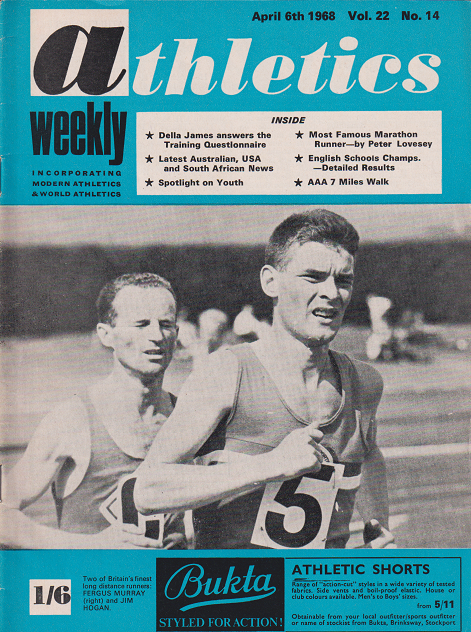
Fergus Murray

Fergus

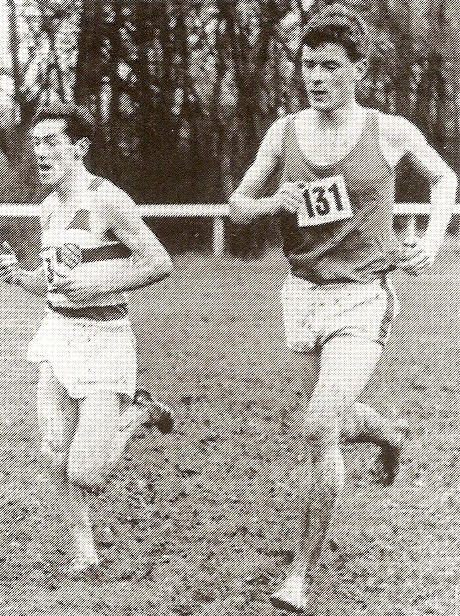
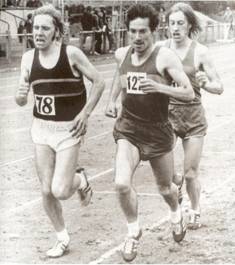
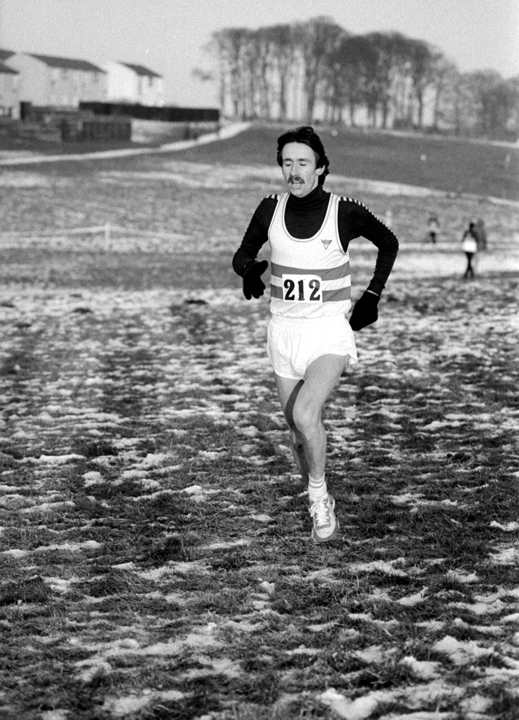
Fergus (131) with Lachie Stewart in the National at Hamilton

“Scottish Athletics”, by John W. Keddie, was the official history of the SAAA in time for the centenary in 1983. Fergus Murray features prominently in the following extracts. He actually started running with Dundee Hawkhill Harriers in 1960, encouraged by the enthusiasm shown by Alistair Barrie. While at Dundee High School, he won the Scottish Schools mile in 1961, in 4 minutes 27.1 seconds.

“In 1963 a promising young distance runner emerged in Edinburgh University student Alistair Fergus Murray (born in Dundee on 11th September, 1942). Early that year he won the Scottish Junior cross-country championship. On the track he won the East of Scotland (14minutes 7.6 seconds) and SAAA (14.1.6) 3 mile titles, before giving a glimpse of his potential with a marvellous 13.32.6 clocking in placing 4th in the annual BUSF (British Universities Sports Federation) versus AAA versus Combined Services Triangular at Portsmouth on 20th July.

The following season in 1964, after winning the first of three successive Scottish Senior cross-country titles, he retained his SAAA 3 mile title (13.47.8) and really made a breakthrough at the AAA championships by placing 5th in the three miles with 13.29.2 – the best ever by a Scot. It was as a result of this performance that eleven days later – on 22nd July, at Helsinki – he was called in as a last-minute replacement for injured Mike Wiggs in the GB versus Finland contest 5000m. To his own surprise as much as anyone else’s he won the race decisively from Bruce Tulloh in a superb 13.49.0, fourth fastest ever by a UK athlete at that time. These performances, together with some fine runs over 6 miles/10,000m, clinched his selection for the 10,000m at the Tokyo Olympics later that year.”

“It was over 10 miles on the track that Fergus Murray first showed his real potential as a long distance runner of class. In April 1964 he placed second in the AAA championships, in which he was pulled to a marvellous 48.41 (29.33.8 at 10,000m) behind Mel Batty, whose 47.26.8 constituted a world record. That performance augured well for the young Edinburgh University student in Olympic year. His attention was mainly focused on 3 miles/5000m, but after his ten miles effort he was selected for the 10,000m at Tokyo in October, and this decision was justified by his fine run for Britain versus Poland on his 22nd birthday (11th September, when he was second in 29.10.4). Unfortunately a heavy cold prevented him running to his full potential in Tokyo and he could only finish 22nd(30.22.4).”

“In May 1965, in perfect conditions for distance running, Fergus Murray treated an enthusiastic Edinburgh crowd at the East of Scotland championships to a marvellous exhibition of solo running over three miles at New Meadowbank, when he broke the Scottish All-Comers’ and Native records with a magnificent 13.25.4 (intermediate mile times of 4.24, 4.28 and 4.33). But even this was eclipsed by his run in an amazing AAA event on 10th July, in which the great Australian Ron Clarke became the first man to run the distance in under 13 minutes with a time of 12.52.4. In sixth place, Fergus Murray recorded a personal best time of 13.21.2; and exactly four weeks later, in the Triangular at Portsmouth, excelled even his AAA performance with a fine win in 13.19.0, ever to remain his best for the distance. Perhaps his best individual performance, however, was a third place in the 5000m at the Universiade in Budapest in August 1965, with 13.52.6. Murray, who trained very hard on a high mileage” had a cartilage removed in August 1966, which resulted in a temporary set-back but at Oxford University thereafter, Murray had a very successful season.

“Fergus Murray developed into a fine marathon runner. Less than a year after Jim Alder had become the first Scot to break the 2.20 mark with 2.17.46 for third in the AAA marathon, 1965 witnessed the first sub 2.20 marathon in Scotland when in the Shettleston Marathon on 15th May, Fergus Murray, who was making his debut at the classic distance, won in 2.18.30 from Alastair Wood (2.19.03).”    After graduating from Edinburgh University with a BSc in science and spending a year doing post-graduate work, Fergus completed a Dip Ed at Oxford University during 1966-67. The O.U. cross-country and track ‘Blues’ teams would have been delighted to recruit such a talented athlete. Alistair Blamire remembers Fergus coming to watch Edinburgh University win the BUSF cross-country team prize at Parliament Hill Fields in 1967. Fergus was wearing a felt trilby hat – very Oxbridge, Alistair thought!

“In 1967, Fergus Murray had a good season over the longer distances. Early in the year he again placed second in the AAA 10 miles, this time to Dr Ron Hill (Bolton United Harriers). Murray’s superb time of 47.45.2 – 6.6 seconds behind Hill – was the fastest by a Scot. Later in the year he reduced his best six mile time to 27.42.96 when placing 6th in the AAA race.”   “In 1967 Fergus Murray (Oxford University AC) won the famous Polytechnic Marathon from Windsor to Chiswick in 2.19.06.”   During the week following this long but apparently not exhausting race, he won the 2 miles for Oxford/Cambridge v Harvard/Yale at the White City in 8.44.0; came 4th in a 2 miles in Reading in 8.38.8; and won the BUSF 6 miles on the Saturday in 28.38.2!

“The 1970 Scottish Marathon Championship was a very exciting race over the course for the Edinburgh Commonwealth Games. On the 6th of June no fewer than six athletes (five Scots) clocked under 2.20 – certainly the greatest in-depth marathon in Scotland up till then. In the end Jim Alder (2.17.11) won by a mere three seconds from Donald Macgregor, with Fergus Murray third (2.18.25), England’s Barry Wood fourth, Alastair Wood fifth (2.19.17) and Alastair Johnston (Victoria Park AC) sixth in 2.19.31.”

“The three Scottish representatives ran wonderfully well in the Commonwealth Games marathon, in which they all set personal bests. England’s Ron Hill won as he pleased, in a brilliant 2.09.28, with Jim Alder second in 2.12.04. Fergus Murray (2.15.32) finished 7th, one place in front of Donald Macgregor (2.16.53).”   That is the SAAA version, summing up Fergus’s running career. Track omissions include: another win (13.46) in the 1966 SAAA 3 miles; first places in the SAAA 6 miles in 1964 (29.05.2) and 1965 (28.33.4); and a gold medal in the very first SAAA 10,000m (29.34.2) in 1969.

For more detail on Fergus Murray’s cross-country successes, the best source is Colin Shields’ Centenary History of the SCCU, published in 1990. Selected extracts are below. (All Fergus’s Scottish CC titles were won at Hamilton Park Racecourse, where in 1966 he raced in bare feet to defeat Lachie Stewart!)   “On 23rd February 1963, Fergus Murray, a first year student at Edinburgh University, who had previously won the Nigel Barge road race, won the Junior title as he liked – winning by over a minute from Mike Ryan (St Modans, who won Olympic bronze for New Zealand in 1968), with Alec Brown third and Lachie Stewart (who won gold in the 1970 Commonwealth Games 10,000m) fourth. Murray led Edinburgh University to the Junior team title, the first of three consecutive Junior team wins (1963-65) and 3 Senior team wins (1966-68) in a six year period when Edinburgh University runners dominated Scottish cross country and road running with a staggering series of wins thanks to punishing training schedules that developed talent to its fullest potential.”

“In 1964, Fergus Murray, after winning the British Universities championship in Nottingham (in a dead heat with Mike Turner) and finishing a close third in the Martini International 6 mile race at Brussels, behind Gaston Roelants (International CC champion) and Derek Graham (Northern Ireland), lined up with confidence for the National Senior championship race, representing Dundee Hawkhill Harriers. Racing over a heavy 7 and a half mile of racecourse turf, Murray trounced three former National champions. His great strength and speed proved decisive, giving him a 39 second margin of victory over Jim Alder, with Alastair Wood third, a further 22 seconds behind, but 4 seconds in front of Andy Brown.”   “Murray retained his National CC title in 1965 with a solo run. In an unrelenting mood, Murray set off at a gallop from the start, and by two miles had opened up a gap from the following group of Andy Brown, Lachie Stewart and Jim Alder. Alder set off in pursuit of the leader at 3 miles but made no impression on the flying Murray, who eventually won by 24 seconds from Alder, with Stewart a further 11 seconds behind and Brown fourth.”

“In 1966, Murray and his Edinburgh University team-mates were in impressive form at the National CC championships at Hamilton Racecourse, where the trail was now, of necessity, confined to the actual race track inside the boundaries of the ground, with no entry to the rough country by the riverside. Murray, Stewart and John Linaker (Pitreavie) ran together for 4 miles, but then Murray turned on the pressure, increasing his pace to find little reaction from his rivals. He established a lead and, with an impressive display of stamina on a heavy, muddy course, proved he was at his best when running on his own. He won by 70 yards from Stewart, the Inter-Counties winner, with Jim Alder making a late run for the tape, which took him into third position, ahead of John Linaker. Edinburgh University packed their six men into the first twenty-one home, to win the National Team Championship for the very first time. Such was the enormous margin of their victory that they had their entire team home before runners-up Victoria Park had their first man, who finished in 22nd position. This outstanding performance allowed the students to record a 109 points margin of victory – the largest ever recorded in the history of the event.

Fergus Murray’s third triumph in a row was only the fifth time that an athlete had achieved this success in the 81-year history of the championships.”

Although Fergus ran for Scotland in the International CC Championships four times (1964, 65, 66 and 69), Colin Shields suggests that he tended not to run to his full potential in the event. His best run was in 1969 (after finishing second in the Scottish National) when Fergus did very well (23rd) in front of a home crowd over a hilly, testing course at Dalmuir Park, Clydebank. Ian McCafferty was a brilliant 3rd, Lachie Stewart was 20th, and the Scottish team ended up a good 5th from the 13 nations taking part. Alistair Blamire reckons that Fergus did very well that day since there weren’t any hurdles, unlike in previous international cross-country championships.

Even after Fergus Murray’s peak, he continued to produce good team performances in the National CC. He was in ESH teams that won gold in 1969 and 1970; silver in 1971 and 1976; and bronze in 1973.

On the roads, Fergus was first of all an inspiration to his University team-mates; and later on a thoroughly reliable senior athlete in championship races. This is best exemplified if one examines his record in the Edinburgh to Glasgow Relay.

In 1963 he was fastest on Stage Two, traditionally reserved for speedy track men. In 1964 he repeated this performance and EU finished second. 1965 saw EU’s outstanding record-breaking 3.36.32 victory, with Fergus’s 31.07 record on Stage Six the finest individual performance of the day. Edinburgh University went on to win again in 1966 and 1967, without their leader but undoubtedly benefiting from the training regime he had set in place.

Fergus started 1968 in fine form, winning the renowned  Morpeth to Newcastle road race on New Year’s day, by forty yards from local hero Jim Alder. Later that year, after his marriage, Fergus retired for six months from racing. However he was fit again by late 1969, when Edinburgh Southern Harriers won the E to G, with Fergus (second fastest) battling to hold off Shettleston’s Lachie Stewart on Stage 6, before the last two ESH runners moved well clear. 1970’s race ended up with silver for ESH, with Fergus only one second behind National CC champion Dick Wedlock’s fastest time on Stage 2. Bronze team medals were won in 1971 and 1972, before ESH won again in 1973, with Fergus fastest, this time on Stage 4. In 1975 he ran Stage 7 during his team’s excellent new record victory (3.33.52). 1975 also featured one of Edinburgh Southern Harriers’ greatest performances: a silver medal in the AAA 12 stage relay and Fergus played his part well. Not far in front were Brendan Foster’s Gateshead Harriers and not far behind another great club, Coventry Godiva Harriers. No Scottish club has ever done as well as the 1975 ESH team in this extremely prestigious event.

Even when Fergus Murray was working at Fettes College, training was still hard and extensive, but time to relax and retain mental energy as in student days, was no longer an available luxury. Yet a final team gold in the E to G was won in 1977, when he ran Stage One for ESH. Although Fettes College was very supportive, the demands of teaching at a boarding school were more testing than the relatively carefree days of university. These were the days before professional athletics. Fergus would not have wished it otherwise, since that era gave a lot of joy and created lifelong friendships.

His marathon career was brief but very successful, starting with victories in the Shettleston Marathon (2.18.30 in 1965) and the Polytechnic Marathon (2.19.06 in 1967). However Fergus really concentrated on the event during the 1970 Edinburgh Commonwealth Games year. At five days notice, he travelled to Japan and on the 8th of February finished second (2.18.04) in a top-class international field in the Kyoto Marathon. On May 16th he qualified for the Scottish CG team fairly comfortably (third in the SAAA marathon in 2.18.25); and he peaked extremely well to break his personal best for seventh place (2.15.32) in the wonderful Commonwealth Games marathon on 23rd July. Fergus also ran the classic Marathon to Athens event in April 1971, finishing 4th in 2.25.04, with Don Macgregor 5th, over an extremely hard course.

Fergus retired from teaching in 1995 and put his running fitness to good use, instructing and guiding mountaineering and climbing in the UK and Europe, finally retiring in 2007, depressed about a series of multiple shoulder dislocations. He still enjoys running enough to keep fit and possesses a set of bound copies of ‘Athletics Weekly’ (from July 1960 to December 1974), which thoroughly document the era when he raced so successfully.

Perhaps the most fascinating aspect of Fergus Murray’s outstanding athletic career was his influence on other runners, especially through his residence at ‘The Zoo’.

For his first two years at Edinburgh, Fergus shared a room in a flat in Mayfield Terrace with Chris Elson, run by very kindly landladies, Molly and Ena Cameron. Chris came from Rotherham AC and brought with him inspiring ideas about training, from club-mate Alan Simpson, a brave and whole-hearted athlete who went on to finish 4th, only one-tenth of a second from a medal, in the 1964 Olympic 1500m. Simpson also set a UK mile record of 4.55.7. These training ideas made a great impression on the Edinburgh University team, leading to their years of ascendancy in the 1960s. Professor Neil Campbell, who in his youth as an EU quarter-miler had often competed against the great Eric Liddell, was a great supporter of the club for many years, both before and after the 1960s. Sunday mornings saw a group meet up outside the Geology Department. They stripped off their tracksuits and left for a 21 mile run through the Pentlands – no worry in those days of kit being stolen.

Alistair Matson, studying Law, was instrumental in arranging the large house at 27 Morningside Drive, in October 1965, where 6 runners lived for the next 3 years until the property was sold. At one time or another, runners living there included Fergus Murray, Alistair Matson, John Meldrum, Brian Covell, Dave Logue, John Bryant and Alex Wight, whose brother Jim lived nearby as well. Others, such as Donald Macgregor, Alistair Blamire and Gareth Bryan-Jones, came along in time for the long Sunday run or a series of faster sessions including repetitions and fartlek. On the kitchen wall was a chart recording the inhabitants’ weekly mileage and woe betide anyone slipping, on pain of being sent out to get in a few more miles! (Alastair Blamire remembers that John Meldrum, who was a medical student and more of a recreational runner, didn’t train anything like as hard as the others. The idea was for ‘The Zoo’ to train 600 miles each week. One Saturday night, John came back at 11.30 p.m. from a night out, and wrote only 15 miles in his slot, bringing the grand total to 597 miles. Poor John was immediately ordered out on the road by some fanatic who had stayed in, to rest for the Sunday 21! There is another story about Alex Wight, a very promising marathon runner, having been on a course one week. Unable to train as much as he wanted, he came back one Saturday night and went out for a 15 mile-run! History does not relate which week these miles counted in….)

Studies were not neglected, however, as everyone graduated, with some going on to professorships or substantial roles in business. So strong did the Edinburgh Hare and Hounds club (The Haries) become, that on at least one occasion at the Scottish Universities cross-country championship, they had all the first team athletes home before the first runner from another university; plus seven out of the first eight in the ‘B’ team race! A real highlight came in February 1966, when they won the Hyde Park Relay, which was a highly prestigious race for university teams in the UK. They went on to retain it for the next two years.

Alistair Blamire recalls that Fergus always did the Sunday 21 and also followed the ideas of the great coach Arthur Lydiard. On one occasion, Alastair bumped into Fergus one Wednesday, and he was already up to 75 miles that week. However, he could be secretive about some of his training, not so much with his club-mates, but with rival runners elsewhere, just in case Andy Brown or Ian McCafferty or Lachie Stewart got wind of what he was up to. Alastair got a terrible telling-off when he spilt the beans to (Shettleston runner) Henry Morrison on one occasion.

Certain EU runners had nicknames: Martin Craven was ‘the Crab’; Chris Elson ‘the Bear’; Alistair Matson ‘the Bomb’; Roger Young ‘Bodger’. However Fergus was always ‘the Beast’, presumably because of his ferocious appetite for hard, hundred-mile training weeks. He was the role model; and his dedication and great achievements were emulated by a succession of extremely good Scottish distance runners. If only ‘The Zoo’ could be cloned in every Scottish city nowadays!

His old friend, rival and training companion, Donald Macgregor, remembers that Fergus in his dominant early prime “was very determined and stood no nonsense from others. For example, once when Sandy Cameron opened up a lead on the Sunday run, Fergus called to him “See you back at the house”, which had the effect of stopping Sandy in his tracks. If you were due to train with him, and wanted to call off, you had to let him know beforehand or you were in trouble! He trained very, very hard and was outstandingly consistent, especially on track or road.”

Alistair Blamire was a very fine athlete himself, who certainly considers Fergus Murray as a major influence. Alistair was twice a close second in the Scottish Senior cross-country championships; and in 1971, he finished 11th and first counter in the marvellous Shettleston Harriers team that shocked the Sassenachs, when they won the English National! He represented Scotland in the ICCU Championship once as a Junior and four times as a Senior; plus once in the IAAF World Cross-Country Championships. On the track he specialised in the 3000m Steeplechase, winning the Scottish title in 1972, setting a Scottish Native record, and representing GB, with a personal best of 8.41.4.

Alistair Blamire remembers that he was a keen follower of athletics while still at school, so Fergus was “a bit (I underestimate) of a hero before I met him. Imagine my ‘Fresher’ excitement when he stopped to talk to me when he was out for a run one day! It wasn’t a coincidence that Edinburgh University had the successes they had when he was there, and for several years after. He was truly ‘The Beast’ when it came to training, but everyone found their own level, based on mileage and fartlek. When he was captain of the ‘Haries’ he produced a wee booklet about training, diet, kit etc – all very innovative. I tried the same thing when I was captain a few years later, and was accused by some so-called runners of forcing them to train too hard! I trained with Fergus once a week later on, and they were always the hardest session I ever did, even though he was probably a little past his peak by then. These sessions were too hard really, but on has one’s pride. For example, at his house, Fergus provided a lunch of tinned stew and potatoes (no veg.); and then insisted on a brutally-tough ten mile run round the Braid Hills! I always felt that Fergus had an, almost mocking, edge over me, and it was a great relief when he wasn’t in the mood from time to time, and I could go at my own pace (while pretending to run as hard as usual).”

In conclusion, Fergus remembers the 1960s as giving great enjoyment, and considers that EU training sessions, while hard were not competitive, with in-built sensitivity to the likelihood that club-mates could well be tired from a session earlier that day or the day before. Fergus’s three summers with Ilford AC greatly helped track performances. He stayed with the parents of Dennis Plater, who also went on to represent GB at the marathon. Work at Fettes did not impinge too much on training but the freedom offered earlier was a thing of the past. The mental effort of hard training, and the realisation that a peak had been reached by the early 1970s, concluded in his development of a wider life-style. Running continued, but a developing enthusiasm for climbing and mountaineering fitted in with absorbing work at a boarding school. This offered a great deal of enjoyment, without the rigours of a demanding training schedule.

Fergus thinks that the highlights included travel, when this was not commonplace, to: Eastern Bloc countries; Japan (3 times); Puerto Rico; Jamaica; Canada; and all Western European countries. Friends from those days were very important and there was never any animosity. They have all stayed in touch and meet up from time to time. The club system then was very strong indeed, and Fergus wonders about the modern era of professionalism. Back then, they never looked upon running as a career, and while having a professional running career nowadays may be okay for an extremely small, very successful number of athletes, he believes that others ought to develop a working career for proper fulfilment.

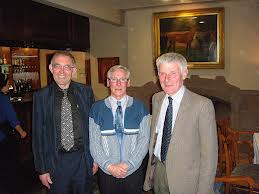
Three Olympians

Three Olympians: Don Macgregor, Lachie Stewart and Fergus Murray at a reunion in April 2012

Fergus Murray – Marathon Career Record

No Date Venue Position Time Winner (Club) Time
  1 15 May 1965 Shettleston         1 2:18:30  
  2 10 June 1967 Windsor – Chiswick         1 2:19:06  
  3 08 February 1970 Kyoto (JAP)         2 2:18:04 Kokichi Uchino (Japan) 2:16:55
  4 16 May 1970 Edinburgh (SAAA)         3 2:18:25 Jim Alder (Morpeth) 2:17:11
  5 23 July 1970 Edinburgh (Comm)         7 2:15:32 Ron Hill (England) 2:09:28
  6 23 August 1970 Toronto (CAN)    DNF   Jack Foster (New Zealand) 2:16:23
  7 06 April 1971 Athens (GRE)         4 2:25:05 Akio Usami (Japan) 2:19:25


Andy Robertson

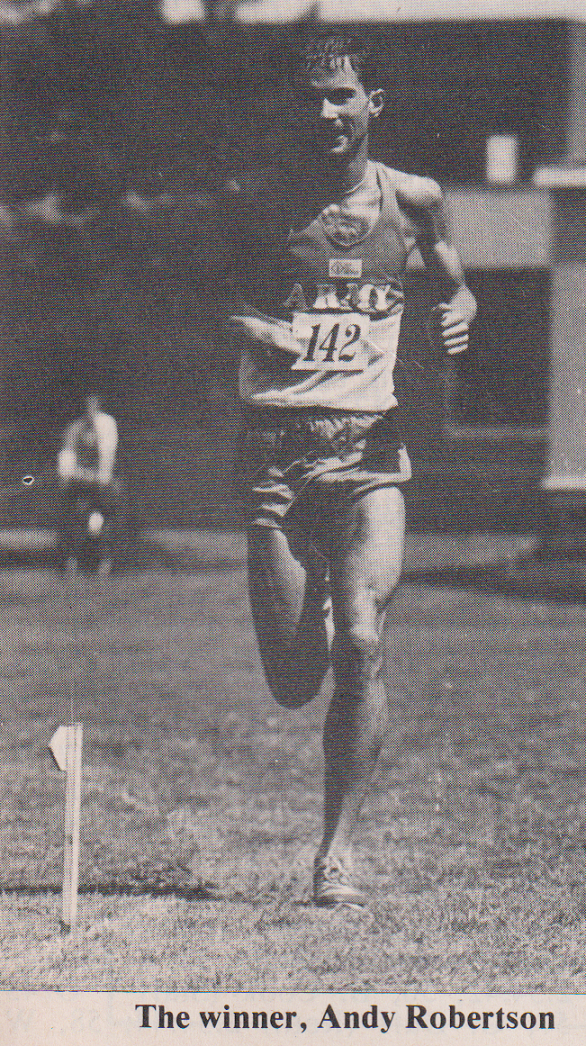
Andrew Robertson was born in Kenya on 25th March, 1957.   His parents were Scottish and his father was a farm manager.   Andy became a Physical Training Instructor with the Army and by 1979 was based at Harrogate where he managed to increase his marathon training considerably.   For the next five years he competed at a very good International level and his fastest marathon (2:14:23)  is still ranked at thirteenth in the Scottish All-Time list.

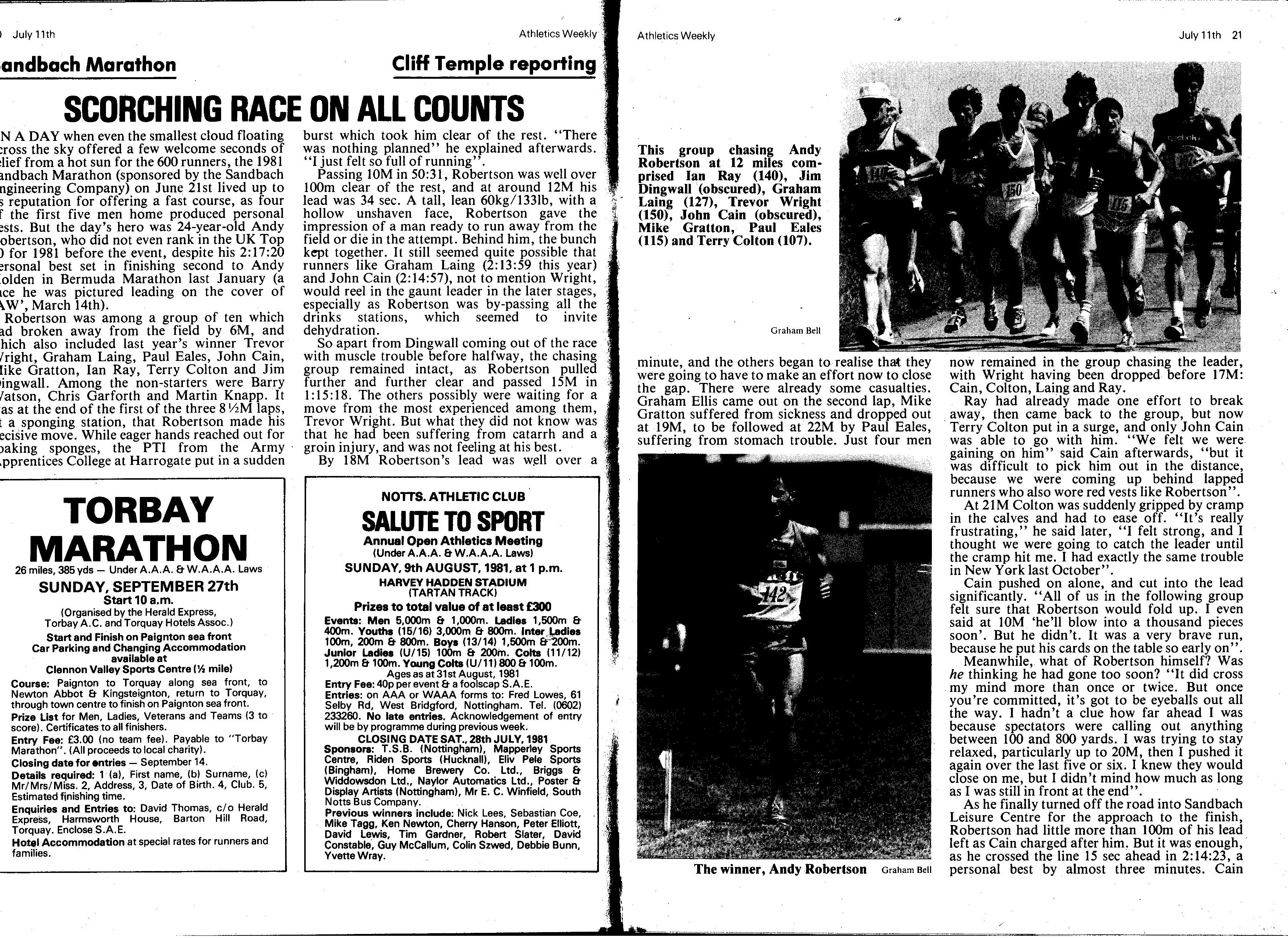
In 1979 he ran 2:21:51 for ninth place in the Milton Keynes marathon.   The next year he improved this to 2:18:14 in Laredo in Spain and in the same year he also clocked 30:09 for 10000 metres.   1981 started very promisingly when on 25th January, after a close race, Andy Robertson finished second (2:17:20) to the well known and versatile Tipton Harrier Andy Holden )2:16:57) on the Bermuda Marathon.   On the 29th February Andy won the inter-services marathon at Swinderby in 2:19:06.   Then he started building up very seriously for a more important race: the Sandbach marathon in Cheshire on 21st June.   The course was reputed to be fast and flat and over three and a half laps.   Andy had averaged 125 – 130 miles per week in training because he knew he was capable of making a real break-through.   A confidence boost was provided a few days before the marathon, when on 12th June at Aldershot, Andy won over 5000 metres in a ‘big’ personal best of  14:18.06.   Then he eased down for the Sandbach challenge.   The late, lamented, Cliff Temple wrote a colourful, detailed article about the race for the ‘Athletics Weekly’.   He wrote: “The day’s hero was Andy Robertson.”   On a warm sunny day, none fast men had broken away by six miles: Trevor Wright, Graham Laing, Paul Eales, John Caine, Mike Gratton, Ian Ray, Terry Colton, Jim Dingwall – every one an international athlete – and Andy Robertson, who made a decisive move at the end of the first lap at a sponging station.   “While eager hands reached out for soaking sponges, the PTI from the Army Apprentices’ College at Harrogate, put in a sudden burst which took him clear of the rest.   “There was nothing planned,” he explained afterwards, “I just felt so full of running.”

Passing 10 miles in 50:31 Robertson was well over 100 metres clear of the rest and at around 12 miles his lead was 34 seconds.   A tall, lean 60 kg, with a hollow, unshaven face, Robertson gave the impression of a man ready to run away from the rest or die in the attempt.    Behind him the bunch kept together and it still seemed probable that the gaunt leader would be reeled in later on, especially as Robertson was by-passing all the drinks stations which seemed to invite dehydration”.   Jim Dingwall was forced out of the race with muscle trouble before halfway.   Robertson pulled further away and passed 15 miles in 1:15:18.   By 18 miles his lead was well over a minute.   The chasing group was down to four: Colton, Cain, Laing and Ray.   At 21 miles Colton was suddenly gripped by cramp in the calves and had to ease off although he still felt strong.   Cain pushed on alone and cut into the lead significantly, sure that Robertson would suddenly fold up.

“Meanwhile, what of Robertson himself?   Was he thinking he had gone too soon?   ‘It did cross my mind more than once or twice, but once you are committed it has to be eyeballs out all the way.   I hadn’t a clue how far ahead I was because spectators were calling out anything between 100 and 180 yards.   I was trying to stay relaxed, particularly up to 20 miles, then I pushed it again over the last five or six.   I knew they would close on me but I didn’t mind how much as long as I was still in front at the end.”   As he finally turned off the road into the Sandbach Leisure Centre for the approach to the finish, Robertson had little more than 100 metres of his lead left  as Cain charged after him.   But it was enough as he crossed the line 15 seconds ahead in 2:14:23, a personal best by almost three minutes.   Cain knocked 20 seconds off his own best with 2:14:38, while the freshest finisher of the day, Terry Colton, still sliced four minutes off his best with 2:25:11.

They were followed by –

* Graham Laing   in 2:15:29;          * Ian Ray in 2:15:58;          *Trevor Wright in 2:16:58;          * Dave Clark in 2:18:42;          *John Robertshaw in 2:18:56;         Colin Taylor in 2:19:09;       Des Austin in 2:19:21.

Ten under 2:20 and Robertson’s victims included four good Scots – Laing, Clark, Austin and Dingwall

As h had his “first drink since before the race”, Andy Robertson said, “I’d like to run for Scotland in the Commonwealth Games next year, if I can find out what I have to do to qualify.   This is my biggest marathon win so far, although I’ve twice won the Inter-Services Marathon at Swinderby..”      He hopes to have done enough now to claim a place in Britain’s six-man team for the inaugural Eiropean Marathon Cup in Agen, South West France, next September, where the course is apparently even flatter than Sandbach.”

On 2nd August, 1981, Andy Robertson wore the Scottish vest with pride in a track international at Meadowbank versus Denmark and Eire, finishing a solid fourth in the 10000 metres (30:24.61)  in front of an Irishman and a Dane.   Andy was rumoured to have Stirling connections, and by now he ran not only for the Army but also for Spango Valley AC, although not apparently in any major Scottish team events such as the Edinburgh to Glasgow Relay, the Road Relay or the National Championships.

Sadly Andy Robertson struggled on 13th September because of an Achilles tendon injury.   Competing for Britain as he had hopes in the European Marathon Cup, he as ninth at 25km but ended up fifty first (and fourth Briton) in 2:27:01.   His team finished seventh.   From the nineteen nations fielding teams, there were 81 finishers, but many dropped out due mainly to temperatures in the seventies and high humidity.

On 31st January, 1982, Andy Robertson repeated his second position in the Bermuda Marathon.   This time he was timed at 2:18:11 behind the very experienced Coventry Godiva Harrier, Colin Kirkham (2:17:28).   Andy followed this on 10th April with third place (2:17:05) over another very fast course in the Westland Marathon at Maasluis, Holland.

Strangely, Andy did not compete in the AAA’s Marathon which was the Commonwealth Games trial on 13th June when Scots (John Graham, Jim Dingwall and Graham Laing) came fourth, fifth and sixth, all in 2:15+.   The result was that John Graham and Graham Laing were chosen for Brisbane and ran very well in October over a very testing, hilly course to finish fourth and seventh in the Games.   By then Andy had gained some consolation on 26th September by  winning the Torbay Marathon in 2:18:21.

His good form continued on 30th January, 1983, when at the third attempt, he fully deserved his victory (2:19:09) in the Bermuda International Marathon.   Then in 1984 he recorded yet another excellent time (2:15:23) in the London Marathon.

There is no mention of Andy Robertson in the 1985 rankings.   His career may have been short but indicates boldness, strength, speed and consistency at an impressive level which would certainly have qualified him to compete with distinction for Scotland in most Commonwealth Games.

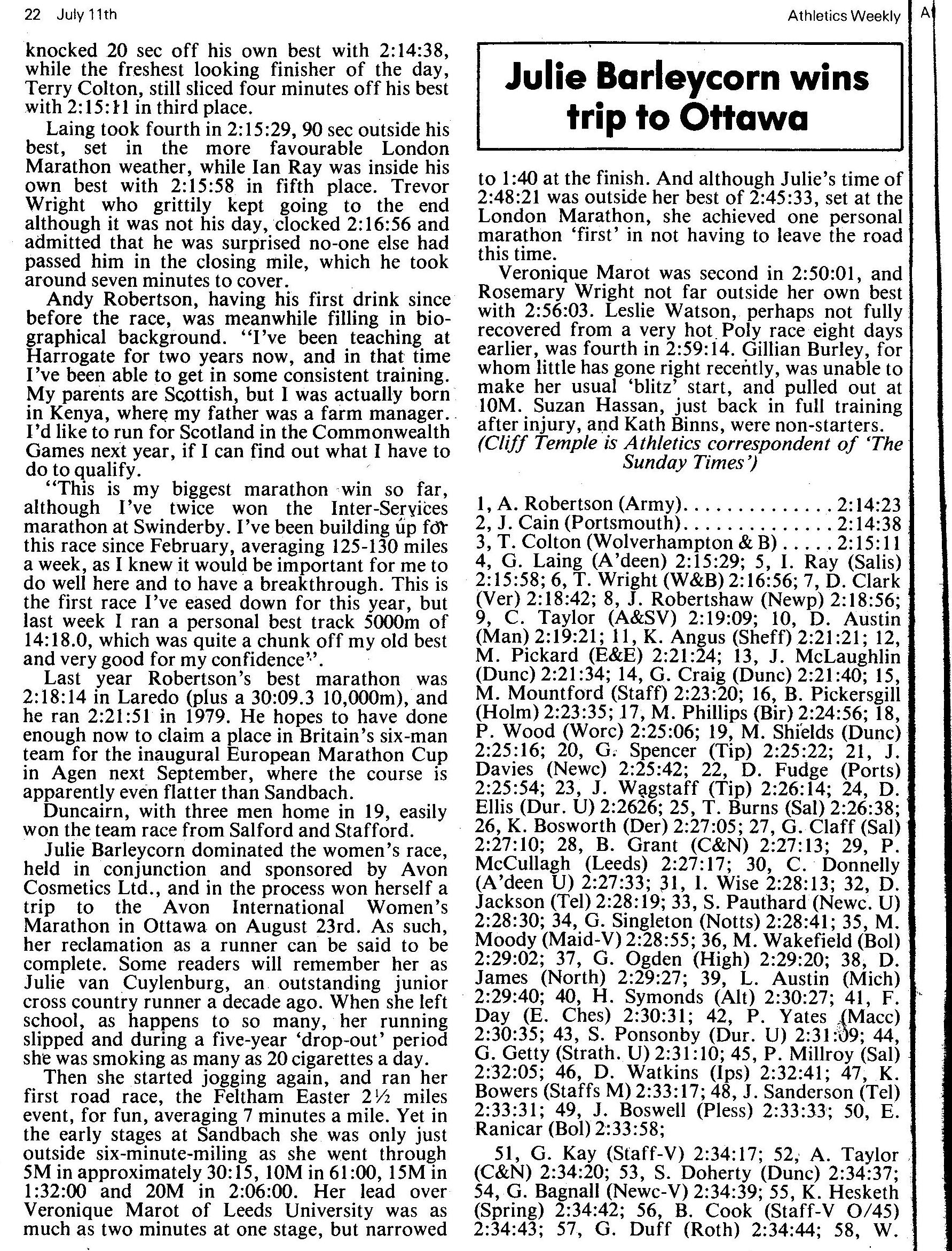
We can finish with a report done by Cliff Temple for ‘Athletics Weekly’ in July 1981


ARobertson81

ARobertson81b

                                                                                                  Andy Robertson – Marathon Career Record                                  

No Date Venue Position Time Winner (Club) Time
  1 22 September 1979 Milton Keynes         9 2:21:51 Gianpaolo Messina (ITA) 2:15:21
  2 06 April 1980 RAF Swinderby         1 2:24:12  
  3 08 June 1980 Laredo (ESP)       13 2:18.14 John Graham (Birchfield) 2:13:21
  4 25 January 1981 Hamilton, Bermuda         2 2:17:20 Andy Holden (Tipton) 2:16:57
  5 29 April 1981 RAF Swinderby         1 2:19:06  
  6 21 June 1981 Sandbach         1 2:14:23  
  7 13 September 1981 Agen (FRA-Euro Cup)       51    2:27:01 Massimo Magnani (Italy) 2:13:29
  8 31 January 1982 Hamilton, Bermuda         2 2:18:11 Colin Kirkham (Coventry Godiva) 2:17:28
  9 10 April 1982 Maasluis (NED)         3 2:17:05 Cor Vriend (Netherlands) 2:13:28
10 26 September 1982 Torbay         1 2:18:21  
11 30 January 1983 Hamilton, Bermuda         1 2:19:09  
12 15 July 1984 Bristol         1    2:18:58  
13 02 December 1984 Florence (ITA-? distance)         1 2:15:23  
14 02 June 1985 Plymouth         1 2:25:35  
15 17 August 1986 Bolton                   2 2:21:15 Mike Neary (Salford) 2:19:25
16 21 September 1986 Torbay         1 2:20:50  
17 20 May 1989 Ryde, Isle of Wight         1 2:25:13  

Lindsay Robertson

L Robertson 1

The team in Seoul in 1987: Fraser Clyne, John Brown, Sandra Branney and Lindsay Robertson.

Lindsay Robertson is ranked number seven on the Scottish all-time marathon ranking lists with a time of 2:13:30 run in Frankfurt on 25th October 1987.   Only two Scotsmen have run the distance faster since then.   In addition he has run seventeen sub 2:20 marathon races.   He was a member of Edinburgh Athletic Club which was one of Scotland’s strongest road and cross country running clubs of the seventies and eighties.   Among their top men were Jim and Alex Wight, Jim Dingwall in his pre Falkirk Victoria days, Jim Alder, Doug Gunstone, Sandy Keith and several others.   So when Colin reports below that Lindsay was EAC’s top road runner at the time, it is a considerable compliment.   He had a quite remarkable record and maybe more should be known about him.   With this in mind, Colin Youngson has written the following account of Lindsay’s athletic career.

Lindsay Robertson was born on 28th June 1958.   In time he developed into one of Scotland’s very best marathon runners.

At first he represented Edinburgh Athletic Club in the usual cross country and road races including the Edinburgh to Glasgow Relay where his debut run in 1979 made an immediate impact – he was fastest on Stage Seven and EAC finished second.   Soon he was given the responsibility of running Stage Six and speeded up rapidly to hold his own in distinguished company.   In fact he raced the longest leg seven times and his club won two more silver medals, in 1982 and 1987.   Undoubtedly EAC rated Lindsay Robertson as their best road runner during this period.

Over the country he seemed less assured but still counted in EAC National Cross Country Championship teams which won gold in 1981 and silver in 1983.

L Robertson 2

In the Edinburgh to Glasgow 1985

When the time was right Lindsay concentrated on what would be his strongest event – the marathon.  Races such as the Edinburgh to North Berwick had been part of the programme for him – the race was/is a Scottish classic that had been started back in the late 1950’s and it had attracted a fine mix of top Scottish endurance runners (eg marathon champions Harry Fenion, Hugo Fox, Don McGregor) as well as some very good athletes from the North of England (Jim Alder, Terry Rooke)   The distance had originally been 22.6 miles but had changed by the time Lindsay took it on in 1982 to 21.8 miles.   No matter he won in a new record time of 1:50:55 which was over a minute and a half quicker than the next fastest over that course.   He repeated the feat the following year but the record stood.   So by the time he started on the 26.2 miles he already knew a thing or two about long distance road racing.    He was a very determined, hard yet intelligent trainer.   In addition he was quiet, modest and a true Christian with a healthy lifestyle who never ran a poor marathon.

His first Marathon was in Gateshead in 1982 and it was a sub 2:20 – 2:19:18 for fourteenth place to be exact.   He followed this with 2:21:43 for third in Edinburgh then in October it was off to Turin where he ran 2:19:16 to be fourth.   This was his first GB vest  although not quite the ‘full GB’ international kit – it had diagonal stripes but he made up for it with full colours for the European and Worlds in 1985 and 1987.   He remembers that he pulled or tore a muscle at about 10 miles and although feeling that he was running with a straight leg for several miles managed a sprint (he suggests that it was more just running slightly faster!) at the end of the 2:16 time.   The aftermath was that he couldn’t walk properly for some time afterwards.   Fourth place in his first British international in a fast time was some consolation though.   In 1983 there were three very good marathons in Barcelona, London and Edinburgh where he won in 2:21:36.

By March 1984 he was running for a small Scottish team in the Barcelona marathon which featured heat, hills and a huge field of runners with a number of very classy European international athletes at the front.  Totally unfazed, Lindsay finished a very impressive sixth in 2:16:15.   By September that year he had created a new personal best of 2:15:55 by racing away to an easy victory in the Edinburgh Waverley Market Marathon which included an England versus Scotland international.   The report in the Marathon and Distance runner for November 1984 read as follows:

“September 2nd.   EDINBURGH MARATHON.   Lindsay Robertson, Edinburgh Athletic Club, the defending champion and home favourite set a course record and a personal best in winning this year’s Edinburgh Marathon in a time of 2:15:55 (his winning time last year was 2:21:35.   A field of 3,597 runners lined up outside Meadowbank Stadium at 8:30 am on Sunday morning, with light rain making the conditions perfect for the runners.   As the race got underway, a group of four runners were immediately to the fore.   The group contained Lindsay Robertson (EAC), Evan Cameron (Edinburgh SH), Alex Robertson (ESH) and the winner of the first Edinburgh Marathon in 1982, Dave Ellis of Birchfield Harriers.   By the time they had run two miles, this group was 100 yards clear of the next runner with the rest of the field starting to settle into their pace.   As the runners reached Princes Street they were being caught by Brian Emmerson of Teviotdale Harriers.   However, soon after catching the group he was again dropped and they continued to push on.   Lindsay Robertson at this point was doing most of the front running and it was good to see the Scotland squad in a 1,2 and 3 position with Dave Ellis still with the group but not looking very comfortable.   By halfway, Lindsay Robertson and Evan Cameron had broken away from Alex Robertson and Ellis.   It looked certain that one of these two would be the winner as they sped through 16 miles with most of the field quite far behind.   Robertson, still doing most of the front running, started to pull away from Cameron as they ran along Cramond sea front and by 19 miles he had opened a gap on Cameron.   Looking stronger all the time, Robertson pulled further away from Cameron and entered Meadowbank Stadium to a huge roar from the crowd as he sprinted down the finishing straight like a 1500m runner and clocked 2:15:55.   There was a wait of over three and a half minutes for Cameron whose time (2:19:34) was still inside the course record.   Bill Venus of Exeter Harriers pulled through strongly to take third place.   Lindsay Robertson, on winning, is now faced with a dilemma: whether to take advantage of his first place prize, a full expenses paid trip to the New York Marathon, when he is earmarked to compete for Britain in an international event in Czechoslovakia around the same date.” 

By the end of 1985 he was well on his way to his treble victory in the Tiberias Marathon in Israel which he won in 1984 (2:16:28), 1985 (2:15:39) and 1987

(2:16:06).  He had received a personal invitation in 1984 and after running so well,  was invited back for the others – unfortunately he could not run in 1986 because of injury so when he won in ’87 it was ‘run three, won three! 1985 also produced thirteenth in the London Marathon in another personal best of 2:14:59.   A year later he completed the same  race in the same position only four seconds slower.   Now that is consistency!   Sadly, just when he was extremely fit and ready for an even more impressive run in the 1986 Commonwealth Games in Edinburgh, two days before the race he went down with an illness (probably food poisoning).

However he reached his peak in 1987.   In April that year he represented Great Britain in the World Marathon Cup in Seoul, finishing a fine twenty second in 2:15:07.  On the trip he was part of  a Great Britain team – four men, for women – who travelled to Korea to race over the course to be used the following year for the Olympic Games.   Fraser Clyne and Lindsay were in the men’s team and Sandra Branney was the sole Scot in the women’s team.   John Brown the SAAA Treasurer travelled as well as part of a fact finding mission.   They did not travel directly to Korea but lived for four days at the Nihon Aerobics Centre just outside Tokyo which was to be the holding camp for the GB Olympic team.   Described by Fraser Clyne as ‘impressive’, the word seems rather mild when you consider that it had (a) an outdoor synthetic six lane track, (b) a three lane indoor track, (c) the centre is fully equipped with every sort of exercise, medical and physiotherapeutic equipment, (d) a 25 metre swimming pool and jacuzzis, saunas, roller beds and a hydrotherapy unit.   The team were quartered in log cabins set on the wooded hillside.   Sounds ideal but apparently there was little in the way of off road training for the distance runners.    After the four days there, they transferred to the Sheraton Walker Hotel in Seoul.   Sandra ran well to finish twenty sixth and be a counter in the women’s team which was fifth.    In the men’s race, the race was won by Ahmed Saleh in 2:10:55 from Taisuke Kodama in 2:11:23.   The team finished eight with Dave Long first home in 20th place (2:15:04) just ahead of Lindsay who was only eight seconds outside his personal best.   He had been 79 seconds behind Long at 35 kilometres but finished very strongly and in fact his final 2 kilometres is reported to have been faster than Saleh’s.   Fraser Clyne was forty seventh.

Then on 25th October he won the Frankfurt Marathon in a superb 2:13:30 which makes him sixth fastest Scotsman ever for the distance.   An amusing anecdote about this race is that the owner of a bar had put up a prize for first man at 10K.   Lindsay did not know this but was determined to stick with the leaders no matter what.   So he followed a runner who turned out to have the sole aim of winning this prize.   Running flat out, Lindsay looked over his shoulder to see the European bronze medallist and the rest of the pack miles behind!   However his impressive stamina allowed him to hang on for an excellent victory.

L Robertson 3

Lindsay running in the Frankfurt Marathon in 1987

In all he ran no fewer than seventeen sub-2:20 marathons (not far behind Don Macgregor’s 25) during a short but extremely impressive career.   These are included in the table below.

Day Month Year Venue Event Time Position 5K 10K 15K 20K Half 25K 30K 35K 40K Notes
13 June 1982 Gateshead AAA Championship 2:19:18 14                    
5 September 1982 Edinburgh   2:21:43 3                    
17 October 1982 Turin   2:19:16 4                    
13 March 1983 Barcelona   2:18:02 6                    
17 April 1983 London   2:17:02 59                    
4 September 1983 Edinburgh   2:21:36 1                    
18 March 1984 Barcelona   2:16:15 6                    
13 May 1984 London   2:16:42 25                    
2 September 1984 Edinburgh   2:15:55 1                    
28 October 1984 New York City   2:20:09 14                    
17 December 1984 Tiberias   2:16:28 1   32:54   65:08 68:39   1:37:08   2:09:28  
21 April 1985 London   2:14:59 15                    
15 September 1985 Rome European Marathon Cup                        
17 December 1985 Tiberias   2:15:39 1   32:15     67:47          
20 April 1986 London   2:15:03 13                    
2 November 1986 New York City   2:17:31 24                    
12 April 1987 Seoul World Marathon Cup 2:15:07 22                    
25 October 1987 Frankfurt   2:13:30 1                   2nd: Herbert Steffny, Euro Bronze Medallist, 2:15:15
9 December 1987 Tiberias   2:16:06 1                    
17 April 1988 London   2:16:26 26                    

LRobertson 4

A Great Picture!

Lindsay Robertson – Marathon Career Record  

No Date Venue Position Time Winner (Club) Time
  1 13 June 1982 Gateshead (AAA)       14 2:19:18 Steve Kenyon (Salford) 2:11:40
  2 05 September 1982 Edinburgh         3 2:21:43 Dave Ellis (England) 2:21:09
  3 17 October 1982 Turin (ITA – ?distance)         4 2:19:16 Mark DeBlander (Belgium) 2:14:57
  4 13 March 1983 Barcelona (ESP)         6 2:18:02 Allen Zachariassen (Denmark) 2:11:05
  5 17 April 1983 London (AAA)       59 2:17:02 Mike Gratton (Invicta) 2:09:43
  6 04 September 1983 Edinburgh         1 2:21:36  
  7 18 March 1984 Barcelona (ESP)         6 2:16:15 Werner Meier (Switzerland) 2:14:50
  8 13 May 1984 London (AAA)               25    2:16:44 Charlie Spedding (Gateshead) 2:09:57
  9 02 September 1984 Edinburgh         1 2:15:55  
10 28 October 1984 New York (USA)       14 2:20:09 Orlando Pizzolato (Italy) 2:14:53
11 17 December 1984 Tiberias (ISR)         1 2:16:28  
12 21 April 1985 London (AAA)       13 2:14:59 Steve Jones (RAF) 2:08:16
13 15 September 1985 Rome (ITA-Euro Cup)       23 2:17:43 Michael Heilmann (E Germany) 2:11:28
14 17 December 1985 Tiberias (ISR)         1 2:15:39  
15 20 April 1986 London (AAA)       13 2:15:03 Toshihiko Seko (Japan) 2:10:02
16 02 November 1986 New York (USA)       24 2:17:31 Gianni Poli (Italy) 2:11:06
17 12 April 1987 Seoul (PRK-World Cup)       22 2:15:07 Ahmed Saleh (Djibouti) 2:10:55
18 25 October 1987 Frankfurt (W Ger)         1 2:13:30  
19 09 December 1987 Tiberias (ISR)         1 2:16:06  
20 17 April 1988         London (AAA)       26 2:16:26 Henrik Jorgensen (Denmark) 2:10:20


Lawrie Spence

L Spence 1

Several of the top marathon men not only in Scotland but around the world started their marathon career only after a background involving lots of conditioning and then a period of fast running on the track – Allister Hutton for example.    Lawrie Spence must be among the best ever Scottish examples of this pattern.    Starting as a boy in Greenock Glenpark Harriers and based in the South West District of the Cross Country Union he won the District title every year from first year Senior Boy through to Senior Man and then went on to win the West District Senior Championship three times after his move to Shettleston Harriers.   He also medalled in every age group in the National Championships – the only other marathon runner to do so was Mike Ryan who was third in the Mexico Olympics marathon in 1968.   In addition he ran for the Junior Scottish team in the last Cross Country International in 1972 and for the Senior team no fewer than eight times   He also took over from Jim Alder as the Scottish Team Captain.   These are summarised in the table below: the first three columns are the Cross Country titles won, the second three columns (in blue) detail the International appearances.   (As in all tables in this section, placed runs in championships such as his second in the Scottish Junior Cross in 1969 and medals in team races have been omitted as there are so many of them).

District Age Group Year   Age Group Year Placing
South West Senior Boy 1968   Junior Man 1972 50
    1969   Senior Man 1976 134
South West Youth 1970   1977 141
    1971   1979 74
South West Junior Man 1972   1980 46
    1973   1981 134
South West Senior Man 1973   1982 138
West District Senior Man 1978   1983 193
    1982   1984 112
    1985        


His track history built on this and is no less illustrious.   Most track runners would have been happy to be in one Scottish all time list at their specialist distance but Lawrie is in no fewer than six.   He has also won track championships at Scottish level: The SAAA Junior 1500 metres title in 1972 in 3:57.8; the SAAA Senior 1500 metres title in 1973 in 3:47.6 and in 1975 in 3:47.3 ; the SAAA 5000 metres title twice in 1978 in 13:45.0 and again in 1981 and the 10000 metres title three times in 1982 in 29:38.1, 1983 in 28:38.9 and 1984 in 29:18.3.   Although not winning a UK title he won silver in 1983 and bronze in 1981 for 10000 metres.   In 1971 he was ranked top Scot for 3000 metres in 7:52.82.

Let’s have a  look at his appearances in the Scottish All Time Best Performances list.   I can’t think of another Scottish marathon man who has run sub four for the Mile.   He also held the Scottish record for 2000 metres with 5:20.8 which he set at Airdrie in 1975 and then lowered to 5:12.8 in 1976 at the same venue.   His current pb (set in Belfast when beating Rod Dixon the 1972 Bronze 1500 metres and 1983 New York marathon winner in a new All Ireland record of 5:03.8) although not eligible for a Scottish Native Record is actually faster than Frank Clement’s record of 5:03.5 set in 1978.   In addition his 10000 metres time noted below is only 0.15 seconds slower than Lachie Stewart’s record of 1970.   A track pedigree to be eminently proud of!

Distance Performance Scottish British
One Mile 3:58.8 14 101
2000 metres 5:03.8 4 25
3000 metres 7:52.82 6 76
5000 metres 13:37.73 7 89
10,000 metres 28:11.85 6 44
Marathon 2:16:01 18 152

The table summarises the personal bests and their all time rankings in Scotland and England – I have added the marathon best and the asterisk at the GB Marathon ranking indicates that it was arrived at by adding one to the UK Athletics rankings which stopped at position 151 on 2:16:00, just stopping short by one second of Lawrie’s mark    Positions as at the start of April 2010.   Lawrie’s own story of the Sub-Four Mile can be read at the SATS website – www.scotstats.com – just visit the site and go to the BLOG  section.

The bare bones of his marathon career are as follows:   He ran five marathons in all over a three year period.   He ran his first marathon in Glasgow in 1983 where he hit the wall and walked in to finish in 2:42:12 but the following year got it right when he finished third in 2:16:01 having learned the lesson of the previous year.   In 1985 he started with an excellent 2:19:11 (fifth in Scotland and fifty eighth in the UK) which he set in Perth, Western Australia.    His faster marathon was in Orange County, Los Angeles when he ran 2:15:03 but the course was never certified and ended up being a one off event and so doesn’t count!   By 1986 he had it down to 2:17:01 which he set in London and brought him up to number five in Scotland for the year.

***

Having found the Scottish Marathon Club questionnaire very useful in the past, I used IT to put some questions to Lawrie about his running career  and specifically about his marathon running. His replies are below in italics.

How did you get into athletics in the beginning and were you coached?

I was coached by my brother Jim who took me from the boys’ age groups through to senior international level..   During the break through years I was lucky to have Lachie Stewart as a mentor which gave me a great foundation in the sport.  In the early eighties I had a spell with Stan Long who was Brendan Foster’s coach but due to him being based down in Gateshead, the distance proved to be difficult before the age of our modern communications like email and mobile phones.   As time went by I became more in control of the detail of what was in the sessions and what the  plans were to be, but always keeping Jim as a rock in my training.   I do believe that you do have to have somebody at the different stages of your athletic career, and also others, almost a team for example to play the ‘good cop/bad cop’ when reviewing your performances and help to modify what is working and what is not.   As I am now a coach myself, I try to be an athletes coach and not a coach of athletes, using my own experience to help them develop and minimise their mistakes.

A jump now to the marathon years.   Why did you run the first one – was it your own idea, were you talked into it, or what?

As I progressed through the events of the 1500m, 5000m and 10000m the marathon was always a natural move for me and it was just a question of when I was going to do it.

Do you  think you came to the event too early, too late or just at the right time in your career?

I don’t think I would have wanted to try the marathon any earlier than I did.   Even when I did, on reflection, I don’t think I ever fully committed myself to the event in that I wanted to still be able to compete on the track and therefore never did the miles of running that would maybe have allowed me to perform better and not suffered the aftermath of the recovery phase.   I do have the thought of what really could my pb really have been?   I know I underperformed in the marathon.  

What did you think was your best race (not always the same as the fastest)?

As stated earlier, I don’t think I ever had a best one but my second Glasgow after having to walk the finish for my first one, gave me the most satisfaction as I was able to run it the whole way in 2:16:01 finishing third and first Scot and getting an engraved crystal vase for my efforts!

My most enjoyable trip to one was to Perth, Western Australia.   The reason for the trip was to go with my wife Ann to see my old training companion Duncan McAuley (who ran for Cambuslang when he lived in Scotland before emigrating) and his wife Fi..      We had spent many a session together and run together.   His help in sessions was invaluable in my development and thereafter in my racing performances.   That’s one of the best things about our sport: the friendships that you build up which last for ever – and they are “real” friends.   Trevor Wright, the English internationalist, was racing and he also had his wife Rosemary (maiden name Stirling) who won gold for Scotland over 800 metres in the 1970 Commonwealth Games in Edinburgh but who was not running in the marathon.  

It always amazed me who I met throughout the world when I travelled to races.   It was great to catch up with them.  

he race in Perth ended up a disaster at about the 19 mile mark in a pack of five when I went to grab my drink bottle from the tables, one of the other athletes also crossed, caught my heels and I fell skinning my arms and knees.   I then did the classic of getting up too quickly and chasing after them like a bat out of hell as they had put the boot in when they saw me go down.   I got back on to the back of the pack but was feeling uncomfortable as I sat for a while but the break was on after my fall and I then drifted off the back running on my own, feeling very sorry for myself with my grazed knees and elbows.   It ended up being a long run back to the finish but passing one who was in a worse state than me to move up to fourth in the race but dropping valuable time which would have given me a PB over a hilly but very scenic course along the Swan River in Perth.  Mind you, I did beat Trevor!

What was your worst?

It must be my first one in Glasgow.   I hit the wall at 22 miles and was reduced to a walk and finished in 2:42.   This international track runner who had been able to race half marathons well was caught out and given the message that the marathon is a unique event and demands respect.   But I did finish the race as that was my whole make-up as an athlete – never drop out but finish and take it on the chin as you take the plaudits when you do well!

Can you give some idea of your training?

It was very much on 10,000 metres training with the speed sessions, fartlek runs and hill work depending on the time of year.    My belief was, and still is, if you train slow then you race slow and vice versa.   I increased my Sunday runs to over two hours and also tried to learn to take on water.   The problem was being able to bring the pace down  in these runs and not overcook and pay the penalty.   I also increased the mileage in my other runs (not sessions) during the week and was hitting about 120 miles per week. 

Finally, what have you got out of running?

Belief in myself, never lose your confidence and take the knocks and get on with it!   I left school at 15 with no formal qualification and at best was getting a craft job in the Shipyards but through running giving me confidence in myself (I was one of the top boys in Scotland at the time) and learning the discipline of training I was able to go to night school and then day release and so able to get the qualifications to go to Strathclyde University, which in turn allowed me the opportunity to have a successful work career.   Through hard work and dedication to the lifestyle and getting the success this brought with it, I moved onwards and upwards as a person.  


L Spence 2

In terms of career development and as a model for any young athlete, Lawrie’s career development can’t be bettered.   I knew and raced against his brother Jim (and know George and Cammy as well) and it is good to see the effect he has had on Lawrie’s career.   Jim himself won many races and was Scottish Marathon Club Champion in his own right.    But having said all that and being an admirer of all that Lawrie has done, the marathon enthusiast in me can’t help saying “If only …”

Bill Stoddart

image003[1]

Bill winning the SAAA Marathon Championship in 1969 at Meadowbank

I met Eddie Knox of Springburn in the Cowgate in Kirkintilloch many years ago.    Eddie had won the Junior International Cross Country Championship and was a multi title holder in every age group from Under 15 up.   He had just come back from a race for a small Scottish team in Hannut in Belgium and couldn’t get over the fact that a Scotsman over the age of 40 had beaten him!   The veteran Scotsman was Bill Stoddart who came to most people’s attention when he won the 1969 SAAA Marathon Championship from the unfinished Meadowbank Track.   The race was used as a trial for the route to be used for the Commonwealth Games marathon in 1970 and a good field was forward for the event including Donald Ritchie, Jim Wight, Hugh Mitchell, and various others.

‘A Hardy Breed’ covered the race as follows; “The runners covered one lap of the track and left to the cheers of a few workmen since spectators were banned from the site.   Donald Ritchie also took part and shared the early lead with Bill Stoddart.   The course was Restalrig Avenue, Joppa, Musselburgh, Seton Level Crossing, Longniddry and the Chance Inn Bridge where competitors turned for home.   At three miles they were joined by Jim Wight (Edinburgh AC) who later became an international marathon runner.   Police, motor cycles, patrol cars. ambulances and carloads of officials shadowed the runners through the city streets and out over the country course. However, by five miles Donald felt the side of his right foot burning and nipping but decided to press on.    Jim lost contact on a hill at seven miles.   Bill put in an effort before 10 miles and passed that mark six seconds clear in 54:10.   Donald’s foot was now giving him great pain so he stopped at eleven miles to investigate.   A three inch blister on the sole had burst.   Even Donald could not restart and had to return to the stadium in an ambulance.   He had modified a pair of EB racing shoes to reduce weight and increase breathability.   That is, he had cut holes in them, succeeding only in decreasing stability allowing excessive foot motion and friction -and disaster.

Bill Stoddart in more recent years has become a veteran multi world record holder and champion in track and cross country as well as the marathon.   In 1972 at the age of 41 he recorded 2:21:18.   He reports that back in 1969 he was a 38 year old teacher of maths and physics at Reid Kerr Technical College in Paisley.   Six weeks earlier he had been silver medal winner in the SAAA Track 10 Miles so he was in good form.   However only a fortnight before the Scottish Championship he had run his first 26 miler in the Shettleston event starting too fast and fading over the last two miles.   Perhaps he would learn better pacing for this championship.   At halfway (at Spittal, East Lothian) he swung round a policeman guarding a bollard first in 70:40. followed by Alistair Matson (Edinburgh Southern) and Hugh Mitchell (Shettleston) in 73:15.   Then came Gordon Eadie (Cambuslang), Jim Wight and Jim Irvine (Bellahouston).   Bill found the head wind on the way back refreshing on a hot and humid day, but the course seemed boring with long straights to endure.   Still, ‘when you win, what does it matter?’   At 23 miles, out on his own, climbing the hill to the stadium, Bill remembers that ‘Willie Fulton, the time keeper was shouting out my time, which I couldn’t hear  since I was a bit light headed by then.   I vaguely remember shouting back to Willie not to bother with my time but would he please tell me (as in the song) the miles to Dundee.’

Bill Stoddart’s winning time was 2:27:25, second was Hugh Mitchell in 2:31:30 and third was Peter Duffy (Motherwell YMCA) in 2:37:04.

Bill’s career as a marathon runner went from strength to strength and it will be covered soon but I’d like to tell for the first time that he was almost the subject of a protest and possible disqualification on the day.   All the officials for the Commonwealth Games Marathon were having their first ‘dry run’ and were assigned to their places well in advance.   I was part of the team at Fisher Row in Musselburgh who were to serve the drinks to the runners.    When Bill passed a car stopped at the side of the road and gave him his drink – it had not been approved and sent out to us before the race started.   The chief steward was all for reporting the incident and having ‘action taken.’   Fortunately we managed to change his mind.

1969 was a very good year for Bill.   He had two marathon times in the Scottish Rankings: 2:27:25 at Meadowbank placed him tenth Scot and was the fourteenth time by a Scot that year; he also recorded 2:29:16 at Manchester on 20th July.   The faster time placed him at number forty six in the UK; At ten miles his time of 50:55 placed him at number two in Scotland and thirteenth in the UK; he was also number three at Six Miles in Scotland.   There was no way that anyone could regard his run in the marathon as a freak performance.   Earlier in the year he had won the Scottish South West Cross Country title for the first time leading Wellpark to victory in the team race and in 1970 he competed for Scotland in the world championships.   In looking at the rankings you must remember of course that it was at a time when British and Scottish endurance running was at a real peak with Don McGregor, Jim Alder, Alistair Wood, Fergus Murray, Ian McCafferty and Lachie Stewart were all running and in the wider British scene there were athletes like Ron Hill, Mike Freary, Bill Adcocks and Tim Johnston we  all performing exceptionally well.

His next medal in the Scottish championships was in 1971.   Clyne and Youngson again: “Bill Stoddart remembers that “torrential rain greeted us as we prepared to warm up for the race and people could be seen dashing for cover.   In a matter of minutes we were running round splashing like ducks in a pond!”   In fact the weather was so bad that the officials were forced to abandon (temporarily) the SAAA Track and field championships while the road runners squelched onwards dourly.   It was ever thus from a marathoners point of view – ‘track fairies.’   After six days of training totalling 58 miles, Pat Maclagan remembers starting  the race through standing water in his Onitsuka Tiger shoes with added foam padding under the tongue, and heel pads.   Since he did not wear socks he had  also taped the soles of his feet.   Unfortunately the soaking dislodged a piece of tape to his considerable discomfort.   Pat recalls complaining about this to Don McGregor who replied callously or helpfully, “Why don’t you stop and take your shoe off, then?”   Instead Pat spent some time trying to manoeuvre  the offending  tape between his toes so it became no longer a problem.

Bill thinks that no one was keen to take the pace due to the depressing conditions so he led for most of 22 miles,   By then Donald Ritchie had dropped back as had Don McGregor  and Willie Day (Falkirk Victoria Harriers) had come through.   According to Pat, Bill and Willie tried to get away at this point but he hauled them back.   Bill remembers Pat “speeding past ” me as if I was going backwards and he didn’t even say ‘Hello'”.   Or indeed ‘Goodbye’.   Pat Maclagan won by two minutes in 2:21:17 with Bill Stoddart second in 2:23:31 and Willie Day third in 2:26:07 – good times considering the weather.

***

This year he was eleventh in the Scottish rankings for the marathon, seventh in the one hour track run with 18,900m 11 ml 1309 yards, ninth in the ten miles track and twenty second in the 10000 metres with 31:12.6.   The times and distances are remarkable and only indicate how high the standard was at the time – in 2010 he’d certainly be in the top two or three.

____________________________________________________________________________________________________________________________


The best summary of his career that I have come across is this article from the ‘Scotland’s Runner’ magazine in November 1992 outlining Bill’s career to that point.

NEVER TOO OLD TO STRIKE GOLD

Margaret Montgomery talks to Bill Stoddart in the wake of his gold medal winning performance at the veteran world road racing championships in Birmingham

With a spritely and alert demeanour which belies his 61 years and semi retired status, Bill Stoddart appears every inch the world veteran champion.   Watching him greet non athletic contemporaries at his regular training haunt – Battery Park in Greenock – the impression of a man with an unusual degree  of zest and vitality for his years is even more pronounced.   While Bill jogs along with easy grace, those he bumps into are either slowly walking their dogs or watching the activities of boats on the Firth of Clyde from the comfort of a park bench.   his particular lunchtime however Bill was to join the ranks of the park bench pensioners.   Taking an hour or so off from a fairly hectic daily training schedule, he managed to sit down long enough to talk about his latest athletic accomplishments and share the goals he has set himself for the coming year.   Fresh from the recent world veterans road race championships where he struck gold in both the over 60’s 10K and25K, Stoddart is presently on the crest of a wave.   Even by his own very exacting standards he has just achieved something rather special.   “I really wanted to pull off the double”, he explains, “Although I’ve come first and second in these events in a single championships, I’ve never won both at once before.”   Stoddart’s preparation for double gold was long and arduous.   Despite his comparatively advanced years, he was putting in between 70 and 80 miles a week in the run up to Birmingham.   On top of that he was racing every other week and doing the equivalent of another five miles a day deep water treading in a local swimming pool.

“I’ve used deep water treading as part of my training for around three years now,” Stoddart confesses.   “I started it in my late fifties and my times have got faster every year since.   It’s a tremendous thing.  It works your cardio-vascular system, tones muscles and prevents shock.   People tend to use it when they’re injured but I’d recommend using it as an everyday training aid.”   Bill’s performance in Birmingham rounded off a highly successful season for the Greenock man.   At Arbroath in June he achieved a world best in his age group for the half marathon with 75:53, while in August he did, to all intents and purposes, the same thing in the 10K when he clocked 34:51.   This however has still to be ratified.   With the world ten mile best in the same age group already lodged under his belt (at East Kilbride and Lanarkshire 10 mile road race in August 1991 he clocked a formidable 57:43) Stoddart’s remaining target is an Over 60 world best in the marathon.   This he hopes to have acquired by the end of the year.  “I clocked 2:49:53 at the Inverclyde Marathon last year,” he says  “I’ve got 2:42 to beat but I’m fitter this year than I was in 1991 so I think I’m capable of the low forties.”   Whether or not Bill does achieve his marathon goal by the end of the year, he won’t be short of accomplishments to list on his athletics curriculum vitae.   Stoddart has won Scottish and British titles in all veteran’s age groups, Scottish titles in distances from 1500 metres up to the marathon and the British in distances of 10000 metres and upwards.   Meanwhile on top of this Stoddart has the distinction of being the only man to have held world bests in all veteran age groups, these being in distances of 5K and upwards.

It all adds up to a remarkable career.   What makes it all the more outstanding however is that it hasn’t been developed on the back of an equally glittering senior career.   Although he competed as a senior, representing Scotland a number of times along the way, it is only since turning 40 that he has become what is euphemistically known as a world beater.   Stoddart puts his ‘late development’ down to the fact that he was too much of an all-rounder in his early days to concentrate solely on one sport.   A county standard table tennis player and a keen junior football player, he only began running ‘for fun’ when he was called up for National Service in 1952.

“I was stationed with the RAF in the Black Forest for two years,” he recalls, “the choice was either to become an alcoholic or a sportsman.   I decided I’d rather become a sportsman.   I started doing cross country running every Wednesday and eventually became good enough to win a place in the RAF combined team.   I suppose I got a taste for running at this time but it was very much a leisure pursuit.   I still saw football and table tennis as my main sports.”   By the time Bill returned to civilian life he was 23.   His appetite for running whetted, he joined Greenock Wellpark Harriers to which he has remained loyal ever since.

Throughout his twenties and most of his thirties, Bill by his own admission was no more than a good club runner.   Training just twice a week and competing in only the odd cross country, mile and half mile, he was devoting most of his energy to building up his career as a draftsman while also pursuing his old loves of table tennis and football.   Running was not high on his list of priorities and perhaps would have stayed that way had it not been for a change of lifestyle and a chance meeting at the national cross country championships when he was in his late thirties.   “I met up with Andy Brown who I’d known was in the RAF,” Bill explains.   “I’d just come twenty fifth in the national which was quite good, all things considered.   Andy came over and said I should concentrate on my running and that if I did I’d make the Scottish team.”

As it turned out he was right.   Brown gave Stoddart a training schedule.   Bill who had just entered further education for the first time and had more time on his hands than he was used to, duly complied by following it assiduously.   Table tennis and football were finally dropped and before long he was representing the SAAA in road races and had made the Scottish cross country team, a feat he managed in four successive years from 1969 to 1972.   “I was known as the old man of the team,” says Stoddart, a veteran of 42 during his last year in the team.   In making the national team at this late juncture in his life. the Wellpark Harrier had what he describes as the ‘great honour’ of being part of one of the greatest ever Scottish cross country teams and attending the World Championships in Vichy.   Among those he travelled to France with were Lachie Stewart, Ian McCafferty, Ian Stewart, Gareth Bryan-Jones and Jim Alder.   It was a team capable of a top three place.   In the end however it failed to place among the medals.   “We got caught up in the strikes that were hitting Paris at the time.   We ended up travelling overnight and were tired before we even started running.   There’s no doubt we could have done better if we had been blessed with better circumstances,” he now says.

Stoddart has also suffered his fair share of injury.   In 1974 while competing in the South West Cross Country Championships, he hot a rock with his spikes and was forced to pull out of the race.   The next week, thinking what was a minor matter had cleared up, he entered another race.   In fact he had fractured an ankle and racing again so soon had turned it into a compound fracture.   Out of training and racing for almost a year as a result of the injury, he gave up ideas of continuing to compete as a senior and began from then on to concentrate on the veteran scene.   “I never got into the County or Scottish team after that injury,” says Stoddart.   “That’s when I seriously started to compete as a vet.”

Although he thinks he might well have achieved more as a senior had he taken running more seriously at an earlier age, Stoddart doesn’t regret the way he’s done things.   “I suppose I thought I had the balance right at the time,” he says.  “There were too many other things to do when I was a young man.   Nowadays it is a lot easier to be concentrated on the one thing.”   Certainly he has packed a lot into his life and has a number of other strings to his bow which might be absent were it not for the fact that he had an all-rounder’s outlook when he was young.   Head of Management and Industrial Studies at James Watt College, Stoddart was one of the first people to complete an Open University degree and can also boast an MA from Strathclyde University in Industrial Relations.   On top of this he is a corporate member of the Institute of Industrial Managers, the Institute of Mechanical Engineers and the British Board of Management.   Other sports related commitments include the post of chairman of the Inverclyde Athletics Initiative and a place on the committee of the Scottish Veteran Harriers Club.

In many ways Bill exudes the qualities associated with old fashioned athletics values.   It is only since a more flexible working life and semi retirement came his way that he has made running a major priority in his life.

“I’ve always worked full time,” says Bill.  “I’ve never made a penny out of my running.”   Although he admits he “wouldn’t say no” to making a small amount from his efforts, Stoddart says he would never go out of his way to look for cash.   The fact that a fair number of the people he beat in Birmingham have subvention funds and are managing to make a living from running as a vet is not enough to change his strongly held beliefs on this matter.   “It’s gone a bit too far,” he says.   “Take Linford Christie and Carl Lewis.   They’re delaying a race until the stakes are high enough.   It’s all gamesmanship and professionalism.   People are obsessed with it.   I remember when people used to be happy to run for a canteen of cutlery or a set of sheets.”   Whatever his views on the sport’s ethics (or lack of them) Stoddart is nonetheless determined to stay with it for as long as he can.   “Till death us do part!” He jokes.

Who knows then what the future could hold for veteran athletics?    I like to think I’ve set standards for others to beat,” says Bill.   “And I hope to go on doing so.”   Now in his sixties, he’s one of the few vets in any age category to have dipped below 76 minutes for the half marathon, 35 minutes for the 10K and 60 minutes for 10 miles.   He’s also getting faster as he gets older.   There would seem to be little doubt that Bill Stoddart could be setting challenging standards for some time to come.

Bill Stoddart Fact File

Date of Birth: May 2, 1931

Club: Greenock Wellpark Harriers

World Bests

10 Miles: 57:43 (East Kilbride and Lanarkshire 10 Mile race, August 1991

Half Marathon: 75:53 (Arbroath Half Marathon, June 1992)

10K: 34:51(SVHC Championships, August 1992)

World Titles

10K and 25K (World Veterans Road Race Championships, August 1992)

Personal Bests

Distance Time Age Recorded At
800 m Track 2:04.0 41
1500 m Track 4:10.5 41
3000 m Track 8:52 41
5000 m Track 14:56 41
10000 m Track 30:32 41
1 hour run 18,9000 m 42
10 miles track 50:52 40
HM road 68:24 42
25K RR 1:21:25 41
Marathon 2:22:14 40
Edinburgh to Glasgow 4:36:13 (rec) 39/40

Personal Bests in Current Age Group

1500 m Track 5:06 60
5000 m Track 17:37 60
10000 m Track 35:10 61
10K RR 34:51 61
10 Miles RR 57:43 60
H Marathon 75:53 61
25K 1:34:50 61
Marathon 2:49:53 60

Where do these times stand in 2010?   At British level, the half marathon time above still stands as at December 2009 as a British M60 age best but Bill ran an excelleny 18:18 for 5K Road on 18th June 1997 at Lochinch which was and still is a British record for the M65 age group.   It is a sign of the quality of the times that in an era when veterans and masters athletics are being fought out at a higher level than ever before that times set eighteen and thirteen years ago are still top of the lists.

Daily Training Schedule

Morning: Swim, followed by half an hour intensive deep water training

Lunchtime: 40 minutes to an hour easy running and strides.   Usually 6 – 8 miles at most

Afternoon: 4 Mile Run.

(Bill says: “I’m not a scientific runner.   I do ten to twelve miles every day but I’m not obsessed by the stop watch while I’m doing it.   I aim to keep even pace.   Speed work frightens me – at my age particularly it can lead to too many injuries.)

Bill  was universally respected – and liked as well although the two don’t always go together – died in September, 2015 and there was a lot of comment on the various social media platforms.   Fergus Murray circulated the news around his contemporaries and friends who all commented on how they got on with him and the qualities that they realised he embodied.   Typical of many of them was this one from Alistair Matson:

“Hi Fergus,

Thanks for letting me know abut Bill Stoddart. I’ve now read his “Scotsman” obituary online. Although I ran in races with him only in 1968 and 1969, he made quite an impression – not least because he was a good number of years older than us yet did not seem to have any serious running background!    Also, he always seem to run really hard – and hope for the best!   If my memory is correct, in his early road races, he tended to fade after battling with the leaders but gradually stayed with them longer until, of course, he won the Scottish Marathon of 1969 from the under-construction Meadowbank Stadium.   I ran in the Shotts and Dunblane Highland Games 14 mile races on successive Saturdays in Sept. 1968 and while Bill was 6.30 mins behind Lachie Stewart in 6th pos. he had reduced that to just over 5 mins behind Lachie at Dunblane also in 6th!

I ran in what would have been his first marathon – Shettleston, 1969.  It didn’t go exactly to plan and he should have won it convincingly. He was about a minute ahead of me at 20 miles and I was well ahead of the rest including Sandy Keith who won in 2:29:22. Sadly a marshall wasn’t in place to direct Bill and me to turn on to a minor road which eventually rejoined the full loop we covered on the first lap.   I don’t know what Bill’s reaction was when he realised like me that we had run in error the full loop a second time to add more than half mile to the marathon distance!  Personally, I felt very deflated as I probably would have held on to 2nd spot and got a pb.   So the account of that Shettleston in the Scottish Distance Running History web-site doesn’t really reflect Bill’s potential success!

Of course, Bill achieved proper recognition at the Scottish Marathon 6 weeks later when he made light of the torrid conditions on a humid day exacerbated by the fumes from the continuous traffic on the A1.   Although lying 2nd at the turn, I succumbed a few miles from the finish from asthma symptoms related to hay fever.  Bill though from the photo of him finishing looked very sprightly with a well deserved victory.

He was a great guy and I’m sorry I wasn’t in Scotland longer to know him better”

There was an excellent film made of him by the Inverclyde Council which is available on youtube :


Jim and Alex Wight

Jim and Alex

In the 21st Century, many Scottish runners, after glancing at statistics from the 1960s to the 1980s, wonder how so many of their predecessors ran a lot faster than nearly all the Scottish athletes in their twenties and thirties nowadays.

Alex and Jim Wight are excellent examples of men who trained hard, raced over a range of distances and produced many outstanding performances. Undoubtedly they had genetic talent but this was developed through sheer effort and relentless competition. It will be far from easy for today’s youngsters to make similar progress.

Alex was born on the 5th of November 1942; and Jim on the 22nd of October 1944. They both, in turn, went to Edinburgh University in time to become part of the greatest student team in Scottish athletics history. Alex was part of the EU outfit which was third in the National cross country championships in early 1965. By November that year Jim had joined him in the Edinburgh University team which smashed the course record for the Edinburgh to Glasgow Relay. Jim enjoyed a major breakthrough by taking no less than 39 seconds off the Stage 7 record, while in the lead ‘running scared’ from Bert McKay of Motherwell YMCA, who was only four seconds slower than Jim. However Bert’s team finished 80 seconds behind the flying students.  While Alex tried to run 100 plus miles per week, Jim aimed for 50 to 60, although he was running up to 75 by the late sixties. 100 plus did not suit Jim, although he wonders now whether, with even more application, he might have been capable of a 2.12 marathon. Alex says that Jim had more natural ability than himself.

The Edinburgh students’ success was due to the inspiration of 1964 Olympian Fergus Murray and the heroic squad of masochists who trained from ‘The Zoo’, 78 Morningside Drive. The house was named after the nicknames of certain inmates: Fergus was ‘The Beast’ and Chris Elson ‘The Bear’. Other fine runners who lived there some of the time included Alastair Matson, John Meldrum, Brian Covell, Dave Logue, John Bryant and the Wight brothers. Don Macgregor came through from Fife for the Sunday session. It was the toughest training school in the land. Up to100 miles or even more every week of long runs, repetitions, fartlek and races, in an ambitious, competitive group. Improve or retire!

For EU and subsequently EAC in the E to G, Alex won two gold and five silver medals. He was first reserve for the 1967 winning EU team! Jim won three golds and a silver. However it wasn’t just about road running. In true harrier tradition, the Wights raced ferociously in cross country. Jim’s finest result was probably 17th in the 1972 English National at Sutton Coldfield, coming through very strongly despite the notorious blizzard. In the Scottish National event, between 1965 and 1979, Alex won seven gold, three silver and three bronze medals. Jim was in the winning EU Junior team in 1964 and 1965. Between 1967 and 1975, Jim won four Senior gold, two silver and two bronze, plus an extra silver in the National Cross Country Relay. They both featured in the greatest team performance in National history, in 1975, when EAC’s six counters could only total a measly 37 points! Alex, whose best individual place was 8th, was unlucky not to run for Scotland in the International Cross-Country Union Championships. Jim, however, ran for the junior Scottish team in Dublin 1964; and also the senior Scottish team in Cambridge 1972.

n the track, Alex improved his 1969 times [14.43 5000m and a (team effort) steeplechase in 10 minutes precisely] to14.32 in 1973, 9.47 in 1973 and, more significantly, for 10.000m, 29.38 also in 1973. Jim went from 14.48 in 1969 to 14.17 in 1972, and had a PB for 10,000m of 29.22 in 1973.

However a major focus for this website is marathon racing. All the above intensive training and racing led to excellence in the marathon and indeed the so-called ‘shorter ultras’.

Even when I joined Edinburgh Southern Harriers in autumn 1974, the Wights’ legendary Sunday run persisted. This featured a gruelling tour of Pentland reservoirs and went on and on for at least 20 miles at a very unsocial pace; which might explain why I usually chose the softer option of 16 miles along the disused railway line to Balerno and back. It took me months to follow my own training pack (led by iron man Sandy Keith) up to the infamous reservoirs. Eventually we learned to endure the occasional 25 miler – but always avoided those hard men, the Wight brothers!

Alex started his marathon career in the Beverley East Yorks race in April 1966, finishing second to Don Shelley in 2.23.15. However he suffered what he describes as ‘a dose of hot weather reality in the June Polytechnic race in 2.52’! He raced on the road at all sorts of distances in North and South England, as well as the Scottish Highland Games road race circuit, although the intended goal was always improved marathon performance.

In 1969 Jim won the Highgate marathon in 2.24.28, with Alex fourth in 2.31.07. Next year Alex was third in the SAAA 10,000m track, just in front of Jim, and maintained this slight sibling advantage in reducing his marathon time to 2.21.05 (5th in the famous Polytechnic race from Windsor to Chiswick). Alex considers this performance, in what was the English Commonwealth Games trial, one of his best races, partly because he finished just in front of A.J. Wood. Jim did 2.22.58 for 8th in the 1970 Scottish Commonwealth trial event.

The Edinburgh to North Berwick marathon on the 8th of May 1971 produced seven PBs for the first eight finishers. Alex Wight won in the superb time of 2.15.27, with Jim second in 2.15.43. That autumn Alex increased the distance by winning the Two Bridges 36 mile race from Dunfermline, over the Kincardine and Forth Road Bridges to Rosyth. His time was 3.28.20. As an afterthought, he also won the Edinburgh to Glasgow Individual Race (and for EAC, inevitably, the team award!) His own account of this event is given in the Point to Point section of this website.

Jim started 1972 in the best possible fashion by outkicking Jim Alder on his own ‘turf’ to win the famous Morpeth to Newcastle. Jim Wight regards this as his most satisfying road race. In the Olympic trial Maxol Marathon in Manchester, Alex finished a disappointed 24th in a respectable 2.19.59, but found better form in retaining his Two Bridges title in a record 3.24.07, with Jim second. This, along with his fine marathon PB, was to represent the very best of Alex Wight, long distance runner.

From then on, Alex seemed to concentrate on shorter races, apart from 2.21.53 in 1974 (Harlow). Jim, two years younger, reached his peak in 1973-4. After his best 10,000m time, he lined up for the Scottish Championship marathon (which was the trial for the Commonwealth Games team). A small, select group raced off on a very hot day, with a following wind. The headwind on the return journey added to the strain for those who could not keep up with the leaders. Even Alex dropped out eventually. Jim, however, was only 34 seconds behind the winning 2.17.50 of Donald Macgregor, who told the press that “Plucky Jim Wight should come with me to the Christchurch Games.” Indeed they were both selected.

A well-known photo of the time shows the 1974 Commonwealth Marathon leading pack, with fiery-eyed Ian Thompson tormenting a suffering group who are straining to follow his 2 hours 9 minute pace! Don Macgregor is there, with Jim Wight hanging on grimly. In the end Don finished 6th in 2.14.15, his best ever, but Jim was forced to step off the road. However Jim Wight made a great return to form later in the year when he won the Two Bridges in 3.26.31; and then romped away to an easy victory in the Harlow marathon in the excellent time of 2.16.28, also gaining revenge on Don Macgregor who finished third in that race. EAC won the team title from Edinburgh Southern Harriers – not bad for Scottish runners in Essex!

In between the Two Bridges and the Harlow, from 6 p.m. on 28th September 1974, at Meadowbank Stadium, Edinburgh Athletic Club broke the world record for the 24-hour 10-man x 1 mile relay. This outstanding feat even out-performed the world best for a composite team and the U.S. Olympic Training camp select, in addition to the record for members of a single athletics club. Their final distance was 297 miles 1145 yards (or 479.009 kilometres). This translates to an average of 4 minutes 50.27 minutes per mile. The heroes were: Jim Alder, Jim Dingwall, Doug Gunstone, Phil Hay, Danny and Ronnie Knowles, Alex Matheson, Joe Patton and, unsurprisingly, Alex and Jim Wight. Truly an amazing achievement.

Jim seems to have retired from racing after the National Cross Country EAC team massacre in 1975; Alex kept going in that event, gaining further team golds in 1976 and 1978, with a swansong silver in 1979.

The Veteran/Master scene was in its infancy and obviously did not appeal particularly to the Wight brothers, although in the 1980s Alex did run 2.32 for 8th in an Edinburgh Marathon plus almost exactly the same time in a London Marathon. Alex remembers thinking even then that the British standard was on the way down. At a recent EU cross-country reunion, he found it interesting to meet people who were useful in their university days but were only fringe team members then, who later turned out to be champions at national and world level – true marathon runners.

The Wight brothers achieved so much. Each took his turn to defeat the other, without apparent animosity. Alex seemed to me casual, ‘cool’, and friendly – a true amateur – while Jim was silent and serious. However they both trained and raced like demons! Alex may have smiled more often but both Wights must have enjoyed their running a great deal. They have every right to look back with considerable satisfaction on marvellous athletic careers.

Peter Wilson

Peter Wilson

Peter Wilson running cross-country at Livingston in 1985


Some runners never get the credit that their running deserves. Were you to ask any road running athlete to name as many SAAA marathon champions from Aberdeen as they could, then everyone would come up with Alastair Wood, Fraser Clyne and Colin Youngson, some would add Graham Laing, some would make inspired (but erroneous) guesses at Don Ritchie and Rab Heron but not many would come up with Peter Wilson. Peter has had a fairly distinguished career with two marathon medals and a place in the Aberdeen team that set the record for the John o’Groats to Land’s End Relay in 1982. The picture above is from that race, with Peter fourth from the left. As a Scottish marathon champion, for most clubs in Scotland he would be a totally unique figure, while in Aberdeen he is one of many. What follows is mostly, but not entirely, from ‘A Hardy Race’ by Fraser Clyne and Colin Youngson (2000).

“Peter Wilson, now a successful osteopath, but then a 27 year old scientific officer at Aberdeen’s Macaulay Institute for Soil Research, was an ex-hockey player who had been running seriously for three years by 1983. An article about him stated “Peter’s weekly training regime is a study in self-imposed torture that would leave the Marquis de Sade drooling!” Every weekday lunchtime he ran ten miles in 55-60 minutes, followed by another five before his well-earned tea. Add Sunday 20 milers, long repetitions and hill-work, and Peter’s reputation – as a difficult man to train with and a fine road racer – is explained. As well as running marathons for Scotland and competing in Europe and the USA, he was a good cyclist and a competent swimmer, and this training turned him into a successful triathlete.”

Although 1983 was to be the year he won the SAAA Marathon, he had a good year in 1982 when, on July 10th at Grangemouth, he was third behind Colin Youngson (2.18.02) and Sandy Keith (2.26.34) in 2.27.01. 1983 started with a good run in the London Marathon in April, when he ran a personal best of 2.20.05 to set himself up for the Championship, which was to be run from Edinburgh. The top three runners, based on form and times, were Colin Youngson (Champion in 1975, 1981 and 1982), Evan Cameron and Peter Wilson. Youngson had the incentive of having won the previous two championships, and while there is always real prestige from three-in-a-row, it would also equal Joe McGhee’s record series of victories. Unsurprisingly he went straight to the front and by five miles he had 30 seconds on his younger rivals, but unfortunately he had a stomach bug which decided to make its appearance during what the referred to as his ‘pit-stop marathon’. Despite having to stop three times, he was 80 seconds up by 18 miles. ‘A Hardy Race’ takes up the tale: “Dehydrated and exhausted, Youngson could not muster any fighting spirit when his clubmate Peter Wilson, who had paced himself well, and sensing victory had closed rapidly, strode past strongly and went right away. The result was: first Peter Wilson (2.26.20); second Colin Youngson (2.28.46) and third Evan Cameron (2.29.30).

In the 1982 JOGLE (see the report elsewhere on this website) Peter was paired with Aberdeen AAC’s fastest marathoner Fraser Clyne and they were inside record pace on the very first stage. Along with the rest of the ten-man team, they built on this to be one and three-quarter hours inside the old record by the finish of the 850-mile run. Fraser writes: “I always respected Peter and enjoyed his dry humour. My recollections of the JOGLE are very blurred, no doubt due to the combined effects of sleep deprivation and exhaustion. Peter was incredibly strong throughout the journey and showed his true endurance potential. There’s no doubt that expedition probably helped us all in our marathon careers, as 26.2 miles seemed easy after trying to run 12 times five-minute miles with a five minute recovery, three times every 24 hours for three days. Peter always impressed me as being extremely dedicated to his running and was a great student of the sport. He frequently downplayed his abilities (another common quality among good runners) but at the same time had a granitic determination to do well.”

Peter Wilson had a fine record in the Edinburgh to Glasgow Relay. He first represented Aberdeen AAC in 1980, running Stage Five and holding on to 4th place, although the team eventually finished 8th. In 1981 Aberdeen won a bronze medal, with Peter fifth fastest on Stage Four. Another bronze was obtained in 1982, with Peter running the First Stage. 1983 was the year when Aberdeen AAC achieved a glorious victory, after a real battle with Bellahouston Harriers. Peter did well to hold on to a narrow lead on the windswept Stage Five. Then in 1984 Peter ran the Last Stage but Aberdeen could only finish fifth. After that, Peter Wilson moved to Edinburgh and joined the famous Edinburgh Southern Harriers. He was given the responsibility of anchoring his team to second place behind the oddly-named Kangaroos, a guest team of multi-national USA-based stars. Peter ran faster than his American opponent! Surely ESH received the gold medals they deserved.

Peter was very much a specialist road-runner and less confident on the country. Nevertheless he featured in the Aberdeen team which won the East District CC title twice (in 1982 and 1983); made the top fifty in the National CC twice, and in 1982 was one of the AAAC team-mates who were pleased to win bronze, even without Fraser Clyne, who was usually their top man, in that event.

His best track performance was a 10,000 metres at Balgownie, Aberdeen, in a fine 30.28. This was only a month before Peter’s 1983 Scottish marathon victory, and demonstrated his good form.

On the roads, his fastest half marathon was an outstanding 66.11 at Fraserburgh in October 1984.

The 1983 Scottish marathon course was certainly slower and more challenging than the old Commonwealth route. It was a variation on the 1981 course, starting and finishing at Meadowbank Stadium, but turning left at the Portobello roundabout before plodding through Granton followed by two hilly loops around Cramond, back through Granton, then steeply up Craigentinny Avenue and right for the finish.   Peter was the proud winner of a special-designed gold medal, to commemorate the centenary of the Scottish Amateur Athletic Association.


His progress at the marathon had been gradual but relentless and consistent. 11th in the Aberdeen Marathon in September 1981 (2.27.34). 2.27.01 for third in the Scottish marathon in July 1982. Representing Scotland in the Home Countries International, he was 10th in Aberdeen in September 1982 (2.26.20). As first Aberdonian, after this he was sponsored by the Milk Marketing board to take part in the Breakfast Run before the New York Marathon, all expenses paid! Then he produced that 2:19:56 ‘lifetime best’ in London, April 1983. Next was his Scottish Marathon Championship victory in June 1983 (2.26.20)

                                                                                   Impressive finishing sprint to win the 1983 Scottish Marathon

In 1984 he wore the Scottish vest again in the hilly and very competitive Barcelona International Marathon, finishing second Scot (21st in 2.21.42), behind Lindsay Robertson but once again well ahead of Colin Youngson. The Scottish team was third. In 1985, Peter managed 2.26.31 at Dundee. He ran again for Scotland in the gale-torn Aberdeen Marathon in 1986, when he was 7th  and third Scot.

Unfortunately, Peter Wilson suffered a bad bicycle crash in Edinburgh. Although he eventually made a good recovery, he did not return to the marathon. Back in Aberdeen, this dedicated man, with an extremely dry sense of humour, remains very fit, and in recent years has become a fearless rock-climber and motor-bike circuit racer!

However – word has reached me from Colin Youngson that after a 22 year break, theis former Scottish marathon champion and sub 2:20 runner is back running seriously again.   Lookout vets everywhere!

George Reynolds

George Reynolds

Don Ritchie, Colin Youngson and George Reynolds

Aberdeen has been the most prolific of Scottish cities in providing SAAA Marathon champions – I include Aberdonians running for other clubs as Aberdonians.   Colin Youngson, Alastair Wood, Sandy Keith, Graham Laing, Fraser Clyne and Peter Wilson were all worthy winners and in 1984 he joined the happy band.   In some ways it was harder for guys like George and Peter Wilson because they were not accorded the – at times excessive – respect that others received and so the races were maybe that wee bit harder.   Colin Youngson pays this tribute the SAAA Marathon Champion George Reynolds.

George, originally from Kinloch Rannoch, was for some time based at RAF Kinloss, near Forres in Moray.   His career highlights included beinng part of the record-breaking Aberdeen AAC team in the 1982 John o’Groats to Land’s End ten-man relay and winning the 1984 Scottish Marathon Championship.   George represented Elgin when running the 1980 Aberdeen Marathon in 2:36:42.

By 1982, George Reynolds was 21 years old and was winning North District Cross-Country League races.   He joined Aberdeen AAC in time to take part in the JOGLE in April of that year.   Although George was the youngest participant, this tall, strong runner played a vital part in his team’s success which is documented elsewhere on this website.   This triumph was celebrated in style at a Civic Reception in the formal splendour of the City of Aberdeen Town House.   Not long after this, George Reynolds moved south to Lincolnshire where he worked as an aircraft technician.   He recorded a fine personal best of 2:20:40 when in the 1983 London Marathon, and subsequently trained heavily for London in 1984, after finishing twelfth in the tough RAF Cross-Country Championships.   For twelve weeks (four weeks build up, four weeks intense, four weeks taper down) he ran as many as 125 miles in a week including a three hour Sunday run.   However this recipe did not produce the desired result, since after a fast start he slowed especially in the last three miles to 2:28.

Like many others he had learned that more does not necessarily mean better.   Consequently he altered his plans for the Aberdeen Marathon, which included the 1984 Scottish Marathon Championship.   After showing impressive stamina with a good third place in the seven-day Tour of Tameside, he started a nine week regime (three weeks build up, three intense, three taper).   In total contrast to his pre-London system, he decided to reduce the weekly mileage to 75 – 80 and concentrated on speedwork.  Sunday runs (24 miles) might be on his own or with friends from Grimsby Harriers.   The reduced mileage gave him a feeling of speed in the legs, even after a long run.   Unfortunately, since the base was preparing for a big flying service in Cyprus, he had to work 12-hour shifts around the clock, and became physically and psychologically low.   This ended in the most pleasant way when just before Aberdeen, the SAAA eventually got around to inviting him to represent Scotland in the Home Countries international versus teams from England, Ireland and Northern Ireland.   George was delighted and revived immediately.

The night before the race George tried out his splendid new Scotland strip and tracksuit and checked his faithful Asics Tiger Jayhawk racing shoes for comfort.   He slept well despite constantly thinking about the race next day.

He remembers nervous chatting to rivals before the Sunday morning event, and the unusual weather in Aberdeen – no wind, sunny and warm.   At seven iles, going up a near deserted Union Street he enjoyed a solitary piper blowing tuneful encouragement to the Scots in particular.   There was to be a piper at every single mile marker on the route!   It was a surge by Charlie Haskett (Dundee Hawkhill Harriers) after fifteen miles which began to split the group.   However on the South Deeside Road at twenty miles, George and Charlie heard the fateful patter of large English feet as Mark Burnhope loomed alongside and before long moved away to victory in a time of 2:19:36.   George was left, isolated and vulnerable, to survive the final miles, gradually tiring and worrying about losing second place.   He only looked over his shoulder in the home straight and didn’t spot the sprinting English runner Alan Catley and was relieved to hold his place (2:21:04, five seconds in front of Catley.   George’s mother, brother Alick and girlfriend Ingrid rushed over to congratulate him.   It was an extra pleasure to realise that he had won the SAAA Marathon gold medal.   Silver medallist was Charlie Haskett (fourth in the International race in 2:21:37) and bronze went to Colin Youngson (sixth overall  in 2:23:36) behind England’s Colin Brown (2:22:37).

Just one week later, George Reynolds ran the Humber Marathon from Hull to Grimsby and amazingly won the event in 2:22:38, winning a trip to the New York City Marathon!    By 1985 George Reynolds, having moved back to Kinloss, had switched clubs to Elgin AAC, as well as the RAF, and ran 2:22:31 in the London Marathon.  No slouch at shorter distances on the road he ran the 1986 Aberdeen Half Marathon in 66:53.    Later he joined Donald Ritchie in Forres Harriers and despite training less hard, finished second in the 1992 Lochaber Marathon.

George eventually gave up competition in 1994, but for some years kept running twenty miles a week and seeing old friends or foes at Highland Games – as an expert on the bagpipes.

***

The profile indicates that George was a worthy winner of the championship and it is maybe unfortunate that he seems to have given the sport up completely at what was a comparatively young age.   

Colin Youngson

Colin top one

Colin winning the BVAF M45 Cross Country Championships at Irvine in March 1995

The running career of Colin Youngson exemplifies the golden age of Scottish road running like no other.   Mainly in the 70’s and 80’s it just about made it to the 1990’s.   The work of Dunky Wright and Jimmy Scott in the Scottish Marathon Club had got the SAAA Marathon championship firmly installed on the big stage of the national championships, and the growing and thriving road running scene made for the best road relay of them all, the eight-stage Edinburgh to Glasgow.   Every road runner of note took part in them both but Colin revelled in them.  Ten medals in the Scottish marathon championship along with 7 golds in thirty appearances in the E-G.   Quite remarkable.   Like many other Scottish road runners, Colin joined the Road Runners Club.   Joining in 1968 he is still a member which in itself is testament to how much he loves the sport: he has written an article for their magazine and it was published in early 2016 under the title  ‘What Did The RRC Ever Do For The Scots?’.

We could start his profile by looking at his replies to the questionnaire.

NAME:   Colin James Youngson

CLUBS:   Aberdeen University, Aberdeen AAC, Victoria Park AAC, Fredrickshof IF, Edinburgh Southern Harriers, Aberdeen AAC again, Metro Aberdeen AC, Forres Harriers

DATE OF BIRTH:   27 October 1947

OCCUPATION: Retired Teacher of English.

HOW DID YOU GET INVOLVED IN THE SPORT?   Although I was a poor sprinter at Primary School, I was aware that I had some stamina, and knew that my father had been a miler.   At 15 I ran just over 5 minutes for the mile in the Aberdeen Grammar School Sports, then won the mile in S5 and S6 with a best time of 4:35.   I was ninth in the Scottish Schools cross-country (well behind the winner, my very good friend Innis Mitchell and fourth in the Mile.   At Aberdeen Uni I improved gradually, especially once Donald Ritchie (the future ultra star) arrived. He usually beat me on the country but I was better on the road. We both aspired to finish less far behind the brilliant runners from Edinburgh University.

HAS ANY INDIVIDUAL OR GROUP HAD A MARKED INFLUENCE ON YOUR ATTITUDE OR INDIVIDUAL PERFORMANCE?

I was one of dozens of good Aberdeen runners who were inspired by the sarcastic, irascible but charismatic marathon runner Alastair Wood. Sunday runs were merciless and challenging. Ally and Steve Taylor were still very hard to beat when they were veterans! Once I started teaching in 1971, the talented tough guys of Vicky Park (including Pat Maclagan and Alastair Johnston) helped me to train harder and make progress. By the time I went to Sweden for ten months (1973-74) I was capable of training consistently well on my own. I reached my peak after I moved to Edinburgh (1974-81), and settled to 80 miles per week, including a long Sunday run and two repetition sessions with a number of very fit guys like Martin Craven, Sandy Keith, Fergus Murray, Alistair Blamire and (for a while, before he got far too fast) Allister Hutton. Then after I returned to Aberdeen we had a very good group, led by Fraser Clyne and Graham Laing. Metro Aberdeen was a particularly sociable club and the midweek ten mile runs were always competitive. Now I have retired, I am no longer capable of training with others without getting injured but Forres Harriers are very friendly and also successful (without my help). All my clubs have been excellent. Although this is certainly an individual sport, I always tried to be a reliable, consistent, valuable club runner, especially in road relays.

WHAT EXACTLY DID YOU GET OUT OF THE SPORT?

Self-respect.  Opportunities to explore potential and achieve many targets. Daily outdoor exercise, fitness and health. Rivals who became friends.  A lifelong interest in a great sport.

WHAT DO YOU CONSIDER TO BE YOUR BEST EVER PERFORMANCE OR PERFORMANCES?

1975: Scottish Marathon win in a championship record of 2.16.50; record on Stage 1 of the E to G.

1992: first Scot to win an individual category (M45) in the annual Veterans 5 Nations CC International (1992)

YOUR WORST?

Nothing too dreadful. Plenty of disappointing runs, inevitably. You learn to get over it and move on.

WHAT AMBITIONS DO YOU HAVE THAT WERE UNFULFILLED?

Never made the team for a major games, due to peaking in the wrong year, injury caused by over-training, the absence of physio support and lack of world-class physical talent. At my best, certainly worth a Commonwealth Games place, but never mind, since I enjoyed several successful international performances in different age-groups.

WHAT DID YOU DO AWAY FROM RUNNING TO RELAX?

Reading, writing, film, television, music, hill-walking, cycling, drinking good beer in great pubs all over Europe.

WHAT DID RUNNING BRING YOU THAT YOU WOULD NOT HAVE WANTED TO MISS?

A few days when it felt like I could run fast, almost for ever. The intensity of racing and hard training. Satisfaction from a good result (managing to give maximum effort). Running marathons in many countries. Winning international vests. The friendship of fellow runners.

CAN YOU GIVE SOME DETAILS OF YOUR TRAINING?

At university, 40 miles per week. At my peak, averaging 60 odd over the year but when building up to a marathon, six weeks of 80, including a weekly long run (16-25 miles), two or three rep sessions, plus recovery mileage, followed by two weeks tapering. As a younger veteran, 50-60, with the speedwork mainly fartlek. As an older veteran (age 60 plus), maybe 30-40 and only one run per day, from 3 miles to 10 miles in length. Nowadays a major aim is to get out every day but to avoid injury as much as possible.


If you have a look at Colin’s list of achievements on the Career Highlights page you will have an idea of what a marvellous career in the sport he has had/is having.   From 800m to 10 Miles on the track, Cross Country on all sorts of surfaces, hill and point to point running (the Lairig Ghru) and maybe particularly the roads where he has excelled in short stage relays and on up to the 45 miles of the Edinburgh to Glasgow straight through.   If they ever resurrect the Trans America Foot Race, don’t bet against him.  The photograph above was taken at Irvine when he was winning the British Vets M45 Cross Country Championship in March 1995.

As I said above, Colin’s career exemplifies the zenith of Scottish road running like no other, with the possible exception of Donald Macgregor.   The Scottish road running scene had been developed over the years since the war by Dunky Wright , Jimmy Scott and their committee members at the the Scottish Marathon Club to  a point at which SAAA Marathon Championship had been given a place in the national track and field championships – road running’s highest trophy and it was held on the biggest stage in the land.   The runners loved it.   In addition the Edinburgh to Glasgow eight stage relay had been building since the days of the fifties when Bannon, Binnie and company plied their trade.   Colin ran in 30 Edinburgh to Glasgow Relays and won no fewer than ten medals in the SAAA marathon championships, four of them gold.   A total of 40 (FORTY!) marathons run sub 2:30 and nine of those sub 2:20 is some record and one of which he can be justly very proud.   He ran in all sorts of road races – the Edinburgh to Glasgow straight through for instance – and at venues all over Britain and the continent with a foray across the Atlantic.   The details are at the link above to his career highlights.   But should any sports historian be contemplating a review of the road running scene they should start with his career.

Have a look at this

Colin's Mug

It is a picture of a successful and outstanding career in road running in the Edinburgh to Glasgow Relay and the marathon.   The tankard  was presented to him after he completed his thirtieth E-G and every race is listed on it, the medals are representative – they are all gold and in two different styles.  If you would like his comments on his career in the Edinburgh to Glasgow Relay, go here .  The smaller ones are the original type of medal which had a relief picture representing each of the two cities on it – the bigger and shinier one was the later version.   The plaque is the Donald McNab Robertson Trophy when he was the Scottish Road Runner of the Year in 1975.   If you want a closer look, click on the wee thumbnail at the bottom.   The link to his E-G career is above and the marathon record for Scottish Championships only is below: if you want his complete marathon running record for over 50 races plus some ultras then go here.

Year Place Time Year Place Time
1972 3 2:26:45 1980 2 2:24:56
1973   2:24:01 1981 1 2:20:42
1974 3 2:21:36 1982 1 2:18:02
1975 1 2:16:50 1983 2 2:28:46
1977   2:19:35 1984 3 2:23:36
1978   2:46:00 1985 2 2:23:46
1979 3 2:19:48 1999   2:55:43

                                                                                                                         Colin about to win the 1982 Scottish Marathon at Grangemouth

There is a lot that can be picked up from accounts of Colin’s three victories in this race and these are described here:

Sandy Keith was, in the mid-1970s, a major marathon rival and I trained with him on long runs near Edinburgh only when I felt good, since he was basically stronger than me. I defeated him three times in the Scottish Marathon – in 1974, 1975 and 1982. However, he beat me in 1977 and was the superior marathon runner from 1976 to 1979.

My training at this time included three key weekly sessions. Monday meant The Meadows: four laps including no less than sixteen repetitions – short or long, on the flat, uphill or downhill on tarmac paths. Wednesday was a nine-mile pavement fartlek through Colinton with a series of testing longer efforts. Saturday was race day in the 1970s but, no matter what state you were in, the Sunday run was compulsory – a basic sixteen miles from The Meadows through Colinton Dell and out the old railway line to Balerno (and then back). The route might be extended via the reservoirs and Bonaly Tower. Anything between 16 and 25 miles might be covered (the latter with a sadistic little final lap of The Meadows, pretending not to be exhausted, until you parted from your companions/rivals with a cheery wave, turned a corner, and struggled wearily home. If you added some recovery running or a few hill reps on the intervening days, you had about eighty miles of excellent training in the hilly city – worth a hundred in the flat south?

Saturday 28th June 1975, Meadowbank Stadium, Edinburgh.

It was a warm, sunny day, and Sandy Keith took the initiative from the start, racing away down the hill to Portobello into a slight headwind. Only Colin tucked in behind and tried to relax. It seemed a hard way to start 26 miles! Sandy’s ambition was to win a marathon from start to finish, from the front – and how he tried! Five miles in 25.30, ten in 51.30, the turn in 67.30. As the pair, on their return journey, passed ex-champions Alastair Wood and Donald Macgregor, who were approaching the turning point, Wood muttered that the young fools would destroy each other. Macgregor warned that they were about two minutes ahead already!

Since there was now a pleasant following breeze, and to show that he was feeling good in spite of Sandy’s efforts, Colin moved alongside and they ran together for the next five miles. Then, at nineteen, as the route swung into a lay-by for a drink station, an official was clumsy in handing up Sandy’s cup of water. Sandy swore, quite uncharacteristically, hesitated for the drink, and Colin, seeing that his rival was feeling the strain, simply surged away for a full mile, down the Wallyford hill. 20 miles in 1.43.45. A nervy glance back revealed a decent gap, fifteen seconds, and it was head down again and flat out for Musselburgh and Portobello. The pace was still fast, but tiredness and worry set in. To win the Scottish Marathon was Colin’s main ambition in the sport, and now it was a case of hanging on grimly. Up the long hill to Jock’s Lodge and then, at the twenty-five mile mark, Youngson’s right leg suffered cramp. Would Keith catch up, so near to the finish? Keeping the limb as straight as possible, Youngson bashed onwards, to the stadium and round the track. No sign of Sandy until the final bend was reached and it was safe to negotiate the straight and break the tape.

What a relief for Colin Youngson, who felt sure that he must have broken the 2.20 barrier at last, but was very surprised to find that Jim Alder’s championship record had been broken by 21 seconds. Finishing times were: Colin Youngson (Edinburgh Southern Harriers 2.16.50; Sandy Keith (Edinburgh Athletic Club) 2.17.58; Alastair Wood (Aberdeen AAC) 2.21.14; Davie Wyper (West of Scotland) 2.25.44; Gordon Eadie (Cambuslang) 2.25.48; Alistair Blamire (ESH) 2.26.20; Ian Trapp (EAC) 2.28.26; Mike Logue (Victoria Park AAC) 2.29.56.

After the race, Alastair Wood said, “Well done, Colin. I think you’re at your peak now.” To which Colin replied that he felt there was a little more to come. But in fact Alastair did turn out to be right since this remained Colin’s fastest time ever. Still, the rest of the season produced further success: second to Allister Hutton (1990 London Marathon winner) in the 10,000 metres track race for Scotland against Iceland in Reykjavik; second behind ‘ultra’ great Cavin Woodward in a fast ‘Two Bridges’ 36 miler; and a close second to Olympian Danny McDaid of Eire in the international marathon in Berchem, Antwerp. This was Colin’s only race representing Great Britain, and he and Max Coleby won the team race. At the end of the 1975 season Colin Youngson was presented with the Scottish Amateur Athletics Association ‘Donald McNab Robertson Memorial Trophy’ as Scottish Road Runner of the year.

Saturday 20th June 1981, Meadowbank Stadium, Edinburgh.

The course was completely new, and not as fast as the ‘Commonwealth Games’ one. The route was London Road, Seafield Road East, Seafield Road, Lower Granton Road; two loops round West Harbour Road, Cramond Esplanade, turn left at the Cramond Hotel, Glebe Road, Lauriston Farm Road, West Granton Road; and then right for Granton, Seafield Road, turn right up Craigentinny Avenue, and right again for the stadium.

Colin Youngson, who had moved north to teach in Kemnay, Aberdeenshire, and had changed clubs from ESH to Aberdeen AAC, was fit and confident. On a warm, sunny day, he started fast and led a group of eight down the hill towards Portobello and then left towards Granton. After a little hesitation, he surged at five miles (25.17) and the group broke up, with Donald Macgregor (Fife AC), Doug Gunstone and former champion Alastair Macfarlane (both Springburn Harriers) chasing hard. Olympian Donald Macgregor was by now SAAA event coach for the marathon, but it is not true that he shouted advice to everyone within earshot – e.g. “Slow down!”

The lead was slender, only six seconds between Youngson (50.42) and Gunstone, who was running with Macgregor at ten miles. By halfway (68.36) it was eleven seconds; and by fifteen (77.06) 16 seconds, with Macfarlane another twelve seconds down, and gaining.

The twenty-mile point was reached in 1.44.40 by Colin Youngson, who was really feeling the mental strain of leading by so little for so long. By then the gap was up to 34 seconds – not at all a comfortable lead. So Youngson put his head down and ran flat out for three miles, to stretch away from Macgregor and Macfarlane, who had moved into third place. Colin was about a minute ahead with a couple of miles to go, but slowed down on purpose while plodding up the steep hill of Craigentinny Avenue, so that he could gain some physical and mental resilience to fight, if Donald’s famed strong finish proved a threat. At 25 miles (2.12.58) the time gap was 54 seconds.

Eventually it was a relieved but exultant Colin Youngson who hung on to win in 2.20.42 from Donald Macgregor (2.21.31); Alastair Macfarlane (2.22.25); Doug Gunstone (2.26.52); Evan Cameron (ESH 2.27.23); Tommy Wiseman (Victoria Park 2.27.57); Dave Lang (Elgin AAC 2.28.28); and Donald Markie (Falkirk Victoria Harriers 2.29.32).

Doug Gillon, in the Sunday Standard, described the three medallists as ‘ageing but speedy war-horses, mounting the rostrum’. (Colin was 33, Donald 41 and Alastair 35).

Saturday 10th July 1982, Grangemouth Stadium

This took place on an out and back course from Grangemouth Stadium. A calibrated wheel was used to ensure that the correct distance was run. Only thirty competitors turned up, but they included a number of good athletes. Conditions were warm and humid.

Colin Youngson of Aberdeen AAC had been running fast in training, including six or ten mile time-trials in his 80 miles per week. He had reduced this to 50 two weeks before the race, and had then experimented, running a fairly hard 21 on the Sunday, followed by the protein ‘diet’, a ten mile run at 7 a.m. on Monday and a carbohydrate-packed breakfast. Thus the tough part of the regime had lasted only 20 hours! No running on Tuesday and Wednesday, a three mile ‘digestive’ jog/stride on Thursday and Friday, and off to the start.

In the dressing room he encountered Jim Brown (Scottish 10,000m record holder and GB International), who declared his intention of running two hours twelve minutes! Colin had great respect for his younger rival, who had defeated him easily on countless occasions over the country and in shorter road and track fixtures. It was agreed that they would share a sensibly brisk pace to ten miles, in under 52 minutes. Then Jim would make his bid. Colin started quite fast, and led for two miles. Thereafter they went to the front for one mile each, into the breeze. Five miles passed in 26.27, which seemed wrong – rather slow for the pace they seemed to be setting. At this point Sandy Keith completed the trio. By ten miles, on target 51.49, the watch indicated a speed-up but the tempo had in fact remained much the same, although Sandy had slipped back to 53.00 and was running with Craig Ross, a 2.21 man.

For the next three miles to the turn, Youngson simply sheltered behind Brown and waited for him to surge away. Nothing happened. Half-way was reached in 67.21; with Ross in 69.10; Keith 69.32; Peter Wilson and Gerry Fairley (Kilbarchan) 71.40. At the front, nothing continued to happen, and the breeze was now helping progress. Fifteen miles (78.11) saw the duo 2.16 in front of Ross.

Gaining in confidence due to the steady, fairly comfortable pace, and feeling that, although it was hard to imagine Jim Brown beatable, he ought to be tested, at least, Colin Youngson prepared to try. As his stopwatch reached 1.30, he moved to the middle of the road and ran absolutely flat out for the next half mile. A look behind revealed a fifty-yard gap! Another hard half mile – and there was no one in sight! Jim Brown, perhaps feeling that his target time was unattainable, had dropped out.

An unsympathetic but delighted Youngson later wrote in his diary “Bashed on slightly less hard”. 20 miles took 1.45.14; Ross 1.50.24; Keith 1.50.38; Wilson 1.51.56; John Lamont (Aberdeen AAC) 1.52.47. Craig Ross had to stop shortly afterwards. The last two miles felt tough to Youngson, since he was striving to beat 2.20 and could see neither the stadium nor a race steward to point the way. However, both appeared, and as Colin panted up to the entrance, there was previous winner Jim Dingwall leaning against the wall. Jim glanced at a stopwatch and said, “Still only 2.16 – should get a decent time if you hurry.” So there was no steady lap of the track, waving modestly – just a red-faced maximum effort which resulted in a narrow failure to break 2.18. Still, it was Colin Youngson’s third-fastest time (2.18.02), and one of the bigger winning margins. Second was Sandy Keith (EAC 2.26.34); third Peter Wilson (Aberdeen AAC 2.27.01); fourth John Lamont (Aberdeen AAC 2.28.59); and fifth Andy Stirling (Bo’ness 2.30.17). Another good Aberdeen performance – even Sandy Keith used to be a club member.

Looking for a review of his career I came up with this article by David Carter in the ‘Scotland’s Runner magazine which is sadly now defunct.   The article covers his career up to the point where he became a veteran and provides a good starting point.   It is worth pointing out right at the start however that although known mainly as a road runner, there is much more to Colin Youngson than that – see the photograph above for a start!   Let’s just list his honours, as far as I know them that is.    The gold medal haul is very impressive:

Individual/Team Event Total
Individual SAAA Marathon 3
  SAAA 10 Miles Track 1
Team National Cross Country 2
  Cross Country Relay 1
  Six Stage Relay 3
  Edinburgh to Glasgow 7
  TOTAL 18


Colin Four


From the SAAA Marathon, 1985

Representative Vests

(NB: Senior Scottish appearances between ages of 27 and 40.   Scottish Masters in every five year age group from M40 to M70 (15 representative races to 2017). 1965 to 2020, 56 successive seasons (in seven different decades) completing at least one ‘Scottish Championship’ of some variety – Indoor or Outdoor Track, Cross-Country or Road.)

Representing Event Number
Scottish Universities 1 Mile Track 1
Scottish Universities Cross-Country 6
Scotland Track 10,000m v Iceland 1975 (Team win) 1
SCCU    3 (1971-73)
Scotland First Team Gateshead XC International 1975 1
Scotland Marathon (1979-1990) 11 (3 team wins)
GB Two Man Team Antwerp International Marathon 1975 1 (Team Gold)
Scottish Masters Annual Five Nations Cross-Country 1990-2017 15
GB Masters European Masters 25K 1 (Team Silver)
GB Masters World Masters cross-country M50 1 (Team Gold)

Now for the promised article from ‘Scotland’s Runner’

YOUNGSON NOW ELIGIBLE FOR THE VETERAN FRAY

David Carter profiles Colin Youngson who became eligible for veteran competition on his 40th birthday in October.   Colin is also a talented fiction writer and from next month ‘Scotland’s Runner’ will be serialising two of his entertaining short stories.

Marathons are made of milestones and Colin Youngson has just passed two.   This year’s Aberdeen Marathon was his 50th and in October he turned 40.   The veteran world is going to notice the difference.

The record so far is impressive – and consistent.   He has 10 medals from the SAAA Marathon between 1972 and 1985 (he missed 1976) – three gold, three silver and four bronze, including a championship record and a personal best in 1974 of 2:16:50.    He has been an ever present in the Edinburgh – Glasgow Relay (apart from 1973 when he was in Sweden) with some memorable (winning) tussles over the last lap.   He still holds the fastest time for the first leg which has stood since 1975.

——————————————————————

 I liked adventure runs, crazy runs of you like, runs to prevent brain death” 

___________________________________________

Another impressive thing about Colin Youngson’s record so far is its variety, particularly more recently, though he ran Ben Nevis as well as his first marathon as soon (aged 21) as the regulations allowed.   He won the Lairig Ghru race last year and came sixth in this year’s Highland Cross.   ‘I’ve always liked adventure runs, crazy runs if you like, runs to prevent brain death.   Especially when you’re on the slide a bit you’ve got to find fun events, the unusual events, the challenge’ he explains.   One event he recommends is the Two Bridges Race.   ‘The scenery’s good, the event is well organised, and if one is used to running marathons it’s a delight to be able to do it all at training speed.   What’s more everyone chats, and there are the beer prizes.’

In 1980 he ran the London to Brighton (54 miles), hitting the wall at 40 but still finishing respectably.   ‘Interestingly,’ he says, ‘I recovered more quickly from that than many marathons.   The marathon, at speed, is hard.   It’s speed that does it.   All those guys that do four hour marathons should forget it.    They should do 10K’s and half marathons and then they could look at a marathon and do a half decent time.’   Yet marathons are clearly in Colin’s blood.   I was interested in the remark that he ran his first marathon (2:41) at the age of 21.   Why was that?   Inevitably, for distance runners from the north east, the name that cropped up was that of Alastair Wood.

‘There was almost a school of distance running at the time around Aberdeen, mainly because of Steve Taylor and Alastair Wood.   In other places in Scotland there was an exaggerated respect for the marathon – it was only for old men.   But Wood gave us belief.   He had done it.   And we saw him training every Sunday.    There was Abebe Bikila, a Japanese, someone else I can’t remember – and Wood.   He called himself “The world’s fastest white man”.’

Was he a coach then?   A mentor?   A guru?   ‘Not really.   The attempt to gain his respect was the spur.   He’s mellowed now but by God he was cantankerous then.   Witty, satirical, challenging.

Colin’s best year in terms of performance was 1975, and 1976 his worst.   Yet 1976 was undoubtedly of more lasting importance.   In 1975 he was sixth in the British rankings for the marathon and an Olympic place in 1976 was not out of the question.   Heavy training, however, produced some disappointing performances., and in 1976, sciatica.    ‘I realised,’ says Colin, ‘that my body just wasn’t built for 100 a week mileage.’

_____________________________________________

If things are getting really crazy in the marathon I’ll just step off the track. 

_____________________________________________

It was a good lesson learned and since then he has settled into a basic 60 miles a week (with increases for particular marathons) with maybe six serious races a year.   It means that he is more or less as fit, fresh and resilient as he was at 21.

His first race as a vet will,he hopes, be the Scottish Vets Cross Country in January.   The Boston Marathon in April is the next possibility.   He realises that an invitation is unlikely but the prospect of a $5000 prize for first vet is tempting.   ‘I’ve got to be pretty fit,’ he says, ‘to put my own money down on that one.’   Then there’s the British vets, European vets and many more.   Will he approach races differently?

‘Yes.   I feel that I want to do more distances.   Maybe 1500 metres for example.   And if things are getting really crazy in a marathon I’ll just step off the road.   I’ve never dropped out before though I can think of one or two occasions when I probably should have.   There was the Athens Marathon for example in 1976.   I was running a temperature beforehand and coughing badly.    There was a medical examination before the race and I filled myself full of cough sweets.   I passed the test but coughed all the way back to the hotel.   It was blistering hot and I did a personal worst, 2:48.   I really shouldn’t have run.   On the other hand of my 50 marathons nine have been sub 2:20.   It would be pleasant to go below 2:20 as a vet ……’

Somehow, dropping out is something I can’t see Colin Youngson doing.    I asked him to describe his running style.   ‘Heavy footed’, he said, ‘hardly elegant – determined.’

He has himself pretty well summed up there.   And when you add to that determination his experience and his competitiveness, you have a formidable runner.   Colin Youngson has a promising future.

Colin’s Dad was a runner and a source of great inspiration to him.   Colin did what all of us should do and researched for himself his Dad’s sporting history.   It is a warm-hearted and also inspiring story and can be reached from    here   The trophies in the picture are also part of the testament.    But, to conclude, if we turn the focus back on Colin we should point out that he has since that article all those years ago had a lot of success as a veteran athlete too:   he was won many Scottish Masters Medals and – for now – six British Masters titles at distances between 3000m and the marathon!   And he’s not finished yet ……….

Colin Youngson – Marathon Career Record

No Date Venue Position Time Winner (Club) Time
  1 12 July 1969 Inverness – Forres         3 2:41:13 Alastair Wood (Aberdeen) 2:27:44
  2 24 October 1970 Harlow       24 2:34:49 Alastair Wood (Aberdden) 2:17:59
  3 24 June 1972 Edinburgh (SAAA)         3 2:26:45 Alastair Wood (Aberdeen) 2:21:02
  4 25 July 1972 Helsinki         6 2:32:18 Reino Paukkonen (Fin) 2:18:49
  5 23 June 1973 Edinburgh (SAAA)         5 2:24:01 Don MacGregor (Edinburgh S) 2:17:50
  6 27 October 1973 Haverodal (SWE)         1 2:22:28  
  7 25 November 1973 Sodertalje (SWE)         1    2:26:07  
  8 22 June 1974 Edinburgh (SAAA)         3 2:21:36 Don MacGregor (Edinburgh S) 2:18:08
  9 06 July 1974 Inverness – Forres         2 2:33:44 Sandy Keith (Edinburgh) 2:26:28
10 26 October 1974 Harlow         8 2:21:06 Jim Wight (Edinburgh) 2:16:28
11 28 June 1975 Edinburgh (SAAA)         1 2:16:50 Championship record
12 13 September 1975 Berchem (BEL) *** for GB         2 2:21:09 Danny McDaid (Ire) 2:20:51
13 06 April 1976 Marathon – Athens         6 2:46 Mircea Damian (Rom) 2:27:33
14 08 May 1976 Rotherham (AAA)       40 2:27:56 Barry Watson (Cambridge) 2:15:08
15 25 June 1977 Edinburgh (SAAA)         4 2:19:35 Jim Dingwall (Falkirk) 2:16:05
16 27 August 1977 Enschede (NED)       35 2:32:57 Brian Maxwell (Can) 2:15:14
17 07 May 1978 Sandbach       43 2:23:07 Tony Simmons (Luton) 2:12:33
18 03 June 1978 Edinburgh (SAAA)       11 2:46:40 Ian MacIntosh (Ranelagh) 2:23:07
19 26 May 1979 Edinburgh (SAAA)         3 2:19:48 Alastair MacFarlane (Springburn) 2:18:03
20 08 July 1979 Tullamore (IRE)*       22 2:30:42 Pat Hooper (Ire) 2:17:46
21 16 September 1979 Aberdeen         3 2:27:44 Graham Laing (Aberdeen) 2:21:40
22 12 April 1980 Maassluis (NED)         2 2:21:29 Jorn Lauenborg (Den) 2:17:30
23 21 June 1980 Edinburgh (SAAA)         2 2:24:56 Graham Laing (Aberdeen) 2:23:03
24 11 April 1981 Maassluis (NED)         4 2:18:54 Cor Vriend (Ned) 2:17:06
25 20 June 1981 Edinburgh (SAAA)         1 2:20:42  
26 18 October 1981 Glasgow**         4 2:19:12 Jim McGlynn (Ire) 2:18:24
27 03 May 1982 Belfast         5 2:24:01 Greg Hannon (N Ire) 2:20:25
28 10 July 1982 Edinburgh (SAAA)         1 2:18:02  
29 19 September 1982 Aberdeen*         4 2:21:03 Gerry Helme (Eng) 2:15:16
30 17 October 1982 Glasgow       12 2:22:13 Glenn Forster (Eng) 2:17:16
31 02 April 1983 Maassluis (NED)         6 2:17:33 Cor Vriend (Ned) 2:13:29
32 18 June 1983 Edinburgh (SAAA)         2 2:28:46 Peter Wilson (Aberdeen) 2:26:20
33 11 September 1983 Glasgow**         4 2:19:18 Peter Fleming (Bellahouston) 2:17:46
34 18 March 1984 Barcelona*       28 2:26:04 Werner Meier (Sui) 2:14:50
35 28 April 1984 Albi (FRA)         2 2:29:49 Raffaele diBenedetto (Ita) 2:27:04
36 16 September 1984 Aberdeen (SAAA)*         6 2:23:36 Mark Burnhope (Eng) 2:19:36
37 13 April 1985 Maassluis (NED)       12 2:19:22 John Boyes (Bournemouth) 2:13:20
38 23 June 1985 Edinburgh (SAAA)         2 2:23:46 Evan Cameron (Edinburgh) 2.22.49
39 15 September 1985 Aberdeen*         2 2:23:58 Dave Catlow (Eng) 2:22:54
40 27 April 1986 Dundee         1 2:20:03  
41 25 May 1986 Aberdeen*         4 2:27:56 Ray Maule (Eng) 2:22:52
42 21 September 1986 Glasgow       13 2:22:42 Kenny Stuart (Eng) 2:14:04
43 26 April 1987 Lochaber         1 2:26:15  
44 24 May 1987 Aberdeen         2 2:29:21 Ian Corrin (Eng) 2:27:42
45 18 April 1988 Boston (USA)     109 2:29:51 Ibrahim Hussein (Ken) 2:08:43
46 22 May 1988 Aberdeen**       10 2:28:38 Hamilton Cox (Sco) 2:21:15
47 02 October 1988 Stone (Flying Fox)         2 2:29:15 Eddy Lee (Pegaus) 2:23:15
48 23 April 1989 Lochaber         1 2:29:40  
49 28 May 1989 Aberdeen (SAAA)*         7 2:31:23 Ian Bloomfield (Eng) 2:22:30
50 27 May 1990 Aberdeen*    DNF   Chris Tall (Eng) 2:23:32
51 26 April 1992 Lochaber         1 2:36:23  
52 18 April 1993 London (AAA)     255 2:37:14 Eamonn Martin (Basildon) 2:10:50
53 03 October 1993 Stone (Flying Fox)         4 2:36:18 Kevin Wilkinson (San Domenico) 2:28:37
54 17 April 1994 London (AAA)     350 2:39:10 Dionicio Ceron (Mex) 2:08:53
55 02 April 1995 London (AAA)     695 2:49:40 Dionicio Ceron (Mex) 2:08:30
56 26 September 1999 Edinburgh (SAAA)     138 2:55:43 Andres Espinosa (Mex) 2:14:31


Asterisk * = Scottish International

** = Scottish International team win

*** = British International team win

Colin Youngson – Ultra Career Record

No Date Venue Pos Time Winner (Club) Time
  1 23 August 1975 Two Bridges 36.2m 2 3:29:44 Cavin Woodward (Leamington) 3:26:45
  2 23 August 1980 Two Bridges 36.2m 4 3:38:23 Andy Holden (Tipton) 3:21:46
  3 28 September 1980 London – Brighton 54.2m 7 5:52:04 Ian Thompson (Luton) 5:15:15
  4 03 June 1984 Edinburgh – Glasgow 50 m 3 5:28:15 Don Ritchie (Forres) 5:03:44
  5 29 June 1986 Lairig Ghru 45.062 km 1 3:43:28  
  6 16 April 1995 Speyside Way 50 km 8 3:33:04 Peter Baxter (Pitreavie) 3:23:11
  7 14 April 1996 Speyside Way 50 km 6 3:29:27 Simon Pride (Keith & District)


Colin’s Top 50      Colin’s SAAA Victories     Colin’s Marathons  Colin Youngson: the Victoria Park Years   Commonwealth Batons, 1970 and 2014   ‘What Did The RRC Ever Do For The Scots?‘   Running Shorts    A Hardy Race

Alastair Wood’s Two Finest races

From Colin Youngson


THE 47TH INTERNATIONAL CROSS-COUNTRY CHAMPIONSHIP

AT HAMILTON PARK RACECOURSE, SCOTLAND 1960


1 A RHADI (MOROCCO) 43.33 Olympic marathon silver 60

2 GASTON ROELANTS (BELGIUM) 43.40 Olympic steeplechase gold 64

3 JOHN MERRIMAN (WALES) 44.22

4 BASIL HEATLEY (ENGLAND) 44.31 Olympic marathon silver 64

5 H. CLERCKX (BELGIUM) 44.38

6 FRED NORRIS (ENGLAND) 44.42 Olympian 52 and 56, Euro bronze marathon 58

7 ALASTAIR WOOD (SCOTLAND) 44.46

8 FRANK SANDO (ENGLAND) 44.49 European 10.000m bronze 54

9 H. MINSHALL (ENGLAND) 44.53

10 STAN ELDON (ENGLAND) 44.54 European 5000m gold 58

15 GERRY NORTH (ENGLAND) 45.04

18 ALAIN MIMOUN (FRANCE) 45.22 Olympic marathon gold 56

22 GRAHAM EVERETT (SCOTLAND) 45.27 Scottish mile and CC champion

23 BRUCE TULLOH (SCOTLAND via his parents!) 45.28 European 5000m gold 62

34 ANDY BROWN (SCOTLAND) 46.15

41 R. IRVINE (SCOTLAND) 46.35

44 JOE CONNOLLY (SCOTLAND) 46.47

45 STEVE TAYLOR (SCOTLAND) 46.50

53 G. McINTYRE (SCOTLAND) 47.22

55 E. SINCLAIR (SCOTLAND) 47.27

56 A. ROSS (SCOTLAND) 47.33

71 FINISHERS

1st Team England; 2nd Belgium; 3rd France; 4th Morocco; 5th Scotland;

6th Spain; 7th Ireland; 8th Wales.


EUROPEAN CHAMPIONSHIP MARATHON, BELGRADE SEPTEMBER 1962

(from the Road Runners Club Newsletter)

Brian Kilby’s magnificent win in the marathon has been acclaimed everywhere and we hope the British Champion will go from success to success. (AJW was 2nd  to Kilby in the AAA marathon. Kilby went on to win the Commonwealth marathon too.)

Jack Holden won the European Marathon in Brussels 1950, beating the Russian Vanin. This marked the USSR’s entry into world athletics. A rather disappointing period followed in the European and Olympics but our fortunes rose again at Stockholm 1958 when Fred Norris and Peter Wilkinson finished 3rd and 4th to the Russians. Popov won in a world best time of 2 hours 15 minutes. Kilby, ably backed by Alastair Wood, have put us right on top as far as Europe is concerned. We wish Ron Hill better luck next time.

BRIAN KILBY    “We arrived in Belgrade about an hour or so before dusk. The weather was fine and quite cool at first ……..Then it became very hot……Training was going quite well although I was having difficulty in keeping with Ron and Alastair, both of whom seemed to grow more confident as the week wore on. After Wednesday I started to ease my training down to less and less each day. When Sunday came it was still extremely hot. We all had rolls and honey for lunch to save any mix up with the waiters who had been most helpful all week.

We arrived at the Army Stadium to see the Russians going round the warming up track in full tracksuits. We found a cool spot and waited. The course was bad, cobblestones for the first 11 miles, just about all of which was uphill. The pace suited me very well and I tucked in with the three Russians behind a bunch of about 20. Up to about 7 miles there was little change but after that we moved through to about 10th equal. Alastair was in the leading bunch with Torgersen of Denmark for company. After the turn at 11 miles the road became much better and so did the pace. Ozog the Pole was still way out in front as he had been unwisely from the start. We moved to the front and the third Russian made a good break, followed shortly afterwards by Baikov and then myself. At the 25km checkpoint I moved past Baikov into 3rd position. Shortly before 30km Vandendriessche caught up with me and said he thought the Russian had had it. He didn’t stay with me however, and at 30km I went into the lead. From then on I was never headed. Throughout, the race had gone as smoothly as if run to a self-made plan. I found the trip most enjoyable.”

ALASTAIR WOOD    “In the days leading up to the race, I must say that I shared the universal opinion that the anticipated high temperatures would prove disastrous to those competitors unused to hard physical activity under such conditions. Indeed, it was difficult not to; fellow competitors, visitors, reporters, officials invariably made some facetious reference to the ‘wonderful sunshine’, or reassured us, in much the same way as one comforts the prisoner soon to mount the gallows, that ‘it won’t be too bad’. For our part, we three scanned the horizons for clouds and rain!

Fortunately the theorists were proved wrong. In the event, the humidity of the atmosphere was very low, and in addition only in the initial stages of the race were we exposed to any extent to strong direct sunlight. By the end of the first hour the temperature was falling rapidly from its afternoon peak of 85 degrees Fahrenheit, and could not have been much about 60 F at the finish. Furthermore, we had taken adequate precautions during the preceding week to avoid dehydration and to maintain the level of body salt.

As to the race itself, I cannot recall any time when I felt unable to continue. In fact the most harrowing part was getting started. For days before the race I had steadfastly refused to admit to myself the torments that lay ahead. In the few minutes in the stadium before the start, I was forced to face what I had to do. As we lined up, Kantorek introduced himself with a rueful expression and the two words ‘Too hot’ – at least I had a fellow sufferer!

From our tour of inspection earlier we knew the course was a tough one, and accordingly, bearing in mind the probable intense heat, Brian and I agreed that the best plan was to take things comfortably during the first half of the race, anticipating that most of the others would over reach themselves in the early stages. If somebody got too far away to be caught, that would be just too bad. We felt it was a calculated risk, especially as it seemed reasonably certain that very few would break two and a half hours.

As it happened, things turned out very well (perfectly for Brian, in fact!) We were able to run easily and stay with the leaders, apart from Ozog who went mad at the start and paid for it later. From half way, Brian went farther and farther away. His magnificent running was at least the equal of any other performance at the Games, despite the almost total lack of publicity it received in our ‘fashionable’ athletics publications.

I held on to Baikov as long as possible, but as yet without the basic strength to fight hard all the way, (AJW had only started running marathons that year) I had to let ‘discretion be the better part of valour’ and relax over the last 4 or 5 miles.

The organisation of the race was extremely efficient. The feeding points offered just about every possible beverage short of Scotch Whisky. The only difficulty was getting a sponge out of a bucket without actually breaking your stride! After 3 feeding stations and 3 overturned buckets I developed an almost perfect vulture-like swoop.

Passing down the dark tunnel towards the dazzling lights of the arena, is probably the nearest I shall ever come to entering the gates of Paradise.”


RON HILL    “When I think of Belgrade, it is with disappointment. In fact the greatest disappointment of my athletic career. For the record, and I must have been asked a thousand times, here is what happened.

I stayed with the leading bunch for about 6 miles and felt fine. Then towards the end of the initial 7 miles climb I began to slip to the back of the group. Worse was to come, for on the next 4 and a half miles downhill stretch I lost even more ground and found it an effort to maintain any pace at all. From then on and along the climb to the 30km point, I just got worse and worse until I reached level ground and found that my thighs were just not functioning at all. I stopped, and that was it. I’ve had bad days before, but to have one in a race like that was extremely upsetting.

However the poverty of my performance was more than matched by the excellence of the running of Brian Kilby and Alastair Wood. Considering the toughness of the course, Brian’s time was very worthy of the European Champion, and I wish him every success in Perth, Australia.”


1 KILBY (GB) 2.23.18.8

2 VANDENDRIESSCHE (BELGIUM ) 2.24.2.0

3 BAIKOV (USSR) 2.24.19.8

4 WOOD (GB) 2.25.57

5 KANTOREK (CZECHOSLOVAKIA) 2.26.54.4

6 POPOV (USSR) 2.27.46.8

7 TORGERSEN (DENMARK) 2.30.4

8 MUSTAPIC (YUGOSLAVIA) 2.30.23.4

OZOG (POLAND) 2.30.33

22 FINISHED (including runners from Eire, Hungary, Germany, Sweden, France and Switzerland). Hill (GB), a Spaniard, a Yugoslavian, a Turk, an Italian and a Russian did not finish.

Back to Alastair Wood