Edinburgh Southern Harriers

ESH 1

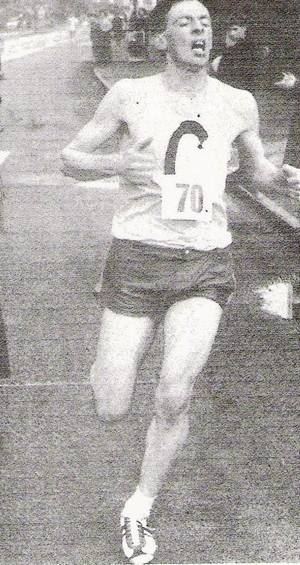
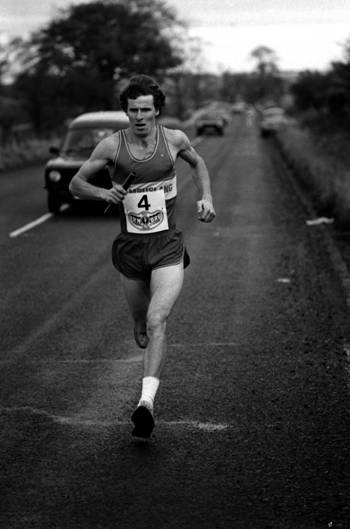
Colin Hume winning the SAAA Steeplechase in 1985

Colin Youngson has written this section about his old club of which he has fond memories and lasting affection.   It is suggested that this selection of good athletes is read in conjunction with those of Edinburgh University and Edinburgh Athletics Club.   Colin writes:

For Edinburgh Southern Harriers the Fast Pack includes: George Brown, Kenny Ballantyne, Craig Douglas, Ian Elliott and Colin Hume (although other good team men were Alex Robertson, Craig Hunter, Colin McIntyre, Ian Steel, George Mathieson, Alan Robson, Calum Henderson, John Gladwin, Neil Thin and Gary Grindlay).

George Brown was a real ESH stalwart.   In the Senior National he first won a team medal (bronze) in 1961.   Over the next decade, a succession of consistent performances brought him a total of nine medals:   two gold (1964 when he was twelfth finisher, and 1970), five silver and two bronze.   In the E-G he featured in ESH teams that won gold (1973), silver (1962, 1963) and bronze (1964, 1971).   On the track, George ran a mile in 4:12.7, and three miles in 14:24.   Much later, in 1979, 1980 and 1983, ESH obtained team gold in the Scottish Veterans Cross-Country championships and George Brown, predictably, was one of their counters.

Kenny Ballantyne   enjoyed an illustrious career and inspired many club mates.   It is good to have an opportunity to profile him, if only briefly.   In the Scottish Junior National cross-country, he won team silver in 1961 and followed that in the Senior National with team gold (1964, 1965 and 1969), silver (1967 when he finished ninth, and 1971) and bronze (1966 and 1968).   Kenny was also very effective in the E-G.   His first team medal in the event was in 1961 when ESH finished second with Kenny recording the fastest time for Stage Eight in which he broke the record.   His team was again second in 1963 and third in 1964.   In 1966, Kenny was fastest on the prestigious Stage Two, in front of Hugh Barrow, Andy Brown and Alastair Wood.   There was another bronze in 1968 and finally the longed for gold medal in 1969.   In 1970 ESH were squeezed into second but Kenny was fastest on Stage Eight.   A final bronze followed in 1971.

Kenny was even more successful on the track, representing Scotland every year from 1961 to 1966.   His best distance was One Mile/1500m and at Motspur Park in 1965 he raced a mile in 4:01.1 which at that time made him the fastest home Scot.   In 1964 he won the SAAA title at that distance, and in addition gained one silver and three bronze medals in the event.   Other pb’s included 1:53.2 (880 yards), 8:51.0 (Two Miles) and 14:05.3 (Three Miles).

Craig Douglas   was a very fine athlete – a real battler – who originally ran for Teviotdale Harriers, but ESH always had a close link with Borders athletes.   On the country, Craig ran for Scotland in the ICCU Junior Championship in 1969 (twenty first after second place in the Scottish Junior, with Teviotdale third team) and 1963 (an excellent tenth).   In both these years he won the East District Junior Cross-Country title.   Actually in 1963 he won the East Senior title as well!   He seems to have concentrated on the track for a few years after that but was part of the ESH teams that won gold (1969 and 1970) and silver (1971 and 1975).   In the E-G, Craig ran for Teviotdale from 1961 to 1966, often going very fast but without gaining any team medals.   However he struck gold in 1969 as soon as he switched clubs to ESH, recording the fastest time on Stage Seven.   In 1970, Craig ‘won’ the first stage although ESH eventually finished second after a thrilling battle with Shettleston.   They were third in 1971 despite Craig’s fastest time on Stage Five, and third once more in 1972.   However it was gold for Craig’s team in both 1973 and 1974 (when he was fastest on Stage Three)

Craig Douglas won the SAAA 880 yards title in 1963 and the 1500m in both 1969 and 1971.   He represented Scotland on the track in six separate years between 1963 and 1971.   Personal best times included: 1:49.9 (880 yards), 4:01.8 (Mile), 3:46.3 (1500m) and 14:36.2 (5000m)

Ian Elliot   was another Teviotdale Harrier, an elegant athlete who later switched allegiance to ESH.    In 1966 he showed early promise by winning the East District Senior Boys title.   He was running for ESH by 1973 when he led them to team bronze in the Senior National.   This was followed by silver in 1974, 1977 and 1978, and gold in 1979, 1980, 1982, 1983 and 1984.   Ian was ninth in 1979 and very disappointed not to make his debut in the World Cross.   He proved the selectors wrong by winning the East District CC later that year.   The Scottish Cross-Country Relay was a successful event for Ian Elliot, who won gold in 1975, 1978, 1981, 1982 and bronze in 1984.   In addition he won two more team golds (1981 and 1982) in the Scottish Six-Stage Road Relay.

On the track, Ian’s personal bests were 3:49.5 (1500m), 14:14.4 (5000m), 29:55.0, (10000m) and 8:53,2 (3000m Steeplechase) in 1977 when he was second in the Scottish rankings.   He won the SAAA Indoor 1500m title in 1974 and represented Scotland in the steeplechase in 1979.   Eventually he returned to Teviotdale and enjoyed several years of considerable success in the Over-40 age-group winning two National Veterans’ Cross-Country titles in 1991 and 1992, plus other championships on the road and track.   Teviotdale Harriers won three National Veterans Cross-Country team awards during this period.

Colin Hume   was yet another very talented Borders athlete who ran for ESH, spent three years representing Memphis State University and then returned to ESH.   He showed great promise from the start, winning the East District Youths cross-country title  in 1978.   That year he was sixth in the Scottish Youths Cross-Country Championship with ESH third team.   In the Junior National Colin won team gold in both 1980 (individual sixth) and 1981 (second).   After his time in the USA he ran in the National Senior in 1985 (team gold, eighth) and 1986 (team gold).   In both 1985 and 1986 he was selected to compete for Scotland in the World Cross.   He won the 1985 East District Cross-Country Championship.   Colin also won team gold in the Scottish Cross-Country Relay in 1982 and silver in 1986.   In the Scottish Six Stage Relay he won gold in 1979, 1980 and 1981 as well as silver in 1986.   The E-G brought further team gold medals in 1978, 1981 (fastest on Stage Seven) and 1985.

His track career was very impressive with personal bests of 1:50.1 (800m), 3:42.72 (1500m), 7:53.06 (3000m), and 8:47.02 (steeplechase).   He was third in the SAAA 1500m in 1982 and won the Scottish steeplechase title in 1985.   A rare achievement was his time in 1983 of 3:59.58 for a mile – indoor!   Colin Hume ran for Scotland on the track in 1981, 1982, 1985 and 1986 over a variety of distances – 1500m, one mile, 5000m and the steeplechase.

Edinburgh AAC

EAC Weatherhead

Adrian Weatherhead to Richard Charleson

Colin Youngson was a familiar part of the running scene in Edinburgh in the 1970’s and knew all the runners, their strengths and weaknesses and got on well with all of them.    He has written three sets of brief profiles of many of the runners from the top clubs and they should maybe read together.   The others are of course Edinburgh Southern and Edinburgh University.

“Edinburgh Athletic Club’s Fast Pack features: The Knowles twins (Danny and Ronnie) and Dougie Hunter.   Others who contributed are Phil Hay, Alex Mathieson, John Kerr, Eric Fisher, Davie Watson, Robin Morris, Nigel Jones, Colin Keir, Alan Gourlay, Archie Jenkins, Brian Kirkwood, Ken Mortimer and that very good Anglo, Joe Patton.

Danny and Ronnie Knowles really have to be profiled together.   Onlookers could only marvel about how similar and how young and fast they seemed in November 1972 when they first ran in the Edinburgh to Glasgow Relay, running the final two stages with their team finishing fifth.   They were newly 18 years of age.  In 1973 Danny had to fight the class men on Stage Two, and on the last Ronnie overtook the Aberdeen runner to secure a silver team medal.   EAC never managed to win the E-G but came second six times out of seven!   Both Danny and Ronnie won three silvers, and Danny was fastest on Stage Seven in both 1975 and 1976 while Ronnie was fastest on Stage Eight in 1976.

In the Scottish Junior Cross-Country in 1974, Ronnie finished seventh and his twin tenth, while EAC won bronze medals.  Their best Senior National was in 1977 when they obtained team bronze.   The Scottish Cross-Country Relay produced two bronze and two silver medals for Danny and one silver for Ronnie, who won another silver medal in the 1981 Six Stage Road Relay.

The above worthy performances were definitely over-distance work for the twins, whose best distance was actually 1500m.   Danny’s fastest time was 3:46.5 and he won an individual silver medal in the 1977 SAAA Championships, plus a bronze medal in the 1976 indoor event.   Ronnie produced personal bests of 3:48.2 (1500m) and 8:29.81 (3000m).   He won a bronze medal in the 1974 Scottish indoor.  

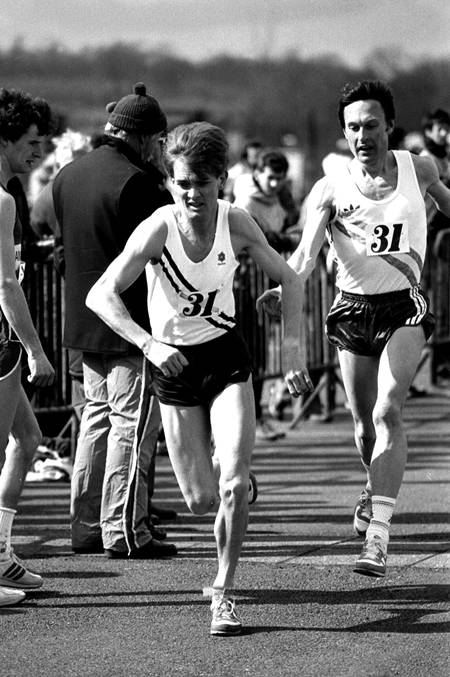
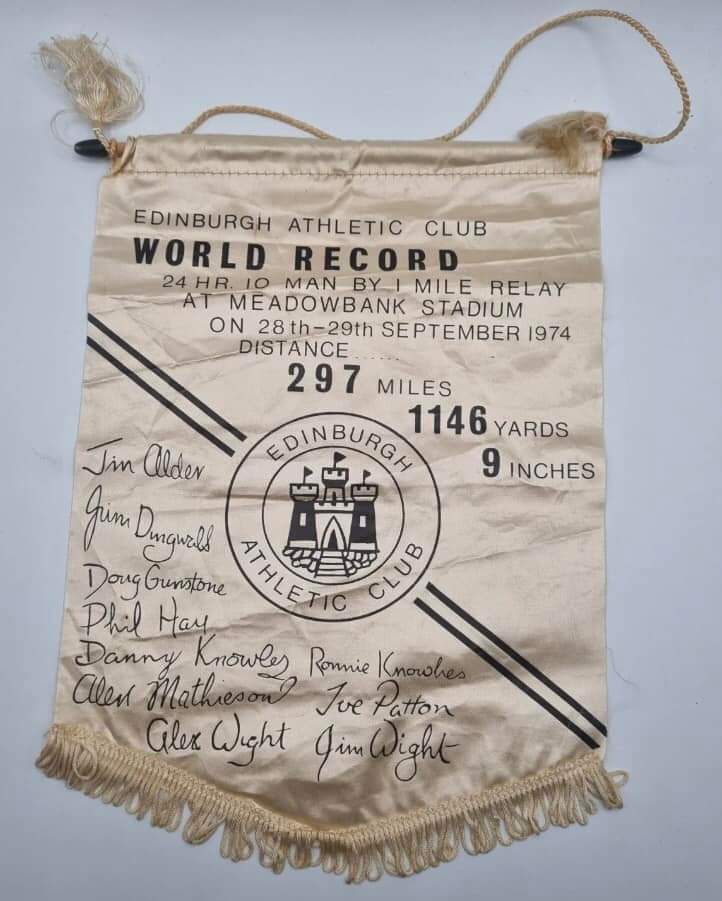
Danny and Ronnie (plus Phil Hay and Alex Mathieson) were four of the ten EAC stalwarts who set a World Record in 1974!

Dougie Hunter   was a tough, stocky guy who always battled as hard as possible.   One of his finest moments in the sport happened early: in the 1978 Scottish Junior Cross-Country, he claimed a valiant second place despite being a full minute behind the peerless Nat Muir.   Dougie must Have enjoyed leading EAC to a gold medal by means of a crushing victory (29 points) over Glasgow University (93) and Nat’s club Shettleston Harriers (107).  

In the E-G, Dougie won four team silver medals in 1976; 1977 (fastest on Stage Seven); 1979 and 1982.   He gained another silver medal in the 1981 Six-Stage Road Relay.   In the Senior National, Dougie won three medals: team gold in 1981 (twentieth finisher) and two silver medals (1979 and 1983).   He added another two in the Scottish CC Relay: silver in 1978 and bronze in 1979.    On the track, Dougie’s best event was the steeplechase (9:25.2) and he also ran a marathon in 2:24:25.”

To that I’d like to add the name of Ken Mortimer.       When I was organising the British Milers Club races in Scotland in the mid eighties, Kenny was an almost ever present with his clubmate Nigel Jones.   Both were accomplished track runners.   Ken however seldom ran on the country although between 1982 and 1987 he ran in five Edinburgh to Glasgow Relays and picked up two silver medals – in 1982 he was fastest man on the fourth stage.   His list of personal best times on the track is impressive:   800m – 1:52.8;   1000m – 2:27.42;   1500m – 3:47.95;   2000m – 5:20.2;   3000m – 8:16.68;   5000m – 14:44.1 and he even had a go at the steeplechase with a time of 9:32.28.   In 1984 he was third in the SAAA 1500m.   He became a veteran in 2000 and has recorded several good times as such.   As a V50 in 2011 he ran 800m in 2:19.36, in 2012 he ran 1500m in 4:55.24; he has an 18:00 5K, a 30:06 five miles, a 37:04 10K,  a 62:27 ten miles, an 85:06 half marathon and finally a 3:12:29 marathon – all as a V50!

After writing the above, contact was established with Ken and he added to the information above.    Since it illustrates the period of the 1980’s in Scottish Athletics and the attitudes of the runners so well, I’ll simply quote his email as I received it.   It reads as follows.   “I remember well the BMC races and never felt that I really managed to do myself justice in them but it was great to have races of that calibre on the doorstep, although at that stage the British League races I was turning out in for EAC were probably taking up the bulk of my mental energy.

It was a great time and I had some great fun with running and many of the highlights you covered prompted some further reminiscing on my part.   A couple which might be of interest were my first Scottish vest in 1984 over the mile at Alexander Stadium when I was paired to run with that very good anglo, Stuart Paton.   I surpassed expectations – perhaps even my own included – in finishing third behind Alan Salter and Eddy Stevens of Belgium in 4:04.32.   They’d both run 4:01 but I’d been there till the last 100m.   Alastair Currie had unofficially timed me around 3:45/3:46 at 1500 metres during the race.   I was flying and was convinced if I could get another mile race a sub-4 was on the cards.   That impression was reinforced in early September at a blustery and cold Meadowbank when I ran my quickest official 1500m but by September the races had dried up and plans to go to Cyprus for a late season attempt fell through.   Another highlight from those days was the Scottish indoors 1500m in 1987 when the Indoor Championships were revived.   I had some experience of running indoors and had been a Cosford Games finalist over 1500m five years earlier but this was a championship.   Heats were required and I front-ran my heat and came under pressure but was determined not to give way, holding on to win it but racing harder than I needed to.   Graham Crawford of Springburn who ran 3000m that day, telling me what I already knew, that it would have been more sensible to ease off since I was in a qualifying position anyway.   Alan Smith of ESH who had a recent 3:46 under his belt was the big threat from the other heat but when the final was run a couple of hours late, to my delight I kicked harder than he did (off a slower pace than the heat) to win it.   I went on to have a decent indoor record winning the East 1500m title the following year (1988), and then picking up two Scottish bronzes over 3000m in 1990 and 1992.

I also ran a bit quicker at two of the distances, 5000m and 3000m steeplechase, both in 1986.   In a Scottish League match at Meadowbank having travelled up from a GRE Cup match 1500m in Wigan the day before, I ran 14:33.47.   It’s a time I should have bettered a few years later in 1992, the year I won the 5000m at the East Districts, but didn’t.   A week later, this time in a British League match at Meadowbank, I lowered my steeplechase time to 9:16.03. 

Since the site is mainly about road running, maybe I should also mention two of my better road races.   The first was the 1983 6 stage relay on leg 5 when I attacked the short leg hard to put EAC back into contention (and back into the lead) with a run which set up a last leg showdown between Lindsay Robertson and Allister Hutton for the title.   Allister was imperious that day and brought Southern home and the EAC squad had to make do with silver medals.   Then there was my occasional venture up into the world of the 10 mile races.   Having been an organiser of the EU 10 mile race in 1982, I finished up eighth in 51:43.   This coincided nicely with my best for 400 metres at the time, 51.4.    I ran it (ten miles) again in 1986 when I finished fifth in 52:40 (and there are some hotos of the race in Graham MacIndoe’s collection) but by now I was intrigued to see what I could do over an easier course.   I got the chance in 1990 when I ran the Tom Scott and finished tenth in 49:08.  

You were absolutely right about me being an occasional cross-country runner although that was where I started.   I reckon my best effort was the Inter-Area cross-country when I finished seventh behind George Braidwood in sixth in the mud of Cumbernauld in 1987.    As you will know, I’m back enjoying my running as a V50 over a variety of distances and even managed to squeeze out 4:46.5 (and a win!) at the August Nithsdale Open Graded last year.   I might even think about returning to my roots in the next year or two and get back on the road.”

And that’s it in his own words.   It is included for several reasons: first it just radiates the tremendous pleasure he got from his running and he doesn’t list numbers of medals or list all his best times he just speaks of the great memories he has – and what’s the sport for if not for the memories.   All coaches are giving their charges memories and if they look back on their career with the delight that Ken does, they will not have done a bad job; second the desire to improve – and the regret when he didn’t -is mentioned at several points, eg aiming to travel halfway across the world to Cyprus to get a better time, or regretting not bettering his 5000m time; third it illustrates the range of events open to runners at the time – Scottish League, British League, Open Gradeds, Championships, Cosford Games and so on.   Most are still there but not all are and it is much more difficult to plan a year’s progressive racing now than it was then; fourth, he talks of international representation, the lack of such now is well documented elsewhere on this website.  

Dundee Hawkhill Harriers

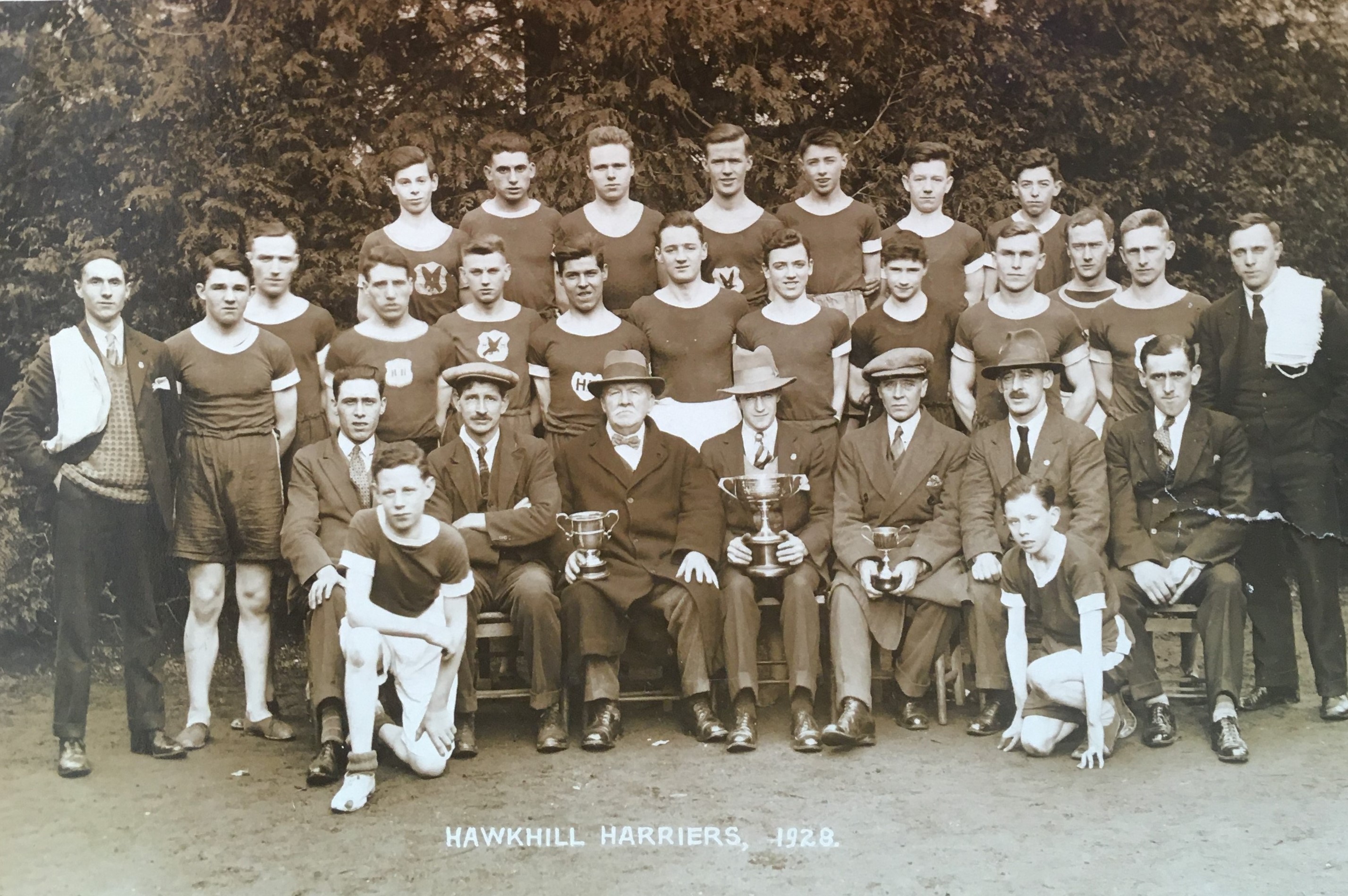
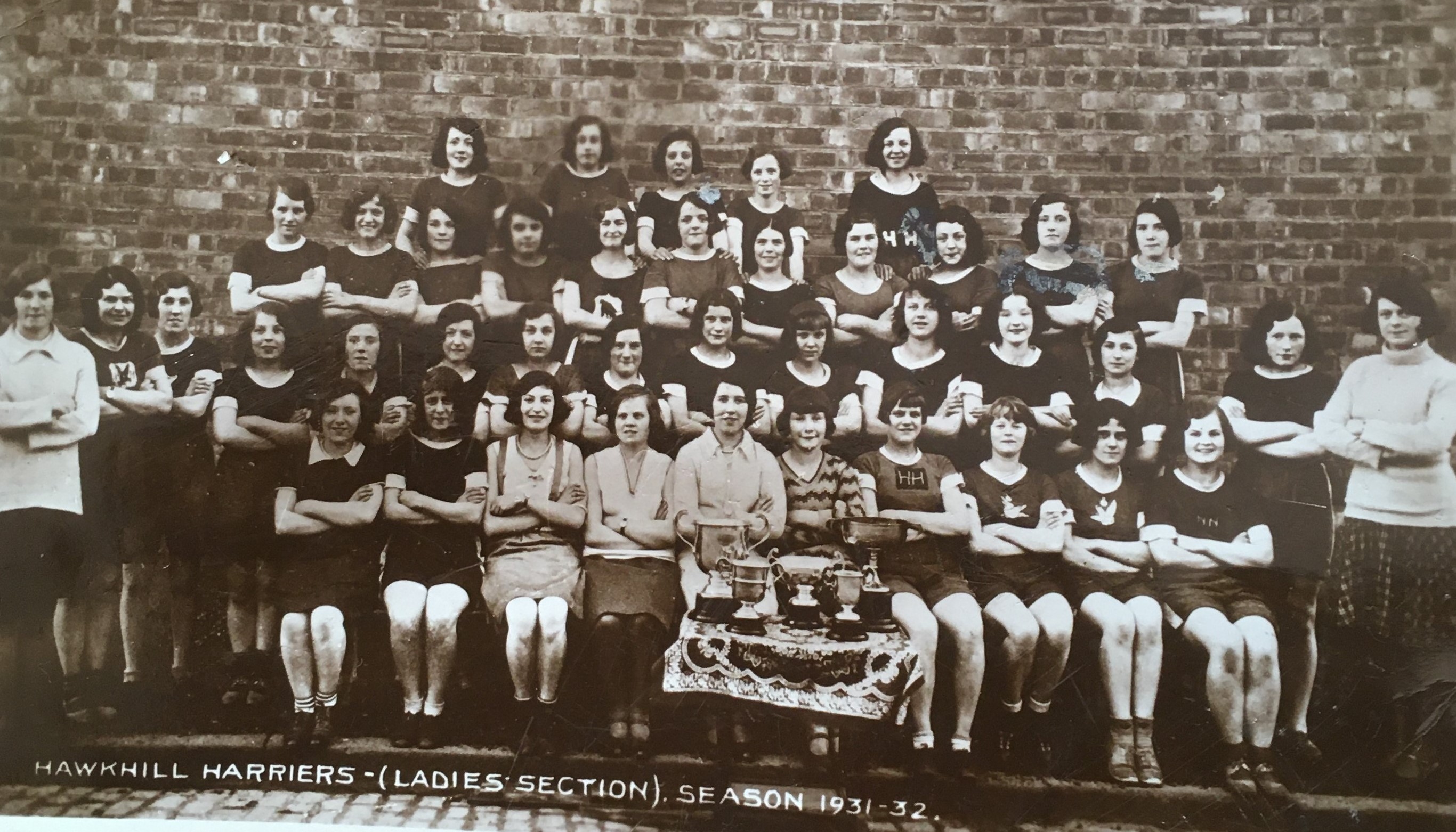
Note the club tops which are a plain colour with the hawk on a square of material stitched on.

Dundee Hawkhill Harriers is one of the oldest clubs in Scotland and also has a women’s section dating back to the beginnings of Scottish women’s cross-country running in the early 1930’s.    They produced women cross-country and track champions such as Mildred Storrar and of course currently they have Olympian Eilish McColgan following in her mother’s very successful footsteps.  But the men have been no less successful and while Mildred Storrar was winning titles, the men were doing well with men such as Alex Donnett and Charlie Smith winning international caps for the men.   Dundee was a real hotbed of athletics and Charlie’s brother Suttie Smith – one of the real stars of the sport – competed for Dundee YMCA although the main rivals to Hawkhill was the now-defunct Dundee Thistle Harriers.   Colin Youngson has selected several runners from a particular spell of real success for the grand club and his account is below.   This is followed by a link to the history of the club from 1924 to 1945.

Dundee Hawkhill Harriers were formed in 1889.   They were the best club in their area for many years and promoted classic road races such as the Kingsway Relays and the Perth to Dundee.   Back in the 1960’s they fought with Aberdeen AAC for supremacy in the North-East Cross-Country League, producing runners like Fergus Murray, Ron Coleman, Phil Kearns, Rab HeronDoug Gunstone and Ian Graves.   However in Scottish National Competitions, their best teams featured in the late 1980’s and early 90’s.   Liz McColgan was world-famous but male club-mates included her husband Peter McColgan, Charlie Haskett and Iain Campbell, as well as ex-Clyde Valley star Peter Fox , Chris Hall (Welsh international, previously Aberdeen AAC), Dave Beattie, Richie Barrie, hill runner Des McGonigle, Matt Strachan, Paul Briscoe and Craig Ross.   Ross Copestake won the Scottish Cross-Country Under-17 title in 1980 and went on to run for his country in the World Cross as a junior and as a senior.   Terry Reid also won the Scottish Under-17 title in 1987.

In the Edinburgh to Glasgow Relay, DHH were a top ten club for several years before breaking through in 1989 when they achieved a tremendous victory.   Dave Beattie was second on the first stage, Peter McColgan brought them into the lead with the fastest time on Stage Two, and Terry Reid, Craig Ross, Iain Campbell (fastest on Five), Charlie Haskett, Richie Barrie and Peter Fox retained first place to the end, a minute and a half clear of Cambuslang Harriers.    The following year, by only four seconds, the Hawks lost a titanic battle with Falkirk Victoria Harriers.   B Pattieson was fastest on Stage Seven and the other silver medal winners were P McCanna, B Cook, Chris Hall, Charlie Haskett, Richie Barrie and both Iain and Ian Campbell!

HMcK RB

Hugh McKay to Richie Barrie in the Six Stage Relay in 1983

Charlie Haskett was a real stalwart for Dundee Hawkhill Harriers (Charlie’s father Chick was a good runner, his elder sister Christine was a major Scottish star on track and country and his son Mark is also a fine athlete.)   Charlie won the East District Senior Boys CC in both 1972 and 1973, followed by East District Youths CC in 1974 and 1975.   Then in the 1975 National CC, he won a silver medal in the Under-17 age-group behind the peerless Nat Muir.   In 1976 he finished eighth junior.   Charlie represented Scotland in the IAAF World Junior CC in both years.   His consistency in the Scottish Senior National was outstanding: six successive top ten performances between 1984 and 1990.  His best placing was sixth in 1985.   Charlie won four Scottish CC medals with DHH: bronze in 1990 and 1993, and silver in 1991.   In the Scottish CC Relay he won team silver in 1990.   The Six-Stage Road Relay produced considerable success for the Hawks and Charlie Haskett won team silver in 1989 and 1991, and must have enjoyed the victories in 1990 and 1994.   He ran 18 E-G’s, including team gold in 1989 and silver in 1990.   In the summer season Charlie ran well in the steeplechase and 10000m (30:24) and gained Scottish international vests as a marathoner, with a best time of 2:18:41 (1984) and silver medals in the Scottish Championships (1984 and 1987).   This durable athlete went on to run well as a veteran on country and road.

Peter McColgan was a Northern Ireland international who ran in the 1986 Edinburgh Commonwealth Games, reaching the Final in the steeplechase and 5000m..   By 1987 he was running for Dundee Hawkhill Harriers and won the 1988 East District   CC title.   Twice Northern Ireland steeplechase champion, in 1990 he won the Scottish 5000m title.    Then in 1991 he he claimed UK steeplechase gold.   He represented Great Britain in the 1991 World Athletic Championships steeplechase in Japan.   His track personal bests include two NI records (3000m indoors 7:54.48, and steeplechase in 8:27.93.) and a mile in 3:59.37.

Peter contributed a great deal to DHH success from 1987 to 1994.   He was fastest on Stage Two of the E-G in 1987 when his club finished fourth.   Then he was fastest once again on Stage Two in 1989 setting Hawks on the road to victory.   In 1989 he was part of the team which won silver in the Scottish Cross-Country Relay and then gold in the same event in 1990.   In the Six-Stage Road Relay, he gained team silver in 1989 and 1991 and then gold in 1994.   However his finest moment must have been when he won the Scottish Senior National Cross-Country title in 1990, leading DHH to bronze.   Peter also finished second individual in the 1991 National, with the Hawks being second team as well.

Iain Campbell (born 1960) originally ran for East Kilbride AAC, running the World Junior Cross-Country in both 1978 (27th) and 1979 (an outstanding 10th).   Then he went on to Clemson University in the USArecording a 5000m best of 14:02.0 in 1985.   He represented Dundee Hawkhill Harriers from 1989 to 1994.  Apart from making a major contribution to gold and silver medals in the 1989 and 1990 E-G, he featured in three further championship wins: 1990 and 1994 Six Stage and 1990 Cross-Country Relay.   Always enthusiastic and hard training, Iain went on to become a regular and successful member of the Scottish Masters squad for the annual Five Nations CC International.

Near namesake Ian Campbell was ten years younger and a track specialist (800m and 1500m) with impressive junior bests of 1:53.6 and 3:51.5.   His senior club 1500m club record is 3:43.64.   He was sixth on Stage One of the E-G in both 1990 (team silver) and 1992.  In addition he helped the Hawks secure team gold in the 1994 Six-Stage Road Relay.

Peter Fox (born 1962) originally came from Motherwell district and showed a great deal of athletic promise.   In 1978 he won bronze in the National Cross-Country Under 17 championship, and then gold in the Scottish Schoolboys Track 3000m.   In 1979 he finished first in the National Cross-Country Under-17, and won the Scottish Schoolboys 5000m.   In 1980 it was silver (behind Graham Williamson but in front of George Braidwood) in the Under-20 National Cross-Country.   Peter Fox ran for Scotland in the World Junior Cross-Country in both 1979 and 1980.

By now, along with Brian McSloy and Colin Farquharson, Peter was one of the young lions racing for Clyde Valley AC.   In 1979 (along with future 800m star Tom McKean) he was one of the team that won the Scottish Cross-Country Relay Young Athletes Championship.   Then Peter won two senior team gold medals in the 1979 and 1980 Edinburgh to Glasgow Road Relays, as well as two silver medals in the 1979 and 1980 Six-Stagers; and two more silver in the E-G when Peter was fastest on Stage Eight.   The 1982 Senior National Cross-Country produced team silver.   In the 1983 E-G, Clyde Valley AAC finished third with Fox fastest on Stage Four.   Then in 1986, running for Motherwell YMCA Harriers, Peter won the West District Cross-Country Individual title.   He was fourth in the 1988 Senior National Cross-Country.

Peter Fox studied for a medical degree at Dundee University and subsequently worked in the area as a doctor.   So Dundee Hawkhill Harriers must have been very pleased when he eventually joined them first-claim, making an immediate impact with a superb third place in the 1989 Senior National over a tough, hilly, snow-covered course at Hawick, behind Tommy Murray and Anglo Paul Evans but in front of Steve Ovett!   With the Hawks, Peter went on to win gold in the 1989 E-G and 1990 Six-Stager; plus silver in the 1989 Six-Stager, 1989 Scottish Cross-Country Relay and 1991 National Cross-Country, and bronze in the 1990 (tenth finisher) and 1991 National.   Although his training after this may have been reduced due to work commitments, this cheerful, popular runner can look back a career with so many fine achievements.

*   In the Six-Stage Road Relay, Dundee’s medallists (gold in 1990 and 1994 and silver in 1989 and 1991) included Haskett, McColgan, both Campbells, Peter Fox, B Cook, P McCormack, P McCavana, D Storey, Matt Strachan, J Hill, Craig Ross, Des McGonigle and Chris Hall.

*   1990 Scottish CC Relay gold medallists were Chris Hall, P McCavana, Iain Campbell and Peter McColgan.   1989 silver medallists were Fox, Paul Briscoe, Haskett and McColgan

*   Scottish Senior National Cross-Country team medallists (bronze in 1990 and 1993, silver in 1991) included Haskett, McColgan, Fox, Hall, Storey, McGonigle, Strachan, Briscoe, G Rennett and I Campbell (the younger?)

That is where Colin’s account of the DHH Fast Pack concludes but of those mentioned above, I knew Hugh McKay and Richie Barrie through their involvement in British Milers Club races that I organised in the mid-80’s.   Hugh (DoB 18/06/60) was a man of several clubs, having run for Central Region and Dundee University before joining the Hawks and he currently runs for Fife AC.   He was a good, honest runner who always gave of his best and by 1985 his best 1500, time was an excellent 3:48.3.   Richie was younger, Date of Birth 10th March 1963, but was also a good runner.  After the BMC Annual General Meeting in Glasgow in 1985, he offered to organise it for the following year in Dundee but was unfortunate that the National Committee wanted it back in England again.   In 1985 his pb for 1500m was 3:49.47 at the age of twenty one.   

Dundee Hawkhill Harriers – 1924/1945   Mildred Storrar   Nan Robson   Caird Park: In the beginning   Caird Park 1954 – 1990

   Dundee Kingsway Relay   The Gunstones     The Hasketts

Eddie Crozier

E%20Crozier%20pic[1]

Athletics, particularly running it seems, is basic to every sport in the land: sprinting is sprinting whether it is done on a track, criss-crossing a tennis court or ‘pinning your ears back and going for a try’;  throwing is throwing whether it is shying a ball into the box at a football match or taking a line-out throw; jumping is also basic to many sports from gymnastics to basket ball.   It is therefore no surprise to see athletics coaches such as Allan Wells, John Anderson, Tom McNab and Stuart Hogg working with professional squads in a whole host of other sports.   Many athletes in their career take part in other sports.  One sport which has benefited greatly from the input of athletics is rugby union.

The new vice-president of the Scottish Rugby Union, Eddie Crozier, used to be a runner himself.     Eddie hails from Dumbarton, son a local lawyer, and ran for the local Dumbarton AAC as a sprinter who specialised in the 400m.   As a rugby man Eddie represented two clubs from Glasgow on the sport’s governing body –  West of Scotland and Glasgow Academicals both of whom were in at the birth of the Scottish Amateur Athletic Association in 1883 as founder members along with such as Watsonians, Loretto, Royal High School, Edinburgh University, St Andrews University, Edinburgh Academicals, Fettesian-Lorettonians and Blair Lodge School.   The rugby link with athletics is still there – for instance at Scotstoun, used for athletics since the 19th century, is currently shared by athletics, mainly Victoria Park AAC, and the Glasgow Warriors rugby team.

Eddie himself is part of a long line of sprinters and 400m men who took part  in his sport.  Taking the 400m, it is possible to go back via Menzies Campbell who was the best British sprinter of his generation over 100m, 200m and 400m who captained Scottish and British teams, captained the Olympic team, won many international honours as well as doing the ‘double treble’  – ie winning the 100 , 220 and 440 yards at the same championships as well as a couple of doubles!  In total Campbell won the 100m 3 times (62, 63, 64), the 220 3 times (63, 64, 65), and the 440 4 times (61, 62, 53, 64).   Campbell raced all over Britain and was a regular runner for Glasgow University as well as for Garscube Harriers. He was a noted rugby player and although he never won a Scottish cap, he won a Twickenham sevens medal with Edinburgh Wanderers.   Going back a wee bit further we get the great Eric Liddell who won the 100 five times (1921, 22, 23, 24, 25), the 220 five times (1921, 22, 23, 24, 25) and the 440 yards twice (1924, 25), including a ‘double treble’ in 1924 and 1925.   Liddell was a rugby winger of strength and speed who was a regular all over Scotland at big meetings such as the Rangers Sports as well as at local meetings.

There were others but if we look at Eddie’s running career, one of his club mates at Dumbarton was noted official and administrator Jim McInnes, who served his time as President of the SAAA, and who himself (a) started out as a sprinter at the club and (b)who had played as one of the backs for Glasgow High School.   Dumbarton had a very good track team at that point – multi-Scottish medallist at decathlon and over the 440 hurdles Bobby  Mills covered many events, quarter and half miler Jack Brown was also a man capable of competing in other events, the young Currie brothers Alistair and Allan with fellow distance runner Scott Reid held great promise for the future, and at one point the club had four sub-two minute half milers in Mills, Brown, Jack Baird and Colin Martin.   Colin was a top class athlete at any distance from 440 yards to the steeplechase and only just missed out on Commonwealth selection.  Check their times on www.scotstats.net in the Archive section.  They trained at the Postie’s Park track in Levengrove Park in Dumbarton.   It was into this team that Eddie Crozier came.

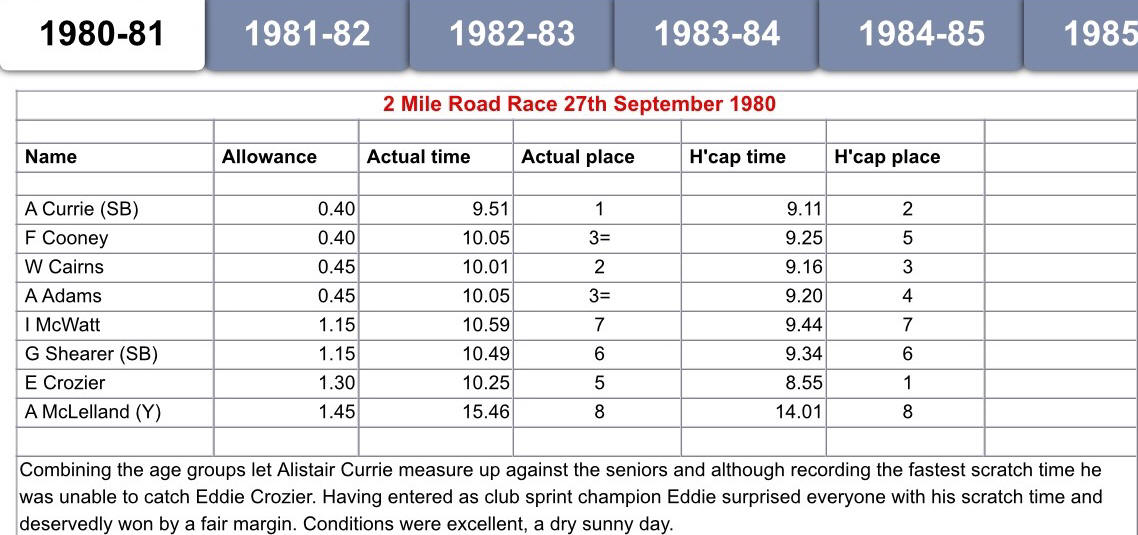
If we look at the result below, taken from the DAAC website and drawn to my attention by Hugh Barrow we note that he defeated sub-4 minute miler Alistair Currie in a handicap club road race in 1980.  Amazing as the running of Campbell and Liddell was, neither has ever defeated a 4 minute miler!   Eddie has that honour:.

Alistair Currie’s ability was clear from the start and at local level races were arranged to give him ‘a good pull oot’.   The note at the foot of the result is self explanatory.   The link between good 400m men and rugby is clear.

If further proof of the 400m sprinters – rugby link were required, Brian Whittle, another outstanding 400m runner with Scottish and GB representation all the way through his senior career, an Olympian as well as a World, Commonwealth and European runner of note, was also a rugby player and a man who could have gone either way: his friend Derek Stark, who admittedly only ran 100 and 200m was also a rugby player of great ability.   Most recently of all, Guy Learmonth of Lasswade, a 48.0 second 400m runner and international athletes over 800m (1:46.69) only took up running seriously when he was not selected for the Under 17 Six Nations squad!

 The elevation of Eddie Crozier is an addition to the ever growing list of former athletes excelling in another sphere.   We have commented in the past on former athletes who are now better known as operatic tenor, a football referee, radio/TV sports reporter, successful sports agents, millionaire financiers, journalists of every sort and the list just goes on.   Well done Eddie.

I finish with a quote from Hugh Barrow:   When confronted with his past athletics endeavours Ed responded – “I can remember that day one of the Adams brothers wound me up re being a sprinter ! I thought my lungs were going to come through my throat !”    Most runners make a comeback at some point in their career – will we see    “E. Crozier (Dumbarton)” on a 10K results sheet at some point?

Glasgow – Fort William Relay

By Mike Lidwell, Dumbarton AAC, 16th April, 1975.

The pursuit of the athletic ideal may lead to the staging of long distance running events but is not so often associated with the appreciation of scenes of landscape beauty.   More often urban scenes are the runner’s lot: seen through a maze of traffic signs and between smoking motors.   Yet the happy union of a good running course and spectacular scenery was achieved by Dumbarton AAC in a long distance relay between Glasgow and Fort William.   As a final inestimable boon the event was blessed with the best weather conditions so far experienced this year.   The sun rose shortly after the runners and shone on the participants until the eventual massing of the clouds heralded the descent into Fort William.   Perhaps in deference to the romantic appeal of this traverse of the MacGregor country, the old name of Inverlochy should be used.

Conception

The aim of the exercise was to counter the trend in modern running away from natural point-to-point  events towards artificial courses on prepared tracks or soul destroying road running.   This breath of fresh air will have helped to revitalise the sport.   Accordingly, no course as such was defined: only a set of conditions was imposed on teh teams to preserve the desired character of the event.   The route used is believed to be the fastest possible without the use of public roads and if we or any other club wish to repeat the run, any time-saving modifications that are suggested will be incorporated.   In practice, some road mileage is unavoidable, a limit of 20% is suggested and of this, less than 5% on major trunk roads.   Only 8 baton carrying runners were employed but additional support runners were not excluded and in view of the rugged nature of certain sections of the course are an essential safety provision.   It is hoped that the time of 11 hours 03 minutes 44 seconds achieved by the club is a challenging one that may provoke a response from other clubs.   However like all records it is undoubtedly doomed once the greater runners tackle it.   The distance run was about 90 miles, excluding involuntary excursions, and the intended route did not differ by a large amount from the straight line, so that an ultimate limit nearer 9 hours 30 minutes is expected.

A large amount of effort was spent organising this inaugural run.   Maps were prepared and trial runs made over most sections.   In many instances, the available maps were found to be deficient in significant detail and these deficiencies were carefully charted.   Study of the maps reveals the problem of establishing changeover points.   The aim was to arrange 30 stages of about 3 miles or 20 minutes running time but some double stages of 7 miles with up to triple our target times were necessary.   The problems of transporting the runners to their starting points were solved by splitting the runners into two teams of four runners, each team having independent transport.   The ‘A’ team was responsible for the first section between Glasgow and Killearn and the third section between Falloch and Kinlochleven; the ‘B’ team was responsible for the second and fourth sections.   In this way the support parties were given time to drive round from Stronachlachar to Glen Falloch and to deposit runners at Kinlochleven where the route is considerably shorter than the road.

The runners were all allocated their stages prior to the start although changes could be made subsequently.   One virtue of this type of event is that legs can be found to suit the tastes of each runner provided there is a sufficient mixture of abilities in the club.   The fell runners necessary for the stages before and after Glen Falloch are perhaps the key to a successful run but the long stretches of old road and forestry track are significant to achieving a good time.   Finally inspection of the calendar showed that the event must be staged after the vernal equinox to ensure sufficient daylight.   As the 15th March coincided with the date traditionally set for the club point-to-point event, it was chosen.

The City Link

Just before 6:00 am the ‘A’ team runners assembled in George Square, Glasgow.   The dawn was just throwing aside the shadows from the facade of the City Chambers as the runners and officials assembled on the starting line in front of the GPO beside the steps of the Cenotaph.   The morning traffic not yet on the move, the field was free for Gordon McLaren to take the first strides across the square then through the streets to join the canal towpath at Port Dundas.   This branch of the Forth and Clyde Canal provides footpath access to the centre of Glasgow although closed to boat traffic.   The eventual construction of the Maryhill motorway may cause this route to be abandoned perhaps in favour of the newly constructed Kelvin Walkway.   After 18 minutes running on the level towpath, Colin Martin took over at Wyndford at the junction with the canal proper.   The morning light was now illuminating the still waters of the canal with all the signs of a fine day to come.

In Maryhill it was necessary to leave the canal and make a short link along the main road to reach Rannoch Drive.   This minor road led through a suburb to the next changeover at Boclair at the gates of the cemetery by the Roman Wall.   Colin being one of the fastest members of the ‘A’ team soon completed this stage to arrive at 6:47, well ahead of schedule.   The next stage was a rather complicated route skirting the Hillfoot Golf Course and then following the banks of the Allander Water into Milngavie, hopping over a fence on to the main road.   Here the North wind could be felt and Ronald Paton was perspiring with the effort when at last the hill up the road through Milngavie to the reservoirs had been surmounted.

The Pipe Track

Here, the city section complete, our route joined the line of the water pipes by which Glasgow is supplied from the pure waters of Loch Katrine.   Various tracks and footpaths giving access to the pipes for maintenance are kept in spick and span condition by the efforts of the corporation and enable this route to be followed with ease.   From the banks of the reservoir which form a customary Sunday afternoon perambulation for the citizens of the West End, a wide view over the City is obtained but Alistair Lawson, one of the pioneers of this enterprise kept his head down as he concentrated on getting over the Mugdock Hill to Strathblane as fast as possible, taking care not to get bogged down in the marshy stretches between the small lochans on the moor.   He was soon seen by the watchers at the fourth changeover negotiating a slippery descent down a grassy field to the memorial at Netherton Cross.   Here Campsie Dene Road an attractive track following the water leat, runs along under the crags of the Campsies.   Gordon, taking over for his second run,sped along the track taking the many gates in his stride.   In some little woodland glades the birds were startled by an unaccustomed apparition as this scantily clad  runner rushed by.   The morning sun could still be seen hitting the hills of Luss across Loch Lomond.   The next changeover the last of this section, was more difficult of access.   The timekeepers and photographers were left gasping after a sharp ascent to the track above the Glengoyne Distillery.   However Colin, the next stage runner, was obviously not affected as he completed this stage to the tennis club in Killearn before his support arrived.   Here the ‘A’ team withdrew after having achieved a very satisfactory start handing over to the ‘B’ team some eight minutes earlier than expected, even after having started 10 minutes late.   The ‘B’ team were in fact caught hopping but their first runner, Harry Martin, did not lose much time stripping off and starting off down Drumtian Road to the footbridge over the River Endrick.   Here the first setback came as, running unrehearsed and returning from his recent honeymoon, headed off trail along the Endrick towards Drumtian Farm.   Once again, after rejoining the trail, his direction went askew as the perturbed watchers waiting by the pipe crossing on the Drymen to Aberfoyle road saw him continuing up the road straight for Aberfoyle.   A valuable 4 minutes must have been lost by the time he had retraced his steps from the garage at Ballat.

 Meanwhile Michael Lidwell was waiting for his stage across the moor to the Moorpark changeover warming up in the sun’s rays now flooding over the old plug of Dungoyne which forms the terminator to the mass of the Campsies.   A landmark for much of the first half of the route.   Eventually the change was made and he set off across the damp grass chasing the rabbits as they plunged for their burrows.   Occasional stone pillars mark the pipes buried underneath but there is little else to show the route across open moorland.   Eventually a dark line of the forestry heaved over the horizon and the trail veered downhill to the right and the changeover at the entrance to the Queen Elizabeth Forest Park.   Here another rushed changeover as the support was delayed by a horsebox on the narrow road.   Ian McWatt, the runner on this long stage through the forest was helped by Allan running in support.   This was fast running again on an access road but then the hard track degenerated to a loose grit surface as the trees closed in beyond Corrie.   Roe deer may be come upon suddenly when runners swiftly swing round the bends.   Occasional glimpses of the snow plumes summit of Ben Lomond were caught through the gaps in ranks of spruce.   It was while on a training run here with Alistair that the idea of the relay was born.   Our route went over Duchray Water by a planked bridge shared with the water siphon then was followed by a short stiff climb  by the piped to reach the level of the aqueduct at the Loch Ard changeover on a private road in the middle of the forest.   Billy Cairns now took over leaving Ian and Allan to drive round to pick up the trail again at Glen Falloch while the rest of the team leapfrogged on to Loch Dhu, driving from Kinlochard by a narrow dead end road.   The trail here departed from the pipeline following the infant River Forth  winding up to its source under Ben Lomond, before at Stronachlachar it crossed a low ridge back to the pipes and into another river system which flows from Loch Chon to Loch Dhu then Loch Ard before joining the Forth.   The runners were still making good time but no spectacular gains on the schedule.

At Loch Dhu, Harry took over again, as Michael husbanded his resources for the mountain stage over the pass at the head of Glen Gyle.   The trail now took a delightful little path through mixed woodland along the shores of Loch Chon.   At Frenich however the path becomes confused.   It is necessary to duck low under the branches of a small cluster of firs to find the oath and Harry chose the farm access track at the road losing a further two minutes.   Billy took the baton at the stile at the start of a path above the pipes tunnelled through the hill to Loch Katrine to the water inlet at Royal Cottage.   The hill is steep but short before the waters of Loch Katrine lie at your feet.   The rivers on this part of the route run east to the Forth.   Our route crosses the main watershed of Scotland no fewer than six times and in this respect may be considered a successor to the much publicised Pennine Way.   The watershed is highly convoluted, the rivers Clyde, Falloch, Orchy, Etive and Leven flow west, while the Forth, Cononish and Ba flow to the east.   However man has tampered with this natural distribution, the water at our feet is destined to flow west into the sewers of Glasgow but I doubt if this was bothering Billy as he descended into the birch groves speckled with sunlight and turned on to the little road that runs over rocky promontories along the loch shore to Stronachlachar.

The Drove Way

DAAC%20Harry[1]

Harry Martin at Loch Katrine

At the white gate marking the start of the private road, controlled by the water board, Harry took over again.   The photographer  with the party was moved to take a mood photograph of the light playing among the trees on the loch shore and slanting over the distant summit of Ben Venue.   The runners tiring, the ace was maintained by running short relay sections alternating between Harry and Billy.   At the head of the loch started one of the key runs of the day, following the route of an old drove road from Argyll to markets in the east.   This is the first of four mountain stages: Glen Gyle to Glen Falloch, Glen Falloch to Glen Atrioch, the Devil’s Staircase and the Lairig beside the Mamore Hills.   Each of these and the other double stages through Loch Ard Forest and over Rannoch Moor has been assigned to a runner as his prime task: six miles of rough mountain going may be considered a day’s outing in itself.   Michael took over at the gate and threaded his way through a heard of bullocks then  slithered over the wooden balks of timber that take a track over the marshy ground.   Soon after crossing the burn the gradient steepened and Eve’s road, made by the contractors to place the electricity pylons, became rough and stony and took a rising traverse on the north side of the glen.   All was still and very quiet in the shelter of the surrounding hills basking in the warmth of the midday sun.   The time is now approaching 11 o’clock and we are about 30 minutes up on schedule.   Running this ascent for the third time, every stone was familiar as the glen narrowed and the track petered out, it was helpful to know the best line as the trail crossed and re-crossed the diminishing slope to the burn.   The ground steepened and a large boulder marked the place for increased effort on the final slope to the col.   Once over the pass at 1420 feet the physical effort was diminished but the terrain became difficult.   By keeping well to the right the worst of this was avoided and the runner wove, jumped and fought his way over the black muddy wallows and deep beds of heather.   After wading the Beinn Glas burn the going became easier and the end of a rough track leading to Glen Falloch was reached.   A short spurt ascended some 200 feet on the track before the test of making a descending traverse across a steep untracked hillside, etched with stream gullies to the river crossing far below.   However he was pleased to splash through the river well within his personal target of 65 minutes for the stage.

The Falls of Falloch are the halfway point and our time to this point was 5 hours, 34 minutes 32 seconds.   An encouraging result which suggested an arrival in Fort William shortly after 5 o’clock.   The ‘A’ team now resumed running with Alistair repeating his trial run over the next stage.   Against the 1400 feet of vertical ascent and six and a half his early morning run over Dumbuck moor was a gentle warm up.   The hill rose uncompromisingly directly ahead of him and the best line lies direct up the drier ground past an old boundary stone of the Britons.   The rest of the team who have been taking a rest period enjoying the sun, lying out on the grass, packed up while Michael washed off in the cold water!   The joys of Glen Falloch are often missed because of the proximity of the main A82 but some fine mountain summits such as Ben Vorlich and Cruach Ardrain lie on either side and all of them today present glittering snow tops.

The gap Alistair passed through between Fiarach and Ben Dubhchraig is at an altitude of 1520 feet and not too far from the snow.   Small patches lay in the hollows of the broken ground of the upper corrie.   Once over the top he descended to the burn and then ran down its easy grassy banks in Glen Atrioch to a vestige of the old Caledonian forest by the River Cononish.   A panorama of the route ahead opened out over the wood towards the peak of Ben Dorain peeping through the Meall Odhar pass.   Arriving in Glen Cononish the possible problem of the river crossing was solved by using the railway viaduct, although this was not recommended as the trains are infrequent.   The survey faced a difficulty with the next stage to Tyndrum as the originally proposed route  had been ploughed with ditches by the Forestry Commission, the only sensible route was to continue beside the railway.   The Cononish rising near the peak of Ben Lui with its precipitous north face  is the source of the Tay and here near the sacred pool of St Fillan is deep with rocky pools.   A changeover by the railway bridge over the track leading from Dalriach up Glen Cononish might have been an advantage but as the support would have to walk in it was not carried out, leaving Alistair to plod alone for a last weary mile into Tyndrum.

DAAC%20Lidwell[1]

Mike Lidwell splashing through the Falloch

The Military Road

A reunion took place here as Ian and Allan arrived after their drive from Loch Ard and a discussion took place as to whether Ian should run again to save Ronald for his run over Rannoch Moor but it was decided to keep to the original scheme.   Alistair arrived worn out but on time and Colin took over using the old road which was abandoned by motor traffic in the 1930’s.   The surface, though eroded in places by small burns that become torrents in bad weather, was good.   Coming down the hill towards Auch with the famous railway horse-shoe.   Colin hesitated as stags blocked his path but continued as they took to the hillside.   At Auch the support waited by the parapet of the old stone bridge and began to feel chilly as a layer of afternoon cloud moved over  the sun.   The level of the terrain had risen as the route moved towards Rannoch Moor, a large, wild upland area which isolates the north of Scotland.   Ron took over for the ‘A’ team for the run  down to the old road just past Kingshouse.   Alistair took over the baton and the others scuttled back to their cars.   Driving along the main road it was just possible to pick out the lonely figure picking his way along the track on the other side of the valley.

At Bridge of Orchy there was a general reunion as the teams met again, the first real chance for a chinwag at Killearn was such a rush.   Jack Brown brought Billy and Harry round the long road from Stronachlachar passing round Loch Lomond by Balloch, a round trip of some ten miles.   In obedience to the old sign, a left-over from the time when tjis was a main road we routed the run through the subway at the station and changed over in the station forecourt.   Soon Ron hove into sight behind a herd of highland cattle.   A fearsome sight these beats in full flight with their impressive spread of horn.   However seeing the crowd  in front they peeled off from the track to allow our runner through: a traffic hazard not so often met on the alternative road route.   Here the direct line concept demanded that we follow Invercauld’s old military road over the hill to the hotel at Inveroran, but the Forestry Commission have been at work across the start of the path and our survey had not properly extended to the northern sections, so our first runner, Colin Martin, took the easy and probably faster road round, a little road dipping and rising over hummocks and through clusters of old pines, that is surely mis-classified as an A road.   An auxiliary car was sent out to cover the changeover at Forest Lodge.   The point at which the road terminates after crossing the Victoria Bridge in fron tof the big white gate.  The bridge is one more in the sequence of fine old stone arches which once took the old road north.   The stage over Rannoch Moor followed a long, remote track, winding its way round the edge of the moor under the shadow of the mountains from Stob Gobhar to Clach Leathad.   The gradients are easy but it is easy to underestimate the climb of some 850 feet in addition to 7.3 miles of distance.   Conditions were good but the chill breeze from the north wafted around Ronald as he appeared to be isolated from his comrades and indeed the whole world.   Once clear of the stand of pines around the lodge, the track rises rapidly up the Black Mount and looking back one surveys the icy ridge of Ben Achalader over the smooth waters of Loch Tulla, then the route passes into a defile before coming into a wide corrie around Ba Cottage.   The building a ruin long ago, but the old bridge still stands and does its job of aiding such travellers as care to pass this way.   A changeover here, the support walking in along the path up Loch Ba from the main road might have been an advantage but involve too much effort.   As it was, Ron was flagging as much from lack of company as exhaustion but the time he reached the summit of Meall a’Bhruidh before he picked up again on the run in to Black Rock.   His time however matched that produced by Alistair and Billy in the New Year trial.   The other runners have been taking things easy at Black Rock, snoozing in the van well wrapped up for warmth, or testing the binoculars by watching the ski-ers sporting themselves on the slopes above, near perfect snow conditions it appeared.   Colin goes to the phone at the ski-lift to publicise our efforts through Radio Clyde.   At last Ron appeared and Ian stripped off to lend his support to the ‘A’ team for the run down the old road past Kingshouse.   Alistair took over at the road junction with the Glen Etive road  and failing any reasonable alternative took the main road for the stage to Altnafeadh.   These short two-mile legs were dominated by the vast mass of the Buchaille culminating in the vertical cliffs of Carn Dearg, a sight which dwarfed the runner seemingly crawling underneath.

The Devil’s Staircase

At Altnafeadh, Gordon took over for the climb to the highest point of the course, at the summit of the Devil’s Staircase, 1850 feet above sea level.   He takes with him Allan, the reserve runner, making his second run of the day in a support capacity.   The organisation to this point has been going like clockwork and the runners are almost an hour up on schedule but the gains were on the early sections and now times are close to the estimates with only the odd seconds being pared off.   The path up was rough and stony, the steepness forcing the runners down to a walk, but once over the crest the greatest descent of the day, down to sea-level at Kinlochleven pulled them forward.   At Kinlochleven in the narrow valley between hills which attract the highest rainfall in Scotland lies the aluminium works powered by hydro-electricity from the fall of waters penned in the Blackwater reservoir.   The route followed the pipes down into the small town.

Meanwhile the support had been busy.   A fast car was sent off for Blair a’Chaoruin through Fort William carrying the ‘B’ team runners for the last two stages.   Another went immediately on to Kinlochleven with Billy for the Mamore Hill stage and Michael to act as guide for the initial footpath out of Kinlochleven.    The others follow more leisurely, having no particular urgency.   The road detours through Glen Coe  and it might be possible for the runners on their much shorter route to get ahead, however Kinlochleven was reached in ample time and the runners had time to warm up and the photographers to reach viewpoints.   Occasional flashes of sunlight illuminated the snows on the peaks of the Mamores but in general the early brilliance of the day was over.   The changeover was beside the public conveniences on the main road, an error really as we learnt from a local that the old road route took the other bridge further upstream.   Allan and Gordon came in together and handed over to Billy who set off in pursuit of Michael well ahead and intent on drawing him out to a good start.  Just past the last houses, a green sign indicated the start of the path which runs up the hillside through the light birch woods but a few false lines must be avoided.   After crossing the track up to the lodge, Michael faltered and Billy proceeded alone but was eventually reduced to a walk up a series of hairpins.   A number of paths traverse this hillside and here the path was joined by a stronger strand for the steepest part, then the track rising from the lodge to the Lairig was reached.   This track is good, rising gradually for the remaining altitude to the summit of the pass at about 1000 feet.   Here the runner found the going harder as the track became strewn with loose stones and dissected with streams.   It was dry as for the preceding week so the runner fared well.   The run seems to go on for ever, down the valley, until at last the woods signal the end.

Conclusion

The fast car had problems.   Choosing the ferry at Ballachulish rather than the long drive round, Jack Brown was delayed.   The last stage runners received a shaking as he raced into position, along the bumpy road through Blairmafoldach.   Ian was just in time to meet Billy, whio just beat the hour for his run.   The Lochaber man, Eddie Campbell, came out to meet us and prepare for our reception.   To speed the pace, Colin took over for a short run before handing over to Harry who carried the baton to the finish.   The clouds swirled up and rain was in the air as Fort William appeared before us.   The pulp mills at Corpach were prominent across the water at Loch Linnhe.   All the runners fell in behind Harry for the run-in bringing this event to a triumphant conclusion.   The timekeepers rushed on and found the finishing line through the centre of the square, by the museum, at the notice board.   Harry came past the Post Office to cross the line.   The timekeepers went into a huddle and announced the result:   11 hours 03 minutes 44 seconds.   This was well up to expectations but all regretted that we had just failed the 11 hour mark.

Besides the organisers, others had been estimating time and staked their money on the result.   A girl from Cardross. perhaps aided a little by Gordon, guessed within 20 seconds of the time to win herself a Westclox Quartzmatic clock.   This cliock had been carried throughout the event as an auxiliary timing check and was proved accurate.   The runners were photographed before departing to relax their muscles in a warm shower at the sports ground.  All pronounced themselves to have had a most enjoyable day and expressed their hopes that other clubs may feel moved to follow their lead in tackling this course.

Postscript

This basic route was adopted for further runs in the following years and even attracted some competition between Lochaber, Clydesdale and a University team with Clydesdale setting a record of 10 hours 48 minutes 08 seconds in 1982.   The construction of the West Highland Way and in particular the engineering of a path along the precipitous eastern shore of Loch Lomond, has drawn attention away from our route.   Previously this shore was impassable unless by a diversion up the Snaid Burn and a steep descent to Doune.   Even now our route has attractions as it is shorter and permits more frequent access for changeovers.   One change for subsequent runs has been the adoption of the West Highland Way route from Milngavie to Killearn following the Allander Water, then an old railway track with a marginal time reduction.  The stage from Falloch to Cononish has been destroyed by aforestation in Glen Atrioch involving the construction of a high deer fence across the path, but there is now a footpath from Dalriach to Tyndrum to avoid proximity to the railway.   The main road from Kingshouse to Altnafeadh can also be avoided by the new West Highland Way footpath with the sacrifice of a little speed for safety.

Inevitably solo runs have been made.   First Bobby Shields (Clydesdale)  in a northerly direction, then |Eddie Campbell (Lochaber) managed to reach Milngavie in 19 hours 30 minutes continuous running from Fort William.   Now an event is run over the West Highland Way route but I suppose some of its meanderings are omitted.

Revised by MO Lidwell, August 2006.


Dumbarton AAC

DAAC Ft Wm

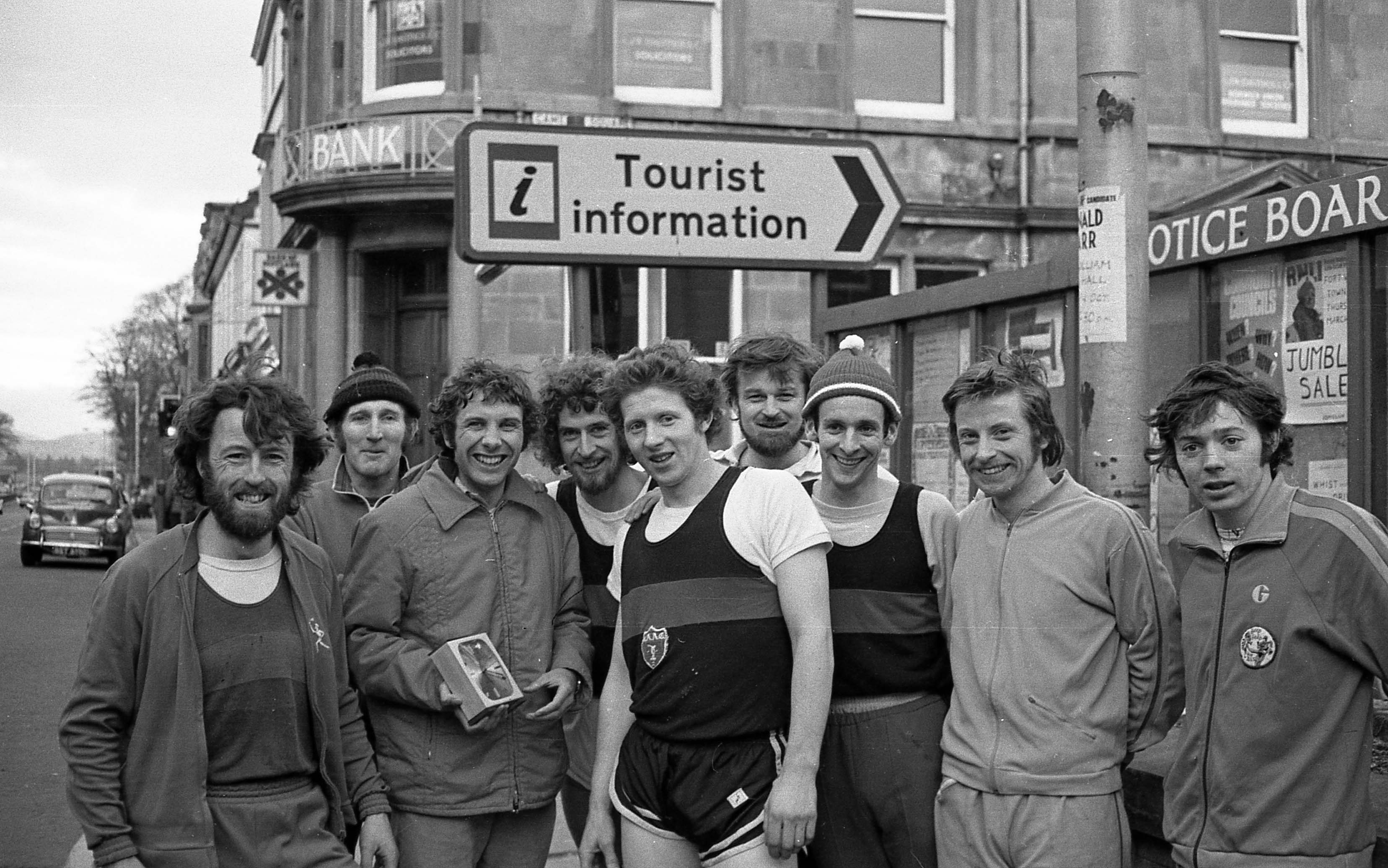
Dumbarton runners at the end of the Glasgow to Fort William Relay

Alistair Lawson, Allan Adams, Ron Paton, Gordon McLaren, Harry Martin, Mike Lidwell, Ian McWatt, Billy Cairns, Colin Martin.

Dumbarton AAC was established in 1919 and has produced many fine runners since then.    We have separate profiles for Colin Martin and Alistair Currie on this website and their period at the top overlaps somewhat.   On this page we will be looking at some of their best athletes from the 1970’s – runners such as Hugh Elder, Allan Adams senior, Willie Cairns, Jack Brown and Alan Currie.    But the club is more than just a road running and cross-country club.   As Colin Martin says in his profile, the club was cnsiderably good on the track when he joined them with the top man being Bobby Mills – best known as a hurdler but also a top ranked decathlete – and including well-known official and announcer Jim McInnes, who was a useful sprinter,   They were a club with some initiative too – in the days before the West Highland Way was invented as a long distance footpath, Dumbarton developed a Glasgow to Fort William Relay with idiosyncratic rules codified by Mike Lidwell.   The teams had to be of eight men, two groups of four; the distance was split into 32 sections and each group had to be responsible for 16 sections with each man covering four stretches.   One team ran mainly road parts of the course while the other ran the more mountainous segments.   Such is the nature of the terrain of course, that even the road team had to do Rannoch Moor and the Devil’s Staircase among its duties.   .     The route was also slightly different – and tougher – than the WHW.   It started at 6:00 am from George Square in Glasgow and went out via Maryhill Road and over the Bearsden Golf Course to Milngavie Town Centre where it linked up with what is now the WHW; when it reached Dumgoyne, the course went up the hill over the fields to the Black Bull in Killearn, down Drumtian  Road to the main road, under the railway bridge and over the fields to cross the A811 and head for Queen Elizabeth Forest, then via Stronachlachar and Glen Gyle to meet up with the route of the West Highland Way at Crianlarich before heading to the Fort.   They pioneered this route and challenge matches were held between the club and Clydesdale Harriers, Glasgow University, Lochaber AAC and even at one point Dark Peak Fell Runners, typically three clubs at a time.   So Dumbarton was an all-round club with not a little initiative and the distance men took part in the League meetings and the track men competed on the road and over the country.   The individuals concerned were a very competitive unit with everyone working for everyone else.   A final note for now: I am still collaing information from Allan Adams, Colin Martin and Alistair Lawson and that will be added as soon as it is available.

The ‘one that got away’ was Hugh Elder.    A solid club runner (DoB: 1/10/48) he specialised in the steeplechase on the track and did well in it.   with two SAAA medals and a personal best of 9:06.0 in 1974.    His other personal best times were

3000m – 8:34.6i (1972);     10000m – 31:20 (1970);     10 Miles – 53:41.0 (1973);     Marathon – 2:49:21 (1970);     2000m Steeplechase – 5:58.2i (1972).

He first appears in the Scottish ranking lists with a time of 10:05.2 for the 3000m steeplechase in 1968 at the age of 20 in nineteenth position, one ahead of Jim Sloss of Beith and two ahead of Doug Gillon  (10:11.6) of Edinburgh AC.   A year later he was sixteenth with 9:50.5 and competitively he was starting to get himself noticed.   After winning the West District ‘chase in 9:56.0, he was third in the Inter-Counties with his ranking time.    In 1970 he started to spread his talents a little and not only did he record a time of 9:34.2 for the steeplechase, but he was also ranked at twenty eighth in the 10000m with 31:20, twelfth in the 10 Miles with 53:41 and thirty second in the marathon with 2:49:21.   In 1971 he won his first SAAA medal when he was second in a time of 9:25.6 behind Bryan-Jones’s 9:08.2 after being second in the West District with 9:39.6 behind Jim Brown’s 9:23.6.   He also won the Inter-District ‘chase in 9:23.6 from club mate Willie Cairns’s 9:53.0.   The statistical yearbook said “Hugh Elder continued his steady progress to proficiency over the obstacles and looks set for better results next season.”   His best time of the season was 9:18.0 set at Meadowbank in July which placed him third Scot.   In 1972 he began with an indoor 3000m in 8:34.6 to be twentieth ranked Scot, and he went on to edge down his steeplechase time to 9:17.6 (sixth in the rankings) and his 2000m steeplechase best was also set where he was placed second.   He picked up his second SAAA medal when he was third in the Championships.    He had by now moved to the Midlands for business reasons and had joined Wolverhampton & Bilston AAC in 1972 and this gave him valuable competition opportunities but also introduced him to the British international 400m runner Verona Bernard (European, Commonwealth and Olympic runner) who would soon (in 1974) become Verona Elder.   In 1973, possibly as a result of the competition he was now getting, he hacked a chunk from his steeplechase time to a new pb of 9:10.6 placing him sixth in Scotland.   On to 1974 and it came down even further – this time to 9:06.0 which placed  him fifth best Scot behind Ian Gilmour, Adrian Weatherhead, Gareth Bryan Jones and Alistair Blamire (incidentally tenth ranked over the steeplechase that year was Frank Clement with 9:27.8!)   He was also in the 10000m with a time of 31:21.6.     In 1975 he dropped back in both events with 9:16.6 and 31:29.7.   His last year of being ranked in Scotland was 1976 when his best time for the steeplechase of 9:26.6 placed him thirteenth, nevertheless he had been a very good runner in the demanding event over eight years.

Hugh’s first Edinburgh to Glasgow relay was in 1967 when he ran on the second leg at the age of 19 and dropped from the twelfth place that Bobby Mills handed him to eighteenth – hardly surprising when you consider he was racing against Eddie Knox, Don Faircloth, Alistair Blamire, Mel Edwards and company.   The following year he was on Stage Seven where he was sixth fastest and picked up one place from eighteenth to seventeenth.   In ’69 he was on the long sixth leg and he picked up from fourteenth to tenth with tenth fastest run of the day.   Keeping the sixth stage in 1970 he stayed in tenth for the team that finished eleventh.   In 1971 he moved from fourteenth to twelfth on the same stage, and there was a wee change n the following year when he was fourth on the first leg.   In ’73 he was tenth on Stage One and his next run was in 1976 when he could only hold on to eighteenth place on the final stage of the race.   He ran eight races in total.   Over the country, in the National Championship, Hugh Elder did not appear too often – he is first spotted as a Junior finishing fourteenth in 1968 and then in his next year in the age group he was twelfth.   Moving up to the Senior squad he was forty eighth in 1970 – not bad in that one place in front was Joe Reilly of VPAAC and one place back was Peter Duffy of Motherwell.   Continuing to improve he was twenty second the following year and second Dumbarton counter behind Colin Martin.   The last appearance in the National that I can find was in 1975 when he was twenty second and first counter for his club.

Allan Adams is best known for his wonderful running as a veteran road runner in the 1980’s but he had been running since the age of 13 and he first appears in the National Cross-Country Championships in 1959 as a Boy finishing seventy first.   Two years later he was sixty second in  the Youths Championship and we have to jump to 1966 before he appears in the available results finishing seventieth in the Senior Championships – six places behind Ian Binnie (VPAAC) and one ahead of Clark Wallace (Shettleston).   He didn’t appear too often in the results of the National which, typically only went as far as fiftieth in most lists and the next appearance is in 1971 when he was 169th    His Edinburgh to Glasgow Relay appearances were not very frequent either: he only ever ran in six races: 1966 on Stage Three where  he moved up from eleventh to eighth; 1972 on Stage Seven he maintained eleventh place; in 1976 on Stage Five he held on to nineteenth place, in 1978 he received in twenty first (four and a half minutes behind twentieth) on Stage Eight and couldn’t do anything about it (who could?);  in 1983 on Three he held fourteenth and in 1985 he received in twenty first and finished Stage Six in twenty first.   There was a very good article by Doug Gillon in “Scotland’s Runner” of December 1986 in which it says that by his own admission he had been running since the age of 13 and never been more than a good club runner.   He says “I enjoyed cross-country but was never better than the top of the middle of the pack.   If I trained really hard I would sometimes make the first team.   But my real love in my earlier days was hill running.   My biggest claim to fame was that I once won the Cairngorm Hill Race and I was second twice, on Goatfell and second to Phil Dolan at Mamore.”   It was then that he took to the roads for a while because he was unable to tackle the hills any more.   But injuries were not the only problem that he had to face.   I quote from Doug’s article:

“Running home from work was part of his everyday routine bur suddenly he began to lose weight dramatically.   “I was coughing all the time and vomiting up my food.   I lost two and a half stones … down to nine stones from my normal 11 … and I began to wonder what I had,” said Allan.    “The crunch came one day when I got so breathless on the way home that I had t stop and walk.”    Like his father before him Allan’s hobby was keeping pigeons, and only after intensive tests in Vale of Leven Hospital did the truth emerge.   He had pigeon fanciers lung.   “It’s caused by the dust and droppings from the birds,” Allan explained, ” a type of allergy.   Once I got rid of the birds the problem cleared up.”

  Allan also played the bagpipes and he played regularly, first of all for Singers Pipe Band and then for the Red Hackle.   That also took time from his athletics but once his marathon career took off, he didn’t have time for the pipes.   Let’s go back to his first international though, which Doug Gillon describes as follows:   “When the call inviting Allan Adams to represent his country came, they wanted him to make his international debut at the age of 42 just three days later in Aberdeen.   He had just won the Lochaber Marathon less than a month previously in a course record of 2:26:36.   The race had taken its toll and only four days before the phone call, Adams had laboured his way round a windy Luddon Half Marathon finishing fifth veteran in for him a slow time of just inside 72 minutes.   “I felt tired and heavy legged,” said the Dumbarton Athletic Club man.   “I wasn’t sure whether I was up to running another marathon so soon.”   So by way of a fitness test he set out from his Dumbarton home for a 14 mile run over the Erskine Bridge and back.   The verdict was that he was that he felt OK and he accepted his first Scottish vest.  

Given the intensity – near paranoia in some cases – with which international marathon runners prepare for races Adams’ performance was genuinely remarkable.   He finished fifth in 2:19:10, first veteran.   It was not his fastest marathon.   His best was 2:25:36 when finishing second to clubmate John Stephens at Inverclyde.   He had become consistent around that time having recorded 2:26 also at Inverclyde and 2:27:00 and 2:25:48 in successive Glasgow outings.   But in September in Glasgow he surpassed himself , again  as a late call-up into Scotland’s colours.   This time however the race had been on his programme.   He placed fifteenth in a time of 2:23:03 winning the Nationwide Trophy as leading veteran.   A third representative honour this time in a Glasgow team took him to Nurnberg in October when he finished fifth in 2:29:07. ” 

His very first marathon had been the Glasgow Marathon in 1978 before it became a people’s race and when it was described as Scottish athletics’ best kept secret, starting and finishing in George Square on a Sunday morning.   Aiming for 2:45 he had run 2:32 – prior to that his furthest race had been the 12 miles of the Balloch to Clydebank.    After his first international marathon, Allan won the Vets hill race at Bathgate in a record time and a weekend later he was fourth in the Bearsden half-marathon (first vet) in 72:12 and a week later again he was second to Brian Carty in the Clydebank Half Marathon in 72:12.   He was not apparently in sympathy with the ‘race sparingly’ school of thought!

If we summarise his marathon career we get

*Ran 25 in 10 years: 3 wins, 3 seconds and 3 thirds.

*Full Scottish vests in Glasgow, 1986, where he was first vet in a pb of 2:23:03; Aberdeen, same year, first vet, 2:29:10 where he says he chased Colin Youngson the whole way – “a hard man to beat”, he says.

*Selected for a Glasgow Marathon team six times: Nurnberg 1985, 14th, 2nd vet; 1986, 5th, 1st vet; 1990, 3rd, 1st vet; Barcelona, 1987, 2:28:42; 1989, 2:26:32, 11th, 2nd vet; Dalian, China, 1987, 12th, 2:35:48, 1st Vet.

*First, Lochaber, 1986, 2:26:36;

*First BVAF Flying Fox Marathon, 1989, 1:29:32.

First Loch Rannoch, 1991, 2:21:37.

* A total of ten first vet awards and seven second vets awards.

Not known as a track runner, Allan nevertheless clocked up the following best times over standard distances:

Vets 10K Track Championships – 1st in 1986, 1990 and 1993;

10K pb on the track of 31:53, DAAA 1986.

On the road, his bests were 10K: Helensburgh, 1991, 31:33;   10 Miles – Tom Scott, 1986, 49:12;     Half Marathon – British Rankings (Vets) M45, 1991, 3rd; 10K, GB Rankings M50, 1991 1st;   Vets Hill Race, Bathgate – 33:30 (course record); Half-Marathon pb, Kirkcudbright, 1991, 1st, 1:08.36.

In solely vets competitions, Allan won five Scottish International vests and was third M45 at Sunderland in 1989.   He has run in twelve Scottish Vets Cross-Country Championships winning six gold, two silver and team gold at Hawick in 1995.

Among his medal haul were the following:   National Veterans Cross-Country Championships:   M40:   silver medals behind Dick Hodelet in 1985 and Brian Scobie in 1986;   M45:   gold medals in 1989, 1990, 1991 and 1992, silver behind Colin Youngson in 1993;   M50:   gold medals in 1994 and 1995.

It is a quite remarkable career and one of which he can be very proud.   He says that if it were not for Colin Martin pushing him hard for all those years, they would not have got the results they did as vets.   They trained hard and git the best out of each other.   He is quite sceptical when asked whether the same philosophy is true of the current generation of road runners.   (If you want to read about Allan’s son, also Allan- and his career at Clydesdale Harriers go here

*

There were many good runners in Dumbarton during the 1960’s and 70’s – and one of the regulars was Willie Cairns.   Younger than the others, he was never a 100 mpw runner but he had a lot of ability.    Willie ran in nine Edinburgh to Glasgow Relays, mainly on difficult stages – he ran on Stage One once, On Stage Two four times, Stage Four three times and on Stage Six once – between 1968 and 1978, and it would probably have been more because his club missed some years as participants.    He first ran in the National Cross-Country in 1968 as a Youth.   One year later he was at Dundee University and ran for them in the event in 1969 and 1971, and then competed in it for Dumbarton AAC from 1972 until  he retired from the sport.   Willie was a good track competitor as well and turned out for his club in the summer track leagues being ranked in the 3000m steeplechase every year from 1971 to 1977 with a best of 9:30.6, he was also ranked in the 10 Miles where he ran 53:02.4 in 1972 and the marathon with a best of 2:38.53 in 1982.   There were others such as Alistair Lawson Ian McWatt, Harry Martin and Mike Lidwell who turned out regularly for Dumbarton AAC as distance runners.

When Jack Baird joined Dumbarton from Shettleston, the club then had four sub-2:00 880 yard runners.   The most unusual of these was Bobby Mills.   Unusual because Bobby was a national medal winning track and field athlete of some note with several top decathlon points totals to his credit.    Bobby was ranked every year from 1959 to 1968 in a total of four events (120 yards Hurdles, 440 yards hurdles, Long Jump and Triple Jump as well as in the Decathlon.)    His best performance in the sprint hurdles was 15.8 seconds, in the one lap hurdles 54.5, in the Long Jump 6.88m, in the Triple Jump 13.08m and in the Decathlon he scored 4784.    In the SAAA Championships he was second in the 440H in 1960 and 1965 and third in 1966 with a bronze also won in the decathlon in 1074.    That would be enough for most men but Bobby went more than the extra mile – he went lots of extra miles in the various cross-country relays and championships and in the Edinburgh to Glasgow.   Bobby ran in 1966 (Stage Four), 19687 (One), 1968 (Six), 1969 (One), 1970 (Three) and 1971 (Eight).        He also ran in County, District and National Cross Country Championships and was a big points scorer in track league matches.    Incidentally the Track League at that time was not done using the format as at present.   There were eight clubs in any Division and the clubs arranged their own fixture as triangular fixture.   eg Clydesdale, Dundee Hawkhill and Garscube met, the CH athletes were scored against the DHH men and the Garscube men separately, Garscube were scored against DHH and CH and DHH were scored against the other two.   Points were allocated for each  head-to-head.   Made for a more exciting league, I think!   But back to DAAC.   The two most easily recognisable men  were Bobby and Jack Brown.   Jack was basically an 880 runner with a best of 1:56 who did other events.   He ran in everything that his club was involved in and was a real inspiration to generations of young Dumbarton runners.   Tall, dark, deep chested he was the very model of a middle distance athlete.    He was club captain from 1961 to 1969, cross-country champion from 1960 to 1963 inclusive, hill race champion 1962, 1964 and 1967, track champion 1952 to 1956 inclusive, 1960 – 1963 inclusive (1962 shared with Bobby Mills).   Jack was the club man par excellence.   After his racing days were over he officiated and many meetings and was easily recognisable at Highland Games with his height, carriage and kilt.    Of course the best known DAAC 880 yards and  800m  man was Scottish and British internationalist Graeme Grant who had personal best times of 1:48.2 and 49.8 for 440 yards in 1966.   Grant (born in Helensburgh on 24th May, 1946)  had won the Scottish Schools Mile in 1964 in 4:21.0.   His best season was 1966: in addition to winning the SAAA title in 1:50.3, he ran 1:48.2 at the White City on 28th May in an invitation 800m, and at the AAA Championships he ran 1:50.0 for 880 yards when finishing fifth behind Irishman Noel Carroll.   It was also the year when he was part of the world record setting team for the 4 x 880 yards at Crystal Palace where his opening leg was 1:49.1.   A superb track runner he also set a Scottish record for 1000 yards and had a second place in the AAA’s indoor 880y.   Nevertheless he ran for his club in many domestic races such as the County Relays over the difficult and hilly Clydebank course.   He ran the seventh stage of the Edinburgh to Glasgow in 1966, pulling up from seventeenth to thirteenth, in 1967 he had a bit of a disaster on the first leg when he was nineteenth of the twenty teams invited.   Undeterred he was out for the team again in 1969, back on the seventh stage where he held on to tenth place.   In 1970 he was thirteenth on the first stage in what was to be his last run in the event.   The National Cross-Country Championship fell in February, just when the indoor season was in full swing and even when he wasn’t racing indoors, it was essential that a top flight 800m runner should be concentrating on getting organised for the summer season.

Dumbarton was a very good club with many good runners and a club spirit that encouraged men like Bobby Mills and Graeme Grant to turn out for them in all events.

Back to The Fast Pack     Glasgow to Ft William Relay     Eddie Crozier

Clydesdale Harriers

CH IDCH IL

Ian Donald and Ian Leggett finishing in the Nigel Barge Road Race

There have been many clubs which have done well consistently well over the post-war period without winning a national event on the road or country.   Clydesdale Harriers is one of those and there are others such as Springburn Harriers which come into this category.  It is maybe appropriate that we look at these two clubs at particular periods in comparatively recent history.  In the period with which I am dealing here, the standard nationwide was probably higher than at any other time – with Olympians running for Shettleston, Edinburgh Southern and Law and District, Commonwealth Games men racing in the colours of several other clubs plus international runners from other home countries (Dave Logue, Ian Hamer) it was not at all easy to succeed at the very top level.   For instance in the early 1970’s Clydesdale Harriers was in the first six in three consecutive years and I would suggest that what separates clubs in that grouping from the very best is the absence of one or even two international class athletes, and that the standard at various periods is otherwise of the highest.    In the period in question the team won the District Championships  three times and won medals eight times.

* Gold in 1972/73,  1979/80  and  1980/81

* Silver in 1971/72

*Bronze in 1970/71,  1973/74,  1976/77,  1978/79

There were also other very good results – second in the District Relay for example – which will become apparent as we go through the mini-profiles.    The main men are well known: Ian Donald, Allan Faulds, Phil Dolan, Ian Leggett, Doug Gemmell and they will all be dealt with here.

Ian Donald had been a member of Shettleston Harriers who moved to live in Old Kilpatrick in the early 1960’s and after training with the club for almost a year, decided to become a member.    He was always ‘his own man’ and although he had won many gold medals in District and National Cross-Country championships as well as in the Edinburgh to Glasgow, and although he was the reigning Shettleston club cross-country champion (having won it in each of the two previous years), once he had decided that was it.   he did a lot for the morale  of the club, telling the young members like Bobby Shields, for instance, that they were as good as his former team mates.    He also taught the older members a lot by the way in which he looked at a race beforehand and analysed it afterwards.   He was undoubtedly a quality athlete.    On the track he had bests of 30:26.0 for Six Miles and 52:04 for 10 Miles.    He won medals in District and National Championships on the track and competed in the old Inter-District match for the West of Scotland.   Good as he was on the variable quality of cinder and grass track around the country, his real metier was either hill running or cross-country.    With Shettleston he had won

  • Two Team Golds in the Edinburgh to Glasgow Relay (1960 and 1961)
  • Four Team Golds in the National Cross-Country (1959 (15th), ’60 (18th), 1961 (24th) and 1962 (22nd)
  • Three Gold (1959, ’61, ’63), Two silver (’62 and ’64) and one bronze (’60) in the District Championship
  • Ran in four London to Brighton Relays (1959, ’60, ’61 and ’62)
  • The club cross-country championship in 1962/63 and 1963/64

After he joined the club he ran in every cross country race that he could and in all club championships.   In fact his very first race was the day after he got clearance from the SAAA.   This was the Dunbartonshire Championships at Dumbarton where Ian (second behind Lachie Stewart) with Johnny B Maclachlan, Ian Leggett and Bobby Shields was a member of the winning team.   He went on to win the club championship, the Hannah Cup for the fastest time in the handicap race and the Dan MacDonald Cup for the highest points total in Championship races over the winter. The impact was immediate and massive.   In the summer of 1965 he was second in the County Three Miles Championships, second in the West District Six Miles Championships and ended the summer with fourth place in the Ben Nevis Race – young Bobby Shields was seven places back.   In between he raced on the roads and on the track as well as over the hills.   Like most of the top men Ian was never a big time runner who did his own thing and raced when he felt like it.   Every winter he raced in everything from the McAndrew Relays at the start of October right through to the National Championships and beyond.    In cross country races, a lot was learned just going over the trail with him before a cross country race. He was the best ‘reader’ of a trail that I ever met.    At the start of 1966 he won the race at Stewarton then was eleventh in the National Cross Country Championships – the highest by a Clydesdale since 1955.   At the AGM in 1967 Jim Shields “congratulated the club on a fairly successful season emphasising the leadership of Ian Donald”. (Extract from the club Minute Book)  

Ian was a quality athlete who continued to run well and win many individual races, particularly on the hills, he led the Clydesdale team to significant victories in County and District Championships and in many road and hill races.   His record in the National continued at the Shettleston level with 20th (1965), 11th (1966), 29th (1967) and 30th (1969),    The effect on the club team was considerable with steady progress being due as much to his example and encouragement during training as it was in actual races.   He was to run in 10 National Championships for the club missing only 1972.    In the other big measure of a man’s ability and spirit, the Edinburgh to Glasgow he ran in 12 not missing a single run in his time with the club.   He covered Stages One, Two, Four, Six, and Eight.   He picked up places in the event every year until the mid 70’s but he also helped others – eg in 1968 he moved up from 16th to 14th on Stage Four and handed me the baton.   I looked down the road and there were four eminently catchable runners strung out along the road in front like beads on a necklace – he had made up a lot of ground when he could barely see the next runner and made it easy for me to look good catching three of them.   He did the same trick the following year with Sandy MacNeil, not only did he pick up places but he set up Sandy to move, as I had done, from 14th to 11th.   By the time Allan Faulds joined the club in 1970 we had two very good men to head up the team and the spirit that Ian had cultivated really paid off over the next three years.    He was also of course still racing on the hills with a second place in the Ben but victories all over Scotland from Arran to Newtonmore.

Ian died of leukaemia in his early 40’s when he should have been looking forward to a career as a veteran athlete.   We had known he was ill for some time but to start with we all thought it was less serious than it was, when we heard it was leukaemia we were all shocked.   But he kept running right up to the year before his death.   A man of many interests he was a very good mountain climber; he had a passion for gardening and had won the Wilson Medal from the Alpine Gardening Club and still trained seven days a week.

CH DG

Doug Gemmell after the Jack Crawford Race

Douglas Gemmell had been a pupil at Clydebank High School whose father had been a member of Springburn before the War and who was a natural athlete.   Very quiet and unassuming, Douglas had a hard racing edge and a competitive calm that led to many first rate performances.   Good on the track, very good over the country and, for me, even better on the roads.     On the track he had personal best times of 8:39.0 for 3000m, 14:53.4 for 5000m, 30:53.0 for 10000m, 53:11.0 for 10 Miles track and 2:29.02 for the marathon.   He only ever ran one marathon – unfortunately because he would probably have been very good.   Nevertheless with medals at County and District levels he can be proud of his record.

His record in the Edinburgh to Glasgow is excellent.   Douglas ran in seventeen of them, sixteen in succession with the first being in 1965, and he ran on Stages One, Two Three, Four, Five and Six with the second leg being the one he ran in most – eleven years in succession!   His record on the stage is that he was often in the top seven or eight times (remember these were the days of great Edinburgh teams as well as the Shettleston team from Glasgow) and only lost three places over the period while picking up a total of  15.   The record in this relay is illustrated in the table below.


Year 65 66 67 68 69 70 71 72 73 74 75 76 77 78 79 80 82
Stage 4 1 4 2 2 2 2 2 2 2 2 2 2 2 5 3 6
+Gain -1 0 -2 +1 +2 -1 +4 -1 +2 +1 +3 +2 -1 0 +1 -2 -1

 On the country, he was consistently good, regularly in the top 50 and with many medals from District and County Championships and Relays.   In the District Championships it had long been an ambition of the club to win the Maley Trophy for the winning team – this was clearly stated before the 1914 War in the club handbook at a time when the club was winning almost everything it could in the country.   The ambition was achieved in 1973 and it was Douglas who led the team home with an excellent run finishing in fourth place.  Although he was actually fourth, he was awarded the third place medal since David McMeekin of Victoria Park who had been third was awarded the first Junior (Under 20) medal.   The pleasure for the club was increased because the huge trophy presented to the winning team had been donated by Willie Maley who won the Scottish 100 yards championship in 1906 in Clydesdale colours.   This was not of course his first run in the event – that had been some time earlier.   That was in 1966/67 in fact when the team was sixth and he was thirty ninth individual, second club counter behind Ian Donald who was in tenth place.   He did not contest the event the following year but then a year later was third counter behind Ian Leggett (fourth) and Ian Donald (twelfth) when he finished twentieth and gain his first medal in the event when the team was third.   Missing the 1969/70 event, he led the team into third place in 1970/71 when he was twenty sixth.   In 1971/72 the team was second and then in 1972/73 came the moment that the club had waited almost seventy years for.   The team was second again in ‘74/’75 but no awards were won for three years until 1979 when the team was second without his participation.   The race was won again in 1980 over the rolling countryside of the Park and Golf Course at Dalmuir in Clydebank and the team was Phil Dolan tenth, George Carlin fourteenth, Gary Millar fifteenth, Douglas McDonald seventeenth, Robert McWatt twenty ninth and John MacKay thirty seventh.    Gold, silver and bronze in the District Championships were his as was the honour of being the man to lead the club to its first ever team win in the event is a proud record.

In the County Relays and Championships his record is even better.   In 1967/68 he was a member of the team that was second in the championships and the following year went one better with second team in the relays and winners in the championships.   In 69/70 it was first team in the relays and in the championships and this pattern was repeated the following year.   In 70/71 it was first in the relays and second in the championships and in 1971/72 there were two firsts.   Douglas was a fixture in all these teams and had bronze, four silver and five gold medals from the ten events.   Ian Leggett was also an ever present and Ian Donald only missed one race with Bobby Shields, Allan Faulds, Cyril O’Boyle and Pat Younger all sharing in the successes.   The run of successes for this extended period was unparalleled in the club’s history with the top four changing from time to time – initially it was Ian Donald, Ian Leggett and Douglas with Bobby Shields and Sandy MacNeil making up the team.   Then for the three years of Allan Faulds’ membership it was a settled quartet of Douglas, Phil Dolan, Allan Faulds and Ian Donald then when Allan left the district and Ian’s illness seriously affected his running Robert McWatt, George Carlin and Gary Millar came into the team but the one man who was in all the teams in all the races below was Douglas.   In 1976 he won the title over a frozen and rutted course at Braidfield Farm in Clydebank.   The team record in the ‘Gemmell Years’ was as follows – 16 gold medals, 5 silver medals and 1 bronze summarised in the table below.

  67/8 68/9 69/70 70/1 71/2 72/3 73/4 74/5 75/6 76/7 77/8 78/9
Relays 2 1 1 1 1 1 2 1 1 1
Champs 2 1 1 2 1 1 2 1 3 1 1 1

Unfortunately he had a series of injuries and with business taking up more of his time he retired for a time although keeping fit all the while.   He made a comeback to veterans athletics in the mid 1990’s.   In the County Championships in a snowstorm in 1995 he was fourth individual. a member of the winning team and first veteran.   The comeback continued with ninth in the vets cross-country and first M45 which led into track races over 5000m and 10000m.   Veteran prizes were regularly won (eg the Greenmantle Dash) and in 1997 he was ninth in the Nigel Barge Road Race.   In February he won the Scottish Vets M50 3000m in 9:32.8 and in the BVAF he won the British title with 9:27.   In the BVAF Cross-Country championship he was second after a terrific tussle with Brian O’Neill.   May, une and July saw almost incessant racing including the Tom Scott (54:17 – first M50),    First M50 in the Vets 10M at Greenock in 56:33.    In the Vets McInnes Road Race he was second and first M50.   In the three Polaroid 10K’s that year he was first M50 in every one.   In the Walter Ross race he was third and first M50.   In the Scottish Vets 1500m and 5000m he won both in 4:36 and 17:01.   he was first M50 in the Andy Forbes road race and in the 10000m track races over the summer he was remarkably consistent with two at 33:42 and one at 33:45.  He had another excellent summer in 1998 when he topped the UK rankings for the 5000m.   In November he was ninth in the vets international in Ballymena and was first veteran in the EU Braud Hills 6 Miles road race.   He was first M50 in both Nigel Barge and Jack Crawford.   Alas, he was again plagued by injury and really had to retire this time.

Colin Yongson add; “Training daily on the tough Braid Hills of Edinburgh gave him two good years as a very good veteran.   At age 49 in 1966, he won bronze in the Scottish Vets M45 Cross-Country.   Then after turning 50 that November, at Beach Park, Irvine, in the annual British and Irish Veterans International Cross-Country, he won a tremendous M 50 silver medal only six seconds behind the Welsh superstar Alun Roper.    Then in early 1997, he he won the Scottish Vets M50 gold.   At Ballymena that November, in the British and Irish Veterans Cross-Country, he ended up ninth M50 after a below-par run  but the Scottish men won M50 silver.   Then he retired again!   I always liked Dougie – an intelligent interesting guy, who ran hard and but was always friendly and positive.”

Douglas was undoubtedly an top flight athlete who was just a bit unlucky with injuries but he would have graced any club at any time.

Ian Leggett took up the sport in 1963 after becoming slightly disillusioned with football – at which he was a good player.   From then until he emigrated to Australia in 1966, he ran at a good club level winning medals in County events and running well on the track and roads.   In 1966 Ian emigrated to Whyalla, near Adelaide, in Australia.         He still pursued his athletic activities with Whyalla Harriers as well as playing some more football with Croatia and City football teams.   Athletics were mainly track meets with the road racing being concentrated in the cities.   At the start of 1966  he decided to concentrate on athletics and ran in the Commonwealth Marathon Trial.   Unplaced he turned back to football  but kept on running and also kept in touch with the club back home.   When he returned to Scotland, he had been transformed as a runner.   He enjoyed the cooler atmosphere and the road racing circuit that had been missing in Australia.   He quickly became one of the quality group of runners in the club at the time – Phil Dolan, Allan Faulds, Doug Gemmell and Ian Donald.   He even tackled hill races at this point including the Mamore and the Ben.   His best years were almost certainly from 1969 to 1973 with medals at County and District and Championship levels.   The 1969 campaign  can be summed up in the following table.

Date Event Place Time Remarks
January Nigel Barge 22nd   Team third
  Club Handicap 2nd   I Donald first
  Midland District Championship 4th   I Donald twelfth
February Inter-Counties Championship 2nd   J Linaker first
  National Championship 30th    
April Tom Scott 10 15th 51:56  
  Club 3 Miles 2nd 15:08 1st I Donald
  Clydebank to Helensburgh 16 4th 1:30:04  
May SAAA 10 Mies Track 8th 54:14 Cinders at Scotstoun
  Drymen to Scotstoun 15 7th    
June Airdrie HG 13+ 2nd 67:13 P Maclagan 1st
  Babcock & Wilcox 14 3rd 79:00  
July Glasgow Transport Sports 3000m 5th    
  Gourock 14 3rd    
  Mamore Hill Race 3rd    
August Kirkintilloch HG 10      
  CH Six Miles 1st 30:44.6 I Donald 31:04
  Largs to Irvine 20 8th    
September Two Mile Race at Dumbarton 2nd   1.   C Martin
October McAndrew Relay 4th, first stage    
November Midlands Relay 4th, first stage    
  GU Road Race 8th 26:25  
  E-G, sixth stage Picked up One    


 It was a good period for the club and it was, as it always is, a disappointment when the squad finally separated – Doug Gemmell went to Edinburgh and Ian Leggett to Livingston for business reasons, Ian Donald died from leukaemia and Allan Faulds’s work also led him away from Clydebank.   Allan and Phil Dolan are the subject of profiles elsewhere on this site.


Clyde Valley AAC

CV 1

When people talk or think of Clyde Valley AAC, they tend to think of Jim Brown (pictures above in the Six Stage Relay in 1986), Ron McDonald, John Graham, Bert McKay and the other big names that ran for them – but the club would not have been as successful as a team without the solid backing from good club runners like Eddie Devlin, David and Steven Marshall (not related), Joe Small and several others.    In an attempt to put this right we have the following brief history of the club written by Joe Small.   Joe also wrote the piece on Monkland Harriers which should maybe be read in conjunction with this one.

1974 saw the formation of a brand new club, known as Clyde Valley AAC, being an amalgamation of five Lanarkshire clubs – Airdrie Harriers, Bellshill YMCA, Monkland Harriers, Motherwell YMCA and the L&L Track Club from Lesmahagow.   The main advantage for Monkland Harriers was the addition of the Motherwell and Bellshill middle and long distance runners to the names mentioned previously.   MacDonald, Brown, Gilmour, etc, now being joined by the likes of John Graham, Bert McKay, Roy Baillie  and Ian Moncur.

The first winter season saw a fourth place finish in the traditional opener, the McAndrew relay.   A first victory in the Midland cross-country relay with MacDonald, Graham, Willie Devlin and Roy Baillie promised much.   A national trophy soon followed with victory in the 2 x 2.5 mile cross-country relay at Bellahouston Park, Glasgow.   Graham, Brown, and MacDonald along with Roy Baillie winning comfortably from Edinburgh AC.   Baillie was better known as an 800m runner coached by Tommy Boyle with nests of 50.0 sec for 400m, 1:51.1 for 800m and 3:56.2 for 1500m.   His best championship finish was second in the SAAA 800m in 1974.   His frequent appearances over road and country usually resulted in excellent performances and who knows what he would have been capable of had he focused more on this side of the sport?

In the club’s inaugural appearance in the Edinburgh to Glasgow eight man relay, the team finished third with John Graham having his first outing in the event.   Again Roy Baillie produced an excellent run with the second fastest time on the short third stage, gaining three places in the process.   Other team members were Brown, MacDonald, Graham, Gilmour, Eddie and Willie Devlin and myself.   The National Cross-Country Championship, held on the club’s local course in Coatbridge resulted in a sixth place finish in the team race, Gilmour and MacDonald backed up by Roy Baillie in forty second, Eddie Devlin fifty eighth, Tommy Callaghan one hundred and seventh and Willie Marshall in one hundred and twenty first completing the team.   More on Willie later.

In 1975-’76, after finishing outside the prizes in the McAndrew season opener, where Jim Brown recorded the day’s fastest time, a second place in the District relay with myself and Eddie Devlin in the team along with John Graham and Ronnie MacDonald followed.   The club could only manage fourth in the National Relay despite fielding MacDonald, Baillie, Graham and Eddie Devlin, before again taking third place in the Edinburgh to Glasgow Relay, the only change from the previous year being Bert McKay replacing Willie Devlin.   For more information on Bert please refer to the profile elsewhere on the website.   For reasons unknown, none of the big names appeared in the National, only Roy Baillie (fifty second) and myself (sixty first) finishing in the first 100.

The 1976-’77 season was not the club’s best: fifth in the National Relay with Eddie Devlin, John Graham, Ian Moncur and myself, followed by fifth in the Edinburgh to Glasgow.   New names in the team that year were Neil Agnew, Moncur and Greg Paterson.   Neil and Greg had both come through the ranks with Monkland Harriers’ from junior boy level and were now competing with the seniors.   Neil was a dependable guy, with a good turn of pace, well used in 800m events.   Great things were expected of Greg in his first season as a junior, having finished fourth in the SCCU Youth championship the year before.   However a string of leg injuries in the following years prevented him from fulfilling his true potential.   Ian Moncur was a great friend of Jim Brown, having been a team mate all the way through school at Bellshill Academy, Bellshill YMCA and now Clyde Valley.   He did not appear to compete as regularly as most of us, possibly as he seemed to take up teaching posts in far away parts of the country, arriving at races from places as diverse as Tobermory on Mull and Forres in the North.   he eventually ended up running for Dundee Hawkhill Harriers with a marathon best of 2:22:09 – a more than useful runner!

Seventh in the team race at the West District championship seemed a disappointing result as Brown and Graham had finished first and second respectively.   Small (27th), Bert McKay (65th), Tommy Callaghan (84th) and Willie Marshall (106th) completed the team.   For the second year in a row, there was no real presence in the National cross-country, with again  only two in the top hundred, Ian Gilmour in thirteenth and myself in fifty fourth.   I can only put this down to injuries, illness, etc, as there would not appear to be any other reason for people not turning out in this event
CV 2

Brian McSloy finishing in the National

In 1977-’78, the first headline of the winter season was “Shock Defeat For Shettleston” as Clyde Valley took victory in the Lanarkshire Road Relay at Motherwell with Brown and Graham performing well.   The Allan Scally Relay was to follow, and another win recorded.   Brown and Graham were joined by Eddie Devlin and Brian McSloy.   McSloy in his first year taking on the senior athletes and was perhaps one of the most under-estimated road and cross-country competitors of the time.   His next outing for the club saw a first placing in the National Cross-Country Relay, joining Devlin, Brown and Ian Gilmour in the victorious squad.   In spite of this record in the early season relays, injury took its toll for the E-G where with no Gilmour or MacDonald, the club dropped two places on the previous year, finishing seventh with McSloy producing a good run on the opening leg to finish fifth, only eleven seconds behind stage winner, Frank Clement.   Another debutant n the race was Colin Farquharson, a product of the Motherwell section, from being an average competitor, hard training with the likes of John Graham and Jim Brown saw Colin improve immensely.   Once again, the National failed to produce a finishing team, despite all three who did start finishing in the top ten: Brown fourth, Gilmour sixth and Graham ninth.

The season 1978-’79 was again a mixed bag as far as results were concerned but further new names appeared in the senior ranks.   A fifth place finish in the opener at the McAndrew Relay with Jim Brown running the fastest time of the day promised much.   The next week, second in the Lanarkshire Road Relays with Brown again fastest and McSloy performing well on the second stage continued the good start.   The West District Cross-Country Relay saw the appearance of young Fraser Stuart for the first time, leading off for the team which finished third, the other three runners being Brown, McSloy and Neil Agnew.   For some inexplicable reason, the club failed to finish a team in the National Relay, they do not appear even to have started a team!    Even more mysterious considering the club won the Young Athletes relay, with a couple of names later to become much better known, Tom McKean and Peter Fox.   Next up was the E-G where a very unbalanced team, old and young, finished ninth: the usual starters Brown and Devlin, were augmented by juniors McSloy, Stuart and Paterson, ‘elder’ members Willie Marshall and Tom Callaghan together with myself completed the line-up.

The West District cross-country saw an excellent victory for Brian McSloy, finishing ahead of Graham Clark, Fraser Clyne and John Graham to name a few.   Finally the club finished a senior team in the national cross-country championship over a frozen course at Livingston, Jim Brown, Brian Gardner, myself, Neil Agnew, Willie Marshall and Tommy Callaghan ended up in seventh place.   Brian Gardner was one of the few runners to come through from the Airdrie section of the club.   Having comoeted well at youth and junior levels, he moved south of the border.   This was his first appearance in the senior race and a fourteenth place finish was a massive improvement on previous performances.   For reasons unknown, travel, distance (?), Brian never featured in the main relays to the detriment of the team, based on his national run.   He is possibly the only Clyde Valley man still competing.   In the 55+ age group now, he has produced outstanding results through all the various stages, including victories at National and European level.    The last event of the season saw the inaugural running of the National Six-Stage road relay at Strathclyde Park and a very strong team – Brown, McSloy, Gilmour, MacDonald and myself, finished in second place losing a large lead to an inspired Allister Hutton on the last leg.
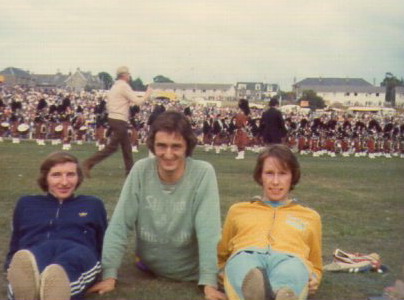
CV 3

Joe Small, Ian Moncur and Neil Agnew at Cowal

In 1979 the traditional start to the season, the McAndrew Relay, saw a second place finish, almost a minute behind a good Shettleston Harriers team.   Next up, the Lanarkshire AAA Road Relay: the team of Neil Agnew, Brian McSloy, David Marshall and Colin Farquharson crossed the line in first place, well ahead of Cambuslang with Brian McSloy running the fastest lap of the day.   This was a notable performance as there were none of the big guns in the team.   The appearance of David Marshall continued a family tradition, with father Willie still competing regularly at a good level.   The West District relay saw no team finishing.   At the subsequent National Cross-Country Relay, the club won for the third time in six years with Jim Brown and Brian McSloy running the two fastest laps.   Aided by Eddie Devlin and Colin Farquharson they had 15 seconds to spare over local club Aberdeen AAC.   Brown was quoted as pointing out the “splendid support they received form the two unsung members of the team, Devlin and Farquharson.”   The E-G saw the club’s first succes in this major event .   Old stagers by now, Brown, Devlin and Graham had Brian McSloy, Neil Agnew, Colin Farquharson David Marshall, and a first appearance for a new name in the ranks, Peter Fox.   Peter was an excellent distance runner, having come through all the age groups from junior boy upwards.   He possibly never fully realised his potential in the senior ranks, due mainly to the rigours of medical studies followed by work as a doctor. whoch probably curtailed his training over the years.   With Graham, McSloy and Brown all running fastest stages the team ended up almost two minutes ahead of Edinburgh AC with Edinburgh Southern in third – a great day for the club.

At the West District cross-country, Brian McSloy retained his title from the previous year.   The club were third in the team race , to quote Ron Marshall in the ‘Glasgow Herald’, “a totally unrecognisable Clyde Valley.”   The unrecognisable runners were Peter Fox, David Marshall, Joe Small, John Lamara and Tommy Callaghan!   For the first time in a number of years, there was a strong turn out in the National cross-country resulting in the club finishing second in the team race picking up medals for the first time in the senior age group.   Packing well, McSloy 7th, Brown 8th, Graham 9th and MacDonald 11th with Ian Moncur forty second and Joe Small forty fifth saw the team come within 19 points of Edinburgh Southern.   The club had a hat-trick of seconds that day as the junior and youth teams also won silver in their respective events.   The end-of-season Six Stage Relay was once again run round the Strathclyde Park circuit.   In a repeat of the previous year, the team lost a large lead on the last stage, again to Allister Hutton, almost a case of déjà-vu!   Joe Small, Peter Fox, Colin Farquharson, John Graham, Jim Brown and Brian McSloy were the club’s representatives on the day.

This was arguably Clyde Valley’s best year ever, with wins in the LAAA Road Relay, National Cross-Country Relay and E-G, seconds in the National Cross-Coyntry and Six Stage Relay as well as third in the West District cross-country.

A terrific win in the 1980 McAndrew Relay started off the 1980’81 winter in good fashion; Colin Farquharson improving with every race finished an excellent second on the opening leg, Graham, MacDonald and Brown stretched out a lead of 25 seconds over ESH by the finish.   The next week saw Eddie Devlin replace John Graham at the Lanarkshire event, the result was the same though, victory comfortably ahead of Cambuslang.   The West District Relay proved disastrous, fielding only three runners the, so far, most successful team of the season failed to finish a team.     Then the next weekend saw almost a return to top form as the club set out to defend the National Cross-Coyntry Relay title in Inverness, coming very close to succeeding.   Devlin, Brown, Farquharson and MacDonald failing by four seconds to hold off Cambuslang Harriers.

However, come the E-G, the club did manage to retain a title.   Small, MacDonald, Agnew, Gilmour, Brown, Graham, Devlin and Peter Fox finished over a minute ahead of their rivals, Cambuslang.   The winning time of 3 hours 57 minutes 19 seconds being the slowest for a number of years.   This was the result of a very strong headwind for the whole distance and not a comment on the strength of the squad!   The club finished third in the National Cross-Country championship team race, Brown, Gilmour and McSloy in the top ten, Farquharson, Small, together with Andy Brown, now 48 years of age and having won the event in 1958, picking up a bronze medal    Having finished second in the two previous years, only a fifth place was achieved at the Six Stage Relay, Agnew, Small, Devlin, Farquharson, Fox and Brown failing to repeat earlier performances.
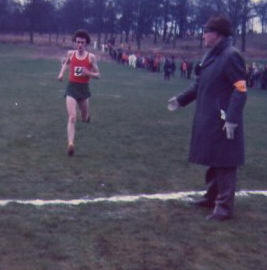
CV 4

Greg Patterson finishing the National

For 1981-’82, I don’t have any details of the McAndrew relay or the West District relay but the Lanarkshire Relay was again won comfortably in October with Cambuslang 200 yards behind in second.   The club’s most successful event over the years had been the National Cross-Country Relay, but this year saw a drop off as Devlin, MacDonald, Agnew and Fox could only finish in fifth place behind the winnes, Edinburgh Southern.   However a return to form saw a second place finish in the E-G, Ian Moncur leading off the usual names: Gilmour, Brown, unusually running the short third leg, MacDonald, McSloy, Graham, Devlin and Fox.   As a comparison, the time in second was over seven minutes faster than the previous year’s winning time.   Having checked out the West District winning time, Jim Brown finished second but there is no record of the team place.   However adding up the places of the six runners, the club should have picked up the bronze medals, bit of a mystery that one?   The National Cross Country at Irvine saw an improvement of one place on 1981, second team, again behind  Edinburgh Southern .    Ronnie MacDonald had an excellent run in fourth, with Jim Brown sixth, Brian Gardner with one of his infrequent runs north of the border thirty second, {Peter Fox thirty fourth, Andy Brown, now forty nine years old improving thirty eight places on last year’s run in fifty second, and Joe Small sixty seventh.   Excellent footage of this race can be seen in the video clips section of this website.

1982-’83 started with third in the McAndrew Relay with peter Fox running the third fastest time of the day and this was a good start to the season’s racing.   No details are available for the Lanarkshire race and the club did not feature in either the West District or the National relay, a sad state of affairs given the past years success in this particular race.

The decline continued with the club’s worst ever performance in the Edinburgh to Glasgow – twelfth place, a full ten places below the 1981 runners-up result, injuries taking their toll.   With no Graham, Gilmour, MacDonald or McSloy, there wasn’t sufficient strength in depth to sustain a challenge in an eight man relay.   Mainstays Brown, Devlin, Agnew, Moncur, Fox were joined by Bernie Kane, David and Willie Marshall – Willie being well into veteran status by this time.   This must be one of the few occasions when a father and son have competed in this race.   The run of poor results continued, at the District cross-country the club’s first finisher being Jimmy Geddes in 168th place!   The story continued at the National, Brian Gardner in sixty eighth being the first to cross the line with only Ian Moncur (79th) the only other finisher in the top 100.   Worse was to follow – the Six-Stage relay saw the club fail to even start a team.    The lowest point in Clyde Valley’s short history?
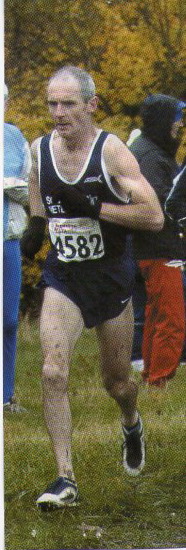
CV 5

Brian Gardner running for Scottish Vets.

By 1983-’84 the writing appeared to be on the wall for the club, the star names were in their late 20’s and early 30’s with the younger element not reaching the same high quality, however we weren’t dead yet!   The Edinburgh to Glasgow in 1983 produced an excellent third place.   The return of Ronni MacDonald, John Graham and Brian McSloy together with Brown, Devlin, Fox, Small and a first appearance from Steven Marshall produced something akin to earlier results.   Steven Marshall on the fifth leg was second fastest only four seconds slower than Evan Cameron and as a first year junior he showed great promise.   However the revival appeared to be short lived.   Come the National, Brian McSlow in forty seventh was the first Clyde Valley man to cross the line.   There was no team in the Six Stage Relay.   Thus ended another poor year!

1984-’85 turned out to be Clyde Valley’s last year of existence.   Internal divisions, which were never properly addressed over the lifetime of the club, saw the break-up of the five sections and a return of the individual clubs which had amalgamated ten years previously.   A final appearance in the E-G saw a worst finishing place of fourteenth, never recovering from Peter Fox’s twenty first position on the opening stage.   This, in spite of Brown, Graham, Devlin, Small, David and Stevie Marshall all running.   A ninth place team finish in the National was the last result for that race, for the record the six counters were Peter Fox, David Marshall, Joe Small, Bernie Kane, Eddie Devlin and Steven Reid.   Stevie Marshall was runner-up in the junior race running in the colours of Dundee University.   Fifteenth in the Six Stage Relay was the final winter outing again the team being David Marshall, Stevie Marshall, Neil Agnew, Eddie Devlin, Kevin Newberry and Joe Small.
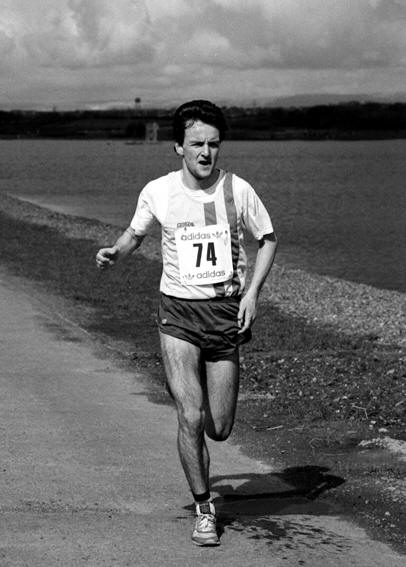
CV 6

Peter Fox: Six Stage: 1986

To summarise the Clyde Valley story, the club had four top class athletes in Jim Brown, Ronnie MacDonald, John Graham and Ian Gilmour.   Together with the likes of Brian McSloy, Peter Fox, Brian Gardner at the next level, followed by good class club runners mentioned above, Eddie Devlin, Colin Farquharson, Ian Moncur, myself, David Marshall, Neil Agnew, etc, success was achieved at National and District events as well as the usual open races and relays.

One criticism that could be brought was the inability to field the absolute strongest possible team.   Due in part to injury, illness and runners having their own agendas and targets, the club never managed to win in my opinion the biggest prize – the National cross-country title – something which should have been within our grasp.   I’ve gone on long enough and would just finish by saying that this is by no means an in-depth history, purely a personal recollection of events based on memory and informantion available to me: the full story remains to be written!

Back to The Fast Pack
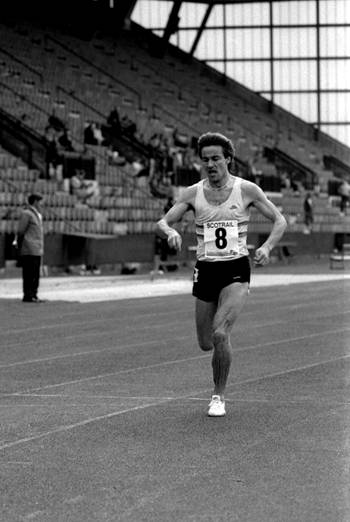
Bellahouston Harriers

ella 58 2

 Receiving the Trophy

In the post-war period of Scottish athletics when endurance running reached a very high standard indeed, the three teams from the West of Scotland that tended to dominate the championship team races were Shettleston, Victoria Park and Bellahouston Harriers.   For some reason the feats of the third of these don’t seem to be as well known as they should be.   Possibly because they did not have as many ‘stars’ as the others and their results were often as much because of solid team work throughout the teams.   They did have very good athletes, some of whom are mentioned below but if we just look at their performances in the top two winter team challenges – the Edinburgh to Glasgow and the National Championships in the late 40’s and 50’s – it is clear that they should take their place with the aforementioned club squads of the time.    In the Edinburgh to Glasgow they had one first, three seconds and four third places between 1949 and 1960, and in the National it was one first, five seconds in the same  time frame.   In four of the Edinburgh to Glasgow medal winning teams, they did not have a single fastest time and yet they finished very close up.    eg in April and November 1949, they were only 20 and 31 seconds behind the second team.   In his official history of the SCCU Colin Shields has this to say: “Bellahouston Harriers whose young team had finished second and third in the preceding years, collected their full set of medals when upsetting the post-war monopoly created by Victoria Park and Shettleston .   Their first victory since 1938 was not achieved easily as Victoria Park and Shettleston exchanged the lead over the first half of the race.   Once Dick Penman took the lead on the fifth stage and Joe Connolly kept Bellahouston’s lead after a struggle with Alastair Wood (Shettleston) and Ian Binnie (Victoria Park), good runs by Des Dickson and Ramsey Black brought Bellahouston home to victory in 3 hours 49 minutes 29 seconds fully 250 yards in front of Shettleston Harriers.   ……. The Bellahouston team showed amazing consistency over the next two years finishing within just six seconds of their winning time on each occasion but having to give best to a resurgent Shettleston team.”

Among the top guys, Joe Connolly was the one who stood out but he only came into the squad in the second half of the 1950’s Des Dickson who was slightly earlier and of course Alex McLean and Harry Fenion who were excellent athletes by anyone’s standards.   Jim Irving who was one of the younger athletes in the club at the time but who became of the top men has the following to say about the club.

“Bellahouston was quite a strong club in the early 1950’s but took a turn for the better when six or seven young boys joined up.   Joe Connolly, Dick Penman, Steve McLean, Crawford Kennedy, Ramsay Black and Jim Irvine were among them.   This pack of boys went on to win county, district and national titles over the country.   After doing National Service in the Army and RAF, they came out and won the Junior National at Hamilton (Joe Connolly 5th, Gordon Nelson 7th, Ramsey Black 10th and Jim Irvine 11th).   We lost one or two at this time – Crawford Kennedy who joined his brother Henry out in Canada – they both won lots of college titles in the USA.  

As the club established itself with the younger members backed up by some of the older ones like Harry Fenion and Bert Irving, Freddie Cowan and Bob Stoddart we went on to become contenders for the E-G, winning a few medals before winning it in 1958 (with Bill Goodwin, Bert Irving, Jim Irvine, Harry Fenion, Dick Penman, Joe Connolly, Des Dickson and Ramsey Black.)

Joe Connolly was the most consistent member of the team over all surfaces.   After finishing second to Harry in the National in 1957, he went on to win it in 1960.   He also represented Scotland in the Empire Games in Cardiff in 1958 in the three miles and six miles.   Joe had best times of – mile 4:19; Two Miles 9:11; Three Miles 13:53 and Six Miles 29:06 and all done on cinder tracks.  

Harry Fenion had a rare double in 1957: he won the National Cross-Country Championship at Hamilton and then won the SAAA Marathon championship in 2:25:44 which was a world class time in this era.   He was also selected for the Empire Games and had a long career stretching back to 1949 when he won the National Youths Cross-Country.  

Bert Irving came from Drummore, near Stranraer.   Bert only came up a few times each year – the E-G trial, the E-G itself, the national and the international!   He was a class act over the country, did most of his running on his own and his best place in the National was third in 1959. 

Des Dickson joined the club after giving up football.   The story with Des was that he could not make the E-G team but the following February was ninth in the National and picked for the Scottish cross-country team.   Des became a very good runner for the club for a number of years.    Gordon Nelson won the Scottish steeplechase title and should have become an outstanding runner and won a lot more.   His training was a bit erratic but what a talent he had.

Billy Goodwin was an outstanding talent as a Youth and Junior, winning Scottish titles over the country.   As a youth (Under 17) he was second in the British Cross-Country Championship.   Unfortunately his career was cut short with serious back trouble.   Ramsey Black and myself were part of most team titles, never being too far away.   Freddie Cowan, David Wright and Bob Stoddart also played their part in all this.

It was a great period for the club but like everything else, it ran its course.”

A great period indeed – we’ll come to the specifics later but between April 1949 and 1960 they won one gold, three silvers and four bronze medals in the E-G at a time when the standard was very high, in addition there were one gold and four silvers in the National Championships.   There were many more in the County and District championships too.   The team did well and we should maybe look at some of the individuals involved

.Bella 58 2

Ramsey Black crossing the finishing line in 1958

Bill Goodwin, Dick Penman, Bert Irving, Jim Irvine and Des Dickson could be a good start.

Not as well known today as his younger brother Brian who was also a good athlete but is better known as an official who worked tirelessly for the sport in general but particularly for cross-country running, BILLY GOODWIN was a genuine talent.   He was absolutely outstanding as a Youth and Junior.   He only appears once in the track rankings – 1959 with 30:20.4 when finishing third in the SAAA 6 Miles Championship to be fifth in the ratings – but it should be remembered that he had to give up tragically early because of his back problems.   He first appeared in the Cross-Country Championships in 1955 when he won the Youths title from John Wright of Clydesdale Harriers who would go on to win the Junior title twice in succession.   He had been unbeaten for the whole of the 1954/55 season and winning the National completed the set of Renfrewshire, District and SCCU titles.   The following year when he won it from Jackie Hislop of Clydesdale Harriers.  Colin Shields says in ‘Whatever the Weather’, the official history of the SCCU, “Billie Goodwin, who started the season with a record-breaking win in the Clydesdale Harriers popular Youths road race, then reeled off victories in the Renfrewshire and Midland Championships.   He retained his national title with an effortless run and just failed to carry off the double in the English National Championships.   Running as an individual, the Bellahouston Youth was boxed in at the start of the race, losing a lot of ground.   he had to weave his way through the large field of runners eventually finishing second just 60 yards behind the winner.”    His name does not appear in the Championships again until 1959 when he won the Junior championship from John Linaker.   As far as the Edinburgh to Glasgow is concerned, His first run was in 1958 when he was third on the first stage and, as Jim points put above, Bellahouston won the team race.   He ran again in 1959, again on the first stage but this time he was seventh with the team being second, in 1960 and 1961 he took the last stage and the team was second in ’60 and fourth in ’61.   It is as a cross-country man that he will be best remembered however with his outstanding performance being his second place in the English National championship.

DICK PENMAN was one of the four young athletes that Jim spoke about above when he was a member of the E-G winning team in 1958.   He appeared in the Scottish Ranking Lists in three consecutive years – in 1959 he was eighth in the 6 Miles list with a time of 30:49.2; in 1961 he was in both the Two Miles (eighth with 9:17.0) and Six Miles (sixteenth with 31:04.0) and in 1965 ( twenty sixth in six miles with 31:12.8).   His first E-0G was in 1954 when he held on to fifth position on the seventh stage.  In 1957 he ran on the final stage for the team that was second; in 1958 he ran an outstanding fifth stage bringing the club from third to first;  in 1959 he had the fastest time on the same stage when bringing the club from fifth to third.   in 1961 he was given the most difficult stage – the sixth – and did well to keep the loss of places to two. in 1962 he ran the first stage in a weakened team and finished thirteenth.      In 1963 he ran the fifth stage again and moved from 15th to eleventh, in 1964 he went from tenth to eighth on the sixth stage and that was his last race in the relay.    He was a good runner, but it seems safe to say that he did not like cross-country very much – I can only find two appearances as a Senior in the National Championships: in 1957 he was twenty second and third counter in the team that finished second, and in 1959 he was fifty second in the team that finished third.    Dick took  part in Billy Butlin’s John o’Groats to Lands End challenge in 1960.   Billy Butlin was the founder of all the Butlin’s Holiday Camps and following Dr Barbara Moore’s walk over the same route living only on vegetables and fruit to prove the value of the vegetarian diet, Butlin saw the chance for some cheap publicity.   Putting up a big money prize, he encouraged ordinary people to enter and then get themselves to JoG and then take part in the race.   People were arriving in Glasgow with five shillings in their pocket to get them to JoG!   Dick entered the race, led by quite a way early on, then developed some injuries and eventually dropped out suffering from an ulcer in Crianlarich.   He had some small sponsorship from a ‘nutritional drinks’ company and his father drove the support car.   I’d like the full story – so if anyone has it, let me know.   He was certainly a quality athlete and given reasonable notice could have done really well in this event which was run in a snowy February.   Look up the Billy Butlin walk on the internet, lots of video clips.    Dick was one of Bellahouston’s top men in the 50’s.

If you look for BERT IRVING in the record books, you will not find many entries: that does not mean that he was not a runner of the highest calibre, especially over the country.   A large part of the problem was that he lived in one of the farthest corners of Galloway – down on the tip of the Drummore peninsula.   We are talking about a time when not too many people had cars and when public transport away from the major conurbations was not always plentiful.   To make the journey to Glasgow was a major undertaking.   So he trained away on his own in the beautiful Dumfriesshire countryside, only emerging for the main races of the season.    The story of him only doing three races (E-G, National and International in the same season was not far from the truth.   His record in the Edinburgh to Glasgow starts in 1957 when he was in the team that finished second; he ran on the fifth stage and turned in the second fastest time with only Alex Breckenridge of the winners, Victoria Park, being quicker.    He was part of the winning squad in 1958 when he ran the difficult second stage where he held the third place given to him by Billy Goodwin at the end of the first leg.   On the same stage in 1959 he moved the team from seventh to fourth and saw the club finish second.   Missing 1960 he was on the second stage in 1961 where he maintained the lead handed to him by Joe Connolly on the first stage.   He missed the next year but although he ran well into the 60’s his real work for the very good club outfit had been done by then.

On the country, he was even better.   He made his debut in 1957 and finished 23rd in the team that finished second behind Victoria Park.   In 1958 he was twentieth and in 1959 he achieved his best ever position in the event when he was third splitting John McLaren (two seconds ahead) and Graham Everett (four seconds back) to gain his first international vest and a trip to Lisbon where he finished sixtieth.   1960 saw him win his second international honour after he was fifth in the National and this time the venue was at home – the same Hamilton Course that had hosted the national.   This time he was forty first and a counting runner.   In 1961 he was eighteenth but 1962 saw him back to his best when he finished sixth – one place behind Alastair Wood and one in front of John McLaren – and gain selection for the international championship in Sheffield where he was fifty eighth.   That was his last international fixture.   His achievements were quite amazing when one considers that he did all his training on his own in a far away part of Scotland where the weather could be as wild as anywhere on the mainland and without the spur of training with a pack of like minded individuals.   It would have been interesting to see what he could have achieved training with a group and easy access to more races.

JIM IRVINE  was another of the excellent group of  runners who graced the team at this time.   Unlike most, Jim is still involved in the sport, in the club and has in fact donated a trophy for a club 10K road race.    Jim first appeared in the cross country national championship as a Youth (ie under 17) in 1952 when the Bellahouston Harriers team finished third but he himself was a non-scoring runner that year, nor was he the following year when the team won and he was forty fourth finisher.  In1954 though when the team was third Jim in forty second place was the fourth counting runner behind Gordon Nelson (7), S McLean (12) and R Stoddart (31)   Next year, as a Junior that Jimmy  was in the team that was second in the National with the scoring runners being Nelson (6), Kennedy (8), Irvine (18) and Mclean (12) – close packing!  In 1956 he was a member of winning Junior team in which Joe Connolly was fourth, Gordon Nelson seventh, Ramsay Black tenth and Jimmy eleventh.   Again very good packing, four men in six places and all in the top dozen.   He was a Senior in 1957 and a member of the Bellahouston squad that finished second and again in 1958 (when he was thirty eighth) and in 1959 when he was thirty third in a team that finished third. – six National medals in six years.   In the Edinburgh to Glasgow his record was also excellent.   In 1955, as a first year Junior, he ran on the seventh stage and held tenaciously on to fourth in a team the finished in fifth place.   He missed the race in 1956 but in 1957 he was again on the seventh stage where he held on to second place in the team that won silver.   1958 was of course the ‘glory year’ when the race was won.   Jim was on the third stage and moved the team up from third to second, helping on the way to the leaders spot.   He did not run in the next two years.   Jimmy was a good runner at a time of good runners and a member of one of the best distance running squads in the country at any time.   It is interesting to go beyond these profiles and see just how good the runners were.   Jim summarised some of his career highlights for us and some notable road races.   I have them in the table below.   But first the highlights:

Best National Cross Country position:   18th in 1961;   fourth in the Renfrewshire Cross-Country Championships 5 times;   Best track times (all on cinder tracks, remember):   Mile:   4:33;   Two Miles   9:33;   Three Miles   14:51;   Six Miles   31:07.


Year Venue Distance Place Comments
1958 Gourock 14 Miles 1st 2nd G Eadie, 3rd C O’Boyle
1958 Cumnock 10 Miles 1st 2nd A Fleming, 3rd G Eadie
1958 Brechin 12 Miles 2nd 1st Pat Moy by 30 seconds
1959 Carluke 12 Miles 3rd 1st AH Brown, 2nd J Kerr

5 seconds covered the three!

  Shotts 14 Miles 3rd 1st AH Brown, 2nd A McDougall
  Gourock 14 Miles 2nd A Allan
  Kilwinning 13 Miles 3rd  
  Carluke 12 Miles 3rd 1st AH Brown, 2nd H Fenion

These were all seriously good races – competition was the thing and there are no easy ‘scalps’ in the names above – the 1959 Carluke race was particularly notable.   A road runner of ability Jim never did the big miles required for the marathon but nevertheless managed a creditable 2:36.   Jimmy was one of the few from that generation who went on to become good veteran runners and he was third twice in the Scottish Championships as an M40 before winning the M50 title in 1986.   His best track times as a vet were – 1500m   4:27; 5000m   15:56;   10000m   32:20 (when winning the Scottish Vets title);    and on the road he has times of – 1:13:28 for the half marathon and 2:43:52 for the Marathon run at London at the age of 49 in 1984.    These are all very good times but he does admit that he ran 1:10:40 for the half marathon at Stranraer but because within himself he felt the course was a bit short, he doesn’t claim it as a pb!   This page recognises the great Bellahouston Harriers squad of the ’50’s and early ’60’s and they were all great team men.   Jimmy never stopped and he ran in the Alloa – Bishopbriggs veterans eight man relay: the vets’ Edinburgh to Glasgow was a superb race which almost emulated the original and was a good race in its own right.   Jim has a full set of medals from these races and even has one fastest lap (on the seventh stage) to his credit!

DES DICKSON was also a member of the winning Edinburgh to Glasgow team in 1958 and won several other medals on the road and country for the club.   Jimmy’s story above is a good one!   Des came into the sport, Jim reports, from football and failed to qualify for the E-G team in November 1957  and then finished ninth in the National in February 1958 and was selected for the International.   He had run in the National in 1957 and finished forty fourth to be a counting runner in the team that finished fourth.   He did make the team in 1958 and ran on the seventh stage – taking over in first place, he held his ground and handed over a lead to the last runner.    1959 was a good year for Des, seventeenth in the team that was third in the national, running on the fourth stage of the E-G he was in the team that picked up silver and in between he appeared in no fewer than four ranking lists.   His one mile in 4:20.2 saw him in fifteenth, two miles in 9:33.0 had him twelfth, three miles in 14:52.3 placed him twenty first and six miles in 30:48.0 was good enough for seventh fastest in Scotland.   In the National in 1960 he was fortieth and the team was second and in the E-G that year he picked up a place on the fourth stage and another silver team medal.   His mile time that year slipped to 4:23 which had him nineteenth in Scotland.   He ran for several years in the 1960’s having more than done his bit for the club in the last years of a wonderful decade for the club.

I’ll stop there but may well come back to Bellahouston to look at some of the other members of this illustrious squad.  Meanwhile, Neil Black who ran for Bellahouston Harriers in the 80’s has been appointed successor to Charles van Commenee as GB’s national coach, and Graham Getty has written this short paragraph about him.

“Neil Black joined Bellahouston in January 1982 when he was working in the East of Scotland.     Following the participation of a number of Bellahouston Harriers in the famous Morpeth to Newcastle race,  in which Neil finished third for his club Morpeth Harriers he was introduced to the Bella boys by another Bellahouston runner, Rab Marshall, who had many years earlier relocated to the north-east of England, joining Morpeth Harriers in the process.   Neil made his debut for Bellahouston Harriers in the West District Cross-Country Championships at Coatbridge on 23rd January, 1982 and, as an unknown in the area, surprised the leading runners, finishing third and helping Bella win the team title with a team including Daly (13th), Getty (15th) and Braidwood (18th).   With this performance, he didn’t remain unknown for long!  

On February 13th, 1982, Neil won the famous Edinburgh University 10 Mile Road Race in a time of 50:13, helping the club to second team with the other runners being Daly 12th, Getty 14th and Wyper 18th.   Two weeks later, on February 27th, Neil followed that up with finishing twelfth in the 1982 SCCU Cross-Country Championships, assisting Bellahouston to fifth team with a team of Braidwood tenth, Getty thirty fifth, Cox thirty seventh, Daly thirty ninth and Joss seventy third.  

Neil also ran for the club twice in the Edinburgh to Glasgow Relay.   In 1982 he ran the fifth stage in 26:25 taking Bellahouston from second to first and helping them to an overall fourth position.    Neil’s time was 62 seconds faster than Dave Logue’s for the winning team, Edinburgh Southern Harriers.   In 1983 he ran the third leg and took Bella from eighth to first in a time of 28:09: this compared with Graham Laing’s time of 28:18 for the winning team, Aberdeen AAC.  

He was a class runner who added much to an already strong Bellahouston team during his short stay in Scotland.”

That’s a clear succinct indication of the man’s talents as a runner and gives a hint of more insight into the athlete’s requirements than almost any other applicant for the job.    At least he knows that the UK does not stop at the Watford Gap!

The club’s entire historical record forms part of the remarkably detailed member’s ticket for 1962-3 which, thanks to Jim Irvine, can be seen  here .


Cambuslang Harriers

Eddie

Two of Scotland’s Best Ever Club Men

Eddie Stewart

The Cambuslang Harriers group  of distance runners of the 1980’s was maybe the best group to come together for the club in the last century.   Not one was a Commonwealth, European or Olympic Games athlete; not one dominated any single event in the country, and yet at a time when there were many excellent athletes in competition with them, they won so many team races and collected so many team medals by running for each other and for the club, that they rank up there with the best of them.  The club had started performing well as a group in the 1970’s when the Rimmer twins joined the club and Rod Stone, a Northern Irish Internationalist working in Cumbernauld, joined the club to add strength and depth to the squad which contained Robert Anderson, Gordon Eadie and others.   At that time I was coaching a group of runners at Coatbridge and after Hugh Forgie of Law & District brought Alex Gilmour along, a good number of men from the club joined the group.   Top dogs were Alex and Eddie with Jim Orr, Tom Ulliott, Pat Morris, Sam Wallace and others all of the highest calibre.  It will be difficult to separate Alex and Eddie because they were such an inspiring double act – very different people, equally important to the club.    Like all top class athletes they were extremely affable, likeable and hard working.   Neither went in for posing or prima donna attitudes.   Alex came to Cambuslang from Larkhall YMCA as a very promising young athlete; Eddie came from Eastwood High School, via West of Scotland Harriers, joining Cambuslang when West of Scotland went defunct.   Alex only had one International vest over the country – New York in 1984 – but was a real hard man to race against and lifted the scalps of all the top men at one time or another: he was always in-and-about team members too, urging them on to work harder, do better.    Eddie was a bit more easy going – on the surface.   He led by example, no one raced harder, but he had a quiet authoritative demeanour.   An example of his manner and influence is shown at the time of the New York World Championships when there were four Cambuslang Harriers (himself, Alex, Jim Orr and David McShane) in the team.   Eddie had them together the night before the race and pointed out that every country had someone like Nat Muir and every country had someone like Allister Hutton; there were 40 countries taking part, so that was 80 places they could probably forget about!   He then discussed the race with them.   Eddie only had two cross-country international vests – 1982 and 1984.   We can start by looking at their own records before commenting on other club members.   (You knew you’d made it when the ‘Sunday Post’ got your name wrong, Hamish McHattie became Hamish McTattie for instance: after the West District Championships one year they were Eric Stewart and Alan Gilmour!) These are necessarily short profiles and are not meant to be totally comprehensive but are here to indicate the quality of the individuals concerned and how they came to be great club men at the start of a remarkable run for Cambuslang Harriers.   Several club members are already profiled in some depth on the website and if you click on their name, you will get the profile.   They are Gordon Rimmer and Colin Donnelly, .    The reasons why any club might do well at any particular period are varied but Dave Thom in his history of the club says that The club’s growing success on all fronts was due to a number of factors: the coaching and encouragement of Robert Anderson, the sound administration from Des Yuill, Jim Scarborough and David Cooney along with his close liaison with the senior athletes, the gritty inspiration of Alex Gilmour, the ever reliability of Eddie Stewart (Steady Eddie), up and coming athletes such as David McShane, Jim Orr and Charlie Thomson and the excellent team spirit which the club was engendering.”   We can take five athletes as examples of this spirit, and all five are noted above by Dave.

Alex Gilmour

I’ll take Alex Gilmour first simply because he joined the club first – in 1975.    Alex did a lot of track running and it was as a track runner that I first saw him in action – an invitation 1500m at East Kilbride – and at the end of his career he had pb’s of 3:54.6 (1500m), 8:05.3 (3000m) and 14:06.53 (5000m) and he was third in the 1985 SAAA 5000m.    He had several track international appearances and narrowly missed selection for the Commonwealth Games in 1986.    Between 1975 and 1989 he ran in ten Edinburgh to Glasgow races, covering stages 4, 5 and 6 with one fastest time (on Four in 1985) and pocketed one gold, three silver and one bronze.   His best run was probably in 1983 when he ran the second stage and moved from tenth to third.    But the amazing statistic is that he never, ever lost a place in the event – and picked up a total of 21 places.    Of course he ran in the Six Stage as well and in the 80’s picked up a gold, two silvers and a bronze.

On the country, as a Senior, between 1980 and 1990, inclusive, he amassed a total of three gold medals, two silvers and three bronze.   His best performance was in 1988 when he was fifth and twice he finished eighth.   His rivalry with his good friend Eddie was beneficial to them both although they never let it interfere with their view of the race as a whole.   eg in 1984 he finished eighth to Eddie’s tenth with only 10 seconds between them, in 1986 he was one place behind Eddie’s eleventh with only 10 seconds separation, in 1988, he was fifth, team mate Colin Donnelly sixth and Eddie seventh with nineteen seconds between them, but the closest finish was in 1990 when Eddie was nineteenth and only TWO seconds ahead of Alex.   I’ll quote from Dave’s club history again: “Later in 1983 the National Cross-Country Relays at Edinburgh proved to be a happy hunting ground for the harriers when they regained the senior title.   Earlier runs by David McShane, Rod Stone and Eddie Stewart had kept them in contention but adrift of the favourites, Edinburgh Southern Harriers.   However a storming last leg by Alex Gilmour won the day for Cambuslang.   The young athletes lifted the bronze award.”   And again, “Success continued in 1986 when the Seniors won the National Six Stage Relay for the first time, when after good work by Tom Ulliott, Rod Stone, Jim Orr, Eddie Stewart and Charlie Thomson, Alex Gilmour overhauled Edinburgh Southern once again.”  

In the training group Alex was also worth his weight in gold – keeping the recovery jogs up to time, encouraging some, telling others off and reporting back on sessions.  In addition to the medals quoted above, he won many of all colours in the Six Stage and Cross-Country Relays plus Lanarkshire Championship and Relays.  At a time when his club was starting to get itself together and make a mark on the National scene, Alex was a key man.

Eddie Stewart  was a tower of strength over the country for Cambuslang   adding leadership to the team which was invaluable as well as being reliably one of the best men in the field wherever he turned up.   He, inevitably I suppose, had the title of “Steady Eddie”.   Surprisingly he only had two International outings – in 1982 and 1984.   He turned out as a Junior in 1977 and 1978 for West of Scotland Harriers which was fairly strong with runners such as marathon man Davie Wyper, young Ian Shaw and others but when they shut up shop he joined Cambuslang.   His record in the national was outstanding.   Let’s put the 1980 to 2002 period (23 years) in tabular form.

Year Place Team Position Award   Year Place Team Position Award Comments
1980 58 3rd Bronze   1992 16 1st Gold  
1981 13 Unknown   1993 10 1st Gold  
1982 8 8th   1994 8 1st Gold  
1983 11 4th   1995 15 1st Gold  
1984 10 2nd Silver   1996 18 2nd Silver  
1985 7 3rd Bronze   1997   DNR    
1986 11 2nd Silver   1998 26 1st Gold  
1987 13 3rd Bronze   1999 23 1st Gold  
1988 7 1st Gold   2000 23 1st Gold  
1989 44 Non-Scoring (Team Gold)   2001 24 2nd Silver  
1990 19 1st Gold   2002 30 Non Scoring (Team Gold) Last Scoring Runner: 27th!
1991 19 1st Gold            

10 National Golds, 4 National Silver and 3 National Bronze

As is to be expected, Eddie had a good record in the Edinburgh to Glasgow in which he raced 13 times, including every race between 1979 and 1989, winning one gold, four silver and  one bronze.   He covered stages 2, 4, 5 and 6 and performed nobly one every one of them.    He ran on the tough second stage five time and picked up 19 places on it, three times picking up four places.   Eddie turned out where he was required and raced in the Six Stage Road Relays collecting a gold, two silvers and a bronze.

The track was not his favourite surface but he did perform well there too with personal best times of 8:16.5 for 3000m (1985), 14:11.7 for 5000m (1985) and 32:10 for 10000m (1977).  It was not unusual to see him using an open graded meeting or a Lanarkshire league match  for training purposes running in the 800m, 1500m and 3000m at the same meeting!  The 1985 times are of interest for a particular reason.   In the National Cross-Country Championships held in February, 1985, Eddie finished seventh but when the team for the international was chosen, he was left out in favour of Colin Hume and Neil Tennant of Edinburgh Southern Harriers, the first of whom finished eleven seconds behind him.   The first six and number eighth were selected.    It looked like a clear case of bias.   Cambuslang Harriers were not prepared to let it go and their ire was the greater because Pat Morris, a promising athlete on all surfaces, finished sixth in the Junior race and was left out in favour of Tom Hanlon (also of Edinburgh Southern Harriers), second in the Youths event.   Having gathered the appropriate number of signatures, Cambuslang called an Extraordinary General Meeting of the SCCU with the single item agenda.   In Eddie’s case, the Union representatives argued that Hume was younger and had shown more promise for the future than Eddie had.   Eddie was just 29 at the time!   Pat was fortunate in that there was a call-off in the Junior team so did manage to get to the International.   Eddie got a consolation race in Italy later in the year but he was not happy.   It takes a lot to rile him and he said nothing at all.   But that summer he trained harder than ever, and specifically for the track and improved his times considerably – almost 9 seconds from his 3000m and 11 seconds from his 5000m.    He raced more track that summer than usual and picked up many good scalps – he made his point that his improvements were not all behind him.   No drama, just quiet determination.   It was daft anyway to suggest to the athletics population that they would not improve much after the age of 29!

A tower of strength, almost opposite in temperament to Alex, they were very good friends.   Eddie moved to live in Prague in 1992 but as can be seen from the table above, returned virtually every year for major competitions and in fact is having a superb veteran athletic career.   He won the Scottish Masters championship outright as an M40 in 1998 leading the club to team gold; he won the M45 in 2005 and has also won the M50 title in 2007 and 2011 plus, the latest acquisition, the M55 championship in 2012!   .

Jim Orr was a Junior who was brought along to our regular Wednesday night training sessions by Alex Gilmour.    Like any other young athlete in the club at the time he had been in the shade of David McShane, a quite outstanding young athlete who had won every age group Cross-Country championship from Junior Boy level.   When I asked Jim what he wanted to do over the next year his answer was quite clear: “I want to make the Scottish Junior team fro New York next year!”    There were a number of Cambuslang runners in the group already and he fitted right in.   Jim was a hard worker in training but not a stupid one: if you ask some young athletes to to a particular session they do half as much again on the theory that, if one aspirin is good, three are better!   He was also a hard racer and no respecter of reputations.   If a big name was having a less-than-good day, Jim would take him or at least have a go.

On the country he had won two team gold medals as a junior with David McShane, Charlie Thomson and S Kenny in 1983 and 1984.   His first year as a Senior was 1984 and he added to the medal collection with a bronze team award after finishing thirty third.   He ran in five senior nationals and won three gold and two bronze medals: individually in ’86 he was eighteenth, in ’87 he was twenty fifth, in in ’88 fourteenth and in 1990 seventeenth.   In the four man cross country relay where it was cut-throat competition for the first team, he ran two in the second team but still collected his share of gold and bronze medals.   There were also medals in the District and County Championships as well.    Did he make the Junior team in ’84?   He certainly did with seventh place in the Junior Championship and in the race itself he was sixty fourth and a counting runner for the Scottish team.

On the roads he came into the Senior ranks just as the club team for the Edinburgh to Glasgow Relay was coming together and he ran very well in the race.   In brief, he ran in eight, won one gold, four silver and one bronze with the fastest time on the eighth stage in 1987 and third fastest on the third in ’83, on the fifth in ’84, on the eighth in ’89 and on the seventh in ’91.   Bearing in mind the quality of Scottish distance running at that time, these were very good runs.   He was also a good track runner with personal best times of 14:35 for 5000m and 31:21.8 for 10000m, both done in 1985.

So, what happened to Jim?   He seemed to have a whole world of athletics before him and his last race was the 1991 Edinburgh to Glasgow when he picked up a silver medal as a valued part of the Cambuslang team.   He was just 26.   The answer is that he just stopped for personal reasons involving work and family.   Running was an all or nothing activity for Jim, like most top athletes he needed to put in a reasonable mileage to get the performances and, having just got married in 1990, with the demands of work increasing, he couldn’t find the time to do that.   It should not be forgotten though that he was, like Alex and Eddie, a key member of the group that brought consistent major success to Cambuslang Harriers

6%20stage%20relays.%20J%20Orr%20A%20Gilmour%20-%20Cambuslang[1]

.

Charlie Thomson was the same age as Jim and they had run in trophy winning Junior teams together but his career was longer.    Charlie has been a familiar figure on the Senior and now veteran scene in Scotland for almost 30 years now and although never an elegant easy striding athlete like some of the track stars, he has had a record of consistency of running at a high level that is probably unrivalled in Scottish endurance running.   His collection of team medals is considerable  as the table below shows.


Event Gold Silver Bronze
National Cross Country Championship 13 4 1
Edinburgh to Glasgow Relay 1 5 3
Six Stage Relay Championship 3 3 6
Four Stage Cross-Country Champs 3  

The totals would have been higher had the competition within Cambuslang been less intense at times – there were occasions when he was inside the the top thirty in the National and not been a counting runner for a winning team, there were times when in the four stage relays he was top man in the second team when the first squad won the race.   I have also left out medals won as a Junior or Youth.  No District or County Championship or Relay Championship awards have been counted either or the number would have been at least doubled and there were no doubt awards in some of the Classics such as the McAndrew Relays and Nigel Barge races.

 Charlie was always better on the country and his record of consistency there is quite amazing: in his first twenty years as a senior his placings in the National Cross-Country Championships were as follows:   26, 20, 18, 20, 27, 12, 37, 18, 33, 17, -, 29, 12, 16, 12, 26, 18, 13, 29, 18.    Not a Scottish International, his best running came too late for the World Championships, never in the first ten, but – ten times out of 20 inside twentieth position, only two lower than twenty ninth and none at all as low as fortieth!

He didn’t do much running on the track but he did have a personal best for the 10000m of 30:53.4.   However, as a veteran athlete Charlie was third in the SVHC Championship in 2008 and has won many individual and team awards since then.

Finally for this page, David McShane was the man that all the young athletes of the time measured themselves against.   Coached by Scottish National Coach Alex Naylor, he had won National Cross Country Championships in every possible age group by the time he started racing with the Seniors: Youths title in 1982, Senior Boys in 1980, and Junior Boys in 1980 and 1981.   He really was a class act on the country and led club teams including Charlie Thomson and Jim Orr to National cross-country titles and team medals at Youth and Junior age-groups and as an individual was chosen to represent Scotland in the International Cross Country Championships in 1982 and 1984.

In the Edinburgh to Glasgow Relay, he only ran in three (1985 on Stage Seven; in 1988 on Stage Three when the team was third; and in 1989 on the third leg when the club was second.     He also won gold and silver in the National cross-country, the six-stage relays and the four man cross-country championships but his senior career was plagued by injury and he finally retired in 1992.   He was one who had played a big part in raising and keeping the team spirit and club morale high during this period when the club was just starting on a prolonged run of success.

Dave Thom reported on the events of 1992/93 as follows: “Moving into a new decade, many cynics thought that teh Cambuslang success story would end but, in spite of a number of major setbacks such as the loss of the sterling services of Des Yuill and Jim Scarborough in 1992 and 1993, the sudden death of Andy Beattie in 1992, the retiral through injury of club stalwarts Alex Gilmour, Jim Orr, David McShane, Mark Gormley and Graham Getty, the departure of Eddie Stewart to Prague they were to be proved wrong.”   And the club did go on to continue, and maybe in some respects surpass the achievements of the above men with Charlie and Eddie going on into the twenty first century but the actual generation of officials and runners who had started the ball rolling had disbanded.  I mean no disrespect to the men who ran throughout the previous years – Gordon Eadie and company would stand comparison with the best of any generation – but the men of the 80’s were special in their own particular way.