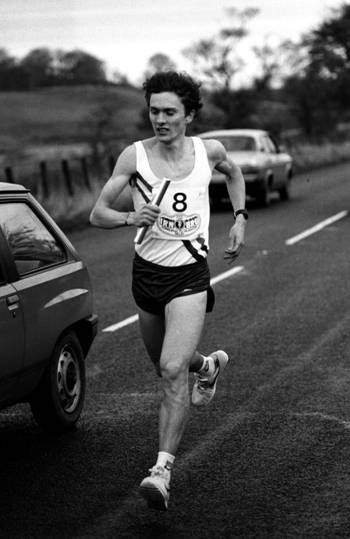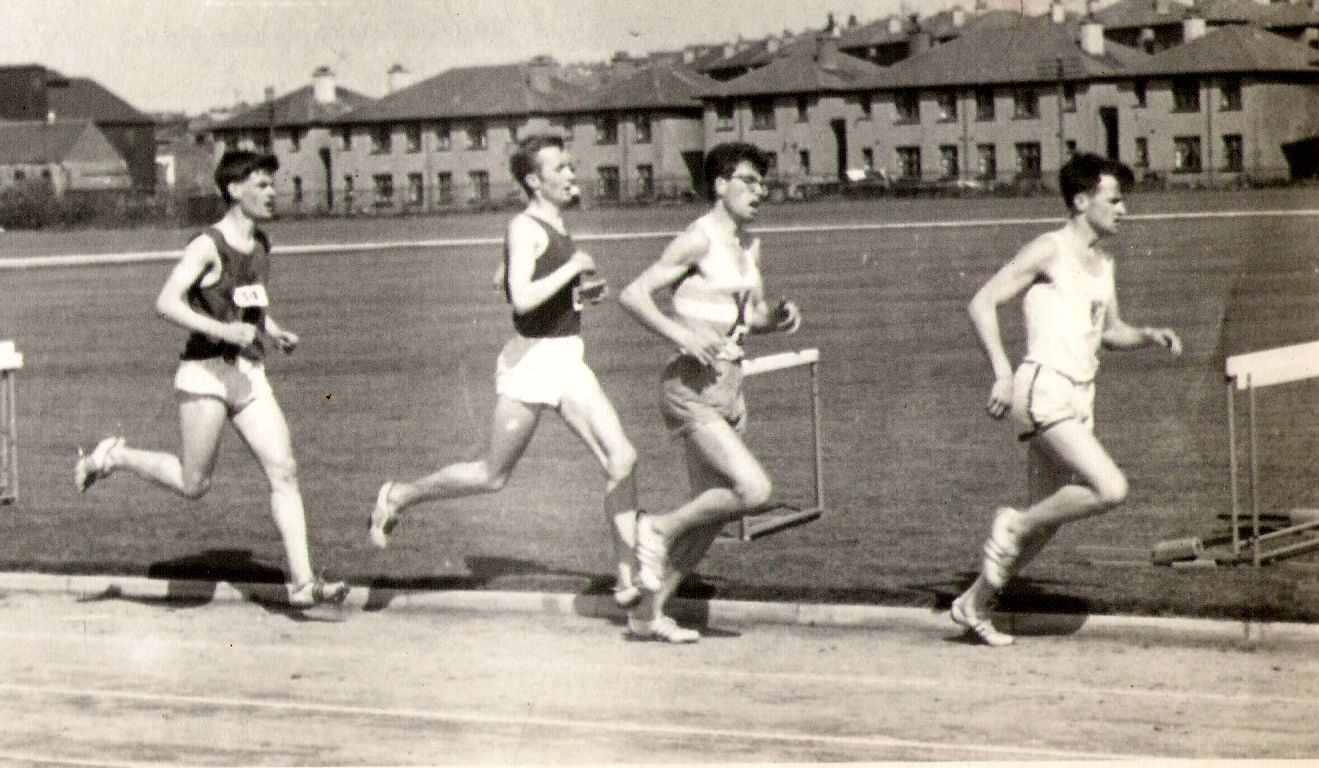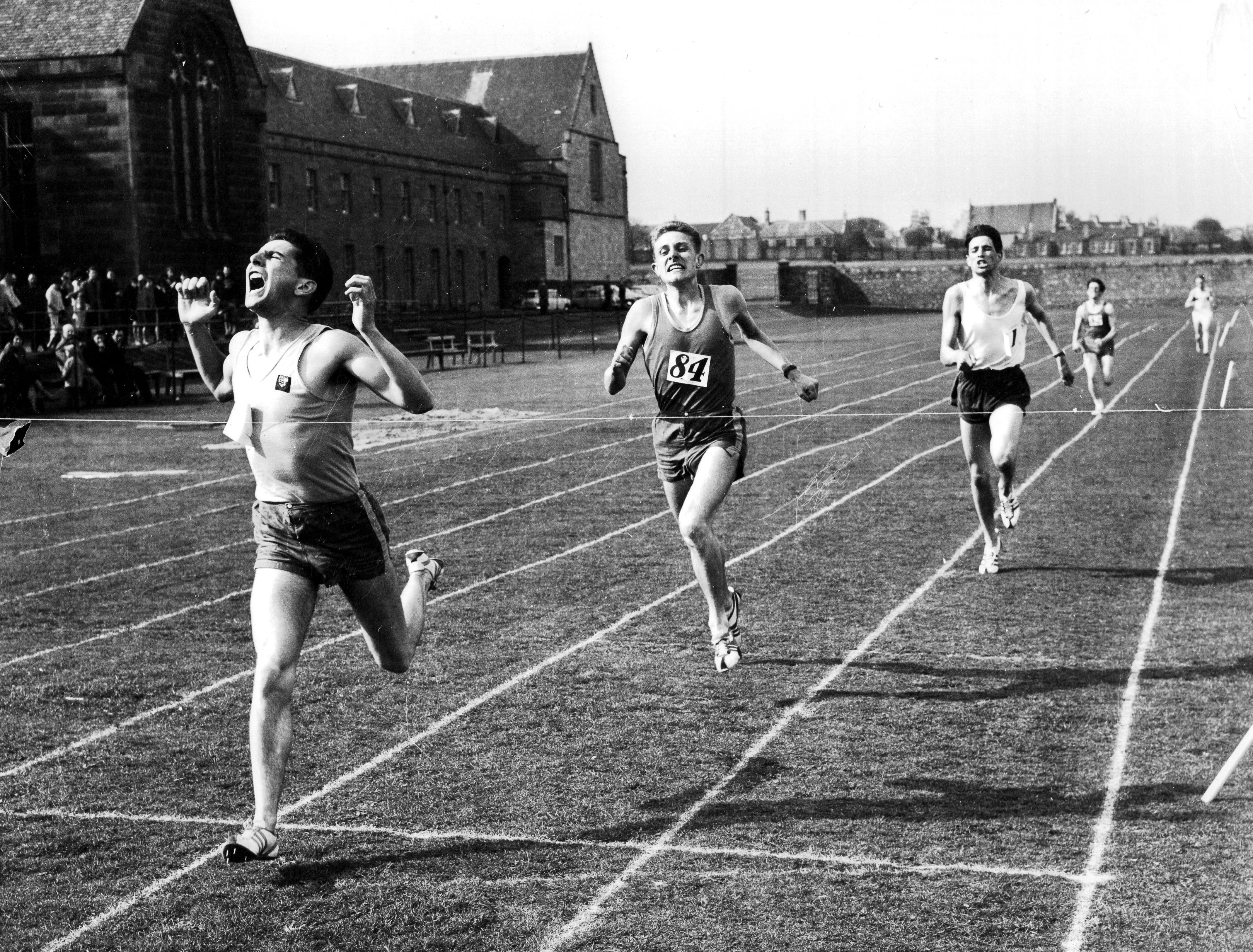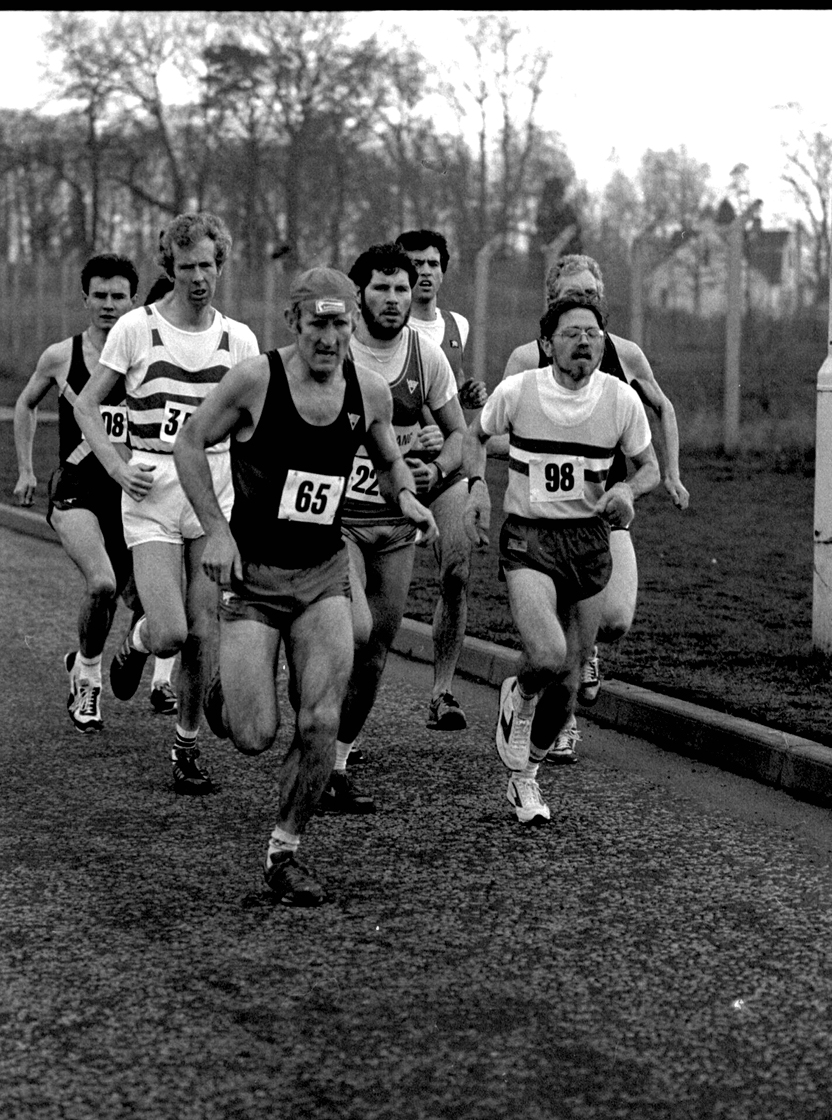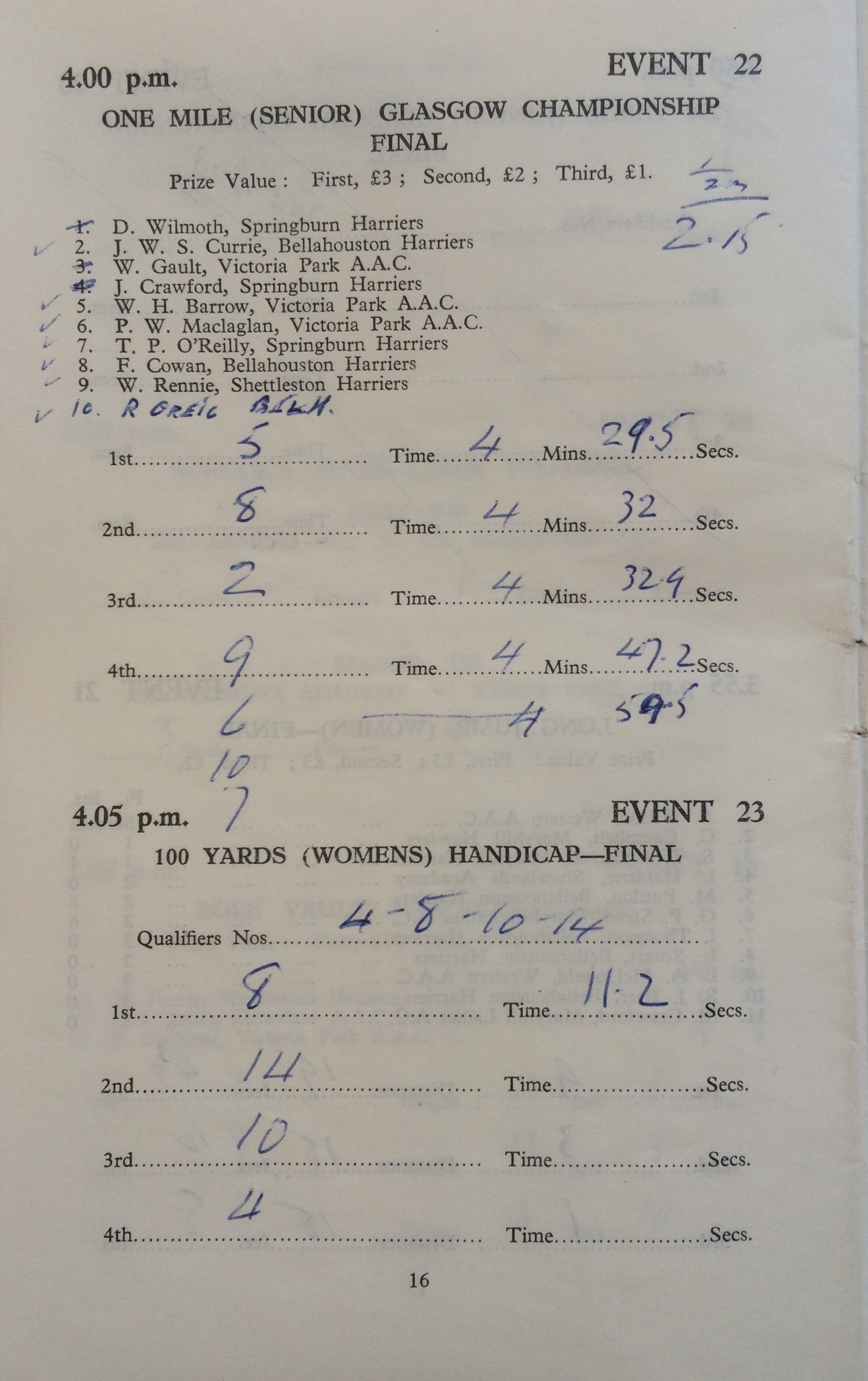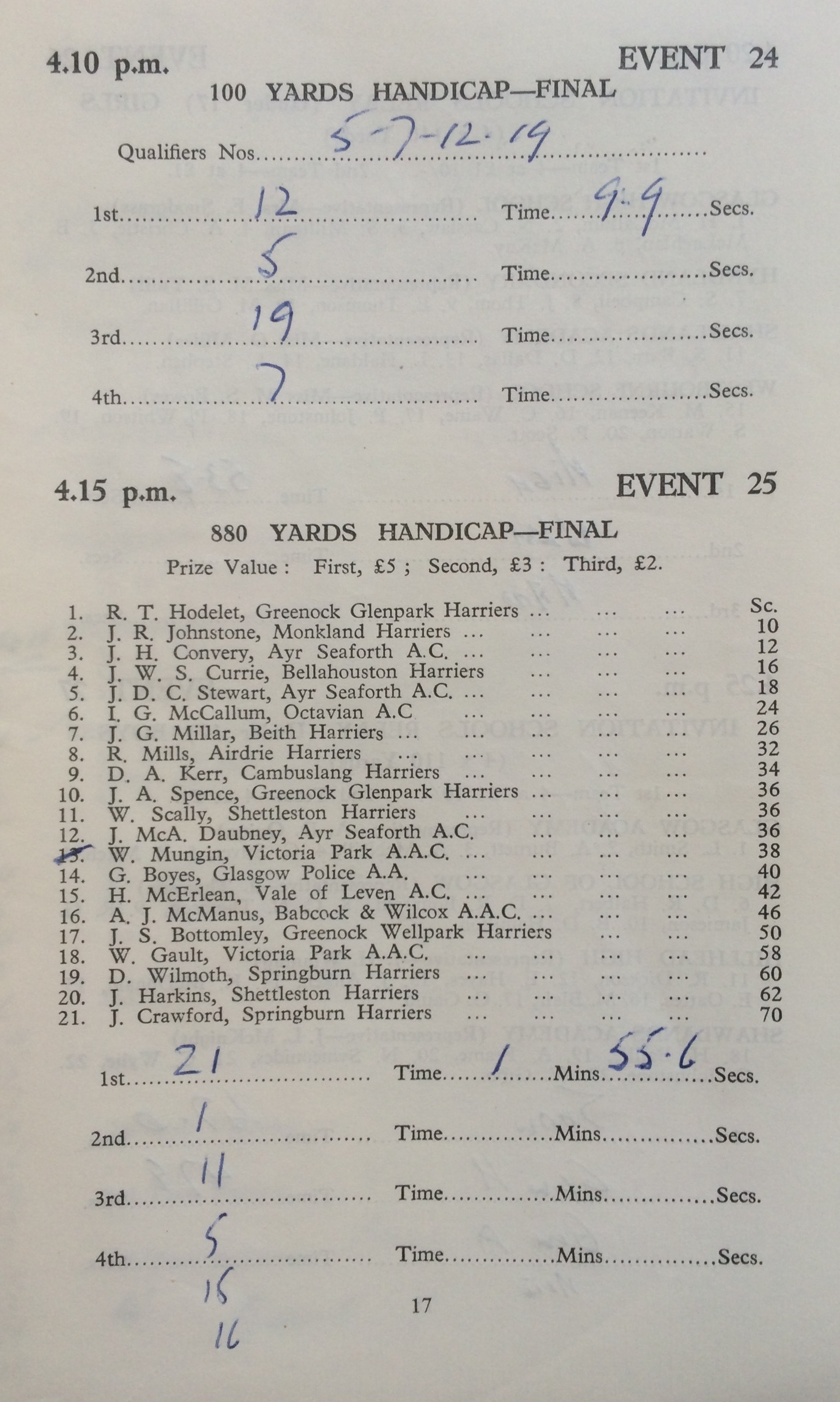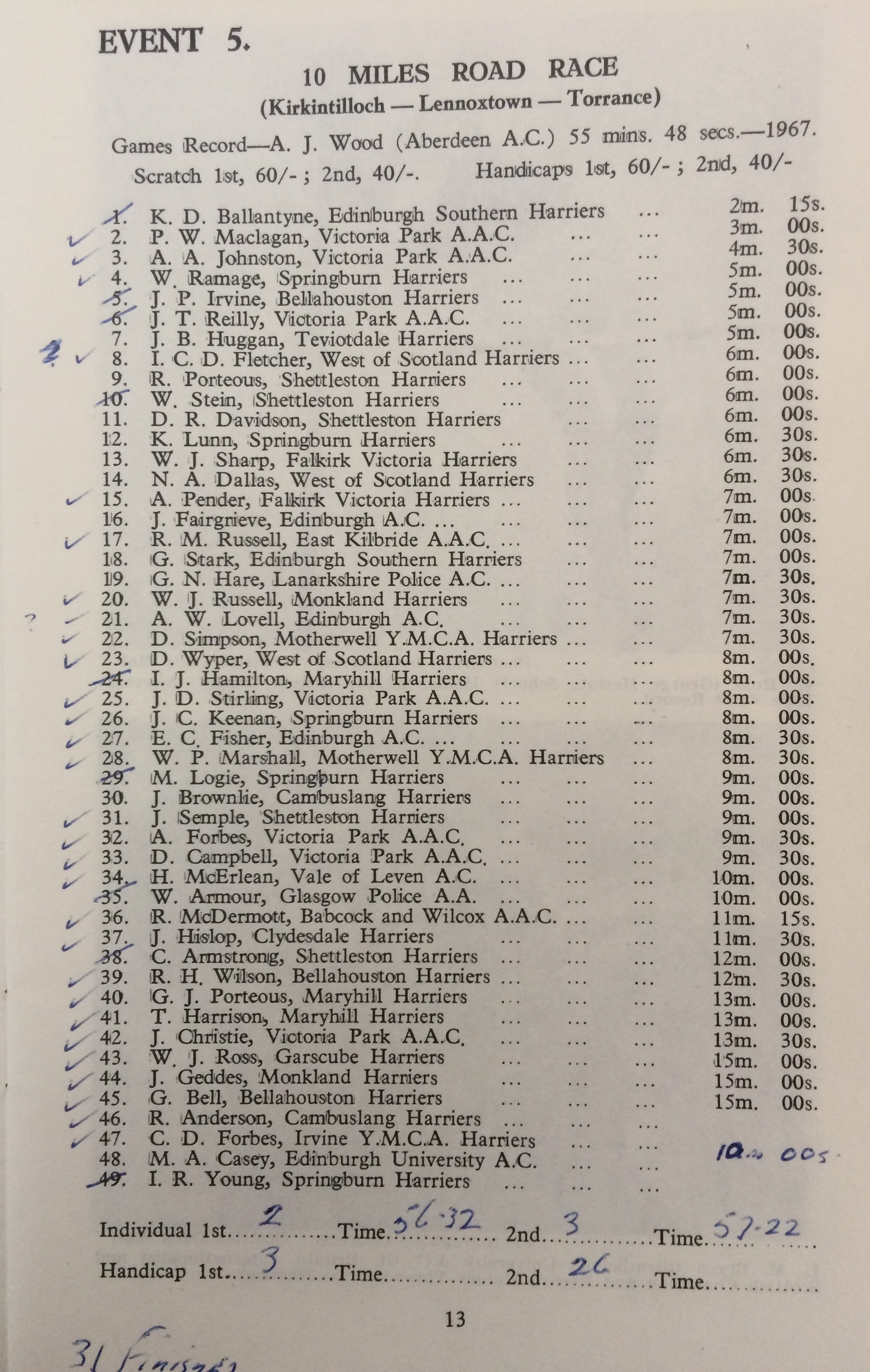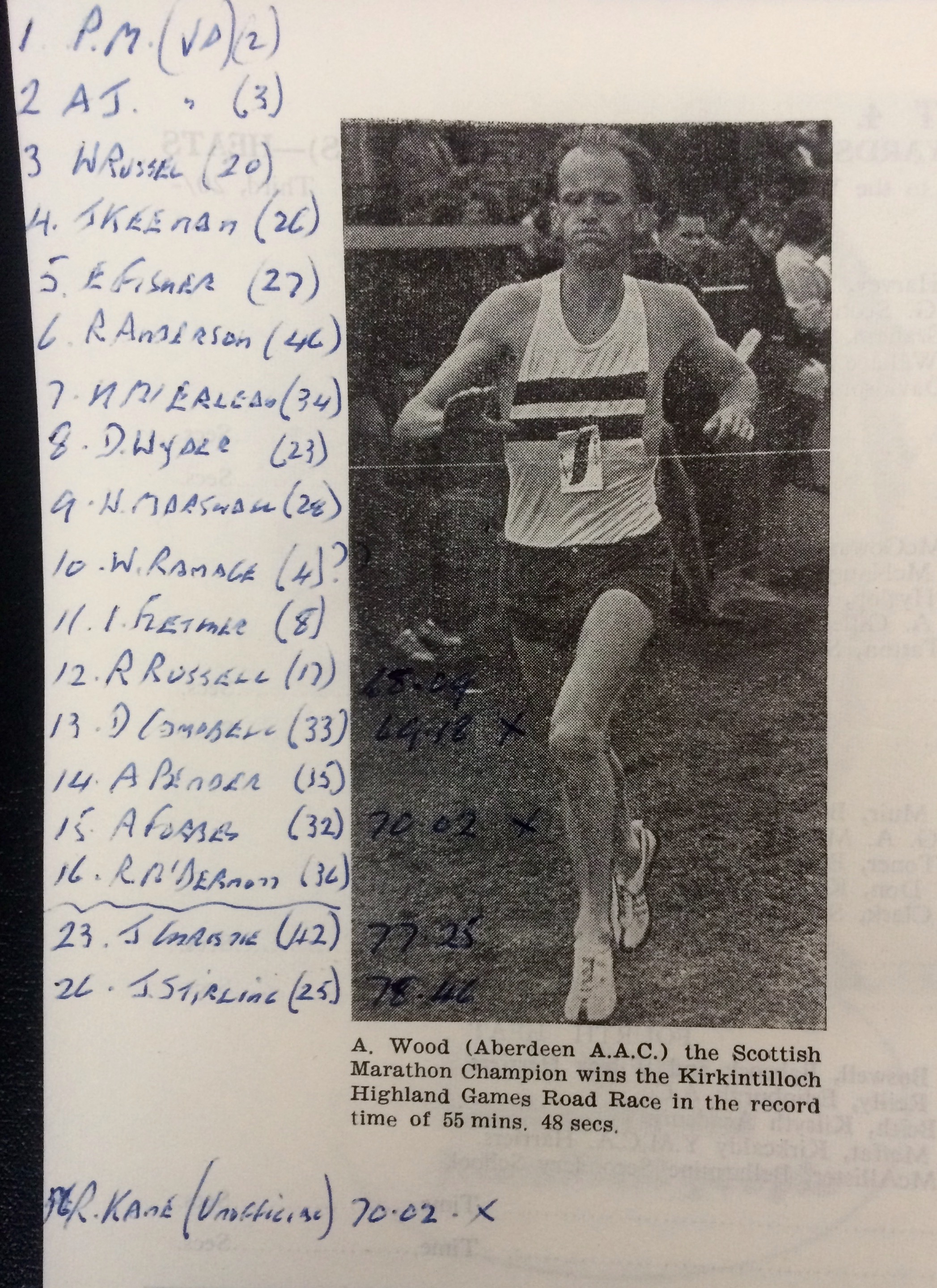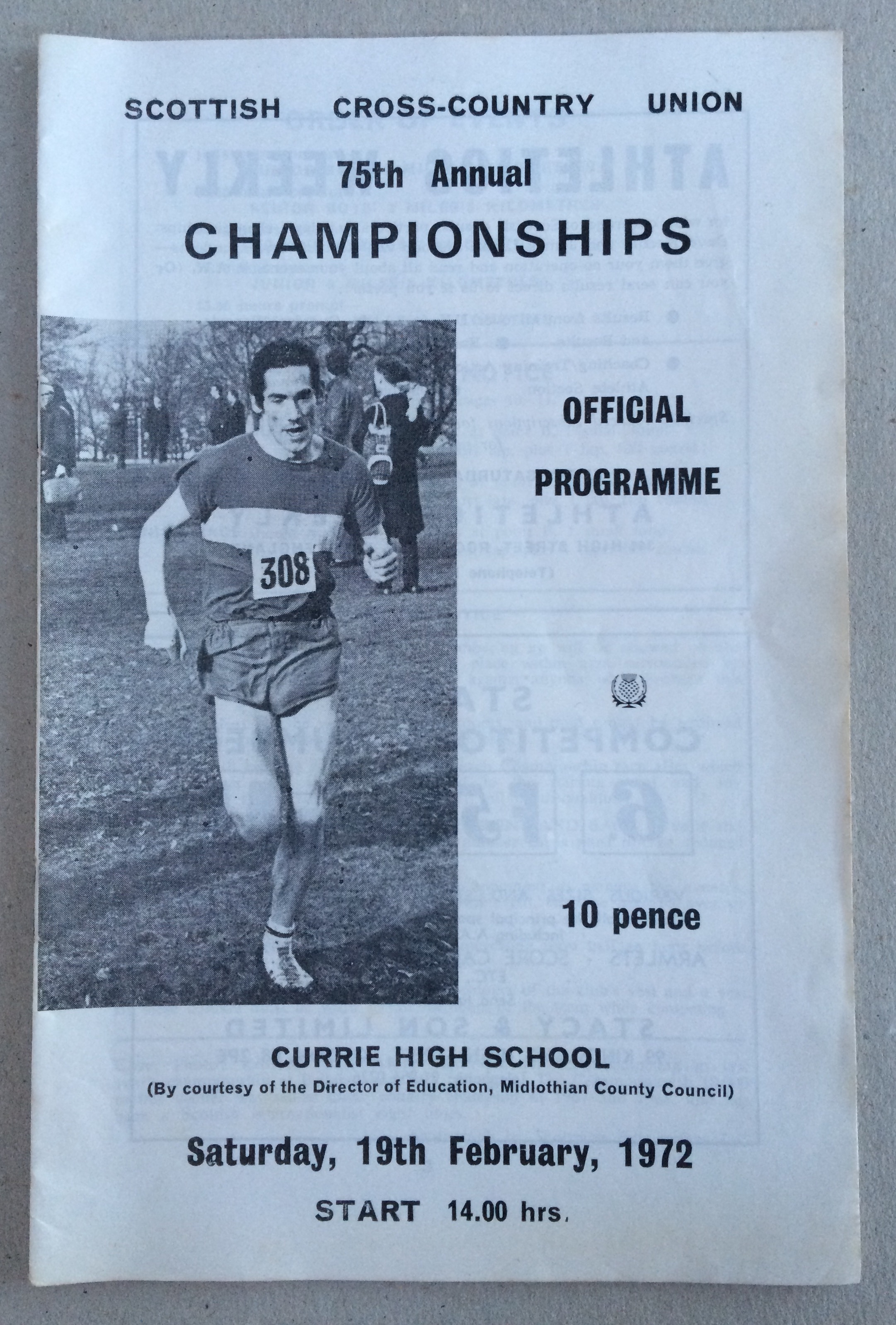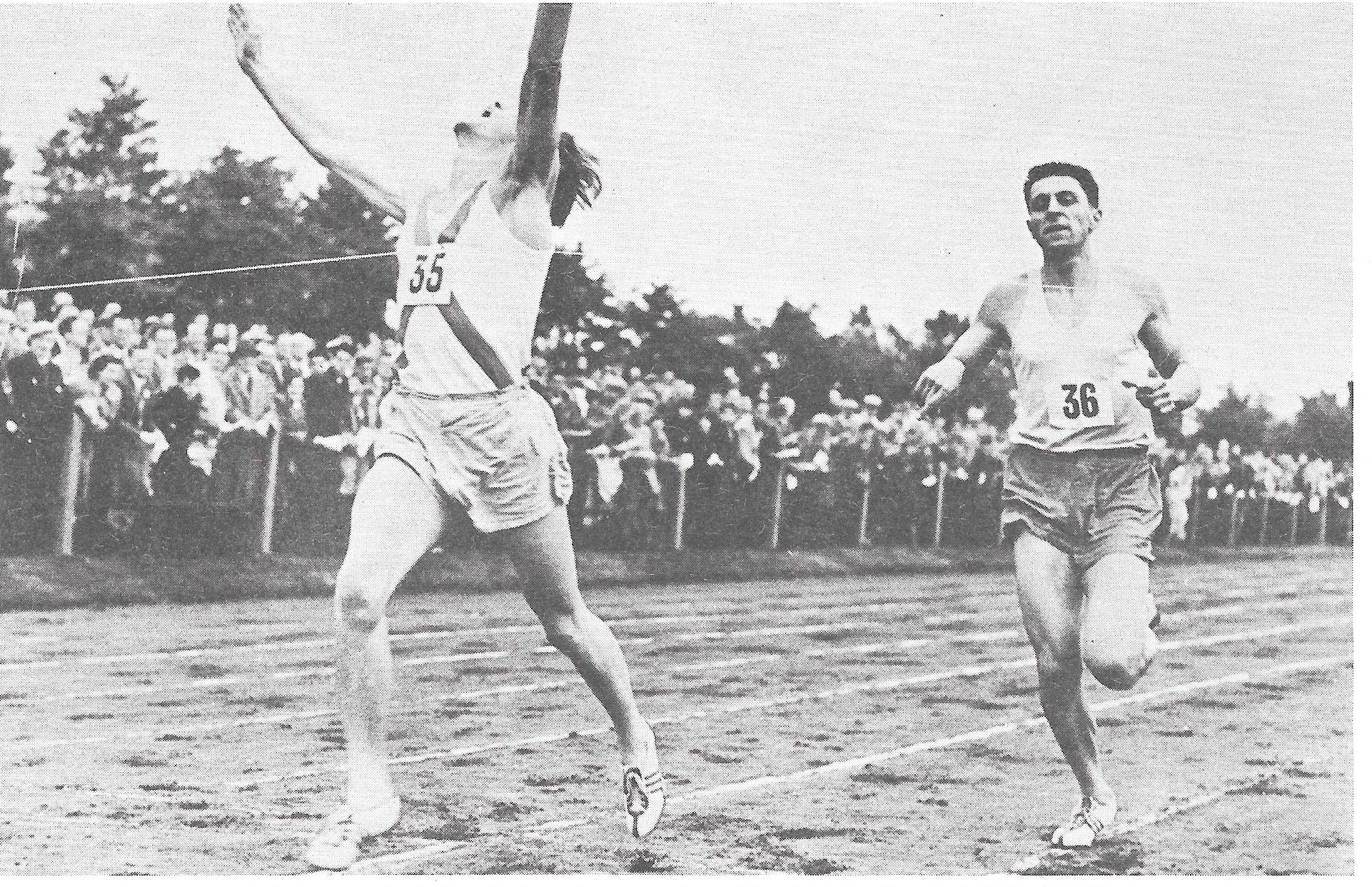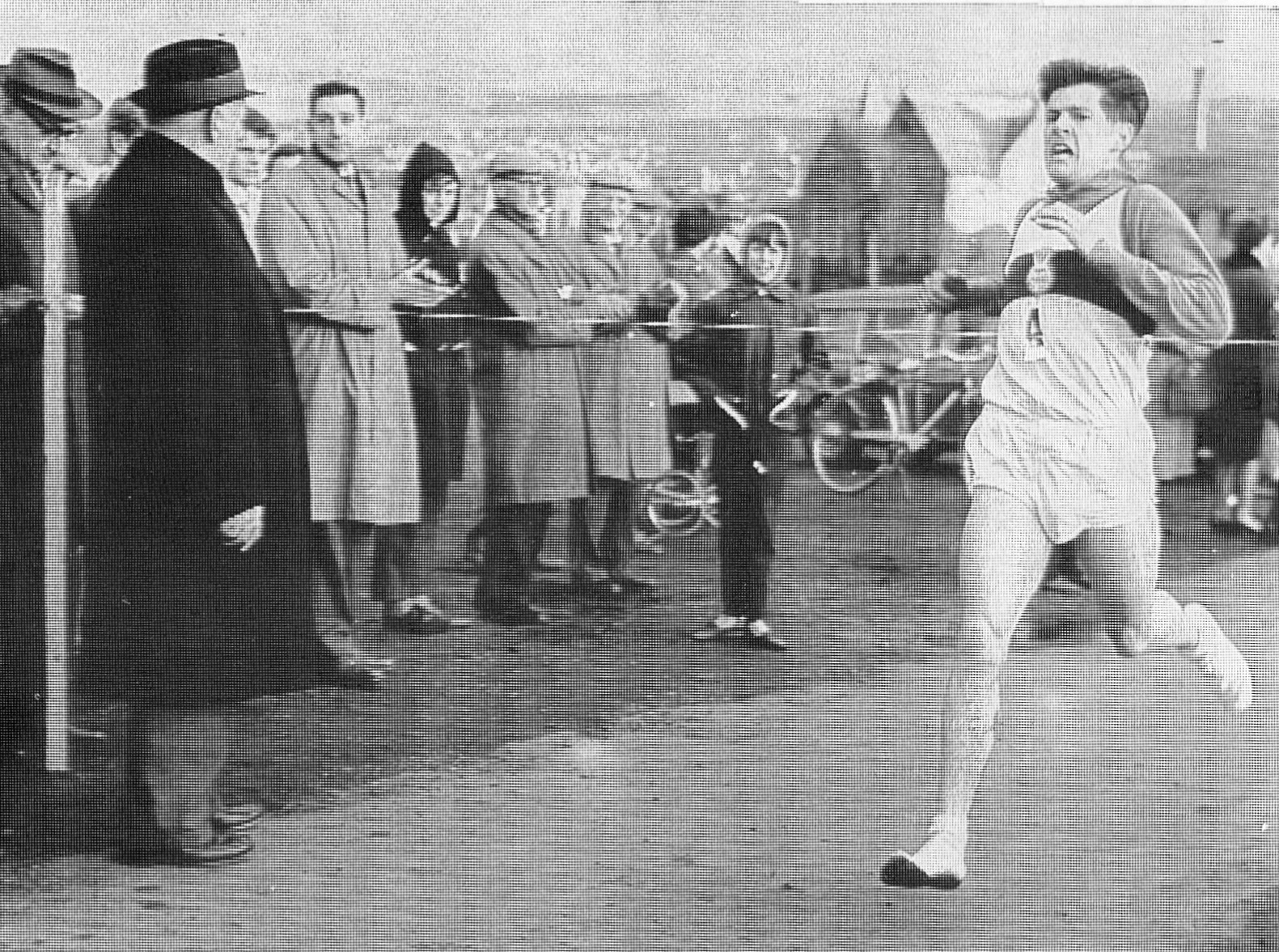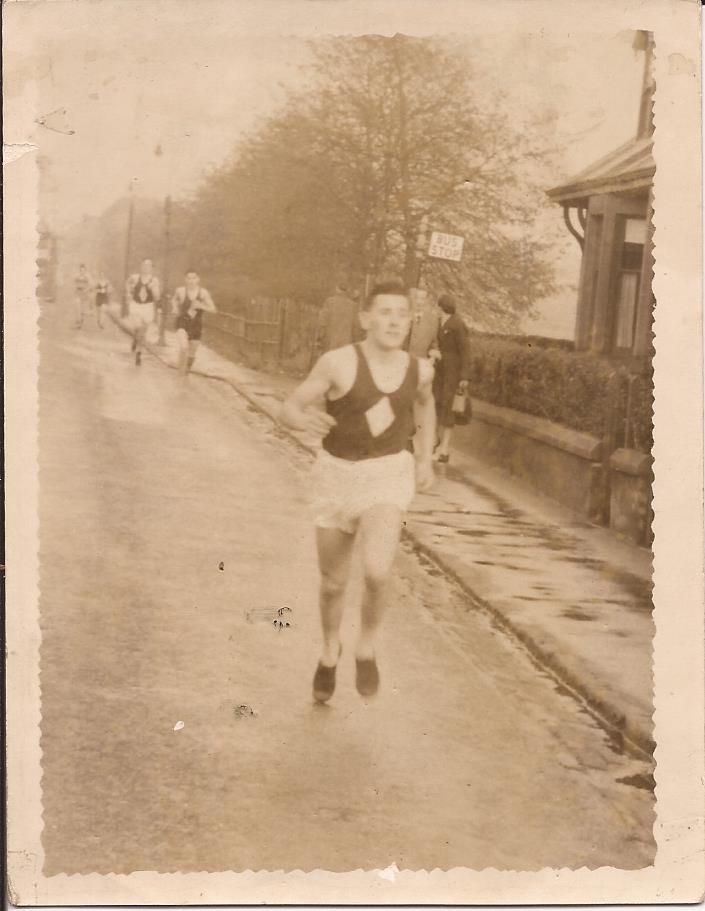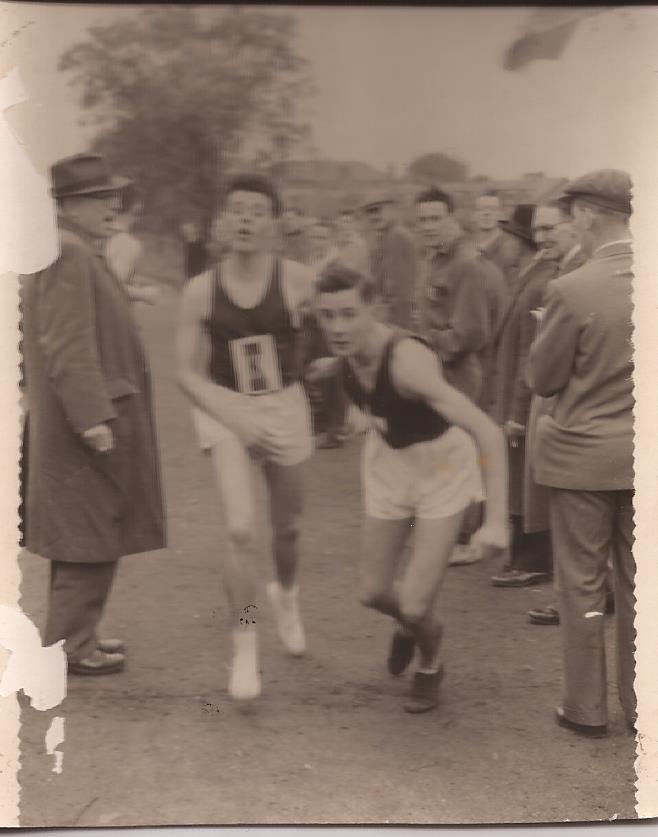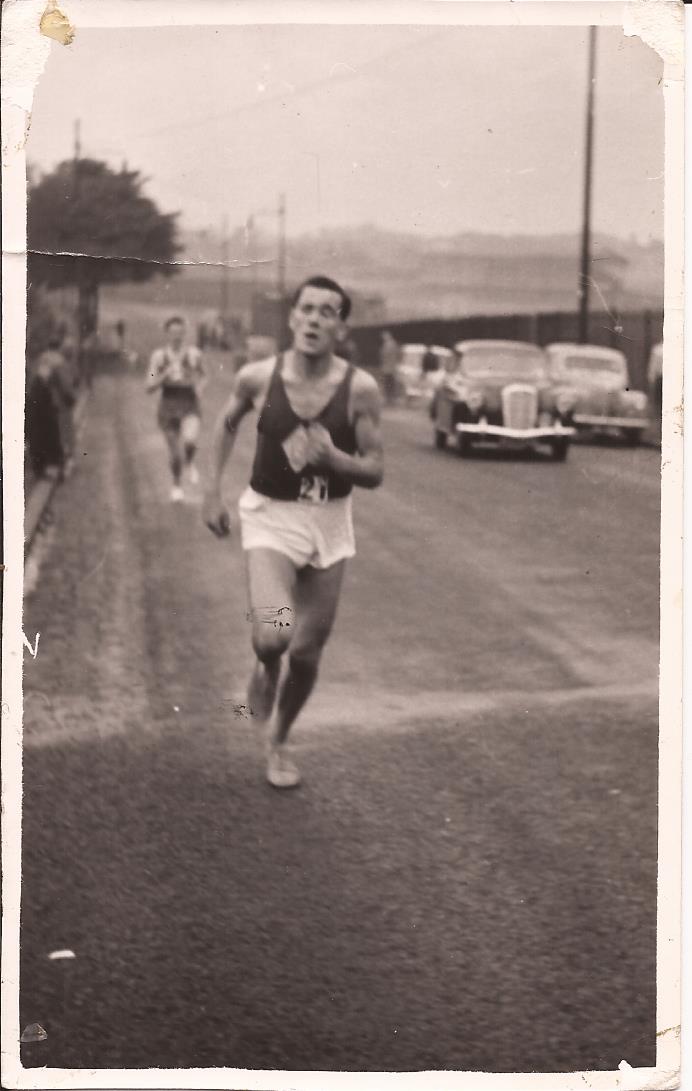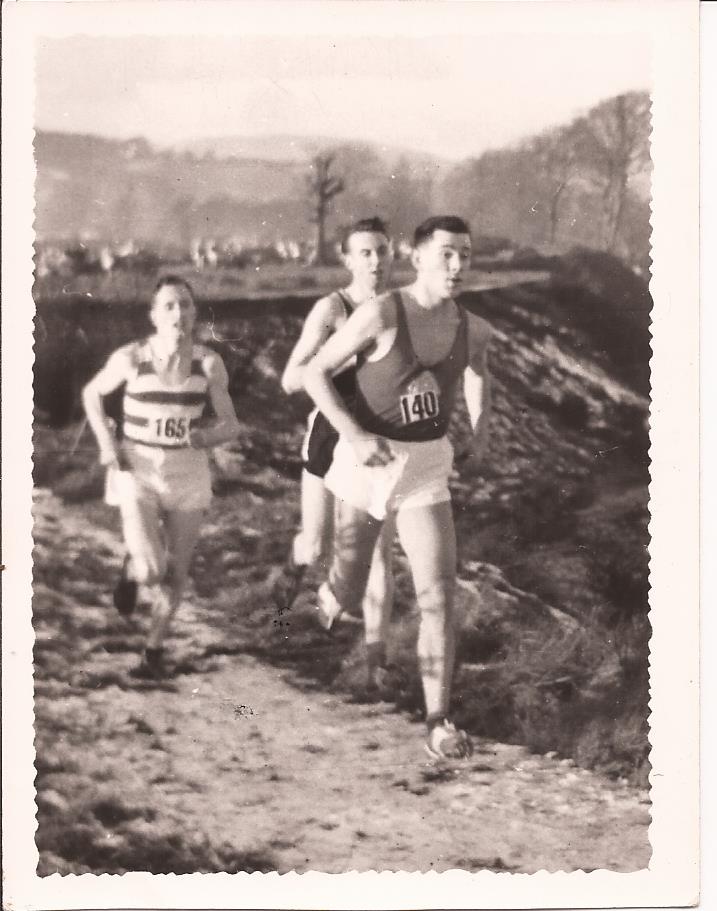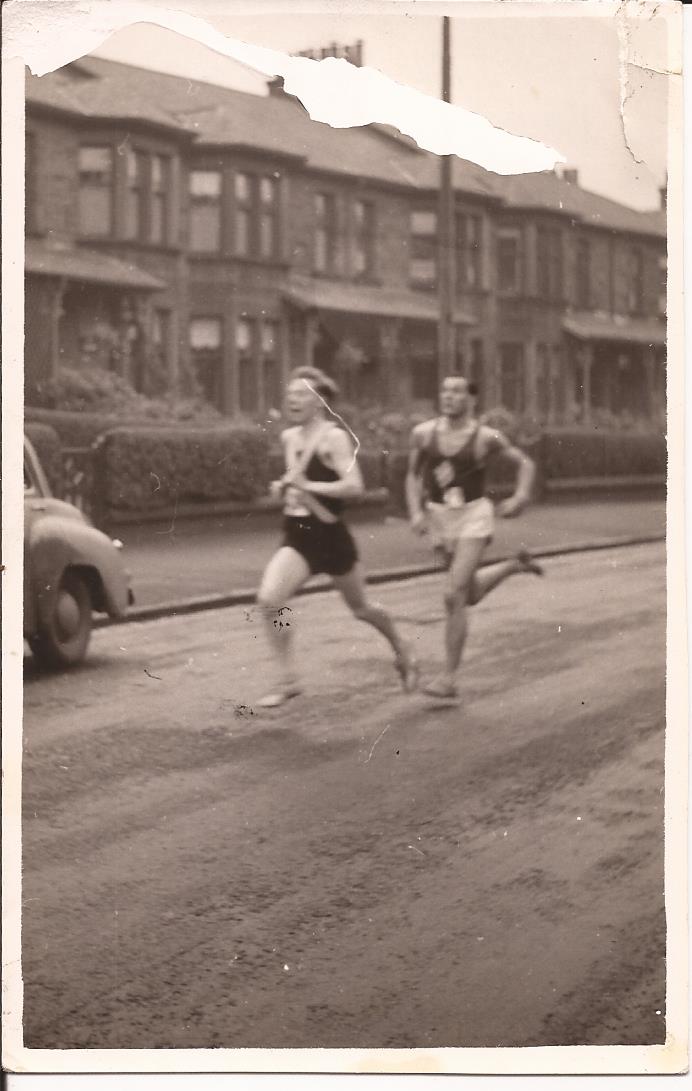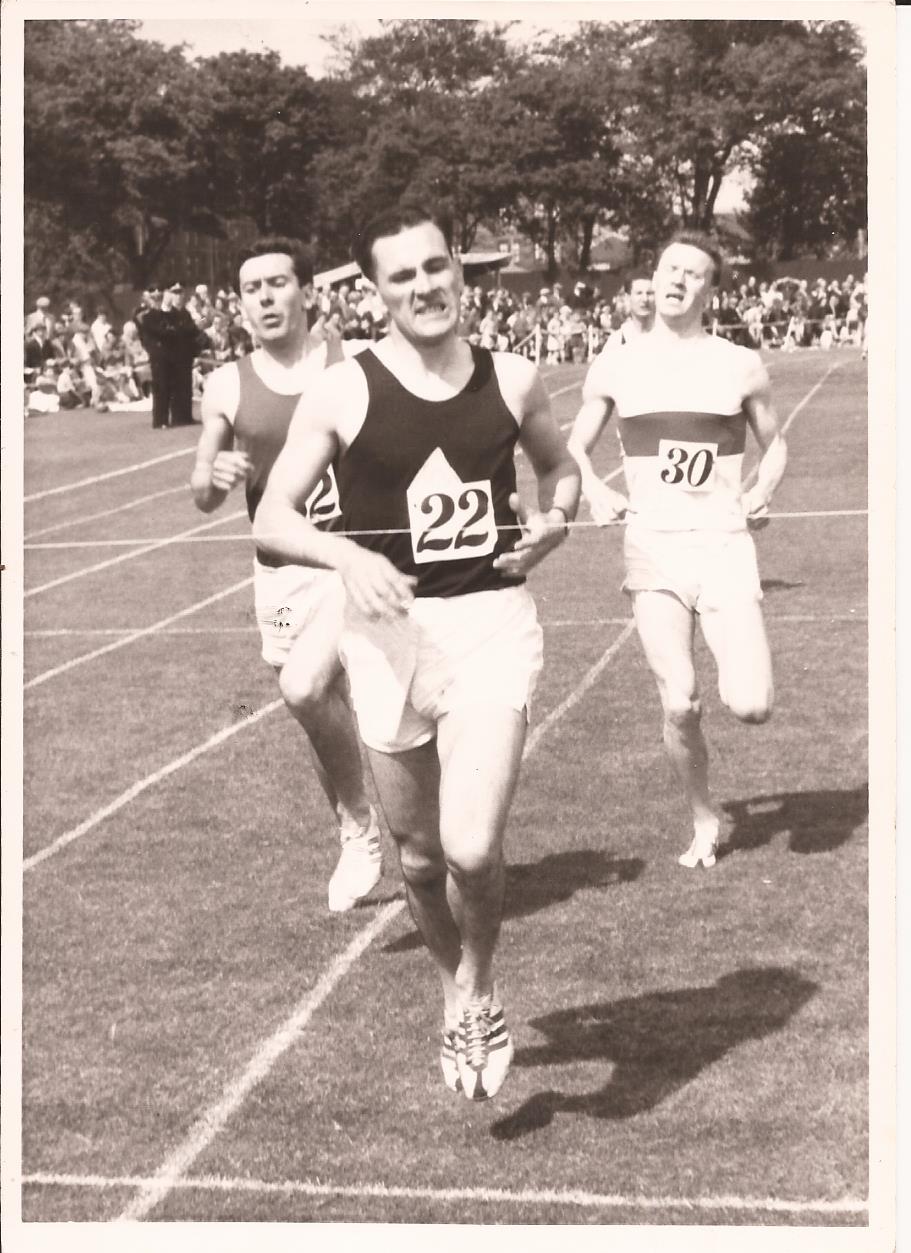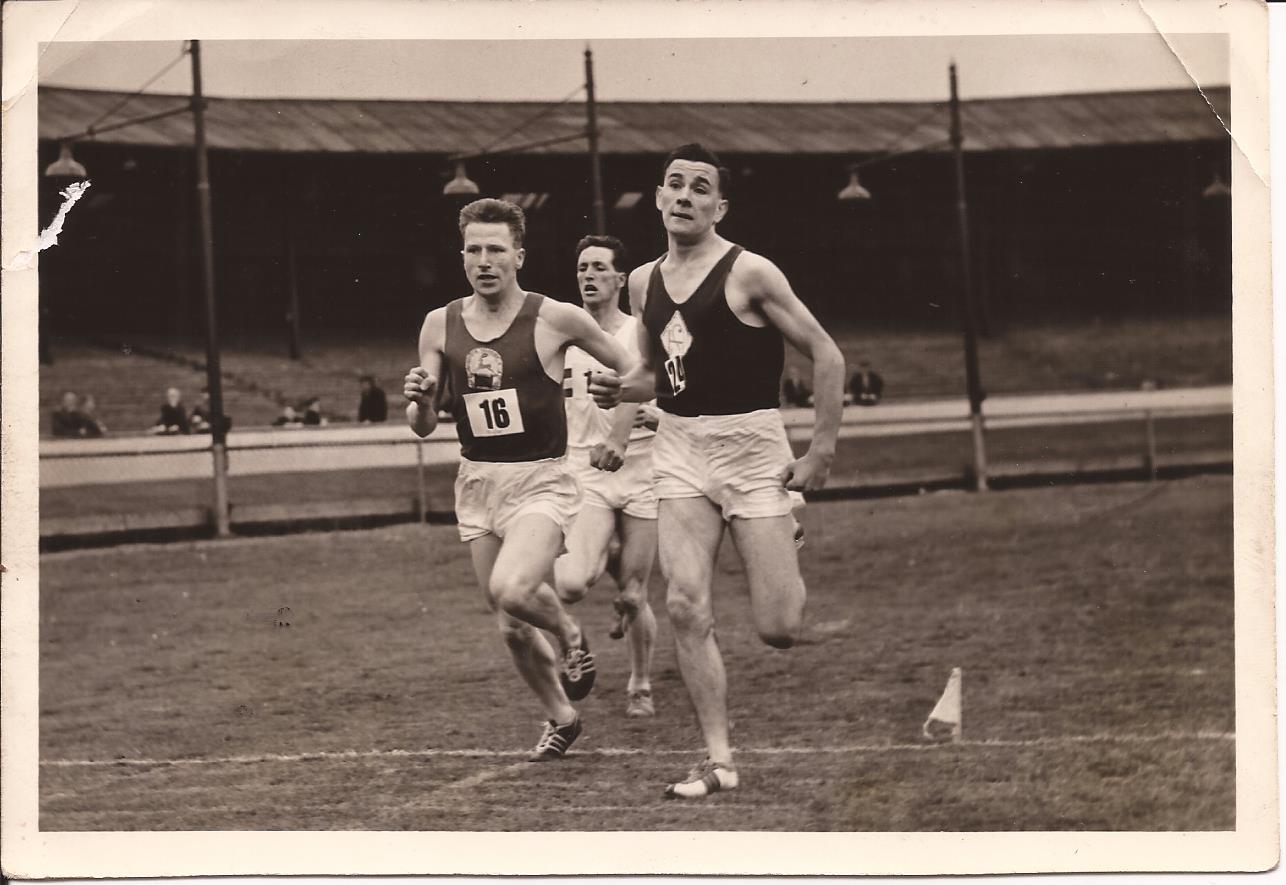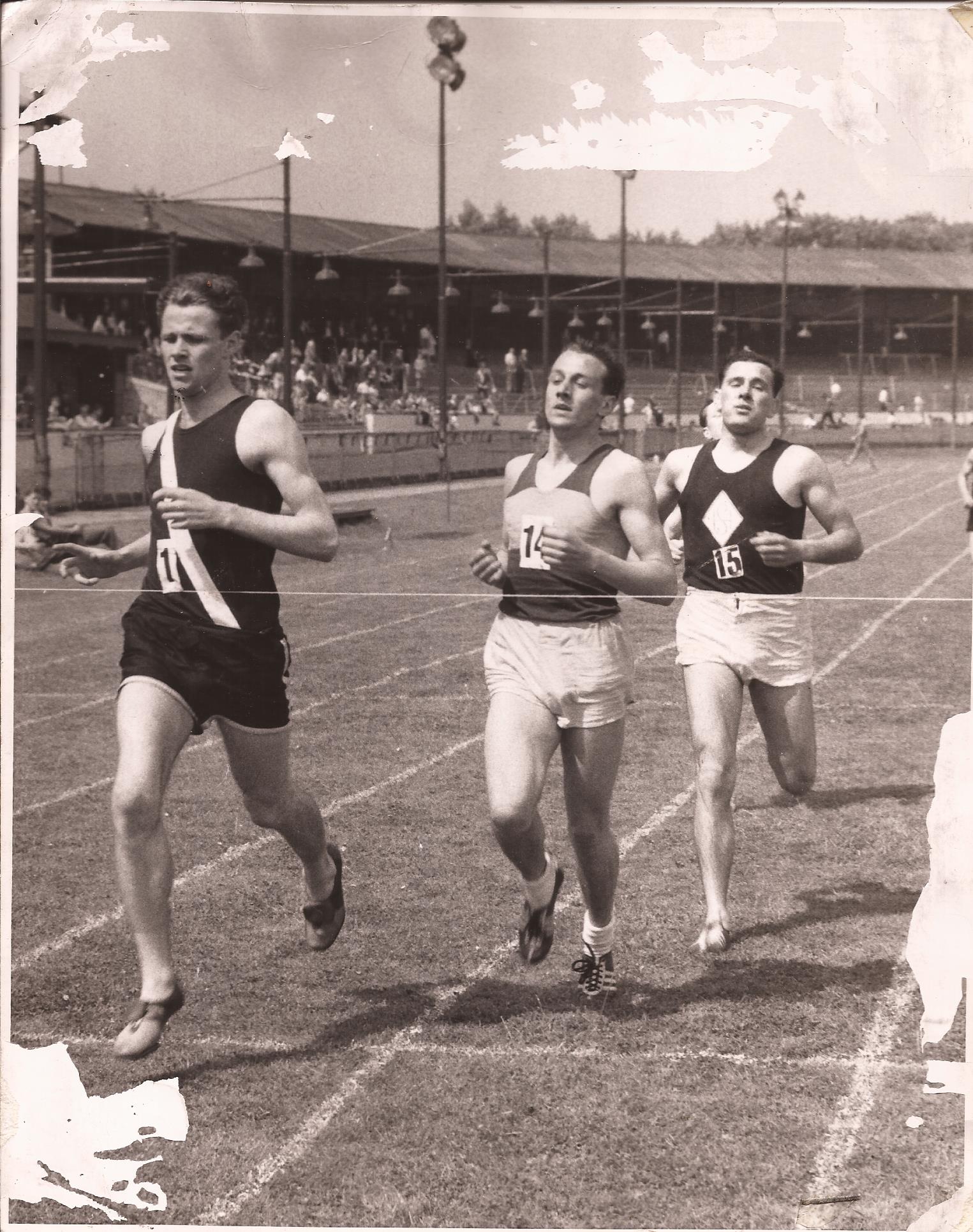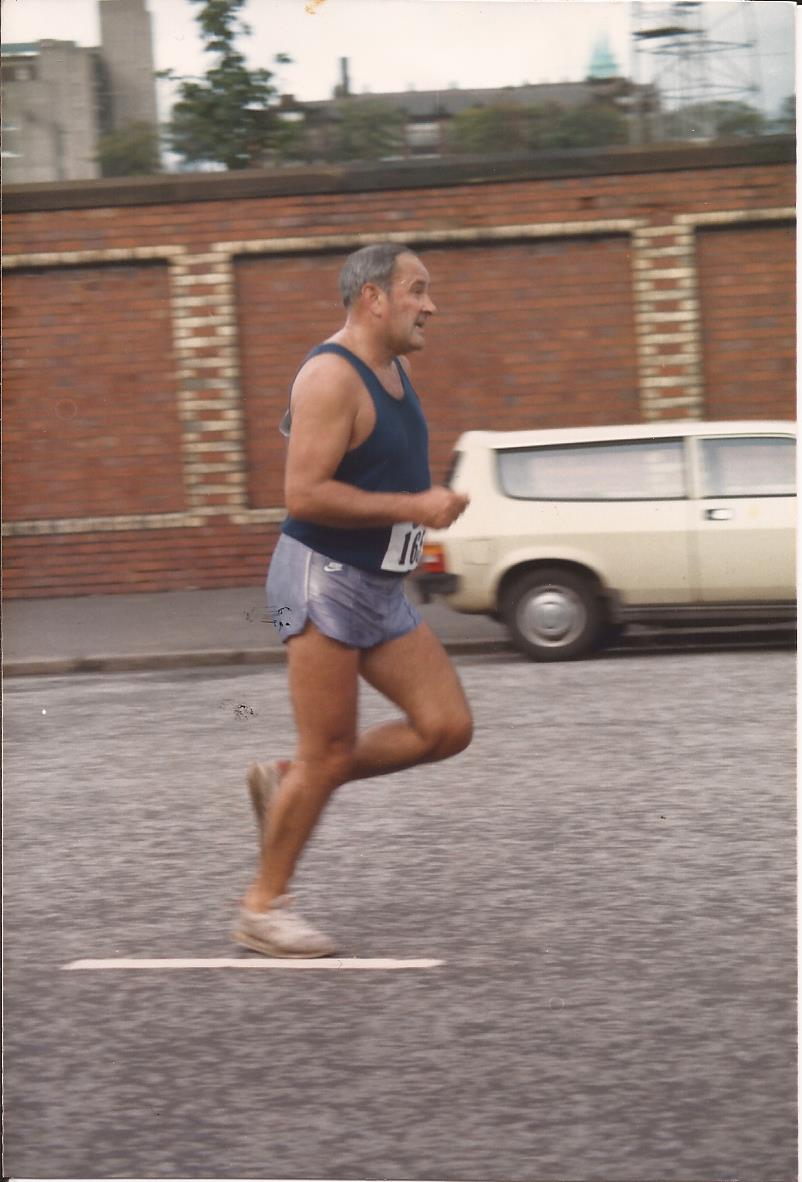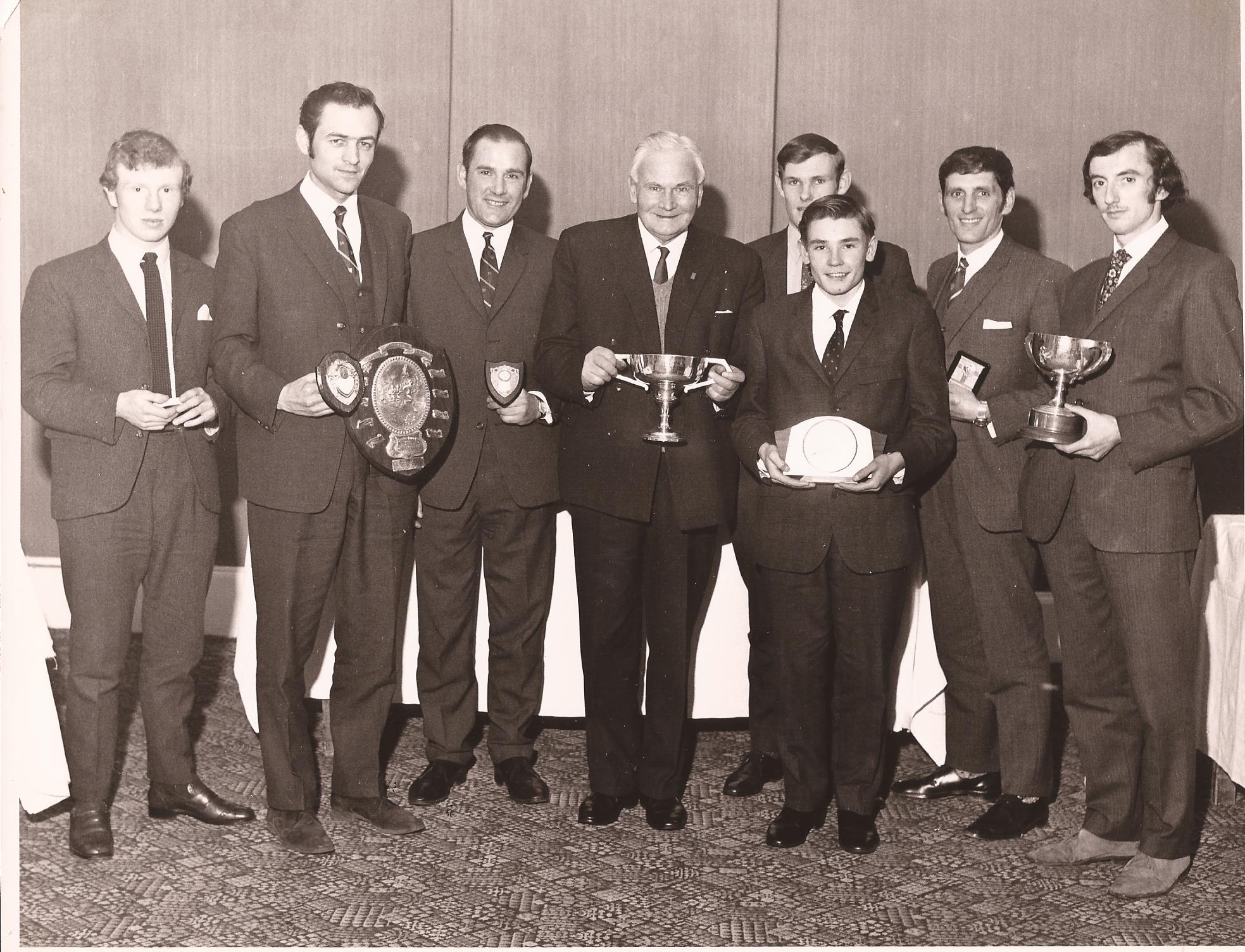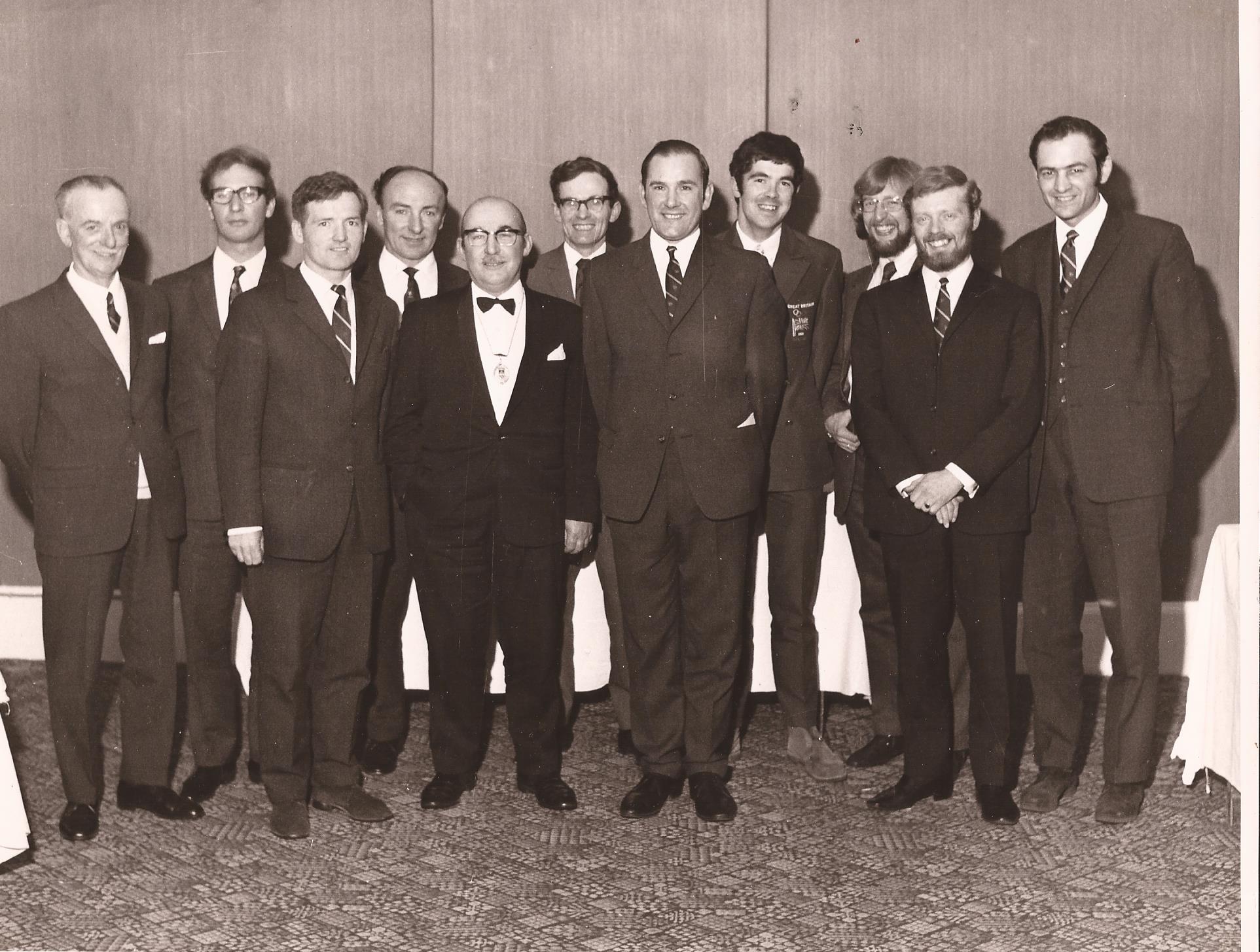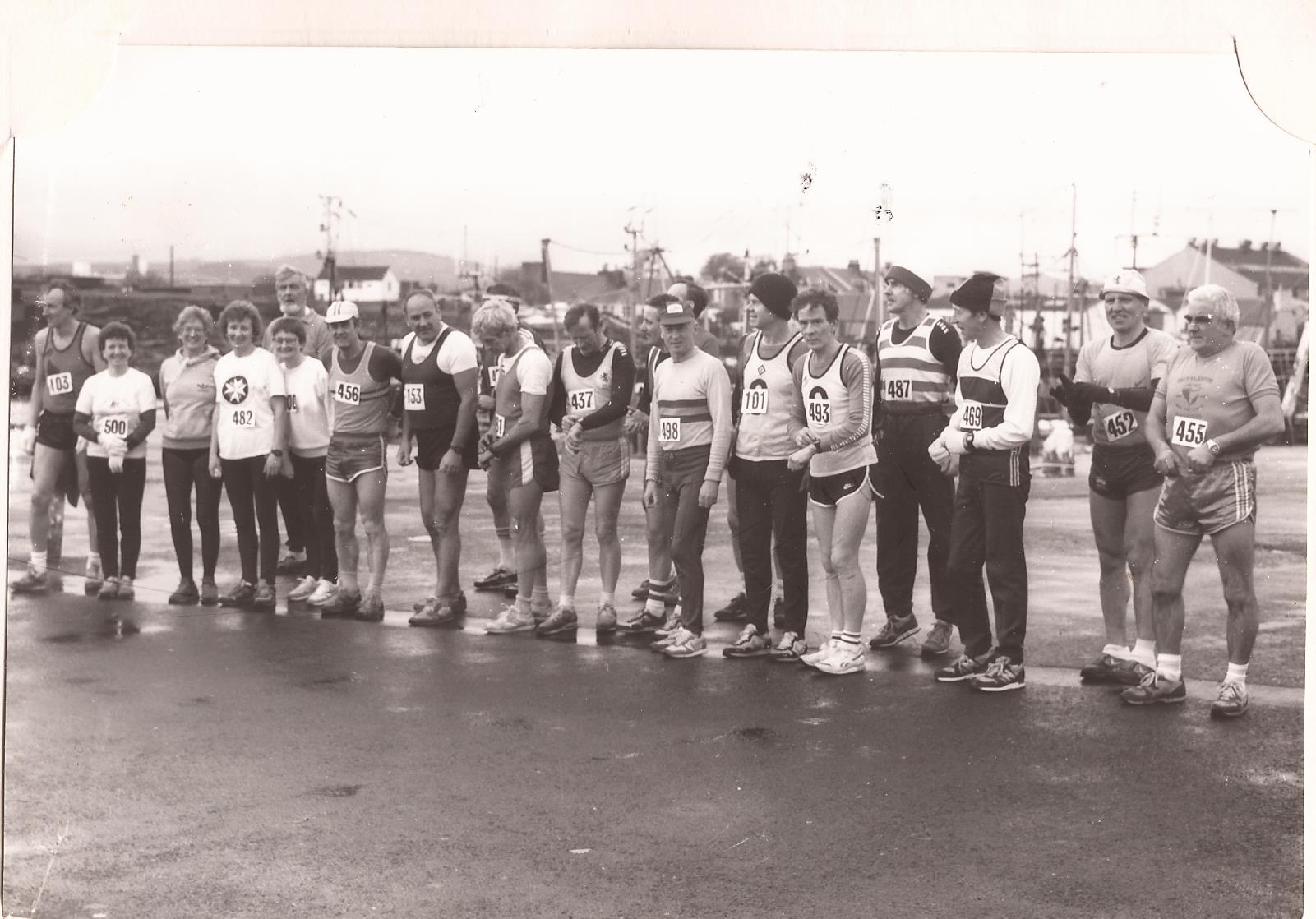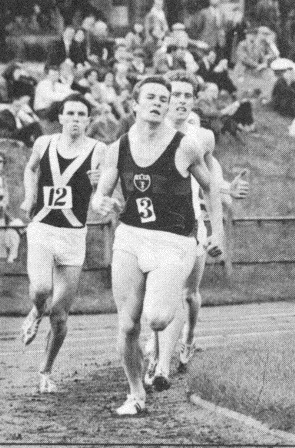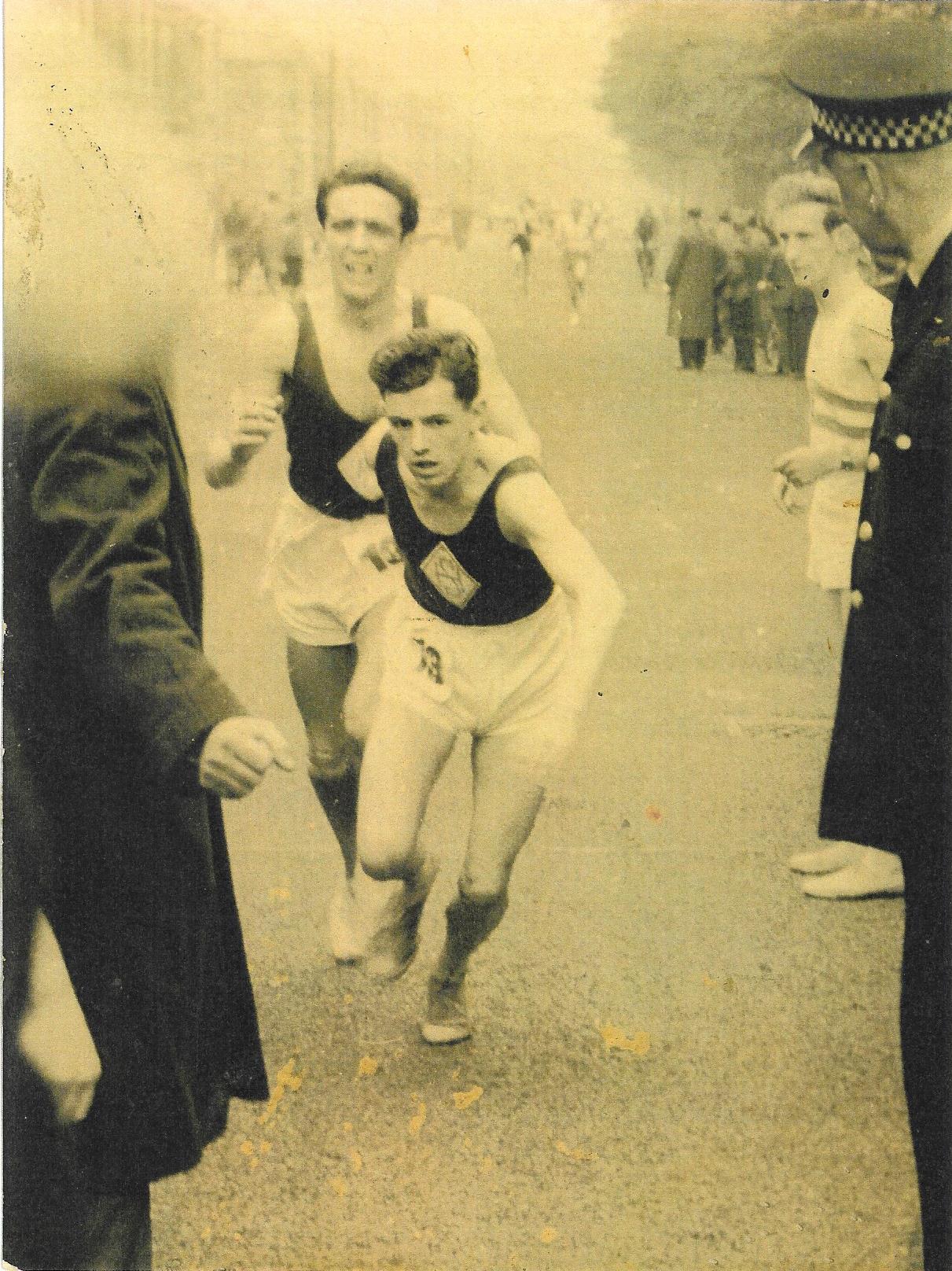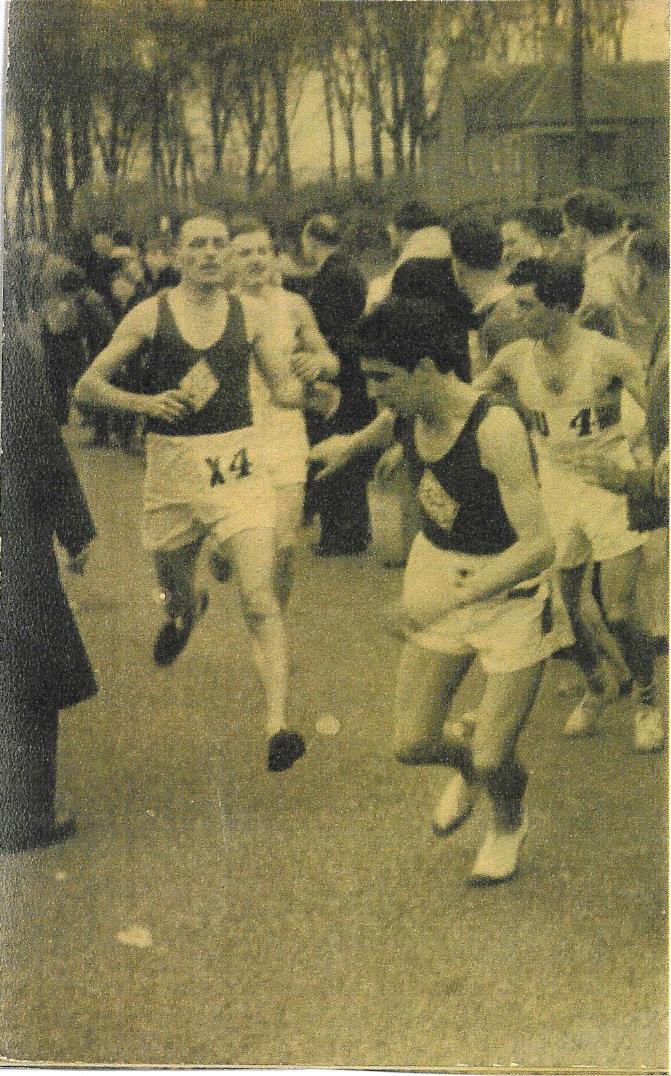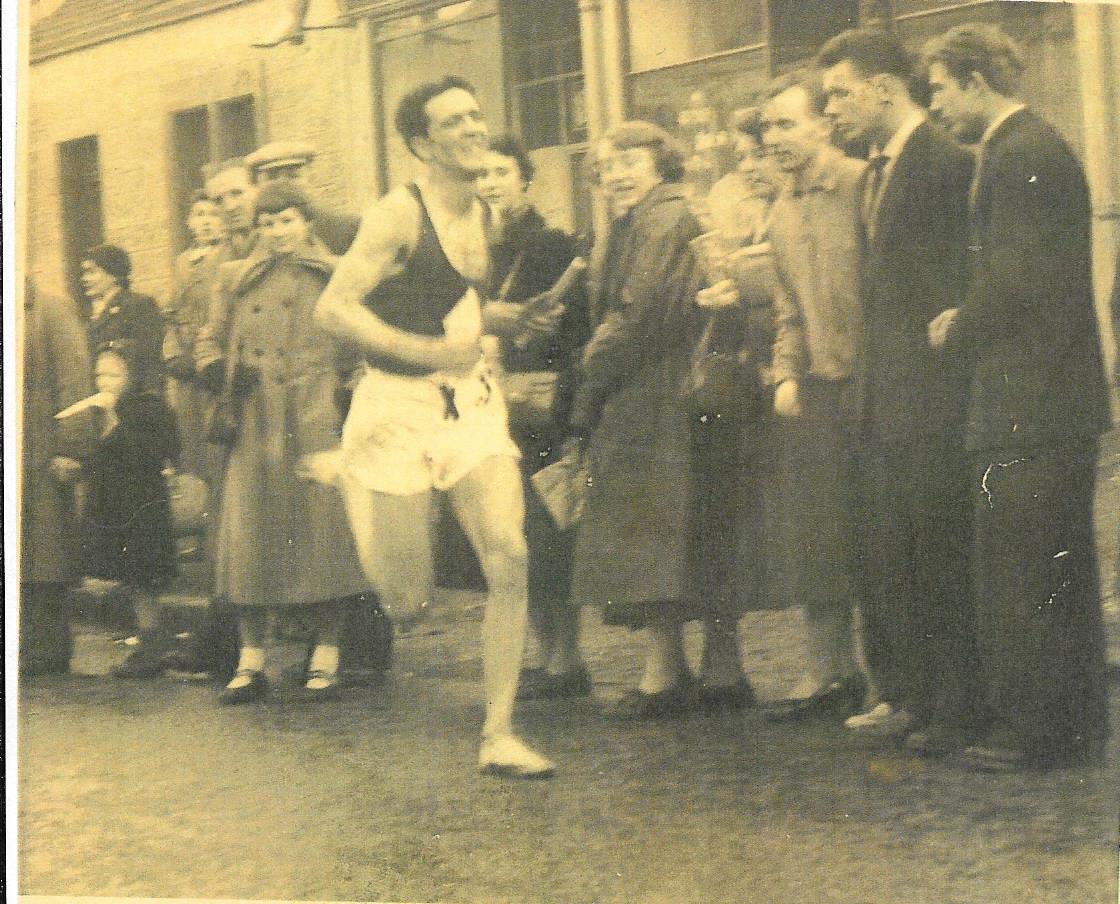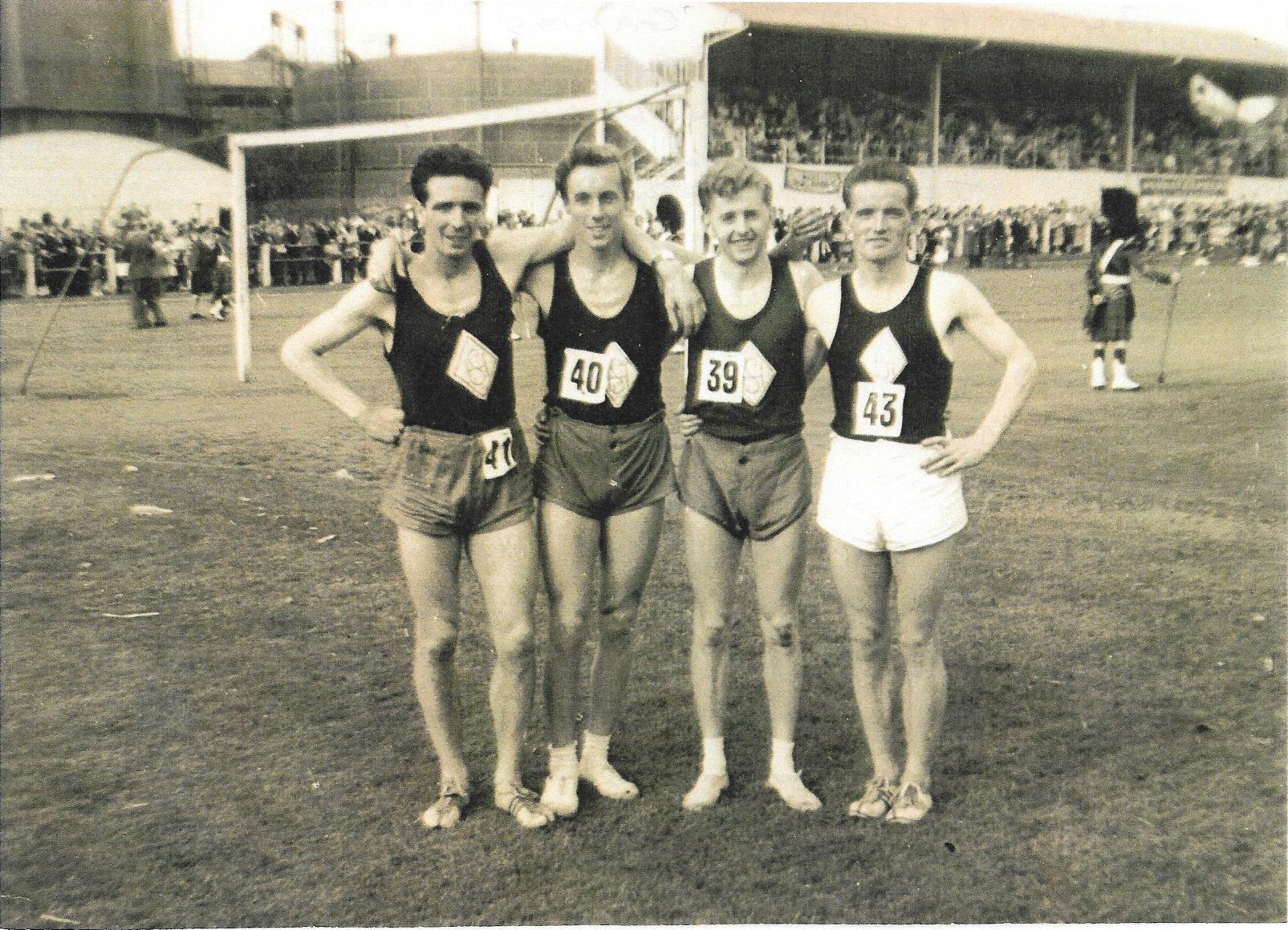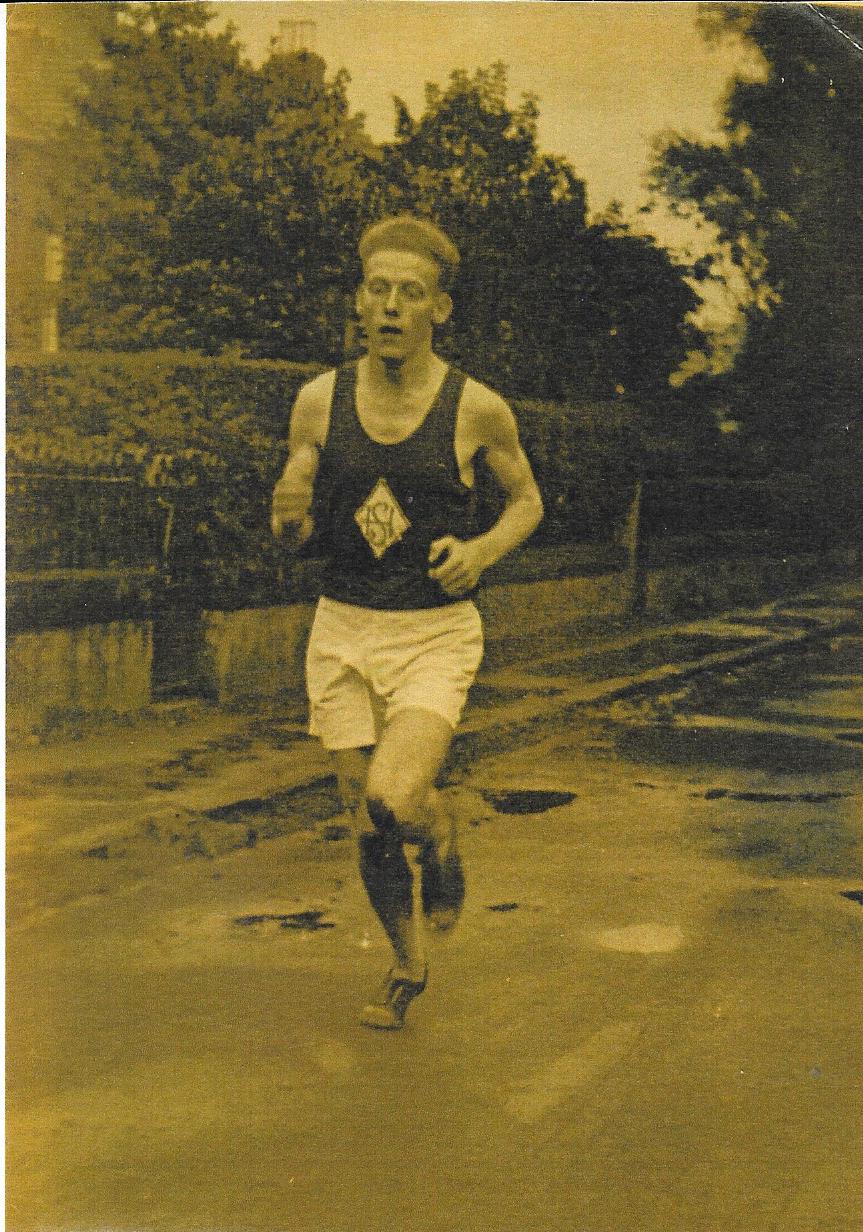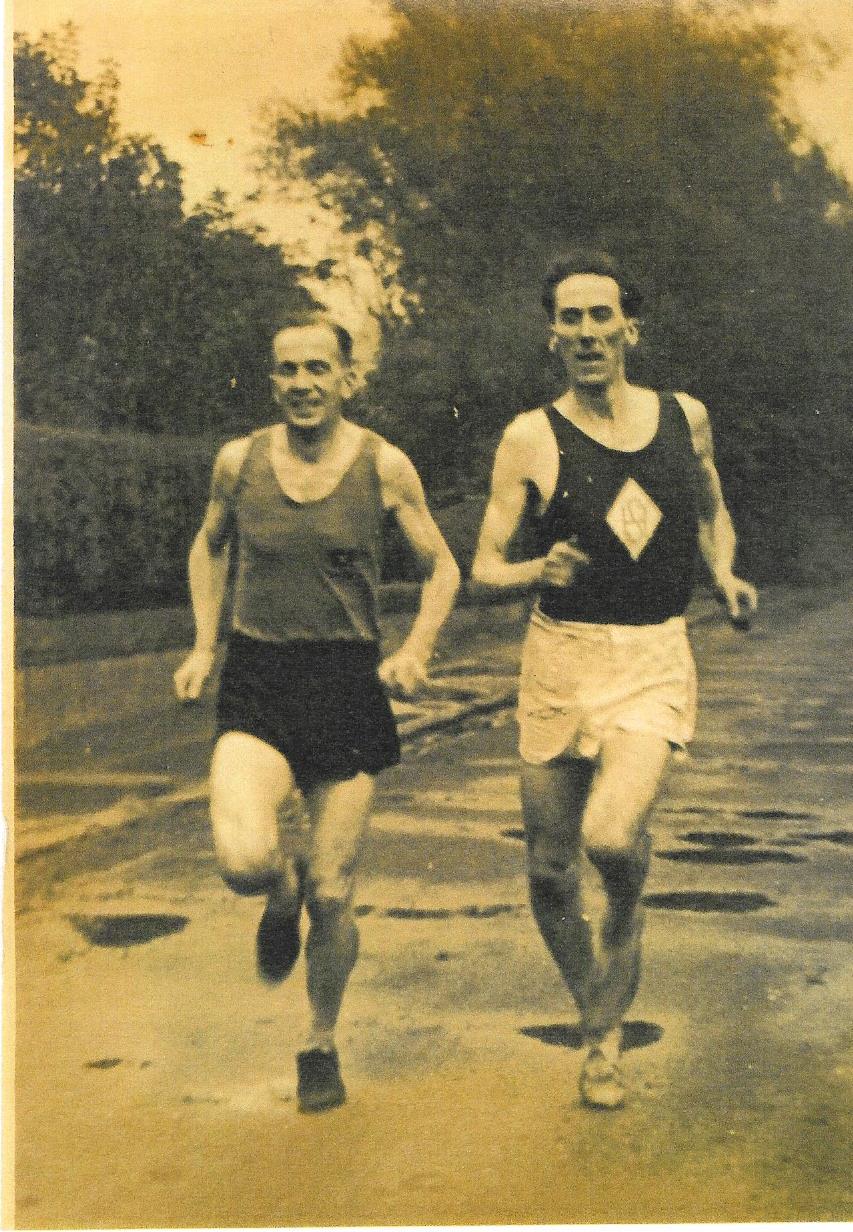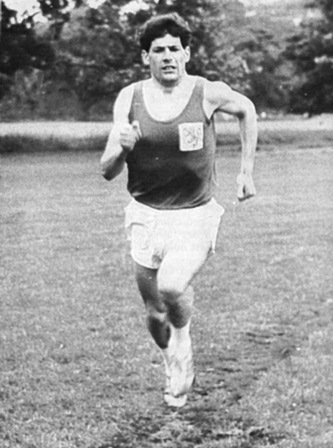
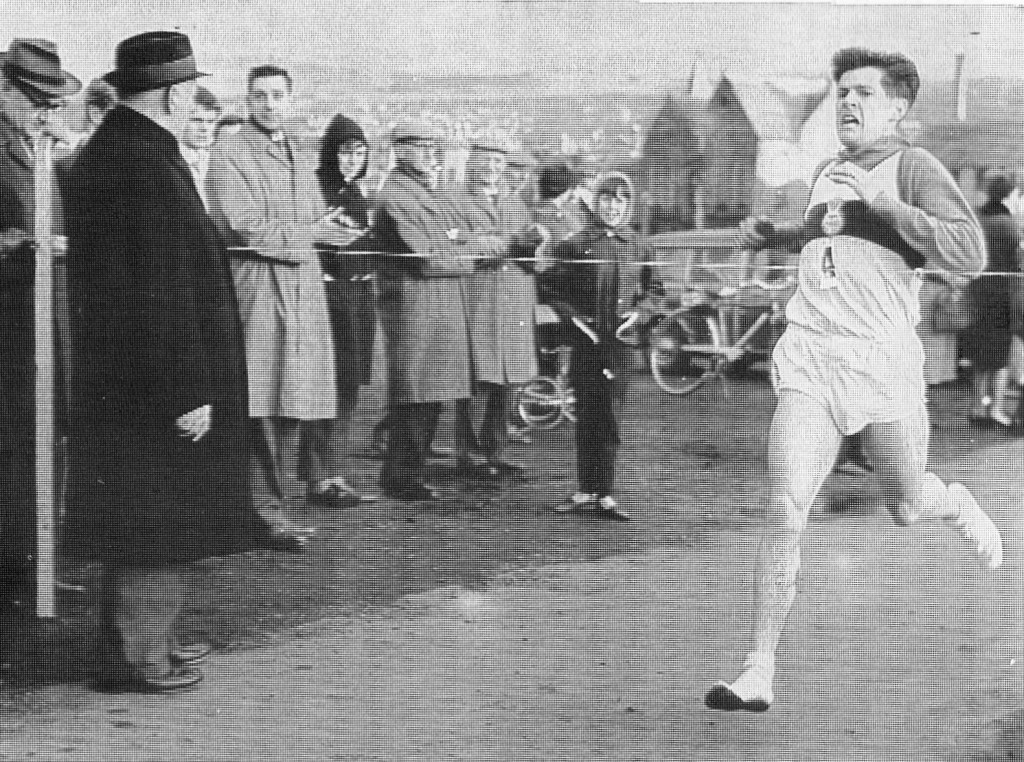
Craig Douglas winning the cross-country league match at Hawick in 1965
He ran the last couple of miles with only one shoe on, but it didn’t make the national press.
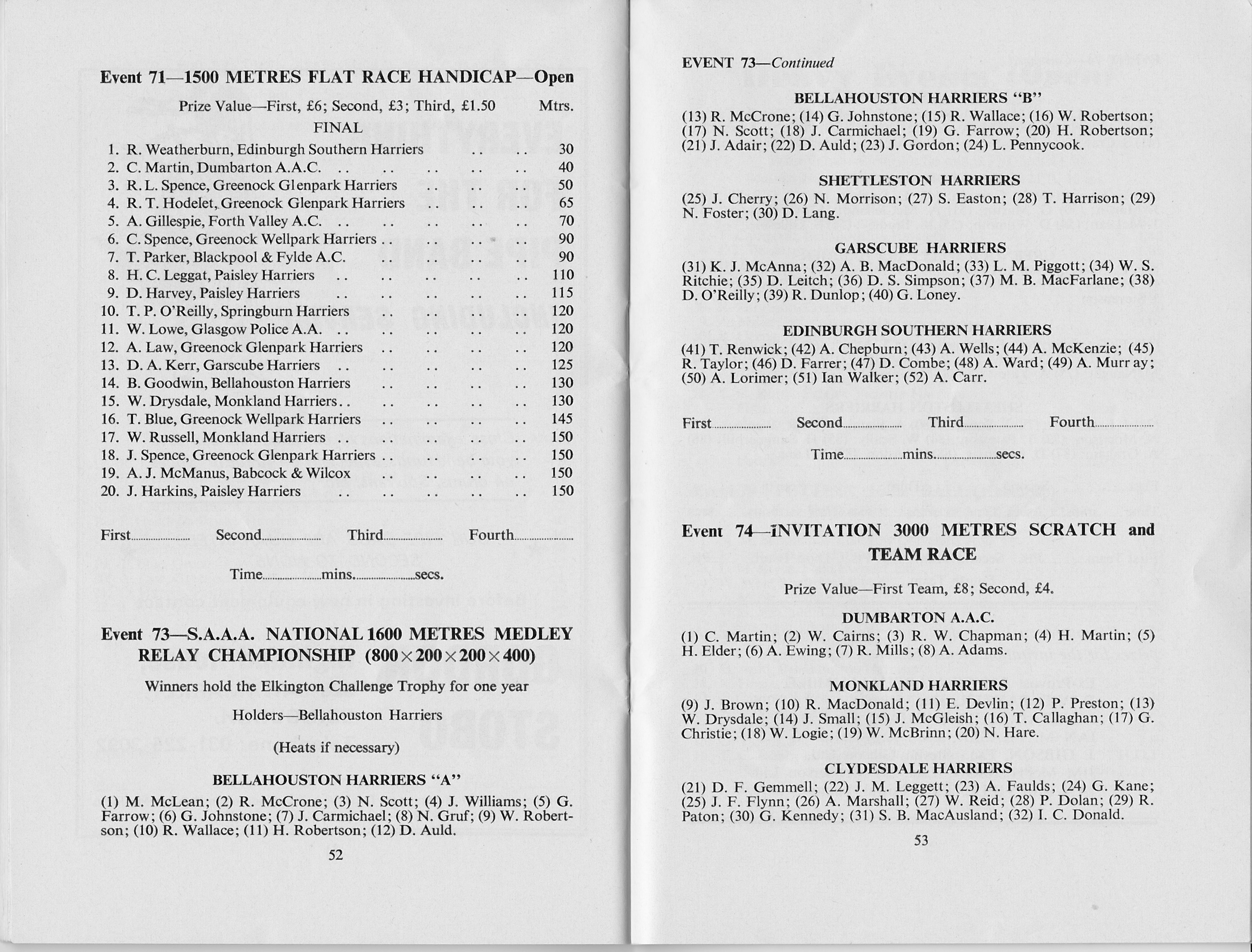
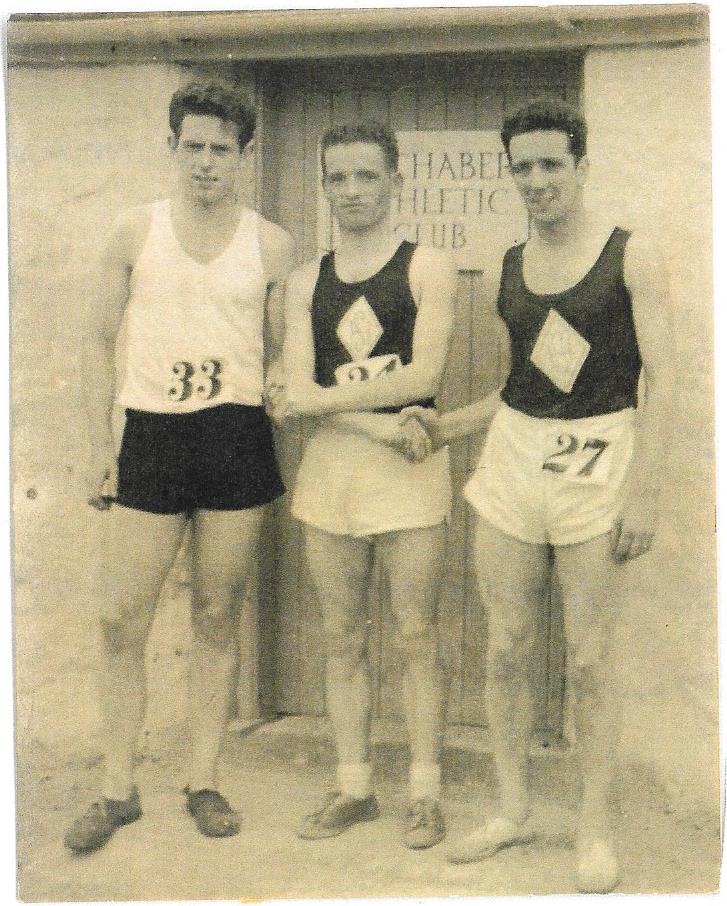
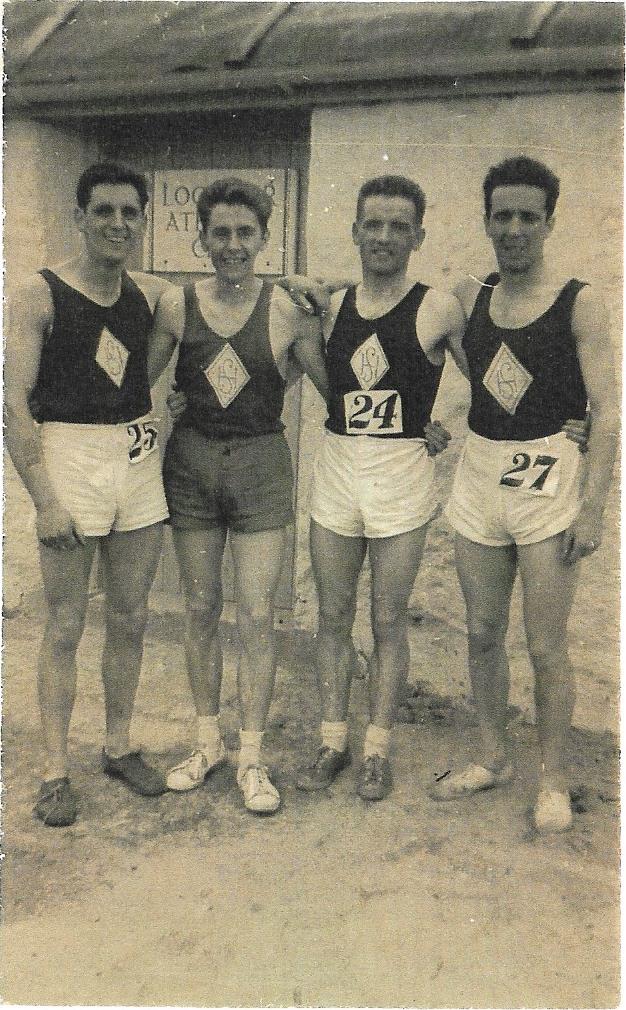
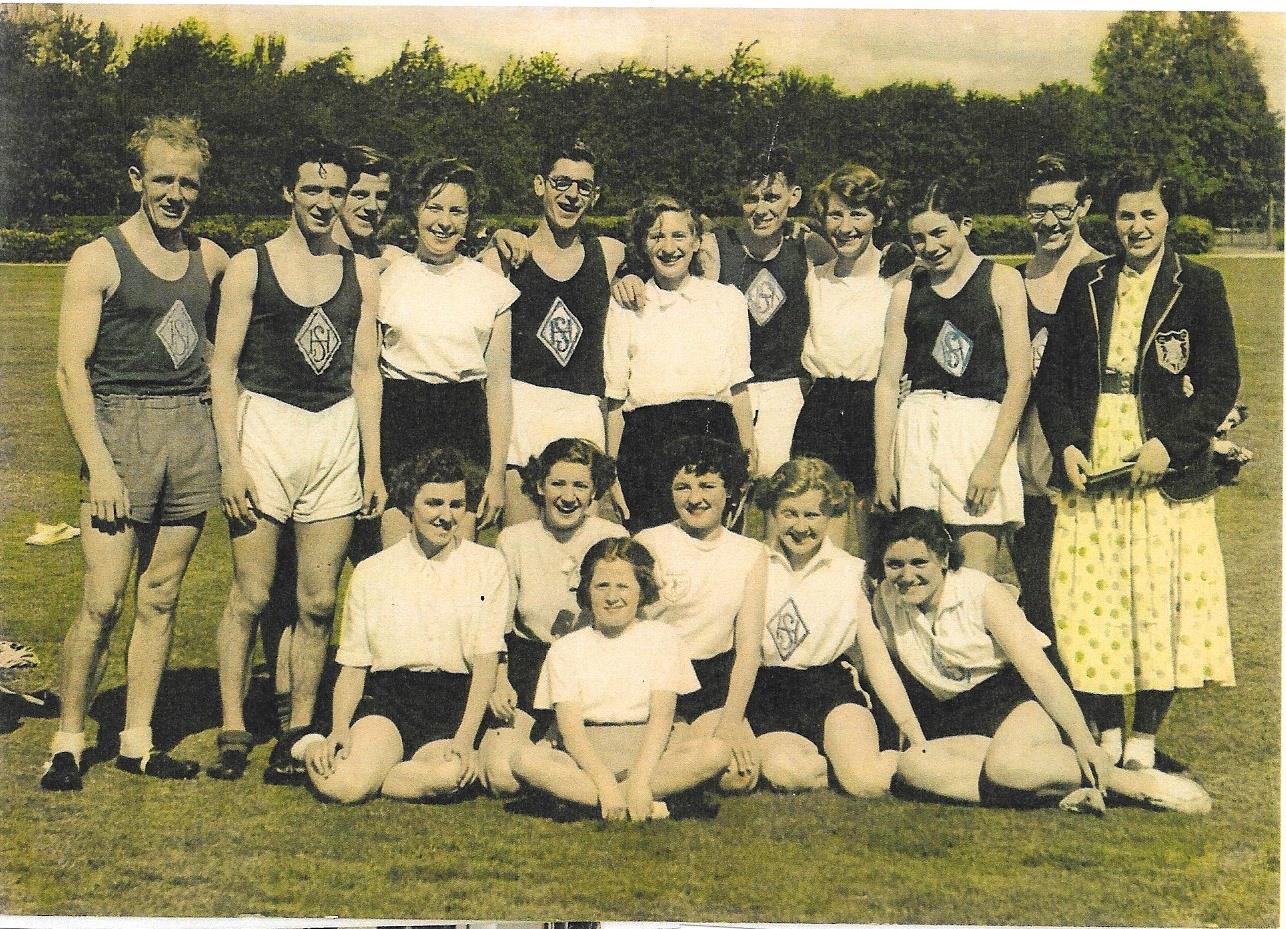
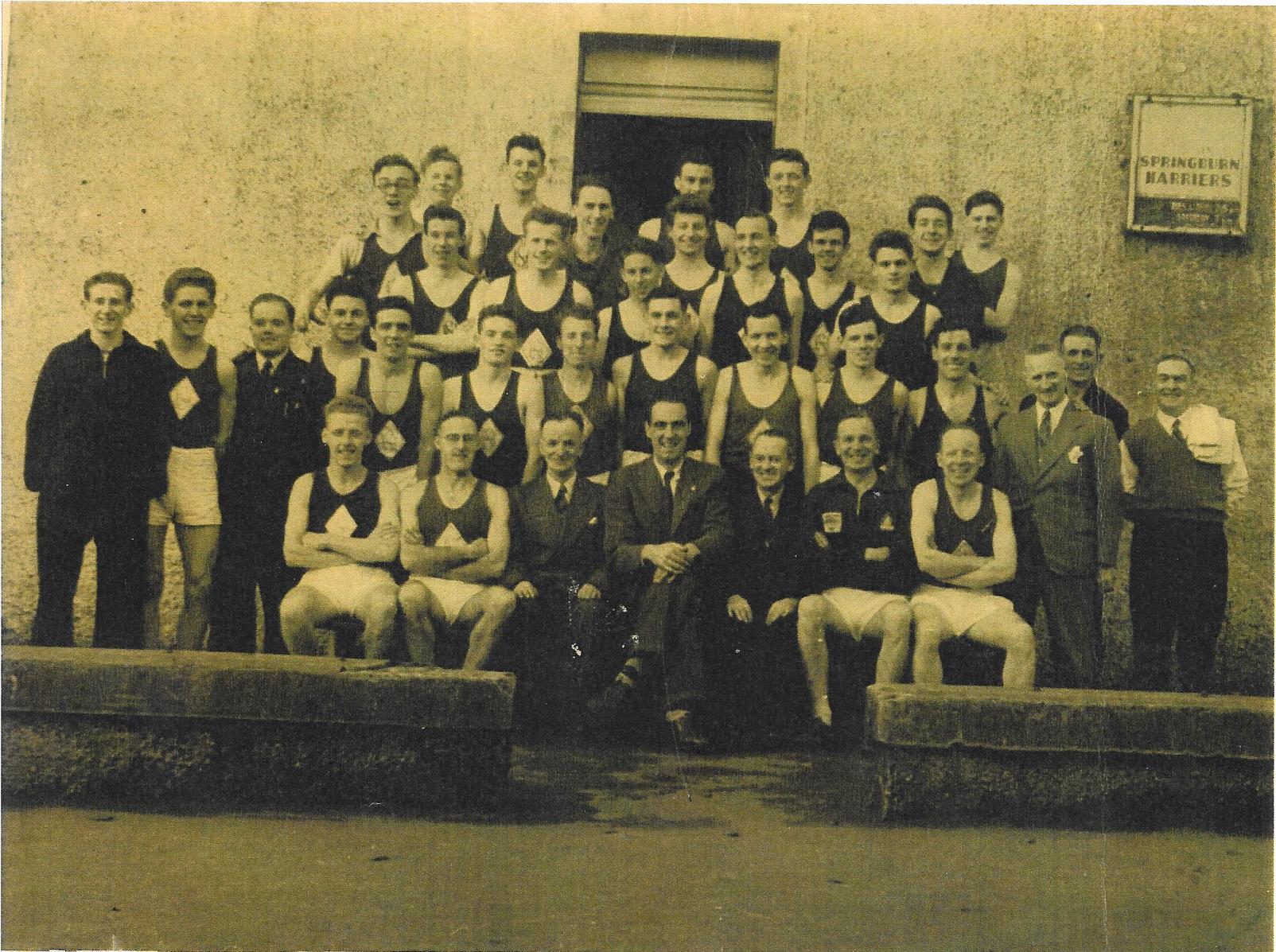
Craig Douglas who started his running career with Teviotdale Harriers and won medals and Scottish vests before moving to Edinburgh Southern Harriers was only one of several from the club to make that move. Ian Elliott, Brian Mather, Peter Roden and Joseph Raeburn were others who subsequently took that route. He moved in May 1967 but we will start at the beginning when he was a junior member of Teviotdale Harriers and setting club records year on year. I quote from the club history which, after lauding his performances as a team member starts its own profile of his career in the club colours with his domestic record setting:
“He bettered every senior club record with the exception of the Cup Race. The first to fall was the junior championship in 1961 when he smashed Denis Riddell’s 1959 time by 32 seconds; that was followed by the senior championship by 27 seconds in 1962; the Jubilee record by 13 seconds the same year; the Jubilee by 10 seconds in 1963; the club championship by 12 seconds in 1964; the Jubilee by 5 seconds again in 1964; the Christie Cup record in 1964, another 3 seconds off that the following and another 18 seconds in 1966; the Langheugh record was shattered by 51 seconds in 1965; and that year the Menzies went to him by 6 seconds.” Most of us don’t know what the various trophies and records are for but they do indicate the regular. year on year improvement of a developing runner, with the records not being set by a second here or two seconds there either.
As a cross-country runner he fist appears in the records when on 5th March, 1960, he was seventeenth in the Youths National, a position he improved to fourth a year later behind such good athletes as Jim Finn (Monkland), George Brownlee (Edinburgh Southern) and Hugh Barrow (Victoria Park) with Lachie Stewart (Vale of Leven) two places behind him.
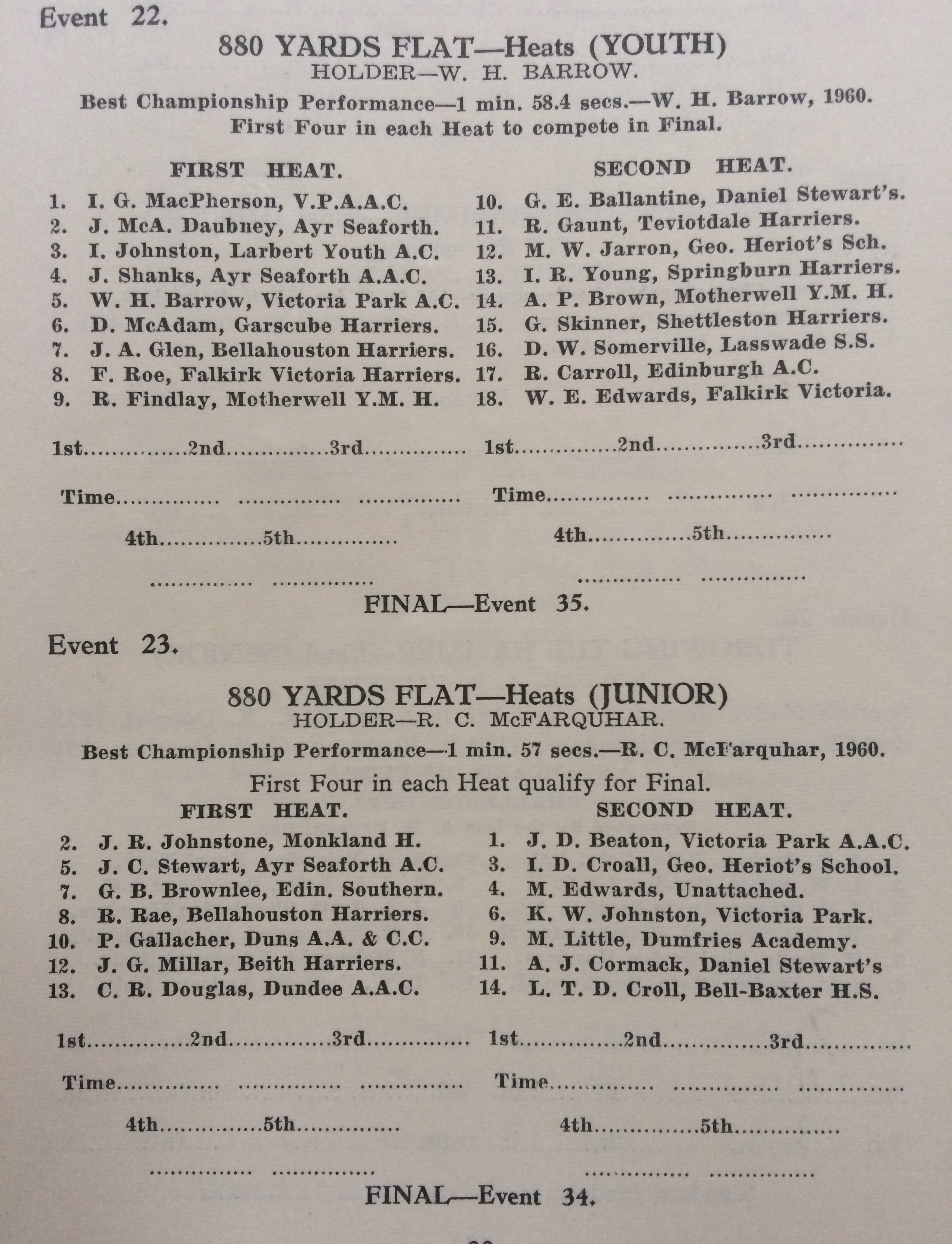
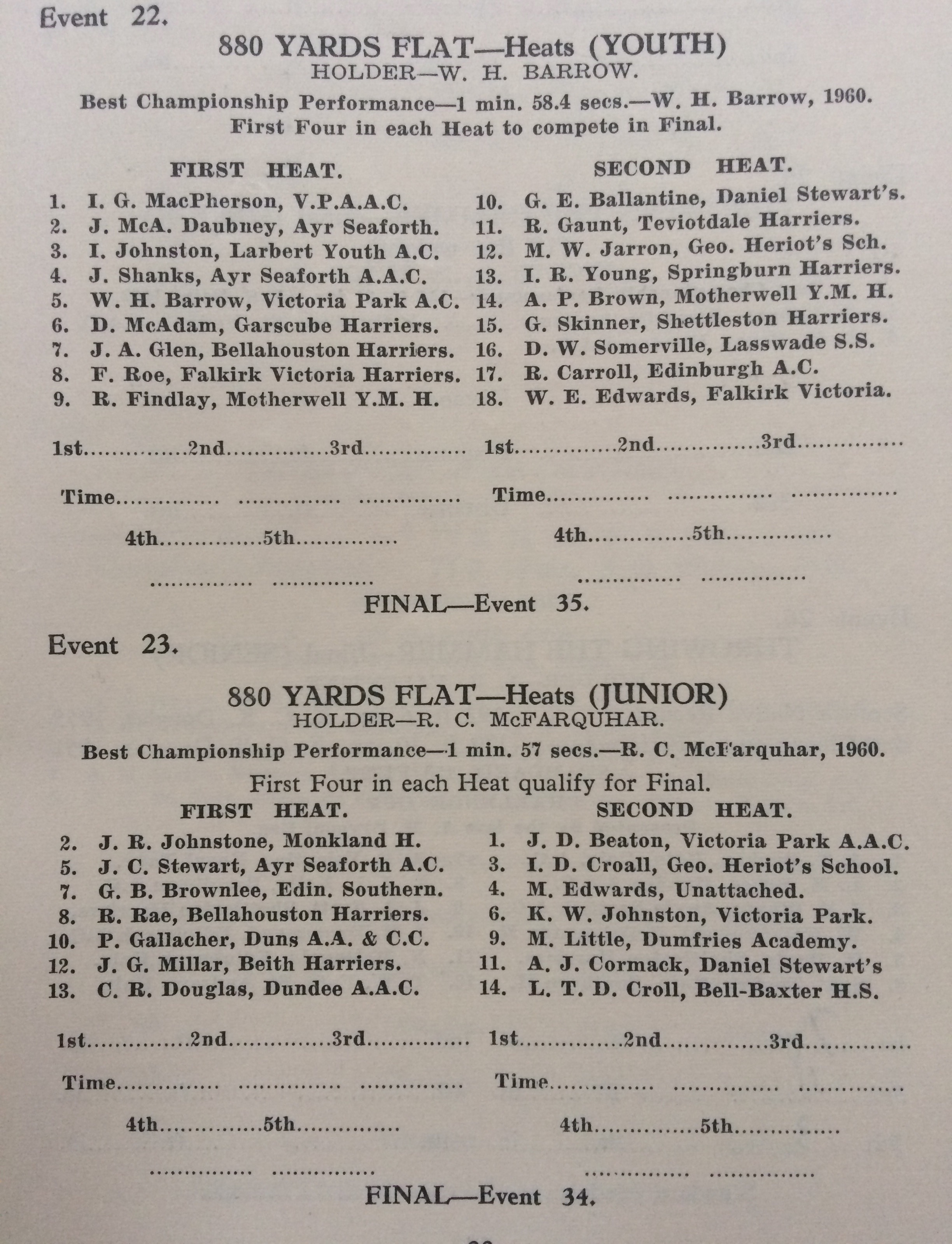
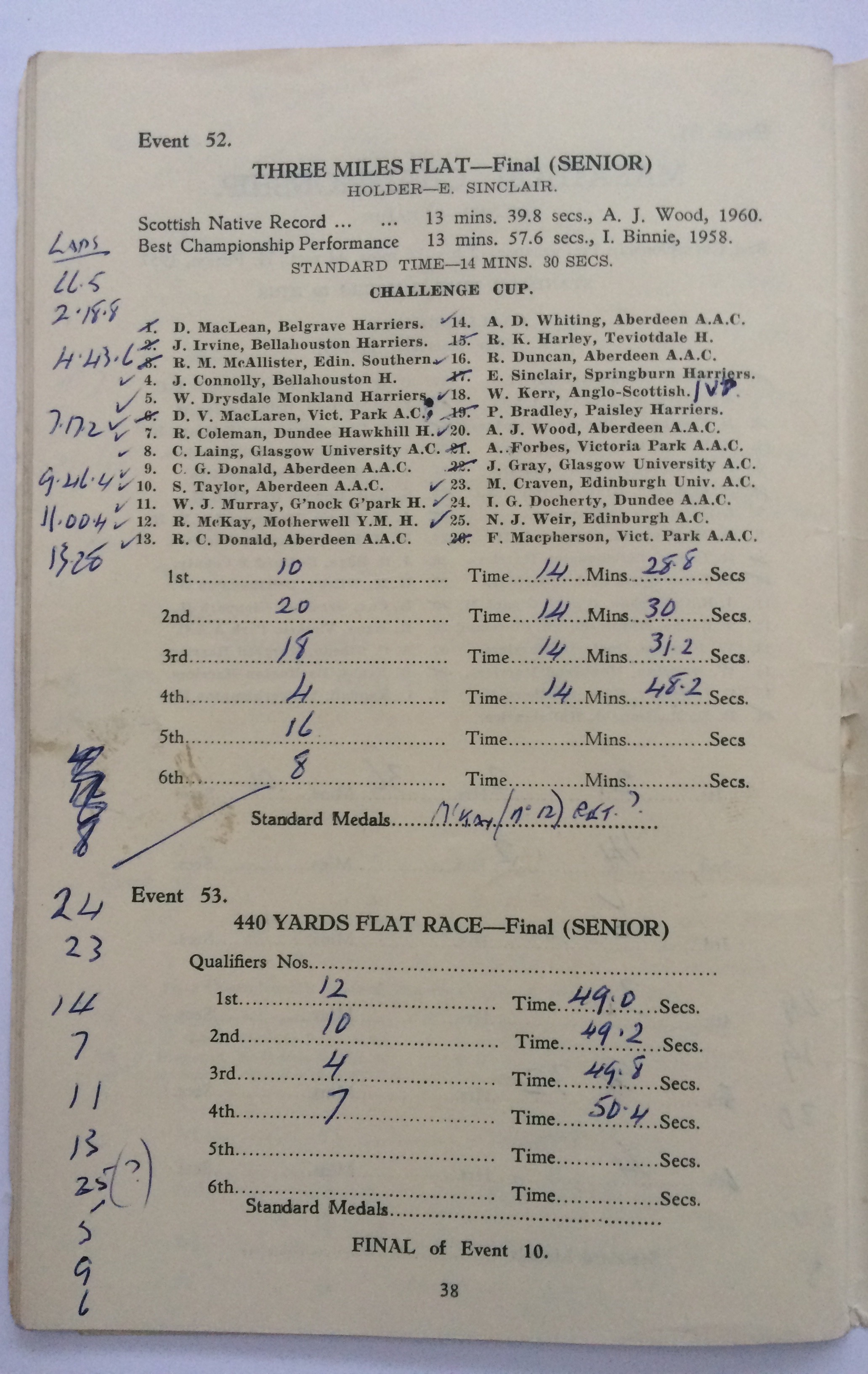
Having shown what he could do in the Youths (Under 17) age group his first season running against seniors was 1961-62 when he was a first year junior. Living as they do in the Borders, Teviotdale Harriers often have to travel longish distances for competition and on 21st October 1961 they first team went to Dundee for the Kingsway Relay where they finished victorious. Alastair Wood of Aberdeen had the fastest time of the day (13:28) with the junior from the Borders being second fastest with 13:42 and Mike Ryan (St Modans) on 13:48. Teviotdale went one better two weeks later on 4th November when their team of Douglas, Brian Mather, George Meikle and Arthur Moodie won the East District championships with Douglas being the equal fastest time of the day with Steve Taylor of Aberdeen. Ahead of ESH by a yard or so after two laps, they increased this to 20 yards by the finish. Another two weeks and on 18th November he ran in his first Edinburgh to Glasgow Relay on the first stage where he finished ninth for the Teviotdale team that finished sixth. Back to the country for the East District league match on 2nd December where Douglas won by 70 yards from G Brownlee of Edinburgh Southern Harriers to see Teviotdale win the team contest by 33 points. The next championship fixture was the East District championship at Dundee on 20th January and Craig Douglas was the first Teviotdale runner home, finishing fourth to pick up first Junior medal as well as a first team winner’s trophy. In the League match in December the report put Teviotdale’s victory over ESH down to several key men being absent from the Edinburgh team, no such comments were made this time when the Borderers won by four points. The major championship however is always the national championships and this year it fell on 3rd March at Hamilton. Douglas ran in the Junior championship for the first time. “AIC Heron *Edinburgh Southern Harriers) surprisingly won the Junior Championship, beating JC Douglas (Teviotdale) by 70 yards in 30 min 25 sec with M Ryan (St Modan’s) the same distance behind Douglas. ” The Teviotdale team was third. Douglas’s team mate Arthur Moody was eleventh and because of the fact that there were several runners too old to be international juniors in the field, they were both selected for the Scottish team for the international along with Jim Finn, Alistair Heron and Lachie Stewart. When it came to the actual race in Sheffield on 24th March, unfortunately, it was a different story – the scoring runners were Stewart in tenth, Heron eleventh and Finn sixteenth. Moody eighteenth and Douglas twenty first were non scorers.
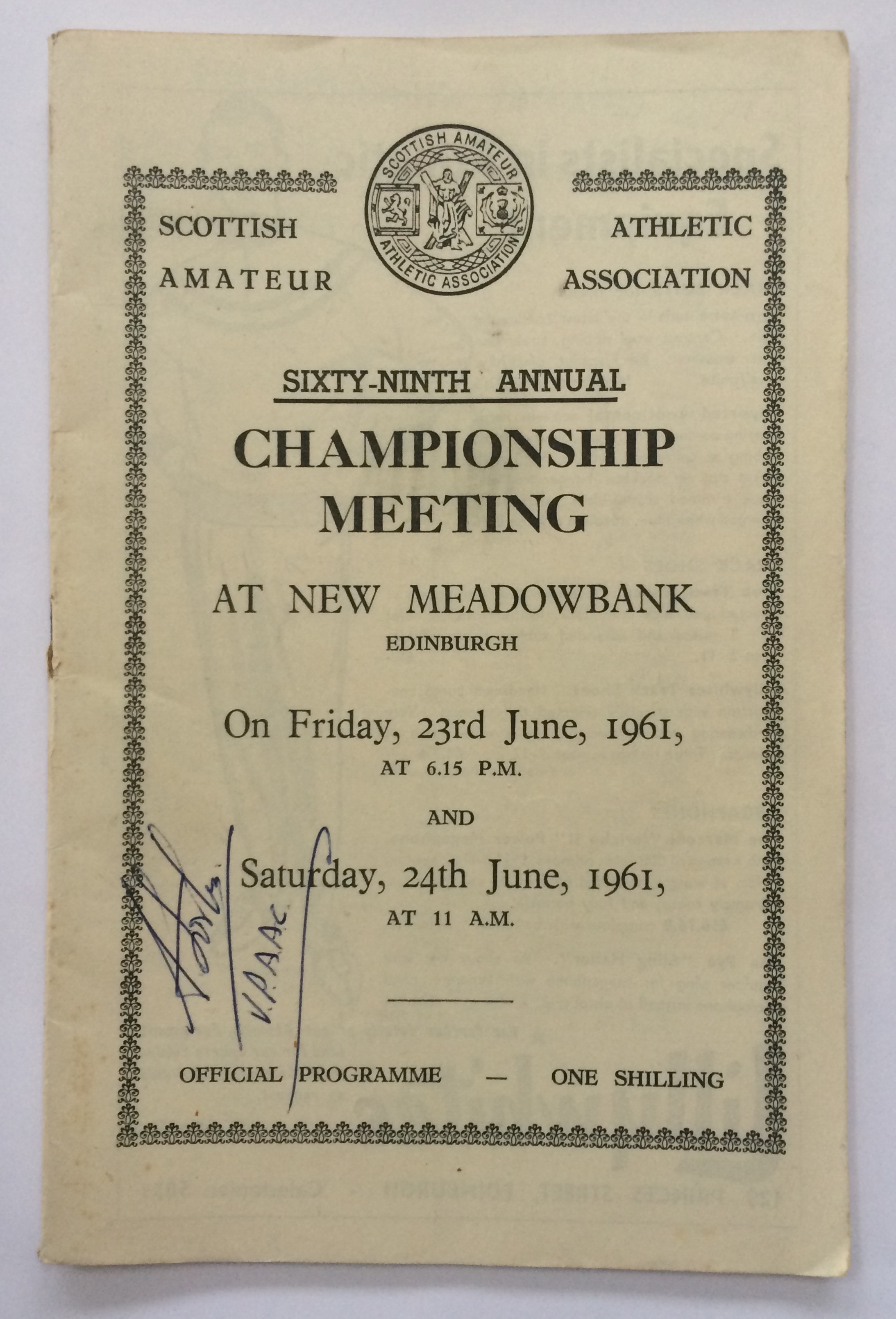
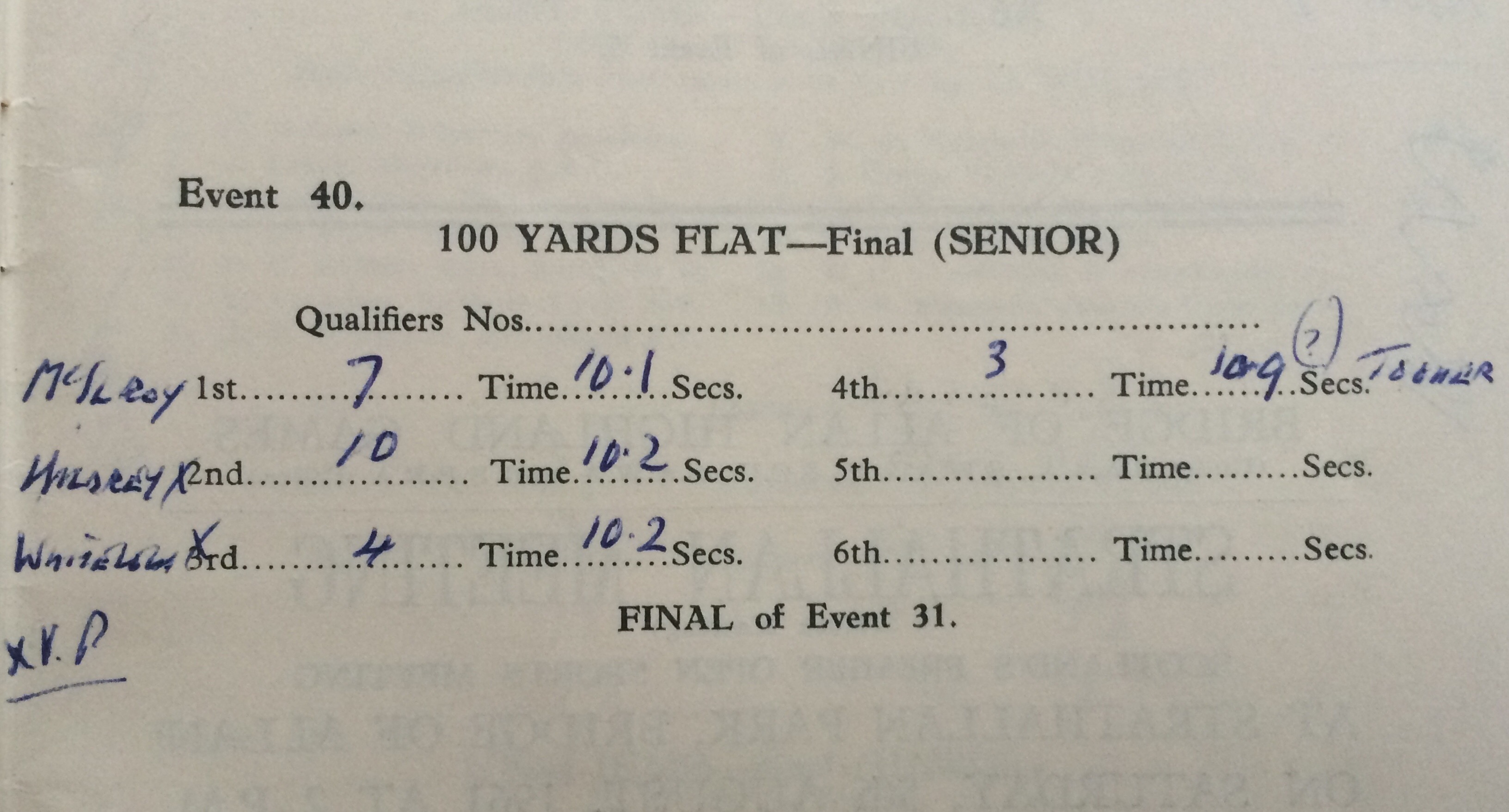
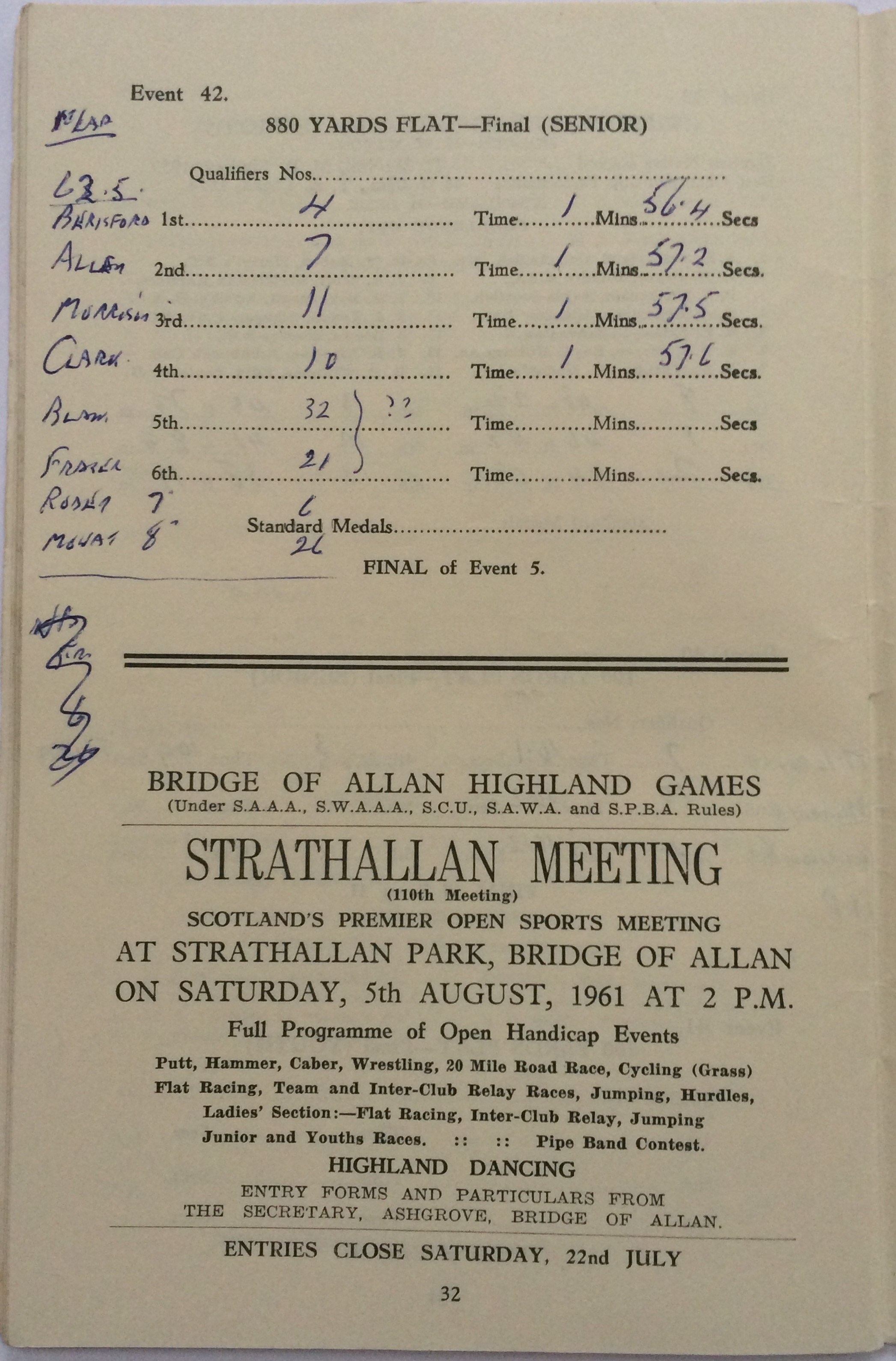
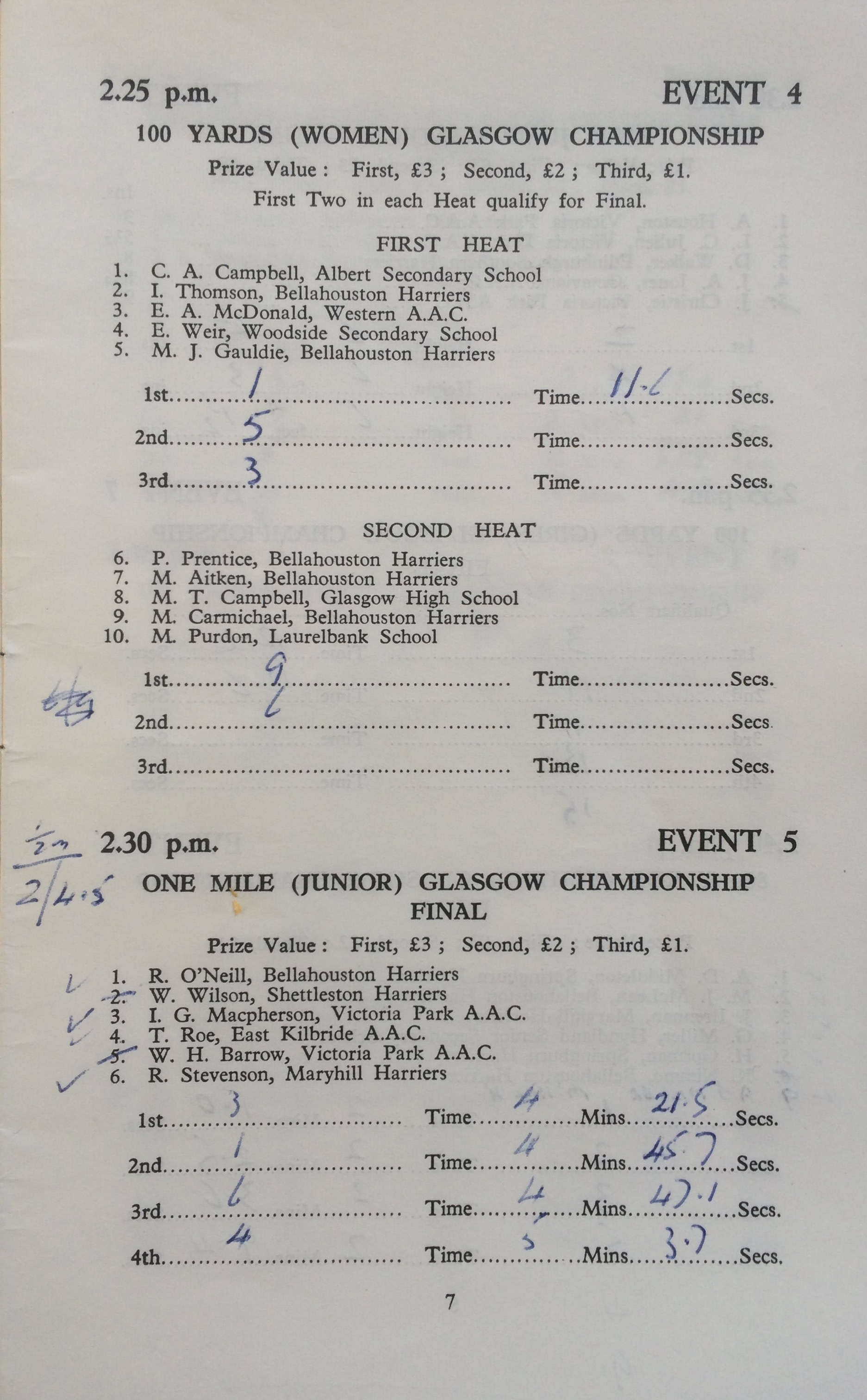
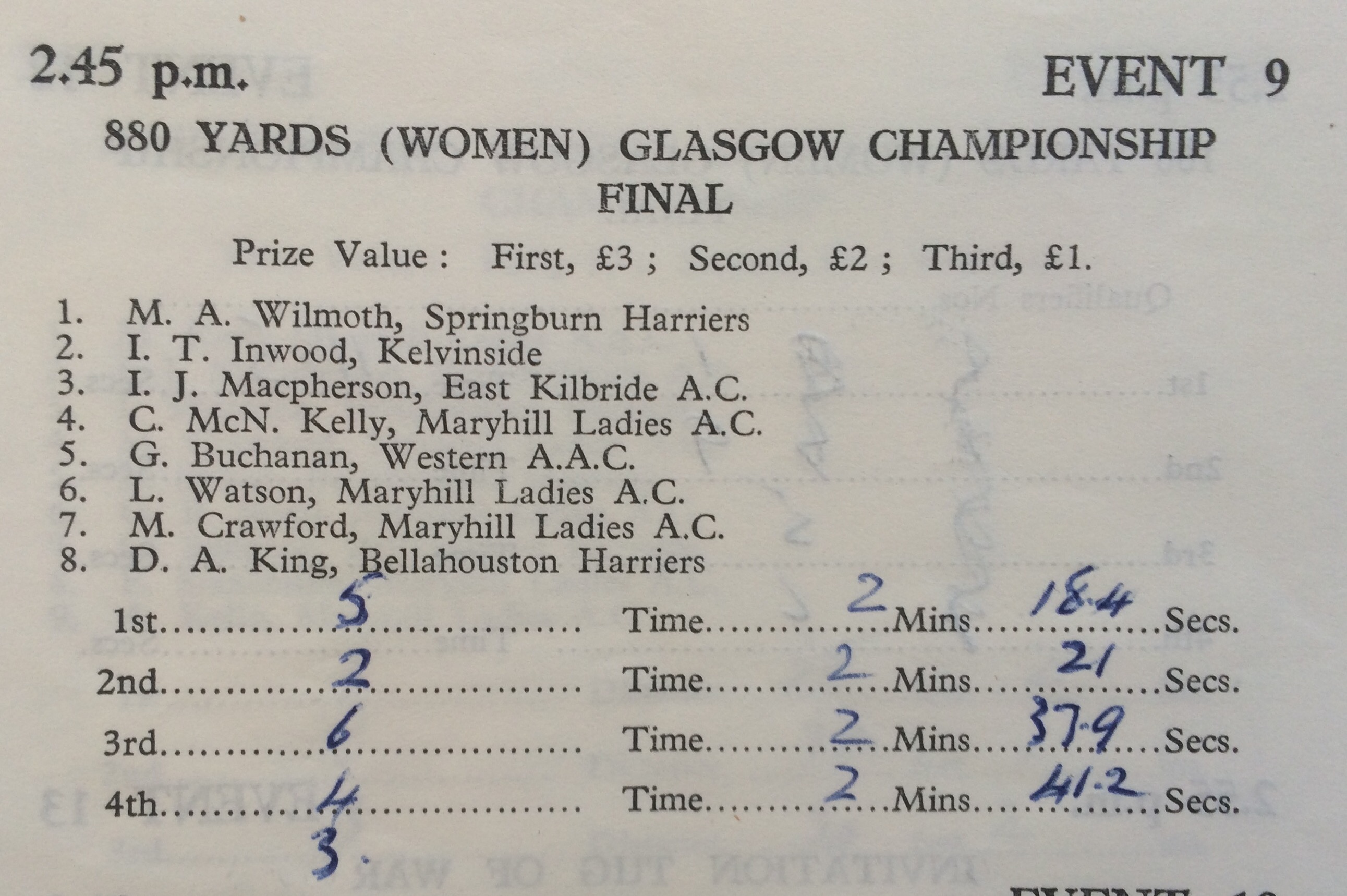
Winter over, it was time for track spikes. First Championship of the season was the East District event on 26th May at New Meadowbank where Douglas finished second in the 880y to Frank Dick who won in 2:02.6. It was unfortunate that these were held on the same weekend as the Border Championships where Peter Roden and Brian Mather won the 880y and Mile and the Three Miles respectively in the Teviotdale colours. The standard in Scotland at this time was high with Jim McLatchie having a very good summer and Hugh Barrow probably the pick of the Juniors but the additional hurdle for any young half-miler/miler was the number of Anglo-Scots who suddenly parachuted on to the scene. In the SAAA championships at the end of June, the first two places in the 880y were the Wenk brothers, and the winner of the Mile was Mike Berisford all of whom were members of the Anglo-Scottish Club. In the Braw Lads Gathering at Galashiels on 30th June Douglas won the half-mile in 1:55 from a mark of 30 yards. Although he did not appear in the first three at any of the major meetings over the summer, by September 1962 Craig Douglas had best marks of 50.7 for the 440 yards, 1:53.7 for the half mile and 4:19.7 for the mile, which marks ranked him eighteenth, sixth and nineteenth for the year.
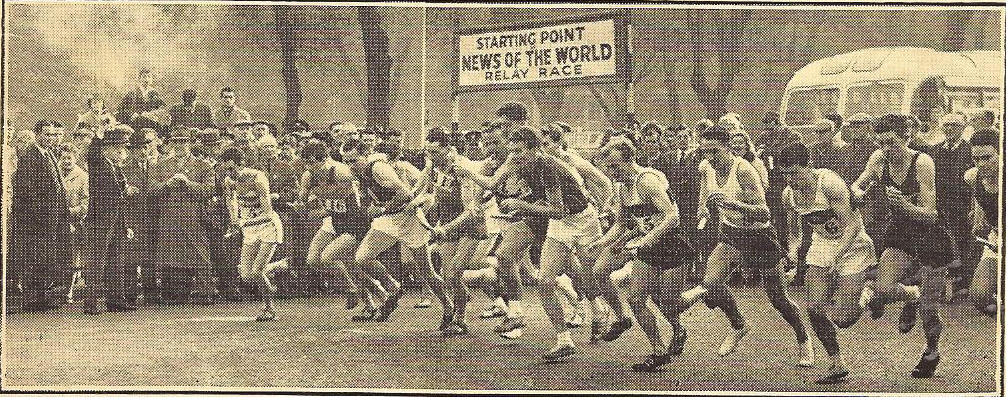
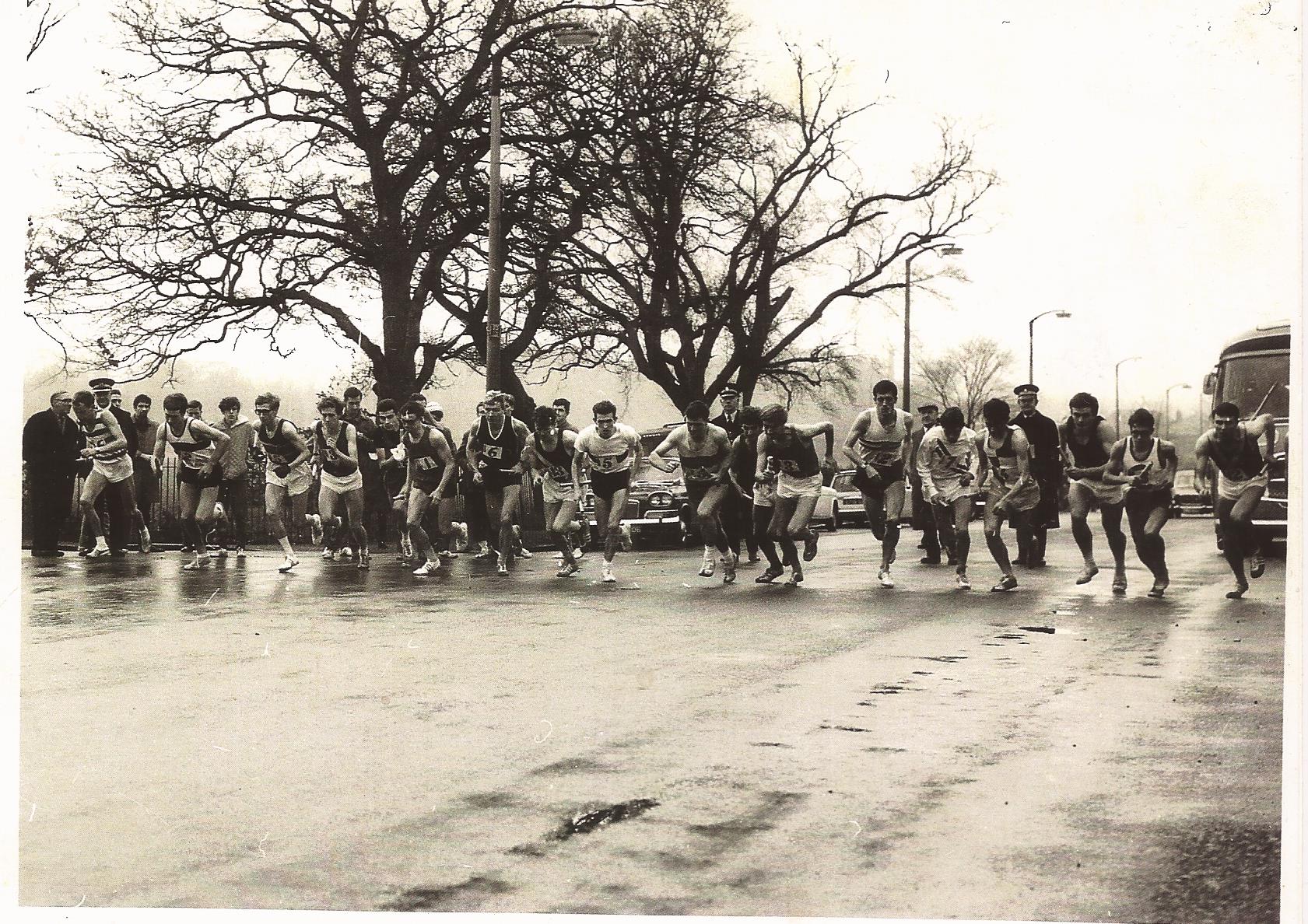
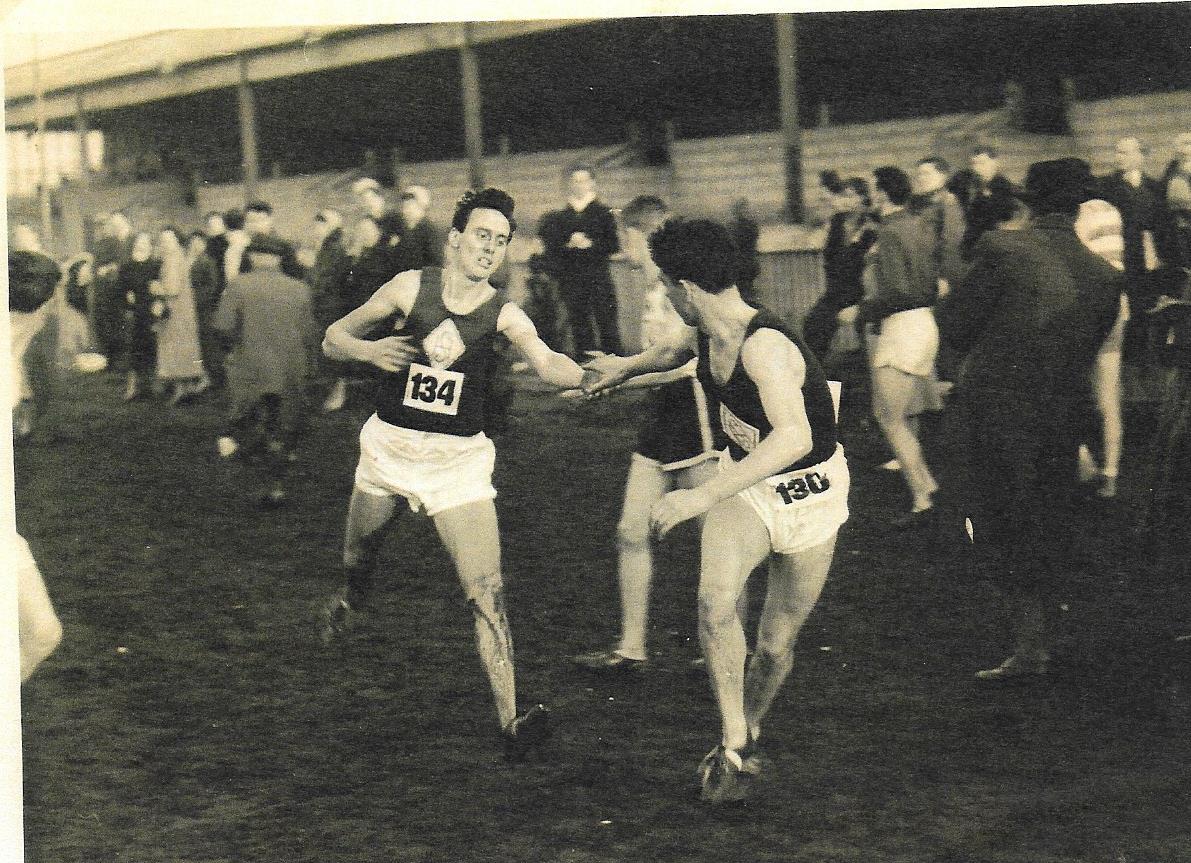
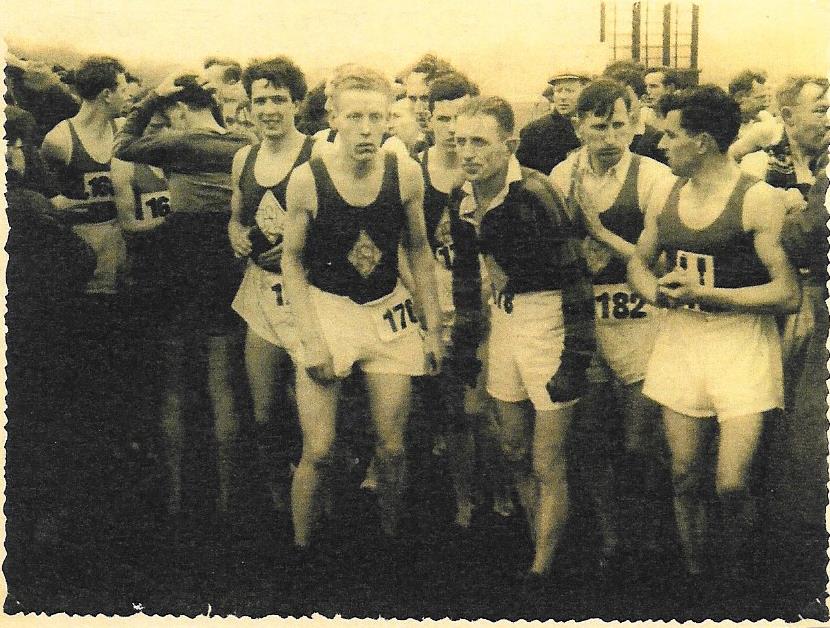
Edinburgh to Glasgow start, 1961
Season 1962-3 began as ever with the short relays. The athlete’s training year usually went from October to the end of August the following year with September more of a rest month – almost always a very active rest! For Craig Douglas as for most other endurance runners, summer 1963 started in October 1962. The next six months would help determine to a large extent how he would perform. He missed the McAndrew Relay on the first Saturday in October where Teviotdale finished third behind Motherwell YMCA and Dundee Hawkhill (including Fergus Murray) with all the Glasgow and Edinburgh clubs trailing. The club team consisted of Roden, Mather, Meikle and Wilson. After a third place in the Kingsway Relay, Teviotdale won the East District Relay title for the second year in succession with a team of Mather (16:13), Meikle (16:30), Roden (16:13) and Douglas (15:57) defeating Edinburgh Southern and Edinburgh University (including Fergus Murray). Two weeks later on 17th November, the Edinburgh – Glasgow relay topped the agenda and Douglas was running on the first stage where he finished eighth for the team that came in sixth across the line in Glasgow almost four hours later. Into the new year and on 19th January, 1963, in the District Championships in Edinburgh, Craig Douglas was the first individual (“JC Douglas had a comfortable win”), he was also of course 1st Junior but the club team of Douglas, Riddell, Meikle, Hamilotn, Roden and Turnbull) finished third. All eyes were on the national championships after that and having finished second the previous year, Douglas must have had high hopes for 1963. Held on 28th February at Hamilton, the race was won by Fergus Murray from Mike Ryan, Alex Brown and Lachie Stewart and Craig Douglas while Heron was back in fifteenth. Fifth behind those runners was no disgrace though and he was again selected for the international match at San Sebastian. Lachie Stewart was top Scot when he finished in third place in the international with Douglas in tenth place and the team winning the bronze medals.
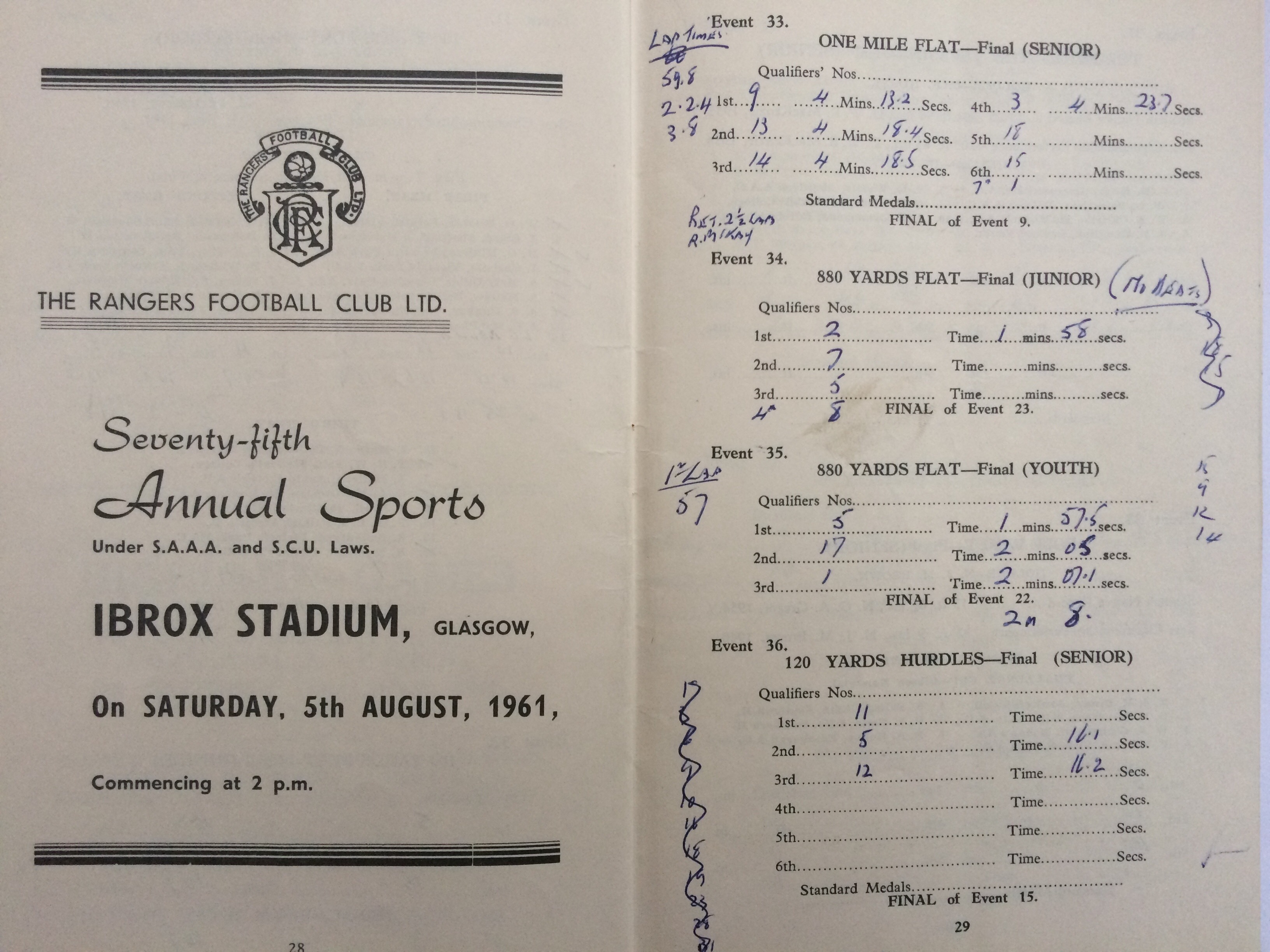
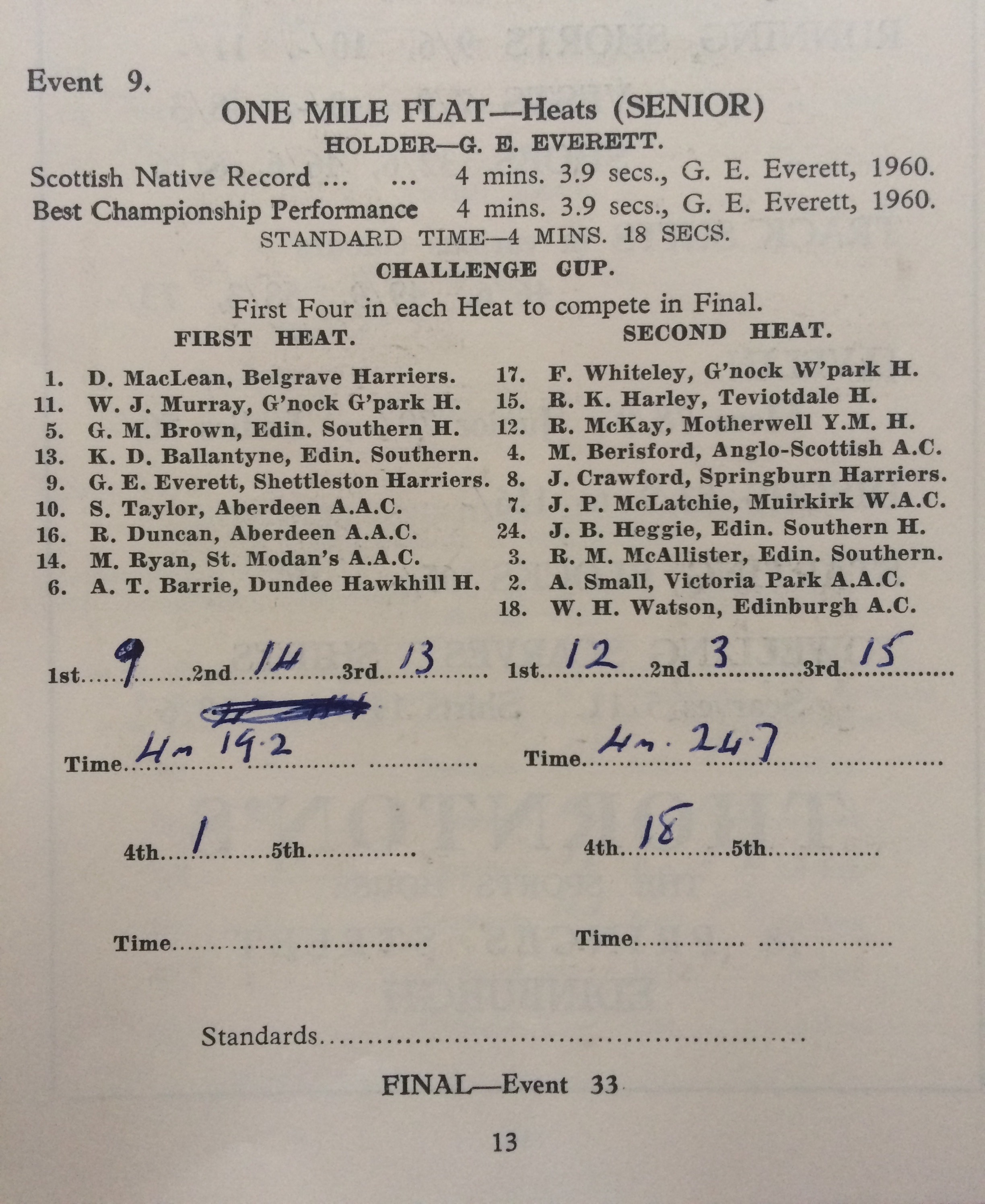
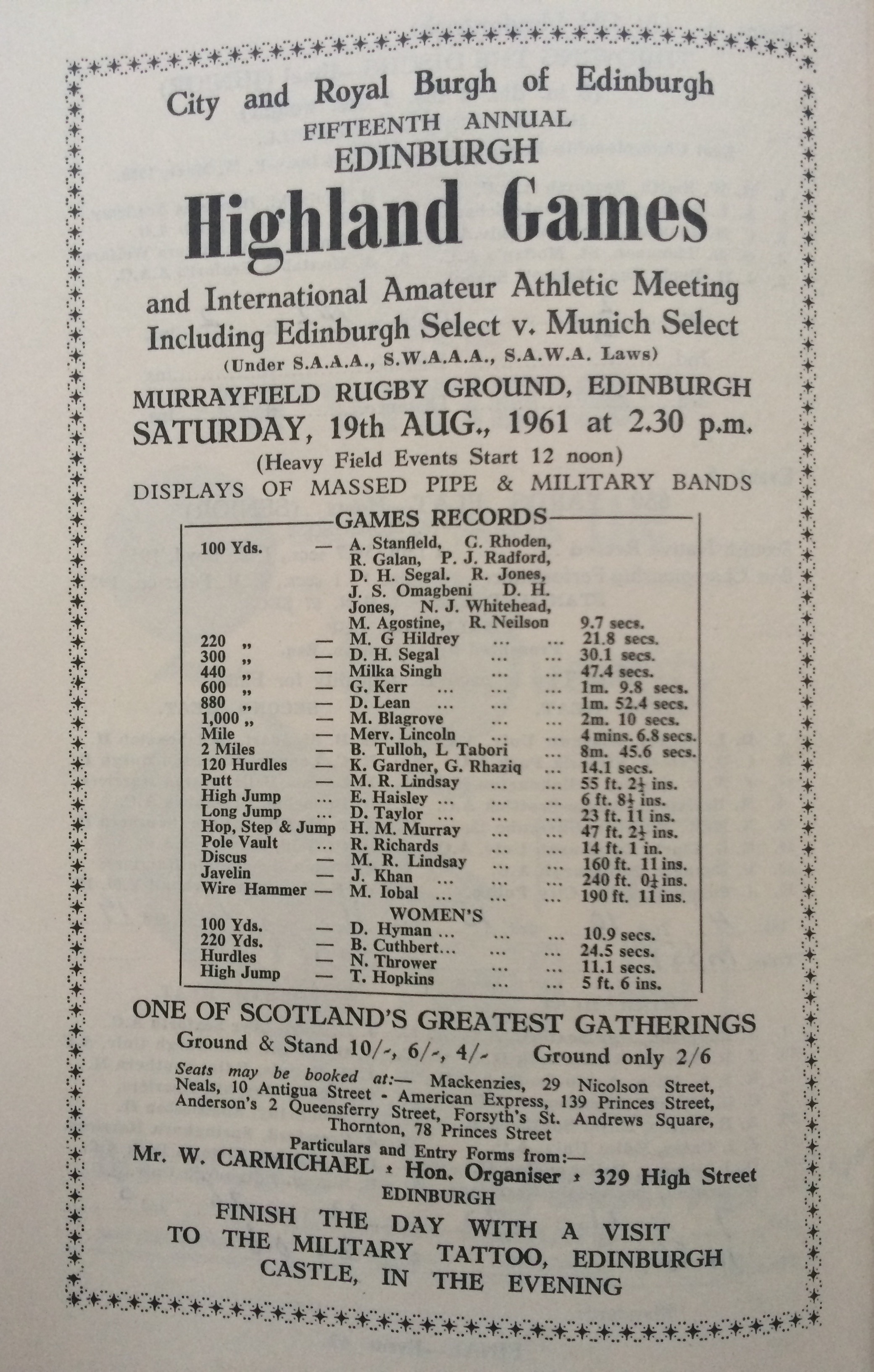
After two SCCU International appearances, 1963 was to see him win his first SAAA international vest. However at the start of the season, in the East District championships there seemed to be a dearth of Teviotdale athletes -in the distance events and oneof those posted missing was Craig Douglas. He was out the following week in the invitation three-quarter mile race at the Lanarkshire Constabulary Sports at Shawfield against Hugh Barrow, Scottish record-holder for the distance and Graham Everett the Scottish mile record-holder, but after a clash on the first bend, Barrow fell leaving Everett to win by eight yards from Douglas with Victoria Park’s Graham Peters third. In the Scottish championships on on 22nd June, Craig Douglas won the first of his SAAA titles. It was over 880 yards and he won in 1:55.2 from Jack Davidson from Ayr. The routine of sports meetings continued until there was a Hawick tour-de-force at the Falkirk FC Sports at Brockville Park on 27th July. The track at that venue was a short track with veru tight bends that made it difficult for the low handicap runners to really open up anywhere but “JR Wilson (Teviotdale) won the handicap 880y from the back mark of 12 yards in 1 min 57.3 sec and the Scottish champion JC Douglas (Teviotdale) certainly did well to finish second with another runner from Teviotdale, P Roden from 10 yards, in third place.” In a match between the Home Scots and the Anglo Scots at Scotstoun on 10th August, Douglas took on his predecessor as Scottish 880y champion, John Wenk. The result was a victory for the Anglo by 1.4 seconds – 1:56 to 1:57.4. As a reward for all his fine running over the season, he was selected for the international match with Belgium held in conjunction with the Edinburgh Highland Games at Murrayfield on 17th August. The result tells the story of a hard fought race: 1. Rocksaert (Belgium) 1:58.6; 2. Douglas (Scotland) 1:58.7; 3. Martens (Belgium) 1:58.7.
The hard facts at the end of summer 1963 for Craig Douglas were: 440y in 51.0 which ranked him twenty third; 1:55.2 for 880y ranked eighteen; 4:17.8 for the Mile ranking him twenty third. Not as good as the previous year but half-miles are not always all about time – tactically a slow run victory may be as sweet as a one led gun-to-tape but when the best for the season is outside twentieth best Scot, it is not where the athlete would like to be.
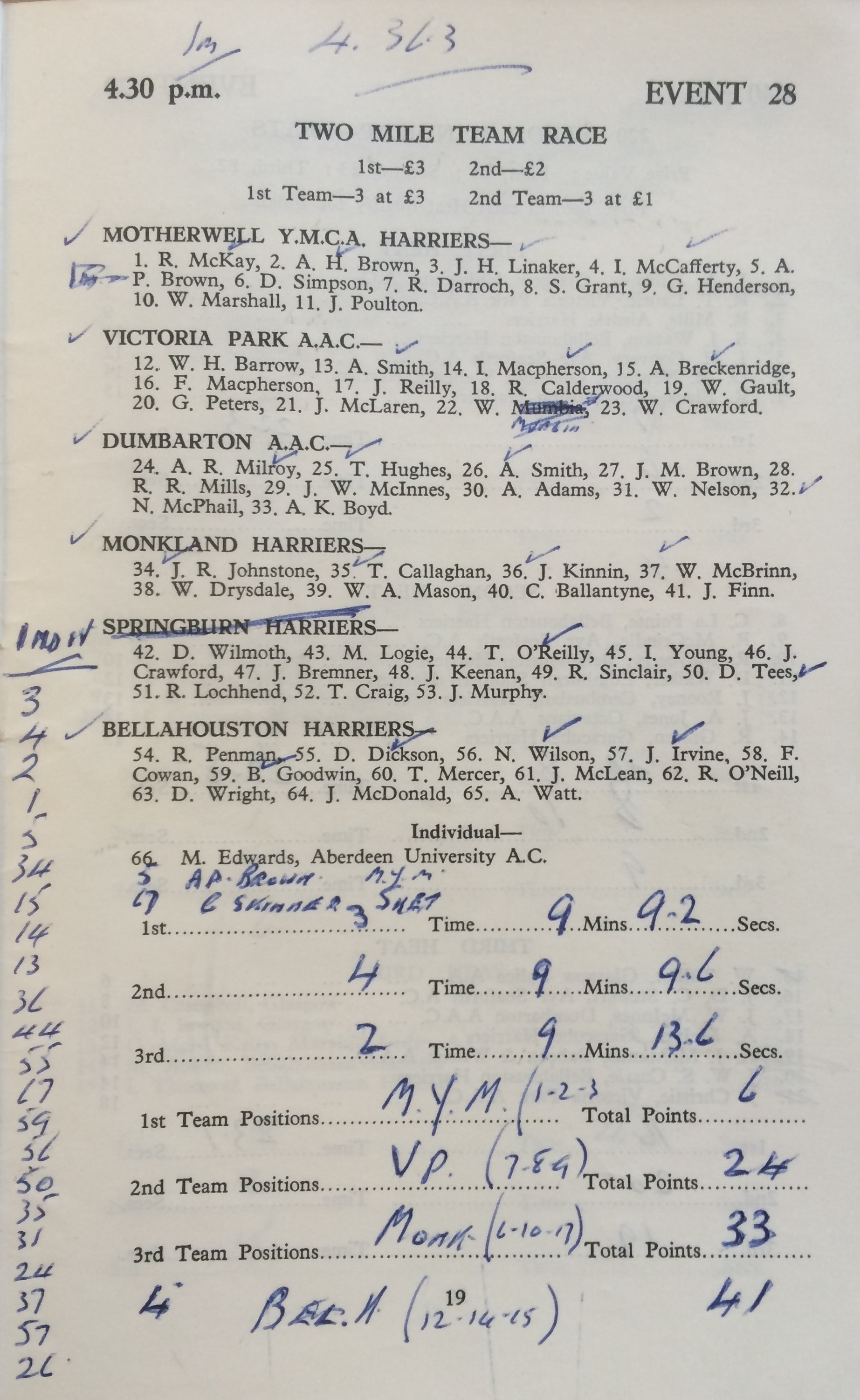
On October 5th 1963 Motherwell YMCA won the McAndrew Relay at Scotstoun and no one was really surprised – it was the second place of Teviotdale that raised the eyebrows. They had beaten the best that ESH, Shettleston, Victoria Park and all the rest could muster. Mather (13:10), Harley (13:15), Wilson (13:37) and Douglas (13:16) – not one in the first half dozen times but only 27 seconds between fastest and slowest in the squad. On 26th October in the East District Relays at Fernieside, Edinburghthey again won the title from ESH with a team of Mather (14:20), Harley (14:33), Wilson (14:26) and Douglas (14:10) – only 23 seconds between fastest and slowest in the team. Douglas was second fastest of the day behind Fergus Murray. One week later at Newcraighall Pit Baths, Edinburgh, Douglas won the East District League match from Donald Macgregor with the Teviotdale club team beaten by Edinburgh Southern Harriers who had all six counters in the first 11 men home. A week’s rest then into the Edinburgh to Glasgow on 17th November. Douglas this time had the severe test of the second stage, the lap of champions, and dropped one place, from 7th to 8th. The single place was dropped to Calum Laing of Glasgow University on a charge from 11th to 7th. On 31st November, at Kirkcaldy he won the second East District League match from team mate RK Harley but the club was second to ESH again. The top men kept turning out for the club: the team was Douglas, Harley, Mather, Hamilton, Meikle and Roden. The same six runners were the scoring men when the East District championships were held at Hawick on 18th January, 1964, and the team result was the same – ESH first, Teviotdale second – but this time Douglas was fourth behind Fergus Murray, Ron Coleman and Mel Edwards. The third and final East District League match was held on 25th January at Musselburgh where the finishing order was Murray, Hartley and Douglas.
The top event of the winter, even including the Edinburgh to Glasgow, the national championship of Scotland was held at Hamilton on 29th February and Douglas, still a junior within Scotland, was fifth in that championship behind Mel Edwards, Ian McCafferty, Lachie Stewart and Joe Reilly (VPAAC), with Alex Brown in sixth place.
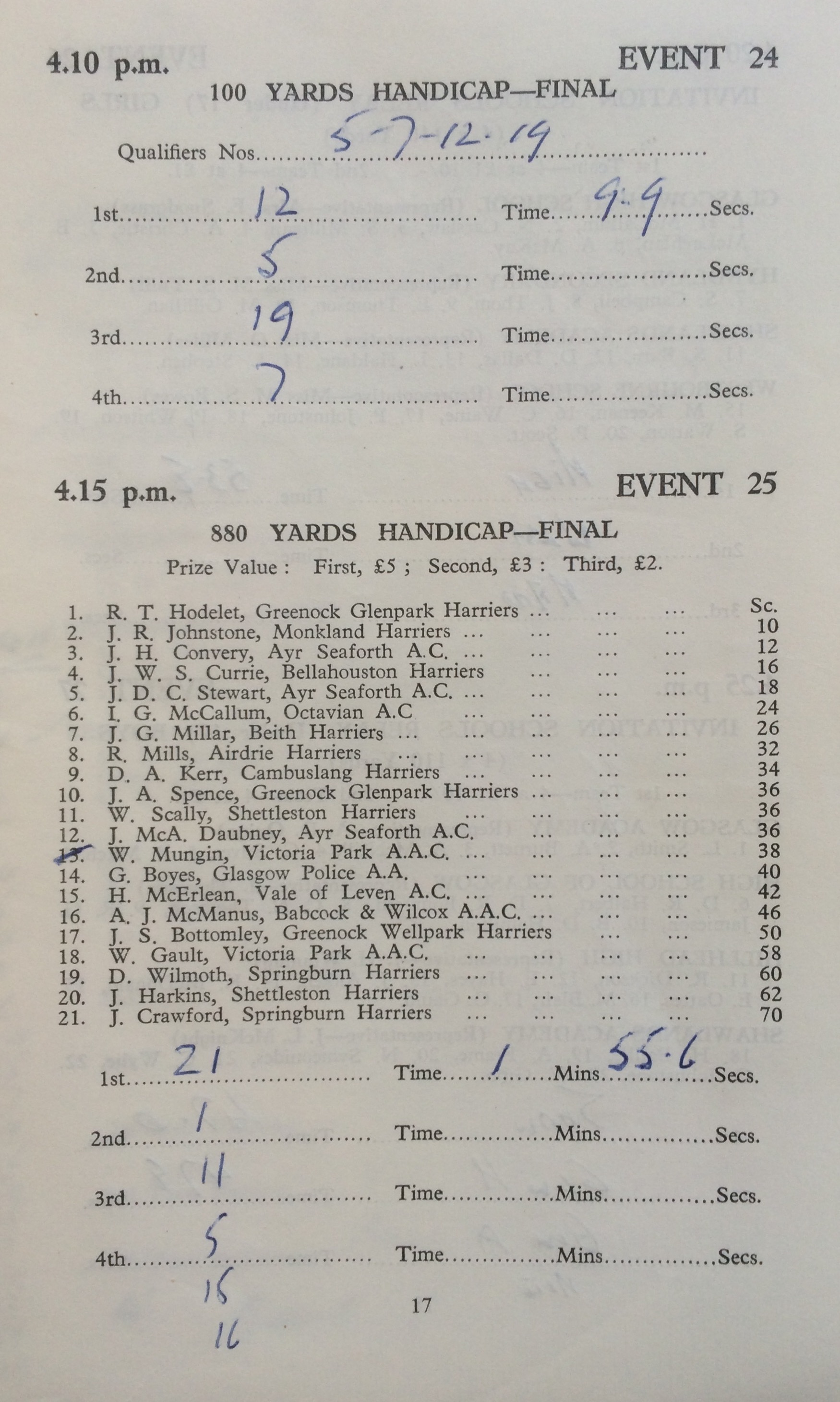
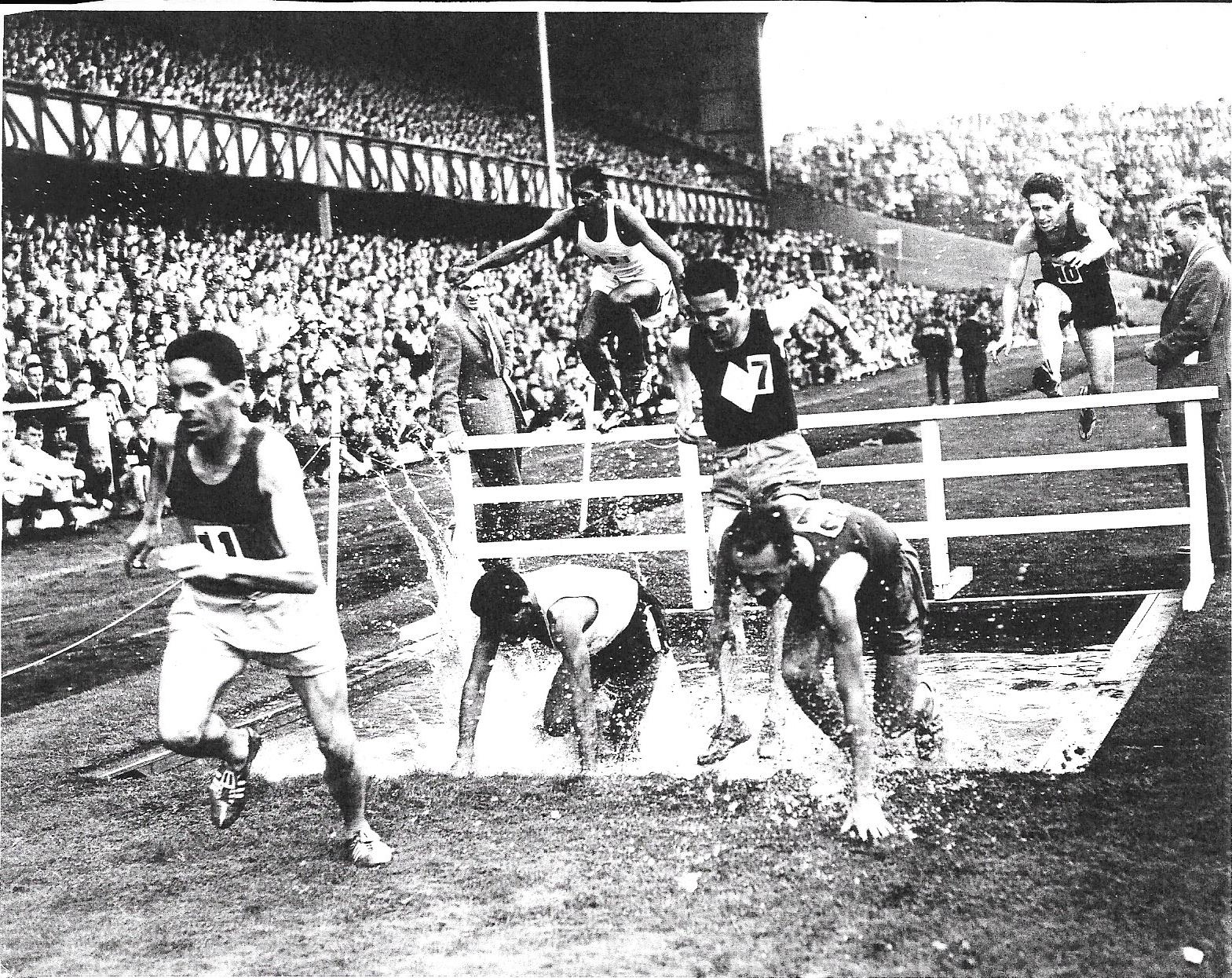
Craig Douglas won his first East District track title on 29th May, 1964, when he won the 880y from Turnbull (Octavians) in 1:54.8 which was a championship record. He had run well at the Lanarkshire Police Sports the previous year but this time it was his team mate JK Wilson who showed the way home to Graham Everett and Jim Johnston. Unplaced in the SAAA Championships, Douglas was running in the Mile in a triangular contest at Scotstoun against Maryhill and Dundee Hawkhill and won in 4:20.8. Then on 18th July, in a match between an Edinburgh Select and the Nykoping and Heleneholm clubs, Douglas was back down at the 880y and ‘won this event impressively’ in 1:53.3, a best ever time for any Teviotdale Harrier. Running in the half-mile at various sports meetings and gatherings he was often handicapped out of it but at Strathallan on the first Saturday in August he won the event from a mark of only 4 yards in 1:57.9 seconds from Neil Donachie of Edinburgh AC. Back in Edinburgh for the Edinburgh Highland Games on 15th August which incorporated a match between Edinburgh and Munich, Douglas represented the former and finished second in the 880y, splitting the two Germans, in a race won in 1:56.9. August always ended with the Cowal Highland Games and Douglas was there on the 29th running an 880y handicap race from a mark of only 2 yards – I wonder how much easier it is to run from 2 yards than it is from scratch? He finished second to W Robertson of Bellahouston whose time was 1:53.5.
At the close of play 1964, his best times were 1:52.8 which ranked him third in Scotland behind John Wenk (1:51.4) and Dick Hodelet (1:52.6) and 4:20.8 which had him back in twenty fifth place.
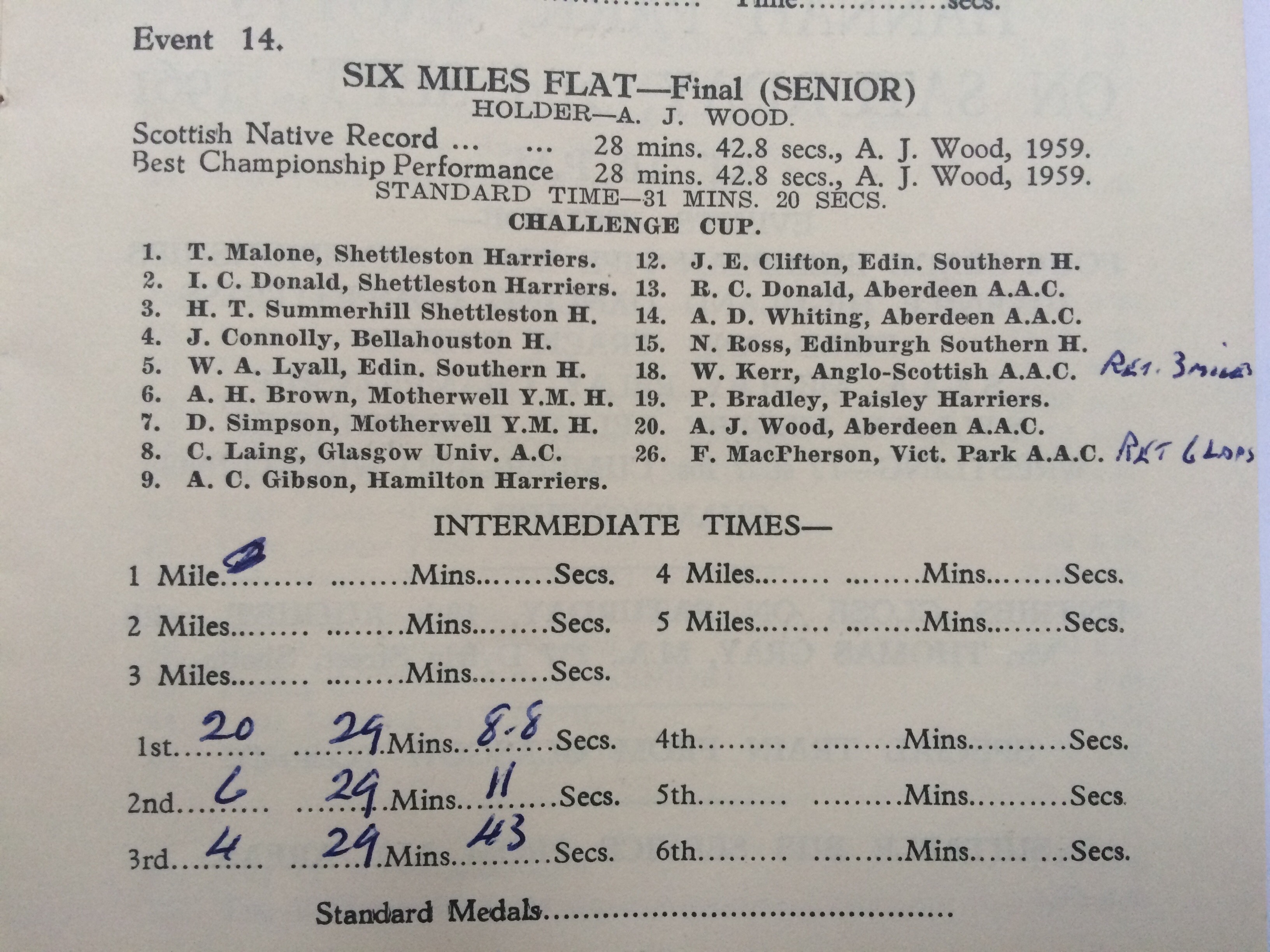
Winter 1964-5 started with the McAndrew Relay on 3rd October and Teviotdale was much lower down the results list than the year before finishing ninth. On the very last Saturday of the month, in the East District relays, the club lost their title to Edinburgh Southern, finishing second approximately 180 yards back. Craig Douglas ran the first stage and gave the club a lead but Kenny Ballantyne pulled it back on the second stage for the Edinburgh club and they were never headed again. Douglas’s time of 13:43 was twelve seconds slower than Don Macgregor’s 13:10 and they were the two fastest times of the day. The Edinburgh to Glasgow was held on 21st November and this time he got the longest stage in the race to run – the seven mile sixth leg. He retained seventh position for the team which was their finishing position. His cross-country and road running was finally receiving notice and he was selected for the SCCU team against the Army at Barrachnie on 27th November. He finished sixth, 43 seconds behind Fergus Murray who won the race. Back to league duty on 5th December he won the East District league match at Newcraighall by 40 yards from Roger Young with Fergus Murray back in sixth position. Teviotdale was unplaced but then, at that time, all three Edinburgh clubs were probably at their strongest ever and Edinburgh University won from Edinburgh AC and Edinburgh Southern. His next representative race was on 19th December when he ran for the SCCU against Scottish Universities at Kings Buildings in Edinburgh. Here he finished twelfth, over two minutes behind winner Ian McCafferty.
On 16th January, 1965, the Edinburgh Districts were held at Newcraighall and Craig Douglas was third individual and Teviotdale did very well to be second team behind the all-conquering Edinburgh University squad and 23 points in front of Edinburgh Southern. The successful team was Douglas, Raeburn, Meikle, PC Roden, AJ Roden and Riddell. The third and final league match was at Hawick on 13th February, 1965, and Douglas won in 33:15 from Roger Young and Fergus Murray of Edinburgh University. The team, with John Hamilton a scoring runner instead of George Meikle, finished second. It was now on to the National on 27th February at Hamilton. This was his first run in the senior race and he acquitted himself well with an eleventh place finish to lead the team home in sixth place with Douglas, AJ Roden, G Meikle, P Roden, D Riddell, P Riddell the runners.
It had been a fairly successful winter for him with several victories and two representative matches and a solid debut in the senior national. At club level too, there was a good bunch of runners, most of whom had run together for years, plus some new younger men adding to the strength too. How would he fare in summer 1965?
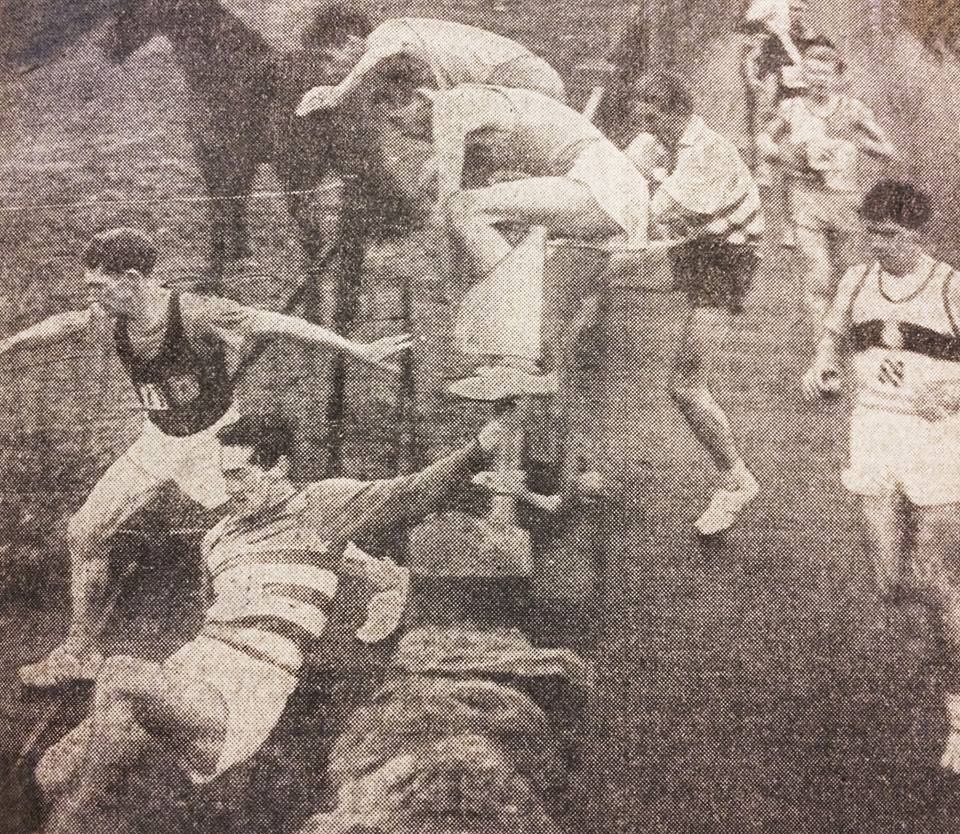
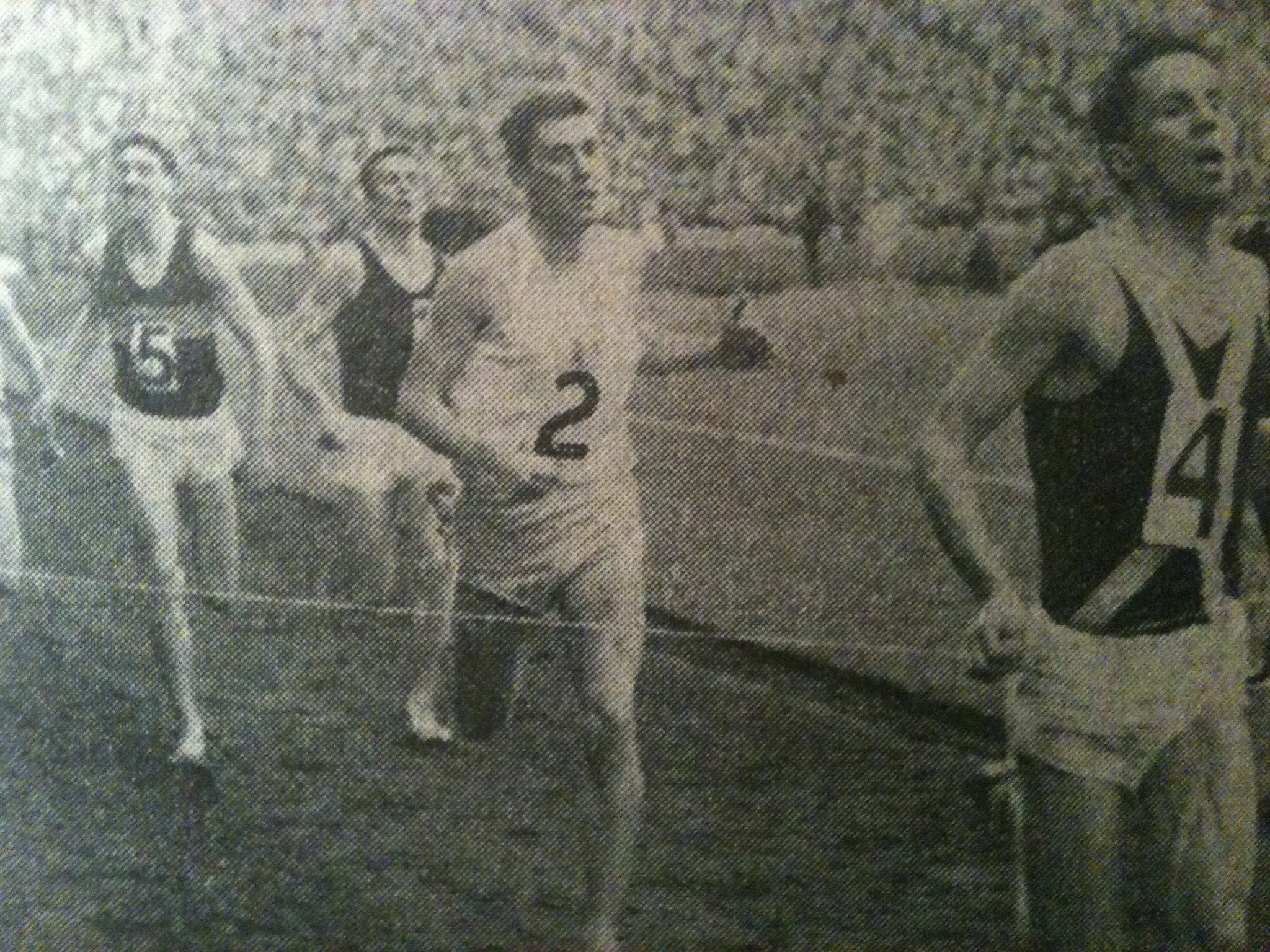
SCCU v Scottish Universities: Andy Brown, Lachie, Bill Ewing, John Lineker, Hugh Barrow, Craig Douglas, Ron Coleman
On 29th May, 1965, at New Meadowbank Douglas won the East District 880 yards title for the second time beating Martin Sinclair and Bill Ewing in 1:53.5, another championship record beating his own time of a year earlier to get his championship season off to a good start. The West District title had been won by Graeme Grant from Mike Maclean and Brian Scobie in 1:54.3 on the same day at Westerlands. Douglas returned to Shawfield for the Lanarkshire Police Sports on 12th June where he was third in the invitation three-quarter mile race which was won by Graeme Grant in 3:04.3 from Bill Ewing. On 30th June, he ran for the SAAA against the Atalanta Club and won in 1:51.7 which was only one second outside the national record, beating Graeme Grant in the process.
The SAAA Championships were held on Saturday, 26th June and Grant won in 1:54.9 with Dick Hodelet a surprise second in 1:55.4 from Douglas in 1:54.6. Hodelet who had been given little or no chance by the reporters before the event, came out of the last bend into a headwind and passed Douglas about 50 yards from the tape. A week later in the Braw Lads Gathering at Galashiels, Douglas won the 880 yards scratch race in 1:56.5. Then his fastest 880 yards so far came on 19th July at Salford in a match between Scotland, Wales and the Midland Counties where he finished third behind Harris of Wales and McKim of Midland Counties in 1:50.0 – exactly one second behind the winner in a tight finish. It was almost three seconds off his pb of 1:52.8 run the previous year, was the tenth best in Britain at the end of the year and maybe demonstrates the value of good opposition in running a fast time.
On 21st August, running for Scotland against Iceland at Murrayfield, Douglas was second to Graeme Grant in the 880 yards which was won in 1:55.5. He followed this with a very good at the Cowal Highland Games meeting on 28th August when he won the scratch 440 yards in 49.8, and the handicap 880 yards in 1:55.6 from the 10 yards mark. His season ended there but before looking at the 1965-66 season, we should note that the 1:50.0 run at the Scotland/Wales/Midlands event topped the Scottish ranking list – the first time he had done so. His best 440y was 49.8 which had him in twelfth position and 4:18.7 was twenty eighth. Two personal bests (440y and 880y), two international vests, a medal in the SAAA were all evidence of a good summer’s work. But the question that seems obvious is, why didn’t he go to the AAA’s? Grant, Middleton and Maclean all went to the English championships and benefited from the experience, his best time had been done in England that summer so – why hadn’t Craig Douglas been down south more often?
The Scottish winter programme is very regular – you could sit down on the 1st October and write out every race that would come up over the winter – 1965-66 was no different and it would start with the short relays. He first appears in the East District relay championships on 30th October when he was second fastest over the course. The brilliant Edinburgh University squad provided the first two teams with the three year old Edinburgh AC in third. Fastest over the trail was Fergus Murray (13:03) and Douglas was only four seconds slower on 13:07. Although not racing on 6th November he was selected for the SCCU team to face the Army on 27th November along with McCafferty, Stewart, Alder, Brown, Knox and Murray. The ‘Glasgow Herald’ report on the Edinburgh to Glasgow relay on 20th November, had an excellent photograph of him running at the front of the field on the first stage where he finished fifth, 26 seconds behind the stage winner, Alistair Blamire. The Teviotdale team was eleventh. It was then a short jaunt to Glasgow Green for the match against the Army where Douglas was ninth finisher. Selected for the Scottish Universities match, he could not run but even without him and Lachie Stewart the SCCU won comfortably. The next championship was on 15th January at Kirkcaldy in the East Districts where he was sixth individual although the team was unplaced. It was a very good field indeed for this race – runners behind Douglas included Ken Ballantyne, Dave Logue and Alistair Blamire, while Ewing, Elson and Linaker were the first three.
Thereafter Craig Douglas missed the rest of the cross-country season. The Teviotdale Harriers teams were finishing further down the order than they had been too – he even missed the national on 26th February. However there were several months before the track season began to operate properly so there was time to get over any injuries or illnesses that may have been plaguing him.
By the time of the Scottish Cup Final on 23rd April, where it was by now customary for there to be two invitation scratch races to entertain the fans, he ran a Mile in 4:10.7 – a personal best on a good track against good opposition. The result bears repeating: 1. JL Stewart 4:10.5; 2. JC Douglas 4:10.7; 3. I McCafferty 4:11.5; 4. WH Barrow 4:11.5; 5. K Ballantyne 4:12.5; 6. J Linaker 4:12.9. Just a month later, on 28th May he won the East District 880y championship for the third consecutive year defeating Adrian Weatherhead, another very good runner, in a time of 1:53.6. Again selected for the match against Wales and the Midland Counties on 4th June at Wolverhampton, Douglas had another fine run to finish second to GA Dean (Midland Counties) with the respective times being 1:52.0 and 1:52.5 and it is worth noting that Dean ran for GB in the Tokyo Olympics that same year. he won the 880 for the SAAA against Atalanta on 29th June in 1:51.5. He was for some reason that is not obvious seldom given much press attention but on this occasion there was an interesting comment made by the ‘Glasgow Herald’ reporter who said “At the Scottish Championships on Saturday Douglas confessed to having renounced all ideas of concentrating now on the 880y – he would like to have a go at the mile – but his 1 min 51.5 sec last night certainly showed he has not lost the knack of two-lap running. In second place, as a non-counter, was ADS Middleton whose 1:51.9 is his best yet, and even more praiseworthy is the 1 min 52.4 of A Stewart, still a Junior athlete.” The reference to the SAAA Championships the previous Saturday is to the fact that Douglas was not among the medals at the SAAA Championships on the final Saturday in June where Grant, Hodelet and Maclean took the medals in that order. The official history of Teviotdale Harriers said that by winning against Atalanta he preserved his record of never having been beaten by a Scottish runner in 1966.
He kept it too at the Strathallan Gathering where he was the back marker in the handicap 880y. The Herald report read that “the 880y was one of the few races won by a backmarker. Douglas was conceding four yards to R Hodelet, runner-up in this year’s Scottish championship, and yet, at the bell, he was in the lead. Hodelet briefly challenged and went into the lead but it was a token effort. With 220y to go Douglas sprinted easily ahead leaving Hodelet to fight, in vain as it turned out, against an upper handicap man.” The ‘upper handicap man’ as it turned out was Adrian Weatherhead off 14 yards! Douglas’s time was 1:53.9. Then came the weekend of the Cowal Highland Games at Dunoon. The weekend was described in the club history as follows:
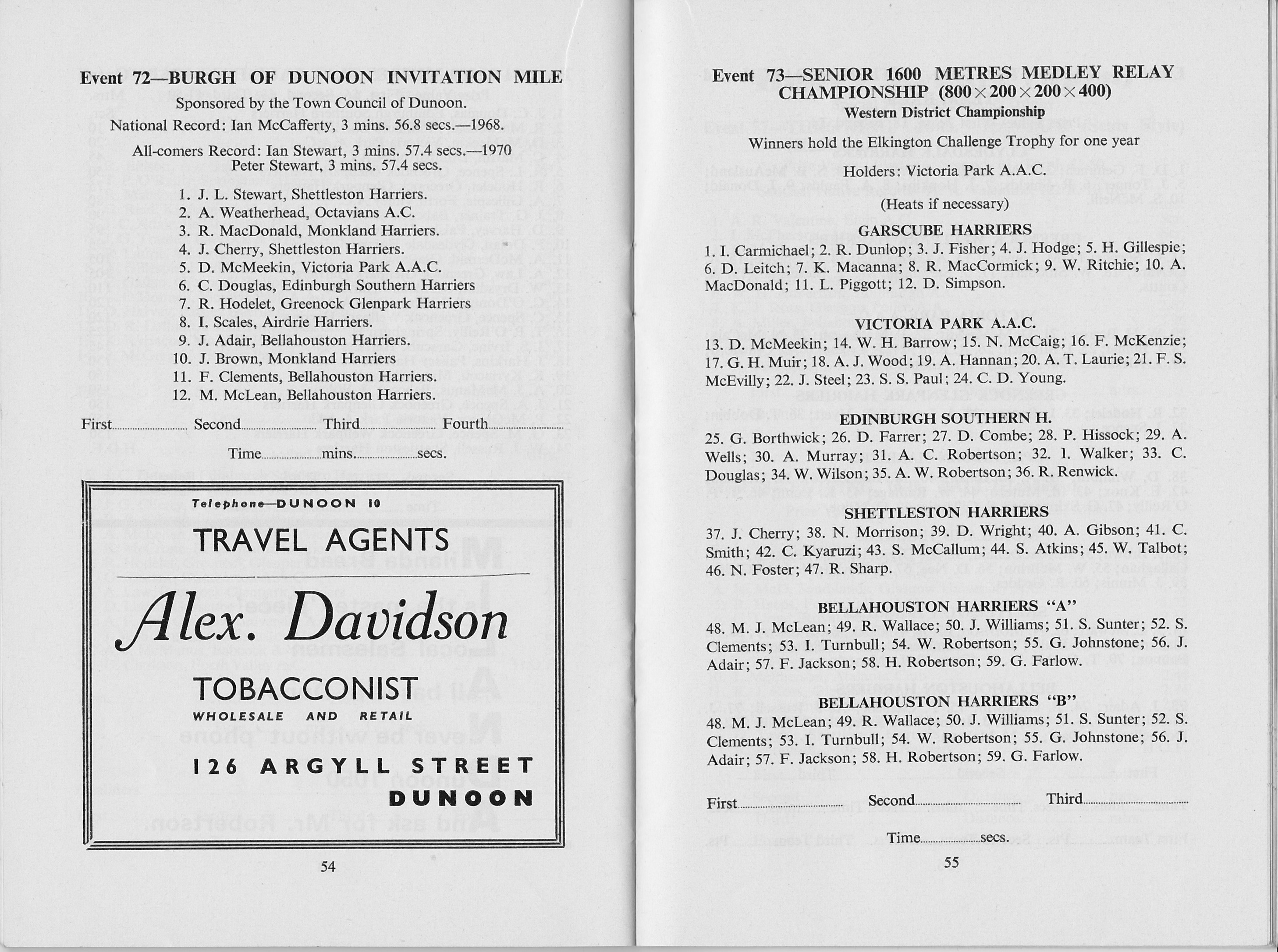
“Craig travelled the length and breadth of Britain to compete in prestige events. An example of this being in August 1966 when he covered a distance of 1000 miles in three days. That was Cowal Games, Dunoon, on the Friday and Northampton on the following day. In the former his win in a special invitation 880y in 1:51.1 was the highlight of the meeting. That day there was a new kind of prize for amateurs. Cigarette gift coupons were given by the sponsors instead of the usual trophies and prizes, so that the successful athletes could choose their own gifts. Craig received 5000 for his win. Also on offer were 10,000 coupons if the Scottish record was broken. Craig’s time was only eight-tenths of a second outside. On the Saturday he was in Northampton competing in the one mile and in this he reduced the 1964 club record of 4:10.8 held by R Wilson to 4:09.7. Some weekend indeed! The following month he was competing against Munich, again winning, this time the 800m and he also had the distinction of carrying the Scottish flag in the closing ceremony.”
In 1966 the Edinburgh Highland Games did not incorporate an international nor even an inter-cities match but there was among the invitation events a 1000y race. “JP Boulter, England’s fastest half-miler, took the opportunity of renovating the Scottish 1000 yards all-comers record of 2 min 10.8 sec which had stood for eight years when he recorded 2 min 9.2 sec . In third place JC Douglas (Teviotdale) almost burst a blood vessel when he heard he had equalled the national record of 2:10.9. He has probably had his best season so far in his athletics career.”
The Munich Match (17 September) referred to above was the return of the 1965 meeting held at Murrayfield and Douglas won the 880 yards in 1:54.2 while Graeme Grant won the 1500m in 3:50.2.
It had been a good summer, a very good summer, and Craig’s 1:49.9 in Birmingham in July ranked him second behind Graeme Grant’s 1:48.9m, his 4:09.2 was eleventh best and his best 440 time (Hawick, 13th July) of 51.1 twenty fourth. The ominous sign for those from Hawick was that he appeared on the ranking lists for ‘Teviotdale/ESH’.
He went into the winter of 1966/67 in very good shape and on a high psychologically. A feature of the East District Cross-Country relay championship on 29th October was the first and third places of Edinburgh University – but they were split by four members of the Teviotdale ‘old firm’. Douglas, Mather, Meikle and J Raeburn were the runners and Raeburn had third fastest time of the day and Douglas fourth quickest. The 19th November was the date for the Edinburgh to Glasgow and Douglas had a very good run on the seventh stage pulling the team from 11th to 8th with equal second fastest time of the day. Not selected for the SCCU v the Army the following Saturday he passed on the East District league match on 5th December. The reason was that he was making his indoor racing debut in December 1966 at Cosford where he won the 880 and two months later on 4th February placed fourth in the final of the AAA’s indoor event which was won by another Scot, Duncan Middleton. Indoor athletics was a relatively new development in Britain. After some faltering attempts of racing on indoor surfaces had failed because of the difficulty of racing on a flat surface with short laps, or on at least one occasion after dusting the surface of said track with a kind of talcum powder causing the runners to slide off the track, the track at RAF Cosford, just north of Wolverhampton was accepted as the ‘home’ of indoor athletics. Assembled when required in part of a disused aircraft hangar and very cold a lot of the time the banked track was a good one for running fast and the venue was easily accessible from all parts of Britain.
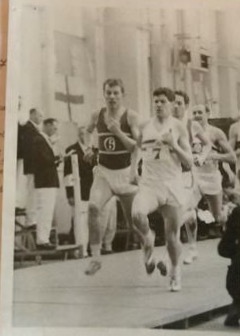
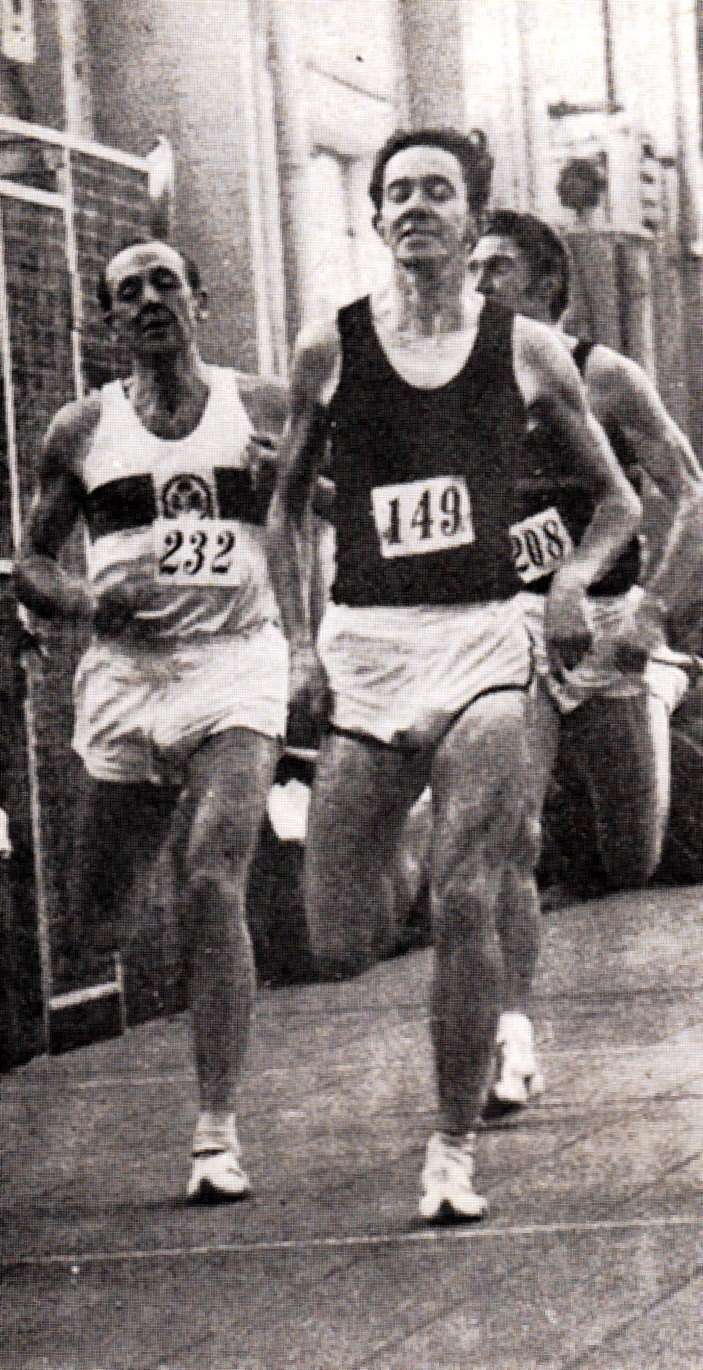
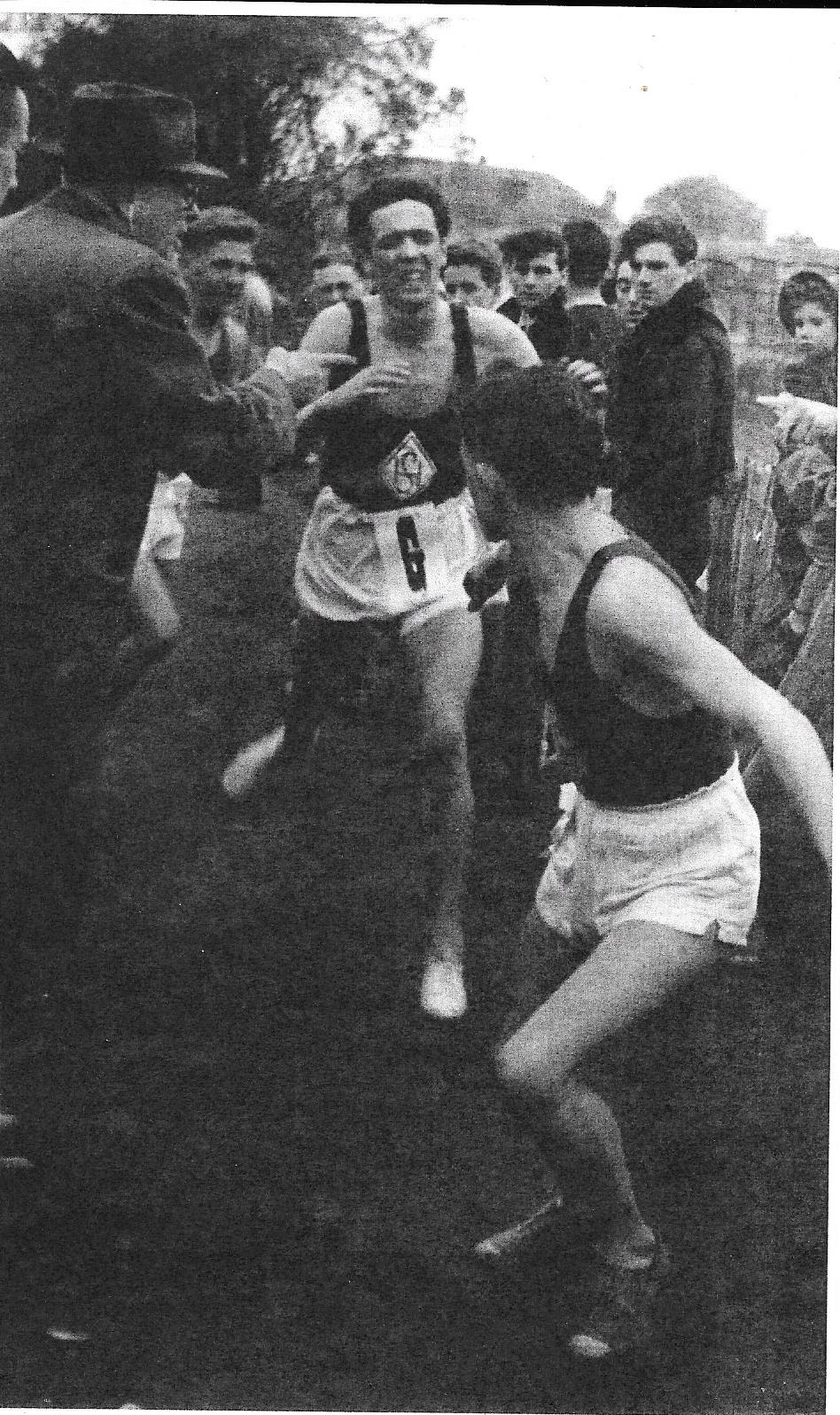
Craig leading John Davies (6), Duncan Middleton and John Gingell at Cosford
There is no trace of Craig Douglas in the East District Championships of 1967 nor in the National – reconciling the work required for long distance running over rough terrain with dykes to climb and streams to cross with that necessary for top speed indoor 880y running was probably the problem. However we learn from the club’s centenary history that
“In May, 1967, following what was described as an ‘internal dispute’ Craig resigned from Teviotdale Harriers and joined Edinburgh Southern. This is no place to discuss the ‘whys and wherefors’ of the row, suffice to say that Teviotdale Harriers lost the services of a great athlete. Craig’s international career continued with his new club until his retirement from competition in 1977 following a leg operation.”
The writer comes across in several passages as a friend and admirer of Craig and what he contributed to the club by a man who supported the club to the best of his ability up to that point when his enthusiasm went to the ESH cause.
Edinburgh Southern Harriers took part in many more league and cup competitions than Teviotdale Harriers did with more opportunities for competition but summer 1967 was a relatively fallow year for Craig as he came to terms with the demands of running with a new club and probably a new competition structure. His first time of note was a 50.3 440 yards at Hawick on 14th June which, at the end of the summer placed him twenty second in Scotland. There were no medals in either District or National Championships, nor were there any representative matches either. His best half-mile of the year was a 1:52.7 when finishing fifth at Grangemouth on 24th June in the Scottish championships behind Middleton, Maclean and Grant. Exactly 2.5 seconds behind the winner and 1.5 behind the third place he was close but not nearly close enough.
Having changed clubs, Craig was banned from team competition and for winter 1967-68 he was ineligible for any relays or as a counting runner in any team event. He didn’t even appear as an individual entry in any event that winter, and if he competed on the boards at Cosford he was neither placed nor did he turn in a noteworthy time.
Summer 1969 was when Craig Douglas won his first 1500m championship medals – and he won them at both District and National levels. It was a good year with rankings in the top ten for 800m, 1500m and Mile. One of his first times was also his best – he ran 3:46.3 when winning at Edinburgh on 16th May – a time which by the end of the season ranked him number two in Scotland but number twenty in Britain. The only Scot ahead of him was Ian Stewart on 3:39.1 and that topped the British lists. That set him up for another race in Edinburgh.
The East District championship was on 31st May at New Meadowbank and after a hard race he won in 3:48.1, two tenths faster than Adrian Weatherhead in second place with John Lees nine seconds back in third. Before the SAAA championships, the SAAA v Atalanta match took place on 21st June at Grangemouth with Craig running in the 800m for the SAAA team. He won in 1:54.1 from Alan McDonald who was only one tenth behind him. Then came the hard race for the national 1500m title. Mike Bradley of Paisley had been having a very good season indeed with some good victories, Hugh Barrow of Victoria Park was a hard and experienced racer of genuine quality and both were among those who lined up for the start. The times of the first three tells a lot about the race. First, Craig Douglas in 3:50.2; second Hugh Barrow 3:50.3; third Mike Bradley 3:50.8. One tenth separating first and second and only half a second between second and third. His best, ie fastest, 800m run was on 23rd August at Nottingham where his 1:52.3 was good enough to win and his third title was the Inter-Counties which he took in 3:54.1 to defeat Mike Bradley by only 0;4 of a second.
It was undeniably his best season as a 1500m runner where he ranked second with his 3:46.9 behind Anglo Maurice Wands. His best Mile time of 4:11.1 placed him eight and his 1:52.3 for 800 had him equal sixth with Hugh Barrow. The time was an 880y time less 0.7 seconds.
in 1969-70 Craig seemed to return to his original pattern of running road and cross-country over the winter season. ESH was having a good year and there was a very good bunch of endurance runners in the club at the time. They were fourth in the McAndrew without Craig’s services. The team which won the Kingsway Relay for them contained Fergus Murray, Ken Ballantyne, Donald Macgregor and Gareth Bryan-Jones, while the team placed fourth in Glasgow had been Billy Murray, Ballantyne, Jack White and F Steell. Seven runners, all top class and there were others waiting in the wings. One of them joined in a third permutation when the East District Championships took place on 1st November. The ESH team was down behind Edinburgh AC at halfway (Billy Murray 13:49 and Ken Ballantyne 13:27) when Fergus Murray (13:04) put them in the lead and Craig Douglas (13:22) finished the job bringing them home first. Then came the Edinburgh to Glasgow on 16th November with Craig running on the seventh stage. The team was in first place at that point and he held on to it quite comfortably, the flashy-phrase making ‘Glasgow Herald’ man reporting that “Craig Douglas, his dumpy looking legs devouring the route through Coatbridge, reached the new checkpoint in record time”
There was a massive change of emphasis the next week when Craig went form an eight stage team race on the roads to an 800m indoor race in Cosford where his 3:50.6 took him into second place, albeit with the same time as the winner. However on the 24th January 1970 Craig was a key member of the team that won the District cross-country championships at Grangemouth when he finished sixth and third scoring runner for the ESH team that won the title. He was also running close to his best when, in the national championships at Hamilton on 21st February, he finished sixteenth ahead of such luminaries as Pat Maclagan, Alastair Johnston, Eddie Knox, John Myatt and Andy Brown – fourth counter for the gold medal winners.
On 25th April in a five-way League Match in which ESH beat all the other competing teams (VPAAC, Shettleston, Octavians and Bellahouston), Craig won the 800m in 1:57.1. The ESH team continued to do well in the various leagues and Craig contributed his share of the points. On 16th May in a match in the British League at Sale, he won the 1500m in 3:52.8. Craig’s next victory came in the East District championships on 23rd May when he won the 800m in 1:51.4 from Convery of Edinburgh AC. This was his fifth East District 800m title. The Scottish championships were held early in 1970 because of the upcoming Commonwealth Games and Craig entered the 800m. He finished third behind Mike Maclean (1:51.2) and Ross Billson (1:50.6) in 1:51.0. After this it was unlikely that he would be selected for the Games team but he kept on running well and on 20th June he had two victories in another 5-sided inter-club Scottish league match at Grangemouth. He won the 800m in 1:54.0 and the 1500m in 4:00. Next there was a British league meeting, also at Meadowbank, on 4th July when he won the 1500m in 3:51.8 helping ESH to a handsome victory. The Duns Games were held on 11th July and Craig was back to his roots in handicap racing in Borders Games. Out in the 880 yards, running from a mark of 2 yards, he won in 1:54.1. His value to ESH was emphasised if further emphasis were needed, when he won the A 800m in the final British League fixture on 22md August at Woodford Green in London. Then on 5th September they won the Scottish league title to keep it company.
It had been another good season which had been started a solid winter of cross-country success mixed with indoor running and had seen another SAAA medal, this time bronze, and a host of wins in league matches of varying standards. As far as times were concerned, his best 800m was the SAAA’s 1:51 which placed him fourth in the standings at the end of the season, he had a 3:47.1 1500m (fifth) and a superb 4:01.8 mile (also fifth).
Not in the first team for ESH in the McAndrew at the start of October, 1970, Craig ran the lead-off leg for the Dundee Kingsway race which the club won comfortably with their three fastest men also being the day’s three fastest times: Douglas 13:45; Macgregor 13:30, Bryan-Jones 13:40 and F Murray 13:51. On the following Saturday, 24th October, he finished third in the East District League match at Hawick behind Weatherhead (EAC) and Bryan-Jones) to assist the club to first team position. If the Edinburgh University team had been the one to beat for the past few years, that role was now assumed by ESH. The East District cross-country championship relay was held on 7th November at St Andrews. Douglas (11:16) and Macgregor (11:19) had them well ahead at half distance and Bryan-Jones (11:39) and Murray (11:45( extended the lead, and the second team of Craven, Matson, Coyle and Logue were second (the first two named were faster than Fergus Murray by 4 seconds) and the C team of Stark, Ballantyne, Wood and McFall was third. Douglas had second quickest run of the afternoon, three seconds slower than Weatherhead. If they were the top dogs in the east, Shettleston were their equivalent in the west and they came head to head in the eight stage Edinburgh to Glasgow on 21st November. Craig was on the first stage against such contenders as Tom Grubb of Shettleston, Alistair Johnston of Victoria Park and Jim Wight of EAC. He had run the stage before and this time he was first to reach the change-over eight seconds up on Grubb and ten ahead of Bellahouston’s Brian Goodwin. Thereafter they stayed in front to the end of the fourth stage but on the fifth Henry Summerhill set a new stage record in taking first place from Graham Stark of ESH. Although each of the Edinburgh team’s last three runners (Macgregor, Craven and Ballantyne) ran faster that the opposition (Stewart, Meneely and Scally), the Glasgow side managed to hold on to the lead to win by only 13 seconds.
Running for the SCCU against the Army and the Northern Counties on 26th November at Leeds, the ‘chunky Edinburgh Southern Harrier’ took the lead early in a match in which Kip Keino featured running for the Army but fell back to finish a very good sixth ahead of many quality runners.
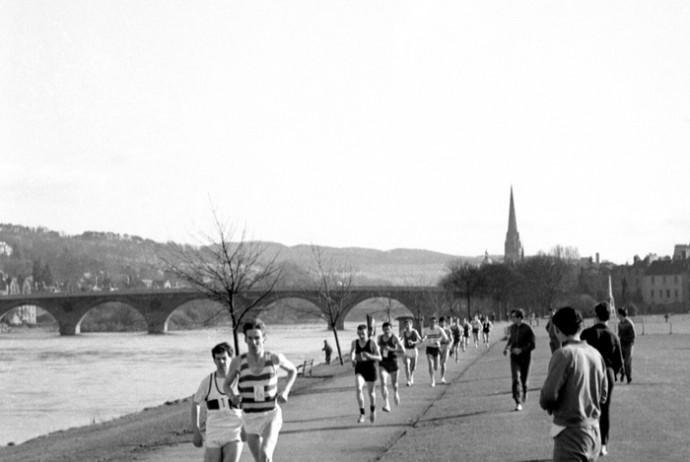
Craig tucked in behind Hugh Barrow: North Inch Relays, 1967
On 12th December Craig was running for the Scottish team in an inter-area match where he was forced to drop out because of severe stomach pains about halfway through the race. Most unlike him – there were others who dropped out from time to time, and at times the excuses were stretching credibility a bit, but he was not known for this and it was a loss to the Scottish team. He was back in form again on 23rd January in the East District championships as part of the ESH winning team of Murray (2), Bryan-Jones (3), Macgregor (7), Douglas (8), Craven (9) and Ballantyne (13). They won by 81 points. The big championships of the winter, the national cross-country championship, was held on 20th February when ESH (109 points) had again to give best to Shettleston Harriers (83). It had been a good winter for Craig and he must have been looking forward to another good track season.
He started track racing with a 51.3 seconds 400m at Meadowbank on 25th April in the ESH club championships finishing second behond Jack Walker and then, not content with that, he won the 1500 in 3:49.4. Emmet Farrell liked to ask “does distance blunt speed?’ and no doubt he would have quoted Craig as proving something but it was a good start. A week later he took part in a four-cornered inter-club between ESH, Heriot-Watt, Edinburgh and Aberdeen Universities and won both 800m and 1500m – the 800m in 1:53.5 and the 1500m in 3:47.0. Fast 400m, 800m and 1500m over two Saturdays – Craig showed again, as he had done through his career, that cross-country distance hadn’t blunted his speed. Another good run at Hampden before the Cup Final on 8th May over the invitation 1500m: Mike McLean set the initial pace, Ron MacDonald took the lead and in the last lap he was challenged by Weatherhead and Douglas. In the end McDonald won by only one tenth from Douglas against a very good field in 3:53.2. Weatherhead was 3:55. The District Championships were held on the 29th May and Craig took part in both 800m and 1500m and came away with gold and silver. The gold came in the 1500m which he won in 4:01.1 from Ken Ballantyne in 4:02.2 and Ian Graves in 4:03.2. In the shorter distance he was second (1:55.3) to Graeme Grant 1:54.1.
The SAAA championships on 26th June provided Craig with his second championship title of the year and the second national title at the distance. He won in 3:54.3 from Ron McDonald (3:54.5) and John Cherry (Springburn but running in the colours of Boston University) who was 3:56.6. Leage athletics had not figured too much in the programme up to that point but on 3rd July the British League match was held at Meadowbank and the reporter remarked “Craig Douglas, the Scottish 1500m champion, was outstanding for the home club with some impressive running in the 800 and 1500m which he won in 1:50.2 and 3:47.0 respectively. Peter Stewart (Birchfield) returned a personal best time of 1:50.8 in taking third place in the 800m.” Back to Borders handicap running a week later when he was at Duns AC open meeting. Running in the 800m handicap off virtual scratch of 2 metres, he wound his way through a field of 33 runners to whom he was conceding starts of up to 66 metres to win in 1:53.5. His commitment to the club was seen at the start of August (7th) in the Octavians Relays at Meadowbank when he was part of the 4 x 400m team with Adam Chedburn, AT Murray and Graeme Grant which won in 3:24.3, and also in the 4 x 1500m team which won in 16:08.4. The quartet was J Raeburn, K Ballantyne, G Grant and C Douglas and the time was a new record – but could not be recognised as such because one of the team was born outside Scotland. The record went instead to the Bellahouston team who finished second in 16:12.6. In the battle in the British League to stay in the first division at Smethwick on 21st August, he pulled a muscle in the 800m but limped painfully to the finish for last place points.
The season was pretty well over from that point. How had he done? Well there were two 1500m titles, and a share of two more in the relays, there were times of 51.3 for 400, 1:50.2 for 800m, 3:47.0 for 1500m and 4:10.3 for the Mile.
Why change a winning formula? Came the short relays in October and he was there. His first fastest time came when he won the first east district league match at Hawick leading ESH to victory in the team race. As an indication of how the make-up of the teams had altered, the club’s counters were Douglas, Raeburn, Craven, Kerr, McFall and Coyle. Some of them were back for the East District relay two weeks later when Douglas, Brown, Bryan-Jones and Murray won with Craig on the opening stage having the second fastest time of the day – 5 seconds slower than Andy McKean. The third weekend in November meant the Edinburgh to Glasgow relay and on 20th November the teams lined up at Fettes College gates. Shettleston won, but their battle was with Victoria Park for most of the route rather than Edinburgh Southern. Craig was on the fifth stage and up against Norman Morrison, Bill Ewing and Joe Reilly. Running into a very fierce headwind on the long exposed stretch through Blackburn he moved the club up one place with the fastest time of the afternoon which was twenty seconds up on Reilly and over half a minute faster than Morrison. The Brampton to Carlisle ten miles road race was usually held on the same day as the Edinburgh to Glasgow but in 1971 it was a week later and on Saturday, 27th November, Craig was second over the ten miles distance four seconds behind Blackburn’s John Calvert who was timed in at 48:52. The next East District league match was on 4th December and ESH again won the team race with Craig in seventh second club counter behind Craven’s fifth place.
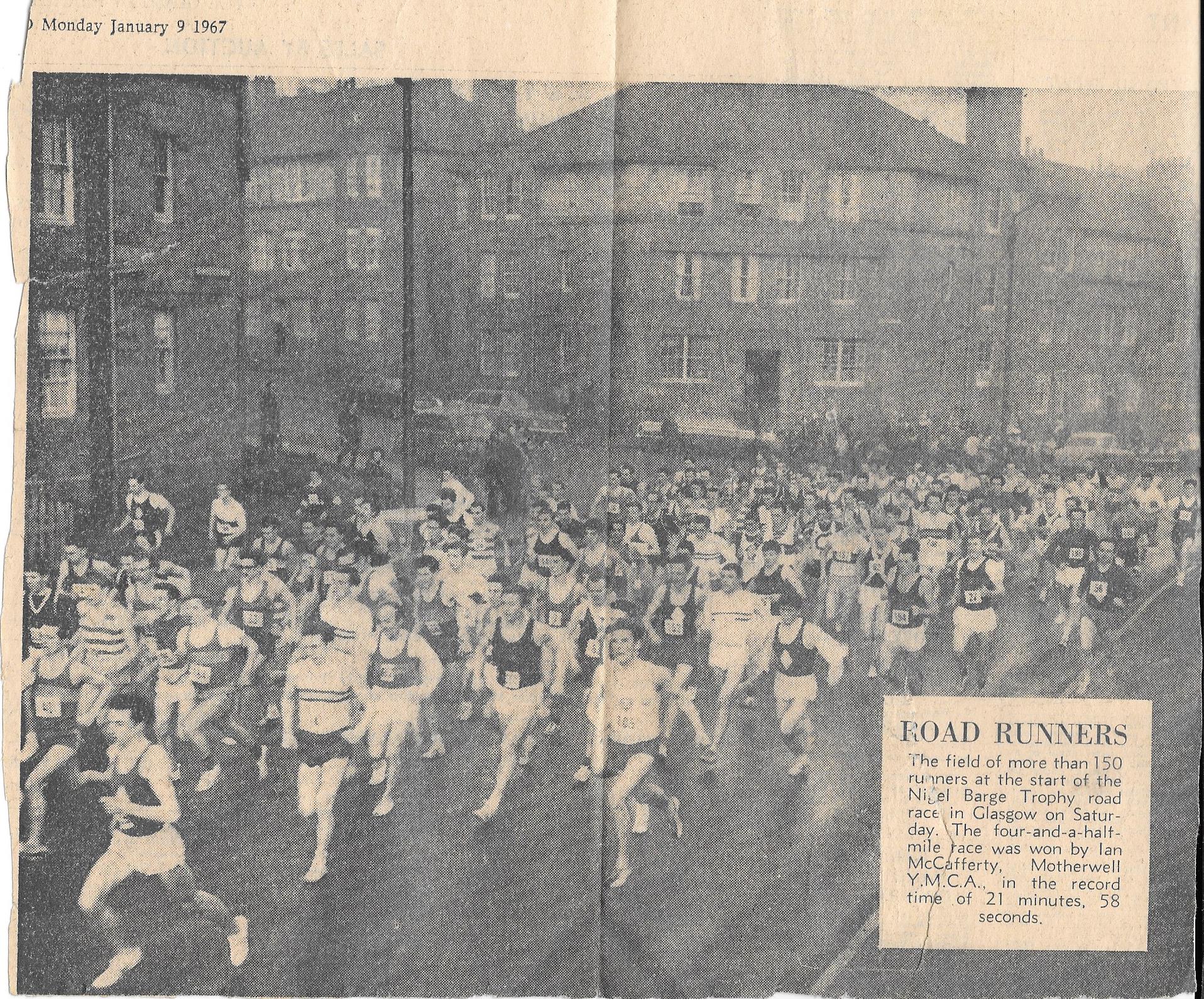
Into 1972 and that was the year when the Springburn Cup applied for and got the same date as the classic Nigel Barge race which was always held on the first Saturday in the New Year. The Barge was the classic start to the new year and their entries held despite the competition. Nevertheless many runners went to the better sponsored Springburn including almost all the Shettleston Harriers. No matter, Craig ran in neither but he did run on 15th January in the East District league final – and even the reporter from the ‘Glasgow Herald’ noticed it:
“DOUGLAS OUTWITS DOWNIE FOR TITLE
Craig Douglas (Edinburgh Southern Harriers), the Scottish 1500m champion, was pressed hard by Sam Downie (Falkirk Victoria Harriers), a vastly improved junior, for the individual title in the East District league race of four and a half miles at Pitreavie. Douglas, by his greater experience, succeeded in outwitting his rival over the last 50 yards and won by a couple of seconds.” It was 22:45 to 22:47 at the finish. It was also a victory for ESH – Douglas, Bryan-Jones (5), Joe Raeburn (8), Stark (15, DM Wood (17, McFall (18). The boot was on the other foot on 22nd January in the District championships at Berwick where Downie won from Jim Wight and Craig was only seventh. Craig did not run in the National – his attention was elsewhere. Running in the Scottish Indoor Championships at Bell’s Arena in Perth he was second to Ron McDonald in 3:54.4 to McDonald’s 3:54.1.
It was a nice lead in to the track season where there was another medal in the SAAA 1500m championship. Championships usually started with the Districts and Craig showed that he was in good form when he won the 800m in 1:54.3 which was three tenths ahead of GC Davies of Edinburgh University. In the SAAA Championships however he was second behind Ronnie McDonald in one of the slower winning times – outside 4:03. Nevertheless at the end of the year he was ranked fourteenth in the 800m with a best for the season of 1:53.8, only fifteenth for 1500m with 3:52.5 but added a new string to his bow with an indoor time of 9:18.2 for two miles. What did 1971-72 add to our knowledge of Craig Douglas? Well, the main points were that he was a good Two Miles runner on the indoor ttrack with its short laps and tight bendsm but also that he could fight it out with the best of them over 10 miles on the road!
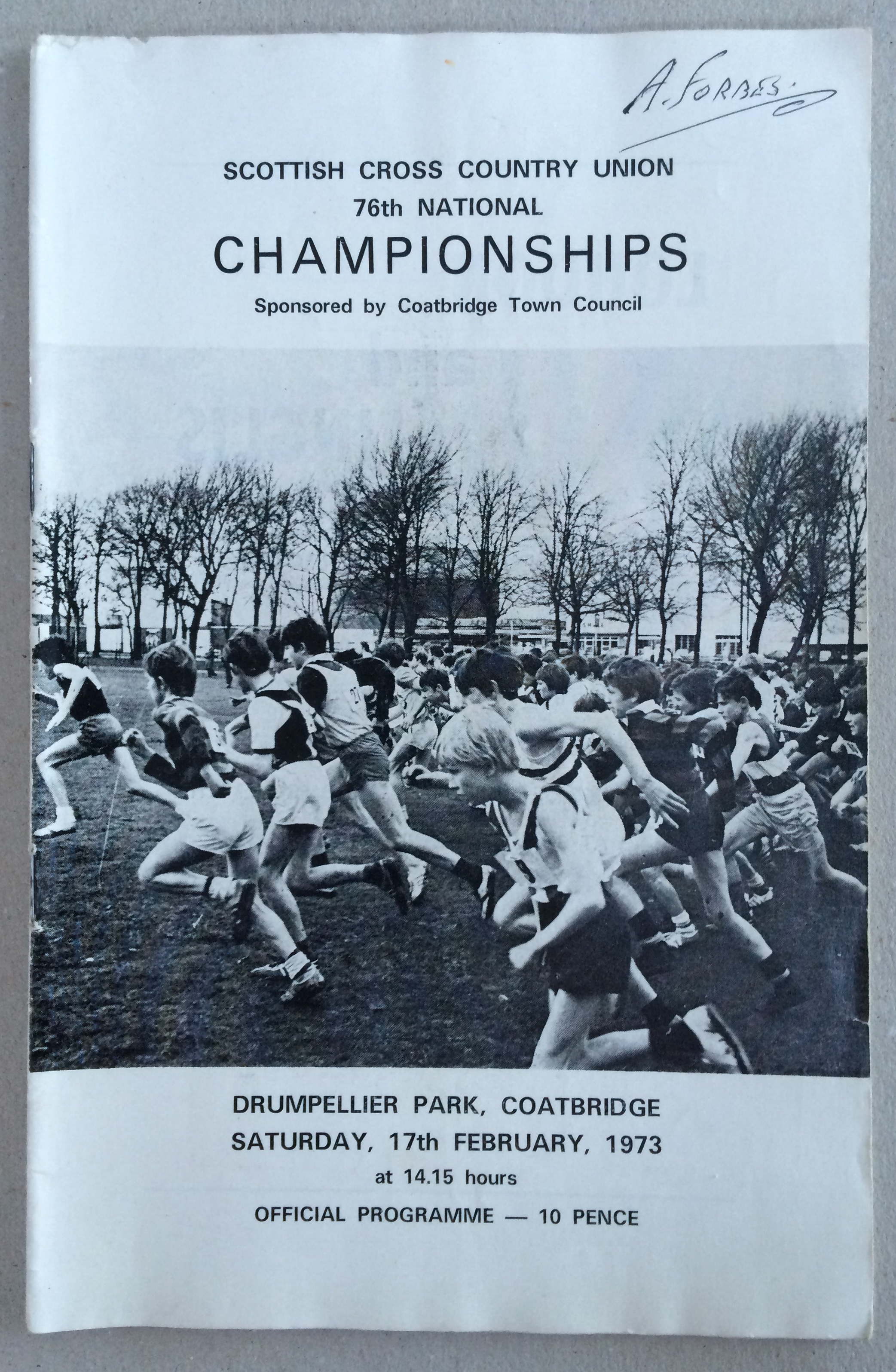
Although not racing as much as usual, Craig was out in the Edinburgh to Glasgow on 18th November running the eighth stage for the ESH team that finished third. This time he had only sixth fastest time and maintained the third position that he had taken over. He appears in the results again on 13th January in the East District League match where he was fourth, 12 seconds behind Willie Day (Falkirk Victoria Harriers) to lead ESH to first place in the team race. A week later, on 20th January, 1973, at Eskbank in the district championships, he finished 10th to be fourth scoring runner for the winning ESH team. The first finisher for the club was Ian Elliott, another who had started out on his athletic career with Teviotdale Harriers. Douglas did not compete at all in the national cross-country championship on 17th February at Coatbridge.
Summer 1973 was the only year during his entire career when Craig Douglas did not feature in any track ranking list over 400, 800 or 1500m. Nor were there any medals in either District or National track championships. It may be that the injury sustained in the league match mentioned above had developed into something bigger but in general, 1973 was a blank year for him. He did run in the East District Relay however and was second fastest man in the ESH second team, behind Martin Craven and the four in the first team. He then ran in the Edinburgh to Glasgow on 17th November that year on the third stage when he moved the club up from seventh to sixth with the third fastest time of the day for the team that finished first and took the gold medals. In the actual District Championships on 19th January 1974 he was down in twenty seventh place, sandwiched between Mel Edwards (Aberdeen) and Paul Kenny (Dundee Hawkhill). Came the National and there was no Craig Douglas in the field when ESH finished second to Edinburgh Athletic Club.
Having missed summer 1973 Craig competed in 1974 and had marks registered at 800m (1:55.5, ranked twentieth), 1500m (3:53.8, sixteenth) and 5000m (14:36.2, eighteenth) but Scottish middle distance running was now into the era of David McMeekin, Ronnie McDonald, Frank Clement and Lawrie Spence making the winning of medals harder although it would have been very interesting indeed to see how Craig Douglas at his best would have fared against them. The SAAA championships were complicated further by the fact that the SAAA had encouraged many from outside the country to compete – ‘open championships’ was the phrase used and both 800m and 1500m titles went to East Germans.
The summer led in to what would be Craig’s last winter season. He ran the first leg for the team that won the Dundee Kingsway Relay on 19th October in what was the day’s second quickest time. He filled a similar role a week later when he led the field home on the first stage of the Allan Scally relay at Shettleston for the winning team. The East District relays were on the 2nd November and again he ran the first stage, ran the third fastest time and saw ESH win the race. Two weeks later, 16th November it was the prestigious Edinburgh to Glasgow relay. ESH was set on the wining track by Colin Youngson’s first leg ‘win’, and never lost the lead. Craig ran on the third stage and set the day’s fastest time for that stretch. Whatever had happened during the summer, he had now run four relays in five weeks and been in four winning teams. The first ever national four-man cross-country relay took place on Saturday 23rd November at Bellahouston and Craig could do no better than seventh on the first stage. He could offer no explanation for what was, by his own standards, a poor run, saying only that he felt very cold for the whole distance. The result was a win in the inaugural relay for newly-formed Clyde Valley. Craig did get a medal – albeit a bronze – to add to his collection of District and National trophies. He made up for the run when he finished third and first from ESH in the East District league on 30th November at Dalkeith behind the EAC pair of Alder and Wight but ahead of Gunstone and Hutton. The next championship event was the East District Championship to be held on 16th January 1975 and Craig, in eighth place was only the fourth ESH scoring runner on the day – needless to say, they won the team race. That only left the biggest championship of them all, the national. This was held on 15th February at Coatbridge and ESH finished second to Edinburgh AC. Craig was fifth counter out of six when he finished twentieth. This was the day when the winning team had all six men inside the first eleven places and Jim Dingwall in thirteenth did not get a winner’s medal, and even their eighth runner, Joe Patton in twenty fourth, was ahead of ESH’s last counter, Nigel Bailey in twenty seventh!
For Craig, his career at the top and winning national medals was now over. Williamson and Robson were coming up to join the McMeekin, Spence and Clement middle distance runners, and Craig’s injury problem in 1975 was such that he had to give up the sport. He is a vastly under-rated athlete: three SAAA victories plus two silvers and two bronzes, eight District championships and two relay golds; over the country there were multiple gold, silver and bronze medals in the District and National championships and relays plus an outstanding record in the Edinburgh to Glasgow relay. A few years later going head to head with Clement, Robson and Williamson would have been very, very interesting. The team mates that I have spoken to all say that he was a hard running, never-give-in kind of runner and a great guy to have in your team.
–