Adrian Callan

Adrian 1

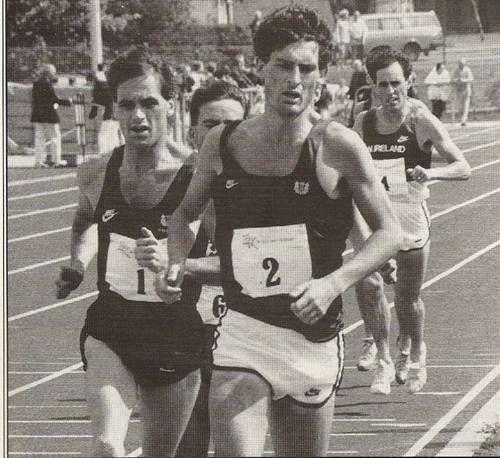
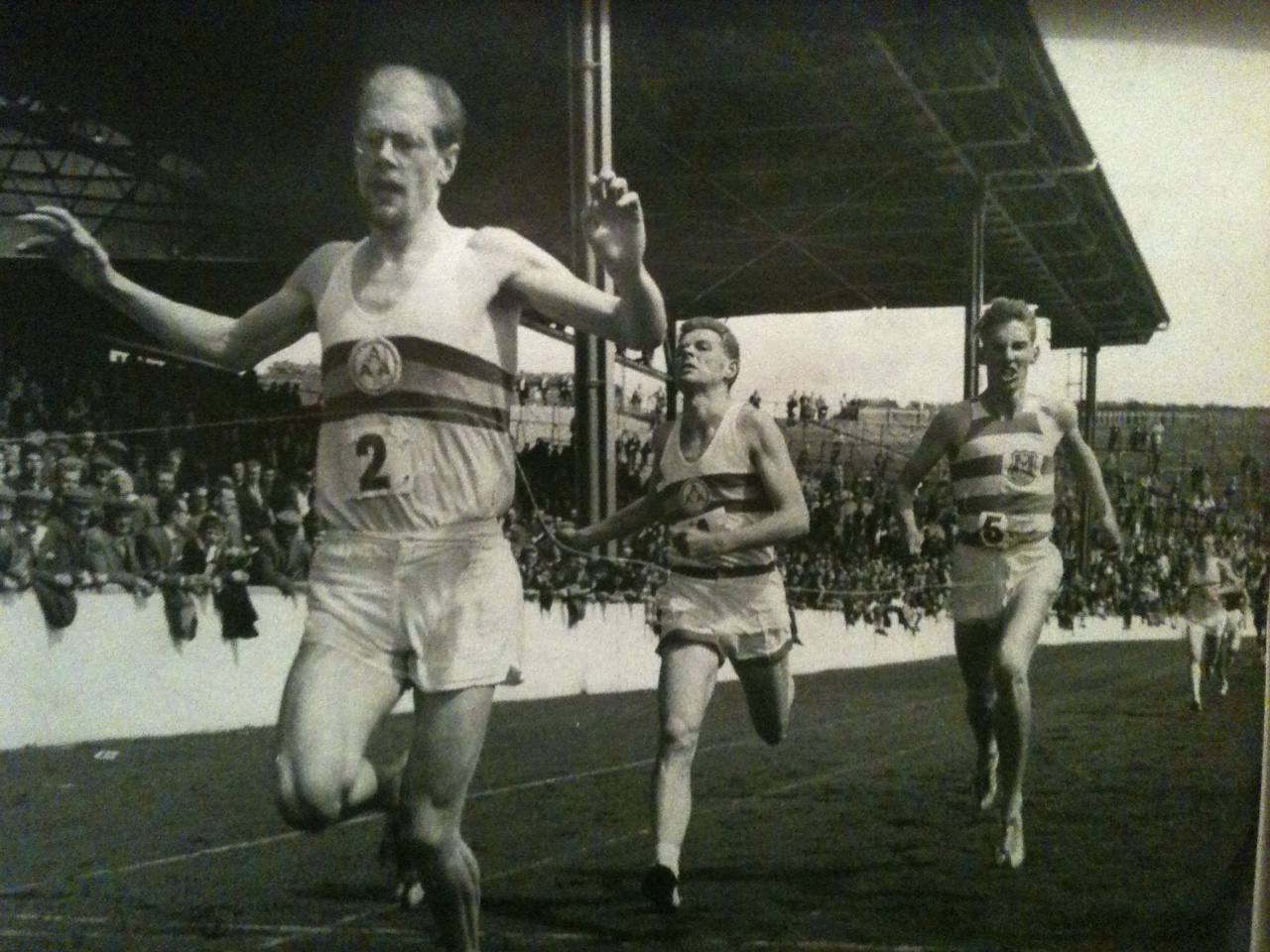
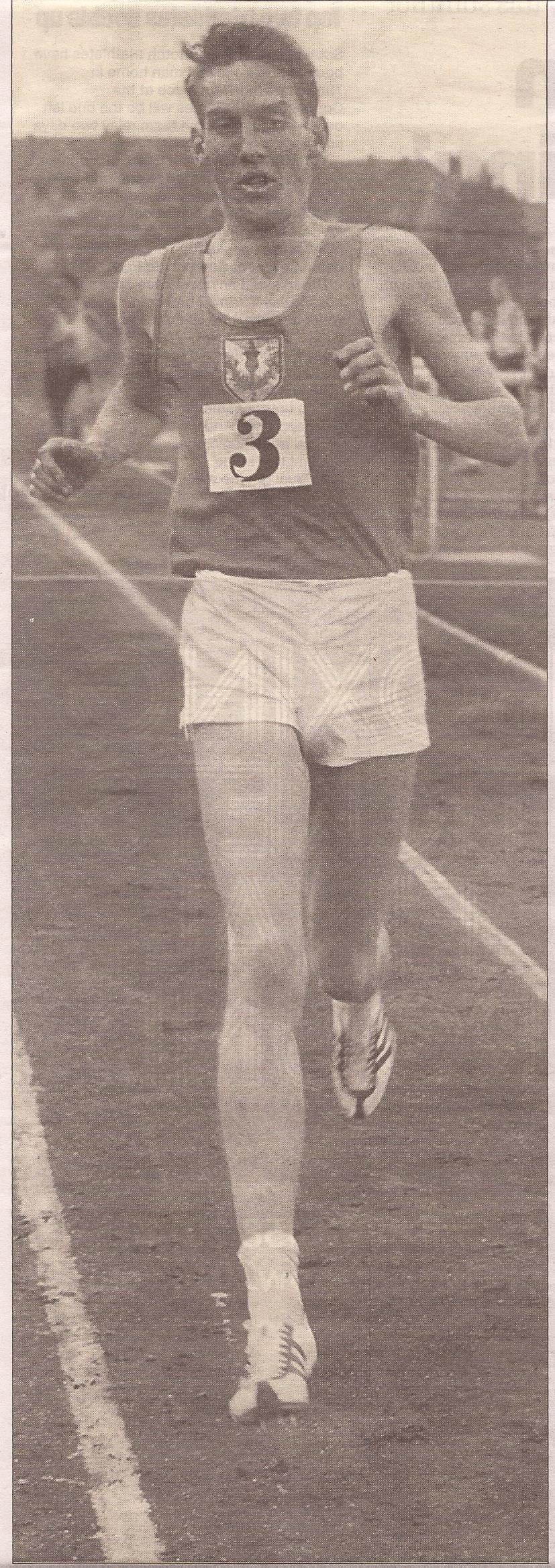
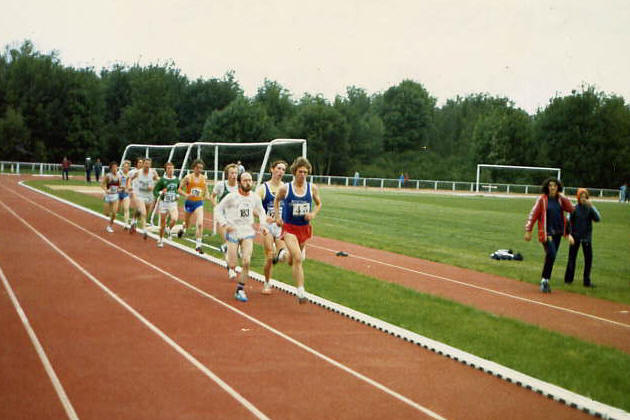
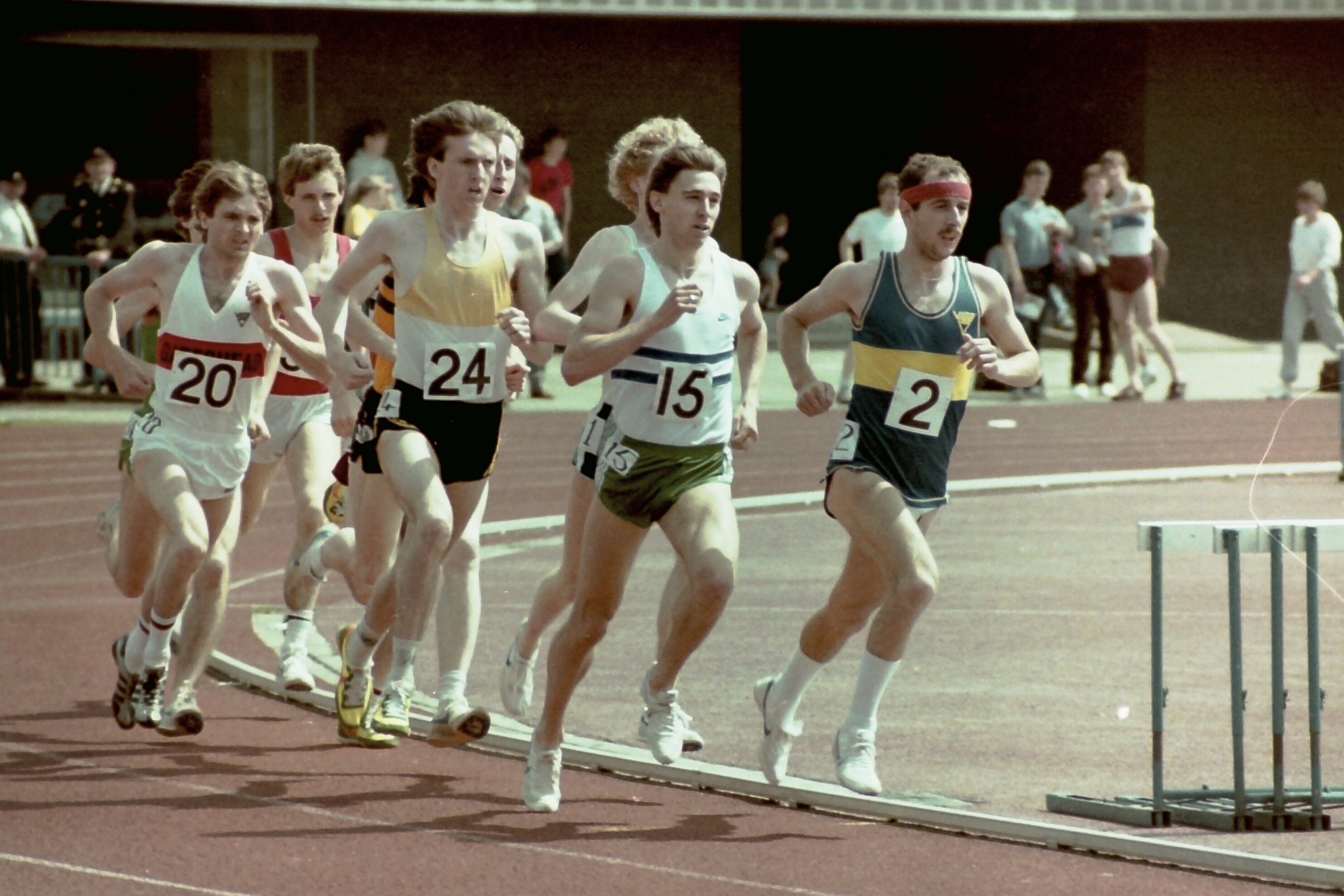
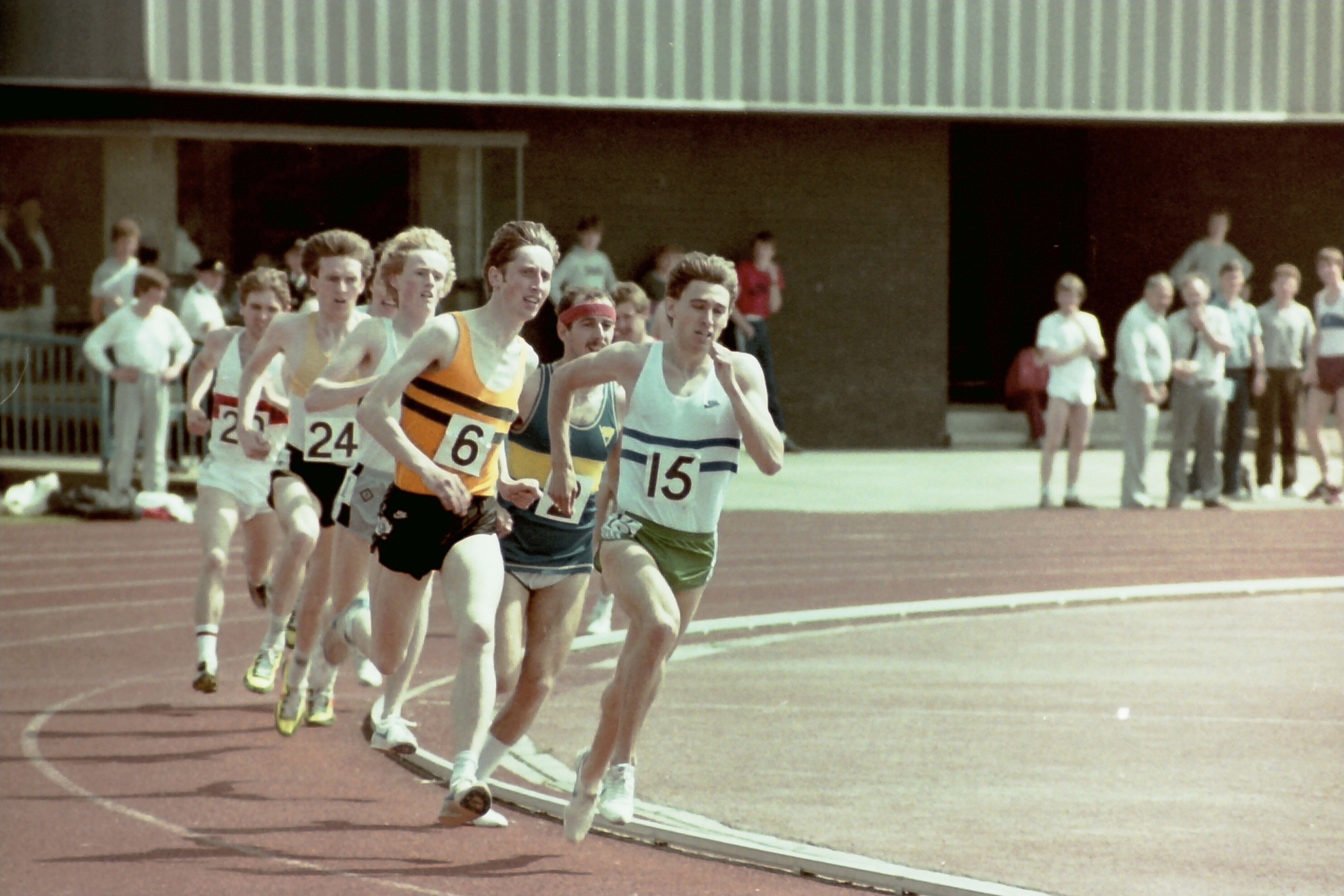
Adrian leading in the International Match at the Opening of the East Kilbride Track

I first spoke to Adrian in 1980 when he was a member of the Scottish Junior team for the Bell’s International at Meadowbank.   I was the admin officer (ie I gave out the tracksuits and collected them back in, gave the athletes wee Scottish badges to swap, etc) and Adrian was one of the two 1500metre runners, the other being Stewart MacPherson, also of Springburn Harriers.   I had known of him and seen him in action for several years before that.   I had just been appointed Scottish Secretary of the British Milers’ Club and Adrian was a member and eligible for race invitations so we soon became friends.    In addition I had been training at Springburn and watched him training under the guidance of Eddie Sinclair.   Eddie’s top athlete was Graham Williamson and Adrian used to train with him and even went altitude training with him to New Mexico.   But I’m getting ahead of myself, let’s go back to the beginning.

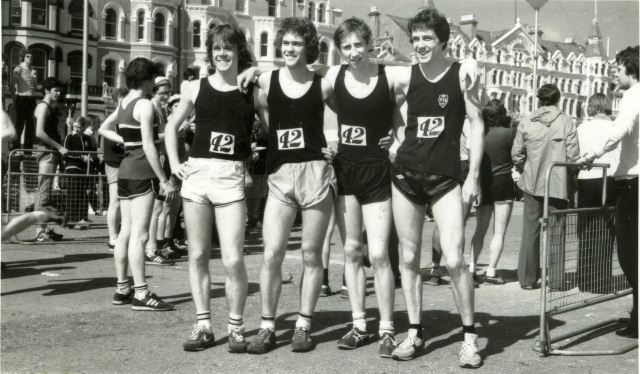
Adrian (Date of Birth:28/11/62) was one of a  group of young Springburn Harriers who won everything there was to win in the way of championships and open races and who won the Western District Young Athletes 3 x 2 Mile Relay Championship from the year it was inaugurated (1976) to 1980 before Clydesdale Harriers won it in 1981.   They won the National YA Relay in 1977.   They won team and individual titles at Junior Boy, Senior Boy and Youth levels with many staying on to become good Seniors in the club.   The coach at the time was Eddie Sinclair – a former Scottish International cross-country runner – who worked the boys hard but sensibly.   Before Eddie got involved, the Under 17 age group used to start their races hard, ease up for the middle third and then pick up the pace at the end – the Springburn technique was to run hard all the way with no ‘sag’ in the middle.   The runners who came through like Graham Williamson, Graham Crawford, Dunky Middleton and Eddie Knox were all very good.   Other names well-known at the time were those of Freddie Farrell, George Jarvie, Davie Tees, Nickie Souter, the Beaney brothers, the Picken brothers, Stewart MacPherson, Stephen Begen and many, many more.   Adrian, when he joined the club, was becoming part of a rolling success story.

He first appears on the scene in 1977 when as a Boy he started the year with thirteenth place in the National Cross Country Championships with the Springburn team second.   In summer he won the Scottish Schools 1500 metres in 4:22.1 and in the same season he was third in the SAAA (4:26.1) and West District (4:39.1).   He appeared in the Boys Rankings for the 800m where he was twelfth with 2:09.5 and in the 1500 where his Scottish Schools winning time ranked him fourth. He started the next year with fourth place in the Senior Boys Cross-Country Championship and led the club team to a comfortable victory over Edinburgh Southern in the team race.  In summer 1978, in the Youth age group and racing boys up to two years older he was second in the Schools in 4:05.5 and third in the SAAA 3000m Championship with   8:48.2.   These times ranked him seventh in the 1500m and third in the 3000m.   In 1979 he won the SAAA Youths 1500 metres in 4:02.2 plus the 3000 metres championship with a time of 8:39.0.    He then went into a good winter season in which he won the Western District Youths (U17) Cross-Country Championship with Springburn winning the team title and then the following year when he won the Junior Championship.   In 1980, at the end of the Cross Country season after finishing second in the National Championship,  he was selected for the Scottish Junior Cross-Country team for the international championships when he was really only sixteen years old!   Better, the race was in Paris and he was the first Scot to finish!    Next year (1981) was not as successful and he could only finish twentieth.  On the track in 1981 and 1982 he had a bad time.   He had been at altitude training in Boulder, Colorado, with Graham Williamson and on his return did not run well at all, and there were injuries too.   As he was a BMC member I kept inviting him into the races we were putting on and he came along and did his best.  My reasoning was that the ability that had served him so well in the past had not gone away and that if he was prepared to run in these races and finish down the field, then his motivation must still be there.   He appeared in no ranking lists in either year.  He didn’t re-appear in the cross-country championships either until 1985 when he was twenty third.   Being a good clubman he ran in the Edinburgh to Glasgow all through the 80’s:  in 1980 (seventh stage), 1981 (eighth stage), 1982 (fourth stage), 1984 (first on the first stage), 1985 (13th to 8th on the second stage), 1987 (9th to 5th on the second stage).   Springburn was not in the race in 1989.   His fitness pattern shown above was replicated on the track with the 1984 – 1990 period being really outstanding.    Having been brought through the ranks by coach Eddie Sinclair, Adrian was troubled with a series of knee injuries.   On his return he started training with George Martin, a former professional athlete who was coaching the women and girls at Huntershill, and came back to his best.

Starting 1985 with an excellent twenty third in the National Cross Country Championships, that summer  he had a best 800m of 1:52.1 (eleventh in Scotland), 1500m of 3:41.9 (second in Scotland, twenty second in GB),  and Mile of 3:58.28 (first in Scotland, sixteenth in GB).   This was his first time inside the magic four minutes for the Mile and put him in a select group of six runners who had done so inside Scotland and no one else did it before his death in 2007.   1985 was a significant year – the Commonwealth Games were being held in Scotland in 1986 and there was opposition from his old training partner and friend Graham Williamson, Alistair Currie, John Robson, Tom Hanlon and the usual Anglos who ‘discover’ a Scottish connection in Games year!   He started 1986 in fine style with a good fifth place in the National Cross Country Championship and selection for the World Championships where he was one of the team’s counting runners.  In the course of the 1985/86 period he had broken the four minute barrier twice (3:59.45 on 23rd July 1985 and 3:58.28 on 13th July 1986), he won the SAAA Championships in 3:43 in 1986 and it was the fastest winning time since 1978 and only one winner was faster in the twenty years up to his death.   With the Commonwealth Games in Scotland he was clearly hoping for a call up to the team but when this did not materialise, he was very angry.   He had been told on a trip with a Scottish team to the Small Countries International (the small countries were Catalonia, Cyprus, Ireland, Wales and a few others) by John Brown, the team manager and one of the selectors, that he would be included if he won the SAAA Championships.    Doug Gillon reported on the incident in the August 1986 ‘Scotland’s Runner’ as follows: “Disappointment at his omission from the Games, prompted Springburn’s Adrian Callan to return the 1500 metres trophy which he won at the Scottish National Championships with a winning time of 3:43.00.   Callan felt he was misled by a communications breakdown, alleging that the Games team manager, John Brown, had denied him a race in Innsbruck – the same race which could have earned Graham Williamson a late place at 1500 metres.   Brown denies making such statement to the young Springburn accountant.    Callan described the trophy as ‘worthless’ and demonstrated his undoubted talent with a front-running 3:41.9 in Shettleston’s open graded meeting at Crown Point.   Again however it was tantalisingly close to the 3:40.5 laid down back in January 1985.”   I knew Adrian quite well and he was quite clear in saying that he had been told that in view of the sub-four and form since then that he only had to win the SAAA title to be sure of inclusion.   When he was not included he phoned me because I was Scottish Staff Coach for 5000 and 10000 metres and asked if I would take the trophy back on behalf of the SAAA.    I had my own battles to fight at that time and it was more appropriate that it be returned to one of the administrators than to a coach.   I suggested that since he lived in Bishopbriggs, he take it to the President of the SAAA, Bob Peel, who also lived in Bishopbriggs.   And that is what he did.  There were many people who felt aggrieved at non-selection at that time but Adrian was entirely justified in the stand he took.

At the end of 1986 he went with fellow Springburn Harrier Robert Chalmers on a sports scholarship to Nevada University.   As Robert says in an article in ‘Scotland’s Runner’  for January 1987, “We spent a very hectic late July and early August getting things organised and only received our student immigration forms two days before we left.   We flew out to Reno, Nevada, on August 24th and arrived 38 hours later (including a night stop in San Francisco).”   It was an interesting experience but they returned after only six weeks and their experiences and opinions are in the article which can be reached at www.salroadrunningandcrosscountrymedalists.co.uk    The picture below is from that article.

He didn’t run in the National Cross Country that year,   His track running, not surprisingly,  tailed off a bit for a few years before he came back (he was too good not to) in the mid-90’s as a longer distance runner.   Times that appeared in the ranking lists from 1987 to 1995 are in the table below

Event 1988 1989 1990 1991 1992 1993 1994 1995
800m   1:51.07 1:54.57          
1500m 3:41.12 3:46.05 3:49.58 3:48.30 3:51.55      
Mile                
3000m   8:11.00 8:17.5 8:07.9 8:22.5 8:17.6 8:05.77  
5000m 13:58.93 14:09.28     14:23.5   14:17.6  
10K Road         29:30      

Had the table gone from 1980 to 1995 the passage from top left (800/1500) to bottom right (5000) would have been more easily seen.    He also had excellent times recorded for 10 Miles on the road as well as for the many now popular 10K races.   His personal best for 10000 was done in the year 2000.  He still had work to do for Springburn even if it was not on the track.  In 1988 he helped them to win the West District Cross Country title and then he was in the team which won it again in 1993    In 1988 Springburn won the Scottish Six-Stage Road Relay Championships.   Made up of three short stages (c5000m) and three longer ones (c10000m), the team of Alex McIndoe, David Donnet, Graham Crawford, Adrian, Jim Cooper and George Braidwood won by only 35 seconds from Edinburgh AC.   Graham and Adrian recorded the fastest time on their stages.

 He returned to cross-country running in 1989 when he was ninth finisher (but only second Springburn man behind Paul Evans) and in 1990 he was fourteenth (three places behind George Braidwood.).

***

Then he started a ‘new’ career as a top flight road and cross country runner but unfortunately for Springburn it was Shettleston Harriers that reaped the benefit.    He switched clubs in 1995 on the day of the Edinburgh to Glasgow – as they say in the official club history, “By the end of the Shettleston celebrations in a Glasgow hostelry, the ‘best in the West’ had made themselves even stronger.   Adrian Callan who had not taken part in the race, went to the celebrations as a member of Springburn and a friend of some of the Shettleston members but left as a clubmate having been impressed by the ambition, and no doubt the conviviality, of Shettleston’s top runners.”

Adrian 2

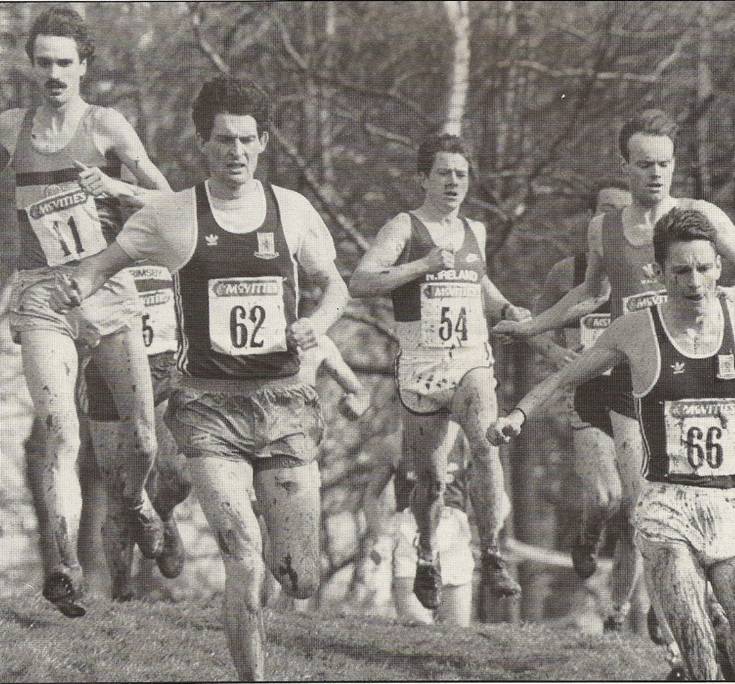
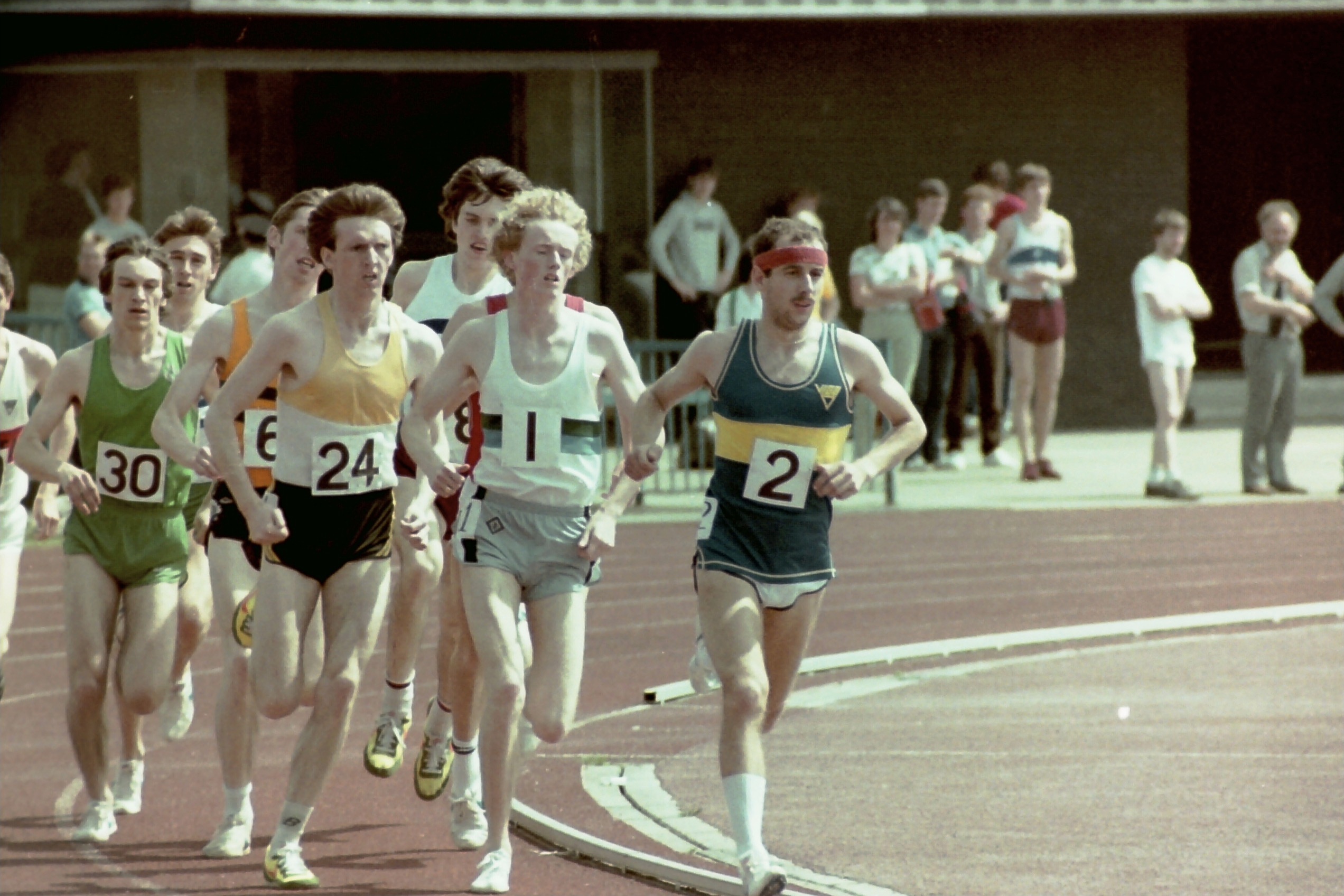
Adrian (62) and Peter Fleming (66)

The change of clubs certainly happened about that time Shettleston were second in 1994 and  Adrian’s last National Cross Country Championship in Springburn colours was in  February1994 when he finished fifth.   He was certainly turning into a formidable cross country runner for all the fact that he was a big and strong man, not at all like the typical cross-country whizz.   Had Scotland still been in the International Championship in her own right then he would surely have collected many more representative honours.   His record in the National Cross Country Championship for Shettleston was – 1995 sixth, 1996 eleventh, 1997 seventh, 1998 nineteenth, 2000 nineteenth, 2001 thirty eighth, 2002 twenty fifth and 2003 twentieth.  Whatever the club he supported it whole-heartedly.

If we look at team medals won while he was a member of Shettleston Harriers, they are quite breathtaking.   The major medals are marked on the table below – the positions marked are the medal winning teams of which Adrian was a part.

Year E-G Relay National Scottish CC Relay Scottish 4K Team District Champs District Relays Six Stage
1995 3 3 2   1   3
1996 2 3 2   1 1 1
1997 2 2 2        
1998             2
1999 2         2 2
2000 3 2 2 1 2   3
2001       2   1  
2002 3 1         1
2003   3 3        
2004   2 2        

That’s 33 team medals and not counting such as County Relays, County Championships or non-championship events such as the McAndrew or Allan Scally Relays!    On an individual level, Adrian seemed to revel in a situation where he was not striving for the very top any more – he was doing what he wanted to do – run and enjoy it.   The team aspect and the lack of individual pressure only made him a better runner.   He won the District Relays more than once, he won the set the fastest time in the Six Stage several times and he even won the Shettleston club championship three times – 1994/95, 1995/96 and 2002/03.   He liked testing himself against the best – he had in the eighties and early nineties raced in the British League for Wolverhampton and Bilston for instance, and as a member of the Shettleston team he raced in the AAA 12 Stage Relay in 1995 and in 1996.   His time as a member of Shettleston Harriers lasted for over ten years and had many remarkable facets.

He had run some very good races on the track over 3000 metres with Shettleston’s John MacKay in the summer of 1994 with times being 8:05.77 for Adrian and 8:06.60 for John in  race at Meadowbank.   He joined in a couple of their sessions and Bill Scally had actually been coaching Adrian for a couple of months before he switched clubs.   Being the loyal clubman that he was, he thought long and hard about the issue and had a number of conversations with Bill about moving.   There was a good bunch of runners at Shettleston at that time – Billy Coyle, Graham Wight, Tony Coyne, Andy Little, John MacKay and others – and for a man who had enjoyed so many years with a good group around him at Springburn, that must surely have been an attraction for him.   Shettleston had lost something at that time just after Nat Muir’s retirement and Adrian with his pedigree and presence – he really was impressive: tall and physically strong he always looked the part.   Some runners like to train on their own but Adrian liked company and as a member of Shettleston Harriers he took part ineir regular long Sunday run which moved from venue to venue as the weeks went by but one of the regular features was Adrian taking everyone back to his Mum’s house for breakfast.

He continued running on the track tough and his best run is reported to have been over 5000m in 1995 when he finished second in the Scottish Championships to Dermot Donnelly who won in 14:16.40 to Adrian’s 14:18.82.   Chris Robison, International cross-country and track runner was third.   In 1998 he was second again – this time to Glen Stewart before returning to Glasgow for his Stag Night!    While with the club his best time for 1500m was 3:51.4 in the Lanarkshire County Championships on 23rd August 1997.    When I asked John MacKay about Adrian’s best runs for the club, he checked with other club members and came up with two outstanding performances.   First when he ran 15:00 for the short stage of the six-stage relay and broke the record  when the team finished second in 1999.   He was 37 at the time, an age when most are looking forward to starting a career as a veteran.   Second was in the Allan Scally Relay Race which is organised annually by Shettleston Harriers.   Bill Scally was organising the club team which won in a new record time with all four runners ( Billy Coyle (22:15), John MacKay (22:30), Adrian (22:18) and Graham Wight (22:15)) inside 23 minutes – a quite phenomenal performance – there have been years when there were not four runners in the entire race inside 23 minutes.   John also reminded me that Adrian’s range was quite fantastic – his 66:01 for the half-marathon during the European clubs championship in Strasbourg being particularly noteworthy.   The course was of three laps with a mile long climb in each and many a top class runner was left in his wake that day.  There are so many outstanding performances from him at about this time – eg. ninth and part of the four man Shettleston team that won the BAF 10km team championship for the only Scottish win ever in this event.    He won medals as a 15 year old, and also as a veteran – second in the vets National in 2003.

The other major event in his life while at Shettleston of course was that he met his wife, Lara Halliday, after being introduced by John and Elaine MacKay.   Lara was the sister of Darren Halliday who ran for Shettleston.

Adrian 3

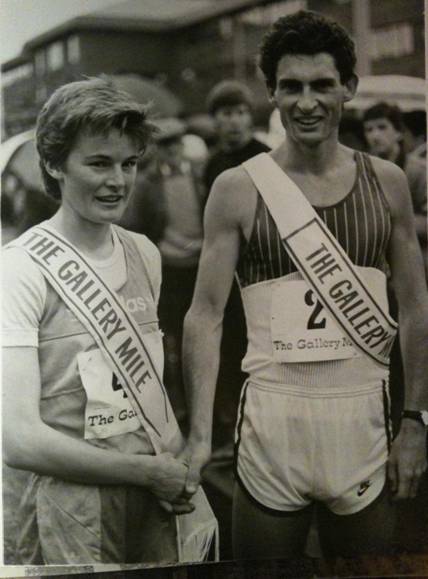
A very young Adrian Callan with an even younger Yvonne Murray

after they won the Gallery Mile Races at Kirkintilloch.

Possibly because he was one of a family of four, Adrian got on with everybody and was a well liked and much respected athlete.   There are lots of examples of his generosity and generally friendly nature.   About 1985/86 he had a caravan that he had bought in St Andrews so that he could go and do some training in peace and quiet and he often took friends along to share the caravan with him and do some running too. The idea apparently was that he had somewhere he could go and just concentrate on his running.  Fiona Meldrum says, “Anyone was welcome to join Adrian at his caravan and we spent several trips there.   Every run finished with Adrian ensuring that we stood in the sea up to at least mid-thigh for at least ten minutes.   Bl**dy freezing – even in summer!  (One of my funniest memories from then was the caravan site laundry.   Being poor students or unemployed folk meant that money was obviously a bit of an issue.   It therefore led to guys putting wet, sweaty gear straight into the tumble dryer so as to avoid paying for the washing machine!”

He was friendly with Ross Welsh down in Annan (in the Scottish Borders) and at that time Steve Ovett had bought himself a castle in the area.   Steve Binns had also come to the area from England and they would often get together when Adrian visited.   It was pointed out that it was hard to believe just how slow Ovett’s easy runs were and also pointed out that Adrian seemed to share this philosophy.    The ‘craic’ was said to have been good and Adrian and Ovett shared the same dry sense of humour.   There were times nearer home when Adrian would do a hard session in the morning and then walk top the top of Ben Lomond in the afternoon/early evening.   Or the long Sunday runs where Adrian and training mates would often end up at the All-You-Can-Eat Curry House and spend the entire afternoon there.

Adrian was diagnosed with leukaemia at the end of 2004 and he died in January 2007 at the age of forty four.   He had competed at a time when there were lots of outstanding milers about and I would like to quote Doug Gillon on the subject: “He competed in the golden age of miling, otherwise he would have won more than one Senior Scottish 1500m title but he represented his country on road and cross-country as well as on the track.   His career spanned the twilight years of Frank Clement and John Robson, and was a contemporary of Graham Williamson.   This trio are still Scotland’s fastest at the mile and metric equivalent   Today he would have been a star.”

And two final quotes from two of his friends:

“He was a really decent bloke and a great friend who was as happy running at club level as he was at international level.”      And  

                                                                    “I still miss the chats with him and the Sunday runs.”

Georgena Buchanan

Georgena

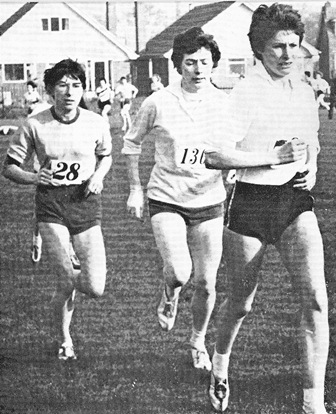
Georgena Craig (130) in the 1964 National Women’s Cross-Country Championships at Bury,

  behind Madeleine Ibbotson (Longwood), eventual winner, and ahead of Pam Davies (Selsonia) the silver medallist.

Picture from Arnold Black, taken by Eric North

Georgena Craig (nee Buchanan) was a very talented athlete who ran mainly in the 880 yards but was ranked at various distances from 220 yards to 3000 metres, raced in relay teams over the 4 x 110 distance as well as the 4 x 880 yards and she was ranked in and won medals in the pentathlon.    Competitively she ran in two Empire/Commonwealth Games and was part of a world record setting GB 4 x 880 team.    Although it is as a track athlete that we will look at her career here, it should be noted that her talents extended to cross-country running.   In the National Championships, she was second in 1961-’62 to Dale Greig, won in 1962-’63 with Dale second, was second in 1963-’64 to Dale and won in 1964-’65 from Leslie Watson with Dale third.   These results are intriguing in that Dale was known to be a very strong endurance runner who held the women’s world best time for the marathon while Georgena was a very fast runner over 220 and 440.  Georgena then missed the National for the next three seasons (or at least was not highly placed in them) but was ninth in season 1968-’69 and eleventh in 1969-’70.   She also represented Scotland in the international championship.   Her best times are in the table below.

Event Time Date
220 y 26.0 1963
440 y 57.1 1965
880 y 2:07.9 1968
800 m 2:05.8 1970
Mile 5:08.4 1966
1500 m 4:48.6

1972

3000 m 10:35.7 1969


Born on 17th July 1942, she became a senior athlete in the summer season in 1962.   On 5th May 1962 in the Western District Championships at Scotstoun, Georgina won the Mile in 5:46.6 and the ‘Glasgow Herald’ said Miss D Greig (Tannahill) led for most of the way but she was caught by Miss G Buchanan (Maryhill) and beaten by a yard.”  A week later at the SWAAA Pentathlon Championships the report read: “Miss G Buchanan (Maryhill) excelled in the half mille with a time of 2:18.2 which is more than eight seconds quicker than the time returned by the winner of the Western District title and will now be submitted as a new Scottish native record.”   Seven days later in the West v East fixture at Scotstoun, Georgena won the 880 yards from I Inwood in 2:20.3, a new meeting record.   On to 29th July at Gourock where she was second to C Kelly in the 220 yards and second again to A Gorman in the 880 yards.   Each time she was giving away yards in the handicap.   In the Land O’Burns Trophy Meeting at Ayr on 11th August she won the 880 yards in 2:21.8, in the Edinburgh Highland Games at Murrayfield on the 18th she was second lodged between J Beretta (AAA) and Maeve Kyle (N Ireland) in a race won in 2:16.3 and a week later in Cowal she was again second behind Madeleine Ibbotson (2:16) and Maeve Kyle (2:20.4) in 2:19.     It was a summer with lots of competition and one in which she gained a lot of valuable experience.   By the end of 1962 she was ranked third in the 880y with a season’s best of 2:16.2, and second in the Mile with 5:19.0; competitively she was second in the SWAAA  1 Mile Championhsip.   In 1963 her range widened considerably as can be seen from her times and ranking positions:   220y   26.0   10th;    440y   58.8   3rd;   880y   2:13.9   1st;   Mile   5:24.4   2nd;   Pentathlon   3288 pts   5th.   Competitively she was first in the SWAAA  880 yards and second in the Mile.

The summer 1964 season started for her on 20th May in the Glasgow Championships in which she won the 800m in 2:21.   Despite missing the West District Championships, Georgena ran in the West v East event and finished second to I Inwood in the 880 yards and the winner was given 2:23.9.   In the SWAAA Championship on 13th June she won both 880 yards and Mile.   The ‘Glasgow Herald’ said “Miss Buchanan came back to form in the 880 yards championship which she retained in the good time of 2:15.9, two seconds slower than her record in the event last year.   The Western runner later resisted the challenge of Miss I Inwood (Maryhill) in the Mile, winning by 10 yards in 5:24.4.”     Two weeks later at the Gourock Highland Games Georgena had two seconds in the handicap 220 yards (running from a mark of 3 metres and then in the 880 yards from the scratch mark after giving I Inwood 12 yards start.   On 8th August in the Scotland v Ireland match at Dam Park in Ayr Georgena won the 880 yards and was reported as follows: “Miss Buchanan never gave her rivals any chance by setting a fast pace through her first quarter in 63.7 and won in a new national best time of 2:13.1 which improved her own unratified record of 2:13.7.”   She could have done with that same time the following week when on the tight little grass track at Murrayfield in the Edinburgh Highland Games she finished third behind Mrs GD Ibbotson who won in 2:13.1 with Pat Lowe second.   Her season then ended with a win at Bute Highland Games at Rothesay when she was timed at 2:22.2.   The second finisher had a handicap of 60 yards – this was ferocious handicapping on the cinder track which was seriously downhill on the back straight and just as seriously uphill in the finishing straight!   Georgina;’ best times for summer 1964 ranged from 26.3 for 220 all the way through to 5:24.4 for the Mile.   They were 220y:   26.3    ranked 12th;   440y:   59.0   6th;   880y:   2:13.1   1st;   Mile:   5:24.4   4th.

Georgena’s best times for summer 1965 were  220y   26.2   7th;   440y   57.1  1st;   880y   2:10.1   1st;   Mile   5:23.6   3rd;   Pentathlon   3221 pts   9th     SWAAA   1st 880y     2nd Mile    and her progress throughout the summer can be traced in the reports from the ‘Glasgow Herald’ which were pretty detailed and quite comprehensive.   The report on Monday, 3rd May after the West District Championships on Saturday, 1st, was headed Three West Titles for Miss Buchanan and said:   “Miss G Buchanan was the top performer at the West District Women’s Championships on Saturday at Scotstoun when she won the 440 yards, 880 yards and One Mile events in times she has beaten on more than one occasion .   The opposition was not up to the usual standard thus enabling her to nurse her energies in judicious fashion to tackle all three races.”     Her winning times were 61.5, 2:20.5 and 5:29.2.

 10th May (reporting on the previous Saturday’s events said this.   “Miss G Buchanan who had competed in the forenoon and afternoon in the pentathlon championship, two hours later took part in the 880 yards at Hampden Park and after having beaten a wind of gale force won in a time of 2:24.5.   She set a fast pace with the wind at her back down the enclosure side followed by Miss I Inwood but when she turned into the wind the pace was clearly affected.  Three hundred yards from the finish Miss Inwood took up the challenge but Miss Buchanan displayed reserve power even against the wind and strode away from her rivals and won by 15 yards.”

On 17th May the report on the East v West competition at Nethercraigs, Glasgow:   “Among those who distinguished themselves, was Miss G Buchanan who wisely decided to concentrate on the 440 yards and 880 yards, a decision that paid off handsomely with a fine win in the 440 in 58.4 sec, 0.5 sec faster than the meeting record, and then took 1.6 sec off the previous best for the half mile with 2:18.7.   It was felt that Miss Buchanan might be beaten by either of the East competitors in the 440 yds but she set her sights properly by going out fast from the start leaving Miss B Lyall behind her all the way and won by eight yards.   Miss Buchanan’s tactics were equally successful in the longer race and despite valiant efforts by Miss I Inwood to hold her, she won by 10 yds.”  

On 24th May it was on the Glasgow Athletics Championships at Scotstoun.  “Miss G Buchanan was successful in retaining the 880 yards title.   After having passed the bell in a fast 64.5 sec she won in 2:15.6” 

The SWAAA Championships were held at Pitreavie on 12th June and there was a large contingent from the Anglo-Scots club in England present.   “The mile was no race at all.   Mis V Tomlinson (Aldershot) having run 54:55.8 earlier this month went out from the start as if on a training run and in so doing built up such a lead as to focus attention on the race for second place.   That query was soon answered when Miss L Watson (Maryhill) left Miss G Buchanan in pursuit of the leader but at the tape Miss Tomlinson was 70 yards ahead in 5:06.7, an all-comers record.   An hour previously Miss Buchanan had been an equally convincing winner of the 880 yards finishing 60 yards ahead in 2:15.2, 2.1 sec slower than the national record.   One wonders why she is persisting these days with fast first laps and much slower second laps.   Her time at the bell was 64.5 which gave her a second lap time of 70.7.   How much easier she would find two laps of 66 sec is arbitrary but one feels that until she looks into her pace judgment she will continue only as a 2:15 runner.”  

Her next competition was in an match between Dunfermline College of Physical Education, Edinburgh Southern Harriers and Western AAC in which Western were third but Georgena won the 880 yards in 2:21.8 and ran the last stage for the winning 4 x 110 yards relay team.   Two weeks later she won the 440 yards in the Octavians meeting in Edinburgh in 59.3 and then it was the Gourock Highland Games where she won the 220 yards handicap off a mark of 3 yards in 26.7 and the 880 yards from scratch in 2:19.2 as well as being part of the winning 4 x half lap relay team.   The track at Gourock is a heavy grass track which is downhill on the first bend and uphill on the second bend so fast times are not expected there!   She had a good report on the Strathallan Games on 7th August when she was said to be in her best form over the ‘sodden grass circuit’ and won in 2:16.1 – she was off scratch of course and the limit runner was E Stewart of Maryhill who had a start of 58 yards.   On the 30th of the month in the Edinburgh Highland Games at Murrayfield she finished third to M Hodson (Bury and Radcliff) and Pat Lowe (Birchfield) with the race being won in 2:12.9.   The 1965 season finished there and the big challenge in summer 1966 was to get in to the Scottish team for the Empire Games team for Jamaica.

Georgena’s best time for summer 1966 were:   220y   26.5   17th;   440y   59.5   5th;   880y   2:09.2   2nd;   Mile   5:08.4   1st.   Competitively she was second in the SWAAA  880y, and third in the Pentathlon.  She had also got married and was henceforth known as Mrs G Craig.   On 2nd May 1966 Maryhill Harriers LAC held a six club open meeting at Scotstoun and the report said “Miss G Craig showed her mastery of half miling when she outpaced her opponents in 2:13.3, her fastest this year.   Miss M Hodson (Bury) proved to be no threat having won a 440 yards shortly before and it was only from Miss P Brown (Middlesex) that only a fleeting challenge came.”      It was a good time to start the competition season with and the following week in the SWAAA Championship at Scotstoun she won the 440 yards and 880 yards and was runner-up in the 200m.   Her times were 60.4 and 2:22.3.   In the West v East at Ayr on the 16th May, Georgena won the 880 yards in 2:20.3.  On 11th June she ran in the SWAAA 880 at Pitreavie and finished second to M Hodson who was timed at 2:09.2.  On 13th June came the announcement in the papers of the team for Jamaica.   The ‘Herald’ read: “Representatives from the nine sports at the Empire Games in Jamaica from August 4 to August 13 spent six hours yesterday in Edinburgh in deliberations over the 60 competitors they would send.   At the end of their talks, they issued the following team …”   From the athletics point of view, there were 12 men and 6 ladies being sent to represent the country and the ladies contingent included Georgena Craig for the 880 yards.    IT seems a very small team in total – 60 athletes – and there were the usual complaints about athletes omitted and the reporter mentioned particularly Dick Hodelet of Greenock left out of the men’s 880 yards.   But Georgena was in the squad.

On 2nd July she travelled with a small group of Scottish athletes to the White City to run in the WAAA Championships.   The report read  as follows.   “Mrs G Craig led the field at the bell in 61.7 in the final of the half-mile but thereafter tired and finished sixth.   Her time of 2:07.9 however was a furth of Scotland record.”   One week later she took part in an invitation meeting at Grangemouth Stadium, the first meeting to be held there, and competed in the Mile where Anne Smith of Mitcham set two new Scottish all-comers records of 4:48’5 for the mile (the first time 5 minutes had been beaten by a woman in Scotland) and 4:30.7 in the 1500m.   Georgena set a Scottish record for the 1500m of 4:49.4 and equalled the Scottish record for the mile with 5:08.4.   Two weeks later the headline in the ‘Herald’ read “Mrs Craig’s Easy Win at Gourock.”   and followed with “On the track the most eye catching win was by Mrs Craig, not so much by her time but by the number of yards she had between herself and the second girl home.   Here is a case for more severe handicapping: as at Kirkintilloch earlier in the week, she caught the front runners with almost a lap to go and from that point she was left to decide whether to try hard or to win by the minimum.  She tried hard and finished 50 yards clear.”     That was the final race before heading for the Empire Games in Jamaica.   Obviously fit – Scottish records of one sort or another at 880 yards, 1500m and One Mile plus a win by 50 yards in a handicap where she was off scratch, all indicated that.

There were two Heats of the women’s 880 yards in the Games.   Rosemary Stirling was in the first and Georgena was in the second.   Results in the table below.

Position Name Country Time   Position Name Country Time
1. M Stephen NZ 2:06.6   1. P Piercy England 2:10.0
2. A Smith England 2:07.2   2. P Lowe England 2:10.0
3. R Stirling Scotland 2:07.6*   3. J Pollock Australia 2:10.0
4. A Hoffman Canada 2:08.8   4. C Carter Canada 2:10.7
5. D Watkinson England 2:09.3   5. G Craig Scotland 2:10.8

* Rosemary’s time was a new Scottish National Record.   Just looking at the time, Georgena’s race seems to have been an almighty scramble up the back straight and with only four to qualify, she was unlucky but in such a melee anything can happen.   It was unfortunate but her Games were over.

The first race on her return was at the Edinburgh Highland Games on 20th August where there was an invitation 880 yards won by Rosemary Stirling in 2:08.7 which was a new Games Record: Pam Piercy was second and Georgena third but no times were reported for the race other than the winner.   She ‘triumphed convincingly’ in the 880 yards handicap at Shotts running from scratch in 2:17.4.   As at Gourock, times at Shotts mean nothing, it’s the victory you went there for: the track is downhill in the back straight, uphill in the home straight and in September was generally of the consistency of grey porridge.   The season was over.

1967:   Georgena did not compete at all in 1967, was not ranked in any event.    In 1968 however she appeared in three lists – 440y:   60.1, ranked 14th; 880y:   2:19.8   6th;   Mile:  5:21.8   5th.   Georgena certainly started the season well.   On May 11th in the West District Championships, she won the 800m in 2:30.2 from McGregor of Maryhill on 2:34.8 and then won the Mile in 5:39.3 from D Stewart in 5:43.4.   A week later at the Glasgow Championships at Scotstoun she won the 800m in 2:20.4 from Lesley Watson in 2:25.0.  And a week after that, in the East v West match, she was third behind Barbara Lyall in 2:24.5.   Her 5:21.8 for the Mile was run at Grangemouth on 6th July when finishing 4th in the SWAAA Championship..   The 60.1 for 440y was run at Grangemouth on 26th May when she was third, the 880 time was at Grangemouth on 23rd June

1969 was the year when distances changed from imperial to metric and races were over 400, 800 and 1500 – after all the Commonwealth Games were coming to Meadowbank in 1970 and the new track had to be marked out in metric distance.   The buzz in that season was incredible as athletes tried to stake their claim to places.  As far as Georgena was concerned, the two big rivals were Rosemany Stirling who had been her team mate in Jamaica and who had done wonderful things in the years since then, and Mary Speedman, daughter of International coach Jimmy Campbell, who had moved to 800m and 1500m   The season started with the West District Championship in Glasgow and Ron Marshall wrote: “Mrs Georgena Craig, for so long Scotland’s No 1 half-miler,  was given as hefty a defeat from another Scotswoman as she could ever have endured.   All the same it was sad to see someone with her past record come under the chopping block.   Mrs Mary Speedman allowed Mrs Craig to lead in both the 800m and 1500m and then put herself in the lead 300m and 200m from home.   In both instances, There was no vestige of a challenge from a tired Mrs Craig and Mrs Speedman was an easy winner each time.”    I’m not sure what ‘coming under the chopping block means – probably a mixed metaphor such as the BBC reporter who spoke of drawing a red line in the sand – but the tone of the article implies that Georgena’s days as a challenger for international selection were over.  He couldn’t be more wrong – don’t know though, he was the man who opined in the Herald that the 1500m distance would never take off in Britain and we would probably settle on a 1600m race!   Anyhow, Georgena had her sights on Edinburgh 1970 and her best marks were:   800m   2:14.6   7th;   1500m   4:49.5   7th;   3000m   10:35.7   1st    SWAAA  3rd 1500.   She followed the District Championships on 15th May with a victory at Peffermill in Edinburgh in 2:14.6 which was her fastest for the season.   Speedman had eight times faster than that though, and Stirling had four.   Her best time in the 1500m was set at the SWAAA Championships at Grangemouth on 5th July.   Only one 3000 metres race was held in Scotland – and it was won by Georgena.  Run at Scotstoun on 30th August, it was a brand new event for the country and there were no championships or events of the distance at sports meetings.   She won it in 10:35.7 from Ann-Marie Orpiszwenska (11:32.6 and Dale Greig (11:46.3.   The only other Scotswoman to run it was Susan Foster of Aldershot who ran 11:21.6 at Crystal Palace on 6th October.  Then it was on to the Commonwealth Games in 1970.

Her  form in 1970 could not have been more different from the 1969 season.   On 9th May in an International against Ireland, Ron Marshall’s report on the event included this.  “On the track, most praise from Scottish officials went to Georgena Craig for her crisp, spirited running in the Senior 800m.   This was the runner of two or three seasons ago we were watching.   She came off the last bend hotly pursued by Andrea Lynch (Ballymena), the Scottish 400m champion, but as soon as Mrs Craig became aware of the danger, she surged forward to the finishing line and left Miss Lynch to wonder why her effort had been in vain.   Mrs Craig’s winning time was 2:16..3, much faster than she has gone for some time.”   The excellent running continued through to the Scottish Championships at Meadowbank on 6th June.  This time the report read: “Rosemary Stirling’s 800m  was surely a superb display of running in which she left no one in any doubt about her chances of a medal on the same track in just over a month from now.   In second place came another veteran, Georgena Craig, taking a similarly new lease of life in clocking a native record of 2:08.7.   Third place went to Mary Speedman in 2:08.9 and I expect all three to be in the team.”    The SWAAA were expecting 22 places to be made for the women’s athletics team, and in any case, all three were indeed selected.   In a meeting at Meadowbank on 13th June, the British women’s 4 x 800m team 0f Lillian Board, Pat Lowe, Sheila Carey and Rosemary Stirling set a new world record of 8:27 but were unanimous in their opinion that it had been a soft record and it could be broken again fairly easily.   As in 1966, there were two heats of the women’s 800m and the results are below.

Commonwealth Games: Two Heats and a Final:  First Four to Qualify

Position Name Country Time   Position Name Country Time   Position Name Country Final
1. S Carey England 2:04.7   1. P Lowe England 2:07.0   1. R Stirling Scotland 2:06.2
2. R Stirling Scotland 2:04.9   2. V Potts NZ 2:07.4   2. P Lowe England 2:06.2
3. C Peasley Australia 2:05.0   3. P Werthner Canada 2:07.5   3. C Peasley Australia 2:06.3
4. G Craig Scotland 2:05.8   4. G Dourass Wales 2:07.6   4. G Dourass Wales 2:08.6
5. A Lynch N. Ireland 2:06.0   5. T Fynn Canada 2:07.6   5. V Potts NZ 2:09.7
6. AR Smith NZ 2:07.3   6. M Speedman Scotland 2:08.3   6. P Werthner Canada 2:10.0
7. T Bateman Wales DNF   7. N Braithwaite England 2:08.5   7. G Craig Scotland 2:16.1
8.         8. B Franklyn Jamaica 2:14.7   8. S Carey England 2:18.5

Georgena had made the final this time and without a proper report on the race it is impossible to make any comment but I’ll do so anyway!  When experienced athletes such as Georgena and Sheila Carey run last and second last in 2:16.1 and 2:18.5, you have to suspect some sort of ‘incident’ during the race.   (And you have to sympathise with T Fynn of Canada who missed out on a place in the final despite having the same electronic time as the fourth placed Gloria Dourass!)

Lillian Board had been diagnosed with cancer and in the course of 1970 it became worse and she ended her track season early.   When the new attempt on the 4 x 800m record was announced, Georgena Craig was drafted into the team.    At the Coca-Cola International Invitation Meeting at Crystal Palace on 5th September, 1970, they obliged but the race did not go as expected.  Let Ron tell the tale: “Two Scots, Rosemary Stirling and Georgena Craig, shared in another world record, though only through the disqualification of the West Germans.   The West German Women’s 4 x 800m relay squad broke the tape in 8:22.6, a world record, but were disqualified for passing the baton on the first leg take-over out of the legal area.   So the world record went to Britain (Miss Stirling, Mrs Craig, Pat Lowe and Sheila Carey) who finished second in 8:25, two seconds inside the record set by Britain earlier this year.”

On September 12th at Dunblane Highland Gathering she won the 220 yards in 27.3 off 10 yards on a rough grass track and a week later won the re-dated Glasgow Championship 800m on the cinders at Scotstoun in 2:16.8.   But the icing on the cake was the award of the Sports Journalists Association Team of the Year Award.   Although the SJA Awards had been going since the 1950’s, this was the first year that a team award had been presented.   It went to the GB Women’s 4 x 800m squad which included Lillian Board, Sheila Carey, Georgena Craig, Pat Lowe and Rosemary Stirling.    The following year it went to the British Lions rugby team, and the year after to Rodney Pattison and Chris Davies (sailing).   A very prestigious award indeed.

For the record her best times for 1970 were 800m  2:05.8 (ranked second),  1500m  4:45.1  (ranked 5th)  and in the SWAAA she was second to Rosemary Stirling in the 800m in 2:16.1    A season to remember

In 1971, she was not ranked in any event and did not seem to race at all.    This is similar to the year after the 1966  Empire Games when she disappeared from view. That was put right in 1972 when she not only ran well but set a personal best for the 1500m.   Unfortunately there is little coverage of her next two years in the sport in the Scottish daily newspapers but we do have her best performances each year.   In 1972:   800m   2:18.2   12th;   1500m   4:48.6   10th   and in 1973:   800m   2:20.9   18th;   1500m   5:04.2   25th.

Georgena’s best year would probably have to be 1970 when she raced in the Commonwealth Games and had a share of the world record as well as setting a personal best time for the 800m   Her most unlucky must have been 1966 when she was run out of a place in the final of the Empire Games 880 yards by one tenth of a second in a scramble for the finishing line.   However that may be, she was a very good middle distance runner indeed.

Colin’s Cuttings

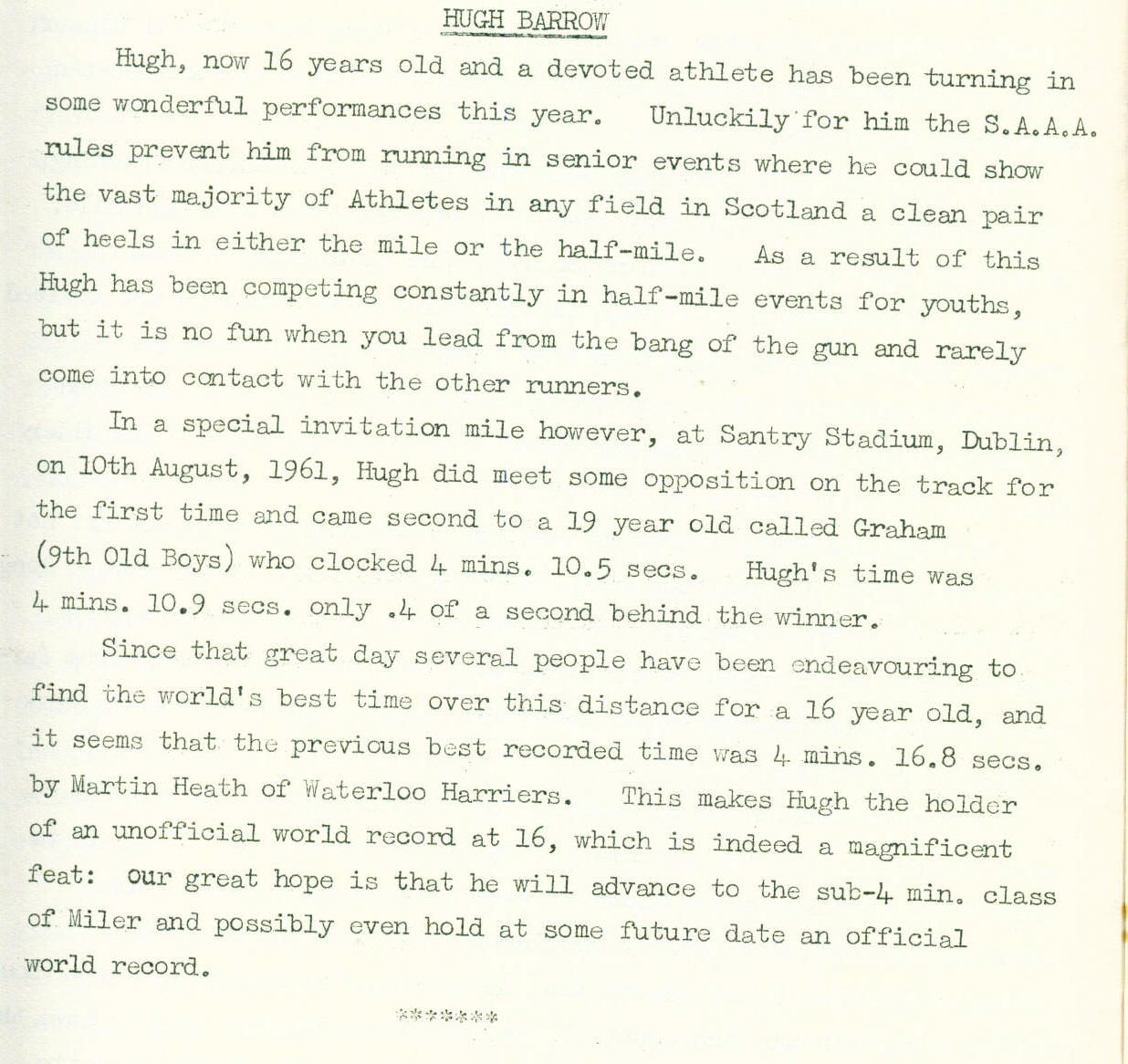
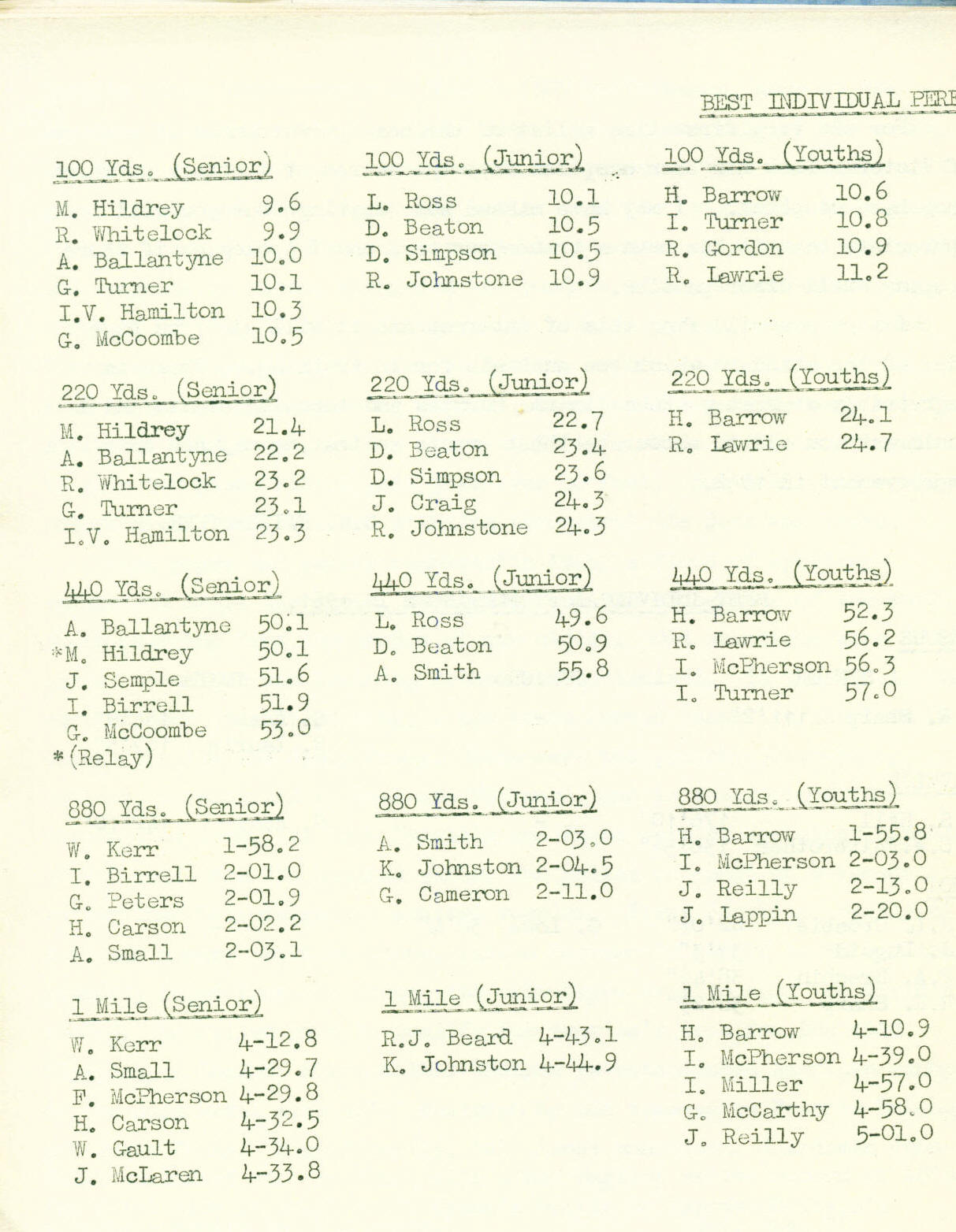
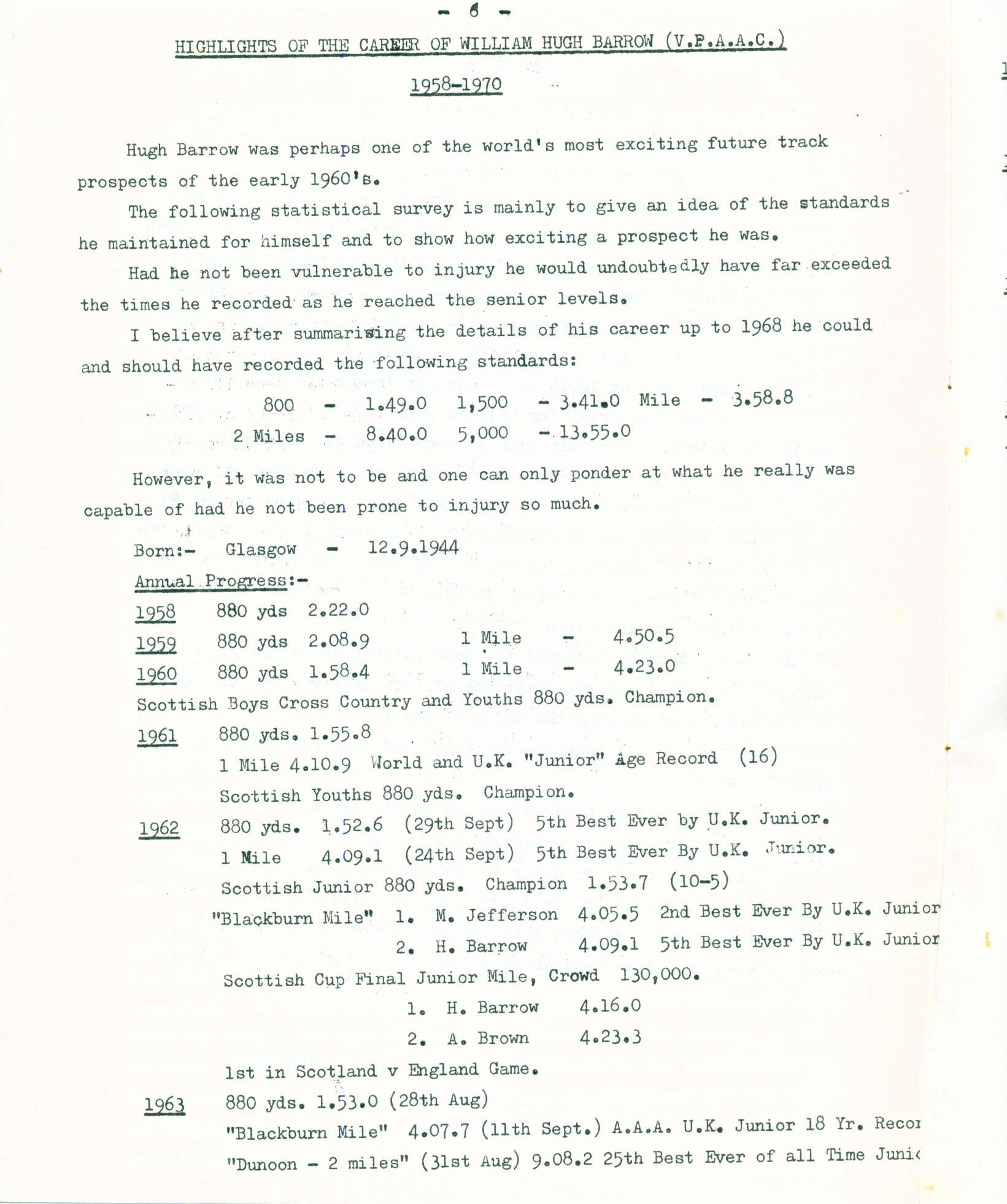
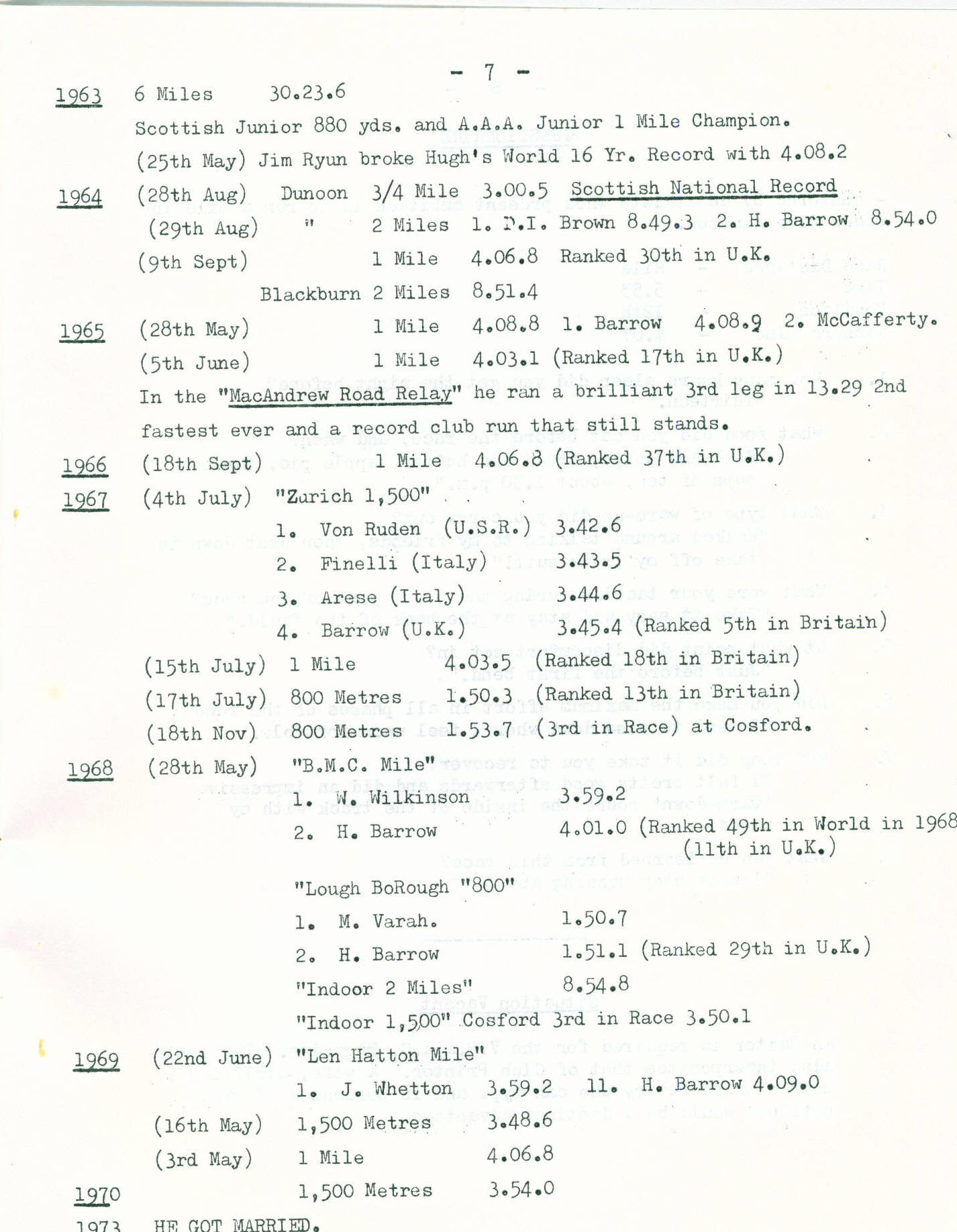
Hugh was undoubtedly a top class athlete and like all of the best athletes travelled to get the competition he needed.   What we have here are four extracts from the Victoria Park magazine – the first two from 1962 and the second two from 1971.   They were sent to me by his club mate Colin Young and I found them very interesting indeed.   The comments above about needing to travel for the right competition is sometimes disputed by those who say that with better organisation Scotland could provide for all the athletes’ needs.   Not always true and the first item speaks of his need for better competition than he as a 16 year old at the time could get at home.   Remember that Under 17’s were not allowed to race Seniors – Graham Everett at home for one could have given him a good competition!    The second one indicates where he stood in the VPAAC rankings for the year but if you let your eyes stray to some of the other events and look at the standards there, you might be surprised at the club’s strength.    Where do you see these guys finishing in the Scottish Men’s League competition in 2013?    The 1971 article recaps his career from 1958 to 1970.   The times were outstanding.    The places were all good.    Frank Horwill, the eminent coach and founder of the BMC who died last year always reckoned that Hugh was special – nit just because he was Member Number One of the British Milers Club, but because of his attitude to racing.   Where many are reluctant to race too often (how often is too often?) or run from the front, Hugh was never one to hang back.   Enough!   Just read the following.

CC P4

CC P5

CC P6

CC P7

Hugh Answers the BMC Questionnaire

Hugh was a British Milers Club member – not only that, he was club member number one!    He still gets his membership card every year, and the number on it is significant.   Frank Horwill always had a soft spot for Hugh, partly because of his readiness to join up to the club’s ideals right at the start, but partly also because of his whole-hearted approach to racing.   The questionnaire below was completed recently as part of a comparison with one of the current crop of young BMC members.

DoB: 12-9-44

Started running at 13 (but never remember when I didn’t run)

Clubs; Victoria Park AAC , Wallasey AC, Belgrave Harriers , Sale Harriers

Personal Best Times

100yds 10.6,          220 yds 24.0,         440 yds 51.0,           880 yds 1 50.3,         ¾ mile 3 0.5,         1500m 3.45.4,          1 mile 4m 1.0,          2000 metres 5m 16.6,         2miles 8m 51.4,         3 miles 13m 52.8

Titles

Scottish Boys CC Champion 1960

Scottish Youths 880 yds Champion 1960 1961

Scottish Junior 880 yds Champion 1962 1963

Scottish Schools Mile Champion 1960 1961 1962

AAA Junior 880 yds Runner up 1962

AAA Junior 1 Mile Champion 1963

British Schools 1mile 1961 1962

Scottish 1 mile Championship runner up 1965 1967

Scottish 1500metre Championship runner up 1969

Coaches:   John Stirling Victoria Park ,John Anderson, Eddie Powell Sale Harriers

 Brief explanation how the BMC came to be?      1963 British miling at a low ebb following the Bannister/.Hewson/Ibbotson era-Frank Horwill wrote to various athletics journals and there was a response from 35 athletes and the club was born.It is detailed in Frank’s book-Obsession for Running

In 1963 can you remember what you did in your leisure time both at home and outside of the home (include exercise and anything that related to relaxing i.e. cinema, bowling etc.)?

I was always interested in sport in general and at that time I was still playing rugby a sport that I am still involved with today.   We also went to the cinema and in the prehistoric days before even discos we went to beat group dances

Can you describe what running gear you wore in those days from racing wear to training wear and footwear (no goretex, digital watches etc, costs etc)?  

This was the very early days of adidas and Puma fighting it out for the running show market before that it was just Fosters who then became Reebok who invented the ripple sole(for ross country) which predated the Nike waffle sole.   My own club Victoria Park at that time dominated in Scotland and also could take on the top English clubs (they had even won the English Cross Country team tile the first time it had left England) and they even  had a cobbler who would come down and take measurements for hand made spikes.    Trendy tracksuits were in their infancy with such makes as Copdale,Umbro and Bukta -Ron Hill was strating out to experiment with string running vests and cutaway shorts

What sort of training were you doing at Zofia’s age (17) and what frequency per week?

It was always quality before quantity trained 6 days per week  twice a day Mon-Fri.     Interval work-hill reps and steady runs-mileage probably about 50 per week even did some weights

Were you a cross country man or a track man or were you happy on either surface?

I did track road and cross country preferred track/road but did a lot of cross country –and then cross country trails were just that barbed wire fences etc .The only time I remember a cross country race being called off was during a foot and mouth epidemic

Availability of transport was not as it is today or the road infrastructure as accessible as it is at present, so how did you travel to races which were over 100 miles and more away?  

Strange but public transport was probably better in some ways  travelled to races by train or bus never really encountered any problems.   Then some clubs members got cars and we shared costs drove to races in England on a regular basis

The world records were 1-46, 3-35 for men and 2-01, 4-12 for women in 1963, did you think they would be where they are today and where do you think they will be in say, 20 years time?

Irrespective of how good you are there is always somebody coming down that road behind you who will do better-its just the way it is–not really suprised by the improvements especially with the influence of the Africans -Kenyans-Ethiopians and north Africans.   I assume that progress will continue but may well slow down

Let’s compare facilities in 1963 and now. Did they hinder you or make you more determined to succeed no matter what it took. Obviously you accepted what you had and made the best of it. Are facilities necessary for middle and long distance. (Tartan tracks etc.)?  

I don’t think not having tartan tracks hindered us in fact it may even have prevented some of the stress injuries–not sure if sophisticated facilities are required for runners -running is a natural activity and as long as you have roads, paths ,grass and hills just get on with it.   OK,  you do need to measure progress but sometimes lack of facilities is a spur to drive you on–many great sportsmen succeeded because they had to overcome this and it helped mould them

Do you think youngsters are being developed the way they should? Are we too hard or too easy in our training methods? What about present leisure time pursuits of youngsters (computers, music etc.)?

 I dont’ like the approach of “it was always better in our day” the older you get the better the sportsman you were it is easy to look back and be selective about what you remember

Its a different era now and different challenges face our young athletes–ok in athletics the watch has stopped and the unforgiving minute has been read and recorded so times tell their own story and there does seem to little progress from the Cram/Coe/Ovett era but that was a special time -a purple patch that type thing only happens every so often in sport

Probably we were naturally fitter in some respects by being used to walking/running or cycling more in your day to day activities and that gave you a base of general fitness to build on but we should not knock young people there are those who still want to succeed and we should encourage them.

What piece of advice would you give to youngsters today, firstly to those wanting to succeed and also to those who may drift away from the sport altogether? 


Were you a mileage man or a speed man or a bit of both?

A bit of both but never really a high mileage man

Did you have an athletic hero who inspired you around 1963 (could be from a past era e.g. Nurmi, Zatopek etc.)?

  No contest-Herb Elliott

Is there any special race you can remember that inspired you (either yourself or someone else)?

Rome 1960 -1500 metres –he totally destroyed the field winning by about 3 seconds also his double 880/1 mile at the 1958 Empire Games in Cardiff

Do you think you reached your athletic limit (i.e. got the best out of yourself)?

No– I set a World Age (group for a 16 year old) best for the 1 mile at Santry Stadium Dublin in 1961 4m 10.9 s and that became a bit of an albatross for me.I did reach 4m 1.0 but I had always wanted to be the first Scot to break 4 mins

You can always find excuses–injuries etc but I just didn’t reach the goal I had set myself – end of message

Did you go to university and how did that affect your athletic progress?

No I didn’t go at that point but did go later when I attended teacher training at Didsbury College Manchester. when I ran for Sale Harriers 1967-70

If you went into work (industry, office) how did that affect your athletic progress?

I started work in an insurance office and trained during my lunch hour it had to be quality work there was no time for anything else

Who do you admire today in athletics?

Paula Radcliffe

What about the state of athletics in this country. Is there any hope and what have we got to do?

There is always hope we have done it in the past  Bannister/Chataway/Ibbotson era and the Ovett/Coe/Cram/Elliot/Williamson period -the same talent is out there somewhere

What do you think about the state of the BMC at the moment. It still has the same values, but does much more now than it ever did?

  I am not really qualified to comment on that as I am no longer actively involved in the club–although I did help organise training weekends with Frank Horwill about 10 years ago and the spirit was still burning then


Hugh Barrow

WHB Roelants

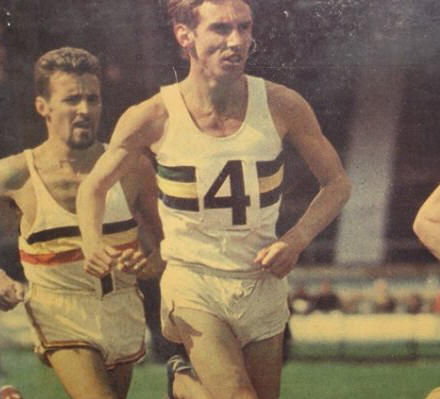
Hugh Barrow at the White City

The picture is of Hugh (4) in an international 3000 metres at the White City in London in 1968, behind him is Gaston Roelants of Belgium who had won the Olympic Steeplechase in 1964 and one place in front is Ian McCafferty.   As you might guess from that simple statement, Hugh was a considerable talent and graced Scottish athletics for two decades.    My first awareness of Hugh dates from my days at Glasgow University immediately after I left the Army in 1958.   One of my favourite magazines at the time was ‘World Sports’ edited by Phil Pilley.   It covered more than athletics but all articles were well written and well researched.   I went into the Reading Room in the Union one month, picked up the latest copy and …… there was an article about a Scottish runner!    Given that there were about two articles per issue about athletics and hardly a one about anything outside London, this was a day to be remembered.   The athlete was a young Hugh Barrow who had set a World Record for the One Mile and was being presented with a ‘World Sports’ plaque at a dinner in London.   There was even a picture.    More than twenty years later when I was Scottish Secretary of the British Milers Club and Hugh (BMC Member Number 1) was giving me a lot of help in organising races and then in putting on street miles in conjunction with the Luddon Half Marathon that he was organising on behalf of Strathkelvin Council.   A long career in the sport and a distinguished one.   In 2007 Hugh was interviewed by the BMC News when the club admitted its 5000th member and a link to this most interesting item is at the foot of the page.    Late on in his athletics career he ran in many road races up to and including the marathon and he answered the Scottish Marathon Club questionnaire for the very first issue magazine that they were producing.   As an introduction to his career it is reproduced here.

PROFILE

 Name:   Hugh Barrow

Club:   Victoria Park AAC, Sale Harriers – and cameo appearances for Belgrave Harriers

Date of Birth: 12 September 1944

Occupation:  Retired local government officer (Director of Recreation, East Dunbarton Council)

List of Personal bests: 

Event Time Year Remarks
100 yards 10.6 1961  
220 yards 24.0 1962  
440 yards 51.0 1962  
660 yards 75.3 1962  
880 yards 1:50.3 1967  
0.75 Mile 3:00.5 1965 Scottish Record
1500m 3:45.3 1967  
One Mile 4:01.0 1968 Furth of Scotland Record.
2000m 5:16.6 1966 Scottish Record
3000m 8:21.0 1969  
2 Miles 8:51.4 1964  
3 Miles 13:52.8 1965  
5000m 14:26.0 1971  
6 Miles 29:28.0 1969  
20000m 71:50.02 1980  
30000m 1:51.06 1979  
Marathon 2:35:01 1079  

Also co-holder of Scottish records in teams for 4 x 400 metres and Medley Relays.

WHB Relay Team

Hugh Barrow (right) with the record breaking VPAAC relay team

Has Any Individual or Group Had A Marked Effect On Either Your Attitude To The Sport Or On Your Performances? 

Herb Elliott was my inspiration in 1958 seeing him at Cardiff Empire Games was the where it began for me

Joined VPAAC and was coached by Johnnie Stirling .The whole scene at VP in those heady days of the late 50s was extraordinary because the extraordinary was the norm

Everywhere you looked at the Showgrounds you were surrounded by Champions and Internationalists that was just the way it was very exciting for a young runner

A headline wrote “Victoria Park where Champions are born”

What do you consider your best ever performance as a runner?  

I have to go with winning the international junior mile Scotland v England  April 1962 at Hampden: not so much the time more the experience.   The AAA sent up two of the top English junior milers-  Bill Chadwick and Frank Martin.   The race was part of the pre-match programme for the Scotland v England match and 132,000 were in the stadium.    We changed at Lesser Hampden and were offered a steak pie lunch with the mass pipe bands which I declined.   After warming up at Lesser Hampden we walked with a police escort down behind the main stand and into the track the atmosphere was electric.  I front ran it and on the last lap an ambulance man walked into me – the noise was so loud he never heard me coming!    The prize was a  tartan rug and Dunky Wright interviewed me live from the pitch for BBC TV.   Scotland won 2-0 reversing the nine goal disaster of ’61 at Wembley

The sport was a bit different then.   You are BMC member number one – what was the effect of the BMC on middle distance running when it started up?

Huge affect it challenged the thinking and attitude UK miling was in a trough following the Bannister Ibbotson era and had become negative in its approach to racing -too many “head waiters”. Frank Horwill really shook up the complacency with some really controversial articles.  He was some man and I kept in contact with him for years after age never dimmed his enthusiasm he broke the mould

What does the sport owe – if anything – to the BMC?

A huge amount:  dragging the standard of Middle distance upwards, which culminated in the Ovett, Cram Coe era.   The BMC cannot take all the credit  but it certainly set down the agenda required.   The aspirations were then achieved by them and others of that generation

There were invitation races (a) Domestically –  such as at football matches etc;    and (b) at major sports meetings such as Rangers Sports, Glasgow Police.   How important were they in the programme?

 Massive. very few nowadays including informed scribes realise the status of these meetings I still meet people today who recall fondly the Rangers Sports In no other country could club athletes perform in theatres in front of at times 50,000 and even at times in front of 100,000 but it was commonplace in Glasgow.    You also ran at Old Firm matches – on one occasion I ran at one during halftime on New Years Day at Ibrox.  It was like entering a war zone dodging the police snatch squads on the back straight and you couldn’t run in a blue or green which meant no VP club vest

WHB Half Time

Scotland v England, 1962  with 132,000 spectators in the Ground

As a man who competed at international level, can you tell us a bit about the representative matches or international fixtures that were part of the scene then?

The 60s brought a wide range of matches v countries like Belgium Iceland and Denmark plus Wales and Ireland  We also had regular representative matches  with English areas like Midland and Northern Counties.   The advent of the British Isles Cup came towards the end of the decade.   There were also Rest of Britain matches against England and there was one against the British Olympic Team held at Portsmouth in 1964.

Indoor athletics was in its infancy in the 1950’s – where and when did you start competing in these matches?    What were the tracks like?

Yes ran at the very beginning of Indoor athletics at Wembley in March 1962 Wooden track twelve laps plus twenty yards to the mile.  You  coughed up wood dust for hours afterwards.   I managed 4m 21 in winning Junior mile.  The USA were there and I was in a small Scottish team with Crawford Fairbrother.

Professionalism was also rearing its head.  One of my senior club mates was very condemnatory of money coming into the sport but training was also becoming a full time occupation.   Can you comment on the amateur/professional  aspect?

Professionalism has been with us since the birth of amateur athletics – you could argue it is the reason for the birth of amateur athletics so I have really no issue with it Some of the stuff that goes with it however I am not comfortable with at all but that’s maybe more a reflection on modern society which in turn is carried into the way governing bodies operate now– that however is a thesis on its own

The 4 minute mile was achieved when you were coming in to your best running on the track and you were involved in several races where the target was 4 minutes.   Can you tell us about any of these races, the atmosphere surrounding them and what they were like to run in.

Yes I ran in quite a few but the one that stood out was the attempt on Jim Ryuns world record of 3m 51 by Kip Keino at Santry Stadium Dublin in.  The race took place at half time in a League of Ireland football match quite amazing.  Pacemakers included Noel Carroll and what a pace the wind beat Keino and he was outside the record but I managed to crawl in third behind Keino and Mike Wiggs

*

There are lots of very interesting thoughts in there which represent Hugh’s considered opinions in March 2015, what follows are his comments in reply to the SMC questionnaire in the early 1980’s.

*

What exactly do you get out of the sport?   Very difficult to answer: I have got different things out of the sport at different times in my career.   Initially it was success and status, now it’s a social thing – it means I deserve my pint of beer!

Can You Describe Your General Attitude To The Sport?   When you do a personal best, at whatever level, there is this deep feeling of satisfaction.

What Do You Consider Your Best Ever Performance?   880 yard relay leg in the AAA’s medley relay championships in 1967.   VPAAC Team set a Scottish record – I think it still stands.

And Your Worst?   Last leg in the Edinburgh to Glasgow Relay in 1976.

What Do You Do Apart From Running To Relax?   Watch TV and eat curries!

What Goals Do You Have That Are Still Unachieved?   I really only ever had one goal, ie to be the first Scotsman to beat he four minute barrier for the mile.   I missed by one second in 1968.   The next year Ian McCafferty achieved this at Reading by running 3:56 and destroyed both Stewart brothers.   (This was one of Ian’s best runs).   I trailed in doing 4:05 and my motivation never really returned.

What Has Running Brought You That You Would Not Have Wanted To Miss?   Fitness and Friendship.

Can You Give Some Details Of Your Training?     I have always believed in quality.   Before quantity.   I know that it sounds naive and goes against a great deal of current thinking, but there appears to be a so many athletes who feel by simply doing ‘more’ is the answer, when what is required is a subtle blend of quality and quantity.    I also believe that at a high level the athlete is ‘born’, he may be honed and polished but he still owes as much to heredity as to training.   To quote my old friend Ian Binnie, “It does not matter how much you polish a piece of Walley Glass, you will never make it a diamond.”   (By the way, Ian Binnie held 50 Scottish records at one time or another.)   It is worth remembering that athletes like Bruce Tulloh and Martin Hyman   (now running for Livingston AC) won European titles and set British records at 3/6 miles on 40/70 miles per week; and their times would still take some beating today.

That’s the questionnaire in full and I feel that it gives a fair coverage of his career and attitudes but we are not finished because there is more to Hugh Barrow than that.    In addition to the comprehensive list of best times above there were international and select honours by the hatful.    For instance how about 

*   Scotland and SAAA teams in many forms from 1962 to 1971 

*   Rest of Britain v England Indoors  1963 

*   Rest of Britain v Olympic Team   1964 

*   GB 1967 

*   AAA 196 

*   England Northern Counties 1968 

AND

World Mile Record Holder at 16 – the only Scot ever to hold a world mile record.

These are far from comprehensive but they are indicative of place in Scottish and British athletics for over a decade.

WHB Babcock's

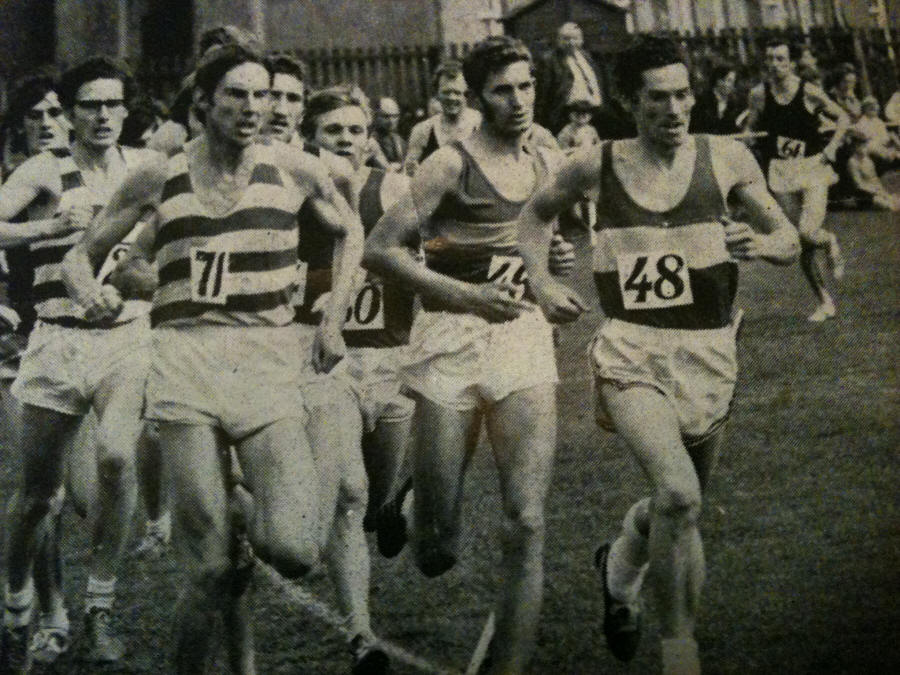
 A Kind of Who’s Who of Scottish distance running at Babcock’s Sports

Including from the left: Pat Maclagan, Hugh Barrow (71), Dick Wedlock (49) and Lachie Stewart (48).

Despite his forays South of the Border with Sale Harriers, it is impossible to think of Hugh Barrow as anything other than a member of Victoria Park AAC in Glasgow.   He wore the vest with the blue and white hoops with great pride and in all sorts of races having joined the club in 1958.   He wore it on the track, on the roads and even, although he didn’t seem to enjoy it as much, over the country.   As an example, his whole-hearted commitment to the club can be seen in his running in the Edinburgh to Glasgow Relay Race.   An eight stage relay between the two major cities which carried immense prestige, it was nevertheless left out of the programme of many good track men.   Hugh ran in 14 races between 1964 and 1979.   It was not a case of going through the motions because you were expected to do it.   His very first run in the race was on the very difficult second stage: difficult because it was the second longest and difficult because it had almost certainly the very best runners from each of the invited clubs.   It’s not one to put out a first year Under 20 athlete.   The first runner for Victoria Park was also a young athlete and he tried to shadow Alex Brown of Motherwell on the first stage – it was clear that that was his plan but he couldn’t carry it out, blew up and handed over in sixteenth place.   Hugh went out and brought the club through to seventh place in the second fastest time on the day only 20 seconds slower than Olympic 10000 metres runner Fergus Murray.   It was quite an amazing achievement.   That effort was given in all 14 races in which he raced on every stage except the short third leg.   He won two silver and two bronze medals.   He was a clubman par excellence well after his best days.    This was as true of him as a committee man as it was as a racer: he held many positions on the Victoria Park Committee and was President from 1972 – 1977 and again from 1986 – 1992.. 

Last Rangers Sports

 1962, the final Rangers Sports with Hugh in the Invitation Mile.   In front is Peter Keeling with John Snowdon, and Hugh.   Further down the track are Ken Wood, Jim McLatchie and Bert McKay.

 Hugh was known to be good right from the start.   As a Senior Boy he won the Scottish Cross Country Championship in 1960, just two years after joining the club.  On the track, he won the National Youths (Under 17) 880 yards title in 1960 (1:58.4) and 1961 (1:57.5), the Junior (Under 20) 880 yards in 1962 (1:56.4) and 1963 (1:58.0).    However, it is as a top class miler that he is best known and he actually set a World Age record for the mile of 4:10.9 in Santry Stadium in Dublin (the scene of many a world record and top class meetings organised by the showman Billy Morton) in 1961.  In the race itself he was second to  Irishman Derek Graham whom he had beaten the night before over 880 yards.   Hugh was congratulated by Olympic 1500 metres champion Ron Delany.  This record stood until 1964 until it was bettered by Dennis Carr of Lowell College with 4:08.7 but it was beaten almost immediately thereafter by the prodigy that was Jim Ryun who became an athletics legend and in fact, in November 2010, it still stands as fourth on the British All-Time lists for Under 17 athletes – only 1.3 seconds behind Alistair Currie in third.   Hugh’s times as a Junior were simply outstanding – apart from that world record – faster than any 16 year old had everrun the distance in the history of the world – he ran 4:09.1 at 17 and 4:07.7 at 18.   That was also the year when he won the AAA’s Junior championship.   Looking at the times, run on cinder tracks without the benefits of shoe technology or paced races, these would still be good performances.

IMG_7315

Hugh’s Prize when he set the World Mile Record

When the British Milers Club was founded two years later in 1963 he was the very first member.   He is still a member of this very elite club and still has Membership Number One.   The club has since been responsible for a great improvement in British middle distance running and almost every British specialist in these events has been a member.   Founder Frank Horwill is a big fan of Hugh’s running and his attitude to racing.   In the early 1960’s the UK miling scene was not in good nick at all.   The usual scene when the mile was run was ‘joggity-jog’ for three or three and a half laps before a scurry to the finishing line.   Frank was scornful of these tactics and demanded that races be run hard all the way.   In BMC organised races, pacemakers were used and even, against the prevailing heresies, paid.   Hugh seemed to agree with Frank as his running showed.   Never afraid to put himself on the line, he was prepared to ‘go’ early on if he felt that the pace was not on.   Even today, in November 2010, Frank has a special regard for Hugh.   When as BMC secretary for Scotland I organised any event – coaching meeting, race event, whatever – Frank would ask, “Is Hugh coming?   Can we get Hugh involved?”   Hugh is equally committed to the BMC and to fast miling: he sponsored meetings, organised street miles when he was with Strathkelvin District Council and took part in other events such as interviewing Steve Cram at Inverclyde when he was brought up to talk to some young athletes.

Staying with 1963 he recalls that he will never forget the afternoon where he ran in front of 130,000 fans at Hampden Park in 1963 as the prelude to Scotland beating England 2 – 0, with Davie Wilson and Eric Caldow scoring the goals.   “… although we can sometimes be a bit negative as a nation, sport keeps producing these communal moments which help bring everybody closer together,” he says.    The link between football and athletics was relatively close at that time with sports meetings being held by for example, Ranger F.C., Falkirk F.C. and with races being held before or at half time in major football fixtures to entertain the crowds.   They were of benefit to both sports giving the athletes an opportunity to race before big crowds and gain a higher profile and keeping the football fans entertained and in good spirits.   It is a pity that they stopped.   However at the end of the 1963 season , at the age of just eighteen, he appeared in the Scottish rankings for no fewer than four events: in the 880 yards he was third Senior and first Junior with 1:53.0, in the Mile he was first Senior with 4:07.7, in the Two Miles he was eighth Senior and second Junior with 9:02.8 and in the Six Miles he was eleventh Senior and first Junior with 30:23.6.    Six Miles was as far as he was permitted to race as an Under 20 athlete – even a Ten Mile Race was not permitted to one so young at that time.   Athletes living abroad were listed separately and top of that list was Jim McLatchie of Ayr Seaforth AAC with 4:07.9 which was run in America where he was studying on a sports scholarship.   The comments on the event in the ‘Scottish Athletics 1964’ booklet were: “Here again the runners suffered from the lack of opportunities for fast races: the potential is there and could be brought out if sufficient scratch races were organised on good tracks.   Barrow was clearly the best of the home Scots, but the impending return of McLatchie should bring about some interesting results.”

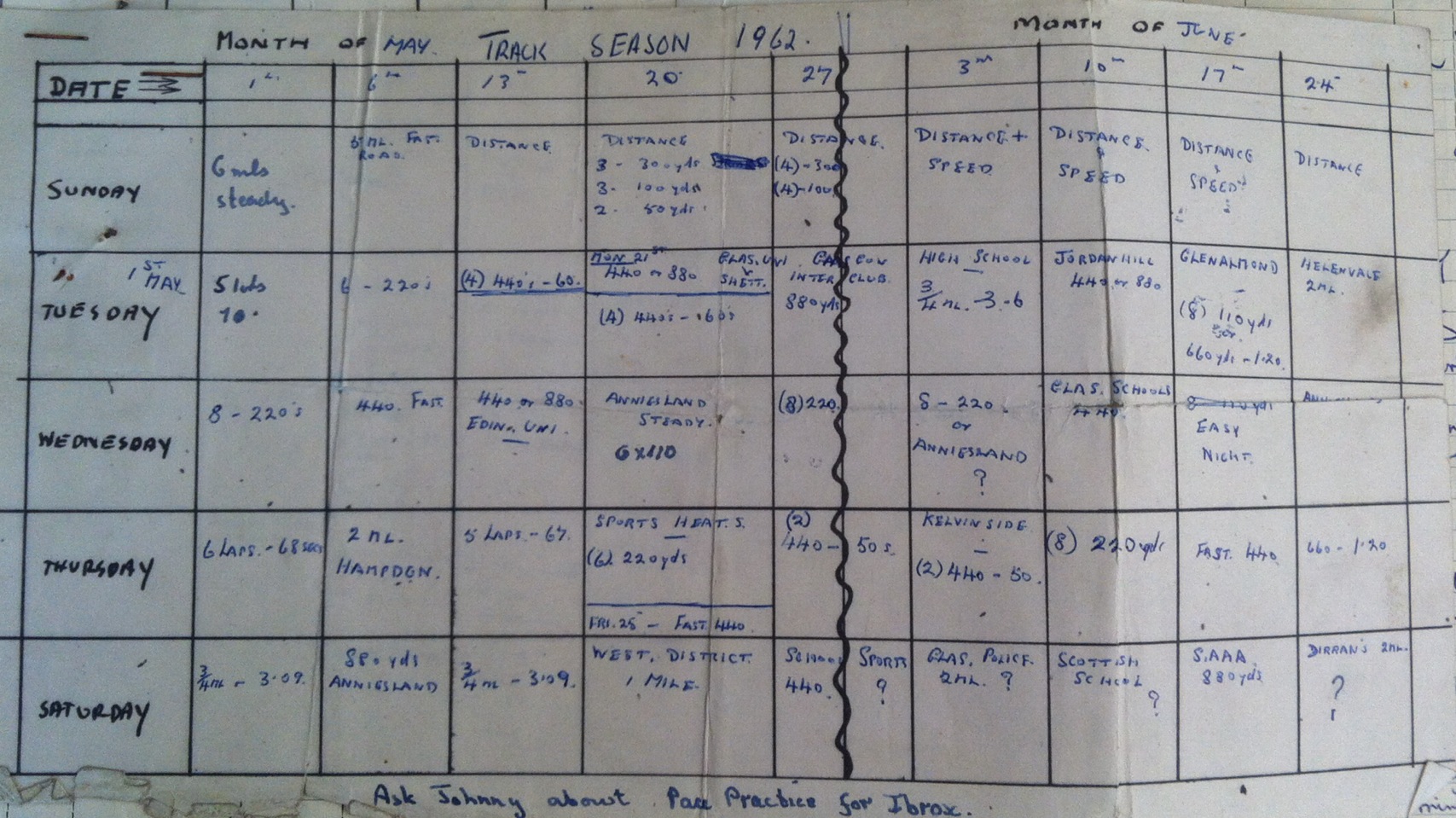
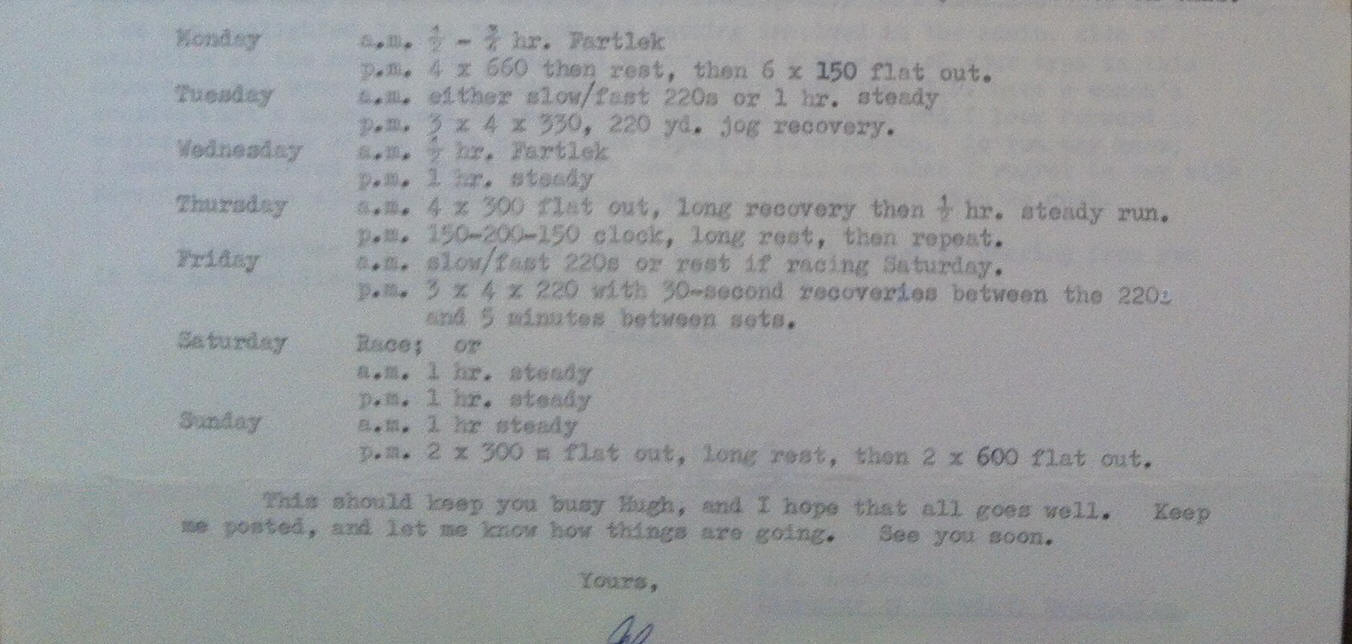
It is always of interest to runners to look at the training being done by the top men in the sport and from a viewpoint 50 years later, the work he did is still very impressive.   First of all, let’s look at two handwritten training sheets from 1962 and 1963.    The first is for his training leading up to the AAA’s Junior Championsip in 1962 in which he was second to Roger Dollimore and looks like this.

WHB Training

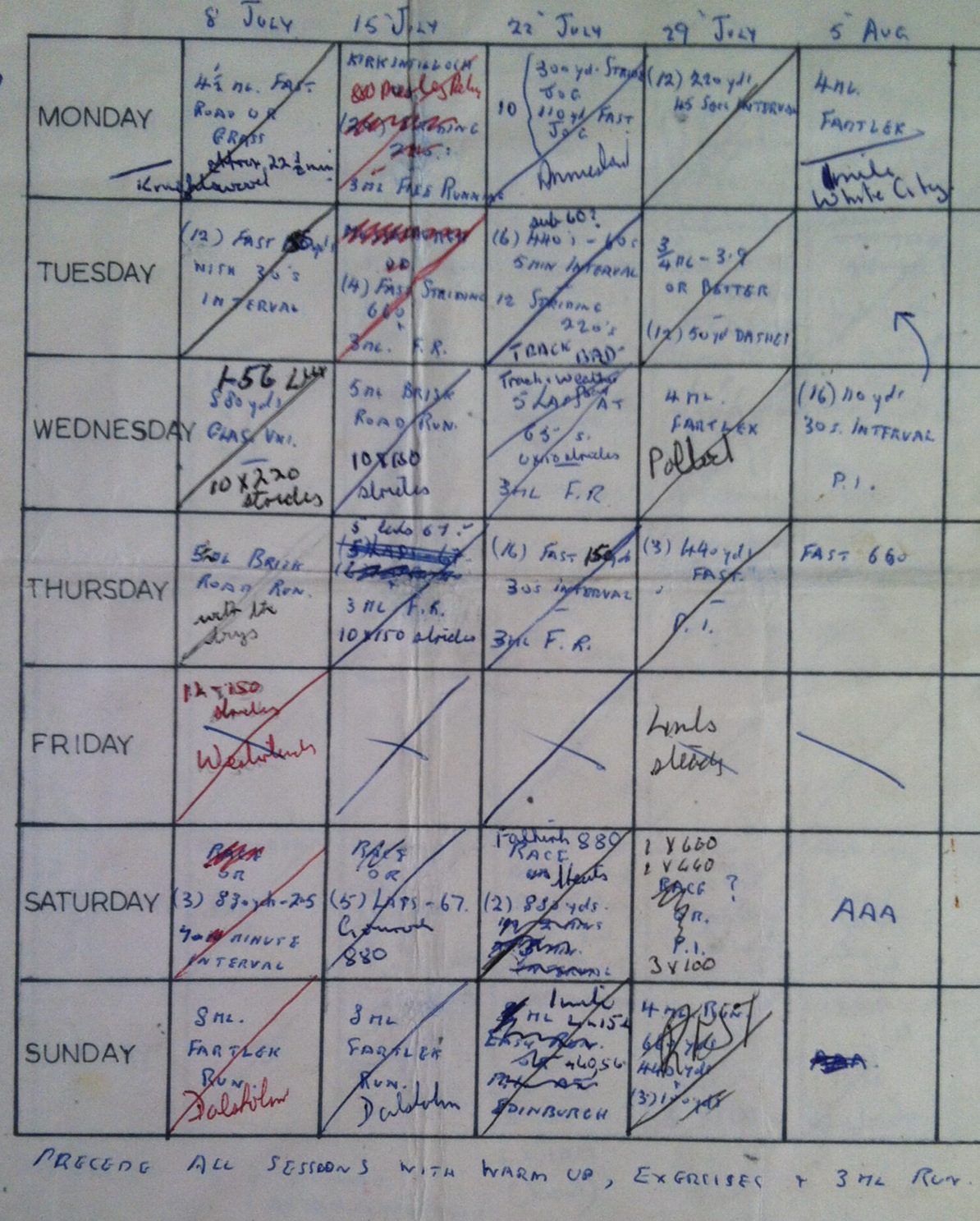
The second is from 1963 and is the run-in to the AAA’s Junior mile at Hurlingham in 1963 which he won.    These are of course the actual sheets used by him and not post-event, neatly typed out for circulation copies so we know exactly what was done.   Both of these sheets were produced by his coach at the time, Johnny Stirling at the club.

WHB Training 2

In an article for the ‘Herald’ in September 2009 by Neil Drysdale, Hugh is quoted as saying that “..it was a burning obsession of mine to become the first Scot to go under four minutes and when you have that kind of ambition, you will do almost anything to make the dream come true.”   He also points out that at that stage, Victoria Park had some fantastic competitors among their members and they would train seven days a week – and twice a day – if they had the chance.   On the Scottish stage too at that point there was a real depth of middle distance talent – Graham Everett (seven times Scottish Mile Champion, AAA’s Mile champion), Lachie Stewart (ultimately Commonwealth Games 10000 metres champion and multi record holder), the superbly talented Ian McCafferty as well as the Anglos such as Ian and Peter Stewart, John Wenk and others).    He adds,  “The memories are priceless, which is probably just as well.   At that juncture, athletics remained a last defiant bastion of amateurism and woe betide anybody who envisaged making material gains from their efforts.”   On one occasion, after appearing as a guest of Arthur Montford on STV’s “Scotsport”, and receiving the princely sum of £1 for his pains, Barrow was peremptorily instructed to return the cash or risk ostracism from the track.”    (NB: see Dale Greig’s experiences when running the Isle of Wight marathon and the letter from the AAA’s to Ryde AC).

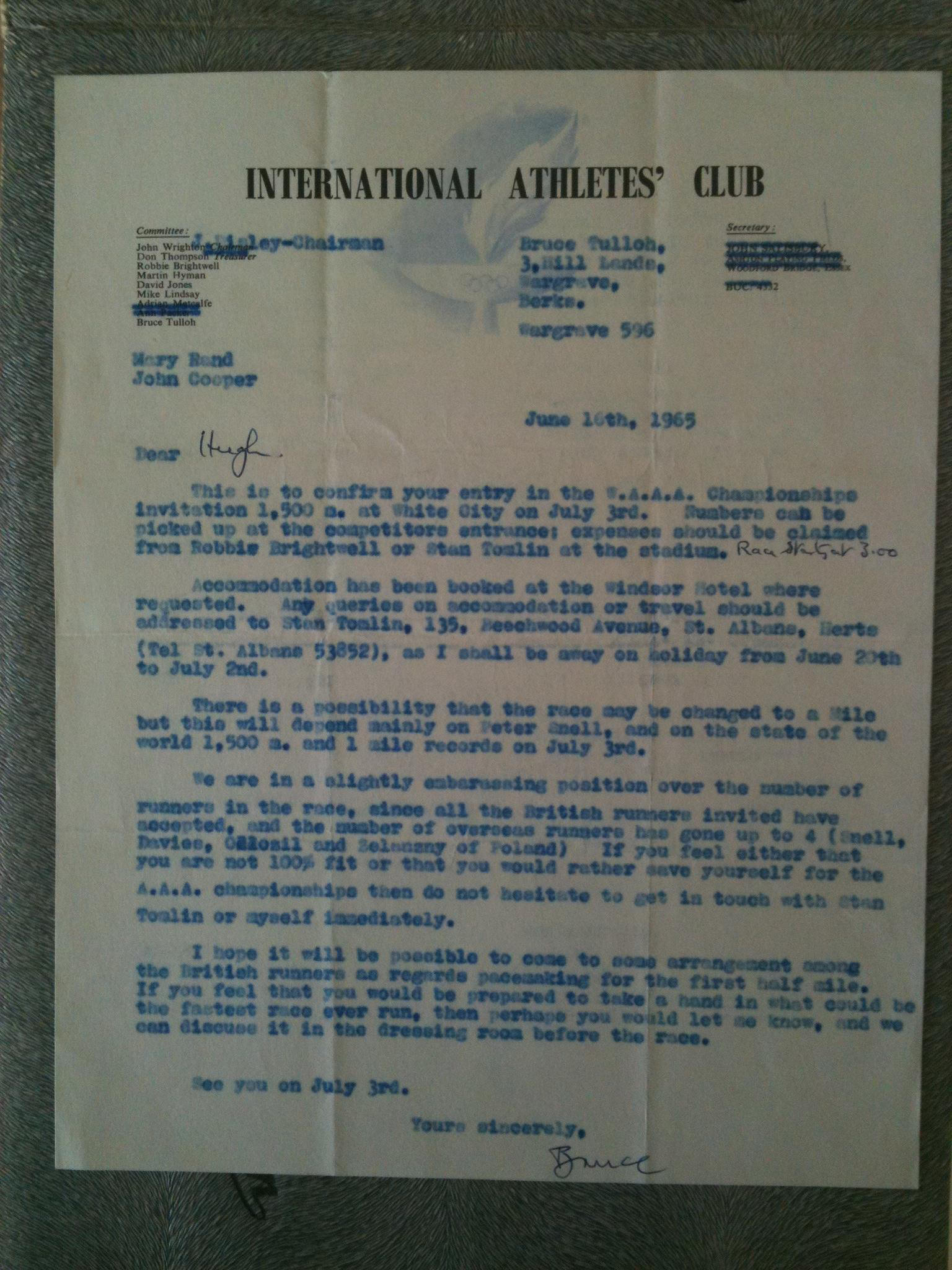
 Hugh was widely regarded as the Scot most likely to break the magic four minutes – that goes for the top men in the sport and not just the journalists from the various daily papers.   His biggest chance of all came in 1965 when, at the age of 21, he was invited by Bruce Tulloh of the International Athletes Club in London to race against World Record Holder Peter Snell and compatriot John Davies, who was also an Olympic medallist, and Joseph Odlozil of Czecholsovakia  in Snell’s last race in his British tour.    What an opportunity!!!   The invitation was what any miler in the continent, never mind the country, would covet.    And then he picked up an injury and missed the opportunity.  To make it even harder to take, five men were under four minutes in that race.  A blow like that would have ended many a career – we are fortunate that Hugh stayed in the sport.   The letter of invitation is reproduced below.

Hugh letter

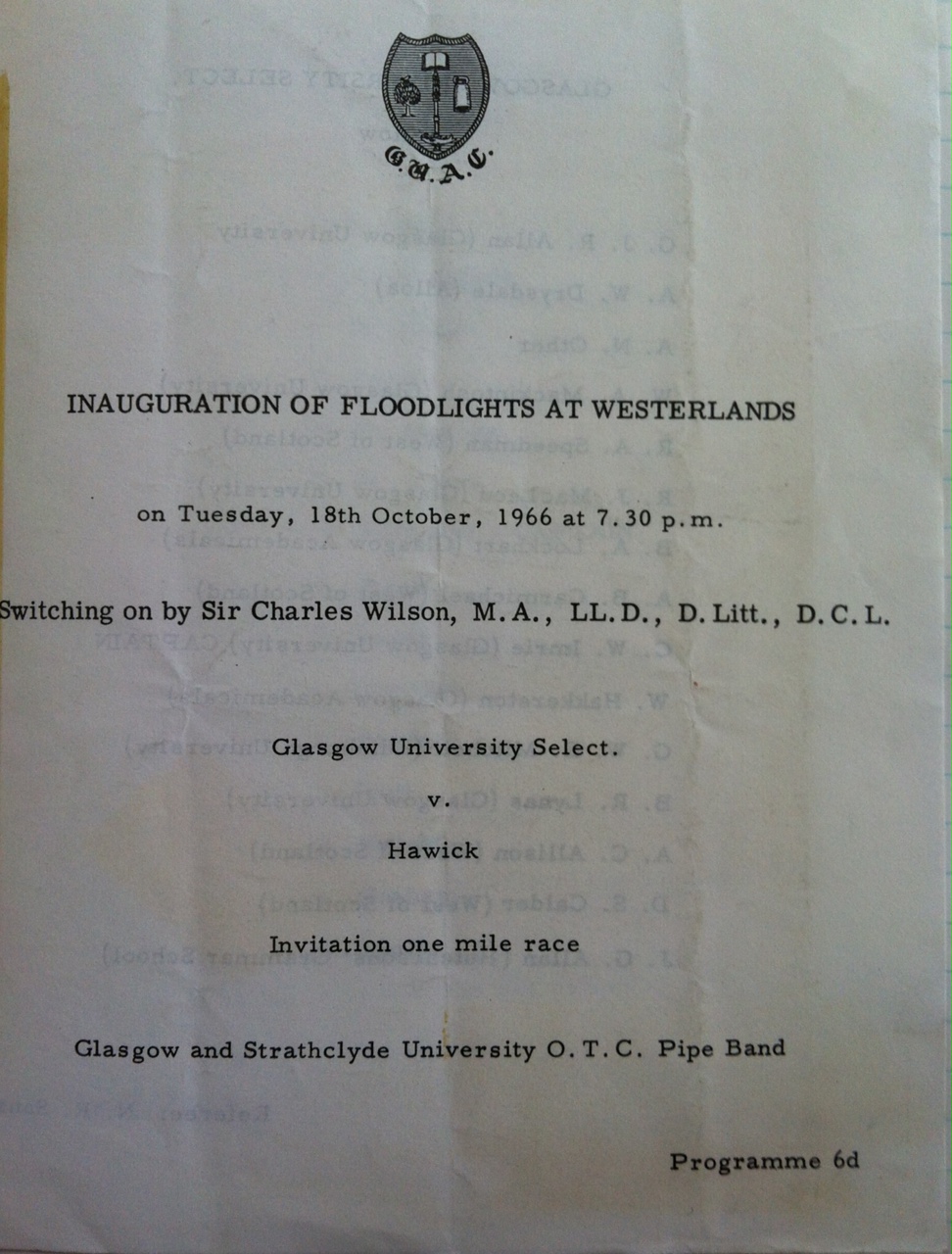
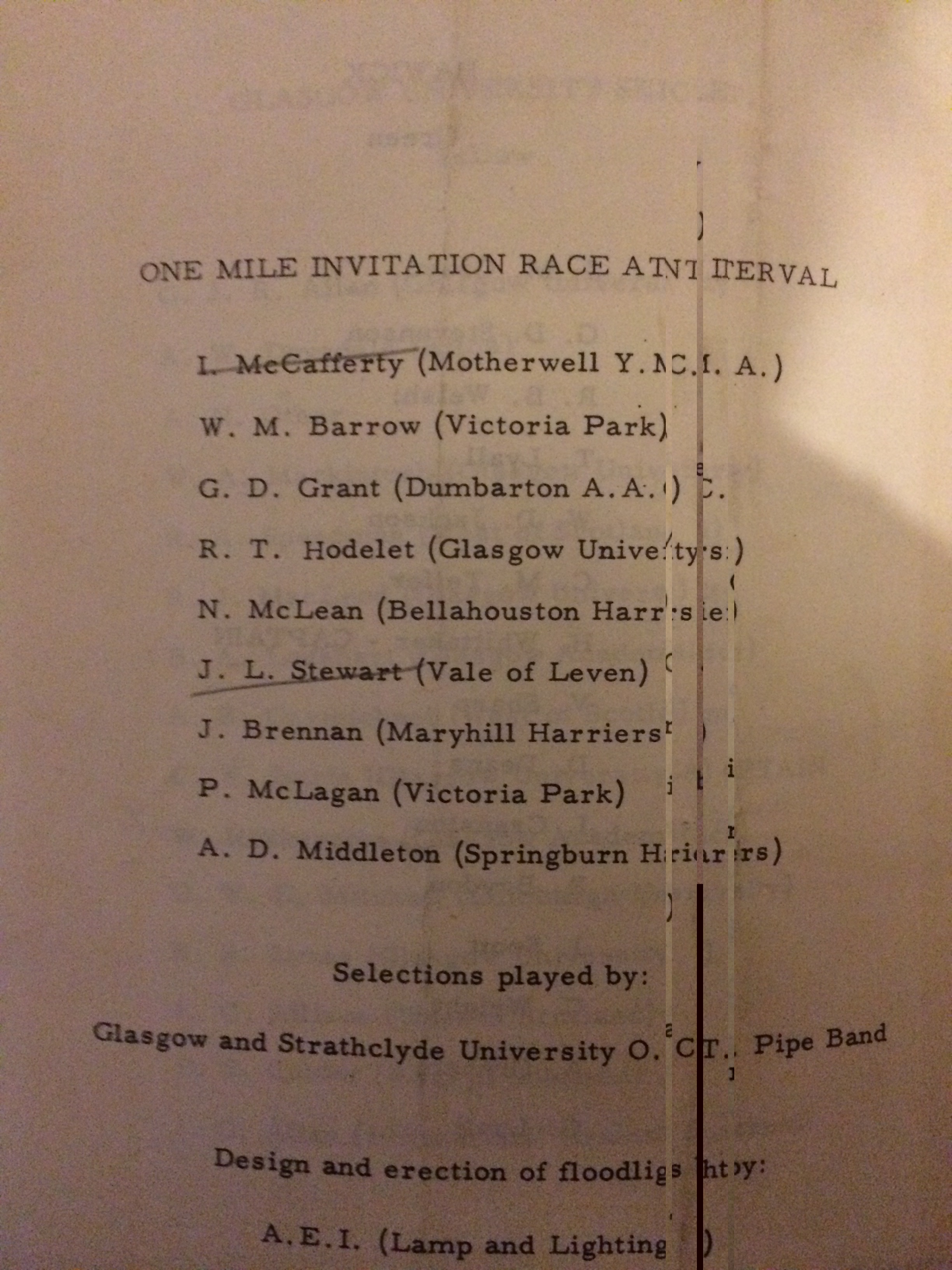
In the course of a wonderful athletics career the places he competed in were many and the incidents numerous and varied but there was an incident in 1965 which must be one of the treasured memories.   The Mile has a magic that the 1500m will never match – the Magic of the Mile, the Perfect Mile, Master Milers, Masters of the Mile and so on all helped to perpetuate it.   The simple fact of four times round the track is simpler to understand and the pace easier for athlete and layman to calculate must also be part of it and there is no mystery as to why ‘invitation miles were (and still are – note the number of Street Miles still in existence) attractive.   This incident concerns one such race.

 “In the aftermath of the Olympics in Tokyo in 1964, where both Alan Simpson (Rotherham) and John Whetton (Sutton) both made the final of the 1500m, they became the dominant force in British in the middle distance scene at a time when ‘invitation miles’ were highlights in the programme for many meetings the length and breadth of the country. However Whetton, the King of the Boards’, was dominant indoors and Simpson, the ‘Head Waiter’, dominated outdoors. This outdoors domination of Simpson led to promoters starting to lose interest in putting on invitation miles so it was felt that Whetton had to get an outdoor win over his rival to whet spectator appetite. So on a June Friday evening in 1965, we arrived at Mansefield Park, Hawick, for the Common Riding Invitation Mile. The field also included former world record holder Derek Ibbotson, along with the likes of Teviotdale’s Craig Douglas, VP’s Graham Peters and myself. It was felt that a Whetton win would help the attendance when the show rolled on to the Rockingham Miners’ Gala Day in Barnsley scheduled for the following day. On a tight five laps to the mile grass track laid out on the rugby pitch, such was the dominance of the dynamic duo, it was agreed that Whetton would edge out Simpson coming off the last bend. However Graham Peters was not in the script and boxed Whetton in. I can still hear him shout to Simpson that he had to go it alone. As commentator we had the legendary Bill McLaren and although he sure knew his rugby he was a bit off the pace when it came to running and got a bit confused by what was happening. probably just as well. For the record: 1. A Simpson 4:03.7; 2. J Whetton 4:04.4; 3. H Barrow 4:06.0

It is difficult to understand in the twenty first century the quality of athlete competing frequently in Scotland in the 1950’s and 1960’s.   For top class athletes like Hugh, the opportunity to face the best was more than welcome.   For instance when the floodlights were installed at Westerlands on 18th October 1966, the official opening involved a rugby match between a Glasgow University Select and Hawick with lots of well known names in the teams but there was a mile race held at half time, which Hugh won, where the field included four of Scottish athletics’ best ever half milers – Graeme Grant, Dick Hodelet, Duncan Middleton and Mike McLean – every one a Scottish champion, and every one a British internationalist.

WHB West Lights

WHB West Mile

A look at the table of personal best times above reveals that in what are regarded as his  peak years in his chosen middle distance events (880 yards to 10000 metres) were between 1966 and 1969.   The shorter distances (100 – 440) were achieved earlier and the longer ones (from 20000 metres up) much later in his career.   His annual progress and Scottish ranking places for the1960’s are listed below.   It should be noted that his 1964 season was curtailed through injury and that there were times when there were one or two Anglos ahead of him in the rankings that disguised to some extent his true position in Scottish athletics.

Event 1964 Rank 1965 Rank 1966 Rank 1967 Rank 1968 Rank 1969 Rank Comment
880y 1:55.5 12th 1:54.0 10th 1:55.01 13th 1:50.3 2nd 1:51.8 3rd 1:52.6 6th  
Mile 4:06.0 2nd 4:03.1 2nd 4:06.8 3rd 4:03.5 3rd 4:01.0 2nd 4:06.8 5th 1968: 11th GB
1500m                     3:48.6 5th  
2 Miles 8:51.4 1st     9:05.6 10th     8:54.8 5th      
3000m                     8:21.2 11th  
3 Miles 14:36.0 19th 13:52.8 5th 14:13.0 15th              
6 Miles         29:55.0 8th              
10000m                     29:28.0 8th  

It was a time when there were many very good middle distance runners in Scotland and Britain – the Scottish 880/800 scene had Mike McLean, Duncan Middleton, Dick Hodelet, Graeme Grant and Craig Douglas among the home Scots and the Mile had Ian McCafferty and Lachie Stewart sandwiched between the Graham Everett and Clement/Robson/Williamson eras; there were many Anglos competing too in his chosen events – John Wenk and John McGrow in both 880 and Mile with the Stewart brothers Ian and Peter being really world-class in the 1500/5000 metres events.    Competition was tough, results were hard to come by and to be Scottish Number One was a pinnacle in its own right.

“IF YOU CAN’T KEEP UP, DON’T COME OUT”

Runners and coaches are always interested in the training done by the top athletes.   When asked about it in the Scottish Marathon Runners questionnaire at the top, Hugh spoke of his approach to training and his belief that quality was far more important than quantity.   What does he  have to say about the training that he was doing during his early days?   Arriving at Victoria Park in 1958 training was simple and unsophisticated.   Winter training involved the traditional pack runs which were always of high quality but sometimes just ‘eyeballs out’ fast running.    On Tuesdays it was five or six miles and on Thursday four or two and a half miles.    The cry was apparently “No one in front of Binnie, no one behind Kane”.   (Interesting that a more formal version had been used in early days of road and cross country running where the pack was led by a designated ‘pace’ and kept in control by the ‘whip’ or ‘whipper in’ at the back)    Ian Binnie was the club top dog at the time and Ronnie Kane was an established first team runner and Scottish internationalist.   These runs were all from the Whiteinch Baths beside Victoria Park and they were all timed.   “If you lost a few seconds going out the door, you never saw them again!”   The Saturday run was again at Whiteinch or from Milngavie Laundry for six to nine miles of real cross country.   On Sundays they would go to Mountblow Recreation Ground in Dalmuir Clydebank, starting with a run up the very steep, three quarters of a mile Mountblow Road for a run along the grass island for six to ten miles or on occasion turn left and run down the Boulevard to the junction with the ‘Low Road’ back through Old Kilpatrick and Gavinburn for a very hilly route.   The training was all very simple and very hard.    Hugh recalls once asking Binnie for advice and the reply was “If you can’t keep up, don’t come out.”

The track training that he did with Johnny Stirling (see above) when he was running really well in the early days was based on Frank Stampfl’s work with Bannister, Chataway and company.    Other top runners of the time found the same source of inspiration – for instance Lachie Stewart says that the very first book on athletics he bought was ‘Running’ by Frank Stampfl which cost 2/6d when published by Four Square books in the late 50’s.   Hugh quotes sessions such as 8 x 440 in 60 seconds with a two minute recovery which was progressively reduced as they got fitter.   This was the case with other sessions such as 4 x 880 in 2:5 starting with a four minute recovery; 12 x 220 in 27-29 seconds starting with a 90 second recovery.   There were also three quarter miles time trials and the training was varied with 4 – 6 x 660 in as close to 90 seconds as possible.   Two things strike me when looking at these sessions: the first is that there is a similarity to some of the training done a couple of decades later by the best British runners and given the times that he was running off it, then if sensibly applied it is a winning formula; the second is that there were no ‘sets’ mentioned.  It was a number of reps – 12 x 220, 8 x 440, etc.    The present generation do sets, like two sets of 4 x 400 in 60 which makes the session more manageable but it is harder to do eight straight off the reel.   I have already mentioned Lachie Stewart and one of his lines when he was running well was that, in the Scottish weather, to break a session into two or even three sets meant having to do a warm up before every set!

How did he compare with others racing at the top level in the 1960’s?   The invitation quoted above from the IAC indicates that he matched up very well.    These invitations did not come to everybody – they were sent to the right people for a particular task and Hugh received a good share of them.   For instance when Kip Keino went to Dublin to have a go at Jim Ryun’s world record for the mile of 3:51 at the famous fast Santry track.   He had a call at the last minute from Dunky Wright to ask if he were available and told to fly out on a Sunday morning Aer Lingus to Dublin.   The race was at half time in a football match and the Irish pace makers were two really outstanding athletes – Noel Carroll and Derek McLeane!   The field went off like madmen and Mike Wigg of England collapsed on the last lap causing Hugh to hurdle him.   Keino he says was a real gentleman, stood on the starting line looking down the track, Hugh says staring into eternity, jargon now would diminish it to ‘focused’ or some such, but the wind beat him and he only managed 3:56.   Hugh missed the four minutes but the point being made here is that he was frequently invited to compete in that kind of company.

After being very successful with the coaching being done by Johnny Stirling, things started to get a bit stale about 1966.   In such a situation, a runner always tries to analyse the situation himself apart from discussions with other athletes, officials and coaches.   If the athlete is any good, every other coach wants a bit of the action and it can be very confusing.    I knew a very good runner who went to live in London and he was approached by one club which said that he was too weak on the left side, they could help him by strengthening the other one, a second club said that the problem was alack of the proper balance, they could help with that and yet another said that the whole difficulty was with his weak back.   This advice can all get too much and in that situation, the safe thing often seems to be to go to the national coach and see what he thinks.   However it worked out in Hugh’s case, he asked John Anderson, who had a very good middle distance squad indeed and started training with him.    The work done altered and I reproduce part of one of his letters to Hugh which contained training sessions for him to carry out.    There was regret at leaving Johnny who had done so much for him in the eight years they had been working together and the athlete coach relationship is a very special relationship, different from any other in sport.   There was however no regret at moving to work with John at that point – he learned a lot from him too.

WHB More Training

Through the 1970’s Hugh’s interests broadened and he gradually started to do more and more road running covering distances right up to the full marathon distance.  He was known to be a good road runner over short distances such as the McAndrew Relays where he had set the fastest time, and up to 7 miles in the Edinburgh to Glasgow.   He simply extended his range to 26+ miles!  The personal best times for 20000 and 30000 metres were recorded in a SMC race held at Coatbridge organised by John Softley.   He also of course continued to race cross-country for his club and to turn out in the Edinburgh to Glasgow Relays right up to 1979.

As will be noted from the above his last pb was set in 1980 and he continued running on the roads and country after that but his main contribution to the sport in the 1980’s was the prodigious amount of work done in encouraging and organising events.   As Scottish Secretary of the BMC I had received a fair bit of assistance from him and when I wanted to organise Coaching Days, he was able as Recreation Manager at Strathkelvin Council to help in various ways by finding us appropriate accommodation at Huntershill and at the Bishopbriggs Sports Centre.   On the three occasions when Frank Horwill travelled up from London to take part, he was put up by Hugh.   Then when the Springburn 12 Miles Road Race became the Strathkelvin Half Marathon and then, after sponsorship by the firm was obtained, the Luddon Half Marathon Hugh along with others such as Alistair McFarlane and Alex Johnston, worked really hard to make it a success.   I believe that t was the most sponsored race in Scotland with many prizes – all of them of good value although some were kind of quirky – eg the winner of the Under 17 Street Mile one year won a year’s supply of mince and tatties!     After the first ‘Luddon’ he wrote of the experience in an article in the SMC magazine.  I quote (selectively) from it.   “I am sure that Alistair McFarlane will agree with me when I say that we both learned a great deal through this first attempt at promoting a large scale race.   The support that I received from the various Departments of Strathkelvin Council was much appreciated and linked with help from Glasgow District Council and a wide range of voluntary organisations assisted in making this event a success, not forgetting the ever-present and long suffering race officials.   There were several problems that we did not anticipate such as the ‘Half Marathon’ debate with the SAAA and the guidelines laid down by Strathclyde Police Traffic Section.    The start time of 9:00 am was not negotiable and with race fields across the country ever increasing this may be one of the factors that race promoters will have to face.   The police also required us to erect some 120 road signs and this led to expenditure of approximately £450 via the Automobile Association…. ”   Hugh goes on to detail several other problems, thank the volunteer organisations who had offered assistance and says that “… within 20 minutes of the manual input being edited the computer printout was available and the results were published in the Kirkintilloch Herald on the Tuesday following the event.”     That gives us a flavour of all the work that had to be done by Hugh and Alistair and was done willingly right up to the race and afterwards in planning for the next year.   It really was a marvellous race – large fields, many top class runners every year, enough car parking, more than adequate stewarding and well-organised reception and number issuing procedures.   There is more about the genesis of this event on Alistair McFarlane’s page on this website.

Given the success in its first year, Hugh then decided that a Street Mile would be good for the runners and would be an extra attraction for sponsors while entertaining the spectators once the half marathon was out on the road.   He invited me in to his office in Bishopbriggs and we decided that it would be invitation only, that there would be races for Men, Women and Under 17 Youths.   The Youths would run with the Women to give the top athletes a hard race.   The course came from Lenzie in the straight Kirkintilloch Road and apart from the sharp climb up to the shops in Lenzie was almost entirely downhill.   Liz Lynch (later McColgan) won the Women’s race in the first and third years, Yvonne Murray in the second; the Men’s race had such stars as local hero Adrian Callan, fellow sub four minute miler Alistair Currie, GB steeplechaser Dave Baptiste from London, Tom McGrath the Irish Internationalist, Sam Wallace, the top Under 20 1500m runner in GB at the time and the Youths race had Glen Stewart, Frank McGowan, Bobby Mooney and several others of good quality.   The responsibility for the course, marking, starting, time-keeping, recording and of course accommodation (which for the milers was at Lenzie Rugby Club with their own showers and a bar available!)  were all dealt with by the Organising Committee.

Although he did not do it on his own and others on the Committee put in as much effort, Hugh’s contribution was equal to any and was an indication that his enthusiasm, energy and devotion to the sport had not waned in any way.   And of course he was still on his own club Committee until at least 1992 and was also a member of the SMC Committee while organising the Strathkelvin/Luddon Half Marathon.

When he left his post at Strathkelvin District Council he was very quickly snapped up by the West of Scotland Football Club (ie a rugby football club) as Secretary and was very successful there, had a year as President of the Glasgow Accies club.   Secretary of the Glasgow Hawks from 1997 to 2007, he was President of the Accies from 2007, 2008.  He also has responsibility for both the Glasgow Hawks and the Accies websites.   His interest in athletics has never diminished – when we had the BMC Grand Prix in Glasgow in the early years of the new millennium, Hugh was there meeting old friends, enjoying the races and generally having a good time.    Hugh was a top class athlete – and much more.

I have referred to Neil Drysdale’s article on Hugh in ‘The Herald’ – the entire article can be found at  www.glasgowhawks.com/news/6913  and is well worth reading.    It is an excellent portrait of Hugh as a person and of the breadth of his sporting interests.

Hugh was still working with the Hawks and vitally interested in sport when the Commonwealth Games came to Glasgow in 2014.   He was one of the first volunteers to work on his third Commonwealth Games and was also one of those chosen to carry the Games Baton.    Before he did so, Kevin Ferrie wrote an article in the ‘Herald’ which makes very interesting reading and you can find it at

www.heraldscotland.com/mobile/sport/commonwealth-games/cwg-news/a-largely-unsung-stalwart-of-scottish-sport-hugh-barrow-was-quicker-than.24811624

WHB Youth


Hugh answers the BMC Questions   Colin’s Cuttings   The Frank Horwill Award


Ken Ballantyne

Ballantyne,%20Ken[1]

Kenny Ballantyne in the Edinburgh to Glasgow

Ken Ballantyne was a very talented and elegant runner who had a remarkable track career as well as being a top quality road and cross-country man.   If we lay out his annual track rankings as a senior we get a grid like the one below, notable for its range as well as its quality.

Year 880 Mile 1500m 2 Miles 3 miles 5000m 6 Miles
Rank Time Rank Time Rank Time Rank Time Rank Time Rank Time Rank Time
1959 23 1:58.4 12 4:15.9
1960 14 1:56.8 8 4:16.2
1961 10 1:55.2 7 4:14.4 15 9:19.0
1962 12 1:54.9 7 4:10.9
1963 27 4:19.5
1964 18 1:55.7 3 4:07.3 17 9:12.0 23 14:19.6
1965 6 1:53.2 1 4:01.1 6 9:00 14 14:07.0 18 30:38.0
1966 7 4:08.5 2 3:15.6 5 8:51.0 13 4:08.6 16 30:15
1967 14 4:10.9 22 9:09 16 14:05.8 16 30:02.2
1968 22 4:18.0 28 14:23.0 22 31:16.0
1969 29:52.8
1970 26 3:57.6 21 14:39.8
1971 29 3:59.3

It was a very good career over a long period of time spanning two distinct eras of Scottish middle distance running.   It went from the heyday of Hugh Barrow, Graham Everett, Graham Stark, Jim McLatchie and Mike Beresford through to the days when the likes of Ian McCafferty, Lachie Stewart, Ian Stewart, Frank Clement and Adtrian Weatherhead ruled the roost; from the days when the four minute mile was a rarity, perhaps even a dream, to the days when it was almost commonplace.   You will see from the comments at the end of Colin’s tribute to him what the opposition thought of Kenny Ballantyne. 

Kenny Ballantyne enjoyed an illustrious running career and inspired many club-mates in Edinburgh Southern Harriers, a top Scottish club which he served with distinction, as athlete and official. He was a great competitor, invaluable in team events, and always friendly and encouraging – a true gentleman.

In the Scottish Junior National cross-country, he won team silver in 1961 and followed that in the Senior National with team gold (1964, 1965 and 1969), silver (1967 when he finished ninth) and bronze (1966 and 1968). Kenny was also very effective in the Edinburgh to Glasgow Road Relay. His first team medal in the event was in 1961 when ESH finished second with Kenny recording the fastest time for Stage 8, when he broke the record. His team was again second in 1963 and third in 1964. In 1966, Kenny was fastest on the prestigious Stage Two, in front of Hugh Barrow, Andy Brown and Alastair Wood. There was another bronze in 1968 and finally the longed-for gold medal in 1969. In 1970 ESH were squeezed into second but Kenny was fastest on Stage 8. A final bronze followed in 1971.

Kenny was even more successful on the track, representing Scotland every year from 1961 to 1966. His best distance was One Mile/1500m and, on the 21st July 1965 at Motspur Park, he raced a mile in 4.01.1, which at the time made him the fastest-ever Home Scot and topped the Scottish rankings that year. Donald Macgregor, who was to finish seventh in the 1972 Olympic marathon, relates in his autobiography that he was training with his ESH club-mate Kenny around then, and that they had changed over to Arthur Lydiard style training, doubling their weekly mileage from April onwards but taking care not to run too fast until closer to an important race.

In 1964 Kenny Ballantyne won the SAAA Mile title. He gained another one silver and three bronze medals in the event. In addition, he was East District Mile champion in 1965, 1966 and 1968.

Kenny’s other personal bests included: 1.53.2 (880 yards), 8.51.0 (2 miles) and 14.05.3 (3 miles).

Steve Taylor (Aberdeen AAC former SAAA 3 miles champion and Scottish Cross-Country International) says “I regard Kenny as a gentleman, a stylish runner and a true friend to me throughout my athletics career. I recall my first meeting with him was in the unlikely setting of the start line before a heat of the National Championships mile, when heats took place on the Friday evening. He told me that his parents lived in Burns Road, Aberdeen, which was close to my home at the time!” 

Old rival Jim McLatchie comments from his home in the USA. “Ken and I locked horns several times over the mile and were on a few Scottish teams together. Tough bugger – I took him for granted in the 1959 Junior Mile Champs where I thought I would win the race, but Ken had a different idea – he ‘kicked’ my arse! He took off about 880 out, and I thought he went too early and I would haul him in over the last 100 – never happened – I left it too late. Credit to him for running a smart race. We would always have a good banter at track meets – East versus West bullshit – how they (East) were better than the West of Scotland, so when we went head to head in a race, I always felt I had to keep the West in front.”

Club-mate, Alistair Blamire (GB Steeplechase International) says “Kenny is a lovely guy and I always thought that he was a much better athlete than even his fine record suggests, especially if he had been able to compete more often down south. He was a legend at ESH, along with the other ‘Southern’ fanatics like Jackie White, Ian McKenzie, Jim Heggie, George Peat and co.”

Contemporary and rival, Hugh Barrow says: “Kenny was a man of his era : athletics was hugely important but not to the detriment of his career outside running.   He sort of symbolised the amateur era – hugely competitive and dedicated but always in perspective.”

Ken’s obituary after his death in 2016 is below:

      KEN  BALLANTYNE-ATHLETE OBITUARY:   Born:15th October 1940; Died 10th November 2016

             Ken Ballantyne who has died aged 76 was a leading Scottish international athlete of the 1960s who very nearly became the first home-based Scot to run a sub 4 minute mile. At the time breaking the mythical barrier was not commonplace and only one Scot, Anglo Mike Berisford, had achieved it. On 21st July 1965 while competing in a British Milers’ Club race at Motspur Park in Surrey, Ballantyne was clocked at 4mins. 1.1 sec, the fastest ever by a home Scot. He was Scottish champion over the distance in 1964, placed in the first three several times, and won the Eastern District title on three occasions. Although the mile was his best event, he was a quality runner over a wide range of distances, good enough  to feature in the national ranking lists each year from 1959 to ’71 at half mile to six miles.


He was a stalwart member of Edinburgh Southern Harriers for whom he competed with distinction at the top level of the Scottish and British Leagues, scoring many valuable match points. Between 1961 and ’66 he represented Scotland eight times in international contests against countries including Wales, Ireland and Belgium.


Away from the track, he also excelled at cross country and road running. With his ESH team he won three gold medals as well as bronze and silvers in the National Cross Country Championships. He shone in the famous Edinburgh to Glasgow road relay, winning a coveted gold medal in 1969 and several lesser medals. On three occasions he recorded fastest stage times including over the prestigious second one in 1966 when he beat leading runners Hugh Barrow, Andy Brown and Alastair Wood.


Once he stopped competing he joined the ESH committee and became their British League assistant team manager before taking over from Jimmy Smart in 1982. During his involvement the club enjoyed a period of considerable success throughout the U.K., competing with distinction in the first division of the British League and in 1975 winning the British Gold Cup. As a dedicated and selfless official he contributed much to the club.


Born at Kalimpong near Darjeeling in India, Ken’s father was manager of a tea planting estate owned by the Duncan company where he and his wife had lived for several years. The family enjoyed a fairly privileged lifestyle with house servants and a nanny who helped look after Ken and his sister Aileen. Aged six he was sent here to be educated, initially at Blairmore prep school near Huntly where his running talent first emerged. He then attended Strathallan School where he gained his first notable success winning the Scottish Schools’ Championship mile in 1958. The following year he won the Scottish junior mile title setting a championship best, smashing the record by almost five seconds, equivalent to about thirty yards.


Taking up a position as trainee manager with the Commercial Union insurance company in its George Street office in Edinburgh he joined ESH, which was to play a large part in his life. He trained initially at various venues including old Meadowbank and Inverleith Park with teammates Ian Mackenzie and future Olympians Fergus Murray and Donald McGregor. Like many at the time he was self-coached, learning training methods from books, latterly a disciple of Arthur Lydiard, the famous New Zealand coach.


There is no doubt that had he been exposed more frequently to the high calibre of opposition faced in his 1965 record run, he too would have broken the 4 minute barrier. His win four days later in the invitation mile at the prestigious Sward Trophy meeting at Chiswick supports that contention.


In September 1967 he married Doreen Hamilton, originally from near Penrith, whom he had met socially in Edinburgh and together they enjoyed a long and happy marriage, bringing up daughters Julia and Nicola. Appointments as branch manager at Hawick, Kelso and Berwick followed till he took early retirement from Commercial Union. He then joined Lowland Insurance Brokers in Berwick where he was particularly valued for his agricultural insurance expertise, becoming a director of the company till it was bought over by a national concern.


Through his work he was well known among the farming community in the Borders and, having lived mostly in Kelso for the past forty years, he played a full part in the life of the town, being a former chair of the Round Table, and member of Probus and the 41 Club. He was also an enthusiastic supporter of Kelso rugby club and attended their game a week before his death.


Unfortunately his quality of life latterly was marred by ill health requiring surgical intervention and regular medication, which was particularly cruel for one who had been so fit and active. He  remained positive and was much respected and well liked by people from all walks of life. His friend and fellow athlete Ian Mackenzie commented, “Ken was a very affable and friendly man who did lots of good work for the various organisations he was involved with, always giving 100% in all he did. As a runner he was a seriously hard trainer and one of the best athletes of his time.”


Despite his achievements he was extremely modest, with many of the large turnout at his funeral unaware of his sporting pedigree. He is survived by his wife, daughters and sister.


Jack Davidson

Ian Archibald

IA Isle of Man

Ian (Number 42), third from Left in Isle of Man with the GUAC team

It is maybe appropriate that Ian is with the Glasgow University team in the picture above because he was always a very popular athlete with his peers and was a key member of a very good Glasgow University squad.    I first met him when he was a Junior and one of a quartet which included Alastair Douglas and two athletes that I was coaching at the time: Douglas McDonald (on the left above, number 42) and Robert McWatt a Scottish Junior Internationalist who emigrated to Canada in the early 80’s.   Although he had a successful career with Scottish Championships and British medals to show for it, he was the kind of athlete that always felt could have possibly done even more.    Maybe Alastair Douglas in his comments below will be able to throw some light on that point.

Year Event Time Ranking
1980 800 1:50.42 4
  1500 3:48.94 8
  1 Mile 4:06.0 4
  5000m 14:45.5 17
1981 1500 3:51.7 16
1982 1500 3:47.6 8
  5000 14:34.0 16
1983 1500 3:42.39 2
  1 Mile 4:03.9i 6
  3000 8:02.9i 6
1984 800 1:52.0 14
1985 1500 3:49.99 13
  1 Mile 4:02.4 4
  3000 8:15.0 12

Personal bests of 1:50.42/3:42.39/4:02.4/8:02.9 and 14:34 are not too bad at all so we now know that he could run fast.   In terms of his competitive record, Ian won the Scottish 1500m championship twice – in 1980 and 1983 – and was second in the AAA’s indoor 1500m in 1983 and third in the British 1500m in the same year.    In the course of his career he ran for East Kilbride AAC, Glasgow University AC, Durham University AC and Worcester AC but the next section of this profile is written by his old friend Alastair Douglas.

IA France

Ian, second right, behind Alastair Douglas,  in Paris in 1980 on a University trip.

“Ian and his two brothers Derek and Robin were all talented runners as was their father before them.   Ian was slightly different in that he was a middle distance runner rather than a sprinter like the others.   He started running at about age eleven and tended to train only a couple of times a week but did very well on that.   He had a rather ungainly running style with a wobbly head which made you feel more annoyed when he beat you.   Added to that he was not short of self confidence and spoke his mind.   However if he did beat you, rather than saying how well he was running, he would slag you off for not being able to beat him.

I remember running against him in the West District Junior 1500m championship.   I did in fact beat him in this race.   It was the first time I had ever got under 4 minutes and was quite pleased with myself.   However I felt quite deflated when speaking to Ian afterwards.   He had only finished three seconds behind me and was saying he couldn’t understand how I was not further ahead of him when I trained seven times a week and he only twice a week.   The thing is, you knew he had a point!

I got to know him a lot better when we were at Glasgow University together.   Inevitably he started training harder when he was in an environment of good standard runners and not surprisingly his performances started to improve rapidly.   Within a year of his increased training he won the SAAA 1500m and BUSF 1500m in 1980.   I remember a lot of his English rivals were not especially amused when he did a lap of honour, after the latter race, with a cigar.   He had three or four really good years when he won a second Scottish title at 1500m: this time he beat no less than Nat Muir and John Robson.   He also won a UAU title. was second in the AAA indoor championship 3000m and third in the UK Championships at 1500m

Although 1500m was his best event, he was a threat to anybody over anything from 800m to 10K.   After leaving Glasgow University, he did a PhD at Durham University.   He joined Alan Storey’s training group which included Olympic medallist Mike McLeod.   I don’t think Alan felt that Ian took his athletics too seriously.   There was once when Alan warned John Solly – the 1986 Commonwealth 10000m champion – not to race Ian over 1500m as it might undermine his confidence as he prepared for the Commonwealths.   However he did race him, and Ian beat him.   However as Solly went on to win the 10000m at Edinburgh perhaps Alan Storey’s fears were unfounded.   One of Ian’s best races he feels was over a distance much longer than he would normally race.   This was over 7 miles and was again against John Solly.   Ian again beat him.   However it was not simply a case of hanging on and winning in a sprint: he basically took more than a fair share of the pace and dropped him wit a few hundred metres to go.

In the late 80’s he briefly dabbled in the professional circuit and in fact was a British Professional 2 Miles champion.   Ian like many of us, was born into an era of exceptionally talented Scottish athletes.   Nat Muir, John Robson and Graham Williamson in particular were world class and so perhaps he did not get the credit he deserved.”

,Alastair speaks of the victory in the 1500m in 1980, well the moment when, after tucking in behind on the bend he moved out to go in front were captured by Alastair Shaw.   The pictures below can be enlarged by clicking on them – thanks Alastair!

Alastair ends his review of Ian’s career there and it gives an interesting insight into the athlete.   What is missing however is any reference to regular cross country or road running and from the list of ranked performances above, it would seem that he was a pure middle distance runner over 800m to 5000m, anything longer being the exception rather than the rule.   The big Scottish winter race was the Edinburgh to Glasgow eight man relay.   Surprisingly he only seems to have turned out in two races – in 1978 he ran the seventh stage and in 1980 he ran the very difficult second stage but in each of them he held his position in the field and in neither was he inside the top ten times.    When I asked Alastair about Ian’s cross-country running he said, “he was much better on the roads than on the country and in the year that I won the Junior National in 1981, I raced him in the Scot Unis on a flat, fast, dry course.   I won and he was second but it was very close.   On that form he would certainly have medalled in the Junior.”   In the race below, the National of 1987 at Falkirk, he finished fourteenth in a quite outstanding field – Nat Muir, Chris Robison, Tommy Murray, Neil Tennant, John Robson and many more top athletes.    This was his best result in a race that he tended to avoid although on this showing, and on Alastair’s testimony, he could have done well.

Archie_1

archie_2 (1)

archie_3

Ian (384) in the East Kilbride colours in the National of 1987: the lap-by-lap story!

I suspect that Ian would not want to dwell on cross-country since he reckons that “cross-country should be for convicts for whom the birch is too good!”    Another of his thoughts, by the way, is that anyone over the age of 25 should be banned from athletics: “grown-ups shouldn’t like beating people.”   Back on the Track we could take a closer look at the two seasons when he won the SAAA 1500m title: 1980 and 1983.   The 1980 championship win in June 1980 (3:48.4) was he says his most memorable win – he was just 19 and he was enjoying training with Alby Smith of Victoria Park.    Two weeks later he picked up the British Universities 1500m in 3:50.9.   Two good races but his pb for 800m was yet to come.   The Edinburgh Highland Games had been a wonderful mix of international athletes and local Scottish handicap events held at Murrayfield where locals could run shoulders with Olympians.   After the Commonwealth Games in 1970 however, it became an International Event only and incorporated   internationals or inter-city contests.   In 1980, sponsored by The Glenlivet, the match was between Warsaw, London and Edinburgh.   Ian was Edinburgh’s representative in the 800m and the opposition was good: Gary Cook (London),   Owen Hamilton (Jamaica), Stanislaw Rzeniaczak (Warsaw) and Mark Enyeart (USA).   Ian responded to the challenge and set what was to be his all-time pb of 1:50.42 for the distance.   All-in-all a good season – but nothing like as good as 1983 was to prove to be.

He started the year with two British international vests.   On 19th February running indoors for Great Britain against West Germany indoors at Dortmund, he was third in the 1500m in 3:44.67 – a very good indoor time, and four days later in the GB v Russia indoor match at Cosford where he was second in a pb for the 3000m distance of 8:03.92 which must have been an even better run.   The outdoor season that year started on 2nd May with a win in the English Universities 1500m in 3:52.4.   At the end of the month he was third in the UK Championships 1500 in 3:45:95.   These set him up nicely for the SAAA Championships on 18th June where he won the 1500m in 3:42.39 which was another pb.   The Scotland Six Nations International is a nice meeting – at one time called ‘The Small Nations’ international – which used to be between Scotland, Wales, two Irelands, Turkey and Israel.   Israel has now dropped out but at that time all six were competing and they were hard fought competitions – it wasn’t often that any of them had the chance to win any international match,   Ian, in his third representative match of the year and his only one for Scotland, was disqualified for pushing.   It happens in 800m races all the time and the runners expect it: to disqualify an 800m athlete for it seems a bit harsh!

He went on racing on the Scottish scene and then in England when he was at Durham.   He is on record as saying that his favourite races were handicap races where everyone could compete and challenge for first.

Alastair referred to the British Professional Two Mile Championship.   Ian says, “It was the British Professional 3200m championship held at Inverkeithing on 4th August 1990.   I was first in 9:09.47 which was a new record (the old times were for Two Miles) and I think I still hold the 3200m record.”    Indeed he does – the run was on a a 400m red ash track and was not the only victory he had on the professional circuit where he raced in 1990, 1991 and briefly in 1992.    I have his other winning marks in the table below.

Year Distance Venue Handicap Time
1990 800m Ballater Scratch 2:09.9
  1600m British Championship: Inverkeithing Scratch 4:33.87
  1600m Kelso 45m 4:23.87
  1600m Dornoch Scratch NTG
  1600m East Lothian 15m 4:14.56
  1600 Pitlochry Scratch 4:24.9
  3200m Peebles 65m 9:27.3
  3200m Airth Scratch 9:25.38
  3200 Pitlochry Scratch 9:42.33
1991 800m Luss 25m 1:56.7
    St Ronans 15m 1:59.3
  1600m Kelso Scratch 4:21.81
  1600m British Championship: St Andrews Scratch 4:38.54
  1600m Perth Scratch 4:19.95
  1600m Pitlochry Scratch 4:22.09
  3200m Burntisland Scratch 9:43.72
1992 3200m British Championships: Inverkeithing Scratch 10:02.0

That is a comprehensive record of his victories on the Games circuit and we know that as an amateur he had run at Strathallan and other Games Meetings.    It is clear that he was equally adept on all surfaces – road, country, tartan, grass and red gravel tracks.   Ian and his group of friends all seemed to be enjoying their athletics; some took the sport more obviously seriously than others but there is no reason why you can’t plan, train and do your best and have a good time doing it.   Of all the profiles on the site, over 150 now, Ian is the one who comes across as enjoying the sport for its own sake maybe most of all.   It’s a real pity he stopped as early as he did.

Ian winning at Pitreavie, 1990/91

However, the Archibald family was not lost to Scottish national sporting teams.   One of the top home performers in the 2014 Commonwealth Games in Glasgow was Katie Archibald, his cyclist daughter.   She really caught the imagination and if you want to read an excellent article about Katie, and her Dad, there is an excellent article from the ‘Herald’  at this link:

http://m.heraldscotland.com/sport/14290526._Father_from_hell_drove_Katie_Archibald_to_success_as_cyclist/


Perth to Dundee

P-D 51

The start of the Perth to Dundee Race in 1951

There have been many classic point-to-point road races held over the years and several of them lasted for a long time before being lost.   A change of course in any race that is a feature of the athletics calendar is regretted but the consolation is that the race itself is still in existence.   When a real classic disappears altogether then it is, to all runners, a tragedy: there is always the feeling that we are not keeping faith with past generations who  promoted it, but even more that we will never have the chance to run in it ourselves.   The race from Perth to Dundee was just such an event.    Competitors included Olympic athletes, British and Scottish marathon champions and British and Scottish internationalists.   We are indebted therefore to Alex Wilson for this account which is the result of a great deal of research and represents an abridged version of his own complete account which may see the light at some point in the future in book form.   Alex would like to acknowledge the assistance from Roy and Barbara Robertson – Charlie Robertson’s son and daughter-in-law.

NB: Alex Wilson has also done a post script covering the last two races in 1981 and 1982.

A Potted History of the Perth – Dundee Marathon: 1942 to 1954

By Alex Wilson.

In 1942 the Allies began to strike back at Hitler’s Nazi War Machine, and for the first time in three dark bitter years of War a ray of hope began to glimmer through the gloom.   When the USA finally joined the Allied effort, Britons began to sense that the War was beginning to turn in their favour.   With few exceptions, organised sport had been in a state of limbo since the outbreak of hostilities in 1939.   A notable exception was the Polytechnic marathon in war-torn London where the remarkable  Polytechnic Harriers continued defiantly to stage their annual marathon race.    In their programme, however, the made sure to inform entrants to the fact that in the event of an air-raid warning the event would be cancelled at short notice.   The Nazis were intent on crushing the heart of industrial Britain and had begun carpet-bombing big cities like London, Coventry and Birmingham, but they had also started targeting Clydebank with its ship-building industry.   For the most part however Scotland was a haven from aerial attack.   Famous Scottish marathon runners Donald McNab Robertson and Duncan McLeod Wright, on home duty, kept themselves race fit despite rationing.   In Dundee the talented Jimmy Brannan set up a cross country league which was well attended by Servicemen from the local Army training camps.   In 1942 Brannan came up with the idea of recreating the old Perth – Dundee race which had first been run in the late nineteenth century.   The event ironically was made possible by the War!   Strict petrol rationing had transferred the main Perth – Dundee highway into a quiet country road.   But there was another key factor: the destruction of the Dundee Thistle Harriers clubhouse in Abbotsford Road by the Luftwaffe in 1940.   These circumstances, and a concomitant shortage of manpower owing to enlistment, forced the homeless ‘Thistle’  to make a virtue out of necessity and amalgamate with inter-city rivals Dundee Hawkhill  Harriers creating Dundee Harriers.   Collectively and with considerable ingenuity under the auspices of Jimmy Brannan, the Dundee Harriers inaugurated the Perth – Dundee marathon.   It has the distinction of being one of the very few events in Britain to have come into being during World War II.   For thirteen years the race would be a major fixture on the Scottish Marathon Club calendar, attracting the finest distance running talent from Scotland and further afield.   The Perth – Dundee marathon flourished during the war years but did not survive peacetime for long.   The 1950’s brought increasing prosperity to the region with the result that the A90 between Perth and Dundee became a busy arterial route no longer suitable for running races.   This is the story of a long-forgotten piece of Scottish Athletics history.

CDR 49

Charlie Robertson  (Dundee Thistle Harriers) Won the Race No Fewer Than Five Times.

Seen here Winning the 1949 Race

It all began back in 1894 when a footrace from Perth to Dundee was held by Dundee Hawkhill Harriers.   The winner was James M Galloway.   He covered the 21 miles 1540 yards course in 2:20:00 to finish 25 minutes ahead of  second-placed James B McNair.   Of course there was no such thing as a marathon in 1894 and, indeed, it was only in retrospect that the inaugural 1894 race was referred to as a ‘marathon’ – as many races of 10 miles and over were commonly known pre-1945.   In 1944 the famous Dunky Wright won 12 of the 114 marathon fixtures of the recently established Scottish Marathon Club.   Not one of these fixtures was actually over the regulation distance, the longest being the Perth – Dundee 22.   Interestingly, while the inaugural Olympic Marathon in 1896 was about 25 miles,  and today of course the marathon is 26 miles 385 yards, the actual distance from the ancient battlefield of marathon to the Greek capital of Athens is around 22 miles.   This, according to the Greek legend was the route taken by a foot courier to bring news of the Athenian victory over the Persians in 490 BC.   So, strictly speaking, the Perth – Dundee was actually closer to the legend!

After Galloway’s inaugural run, a series of walking matches from Perth to Dundee were held about the turn of the century.   A lapse then occurred until about 1930 when the Dundee Hawkhill Harriers, prompted by Galloway who was by then on their committee, staged a series of walking matches which attracted large fields from 30 to 70 strong.   Galloway’s two sons, Scottish and AAA’s champion, George and Alex between them won five out of the six events.   Again there was a lapse until 1942 when Dundee Harriers captain Jimmy Brannan launched an attempt on Galloway’s ancient record.   A writer characterised Brannan as a “restless, erratic, yet likeable, genius”.   He had been a promising young runner and in 1931 had been selected as a reserve for Scotland at the ICCU International Cross-Country Championships after finishing twelfth at the Scottish National Championship.   However Brannan disappeared from the athletics scene soon after that and nothing was heard of him until 1940 when he made a comeback.   Finding the united Dundee Harriers in a state of disarray, he brought his considerable organisational skills to bear , enlisting local service units and setting up an eastern cross-country league.

In 1940 German bomber planes dropped bombs in the Blackness Road area in Dundee, one of which obliterated the Abbotsford Street clubrooms.   This came as a hard blow to the Thistle Harriers’ club which was already losing its young runners to the Forces.   City rivals Hawkhill Harriers were facing similar woes.   In an unprecedented move, the remnants of the Thistle and Hawkhill Harriers clubs amalgamated under the name of Dundee Harriers.   Thanks to this initiative, Dundee Harriers was the only functioning Harrier club in the East of Scotland in the Second World War.   After the War, the ‘Hawks’ and the ‘Thistle’ went their separate ways again and the ‘Thistle’ rebuilt their clubhouse in Abbotsford Street.   From 1946 onwards a joint committee comprising members of both clubs shared responsibility for organising the Perth to Dundee Marathon.

In 1942 Brannan turned his attention to marathon running and decided it was time to revive the legendary Perth to Dundee.   This he accomplished despite considerable difficulties in obtaining resources.   Brannan galvanised the support of the amalgamated Dundee Harriers which at that time was under the auspices of DM Thompson, President of Dundee Harriers.    Thompson as race convener was pivotal in the success of the 1942 and 1943 races.   Through Brannan’s influence, Dundee Express Deliveries household removals firm donated a handsome perpetual trophy which the named ‘The Dundee Express Trophy’ and was to be awarded to the first competitor to finish the course.   In 1943 a second perpetual trophy, the ‘Owens Trophy’ was sponsored by J Owens, Esq, and awarded to the first Angus competitor to finish the course.   Placing, handicap and special awards were provided by the Dundee Harriers.   However Thompson was directed south on war work in the autumn of 1943 and thus ended his involvement with the race.   With the fixture now gaining momentum, the 1944 race attracted a record entry and was organised jointly by Brannan and Alex Mudie.   The task of organising the race eventually fell to  PD Henderson after Brannan’s retirement from competitive athletics.

Official race programmes were printed and distributed.   Among those responsible for their proliferation was Chick Haskett, father of 2:18 marathon runner Charlie and a nephew of Scottish cross-country international and NCCU President Alex Donnett, who acted as timekeeper.   The revived race was held over the original 22 mile course with the competitors covering an extra furlong more than Galloway did forty eight years earlier.   The start was at South Inch Park in Perth.   From here the course went along Shore Road and swung right across the River Tay by Victoria Bridge (demolished in 1960 and replaced by the Queen’s Bridge), an on to the main Perth to Dundee road continuing via Glencarse, Longforgan and  Invergowrie to Ninewells.   After the tram terminus at Ninewells, the route forked right down to Riverside Park and went past the Tay Rail Bridge to the finish, situated by the drinking fountain at the east end of Riverside Drive.   In the 1946 programme, the course was described as ‘level practically the whole way’ and ’eminently suitable for fast times’.   In actual fact, competitors had to negotiate two tricky inclines in the latter stages of the race, these being “Snab’s Brae” from Inchure to Longforgan at around 15 miles, and the uphill section to Ninewells at around 18 miles.   It was without doubt a scenic route set against the rolling Sidlaw Hills to the North and the River Tay to the South.

The smooth running of the race was in no small part dependent on a closely co-ordinated team of dedicated volunteer helpers, marshals, and officials.   And with the added difficulty of the distance involved and the race being a ‘point to point’ course, timing and logistics were critical to success.    The minor matter of changing accommodation for instance was provided by the Queen’s Barracks in Perth.   Of course the race officials and the runners’ belongings had to be transported from Perth to Dundee without hitch.   In this regard the organisers were indebted to Dundee Express Deliveries who always contrived, even during the most difficult days of the war, to place transport at the disposal of the organisers free of charge.   As befitted a race of this distance, refreshments were provided at the check points along the route and intermediate times taken.       The timekeepers had their work cut out keeping intermediate times for the leaders and the pursuers, especially as sizable gaps began to emerge, and they would be seen rushing frantically from point to point in their car.   Several cars and numerous cyclists always accompanied the runners through the Carse of Gowrie.

Jimmy Brannan

Jimmy Brannan

The inaugural race of 1942 attracted only a handful of competitors but nevertheless was hailed as a success after world famous marathon runner Donald McNab Robertson clipped over 14 minutes from Galloway’s timeworn record.   Despite  having no rival to keep him on his toes in the latter stages of the race, Robertson gave an impressive display of sustained front running to cover the 22 mile course in 2:05:51.   Jimmy Brannan was second in 2:10:37 and Jock Lindsay (Bellahouston Harriers) third in 2:18:48.   A former protégé of Dunky Wright , Donald Robertson was a six-time winner of the AAA marathon.   From 1930 until the outbreak of war in 1939, Donald Robertson and Dunky Wright dominated the AAA’s marathon winning between them all but two titles.  Robertson had been chosen to represent Britain at the Los Angeles Olympics in 1932 but turned down the invitation to look after his mother.  Selected again as British champion four years later Donald ran at the Berlin Olympic Games where he finished seventh.   Donald also represented Scotland twice at the Empire Games placing fourth in 1934 and second four years later in Sydney.   Winning the British championship in 1939, he had been bound for the abandoned Helsinki Olympic Games of 1940.

The course for the 1943 race was extended to the regulation marathon distance for an ambitious assault on Harry Payne’s British Record of 2:30:57.6.  Donald Robertson and Tom Richards, among others, were invited to participate.  Unfortunately no amount of planning could have foreseen that Donald Robertson would contract a chill and be unable to run.   Local favourite Jimmy Brannan deputised for the indisposed Robertson, but collapsed dramatically after 15 miles.   With no one to push him, the Welshman ran out an easy clear winner  in 2:44:13.   Richards was followed home by two Maryhill Harriers runners – the tall, bespectacled figure of Andy Blair second in 2:50.4, and Andy Burnside third in 2:52:10.   Sadly this was to be Blair’s last race.   A glazier by trade, he fell to his death the following month while working on the roof of Singers’ sewing machine factory in Clydebank.   When the Scottish Marathon Championship was inaugurated in 1946, a perpetual trophy named in his honour, the ‘AH Blair Trophy’ was awarded to the winner to hold for a year.   Although Richards winning time was a long way off the British record it was easily the fastest marathon time posted by a Briton during World War II.   Brannan it was later revealed had been running against his doctor’s orders, having been ill with the ‘flu.   He never fully recovered his health and died suddenly four years later aged 39.

The creators of the 1944 programme couldn’t resist poking fun at the Nazis.   the cartoon on the cover shows a cigar puffing Winston Churchill, FD Roosevelt and Joe Stalin running side by side en route to Berlin with Adolf Hitler training behind, well beaten.   A real gem!

The 1944 event was  again held over the traditional 22 mile course. On this occasion it was the turn of another Scottish marathon running legend, Dunky Wright, to have his name engraved on the winner’s trophy.   The 1930 Empire Games champion was in the twilight of a long career spanning four decades, but even at 47 was a force to be reckoned with.   It proved a close race but Wright had the upper hand, winning from Richards by over 300 yards in 2:11:07.   Wright’s club-mate, Gordon Porteous, finished third in 2:1425.   Porteous was a solid, if not outstanding, club runner during his younger years.   He really came into his own after turning sixty when he set a world marathon M60 record of 2:51:17 to win the inaugural world veterans championship in Toronto.   Wright retained the title in 1945, winning by seven minutes from Willie O’Connor (Shettleston Harriers)  in 2:09:37.   Gordon Porteous again finished third.   The picture is of Dunky receiving the Trophy in 1945.

The 1946 Perth to Dundee was the last big road race of the season.   It was also the last in the long and illustrious career of a certain Duncan McLeod Wright.  Only 15 days shy of his fiftieth birthday, Dunky was still a threat and looking to score a third victory and thereby win the Dundee Express Trophy outright.   However despite running his fastest time for the course, he had to settle for second behind his club-mate Emmett Farrell who gave an inspired performance to lower the course record to 2:04:43.

The 1947 race marked a return to Tayside for Donald McNab Robertson.   The five-time AAA’s champion had a real challenger in the up-and-coming Charles D Robertson, a Dundee arts student representing the promoting Thistle Harriers club.   However the elder of the two Robertsons lived up to his role as favourite, breaking away from his younger namesake three miles from home to win by a quarter of a mile in a course record of 2:03:25.

Map of course

This map, drawn by DM Bowman (Clydesdale Harriers), shows the route of the 1948 Perth – Dundee Marathon which hosted the Scottish Marathon Championship for the first time.

David Bowman drew the maps for all the Scottish Marathon Championships up to and including the 1970 Commonwealth Games Marathon.   He was meticulous about detail and usually included water points, sponge stations and five mile points.   he often had an insert with the contours showing the location and severity of gradients on the course.

In 1948 the organisers were invited to host the Scottish Championship so the course was again extended to 26 miles 385 yards by moving the start further westward to a point on the Methven Road.   Local hero Charlie Robertson was not to be denied and won by over half a mile from Emmet Farrell in 2:45:12.   As reward for his efforts, Robertson took home no fewer than three trophies together with his winner’s medal.    The 1949 race reverted to the traditional 22 miles route and Charlie Robertson defended his title in emphatic style, winning from Gordon Porteous by nine minutes in 2:05:49 – the biggest winning margin since the inception of the annual race.   Bob Fail (Gosforth Harriers) who finished third in 2:16:44 was the first of the English runners to participate.   Robertson was actually on course for the record until a few miles from home but lost ground in the closing stages on account of the unseasonably warm weather.   A notable performance was that of the 64 year old Australian veteran Stewart Vance who was visiting Britain.   Last at one stage he pulled up to tenth and collect the handicap prize.

Donald McNab Robertson was conspicuous by his absence.   A couple of months earlier the Scottish distance running fraternity had been shaken by his death, from a thrombosis, at the age of 43.

The 1950 race was held in torrential rain with surface water making the going difficult in some parts of the course.   However Charlie Robertson was unstoppable and achieved the impossible – breaking the course record by a second.   Flooding at Invergowrie forced Robertson to tiptoe precariously along a narrow dyke  to avoid having to wade through knee deep water!   Again his winning margin was huge – a full six minutes.   Having clinched the crucial third victory that had eluded Dunky Wright, the Newport runner became the new owner of the coveted Dundee Express trophy.    The race is in the pictures below with the trophy: click on them to enlarge them.

The 1951 Perth to Dundee race was a much closer affair and in terms of quality the best so far.   Robertson continued to go from strength to strength and was looking for a fourth win but reigning Scottish Marathon Champion Harry Howard and Bill McMinnis (Sutton Harriers) had other ideas.   McMinnis, a PE instructor at RAF Padgate was a recent winner of the Liverpool Marathon in 2:37:40.   As expected the race turned out to be a three way tussle between Robertson, Howard and McMinnis.   At one point it looked as though Howard would have his way but Charlie Robertson pulled out all the stops on the long incline to Ninewells to win narrowly in yet another course record – 2:01:41.   Howard (2:02:13) and McMinnis (2:03:47) also finished inside the old record figures in what was the classiest race so far.   It is fair to say that on this occasion it was local knowledge that tipped the balance slightly in Robertson’s favour!   The young St Modan’s runner, Joe McGhee, a star of the future in the making, clocked 2:09:41 but that was only good enough for sixth place.

Howard and Robertson

Charlie Robertson overtakes Howard on the climb up to Ninewells.

The 1952 race was again over the full regulation distance for the last time.   For the second time, the Perth – Dundee Marathon would host the Scottish Championship.   Charlie Robertson was the firm favourite after lowering Dunky Wright’s Scottish record to 2:30:48 in the AAA’s marathon.   He had narrowly missed out on selection for the 1952 Olympics and therefore was back challenging for a fifth win.   However, Anglo-Scot Jock Duffy of Hadleigh Harriers gave the champion more than he bargained for and provided the most exciting finish in the history of the race.   Robertson was, by his own admission, a little short of training and ran himself literally to a standstill, coming to an exhausted stop only half a mile from home with the determined Duffy breathing down his neck.   However just as Duffy was about to pass, Robertson got going again, and, summoning his last reserves of energy  sprinted home to clinch his third Scottish title in 2:38:07.   Duffy, a bricklayer hailing from Broxburn, brought home the runner-up plaque in 2:38:32, finishing two minutes two seconds ahead of third placed Emmet Farrell.

There was an English invasion in 1953 and in the absence of Robertson, who was in semi-retirement from the sport, Eric Smith (Leeds Harehills Harriers) outpaced Joe McGhee in the closing stages to win by 19 seconds in a course record of 2:01:13.   Alan Lawton, also of the Harehills club, was third in 2:02:40, while Alex Kidd (Garscube Harriers) found 2:05:42 only good enough for fourth.

The 1954 event saw a resumption of the English incursion, Alan Lawton winning for Leeds Harehill Harriers by more than four minutes.   Lawton covered the 22 mile course in 2:01:18 only narrowly missing the record set the previous year by his now highly successful club-mate.   George King (Greenock Wellpark Harriers) confirmed his third place in that year’s Scottish Marathon Championship by claiming the second prize in 2:04:23.   He finished nearly a minute ahead of another English ‘invader, Alan Turner of Bedlington Park Welfare Harriers

The 1954 race was, as mentioned, the thirteenth and last Perth – Dundee Marathon.   The increasing traffic on the road was only one reason for the event’s demise,

*but the demise of the race had to do with the fact that Dundee Thistle Harriers were themselves in terminal decline.   The ‘Thistle’, according to Charlie Robertson’s son Roy, had become too road-oriented and as a result had been having difficulty recruiting young athletes, who instead were flocking to city rivals, Dundee Hawkhill Harriers which had a stadium and cinder track at Caird Park.

Thus ended an historic race series graced by several of Britain’s best marathon runners of the 1930’s, 1940’s and 1950’s.

POSTSCRIPT

On 5th July, 1981, after a 27-year hiatus, the Perth – Dundee road race was resurrected in conjunction with the Dundee Highland Games.  By then, all but senior or at best middle-aged Dundonians, would have lost any recollections of the footraces held in the 1940’s and 1950’s.   Who was the instigator?   A senior member of the Hawks?   Or maybe it was Games Secretary and organiser John McGuire?   Perhaps a reader will care to enlighten us.

The race was run over an advertised distance of “about 22 miles” between the two cities.   The route started at the North Inch, Perth, and was mainly on the dual carriageway.   After reaching the outskirts of Dundee, the runners swung left up the Kingsway to the finish at Caird Park, concluding with a lap of the track.   The course therefore was slightly different to the old one – and evidently a little longer too.   Details are sparse, but it is known that around 40 runners took part and Sam Graves of Fife AC was first home in 2:18.   Indeed Google Maps indicates the distance to be something over 23 miles.   The revival race was certainly deemed a success given that it was repeated the following year.   The 1982 event attracted almost double the number of entrants, 75 in all taking part.   Despite the high number of local entrants, it was an Irishman based in England who produced the best performance of the day, coming home in 2:17:05 to claim the £40 first prize (a voucher – not cash!) and teh Barnett Trophy.   Peter Mitchell, of Reading AC overcame wet and blustery conditions and still looked full of running when he reached the tape after a circuit of the Caird Park track.   He had enjoyed an excellent battle with Murray McNaught, from Fife Athletic Club, who led the race most of the way.   Murray, who finished 15 seconds later, took his defeat in truly sportsmanlike fashion and was among the first to congratulate the winner.   The next places were filled by Brian Kirkwood (Edinburgh AC), third in 2:18:13, Peter McGregor (Victoria Park) fourth in 2:21:14, the previous year’s winner Sam Graves, fifth in 2:21:14 and D Walker, sixth in 2:30:32.   In addition to the prizes, there was a finisher medal for each contestant who completed the course.   It is not known who the first woman was, or indeed if there were any women competing, but there was a woman’s prize of £10 on offer.   It will be noted that in 1982, gender equity in sports prize money was still a thing of the future.   The Courier  reported that only 3,500 spectators braved the elements at Caird Park, where in addition to seeing the finish of the road race, they witnessed an exciting “heavies” contest featuring British Shot Putt record holder, Geoff Capes.

Needless to say the running of the race on a busy dual carriageway was bound to raise concerns over safety and provoke police intervention.   There was also criticism from the Scottish Marathon Club, which wrote in the editorial of its October 1982 magazine: “At the Perth to Dundee Road Race on July 4th, at least two runners were forced, on threat of disqualification, to run about 12 of the 22 miles on the grass verge.   The situation would have been bad enough had all the runners been forced on to the verge, because clearly all the competitors should have to face the same conditions, but the promoters obviously infringed the SAAA Rules for Competitions by such action.   If the organisers had intended the race to be a cross-country event then it should have been advertised as such and would probably have attracted an entirely different field!”

The race was almost certainly abandoned thereafter, be it due to the policing problems or the organisers.

The 1981 and 1982 races brought the total number of runnings to 16 (1894, 1942 – 54, 1981 – 2) and that is how it still stands today.   It remains to be seen whether  we will ever see a resumption of this classic intra-city footrace in any shape or form.

James Alexander Youngson: Athlete

JAY[1]

20/7/1913 – 5/11/1992

Dad was interviewed by The People’s Journal for the edition published on Saturday, October 10th 1981. The article is typed up in full; and I can sympathise now with his memory being inaccurate at times!

                        SPORTING HIGHLIGHTS

JAMES TOOK UP RUNNING AGAIN – AT 65

 In the opinion of many folk, the top performance in the recent City of Aberdeen Milk Marathon came from 68-year-old James Youngson, who finished 201st in 3 hours 31 minutes 16 seconds.  This sprightly pensioner was a keen athlete in his younger days, but returned to competitive running only three years ago.  James explains, “When I was at school in the 1920s, you had to be in the first X1 or XV or you weren’t very highly regarded. That was until a chap called Jock Kerr Hunter (later to become adviser to the Scottish Council for Physical Recreation) arrived at Gordon’s College and he encouraged everyone to take part in some sport. In those days there were about six athletic clubs in the city and, as a member of Y.M.C.A. Harriers, I achieved some success in mile and two-mile events.”At the age of 16, James became infatuated with the Cairngorms and made regular cycling trips with two friends to the mountains.   When war came in 1939, James did a stint of four years overseas. “Nine months from demob (in 1945), I was asked to start a physical training session for my unit. I had to instruct everyone, including the C.O.”

                                    REDISCOVERED

Towards the end of his army service he caught typhoid fever and in later life T.B. He fought back from illness and carried on hill climbing and cycling to keep up his fitness.   Then, in 1978 (actually September 1977), the council announced a ‘Fit Like’ campaign (part of Sport for All week?) to encourage people to exercise to improve their fitness. The scheme included walking, jogging, cycling and swimming (he only watched the latter, enviously).   “After finishing second in the ‘Fit Like’ scheme, I rediscovered my enthusiasm for running, which I hadn’t taken part in since 1945,” he says.  So, after six months training (no – almost two years!), and at the age of 65 (actually 66), James entered the 1978 (actually 1979) City of Aberdeen Milk Marathon.

His son Colin is the current Scottish marathon champion and has won many other events, including two Swedish marathons. Colin finished third in the 1979 event, but what of his father? “I expected to come in last and I did,” laughs James, but he did complete a tiring course in four hours five minutes.   Undeterred, he joined the Scottish Veteran Harriers club in Glasgow last year.

                                                BEST

James came third in the M65 age group in the World Veterans’ Marathon Championship. He was second Scot home (behind Gordon Porteous). Three men counted, and M65 was the only Scottish Veteran team to win gold medals in Glasgow 1980. 
Having lowered his personal best in that event, he had high hopes entering the city marathon the following month. James won the over-60s prize, but was disappointed with his performance.  This year’s 201st place was achieved in an excellent time, a new personal best, but he feels capable of lowering that by eleven minutes.  And what of the future?   “I intend to keep on running because I enjoy it. I know of one man who is 70 and still going strong, so I feel I’ve got a bit to go.”   James feels very strongly about fitness. “Too many people come home from work and flop down in front of the television when they should be out getting fit. There are so many different ways to keep fit apart from jogging.”

Dad, ever the enthusiast, kept cuttings, race numbers, a few medals (including an Aberdeen Milk Marathon one), a trophy, certificates and congratulatory notes from Mel Edwards. Fact or part-fantasy, his interviews are always interesting to read.

One newspaper photo from September 1977 captures Dad in a shoulder stand in the coal cellar, surrounded by crates of home-brew bottles. The article states as follows. “All this week a 64 year-old-man has been running the pants off  20 and 30-year-olds to become the favourite for the best competitor award in Grampian’s ‘Sport For All Week (eventually he finished runner-up and, on checking his diaries, this must have been the ‘Fit Like’ scheme).   Mr James Youngson, of 49 Hamilton Place, beat a University rower, a physical training instructor and 12 other competitors to win a two-mile race, was beaten by only ten seconds in a four-mile walk and came fourth in a six-mile cycle race.   Mr Youngson, the oldest competitor in last night’s race along the promenade, won by fully 40 seconds in a time of 13 minutes 9 seconds.   Today he was thrilled at his performance, although a little sore after it, when he told the E.E. about his secret.   ‘Yoga,’ he said, ‘Is the answer for physical fitness – for giving that bit of energy and push.’   Mr Youngson admitted it was crazy at his age he should be beating people, in some cases, more than 40 years younger than himself.

But his incredible achievement is down to simple hard work – sessions of yoga, bouts of jogging and lots of walking. He has twice tried to locate the source of the River Dee by walking its entire length; and spent a week jogging in preparation for this week’s events.   His advice is to take some exercise every day. ‘There are 24 hours in the day and no one can say there is not time. People could do a set of relaxing exercises in the evening before having a cup of tea or a pint.’”

I have a newspaper photo of Dad (in hooped shirt and normal grey trousers) and others jogging for the Evening Express cameraman in the Duthie Park. In 1978 he did jog down there and at Hazlehead on several Sundays, culminating in the sponsored ‘Jog-Walk’ which he took very seriously (26 laps, but felt he could do better in future). In mid-December 1978 he ran a six-mile cross-country race at Balgownie.

On Saturday 24th February 1979 he travelled with good ‘young vet’ Aberdeen AAC runners to the Scottish Veterans 10,000 metres cross-country championships on Irvine Moor, Ayrshire. There he finished 89th from 111 and was timed at 43.40, winning a proper Scottish Cross-Country Union plaque for second over-60, behind a great runner, John Emmet Farrell. Dad’s diary comments: “Feel a bit frustrated at not being able to really challenge him.”  He took part in a May 1979 ‘National Jogging Day’ five-mile run from Fetternear, Kemnay. In June, according to the E.E. “Mr James Youngson, who celebrates his 66th birthday next month, put to shame” all the hundreds of other participants in the Jog-Walk for charity in Duthie Park, since “he had to be forcibly stopped in his tracks at the end of the afternoon and finished with a grand total of 33 laps” (each of three-quarters of a mile, apparently). On the 16th September that year in the inaugural Aberdeen Marathon he was actually last (59th) equal with a young guy from California (quite a few had dropped out on a very tough course) in 4.05.39. Dad’s diary thanks the American for his companionship and notes “Shattered but gradually recover.” Then on 16th December he ran the Hydrasun cross-country at Balgownie, triumphantly noting on his race number ‘3rd last’; and that Mum sat in the restaurant until the race was over and then had to give him a lift home in the car! In his diary he notes about the race: “Heavy going but happy.”

1980 events included managing 18 miles in a Hazlehead Park sponsored walk in April; and completing the 4th Annual Scolty Hill Race in Banchory. I also remember him really enjoying the Aberdeen AAC club half marathons (From and to the Bridge of Dee: out the North Deeside Road, turn left at Milltimber Brae and again at the Mill Inn, then in the South Deeside Road.) Dad said it was his favourite distance because, unlike after full marathons, he could then enjoy wolfing down a big meal! On the 24rd of August, he took part in the World Friendship Jog before running the marathon in the 13th Annual World Veteran Championship Marathon, around Bellahouston Park in Glasgow. I was a jogging supporter that day, and can assert that Dad’s 3 hours 45minutes 21 seconds (for 3rd M65) was slowed somewhat by his prostate – no less than six comfort breaks! His age-group team gold (with other M65s, the great Gordon Porteous and Bert Grant) was his country’s only one. The World Veterans team gold medal and (silver individual one for third place) are delightful thistle-shaped designs by Carrick Jewellery Ltd. (I was overjoyed to obtain a World Vets team gold medal as third counter for GB in the 1999 World Vets M50 Cross-Country, thus almost equalling my father, although I could only manage 7th in my race …..) Then his ‘disappointing’ run on 28th September 1980 in the Aberdeen Marathon produced a good time of 3.36.18.

Although 1981 saw the highlight of Dad’s comeback; it was also the beginning of the end, for running at least. In March at the age of 67, he was interviewed just before the first London Marathon (the photo showed him racing along grinning). “It won’t be so much a case of stamina and will to win as a triumph of mind over body.” He had decided not to compete himself since it seemed too much of a commercial event. “Those watching the marathon should bear in mind that it does not really matter where you finish. The majority of the field will be setting out to prove something to themselves, and at the end of the day, life without a challenge means very little.” The reporter, Russell Smith, goes on “And who better to pass judgement on the marathon than a man who has, in his time, recorded 3 hours 36 minutes despite a history of malaria, tuberculosis and – worst of all – a complete mental breakdown.” (Bet Mum loved that!)

‘Long-distance running was my salvation after that breakdown, which was caused by pressure of work. At first it seemed daft that a man in advanced years should even contemplate such an energetic pursuit. Those who witnessed my first attempts quite rightly looked on me as a silly old man.’  

But having beaten the doubters and won his battle with fitness, James Youngson now has a message for those in middle age. ‘You don’t know what you are missing,’ he says, ‘Give it a try – whether it be walking, jogging or running. Exercise – to a suitable timetable – opens so many new doors. It does not need to be competitive. In my case running seemed to be a logical extension to the hill-walking I undertook as a means of beating my mental breakdown.’  

Since those early days, the Youngson fitness formula has encompassed yoga, meditation and a proper diet along the road to the top as one of Scotland’s leading veteran runners. Running 50 or 60 miles a week (Wow!) keeps him in trim for the next challenge, just possibly a crack at the New York Marathon, along with his son Colin.”

He ran an impressive 39 laps in the Evening Express Jog Walk at the Duthie Park on 14th June 1981. The programme for the 27th September 1981 City of Aberdeen Milk Marathon includes 14 ‘Pen Portraits – Athletes to Watch’. Those with photographs are: Alastair Wood; Don Ritchie; Fraser Clyne; Colin Youngson; and James Youngson of Aberdeen A.A.A.C. “Now aged 68, set his best time of 3.36.18 in last year’s race when winning the over 60 class. Father of Colin.” Dad just loved publicity! Race day was wet and windy, and the course typically far from flat. Unfortunately I had a sore throat, a stomach bug and surprisingly enough sense to avoid taking part. Dad, however, (who may even have tried the pre-marathon carbo-loading diet) arrived at the Duthie Park finish full of life, terribly apologetic about having run right away from his 47 year-old club-mate Ian Morrison. A great performance, which is still the Aberdeen AAC M65 club marathon record in 2010. His diary comments: “Very windy but with strength from God and Lord Jesus, do 3.31. Very stiff but enjoy a meal when I get home.”

However Dad had a cataract operation shortly after this, and by the time he did his best to run the 1982 Jog Walk at Linksfield, he was suffering badly from giddiness, which made further racing impossible. Probably taking part in the Scottish Amateur Athletic Association 1983 centenary year ‘Round Scotland Relay’ was his last hurrah, although he continued to walk as fast as he could for several years.

BUT WHAT ABOUT HIS EARLY RUNNING CAREER?

Impressed though I am by Dad’s comeback running (even more impressed, now I approach my 63rd birthday myself), I was intrigued about the running he did in his youth. There were clues: his Gordonians blues blazer, tie and scarf (dated 1933-34); a personal best mile mentioned as 4 minutes 40 seconds; a North Eastern Harriers Association medal engraved on the back ‘3 Miles 1934-35’; a weird anonymous medal with a design, which could just be Egyptian.   Then there was the battered little presentation case of six knives (Sheffield England; Stainless De Luxe) which he boasted he had won (under an assumed name, to preserve his amateur status) for winning a mile on the professional Aboyne Highland Games grass track. In the town of his childhood at Birse Cottage, and probably in front of the King. No prize his son Colin could ever win, he insisted, could ever compare with these! (In July 1989, my three boys were mildly amused onlookers when I too entered under a pseudonym (‘Jim Alexander from Aboyne’!) and finished third in half-mile and mile races at the professional Taynuilt Highland Games, winning a couple of fivers and escaping detection by SAAA snoopers!)

Of course ‘young Dad’ must also have been ‘cross-training’ like crazy, as well as running, and race-walking to and from Burtons, via Jack’s Brae: sea swimming on the first of January or in the salt water Beach Baths or even in Egyptian brine; cycling up to Ballater after work on Saturdays, staying at a Youth Hostel, and then taking his  racing bike through the Lairig Ghru; sleeping in mountain bothies and ditches; speedy hill-walking away from Jimmy Chivas; playing football, badminton and basketball and striding out briskly in the Egyptian desert while towing dogs called Joe, Bess or Ena; and (mainly after the war, I believe) taking part in time-trial fixed-gear bike races on the South Deeside Road.

Hunter Watson, the long-time Aberdeen AAC secretary and historian, offered more information in a club magazine. Apparently, during the two World Wars, the association of local clubs was renamed the North Eastern Harriers Association (NEHA), and the 3-Miles team Road Race usually took place in December. Another regular event was the Round the Town Relay. The YM Harriers were often the best team in Aberdeen during the 1930s (others included Aberdeenshire Harriers, Aberdeen University, Shamrock Harriers and Caledonian Harriers). Prominent YM athletes at that time included the Milne twins, Alex and George, who did especially well in five and seven mile races. (Auntie Peggy Dad’s older sister, married an Alexander (Alec) R. Milne, who died on 28th February 1978. He was a retired Aberdeen Savings Bank manager (Holburn Branch); and his last address was 1 Hopecroft Gardens, Bucksburn. In Aberdeenshire ‘Alex’ is usually pronounced Alec. Had Peggy first met him due to the fact that her brother Jim was a team-mate of Alex in the YM Harriers? Maybe I will find out Alex’s date of birth via his death certificate; and then ascertain whether he had a twin brother called George!)

The club rented a wooden hut on the south bank of the River Dee, upstream from the Victoria Bridge. This hut belonged to a swimming club. Lighting was by paraffin lamp, and water had to be carried in from the outside and heated over a stove lit by the athletes. A zinc bath was used for sponging after training runs. Track training was carried out on a cinder running track in Linksfield Road. When they all went out for a cross-country or road training run, a ‘Pace-maker’ and a ‘Whip’ were appointed, to make sure that the pack stayed together, until near the end when they were free to race home. (Even when I ran for Victoria Park AAC in Glasgow in the early 1970s, a similar system operated, with a slow pack going off first, and then the fast pack to chase them round a certain traditional road route.) Then in August 1939 the YM Harriers agreed that the club should go into abeyance until the war situation became clear. War was declared on 1st September; and the club was never formally reconstituted. However some of its trophies are still competed for by Aberdeen AAC.

On the quest to find out about Dad the young athlete, I went to Aberdeen Public Library and looked up microfilm of old editions of ‘The Press & Journal’ and ‘The Evening Express’.

He left Gordon’s College at the age of 15, probably in 1928, but retained his link with the school as a Gordonian. His Blues Scarf has the dates 1933-34. Was this for summer track athletics or winter road and cross-country? On Saturday 17th June 1933, the Evening Express has a brief mention of an athletics contest between Aberdeen University and Gordonians at King’s College grass track (where I also raced many times in the 1960s and 1970s). The Students won, but five Gordonians, including ‘J.A.Youngson’ are reported to have done well! The reporter was ‘confident that, with a bit more training, Gordonians will give their rivals a better tussle’. Dad may also have competed for Gordonians at King’s in a five-team athletics match on 5th August 1933. ‘Varsity’ won; with Shire Harriers second; Gordonians third; in front of Dundee Hawkhill Harriers (!) and Aberdeen YMCA. By the way, until the 1970s it was traditional to refer to athletes by their initials in sports reports. Hence J.A. Youngson. I remember Mum saying that some of Dad’s pre-war friends used to call him JAY rather than James or Jim!

(In his diary on March 4th 1978, Dad mentions going down to King’s College and jogging round the field “which takes me back some 40 years. Very enjoyable. Manage 9 laps plus and ease-off lap. Home to a large meal.”)

So how about the 1933-34 Winter Season? Well although Gordonians had a pretty good athletics team, it seems that they could not field a squad to take part in cross-country events. This would explain why there is no mention of Dad taking part in the NEHA fixtures that season. It also explains why he later changed clubs, joining Aberdeen YMCA Harriers in early Winter 1934.   On December 14th 1933, the EE published a timewarp photo of three ‘Trail-layers’, each with a satchel under his left arm, dropping a trail of shredded paper for a NEHA cross-country course. I knew of this system, but it had stopped by the mid-sixties, when I first ran cross-country. Did all the runners get lost if it was windy?

However Dad definitely ran well for Gordonians in Summer 1934. I remember that he said he used to train sparingly, since athletes at the time were afraid of becoming ‘stale’. A 1933 EE article on diet emphasises that ‘over-feeding and rushing of meals will bring on staleness quicker than anything else’. Oatmeal porridge is recommended, as well as fish, milk, eggs, roly-poly pudding. Vegetables are deemed necessary at dinner, but only a few potatoes. In the morning, the kidneys will be cleared if one drinks a glass of water. Cakes and sweetmeats are regarded with suspicion. An occasional dose of treacle is considered a good laxative. Simple foods and not overloading the stomach should pave the way for future success!

On the Wednesday the 4th of July 1934, the EE reports that there was an athletic meeting at Seafield (Gordon’s College’s old sports grounds, where in 1965 I finished a very long way ahead in the one mile race on a grass track during the local derby Aberdeen Grammar School versus GC match.) Dad however, representing Gordonians, finished half a yard down on Alex Milne of the YMCA, who won in 4 minutes 50 and four-fifth seconds, with George Milne third. Maybe they talked Dad into changing clubs that autumn! Dad is also named in the winning medley relay team (probably running 880 yards) when Gordonians beat Aberdeen YMCA Harriers. This was also the overall result in the match. Very probably it was Dad’s form this summer which won him his Gordonian Blue, and enabled him to buy his scarf and the blazer which he wore so proudly.

On Friday 27th July 1934 there was a match at Hazlehead: AU Hares and Hounds vs YMCA vs Gordonians. On this occasion, Dad finished third in the two miles race, behind one Varsity runner and one Shire man. There was a team race, so he certainly would not have been last! The winning time was 10 minutes 19 seconds. Gordonians had one extremely good sprinter and some field athletes, but Dad seems to have been their best distance man. Incongruously, right next to the P&J athletics report is a very large advert for cigarettes with the slogan ‘Have a Capstan!’

On the 4th of August 1934, adjacent to a list of results from the Empire Games is an equally detailed list of results from the Pittodrie Sports! Dad finished third in the one mile behind a couple of successful local runners: C. McPherson and A. Watt (both Shire). It must have been a thrill to race against the best local men (and some from Dundee) in front of a crowd of 5000 on the Dons’ hallowed ground.

It was announced in the EE in late October 1934 that “The Aberdeen Y.M.C.A. Harriers have now everything in apple pie order for the coming season. Although the active membership is 21, there are still a few vacancies for lads who wish to take up the harrier game.”    Who could resist the call? Not Dad!

Then, Eureka! A report of the race in which Dad won his NEHA medal! The P & J on Monday 19th November, 1934, described a race which happened on Saturday 17th. Below is a summary.

DOUBLE HONOURS FOR Y.M.C.A.

In the North Eastern Harriers Junior 3 miles 6-man team championship, held at the Links, Aberdeen Y.M.C.A. Harriers achieved individual and team victories.” There follows an account of the first two miles, led by various nonentities. Then! “In the last mile, the favourite, James A.Youngson, went to the front but could not shake off the Milne twins, who were running in a loose and easy style. These three club-mates had a desperate fight, until the final sprint. Alex Milne won by inches from James A. Youngson, with George Milne a yard behind.

                                    1 Alex Milne YM 16.45 and one fifth of a second;   2 James A. Youngson YM;   3 George Milne YM.

Team placing:  1 YMCA (1, 2, 3, 7, 10, 11 = 34 points’;   2 Aberdeenshire Harriers;   3 Aberdeen University”

(Outsprinted in a close race! This explains my genetic inability to win in a sprint, then.)

            The EE on the following Saturday 24th November 1934 comments further, in a weekly column by “Roadside” who deals with cycling, running, race walking and track athletics.

                                     “PROMISING ‘Y.M.’ RUNNERS

Last Saturday’s three-mile junior team race at the Links resulted in another YMCA triumph. Alex Milne, James A. Youngson, and George Milne filled the first three places and the club also won the team event by a comfortable margin.

The ‘Y.M.’ also had the first three men in the two-mile novice championships at Pittodrie Park in October. This would seem to indicate that they have, at present, the best set of youngsters in the city.

To get back to the three-mile junior race. The event was held under ideal conditions and, although the time does not stand comparison with former years, it must be kept in mind that formerly the course was shorter. The lap has now been carefully measured, and it is 854 yards which gives a course of six laps plus 156 yards. The previous course never exceeded 5 and three-quarters laps. The running of the race on the left-hand turn, and the shifting of the finishing line was, I think, quite a successful innovation.

Next step was to try to find an account of the novice two-mile race, round the cinder track the outside of the football pitch before the Dons home match versus St Mirren on October 13th, 1934. If Dad had ended up favourite for the three-mile event, surely he must have won the earlier race? But no, he didn’t even run, although the Milne twins did, so Dad must have won a novice race previously, just possibly while representing Gordonians during 1933-34, and subsequently had been upgraded to ‘junior’ athlete status. A ‘novice’ before the war was someone who had never won a race in open competition.

On Saturday 24th November 1934, there was a 20-mile relay race from Invercannie Waterworks near Banchory (starting on the 20th milestone on the N. Deeside Road) to Aberdeen. Although the Milne twins ran for the YM Harriers, who finished second, Dad was not named in their team that year.

In December 1934, Dad was mentioned in the EE as liable to figure prominently in the forthcoming YMCA Harriers 5 mile club championship over the Torry course. This was “likely to result in a duel between James Youngson, James Thow and the twin brothers – Alex and George Milne”. The route was from the foot of Menzies Road, past Craiginches to the top of Nigg Brae, where the runners took the turning that led to Bridge of Dee, before crossing the bridge and racing down Riverside Road, to finish near Victoria Bridge. However Dad did not take part. Arthur Lobban won, followed by Alex and George. In Dad’s 1981 interview he said that he had some success before the war in local one mile and two mile events. In addition, he definitely ran well over three miles; but perhaps five miles was too far, considering how little he trained. Maybe, by contrast, the Milnes gained superior stamina because they banged in the miles by training together all the time – tantamount to cheating!

There is no mention of Dad in early1935, until the last race of the season, on Saturday 16th February 1935. The EE article states the following.

HARRIERS RACE FOR CALEDONIAN CUP

Six Teams to Compete in Stiff Test

The fifth annual three-mile race for the Caledonian Cup, on road, country and then road, will be held under the auspices of the North Eastern Harriers Association, today at 3 p.m. It is the N.E.H.A. 3 Miles Junior Cross-Country Championships.

The competition is open to all amateur clubs within the area. Teams are of twelve runners each, of whom the first six men home count for places.

Teams are forward from  ‘Varsity, Shire, Aberdeen YMCA, Gordon Highlanders (2 teams) and Elgin YMCA Harriers.

The course is from South Esplanade West (in Torry), past Craiginches to Harpers’ Works, striking off to the left to take the fields over to the road leading under the railway. Runners then take the country again to come on to the road at the railway cabin, and thence back to the finishing point in South Esplanade West again.

Stripping accommodation is at the Dee Swimming Clubhouse, near Victoria Bridge, but ‘Varsity and ‘Shire will strip in the ‘Shire hut at Suspension Bridge.

Trail layers are asked to report at Dee Hut, at 2.15 p.m.”

There follows a full list of entrants, oddly not including Lobban and the Milnes.

Next Monday’s P&J has the results!

Y.M.C.A. Man First Home in Harriers’ Event


“Varsity won the N.E. Harriers’ Association three-mile junior team championship which was decided over a course at Torry on Saturday afternoon.

A field of sixty runners took part. From the start, A.R. Hewitt and N.R. McLean (‘Varsity) forced a stiff pace, with J.A. Youngson (YMCA) five yards in the rear. Taking the country, McLean went to the front, with Hewitt and Youngson at his heels.

Midway over the country the three leaders were having a tousy duel, the Elgin team being well bunched together for the team award. Coming on to the road again, McLean was clinging to three-yard lead, from Youngson and Hewitt, with H. McDougall (‘Varsity), J. Riddell (Elgin) and W. Grant (‘Shire) ten yards behind.

In the last 200 yards Youngson came away with a terrific burst of speed to pass McLean and carry on to win his first individual honour by twenty yards in the good time of 16 minutes 35 and a fifth seconds.

An exciting duel took place between McLean and Grant for second place, the former just getting the verdict by inches at the tape.”

Well! Where did that sprinting power come from? Perhaps this was Dad’s greatest-ever victory. Presumably, having won a ‘junior’ race, he would now be classed as a senior athlete!

The following Saturday’s EE ‘Roadside’ column emphasises how well Elgin YM had done, to come second to Varsity in the team race. Then he writes “The individual winner was J.A. Youngson of Aberdeen Y.M.C.A., who returned the second-fastest time for a winner of this race. The cup and individual medals were presented to the successful competitors by Mr Alexander Silver.”

Evidence of Elgin YMCA Harriers Club’s rise to prominence came in their promotion of an amateur athletics meeting on Wednesday 19th June 1935. This was the first meeting held since the inauguration of the club, and took place at Boroughbriggs Park, Elgin (where I raced a North District cross-country league race at the age of 62 in 2010!) In the previous Saturday’s EE, ‘Roadside’ mentioned that “The ‘stars’ to appear in the one and two miles handicap races are W Fraser (AU), L Davidson (‘Shire) and J.A. Youngson (Y.M.C.A.).” Then the P&J on Thursday 20th reported that the Two miles race (handicap) was won by local runner J. Riddell in 9 mins 41 and three-fifths seconds, from J.A. Youngson (Aberdeen YM) and A. Murray (Elgin).
www.rastervect.com

www.rastervect.com

In November 1935, Dad was selected to compete in a legendary Aberdeen team race.. Alex Wilson,  supplied me with the following report in ‘The Scotsman’:

            ROUND THE TOWN RELAY RACE AT ABERDEEN 

The North-Eastern Harriers’ Association held their 20-mile Round-The-Town Relay race at Aberdeen on Saturday 30th November 1935. Five teams of six-a-side participated in the event, which was won by Aberdeenshire in the excellent time of 1 hour 44 mins 17 secs.


  1. Lobban (University ‘A’) led J. Youngson (Y.M.C.A.) by ten yards at the first lap, covering the distance in 12 mins, 12 secs. In the second lap, D. Annand (University) and A. Milne (Y.M.C.A.) ran abreast until 100 yards from the finish, when Annand pulled away to lead by 10 yards at the take-over. In the third lap, G. Milne (Y.M.C.A.) finished 100 yards ahead of L. Murray (Aberdeenshire) , and in the fourth, fifth, and final stages C. McPherson, W. Grant and F. Yeoman, of the Aberdeenshire team, secured the lead respectively. Results were:

                                    1 Aberdeenshire Harriers;   2 ‘Y.M.C.A.’;   3 University ‘A’;    4 University ‘B’;   5 Caledonian Harriers.” 

Hunter Watson supplied more information. The YM Harriers had not long been formed (possibly in 1933); and Dad would have worn a royal blue vest with a red and yellow triangular badge.

The P&J listed all the numbers of all the competitors in the five participating teams; and stated that the Shire Harriers had a winning margin over Dad’s team of only a hundred yards, with the University a further 400 yards behind. In addition there is a blurred picture of the five first lap runners, who were (left to right): “A.J. Youngson (initials wrong way round) (Y.M.C.A.); E. Wood (Caledonian); A. Lobban (Varsity A; A. Hewet (Varsity B); and A. Watt (Shire)”. Dad is indeed wearing a dark vest with triangular badge and white shorts and white shoes, and looks very young (22), with short dark hair and skinny legs. What a pity the microfilm spoiled the clarity of the photo.

The man who outsprinted Dad – ‘G. Lobban’ of the University, does not exist in the programme. This refers to A.W.C.  Lobban, who was listed as Varsity B but must have run for the A team. There is also an A. Lobban (Arthur, later the club secretary) in the YMCA team. I assume these were two different athletes (both good runners).

1935 was the very first ‘Round-The-Town Relay Race’. Six stages made up a total of around 19 miles. The First lap (2 and a half miles) started at the end of University Road, and went along King Street, up School Road and St Machar Drive to Great Northern Road and along to the end of Anderson Drive to the first take-over. (Dad must have been okay on uphills.) His 1935 time for the First lap was faster than the stage winners in 1936, 1937 and 1938. YMCA won the last two events. The Relay will have stopped after that, due to the start of the Second World War.)

Second lap (4 miles) – over Anderson Drive to the Bridge of Dee. Third lap (3 and a half miles) – Over Bridge of Dee and Abbotswell Road to Balnagask Road, out to the terminus at the end of Victoria Road, and in to the end of Menzies Road. Fourth lap (5 miles) – Out Menzies Road to Kirk o’ Nigg, down Abbotswell Road and over Bridge of Dee to Victoria Bridge. Fifth lap (1 and three-quarters miles) – Along the Quay to the end of Market Street and down to the end of Church Street, thence to the Promenade and to ‘the Dance Hall’. Sixth lap (2 and three-quarters miles) – Along the Promenade to the Bridge of Don and in King Street to the end of University Road, where the race finished.

And that is almost the last mention of Dad’s early running I have found. Certainly he did not run longer cross-country fixtures (over five or seven miles) in January  and February 1936; and did not defend his Caledonian Cup title, probably because, having won a ‘Junior’ event, he was no longer eligible. Furthermore, there is no mention of J.A.Y. in the summer 1936 Amateur track season. Was that when he was running under a pseudonym in Professional Highland Games like Aboyne, Ballater and Aboyne – when the famous steak knives (which I keep now) were won? If only I had asked what name he ran under!

However, one more newspaper cutting (from the Dundee Evening Telegraph) has been found. On 23rd July 1936, Dad came third in a handicap 2 Miles in the Arbroath FC Supporters Club Sports, at Gayfield, Arbroath. There was a crowd of 5000.  The winner was A. Hay (Dundee Thistle – off 120 yards) in 9 minutes 34 and a fifth of a second. In second place was John Suttie Smith (Dundee Hawkhill – off 80 yards) and third J. A. Youngson (Aberdeen YMCA). Hay was a very good runner who competed for Garscube Harriers (a Glasgow club) during WW2. Suttie Smith had been an outstanding Scottish Cross-Country International; and Scottish Champion five years in succession between 1928 (when he was a brilliant second in the International XC at Ayr Racecourse) and 1932. For Dad to race against such a legend must have been thrilling. In fact, I do remember him mentioning Suttie Smith – although at the time his name meant nothing to me. Yet JSS, for the last time (from 10 consecutive appearances) had run for Scotland in the 1936 International XC at Blackpool – so he must still have been a very fit Senior athlete when he overtook Dad!  

Dad was a man who took up new hobbies with great enthusiasm; and many of these did not last long. Perhaps he felt he had run as well as he could over one to three miles and did not want to devote more time to training. Perhaps he was sick of being outgunned by the Milne twins, who continued to do well right up to World War Two. Maybe Dad was working long hours and preferred to use his leisure time for cycling or walking. In any case, this ‘restless character’ was in no danger of getting fat or unfit!

 I have Dad’s diary for 1944, at the age of 30, when he was stationed in North Africa not far from Cairo and when his handwriting was less illegible. He was playing quite a bit of football; and then on 23rd April, there is the following entry: “Did my first training run round the perimeter wire. I felt fine.” Next day: “Another training spell. My legs felt quite stiff so must carry on every day until they are looser.” He runs every day; it takes about 8 minutes for each circuit. 28th April: “I don’t feel so good, have strained the old chest muscles over my heart.” He rests and then on the 1st of May: “Hurrah! Got up feeling much better but pain still there so no training now. I am sorry, but I will go too hard at it in training.” On the 3rd: I have gone to the sick officer to find my pain is simply muscles and my heart is fine.”

On the 5th of May: “Am longing to start training again but pain is still there.” Three days later: “Started training again doing exercises and four times round the square. Pain over heart not as bad now.” 9th May: “Do some light exercises. Will I be fit for Sports Day, I wonder.” Next day: “Exercises and a few laps. Doug Stone and Derek Payne came training with me which was a nice change.” By the 20th: “More training with short bursts of speed and finished with a quarter mile and beat Derek easily but felt very tired afterwards.” Two days later: “Tired after hard swim in salt water and felt stiff. Doesn’t agree with running.”

On the 24th of May: “Felt low all day. Did four laps. Thoroughly enjoyed it.” (I think that says a lot for the therapeutic effect of exercise on Dad’s mood; and that was almost thirty years before he added constant prayer to his regime.) The day after: “Race day but left it alone. One of the boys is supposed to have done the mile in 5 mins. Very good going. I doubt if I could beat 5.30. However enjoyed the training.” (Note the characteristic Youngson lack of confidence before races.) 26th of May: “This is my last day of training. Did a fast half mile with Derek Payne. Felt fine and looking forward to Sports Day. This sort of life suits me. I don’t have much time to think.” Then after two days rest, on the 29th of May: “Well, the Sports Day. As usual was very nervous. 2nd in half mile to Jock David, in 2.12 and two-fifths secs; 2nd in the mile in 5mins 2 and a half secs. So what, I lost to better men but I’m not so young as I was (i.e. not quite 31). Very, very tired. Bed is the best place and the best friend.” Thereafter he gave up running and took up regular badminton! He also enjoyed reading ‘Cycling’ magazine. That September he was sent to hospital by the R.A.F. unit psychiatrist because of serious stress at work (no mention of malaria, but he may have suffered that as well during this period). Two months later he felt fit, but with weak legs; and by the end of 1944 he was sailing past Gibraltar en route for Britain at long last. He may have competed again in 1945; or he may have waited until 1977 to start running once more!

After marrying Flora in 1945 (from his diaries it is clear how happy they were with each other) he seems to have restricted his exercise routine to cycling to and from work. However by 1948, apart from hurling me about in the infamous bicycle side-car (sometimes to watch the Sunday morning finish of 25 or 50 mile cycle races, while Mum went to church), he had a number of weekend and holiday bike rides down to Mum’s relatives in Dunblane and district; up Deeside or through Banff and Buchan and over the Highlands. Then in 1949, having built a new bike (a Raleigh Record Ace) he got me a special seat and put in a lot of road miles. On one holiday in July 1949 he went off on his own to Lochinver and on 24th July stayed at Achmelvich Hostel (on the hilly route I did with Innis this summer). Mum did a little bit of cycling too!

For 1950 he kept a cycling mileage total: 2790 and a half! The most serious holiday trip in July took him to Fraserburgh; then Inverness, Ullapool, Achmelvich. Lairg, Tongue, Castletown, John o’Groats, Wick, Carbisdale Castle Hostel, Bonar Bridge, Strathpeffer, Inverness, Aviemore, Braemar, and home. Although he did use one local train and one bus, he cycled 441 miles in a week, with two days over 100 miles!

Dad’s Youth Hostel card makes fascinating reading. Between 1951 and 1954, as well as ‘local’ stays at Feughside, Ballater and Braemar, he stayed at places as various as Crianlarich, Penrith, Truro, Land’s End, and Dublin.

One of Dad’s two major foreign trips was either in 1952 or 1956 (unfortunately I do not have those diaries) when he spent a hectic fortnight probably touring Germany and what used to be called the Benelux countries – I have his battered map but no indication about the route, which would have been supplied by the Cyclist’s Touring Club (CTC). Certainly in July 1954, when he was newly 41 years old, his hostel card and map both indicate a vast tour of Scandinavia. He must have gone south by train before taking a boat from Newcastle to Esbjerg in Denmark. Then he cycled east to Kolding, Odense and Copenhagen before boarding the little ferry from Helsinborg (Elsinore) across to Sweden. He stayed at Orkellunga Youth Hostel and then turned north to Jonkoping and Karlskoga (quite close to Orebro, where Stella and I worked in 1973). After that, it was west to Karlstadt, into Norway and probably on to Oslo. Then he stayed in Eidfjord and Bergen, where he boarded the boat back to Newcastle. I can only speculate on the enormous number of kilometres covered! As late as 1959, as well as leaving me puffing behind on Mum’s lady’s black bike en route to Feughside (19 miles) or Auchmithie (Arbroath – 53 miles!), he was off touring Wales. Later destinations included Broadmeadows in the Borders, Winchester, Cumbria and Once Brewed (a hamlet on Hadrian’s Wall).


Tell me, do YOU ever take any exercise?!