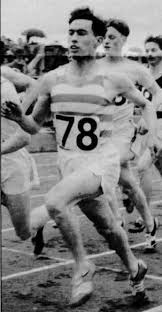
Bert McKay

Bert McKay

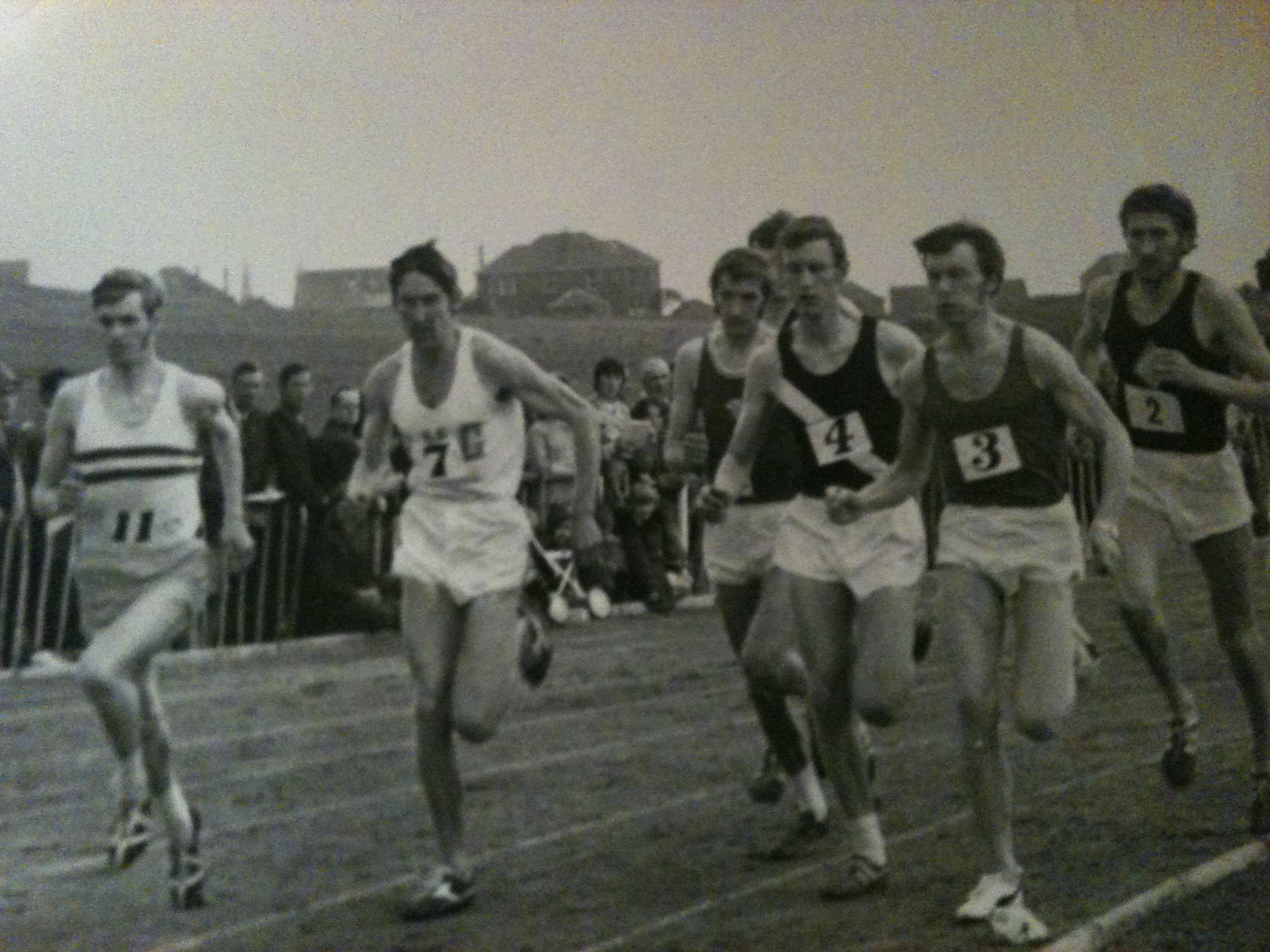
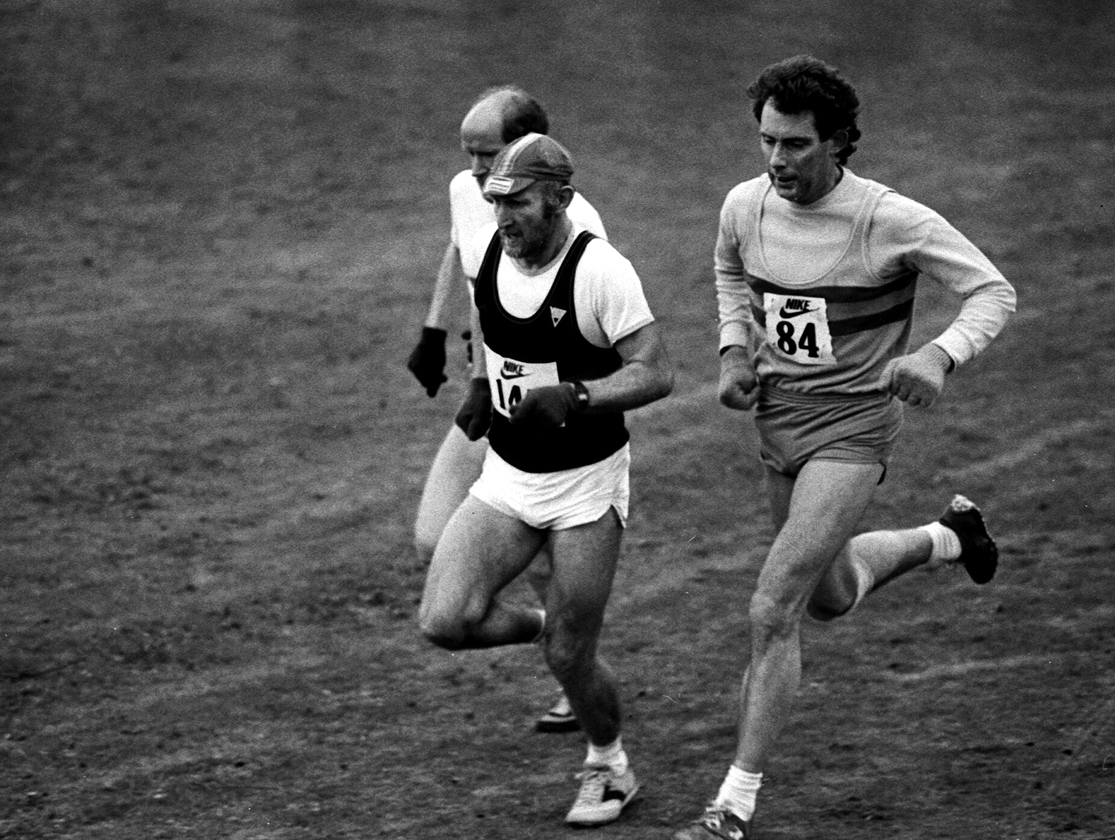
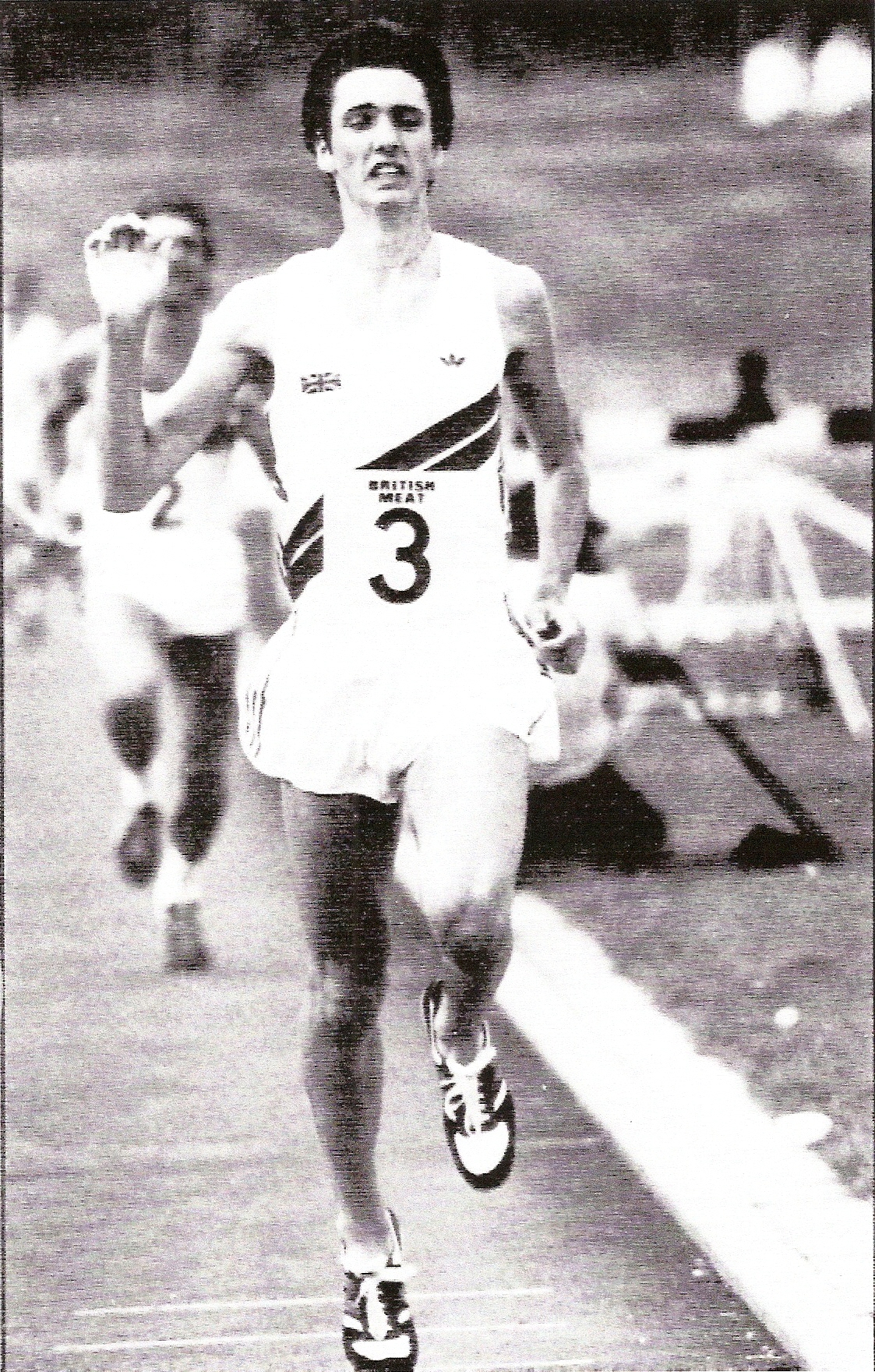
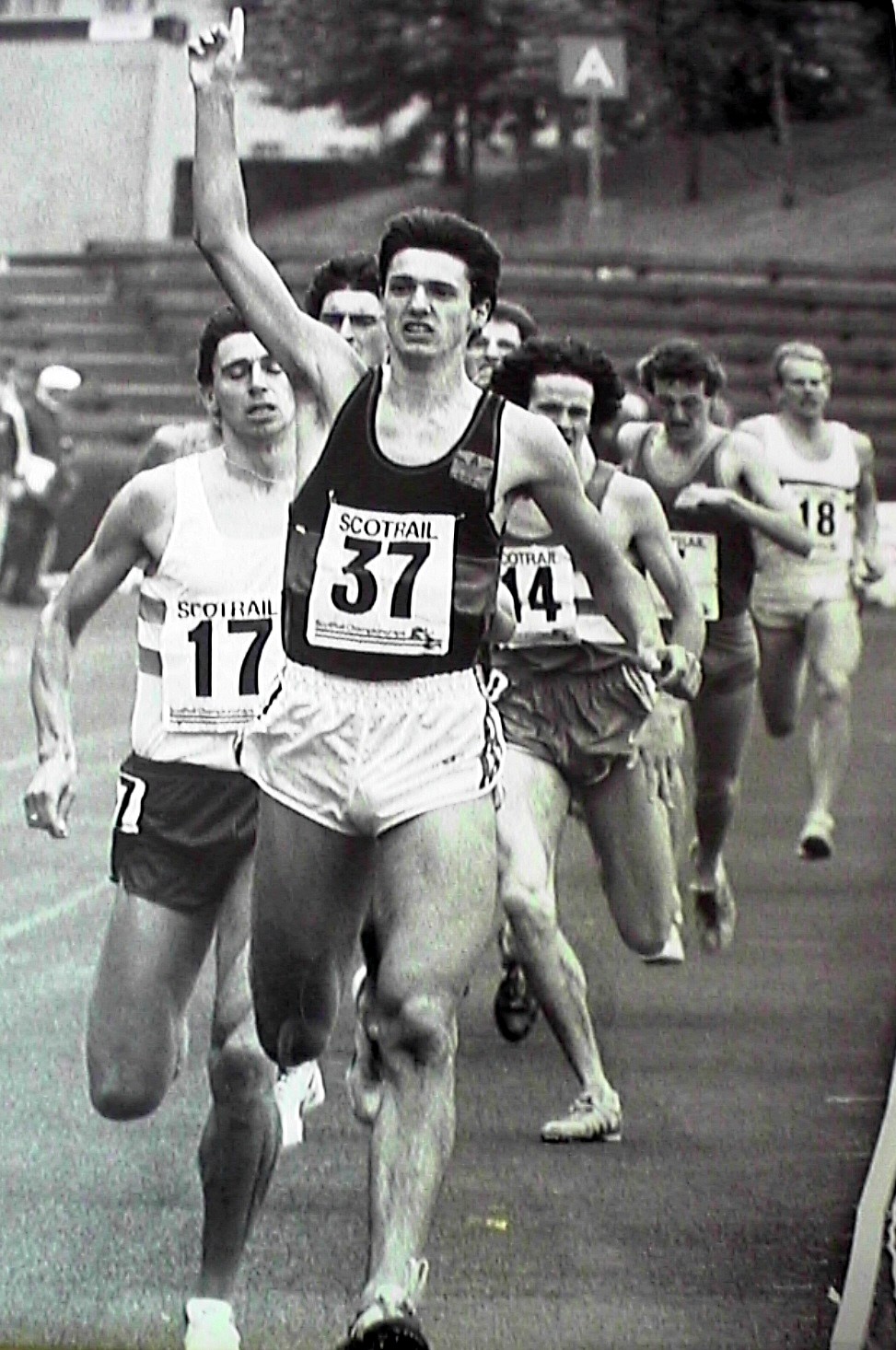
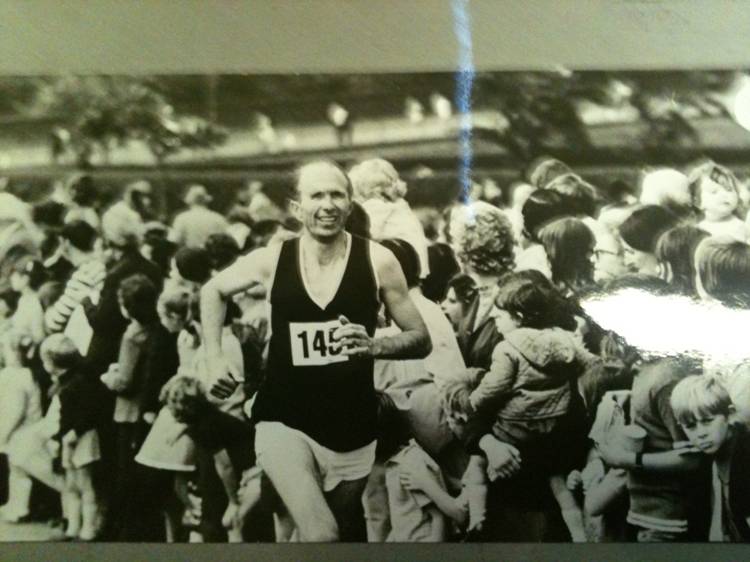
Bert McKay running in the Coatbridge 5 in 1973

Bert McKay says that he never considers himself a long distance runner, seeing himself more as a half-miler/miler.   The cross-country was to get fit for the track and also, having Andy Brown as a team-mate there was no way he could escape representing the club in the Edinburgh to Glasgow Relay, the National Cross-Country, etc.   Another reason for competing in road and cross-country was that there was no track in Motherwell so the roads and country were their only training facilities.   He does go to say that he grew to love road and cross-country and the rivalry between the various clubs.   I’m including him the ‘Milers’ section because I agree that that is where he should be.   His range was wide from 880 yards to 10 Miles and he competed seriously almost every year in team races at Two and Three miles on the track and in all the cross-country relays and championships.   Nevertheless he did have some very good races against top milers such as Graham Everett and Jim McLatchie – he even paced Graham through the first mile of an attempt on the Scottish Two Miles record in 1965.   Motherwell had a lot of very good middle and long distance runners – men like Alex Brown, Ian McCafferty, John Linaker and others – but like many another, I regarded Bert as the most senior in the club probably with the exception of the legendary Andy Brown.

Bert was among the best respected men in the endurance running world – appearing in the Scottish track ranking lists 26 times between 1961 and 1972, winning four SAAA Championship medals in addition to his honours on other surfaces, he collected the scalps and beat the times of most of the more celebrated runners of the day including Lachie Stewart and Fergus Murray at one time or another as we will see below.   Bert is a runner who must be included n any collection of endurance running profiles.    His personal best track times are in the table below.

Distance Time Ranking Year
880 yards 1:56.3 17 1962
One Mile 4:08.7 3 1962
Two Miles 8:57.2 3 1961
Three Miles 13:56.6 6 1964
5000m 14:24.4 15 1969
Six Miles 30:37   1969
10000m 31:30 26 1972
10 Miles 51:23.0 3 1969

Bert McKay (Date of Birth 13/12/35) first appears in the results in 1957 as a Senior athlete.    In the Scottish National Championships at the start of the year he was fifty seventh and the team was tenth.  Although he almost certainly raced during the summer, we next meet him in the winter of 1957.   At the start of the winter, Motherwell were not in the first six at the McAndrew but we note that the following week when Motherwell wn the Scottish YMCA relay title, the team included J Poulton, W Marshall, R McKay and T Scott with McKay being third fastest of the team.   A week later in the Lanarkshire County Championships, the team was third with the same runners but this time Scott and McKay shifted positions and Bert was second fastest of the quartet.   Unfortunately the team was unplaced in the District Championships.   In November that year he ran in his first Edinburgh to Glasgow Relay on the very challenging second stage and, like many excellent runners thrown out cold on to that stage, failed to do himself justice and dropped from second to fifth, but the team was not able to hold that position and finished tenth.   There were few results available after this but after a full winter’s work, Bert was forty ninth in the National of 1958 and this time the team was up to sixth.   On 24th May he won the YMCA half mile championship in 2:01, Andy Brown won the Mile in 4:39.4 and JH Linaker (Kirkcaldy YMCA) won the Junior Mile in 4:40.1.   He then appeared at the West District Championships where the Mile was won by Graham Everett who had been racing all over England as part of his quest to become the first Scot under four minutes for the mile.   The report in the ‘Herald’ said RW McKay (Motherwell YMCA) held Everett for fully three quarters of the distance and recorded 4 minutes 12.2 seconds.”   At the Lanarkshire Police Meeting on 7th June at Shawfield he won the Mile off 30 yards from clubmate AH Brown (25 yards) in 4:18.5.   It is fair to assume that he ran in the SAAA Champiionships and was unplaced and he eventually ended a fairly good summer with second behind Graham Everett in the Invitation Mile at Cowal in late August after Donnie McDonald had towed the field round to half-distance in 2:01.4 before Everett took over to get to three-quarters in 3:04.6.   The wind slowed him thereafter and his time was 4:07.5 with no time being reported for Bert.

The team was sixth in the E-G in November 1959 but unfortunately the records, even on Ron Morrison’s excellent statistical archive on his website, do not give the Motherwell runners but we can safely assume that Bert would have been a key man..  Bert started 1959 with a run in an Invitation Track Race over Two Miles.   Won by Graham Everett with Des Dickson of Bellahouston third, Bert was third to finish and Motherwell finished second team with Andy Brown fourth and John Poulton fourteenth.   When it came to the Nigel Barge four and a half mile road race two days later, the Motherwell team was beaten by Bellahouston and Bert was third counting runner in sixteenth position.   Despite Andy Brown’s second place, the team was unplaced in the District Championships two weeks later at Renton outside Dumbarton.    By the National in 1959, having been out of the results for several weeks, both Bert and the team had improved on 1958’s results – he finished twenty eighth and the club was fifth.   The summer season started in May with lots of triangular matches – Victoria Park v Bellahouston v Shettleston, Shettleston v Garscube v Teviotdale, for example and various permutations of University fixtures.   Then came wee out of the way meetings to warm the runners up and the actual racing started at the end of May with the District Championships.   In 1958 Bert had been second to Graham Everett in the Mile at the Districts and in 1959 his first outing was in the YMCA Championships at Larkhall a week beforehand – he won the 880 yards in 1:58.7.   At the Districts, with Everett racing abroad, he took the lead early on but Bill Kerr of Victoria Park had a real go at catching him.  Didn’t quite manage it and Bert won in a slow 4:22.7 – more than ten seconds slower than the previous year.      One of the frustrating things about looking back at newspaper reports is that they often don’t tell you more than the bare minimum of information about athletics events and although it is certain that Bert raced frequently, the next appearance is in connection with the West v East at the end of June.   I quote from the “Glasgow Herald:   The mile developed into a duel between RW McKay and G Stark.   Stark closely followed McKay for most of the race and showed superior speed down the finishing straight, winning by less than two yards.”   No time was given for Bert in the report and the results only gave the winner’s name.   Nevertheless it was clear by now that Bert was considerably good.   Stark was the National Mile record holder and to lead him for most of the race and then be beaten by only a yard and a half is good running by anyone’s standard.   He met up with Stark again at the start of August and the race report reads as follows: “The principal event at Carluke Rovers open sports meeting was the invitation one mile short limit handicap in which the Scottish record holder G Stark (Edinburgh Southern Harriers) was running from scratch.   At the end of the first lap, Stark was just behind R McKay (Motherwell YMCA) and J More (Kilmarnock) who started from 10 and 15 yards respectively.   In the meantime however, the Scottish steeplechase champion, T O’Reilly, off 35 yards, was setting a good pace over the seven lap course and by half distance it did not look like Stark would catch the leaders.   Soon afterwards, McKay and More left Stark and he had to be content with sixth place – 6.2 seconds behind O’Reilly the winner.”   Unfortunately the report does not say who were second, third, fourth or fifth!    So we don’t know from that where Bert finished or what his time was.   The winner was 4:19.2, and by simple arithmetic we get 4:25.4 for sixth place.

 Bert turned out on the straight head-to-head race that is the first stage and was eleventh in a team that placed fifth.   In the National in 1960 he had dropped from the past year’s position to seventy third but the team had by now moved up to fourth.   Summer 1960 started according to the reports later than usual.   It was not until 11th June at the Glasgow Police Sports at Ibrox that he appeared running in the Mile where he was second, one place ahead of Mike Ryan from St Modan’s.   He did not feature in the National Championships or the District Championships as far as the Press reports were concerned.   A summer best described as quiet.  So it was into the 1960/61 season in October.

On 1st October 1960, Motherwell was third behind the Shettleston winning team with Bert McKay on the first leg running a time of 15:35.    A week later he ran the first stage in the Lanarkshire County Relays and handed over a lead that the club held while turning in the third fastest time of the day.   On 29th October, after David Simpson had a good run on the first stage of the Scottish YMCA Relays Bert ran on the second stage for the club team which won by almost three minutes.   Came the big one, the Edinburgh to Glasgow,, he was again on stage one and this time was eighth with the club again finishing fifth.   In the National at the start of 1961 he did not run and the team did not finish a full six scoring runners.  That summer Bert was almost an ever present in the club team at all the two mile team races and turned out in in the championships without winning a medal.  There were, however, several notable performances in summer, 1961, and the first of these came at the start of May when in what was called a ‘Grading Meeting’ at Seedhill Track in Paisley the result of the Mile was a win for Graham Everett from Bert McKay and Mike Ryan – then later at the same meeting the steeplechase resulted in a win for Bert McKay in 10:48.8.   This was followed by the West District Championships on May 7th where he won the Mile and lifted the scalps of  Jim McLatchie and Mike Ryan when winning in 4:17.3   On 8th July at Pitreavie, running for the SAAA against an Atalanta team, the report for the Mile read R McKay (Motherwell) and KD Ballantyne (Edinburgh Southern Harriers) covered the last 20 yards of the mile almost together and finished in the same time, 4:17.3, but McKay was judged to have won.”  Having shown his strength by the double at Seedhill, he went even further in June.  In the Glasgow Police Sports, Graham Everett set a new Scottish record for the Two Miles on the good cinder track at Ibrox.   I’ll just quote the ‘Glasgow Herald’.   “Everett was taken along at a merry pace by R McKay (Motherwell) and both were well ahead of the field at halfway in in the fast time of 4:14.5, too fast as Everett admitted afterwards.   It was clear that if this pace were to continue the all-comers record would be broken.   Unfortunately McKay was unable to carry on  having fallen out more or less exhausted after one of his best mile times.   Everett was alone thereafter, but his time of 6:31.4 for a mile and a half beat T Riddell’s native record and JJ Barry’s all-comers record.   He slowed over the last half mile and lost his chance of beating the all-comer’s record of 8:45.6 but the time of 8:48.6 beat his own best Scottish record by 1.8 sec.   ……………………  McKay made a fine recovery after his exhaustive effort in the Two Miles and won the mile in 4:08.3 from 40 yards.”    Bert said that it was a deliberate attempt at pace-making for Graham, because he thought he could get the two miles record.   After he dropped out he could hear Andy Brown cursing him as he passed because they could have won the team race.  It had been a quite remarkable season at the end of which he was in the ranking lists for five events:

Year Distance Time Ranking
1961 880 yards 1:57.1 19th
  One Mile 4:13.8 6th
  Two Miles 8:57.2 3rd
  Three Miles 14:14.6 11th
  Six Miles 30:27.6 7th

The McAndrew Relay race on 7th October 1961 had Bert McKay hand over a lead to David Simpson that tea mates John Linaker and Andy Brown saw translated into a good victory.   The same quarter ran in all the short realys that year and Bert handed a lead to the team at the end of the first stage in the Lanarkshire Championshps (won by 600 yards), the Scottish YMCA Championships, the Midlands Championships (won by more than two minutes and then in the Motherwell club time trial for the Edinburgh – Glasgow selection, he tied with Andy Brown and David Simpson for second behind John Linaker.   Five races in the five weeks before the E-G itself on 18th November.    The team in the E-G in November 1961 made up for the poor showing in the National when they finished third to pick up their first medals in the race.   Bert ran on Stage seven for the first time and pulled the team from third to second with the third fastest time of the day.   There was a bit of a hiatus after that until the Lanarkshire Championships where Bert was fourth behind Linaker, Brown and Everett.   Into the New Year and the McAndrew Road Race was run in very tricky conditions – several football matches had been cancelled because of snow.   The ‘Glasgow Herald’ said, “AH Brown mastered the rather precarious footing on certain stretches of the road and won the Nigel Barge four and a half mile road race on Saturday at Maryhill by 20 yards from J McLatchie in 23:20 – 30 seconds outside the record for the course.   McLatchie was less than a yard ahead of R McKay who finished very strongly and J Linaker, another Motherwell runner, who finished fourth.”    A hard fought race but Jim McLatchie’s story about it sounds good to me.   “Dunky Wright approached me about running in the Nigel Barge Road Race in 1962 since I did a few training runs from Milngavie to Maryhill and back – he said that was part of the course.   I never ran in road races – so I showed up anyway and was up with the leaders – the Motherwell boys – Andy Brown turned to Bert and said, “What’s McLatchie doing up here? ”   Bert’s reply, “I think he’s going to kick our arses.”   Andy: “He’s not a road runner.”    Bert: Today he is.”    On 3rd February, 1962,   Bert had what the ‘Herald’ writer described as ‘the best cross-country performance of his career.’   It was in an invitation eight mile race at Cleland Estate, Motherwell.  “The invitation eight-mile cross country race within the Cleland Estate on Saturday ended, as expected with AH Brown beating a club-mate, R McKay by 80 yards in 42 min 42 sec.   McKay put up about the best cross-country performance of his career and this win by Brown enhanced his reputation for consistency over the past 12 years.   At the end of the first lap of two miles Brown led the field of 42 runners from J McLaren (Victoria Park, McKay and Everett (Shettleston) and JH Linaker.   Over the next circuit McKay moved into second place, 40 yards behind Brown and at regular intervals came McLaren, Linaker and Everett.   At the end of the third lap, McKay had closed slightly on Brown with McLaren 120 yards behind him, and Everett and Linaker 40 and 50 yards farther behind respectively.   This was the order at the finish but Brown had drawn away from McKay.      Bert did not turn out in the Scottish YMCA championships two weeks later and they were won by Andy Brown from David Simpson.   The winter ended with another fifth place in the National for the team but Bert was not running on the day.

We know Bert ran in the West District Championships in May 1962 because Jim McLatchie tells us so but he didn’t feature in the results or the reports.  Let Jim tell the story: 1962, West Districts Mile race.   I was in pretty good shape and told Bert I was going to run hard and he could hang on.   I came through the first 880 around 2:03 – all I could hear from Bert ‘For ‘goodness’ sake, this is too fast for a beginning of the season race.’   After the race I asked him why he didn’t hang on and he said he was peaking for the Nationals later that year when we both went on to record personal bests.”   He  turned out in the Police Sports at Shawfield on the first Saturday in June where he was off scratch in the invitation three-quarter mile along with Willie Morrison of Larkhall.but they were both beaten by Jim McLatchie running off 5 yards.   A week later and at Ibrox, he was second again, this time to clubmate Andy Brown in the Invitation Two Miles with Calum Laing (Glasgow University) in third.   Another seven days and he was at New Meadowbank for the SAAA Championships where he was third in the Mile behind Mike Berisford of Sale and Jim McLatchie.   Other than team awards, his first individual place after that was at Shotts Highland Games where he was third behind JP Anderson and J Hillen (both Saltwell AC) in the Two Miles.   By the end of the summer (1962) he was ranked in four events the six miles having been dropped from the schedule,  Best times for the year were 1:56.3 (17th), 4:08.7 (3rd), 8:58.6 (1st) and 14:03.2 (5th).

Motherwell won the McAndrew Relay at the start of October, 1962, with Bert again doing sterling service on the first stage.   With one exception it was the team from the previous two years – Alex Brown taking the place of John Linaker – with David Simpson on two and Andy Brown on four.   Andy had the fastest time of the day with Fergus Murray second and Alex Brown third and Bert himself had sixth fastest time.   In the County Relays the following week, Andy Brown relegated himself to the second team, and running the first stage beat team mate David Simpson by 15 seconds.   Nevertheless the team of Simpson, Marshall, McKay and Alex Brown won with Motherwell having the four fastest times of the day with Andy Brown, David Simpson and then McKay and Alex Brown being third equal.   The B team was third behind Shettleston.   Then on 20th October it was the YMCA Relays that they won with Bert McKay, David Simpson and Alex Brown building up a useful lead only to see Andy Brown going off the course because he was mis-directed.   The B team of John Poulton, Willie Marshall, W McKnight and D Young won with the A team being third behind Larkhall.   Bert had the fastest time of the day on that occasion, with Willie Marshall being second fastest and David Simpson third.      On November 3rd the team retained their district title, this time Alex Brown ran the first stage, followed by John Poulton, Bert MacKay and Andy Brown.   They really were an all-conquering squad at this time.   Whatever the permutation, they were winners.   The next week were club trials for almost all clubs involved in the Edinburgh to Glasgow and in the E-G, Bert showed what he had hinted at the previous year when he was third quickest on the seventh stage -this time he ran the fastest time on the stage and also equalled the course record.   The team won with four of the fastest times of the day on stages four (AH Brown), five (AP Brown), six (J Linaker) and seven.  As Colin Shields says in the official history of the Scottish Cross Country Union,“Whatever the Weather” the perils of a November race date were clear in 1962 when there was deep snow and cars were abandoned in Airdrie Main Street.   It was on this occasion that Tom O’Reilly of Springburn said that it was not so much dedication as pure bloody stupidity!  Colin’s comments were maybe more measured but no more accurate when he said “Moving up on sixth from Stage Three, Motherwell improved from then on.   AH Brown improved 23 seconds on the 1957 stage record to finish third, and his young brother Alec and then John Linaker gained further places to to bring Motherwell into a 40 second lead by the end of the sixth stage.   Bert McKay equalled the stage record to open a gap of two minutes over Edinburgh Southern Harriers and it was left to John Poulton to bring Motherwell home to their first ever victory.”   In February Bert did well enough in the National in 1963 to win his first and only cross-country vest for Scotland.  The result of the race was a win for John Linaker of Motherwell in 35:53, followed by Alastair Wood of Aberdeen in second, Andy Brown in third in 35:57 and Bert McKay fourth in 36:33.

That summer, 1963, there is no mention of him in the Western District Championships which was where he normally started the season.   It was perfectly possible that he ran in the team race at Shawfield in the Lanarkshire Police Sports for the first three were Andy Brown, John Linaker and Ian McCafferty!   The Motherwell team competed regularly at venues as far south as Lockerbie as well as all over the Central belt but Bert’s next win was at Babcock’s Sports in Renfrew on 17th June when he won the Two Miles in 9:08.9 with Andy Brown second and Alex Brown third to take the team title – to add to the club’s joy, John Linaker won the Mile and David Simpson won the 14 mile road race!   Bert then won  his second SAAA medal when he was third in the Three Miles behind Fergus Murray and clubmate Andy Brown.   By the end of  ’63 he was ranked in the Mile, Two Miles and Three Miles lists and was third in the SAAA Three Miles championship at Westerlands in a time of 14:26.4 behind Fergus Murray (14:01.6) and clubmate Andy Brown (14:12.8).   His best times for the three events were 4:16.0 for tenth place in the Mile, 9:08.2 when finishing fourth in Glasgow in June which placed him seventh in the ratings, and 13:58.0 for the Three Miles, recorded at Pitreavie in in July.   He went in to the winter running extremely well.

In the McAndrew Relay, Motherwell started off with Alex Brown who ran into third position but Bert McKay running on the second stage, not only gave the club a lead but set a new record for the course with a time four seconds faster than Lachie Stewart..   Ian McCafferty and Andy Brown made sure of the victory and the team had four of the six fastest times!  A week later in the Lanarkshire Relays Motherwell had the first two teams with Bert running for the second team which finished 500 yards behind the first.   Even more amazing was the club’s taking first and second places at the District Relay Championships on 26th October with Bert having second fastest time of the day, only four seconds slower than Ian McCafferty with Alex Brown in third fastest slot another eight seconds back.   The winning quartet was  AP Brown, W Marshall, I McCafferty and R McKay.   Andy was in the second team which consisted of George Henderson, D Young, David Simpson and AH Brown.   Quite remarkable when you consider the standard of the remaining clubs in the race.    In the YMCA Championships a week later they were gallus enough to put Andy Brown and Bert into the second team and still get the first two places.  The ‘Glasgow Herald’ for the result of the E-G said ” Motherwell Again Win Road Relay Race”.   Bert was on the seventh stage of the E-G where he not only set the fastest time of the day but broke his own record for the stage set the previous year.    Again Motherwell won by virtue of the fact that the middle of the relay had fastest times by their members on stages four, five, six and seven with AP Brown, D Simpson, J Linaker and Bert McKay bringing them from sixth to first over the four stages. It is difficult to argue with Colin Shields who said that they won it the hard way – it was not until the end of the sixth stage that they were in front, and he says of Bert’s contribution: “Bert McKay, having equalled the stage record the year before, bettered it by 24 seconds to establish a two minute lead and G Henderson brought them home easy winners.”     In the National in 1964 he finished twenty ninth and the club closed in as third team.

That summer (1964)  Bert started with a good run in the West District Championships at Westerlands, where he lead for much of the race before Lachie Stewart moved off leaving Bert in second with Andy Brown in third.   Not placed in the SAAA Championships, he went on to a comfortable win in the Mile at the Strathallan Gathering in August.    The scene was very different from that of the twenty first century.   Local meetings played a big part of the athletics scene then – local highland gatherings (Dunblane, Strathallan, Shotts, etc), works gala meetings (Dirrans Sports, Babcock’s and Wilcox Sports, Singer’s Sports), community sports meetings, Braw Lads Gatherings, etc, etc.    They were held on a variety of surfaces – good well-tended grass, poor cow-field grass, cinder and sticky-oot brick, ash, etc but these differences were over come by the men and women who ran in them.   The best men raced each other week, week out.   The Two or Three Mile Team race was always well supported – Shettleston Harriers, Victoria Park AAC, Motherwell YMCA, etc all turned out teams in the races and the teams were always the best that they could field.   Lachie Stewart raced Ian McCafferty, Hugh Barrow, Andy Brown, Dick Wedlock, etc all summer.  At the end of May, 1964, the ‘Glasgow Herald’ had the headline “R McKay’s record in the Three Miles” and read “R McKay (Motherwell) was one of the outstanding competitors at the Lanarkshire Championships at Larkhall on Saturday, winning the Three Miles in a new best time of 14 Min 11 Sec from his clubmate AH Brown.   Brown was the previous record holder with a time of 14 min 37 sec, set two years ago over a heavy, wet grass track at Laigh Bent.”   One week later on the last Saturday in May, he defeated Andy again for second place in the Three Miles at the West District Championships at Westerlands in Glasgow with Lachie Stewart first..  Two weeks later in the Lanarkshire Constabulary Sports at Shawfield he was again second to Lachie in the Three Miles and only one week later, he was second to Lachie again at Babcock’s Sports in Renfrew in a Two Mile Team race where he led Motherwell to a team victory.   Next was the National Championships where he was unplaced and it is frustrating that only the first three are published for our reference.   Omitting the whole of July, Bert’s next appearance that year was at Strathallan Highland Gathering where, as backmarker in the half mile, he came through to win.   August finished off with Edinburgh Highland Games, Bute Highland Games (longest event One Mile) and Cowal Highland where he did not figure in the results.  As can be seen, the races were not well spaced either, tending to come one on top of the other all summer.   It may be of course that we have lost a lot in terms of the competitiveness of our runners because of the official demands that runners space their programme.   The Scots who are doing really well just now are largely those who compete on all surfaces, all year against good opposition in the American College circuit.    The surfaces were less good, but the unremitting high level competition maybe gave the runners a hardness that is missing today. He only appeared in the rankings for the Two Miles and Three Miles with times of 9:12.2 and 13:56.6 for ranking places of eighteenth and sixth.    The absence from the rankings should not be taken to mean that he was running badly.

At the start of the winter, 1964,  Motherwell again won the McAndrew Relay at Whiteinch  with Andy Brown finishing second to Hugh Barrow of Victoria Park (fastest time of the afternoon) before Bert brought them into first place which was held by Ian McCafferty and Alex Brown.   On 10th October, the club retained the Lanarkshire title with Bert running the final lap.   In the Districts the club won the title for the fifth consecutive year with Bert on the third stage.  He lined up at the second stage of the E-G  where he dropped from first to third in the team that won thanks to four fastest times on stages four to seven (Brown, Simpson, McCafferty and Wedlock).   The club was undoubtedly the strongest in Scotland and when they won the Nigel Barge team race in January 1965, Bert was not in the counting team who had three in the first six finishers.   In the National in 1965 he was fourteenth with the team in fifth.

In summer 1965 Bert started as usual with the West District Championships, this time at Ayr, and finished third in the Mile behind Hugh Barrow and Ian McCafferty.   Bert did not appear in the results for any of the other competitions in May or June, not even the Scottish Championships in Edinburgh – at least not in the published lists with only the winner being noted in some.  His summer seemed to finish with the Shotts Highland Games at the start of September where he was second to Ian McCafferty in the Two Miles.    However at the end of the summer he again ranked in three events – the Mile, Two Miles and Three Miles with times of 4:11.4, 9:00.6 and 14:13.0 to be ninth, eighth and twenty second respectively.

Season 1965-66, they won the McAndrew (Brown, Brown, McKay, McCafferty), the Lanarkshire (with Andy Brown and Bert McKay in the B team which finished second), the Scottish YMCA Championship relay st Motherwell with their ‘older members’ in the A Team (McKay on the second stage turned a two second deficit into a 500 yard lead!) and the Midland Relay Championship.   The report in the Glasgow Herald is worth repeating here: “Motherwell can never make their lead big enough.   Not content to win, they seem to want to blast the opposition off the course.  They had a better start than usual when AP Brown handed over in second place – two or three places higher than was expected – behind J Brennan (Maryhill) who surprised most by being third fastest throughout the day.   R McKay was not long in going ahead for Motherwell on the second lap, and from that point on interest in Motherwell became academic.   What is worth writing is the magnificent running by I McCafferty through the three fields heavy with mud on the east side of Home Steads Farm.   While all around were floundering, he gave the impression of of skating freely on the surface with his short business-like stride.”   They won from Shettleston by two minutes and nine seconds.   In November he was back on the seventh stage for the fourth time and held his second place in the squad that finished second.     In the National in 1966, he is clearly well placed in a picture in ‘Athletics Weekly’ but does not appear in the results.

Opening his season with a win in the YMCA 880 yards championships in 1:59.5, and in the West District Championships at Ayr Bert finished third behind Hugh Barrow (winner) and Ian McCafferty.   The Motherwell runners took part in most events but the next sighting of Bert McKay in the results columns was at the Lanarkshire Constabulary sports where he was second in the open half mile, no doubt after taking part in the Two Miles invitation.   By the end of the summer of 1966 he was ranked fourteenth in the Mile with 4:11.0 in Glasgow in June but this was his only appearance in the rankings for the year.

The ‘Glasgow Herald’ reported consternation on the faces of Motherwell officials at the McAndrew Relays, in 1966, when Ian McCafferty failed to turn up.   The reshuffle meant Willie Marshall was pulled into the team and sent out on the first stage.   He handed the baton  over to Bert  in twenty first position and the reporter felt all hope of a win evaporated.   Bert pulled the team up to ninth and sent off Alex Brown who picked up to fifth and Andy Brown came home in third place.   A week later and again McCafferty failed to show up while Bert McKay was not able to run either in the Lanarkshire Relays.   The team finished third.   Two weeks later, and still without McCafferty,  but with Bert McKay back in the team they won the YMCA Championships at Irvine with Willie Marshall, Alex Brown, Bert McKay and Andy Brown.  The first paragraph of the ‘Herald’s report on 31st October said it all: “Smiles were back on the faces of Motherwell YMCA camp followers at Stirling on Saturday Their outstanding 4 x 2.5 miles relay team carried out a brutal demolition job of demolishing all who dared take away their Midland District relay title after six years custody.”   McCafferty was back – the team of Alex Brown, Bert McKay, Andy Brown and Ian McCafferty was never headed.   In November 1966 Bert again ran on the seventh stage of the E-G but this time dropped from second to fourth in the team that finished third.

In summer 1967 he recorded a fastest mile of 4:13.3 when finishing fourth  at Ibrox in mid-August which ranked him twenty second, 9:02.6 for the Two Miles at Barrachnie in May to be nineteenth, 14:13.2 at Shawfield in June, finishing one tenth in front of Hugh Barrow, to be ranked twenty second in the Three Miles.  These times and venues tell a story of running in the 1960’s: Ibrox was probably in an invitation race, Barrachnie was the Shettleston Harriers home track and was known to be almost circular and the chances are that it was a league or county match.  The race at Shawfield was in a Lanarkshire Constabulary meeting and run on a softish track inside the dog track for greyhound racing was often held there in midweek. The report in the ‘Glasgow Herald’ said   “AP Brown (Motherwell) at halfway never looked like catching his club mate R McKay but his recovery over the final half-mile was so remarkable that he beat McKay by 30 yards in the good time of 14 minutes 08.6 seconds.”  Incidentally, the previous year he had been second in the open Handicap half mile to Gordon Sinclair of Glasgow University.   He had started the season with second to McCafferty in the YMCA Championships on 20th May at Grangemouth but was unplaced in the very strong West District Championships a week later.   On June 3rd however, he came out on top in a Two Miles race at Airdrie when he beat Alex Brown by 15 yards in 9:23.   Seven days later the positions were reversed when Alex, well behind at halfway, won from Bert in the Lanarkshire Constabulary Sports Three Miles Individual and Team Race at Shawfield in 14:08.6 with Motherwell winning the team event.   .The SAAA Championships at the end of June were of a very high standard and bert’s name did not figure in the first three in any event.   No doubt he was part of the Motherwell team that won Two Miles team races at meetings in Strathallan, Bute, Cowal, and Shotts where the counting men were usually three in the first four or five.

But the big event at the end of summer 1967 was the formation of the new club of Law and District AAC.   Both Brown brothers, David Simpson, Ian McCafferty and some others left Motherwell leaving them seriously bereft.   From a club challenging for, and often winning, high honours, they became a struggling club which had to rebuild.   Bert McKay and Willie Marshall were two who stayed with Motherwell and did more than their bit for the old club.   Willie won the club trial for the McAndrew team from Bert but that was insignificant. With only one team success in October (the YMCA championships at Kirkcaldy where Andy Brown ran for the B team that finished third), Bert ran possibly one of his best ever Edinburgh to Glasgow stages in 1967 where on the very hard second stage he pulled the club from 18th to fourteenth with one of the best runs of the day,   On 17th January Shettleston Harriers had an open meeting at Barrachnie and Bert ran in and won the Mile in 4:23 – not bad on that track and in January!    There was no sign of him in the National Cross Country Championship and the first Motherwell runner was Peter Duffy – a useful new addition to the club.

In 1968 he was second in the West District Mile with a time of 4:20.6 and his season’s best of 4:20.2 when finishing third at Pitreavie in June ranked him only thirty first and  that was his only ranked distance.  The lack of Two and Three Miles times was probably largely down to not having significant teams entered in almost every meeting throughout the summer.   In the West Championships he split Ian McCafferty and Lachie Stewart with the times being 4:17.4, 4:20.7 and 4:21.9.

 With the Motherwell team weakened as it had been, they were not in the top ten in the McAndrew but Bert was clearly in good form judging by subsequent races. On 19th October they won the YMCA Championship Relay with a team that included Andy Brown but Bert had the fastest time with his 11:53 trumping Brown’s 12:15.      The big one of course was the Edinburgh to Glasgow and again Bert was on the second stage.   Taking over from Willie Marshall in fourteenth place, he ran another good race on this stage to move from that position to tenth.   Unfortunately the club could not hold that and finished nineteenth – and they were out of the race.   Bert’s next run in the event would be in 1975 as a member of the Clyde Valley team formed by five clubs, including Motherwell, linking up.   His form in the 1968/69 season continued into the Nigel Barge Road Race on 4th January 1969 when he was fourth in what the ‘Herald’ correspondent described as “McKay moved ahead of Alec Wight on the run-in and his fourth place must be his best run of the season.”    The first four were Lachie Stewart (Shettleston, 22:01), Dick Wedlock (Shettleston, 22:16), Andy Brown (Law) 22:41 and Bert McKay (Motherwell, 22:52)  – only 300 yards behind the winner!   He did not seem to have run in the various races for the remainder of the winter – not the Springburn Cup, the Districts, the YMCA championships or the National.

He must have kept in shape though because summer 1969 was a much better one for him with no fewer than four championship medals.   Bert not only won the West District championship 5000m in 14:40.2, but was third in the Inter-Counties in 15:04.6 behind John Linaker (14:58.2) and Colin Martin (15:00.8) and third in the SAAA with 14:30.4 behind Lachie Stewart ( 14:09.6) and Dick Wedlock (14:24,4).   His best time of the year was 14:24.4 which ranked him fifteenth.   Then in the longest track race that he had run so far, he was third in the SAAA 10 Miles track championship in 51:23.0 behind Jim Brennan of Maryhill (50:41.2) and Bill Stoddart (Wellpark) in 50:55.0.

Summer 1970 was Commonwealth Games year in Scotland and everything was subordinated to that.   Bert was thirty four and not in contention for a place at that point, and there was no Edinburgh to Glasgow in winter to look forward to but he kept training and reappeared in the rankings in 1972 when he was ranked twenty sixth in the 10 miles with a time of 51:23.0.   He had of course run the distance on the road – third in the first ever Tom Scott 10 Miles road race in 51:41 and fourth two years later in 50:50 for example.

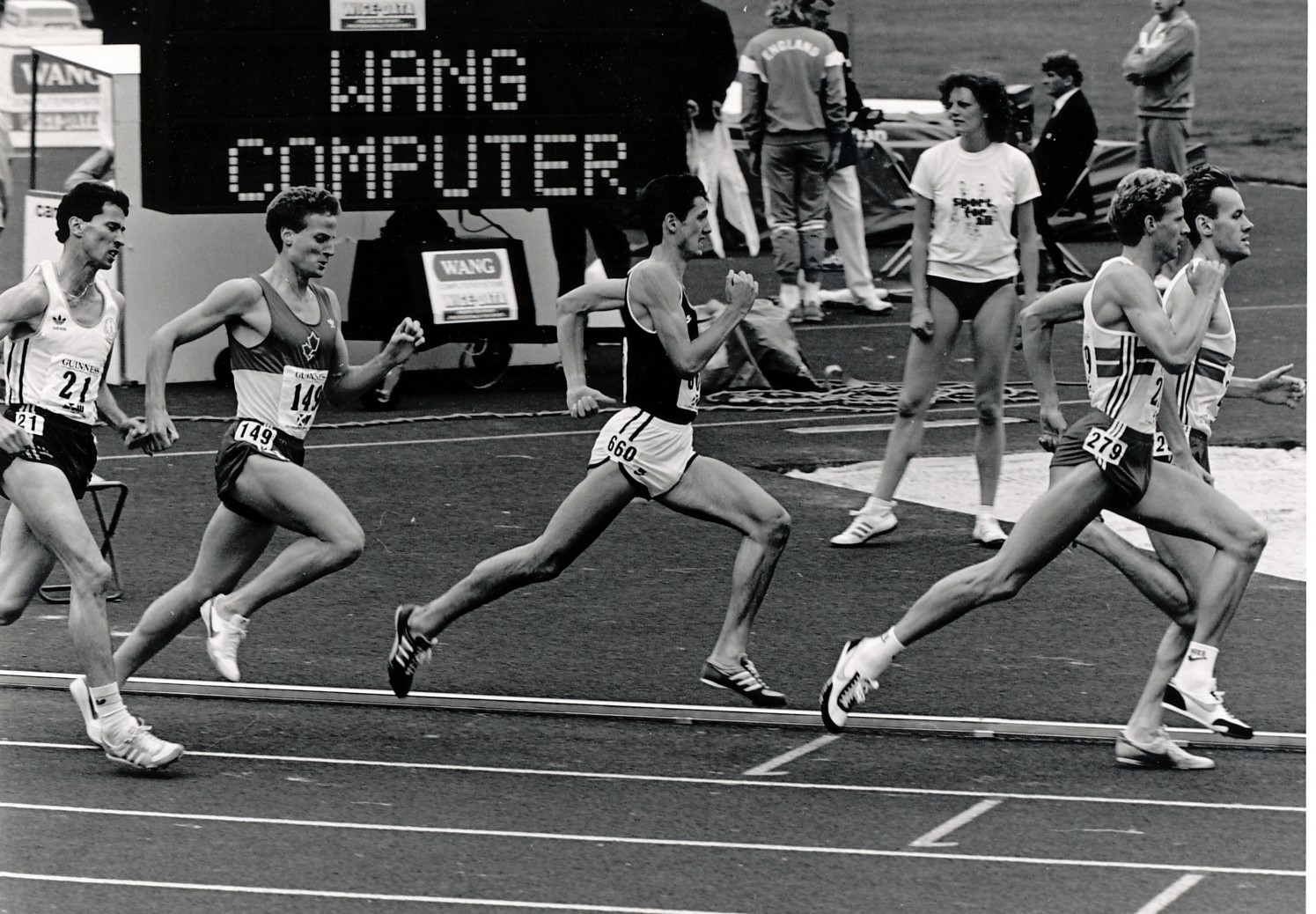
Bert did not appear in the ranking lists for any event in 1970 or 1971 but made his final appearance in 1972 when he was ranked at twenty sixth in the 10,000 metres race with a time of 31:30.  The picture above shows a clearly fit Bert McKay racing in 1973.   He was running in 1981 at the age of forty five and was first veteran to finish in the Tom Scott 10 Miles Road Race.    This ten year period will not be covered in the same sort of detail as his running career up to 1971: apart from anything else, the archives for this are sadly lacking in detail.   When it seemed to outsiders that his participation in athletics was starting to decline, it received a boost from an unlikely direction.

It was clear that Motherwell YMCA was not the force it had been, and nor was Monkland Harriers.   There were several other Lanarkshire clubs with fairly small memberships and they came together to form a new club.   So it was that in 1974 Bert appeared in a new vest – it wasn’t that he had left Motherwell, but a new club had been formed from five local Lanarkshire clubs.   Monkland Harriers, Motherwell YMCA, L&L from Lesmahagow, Airdrie Harriers and Bellshill YMCA.   The club was to be called Clyde Valley;  the clubs all trained separately as before and kept club identities within their own area, coming together for racing purposes:  but it meant that many very good runners came together to make a very good team.   Bert was competing seriously again and incidentally passing on his hard-earned wisdom to many talented and ambitious youngsters.   His own training had been reputed to be very hard and the young pretenders such as Jim Brown and John Graham came to be of a similar cast.   If you use the link below, you can see what an influence Bert had on the young John Graham.   The new club also had a beneficial effect on his own running as well.   He had probably thought that his days of running in, and winning medals in, the Edinburgh to Glasgow Relay were over – they weren’t!   The club was formed n 1974 and in November 1975 he was back on the seventh stage of the relay, holding the team’s position in third which is where they finished.   Better than that, he even ran the third fastest time on the stage.   In 1966 he had also run the seventh stage and had won a bronze medal with Motherwell.   Missing 1976, he ran in his last E-G in 1977 at the age of forty one, this time on the third stage and saw the team drop from second to third but it finished out of the medals in seventh.   Other than the E-G results it is almost impossible to find where and when he raced as a member of Clyde Valley – with a first team pool of young talented runners such as Ron McDonald, Jim Brown, John Graham, Roy Baillie and others it is not surprising that he was not in the four man teams.   It is highly probable that he was racing in the B or even at times, the C team but this is not reflected in published results.   The National results, almost always published in full on Ron Morrison’s website atwww.salroadrunningandcrosscountrymedalists.co.uk do not show Bert as having run there either.   In addition, the newspapers stopped reporting on most of the Highland Games meetings other than Edinburgh, many of the Sports (Police, Transport, etc)had been abandoned as well.   He is highly spoken of as a motivator, mentor and coach for the Motherwell group of Clyde Valley athletes and his contribution to the success of the new club owes him a debt on that side too.

***

As was said in the opening paragraph, Bert was well-liked by the other athletes and highly respected by all.   For instance, Hugh Barrow who had many a race with him says “Bert was one of the really good runners of that generation, not a star but bloody good when there were a lot of good ones about!  “       Jim McLatchie said, “Bert was a tough competitor, more so when the Motherwell boys were all in the same race.   I enjoyed the tussles and I knew I would have to run hard if Bert was in the race.   It would have been great to have sat down with him after a race and sup a pint and discuss running – but I didn’t drink back then and not sure if Bert did either.”    And of course John Graham elsewhere on this website pays tribute to the training that he did under Bert’s guidance when he was a young athlete.   Look it up.

Finally, although Andy Brown was indisputably Mr Motherwell YMCA, Bert was not far behind in the opinion of many.   Had Bert gone to Law and District AAC, it might have been really formidable, but he didn’t, choosing to stay where he was.   Be that as it may, he has had a good career in the sport and has the respect of all who knew him, raced against him or watched him in action.
Lynne MacDougall

LMacD 1

Winning the Scottish Universities Cross-Country Championship in 1986

There have been many outstanding women endurance runners in Scotland in my time in the sport but very few have made it to the Olympics.   Liz McColgan, Yvonne Murray, Karen McLeod – and Lynne McDougall.    I remember one of the very good senior men I was coaching in the late 1980’s phoning me after a road race with the boast that he had out-kicked an Olympic 1500m finalist!   It was Lynne that he outkicked.   Although she is now perhaps better known as a top class road and marathon runner, she ran in the Los Angeles Olympic final back in 1984 and was also an outstanding 800 metres and cross-country runner.  There were also representative races over the country with three runs in the World Cross-Country Championships at Madrid (as an Intermediate), Rome and Gateshead and a GB vest on the road when she ran a 6K leg of the Yokohama Ekiden Relay.   A popular member of any team, she is said to be incredibly good at impersonating people – and she was particularly good at doing a couple of Scottish athletics officials!   There was one occasion when with a Scottish team in Italy  she wanted honey for breakfast and was reduced to flapping her arms like wings and saying “Bzzzzzz!”   She was however superbly talented and the range of her abilities and length of her stay at the top can be easily shown by her appearances in the Scottish and British All-Time ranking lists.

Event Time Ranked GB Ranked Date
800m 2:01.11 5th 26th 18/8/84
1000m 2:38.67 4th 13th 19/7/86
1500m 4:05.95 4th 18th 20/8/84
Mile 4:30.08 4th 16th 7/9/84
5000m 15:45.03 7th 35th 29/6/97
10K Road 33:22 1st Unknown: c50th 0/12/00
10M Road 55:28 1st Unknown /11/01
`Half Marathon 74:22 1st Unknown 2001
Marathon 2:36:29 11th 53rd 24/02/02

Add in one Olympics and two Commonwealth Games and you have an idea of the quality of which we speak.   How about championships won?   Scottish Senior victories in the 1500m were in 1982 (4:16.2), 1986 (4:10.23), 1988 (4:13.99), 1989 (4:08.14) and 1996 (4:30.05); SWAAA 3000m in 1991 (9:24.43) and 1993 (9:28.45).   In the AAA’s Indoor Championships she won in 1984 (4:16.89), 1988 (4:26.00) and 1989 (4:21.96); in the WAAA Under 17 championships she won in 1981 (4:25.76) and 1982 (4:27.0) and in the WAAA Under 15’s Lynne won in 1979 (4:34.34); In the UK Championships proper she finished second to Zola Budd in 1984 (4:10.80) and won in 1989 when Zola Budd was history in 4:11.31; she won the CAU 1500m in 1996 in 4:21.85 and won the British Schools International in 1981 in 4:25.39.   What a record.   I can’t think of another Scottish athlete – male or female – with such a list of successes.   She seems to have been competitive from the very start – Fiona Meldrum says that they both ran their first race at the same time (they were 9 or 10 years old at the time) and remembers it as being a very hard race for both of them.

 But Lynne’s story is also one of a catalogue of disasters defeated and hardships overcome; disasters that would have seen a lesser athlete, whatever the talent, depart the sport.   Lynne has answered the questionnaire and, before looking at her career in detail, we should read what she has to say.

LMacD 2

Name:   Lynne McDougall

Club:   Victoria Park/McLaren Glasgow/City of Glasgow

Date of Birth:  18th February, 1965

Occupation:   Research Fellow at the University of Glasgow

How did you get involved in the sport: I loved running from when I was very young and have vivid memories of testing myself running various distances in Primary 1 and 2 in Ayr.   When I moved to Glasgow with my family I went to Simshill Primary and became friends with Andrea Calderwood whose dad, Bobby Calderwood, was of course a very good runner.   We went along to Victoria Park and I was lucky that the middle distance coach at the time was Ronnie Kane who was, I think, one of Scotland’s best ever coaches (although probably underrated).   I was 9 and began to compete in cross-country.

Has any individual or group had a marked influence on either your attitude to the sport or individual performances?    Two of my coaches have had an important influence on my athletics.   Ronnie Kane, my first coach, provided an excellent introduction to the sport and a firm basis for development.   He was wholly committed as a coach and had an intelligent and methodological approach.   He encouraged all of the people in his group, no matter their abilities, to be as good as they could be.   His attitude was far from the parochialism we sometimes see in Scotland now – our key championships were always the AAA’s and the English National Cross-Country Championships and we often went to England seeking fast races.

My second coach, John Anderson, also had a very important influence.   I was introduced to John by Jimmy Campbell (who coached Christine and Evelyn McMeekin).   I was not sure what to do after Ronnie Kane died in 1982 and had no coach.   I linked up with John prior to the European Junior Championships in 1983.   Not all of John’s athletes were international athletes at that time, but the majority were and this made me feel that I should emulate their approach to training, racing and life style.   This kind of group atmosphere, mixing with well known athletes through John’s contacts, and John’s training programmes which emphasised a lot of quality running helped me to improve rapidly.   Within a year of starting working with John I had knocked 5 seconds off my pb for 800m and 10 off the 1500m.   I never ran was well as I did in that 1984 season for a range of reasons but I continued to work with John on and off over the years.   When I eventually began to train for the marathon I again sought guidance from John – he is one of the most knowledgeable athletics coaches in the world.

My partner, Allan Adams, has had an important  influence on me in my latter years.   I learned a lot about long distance running from him and he helped me in training.   He has a very professional approach to training.   I particularly like his attitude to racing where he is competitive but also pleased to see others do well.   If he has a bad race he bounces back very quickly and stays very positive.

What exactly do you get out of the sport?   I used to enjoy winning races or doing well – it gave me a great sense of satisfaction!

There have been times when I have been fit and I know that I pushed myself to the limit.  I cannot imagine going through life and never experiencing this.   This means that despite not achieving all the things of which I think I was capable there have only been a few times when I have abandoned running (and even then I only stopped competing but continued to run) so it defines me and is a constant source of well-being.

More prosaically, through running I have been able to see the world.   I would never have been able to see all of the places I have visited otherwise.   I have also met many remarkable people from all walks of life, countries and backgrounds.   I would never have been able to meet all of these people without being involved in a sport like this.

Can you describe your general attitude to the sport?   I don’t think that I have a general attitude to the sport.   It has been different at different times of my life and at different parts of my career and I must admit that I have struggled sometimes to achieve the right mental approach because I have let external factors and my emotions distract me.   From observing successful athletes I think that there seem to be a few common factors in their attitudes including love of the activity of running (not just winning), self belief, focus on their own performance and a positive outlook.   Only some people are born with such an attitude and the rest of us have to learn these things.

What do you consider to be your best ever performance?   I think I ran well at the Scottish Championships in 1989 when I set a new Championship record.   I had a lot of personal difficulties at that time and yet I was able to overcome them on that day, win and get the Commonwealth Games qualifying time that I needed to go to Auckland in 1990.   I got my attitude right that day!

And your worst?   That’s easy!   In 1998 I ran in the AAA’s 5K.   My heart was not really in it and I was over-anxious and stressed before the race.   Not surprisingly I started badly, and the gradually got slower and slower until I was walking and then I walked off the track.   That is the only race I have ever not finished and I never competed on the track again.

What did you do apart from running to relax?   To relax – the usual things … sitting around and watching telly!   I have no other talents such as other sports or arts so did not have any hobbies.   However I do think that it is important to have other interests.   I qualified as an addictions counsellor and did a Masters while I was running.

What goals did you have that are still unachieved?   Many!   I ran my fastest times while I was still a junior when I was certainly not training as hard as I could.   A variety of factors in the years after that made it difficult for me to put in place all the things that need to come together fro an athlete to be successful.

What has running brought you that you would have wanted not to miss?   The opportunity to compete in many different parts of the world.   I found some of this stressful but at the time it was very exciting.   Taking part in major games like the Olympics and Commonwealth Games was particularly exciting because in addition to the competitions these brought along with them a lot of opportunities such as meeting new people or travelling to new places.

Can you give some details of your training?   Two things that I think are important are intensity and being specific in training.   The first means that you have to spend quite a lot of your time running fast if you want to be a serious athlete.   This means at race goal pace and faster.   The second means focusing on the training that is specific to your event.   So if you want to be a track runner you need to do track sessions!   I trained on the track 3 times a week when I was a track runner.   I am inclined to think that people are not really training intensively enough or specifically enough these days.

When I was competing on the track my key sessions were:   8 x 300 with 3 minutes recovery; 4 x 600 with 5 minutes recovery; 3 x 1000 with 7 minutes recovery; plus sprint sessions like 150 -200 – 150 in increments of 10m with walk back recoveries.   I also ran 3 – 4 miles fast once a week and ran an hour or 10 miles once a week.   I trained twice a day with a total mileage of around 60 miles a week.

I took up marathon running comparatively late in my athletics career and did my first when I was 35.   When I was a middle distance runner I did relatively little mileage but quite a lot of intense running and ran sub 34 minute 10K’s off this kind of training.   I did very little racing over longer distances and in fact I ran only one half marathon before I did my first marathon.   My training for the marathon changed a bit from my track training in that I increased the length of my sessions and runs.   A typical week might be something like this:

Monday:        am   5 miles          pm   5 – 7 miles

Tuesday:        am   5 miles          pm   Track session, eg 1000m/600m x 5 with same distance jog recovery.

Wednesday:   am   5 miles          pm   1 hour steady

Thursday:       am   5 miles          a ‘stepping stones’ session like the one above but perhaps of 9 or 12 miles duration

[Lynne explains: ‘Stepping Stones’ is when you run one mile at one pace and then another at a faster pace: eg in a 12 mile run, you might do six at marathon pace and six at 10K pace.]

Friday:           Two easy runs or a rest

Saturday:       Another stepping stones

Sunday:         Long Run               20 miles done at or near race pace (6 min miles)


Doug Gillon, in an article in the ‘Herald’ suggests that the first indicator of her ability was in the winter of 1976 when she won the Scottish Under-13 championship from Linsey Macdonald who would also be an Olympic finalist, albeit in the 400m in Moscow in 1980.    Her record in the Scottish National Cross-Country Championships at the beginning of her career was exceptionally good: in 1977 she was second in the U-13 Championships which she won the following year.   Missing the championships in 1979, she won the U-15 championship in 1980 and in 1982 she won the U-17 National.   As an U-20 in 1985 Lynne finished fourth in the Senior National which she won in 1985.      But good as that record was, a better indicator might have been her track running in the same year.

LMacD 3

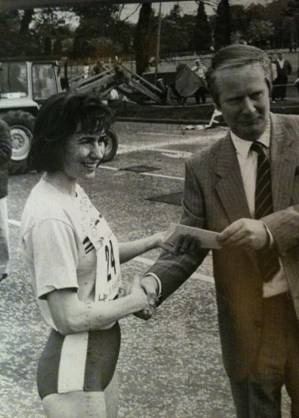
Lynne receiving her award for winning the Gallery Street Mile in 1983

(This was a Street Mile from Lenzie to Kirkintilloch organised by the BMC and Strathkelvin Council in connection with the Luddon Half Marathon)

As a ‘Girl’ (ie Under 13) Lynne ran an 800m in 2:21.9 which had her at the top of the age group rankings but it also placed her fourth Junior (Under 15) and fifteenth Intermediate (Under 17); her 1500m time of 4:52.3 was also top of her age group but placed her second Under 15, third Under 17 and nineteenth Senior!    At this point she was training with an excellent group under the guidance of Ronnie Kane who had been a Scottish cross-country internationalist and a regular and dependable member of the outstanding Victoria Park team of the 1950’s.   The group contained such excellent athletes as Fiona McQueen. Judith Shepherd and Janet McColl, all of whom made the difficult transition to senior athlete having negotiated the pitfalls on the way up that lose the sport so much talent.   After winning the National in 1978, Lynne had another good year as an Under 15 on the track.   She won the West District 800m in 2:22.3 and was second in the East v West fixture in 2:15.0.   At the SWAAA it was the 1500m that she tackled and won in 4:46.5.   The 800m time ranked her second in her age group and her 1500m best for the season of 4:39.8 topped her age group.

In 1979 Lynne continued to progress: she won the West District 800m, the East v West 800m and the Scottish Schools on 16th June in a season’s best of 2:15.13 which was two seconds clear of Angela McGeown from Paisley who managed to top the rankings for the season with a late-season 2:14.9.   She won the Junior SWAAA 1500m and in the UK Schools she won in 4:29.6. which was a UK age 14 best at the time. Add in a victory in the WAAA Championships and you have successful summer. Her season’s best at the distance was 4;29.6 which was run at Grangemouth on 16th July: the time was eleven seconds up on Sharon Morris and a whole 20 seconds up on Yvonne Murray,

1980 had a third place in the WAAA Under-17 indoor championship 800m at Cosford in 2:10.6.In 1981 she tackled only one senior championships – that was at the West District 3000m which she won in 9:53.4 – preferring to run at the Intermediate Championships where she won the Scottish in 2:11.9 and the East v West which she also won (2:10.0).    In the Intermediate rankings she was fifth in the 400m with 58.2, first in the 800m with 2:08.9 and first in the 1500 with 4:23.8.   Lynne ran in two women’s internationals that year.   In the match at Meadowbank against Denmark and Eire she was fifth in the 1500m in 4:29.8 and in the match against Norway and Wales at Ardal in Norway she was again fifth in 4:24.6.   It should of course be noted that she was racing against senior women of international standard.   Her travels that year included Antrim, Oldenburg (West Germany), Ardal, Dublin, Birmingham and Crystal Palace as well as the Scottish circuit.    She was at this point still a pupil at King’s Park High School.   Her performances showed a remarkable consistency for a 16 year old: often enough a young runner has one or two or even three performances in a season that rank with the best of the Seniors but Lynne had many more than that.   Her 1500m performances in 1981 included:    4:23.8 (Antrim, 24/5), 4:24.7 (Oldenburg, 13/6), 4:24.7 (Grangemouth, 28/5), 4:24.7 (Ardal, 29/8), 4:25.6 (Dublin, 4/7), 4:26.9 (Birmingham 19/9) and 4:27.1 (Crystal Palace 25/7).   On the Women’s All-Time lists her 4:23.7 that year placed her ninth on the seniors list but first on the U-17 list to equal her top rankings for the U-15’s and U-13’s.   An outstanding year by any measurement.

If 1981 was good, 1982 was better!   At the age of seventeen, she had no fewer than five times in the Senior women’s rankings with the best (4:15.7) being third behind Christine McMeekin (4:14.87 and Yvonne Murray (4:15.1).   Her best 800m time of 2:06.87 was fourth and she was even in the 400m lists with 58.3 seconds.   At the end of the season she had moved up to fourth on the all-time list.   It was a time when the standard of women’s middle distance running in Scotland was good – her rivals included the McMeekin twins, Yvonne Murray, Andrea Everett and Elise Lyon (Wycombe Phoenix).   In the SWAAA senior championships, she won the 1500m from Christine McMeekin with 4:16.2 to Christine’s 4:16.7 while in the West Championships she was second in the 800m with 2:14.7 and in the schools championships she defeated Andrea Everett with 2:09.6 to 2:11.8.    There was a women’s international that year in Maribor, Yugoslavia against England, Yugoslavia and Spain and Lynne was again in the 1500m where she was sixth of the eight runners with a time of 4:18.19.   Her racing venues in 1982 included Crystal Palace, Maribor, Cwmbran, Amsterdam as well as all the Scottish venues.

1983 was the year when Lynne had her first taste of a major games when she was picked for the European Junior Championships at Schwechat in Austria.   Running in the 1500 metres she qualified for the final along with Elise Lyon from Brighton where she was fourth in 4:15.39 behind the Romanian winner, Margareta Keszeg, who was timed at 4:13.17 with Elise tenth in 4:22.13.   This was to be her first Games occasion but by no means her last.   She comments on the event: “I was quite pleased with this performance.   I had been the top ranked Junior in Europe the year before but then Ronnie died and it was a difficult winter.   I had a terrible run in the world Cross-Country in Gateshead.   I started being coached by John just prior to the championships and this really helped to turn things round and so to be that close to a medal after a period of turmoil was quite good.”

1984 was Olympic year and Lynne started off on 14th January winning the indoor 1500m in the WAAA Championships at Cosford in 4:16.89 and in the international fixture two weeks later she represented Britain against the GDR and finished third in 4:14.11.   The next result of any consequence was in May in the UK Championships at Cwmbran when she was second in 4:10.81.   Two weeks late, on 10th June, at Gateshead in the Olympic trials Lynne was second in 4:06.99.   Eighteen days later in Oslo Lynne was second in 4:09.27.   The Olympics were in Los Angeles in August and the Soviet bloc boycotted them in retaliation for the American boycott of the Moscow Olympics in 1980.   Nevertheless the standard was very high indeed and in the 1500m for Britain Lynne was accompanied by Christine Boxer and Chris Benning.   Her first race in the arena was on 9th August and she finished fifth in the second Heat in 4:09.08 to qualify for the final.   Two days later in the final, Lynne was eleventh in 4:10.58.    As a nineteen year old, the youngest in any endurance race final at the Games, she could not have been disappointed in this result although the papers made a big deal of Lorraine Baker – 20 years old – who made the 800m final and even more of Zola Budd.  The actual race was fascinating with the issue in doubt right to the last few strides: the field was still bunched with 600 metres to go and Lynne was in the bunch – have a look at the race on YouTube,  just go to 1984 Olympics and then type in Women’s 1500m and you’ll get it.  Lynne has this to say about the Games: “This was a wonderful experience.   People were very kind to me because I was one of the youngest members of the team.   I think I could have run better in the final if I had been better prepared mentally.   However this was only me second senior GB vest!!!”   It should be noted that at this point many of the top Eastern European women, and some others too, were suspected with good reason of having used drugs to reach their peak and of course the whole thing came to the surface in 1988 with Ben Johnson’s disqualification and the many stories about other medal winners.   She was probably ‘cleaner’ in this respect than several ahead of her.   Two weeks after returning from Los Angeles, Lynne raced to 2:01.11 for 800m at Crystal Palace which was a Scottish record that still (September 2011) stands.   Two days later in Budapest she was fifth in 4:05.98.   Still racing in September she was fourth in the Mile at the IAC meeting at Crystal Palace in a time of 4:30.08 on 7th September and on the sixteenth on the international against Yugoslavia in Karlovic, Lynne was third in the 800m in 2:02.37 to bring the curtain down on a very successful summer season.

1985 was not nearly as busy a year however she started by winning the Scottish Cross-Country Championship from Yvonne Murray.  Doug Gillon had this to say about it in the ‘Herald’ of 25th February: “The women’s championship at Rosyth saw Lynne MacDougall carve out yet another victory over Yvonne Murray.   Lynne stalked her capital rival hoping to outsprint her towards the end.   The Edinburgh girl, aware of the danger, tried to get away, opening a 30 yard gap, but the Olympic finalist remorselessly cut her down and went away to win by twenty two seconds.” For summer 1985 Lynne is only on record with an early season indoor 1500m in the international against the Federal Republic of Germany at Cosford where she was first in 4:14.51.  This time placed her twelfth in Britain and second in Scotland (behind Yvonne Murray)  at the end of the year.   The ‘Glasgow Herald’ of 17th April 1985 had this report from Doug Gillon: “Lynne MacDougall, the Olympic 1500m finalist from McLaren Glasgow, has been struck down by a knee injury on the eve of the 1985 track season.   For the past few days she has been able to run for only 15 minutes at a time and is now reconciled to the fact that she will not be able to compete until July at the earliest.   “I went to Portugal for warm-weather training, she says.   “I had been there only four days when I twisted a knee and damaged the ligaments.   I haven’t really been able to train now for three weeks.”   Lynne was in Portugal with the International Athletes Club and treatment was readily available.   “The damage was done on the tight bends of the cross-country course,” she said.   That means she will miss the UK Closed Championships in Ulster next month, an event which looks increasingly likely to be affected by considerable defections following IRA threats.   Lynne however is looking philosophically at injury.   She has degree exams which will determine whether she does an honours year or not.”   

 She won the Scottish Universities Cross-Country Championship at the start of the 1986 (it was to be six years before she ran over the country again) and she is pictured at the top of the page crossing the finish line. All these races were in the early part of the year. 1986 however was Commonwealth Games year – and they were to be held in Scotland too.   There were many complaints about the size of the team, the selection procedures and the whole financing of the Games but Lynne made sure that she was selected when she won the SWAAA Championships in June with a time of 4:10.23 on 14th June.  The report in “The Glasgow Herald” said: Since her appearance in the Olympic 1500m final, Miss MacDougall has suffered prolonged injury problems.   That doubled with the build-up to her final examinations for a degree in psychology at Glasgow University continued to hamper her.   Last week she struggled to finish a detached sixth in the women’s 1500m before completing her finals in midweek.   But she produced a gutsy performance clinging grimly to the shoulder of Dundee’s Liz Lynch before striking for home from 280 metres out, slicing six seconds from her own championship best.”     On 19th July she ran a very good 1000m at Birmingham where she finished sixth in 2:38.67.    The Games started on 24th July and became known as the Boycott Games as 32 nations stayed away in protest at the Thatcher Government’s links with apartheid South Africa.   26 nations attended however.   Lynne was in the 1500m representing Scotland along with Yvonne Murray and Christine (McMeekin) Whittingham.   Qualifying for the final she finished in a time well below her usual – 4:17.25 in eighth place while Yvonne was fifth in 4:14.36 and Christine was eliminated in the Heats in 4:33.01 when finishing sixth in the first Heat.  Lynne’s own take on the event is as follows: “I struggled over the 1985/86 winter after being out all of the 1985 season with the knee injury.   It was really difficult to get back to the shape I had been in at the beginning of 1985 where, as I think the Scottish Cross-Country win over Yvonne Murray indicates, was probably the best shape I have ever been in.   At least I made the final!”   The season ended on 8th August with a Mile at Crystal Palace in 4:34.10 in the IAC/GP meet.      By the end of 1986 she was in four separate Scottish ranking lists: sixth in the 800m with 2:04.4. third in the 100m with 2:38.67, third in the 1500m with 4:10.23 and first in the Mile with 4:34.10.   Lynne did not turn out in either the West Districts or the UK Championships but did race in the Scottish Championships at Crown Point on 19th June where she was second to Karen Hutcheson.   The ‘Scotland’s Runner magazine reported as follows: “Karen Hutcheson led from the start with an even paced 66.54 for the first lap and a time of 3:04.75 at the bell.   Behind her, a slow-starting Lynne MacDougall fought back, closed on Jill Hunter, and passed her on the last bend to take second but victory was Hutcheson’s in a personal best of 4:14.04.   Placings: 1.   K Hutcheson 4:14.04;   2.   L McIntyre 4:30.47;   3.   J Hunter   4:21.24.”   By the end of 1987, Lynne was second in the 800 (2:04.67), third in the 1500m (4:11.27) and third in the Mile (4:13.24).   Running at that level is of course an expensive business and in May 2009 there was an announcement of a marketing campaign organised by Dundas Marketing in Edinburgh for several of John Anderson’s group of athletes including Lynne, Liz McColgan and Lynsey MacDonald with Dave Moorcroft also on hand.   The article in ‘The Glasgow Herald’ of 10th May 2009 is worth looking at it is easily found on the internet.

1987/88 would be much more active for her.   On 7th November she was second woman in the Glasgow University road race in 26:15 behind Sandra Branney’s 25:18.   On 20th December she dropped a distance or three to win the West District Indoor 800m championship with a time of 2:13.1.   Into 1988 and Lynne won the Springburn Harriers Jack Crawford Memorial Road Race in 29:20 and then the Nigel Barge Road Race in 26:08.   On 23rd January she was second in the AAA Pearl Assurance Indoor 1500m at Cosford in 4:26.50.    Two high profile indoor 1500’s followed and were reported in ‘Scotland’s Runner’ as follows: “Lynne McIntyre, disappointed to lose out in the tightest of finishes at the Dairy Crest International at the Kelvin Hall, had only a week to wait for revenge.   The Glasgow AC woman had been given the same time, 4:18.27, as Bev Nicholson against France but eight days later, competing against Belgium and Holland at Ghent she had eight seconds to spare over Nicholson as she clocked a season’s best of 4:16.39 to finish second.”   The good form continued into summer 1988 where she finished fifth in the final of the TSB/Kodak Olympic trials in 4:12.50 while Karen Hutcheson was eighth in 4:15.85.   On July 22nd in the Scottish Championships at Crown Point track in Glasgow Lynne again defeated Karen Hutcheson in a field that was considerably better than the previous year.   ‘Scotland’s Runner’ again:   Lynne McIntyre, showing some welcome signs of returning to form, relieved Karen Hutcheson of her 1500m title after the duo had dropped Chris Whittingham about 700m from home.   In the end, McIntyre won comfortably putting in a sub-66 second last lap to pull clear.    1.   L McIntyre   4:13.99;   2.   K Hutcheson  4:18.06    By the season’s end she had best times of 2:05.46 for 800m (fourth ranked), 4:12.50 for 1500 (third ranked) and 9:35.1 (sixth ranked).

LMacD 4

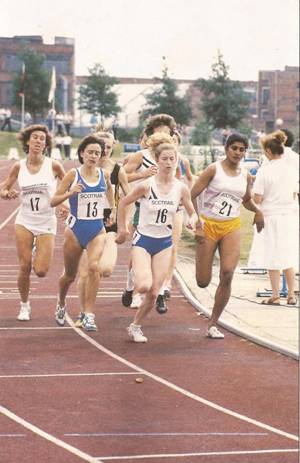
Scottish women’s 800m, 1989.

Lynne (13), Abrahams (21) are both clear, Bevan is behind Lynne in the black vest and Anderson is immediately behind number 16.

At the end of 1988, the Commonwealth Games guidelines for 1990 were released and for the women’s middle distance races they were 2:02 (A Standard) and 2:05 (B standard) for the 800m, 4:08.5 and 4:15.0 for 1500m and 9:00 and 9:15.0 for the 3000m.   Lynne knew her targets from that point.   Ending 1988 with a victory in the Glasgow University Road Race in November, there is no record of her competing indoors or on the country in winter 1988/89 with the first run in 1989 being n the Dunky Wright Road Race in Clydebank where she defeated Sandra Branney to win in 29:26 to Sandra’s 31:02.   On the track, in the HFC Bank UK Championships in Jarrow Lynne won the 1500m in 4:11.31 from Alison Wyeth (4:13.33) and Sonia McGeorge (4:14.24).   It was reported by Doug Gillon in the July 1989 issue of ‘Scotland’s Runner’ thus: “A new Scot on the gold standard was Lynne McIntyre (1500m) clearly almost back to   the form which earned her an Olympic final place in Los Angeles.   She was rewarded with 800m selection for the International Select at Portsmouth the following week.”   If this was a good run she excelled in the Scottish Championships at Crown Point.   This was one of the years when the governing body saw fit to invite a ‘squad from abroad’  to compete on the excuse that they were raising standards in the championships – we had the Australians at Meadowbank but this year there was a visiting team of Indians taking part.   However in her favourite event, the 1500m, the report read as follows: “This was clearly a two-horse race as Lynne McIntyre and Karen Hutcheson left the pack early on to take on a duel of their own.   They set up a fast pace and constantly increased the gap between themselves and the rest of the field.   The two stayed together into the final lap. the split time at that stage being 3:02.73.   With 350 to go Lynne started to pull away from Karen and started her long sprint for home.   Karen was unable to respond to this sudden burst and at the end of the race there was about 20 metres between them.   Lynne’s time of 4:08.14 beat her own championship best performance by over two seconds and was within the Commonwealth Games selection standard of 4:08.50.   1.   L McIntyre   4:08.14; 2.   K Hutcheson   4:12.26; 3.   Laura Adam   4:18.44.”   (Adam had already won the 3000m on the previous evening.   Not content with that, the report for the 800m reads: “Lynne McIntyre and Sue Bevan took up the running in the first lap of the 800m, the final of which was only one hour and twenty minutes after Lynne’s excellent 1500m victory.   The pace was unhurried as they went through the bell in 64 seconds.   With 300 to go Lynne took the lead in a bid for home and was closely followed by Sue Bevan and Mary Anderson.   By 200m to go, Sue was putting on the pressure and then Mary started to come to the front at the 150m mark.   Into the straight and any one of the leading pack could have won.   As they neared the finish, Mary Anderson seemed lost for pace ad India’s Shiny Abrahams seemed to come from nowhere to take the lead.   Lynne McIntyre made a valiant bid to catch her over the last few metres and almost did so, but Shiny had just made it to the line to win.   1.   S Abrahams   2:06.72; 2.   L McIntyre   2:06.77; 3.   M Anderson   2:07.76; 4.   S Bevan   2:08.32.”    (Anglo-Scot Sue Bevan was comparatively young at this point but she was to go to become a Scottish International track runner over 800m both indoors and out in the 1980’s)   Lynne now had her qualification for the Games and at the end of the summer in 1989she was ranked second to Yvonne Murray in both the 800 (with 2:03.43) and 1500 (4:08.14).    When it was announced that only 22 athletes would be selected for Auckland with only ten of them women, there was a real stushie with SAAA Secretary Ewan Murray pilloried for saying that no one would go ‘just for the trip’.    Ruth Booth the women’s team manager was ‘upset and amazed’ at the lack of places and the SWAAA complained formally.   Nevertheless the team went as selected and Lynne was there.   November 1989 was another victory for her in the GU Road Race – this time in 26:15 for the 5.5 mile course from Ruth McAleese (27:34).

In February 1990, Doug Gillon previewed the Commonwealth Games in ‘Scotland’s Runner’ and had this to say about Lynne: Lynne McIntyre with solid warm-up outings at 1500m and 800m is beginning to regain the form which took her to the Olympic 1500m as a teenager, and cannot be dismissed as a medal prospect in the metric mile.”      Further through the same issue of the magazine in an article entitled ‘For Love Or Money’ which dealt with the difficulties for athletes of trying to balance a full-time athletics life style with the need to earn money to put bread on the table, the following comments were made: “At least £10,000 a year is what several of the Auckland Scots calculate athletics is costing them.   …. For McIntyre that Commonwealth Games equation came true in 1986.   The 13th Games in Edinburgh provided the scene for her proudest moment in a successful international athletics career.   Wearing the dark blue vest of Scotland in Meadowbank was more fulfilling to the Glasgow woman than any of the other numerous occasions when she has competed for Scotland.   “At Commonwealth Games time it becomes very important to be Scottish,” Lynne says, “and because they are the ‘Friendly Games’ as well, it is so much better that we compete as a small country.”   …..  “I think that if we competed as a British team the Games would be viewed in a different light – it would be just another competition.   A further reason is that the English are so good they would make up most of a GB team”   …..   The Commonwealth Games can provide Scottish athletes with the level of competition to inspire them and to promote pride in themselves and in their performances.   Not all international appearances for Scotland can do this, as Lynne recalls, “I think the worst I have ever felt in a Scottish vest was when we competed against Birchfield Harriers and the Midlands.   There we were – a National team – taking on a team from an English club and a region!   It was an opinion of our standards before we even started.”      (I should maybe add, that for many years after this the same fixture continued – it was designated a ‘Scottish Representative’ team and a ‘Representative fixture’ with the word ‘International’ carefully avoided.   The Midlands Select was always of a very high standard and it was not at all certain that we would beat them.   To add to the lack of a sense of occasion, the vests and tracksuits were issued to the athletes and taken back again afterwards!    I remember coming back after one such encounter at a time when the Scottish kit supplier was changing from Asics to Nike: the track suits were issued, taken back again and then a sale was held on the bus with the track suits going for £5 each!   Only the green eye-shades were missing).

However, Lynne went to the Games in Auckland and right well did she do there!    After a lot of trouble with injuries and other problems she went and was fifth in the final – but good as that sounds, it was even better than it sounds.   The Games were the third to be held in New Zealand and to the great relief of the organisers, there was no boycott as there had been in Edinburgh in 1986.    Lynne made the final of the 1500m easily enough as did Yvonne Murray and Karen Hutcheson.   In a fast race, Lynne missed the silver medal by one second – in fifth place!    The result:   1.   Angela Chalmers (Canada) 4:08.41; 2.   Christina Cahill (England) 4:08.75; 3.   Bev Nicholson (England) 4:09.00; 4.   Yvonne Murray (Scotland)  4:09.54; 5.   Lynne MacDougall (Scotland) 4:09.75; 6.   Debbie Bowker (Canada) 4:11.20  …. 10. Karen Hutcheson (Scotland) 4:13.77.   Lynne says “This was another great experience.   The New Zealanders really ensured that it was an athlete friendly Games and it had a much better sense of occasion than the Games four years previously in Edinburgh.   I ran 4:07 in an Open Graded in Australia prior to the Games so I knew I was coming back to good form.   Unfortunately I had a very sore tendon in the lead-up to the Games and this limited my training in terms of volume although my track sessions were very good.   I think I managed to compete well at this Games despite this because I was away from my home environment for eight weeks training in Australia.”

 By the end of the year she was second in the 800m rankings with 2:04.43 to Yvonne Murray’s 2:03.57 and third in the 1500m behind Liz McColgan and Yvonne with 4:08.88.   Still plagued by injury, there had been times when it seemed that she would not be able to run in Auckland but with a lot of medical assistance, she did and that made the year a big success.   There was however a price to pay in the form of operation on ankle tendons.

 In 1991 there was only one race – the national 3000m championship which she won.   Doug covered it as follows in the ‘Herald’ of 6th July 1991: “McIntyre Is Back In The Big Time.   Scotland’s forgotten Olympian Lynne McIntyre, ended the wilderness years when she won the 3000m crown, the first track to be decided in last night’s opening session of the Scottish national athletics championships.   The City of Glasgow woman was an Olympic finalist over 1500m in Los Angeles at the age of 19.   But for six years she has been plagued by back and ankle tendon injuries.   Surgery last year repaired the ankle damage  and at Crown Point Stadium, now aged 26, the three time former national  1500m title-winner showed a flash of her former glories in her first championship outing at the longer distance.   She sprinted clear of Hayley Haining with 250m to go to clock 9 minutes 24.23 seconds.   “There were quite a few times that I thought of giving up athletics,” said psychology graduate McIntyre, “I was not only frustrated by the injuries but at not being able to run as fast as when I was younger.   But now I am going to try to make the Barcelona Olympics.” 

As it turned out, other than that, Lynne did not race at all either on the road, on the track or over the country.    It looked like the end of a first rate career in the sport …… it looked like it but there was more to come.    There were Olympics in 1992 and Lynne was never one to pass up on a challenge!   There was an article in ‘The Herald’ on 13th January 1992 by Doug Gillon which began: “Lynne McIntyre, racing cross-country for the first time in six years, captured the Scottish closed 4000m title from defending champion Vicki Vaughn yesterday at Irvine and earned herself a certain place in the Scottish team to contest the world championship trial at Basingstoke on February 9th.”   Not just back in business but straight in at international level!   The race was run in perfect conditions on ‘a perfect course’ at Irvine Riverside in an extended version of the article in ‘Scotland’s Runner of  February 1992, she told Doug that there had been a planned progression back to racing fitness. she knew that if the tendons broke down she was finished.   But now?   “I’m quite motivated about Barcelona , at either 1500m or 3000m, but my times haven’t improved for seven years . and after so many disappointments I’m reluctant to admit to Olympic possibilities, even to myself.”   Doug added that it was a ‘timely boost’ for McIntyre after several seasons when her career teetered on the brink.   The result of the race was – 1.   L McIntyre   15:09;   2.   V Vaughan   15:15;   3.   A Rose   15:32.

LMacD 5

But nothing was ever easy for Lynne.   ‘Scotland’s Runner’ again:  “National 4000m champion Lynne McIntyre who entertained hopes of a medal, withdrew just before the gun with a leg muscle problem and required minor surgery on her return.   She expects to be back in training in a fortnight.”   It didn’t turn out well for her though and she was absent from the SWAAA Championships and the Olympic Trials nor was she ranked in any event at all at the end of the year.   Her next appearance in the Scottish Championships was on 10th July 1993 at Grangemouth when she won the 3000m in 9:28.4 from Sue Ridley (9:34.9).   “… Lynne McIntyre regained the 3000m title, breaking clear at the bell from last year’s winner Sue Ridley …. she proved that she has regained her appetite for the competitive fray,”   reported Alasdair Fraser for ‘Scotland’s Runner.   But it was not until the end of 1995 that Doug Gillon wrote the following in the ‘Herald’ under the headline ‘McIntyre plans to put athletics career back on track.’   1993 was also the year when she won the first ever Glasgow Women’s 10K Road Race.   The race, famous for both the quality of athlete at the ‘sharp end’ and the huge numbers of runners taking part is still being run and Lynne is still racing in it.   If you go to YouTube and type in ‘Lynne MacDougall’ you will get a film clip of her finishing first in the 2009 race.

The athletics jury which has already condemned 30-year-old Lynne McIntyre one of sports under-achievers may yet have to reconsider.   Twelve years after she was the youngest Olympic 1500m finalist at 19, the City of Glasgow woman hopes to return and win selection for Atlanta in the same event.   Why not?   She has overturned a catalogue of disasters, any one of which would have buried a person of lesser moral fibre.   In 1984, McIntyre was seventh in Los Angeles.   A week later she set a British junior 800m record (2:01.11) which still stands.   Were it not for South African Zola Budd’s passport of convenience, she would also hold the 1500m mark.   Charting the rise and demise of the former Lynne McDougall is simple, but behind the statistics – as many Scottish senior outdoors titles as Commonwealth champions Liz McColgan and Yvonne Murray combined – and the belief that she can run faster after a 12 year absence, lies a saga of triumph against emotional and physical adversity.   The death of her coach, and then her father, painful injury, surgery, and then divorce – all while earning an honours degree and a distinction in a post-graduation Masters – conspired against her.   Budd and McIntyre, the two youngest in that 1984 team, exchanged little conversation, with Budd a cloistered pawn in a newspaper circulation war.  However McIntyre, dismissing two Commonwealth Final appearances as incidental, hopes to have the last word.   Just two months after her seventeenth birthday, belying her frail physique, she won the Scottish senior 1500m title, setting a senior native record.   It survived a week, broken by future Commonwealth 10000m champion  Murray – one year her senior.   Two years later McIntyre won the national senior cross-country title with Murray second.   And when Murray won the 1986 Scottish 1500m title, the older McColgan – later that year to become the Commonwealth 10K senior champion – was runner-up.   In 1989 she set a Scottish championship 1500m record which still stands, and the future European and World finalist, Alison Wyeth, was runner-up when McIntyre won the UK 1500m title.

“But perhaps none of this should have surprised.   In the winter of ’76, she had given a clue by running future Olympic 400m finalist Linsey MacDonald a close second in the Scottish under-13 cross-country championships.   A few months ago, despite having kept in modest shape – enough to pick up what, by her own standards, were soft Scottish track and cross-country titles in the interim – McIntyre was contemplating final retirement.   Instead after her flickering enthusiasm had been kept alive by Gerry Barnes and Bill Parker, she returned to John Anderson, the man who had helped steer her to Olympic success following the death of much-loved Glasgow coach Ronnie Kane.   Anderson refused to help her unless she was serious.   “I told him I was back because I felt I’d never fulfilled my potential,” she said. “If I could achieve that at 19, psychologically immature, I know I can run faster now.   I got a poor degree at Strathclyde (she dismisses a second-class honours degree in psychology) and don’t want to look back on my athletics in the same way.   Perhaps I can do as well in my athletics, second time around, as I did in my masters.   It was perhaps no coincidence that she sought out Anderson within days of her former husband re-marrying.   “It took me three years to sort out my life after our marriage broke up,” she said.   “I felt ineffectual – as if I could not control my life.   It was hard working out where I went from there.    But women, I think, do better than men in that situation because they confront themselves.   We internalise it while men just carry on.”   Listening, one understands why at 21, she counselled drug addicts and alcoholics full time, and why now she co-ordinates the Glasgow Healthy City project which attempts to address the problem of urban regeneration by combating unemployment, poverty and deprivation.   She realises winning Olympic gold   might be easier than changing Government attitudes.   The elfin face is remarkably unchanged since 1984, I observe.   “Surprising, considering I enjoy a Glenmorangie – with a dash of water – and a good dry white wine,”  she says with a laugh.   The heresy: “There’s more to life than athletics.”   Perhaps that truth reveals why she might just succeed in turning back the clock.   Unlike most top athletes, she puts something back.   Responding to an initiative by fellow 800m internationalist Carol Sharp, McIntyre will help present a Puma-backed conference next week end at Jordanhill College which will attempt to reverse the pattern which sees Murray as the only Scott, Sharp and McIntyre apart, to have broken 2:03 for two laps in more than a decade.   Perhaps en route to Atlanta, Lynne will retrace her footsteps and show the way.”

Back with John Anderson, Lynne ended 1996 with six of the top sixteen Scottish 1500m times as follows:

Ranking Time Venue Date Race Position
1st 4:17.10 Birmingham 16th June Eighth
2nd 4:18.81 Birmingham 15th June 2nd, Ht 1
4th 4:21.85 Bedford 27th May 1st
6th 4:23.7 Liverpool 28th July 1st
13th 4:27.82 Belfast 22nd June 1st
16th 4:30.05 Crown Point 29th June, 1st

The top time of 4:17.10 ranked her fourteenth in Britain.   She had also run 2:08.37 for 800m which placed her fourth in Scotland and 36th in Britain.  In July however, there was a Scottish silver and bronze at the British Championships in Sheffield with Yvonne Murray (15:39.08) second and Lynne third (15:43.03).  There was also a road 5K in 17:15 which was sixth best time by a Scot that year.   The Annual Yearbook commented, “Lynne MacDougall’s successful comeback continued with a list topping of 4:17.10 – the slowest time to top the Scottish rankings since 1977 – a year when a 12 year old Miss MacDougall appeared in the lists for the first time with a 4:52.3.   She also won her fourth National in a close finish with Irish holder Ann Tevek.”   In 1997 her road racing had gone up to 10K and she was third in the rankings after winning at Ayr in 33:42.   On the track she had four of the top seven 1500m times (4:12.4 at Crown Point in August, 4:16.6 at Sheffield in February, 4:20.1 at Enfield in June and 4:22.8 at Grangemouth in July) prompting the following comment from the statisticians: “32 year old MacDougall took advantage of a mixed race at Crown Point to record 4:12.4 – her fastest run since 1990 – and recorded four other winning races under 4:24 with a victory in Malaysia in 4:23.7 in thick smog in September.”  The Malaysian race was an interesting one: Lynne had been sent on a fact-finding errand by Scottish Athletics to Kuala Lumpur ahead of the following year’s Commonwealth Games and while there, they had won the Malaysian Championships (‘despite 80% humidity and serious air pollution’)! Also in 1997, Lynne had three of the top five Scottish times for the 5000m – 15:45.03 in Sheffield in June placed her second, victory at Crown Point in 15:51.7 in June placed her third and 16:04.01 at Birmingham when she was third behind Yvonne Murray in July placed her fifth.

The rankings in 1998 took an interesting turn in that there were ranked places in three road races and only one track position.   The statisticians said in their yearbook, that she had concentrated on road running  that year and certainly her placings showed that.   In road racing, Lynne was first in the rankings for 10 miles when she won in Manchester in August with 55:58, second for 5 Miles when she won in Glasgow in February with 26:23, and third for the 10K when she was first in Belfast in 33:32.   On the track she had second and sixth in the 5000m – 16:01.41 when finishing fifth in Turku, and 16:21.8 when winning at Crown Point in August.  Unfortunately, because of injuries she could not run in the Commonwealth Games.

Unfortunately in 1999, Lynne appeared nowhere at all in the ranking lists.   The injuries that had denied her a third Commonwealth Games after she had been one of the first to be selected, had not gone away and were still causing her some difficulty.

By 2000 Lynne was committed to road running – at home she was ranked fourth at the five miles distance with her 27:49 when finishing second in Glasgow in November behind Hayley Haining, Katie Skorupska and Gillian Palmer.   She was top of the 10K road distance with her winning time from Leeds in December of 33:22 from Hayley Haining’s 33:38.   At ten miles her winning time from Carlisle in November of 57:37 placed her fourth.   She also had the top two half marathon times of 74:50 (Reading, March) and 75:43 (Glasgow, August) as well as a creditable 79:31 at Bristol in October when she decided to drop out, then changed her mind and turned in a time that many men would be pleased to call their own!.   But at the longest standard distance of the marathon she topped the rankings with 2:38:22 from second placer Trudi Thomson’s 2:40:40.  This was turned in when she was first British female runner to finish in the London Marathon which meant that she was the UK  Women’s Marathon Champion.     The picture below was taken in August 2000 when Lynne and partner Allan went for a running holiday in America.   In the North Reading, Mass., 5 miles Allan won the men’s race in 24:52 and Lynne was fifth overall and first woman in 28:43.   They’re entitled to smile!    The statisticians welcomed her not only to road racing but also to the veterans’ ranks with “New veteran Lynne MacDougall, in her first serious road racing season, recorded excellent times in the 10K, half-marathon and marathon.”

LMacD 6


Lynne with partner Allan Adams after they won a double victory in America in 2000

Despite appearing on no fewer than five Scottish all-time ranking lists, Lynne in 2001 stuck to road running where the ability that had her as one of the best ever at distances from 800m to 5000m on the track indicated that she was certainly one of the best of her generation on this surface too.    As a V35 she was ranked second to Hayley Haining at 10000m with her time of 34:30 when finishing eighth at Cheltenham in September and topped the lists at 10 Miles (55:28 when winning at Carlisle in November), half marathon (74:24 when finishing in fifteenth in the Great North Run at South Shields in September) and in the marathon (with 2:37:40 at London in April).   As far as championships were concerned she won the Scottish 10,000m with a  time  of 34:41 and it was her second national title at the distance with the first being in 1993 when she was timed at 34:28.

In 2002,  she retained her first place in the marathon rankings with the improved time of 2:36:29 when finishing second in Seville in February.  This gave her the qualifying time for the Commonwealth Games in 2002. But there was an unexpected problem.   Doug Gillon covered it with his article in the ‘Herald’ of 14th June that year.   Under the headline “Injury Gives MacDougall Much To Chew Over”,  he said:   “Scotland yesterday confirmed the first three places in the Commonwealth Games team for Manchester:  Marathoners Simon Pride and Lynne MacDougall and Sarah-Jane Cattermole for the 20K Walk.   An Olympic finalist 18 years ago in Los Angeles, MacDougall reached the Commonwealth Games 1500m final in 1986 and 1990 but ran her fastest marathon in Seville earlier this year.   She is an uncertain starter for the Bank of Scotland team however.   “I have a back injury which may be related to my teeth, perhaps my bite is out of alignment, and have missed some training,” she said.   “I am to see a specialist and will go only if I am fit enough.”   As it turned out, she didn’t think she was and missed the Games. Doug from the ‘Herald’ on 31st August 2002: “City of Glasgow’s MacDougall ruled herself out of Scotland’s Commonwealth Games team with a back problem.   She was a bitterly disappointed spectator when the Manchester bronze medal went with a 2:36:37 which was 15 seconds above what she had run in Spain.   “It’s been a bit de-motivating,” she said.   “I haven’t raced since that marathon but my back injury has gone and I’m back in training.”    Her other ranking places in 2002 were third in the 10000m with 34:19 recorded when winning at Paisley in September and third in the half marathon with 76:24 which she ran at Glasgow in September when she finished tenth.      Incidentally when she won the half marathon at Alloa in March, Allan won the men’s race to reprise the American result from 2000!

She appeared only in the 5 Miles and 10K ranking lists in 2003 – fifth with 26:08 in February for her run at Alsager in Cheshire and sixth with 35:24 two weeks later at Grangemouth where she finished second – but the Annual Yearbook noted that Gillian Palmer, Kathy Butler and Lynne MacDougall were all injured in 2003 which left the way open for such as Susan Partridge and Hayley Haining over the shorter distances and Trudi Thomson over the longer ones.   It was now five years since her last track race and although still racing well her career at the very top was by now over.   However, unlike many of her rivals she kept her love for the sport and kept on racing domestically: in 2005 she was third in the 5K Challenge in Glasgow with a time of 19:43; in 2007, by now a V40, she is on the record as having run run a 3K in November round Glasgow Green in 10:51 after having already run two 10K’s, in 37:34 in May and 37:56 in June – all three were in Glasgow.   Lynne ran the Women’s 10K in Glasgow in 2008 in 38:09, in 2009 in 38:54, in 2010 in 38:49 and in 2011 in 39:21 (second V45).

Settled now and living on the south side of Glasgow with Allan and their son Josh, with a good job which she loves at Glasgow University, she is very contented with her life but continues to run – and I believe she will continue to do so just because she loves to run.  She is still mentioned in despatches (eg in the ‘Sunday Herald’ preview of the 2009 Glasgow Women’s 10K there is a this: “25 years after she was the youngest Olympic 1500m finalist, Lynne MacDougall, now a mum, is in action again …).    There was also

Settled now and living on the south side of Glasgow with Allan and their son Josh, with a good job which she loves at Glasgow University, she is very contented with her life but continues to run – and I believe she will continue to do so just because she loves to run.  She is still mentioned in despatches (eg in the ‘Sunday Herald’ preview of the 2009 Glasgow Women’s 10K there is a this: “25 years after she was the youngest Olympic 1500m finalist, Lynne MacDougall, now a mum, is in action again …).    There was also another excellent article covering the various aspects of her career as a runner, student, graduate, mother, etc, in ‘The Herald’ of 3rd May 2010 in the course of which she says “I’m retired, so I only run four times a week.”   Her running career was stellar and, but for the dreadful injuries and the toll they exacted, it could have been even better.   She is an excellent advertisement for the sport and indeed a first class role model for any young sports person.

Ronnie McDonald: Monkland Harriers

Ron at Airdrie

Ron McDonald (4) at Airdrie Highland Games with Hugh Barrow (7), Dick Wedlock (half hidden behind Ron) and Harry Gorman (2).

 Ronald MacDonald was born on the 7th of November 1952. He was an athlete of enormous talent but suffered many injuries. Nevertheless he produced fine performances on track, country and road, from his days as a Youth in 1969 until 1982. He was an invaluable member of two clubs, Monkland Harriers and Clyde Valley AC, and ran for Scotland many times.    His career will be dealt with in the following order: Cross-Country; Road; and finally Track.

In 1970, Ronnie MacDonald defeated his friend and rival Jim Brown by five seconds to win the Midland District Youths CC Championships and Monkland Harriers won the team award. He followed this up by an even closer victory in the National Youths CC, only four seconds in front of Jim Brown and Lawrie Spence. Monkland were team victors once again. Subsequently, Ron was 13th and a team counter for Scotland in the ICCU Junior CC International at Vichy, France.

Ronnie’s success continued in 1971, when he only just managed to win the National Junior CC, sharing the winning time with Jim Brown! Both young men were coached by Tom Callaghan. However Ronnie’s shorter but ferociously determined rival Jim was gaining in stamina, winning the Midland District Junior and Senior CC three years in a row between 1971 and 1973; as well as triumphing in the National Junior in 1972 and 1973, when Monkland won the team title both times. When MacDonald and Brown battled against each other in the National Junior, they ran absolutely flat out, creating an enthralling contest for spectators. In the International Junior CC at San Sebastian, Spain, after leading for most of the way, Jim Brown was outsprinted and finished third, with Ian Gilmour 13th and Ronnie MacDonald 14th. Scotland won a rare silver medal (behind the Auld Enemy). This was the best Junior performance for seven years.

In 1972, Ronnie represented Scotland in Spain, along with experienced team-mates Lachie Stewart and Dick Wedlock. Then Ron was third in the National Junior, behind Jim Brown and Paul Bannon. Once more he was selected for the International Junior CC, this time at Cambridge , where he was 23rd, with Jim Brown second and Lawrie Reilly 20th. Scotland were fifth team.

In late January 1973, Ronnie MacDonald was recovering from a hip injury. He restarted training on New Year’s Day and built up to 50 miles a week, all on grass. In the Scottish Inter-Counties CC Championship at Irvine, according to reporter Ron Marshall, “he nursed himself through the field from the half-way point and steadily drew up to join the front-runners. His third place (21 seconds behind Dunbartonshire’s Colin Youngson, eleven seconds behind Ayrshire’s John Ferguson and just in front of Dunbartonshire’s Hugh Barrow) was a satisfactory conclusion.” Ronnie also led the Lanarkshire team to victory, three points in front of Dunbartonshire. A month later, Jim Brown retained his National Junior title, with Ronnie fourth and Monkland won the team. This year was the fourth and final time Ronnie MacDonald ran the International Junior CC, only on this occasion the Championship was the inaugural IAAF World Junior CC, which took place at Waregem Racecourse, outside Ghent, Holland. Jim Brown succeeded in winning a marvellous gold medal and his team-mate Ronnie was a counter yet again in 13th position, with Davie McMeekin and Lawrie Spence the other counters in 17th and 27th places. Only Nat Muir and Ronnie MacDonald have run four consecutive International Junior CC Championships for Scotland.

Ron MacDonald excelled in his first year racing in the 1974 Senior National CC, when on his local course, Drumpellier Park in Coatbridge, he finished third, behind Jim Brown and Andy McKean. Ron was of course selected for the World Senior CC at Monza, Italy, and ended up second Scot (31st), well behind Jim (4th) but gaining revenge on Andy (46th). Scotland was seventh from 15 teams. Then, in late 1974, Ron won the annual Inter-Area CC match, with his Scottish team-mates packing well to defeat the North, South and Midlands. Then in November 1974, the newly-formed Clyde Valley AC triumphed over the two main Edinburgh clubs in the first-ever SCCU Relay Championships at Bellahouston Park. The winning team was: Roy Baillie, Jim Brown, John Graham and Ron MacDonald.

For some time after that, Ron MacDonald was frequently injured, but he showed signs of a cross-country comeback in 1980, when we finished 11th in the National CC. His team won silver. Later that year, he was a member of the Clyde Valley outfit that came second in the National CC Relay. However he came right back to top form in 1982, with fourth in the National (with Jim Brown sixth and their team second); followed by a final run for Scotland in the World CC Championship in Rome, when he was fourth Scot (95th), behind Nat Muir (26th), Allister Hutton (30th) and John Robson (85th), but in front of Fraser Clyne, Alastair Douglas, Lawrie Spence and Ed Stewart.

On the road, Ron MacDonald twice won the prestigious 5-mile Nigel Barge Road Race at Maryhill, just after New Year: in 1971, at the tender age of 18, beating Commonwealth Games 10,000m representative Dick Wedlock by 3 seconds, to record 22 minutes 4 seconds. In 1982 he repeated the feat, this time beating Alastair Douglas by five seconds.

On New Year’s Eve 1974, Ian Stewart defeated a strong field to win the Madrid ‘Round the Houses’ Road Race, and with the backing of Ron MacDonald (4th), Bill Mullett (6th) and Nat Muir (7th), Scotland won the team prize, from Portugal and Spain.

Ron first ran the Edinburgh to Glasgow Relay for Monkland Harriers when they finished ninth in 1971. Barely 19 years of age, he was second-fastest on the classy Stage Two, only 25 seconds behind Commonwealth 10,000m champion Lachie Stewart. In 1973, Monkland improved by one place, with Ronnie tackling the longest Stage Six, where he was 4th fastest behind Andy McKean, Dave Logue and Ian Stewart.

Ronnie just beaten by Dave Moorcroft in the AAA’s Junior Championship, 1971

Clyde Valley AC won bronze in 1974, with Ron second-fastest on Stage Two, behind Lawrie Reilly. Another third place in the fastest-ever year of 1975. Ron was second-fastest, only ten seconds behind Dave Logue, on Stage Six. In 1976, Clyde Valley were fifth, with Ron less-fit but tackling the Eighth Stage.

1979 saw Clyde Valley winning silver in the inaugural Scottish Six-Stage Road Relay at Strathclyde Park. They repeated the feat in 1980, both times being denied victory only by the last leg heroics of Edinburgh Southern’s finest runner, Allister Hutton. The Clyde Valley men at this time included Ron, Jim, Joe Small, Brian McSloy, John Graham, Ian Gilmour, Peter Fox and Colin Farquharson – an extremely talented bunch, indeed.

In 1980 Clyde Valley succeeded in winning gold in Scotland’s favourite road relay. Ron moved his team up three places on Stage Two, sharing second-fastest on Stage Two with Ian Elliot, only 14 seconds behind Nat Muir. They were second in 1981, with Ron fastest on Stage Four. His swansong was in 1983, when his team won bronze, with Ron gaining two places on Stage Two.

Ron MacDonald’s career in cross-country and road-running is very impressive. However his greatest successes came on the track, particularly over 1500m and the magic mile.   As a Youth in 1969, Ronnie won the West District 800m 1.59.0 in front of list-topper Davie McMeekin. He won both the Scottish Schools and the SAAA Youths 1500m  in front of Frank Clement and recorded a season’s best of 4.01.4.

A Junior in 1970, he ran 1.59.3 for an early season 800m but his focus was on 1500m. He won the SAAA Championship in a close finish with John Ross, with Frank third. On the first of August, Ronnie MacDonald also won the AAA Junior 1500m at Kirkby, Liverpool, in a PB of 3.50.5. He was deservedly awarded GB Junior colours for the European title meet in Paris, where he qualified for the final. His stamina was also evident, with 3000m (8.39.8); and 5000m (14.48.2), after easily winning the Scottish Schools title. He set his 5000m PB when coming fourth in the Schools’ International in Santry, Dublin on 13th July.

Then, in 1971, Ronnie reduced his 800m best to 1.56.8 and subsequently won the SAAA Junior 1500m (3.49.5) after a close finish with Frank Clement. However Craig Douglas battled to restrict him to silver in the SAAA Senior 1500m. Ronnie’s new PB was set at Hawyards Park on 5th June, with a winning 3.46.0. This was set when pipping Adrian Weatherhead in a 4.04.0 mile victory. A fortnight later, Adrian ran a mile in 3.58.5! Ronnie topped the Scottish Junior 3000m list with 8.07.2. He picked up a bronze, one place behind Jim Brown, in the AAA Junior event. Ronnie retained his Scottish Schools 5000m title in a solo 14.24.6.

In 1972, Ron MacDonald became a Senior on the track. For 800m, he recorded 1.54.0. In addition he won the West District title. He made real progress in his favourite 1500, winning a slow SAAA Senior Championship after a terrific sprint with Craig Douglas and Jim Dingwall. He produced five times below 3.48 (with a best of 3.43.0 to reach the AAA final at Crystal Palace, where he finished 8th (3.44.6).

After recovering from a hip injury, Ron produced some good late season performances between the first of September and the sixth of October: 5000m in 14.35.2  and 1500m in 3.46.5 for two wins at Meadowbank; and a mile in 4.02.5 9 (fifth place at Crystal Palace).

In 1974 he showed better sustained form. On 18th May at Westerlands, Ron MacDonald won an 800m in 1.52.6. He finished second in the Scottish 1500m ranking lists (3.43.1) behind Frank Clement; and also picked up a silver medal in the SAAA event at Meadowbank on 22nd June, with only Klaus-Peter Justus of the GDR in front. Ron’s fastest 1500m of the season took place at Crystal Palace, a track on which he always seemed to run well. The yearbook goes on to state: “Ron MacDonald joined the select band of sub-8 minute 3000m runners, when on 20th May at Crystal Palace, he won an early season race in the fast time of 7.55.4, defeating among other stars David Black, Commonwealth silver and bronze medallist.”

1975 was another successful season. Ron MacDonald won silver again in the SAAA 1500m on 28th June at Meadowbank, behind Lawrie Spence. Then Ron produced 3.46.0 on 1st August at Crystal Palace. Then he gained revenge on Lawrie in Reykjavik on 19th August, by winning the 1500m (3.49.9) in a Scotland versus Iceland International Match. An odd feature of this competition was that Allan Wells, future 1980 Olympic gold and silver medal-winning sprinter, finished third in the long jump and ran the anchor leg for the winning 4x400m relay team!

Ron’s good form continued. On 23rd August he ran a mile in 4.04.1. On 30th August he broke the four-minute barrier at Stretford with 3.59.7. Then on September 1st at Gateshead, he won the mile in his best-ever time of 3.59.1. Ron rounded off the season with another win: 8.08.4 for 3000m on the 6th of September at his home track in Coatbridge, just in front of Jim Brown.    I do not have yearbooks for the 1976 and 1980 seasons, but Ron seems to have given up track running, since he does not appear in the ranking lists for 1977, 1978, 1979 and 1981. However he did run 8.03.9 in a winning 3000m at Haringey on the 7th of July 1982.

Eventually the injuries became too frequent for Ron MacDonald to compete at a high level. However this article has made clear how many fine races he ran. Undoubtedly he was unlucky not to make the team for the Commonwealth or European Games, since at his talented best he would have been very competitive with the stars, especially over 1500m.

Karen Hutcheson

Karen H

Representing GB in Kelvin Hall (Karen is Number 2)

Karen Hutcheson (Date of Birth 23rd September 1965) was a first class athlete who in the course of her career represented Pitreavie AAC, Queen Anne’s High School, Lochgelly and District, Berry Hill Mansfield, Nantes and Roches-sur-Yon..   She began her career training with Jimmy Bryce’s squad in Fife before moving to Mansfield in England and training with Alan Hargreaves.   She has now slipped almost totally from the consciousness of Scottish athletics fans and aficonados but if we take a quick look at her best times her quality quickly becomes evident.

Distance Time  Scottish A-T Ranking GB A-T Ranking Date Comments
1500 4:09.46 9th 4/9/89
One Mile 4:28.8 3rd 14th 20/8/89
2000m 5:52.6 3rd 26th 28/1/90 = Joyce Smith and Paula Fudge, faster than Kathy Butler
3000m 8:48.72 5th 16th 28/1/90 CG 3000m Final in Auckland, NZ

Karen first appears in the record books as a member of Pitreavie AAC in 1982 as an intermediate – ie an Under 17 athlete.   She is nowhere in 1982 but what a year she had if 1982 was her first in the sport!   Her best 400m time was 58.8 seconds which ranked her fifth Inter and 34th senior, at 800m she ran 2:12.8 which placed her second and 18th among the seniors and in the 1500m she was again second Inter but 16th senior with a time of 4:30.5.   In the 800 and 1500 she was s behind Elise Lyon of Wycombe Phoenix who would go on to win the Euro Junior 1500m.   Karen also recorded marks at the Mile (4:55.7 at Hendon) which placed her first Inter and seventh Senior and the 3000m, not an event normally run by her age group, in 10:03.0 which placed her seventeenth senior.    Competitively she won the SWAAA 800m at both East District (2:17.36) and in the East v West in 2:15.7,  and she won the 1500m in both East Championship (4:43.75) and SWAAA (4:38.0).   The year was remarkable for both the range of events and how well she ran in them – and to end the year with four championship titles is not a bad way to go.

In 1983 she ran well enough to set persona; bests in 800m (2:09.12 – ninth among the seniors), 1500m (4:22.97 – tenth) and 3000m (10:07.67 – eighteenth).   There was one personal best in 1984 and that was at 1500m where she ran 4:27.15 but better than that, Karen won her first SWAAA senior title at the distance.      There were two recorded times for 1985 and these were 2:08.28 for 800m and 4:25.4 for 1500m   The last three time were all ranked at ninth in Scotland (35th and 45th GB).   There was also another SWAAA medal – bronze in the 800m.   She was almost exactly contemporaneous with Liz McColgan , Yvonne Murray and Lynne McDougall and no doubt the races between them all helped them all to develop their talents.  At the end of summer 1985 she was twenty years old and really ready for the senior fray.

Karen H SWAAA

SWAAA Championships, 1984, Meadowbank: young Karen in blue behind 672.   Leader – Carol Sharp

The women’s rankings for the 1986 were only published to a depth of five deep – sometimes not even that – and Karen only appeared in the 1500m list at number five with 4:18.72 behind Yvonne Murray, Chris Whittinghame Lynne McDougall and Liz Lynch.  She had however been third in the WAAA indoor 800m at Cosford in 2:06.35 behind Kirsty McDermott and Helen Thorpe.   In 1987, she repeated the performance with third in the WAAA Indoor 800 in 2:06.06 behind Janet Prictoe and Lorraine Baker, and then on 15th March at Cosford she turned in a 1000m in 2:44:45 which still places her eighteenth in Britain for the distance indoors.  . The UK Championships was limited to British entries and in 1987 it was held early season in Derby.   Karen did well here too finishing third in the 1500m in 4:17.04 behind Bev Nicholson and Shireen Bailey. On 14th June in Mechelen in Belgium, Karen raced to a 4:13.7  1500m which has her twenty second in the British All-Time Under 23 rankings.   1987 however was also the year when Karen won her first SWAAA 1500m.   The report in ‘Scotland’s Runner’ read as follows: “Karen Hutcheson led from the start with an even paced 66.54 first lap and a time of 3:04.75 at the bell.   Behind her, a slow-starting Lynne McDougall fought back, closed on Jill Hunter and passed her on the last bend, to take second, but victory was Hutcheson’s in a personal best of 4:14.04.   Pleased to be champion but disappointed that neither Liz Lynch nor Yvonne Murray had been there to help her to a to a faster time.”       Result:  1.  Karen Hutcheson  4:14.04;  2.  Lynne McDougall    4:20.47;  3.  Jill Hunter   4:21.24   with Karen MacLeod and Violet Blair close up in fourth and fifth.     In the ranking lists at the end of the year, Karen appeared in the 1500m with 4:13.07 which placed her fourth,  the Mile with 4:35.24 and the 3000m with 9:01.46 and she was third in both of these as well.   In front of her in the 1500 were Yvonne, Liz and Lynne, and in the Mile and 3000m it was Liz and Yvonne!    By now she was running for Berry Hill Mansfield.

In the 1988  SWAAA 1500m championships Karen went in as defending champion against Lynne McIntyre whom she had beaten by six seconds the year before.   The race is described in ‘Scotland’s Runner’ as follows: “Lynne McIntyre, showing some welcome signs of returning to form, relieved Karen Hutcheson of her 1500m title after the duo dropped Christine Whittingham about 700m from home.   In the end McIntyre won comfortably putting in a sub-66 second last lap to pull clear.”   Result: 1.   L McIntyre   4:13.99;  2.  K Hutcheson  4:18.06;   3. C Whittingham  4:22.67.   At the end of the summer season, Karen was ranked in both 800m and 1500m.   In the 8700m she was fourth with 2:05.46 behind Yvonne Murray, Chris Whittingham and Lynne McIntyre but ahead of internationalists Sue Bevan, Liz McColgan and Carol-Ann Grey.    In the 1500m she was fifth with 4:15.85.   The list was headed by Yvonne (4:06.34), Liz, Lynne and Christine with Anglos Laura Wright and Sue Bevan immediately behind her.  It really was a very good time for Scottish women’s middle distance running.

January 1990 was of course Commonwealth Games year and all Scots athletes had set their sites on competing in Auckland, New Zealand at the start of season 1989.   Karen was no exception and she started 1989 with a win in the SWAAA Indoors 800m in the fine time of 2:06.32..   Doug’s report in ‘Scotland’s Runner’ said “A further class run was the 2:06.32 victory by Anglo Karen Hutcheson who the previous week had won the Omron Games 1500m at Cosford.”    She returned to the Kelvin Hall to represent GB against West Germany where she won in 4:13.52 which was a Scottish indoor native record.   Doug’s report read: “One of the best contests was the women’s 1500m, where Karen Hutcheson  the former Pitreavie runner, now based in Mansefield, had revenge over Nicky Morris who had beaten her for the Omron Games title at Cosford.   Hutcheson won by just 0.9 of a second which, when the SWAAA get around to formalising such matters, should presumably be recognised as a native record.   The 5’4″ powerhouse went on to beat Lynne McIntyre for the 1500m crown at the AAA/WAAA Championships a week later, the only Scot to win a title.   With it Hutcheson gained European Indoor selection.”    Then on 19th February at Den Haag in The Netherlands, she ran 4:10.76 where she was out of the first three.   At the end of the indoor season  Karen appeared in two lists: the 800 where she led all the rest with 2:05.71 and the 1500 where she was second (behind Liz Lynch) with the 4:10.76.

Summer 1989 saw her finish second in the short-lived UK Championships at 3000m behind Liz Lynch in 9:00.61.  On 18th June she raced over in Sittard in the Netherlands she ran 2:04.84.   In the Scottish Championships at Crown Point in Glasgow she had a terrific race with Lynne McIntyre of Glasgow AC and the report on the race in ‘Scotland’s Runner’ read: “This was clearly a two horse race as Lynne McIntyre and defending champion Karen Hutcheson left the pack early to take on a duel of their own.    They set up a fast pace and constantly increased the gap between themselves and the rest of the field.   The two stayed together into the final lap, the split time at that point being 3:02.73.   With 350 to go, Lynne started to pull away from Karen and started her long sprint for home.   Karen was unable to respond to this sudden burst and at the end of the race there was about 20m between them.   Lynne’s time of 4:08. 14 beat her own best championship performance by over two seconds and was within the Commonwealth Games qualifying standard of 4:08.50.”   Karen’s time was 4:12.26.        In the ranking lists published the following month, Karen was third in the 3000m behind Yvonne and Liz.   The relative times were 8:38.51, 8:44.93 and 9:00.41.   Next was another Anglo, Laura Adam on 9:07.61.  (She was also ranked third in the 800m with 2:04.94 and third in the 1500 with 4:11.33)   The qualifying time for the 3000m  in the Commonwealth Games in Auckland was 9:00.00.   After the usual wrangling over selection procedures and priorities, Karen was picked for the Scottish team.    Selected without having done the actual qualifying time put added pressure on Karen but the presence of  two of her long time rivals and friends in the same event must have had some calming effect, however slight.   Like most Scots I watched the race unfold on television and the excitement grew as the race went on and the three Scots led the field for several laps but let Doug Gillon tell the story.   The report that follows is from the ‘Glasgow Herald’ of 29th January 1990.

“For five glorious laps of the Mount Smart Stadium here last night three petite Scottish lasses led the Commonwealth Games 3000m final.   It looked for a while as if Liz McColgan, Yvonne Murray and Karen Hutcheson might pull off a unique medal monopoly for Scotland.   But in the end the slim blue line cracked, succumbing to their fatal flaw, lack of finishing speed, as Canada’s Angela Chalmers sprinted past to clain the gold.   Murray, the Olympic bronze medallist and last year’s Europa and World Cup champion at the distance, had been good enough to outsprint Chalmers over  1500m last summer in Brussels, but was passed today in the final 40 metres with McColgan having to battle with Hutcheson for the bronze.   But the Scots have still got another shot at gold.   McColgan is adamant that she still has every chance of winning the 10000m on Friday, while Murray is due to run the 1500m heats earlier on the same day.   ‘After a run this evening we’ll know whether Yvonne has recovered enough to compete in the 1500m,” said coach Tommy Boyle this morning.   In that race the ESPC woman would face being outsprinted by Chalmers again.  

Last night’s race was less than 200 metres old when McColgan squirmed from the pack with a muttered oath audible to her friend and rival, Murray.    Already McColgan had detected that the race could play into the hands of the fast finishers.   The Dundee Hawkhill Harrier swooped to the front and, after a sluggish 36.4-second  opening 200 metres, reeled off laps of 67 seconds, 70, 71, 71, 71.   In line astern the other Scots followed but could not dislodge the menacing figure of Chalmers.   McColgan led through 1000m in 2:53.98.   Had she maintained that pace the outcome might have been different but she reached 2000m in 5:52.43, easing the pressure on the Canadian, who had shown her hand with a fast 800m victory over Murray on the same track the previous weekend.   With exactly two laps left, Murray surged clear, jettisoning her two compatriots with a 32.5-second 200m but she could not sustain that momentum and Chalmers clung on delaying her own challenge until the final 80 metres before winning in a Games record time of 8:38.38.   It was eight seconds faster than she had ever run before.

Murray clocked 8:39.46, with McColgan taking the bronze in 8:47.66.   But perhaps the gutsiest performance of all was by Fifer Hutcheson, selected despite not having achieved the qualifying standard of 9:00.0.   She passed McColgan with 530 metres left in a bid to win the bronze medal but was outkicked in the end by McColgan.   The smallest of the Scots hung on to record 8:48.72 – 12 seconds faster than she had ever run in her life.   Murray said she had run ‘exactly the way we had planned, I knew all about Angela’s speed but she ran very well.   I had intended hanging on to Liz, but hoped she would push it more and we might have dropped the Canadian.’.   On a windy night with a hint of drizzle, the conditions did not favour McColgan.   ‘The weather was against my tactics,’ she agreed.   ‘If it had been less windy it might have paid off.   It was very hard to front-run.   But I don’t like jogging along, I’d rather race.    I’ve been running tired for a few days – there’s nothing wrong, but the change of climate from Australia to here may have told on my body.   I’m not too happy about the run because I believed I could win.    But it has blown the cobwebs away for the 10000m on Friday.’

She reprimanded an intrusive Kiwi scribe who rudely criticised her race plan.   Told that he tactics were all wrong, she replied, ‘How would you know?   Have you run in any races?’   Asked if she still thought she could win the 10000m against the New Zealanders the Olympic silver medallist said, ‘Yes because I’m better than them.'”

I’ve quoted the article in full mainly because it’s a good article with an excellent account of the race but also because of the comments from Yvonne and Liz.   Liz went on to win the 10000m on Friday from Jill Hunter of England by 10 seconds (32:23.56 to 32:33.21).   Yvonne was fourth in the final of the 1500m in 4:09.54 to Angela Chalmers’s winning 4:08.41.    With Lynne McDougall fifth in 4:09.75, there were five in 1.34 seconds!!!    Karen also ran in the 1500 and was tenth in the final in 4:13.77.  The Games run was at the very start of the year and she ran well for the rest of 1990.  Immediately on her return,  Karen won the SWAAA indoor 3000m in 9:23.59.    That year she had personal best times of 2:09.2 for 800 (seventh in Scotland), 4:10.28 for 1500m (fourth, behind Yvonne, Liz and Lynne) and of course the 3000m at the Games was a huge pb at 3000m.

Karen H BW

1991 must have been a kind of anti-climax after the wonderful year that had been 1990 but there were good runs nevertheless.  She was third in the UK Championships behind Liz Lynch and Jill Hunter in 9:11.66.  As for times, she ran 800 in 2:10.1 ranked her fifth in the country, 4:12.97 placed second of the country’s 1500m runners and 9:02.22 saw her third fastest Scot over 3000m.   Karen started 1992 with a win in the WAAA indoor 3000m in 9:11.99 ahead of Sonia McGeorge and Zara Hyde.   Best performances from Karen that summer were a 1500m in the WAAA’s at Sheffield where she was fifth in Heat 2 in 4:21.91 in June, 4:32.85 for One Mile when she finished sixth at Bordeaux on 2nd February which ranked third in Scotland   and    9:07.36 for 3000m when she won at Walnut, USA, on 17th April which was fifth fastest time by a Scot for the distance.

In 1993 she had become Karen Hargrave and appeared in two lists with very good times recorded indoors.   In the 1500m she ran 4:22.05 at the annual international meeting at Lievin in France on 28th February where she was second in the race and ranked top Scot indoors  and second over the whole year.   Up to 3000m where she was ranked at second indoors and fourth for the entire year with her time of 9:24.77 which she ran in Kelvin Hal on 30th January.   Karen was still running at a very high level.     Unfortunately she did not appear in the Scottish rankings for 1994 and then when she did appear in 1995 it was noted in the Annual Yearbook that “Karen Hargrave (formerly Hutcheson) now married and living in France recorded five 1500m runs below 4:25 and got within six seconds of her 1989 best.”   Details:    4:15.82     Paris     22nd July;     4:18.36     Paris     21st July;     4:21.03     Viry-Chatillon    16th July;     4:22.78     Beaupreau   3rd June;     4:24.43    Nantes     21st May.    These were five of the top eight times by a Scot and the best put her in second place in the rankings.

In 1995, running in the colours of Nantes, Karen was ranked in the 3000m but not in the 1500m.   Ranked at the end of the season as third individual, she had four of the top 9 Scottish times with:   9:25.4 at Crystal Palace on 27th August where she finished seventh; 9:27.6 at Nantes on 26th May where she was first; 9:31.3 at Beaupreau on 8th April where she was first again; and 9:39.35 at Cherbourg on 7th May where was again first finisher.   In 1996 the recorded marks in the Yearbook are all indoors – 4:25.29 at 1500m and 9:37.33 for 3000m at Bordeaux on 13th January and both were winning times.  Karen ran another double at Lievin on 4th February when she was third in the 1500m in 4:26.90 and second in the 3000m in 9:37.33.   In rankings terms she was third Scot in the 1500 and fourth in the 3000m at the end of 1996.   Her last year of running for Nantes (1997) she was seventh best Scot over 1500m with her best time of 4:26.35 at Fort-de-France on 5th July; she also recorded 4:27.46 in Nogent-sur-Oise on 16th February.   There was not mention of Karen in Scotland in 1998 but in 1999 she appeared – still running in France but for the Roche-sur-Yon Club and was fifth ranked with 9:45.72 at Antony on 23rd May.   One of the fascinating things about this ranking is that the old guard of Murray, McColgan, McIntyre and company had given way to Haining, Skorupska, Fairweather and Fagan.   None of the former were still in the rankings.   Karen next appeared in the Scottish rankings in 2001 as a V35 running 4:48.95 at Angers on 20th February – others in the 1500m lists were Butler, Scott, Parkinson-Ovens and Palmer.   Where Lynne McIntyre and Liz McColgan were running almost entirely on the roads, Karen was still speeding round the track, albeit different tracks against different faces across the Channel.

The trail goes cold at this point and she does not reappear until 2007 although the results make it clear that there probably was not a cessation of activity on her part.   Her most recent appearances according to Power of 10 is in 2007 when there are times of 4:51.71 in Albi in France in March where she was second in the Championats Nationaux Interclubs N1B, 10K at Morlaix in France on 28th October when she ran 37:00 to finish seventh and a half marathon at Pezenas, also in France where her time of 84:28 placed her twenty third.   As recently as June 2008 she recorded 36:21 for a 10K on the road in France at the age of 43.

Karen is undoubtedly a talented athlete who in the late 80’s and early 90’s was among the very best Scotland has produced.  Her best recorded times for all distances are below.

Event Time Year Event Time Year
400 58.88 1982 2000m 5:52.6 1990
600 i 1:31.3 1986 3000m 8:48.72 1990
600 1:34.4 1986 5000m 16:26.65 1996
800 2:04.84 1989 10000m Road 34:05 1995
1000 2:43.78 1987 15000m Road 54:45 1999
1500 4:09.46 1989 Half Marathon 84:28 2007
Mile 428.8 1989 Ekiden DNF 1992


Dick Hodelet

DH Vet

Dick Hodelet (84) in the vets cross-country, with Allan Adams and Donald Ritchie

Richard Theodoor Hodelet (born 13/03/1942 in Rothesay) won the Scottish 880 yards Championship in 1964 and represented his country on the track. He was also a good all-round distance runner, particularly as a veteran.

Dick’s personal bests included: 10.2 (100 yards), 49.0 (440 yards); 1.50.4 (880 yards); 3.58.8 (1500m). His fastest 880 yards broke Jack Boyd’s Scottish Native record, in the annual East versus West match at Pitreavie on 8th June 1966. Between 1964 and 1968, in the SAAA 880 yards he won one gold medal and three silver medals, after tremendous battles against the likes of Graeme Grant, Mike Maclean and Duncan Middleton. These four “contributed substantially to the advancement of the event in Scotland” according to John Keddie in his SAAA Centenary publication “Scottish Athletics”.

Dick Hodelet is a life member of Greenock Glenpark Harriers (founded 1895) and in 2007 the Greenock Telegraph printed the following article. “One of Scotland’s finest athletes has been inducted into an exclusive hall of fame: Wyndham Halswelle, the 1908 Olympic 400 metres Champion.   One Scottish record set by Halswelle a hundred years ago was beaten at Westerlands by Greenock runner Dick Hodelet in 1968 – and his record still stands to this day. (This was the Scottish Native Record for 600 yards. Halswelle ran 71.8 in 1906; Hodelet 71.5.)    Dick, a member of Glenpark for 46 years, and treasurer for 32 of them, still runs every day. And he is the over-40 record holder of a couple of times never beaten by local athletes – 48.7 seconds for 400 metres in Dublin and one minute 49.7 for 800 metres at Pitreavie, a Scottish record.   Dick was the last finance director at the former Inverclyde District Council. He is a long-standing stalwart of Greenock Glenpark Harriers and was the man behind Scotland’s first mass marathon when he started the Inverclyde Folk Marathon in 1981.”

 His GGH profile states that “Dick Hodelet was the winner of the most club championship titles in this famous club’s history – a feat which is unlikely ever to be matched. (As well as numerous track titles, he won the club cross country championship an amazing ten times.) He has beaten world champions at his best, he still holds Scottish records over middle distance, and the dogged athlete has persevered, despite numerous injuries, to compete year after year, collecting titles in every age group he has competed in. A True Greenock Glenpark Harrier, Dick always insists that the club is called by its full name, never by the abbreviation.”

 The Greenock Glenpark Harriers club records (updated April 2010) show that Dick Hodelet holds these marks at 100m, 200m, 400m, 800m and one mile.

When he turned 40 years of age, Dick Hodelet enjoyed several years of great success as a veteran. In 1984 he won the Scottish Veterans CC title, beating no less an opponent than the great Lachie Stewart. Dick won this prestigious race again in 1985, in front of Allan Adams and Bill Scally; and also finished third M45 in 1988. On the track he did even better in 1984, by breaking the Scottish Veterans Championship Best Performances for 1500m (4.11.01) and 5000m (15.17.7).

Nowadays, at the age of 70, Dick Hodelet continues to take part in the Glasgow Parkrun in Pollok Park.

DH 1

Dick (9) finishing second to Graeme Grant (Dumbarton) and just ahead of Mike McLean (Bellahouston)

That’s Colin’s profile of Dick Hodelet and what follows is Dick’s own profile as printed in the local newspaper after he was asked to look back at his career by Mark Pollard

No Bugles No Drums

 My remit from Mark in writing this article was to detail my most memorable achievements which might inspire the current generation of athletes to go onto bigger things. So with that in mind I make no apology for the following personal trip down memory lane! To allow for more meaningful comparisons with today’s standards I have converted races run in yards to their metric equivalents using recognised factors.

I joined Greenock Glenpark Harriers from Auchmountain Harriers as an 18 year old in July 1960 after Auchmountain Harriers folded. Why Glenpark and not Wellpark? Well three of us walked over from Auchmountain’s clubhouse in Carwood Street one sunny summer’s evening and Orangefield was closer than Old Inverkip Road! I had some success with Auchmountain, winning the youth’s cross country championship and the Renfrewshire junior 800 metre title on the track. For me, at that time, track running was the be all and end all in athletics. All other running was only a means to making me a better runner on the track.

In the winter of 1960/61 as a promising junior I was invited to a weekly Monday night training session in the gym at Stow College in Glasgow, run by the then Scottish National coach, Tony Chapman. It was here that I was introduced to circuit training and this helped me immensely by building up my upper body and generally conditioning my heart and lungs. Any winter that I skipped on the circuit training resulted in a poor track season the next year. Circuit training is maybe a bit out of fashion nowadays, but in my view anyone with pretensions to winning championships must make it part of their winter training regime.

To be honest I cannot really remember any formal coaching at Glenpark. I just went along with what the older guys were doing and they were probably doing what Bill Elder, the club secretary and coach told them to do. As I progressed I can remember the interval training sessions that Jim Spence set as having a big influence on my training. He came up with a lot of innovative and varied sessions which were very tough, remember there was no track at Ravenscraig at this time. We used the Long Dam, the Puggy Line and the dam at Thom Street for interval speed training.

Bill Elder, or Big Bill as he was known to all and sundry, enjoyed unprecedented success over three decades coaching a conveyor belt of talent gleaned from the local Boys’ Brigade ranks where he was a leader in the East Congregational Church on the Bali Brae. Bill was a colossus of a man, whose own running career was cut short by two major accidents. He did not suffer fools gladly and if you were in his bad books he let you know it!

My big breakthrough year on the track was 1963 but it did not start off well. I was eliminated in the heats of the Scottish 800m at Westerlands at Anniesland Cross, a track that was to be the scene of some of my best races in the future. However three days later at the Glasgow Transport Sports at Helenvale, I ran a heat and a final of the 800m in 1m53secs within an hour. I felt that I was now getting somewhere. At the end of the season I beat Hugh Barrow, the Scottish boy wonder of the day who had broken the world mile record for a 16 year old, in an 800m at Anniesland.

As part of my CA training I had to do an academic year at Glasgow University and in 1964 Westerlands was now my home track and training centre along with the Stevenson Building gym where the dreaded circuit training was done! I had a good cross country season prior to the University track season starting in May. The Uni had matches all over the country every week and I would run up to 4 events in a match, as I just loved racing so much. No doubt if I had a coach he would have restricted the amount of races I was running. I ended up with season bests of 11.2s for 100m, 23.2s for 200m, 49.6s for 400m and 1m51.9s for 800m when I won the Scottish Championship at Meadowbank in a new Championship record. This was particularly pleasing as Englishmen were 2nd, 3rd and 4th!  I was also in the Uni relay team which broke the Scottish 4 x 400m relay record, running the third lap, passing the baton to one Menzies Campbell who is now the leader of the LibDems! The fastest 800m in the world in 1963 was run by an Irishman, Noel Carroll, who was studying at Villanova University. I beat him at an International at Ayr in July, (the Scottish weather was a great leveller!), and at the Heysel Stadium in Brussels in August. Later in the year he reached the semi final at the Tokyo Olympics. So I knew I was doing something right.

1965 was a poor track season as I had changed jobs in the winter which involved a lot of travelling every day, which cut back on the training, mainly the circuit training! However I managed to put up a spirited defence of my Scottish title, being just pipped by my great friend and rival Graeme Grant.   In 1966 I still did not have a coach, but now working in Glasgow I started training with Graeme at Westerlands. He was coached by John Anderson, the Scottish National coach, now best known as the referee on the TV show Gladiators. So effectively I was also being coached. John coached athletes to Commonwealth, European, World and Olympic medals. John’s philosophy was simple. By the time February had arrived we changed from stamina to speed training. Speed was everything in our sessions. But we had to learn to run fast when we were tired, very tired. A typical session was 30 x 200m in 30 seconds with a 90 second rest. The real killer was 20 x 20 second sprints with a 75 second interval. As most sessions were done on the grass at Westerlands as straight runs you had to turn around and get back to the start and be ready to go again in the 75 seconds!

In June 1966 I ran 1m 49.7s for the 800m on a cinder track at Pitreavie breaking the Scottish National Record having gone through the 400 in 52.3s, then hanging on for grim death in the home straight to fight of a sprint finish from Mike McLean. John Anderson’s sessions were paying off! I just missed selection for the Commonwealth Games in Jamaica. Scotland could only afford to send twelve athletes from a short leet of fifteen; I was one of the three who stayed at home! As a consolation Scotland sent a team to Reykjavik for a two day match against Iceland. I was in great form, winning three golds and a silver. I won the the 800m, 2nd in the 400m and was in the winning 4 x 400m relay and 4 x 100m relay teams. The sprint relay was the last event of the match and one of our runners took ill just prior to the start and I took his place. Not many runners can say they have competed for Scotland in the sprints and cross country!

I also ran my fastest ever 400m that year, running 48.7s in Dublin. The Irishman Noel Carroll also ran in this race and he was clearly worried about me as just prior to the start I saw him in conversation with the lane steward. Lanes were drawn by the steward offering each runner a choice of numbered sticks which were a bit like an ice lolly stick and turned over. Mr Carroll was first up and he picked the stick on the extreme left which lo and behold gave him the lane inside me!

1967 was another poor track season. I had a lot of injuries and was also studying for my final exams. As far as studying and training was concerned I always felt the one complemented the other. All work and no play as they say makes Jack a dull boy!

1968 track season started well when I broke the Scottish record for the rarely run 600 yards at an invitation event at Westerlands. My time of 1m11.6s broke the 1906 record of the Olympic gold medallist W G Halswelle and still stands today. This was also an Olympic year and I had run well at a trial in Birmingham beating some good guys who went onto the Olympics at Mexico City later in the year. I was invited to a subsequent Olympic trial but could not run as I came down with the ‘flu two days before the race! Such is life.

In 1969 I went to work in Sierra Leone for two years. For many years the country had been dubbed the white man’s grave due to malaria and the heat. I arrived in the February pretty fit as I had won the Glenpark nine miles cross country race the weekend prior to leaving. I had been in Freetown a couple of weeks and went along to a track meeting at Brookfield’s Stadium to see if I could get a run. As the locals had never seen a white man walk fast in the heat and humidity never mind run I was a bit of a novelty!

 There were two events I could run in, the 100m and the mile, neither of which was my best event. As I had very little track work under my belt I decide to run the 100m as a warm up. The stadium was packed as the Prime Minister of Sierra Leone was in attendance. There was much laughter in the stand as I finished a poor third to a guy who won wearing a pair of winkle picker shoes! All of a sudden the milers were my best friends as they made sure I wouldn’t miss the start of the mile! They were anticipating another beating of the newcomer. For the first two laps I thought they were going to be right as I struggled with the early pace. I started to feel better at the start of the last lap and going down the back straight I had caught the local hero and swept by him in the home straight to win by twenty yards. Well it would have been twenty yards but nobody else finished the race as the crowd swarmed around me at the finish! For some reason the Prime Minister, who had arrived in a cavalcade of Cadillacs, decided to leave at that point, the cavalcade creating a dust storm as it drove round the track at 100 mph before exiting the stadium! I had warmed up wearing a Greenock Glenpark tee shirt and for the rest of my time in Sierra Leone people would stop me in the street to shout, ”Hello Greenock”!

I joined a club called the Coca Cola club which within a week of me joining mysteriously changed its’ name to The Republicans! I competed in the Sierra Leone Track Championships that year winning the 400m and 800m and helped my club to four relay victories. I joined the Freetown Rugby Club to try and keep fit and won two Sierra Leonean caps for matches against Liberia. As long as no one tackled me, or I had to tackle anyone, I loved playing rugby, but one tackle on the brick hard ground usually made me hide for the rest of the game! An elderly English gentlemen at one of the games told me later that he had never seen anyone play so well and so badly in the same game!

 I was back in Greenock by 1971 and by that time my track career was winding down. I still enjoyed running and had success in road and cross country events. I won the Glenpark Cross Country championships sixteen times, finished third and first Briton in the World Vets 10K road championships in Perpignan, France in 1983. I also won the inaugural Scottish National Veteran Cross Country title at Falkirk in 1985. I beat Alistair Hutton to win the first leg of the Edinburgh to Glasgow Relay. Alistair later won the London Marathon. I am still running and racing enthusiastically to this day.

 So what have I learned about running and coaching? I would say that the people who win Olympic medals are those who were born with natural speed and then work as hard as those who don’t have the natural ability and compensate with harder training. Unfortunately this latter group, in my opinion, will not win major races. I have also been asked why did I not do any coaching. The short answer is that I would not have been any good at it. It takes a long time for an athlete to mature into a winner, and I am afraid I didn’t have that much patience! However I did put something back into the sport, having recently retired as the Glenpark Club Treasurer after thirty two years. I also started the Inverclyde Marathon in 1981 which resulted in a running boom in Inverclyde, This was the first mass marathon held in Scotland, the fruits of which are still evident by the amount of people still jogging in our streets today. I organised this race for six years.

 I hope this article does encourage today’s crop of athletes to see what can be achieved by a local. But they must have confidence and self belief and the ability to train hard today and come out the next day and do it all again! And maybe they will also appreciate that the grumpy old guy who likes to get changed in the corner of the clubhouse by the radiator won some good races and ran some fast times in his day! My 400m and 800m times set in the 1960’s have not been beaten by any local runner. That in many ways is indicative of the drop in standards not only locally but nationally and nothing would give me greater pleasure to see my times go by the board, but only if it was a Glenparker!

 Athletics is a great sport and I have been fortunate enough to be involved in it for most of my life. I still run with Jim Sheridan and Tommy Knight who were in Auchmountain with me over fifty years ago! That level of friendship is priceless.

 Running is simple. When I was younger a popular American coach’s book was called “Run, Run, Run!”  That is the best advice I can give today. Oh, and don’t forget the circuit training!

Donald Gorrie

DCEG

Winning the SAAA 880 yards in 1955

“Donald Cameron Easterbrook Gorrie was born in India on April 2 1933, the son of Robert Gorrie, a forestry officer, and the former Sydney Easterbrook.  The family moved back to Scotland when he was six, and he was educated at Oundle and Corpus Christi College, Oxford, where he read Classical Mods and Modern History.

Gorrie first found fame as a middle-distance runner. He broke the Scottish native 880 yards record in 1955, won an Oxford Blue three years running and in 1957 was president of the University Athletic Club. He won championships in the United States and Canada and races in Norway and Czechoslovakia, and competed in the World Student Games. He qualified as a coach, and would in later life be president of the City of Edinburgh Athletic Club and Corstorphine Athletic Club, valued both for his commitment to the sport and for his after-dinner speeches.”

The above brief introduction to Donald Gorrie comes from the Daily Telegraph and tells us a bit about the man, but we are mainly interested in his career as an athlete which was considerably good.   SAAA native record holder (1955). While at Corpus Christi College he was an Oxford Blue three years in succession, President of the University Athletic Club in 1957, competed in the world student games, won races in USA, Canada, Norway and Czechoslovakia.   He was also a member of the Achilles Club and was a vice-president from 2006 until his death in 2012. He was an active committee member and even a cursory glance at the Club annual reports shows that.   Even in 1988 he was the member in charge of US matches.   It is unfortunate that his time at Oxford coincided with that of Bannister, Chataway, Brasher and company and his career possibly suffered a it from lack of recognition because of that.   He only ever competed for two clubs – OUAC and Achilles.  But it is certainly a career worth investigating further.

He was running well enough in 1953 to win his first (of three) British Universities 880 yards titles with a time of 1:54.4, but did not draw himself to the attention of the Scottish athletics public until 1954.  Donald Gorrie was to run very successfully in the matches between the Achilles Club and the various American Universities.  The club had  two series of such contests: against Yale and Harvard, and against Cornell and Pennsylvania Universities.   It is not clear whether he was running in the fixture against the latter two on 12 June 1954, but Derek Johnston won the 880 in 1:53.1 and the 440 in 48.8.   The SAAA Championships were held on 25th and 26th June and Gorrie was entered in the half-mile.   He qualified for the final but finished outside the first six in a nine man field.   The race was won by R Stoddart (Bellahouston) in 1:58.6.

In terms of titles, records and general all round successful athletics, 1955 was possibly his best year.  Staring the year with a 50.1 seconds for 440 yards at Oxford on 12th May, he won his second British Universities half-mile title in the good time of 1:52.8.   These two marks placed him second and first in the Scottish rankings at the end of May.  Then on 11th June at White City in a match for Achilles against Yale and West Point, he won the 880 yards in 1:52.3.   The Achilles team was very strong and won all the running events – Derek Johnston won the 440 and Alan Gordon won the Mile.   Two weeks later at Meadowbank he won the SAAA 880 yards title in 1:54.2 and then just a week later, at Pitreavie on 30th June, in a contest between the SAAA and Atalanta, he not only won the 880 yards but set a new Scottish native record of 1:52.9.  John Emmet Farrell’s comment in the ‘Scots Athlete’ of August 1955 read: “Donald Gorrie was just too classy for that magnificent trier Ian Stuart in the half-mile.”   Further through the magazine there was a report on the championships.   “Heats on Friday.   Again qualifiers went to form.   Last year’s runner-up, Bill Linton, through lack of training possibly, failed to qualify.   Stewart Petty, a previous winner of this event, qualified only as fastest loser.   Main interest in the final centred round the Oxford man DCE Gorrie and speculations as to whether he could beat JC Stothard’s record time of 1 min 53.6 sec sere rife.   At the gun Petty shot away and for the first lap led at a cracking pace.   Gorrie then took over, and piling on the pressure, strode away gamely followed by Stuart (GUAC).   Gorrie was a sound winner, Stuart second and Donachie beat Hume in the run in for third place.   Holder Bob Stoddart was never in the race.   The winner’s time 1 min 54.2 sec was just over half a second outside the Scottish record, but nevertheless a grand performance under the prevailing conditions.”  

Gorrie answered the question of whether he could get the record the following Friday. In an invitation half-mile at Pitreavie he was paced through half distance by JV Paterson and went on to run 1:52.7.    Of the record at Pitreavie, Farrell commented: “Stothard’s 20 year record goes!   Shortly after winning the SAAA half-mile title Anglo-Scot Donald Gorrie set up a new Scottish native record for that distance with a magnificent run of 1:52.7 which, subject to ratification, will erase JC Stothard’s figures of 20 years standing of 1:53.6.”   The ‘Glasgow Herald’ had a full description of the event.   “NEW SCOTTISH RECORD.   Half Mile Feat. DCM Gorrie  (Oxford University) took 0.9 seconds off the 20 year old Scottish native half-mile record at the SAAA v Atalanta athletics match last night at Dunfermline.   Conditions were perfect on the new running track at Pitreavie and Gorrie, along with JB Paterson, planned to attack the record which has been held by KC Stothard since 1935.   It was Paterson’s job to run a 55 second first lap and hold his pace until the beginning of the back straight.   That he did and Gorrie took the lead 300 yards from the finish and won in 1 min 52.7 sec.   Paterson was rewarded for his effort by winning the quarter mile in the fast time of 49.6 sec.”   There were two other runners in the race – both home Scots – and Neil Donachie says:

“I remember the race in which Donald set a new Scottish record on 30th June, 1955, as I was one of the four runners who took part.   It was my first representative race, SAAA  v  Atalanta.   Invitations came by post in these days – I lived in the country and I only had 48 hours notice.   When I arrived at Pitreavie I was advised that Donald, whom I did not know, was to attempt the Scottish record and that JV Paterson would make the pace.   The other two, Stewart of Glasgow University and myself, were ‘invited’ not to interfere with the attempt.   In other words, run as well as you can but keep out of the way.   Donald duly ran 1:52.7 and the only person that I beat was JV who had done all the pacing.   I do not recall what time I ran but I was not particularly quick.    Two months later at the Rangers Sports at Ibrox on the first Saturday in August JV, as he was known to all, thinking that he could beat Donald’s new record tried to get someone to pace him but all declined.   He was annoyed at the lack of support  and in the event JV ran a 49 sec first lap but no one was foolish enough to go with him and he blew up on the last bend.   I heard about this from my training partner, another runner in the race, but I was approached by JV in the week following the race who repeated the story to me.   I was amused and I told him that he should not have shown his annoyance and then ru his race, upping the pace steadily and he might have achieved his aim of making everyone else blow up as well.”

 In the AAA’s championships at White City on 16th July, he was fourth in 1:52.0 in a very tight finish – the winner was Derek Johnston and his time was 1:51.4.   Four men within 0.6 seconds.   His running that season had been so good that he was selected for the World Student Games in August where he won a gold medal as part of the British team which was second in the Mile medley relay in which he ran the half-mile leg.   Another Scot, JGR Robertson from Glasgow University, ran one of the 200 metre legs.   Defeated by Germany, both teams ran 3:14.3 with Spain third in 3:16.0.

At the end of 1955, Emmet Farrell asked what Scots had made the greatest impact in athletics during the past season?   He answered his own question with (in no particular order of merit): Donald Gorrie, Ian Binnie, Joe McGhee, Bill Piper and Ewan Douglas.   It was exalted company for Gorrie to be in – but he was there on merit – Farrell didn’t play favourites!

*

His running in the United States for Achilles has already been discussed but it should be noted that these events were taken more seriously on the other side of the Atlantic than they seemed to be here.   I quote from the New York Herald Tribune of 24th April 1956.

“CONFIDENT OXFORD RUNNERS AFTER THREE TRACK PRIZES.   The four Oxford University middle distance racers comprising “possibly the greatest Oxford ever had, even including Roger Bannister” looked over the American field entered for the Penn Relays this week and decided to go for three relay titles instead of two.   They are solid favourites to win all three.   Of world relay caliber, based on their individual times in the 880 and mile, Ian Boyd, Alan Gordon, Donald Gorrie and Derek Johnston, the British Empire half-mile champion, will try for the two and a half mile distance medley Friday, the four mile and the two mile Saturday.   Boyd, the senior member of the dark blue quartet, and Arthur W Selwyn, an old-Oxonian who is managing the team, disclosed their plans and confidences to local coaches, officials and writers at the weekly luncheon at Leone’s.   Selwyn admitted Oxford will run the four mile as well as the two mile Saturday, because the opposition from Pitt, Michigan, Manhattan and NYU , all of whom have run between 7:35.2 and 7:40.6 this year, does not measure up to pressure competition for the Oxonians.   Fancy that!  

The four mile will be run at 3:10 Saturday, the two mile at 4:35 and the interval is more than adequate for the Britons they claim.   Whether Pitt, which has won 10 of 11 two mile relays this year on Arnie Sowell’s anchor legs of 1:48and up will send Sowell out against Oxford or shift to the spring medley is not definite.   No matter who lines up against Oxford, the British quartet will be favourite to win its three races.   Boyd has run the half in 1:51.9, the mile in 4:07.2, Gordon 1:53.4 and 4:00.7, Gorrie 1:51.5 and 5:15, and Johnston 1:48.1 and 4:10.2.   On their posted times, Oxford has a two mile relay potential of 7:24.9 compared to the world record of 7:27.3 set by Courtney-anchored Fordham in 1954.   It has a  four mile potential of 16 mins 38.6 sec compared to the world record of 16 min 41 sec set by a British national team of Chris Chataway, Bill Nankeville, Don Seaman and Bannister in 1953.   The Oxonians also believe they can beat the world distance medley record of 9:50.4 set by Wes Santee’s Kansas team of 1954.  

When Americans lifted their eyebrows, Boyd said “You don’t know how much we in England have improved since that Bannister team of three years ago.”   Though the British haven’t won an Olympic track title since 1936,   Boyd reported a tremendous national re-awakening of traditional British speed in the 880 and mile, highlighted by Bannister’s celebrated crashing of the four minute barrier.”

How did they do?   The ‘Glasgow Herald’ of 30th April reports:

“Oxford University won two events at the Penn Relays at Philadelphia on Saturday but failed in their bid to improve existing world records.   A sudden rise in the temperature to 83 degrees contributed to disappointing times in both events.   The Oxford team of DE Gorrie, DJN Johnston, A Gordon and I Boyd won by 70 yards in the 4 x 1mile event but their time was 17 min 35.3 sec, well outside the world record of 16 min 41 sec made by a British team in 1953.   Oxford’s winning time in the 4 x 880 yards was 7 min 40.6 sec – 13.3 sec outside the world record mark.   Johnston made up a 15 yard deficit on the last lap and won by 15 yards.”    

83 degrees might be hot for some but the Gettysburg Times reported that the race was run in perfect weather and said that Oxford and Villanova received the plaudits.   Villanova won the distance medley in 9:58.1 which was a new meet record but Arnie Sowell ran in three relays for his college (Pittsburg): in the distance medley he ran the third stage and clocked 2:58.7 for three quarters of a mile, in the sprint medley relay he ran a 1:54.7 half mile, and in the mile relay he ran a 46.9 quarter.   Maybe of more interest to a Scottish/British puiblic was the fact that Ron Delany anchored the Villanova team to victory.   I quote from Time magazine.

“Anchored by Irish Ron Delany, Villanova’s medley relay team ran the distance (2½ miles) in jig time (a meet-record of 9:58.1) at the Penn Relays in Philadelphia to beat Oxford’s English invaders by a long 20 yds. Next day when the Britons came back to run off with the four-mile and two-mile relays, Villanova and Delany retaliated by taking the sprint medley and setting another meet record (3:11.9) in the one-mile relay.”

It was a massive meet, but Oxford and Gorrie had two firsts out of three on a day of heat not usual this side of the Atlantic so it could be considered a success.

Back home, in the British Games at White City on Whit Monday (21st May), 1956, he ran in the  800m invitation where the invited field was JV Beesley (GB), DCE Gorrie (GB), BS Hewson (GB), LC Locke (GB),  K Richtzenhain (East Germany), I Roszavolgyi (Hungary), S Saric (Yugoslavia), DG Stewart (GB), JE Davis (Great Britain), R Moens (Belgium).    There was a lot of class in that field and two English based |Scots (Gorrie and Locke) were in among them.   Mike Rawson won by a yard from Brian Hewson in 1:51.6.  Gorrie raced in Scotland on on 9th June at the Police Sports, before a crowd of 20,000 people he ran in a high quality invitation 880 yards.   He was third behind Brian Hewson and Mike Rawson, all three representing the AAA’s.   The winning time was 1:52.2.   He did not defend his Scottish title at the SAAA Championships two weeks later.  where JV Paterson won in a time 06 seconds slower than Gorrie ran the previous year.   He did contest the AAA’s 880 yards championship on 14th July and qualified for the final where he ran 1:54.4 and was out of the medals.   Rival JV Paterson was fourth in 1:53.1 behind the winner, Mike Rawson in 1:51.3.     The season had been a bit quieter than 1955 but he still had targets, and still had  a lot to give to the sport.   His time of 1 min 52.1 was easily the best of the four.

DJ

Achilles team mate Derek Johnson

Always an early starter to the season, his life time best came on 11th March 1957 when he raced to 1:50.8 for the 880 yards.   On 6th April he ran in the Oxford v Cambridge match: “DCE Gorrie, Oxford’s captain, who is a former Scottish champion and and native record holder for the half-mile, won that event for Oxford in 1 min 52.4 sec, beating DI Smith, Oxford’s other runner, by 1.5 seconds.”    He also won his third British Universities championship on 19th May.   The report read:   “DCE Gorrie’s Success.   DCE Gorrie (Oxford) a former Scottish half mile champion, won that event in  the Universities’ championships at Reading in 1:54.2.   JV Paterson ran well and finished third n the 440 yards in 49.4 seconds … ”     Gorrie travelled with the Achilles club to America for the match against Harvard and Yale on June 22nd 1957.   He was victorious in the 880y in a new meeting record time of 1:52.0 – one of two records, the other being RH Dunkley (Cambridge) in the two miles with a time of 9:13.5.   The fact that this clashed with the SAAA Championships, was unfortunate.

DG MP

His racing career was effectively over but his interest in athletics continued however and he remained on the Committee of Achilles for the rest of his life.   The programme for the Harvard/Yale  v  Oxford/Cambridge in  April, 2009 contained Roll Call of Champions and there it was – 880 yards, 1957, DCE Gorrie (Ox).   Nearer home, although he never represented a Scottish club and raced sparingly north of the border, he was President of Edinburgh AC and of Corstorphine AC .   He even obtained a coaching qualification.    When he died he was described in one newspaper as    “Rangy, stooping and crotchety, Gorrie was a long-standing and passionate advocate of devolution. He forsook Westminster for Holyrood – alienating constituency activists by making the switch and having to find a seat as an MSP for Central Scotland.    Gorrie was one of three Lib Dem MSPs who in 1999 refused to support the party’s Scottish leader, Jim Wallace, forming a coalition with Labour, distrusting that party as centralist and corrupt . He also disagreed frequently with Wallace’s successor, Nicol Stephen, but insisted he was not a one-man “awkward squad””    and went on to cover his career after leaving the sport.

He qualified as a coach, and would in later life be president of the City of Edinburgh Athletic Club and Corstorphine Athletic Club, valued both for his commitment to the sport and for his after-dinner speeches.   Gorrie taught at Gordonstoun, then in 1960 was appointed director of physical education at Marlborough College. Among his charges was Mark Phillips; when in 1973 Capt Phillips married Princess Anne in Westminster Abbey, the Gorries were among the guests.

In 1966 he returned to Scotland, as a researcher and adult education lecturer in Scottish history, and two years later he joined the Scottish Liberals as director of research. From 1971 he was the party’s director of administration; he became vice-chairman in 1974, but left the Scottish party machine in 1975 after challenging Russell Johnston unsuccessfully for the leadership. The next year he set up Edinburgh Translations, which remained his business.    When the city council was restored in 1995, Gorrie was elected Lib Dem group leader, serving until his election to Parliament.   He contested Edinburgh West in 1970 and March 1974 (finishing third), in October 1974 (coming fourth), then again in 1992, losing by just 792 votes to the popular Tory incumbent Lord James Douglas-Hamilton. Five years later, at an age when many contemporaries were heading for the potting shed, Gorrie captured the seat by 7,253 votes to become the first Liberal to represent an Edinburgh constituency since before the war.

As part of Paddy Ashdown’s sizeable new intake at Westminster, Gorrie proved an effective contributor, but he did not take to the life. Having helped vote through Labour’s devolution legislation, he put himself forward for Holyrood and decided not to stand again for Westminster; in 2001 the Lib Dems retained his seat.   At Holyrood, Gorrie had no chance of a ministerial job because of his views on the coalition with Labour. This left him free to embarrass Donald Dewar, the inaugural First Minister, over the soaring (from £40 million to £440 million) cost of the new Parliament building. Gorrie suspected Dewar of treating the modernistic pile as his personal legacy.    He was named Holyrood’s Backbencher of the Year in 1999, and Free Spirit of the Year for 2001.   Re-elected in 2003 at 70, Gorrie retired at the 2007 election.

Gorrie was at various times chairman of Edinburgh Youth Orchestra, and a committee member of the Edinburgh Festival, the Royal Lyceum Theatre, the Scottish Chamber Orchestra, Lothian Association of Youth Clubs, Castle Rock Housing Association and the Queen’s Hall, Edinburgh. He was appointed OBE in 1984, and Deputy Lieutenant for the City of Edinburgh in 1996″.


Alan Gordon

Alan Gordon

Alan Duncan Gordon has been described by Doug Gillon as  ‘the Scot whose athletic feats were once airbrushed from history’ was born on 21st September, 1932 in Bolsover, Derbyshire and was one of the country’s best ever milers.   He appeared in the Scottish ranking lists every year from 195 to 1962.  Alan was one of the runners in Bannister’s first ever 4 minute mile in 1954, in 1955 he was sixth in Britain at 1500m (3:48.6) and 11th in the Mile (4:07.9), and in 1956 he ran 3:46.when he finished third in a floodit meeting crossing the line with Chris Chataway, and 4:06.2 for the Mile when setting a new record for the Oxford v Cambridge meeting.   These two performances would be recognised as Scottish records today but at that time, they were not recognised since they were run outside Scotland.   (A report on Helen Cherry’s ‘record’ run at the White City in 1962 going unrecognised said that for record ratification purposes, England was a foreign country.)    In 1959 he appeared in the lists for 1500m, Mile and Two Miles where he was ranked first, first and fourth with times of 3:47.8, 4:06 and 8:52.2.   In 1960 he was third in the Mile rankings with 4:06.4 and in 1961 he was third in the 1500m with 3:53.7 and in fourth in the Mile with 4:12.4.   Finally he was 25th in the Mile in 1962 with 4:21.0.   These figures do not tell even half of the Alan Gordon story – he had been at the top of British miling since the early 1950’s and took part in several of the most important races in the history of the sport: for instance when he took part in Derek Ibbotson’s world mile record setting race, he had taken part in more sub-four minute miles than anyone else on the planet but never broken the time himself. Along with Graham Everett and Mike Berisford he was one of the favourites to be the first Scot to beat 4 minutes for the mile.

He is perhaps best known for taking part in Roger Bannister’s first ever sub-4 mile.    The story of how Bannister was paced first by Brasher and then by Chataway before taking the race on himself with 220 to go and breaking the tape in 3:59.4.   The surge of the crowd forward after the first three were through is also familiar to us all.   Fourth was Alan Gordon, running for Oxford, then an American, George Dole and then Brasher in sixth.   There were several variations of the story of the finish and officially the times of the last three were not taken.   Brasher even said that neither Gordon nor Dole had finished but that was put right.  Doug Gillon’s excellent article in the box below  tells the real story.   It is an often told tale and there is a good description in Bruce McAvaney’s Melbourne speech which can be found at www.grcc.net.au/documents/interviews/Bruce_McAvaney_04.pdf , while Dole’s account of the race from a participants point of view is at http://www.telegraph.co.uk/sport/othersports/athletics/2378077/My-part-in-Bannisters-mile.html

Gordon’s next big race was at the Whitsun Bank Holiday Games at White City in May 1955, where he paced Laszlo Tabori, one of the group of Hungarians coached by Mihaly Igloi who were taking the world of middle distance running by storm at the time, to a sub-4 clocking.   After Gordon took the field through in 59.9 and 2:00.8, Brian Hewson went into the lead at the bell, reached in 3:02.0.   Tabori won in 3:59.0, Chataway and Hewson were both timed at 3:59.8 and it was the first time that three men ran under four minutes for the distance in the same race in Britain.  Less than a year after Bannister’s mile, it was no longer the fastest in Britain.   There is video which shows this race with excellent shots of Gordon in action at  http://www.youtube.com/watch?v=5UytFl3NtTU           The Glasgow Herald report read: “Three runners, a Hungarian and two Britons, ran the mile in less than four minutes on Saturday at the British Games at the White City, London and so emulated J Landy (Australia) and RG Bannister (Britain) the only men who had performed this feat.   L Tabori, the Hungarian returned 3:59.0 and both CJ Chataway and BR Hewson, second and third respectively, were timed at 3:59.8.   … It was a race that  right from the gun promised a fast time, though the White City track was heavy after the deluge of Friday night.   AD Gordon (Oxford University) led the way at a spanking pace for the first two laps with Hewson, Chataway and Tabori behind him in that order.   The first lap was covered in 60 seconds.   After the second lap, reached in 2:00.8, Hewson took over the pace making task with Chataway on his heels and Tabori a strongly running third.   When the time at the bell was announced as 3:03.2 few among the large crowd felt that a four minute mile was possible but 220 yards from home Tabori made his first breath-taking challenge.   Amid vast excitement the red-vested Hungarian and his two white-vested British rivals sprinted at a killing pace down the back straight.   Then Tabori gave ground and it seemed that the home runners had won the day.   Coming round the last bend Chataway forced himself in front of Hewson for the first time, and then, to the amazement of everyone, Tabori running wide into the home straight, swept past his spent rivals and won by about four yards.”

 In 1956 Gordon ran at the Rangers Sports at Ibrox for the AAA team and won the Mile.   The Glasgow Herald commented: “The 1500m was to have been the outstanding event of the programme, which attracted fully 25,000 spectators, but only three of the seven selected runners appeared.   Notable absentees were R Delany (Ireland) and G Everett, the Scottish mile champion and record holder, who after an x-ray examination at a Glasgow hospital was told to rest an injured foot for at least a fortnight.   The race was therefore contested by three Englishmen and in the finishing straight AD Gordon produced a finish that P Driver could not resist.”   The “Englishman’s” time was 3:52.5.   Gordon raced in Budapest as part of a small British team on 18th August and finished eighth in the 1500m in 3:48.8 in a race won by I Roszavolgyi in 3:44.2.   His best for the season however was an excellent 3:46.4 at the White City Floodlit meeting for fourth place in the same time as Chris Chataway who was placed third.

On Friday, 19 July 1957, at the White City Ibbotson set a new British record of 3:57.2 for the mile in a race in which the first four runners were all under four minutes.  The Glasgow Herald report read:    “A mile record seemed in sight from the start of the race last night in which M Blagrve (London) set a fast pace.   The time for the first lap was 55.3 and for the half-mile 1:55.8.   On the back straight during the third lap Jungwirth, who had been lying second, moved into the lead and was followed by Ibbotson, Lewandowski, Delany and Gordon.   With three-quarters of a mile in 3 minutes, the pace had dropped slightly during the third quarter.   On the last lap Ibbotson decided to make his strike 300 yards from home.   Jungwirth closed up to him and Delany came from the middle of the field to challenge Ibbotson.   But they did not have any real hope of catching him and the race was all but over 20 yards from the finish.   Ibbotson said after the race that he had asked Blagrove to run a fast half-mile and his plan worked perfectly.   If the third lap had not been so slow he might have won the race in 3:55.”   The result was after Ibbotson’s 3:57.2, Delany 3:58.8, Jungwirth 3:59.1, Ken Wood 3:59.3, Lewandowski (Poland)  4:0.6 and Alan Gordon 4:03.4 which was to be his career best.  The only unfortunate incident of the day was when one of the officials refused to sign the authentication certificate for the record on the grounds that Ibbotson had been paced.   He was however over-ruled!  The following month, on the first Saturday in August he ran in the Mile in the Rangers Sports at Ibrox where he was second to Ken Wood – a race which did not meet with the approval of the athletics savvy Glasgow spectators!   The Glasgow Herald reports:   “K Wood (Sheffield) was the main attraction in the Mile, and he was subjected to slow handclapping for what was considered a slow quarter and half-mile.   Yet he finished in 4:03.9 – the second fastest time recorded for the distance in Scotland.   Wood gained a 15 yard lead at the 300 yard mark and was well inside 57 seconds for the last quarter.”   Wood  defeated Gordon again on 5th August at the White City in London, in the Emsley Carr Mile where he was third behind Wood (4:02.0) and Graham Everett (4:06.0) in 4:06.8.   Came the 17th August and Gordon was running in the Edinburgh Highland Games where he was behind Wood yet again: first Wood 4:09.4, second AD Gordon, third MA Berisford.     He finished off the season with a 3:45.4 for 1500 in his debut GB v Poland 4:10.77

In the AAA Championships on 12th July. 1958, the Herald report read: “It gave tremendous satisfaction to the Scottish contingent to see three Scots in the first five to finish in the mile – GE Everett (Shettleston) first in 4:06.4, M Berisford (Sale) third in 4:08.2 and AD Gordon (Achilles) fifth on 4:08.3.   Over the first quarter run in 62.6 GW Goddard (Melton Mowbrey) was closely followed by Gordon with Everett lying third, and Berisford last of the nine starters.   Goddard retained his position at the end of the second lap with M Halberg (New Zealand) in second place and Everett still holding third place.   In the back straight of the final lap Everett moved smoothly into the lead followed by Halberg who has been credited with a mile in 4:01.   Enthusiasm ran high when Everett accelerated down the home straight and won by close on seven yards from the New Zealander and Berisford, coming from the rear with a tremendous burst, finished third. ”   In the results places from third were Berisford in 4:08.0, Goddard 4:08.2, Gordon 4:08.3, Morrison (Dartmouth) 4:08.3.   Gordon had qualified for the final by running 4:07.4 in his Heat.   Selected for the Empire Games in Cardiff, he ran below par to be fourth in his Heat in 4:10.7 and failed to qualify for the final.   He had a very good run in the Emsley Carr mile on 2nd August at White City in the race won by Murray Halberg in 4:06.5 from Merv Lincoln (Australia) also in 4:06.5 and Derek Ibbotson in 4:07.7.   Gordon was fourth in 4:09.1 with Graham Everett fifth in 4:14.   There were also times of 5:13.2 for 2000 metres and 8:48.4 for Two Miles that year.

Topping the Scottish rankings in 1959 with 4:06.0 run at the White City on 16th May in a race at the British Games where Everett and Gordon were seventh and eighth. The race was won by Valentin from East Germany in 4:00.8.   The first British finisher was Ibbotson in sixth.   Two days later at the same meeting he ran in the Two Miles where he was recorded at 8:52.2 when finishing eighth and was reported by the Herald as never being within sight of victory.  The time was good enough nevertheless to rank him fourth Scot for the year behind Alastair Wood (8:46.4), Bruce Tulloh (8:50.0) and Graham Everett (8:50.3).    Earlier in the season he had run at the AAA Championships on 11th July where the three Scots in the Mile final were Everett (fourth), Berisford (Sixth) and Gordon (seventh) in a race which started very slowly.    The season ended for Gordon with two races in September: on 3rd September at White City in a Mile won by Herb Elliott in 3:55.4, and then on the eighth in a 1500m he was timed at 3:47.8 to be on of only two Scots ranked that year for the distance, the other being Graham Everett who was one second slower.

There is not much trace of Gordon in summer 1960 – he did not appear in either Scottish or English AAA’s championships, nor in the Whitsun meeting nor was he marked as a contender for an Olympic place – although he did record 4:06.4 .for the mile .   He surfaced again in 1961 with a 4:12.5 at Wimbledon on 9th May which ranked him fourth Scot at the end of the year behind Berisford (4:01.4), Everett (4:05.1) and Hugh Barrow (Victoria Park- 4:10.9).    He also ran a 3:53.7 1500m which ranked him third.  The old order was indeed giving way to the new and in the AAA’s championships the two Scots Berisford and Everett finished seventh and eighth.   Alan Gordon’s only ranking in 1962 was for the mile where he was down in 25th with a time of 4:21.    It had been a vey good career at the top of British athletics with several very fine races.    It was rather galling that the behaviour of the crowd at the end of the Mile in 1954 spoiled the finish for the remaining three runners – no times were taken officially apparently for the fourth, fifth and sixth finishers in an Oxford v AAA’s meeting.   Gordon’s comments below in the interview with Doug Gillon are revealing.

Alan Duncan Gordon’s Scottish records have been recognised, and his role in the most famous race in history is at last secure.  On Thursday he will will be one of the privileged group to join Sir Roger Bannister at a private dinner in Oxford to mark the 50th anniversary of arguably the most iconic sporting moment of the twentieth century, the breaking of the four-minute barrier for the mile. It ranked with the first ascent of Everest in pushing back perceived limits of human endeavour, yet Bannister merely opened the floodgates.  His record lasted just 46 days, and at the 40th anniversary 964 athletes from 60 countries had broken it 4756 times, according to statistician Stan Greenberg.  Now the number is heading for double that. The race is steeped in myth, misinformation, and mystery. And the record possibly should not even have been ratified. Even the world governing body’s official history carried incorrect data until corrected some years ago by The Herald. This has led to the 72-year-old Gordon (below), then a little-known Scottish undergraduate in the field on the Iffley Road cinders, being retrospectively credited with the Scottish record for both the mile and 1500 metres. It was reported, not least by pacemaker Chris Brasher who later became a journalist and founder of the London Marathon, that he had finished fourth, and that Gordon had not finished at all. The reverse is more likely. The undisputed facts always were that Bannister had won in 3:59.4, Chris Chataway followed in 4:07.2, with Bill Hulatt third in 4:16. ”Chris Brasher not timed, GF Dole (USA), and Alan Gordon did not finish,” read the official International Amateur Athletics Federation account which was amended after we spoke with historian Richard Hymans. Even Bannister’s newly-updated edition of The First Four Minutes still fails to mention the names of half of the six-strong field that day. Brasher, subsequently Olympic steeplechase champion, paced the first two laps in 1.58.2. He later wrote that Dole and Gordon had failed to finish, prevented by the crowd. ”This is a myth. Complete nonsense,” said Gordon. ”Brasher, who was spent after his pace-making, actually finished last, and I was fourth, just behind Hulatt. The American, Dole, also finished. In fact, my time, 4:18, was the fastest I’d ever run. I had not broken 4:20 before.” The IAAF account still does not give Gordon’s time, nor Brasher’s. ”Brasher did well with his pace-making, but just jogged after surrendering the lead, and everyone else overtook him, though that is not how he portrayed it. ”I had a very acrimonious correspondence with the Observer newspaper over Brasher’s reports. Chataway and I both took him to task over his account of the race, and he admitted he got it wrong. I was surprised that a fellow Achilles man would do this to a chap, and have made such an error. ”Eventually I got a hand-written, but unsigned note. It demanded to know why I had gone for him.” Some years ago I discovered a contemporary 1954 report quoting Hulatt, detailing his battle up the straight with Gordon. I quoted it to Brasher before his death, and asked whether all six men had completed the race, a crucial question. He said: ”I should think they probably did, but it was bedlam when the race finished.” So it was, but had Brasher failed to finish, Bannister’s record should have been nullified. Brasher admitted to me that he could not move on the track at the end. Did he cross the line? Who knows. ”I’ve got a very good memory,” says Gordon. ”We were 100 yards behind Roger, and my last view of Brasher that night was of him fighting his way through the crowd, towards the finish. When his articles came out, I wondered what the hell he was playing at.” Pace-making was frowned on. Bannister had run the third fastest mile ever, 4:02, in 1953. Brasher had jogged then for two laps, while Bannister completed nearly three, paced by Australian Olympian Don MacMillan. Brasher then took off, to avoid being lapped, shouting encouragement over his shoulder at Bannister. What would otherwise have been a UK record was never ratified. The British Amateur Athletics Board believed the method employed was not, ”in the best interests of athletics”. Gordon now lives with his wife Liz, who is from Pencaitland, near Edinburgh, in an old house, set in three acres with a swimming pool, on the banks of the Rhone, near Aix les Bains in eastern France. ”I ran most days until a few years ago, when my knees gave out. Now I use a couple of poles if I’m walking, but I prefer the bike.” Gordon founded a market research company in Geneva in 1970. He rarely returns to the UK. ”My father and grandfather were Aberdeen graduates. My father was a doctor and my grandfather was a dominie, teaching classics in Turriff. I’ve still got a nephew in Scotland, Richard Gordon. He’s managing director of the Scotch Malt Whisky Society.” Gordon was unfortunate not to break the four-minute barrier. His best 1000m time of 2:22.1 suggests a sub-four mile should have been a formality. ”Yes, I should have done it,” he said. ”Graham Everett [eight-times Scottish mile champion from 1955-63] took me through three laps in 3:00 in the AAA match v Oxford. I just wasn’t in form, and felt I’d let him down. I should also have beaten it at the Empire Games in Cardiff (1958), but made a mess of it. I’d to take unpaid leave for that. My company asked me when I was going to stop this running nonsense, and settle down. ”I was doing a full day’s work, and then taking the Tube to the White City. I remember falling asleep in the changing room before one international. ”I’m totally cynical. I watch the sport now and wonder who is not on drugs. ” The last time the world best for the mile was broken in Britain was by Derek Ibbotson, in 1957 (3:57.2) at the White City. Gordon finished sixth in 4:03.4. This surpassed the Scottish record of the day. Because it was recorded in the official IAAF history, Scottish statisticians retrospectively ratified it after The Herald brought it to their notice. His 1500m best of 3:45.4 (for Britain in Warsaw) has also now been recognised as a Scottish record. At one time Gordon had competed in more sub four-minute miles than any other athlete. He was also one of the first members of the International Athletes Club which revolted against officials. ”They took money as journalists while we didn’t get a centime. After that, the shoe company, adidas, gave us two pairs of spikes a year, but my training was always just 40 minutes, in my lunchtime.”

Support for his comments about the differing standards of support mentioned above is found in “3:59.4: The Quest For The Four-Minute Mile” by Bob Phillips on page 185 where he says: “Hewson was an elegant stylist who had run a 4:05 mile the previous year…. his everyday title was 22829748 Bombardier Hewson BS as he had extended his National Service in the army to three years.   For those who suffered the mixed blessing of two years’ enforced duty in uniform, this might have seemed like a peculiarly masochistic decision for Hewson to have made.   In the circumstances though it was hardly surprising, considering that he was based at Woolwich where the supportive commanding officer allowed him to live at home, less than half an hour’s car drive away.   Such patronage of outstanding sportsmen in the armed service and in business was not unusual in the 1950’s and is often overlooked when the amenities in Britain are unfavourably compared to those in the USA and Europe.   Hewson’s lifestyle, with every opportunity for training and competition, could have been little different to that of Iharos and his fellow-Hungarians.”

No further comment is required.

Graham Everett

image003[3]

The picture above is of Graham Everett of Shettleston Harriers and Scotland winning the AAA’s Mile Championship in 1958 with Murray Halberg of New Zealand in second place at London’s White City.   It is one of Scottish athletics best known pictures – and rightly so.   Graham won the Scottish mile championship no fewer than eight times in all, seven of them consecutively.   He set Scottish records at the Mile and Two Miles.   He won the Scottish Senior Cross Country Championship in 1960 after an epic battle with Alastair Wood of Aberdeen who was running for Shettleston at the time and represented Scotland in four world cross country championships.   The statistics are summarised in the following tables.   First, his victories in the SAAA Mile Championship.

Year Winning Time Scottish Records Other
1955 4:13.2    
1956 4:16.1 Mile: 4:07.5 *Won Crabbie Cup; won Coronation Cup
1957 4:12.8 Mile: 4:06.6  
1958 4::07.0   Won AAA’s Championship; won Crabbie Cup
1959 4:11.3 2 Miles: 8:50.4  
1960 4:03.9 Mile: 4:03.9  
1961 4:13.2 2 Miles: 8:48.6  
1963 4:13.4    

*The Crabbie Cup has been presented since 1944 to the athlete whose performance in the Senior Championships is considered by the General Committee to be the most meritorious.   The Coronation Cup is awarded annually to the athlete considered by the General Committee to be the outstanding Scottish athlete of the year.   In 1956 Everett shared both trophies with JV Paterson.

As a track athlete Graham Everett wanted to break the four minute mile.   The mile was his event and although he was good enough as an 880 yards runner to compete in the 1958 Commonwealth Games his range on the track was narrow stretching from 880 to 2 miles.   Born in Glasgow on 20th January 1934 appeared suddenly and dramatically on the scene in 1955 – you will look in vain for him in the Boys, Youths and Junior title winners: his only championships were at Senior level.   There were two serious contenders  from south of the border to be first Scot under four minutes: Alan Gordon and Mike Berisford.   Everett was top dog in Scotland with seven consecutive Mile titles to his name; just missing out in 1962 he regained his crown in 1963.   In Mile races north of the border he was seldom seriously challenged.   Having won the SAAA title in 1955, he raced against Stanislaw Jungwirth of Czecholsovakia at the Glasgow Police Sports at Ibrox before crowd estimated at 30,000.    Jungwirth won in 4:04.5 with Everett setting a new record of 4:07.5.  There was a note in the ‘Scots Athlete’ of June 1956 which read

GRAHAM EVERETT AND THE CZECHS

22 years old Graham Everett lowered the Scottish native record (4:11.2, AD Breckenridge) to 4:07.6 (actual time 4:07.5) when finishing third to the famous Czech S. Jungwirth and England’s Ian Boyd whose times were 4:4.5 and 4:4.9 respectively, in a great mile race at Glasgow Police Sports on 9th June.   In a most kindly and sporting gesture, greatly appreciated by the Shettleston miler, the Czech athletes and officials presented him with a beautiful plaque.   With the plaque was the greeting:- “With best wishes for future success in the future with your running at 1 mile and 1500 metres”

Two weeks later the SAAA Championships were held at New Meadowbank and James L Logan reported in the ‘Scots Athlete’:   “In the much-publicised mile the less fancied men must have been surprised to find themselves in the company of the giants at an advanced stage of the race.   With a very fast ‘half’ to his credit earlier this season, JR Cameron might have been expected to make a very strong challenge but Everett commanded affairs immediately the break was made at the second last bend  and, indeed, it was WH Watson who came on in determined fashion to take second place.   Happy days when we can sniff at the time of 4:16.1?”   1956 was of course also an Olympic year and John Emmet Farrell in the ‘Scots Athlete’ pointed out just how unfortunate Graham was in missing selection in a paragraph in the October 1956 issue of the ‘Scots Athlete’ when he pointed out that In the 1500m the selection is Ken Wood, Brian Hewson and IH Boyd.   When we find that in the AAA Mile Boyd and Everett were third and fourth respectively with respective times of 4:9.6 and 4:10.0 respectively, it is clearly seen how near our mile champion was to Olympic honours.”


 A year later at the same meeting, Derek Ibbotson was timed at 3:58.4 which was a British record and a best for a European.   Berisford was second in 4:06.0 with Everett third in 4:06.6.   In accordance with the rules in force, Berisford’s time was not recognised as a Scottish record because he was not born in Scotland and Everett’s time was recorded as the Scottish record.   A month later, Alan Gordon ran 4:03.4 behind Ibbotson’s world record breaking 3:57.2.   This was the fastest ever by a Scot but when they met in the Emsley Carr Mile at the White City in August, Everett was second in a personal best of 4:06.0 to Gordon’s 4:06.8.   Came the AAA’s Mile Championship three weeks later and, the race being won by Brian Hewson in 4:06.7, Everett and Berisford were both timed at 4:07.5.   Over the period 1956 – 61, Everett had a better record in the AAA’s than Berisford: a first, a third, two fourths and a fifth to Berisford’s of a second, a third, two sixths and an eighth but there was not much between them.  Derek Ibbotson came up to Glasgow quite frequently and Hugh Barrow (pb 4:01.0) remembers doing rep sessions with Graham and Ibbo at Westerlands track.   He reckons that Graham could and should have been the first Scot under four minutes – quite an admission from one who to many others should have had that honour.   Hugh remembers Graham as a fierce competitor and typical of that generation of Scottish endurance athletes.   At one point, Hugh remembers, he organised a string of betting shops and I remember an article in the ‘Daily Record’ with a picture of Graham in a bowler hat under the headline of ‘The Bookies’ Runner’.   The shop is now known as Interscot and Graham has no connection.   Hugh also tells me that when working in Glasgow Graham used to do reps up Great George Street, just off Byres Road..

In January 1957 James L Logan had a three page article about Graham and his progress in the ‘Scots Athlete’ he began by saying that not since the days of Alan Paterson has Scotland had such an exciting international prospect as Graham Everett.   Given that Logan was a member of Victoria Park AAC who had runners such as Ian Binnie gracing their squad, this was praise indeed.   There is a link to the article at the foot of this page but for now, it might be informative to look at the training that Everett was doing at this point.   His training is described thus:

Winter: September – November 1955.  

Monday:   Afternoon – 5 miles cross-country with 100 – 300 yard bursts.   Evening – 5 – 6 miles road work with bursts.   Tuesday: Afternoon:   Same as Monday.     Wednesday:   Afternoon – 6 – 7 miles cross country with fast spells; Evening – Rest (Cinema or Theatre).   Thursday:   Afternoon, Evening: Same as Monday.   Friday: Afternoon, if no race, on Saturday, 5 miles cross country.   Saturday:    If no race, cross-country and road, usually anything between 8 – 10 miles.   Sunday: 12 miles road and country.

November 1955 – April 1956

Similar to above but track was used on Tuesday and Thursday evenings.

Summer: April – September 1956

Monday:   Afternoon – 5 miles running on grass with about 6 – 8 200 yard strides.   Evening: 2 miles warm-up, 10 x 440 yards at 60 seconds.     Tuesday:   Afternoon, Evening, same as Monday.

Wednesday:    Afternoon – 5 miles running on grass with fast spells.          Thursday: Afternoon -, same as Monday.   Evening – 2 miles warm-up 3 x half mile at 2 minutes, 6 x 100 yards sprints.    Friday;   Rest;   Saturday:   Race

Sunday:   12 x 200 yards at three quarters speed.

The entire article is well worth looking at but for now, nine sessions a week, rep sessions of 3 x 880 in 2 minutes and 10 x 440 in 60 are very like modern day sessions – eg Steve Cram says that his favourite session was 10 x 400 in 60 with a minute rest!

image005[1]

1958 was the big year: Empire and Commonwealth Games year with the event being held in Cardiff.   Always looking for races, Everett travelled to England a lot and his first real races of the season resulted in victories at the Sward Trophy Meeting (there were many of these Trophy Meetings in England at the time with competition usually of a high standard), the Northern British Games (4:06.3) and the SAAA Championships (4:07.0) in a championship best.   His really big moment came on the 12th of July at the White City Stadium in London where he won the AAA’s mile from Murray Halberg.     There were Heats on the Friday night and Halberg was the fastest qualifier with 4:06.7 although Everett, Berisford and Gordon all qualified easily.   The final on the Saturday suited Graham Everett to a T.   Laps of 62.6, 65.7 and 62.6 again set up a fast last lap.   Everett took the lead on the back straight and was never caught winning by a full seven or eight yards from Murray Halberg.   His last lap took just 55.0 seconds.   Berisford was third and Gordon fifth.   All three were selected for the Empire Games but things did not go well for Graham.   He had also been selected for the 880 yards where he was in the third Heat.   Unfortunately he was spiked and finished third in 1:55.0.    This may well have had an effect on the Mile where he just failed to qualify for the Final when he was fourth in the first Heat in 4:10.0.   This, plus a poor run in the Emsley Carr mile a fortnight later probably cost him a place in the GB team for the European Games.   In a late season race at the White City when four runners were under the four minutes, Everett set a personal best of 4:03.5.    A month earlier Berisford had set the identical time in a GB v the Commonwealth match.   After a quiet 1959 when did set a Scottish Two Miles record, he had what many consider to be his best year – 1960.

1960 was the year in which he really had a go at cracking the four minutes and at qualifying for the Rome Olympics.   In the SAAA Championships in July he front-ran a personal best of 4:02.8 which was fractionally outside the Olympic qualifying of 4:02.5!   At the British Games in August he he did a personal best of 3:45.7 for the 1500 metres – and at the same meeting Berisford ran in the mile 4:03.3 in the Emsley Carr Mile.   By the end of the season Graham had not achieved either of the targets but had only just missed out.   He kept competing for another four years at a fairly high level but his best times had all been set by the end of 1960.

*

No mention has yet been made of his cross country or road racing ability but with his ability he shone on all surfaces.   A lot of his career can be shown in some amazing statistics.   If we look at his record in cross country championships we get this list:

Club:   Junior Champion   1955; Senior Champion   1956, 1957, 1958, 1959, 1960 (at a time when Shettleston was a very strong cross country club)

County:   1956, 1957, 1960, 1961

District:   1955: 14th;    1956: 14th;   1957: 3rd;   1958: 2nd; 1959: 1st , 1960: 1st,    1961: 1st; 1962: 4th.

National:   1955: 4th (Junior);   1958 2nd (Senior);   1959: 4th;   1960: 1st;   1961: 2nd;   1963: 29th;   1964:  10th.

In addition there were four appearances in the International Championships – in 1959 when he finished 31st; 1960 22nd, 1961 18th and 1962 71st.

Then there were all the team golds, silver and bronze that he helped his club to win – six golds in the County Relays plus two golds, two silvers and a bronze in the District relays plus two golds from the McAndrew Relay which was a major competition at that time.   With its many highlights it would be difficult to do justice to his career in detail.   Instead we can look at his victory in the National Cross Country race in 1960 which many insist is the best cross country race they ever saw.   In 1958 he was second to Andy Brown (Motherwell YMCA) winning his first senior championship.    A year later and he was fourth with Alastair Wood in first place and then in 1960 he won everything  including county and district championships before the National.   In the Districts at Renton, he won by over a hundred yards from Joe Connolly (Bellahouston Harriers) and Andy Brown.   Then came the National.   I quote from Colin Shields’ “Whatever the Weather”:  “Shettleston miler Graham Everett won the National Senior title, defeating the holder Alastair Wood.   Everett set a fast pace from the start with only Wood being able to stay with him, and at half distance, with the pair well clear of the pursuing field, Wood took up the running.   Everett then displayed his track speed, which he had carefully honed in the weeks before the race with victories in the 1000 yards (2:18.2) and 3000 metres (8:49.0) at Shettleston’s winter track meeting and drew away to win easily by 30 yards from Wood with Andrew Brown finishing a distant third 500 yards behind.”   Maybe winning by 30 yards after such a race looked easy to Colin but the reality is that it was a hard man-against-man race all the way with neither tough-minded individual prepared to yield easily.  I’m only sorry that it was run after the ‘Scots Athlete’ had the chance to report on it!

The 1950’s and early 60’s was a time when the standard of road running in the country was at one of its highest peaks ever.   Shettleston with Everett, McGhee and company were almost on a par with the VPAAC team with Binnie, McLaren, Calderwood while Bellahouston (Connolly, Dickson, Fenion) were not far away either.   Never ever being slower than fourth on a stage (and that was the very difficult second stage is a very creditable record..

Year Stage Time Place on Stage Took Over Handed Over
1955 7 29:31 2nd 1st 1st
1956 6 34:25 2nd 3rd 3rd
1958 7 2nd 2nd
1960 5 26:38 Fastest 1st 1st
1961 6 33:39 3rd 1st 1st
1963 2 31:02 4th 5th 4th

For more fascinating detail of his running in this relay, look at the Edinburgh – Glasgow page on this website and see the story of all the races run at this time.   The picture below is of Graham winning the National in 1960 and taken from Colin Shields’ book – click on it for a bigger version.

Graham’s running career was short – he appeared as a Junior in 1955 and had run his last race before 1965 but he was still putting back into the sport fully 50 years later.   A qualified Senior Coach, later Level 4, he started coaching his daughter Andrea who was herself a Scottish International Middle and Long Distance runner, and went on to coach many, many more athletes.   It was common to see him on winter evenings at the trackside at Crown Point in Glasgow’s East End coaching athletes despite suffering from arthritis.   He also assisted with Scottish squads and was a regular for a while at Senior and Development Squad days.    He was a great athlete at a time when the standard was high.


After the above profile was written, I spoke to Graham about his career and I’ll just put the conversation into a Question and Answer format which is maybe more rigid than the conversation was but which has all the salient features.

What did you get from running?   “Enjoyment, a lot of enjoyment.   And there was the discipline that had to be followed if you were to succeed.   Discipline is always important”

What do you consider was your best race?   “The 1960 Cross Country Championship: it was the biggest effort and the most elation ever.   Every time we went off the racecourse into the woods we really battered it and in the last lap when we went up into the big button hook together and off the top I just sprinted and opened up a gap.   I heard Alastair kind of squeal and I just kept going to the finish.”   (For those who never ran at Hamilton Racecourse, it consisted of a long straight between typical white fences with a wee loop at one end and a huge loop (the ‘buttonhook’) at the other.    The stand was in the middle of the straight.   the heavy going was downhill from the stand to the buttonhook when it climbed and climbed up and round the top before it dropped again and the you had to climb back up to the finish of the lap.   For a number of years the trail left the racecourse just coming out of the wee loop and went down towards the Clyde which is where they ‘battered it’!)   “The following year I had two abscesses two weeks before the race.   They were removed but I was just knackered before the race but finished second.”

And your worst?   ” An invitation Mile at the White City where I led into the straight.   Herb Elliott and Merv Lincoln and others like that were running.   I was about fourth or fifth in the World at that time.   In front with 100 yards to go and the last 50 yards were terrible.”

Who was your toughest opponent?  “Alastair Wood was very tough on the country.   Ian Binnie was also very hard.”

What was the biggest disappointment?   “The 1956 Olympic trials were at the White City in London and I was sure to qualify from the Heat, I knew the others and was confident.   Then when I was warming up and just keeping warm, I heard a gun go off.   It was my Heat.”

Why did you stop running when you did?   “Achilles tendons.    Both of them.   They had been giving him a lot of trouble and he had seen all the top doctors and surgeons and they had all told him there was nothing there.   I came off the golf course and told them that I couldn’t walk after the ninth hole!    I spoke to Jimmy Graham, an orthopaedic surgeon at the Glasgow Western Infirmary.   Jimmy suggested I get my GP to refer me on to him but the GP was reluctant to do so.   But when I insisted, he did so and the result was a correct diagnosis: I had a bony heel spur that was actually growing in to the Achilles.   On both legs. “   (The correct diagnosis meant that something could be done to correct it but it was the end of Graham’s running career.)

His daughter Andrea is living in America and still running and still winning races as a Masters athlete.    Jimmy Graham was also the Scottish Rugby Union team doctor: now retired, he keeps himself fit at the Esporta Sports Centre in Bearsden.   Graham died in Glasgow Royal Infirmary on 20th January, 2017.


Alistair Currie

A Currie

Alistair winning for GB against the GER Juniors in Birmingham in 1982.

I first saw Alistair in action when he ran for Dumbarton AAC  as a Youth (Under 17) in the Dunbartonshire County Cross Country Championships at Colquhoun Park in Drumchapel in 1981 or 1982.   Dumbarton had a very good group of Youths at the time – Alistair’s brother Alan (who went on to become a very good Senior athlete in his own right) and Scott Reid who won the Scottish Schools and Scottish Under 17’s 5000m track championships.    Scott wasn’t in the sport for very long and Alan’s medical studies took him off the athletics scene for a bit but Alistair was always a class act and was always highly respected on the Scottish and, later, British scene.  They won the West District Youths team championship twice – in 1982 and 1983.

How good was Alistair?    Well he is still, more than 25 years after the peak of his career in no fewer than three Scottish Ranking lists and has personal best times of .

Event Time Date
1500m 3:39.43 19 July 1985
One Mile 3:59.29 2 August 1985
2000m 5:09.82 4 August 1985
3000m 7:53.39 4 June 1989
5000m 14:11.2 1989

Alistair, early in his career, started training with Alex Naylor, the respected coach who was well respected throughout Britain and had coached at National level all the endurance events and had held posts at GB level for several of the.   He was given the honour of the Master Coach  title and attended many major Games as Scottish or British official.   They worked well together through Alistair’s career.

Having joined Dumbarton AAC in 1976, Alistair and Allan won club championships all the way through the age groups.   Alan won the Junior Boys Championship in 1977 and Alistair won it in 1978 and 1979.   In 1980 and 1981 Alistair won the Senior Boys Championship and in 1983 he won the Youths Championship.   They shared first place in 1985 when they won the club Hill Race Championship.   In the Senior Cross-Country Championships, Alan won in 1986 and Alistair picked it up the following year.   They had been running in many races apart from the internal club events and Alistair had run in the Scottish Cross-Country Championship most years up to 1984.   In 1981 he was fourteenth senior boy, 1982, nineteenth Youth (Under 17) and in 1983 he was tenth with the Dumbarton team second and in 1984 he was ninth in the Junior age group.   Alistair only ran in one Edinburgh to Glasgow Road Relay when he was on the fourth stage, moving up from fourteenth to twelfth with a time of 26:40.   Also on the fourth stage, running for Edinburgh University was big brother Alan who move his team from fifteenth to thirteenth and his time was 26:36.   So although he held Alan off, he was four seconds slower than the pursuing Alan.   However, Alistair’s main athletics focus was on the track and that’s where we will focus too.

Alistair won his first Scottish track championship in 1980 when he took the Boys 800m title with a time of 1:59.1 which put him at Number One on the age-group All-Time list.    In 1981, however, he had superb year as a first year Youth.  He won the SAAA Youths 800m championship in 1:55.3 and in the other championship events he won both 800m and 1500m at the West District championships in 1:54.9 and 3:58.5, won the schools 1500m in 3:58.9 and won the Scottish 3000m in 8:46.6.   In the rankings for the year he was top in no fewer than three events – 800 with 1:54.9, 1500 with 3:55.2 (run at Brighton in August), and Mile with 4:09.6 (run at Billingham).   Oh, yes, and he was fourth in the 3000m with 8:44.6.   His times for the Mile and the 1500m put him at the top of the Scottish All-Time List for his age group.   (In the Mile, Hugh Barrow was second and Peter Stewart was third).    In 1982 he was again a double championship winner at the West District with a 1:58.8/3:57.4 800m/1500m double but overshadowed that with the same double in the SAAA Youths Championships in 1:58.4 and 4:03.8.    As far as the rankings went, he was top in both by some way – his best 800m was 1:53.9 and 3:50.50, both of which ranked him highly in the Senior ratings.   In the Youths All-Time list, he ended summer 1982 with second in the 800m with 1:53.9, he was also second on the 1500m with 3:50.50 and his time of the previous year (4:09.6) kept him head of the One Mile rankings.   All the time he was racing and learning his trade wherever there were the races he needed and selections for schools races, etc, had him all over the British mainland.

In 1983 he started to make his mark on the Scottish scene when he was a first year Junior.   In the 800m, he was top Junior and tenth Senior with 1:51.5,  second Junior and fifth Senior in the 1500m with 3:49.43 first Junior in the 3000m with 8:25.69 and won the SAAA Junior 1500m.    He started 1984 well with an  excellent run in the Scottish Junior Cross Country team for the International Cross-Country Championships to be held in New York.   This was to be his only cross-country international because of his growing specialisation on the track.   That year he was first Junior and fifth Senior in the 800m with a best of 1:50.2, again first Junior and fifth Senior in the 1500 where he ran 3:42.89, first Junior and fifth senior in the Mile  his 4:03.7 placed him again first Junior and fifth Senior and 8:10.09 in the 3000m placed him first Junior and sixth Senior.    Top man in the Junior ranks in four events is not bad.   In the SAAA Championships, he was him finish close up to the winner, John Robson, with his rival Adrian Callan third.   The year ended (8th December) with a time of 3:49.1 on the Cosford Track at the AAA’s Indoor Championships which still ranks as seventh of all time on the British Junior Rankings.

1985 must have been one of his best ever years.   In the course of the year he was fifth in the Peugeot/Talbot Mile, thirteenth in Oslo, fourth in the UK v France B International, third and first Brit in the AAA’s championships, second in the Eire v Scotland v Catalonia International, third in the Scotland v Ireland v Norway, first in the SAAA, seventh in the IAC, fifth in the Kodak and third in the AAA Indoor 1500m!   What a record of top level competition.   I can’t cover them all but we should look at some a bit more closely.   In June 1985 Alistair went to Dublin for the Eire v Catalonia v Scotland fixture.   Alistair was representing Scotland along with Adrian Callan and the race was reported in  ‘The Scottish Runner’ as follows:   “Ireland’s Frank O’Mara was the man to watch and he obliged by taking the pace from the start.   Heading for a 60 second lap the pace was neither too fast nor too slow.   Currie tucked in behind him.   A second lap of 61 seconds kept everything comfortable but over the next 300 the pace dropped drastically.   At the bell in 3 minutes 50 seconds Adrian Callan put in a burst and tried to take the lead   –

O’Mara and Currie found an easy answer however and they set off on a 54 second last lap.    Callan was found wanting for speed and was dropped.   Although Currie was pleased to find himself going with this pace, when he and O’Mara entered the home straight he had little left to go faster.   The Irishman on the other hand had everything under control and he kept an easy if unspectacular lead for his win in 3:44.18.    Currie finished 0.46 seconds later for his best to date (he has since done a 3:39.78 in Oslo on 27th June) having been found wanting in finishing speed at the end of a fast last lap.”  

I can’t help feeling that the reporter is being a wee bit hard here – having won the SAAA title less than a month before by outkicking John Robson, he now runs another personal best off a reasonably quick pace and finishes less than half a second behind O’Mara (one of several Irishmen at American Universities at the time) and is accused of being lacking in finishing speed.   he had started the last lap behind his opponent and as Seb Coe said to David Coleman on another occasion, “it is relatively easy to kick off 30 seconds for 200 pace, it is MUCH harder off 27 seconds for 200 pace.”

 In July he won his first Senior 1500m championships and this is illustrated and the story told in the caption of the picture (picture from Graham MacIndoe, official photographer).

A Currie Scot Champs

 The race in Oslo mentioned in the report of the Irish race, was one of the Grand Prix races which were held all over Europe at the time and the 1500/Mile races were supported usually by Steve Scott (USA), Steve Ovett, Seb Coe, Thomas Wessinghage (Germany), Sydney Maree (the South African who had got US citizenship), John Walker (NZ) and a supporting cast which included several very good athletes such as Alistair who raced in many a Grand Prix, Steve Crabb (Enfield)  and others.    I watched the Oslo race on television and saw Alistair tracking Walker for almost all of the race and being so delighted with his performance that I phoned his Dad, Andy, to tell him to pass on my congratulations when he spoke to Alistair!    The picture below is of Alistair chasing Steve Scott in that race.

The highlight of the year however had to be his breaking of the four minute mile time which he accomplished at London on 2nd August when finishing seventh in the prestigious IAC meet..    The final tally of very good times is shown in the table below with his times and Scottish and British Rankings.

Event Time Venue GB Rank Scottish Rank Date
800 1:49.01 Wigan 22nd 3rd 11/8/85
1500 3:39.43 London 6th 1st 19/7.85
Mile 3:59.29 London 13th 2nd 2/8/85
2000 5:09.82 Budapest 12th 1st 4/8/85

****

The reward for all of this running was selection for the Commonwealth Games to be held in Edinburgh in 1986.   The ‘Scotland’s Runner’ magazine, first printed in June 1986 in time for the Games, said that although Adrian Callan had not qualified for the Games, “John Robson and Alistair Currie, despite injuries and exams – the latter, in Currie’s case, on the day of the National Championships which prevented his racing Callan – both scraped in by fractions.   Robson indeed by a mere two hundredths of a second.”   Following his racing in the previous year his running in the Games was a disappointment when he was fifth in Heat One (five places ahead of Tom Hanlon) of the 1500m in 3:44.82 and failed to make the Final.   In 1986 and 1987 his name appeared in the results lists as representing Loughborough College instead of the more familiar Dumbarton AAC and the studies took precedence for the next two years.    Although he still raced and ran well, it was not as often or at the same level as 1985.

A Currie 86 Games

The Commonwealth Games in 1986:   Alistair in third between Steve Cram and John Gladwin

At the end of 1986 he ran in his club’s two-mile road race in Dumbarton and duly won it on 9:21.   Alistair was always a good club man and even took part in their Glasgow to Fort William Relay, an event that was run under some very arcane rules and pre-dated the West Highland Way by more than a decade.   His rankings at the end of 1986 were sixth in the 800m with a time of 1:50.60 and he stayed top of the 1500m list with 3:40.60.   On 5th May 1987 he ran in the HFC AAA’s Championships and failed to qualify for the Final with his time of 3:53.67 which only placed him as fourth Scot in the event.   Mind you, if you were studying hard, then May would be the worst possible month for a serious race!   By the end of the year he was fourth in the rankings with 1:51.4 (in the colours of Newham and Essex Beagles) and fifth in the 1500m with 3:45.98.

In the second half of 1987, Alistair started to show some signs of his form of two years earlier and finished the year fifth in the 800 (1:51.4), fifth in the 1500 (3:49.98), second in the Mile (4:01.1) and fifteenth in the 3000m with 8:26.6.   Not quite as good as ’85 but getting back and with a fairly wide range of distances.

In 1988, on the 3rd July, he ran in the Scotland  v  Ireland  v  Iceland at Grangemouth and finished fourth in 3:54.24 before tackling the Scottish Championships on 22nd July.   The race was reported in ‘Scotland’s Runner’ as follows.   “Seeing off challenges by Alistair Currie and Gateshead’s Geoff Turnbull in the final straight, Tom Hanlon shaded his 1987 time by 0.15 seconds to retain his title.   A slow first two laps (63.85, 64.10) ensured the field stayed together but with 250m left Hanlon made his move and with the last lap run in approximately 55 seconds neither Currie nor Turnbull had the extra acceleration to get past him – and Currie paid for his bid by losing third place to Adrian Callan.    Result:   1.   T Hanlon   3:47.43; 2.   G Turnbull   3:47.79;  3.   A Callan   3:47.88;   4.   A Currie   3:47.89.”     What a finish, the top four were separated by less than half a second with only one hundredth between Callan and Currie!   Later that year he turned out in another race with a very close finish – the BMC Invitation 800m at Crown Point, Glasgow, organised by Lachie Stewart.   The result was a win for Tom Ritchie with Alan Murray second in 1:52.6, Glen Stewart third in 1:52.6 and Alistair fourth in 1:52.8.   With a best time for the year of 3:44.31 for the 1500m  he was third ranked behind Hanlon (3:38.59) and Callan (3:41.12).   1989 started with a bang!

On the 15th January in Kelvin Hall Alistair took part in the 3000m championship and Doug Gillon’s report hailed his return.   “Of the 22 events contested, 11 were won with better performances than last year, notably by Alistair Currie.   The Dumbarton man, who in 1985 looked ready to claim the mantle being shed by Graham Williamson as the country’s leading 1500m runner, was thwarted by the pressure of studies, but his mature 3000m victory after stalking Gateshead’s Graham Walker signalled his return.   His time, 7:55.85, was nearly 10 seconds faster than the dead-heat victory last year by John Robson and Nick O’Brien.   Now a full-time runner, he insists however that his future lies at 1500m.”

The same issue of ‘Scotland’s Runner’ published the Scottish All-Time Ranking Lists and Alistair appeared in no fewer than four of them:   800m (19th with 1:49.01 which eh ran in 1985), 1500 (seventh in 3:49.43, again run in 1985), One Mile (fifteenth with 3:59.29 in 1985) and 3000m (7:55.85i in 1989).   The stage seemed set for a good summer season.    That 3000m run however was good enough to have him selected for the British team at the European Indoor Championships at The Hague in the Netherlands which was won by Dieter Baumann (FRG) in 7:50.3 with Abel Anton (Sp) second in 7:51.88 and Jackie Carlier (Fr) in 7:52.33 and Alistair out of the medals.

1990 also started well indoors when on 25th February in Kelvin Hall he ran in the 800 and 1500m as a guest in the Scottish District Select v Scottish Schools v Loughborough v Birmingham where he finished first in the 800m in 1:53.56 and second in the 1500m in 3:48.23.     In the rankings published early in the year he was second in the 800m, second in the 1500m with 3:45.26i and fourth in the 3000m with 8:01.10.   This was a period when there were several non- Scots living in the country or even some living outside Scotland but with recently discovered qualifications to represent the country.    Thus in the 1500m rankings, although he was ahead of Tom Hanlon, the list was topped by Ian Hamer of Wales, and two of the three in front of him in the 3000 were Hamer and Peter McColgan of Ireland.     However when the SAAA West District Indoor Championship took place, there was no Alistair Currie in any of his three events.   He did compete in the outdoor Scotrail National Championships on 27th July at Crown Point in Glasgow he was fifth in 3:49.18.   Again there was the usual quantity of non-, or even new, Scots leading the field.   The finishing order was 1.   T Hanlon  3:47.69;   2.   Larry Mangleshot (Woodford Green);   3.   Davie Wilson  (Ireland);   4.   F Weigan (Holland);   5.   A Currie   3:49.18;   6.   Steve Ovett   3:51.68;   6.     Adrian Callan   3:53.22.    Nevertheless, a fit and well Alistair Currie was well capable of beating the winning time and a run of almost 3:50 was nowhere near his best.   It is fair to assume that he had been injured between his excellent start to the year and the SAAA Championships.   His competitive appearances became fewer in number although in 1992 running in the colours of Newham and Essex Beagles he was ranked in the One Mile (4th with 4:09.4) and in 1993 in the 3000m (19th with 8:24.61).


I’d like to finish with a story about Alistair on a trip with a Scottish representative squad to Birmingham.   After the match, the coaches were sitting in the Hotel Bar prior to heading up to get washed and changed for dinner when Alistair and a friend came in.   he went up to the bar and asked the dragon behind it for “Two Citrus Springs, please.”    Citrus Spring was a fairly popular fruit juice.   The dragon poured them into a single glass and Alistair requested that it be put in two.   “You didn’t say you wanted separate glasses!”   And in his usual quiet fashion, he said, “If I asked for two pints of beer, you wouldn’t have put them in a single glass, would you?”   After muttering something like don’t get funny with me she put them in separate glasses.   Although one of the quietest and most private of athletes, this illustrates his nice droll sense of humour.

He had graduated from Loughborough College in 1988 with a degree in PE, Sports Science and Recreation Management.   He was also Sports Manager for two years for Mansfield District Council and then spent eight years working for Reebok as an athletics consultant.    After five years in the charity fundraising sector, he came back to work for Scottish Athletics in the important jogScotland Manager.   Having been in the sport since joining the local club in 1976 and having had a wonderful career during which he raced all over Europe against the best in the world at a time when his chosen events in Britain, Europe and the world were at an all time high, having run in the Commonwealth Games, the European Indoor Championships and won Scottish titles at all age levels, his career now came first.    As with his brother he bowed out of the spotlight when he realised that.

Margaret Coomber

Coomber AW Cover

Leaders in the English women’s national in February, 1972

Margaret Beacham, Rita Ridley (winner), Betty Price, Margaret Coomber (second) and Christine Haskett (third)

Margaret Teresa McSherry was born in Dartford in Kent on 13th June 1950, did almost all of her racing in England and never joined a Scottish club but was nevertheless a loyal and long term member of Scottish teams on the track and over the country.   Her career was relatively long with Margaret appearing the Scottish ranking lists from 1966 right through to 1984.   Although probably more of a speedster (she had Scottish rankings as low as 200 metres and she did not appear at anything further than One Mile until the early 70’s) she ran in the world cross-country international championship from its inception in 1967 through without a break to 1980.   Representing Scotland in three Commonwealth Games, Margaret ran for Great Britain in 13 international fixtures and she was selected by the British selectors for the Olympic Games in Munich in 1972.   A wonderful career by any standards.   It is not intended to cover all her races in detail – to do so would require a biography rather than a profile – but to outline her career with some seasons looked at in detail.

She first drew attention to herself as far as most Scots were concerned when she appeared in the Scottish ranking lists in 1966 over the 440 and 880 yards distances.   In the 440 the 16-year-old clocked 58.94 and in the 880 yards 2:16.75.   A year later and she ran 2:16.32 for the half-mile and 5:05.91 for the Mile.

In 1968 she recorded best times for all three distances of 58.26 at Brighton in June to be 6th ranked Scottish senior, 2:14.23 at Erith in May to be ranked 4th and 5:08.01 at Portsmouth in August to be Scottish number one at the distance ahead of Sandra Kirk, Margaret Purdon and Georgena Craig.   The Scottish Athletics Yearbook noted, after noting that the top four 880 yards runners were all Anglo Scots, “Sandra Kirk and Margaret MacSherry both thriving on the higher class of competition in England …”    She had however not run in track championships yet bt she put this right in 1969 when she won the SWAAA 1500m championship in 4:43.9.   Not only that but she had nine of the top eleven times over the distance,

Time Place Date Venue Ranking
4:28.5 5 1 Sept White City 2
4:30.6 3 7 June Crystal Palace 3
4:31.9 2 9 Aug Crawley 4
4:33.7   20 Aug Crystal Palace 5
4:56.3M 7 14 June Leicester 6
4:36.5 1 26 June Crawley 7
4:39.6   4 May Hendon 8
4:41.5 1 17 May Crystal Palace 9
4:43.9 1 5 July Grangemouth 11
4:52.8 1 26 July Croydon 22

Margaret was also number three in the 800 metres with 2:08.1 and number six in the 400m where her best time was 57.6.   These times at the end of the 1969 season were very encouraging for a 19 year old – especially with the Commonwealth Games coming to Edinburgh the following year.  So how did she fare in 1970?

She started with a very good run indeed in the world cross-country championships at Fredricksburg in the USA on 21st March.   The ‘Herald’ did not play the run down: “Margaret MacSherry, the 19 year old who runs for Cambridge Harriers, gave one of the most impressive performances ever by a Scottish athlete at the women’s international cross-country.   She took sixth place, only 27 seconds behind Doris Brown, America’s world record holder and winner at Clydebank last year.”   On the track, she qualified for her first Commonwealth Games as did her long term rival Christine Haskett – now Christine Price – and they finished only two tenths of a second apart in seventh and eighth.   Margaret was in seven in 4:23.6 with the second runner in 4:19.0.   Not far away.   But how did the season go?   Her season’s bests were 58.6 for 400m,  2:09.4 for 800m, 4:22.4 for 1500m and 4:55.01 for the Mile.   Winning the SWAAA title for the second successive she beat Christine Price (who was to win in 1971 and 1972)  by half a second in 4:30.3 and on 22nd June Margaret (still MacSherry) lowered the Scottish 1500m to 4:22.4 when she finished eighth in the Final in the WAAA’s championships.  This was to be the first of three Commonwealth Games for her.  But the Games was undoubtedly the high spot.   The official report read: “For the first time a 1500 metres event for women was included in the Games programme.   Ten runners competed and produced an eventful race.   It started sedately with Joan Page, England, leading and doing the first lap in 70.5 seconds.   The second lap with Page still leading  was even slower – 74.4 seconds.   Rita Ridley, England, then dashed ahead into a ten metre lead, passing the bell at 3:11.5.   In the last lap, Ridley’s effort began to tell, and Joan Page and Sylvia Potts, New Zealand, caught up with her.   .   The three girls raced neck and neck, when Potts – a stride or two from victory – fell face down on the track.   The two English girls dashed past for Rita Ridley to take the gold and the Scottish all-comers record, and Joan Page the silver..   Thelma Fynn, Canada, drove through behind the two English girls to capture the bronze medal.   After the race, Sylvia Potts refused to make excuses for the mishap.   “I did not trip,’ she said, ‘my legs just couldn’t carry me any further.   I was just run out.’  

It was a time when Margaret was also racing well over the country.   She had first represented Scotland in the International event in 1967 when, like the 1500m in 1970, it was a new event on the women’s cross-country circuit.   In that year she finished ninth t be first Scot home in the international at Barry in Wales.    In 1968 she was thirteenth and in 1969 eighteenth to be again first Scot to finish.   In 1970 however she had what was possibly her best run in the event to be sixth.    Ahead of her were Doris Brown (USA), Rita Lincoln (who became Rita Ridley before the CG), Thelma Fynn (Canada), Barbara Banks (England) and Joan Page (England).   Christine Haskett was two places and four seconds behind her with the third Scot being Sheena Fitzmaurice being one minute and twenty places further back.

In 1971 she competed again in the cross-country championships as Margaret MacSherry (finishing 28th) but later in the year married Malcolm Coomber.   The next few years also saw her times for all distances between 400 metres and the mile come down: between 1971 and 1973 the 400 metres came from 56.55 to 55.6, for 800m from 2:06.13 to 2:02.01, the 1500m from 4:37.85 to 4:26.43 and her mile pb dropped to 4:48.9.   The big event in this period was of course the 1972 Olympic Games and 1972 was a good year in every sense for her.   She set her  best ever 400m of 55.3 that season and running in many high level meetings, including several GB internationals.   Missing the SWAAA Championships, Margaret competed in the  WAAA 800m where she finished third.   The results for that year were more than good enough to see her selected for the Munich Olympic Games.   Here she ran 2:03.0 to be sixth in her Heat and she failed to qualify but Rosemary Stirling, another Anglo-Scot did 2:03.6 to be third in her Heat and get through to the next round where she clocked 2:02.4, which in turn saw her into the Final where she ran 2:02.0.   Athletics can be quite cruel at times – the Heat draw did not help Margaret’s cause at all.     At the end of the 1972 season she was ranked number three in the 400m with her 55.3m, number two in the 800m with 2:03.0, number four in the 1500m with 4:31.5 and number three at the mile with 4:55.5 run indoors.

Coomber shield team

The Cambridge national cross-county winning team in 1968

In 1973 Margaret was ranked for the first time at 3000m – and ranked in second place.   Another very good year and it is maybe surprising that she had not been ranked at that distance before given her undoubted ability and strength over the country.   She started the year in the Scottish championships in Edinburgh on 10th February where she had to give best to Christine Haskett.    “The annual ding-dong battle for the Scottish women’s cross-country title maintained its pattern on Saturday in Edinburgh when Christine Haskett (Dundee Hawkhill) wrested the Mary Semple Trophy from Margaret Coomber.   These two have dominated the championship for the last four years.   After having been runner-up in 1969, Mrs Coomber, competing for Cambridge Harriers, won in 1970 and last year; the title in the intervening years went to Miss Haskett.   And on Saturday at Paties Road Playing Fields, Colinton, the Dundee girl justified the trip from Stretford where she is studying by routing the others for a 90 yard victory.   Miss Coomber and Ann Barrass, another Anglo from Aldershot, stayed with Miss Haskett for the first mile or so, but then were unable to contain the sustained surge of the Dundee runner who covered the 3.75 miles in  22:53.”   In the English national championships in Blackpool on 24th February, Margaret was tenth and a member of the winning Cambridge team while Christine had to drop out.  Selected for the international she was again first Scot with a nineteenth place in the 4000m race at the championships at Waregem in Belgium on 17th March with Christine Haskett in twenty seventh.   In the track season, Margaret made a rare appearance on a Scottish track when she finished first in the 800m at the British Games at Meadowbank on 18th June.   Running a time of 2:06.9 she was three tenths of a second ahead of Sheila Carey and four tenths in front of Pam Cropper to be one of only two Scots women to take gold, the other being Myra Nimmo in the long jump. Les Piggot (100) and Norman Morrison (two miles) were the only two Scots men to win at the meeting.   The following week at Drachten in Holland she won the 800m for Great Britain against the Netherlands and Czechoslovakia in 2:06.9 with Sheila Carey second only four tenths behind in second.   Although she did not appear in the WAAA medallists list, Margaret was regarded as a safe bet for the Commonwealth Games team for 1974 in New Zealand along with such as Myra Nimmo, Liz Sutherland, Meg Ritchie, Rosemary Payne and Helen Golden.    At the end of the season her bests for the various distances – ranking positions in brackets – were 55.6 seconds (6th), 2:02.0 (1st), 4:26.4 (3rd), 4:48.9 and 9:57.8 (2nd).   She was as expected picked in the team to go to the Games.   In the 800 metres she was fifth in the first Heat in 2:05.94 and failed to qualify for the next round and in the 4 x 400m relay, the team was fourth in the Final.   After the success of the 1970 Games (from a Scottish national perspective) 1974 was a big come-down.   It is possible to point out that it was a very difficult Games to time, given the European seasonal pattern for January in Christchurch.   The international cross-country had been held in mid-March and the domestic track season had been a long one.   Add in the fact that there were no permanent indoor athletics facilities at all in Britain and there are contributory factors for the relative failure of the team that year.

Returning to the domestic cross-country season, she was selected on past performances as well as her track form for the world cross-country championships in Monza in Italy.   In the race itself, she was 39th in he eighth successive running of the event.    The actual 1974 track season when it came was a good one and Margaret’s best track performances are noted in the table below

Date Venue Distance Time Comment
27 Jan Christchurch 800m 2:06.5 Heat
27 Jan Christchurch 800m 2:05.9 SF
1 June Crystal Palace 1500m 4:24.5 1st
9 June Bucharest 1500m 4:26.4 6th
20 June Crystal Palace 3000m 10:12.4 9th
24 July Cwmbran 1500m 4:25.5 4th
14 Aug Crystal Palace 800m 2:06.0 1st
17 Aug Meadowbank 400m 56.0 5th
26 Sept Crystal Palace 800m 2:07.1 2nd

 The track statisticians’ athletic yearbook merely remarked that ‘Margaret Coomber never approached her superb 2:02.0 of ’73 but was consistently in the 2:06/2:08 range.’  

The following year, 1975, she finished third in the SWCCU Championships behind Christine Haskett and Ann Barrass to be selected for the international championships.   In Rabat, Morocco, Mary Stewart was first Scot in eighth place, Christine Price was next for the country in 23rd with Margaret third counting runner in 39th.   On the track her first biggish win was on 31st May at Crystal Palace when when won the 800m in 2:06, but the summer was spent as before with fast racing in England and high ranking positions in the Scottish Lists.   There was no fast 3000m this year, instead the range was from 200m to 1500m :   200m: 25.3 (13th),  400m: 55.87 (5th),   800m: 2:04.59 (2nd);  1500m: 4:50.10 (4th).

1976 was an Olympic year so Margaret had to be going for it and sure enough her times for 800m and 1500m were quicker than in 1974.   She started the year with the cross-country championships.   In the Scottish Championships on 7th February she finished third, behind Christine Haskett and Moira O’Boyle and, since the first five finishers were automatically selected, progressed to yet another International championship.    In the championship, she could do no better than 54th in a race that was growing in size every year with new countries entering teams.   Scotland’s runners were Mary Stewart 9th, Christine Haskett  23rd, Moira O’Boyle 42nd, Margaret Coomber 54th, Ann Parker 60th and Mary Chambers 61st.

Margaret’s best performances in summer 1976 were 200m:  26.1 w;   400m:  56.0 (1st in rankings);  600m:  1:30.5;   800m:  2:03.9 (3rd);  and  1500m: 4:19.23 (2nd).   Unfortunately none of these, good as they were, was good enough for a place in the Olympics team and her next opportunity to race at a major Games was to be the 1978 Commonwealth Games in Edmonton, Canada.   1977 was to be a staging post on the way there.   Ana a clear statement that Margaret Coomber was still in business it was too!   The top three Scottish times over 1500m, six of the top 15 and over 6 seconds clear of the next fastest (Judith Shepherd).   She was also fifth quickest over 800m, had a 2:43.0 1000m and was second fastest over 3000m with 9:50.2 where Judith Shepherd had nine of the top ten times including the top seven and a season’s best of 9:20.0.   She started the year as was usual for her with cross-country running and finished second in the Scottish championships to Christine Haskett and then headed for the International championships where she was first Scot but down in 52nd place in 19:02 with Christine Haskett back in 61st (19:17).    With Judith Shepherd in 65th and Gillian Hutcheson 86th, the team finished a lowly 16th.

On to the track season in 1977 and it was one in which Margaret reserved all her best performances for the second half of the season.   Championships first.   In the Scottish Championships at Meadowbank on 25th June, she won the 1500m in 4:27.2 from Judith Shepherd (Glasgow) in 4:31.2.   Shepherd also won the 3000m in 9:39.2 from Christine Haskett who ran 9:56.3.  She ran in the Sunsilk WAAA championships on 19th/20th August where she qualified for the final but was not among the medals.    Her performances for the summer are summarised in the following table, fastest times at 1500m first.

Event Time Date Ranked Comment
400m 58.1 30th July 16th Individual ranking
800m 2:10.5 30th July 5th Individual ranking
1000m 2:43.90     No rankings given for  the non-standard event
1500 4:20.4 2nd July 1st 100m times are listed according to Scottish 1500m times
  4:22.8 20th August 2nd  
  4:23.3 19th August 3rd  
  4:27.2 25th June 5th  
  4:30.6 15th May 13th  
  4:31.3 3rd September 15th  
3000m 9:50.2 27th April 2nd Eighth fastest time:  top seven by J Shepherd

As the season was drawing to a close the international fixture between Scotland and Norway on was held on 3rd September where Margaret was third in the 1500m in 4:31.3.

1978 began with the cross-country season and Margaret was out in the Scottish championships again but the main rival was not Christine Haskett this time but Judith Shepherd.   The ‘Glasgow Herald’ report commented: Miss Shepherd, aged 18, had the satisfaction of winning the senior title at her first attempt.   Margaret Coomber and Kerry Robinson, another 18 year old, gave her close attention most of the way but Judith broke clear half a mile from the finish and eventually won by five seconds from Mrs Coomber, herself a former champion.”   And it was on to her twelfth consecutive world cross-country championships.   Held this time in Glasgow on 25th March on a miserable wet afternoon in Bellahouston Park and it was not a good time for Margaret Coomber.  who was second Scot to finish (Judith Shepherd was first in 22nd) in 69th place of 99 starters with the Scots team again 16th.   Fiona McQueen in 79th and Janet Higgins in 87th were the other counting runners.

Because of the Edmonton Games the SAAA/SWAAA Championships were held earlier than usual – on 3rd June – but as the ‘Glasgow Herald’ said on the following Monday, they posed some interesting problems for the selectors, one in the women’s 1500m.   “Margaret Coomber, a veteran of two Commonwealth Games, pushes Christine McMeekin into third place in the 1500 metres in a native record time of 4:20.4 after Christine’s heat time of  4:21.8 on Friday night.   Will both of them be selected?”   Well both of them were selected and both of them qualified for the final.   The final was held on 12th August with 12 runners and Margaret was 12th in 4:26:28.   She had run faster seven times that year.   Christine (McMeekin) Whittingham  was 4th  in a time of 4:12:43 – 4 seconds faster than her best up to that point.

Event Time Date Ranked Comments
400m 56.9 2nd Sep 14th Individual placing
800m 2:06.3 6th July 3rd Individual placing
  2:06.6 27th May    
  2:07.3 20th August    
1500m 4:18.2 25th June 2nd  
  4:18.4 5th July    
  4:19.0 11th August    
  4:19.1 24th May    
  4:20.4 3rd June    
  4:23.5 14th May    
  4:24.1 23rd April    

Margaret at 28 years of age had run in her third Commonwealth Games and run faster than ever over 1500m.   Christine McMeekin was only her most recent rival – Christine Haskett had been a serious opponent for many years over the country and on the track, and in the previous year Judith Shepherd had provided her with a genuine challenge on the track and country.   Margaret was still not finished with the Scottish track or cross-country scene yet.

In the SWCCU Championships in Rosyth, there was no Margaret Coomber and the championship was won by Judith Shepherd from Kerry Robinson.   Selected for the World Championships, Margaret was the third Scot to finish behind Judith Shepherd (44th) and Kerry Robinson (67th), in 82nd place of 100 starters.   Back on the track, she was ranked in four events again – and for the second time was in the 3000m ratings.    The times and rankings were:   400m:  58.0 (19th);     800m:   2:10.1 (7th);          1500m:   4:23.08  (5th);          3000m:   9:53.0   (4th).   Competitively, in the SWAAA Championships on 16th June Margaret won the 1500m from Fiona McQueen (Glasgow) in 4:27.   Fiona was one a very good group of young athletes from Glasgow being coached by former Scottish cross-country internationalist and Victoria Park AAC runner Ronnie Kane.   His small squad had great spirit and included Fiona McQueen, Judith Shepherd, Lynne McDougall and Janet Higgins.   When he died rather prematurely the group split with athletes going to college in America, to France as well as to other coaches within Scotland.  It was a real loss when he died.

Margaret ran in the international cross-country championship again in 1980 making it fourteen in a row since her debut in 1967 and although she finished 88th, she was the last scoring runner for the Scottish team and kept her record of being a counter in every one of the fourteen.

Coomber squad USA

Florida State women’s team, 1981: Margaret is on the right of the centre row.

In 1980, at the age of 30, she moved to Florida and remained there from season 1980/81 to 1983/84.   Husband Malcolm joined the coaching team at Florida State and one year later English international Sandra Arthurton signed on for the University team.   Very successful, her cross-country achievements were listed in the University’s annual as follows:

09/20/1980 ALABAMA INVITATIONAL                               3  19:05.3      3

10/04/1980 FLORIDA STATE INVITATIONAL     5K                  1  17:06        1

10/11/1980 FURMAN INVITATIONAL                                5  19:11        5

10/18/1980 FLORIDA INVITATIONAL                               1  16:48.1      1

11/01/1980 AIAW REGIONAL CHAMPIONSHIP                         3  18:34        3

1981 Season

09/19/1981 ALABAMA INVITATIONAL                               2  17:52.3      2

09/26/1981 FLORIDA STATE INVITATIONAL     5K                  3  17:21        3

10/03/1981 CALIFORNIA INVITATIONAL        5K                 14  18:10.6     14

10/23/1981 FLORIDA INVITATIONAL                               3  16:54        3

11/07/1981 AIAW REGIONAL CHAMPIONSHIP                         3  17:30        3

11/21/1981 AIAW CHAMPIONSHIP                                 48  18:56       32

1982 Season

09/18/1982 ALABAMA INVITATIONAL           Three-Mile Run      3  17:23        2

09/25/1982 LADY SEMINOLE INVITATIONAL     5K                  2  17:18.6      2

10/02/1982 VIRGINIA INVITATIONAL          5K                  9  18:25.6      9

10/16/1982 TENNESSEE INVITATIONAL                             7  18:27        7

10/23/1982 FLORIDA INVITATIONAL                               3  16:34.3      3

11/13/1982 NCAA REGIONALS                 5K                 29  18:10

1983 Season

09/17/1983 NC STATE INVITATIONAL                 5K                  4  18:01.1      4

09/24/1983 FLORIDA STATE INVITATIONAL     5K                  3  16:57.1      3

10/01/1983 4-WAY MEET                                            5K                  7  16:53.5      7

10/15/1983 CLEMSON INVITATIONAL                              12  17:28.2     12

10/29/1983 APPALACHIAN STATE                            5K                  1  17:42.8      1

Coomber 1

Track races were listed separately and are as noted below.   Immensely impressive but note that she was often required to compete twice in one meet and some of the ‘doubles’ were difficult – eg 24th April’s 800m/3000m double.   Starting with 1981.

Date Opponent/Meet Event Place Results
10 Jan 1981 LSU Indoor Mile 1 4:55.17
10 Jan 81 LSU Indoor 1000 yards 1 2:38.61
14 March AIAW Indoor Championship 1000 metres 3 2:47.25
4 April Texas Relays 1500 metres 8 4:35.1
24 April Florida State Quad 800 metres 3 2:09.9
24 April Florida State Quad 3000 metres 1 9:52.9
1 May Florida 1500 metres 1 4:23.0
17 May Virginia Invitational 1500 metres 5 4:24.4
30 May AIAW Championship 1500 metres 12 4:24.91

1982

Date Opponent/Meet Event Place Results
20 February 1982 LSU Women’s Indoor Invite 1000 yards 2 2:35.29
13 March AIAW Indoor Championship 1000 yards 8 2:31.73
20 March Lady Gator Invitational 1500 metres 2 4:22.4
27 March Georgia Bulldogs Babes Invite 800 metres 2 2:12.40
3 April Virginia 1500 metres 1 4:32.49
3 April Virginia 800 metres 4 2:13.6
17 April Alabama 1500 metres 1 4:27.39
17 April Alabama 800 metres 1 2:11.60
1 May Florida 3000 metres 1 9:45.1
1 May Florida 1500 metres 1 4:39.6
8 May SPEC Towns Invitational 800 metres 1 2:09.6
16 May Cavalier Track Classic 1500 metres 5 4:19.6
4 June NCAA Outdoor Championship 1500 metres 7 4:23.19
4 June NCAA Outdoor Championship 800 metres 22 2:09.65

1983

Date Opponent/Meet Event Place Results
13 February Texas 1000 yards 1 2:32.23
2 April Florida 1500 metres 1 4:24.27
9 April Michigan 1500 metres 1 4:26.3
17 April LSU Relays 800 metres 3 2:10.1
7 May Tennessee 1500 metres 5 4:29.40
7 May Tennessee 3000 metres 4 9:58.58
4 June NCAA Championships 1500 metres 15 4:21.40

1984

Date Opponent/Meet Event Place Results
28 January LSU Relays Mile 1 4:47.76
11 February Husker Invitational Mile 2 4:45.79
9 March NCAA Indoor Championship 1500 metres 5 4:24.79
14 April LSU Invitational 3000 metres 3 9:26.26
21 April Olympic Preview 800 metres 3 2:09.52
2 June NCAA Outdoor Championship 3000 metres 13 9:22.94

When looking at the times bear in mind that the indoor tracks varied in distance and con figuration, the effect of doubling up in events (sometimes quite close together on the programme) and the imperative of getting high places for the University as opposed to going for a good time.   Margaret’s performances kept her well up in all the national ranking lists back home but there were to be no more Games appearances for this excellent athlete who had run so well in Scottish and British championships, and who had represented both Scotland and Great Britain with distinction over many years at the top of the sport in this country.