Experiences: 1

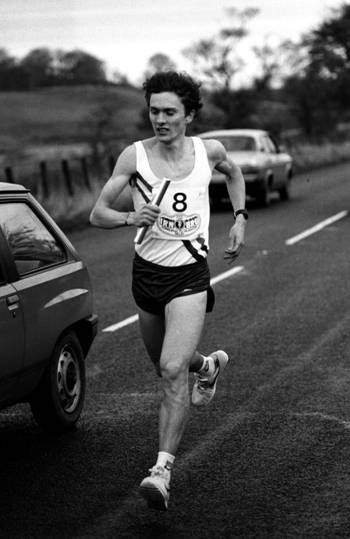
Lindsay Robertson

This page has a straightforward purpose: to share stories and incidents that Scotland’s endurance athletes, teams and coaches have experienced in the course of their athletic carers.   Given the amount of travelling, the number of miles covered in training and racing, given the rather broad range of competitors and ‘hingers-oan’ then these tales are legion.   Send in your own and we’ll add them to the page.   For example, if you want the humorous anecdote, there is the story of a runner (Johnny B Maclachlan, Clydesdale)  in the West District cross-country relays at King’s Park, Stirling, who while running in third place hurdled a barbed-wire fence near the end of the race.   Unfortunately he caught his under-carriage (I hesitate to refer to them as ‘crown jewels) on the fence.   One of the runners beside him at the time (Albert Smith, VPAAC) said, “You should have heard the language he used – and he’s a BB officer tae!”    Barbed-wire and male appendages feature in several such tales – the one about the runner (John Wright) who caught the latter on the former in the County Championships and was taken to the hospital A&E Department where he was received by the woman doctor but he refused to tell her what was wrong – too embarrassed – but fortunately he was accompanied by a less squeamish club official and he just had to grin and bear it!

Then there are the stories about particular incidents during races – the chap who was knocked down in the Edinburgh to Glasgow and immediately picked up and taken into a house at the roadside from which he escaped through the window to carry on with his leg of the race.   The National used to be held at Hamilton race course and most times consisted of a long straight with a huge loop at one end with a massive hill involved and a small perfectly flat loop at the other end.

One runner was caught stopping at the start of the small loop (just before actually turning into it) bending down to tie his shoe lace but turning through 360 degrees while doing it so that he was facing back the way he was going and trotting off to continue the race having gained 20 or 30 places and had a wee breather into the bargain.
Leslie Olympian

I’ll start with some already contained in the website and use one from the Maryhill Ladies AC page about the time when a young PE teacher called John Anderson was taking four girls down to the British cross-country championships in the early 1960’s.   They travelled in a dormobile type vehicle and after they had set out it started snowing and the snow got thick and it became evident that they would have to pull over and spend the night in a lay-by.   No motorways and no service stations at that time.   John, beingan enthusiastic type, let the women have the inside of the van and he said he would take his sleeping bag and spend the night under the vehicle.   It wasn’t a good idea and eventually he had to knock on the door and ask if he could get inside the van.   Far from being in PJ’s or anything, the runners were all in overcoats, it was so cold    Eventually they all dozed off for a couple of hours or so.   In the morning Leslie Watson and Cathy Kelly jogged off for help and came back with a tractor and the van was towed clear and they set off for the championship.   Eagle-eyed John saw a cinema with a queue outside it.  He immediately decided that they were going to the pictures!   He disabused them of the notion that they were going to see the film: the walls of the cinema would be lined with heaters and they were only going in long enough to be properly warmed through.   He paid for them to get in, they warmed up and then back into the van and off to the race where they acquitted themselves nobly!    Hugh Barrow has another John Anderson tale.   In his own words, “I remember sitting in the middle of a packed mini bus driven by John Anderson heading over Shap towards RAF Cosford in the 60s.   In the front as ballast Doug Edmunds, in the back for music Moira Kerr, also The likes of Dunky Middleton and Hamish Telfer I think.   John never known for his conservative driving had the foot to the metal and this was making big Doug nervous.   As John took the shortest route round a blind bend Doug asked him what would happen if we met his brother coming in the other direction– to which John answered it would be ok as he would also be on the wrong side of the road!

Alistair Lawson:     Alistair was a good runner who for a time was a member of Dumbarton AAC and ran in the Glasgow to Fort William Relays in the 60’s and 70’s.   He travelled the world climbing in the Drakensbers, the Andes and various other mountain ranges and is a committee member of the Scottish Rights of Way Society. Once upon a time, when the world was still young, I was with a bunch of hikers up in the Peruvian Andes. We were making our way into the heart of the mountains by following a “quebrada” (= glen, in Scotland). The floor of this glen was around 13,000 feet above sea level, though we were still very much at the foot of the amazingly high surrounding mountains. During the day, a couple of members of the party, who were suffering from the altitude, had dropped further and further back and, by the time we were thinking of stopping and setting up camp, had not been seen for some time. The rest of us felt someone should go back and accompany them the rest of the way, and, as I was known to be a runner, I was “volunteered”. Going down the glen seemed, of course, as though it should be a dawdle, so off I went at a modest jog. Within half a mile, I was puggled, short of breath, gasping, and the oxygen-starved leg muscles were ready for a walk. The moral of the story? “Altitude beats Attitude”. Needless to say, I have been puggled on many other occasions, before and since, most of them at sea level, in Scotland, with the benefit of 100% atmospheric pressure. Well, there you go.

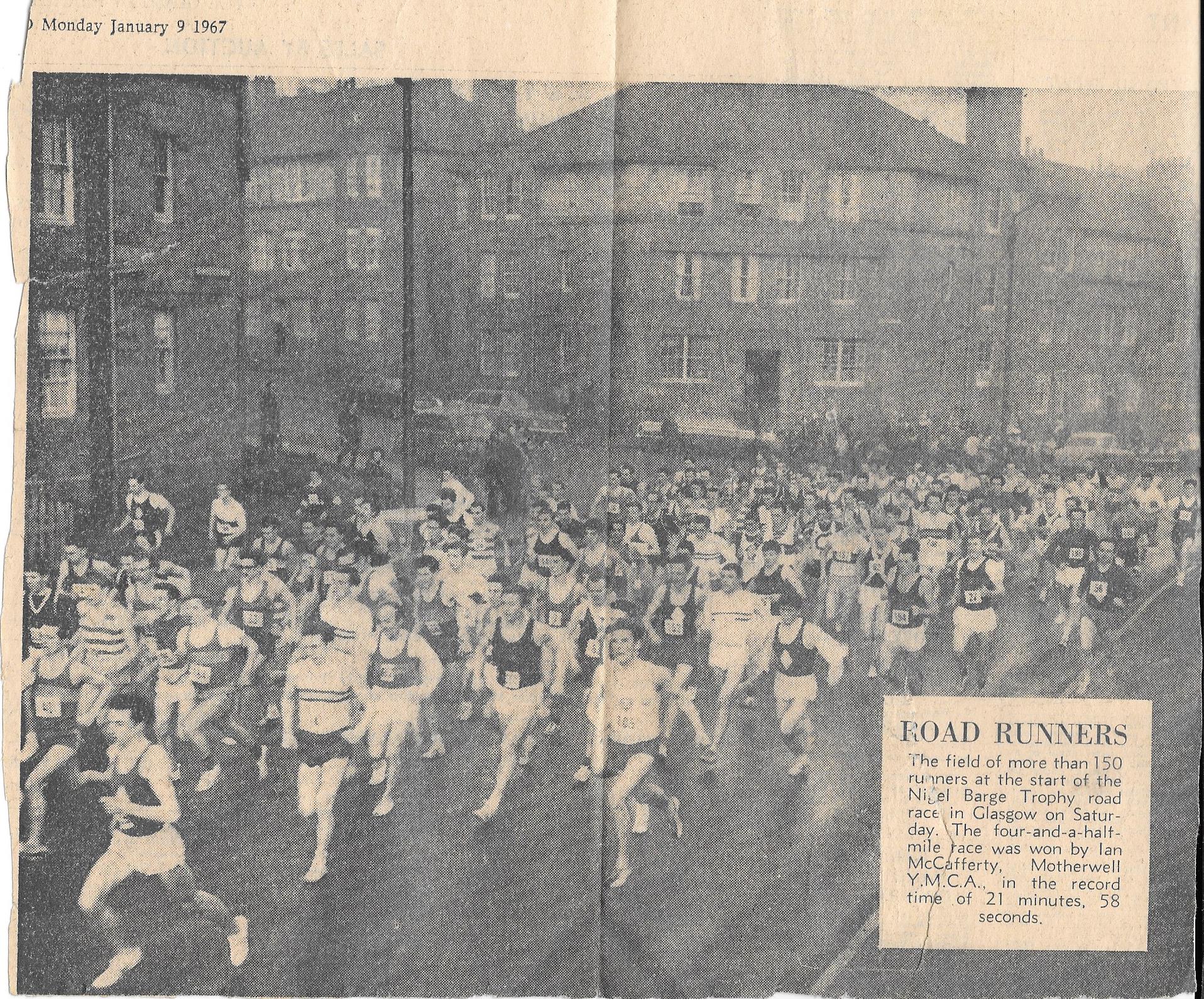
Jim McLatchie who was a first class track runner and quite early in his career he was talked by Dunky Wright into running on the road in the Nigel Barge Road Race.   The Motherwell YM runners were there in strength and Jim was running with them well into The race.  As they belted along, Andy Brown turned to Bert McKay and asked, “What’s McLatchie doing here?”   Bert’s reply was “I think he’s going to kick our arses.”   Andy: “But he’s no a road runner.”   Bert:    “Today he is!

Allan Faulds tells of the time before he and Liz were married and he went out for a run from her parents house in Scone.   As he disappeared round the corner, Liz heard one wee boy say to the other, “There’s a man running.”   To which his pal replied, “Aye, fancy that, he’s got a car!”
I remember travelling to the AAA’s marathon in Rotherham with Alastair Macfarlane, Bill Ramage and Doug Gunstone and we were put up in accommodation provided by ordinary householders.   I was in a teenage girl’s room which was more sweetly scented than any I had ever experienced but Bill and Alastair were in the flat above a newsagent’s shop.   When I went round with them to drop off their luggage before going for a meal we were met by a chap who asked where we had been and said that the dinner had been ready for 7:00 pm and it was now nearly 9:00.  Behind the door was hanging a fur coat and not far away were a pair of high heels.   Now women around.   We went up to their room, with en suite, to clean up and get ready.   In the middle of the room was a pile of men’s magazines (eg Playgirls – big girls for big boys!).  I went into the bathroom and was amazed – lilac shag pile carpeting and the throne of mercy was in a corner facing a floor-to-ceiling mirror with a family sized jar of vaseline on the shelf at the side.  You can probably imagine the comments passed (like a Bessarabian brothel was one) before went down for the promised dinner.   The last word I will say about this was when I had trouble getting the fork through the pastry, I had some difficulty and in reply to his comment that it was tough because we were late, I wriggled a bit and said no, the difficulty was down to my weak right wrist.   His comment was “Well, we all know what causes that!”

Jim Russell sent this one about the Edinburgh to Glasgow.

“In the 1974 Edinburgh to Glasgow Bellahouston had built up a gap over Aberdeen of 3 minutes 33 seconds by the third changeover. Aberdeen then started to close the gap on each of the following stages till they got to the final changeover. 18 year old Graham Laing took over chasing a 64 second gap to Jimmy Irvine 39 year old and running his 16th and final E-G. Graham gradually closed the gap along the Edinburgh Road and Alexandra Parade till as they approached the Wills factory he was on Jimmy’s shoulder. Instead of going straight past Graham who must have been feeling the effort he had put in to close the gap ran with Jimmy and as they turned off the Parade he asked “How far to go”. The reply from Jimmy was silence. Down the hill they went together and as they reached the corner at the bottom Graham asked again “How Far”. Again the reply was silence. On they went and as they turned on to High Street Graham again asked the question and again the reply was silence. Down High Street they went and as they started to turn the final corner onto Ingram Street Jimmy sprinted as hard as he could and told Graham “600 yards”. Having taken Graham by surprise Jimmy opened a gap and hung on for all he was worth along the busy street eventually coming home 3 seconds ahead. A case of experience and craftiness over youth.”    [Incidentally when Jim read this story his comment was that he remembered it well and he should not have run in it at all.   He had been feeling ill all week – and he was ill for two days after it!]

I remember one of the trial runs for the 1970 Commonwealth Games marathon when Bobby Lochead of Springburn was looking for some diluting orange juice to make up his bottles for the race.   At that time the runners in the SAAA Marathon could provide their own bottles of drink and write the stations at which they wanted them left.   The usual practice was to make up a pint of concentrated orange juice with water, add a tablespoon of sugar and a teaspoon of salt.   Bobby was a qualified so when he came back with lime juice saying he couldn’t get orange but the main thing was ‘the sodium ions’ I didn’t argue.   The first mouthful he got during the race was spat out – it tasted foul apparently!    So much for chemistry and marathons.

Incidentally I attended a British Endurance seminar before the Atlanta Games where an American nutritionist was talking about the official drink for the Games.   Because of the US Food & Drug Act it couldn’t contain salt: eh?      Then when I described to her the old drink (juice + teaspoon of salt + tablespoon of sugar) and asked how it was different from the official drink, her reply was simply, “It’s cheaper!”

Another from Hugh Barrow: “On a beautiful sunny March afternoon in the late 60s the VPAAC Cross Country Championship was taking place over the traditional course in Milngavie.   As the field meandered over the fields near Milngavie Golf Club they had to traverse several stone dykes where behind one a romantic couple were making the best of the good conditions.   Such was the endeavour of the runners they didn’t break stride as they vaulted the dyke and the couple — and such was the intensity of the moment, neither did they”.

More from Bellahouston, this time from Iain Burke.   “Andy Daly and Peter Fleming meet up on a Sunday morning in the 80’s leading up to the Glasgow Marathon.   A long run is planned – 20 mile plus at race pace or faster.   After about 18 miles they get to East Kilbride and Andy keels over.   No worries, he tells Peter, “My granny lives just up the road.”   They head up to Andy’s granny’s where she puts him to bed with tea and biscuits.   Peter heads off and carries on back home.   A couple of hours later, Andy’s up out of bed and finishes the run.   You couldn’t make it up!”

Another Andy Daly tale:   We had booked a trip to Essonne in the mid-80’s.   I was coaching George Carlin and took my daughter over to watch the race.   Andy had run in Barcelona for a Scottish squad the week before an done 2:20 for the distance.   When he turned up I asked if it was not kind of close to be doing another 26.2 miles.   But he had paid Stuart Easton for the trip and he was going.   We eventually got to Essonne and on the morning of the race I was talking to George about the race and how he was going to run it when Andy came in and asked if I would pull him out after the first of two laps.   I just refused – even at that time of the morning, hours before the race, there were gendarmes with whistles and batons keeping cars off the route of the race.   Looking menacing they were.   So the race started and after the first lap Andy was running third, when I shouted at him going into the second lap, he replied that he was fine, no worries Brian.   The winner won, second and third came in, then fourth, fifth and sixth and my daughter (aged 12) was concerned about Andy.    He eventually came in looking all in – in 2:24!   Two marathons in 4:48 just seven days apart.     He went for a run the next morning though and then the boat coming home was up-and-down all the way across with just about everybody on board being physically very sick.   George was talking about a prize for the Golden Huey Bag Award.   When we got to Dover, t

the only guy picked by customs to be searched was Andy.    He came back on to the bus looking awful and I asked if they had found anything to be told, “Brian, I wasn’t even smuggling the contents of my stomach back in.”

We used to go warm weather training in the early and mid 90’s, usually to Alfa Mar.   One year we had arrived and were in the front of the hotel when Ewan saw this guy and recognised him immediately as world record holder Wilson Kipketer.   He went over and asked if he could get his photograph taken with him and Kipketer obliged.   It turned out that he was there n his own with his coach and he started to talk to the guys regularly and became quite friendly.    I was only there for ten days although the squad were there for a fortnight and the night before I left I was packing bags when two of the group came to the door and invited me down for a drink.   We went down and joined the whole group at the table and there was Wilson K sitting next to an empty chair which I grabbed.   he wasn’t drinking so I just offered to get something for him, to which he replied, after reaching to a distant ash tray and picking up a fag end, “Not until I have finished my cigarette.”   A wee bit later and the conversation died down to be ended by Mark saying to the world record holder, “Have you heard of Cambuslang Harriers?”   He was, I am sure, joking, but he was given a bawling out just the same.

Colin Youngson has replied to a specific request for his own running memories with a typically wonderful essay which is a bit long for the page here but you can get it by following this link   For now, this extract from running at University will have to do.   He has served his apprenticeship at school and is starting to take the sport seriously:

“Only about forty miles per week is averaged, but as the months pass, you do get better, as is proven during the short summer track season, when you concentrate on doubling up (one mile and three mile races) and post new best times. Then you enjoy the track events at Highland Games before going camping, youth hostelling and earning cash by working at a summer job. Due to the resilience of youth, injuries are seldom encountered. When they do occur, you simply rest a couple of days and then try to jog back to fitness”

You have to read it!
Now one of the best tales I’ve heard for a long time come from Mel Edwards who sends this one

“One of the most exciting and satisfying days of my life was back in October 1967.

I had just won my debut marathon in Harlow, Essex in 2.18.24 which was a course record and would place me 4th in the UK rankings for the year, and was heading for the train to Liverpool Street en route to Southampton where I was working at the time.    The train was packed except for one carriage which had a solitary occupant who was staring gloomily out of the window, chin on hand. I think this is what put passengers off selecting this one because every other one was full.   So I bit the bullet and entered to be met with a glower. I sat down and read my AW. Finished it and decided to say something. “Been up to much today?” Response, with a gloomy look “I’ve just done a marathon”. “Oh” I said “I did that one as well. How did you get on?” Reply “ I was last”.

Back to the window, chin on hand.  I thought, what a blooming shame. You’ve run 26 miles and you’re depressed.   Then I had a brainwave. “What position were you?”    “Last, I told you”.  “No” I said “What actual position were you? They posted the results on the board” “98th…last”  I thought “Got you!”  “Do you remember Tom Dradey the race organiser gave us a briefing on the course on the start line?”    “Yes”.  “And do you remember he said he was delighted he had a record field registered and on the line of 110 runners?”   His next words were “Eh, Ah, Ooh”   “Yes” I said “12 dropped out. You had the guts to finish”   Well, I couldn’t get him to stop talking all the way to Liverpool Street. All about his family, his work, his running. He’d had a fraught week because he was worried about the marathon AND his budgie was off it’s food!    We said our farewells at Liverpool Street, and I wished him and his budgie all the best. My lasting memory of him was him going “Tsk, tsk, 12 dropped out” and raising his eyes to the heavens.

I never met him again, but he put the seal on one of the best days of my life.”

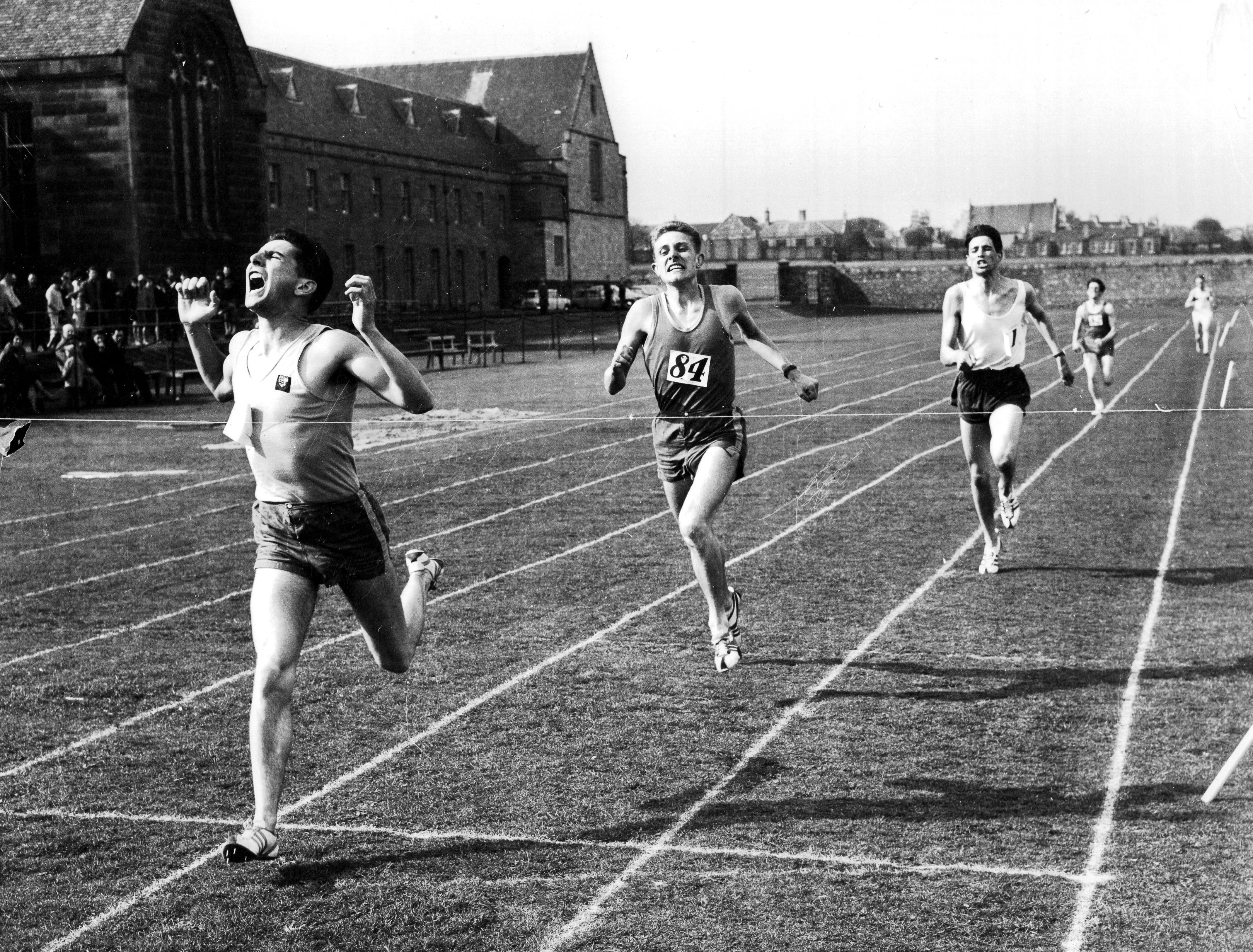
Mel winning the Junior National 1963: best cross-country race I ever saw!

Jim Russell sent three more – the first two are Andy Daly tales.   The first one is about a holiday mishap.   Jim says: “Andy was on holiday in, I think, Majorca and on the day before flying home he was out for a training run.   He turns a corner forgetting that in Europe they drive on the other side of the road.   He is caught a glancing blow by a car and sent flying.   He is then taken to hospital where he is X-rayed and told that he has only suffered bruising to his foot and elbow.   After flying home the next day he goes out for a 10 mile run.  Nearing the end of the run and going along Barrhead Road he has a couple of blackouts from the pain in his foot and elbow.   Arriving home he goes straight to hospital where he is again x-rayed and told he has fractures in both foot and elbow which must have been hidden previously by the bruising.   Only Andy would have thought of going for a run after being knocked down by a car.   The time for his run was 58 minutes!”

The second one is about training nights.   “Club night during winter and we’re going out for a road run.  It’s cold, raining heavily and most are wearing some sort of waterproofs.   I have a full waterproof tracksuit and others have waterproof jackets, but not Andy.   Stating that it’s not cold he is just wearing shorts and a string vest.   Then on another club night, this time during the summer, we are out in Pollock Estate (now they call it Pollok Park) and going along the side of the River Cart when we run into a swarm of midges.   A few of us get some in our mouths and there is a spate of coughing and spitting to clear our throats, I even throw up.   But again Andy has to be different and swallows them saying they’re pure protein!

And finally for now, Jim has one of his own involving Jim Brown.   “While still Juniors a 2000m steeplechase was arranged at Scotstoun to help get qualifying times for the AAA Championships at Kirkby Liverpool.   When we got to the first water-jump, Jim, who was running in his first ever steeplechase, had a few metres lead on me.   He got on to the barrier OK but came down into the water on both feet and came to a complete stop.   Meanwhile I was in mid air trying to avoid coming down his back with half-inch spikes.   Luckily he got going again before I could hit him.   Later on we were both running in the steeplechase in the Inter Counties at Dam Park in Ayr.   Before the race I jokingly said to Jim could he make sure he landed with one foot at the water-jump so that I did not rip his back open.   Needless to say, we came to the first water-jump and again Jim had a few metres lead on me, and yes, again he landed on both feet, coming to a stop while I frantically tried to avoid him.   Luckily he again got going before I hit him or a great career might have come to a sudden end!”

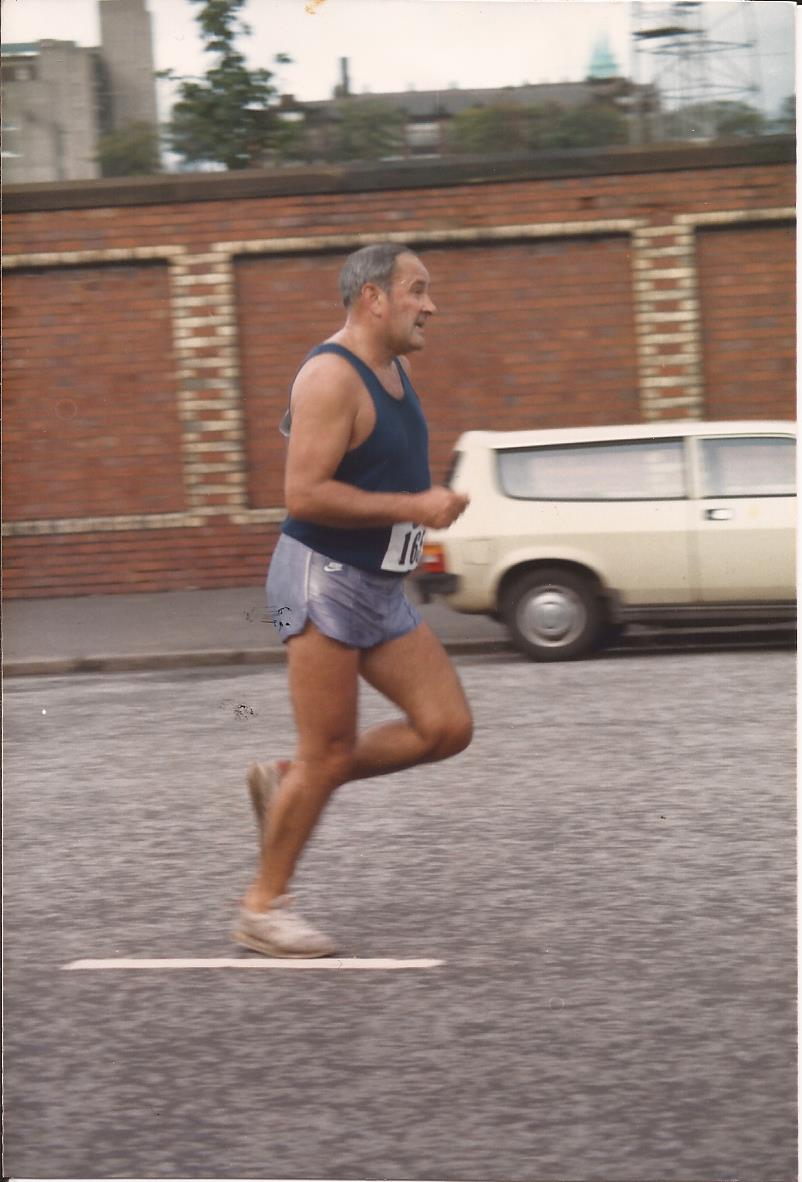
A really good one now from Lindsay Robertson (abpove) who won the Sea of Galilee Marathon twice.

At the 1985 SOG, a couple of days or so before the race a guy came up to me and asked if I would like to go jogging with him the next morning. I casually checked out what sort of standard he was – I had never heard of him. ‘So, what’s your best time.’ ‘2:10’.

Internal expletives!!!!    The next morning we duly met before breakfast and after cheerful greetings set off for a jog. A minute later I was thinking ‘You look like you’re struggling’ so enquired again ‘What did you say your best time was again?’ ‘3:10’.   Huge sigh of relief!!!

On the way out to Israel in ”84, on the El Al plane I saw what I thought was an extremely boring film. On the return flight, I was in fine spirits as the Captain announced a lunch was about to be served, followed by what sounded like an exciting, all action film. The meal lived up to expectations, but after the lights dimmed and the film started, I was horrified to find the film was the same stinker I endured on the way out!   I often can’t be bothered complaining but I was straight out if my seat and up the aisle in search of a steward. An impasse was quickly reached, I was told this was the the first time El Al had screened this film. I said they had shown it on the way out, it was absolutely rotten and in any case, they had announced they were going to show the block buster. A man seemed to appear from the shadows and said Excuse me Sir, you are Robertson? Yes’ ‘you won the race?’ Yes’ ‘Just sit down sir, we’ll sort this out’

Soon after a Jumbo load of people saw the film screen suddenly go blank followed shortly thereafter by the start of a completely different film!

At Heathrow I just missed a shuttle to Edinburgh, but the captain of the next one turned out to be a runner I had met a couple of months previously. He had said to me if I was ever on a flight he was piloting to let him know via a stewardess. I did, and spent the rest of the flight in the cockpit. I was glad I had missed the earlier flight!

Also from Lindsay is this one from the Sea of Galilee in 1985.   “The day before coming home I arranged to go out with a couple I had met the year before.   Jim Doig went to bed early because he was going home early the next morning.   I waited ages in reception, I think a road had been closed due to an accident.   Eventually, well after midnight, the phone at reception rang and the guy at the desk said it was for me.   A groggy sounding Jim as at the other end, asking whait Wanted.   I asked him what he wanted because he had called me.    He said he hadn’t called me he had been woken by the phone and here was I at the other end.   Never got to the bottom of that!    My friends eventually turned up and out we went.   In a pub/club Eli spotted someone he knew, a former winner of the Eurovision song contest.   Eli called across for the man to come over.   I remembered the singer and the winning song and asked him if he was still singing.  He sort of coughed and sprayed a mouthful of his drink before explaining that he was a big star!”

Thanks Lindsay, and for this one which comes from the New York City race in 1986.   “At the NYC Marathon post-race party, I got talking to a girl who initially said that she wasn’t sure if she knew me well enough to dance???  Later however, as the evening was winding up, I was cordially invited to follow her.   Not wanting to offend, I duly tagged along, intrigued by the prospect of a nice hot chocolate or even an interesting stamp collection.   Out into the lobby, into the lift, up, up, up.  The lift stops, she gets out, then suddenly someone appears at the lift entrance, dressed as a US football player.   Gary Fanelli, a celebrity figure who ran the race dressed in New York Mets uniform and played catch with spectators on the way round, seemed to take up the whole doorway.  I can’t remember if he got in, but by the time I had thought what’s this?   Oh, it’s Gary Fanelli, etc, the doors closed and the lift took off.”

And he never did get to see the stamp collection!
Allan Adams

Allan Adams (born 3rd January 1944) enjoyed a long running career, achieving most success after the age of 40, when he not only ran marathons for Scotland but also won many age-group titles as a Veteran. Dumbarton AAC was his only club and he served them extremely well. His son, Allan Adams (Junior) also became a prominent Scottish athlete and represented his country internationally. In 1997 he won silver medals in Scottish 10,000 metres Championship and Half Marathon; and secured bronze in the 2001 10k. In 2004 Allan Junior won the Scottish 10k title.

By 1966, Allan (Senior) was representing DAAC in the Edinburgh to Glasgow Road Relay, moving up three places on Stage Three. He took part in the event again in 1972, 1976 and 1983. Allan’s clubmates during this period included International runners Graeme Grant and Colin Martin, as well as steeplechasers Hugh Elder and Bill Cairns. Tough guy Alastair Lawson also featured: he specialised in hill and trail races; but no one trained harder than Allan Adams.

His frequent training partner, Colin Martin, started off as a talented young track specialist but in 1988 won the Scottish Marathon Championship, outkicking Donald Ritchie, the ultra-distance legend. Before this triumph (aged 41) Colin and Allan had been doing 90 to 100 miles per week, with Tuesdays and Thursdays devoted to 400, 800 or even mile repetitions with Lachie Stewart and his promising son Glen (later a GB track representative). The Saturday session might be 22 miles on the road; with Sundays an hour and a half over country trails. Both men became extremely fit, due to this arduous schedule.

Back in 1979, Allan Adams appeared in the Scottish ranking lists with a marathon time of 2.32.27. By 1985 (aged 41) he had improved to 2.25.48 and won the Inverclyde/SVHC Marathon in front of David Fairweather and Brian Carty. Then in 1986 Allan produced an outstanding 2.23.03. He was still running 2.26.32 in 1989 and signed off with 2.31.37 (aged 47) in 1991. Apart from World Veteran champions Donald Macgregor, Dave Clark, Alastair Wood and Bill Stoddart, plus ultra-distance legend Don Ritchie, hardly any Scottish Veterans have covered the classic distance so fast.

1986 was his peak as a marathon runner. In April he was 1st M40 in the famous Tom Scott Memorial 10 Mile Road Race, finishing in the outstanding time of 49.12. After that, he set a record for the Cairnpapple/SVHC Hill Race. Then in May, at the Aberdeen International Marathon, Allan Adams ran for Scotland in the match against the ‘Auld Enemy’. English team runners were the first three home. Aberdeen AAC’s Colin Youngson was first Scot, only a minute ahead of the fast-finishing Adams, who was fifth (and 1st Veteran) in 2.29.10 on a long, hilly course. In September, representing his country again in the Glasgow International Marathon, Allan was second team counter (and 1st Veteran) in his fastest-ever time of 2.23.03.

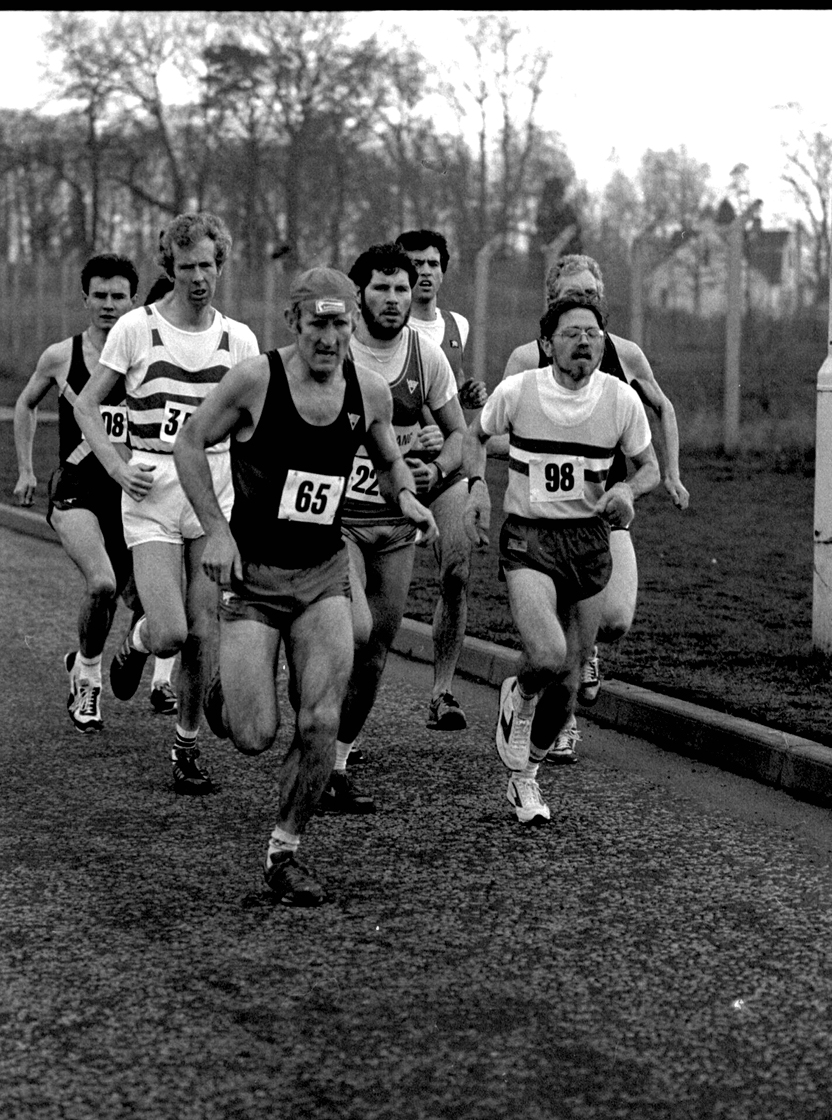
Alan-Adams-Tom-Scott-1985

[Allan Adams (number 65) in the Tom Scott 10, 1985. Photo by Graham MacIndoe.]

Further highlights were to come for this Tough of the Road. In April 1989 at the Lochaber Marathon, Allan had a real battle with Colin Youngson for the Scottish Veterans marathon title. There was snow on Ben Nevis behind the runners, as a pack of seven battled into a strong headwind on the way out to halfway. Naturally, Adams showed his strength by leading into the gale, while Youngson loitered in shelter behind the others. After the turn, the pace suddenly increased by about a minute a mile! Colin gained fifty yards but Allan hung on. Every time the leader passed Allan’s wife (who kept overtaking the pair in a car) Colin tried to look fresh, but in reality he was tiring. Eventually he threw everything into the last couple of miles and, exhausted, won in 2.29.40 while Allan won the M45 age group in 2.30.09.

Then, in October 1989, Allan Adams became British Veterans M45 Marathon Champion in the Flying Fox event in Stone, Staffordshire. In actual fact, Allan became the only Scot ever to win this event outright, defeating all the M40 runners too! He was timed at 2.29.32, with his Dumbarton team-mate Colin Martin 2nd M45 in 2.33.03.

In Masters Cross-Country, Allan was outstanding, representing Scotland five times in the annual Five Nations British and Irish International fixture: with his best performance being 3rd Individual M45 at Ampthill, Bedford in 1989, when his team won silver medals.

Allan Adams won no fewer than six Scottish Veterans Cross Country titles. In 1985 he finished second M40 (only three seconds behind Greenock Glenpark Harrier Dick Hodelet); and in 1986 he was second again, this time to Maryhill Harrier Brian Scobie.

1989 brought Allan Adams’ first M45 Scottish CC gold medal; and he retained this title in 1990, 1991 and 1992. After M45 silver behind Youngson in 1993, Allan continued age-group domination with M50 gold in 1994 and 1995, before injuries brought his career to a halt.

In 2012 a reunion was organised at Drymen by Clydesdale Harrier Brian McAusland. This was attended mainly by old runners from the West of Scotland, plus a few from the East or North. Allan Adams, cheerful and vibrant, looked as strong and energetic as ever!

Andy Forbes’s Programmes


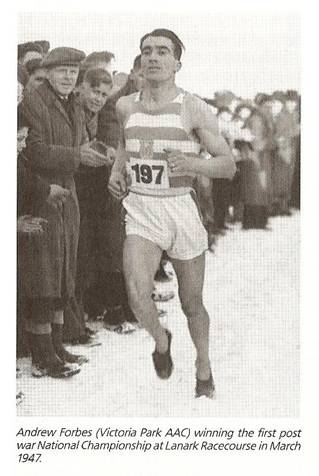
Andy 1947

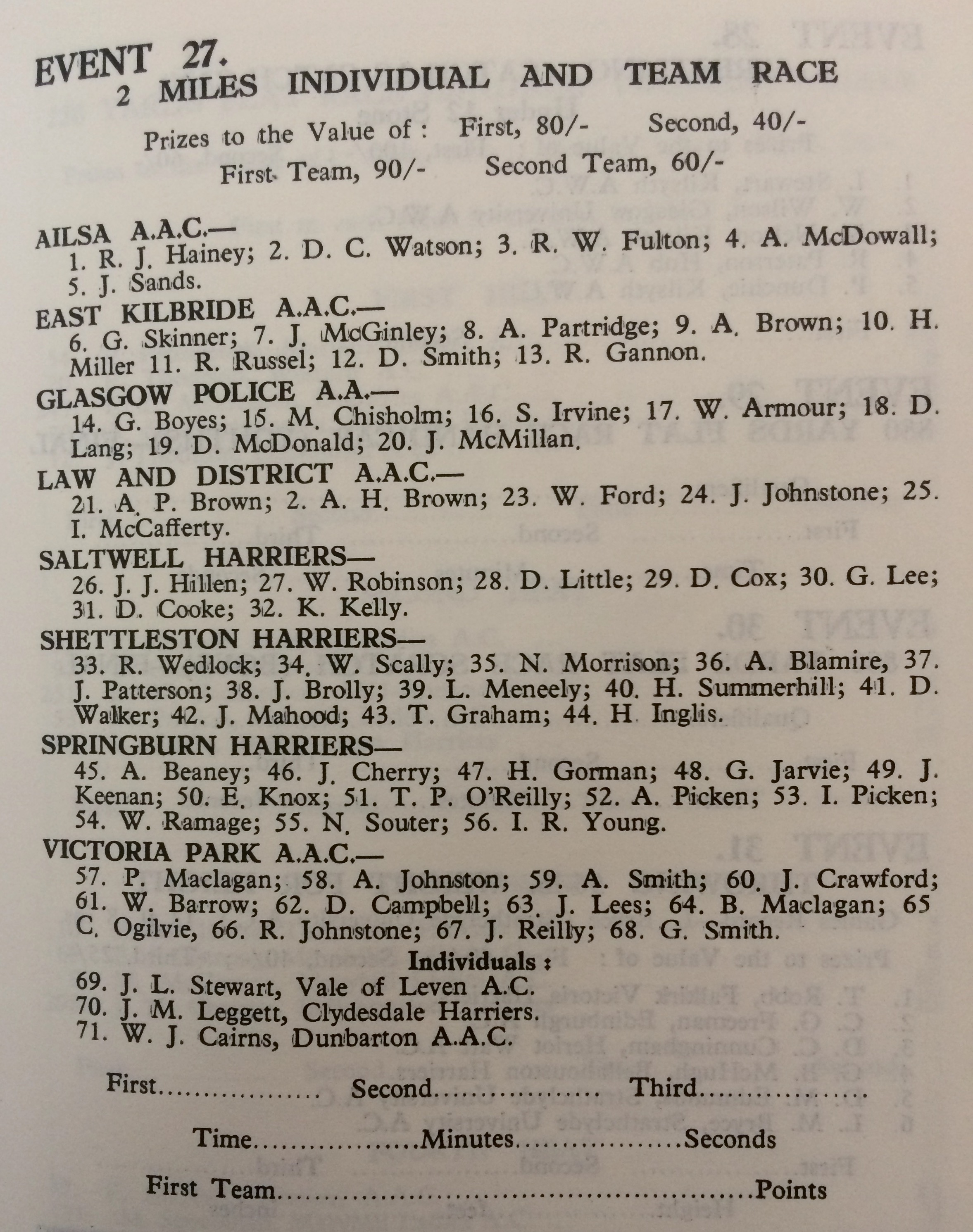
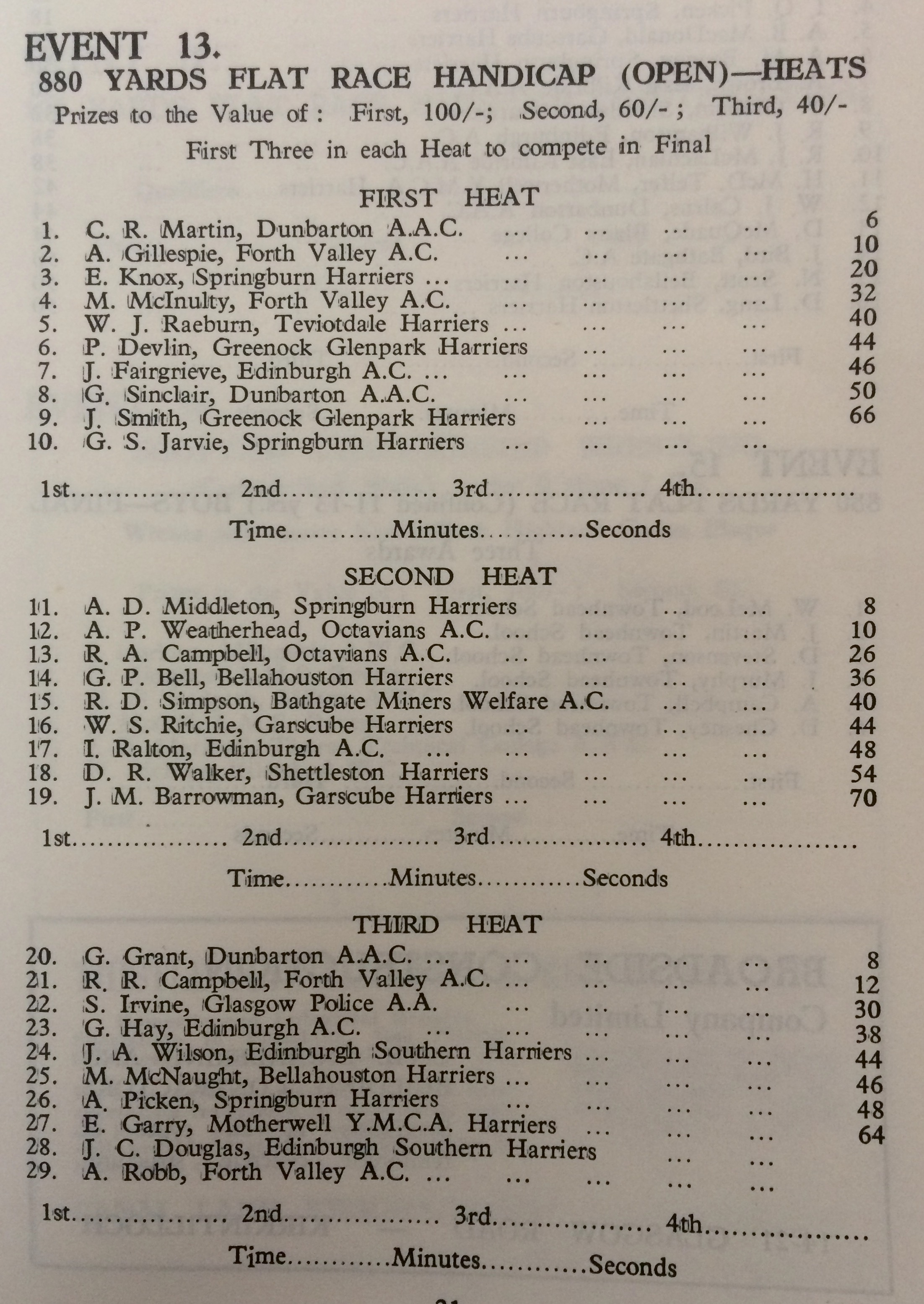
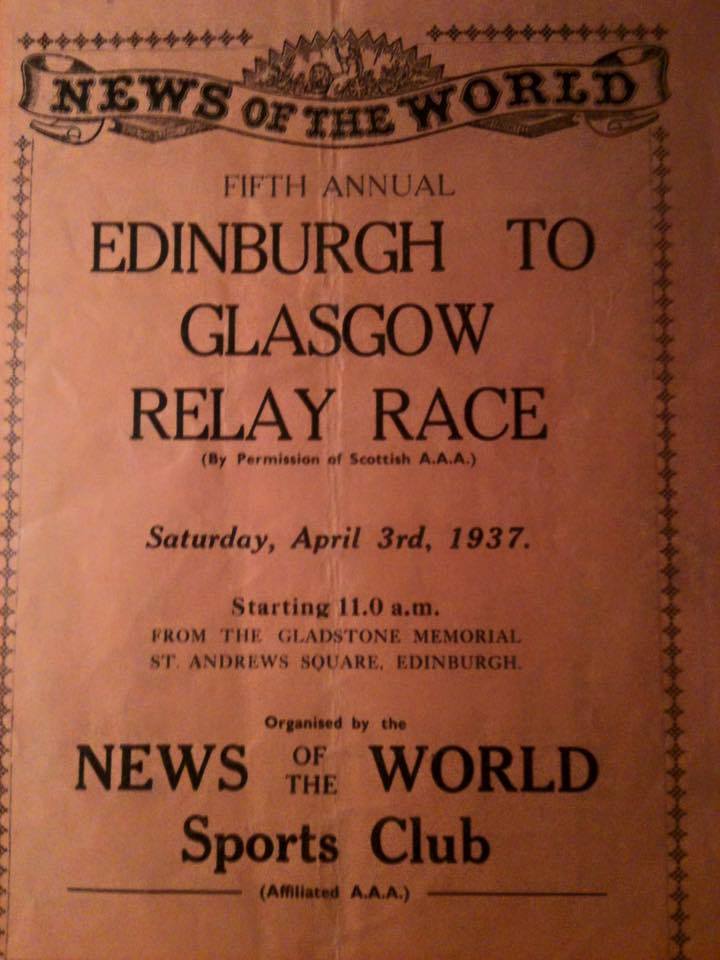
Graham Macindoe is a very lucky man in that his father visits the local Thrift Shop in Bathgate and that particular outlet has provided a whole series of wonderful athletics memorabilia.   First of all there were the Edinburgh to Glasgow programmes – the News of the World ones with pictures – and now there are a lot of programmes from what seems to be Andy Forbes’s collection.

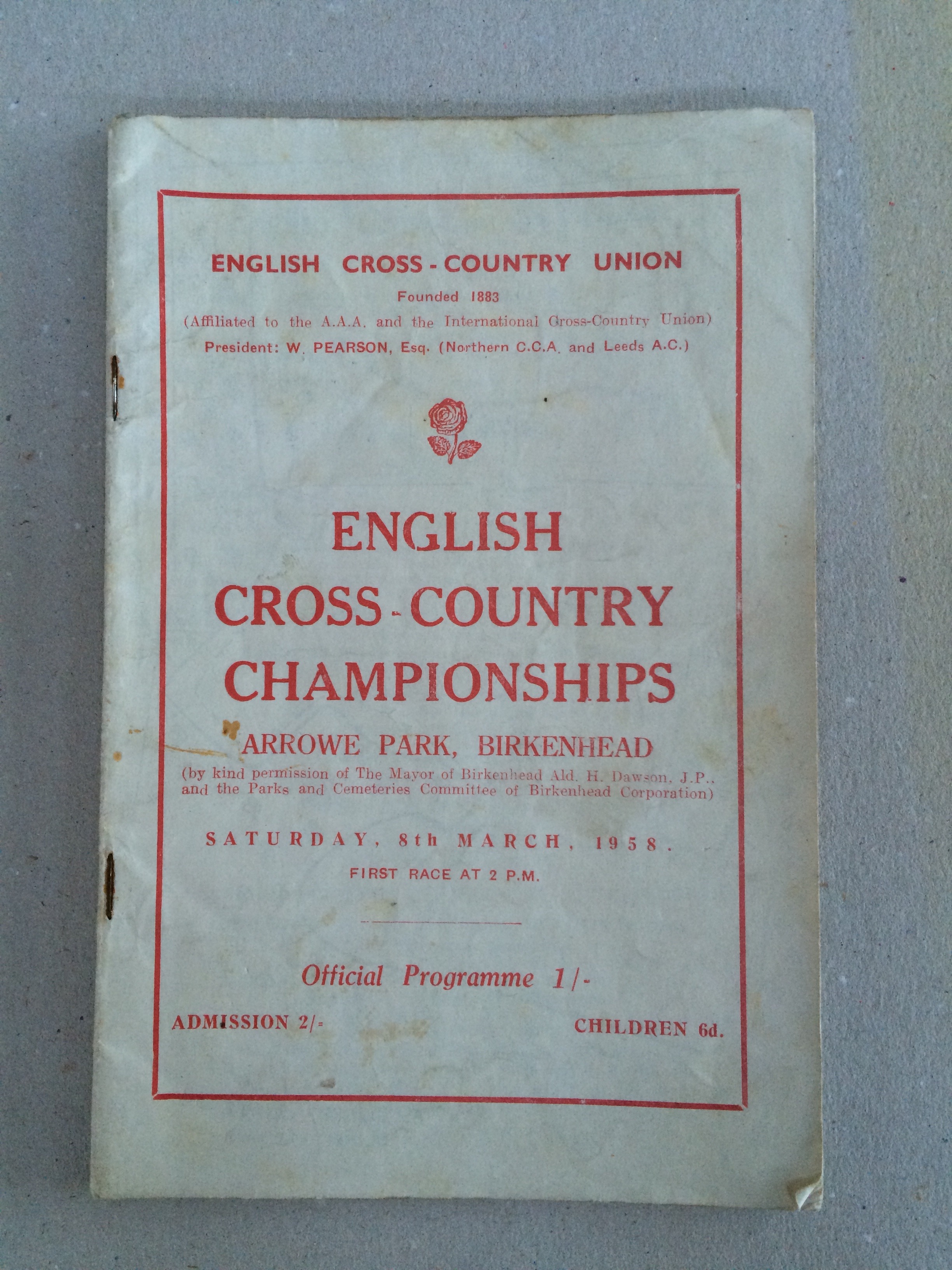
Andy was a wonderful man – I only knew him from the early 60’s when he was a bit past his peak but he was still a good runner, an elegant runner, a runner who made the whole business look effortless.   He was a class act – Scottish Cross-Country champion in 1947 and 1951, SAAA Three Miles champion in 1951 and 1952, silver medallist in the Empire Games, six times a cross-country internationalist – and that’s only scraping the surface of his achievements.   Very easy to talk to, good-natured at all times.   Like everybody who knew him, I liked him a lot.   However – Graham got the programmes into his hands and some are reproduced here.   First of all there is the one from the English National of 1958.

English National 58

Victoria Park had won the English Championships in 1951, and although the did not replicate this victory they kept taking on the best.   In 1958 the team was fifth with leading man John McLaren ninth.

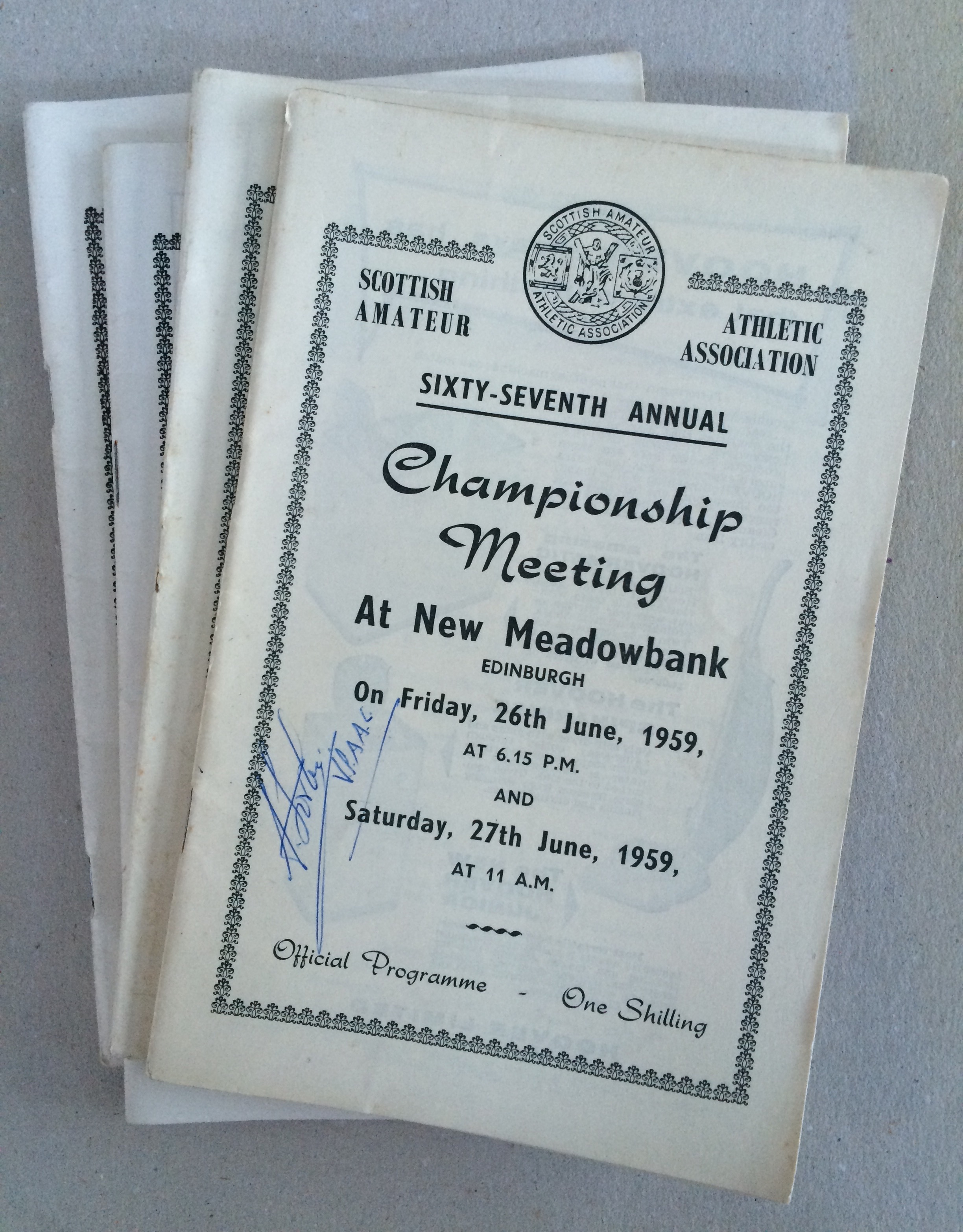
The next programme we have is from the Scottish National Championships in 1959.

At that time the championships always took place on the last weekend in June – usually some of the heats plus final of the Six Miles on the Friday and the remainder on Saturday.   For several years the 880y/800m had three races over the two days – heats on the Friday and then a semi and a final on the Saturday.

Meadowbank 59

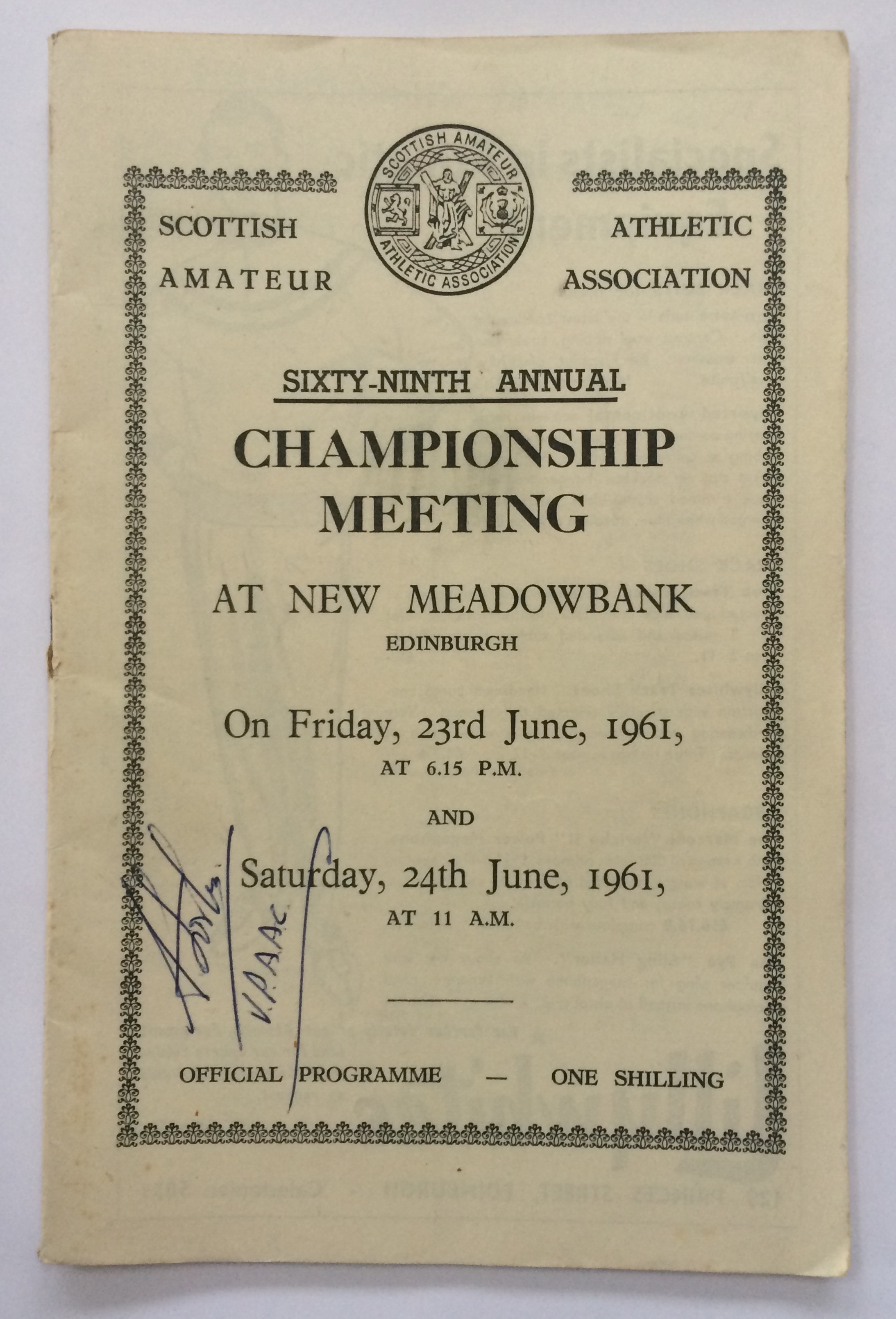
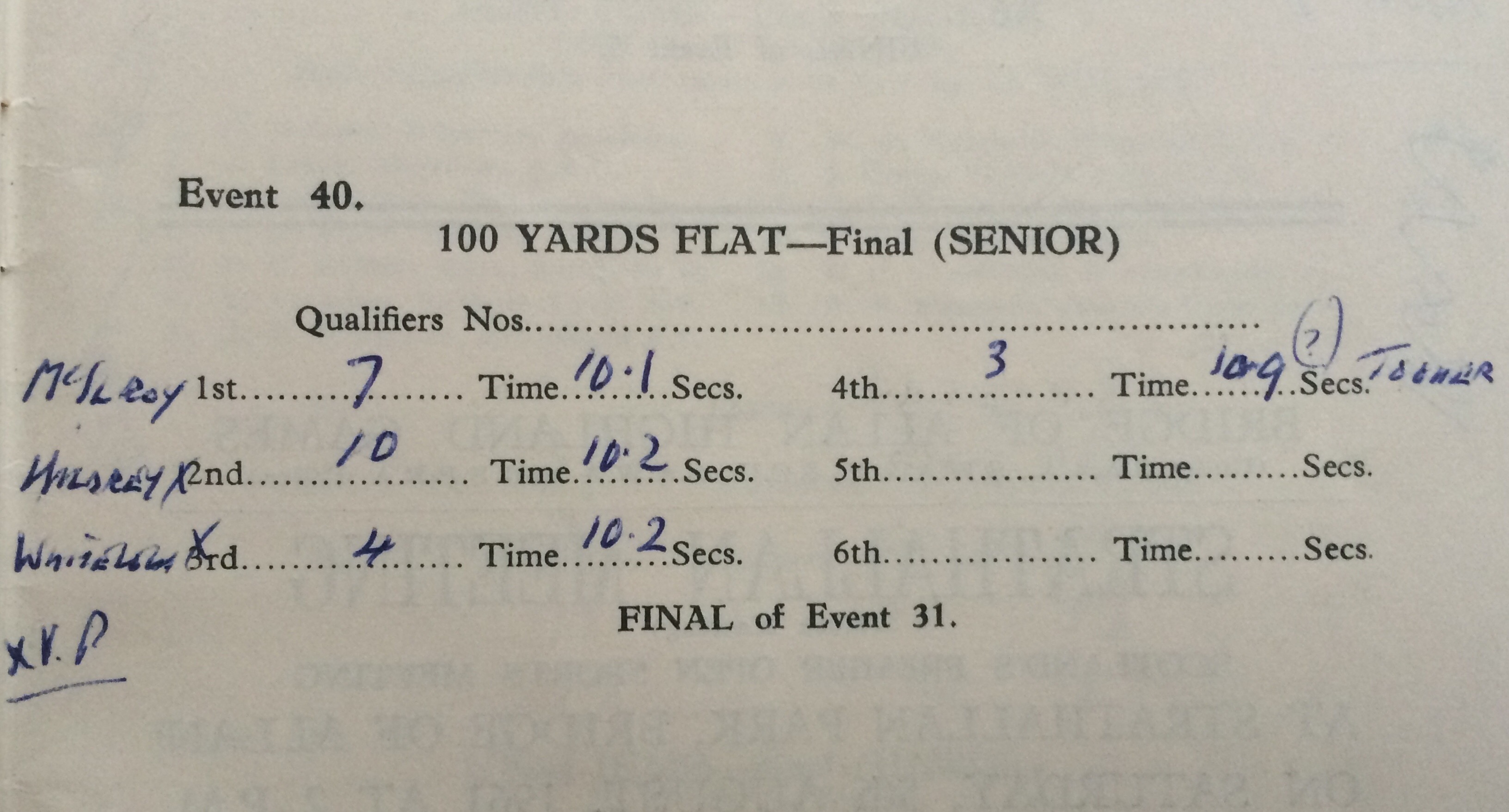
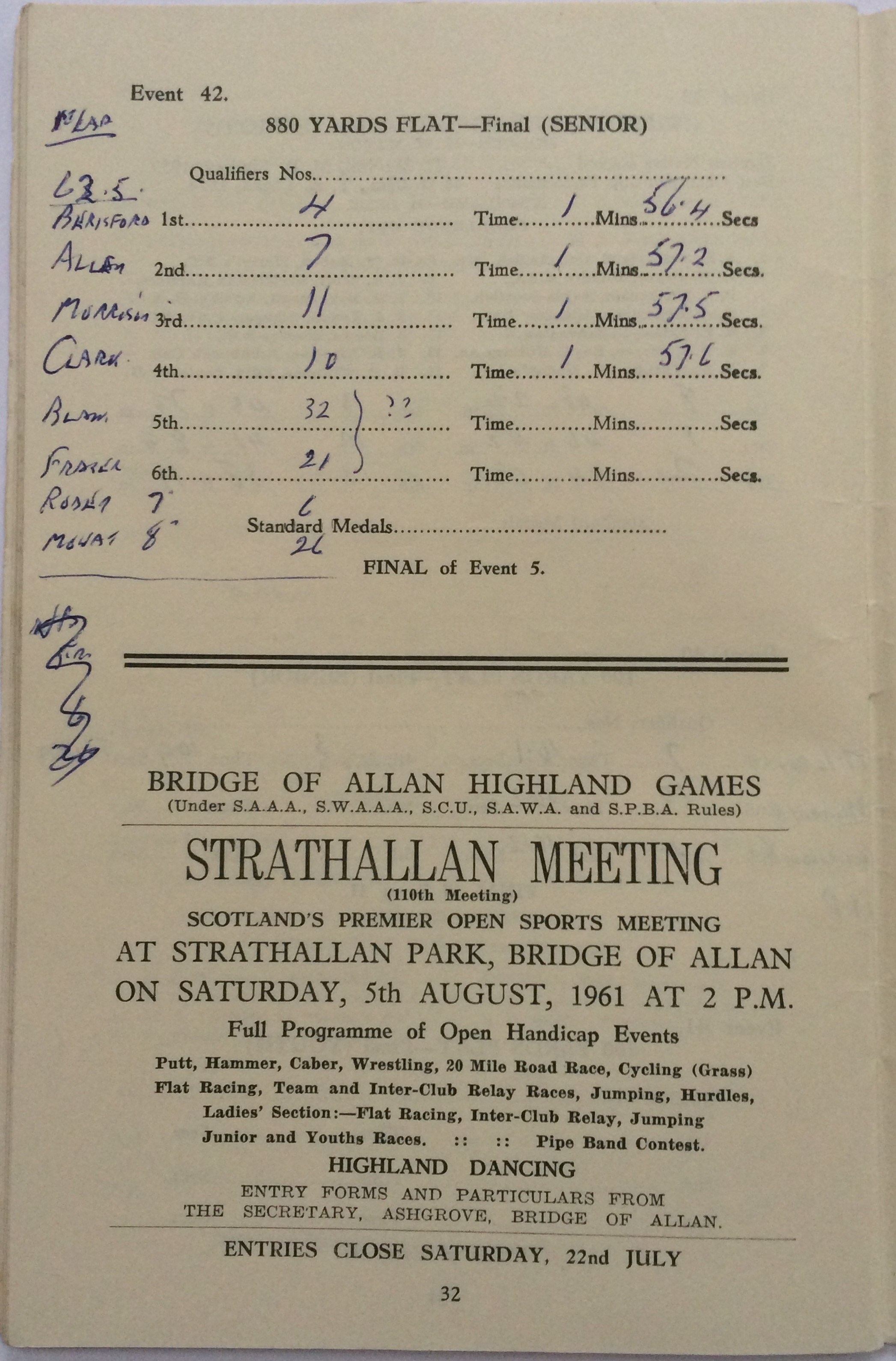
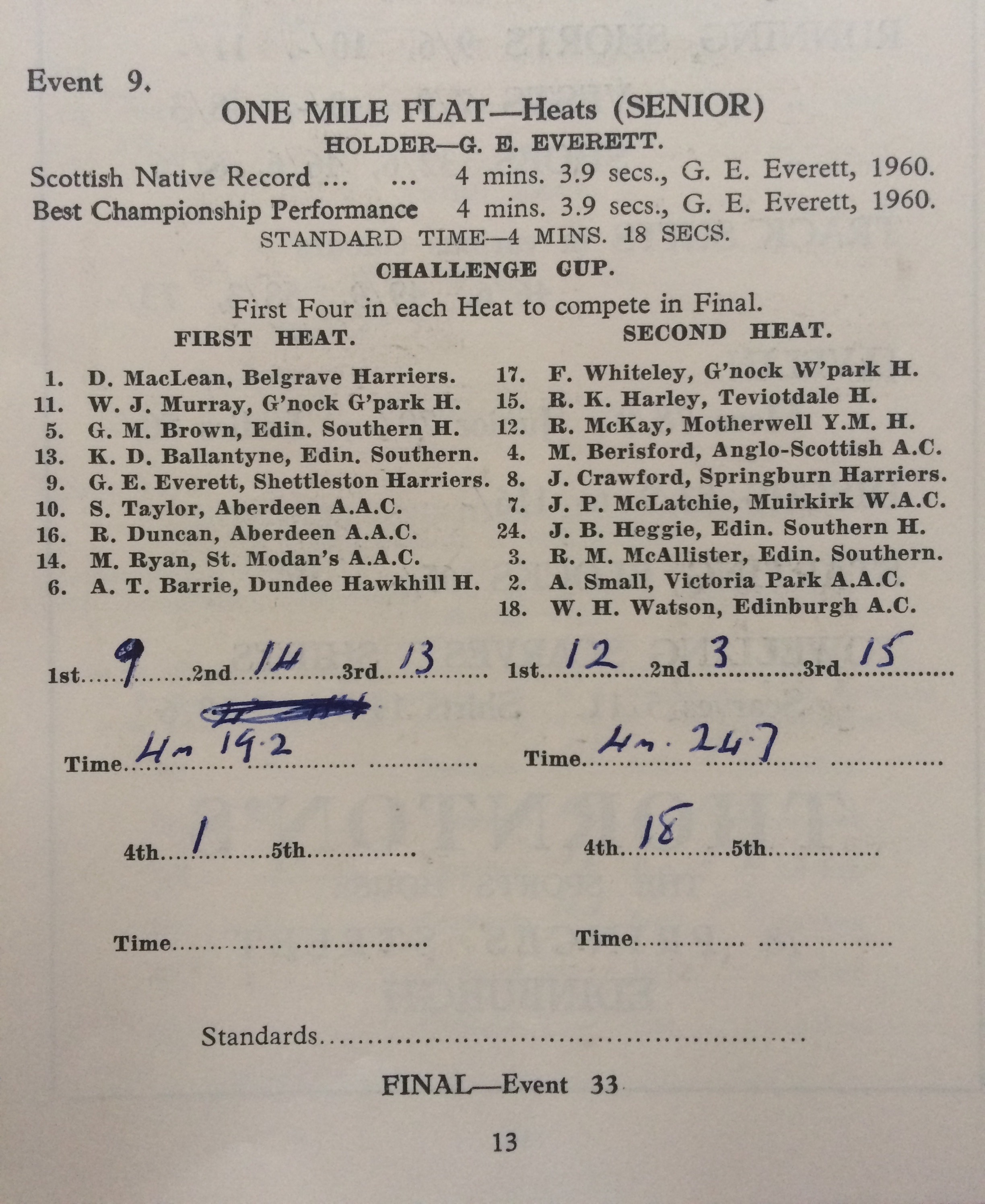
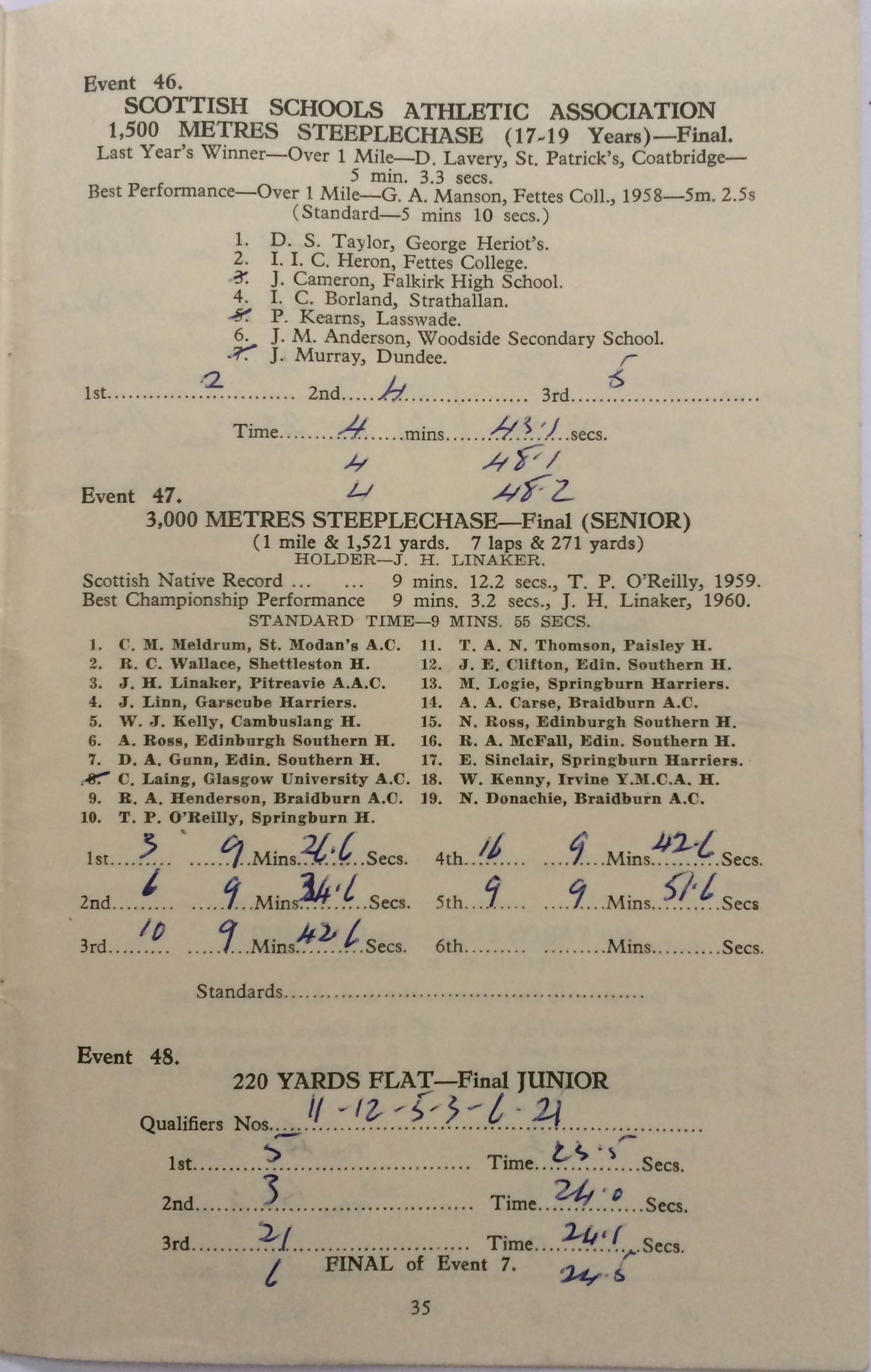
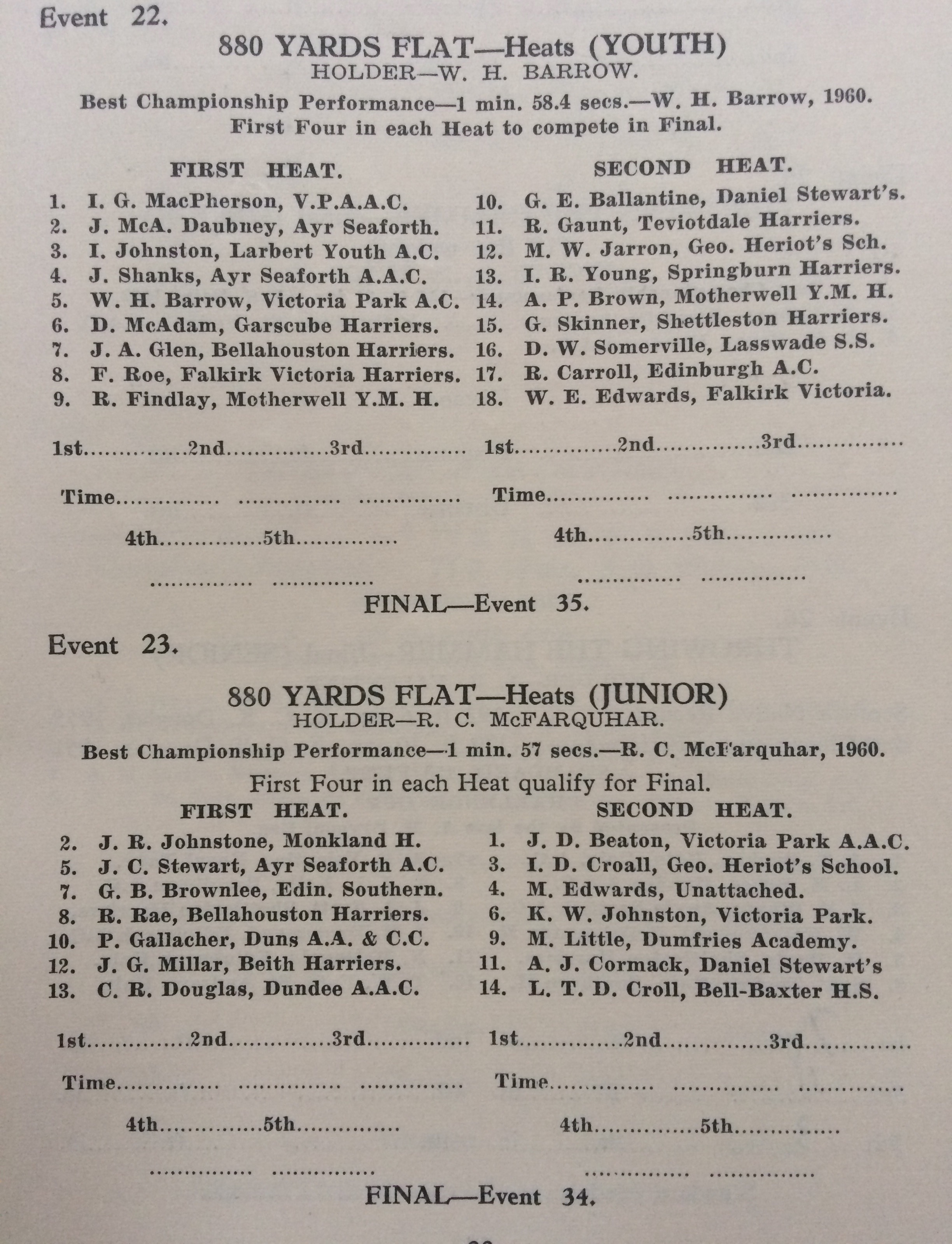
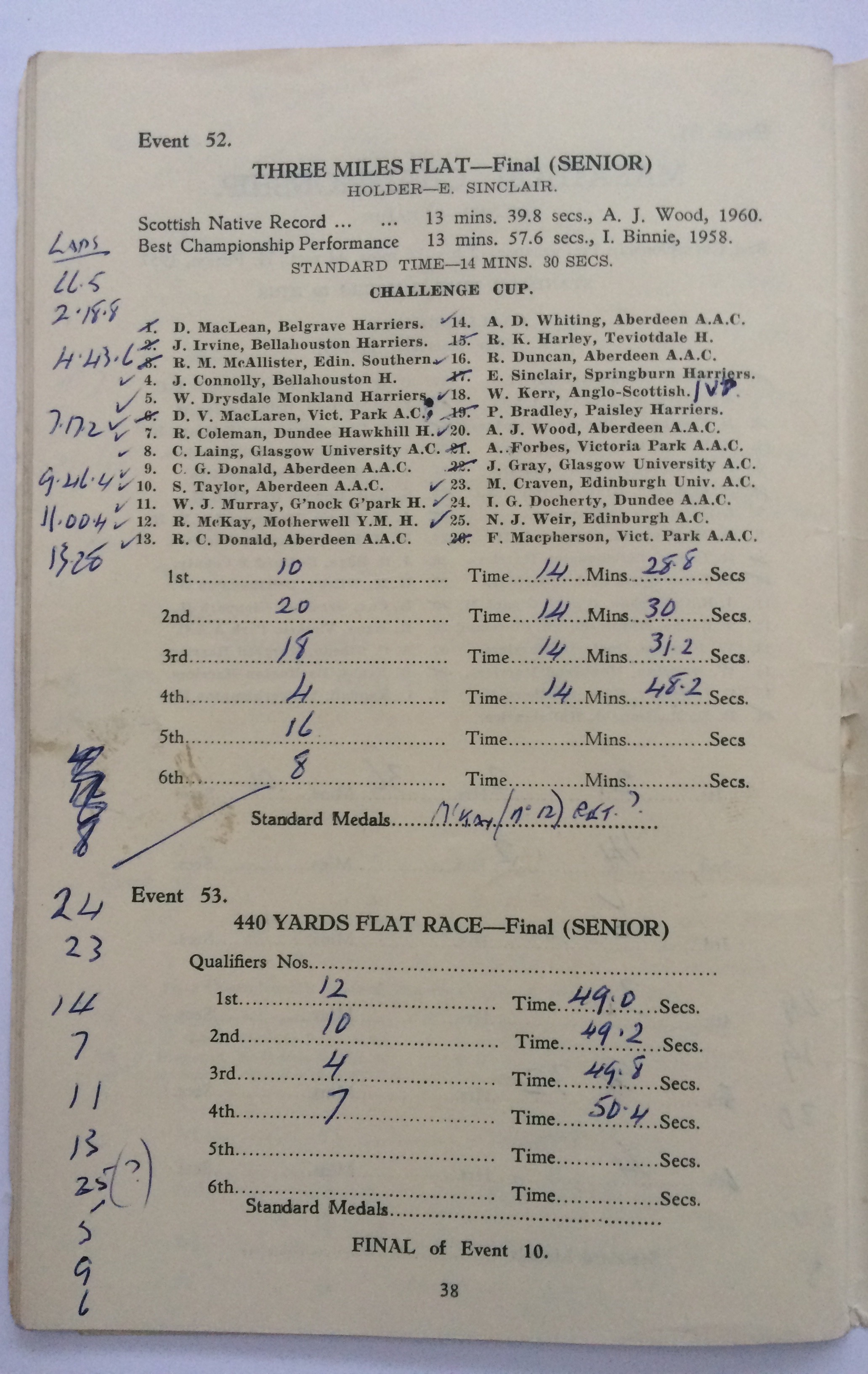
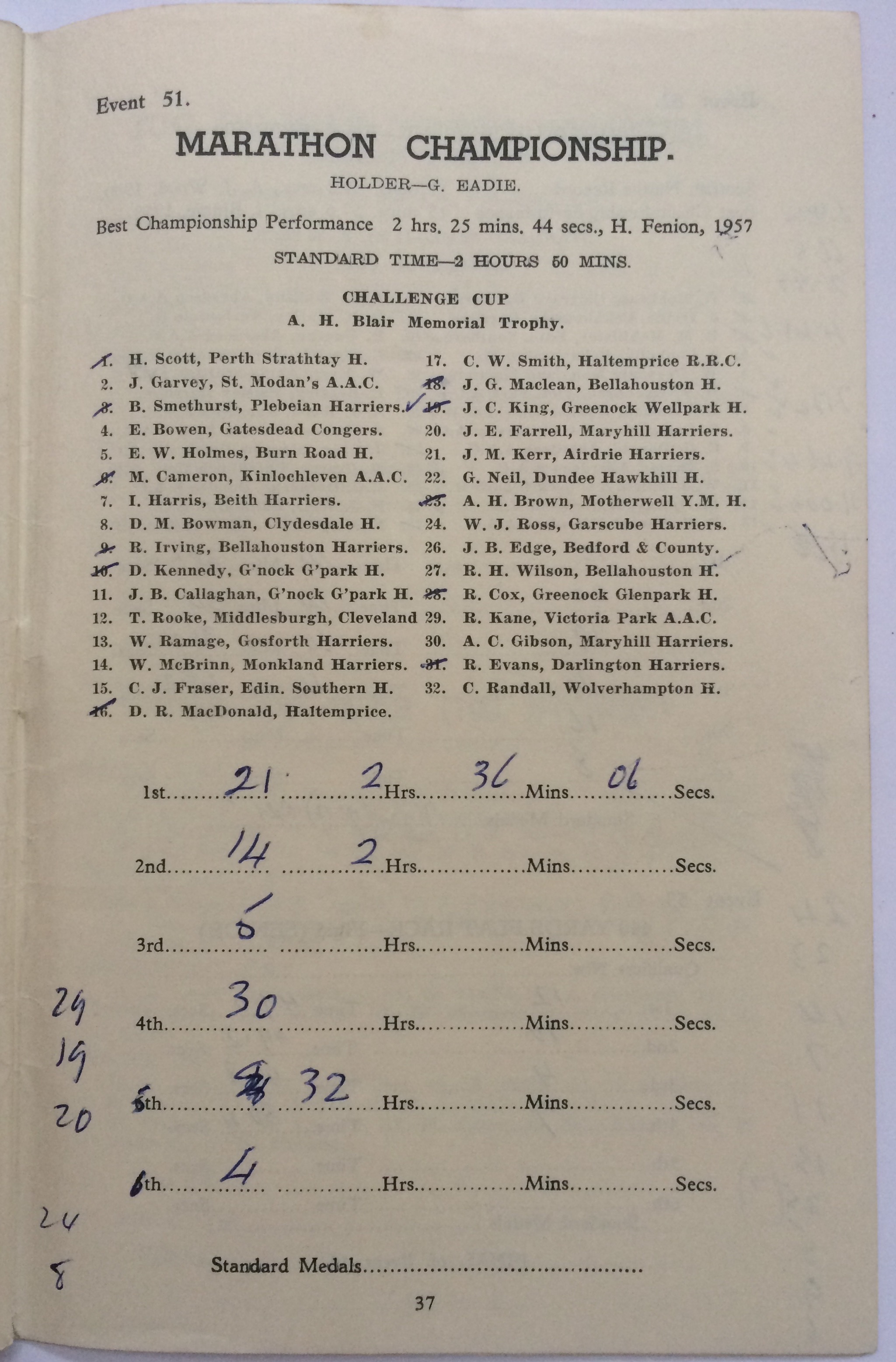
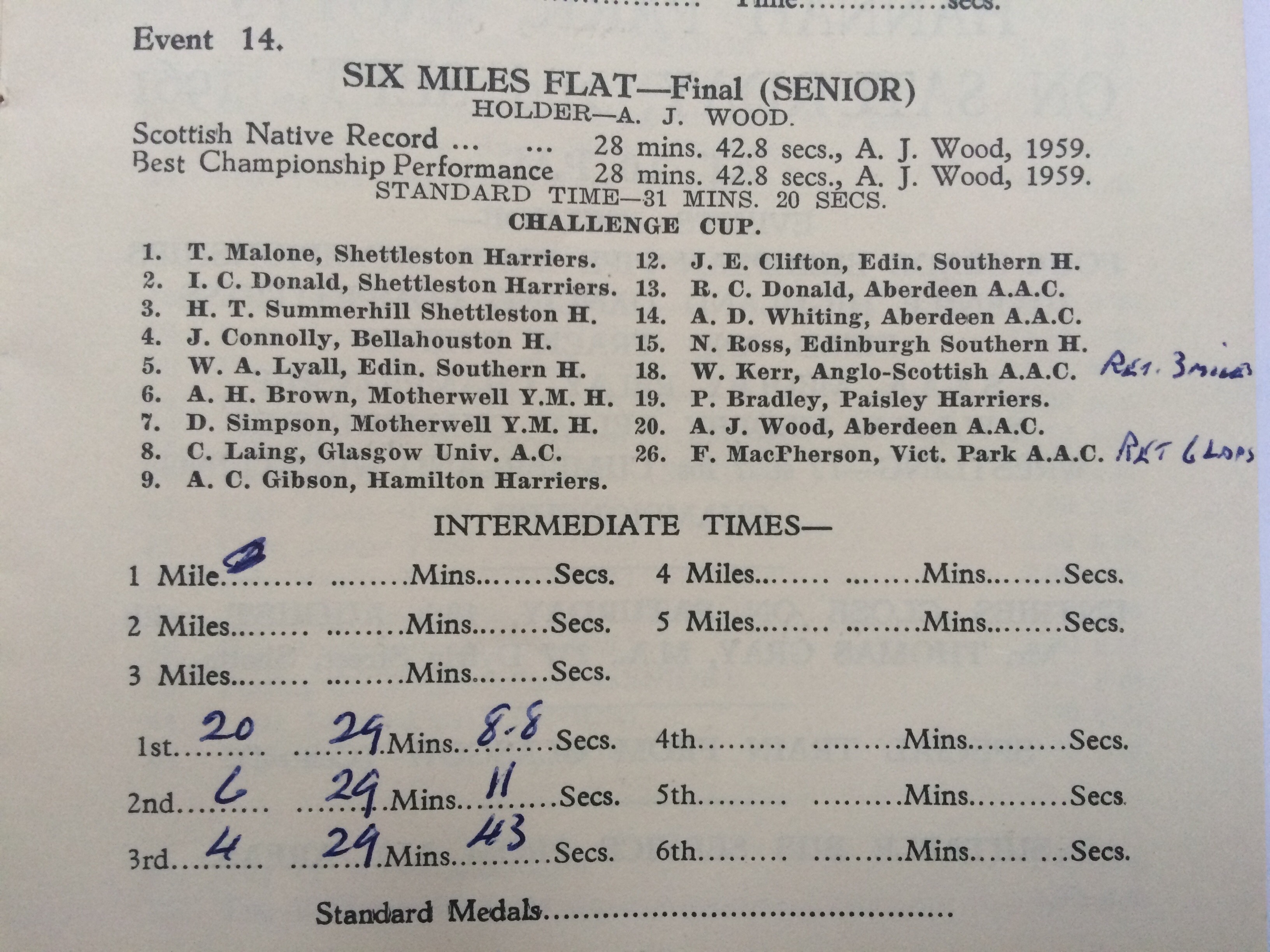
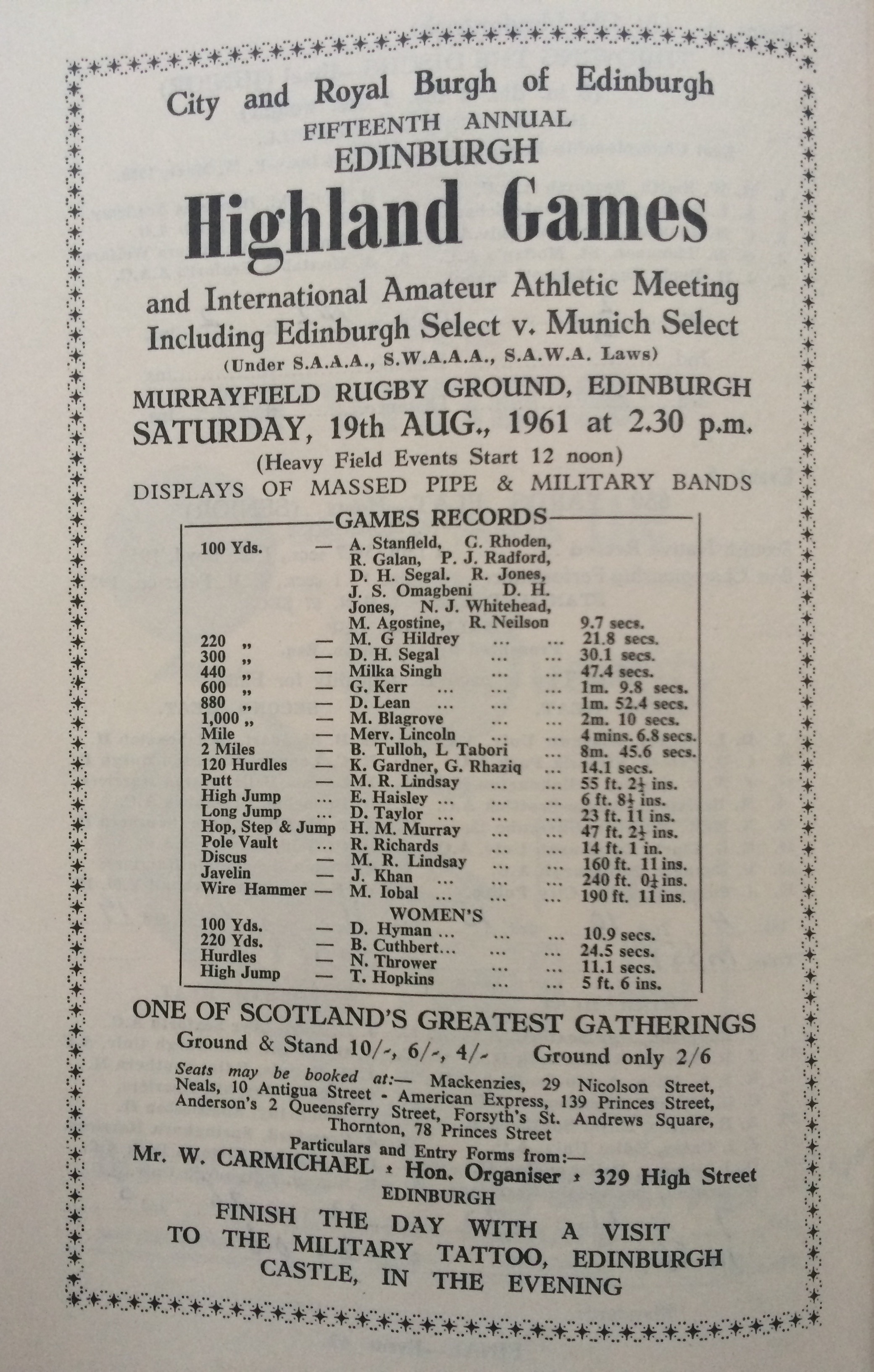
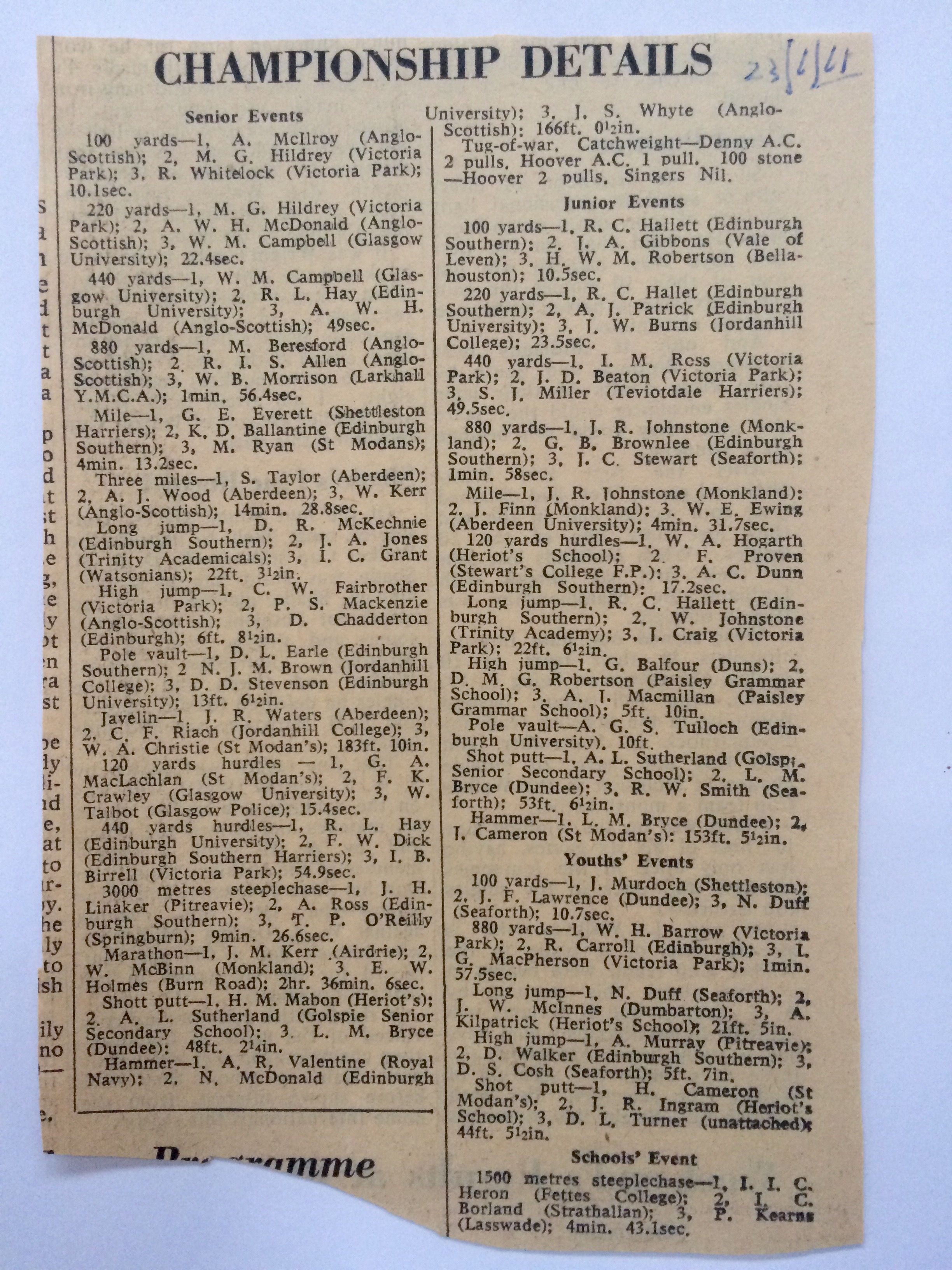
Programmes sold ell although not everybody actually filled them in.   They were then stuck in pockets, kit bags or poly bags beside the picnic brought for sustenance during the afternoon.   The result is that very few completed programmes are still around.   What   follows is the programme for 1961 – or most of it – as completed by Andy.   You’ll note that for one event at least the Vicky Park runners results are marked with a wee cross!

AF SAAA 61 Cover

AF SAAA 61 100y

AF SAAA 61 880y J&Y

AF SAAA 61 half mile final

AF SAAA 61 Mile 880y

AF SAAA 61 Mile H

AF SAAA 61 steeplechase

AF SAAA 61 880y J&Y

AF SAAA 61 3 Miles

AF SAAA 61 Marathon

AF SAAA 61 6 Miles

AF SAAA 61 EHG

… and if you meant to keep it, you cut out the results from the Monday’s ‘Glasgow Herald’ or ‘Scotsman’ …

AF SAAA 61 results

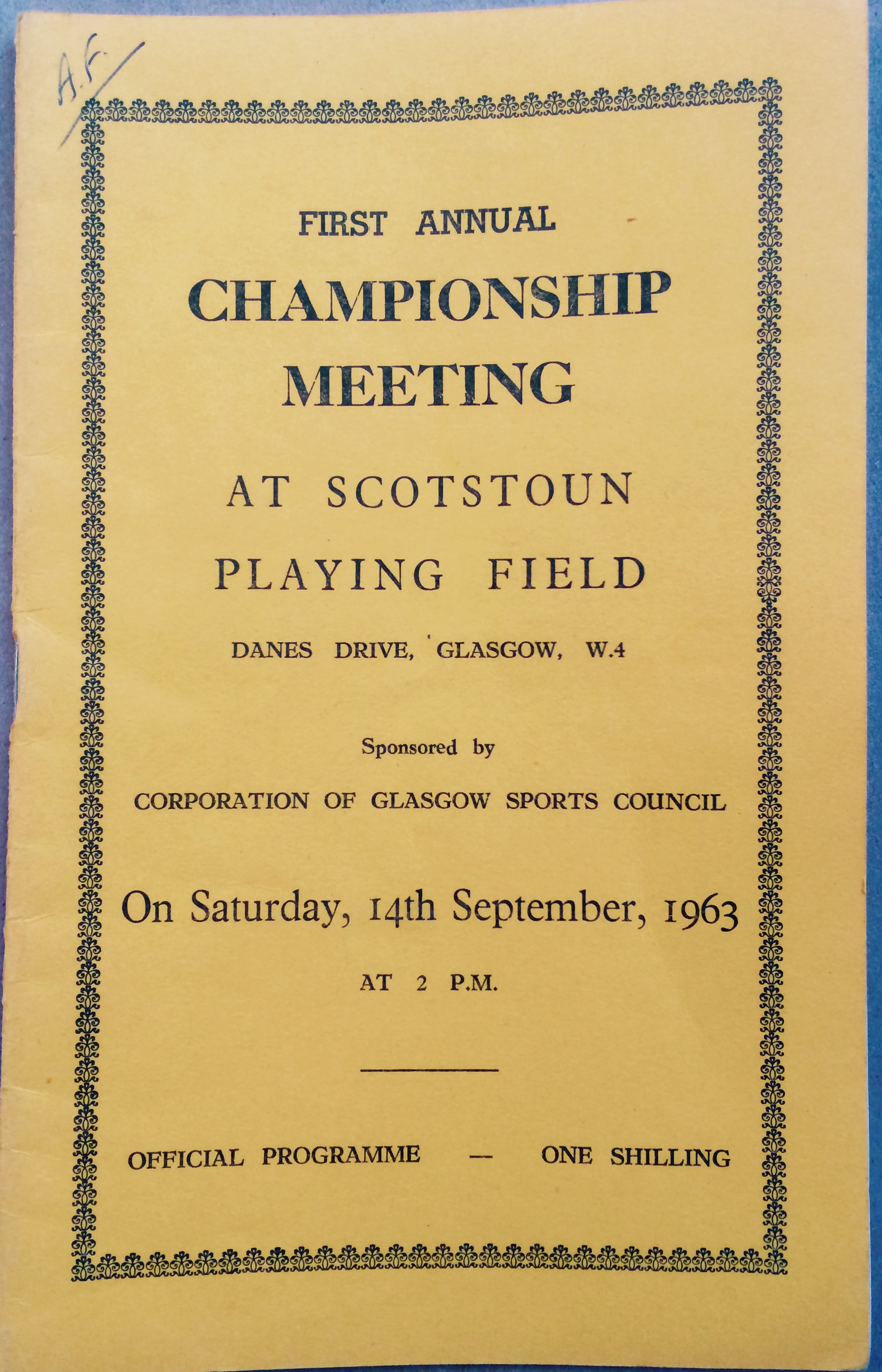
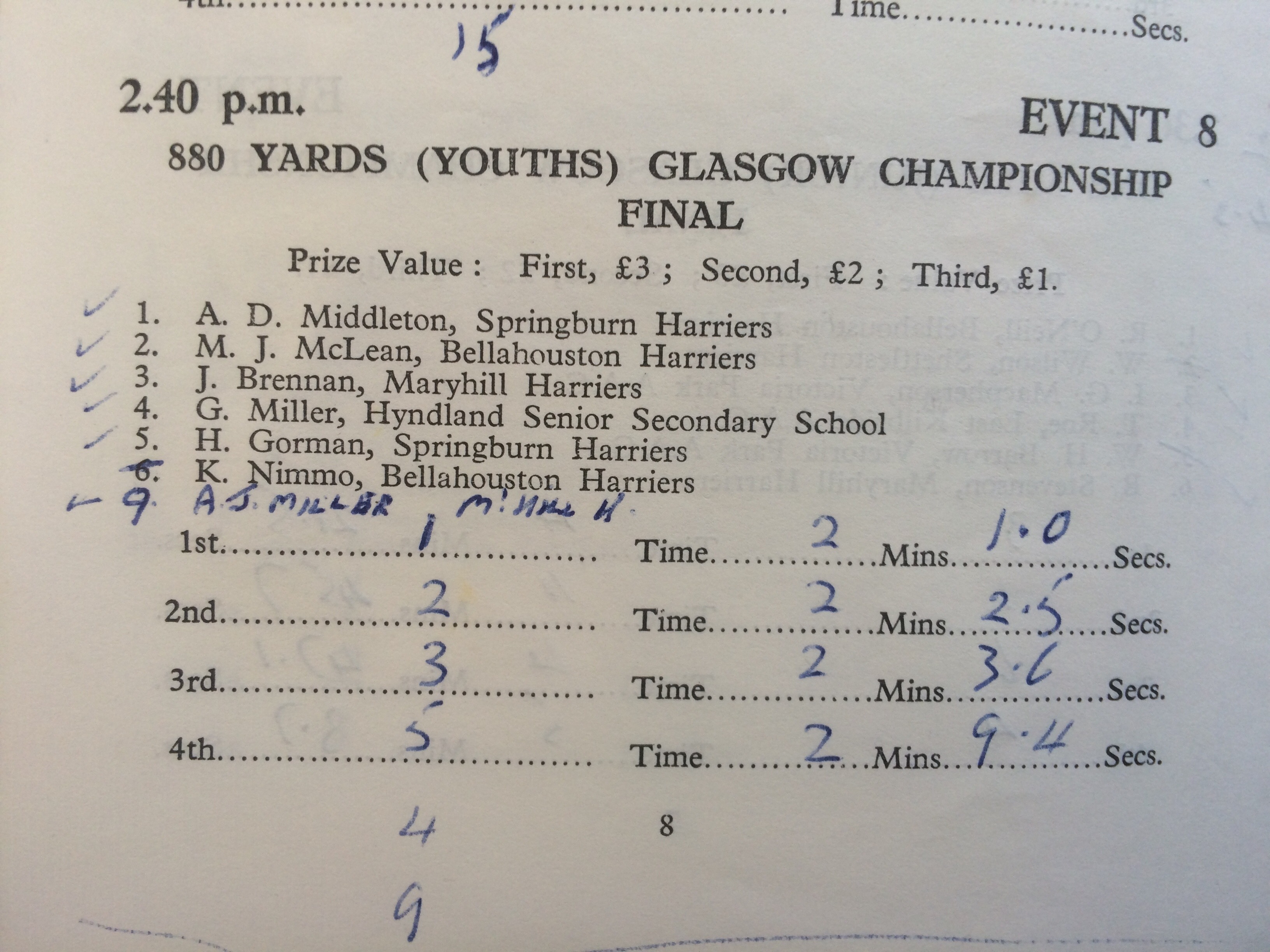
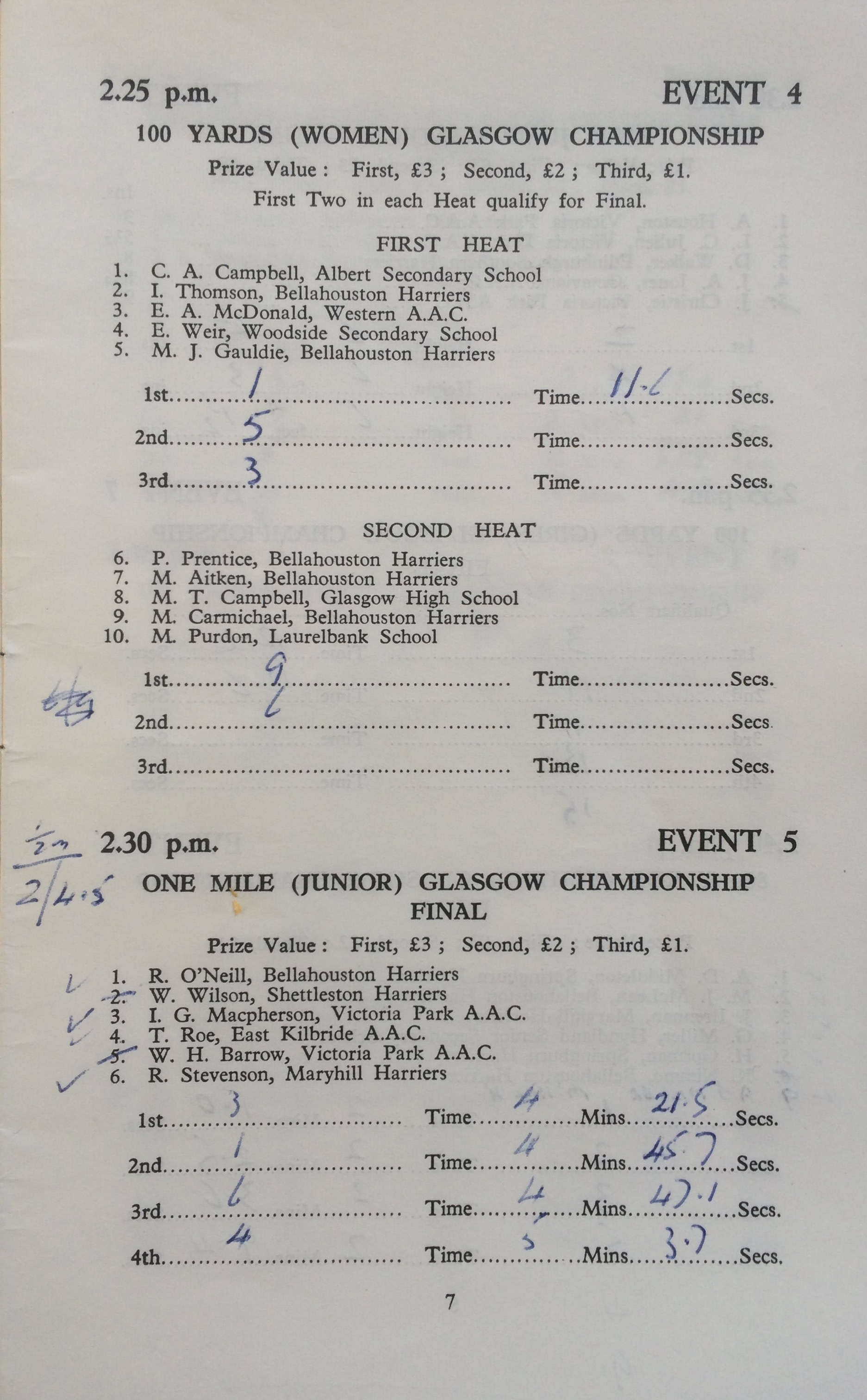
Another meeting which went well for a number of years was the Glasgow Championship meeting at Scotstoun and of course Andy was out in those – but the fields always had quality with Lachie, Ian McCafferty, Frank Clement, Hugh Barrow, Les Piggott and many more competing there.   It’s a pity that it’s gone with the City Council seeming to see Scotstoun more as a rugby stadium these days despite the quality of the track.

Glasgow Champs 63

AF Gg cover

AF Gg 1

Af Gg 2

AF Gg 3

AF Gg 4

AF Gg 6

AF Gg 5

AF Gg 8

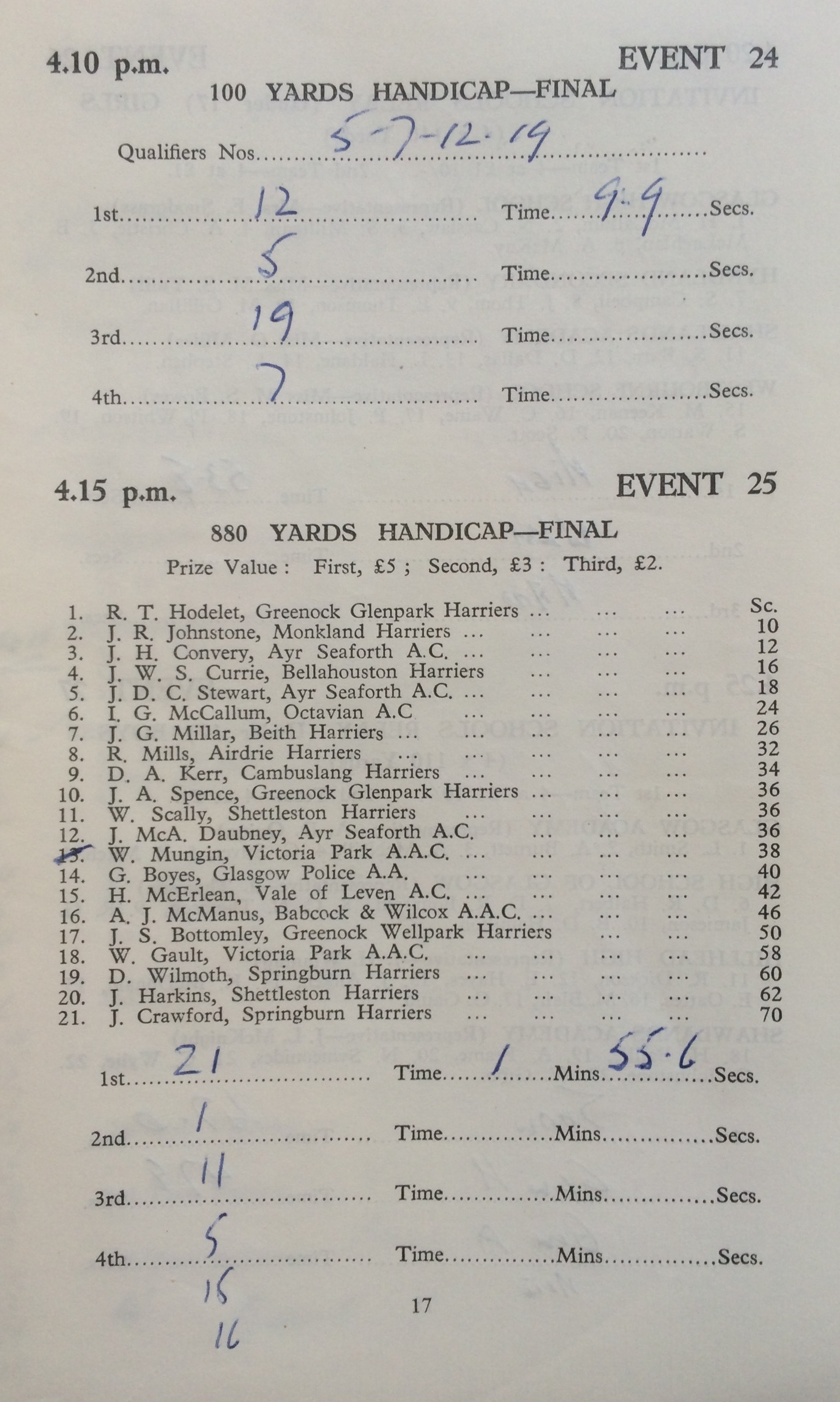
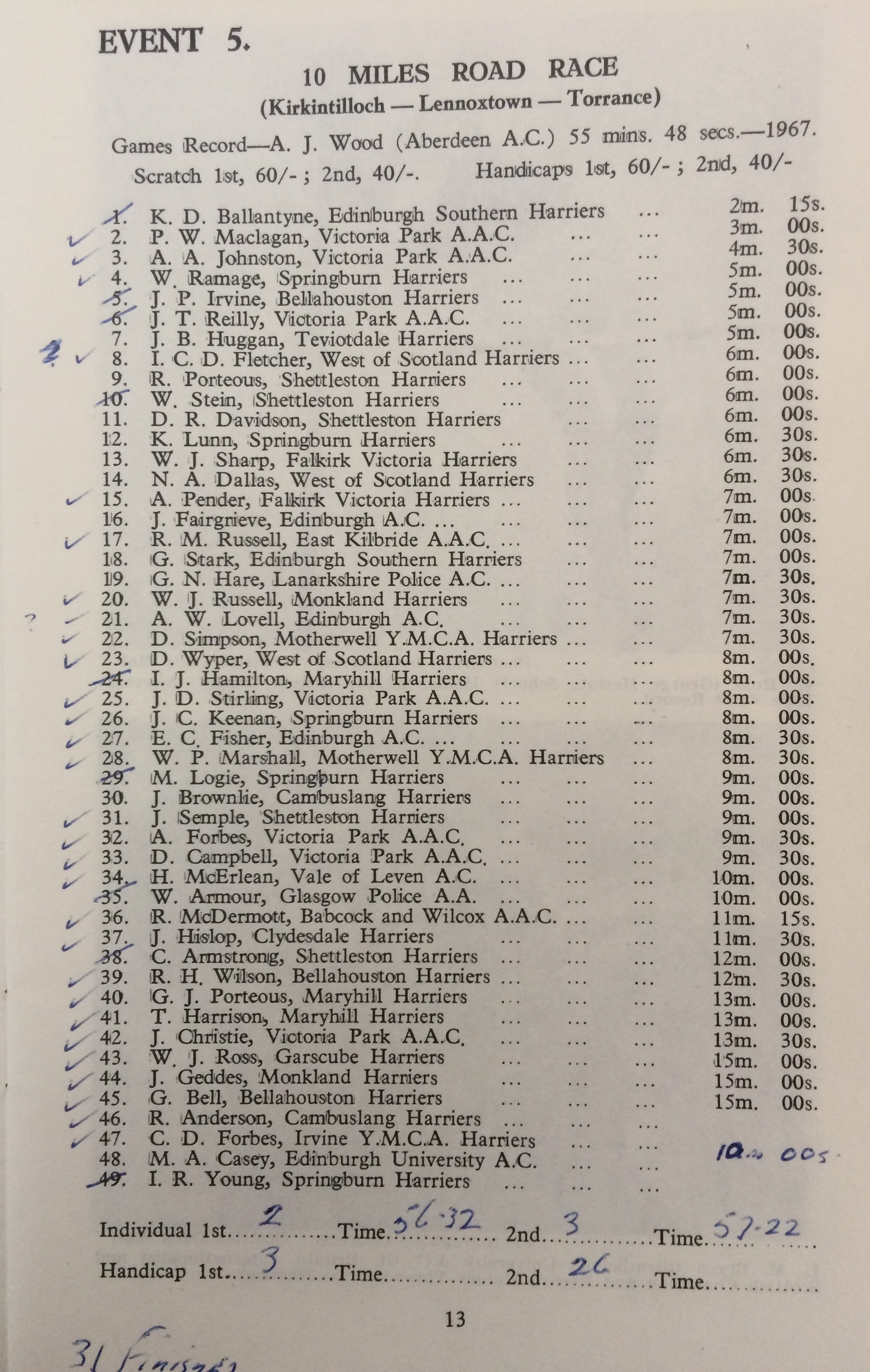
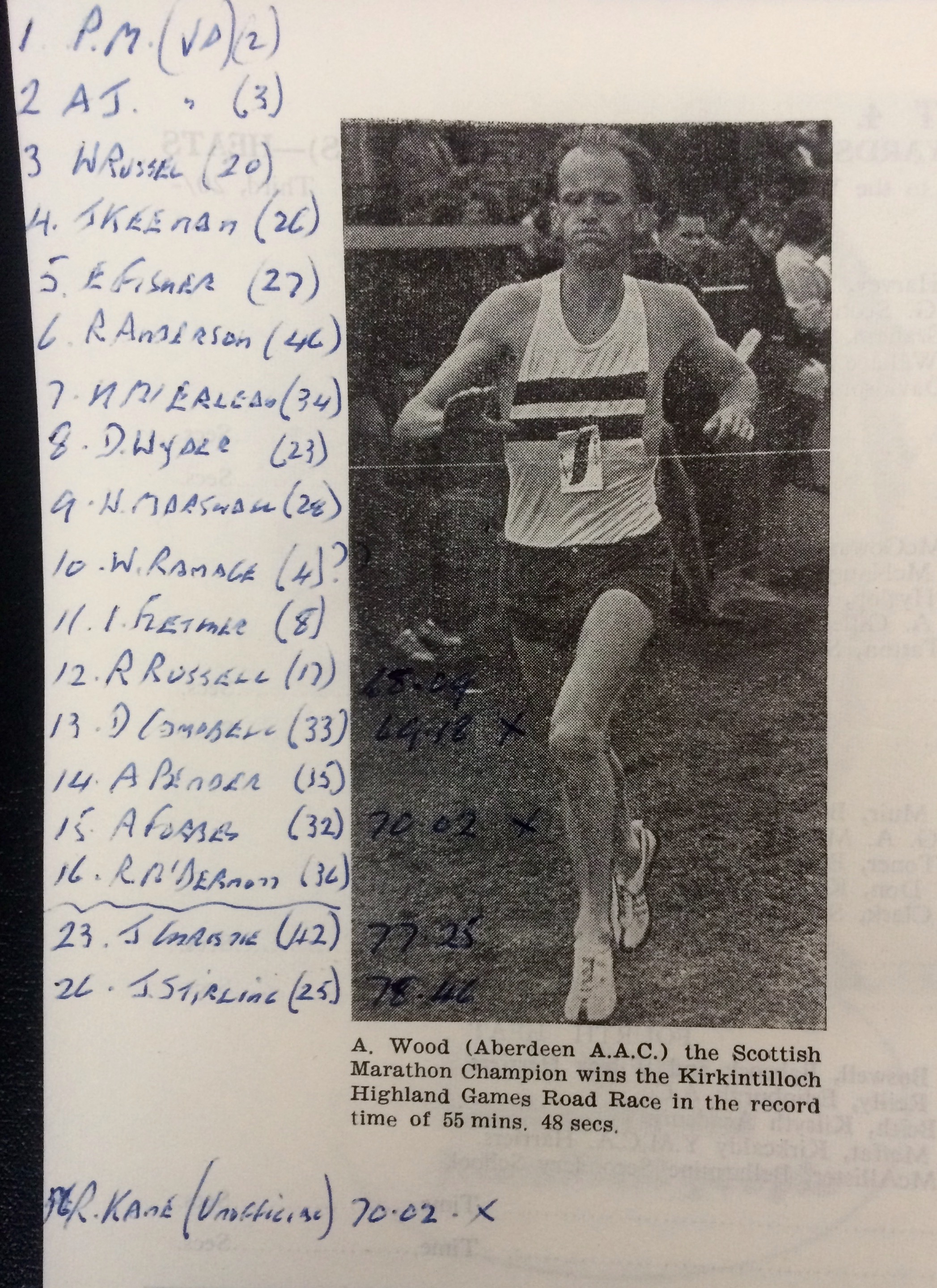
We have had British, Scottish and Glasgow championships but the next programme if from a different kind of meeting, on a grass track in a football field but with a ten miles road race in which Andy probably ran.   I say ten miles but given that top class runners normally took 55 minutes it was probably nearer eleven.

Kirkie 68

AF KHG 68 1

AF KHG 68 2

AF KHG 68 4

AF KHG 68 5

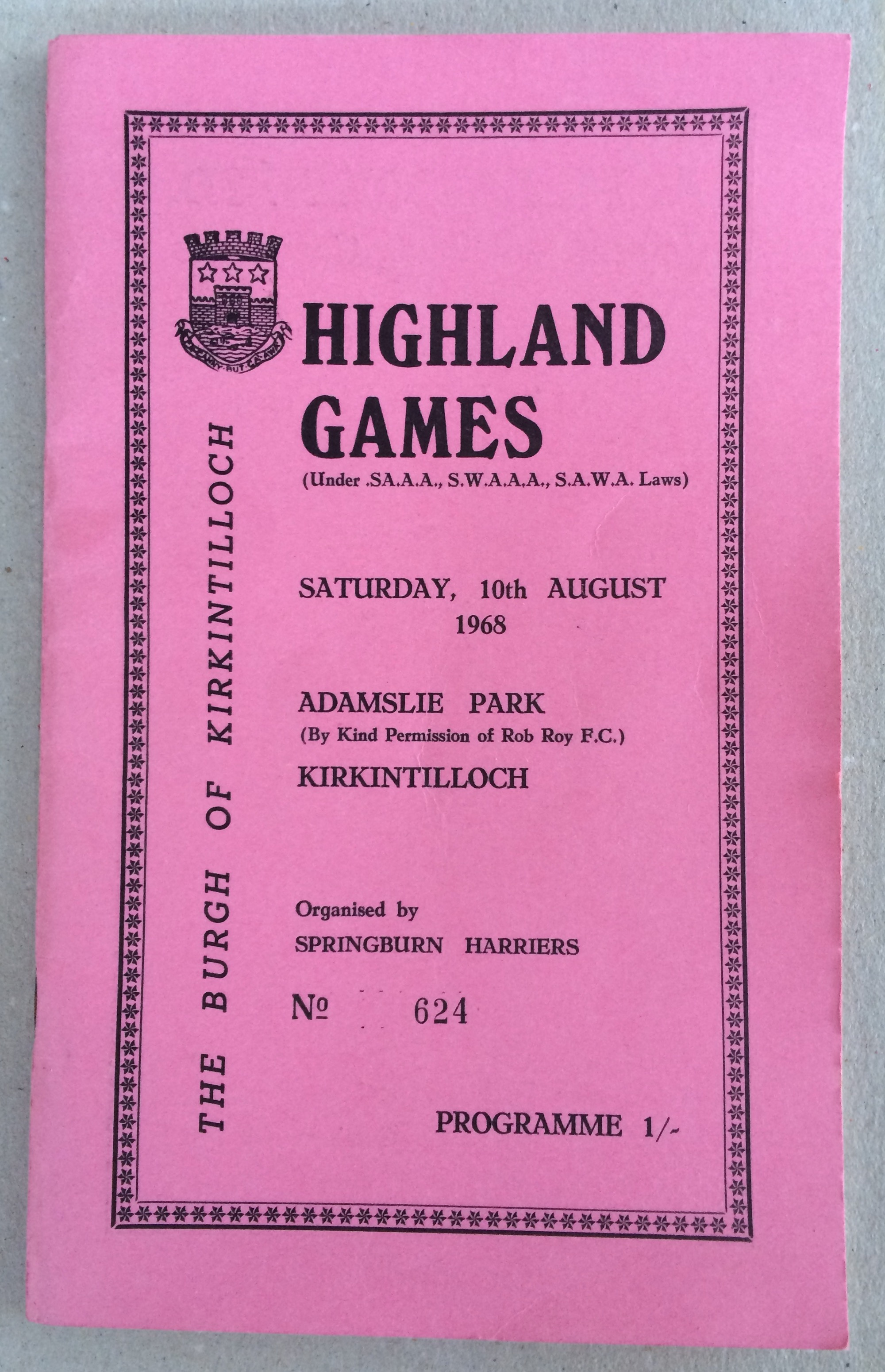
By 1968 Andy was running as a veteran and taking part with his friends Emmet Farrell, Gordon Porteous and David Morrison in road races all round the country – you’d see them at Dunblane, at the Strathallan Gathering, at Gourock and all sorts of meetings.   This programme is from the Kirkintilloch Highland Games in 1968.

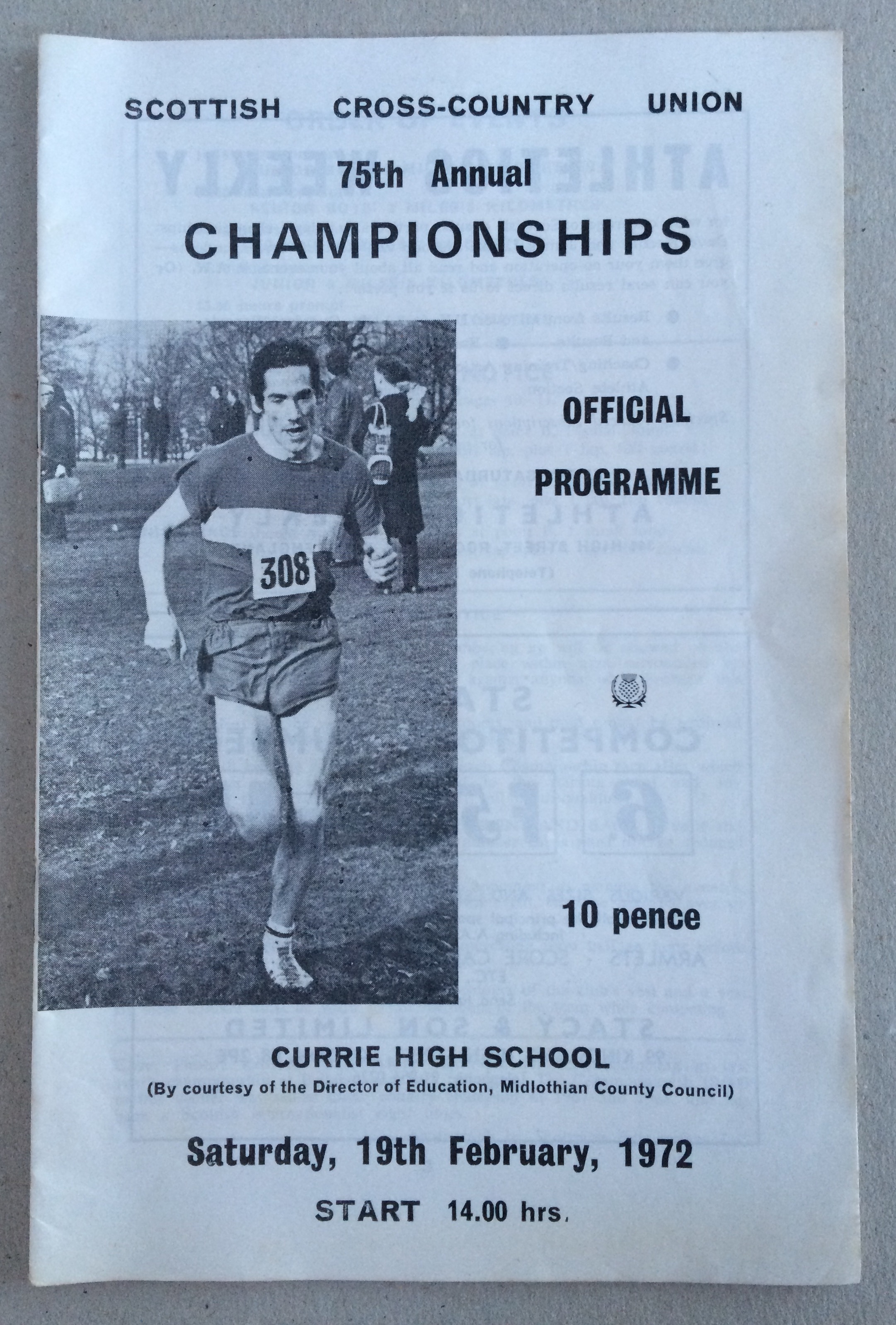
National 72

This one is from the National Cross-Country Championships in 1972, notable for the absence of many good runners because of the power workers strike.   The national shortage of power meant that workers were all put on to a four day week, and if one of your days was a Saturday then that was just your luck.   Cover picture is of course Lachie Stewart who actually finished fifth on the day with Ian McCafferty victorious.

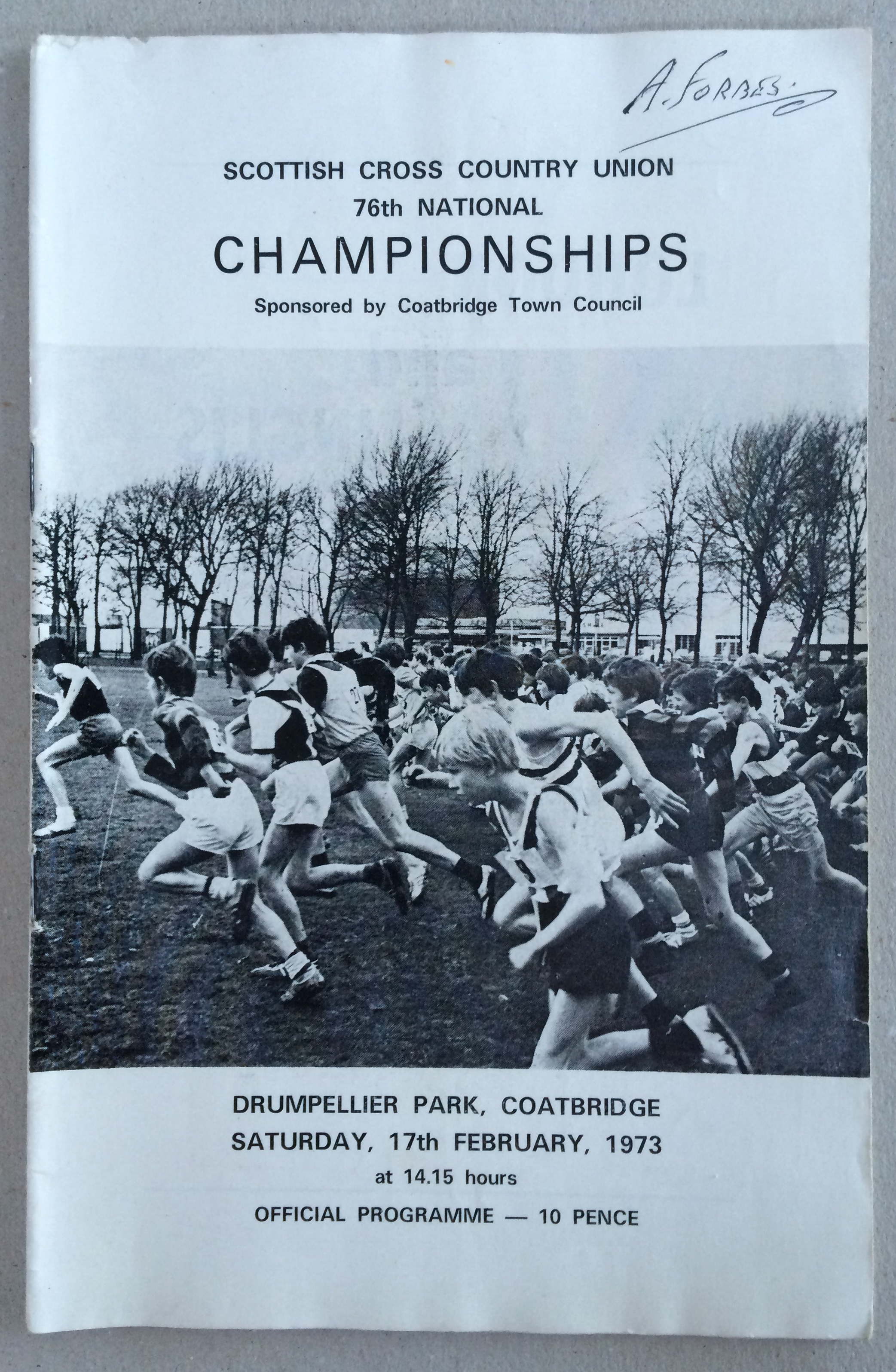
National 73

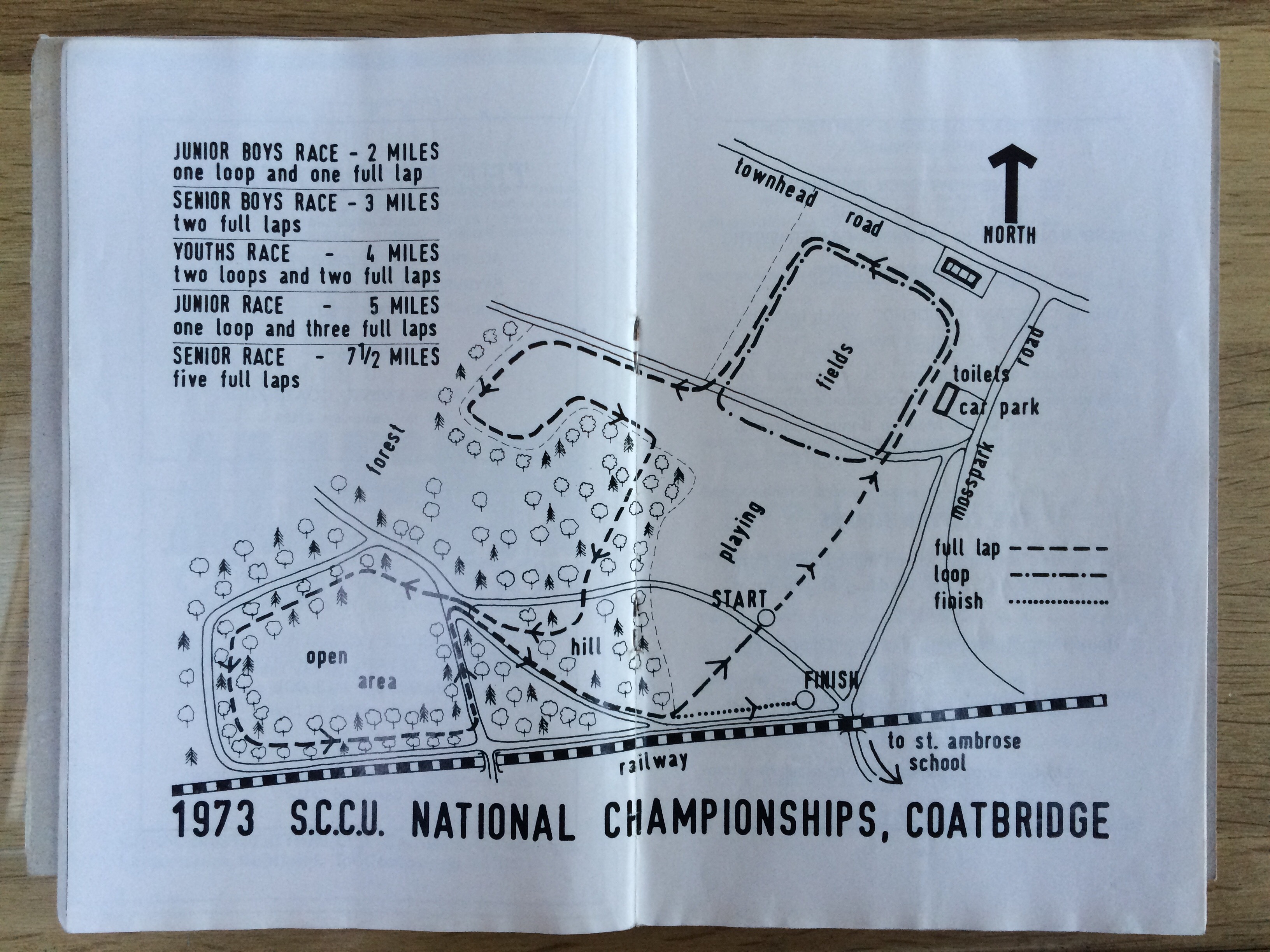
The second in a mini-series of national programmes, and for the first of a series of races at Coatbridge which were well organised, held over good running courses which nevertheless had plenty of variety and where the runners needed the old fashioned skills of cross-country running.   One man who really seemed to enjoy the trails and conditions at Coatbridge was Andy McKean who won from Weatherhead and Stewart.

Trail 73

The centre-spread!   The trail for 1973.

Prog Extract

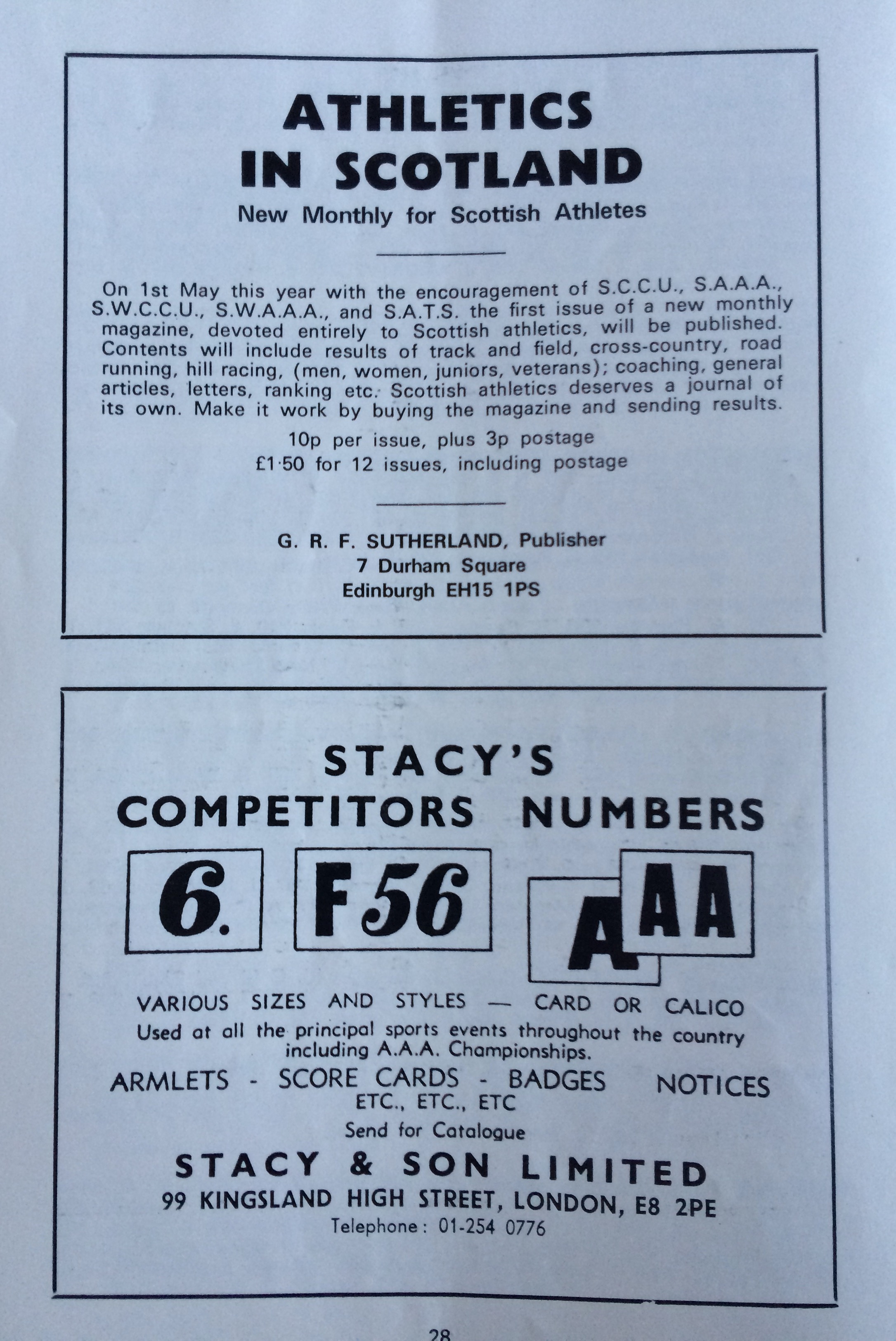
George Sutherland produced a very good magazine.   On A4 paper, every word typed by hand it was a really interesting production: results in detail, ranking lists, race reports from all over the country from the borders to the north and articles on coaching and so on.   It was a real shame when it went.   We often get good magazines in Scotland but they never seem to last very long:   The Scots Athlete from 1946 to 1957, the Athletics in Scotland magazine had a shorter life and the very good Scotland’s Runner from 1986 to 1993 – all top class productions, all sorely missed.

And – the bonus picture –

GMac EG

Andy ran the first leg in this one and finished fourteenth.   He had started running in 1935 and we have programmes here up to 1973 and he went on long after that.

A wonderful athlete and a very good man.

All-time fastest British Milers on Cinder Tracks

Dave Cocksedge is an athletics journalist and statistician of the highest calibre.   He is also a member of the British Milers Club and that is where I met him.   It was at a BMC Annual General Meeting  and Coaching Weekend at Cheltenham in the late 80’s and we jogged a couple of miles while the athletes were warming up for their session on the Saturday afternoon.   He has done a lot of work for the BMC and one of his latest in a list of the fastest British milers of all time on cinders.   There is no doubt at all that the all-weather tracks of today are faster than the all-weather tracks of the 70’s, 80s and 90s which were faster than cinders.   There is always work being done on faster tracks and there is no doubt in my mind that many near-misses of the 50’s, 60s and 70’s on cinder tracks would have been a couple of seconds quicker on current surfaces.   Enough philosophising – let’s have the list.

3:55.68     Alan Simpson     White City     30th August 1965

3:56.8      Ian McCafferty     Reading     11th June 1969

3:57.2      Derek Ibbotson     White City     19th July 1957

3:57.3     Ian Stewart              Reading       11th June 1969

3:57.5     Mike Wiggs              Dublin     5th July 1965

3:57.68     John Whetton     White City     3rd July 1965

3:57.74      Andy Green     White City     3rd July 1965

3:58.0     John Kirkbride     Motspur Park     23rd July 69

3:58.01     Stan Taylor     White City     18th August 1962

3:58.4       Nick Rose     Motspur Park     25th July 1973

3:58.5       Jim Douglas     Motspur Park     23rd July 1969

3:58.6     John Boulter    Motspur Park     24th July 1968

3:58.7     Allan Rushmer     Northampton     26th August 1967

3:58.7     Peter Stewart*     Reading     11th June 1969

3:58.8     Roger Bannister     Vancouver, Canada     7th August 1954

3:58.9     Brian Hewson     White City     3rd September 1958

3:58.96     Tony Harris     White City     3rd July 1965

3:59.2     Derek Graham    White City    20th Aug 1966

3:59.2      Walter Wilkinson     Stretford     28th May 1968

3:59.24       Mike Berisford        White City     18th August 1962

3:59.3      Ken Wood     White City     19th July 1957

3:59.4      Bill McKim     Motspur Park     22nd Jul 64

3:59.4      Roy Young    Motspur Park     14th Jul 71

3:59.80     Maurice Benn     White City    3rd June 1968

3:59.8     Chris Chataway     White City     28th May 1955

3:59.8     Rayfel Roseman     Motspur Park     23rd July 1969

3:59.9     Gordon Pirie     Dublin     23rd September 1960

4:00.0     Mike Blagrove     White City     3rd September 1958

4:00.0       Steve Ovett        Motspur Park     25th July 1973

4:00.1     Brian Hall     Witton Park     6th June 1962

4:00.3     Frank Clement     Scotstoun   17th May 1975

4:00.4     Phil Banning     Motspur Park     25th July 1973

4:00.5     Bill Cornell     Eugene, Oregon     16th June 1962

4:00.5     John McGrow     Brighton     21st August 1966

4:00.5     Chris Stewart     Motspur Park     14th July 1961

4:00.6     John Cadman     Motspur Park     25th July 1973

4:00.7     Peter Keeling     White City      3rd August 1964

4:00.9     Chris Barber     White City     24th July 1974

4:01.0     Mick Gowan     Motspur Park     21st July 1965

4:01.0     Hugh Barrow     Stretford     28th May 1968

4:01.0     Andy Carter      Motspur Park     8th July 1970

4:01.1     Ken Ballantyne     Motspur Park     21st July 1965

4:01.3     Derek Haith     White City     29th May 1961

4:01.3      Alan Mottershead     Motspur Park    15th July 1981

That’s the top 33.   Scots are marked in red – only five of them of whom two go back to the 1950’s.   And only one Scots track listed as the venue for any of these races.    The Scots mentioned ran at Reading, Stretford and Motspur Park.   Going solely on the times noted above, the best races were at Reading in 1969 where McCafferty beat the two Stewarts, and the one in 1965 at the White City where John Whetton defeated Andy Greeen and Tony Harris.

(20th Dec 2015)

Danny Wilmoth’s Photographs

Danny Chain

Having put up some of Tom O’Reilly’s Photographs, it seems only right that I put up some of Danny’s.   Both members of the same club, both ran in many of the same teams, Tom encouraged Danny to join the club and so on.  Now see some of Danny’s pictures.

From the left Eddie Sinclair, Tom O’Reilly, Bob Dalgleish, J Crawford , John McCormick, Danny Wilmoth

dw-15-xmas-53

Christmas Handicap, 1953

dw-laa-relays-54Lanarkshire relays, 1954

dw-mcandrew-59 McAndrew Relays, 1958

dw-west-champs-1962

Wes Districts, 1962

dw-mcandrew-55-ji

McAndrew Relay, 1955

dw-babcock-1958-half

Winning Babcock’s Half Mile, 1958

dw-shawfield-1060

Lanarkshire Police Sports, Shawfield, 1960

dw-lanark-const-880-1955

Lanarkshire Police Sports, 1955, half-mile

dw-mcandrew

McAndrew Relays

dw-springburn-h-presentation

Springburn Club Presentation

dw-springburn-presentation-w-prize-winners

dw-v-largs

Vets line up at Largs: 80’s

1003, Huntershill., Vets

dw-v-men-ballymena-1995 Men Vets, Ballymena, 1995

dw-v-women-1995-ballymena

Women Vets, Ballymena, 1995

dw-vets-torre-90

Tom O’Reilly’s Photographs

Two or three years ago we were given copies of some of Tom O’Reilly’s groups, etc.   Many of the people in them are familiar and where I have them, I’ll add the names but for some …. you’re on your own!   Relays first.
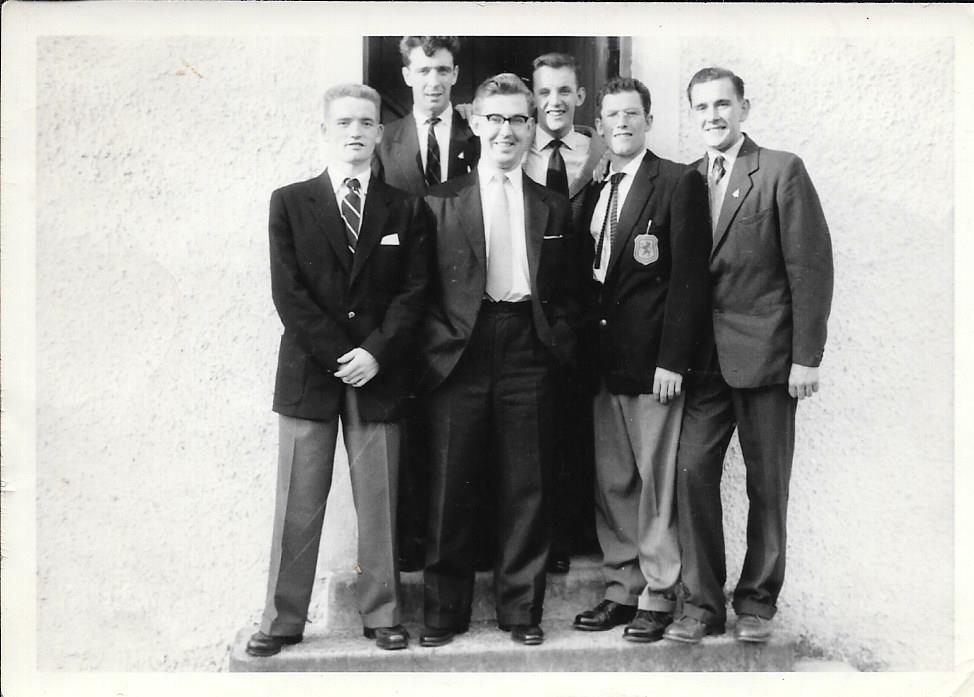
ToR Midlands

Tommy Lambert to Tom O’Reilly at the Millerston Pony Trotting Track at Millerston (Stepps)

ToR McA

McAndrew Relay :Tommy to Garry Mackay

ToR LAA Relay

Lanarkshire Relay at Auchinairn : Tommy hands over first at the end of the first stage to Garry Mackay

TOR EG Stevenson

Edinburgh to Glasgow: John Stevenson to Tommy at the start of the fourth stage

ToR EG S4

Tommy at the end of that fourth stage

ToR Spean Br 3

First three at Spean Bridge: Ian Harris (Beith), Eddie Sinclair, Tommy

ToR Span Br

Winning team at Spean Bridge: Moir Logie, John Roon, Eddie Sinclair and Tommy

ToR Gp 1

Club Presentation: F Morton, Tommy, Duncan Middleton, Hugh McCartney, jnr, Jack Crawford snr, Jim Keenan, Kenny Lunn, Alan Lamont, Eddie Knox, Harry Gorman,  Davie Tees, George Jarvie, Moir Logie.

Front: Duncan McSwein, J Young (Provost), Bob Dalgleish, Hugh McCartney

ToR Gp 4

Tom second left back row, Bob Dalgleish second right back row, Campbell Christie third right back row

Molly Wilmoth second left front row.

ToR Ibrox

Tommy (7) in the Ibrox Steeplechase: the chap on the right, second out of the water is Springburn’s Andy Girvan

ToR Ibrox Water

Tommy : Ibrox again

ToR Bute Medley

Winning Medley Relay Team at Bute Highland Games: Tommy (440), John Kerr (220), John Young (220), Eddie Sinclair (880)

ToR Tracey

Tommy Tracey in the club championships

ToR Morton Wallace

Jim Morton and Davie Wallace

ToR National

Start of the National at Hamilton: Tommy on the left beside Tommy Tracey

ToR Gp 2

What Tommy calls the ‘all conquering boys team’

ToR Gp 3

Outside the old clubhouse

Atalanta Membership

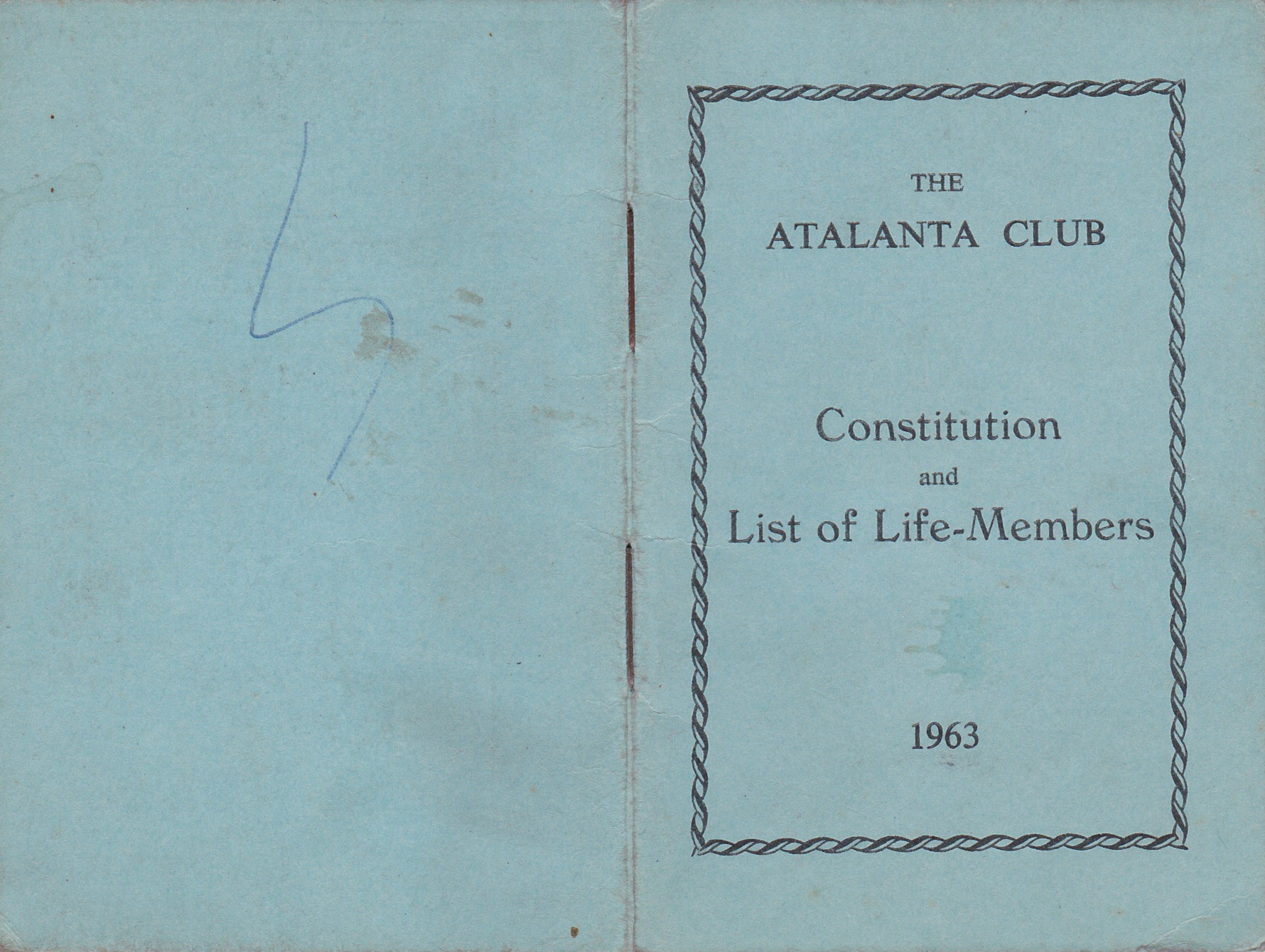
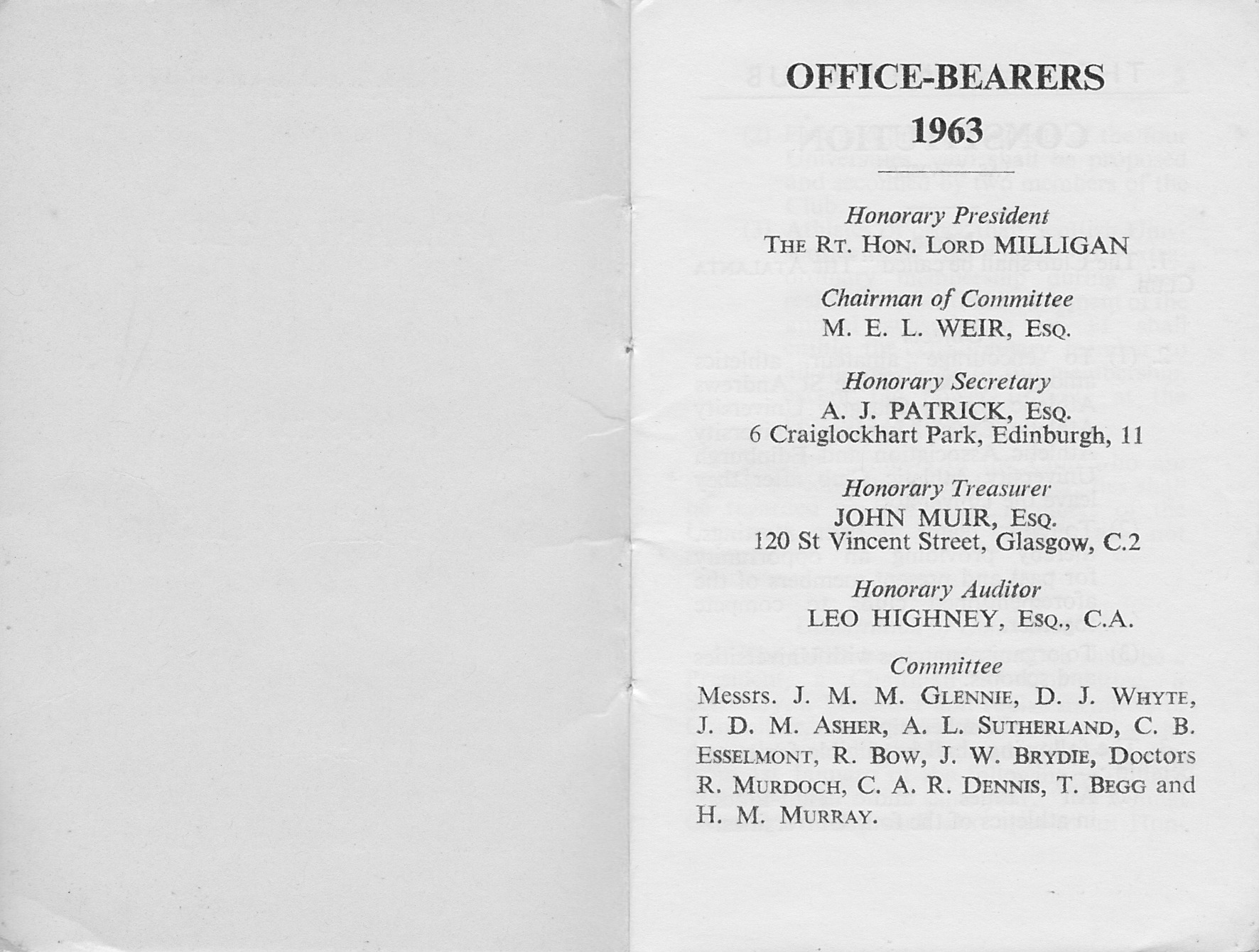
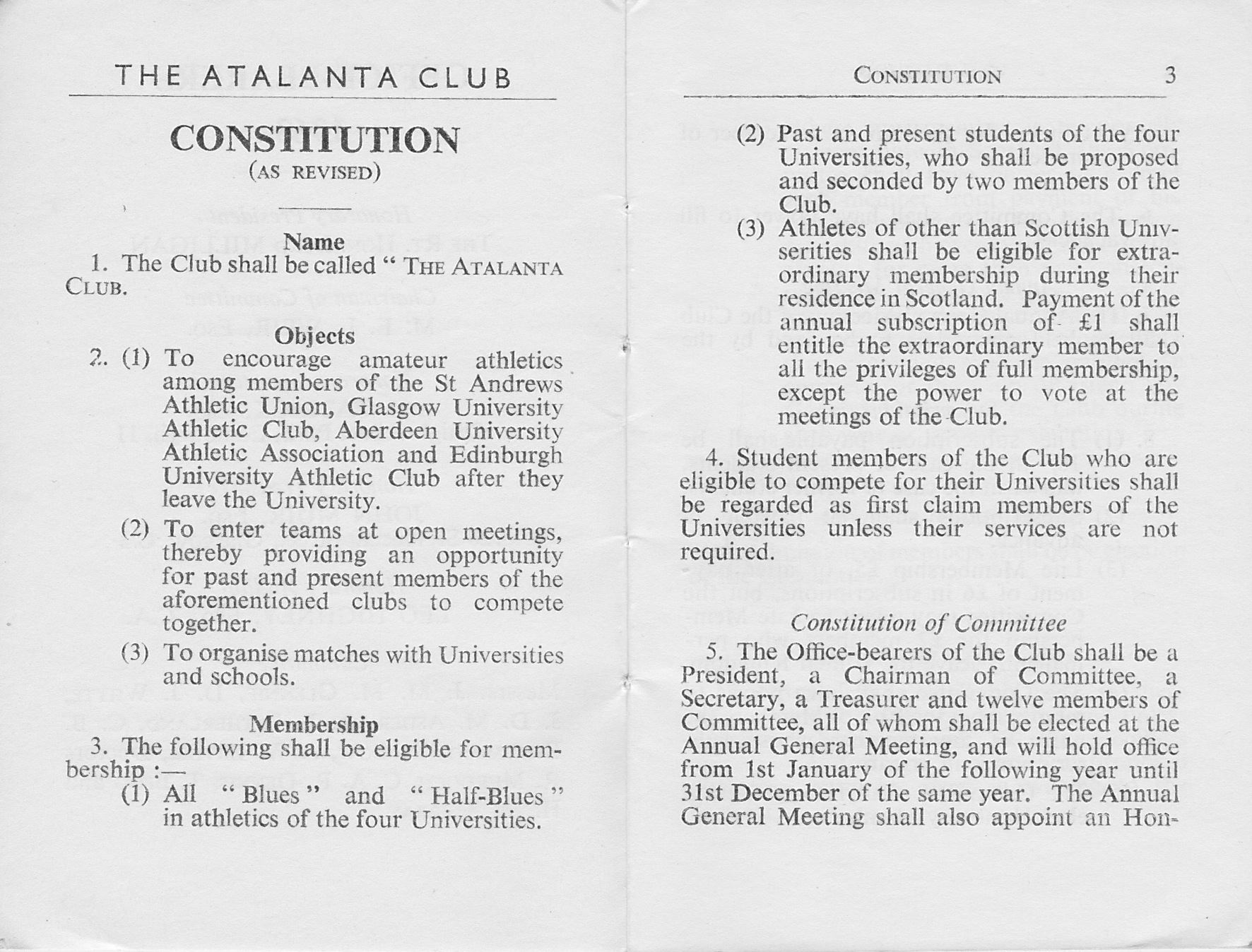
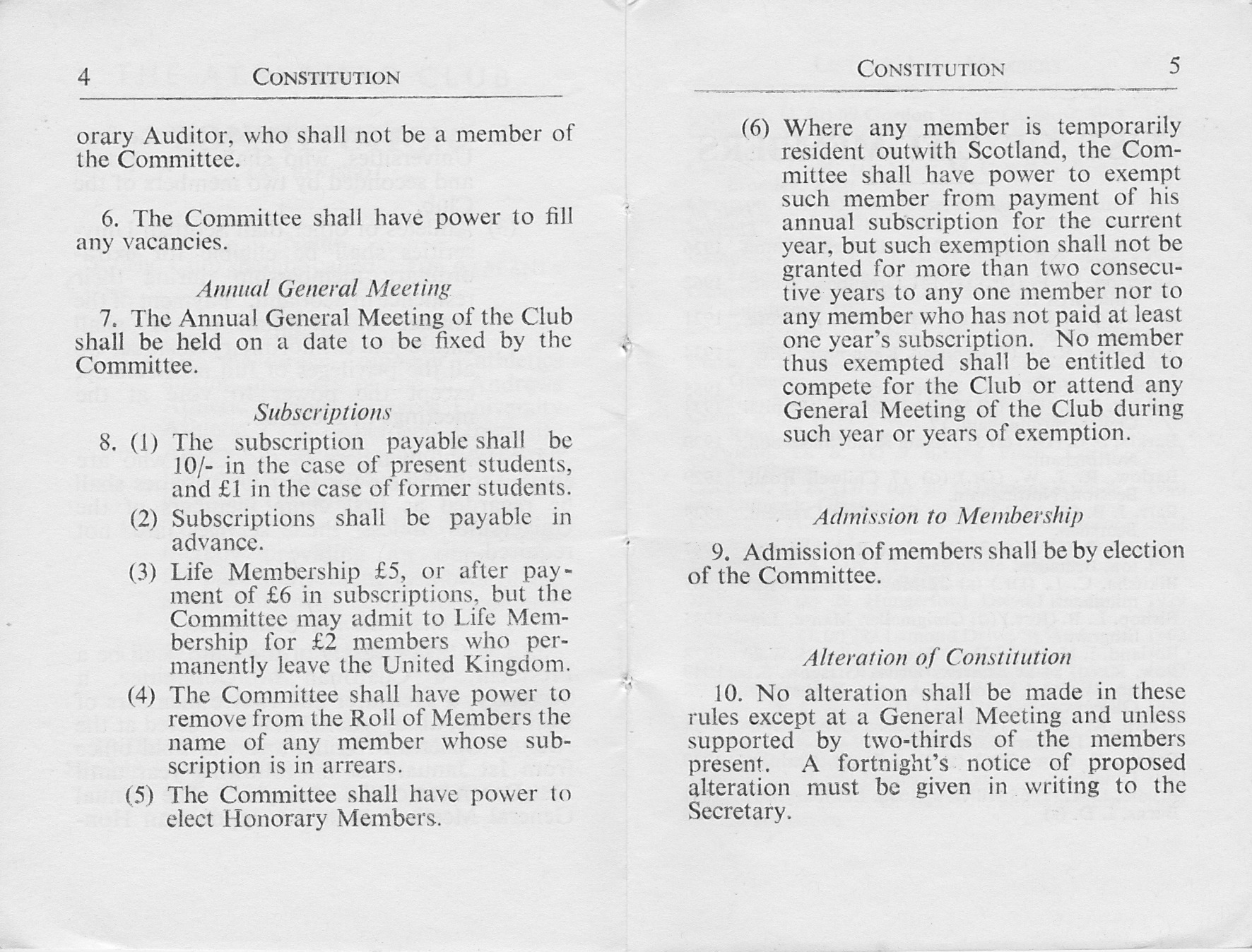
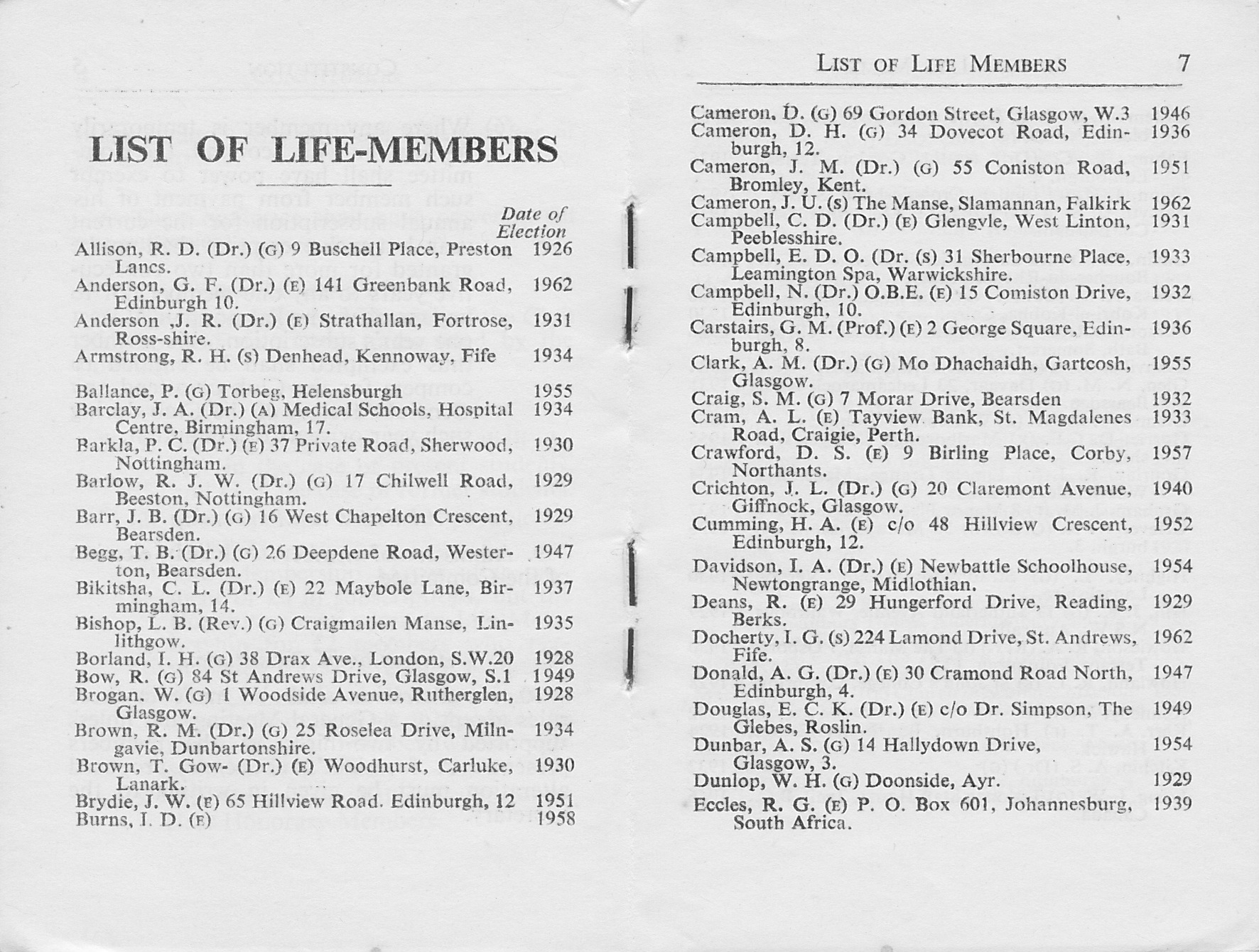
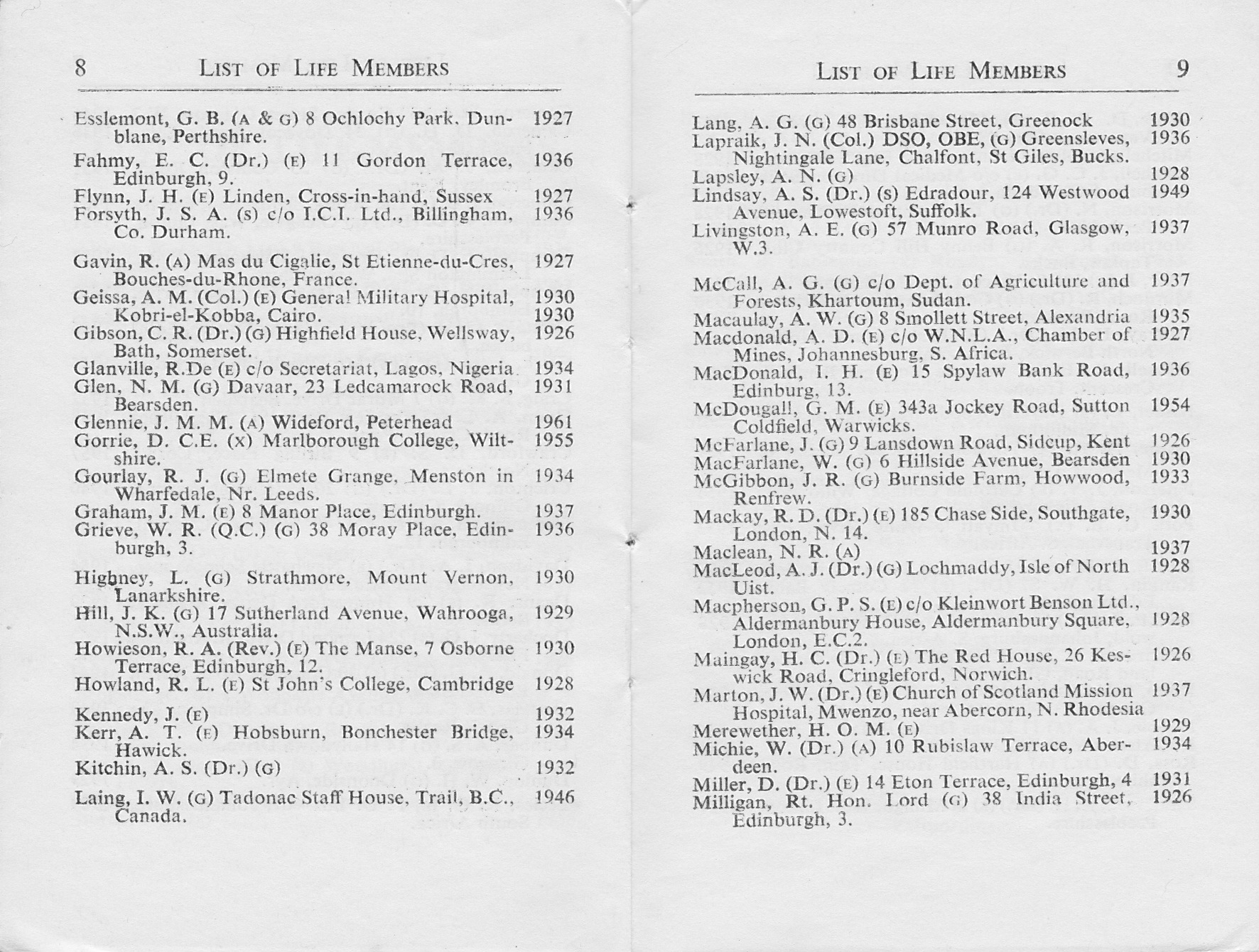
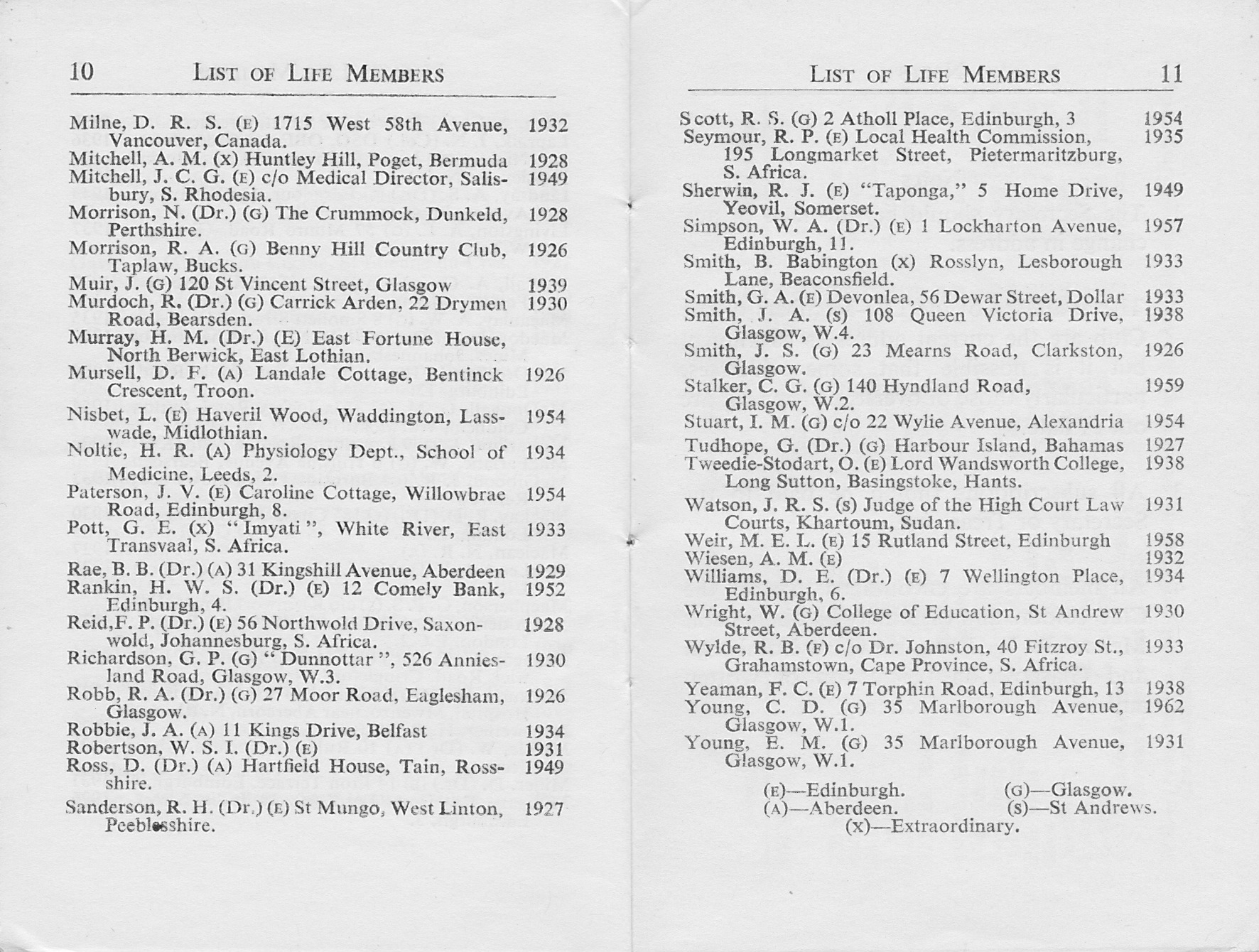
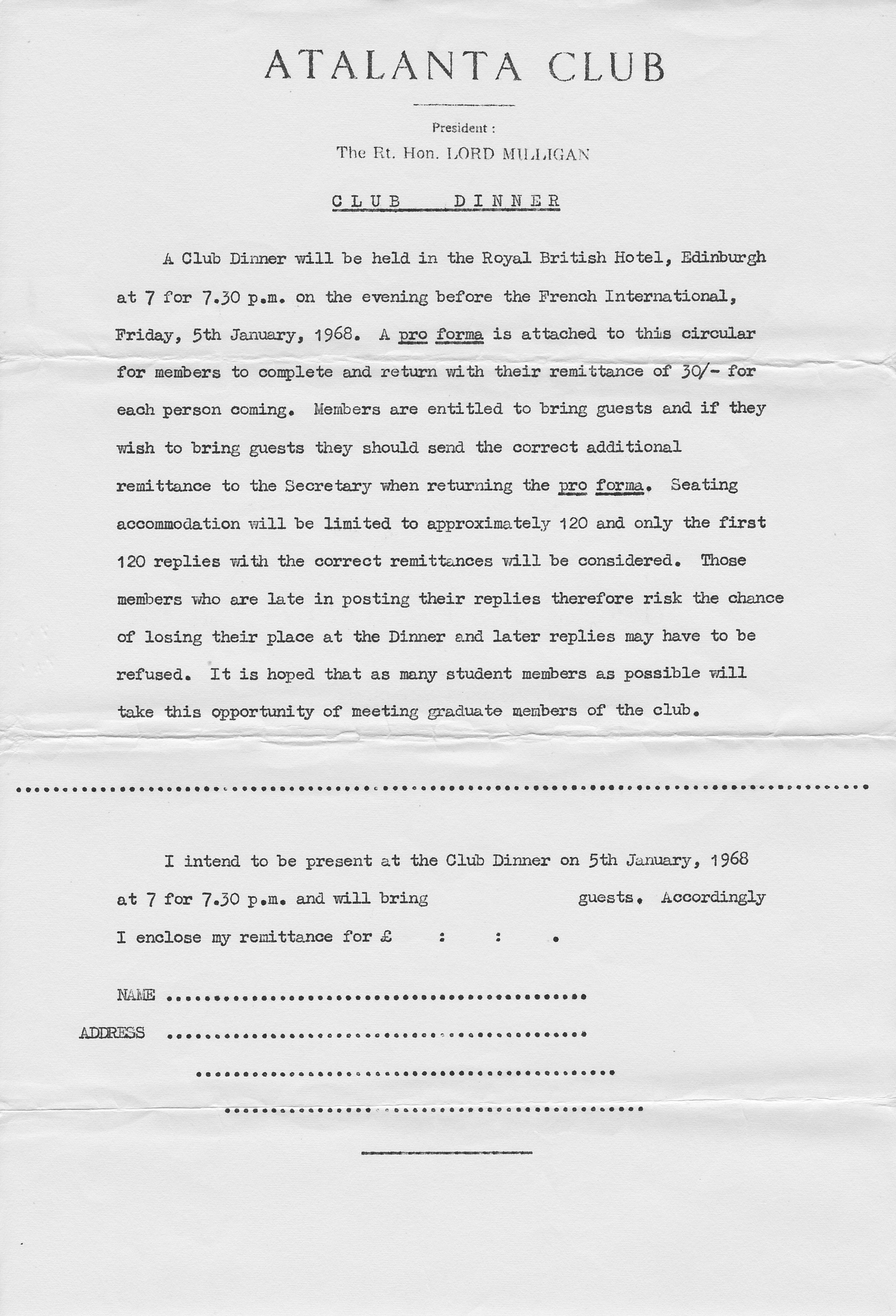
Colin Young who ran for Atalanta in the 1960’s was good enough to send a copy of the Member’s Handbook for 1963  plus a copy of the invitation to the annual dinner.   They have been copied and are reproduced here for information and as a companion to the page on the Atalanta Club.   If you take the time to look through them you will see that they are a valuable Social history document: look at the geographical  spread of the members – all over the UK, France, South Africa, Rhodesia, Canada, Nigeria, etc, etc.   Note too that they are keeping in contact with founder members such as Hugh Maingay – the club was formed in 1926 and there are quite a few of those members still ‘on the books’.   Lots of interesting stuff here.   Thanks Colin!
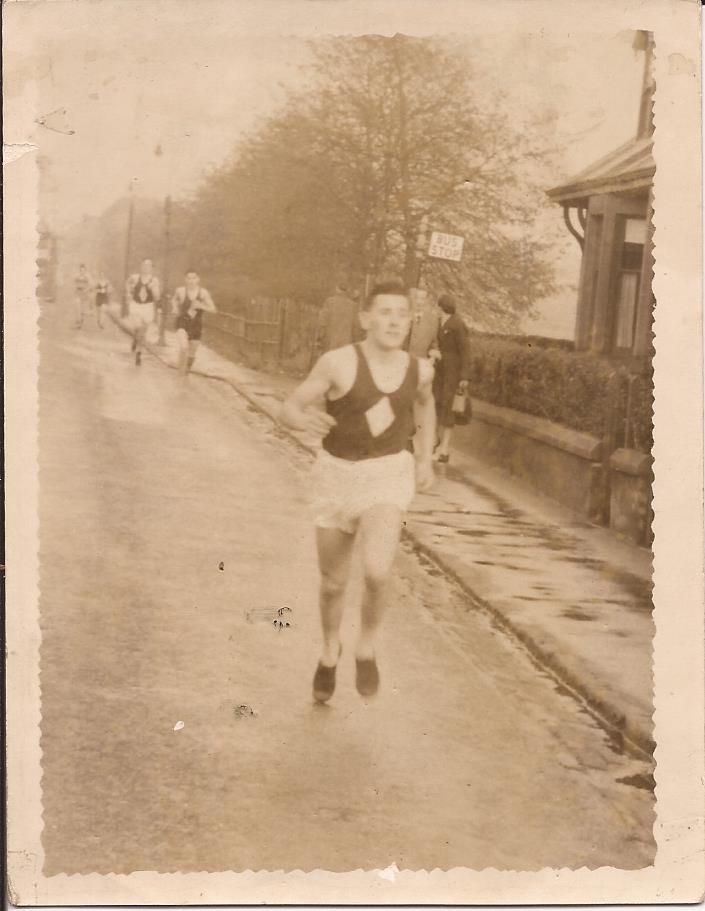
Const Cover

Const 1

Const 2&3

Const 4&5

Const 6&7

Const 8&9

Const 10&11

Dinner circular

Chris Upson

ChrisUpson2
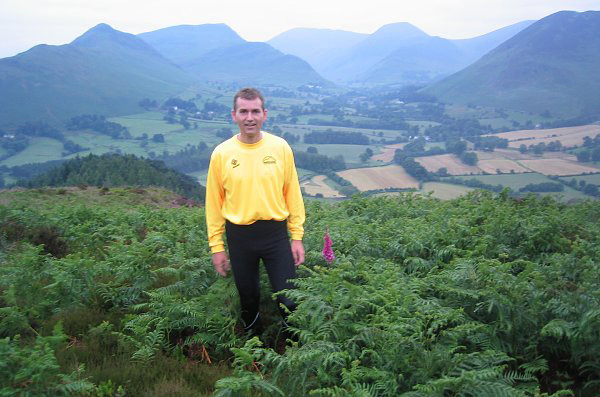
(Chris has of course run for Scotland in the Annual British and Irish Masters Cross Country International; is currently racing better than ever; and has a long, distinguished history as a dedicated hill-runner.)

CLUBs. Ronhill Cambuslang (previously Westerlands 2000-2014).

DATE OF BIRTH. 08/08/1963.

OCCUPATION. Naval Engineering at BAE Systems.

HOW DID YOU GET INVOLVED IN THE SPORT?

Very gradually… From 5 years old I knew I wanted to run on the hills and explore wild places. Teenage years were spent exploring the English Lake District on foot and bike. Mid 1980s I caught the Munro-bagging bug, and have since climbed all the Scottish Munros and Corbetts. In 1989 I had a near fatal climbing accident that broke my ankle and crushed a lumbar vertebra. In 1990 I came back more determined and climbed Mont Blanc, then Elbrus in Russia in 1993. I then spent 10 years rock climbing around Britain, Europe and the United States, before thinking about trying a couple of hill races in 2000 with Glen Rosa and Borrowdale. Since then I’ve completed more than 800 races, plus visiting Nepal 6 times and hiking across the Pyrenees 2 and half times.

Races have ranged from 800 metres at the Emirates, to the 10-stage Everest Sky Race in Nepal.

HAS ANY INDIVIDUAL OR GROUP HAD A MARKED INFLUENCE ON YOUR ATTITUDE OR INDIVIDUAL PERFORMANCE?

Recently, the stalwart veterans at Ronhill Cambuslang and SVHC Masters have inspired me to keep working hard. Uncompromising runners like Paul Thompson, Colin Feechan and John Thomson show that you can still perform at a high level as a V55. I guess that growing up in the 1970s I’m inspired by keeping things simple, and remembering the importance of physical discomfort.

WHAT EXACTLY DO YOU GET OUT OF THE SPORT?

A sense of belonging. A sense of purpose.
WHAT DO YOU CONSIDER TO BE YOUR BEST EVER PERFORMANCE?

Best performance: 1st M50 at Scottish Masters Cross Country at Kilmarnock in January 2015.
YOUR WORST?

I don’t remember any worst performances. I think all performances are part of the learning process.

WHAT UNFULFILLED AMBITIONS DO YOU HAVE?

Sub 2:50 marathon. Possibly a World Masters track medal.

OTHER LEISURE ACTIVITIES?

Playing violin. Playing with my 3-year old son Benjamin.
WHAT DOES RUNNING BRING YOU THAT YOU WOULD NOT HAVE WANTED TO MISS?

That gut-churning sense of excitement before every race.
The sense of relief and peace after the race.

CAN YOU GIVE SOME DETAILS OF YOUR TRAINING?

Quite ad hoc. At present, just lunchtime runs and weekend races.
Occasionally more structure leading up to a marathon.

Career Highlights in hill-running.
Won the FRA Long Distance Award in 2003 for Lakes24, a new route in the Lake District that bagged 24 Marilyns in 24 hours.

Favourite Races.
My favourite race of recent years is Defi de l’Oisans in France. My favourite Scottish races are probably Two Breweries and Pentland Skyline.

Most Memorable Race
Inter Lacs 2003. Restonica Valley, Corsica. 2-Stage event. Very rugged spectacular scenery. Ben Nevis is the most challenging and memorable Scottish race.

Other Interests.
I also occasionally take photos for the Geograph project; and sometimes play my violin with the Glasgow Chamber Orchestra.

Ian Leggett

IAN LEGGETT

IanLeggettBarge

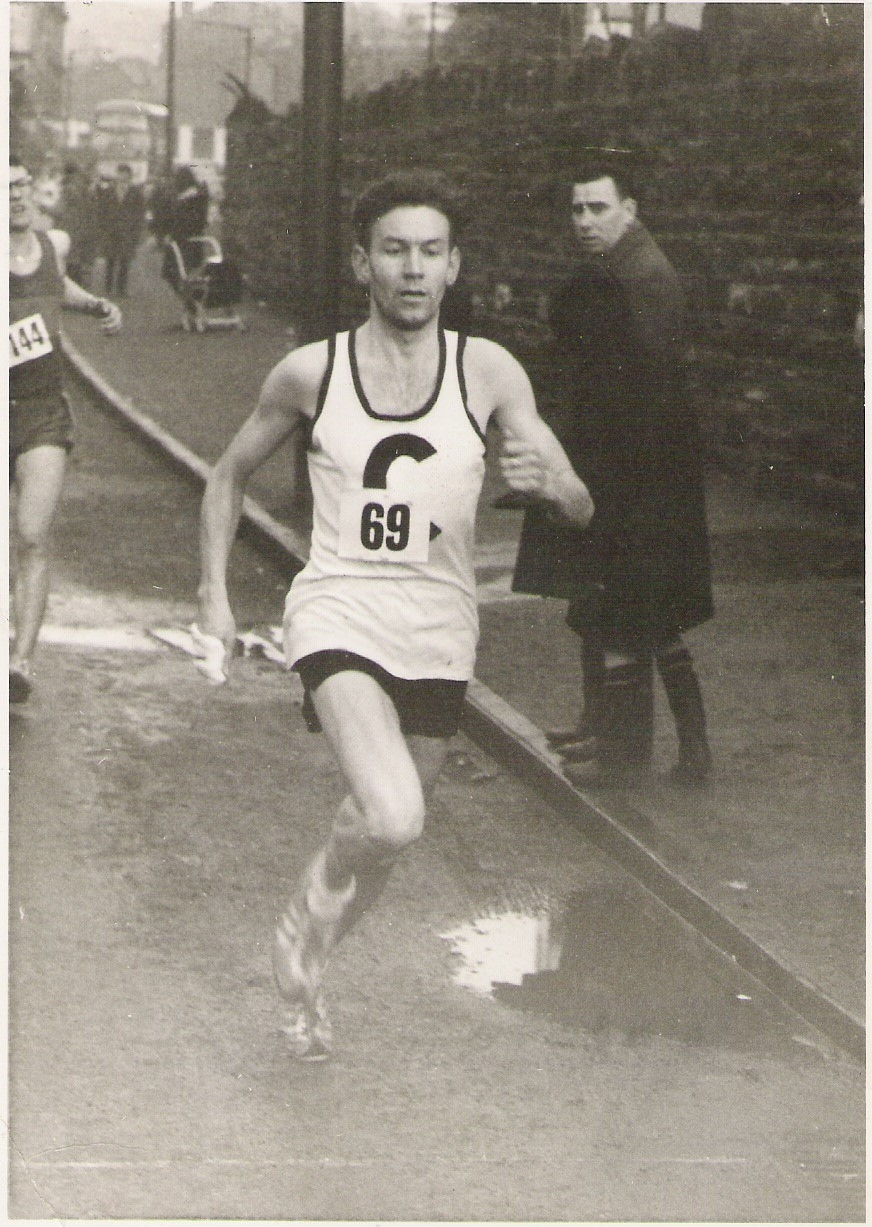
(Ian Leggett, pictured above in a 1960s Nigel Barge road race, is one of our most durable SVHC runners. He made his debut for Clydesdale Harriers in 1963 as a senior and quickly became a first team runner. Clydesdale won team gold medals in Dunbartonshire Cross-Country relay championships. Between 1966 and 1969, Ian emigrated to Australia but returned to run Stage Six of the Edinburgh to Glasgow in the latter year. From then up to 1973 he was at his fastest, running particularly well in the Midland (West) District CC (4th) and the National (31st). In the 1969 Scottish Inter-Counties CC he had perhaps his best-ever race, finishing second to international athlete John Linaker. In addition he ran well on the track, won long road races and tackled severe challenges like the Mamore Hill Race and Ben Nevis. Of course he was awarded several Clydesdale Harriers championships, for example the 3 and 6 miles track events, and other club trophies. Ian Leggett raced a great deal more than nearly all athletes nowadays.

As a Veteran/Masters runner, Ian won Scottish middle distance track titles and ran for Scottish Veterans in the annual British and Irish CC International, winning team medals. His long fight to win a Scottish Masters CC title seemed to be making progress in 1986 when he was second M45 behind the aforementioned John Linaker. It was the same one-two (M50 this time) in 1990. Ian picked up two more silver medals (M60); and a silver and bronze in M65. At last, in 2011, Ian Leggett won a very well deserved gold medal in the M70 category, and followed that with, guess what, a silver the following year.

As the article below makes clear, he is not only a role model for ageing SVHC members, but also quite a character!)

YOU DON’T NEED TO BE MAD TO BE A RUNNER
BUT IT CERTAINLY HELPS
By Ian Leggett

I don’t usually reply to questionnaires as they usually result in cold calls about PPI or more questionnaires but in this case I felt I was safe enough.

My Name is Ian Leggett, appropriately enough for a runner born and raised in Maryhill, Glasgow, where my allegiance to the famous Partick Thistle (JAGS) was formed.

Married to Cathy for 52 years and blessed with 7 sons and 3 daughters (before we purchased a television set).
CLUBS currently Lothian Running club, prior clubs Livingston, Clydesdale, Whyalla Harriers South Australia.
AGE 76
OCCUPATIONS Ex Postman and admin worker.
HOW DID I GET INVOLVED IN THE SPORT? During National Service played football and was drafted into athletic involvement – anything to dodge drilling and cookhouse duties.
HAS ANY INDIVIDUAL OR GROUP INFLUENCED YOU? My first connection with athletics came as a result of following the Jags around the Glasgow Sports at Ibrox. In those days 5 a side football tournaments were highly contested summer events, but the highlight of that day was an Aberdeen runner by the name of Alastair Wood in the 3 mile race – left the other runners in the field for dead and made a lasting impression on me. He went on to win marathons but probably his finest achievement came in winning the famous London to Brighton race in 1972 and breaking the record.
Another was Brian McAusland and the Clydesdale Harriers team of the 70s.
We had great team camaraderie and absolutely fantastic changing facilities down in the basement of Clydebank Baths, with heated pipes and showers, where many a Bothy ballad rung out on a cold winter night after a training session.
Martin Hyman and the Livingston club of the 80s was another group which kept my momentum going in the sport,
WHAT HAVE YOU GOT OUT OF THE SPORT? Lots of friends, healthy wellbeing and, through Masters events, travelling to many places around the world I would probably have missed i.e. Finland, Denmark, France, Italy, Slovenia, Australia – and even England.
WHAT DO YOU CONSIDER YOUR BEST EVER PERFORMANCE? The last race I ran.
YOUR WORST? Undoubtedly, as a novice runner, running the second leg of the Edinburgh to Glasgow relay. I was completely unprepared for this type of contest. The second leg usually featured the cream of the best runners and I ended up shell-shocked at the end of the leg and almost called it a day there and then.
WHAT UNFULLFILLED AMBITION S DO YOU HAVE? To run overseas in a Scotland vest, instead of having to run as Team GB.
OTHER LEISURE ACTIVITIES? My 13 grand children help me fill up my time outside the sport.
TRAINING DETAILS? No secret! Arthur Lydiard processed the ultimate training schedules. It’s just adjusting your lifestyle to suit whatever your personal ambitions are.
Group therapy suited me best, with the old version of pack runs, adjusting to the season of either track, country or roads – we were all very versatile in those days. There weren’t as many races on the calendar as there are today.
When there was a free weekend without a race, there was a culture of going visiting other clubs to have a run and buffet afterwards. I remember one trip in particular as Clydesdale visited Greenock Wellpark but we had a lot of call-offs on the day. The buffet was enormous, with more than enough Scotch Pies, and we were obliged to eat more than our fair share so as not to offend our hosts.
I never thought I would be sick of the sight of a Scotch Pie in my life but that day was pretty close.
ADVICE TO ANYONE IN THE SPORT? Respect your body, because injury is the hardest obstacle to overcome.
AW RA BEST, IAN LEGGETT

QUIRKY RACES

One was a race organised by the notorious Barlinnie Prison in Glasgow to raise funds for HIV testing units within the prison.

We arrived at the main gate and were ushered into our changing room which was, the warden who escorted us took great pleasure in pointing out, where the last hanging had taken place.

The race itself consisted of 5 laps inside the prison. The head warden, who was a 6 foot 6inches Texan, started the race with a klaxon (no gun).

A few personalities, including Terry Butcher, a couple of Celtic second-string players, a well-known Glasgow boxer and some privileged prisoners, helped to make up the 50 starters. The privileged prisoners were conspicuous by their orange plimsolls, white tops and black shorts. At the start we were surprised by a few of the orange plimsolls flying off around the first corner. Then, at the second corner they were leaning against the wall, having a fag. As the rest of us raced round we were greeted by the rattling of tin mugs against the bars of the windows – it was like a Japanese prisoner of war movie.

After the race we were given a slap-up meal with the prisoners and enjoyed their company.

It was an enlightening experience but I gave a sigh of relief as the big double doors slammed shut with me safely outside.

Another race for the archives was in Broxburn, organised by BELL’S distillery, not so much the race itself but the finishing drinks were thimbles of whisky and the prizes consisted of bottles of the amber nectar. Can’t say if it was beneficial to after-race recovery but certainly an enjoyable warm down! By today’s drink -drive regulations we would have been very close to the limit.

Similarly the Broughton Brewery race at the New Year where the first prize was a crate of the local ale, second was half a crate and 3rd was 6 of the best; and a bottle to each finisher warmed the cockles of each heart.

My club was fortunate enough to finish 3rd in a prominent Glasgow road relay and the prize was 4 trouser presses. Not long afterwards, at the annual club Christmas handicap race, nicely wrapped up, were 4 very distinctive trouser presses.

If any readers would like to share details of any race that they found quirky, just send the information to Colin on the back of a twenty pound note!

(Brian’s friend and former Clydesdale Harrier team-mate Brian McAusland added the following. “On a two-hour plus Saturday afternoon run down through Dumbarton and the Vale of Leven and back home via The Boule – going out through Dumbarton he switched on his transistor radio (for the Thistle result later on), and there was Victor Sylvester’s music, so he grabbed me round the waist and ballroom-danced me for fifty or sixty yards up the High Street. Wasn’t even legal at the time!

At a Scottish Marathon Club dinner in Glasgow the first course was served, the staff scattered around the room waiting to clear the tables. When they got the nod from the heid bummer, they swung into action immaculately. Leggett grabbed the table numbers from our table and the one beside it, held them up and called out ‘Seven point six!’ a la ice dancing, gymnastics etc.”)

Betty Gilchrist

BETTY GILCHRIST

Dec14Bettymedal

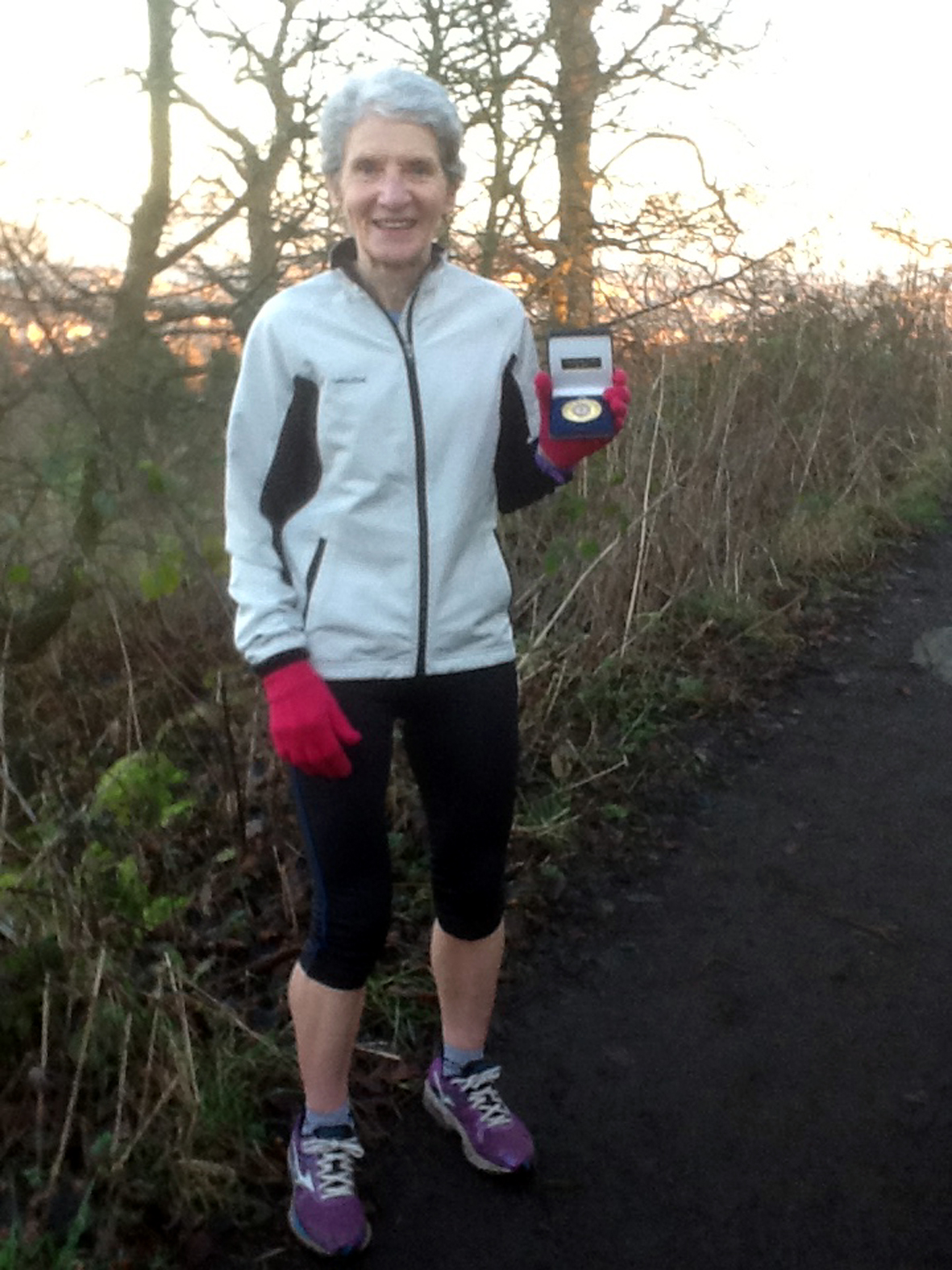
[Betty (W70) achieved clear victories in both the 2014 British and Irish Masters Cross Country International at Nottingham; and the 2015 Scottish Masters CC at Kilmarnock.]

CLUB: Ferranti AAC (a friendly and supportive club).

DATE OF BIRTH: 20 -9-44.

OCCUPATION: Retired.

HOW DID YOU GET INVOLVED IN SPORT: I lived in Saudi Arabia for over 20 years and met Ian Wilson who invited me to join his group.

HAS ANY INDIVIDUAL OR GROUP HAD A MARKED INFLUENCE ON YOUR ATTITUDE OR INDIVIDUAL PERFORMANCE?
Ian was a fantastic coach who really encouraged us and is still coaching very successfully in Ireland.

WHAT EXACTLY DO YOU GET OUT OF THE SPORT?
Keeps you fit and you meet some friendly people at races – and living in Edinburgh
we have great running routes on our doorstep – hills, river paths, canal paths or along the shore.

WHAT DO YOU CONSIDER TO BE YOUR BEST EVER PERFORMANCE OR PERFORMANCES?
Hard question but my favourite five races would be: Bahrain Marathon Relay; Brampton to Carlisle; Midnight Sun; Porty New Year’s Day; and of course Parkrun (great for us older runners).

YOUR WORST? Haddington Half.

WHAT UNFULFILLED AMBITIONS DO YOU HAVE?
To run a decent time at Haddington!!! (4th time lucky.)

OTHER LEISURE ACTIVITIES? Gym – swim – walk.

WHAT DOES RUNNING BRING YOU THAT YOU WOULD NOT HAVE WANTED TO MISS? Friends around the world.

CAN YOU GIVE SOME DETAILS OF YOUR TRAINING? Don’t really do any speed sessions any more. Simply go out and run. I had a bad foot injury about two years ago, and later that year had a hernia operation, so mileage and speed have dropped but I am still happy to be out there.
Monday – 3 miles + gym.
Tuesday – 5 miles fartlek + gym.
Wednesday – 5 miles off-road.
Thursday – 5 miles with hills + gym.
Friday – 7 miles tempo for me (= steady for my running partner).
Saturday – Parkrun or race.
Sunday – 90 to 105 minutes Time On Your Feet; or race.

(As one of her five favourite races, Betty names The Bahrain Marathon Relay. Below is some information about this unusual event.)

The Bahrain Marathon Relay, the largest race in the Middle East, takes place at the end of October, and starts at 10 a.m. at the Bahrain International Circuit, home of the Bahrain Grand Prix. Temperatures soar to the mid to high 30s by early afternoon. The 50 km event is undoubtedly an exhausting challenge, given desert conditions, with heat and humidity. There are 16 stages, each approximately 3 km in length. There are eight runners in a team. Each athlete will run either one, two or three legs of the relay. There may be 150 teams competing.

Ian and Teresa Wilson spent over 30 years working in Saudi Arabia and, through their positive coaching methods, succeeded in training seemingly ordinary athletes up to both Olympic and World Championships levels. Teresa is originally from Stillorgan in Co. Dublin. Ian is originally from Sunderland. Eventually, they decided to retire and settle in Co. Laois, Eire, at the end of 2013. Their company is Nuparc Wellness, a business established to assess health and wellbeing of individuals in large corporations. Ian is a UK Level 4 endurance coach; and Teresa a UK Level 2 endurance coach. Even in semi-retirement, hey have taken Irish teams to Bahrain.

The Bahrain Marathon Relay, for which the Wilsons have prepared many teams, was first run in 1981 and has grown to the point where the event attracts a large number of teams and athletes ranging from Olympic standard to those who just enjoy a healthy jog and the camaraderie of taking part. It has become an important highlight not only for Bahrain and its neighbouring countries but also for countless runners who fly in from all over the world to compete. There is a good deal of corporate sponsorship and almost two million dollars has been raised for charity, during the 27 years of the relay.

Roads through the desert, camel trains, extreme heat, rainstorms, sudden hot head- or tail-winds – all these aspects add to the uniqueness of this event. The full history of each race makes fascinating reading.

Scottish athletes who have taken part include Phyllis O’Brien (HBT); Ivie Rennie and Gordon Reid (Kilmarnock AC); Janice Madsen, former British Marathon International Lynn Harding, and David, Betty Gilchrist’s son.

Betty herself holds the record for most appearances by a woman in the Bahrain Marathon Relay, having run 22 stages. Teresa Wilson and Jackie Newton tie with 18.