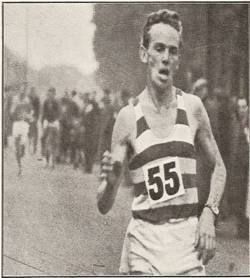
Ian Binnie

EE IB 1

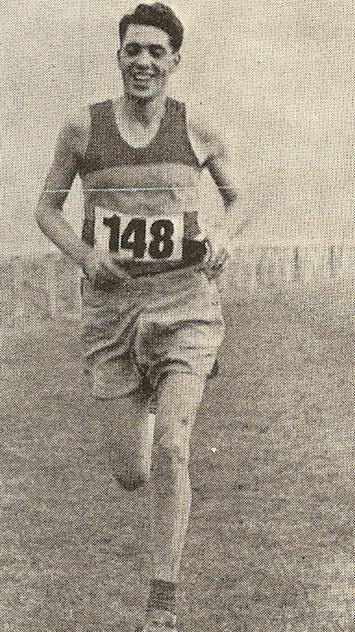
Ian Binnie was one of Scotland’s greatest ever distance runners.    He didn’t like cross-country although he was part of the great Victoria Park Cross Country team that won all there was to win in the 1950’s and twice represented Scotland in the ICCU Cross Country International.   He really excelled on the track and on the roads.   Unusually no one to my knowledge ever said that he should have tried the marathon although it is a common enough remark about most talented road runners.    It was probably realised that he was such a real gem in the longer middle distance races as we will see and he was appreciated for what he was.  He knew how good he was and times came across as arrogant but he knew his own mind.   He always kept his word – on the occasion when he ran his superb one hour run at Cowal, he was phoned at home on the Wednesday before the race by Jack Crump of the AAA’s telling him he had been chosen to run for Britain on Saturday at the White City.   he told Mr Crump politely that he couldn’t do it because he was running at Cowal Games that weekend.   Crump was furious that he had turned down a GB vest! More of that below but he told me the story himself.    He was easily recognised as he ran in the streets and roads around the West End of Glasgow and Dunbartonshire – in summer along the Great Western Road Boulevard with no vest or T shirt, the tan testifying to the amount of running done in that fashion, in winter he wore the VPAAC vest and I even remember seeing him running a la Gordon Pirie in working boots.   The last race I personally saw him run was a Three Miles at Scotstoun well after his best days and he broke away with Alex Brown of Motherwell YMCA.   Alex was leading and after seven or eight laps, still within a yard or two of Alex, he stepped off the track.    He wasn’t going to have a time as slow as he thought that was going to be recorded.   A loyal Vickie Parker he made several disparaging remarks about most clubs but particularly about local rivals Clydesdale Harriers – but in the mid 1990’s, when Clydesdale were running much better than VPAAC, he took time to come and speak to some of the CH runners in the Kelvin Hall: sitting on the floor in the gallery with six or seven young athletes (mid twenties) he talked about training and racing for over half an hour.   My first encounter with him was when four Clydesdale Harriers were having a meal at the old Whitehall Restaurant in Glasgow one Saturday night when another four guys came in and immediately the two tables were involved in banter throughout the meal.  I had just joined the club and was there with Johnny Maclachlan and Neil Buchanan and some other guy and the four at the other table included Binnie and Albie Smith.   It was an interesting evening.

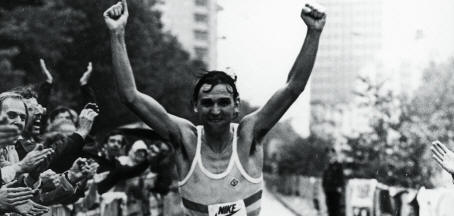
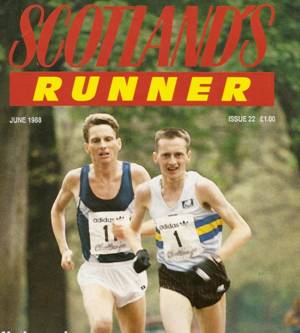
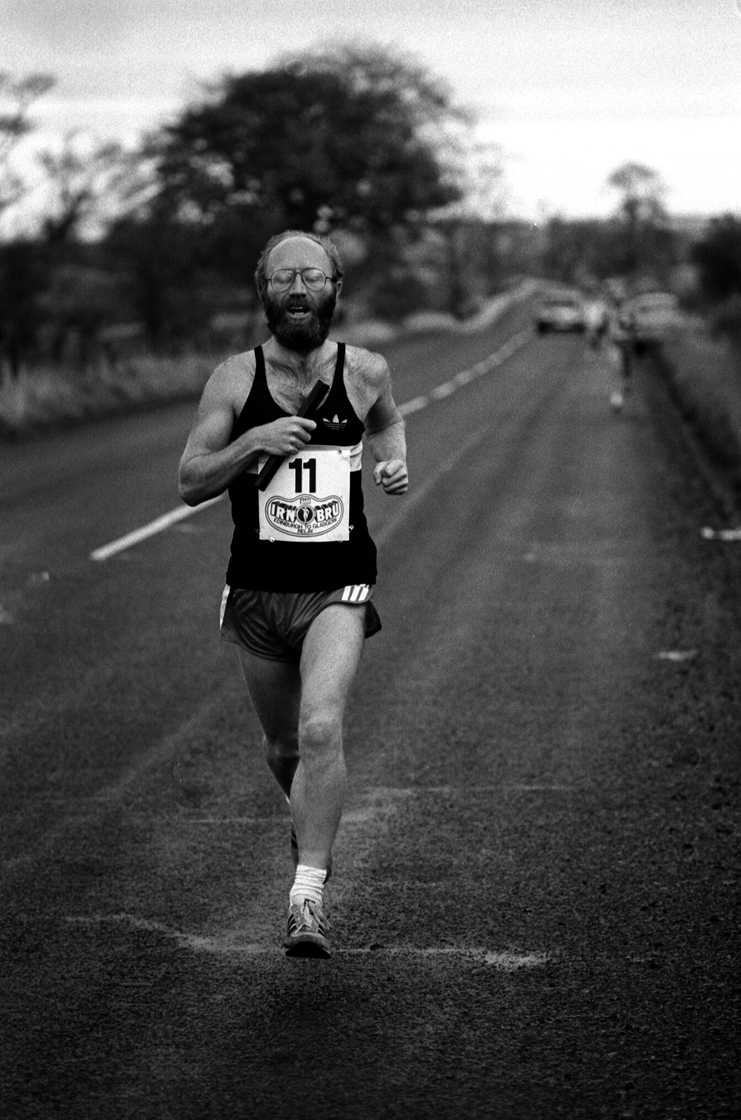
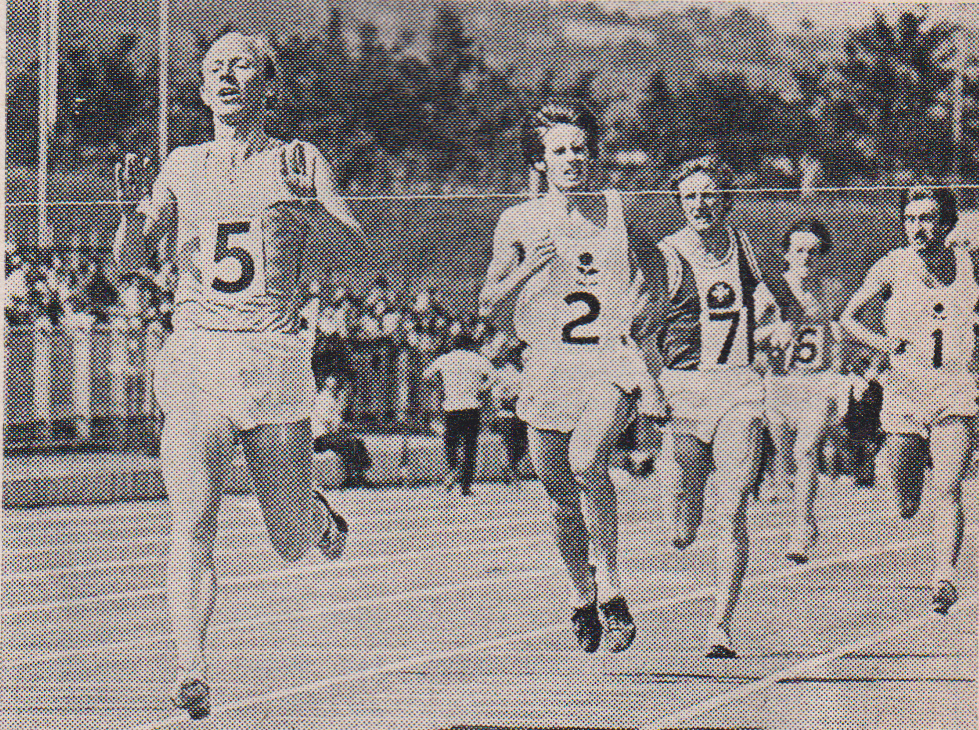
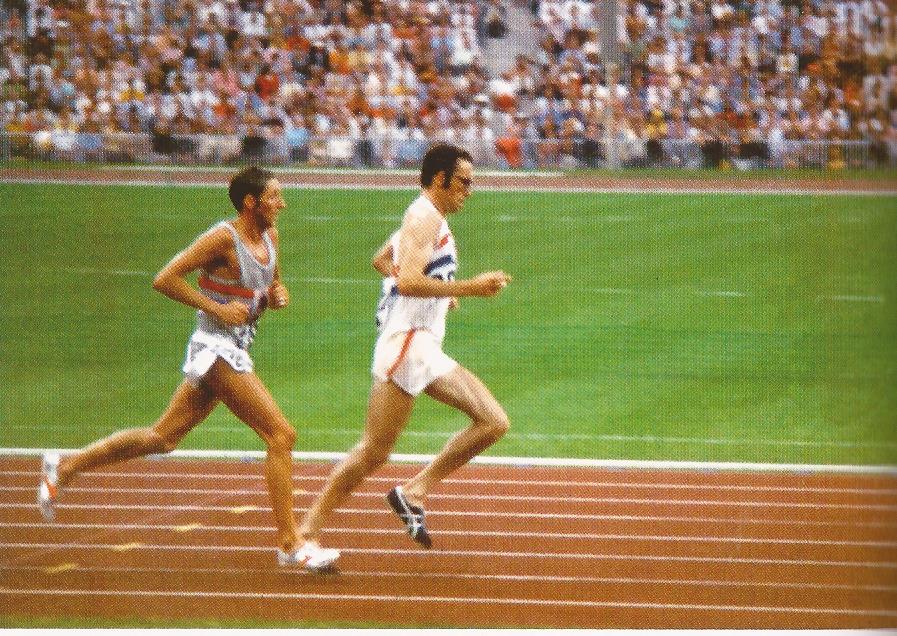
There are many stories about him – for instance the fact that the rules for the Edinburgh to Glasgow Relay were changed twice because of him.   One time he handed the baton to a small boy on a bike to carry while he ran, only taking it back in time for the changeover.   The rules were amended to state that ‘the baton must be carried’.   Fine, he then had a pocket sewn into his vest where he stowed the baton until hand-over time.   The rules were altered again to ‘the baton must be carried (ie in the hand).    There was the year when he took the E-G trophy back with a knitted VPAAC vest on it because they were going to retain the trophy and he wanted it properly dressed.   At another time he didn’t bother to bring a trophy because they were going to win it again! Anyway, we can start here with a contribution from club-mates of his – Hugh Barrow and finish with the obituary written by Doug Gillon in 1997.   The picture below shows Binnie running with the best in the world.
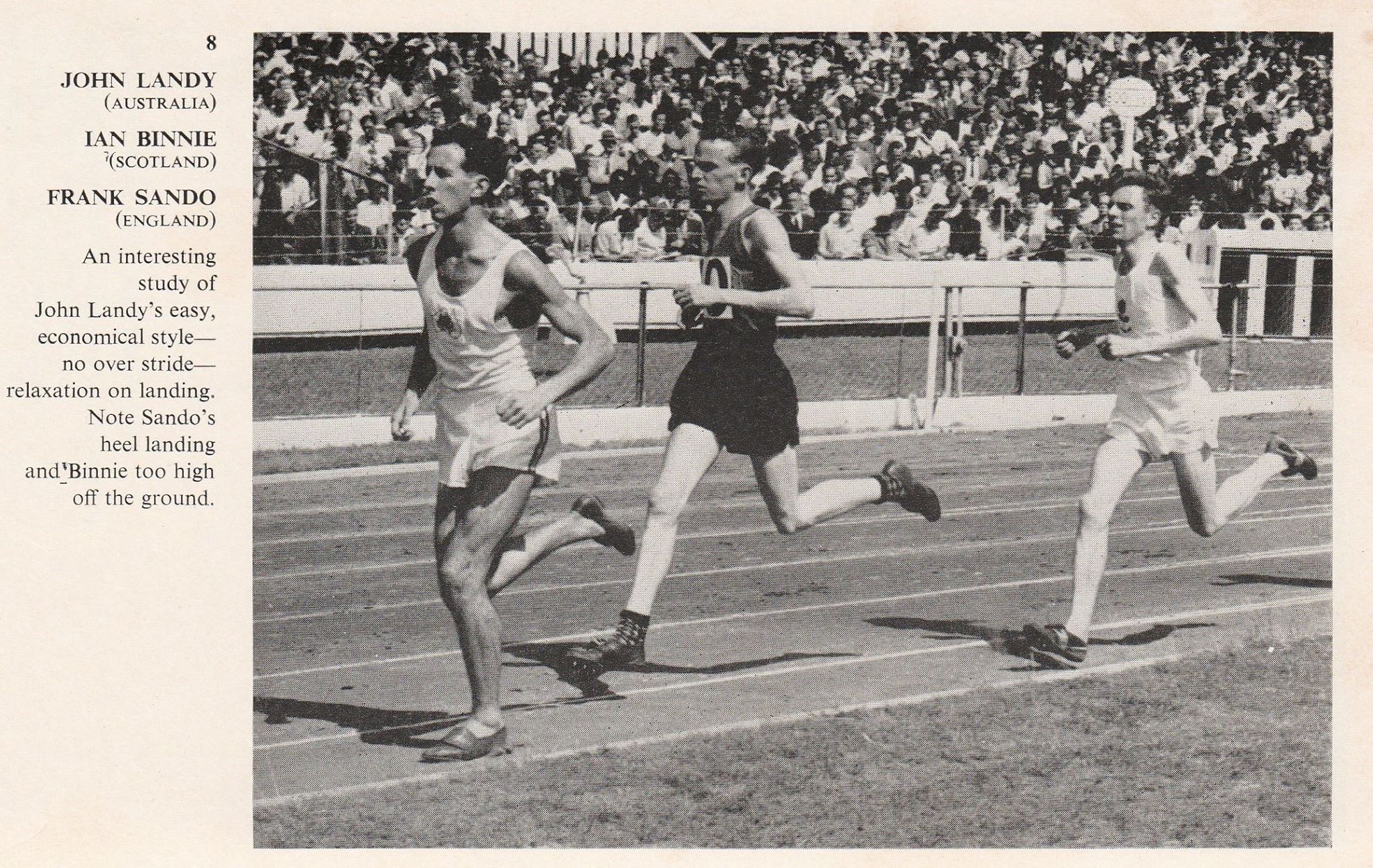
Binnie withthe Best

In 1985 Hugh Barrow wrote a tribute to him in the Scottish Marathon Club magazine and it is reproduced below.

Ian Binnie  –  Scotland’s Zatopek

By Hugh Barrow

Ian Binnie, of whom it was once allegedly said by Jack Crump “He looks like a swede but runs like a turnip.”

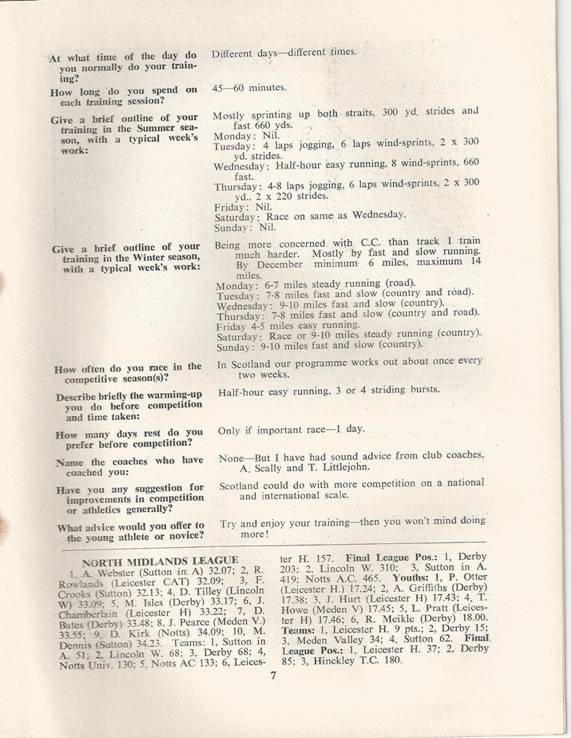
One of my earliest memories of the time that I joined Victoria Park in the late 1950’s was of this most enigmatic of runners, Ian Binnie.   Bin, as he was called by the other runners, had an approach to training similar to the attitudes to be adopted later by David Bedford.   Ian worked on the premise that you did more than your rivals and you did it faster.   At a time when most Scottish distance runners would train three or four times each week plus a Saturday race, Ian Binnie would train at times three times each day and these sessions were not done at what could be described as anything approaching easy running.   His idol had been Emil Zatopek and he modelled his methods on the same prodigious amounts of work.   When Ian had completed his evening track sessions eg 20/30 times 300 some body might question him about the fact that he had also been seen out at lunch times, but back came the reply that these sessions did not really count.   Always secretive about his training it is now sometimes difficult to distinguish fact from legend but what cannot be disputed is that Ian Binnie trained at a cruel level even by present day standards.

He set himself very high standards, some might have said unattainable standards, but that was the measure of the man.   He wanted to hold every Scottish Record from the mile to the marathon and he only failed by these two.   Possibly his finest run was in 1953 against Gordon Pirie at the White City, London, on the night that Pirie broke the World Record for Six Miles.   Ian recorded 28 minutes 53 seconds and how many Scots would today beat that time.   He only knew one way to run and that was from the front, often setting a suicidal pace.   His critics often drew attention to this and his lack of finishing speed just as the same people criticise Ron Clarke and Dave Bedford but they could not criticise his courage.

he was a member of the very successful Victoria Park teams of the 1950’s, a team that won the Edinburgh to Glasgow Relay on eight occasions, the first Scottish club to win the English National Cross-Country Championships (only Shettleston Harriers have emulated this performance) and came third in the London – Brighton Relay.   Never keen on Cross Country running, Ian put in many brilliant Road Relay legs  against such as Joe McGhee of Shettleston and Joe Connolly and Harry Fenion of Bellahouston.

The records speak for themselves but to a young hopeful it was more the way he went about his running that remains in the memory.   On asking advice one evening, the reply came back, “If you can’t keep up, don’t come out!”   On reflecting back now over some twenty five years of running, that advice still seems quite sound.

IAN BINNIE’S SCOTTISH RECORDS

YEAR DISTANCE TIME/DISTANCE
1952 5 Miles 24:59
6 Miles 30:04
1953 2 Miles 8:58.4
3 Miles 14:01.4
4 Miles 19:28
5 Miles 24:24
6 Miles 29:20.7
7 Miles 36:01.8
8 Miles 40:01.8
9 Miles 45:05
10 Miles 50:11
11 Miles 55:24.2
12 Miles 60:34.2
1 Hour Run 11 Miles 1575 Yards
1954 3 Miles 14:02
4 Miles 19:15.4
5 Miles 24:12.1
6 Miles 29:01.9
1955 3 Miles 13:54.8
1957 3 Miles 13:51.2
1958 2 Miles 8:57.2


The comment at the end of the article to the aspiring runner is similar to some of Alastair Wood’s in Aberdeen (Do yourself a favour, go to the pictures) and Binnie was famous for such retorts: “No matter how much you polish a bit of wally glass you’ll never make it into a diamond” for instance and his “Sorry Mr Crump, I’m running at Cowal Games on Saturday!”  was a bit of lèse-majesté!   Remember that these times were run on cinder tracks and without all the improvements in kit – shoes in particular – that modern runners have.   In addition the SAAA Championships ran the 6 Miles on the Friday night and the 3 Miles on the Saturday afternoon.   So no time trials with pace makers at selected venues: in these circumstances, how would his times stand up 50 years later?   Well in the Scottish Rankings for 2008, he would have been placed fourth in the 5000 metres and first in the 10000 metres.   As David Coleman might have said, “Quite remarkable really!”   The best source of day-to-day information is ‘The Scots Athlete’ and I’ll be quoting liberally from that but first let’s look at his career chronologically.

‘The Scots Athlete’ first mentions him in the results of the Dundee Kingsway Relay and the McAndrew Relays in autumn 1950: he ran first leg in the McAndrew Relays under the name of G Binnie and had third fastest time of the afternoon; two weeks later he was in the Kingsway Relay for the A Team and finished third in the second fastest club time and fifth fastest overall but was listed as J Binnie.   In November he ran in the Edinburgh to Glasgow where he was on the first stage again and finished fourth but the comments on the winning eight said of him: “one of the up-and-coming youngsters of the team, and one who has shown distinct promise over country, road and on the track.   Joining the club just last winter he is one of this year’s winning ‘four’ in the McAndrew and Kingsway Relays.   A leading member of the club’s successful 2 miles track team last summer.   Keen and conscientious in training, Ian will go far in the sport.”   Not a lot more was written and  he did not run in the National at Hamilton where his club won the title.   Summer 1951 saw him win his first championship medal with a third place in the SAAA 3 Miles behind Andy Forbes (14:28.8) and Tommy Tracey (14:47.1) with Binnie timed at 15:5.6 – there were many comments about the heavy nature of the wet track and how it slowed all the times on the day.   The ‘Scots Athlete’ ranked him fourth in their 3 Miles ranking list behind Forbes (VP), Tracey (Springburn) and AT Ferguson (Highgate).

The following winter he had another good run in the McAndrews on the first stage for the winning team and then in the Edinburgh to Glasgow he won the first stage with a huge gap – 26:55 to 27:49 over Andy Brown of Motherwell.   Emmett Farrell had this to say in his ‘Running Commentary’ of January 1952 after the Nigel Barge Road Race where he was second and only ten seconds down (24:48 to 24:58) on Andy Forbes: “Binnie whose performance in beating Tracey (third in 25:13) was brilliant, is perhaps reaping the dividend of his sustained consistent training.   Zatopek appears to be the model of the young Victoria Park man who runs often and long in the slow fast tempo popularised by the great Czech.   At the moment Binnie does not relish cross country regarding which he has a complex: but he is building up to have a real go at the three and six miles track distance later.   It will be interesting ti see how he comports himself in the summer.”   Complex?   Maybe – he avoided the Midland Championship but when the Scottish Championships took place on 1st March at Hamilton Racecourse, he was seventh finisher and second club man behind Andy Forbes (fourth) in the winning team.   In 1951 Shettleston Harriers had been runners up in the English Cross country championship after being only second to Victoria Park in the Scottish, so in 1952 the Scotstoun club decided to go down to the event to be held in Birmingham.   In short, they went, they saw, they conquered!   They won with 241 points against Bolton United Harriers 255.   The team captain Andy Forbes knew full well the value of speed in cross country running and had particular knowledge of the very fast start at the English National.   So every Sunday they trained at Mountblow Recreation Ground in Clydebank – the home of Clydesdale Harriers at that time.   The venue had a 330 yards red blaes track but the grass perimeter was just over a half mile of mainly good but heavy grass running.    And they did fast half mile reps.   The result was that they coped well with the ‘blitz’ start and finishing positions were Forbes 11, Jimmy Ellis 32, Binnie 41, Chick Forbes 51, Ronnie Kane 52 and Johnny Stirling 54.   There are some comments on the economics of the trip below.   Ian Binnie was selected for the International Cross Country team that year and finished 62nd and out of the counting team runners.

The British winning team
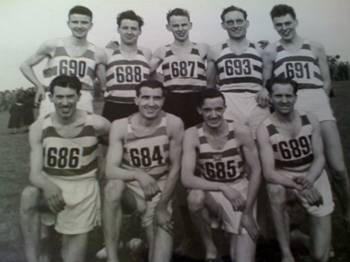
EE IB 2

Bobby Calderwood, Ronnie Kane, Ian Binnie, Donald Henson, Alex Breckenridge behind

Johnny Stirling, Andy Forbes, Chick Forbes and Jimmy Ellis in front

In the Six Miles at the SAAA Championships in June 1952, on a bitterly cold and windy Friday night he won the Six Miles which was reported as follows: “Undismayed by a leg injury acquired in training, which was well strapped, Binnie from the gun was out for a new record.   At 5 Miles with 24:59 he had a new Native record (prev. 25:12), but this went unnoticed by all present and at 6 Miles swamped JF Wood’s other Native Record 0f 30:34 with 30:04.2.   In the Three Miles on the Saturday he was third behind Forbes and Eddie Bannon of Shettleston in 15:9.1.   In August Emmet Farrell, said: “Ian Binnie, our six miles champion and record-holder looks the best prospect of our distance track men.   He has his own ideas of training, modelling himself somewhat on the lines of a miniature Zatopek and has even been known to run 12 miles on the day before a race.   With added strength and confidence there is no saying to what heights he may aspire.   He has his eye on Peter Allwell’s Native Record at two miles of 9:13 odds.   After seeing Binnie do a 9:24 recently on a loose track with ease he wouldn’t be far away on say the Helenvale track where the present figures were made.”    He finished the season fourth in the Three Miles and top of the Six.

Season 1952-53 for Binnie was maybe his best ever.   The winter season started without him in the McAndrew Relay and he did not turn out either in the Midlands Relay Championship.   Came the Edinburgh to Glasgow Relay and VPAAC were again the winners and this Time Binnie was on the sicth stage head-to-head with Eddie Bannon of Shettleston and he was only three seconds quicker st the end – 33:37 to 33:40.    Emmet Farrell had this to say of the race: “Perhaps the finest intrinsic running was that of Ian Binnie’s 33:37 and Eddie Bannon’s 33:40 in the long seven miles stage.  Binnie’s time was only five seconds outside Jim Flockhart’s remarkable 1937 record.”   In February Binnie turned out in the Midland Championship where he was twenty fourth and last counter in the winning Victoria Park team.   On 28th February he ran in the National Championships at Hamilton Racecourse he was eighth and second VP runner with Andy Forbes second.

Previewing the 1953 track season the ‘Running Commentary’ had this to say: “The Three and Six Miles Records May Go.”   As I see it Andy Forbes should retain his Three Miles title and clubmate Ian Binnie his Six Miles, both in fast time.   Forbes still has the flair for the big occasion and if he has to be beaten then it will possibly take a time inside his own great record of 14:18.2.   Binnie, now training more often, further and harder than ever and already this season shown top condition and versatility with class 3 mile track and 15 mile road race wins would be most disappointed not to well beat 30 minutes for the 6 miles and eradicate the 30:04.2 record figures he established last year in windy conditions.   Binnie of course may try for the double but this is a very difficult feat unless the athlete is extremely robust and possessed of exceptional recuperative powers.”      Well, Binnie clearly had robustness and recuperative powers!    In the first paragraph of his report on the athletics, Emmett Farrell said :”Ian Binnie’s double victory in the 3 and 6 miles championships and his seven records made in these two races must surely win him the Crabbie Cup for the most meritorious performer.”   For the race:  “Running De Luxe.   The 3 Mile event was the piece de resistance of the meeting,   Ian Binnie displayed a brand of distance running rarely seen in Scotland.   After two or three laps during which Black shadowed him he was out on his own showing devastating sustained speed down the straights his artistic striding being a sheer delight to the eye.   First mile was reeled off in 4:33.3.   The two-mile stage took 9:16.8 and the tape was broken in 14:0.,4 for a new native and all-comer’s record thus displacing respectively the figures of club mate Forbes and Maki of Finland.”   The winning time in the Six Miles was 29:20.7 for new native and all-comer’s records as well.   Two weeks later it was the AAA’s Championships and John Keddie, in his official history of the SAAA, describes the race thus.  A fortnight later at the White City he went even better at the AAA Championship where his own front runing set the pace for a marvellous World Record by Gordon Pirie.   Pirie’s time was 28:19.4 and behind him Binnie finished a meritorious third with a superb 28:53.4, ever to remain his besr performance for the distance.”

For many however the one hour run at Cowal Highland Games was the highlight not only of the year but of his running career.   ‘The Scots Athlete’ again.

Scottish Native and All-comer’s and British National and All-comer’s Records fall like ninepins to 22 year-old Scot Ian Binnie

At half past two on Friday 28th August at Cowal Stadium track, Dunoon, Argyllshire on the first day of the famous two-day Cowal Highland Games, five competitors lined up for the start of a one hour run – the main purpose of which being to give the Scottish distance runner Ian Binnie of Victoria Park AACan opportunity of attacking the Scottish and British records.   Binnie’s running turned out to be one of the greatest athletic performances ever seen in Scotland.   At each stage from and including 7 miles – 8, 9, 10, 11 and 12 miles and one hour he recorded faster than all previous native and all-comer’s bests in the British Isles and the Empire.

He had to contend with a stiff breeze and though the track was in excellent condition Ian felt the effect of the black coal-dust top cutting up and did not think it was as firm as the White City track.   he commented on being very badly stitched at around the 4 miles stage and feeling like retiring.   His 10 miles time, 50:11, was superb.   It broke the British All-comer’s record 50:30.8 standing to the name of Bill Eaton (1936) and far superseded that of any native Scot.   He went on to increase the British all-comer’s 1 hour record of Alfred Shrubb (1904) by 435 yards to 11 miles 1571 yards and continued to 12 miles which he reached in 60:34.2 beating the previous British best 62:43 created by S Thomas at Herne Hill in 1892.

Though Ian was pleased enough with his collection of records it was typical of him to express his disappointment at not covering 12 miles inside the hour which was his personal target.   he now holds every Scottish record from 2 to 12 miles.   We give his times at each mile stage along with those of Shrubb who established his in a similar race in 1904.   The performances shown recorded by Shrubb were the standing British all-comer’s marks.

Mile Binnie Shrubb
1 4:53 4:44
2 9:50 9:44
3 14:51 14:45
4 19:54 19:50.6
5 24:57 24:55
6 30:01 29:59.4
7 35:1.8 35:04.6
8 40:01.8 40:16
9 45:05 45:27.6
10 50:11 50:40.6
11 55:24.2 56:23.4
12 60:34.2

It is not at all surprising that he was named ‘Scots Athlete of the Year.”

The 1953-54 season started as usual with the McAndrew Relays at Scotstoun.   Home team Victoria Park won their 12 miles relay with a record time of 62:43 which was 55 seconds inside the existing record while Binie broke Eddie Bannon’s individual record which was only half an hour old by six seconds with 15:01.   “Emmet Farrell again – “they also easily retained the Dundee Kingsway Relay Trophy finishing first and second teams.   By all-round work they had a sound enough win in the Edinburgh-Glasgow Relay although special mention must be made of young Norrie Ellis who built up a winning lead in the 4th stage and of Ian Binnie’s record-breaking sixth stage knocking 11 seconds off Jim Flockhart’s time set in 1937.   They suffered their only defeat on their only cross country outing so far (December 1953) – the Midland Relay at the hands of close rivals Shettleston Harriers.   Starting almost on level terms over the last two and a half mile stage, Ian Binnie was no match for international star Eddy Bannon.   Just as Binnie dominates and is such a tower of strength to his club on track and road, so Bannon is for his club on the country.”   So no mention of a ‘complex’ by now and in the preview of the National Cross-Country Championships in 1954, Emmet Farrell lists his contenders and outsiders without mentioning Binnie and then comes “The Position of Binnie:   I did not discuss Binnie’s prospects for the simple reason that the Victoria Park crack is allegedly not interested in selection for the International and may prefer to make a sterner bid in the English National a week hence.   Yet he is keen to help his club to another National team title and if he does not rate as Bannon’s chief rival for the title he should easily find a place in the top six.”   Binnie had not run in the District Championships where his club was again victorious.  Well, Binnie did run in the National but he did not ‘easily find a place in the top six.’   He did not even find a place in the VPAAC top six – he was thirty ninth and seventh club finisher in a race where Shettleston Harriers won by 23 points.

In the June issue of the ‘Scots Athlete’ there is a preview of the up-coming Scottish Championships with a section headed “Can Binnie Retain His Two Titles?”   Which goes on “Last year Ian Binnie literally ran away with both 6 miles and 3 miles and of course set up native and all-comer’s records in the process.   His recent form has been erratic and somewhat disappointing.   His hour run while good enough was not the Binnie standard and the Victoria Park crack is not regarded as certain to win both titles.   I find it difficult to oppose this mercurial but brilliant runner who by the time of the championships may have recaptured some of last year’s effervescence.   In the 6 Miles I see little opposition if Binnie is in good form.   Harry Fenion who is running well and Hamilton Laurence of Teviotdale should take place positions.   Binnie may have a harder task to retain his 3 mile title.   Chief opposition may come from little John Stevenson of Greenock Wellpark who has been showing excellent form over 1 and 2 miles.   Other likely candidates are Eddie Bannon, our cross country champion, Alex Black, now at Dundee, Springburn’s Tommy Tracey and Englishman Adrian Jackson.   If they are all lined up at the start what a thriller it will be all the way.”   The Scottish rankings at the beginning of May that year had Binnie second in the 3 miles with a time of 14:17.1 against John Stevenson’s 14:13.4 – Stevenson also topped the Mile list with 4:25.6.   Came the championships with the 6 miles as usual on the Friday night.   “Wintry conditions prevailed.   Ian Binnie was in great form for though admitting after the race to being continually blown off the track when against the wind he broke his own native record (19:28) and Paavo Nurmi’s 1931 all comer’s mark (19:20.4) at 4 miles and his own all-comer’s records (24:24.1 and 29:20.7) at 5 and 6 miles.   It was a superb effort.”   He also won the 3 Miles in 14:19.6 from Eddie Bannon (14:33.6) in a field of 20 runners.    By the end of June he led the rankings at 2 Miles (9:11), 3 Miles (14:04), 6 Miles (29:20.7).   As a result of his two wins he was selected for the Empire Games in Vancouver where every event was overshadowed by the Jim Peter marathon (see Vancouver 54 elsewhere on this website) and the Bannister/Landy Mile.   However Binnie was selected for both Three and Six Miles and competed in both.   There was very little coverage but he was seventh in the Three Miles in 13:59.6 and sixth in the Six Miles in 30:15.2.   The Three Miles time made him the first Scot under 14 minutes for the distance.

The 1954-55 season  saw a change in the usual pattern when Shettleston Harriers won after five years of Victoria Park triumphs.   Binnie started off on the last lap behind Joe McGhee and although he ran a brilliant new record of 14:58 for the course he could not catch McGhee who only ran 15:33.   The pattern of recent years had changed to such an extent that Shettleston were first, third and fourth!   In the Midland Relays, the result was the same with Binnie running 16:51 for the first lap.   However when the Edinburgh to Glasgow Relay was run, Victoria Park again triumphed for the fifth successive year and with a new course record and Binnie set a record of 33:21 for the sixth stage where Joe McGhee was second quickest with 33:51.   He turned out for his club again in the Midland District Championships where they were second to Shettleston and Binnie was thirty first and fifth club runner.   The team result in the National – again at Hamilton – was the same despite Donald Henson of VP winning and Binnie finishing fourth – his highest ever in the National.

In the annual preview of the SAAA Championships in the June ‘Scots Athlete’, the headline wasIan Binnie hot “Double” Favourite.   The article read: After his brilliant 3 miles of 13:54.8 at Ibrox, Ian Binnie looks set to retain both 3 and 6 Miles titles.   Despite being unable to hold his killing opening pace and fading somewhat, Binnie must be congratulated on his wonderful time and after all, only Dunkley passed him on his way to the tape.   He kept his promise of running the race of his life though doubts concerning his tactics still prevail.   Modern standards are emphasised by realising that Binnie’s time was practically identical with that of Sydney Wooderson’s in his famous classic with Willie Slikhuis in 1946, and Dunkley best known as a miler did his 13:50.3 3 miles as an experiment and may try for top honours in the steeplechase because the mile and 3 mile fields are over-crowded with brilliant exponents.   

The report of the Championships said that Binnie won both races ‘creditably enough’ although not up to his usual standard but praised Andy Brown for pressing hard in both races and emerging with two second places.   The report on the 6 miles started as per usual by commenting on the windy Friday night for the race.   A fast start saw the one mile in 4:32 with Brown following closely but he was shaken off during the second mile (9:17.4) at which point the pace slackened with Ian winning in 29:40.4.

Victoria Park regained the McAndrew Trophy in October 1955 taking 15 seconds from the record for the race and Binnie?   Well the report was that where Binnie gave Joe McGhee a start on the last leg again, this time he was closed down very quickly and Binnie brought the club home victorious.   Binnie was 15:02 and McGhee 15:32 and the club difference was only 5 seconds!   Shettleston got their own back when they won both Midlands Relay and the Edinburgh to Glasgow.   In the Midland Relays the Victoria Park A Team could only finish seventh with Ian Binnie running second  and his run in the ‘News of the World’ was ‘non-vintage Binnie’ although he did have the second fastest time only seven seconds behind Bannon.  Bannon was 33:50 with Binnie 33:57.

In the annual Morpeth to Newcastle race Ian was fifth after leading for most of the way.   Emmet Farrell reported that it was ‘definitely not Binnie at his brightest’.   Binnie missed the Midlands Championships where VP were fifth despite John McLaren winning the race.    He was back in cross-country mode for the National where his club won from Shettleston and Binnie was eleventh.

Then in the ‘Scots Athlete’ of August 1956 – when he had already run 9:06.2 for 2 miles on 5th May and 13:58.9 for 3 Miles on 12th May, came the bombshell:   “Ian Binnie’s retirement from athletics, temporary or permanent as yet unknown, has been the recent Scottish talking point.   An erratic, controversial figure, Binnie could be brilliant.   Nevertheless repeated errors in judgement and a preference to race against the watch rather than against the man, lessened his competitive ability.   Nevertheless with Zatopek-like zeal in training and his uninhibited contempt for existing Scottish standards he materially assisted in establishing the new athletic deal north of the border.   With little interest in cross-country but brilliant on track and devastating on the road there is a whisper that he may make  a come back in road races.   His club will miss him as anchor man in the big relays and Scottish running will be the poorer without his great ability.   Let’s not hope that this is Binnie’s athletic epitaph.”

The answer came three months later when the cover picture of the magazine had Ian picture with the caption: After a record run leg in the VP Road Relay, Ian Binnie finishing for Victoria Park AAC who won with a new course record.”      Ian’s own run on the last leg against Graham Everett of Shettleston saw him start with a lead and set off in ‘his usual hurricane fashion’ but Everett had no intention of letting him go and by one mile, had the lead down to five yards but with a mile to go Binnie was moving away again and although Everett came back at him, Binnie moved away and won with a record time.   Then in November VPAAC won their sixth Edinburgh to Glasgow and Binnie on the sixth stage had the fastest time by just over a minute but was well outside his own record time ( 33:20 v 32:32.).   He turned out for the club in the National Cross-Country where he finished fourteenth for the team which won with 93 points against Bellahouston’s 125.

In the summer of 1958 he became the first Scot to run inside 14 minutes for the Three Miles when he won the Scottish Championship in 13:57.6 and that was to be his last championship and his last record.    He went on running until into the twenty first century but there was very little racing in there after 1958 although he was an easily recognisable figure running along the Great Western Road with his vest squashed up in his hand.   His interest in the sport never waned – when the Kelvin Hall had its track relaid in the early 2000’s he took some of the off cuts to examine them and we discussed the composition of the track.   We had a chat one afternoon at the side of the road at the start of the McAndrew Relay where he had been such a star – and nobody interrupted us – no one recognised the spare, fit figure with the rucksack watching his club running round the familiar roads of Scotstoun.

Stories of his training are legion but what were the influences?   It’s difficult to find out but Hugh Barrow says that he was in contact with Franz Stampfl and Gordon Pirie – and it doesn’t take a long look to see something of Pirie in his attitudes.   Apparently he tried to make contact with Zatopek but in the days f the ‘Cold War’ it is not clear whether he was successful

*****

Colin Youngson of Aberdeen who ran with Victoria Park in the early 1970’s recalls that ‘Bin’ as he was known went out with the Victoria Park fast pack in the 1971-72 period “He would have been about 42 or 44 then.   He would not run away from us ( Pat McLagan, Alistair Johnstone,  Hugh Barrow, Albie Smith, young Dave McMeekin and I were hard to run away from) but certainly had no difficulty in keeping up or taking the pace, as we zoomed past the slow pack and into the non-wisecracking section of the brisk Tuesday or Thursday night 5 or 6 mile run round Knightswood, etc, in the dark.   He did drawl these condescending put-downs, particularly about Pat who was a good runner.   I guess for Bin it was a fairly justified superiority complex, and partly a slightly cruel joke, more subtle than Albie’s crushing comments!   We really did beg Bin to consent to inclusion in our very good E-G team, but he was not moved.   I suppose he had been numero uno and would not race below his best, even if he was helluva fit for a 42 year old and would have thoroughly justified his inclusion in the team.”   Colin then reflected “Binnie and Ally Wood!   What a pair!   To some extent they made me the callous joker that I remain today – certainly a good toughening up process for a secondary school teacher!”     

Colin has many good tales about ‘Bin’.   Elsewhere on this website (the E-G Section) Colin’s Edinburgh to Glasgow memories are printed in detail but I’ll quote the Binnie bits again here.   “Vague rumours of legendary deeds had reached my ears – mainly concerning the tussles on the ‘long leg’ between Joe McGhee (Empire Games marathon Gold medallist) and that uniquely relaxed character with the elitist attitude, Ian Binnie of Victoria Park.   According to Binnie he could give poor Joe several minutes start and still pass him before the finish.   I never heard Joe’s side of the story, but as Binnie never tired of telling newcomers to the Vicky Park team, “It’s hard to motivate myself, lad.   After all I have SEVEN gold medals already.”   Binnie’s best known comment (to a younger team-mate who was a deserving Scottish cross-country international) was “Ach, Pat, it disny matter how many vests you win, you’ll never have any class.   You see, a GREAT runner is always a GREAT runner  – and a DUMPLIN’ is always a DUMPLIN’.”    

Another Binnie quote was to a runner preparing to ‘sprint’ for the line in a relay, “Hamish, you’re wastin’ your time.   Cut your losses – sell your kit!”

****

When he died in 2007, Doug Gillon, who had been a runner for the same club at one time wrote the following obituary in the Glasgow Herald on 4th August 2007.

IAN BINNIE

Athlete:: born July 15th 1929; died July 26th 2007.    Ian Binnie who has died suddenly aged 78 was the greatest Scottish endurance runner of his generation with ferocious work ethic which to his death he played down.

In 1953 Britain had just lost the six miles in the international match against Germany when Norris McWhirter, of Guinness Book of Records fame, told the London crowd at the White City that a man who had turned down the chance to represent his country in that event that very afternoon had just broken two British records, the Empire record the UK All-Comers record plus six Scottish records  in the same race “…. running, if you please, at some place called Cowal.”   That man was Ian Binnie who always used to insist that “I was just a very lucky boy.”    So ‘lucky’ that he broke 21 Scottish records during his career.   He held the course record in virtually every Scottish road race.

Binnie was certainly blessed with talent.   Brought up in Oxfordshire by his grandparents because his father, John. was in India with the Foreign Office, Binnie excelled at cricket and had trials for the county before he moved north when the family returned to his parents’ native Glasgow.   He came late to athletics but soon made a prodigious impact.   He borrowed from the harsh regime of the Czech master Emil Zatopek who had won three Olympic titles in 1952.   Binnie would run up to 40 laps, sprinting for up to 300 metres then jogging 100.   No Scottish athlete had tried anything so extreme and it soon paid dividends.

The Scottish All-Comers mark for Six Miles had stood to the legendary Alf Shrubb since 1904 when Binnie wrote it out in 1953.   Then he paced Gordon Pirie to a World Record in the Six Miles at the AAA’s Championships, setting a Scottish best of 28:53.4.   Apart from Andrew Lemoncello who runs in the World Championships this month, no Scot has run that fast this century.   On the Cowal cinders that day in the summer of 1953, Binnie broke Scottish records at seven, eight, nine, ten and eleven miles, plus one hour (he covered 11 miles 1571 yards, narrowly missing the World Best with the third furthest ever. )   His 10 Mile time was a British record, and his one hour one was an Empire and UK All-Comers one.

Binnie went to the Empire Games in Vancouver finishing seventh in the Three Miles and sixth in the Six Miles.   he was the first Scot to break 29 minutes for the Six Miles, 14 minutes for the Three and 9 minutes for the Two. He won the Three and Six Mile double at the Scottish Championships for three successive years.   This gained him the prime Scottish Trophy, the Crabbie Cup.   The last person to win it thrice consecutively had been Eric Liddell.

Binnie was fiercely proud of his club, Victoria Park, and helped them to a unique record.   In 1952 he was a member of the Scotstoun club’s team which became the first from outside England to win the English National Cross Country title.   The team of nine wo travelled to Birmingham included Empire Games medallist Andy Forbes,  and his brother Chick,    Ronnie Kane, Bobby Calderwood and Alex Breckenridge who later served two tours as a major in the US Marines in Vietnam.   The whole trip including the railway return cost £65 including one guinea a head for bed and breakfast for all nine athletes.   These stalwarts monopolised the Edinburgh to Glasgow Relay in the 1950’s.   One year Binnie arrived wit the trophy which had a silver running figure on the top.   He had knitted kit for the figure in his club’s blue and white.   They duly won again.

Binnie was a man who kept his promises, no matter what.   Bill Struth, the Rangers manager, invited him to compete in the Ibrox Sports and he accepted.   The phone rang one evening.   It was Jack Crump, secretary of the AAA’s.   He rebuked Binnie for turning down selection.   “England needs you.”    For a GB International no less.   Forty years on Binnie recounted the conversation with glee: “I told him I was Scottish and my mince was getting cold.”   Binnie duly raced at Ibrox and was leaving the ground when Struth appeared on the stairway.   “He complimented me on keeping my promise and presented me with a key to the ground.   He said I could use the track any time, providing the players weren’t training on it.   It was the best track in Scotland and the greatest gift any athlete could ever have had.”

Binnie was an engineering draftsman, mainly in Babcock’s.   A non-smoker he ran regularly until a year ago, always with a stopwatch.   But lung cancer, apparently asbestos-related, was diagnosed and he died at his home last week.

He is survived by his wife Barbara, daughters Shelley, Serena and Sheona, and two grandchildren Jessics and Jack.   The funeral service is at Comrie Church, Arran and thereafter at Sannox Cemetery.`
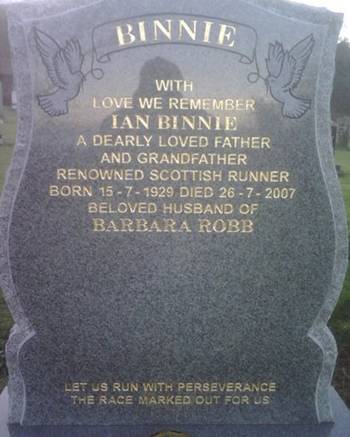
EE IB 3

The Ian Binnie Memorial at Sannox Churchyard
Eddie Bannon

EE EB 1

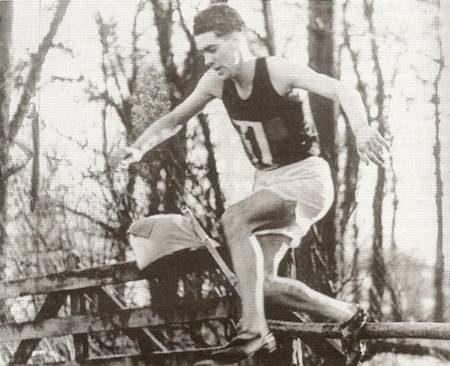
Clearing a fence in the 1952 National

Eddie Bannon was one of the country’s best cross country and road runners winning the National Cross-Country Championship four times as a Senior including three-in-a-row from 1952 to 1954 inclusive.   In addition there were seven appearances in the World Cross-Country Championships between 1951 and 1956.  Eddie was also a class act on the roads with ten runs in the Edinburgh to Glasgow relay, turning in eight fastest stage times, two second fastest and setting two stage records in the process.   His career as an athlete was relatively short spanning only twelve years but at his best he was probably one of the country’s best ever cross-country runners.    Information for this profile has mainly come from ‘The Scots Athlete’, from the Centenary history of Shettleston Harriers by John Cairney and from Colin Shields’ centenary history of the SCCU, ‘Whatever the Weather’ with more statistical information from Ron Morrison’s website.

The Shettleston history describes his start in the sport as follows: “Eddie was brought up in Springfield Road, the eldest of five children.   After primary school at St Michael’s in Parkhead and secondary school at Sacred Heart in Bridgeton, he served his time as a coach trimmer with Rolls Royce.   Just before he got married in 1953, he switched jobs and became an agent with the Provident Cheque Company, taking over some of his father’s customers in the Bridgeton and Parkhead area.   His preference for an outdoor job may have been satisfied but the fog and smog ridden streets of Glasgow’s East End in the 1940’s were a poor second best to the hiking he did in the hills with one of his pals, Bill Preston.   He started running while in the youth club of St Michael’s Church in Parkhead, but he had many other interests as well.   His mother called him “a joiner” because he affiliated to so many organisations including a drama group, scouts and even Army cadets.   He first came to the fore at Gartocher Road when he won the Shettleston Youths cross-country championship in 1948 after being described in the press as ‘a 16 year old phenomenon.’      In the same year he won the Scottish Youths mile title and in April the following year earned his place in the Edinburgh to Glasgow team, helping the club to their first victory, and achievement repeated in November.    He won the club Junior championship in 1950 and 51 and then the senior title six years in a row until Graham Everett took it in 1957.   he competed in nine Edinburgh to Glasgow races and had the distinction of winning four medals while still a junior.   True to his mother’s description as ‘a joiner’ he served on the club social committee and on the recruiting and coaching committee, displaying a genuine interest in the welfare of members, the financial needs of the club and the development of new talent.   One organisation he did not joing was the British Army.   ‘Incredulous’ is possibly the best way of describing the feeling in Gartocher Road when the man who was one of the country’s foremost distance runners failed his army medical due to sinus problems.   The army’s loss was very much Shettleston’s gain.”

We’ll go over some of that ground again in more detail but it should be pointed out that ‘Gartocher Road’ refers to the Shettleston Harriers HQ which was on the road of that name.

He first appears in the columns of ‘The Scots Athlete’ in February 1949 when he was second in the Midland District Junior 7 Miles Championship.   The next season started as usual with the McAndrew four man road relays at Scotstoun and he ran on the second stage for the Shettleston Harriers team and ran the second stage for the second placed quartet.   Two weeks later he again ran second for the club in the Dundee Kingsway relay where the squad was again second.   There had been two Edinburgh to Glasgow relay in 1949 and the young Eddie Bannon had run in them both.   In April he ran on the eighth stage, maintained Shettleston Harriers in first place and recorded the fastest time of the day for the stage.   His reward was to get the same stage when it was held in November and again he maintained first place and again he had the fastest time on the leg.

On 7th October 1950 he ran the third stage of the McAndrew in the Shettleston team which finished second and then in the Midlands relay a fortnight afterwards  he ran fourth in the Shettleston team.   In November 1950, still a Junior he was switched to the fifth stage and took over in the lead, handed over in the lead and recorded the fastest time of the day.    On 2nd December he was third to Tom Tracey of Springburn, one of the very best in the country at the time and team-mate Ben Bickerton.   Bickerton was ahead of him again when he won the Inter-Counties at Stirling and Bannon was third with another Shettleston Harrier squashed between them – Clark Wallace was second.   In the Midlands however he was second to Tom Tracey – only 12 seconds down this time.   Then it was the Junior National. Third in 1950,  he won it in 1951 by 36 seconds and then went on to be fourth in a first class run in the English National championships.   If his running in Scotland was noteworthy before this, then this was the race that drew him to the notice of the wider athletics public – after going for the win when nearing the finish, he dropped back to an agonising fourth place.   For the ‘Scots Athlete’ report on the race click here    The National victory was enough to get him selected for the International Championships as part of the Senior team and he was a scoring runner when he finished in forty ninth place.    The ‘Scots Athlete’ in November ranked him ninth in the Mile in their annual track rankings with the comment ‘I believe that Bannon would improve if he did less cross-country racing.’    Maybe forgivable so early in his career, it would become apparent as time went past that he was not nearly as interested in track as in road and especially country.

At the start of season 1951 – 52, he ran on the third stage for Shettleston in the McAndrew Relays on 6th October.   On 3rd November in the Midland District Relays Eddie ran the fourth stage and brought the club from fourth to second in the fastest time of the day.   In the Edinburgh to Glasgow on 17th November he ran the vital sixth stage and moved the club from third to second with the fastest lap of the day.   In the preview of the National Championships, published in the same issue of the magazine,  Emmet Farrell said, “Scotland’s big three are undoubtedly Eddie Bannon, Andy Forbes and Tom Tracey, and of these Bannon is the bright particular star and on present form must be a strong favourite to win our National Cross-Country title.   Up to the present he has shown devastating speed, and in last year’s brilliant fourth in the English National demonstrated that he has the stamina to go with it.   He showed his ability yet again when on 2nd February 1952, he ‘jumped early into the lead and was never challenged’ when he won the Midlands District Championship at Lenzie.   He duly won the National Championship for the first time and went to the International where he finished fourteenth and first Scot.

[He had been regarded in all quarters, including in France and Belgium as a contender for the International championship and I can’t help observing that there were at this point many races in both of these countries to which many English athletes were invited and sent with never a one for any Scot.   Races were held at Brussels, Forstaise and Hannut in Belgium, and at Meridor, Chartres and Ghien in France in which the likes of Pirie and Sando took part.   When two decades later many Scots took part in these races with distinction, the quality of endurance runner produced north of the border improved immensely.]

EE  EB 2

That summer (1952), running in the Three Miles at the SAAA Championships in June, he was second to Andy Forbes in the championship in 14:29.3 with Ian Binnie (who had set a Scottish record for Six Miles the previous evening) third.   At the end of the season he topped the Scottish rankings for the Two Miles with 9:23.5 and was third in the Three Miles with 14:29.3.   On 5th July he competed in the Triangular International between Scotland, England & Wales and Ireland at the White City in London where he was fifth in the 5000m behind AB Parker (E/W) 14:47.8, John Landy (Australia – guest) 14:51.2, F Sando (E/W) 14:54.4 and Ian Binnie 15:23.6.   Prompted by his racing over the summer, Emmet Farrell remarked in his ‘Running Commentary’, “Eddie Bannon has not shown so far the form over the track that his running over field and fen would indicate.   Though more than useful over the track from 1 to 3 miles, Eddie’s heart really lies in the country.”

On to the 1952 – 53 season and he had second fastest in the McAndrew Relay when running the fourth stage for his club.   In the Midlands relays on 1st November he was duelling with Andy Forbes on the third stage and the report read: “Bannon was at his thrilling best and reversed a 33 second deficit to an exact half minute advantage” – he also had the fastest time by 26 seconds.   He was again asked to race the sixth stage of the Edinburgh to Glasgow and brought the team from third to second and had second quickest time behind Ian Binnie which encouraged Emmet Farrell to remark that “perhaps the finest intrinsic running was that of Ian Binnie’s 33:37 and Eddie Bannon’s 33:40 on the long 7 miles stage.”     In the Inter-Counties Cross-Country Championship in mid-December Eddie won in 35:03 (the second man home recorded 36:20!)   On 31st January at the Midlands Championships he was again the winner in 30:53 with second runner in 31:28.   Going in to the National at Hamilton he was clearly top dog.   “I take Eddie Bannon of Shettleston to retain the Scottish Cross-Country Championship with some confidence.   Up here in Scotland his class is such that he could win even with a lapse in form.   But he is running strongly and confidently and should prove too strong for his field.   Eddie is not likely to run in the English Championships this year, preferring to save himself for the Scottish and International races.”   In the event he won the National on 28th February by 47 seconds from Andy Forbes.   Then came the big one – the International.

The International was held in 1953 in Paris and Eddie Bannon was fourth.   Emmet Farrell waxed lyrical, under the headline “Bannon in World Class”, he said: “Eddie Bannon ran his greatest race to date and his superb fourth place surely places him among the elite of the great cross-country runners of the world.   Running a beautifully judged race, he was prominent throughout and actually led for a spell over the last lap.   I feel that Bannon, like Flockhart, is essentially a cross-country type and wonder just what would happen over a real country trail.   Could he have won?   This however is purely an academic question.    Next year the International will be at Birmingham over, we assume, a fair cross-country test and a fit Bannon must have an obvious chance.   Incidentally the Shettleston man will shortly receive an invitation to compete next February in the annual International test over 5 miles at Hannut, Belgium.”     This ended the cross-country season and it was on to the track.

Back to the club history, because by now questions will be appearing about the training he was doing to get these results.   I quote: “Going out with Eddie on a training run was a feat in itself, according to Graham Everett, as most people gave him a body-swerve because he was so good and so competitive.   At the end of one of the club trials for a place in the Edinburgh – Glasgow team, Eddie was in the lead followed by Graham and Joe McGhee.   Running down Hallhill Road, Joe suggested that it would be a good idea if he and Graham ran in together to finish the race.   Graham readily agreed, but when Eddie found out later he was not best pleased.   ‘Don’t ever do that again, was the response of Graham’s hero.   The same trio was involved in another incident that exemplified Eddie’s competitiveness.   During the Nigel Barge race in Maryhill, Graham picked up one of Eddie’s shoes after it fell off in a collision with another runner    Eddie ignored Graham’s offer of the shoe with a curt ‘throw it away’ as he sped off in pursuit of Joe who won the race.   Joe McGhee also had a great respect for Eddie, and his description of Eddie’s training methods gives an indication of the friendly but intense rivalry that existed within the club.   ‘He would lead our fast pack in a training regime that certainly toughened everyone up, involving an informal fartlek style with unexpected and apparently random bursts that left the rest of us trailing.   By the time we caught up with him, he was ready for another sprint.   I developed an eye for the type of terrain on which his bursts occurred, usually up hills, and I would hang on blindly until he slackened and then try to continue past him for a few more yards.’   Joe had the edge over Eddie on the road but beat him only oince over the country at the 1955 National Championships at Hamilton.”

The by now normal remarks about how well Eddie could do ‘if only…’ appeared in the ‘Scots Athlete’:  ” Eddie Bannon – Scotland’s hero of the International Cross-Country Championship – has the class to be a real live contender and a probable winner of either the three or six miles or both but his heart does not seem to be set on the track as it is on the country.   Still if he runs in either he must be reckoned with.”   But there was no Eddie Bannon in the track championships that year.   Scotland had to wait until winter 1953 – 54 to see him back in action.   He had the fastest lap in the Midlands Cross Country championship helping his club to first place and then in the Edinburgh to Glasgow in November 1953 he kept his club in second place when he ran the sixth stage and again had the second fastest time to Ian Binnie.   He did not turn out in the District Championships in February 1954 and the reason was hinted at in Emmet Farrell’s comments in the February 1954 issue of the ‘Scots Athlete’.   “A hat trick for Bannon?  ….”The main doubt and talking point is the champion’s toe injury which has been troubling him and retarded his training but now that he is back in full harness I find it difficult to oppose him.”      Came the championships and Bannon was again the victor in 50:19 from Tom Tracey in 50:43.   In the International, he was fourteenth to be first Scot and second Briton to finish.   In summer 1954 he was mentioned as a contender for the Three Miles as follows “Other likely candidates include Eddie Bannon, our cross-country champion.”    The message was getting through that he was not a committed track runner although he did run and record good times: for summer 1954 he was third in the Three Miles rankings with 14:21.2 and fifth in the Two Miles with 9:21.0.

Season 1954 – 55 was another where he ran superbly well and there was another collection of team medals.   They started with the McAndrew Relays with Eddie running first and Joe McGhee on the last stage.       The County Relays and the Midland Districts also provided team golds and Eddie had fastest time in the latter.   In  November in the E-G he ran on Stage 2 and brought the team from third to first, with not only the fastest time on the day but also a stage record.      Second in the District Championships he led the winning team home and in the National on 26th February, he was seventh. 7th which had him selected to run in the International where he was 35th.

In summer 1955 he ran in the SAAA Three Miles and was second to Binnie in 14:33.6 to 14:19.6 before getting ready for the cross-country season.   On the 1st October he was only in the Shettleston B team for the McAndrew but by the Lanarkshire Relays he was lead off man for the winning team .  He was fastest overall in the Midland District Relay when he ran the third stage for the winning team.    In the Edinburgh to Glasgow in November, he ran on the long leg (the Sixth) where hw as fastest of the day, beating Binnie by only one second.   He was however only third in the Midlands Championships proper behind John McLaren and Andy Brown.   But came the National and Eddie Bannon came good with another first place in 46:55 to Andy Brown’s 47:06 in second place.   Again a member of the Scottish team he was thirty third in the International held in Belfast.    That summer he was not track ranked at all for any event.

1956 – 1957 began with the McAndrews where he was again in the second team but less than a month later he had the fifth fastest time in the Midland District relay at Stepps.   In the Edinburgh to Glasgow Relay in November he ran the seventh stage where he was fastest by over 90 seconds and he proceeded to the National where he was ‘only’ sixth which Emmet Farrell saw as a pedestrian performance – going on to say that this was of course relative only to his own past running: many would regard such a placing a a high spot.   He did however go to the International in 1957 which was to be his last run in this event and finished thirty seventh.

Not only was the 1957 his final run in the International but he disappeared from the National scene until 1960 when he was fifteenth in the National in March and then in the Edinburgh to Glasgow he was on Stage 7 where he maintained the first place that he was given and ran the fastest time of the day for that stage.   There were to be no more appearances as an athlete for Eddie Bannon after this last demonstration of his superb talent: no racing in 1958 or 1959 and then the fastest time on his leg of the E-G!   Amazing.

The following AW questionnaire replies are reproduced thanks to John MacKay finding them and sending them on to me.

EE EB 3

The Shettleston Harriers history points out that he won all his National Championships at Hamilton Racecourse which was notoriously heavy and these were the conditions in which he excelled.    Ironically enough, his wonderful fourth place in the International in Paris in 1953 when he was only 23 was run on fast dirt track and grassland course where he was in the forefront throughout the event and actually led the quality field for a lot of the last of three laps.   He was forty six when he moved to Toronto where he found work as a streetcar driver.   “He remained a regular runner and with a combination of irony and tragedy, it was on a visit home to the East End to see his mother in Ardgay Street in 1986 that he collapsed and died in Tollcross Park while out on a run the day after arriving.   He was only 56.”

Lynda Bain


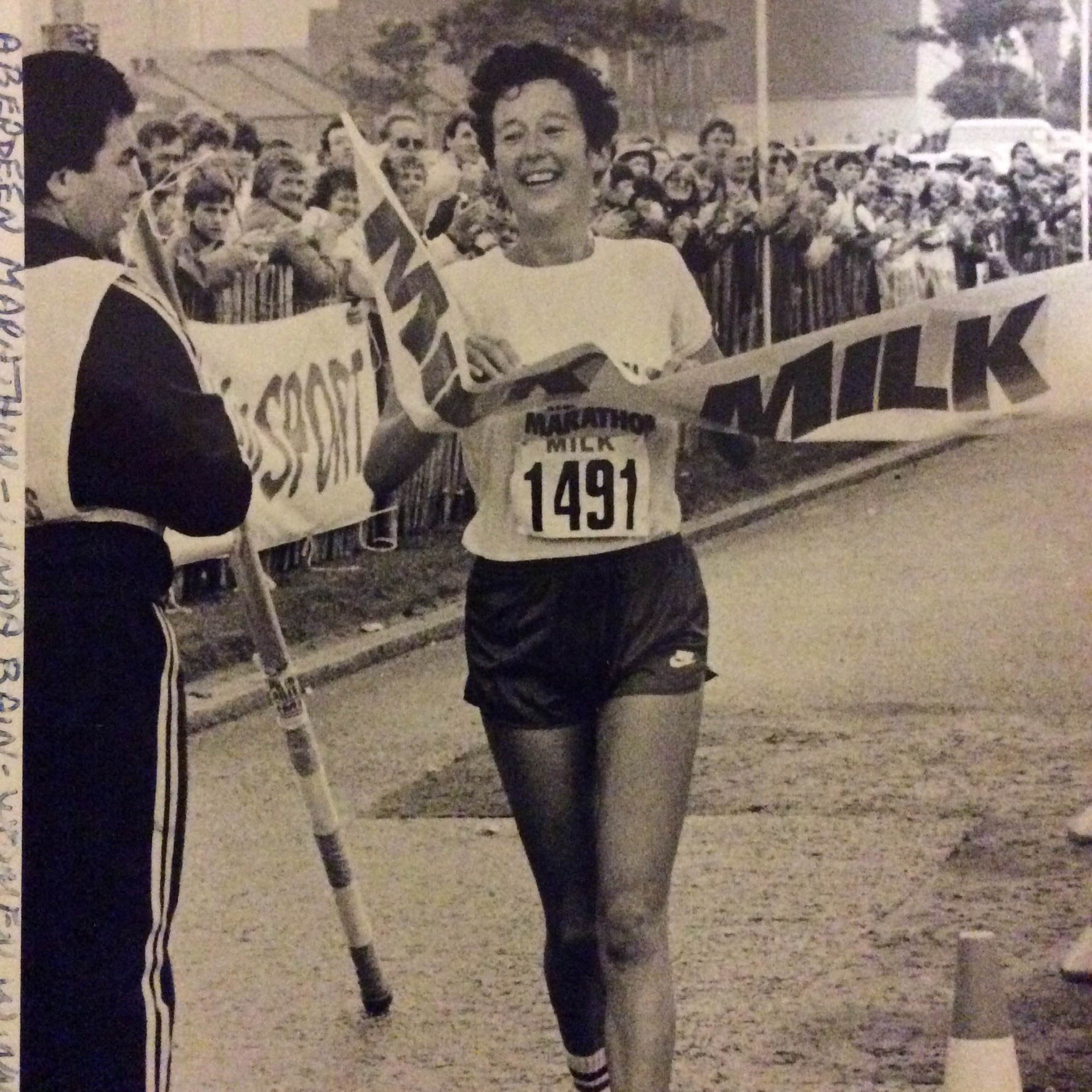
                                                                                    Lynda enjoying victory in an Aberdeen Marathon

Lynda Bain (nee Stott, born 1956) was the first recipient of the Scottish women’s marathon title. The quietly-spoken school librarian at Bankhead Academy, Dyce, outside Aberdeen, only took up running in 1981 but soon developed into one of the country’s finest distance runners. Her first marathon, at Aberdeen in September 1981, was run in gale force winds with driving rain, making conditions nearly unbearable. Stott showed great resilience in coming home third (3.21.12) behind Katie Fitzgibbon (3.07.46) and Priscilla Welch (3.08.55).

 In the 1982 Aberdeen Milk Marathon, Lynda Stott showed considerable improvement by taking second place (2.53.04) not far behind Jacqui Hulbert of Wales (2.52.20) but this time in front of future marathon great Priscilla Welch from Shetland (2.55.59). Then she was first woman home in the May 1983 Motherwell Marathon. Her good time of 2.46.47 made her third-fastest Scot over the distance.

  After her marriage, the North-East woman returned to Aberdeen in September 1983 to collect her first national title, clocking 2.50.29 to gain revenge on Welsh athlete Jacqui Hulbert (2.56.20) and Aberdeen AAC clubmate Morag Taggart (3.07.08). Lynda Bain was presented with the Scottish Ladies Championship Barratt Trophy.

 In 1984, Lynda made a rapid start in an attempt to defend her Scottish Women’s Marathon Championship. She knew that world-ranked American Gillian Horowitz had entered; but did not realise until ten miles that she had not actually turned up, due to bad weather stranding her plane in Edinburgh! Despite struggling briefly about the 18 mile mark, Lynda managed to hang on well to retain her title, taking three minutes off Leslie Watson’s Scottish Native Record with her time of 2.41.41. This was Lynda’s seventh personal best in ten marathon outings. Margaret Baillie of Fife AAC was second in 3.00.57 and Morag Taggart, now of Pitreavie AAC, picked up a second bronze medal in 3.10.03. For this performance, Lynda Bain was chosen to represent Great Britain by racing a 1984 marathon in Czechoslovakia.

 Lynda was part of Aberdeen AAC’s winning team in the SWCCU Scottish Road Relay Championships in 1985.

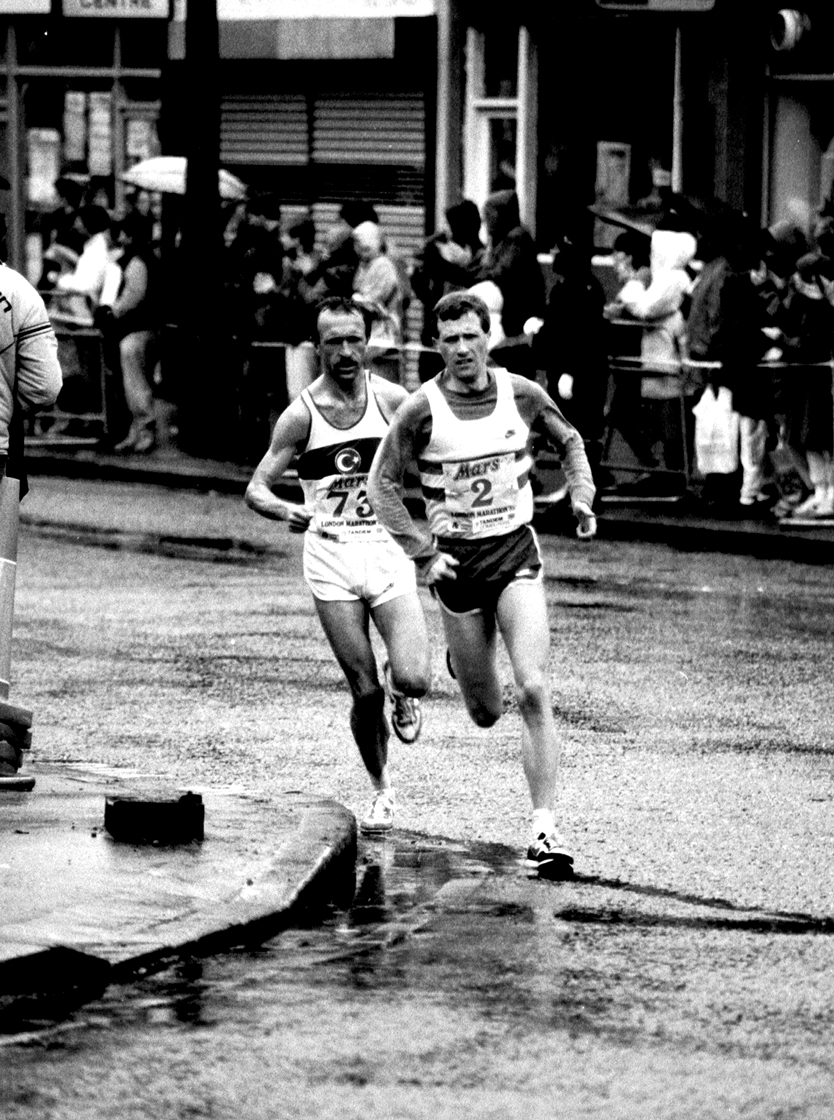
  Lynda Bain’s finest race was on 21st April 1985 in the London Marathon. This was a particularly memorable edition of the event. Steve Jones of Wales set a course record (which lasted twelve years) of 2.08.16, not far in front of Charlie Spedding’s English record of 2.08.33 and Allister Hutton’s Scottish record of 2.09.16. Charlie and Allister continue to hold those records, 25 years later!

   In addition, the great Ingrid Kristiansen of Norway created a new world record of 2.21.06. She was probably helped by the fact that there was on this occasion a mixed field of men as well as women, providing shelter or targets to overtake. Sarah Rowell set a new UK record of 2.28.06 and Lynda Bain finished 7th in an excellent 2.33.38, a new Scottish record. She was two places in front of Veronique Marot, who went on to win the race in 1989, when she set a new UK record (2.25.56) which lasted until Paula Radcliffe amazed everyone with 2.18.56 in 2002.

  On the 9th of June, 1985, Lynda won the Marathon 16 mile road race in 1.30.27, eight minutes in front of 50 miles world record holder Leslie Watson. Lynda said this was “a good run over a difficult course in poor conditions” but stated that she intended in the near future to switch from marathon training to concentrate on trying to build up her speed over shorter distances like 10k. Even after her 1985 peak she recorded track PBs for 1500m (4.41.9 in 1988); 3000m (9.51 in 1988); and 5000m (16.51 in 1989). Her July 1985 half-marathon best was a fine 73.22 in Aberdeen.

   Sadly, injuries subsequently hampered Lynda’s running career; and she never fulfilled her dream of competing in the Commonwealth Games. However she was still good enough to win the Moray Marathon (3.06.49), representing Garioch Road Runners, as late as 1995.

Allister Hutton

M4 AH 1

Allister in the London Marathon, 1986

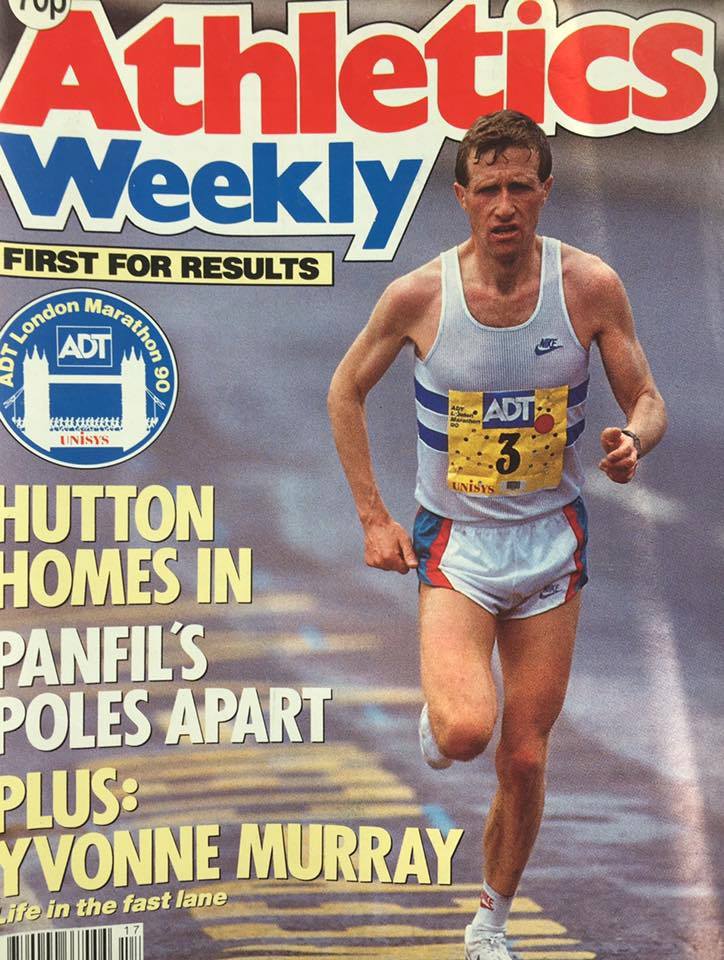
Allister is a quite exceptional all round endurance athlete with a top class record on the road, over the country and on the track.   He is the current Scottish marathon record holder with his time of 2:09:16 recorded in the London Marathon in 1985 when he was third behind Steve Jones and Charlie Spedding and he won the race in 1990 in 2:10:07.   He has never received the credit he deserved for either.   Prior to the victory he had finished third, third, sixth and thirteenth in his previous four attempts and yet the pundits, including Athletics Weekly didn’t mention him in their forecast.   Before we go on, I’d like to thank Graham MacIndoe for all the photographs used on this page.

There are a number of articles and appreciations here with the first being  by Colin Youngson who has written about the event on several occasions not least in the book which he co-wrote with Fraser Clyne called ‘A Hardy Breed’ which is a history of the Scottish Marathon Championship.

Allister Hutton was the finest all-round Scottish distance runner of his generation. Whereas his great rival Nat Muir was faster over 5000m and often defeated him at cross-country, Hutton was also successful at these events and his range extended to 10,000 metres and road running, especially the half-marathon and marathon distances. On his day, Allister Hutton was the best road runner in Britain.

His breakthrough was when, at the age of twenty, he won the Scottish Junior Cross Country title in 1975. More senior member of his club Edinburgh Southern Harriers could only be impressed by Allister’s typically relentless front running.

During the next year or two he took part in key training sessions two or three times a week with older runners from several Edinburgh clubs: around The Meadows on Monday nights (sixteen short efforts); the Colinton Circle on Wednesday nights (nine longer repetitions); and on Sunday mornings. The latter was considered the hardest session in Scotland: a long group run from The Meadows, along the canal, through Colinton Dell, out the old railway line to Balerno, back past the reservoirs to Bonaly Tower and eventually a final lap of The Meadows – 25 miles at an unfriendly pace, including hostile surges. International marathon runners forced the pace, but young Allister hung on impassively. Before long he had outpaced his former training companions and was only to be seen zooming along effortlessly, saying nothing but raising one (polite) finger in acknowledgement of other athletes.

Hutton’s training was totally dedicated, high-mileage (in fact 110-120 miles per week), and frighteningly fast. Edinburgh Southern won many important team races in the 1970s and 1980s, especially district and national championships on road and country. Although Allister could be an awkward character, calmly refusing to race unless it fitted into his plans, he was the major factor in his club’s success. For example, during the first three years of the National Six-Stage Road Relay, he took over on the final stage in second place, well behind a current international runner – the Clyde Valley opponent varied, as did the time gap – first thirty seconds, then a minute and finally one and a half minutes. On each occasion, Hutton’s perpetual motion, seemingly effortless style saw him reel in his rival before overtaking and bowling away to a gold medal and the congratulations of amazed clubmates and frustrated losers. No wonder the rest of the squad considered their finest performance to be when they won the 1977 Edinburgh to Glasgow Road Relay without Hutton! Allister himself remembers as highlights his team almost beating Brendan Foster’s Gateshead Harriers in the AAA 12-Stage Relay; and winning the Pye British Athletics Gold Cup.

M4 AH 2

The fastest long stage in the 1985 Six Stage Road Relay

 By the time he was twenty years old, many had suggested to Allister that he was destined to be a marathon runner, due not only to his dedication and toughness, but also his light frame and efficient, balanced, rhythmical style. Typically, Hutton ignored this advice. He was determined to explore his potential at shorter distances to the absolute limit. This he did, improving gradually year after year. At cross-country, he was National Senior Champion in 1978 and 1982; and he had a record ten appearances for Scotland in the IAAF World Championships. At 5000 metres, he recorded his best time, 13.41.45, at the age of 26. Four years earlier he had run 28.13.09 for 10,000 metres at a mere 22 years old; but it took almost another ten years before he finally broke a barrier to record 27.59.12. Thirteen of the top fifty Scottish 10,000 metres performances are his, and this demonstrates Allister’s courage in sticking with a track event reckoned to be gruelling and dispiriting but a true test of pace judgement and character. Of course these were the days before 10k/half marathon road races existed; and track 10ks were available in district, national and U.K. championships as well as the G.R.E. Cup.

Eventually, in 1980, Hutton took part in the U.K. Olympic Trial marathon, but was forced to drop out. In 1984, awesome runaway victories in the Morpeth to Newcastle and AAA Half Marathon convinced him to try again. In 1984 he managed 2.16.08 and a good second place to the famous Swede Kjell Erik Stahl in the Oslo Marathon. His training until now was basically for 10k – mainly speed endurance. After a second record-breaking Morpeth win, Alan Storey advised him to switch to two five-week cycles: the first of hard steady miles; and the second including three weekly interval sessions with short recoveries, plus a couple of serious two and a half hour runs. Reaching a peak, in April 1985 Allister Hutton finished third in the London Marathon. His time, 2.09.16, remains at the top of the Scottish All-Time List, and justified completely the years of Spartan concentration on maximising his speed and stamina before switching to the classic distance.

Allister Hutton’s seven best marathon times were all produced at London, apart from a rare foray to Chicago in 1985. He finished only 13 marathons, and almost prefers to remember racing for Britain on the track, taking part in three Commonwealth Games and a European Championship – and defeating World Champion John Treacy in the Gateshead cross-country. Yet arguably the finest performance of his career, a race which ensured his place in the memory of all who watched it on television, was in 1990 in London, when he had reached the ‘advanced’ age of 35. Allister almost missed the start, when the runners’ bus got lost! Then, when the pacemaker Nick Rose dropped out after Tower Bridge, Hutton was left alone in the lead. Assuming that this isolation was foolish, his rivals in the chasing group let him go. By twenty miles this gritty Scot had ground out a lead of at least seventy seconds. After that, the chase began in earnest, as English commentators forecast his doom. Seldom has a sports broadcast seemed so fascinating to Scottish viewers; seldom has time (and distance) taken so long to pass. Yet Allister showed no sign of distress: his style remained controlled and his face composed. However the long, long straight of The Mall seemed an eternity to him – both agony and ecstasy as he lived out the dream of leading such an important event in front of so many rivals and spectators. Eventually he crossed Westminster Bridge first, still twenty seconds ahead, in 2.10.10 – a really dramatic Scottish victory in the English heartland.

Jim Alder used to say that young runners needed to serve an apprenticeship – learning from coaches and older, faster clubmates. After some years of constant training, the ‘apprentices’ would mature and qualify as proper athletic tradesmen. Allister Hutton believes that today’s talented youngsters seldom endure such an education, which explains why his own best times remain superior. For years after sporting retirement, he was still to be seen striding out briskly around Edinburgh. However he refused to return to racing – and no one was likely to convince this quiet, steely individual otherwise.

M4 AH 3

In the London Marathon, 1985 (3rd right)

This second article is from the lamented ‘Scotland’s Runner’ Magazine and was printed after his victory in the London Marathon in 1990.

HUTTON HITS HOME!

Scottish athletics administrators would be wrong to think that Allister Hutton’s bold front running  ADT London Marathon triumph has taken the edge off his belief that the country’s middle distance and marathon runners are getting a raw deal.    On the contrary the indications are that the 35 year old Edinburgh Southern Harrier will use his capital success to promote a rethink at the top.   Only a handful of SAAA officials escaped Hutton’s scathing comments as he told ‘Scotland’s Runner’ : “In all the years I’ve been in the sport I’ve always had more encouragement from my club than I’ve had from the governing body.”    And the glory of London took a back seat as Scotland’s new running hero used his own pre-Commonwealth Games experience to illustrate his frustration with officialdom.   Where, he wondered, was the common courtesy of a reply when he sent a letter indicating that he did not want to run in the marathon in Auckland.   “Surely it warranted some sort of response from the SAAA even if it was only to ask why the top man in the event did not want to compete in the event?”   said Hutton.   “But they didn’t even acknowledge my letter.”   On the question of whether he would have been interested in a place in the 10000 metres, Hutton said, “I did indicate that I did not have the qualifying standard for that distance.”    But hints, nods and blind horses come into the picture when he highlighted the fact that other countries are never reluctant to nominate an athlete for more than one event – with the choice being left to the individual.

“They knew the score,” claimed Hutton as a prelude to his view that the Commonwealth Games standards were way out of line with reality.   “A 28:20 for the 10000 was bordering on stupidity,” he added.   And he was equally scathing about the 2:13 guideline for a marathon place.   “England and Wales don’t demand that kind of standard” said the runner who is one of only five Scots to have returned a sub-2:13 marathon.   Only a handful of distance runners in the whole world could have matched up to the Scottish qualifying demands, he added.

“It would have been good for Scottish athletics and marathon running in general if we had been offered a reasonable standard, if common sense had prevailed at official level.”   The SAAA are simply not doing enough to encourage runners in the middle distances when you see Scotland miss out on a chance to be represented at the Commonwealth Games.   He added “I’m speaking as a runner who has come up through the ranks, from 5000 metres to the marathon, when I say that we have lost our way since the days of Ian McCafferty, Ian Stewart, Lachie Stewart and Jim Alder.   Surely it must be worrying to those in charge that we have witnessed a sharp decline in performance standards in recent years.”

Scotland’s unrealistic 2:13 guideline also came across when Hutton turned his attention to his automatic selection for Split later this year.     “The 2:15 requirement speaks for itself,” said the Edinburgh runner who is determined to reap the benefits of a long rest before turning his attention to Yugoslavia.   “There is always a danger of trying to get back too soon,” he said, “As of now, I’m going to take it day-to-day and week-to-week.   There is no set plan for the months ahead.”     Coach Alan Storey will be one of the first to know Hutton’s thinking on how he should approach the European championships.    “But everything is flexible,” emphasised the runner who admitted he will be side-stepping many of the requested personal appearances that will come his way in the wake of the London glory.   “People tend to forget how you react to running a marathon.   Mentally I’m on a high.   Physically, I’m run down and tired.   It’s a question of being given time to recover,” said the man whose marathon career began on a low note.   But the memories of how he quit after 15 miles of a 1980 race have been buried in the consistency he has shown in London (five times), Chicago (twice), Oslo and New York during the intervening ten years.

“London has been good for me,” said Hutton in what many will regard as an understatement in view of his 1985 personal best of  2:09:16 and the overdue 1990 triumph of 2:10:10 which ranks the Scot as the fastest Over-35 Briton of all time.

M4 AH 4

Training in Edinburgh, mid-80’s

In the actual race the top  men were wary of each other and ignored Allister as he sped off in front on a very wet and windy day.   His winnings totalled £35000 and the first thing he did on return was to contact an accountant “because the Inland Revenue are the real governing body of the sport.”   The article from ‘Scotland’s Runner’ talks about Split but unfortunately he didn’t make it.   He reckons he was in the form of his life with a 29:10 for a hilly road race but picked up a throat infection and was unable to run.   With a Scottish record inside 2:10 and thinking he was in even better shape, what could he have done to the record book?

14938197_1335665013134685_465056615591694707_n


Allister Hutton Marathon Career Record

No Date Venue Position Time Winner (Club) Time
  1 03 May 1980 Milton Keynes (AAA)    DNF   Ian Thompson (Luton) 2:14:00
  2 01 September 1984 Oslo (NOR)         2 2:16:08 Kjell-Erik Stahl (SWE) 2:13:01
  3 21 April 1985          London (AAA)         3 2:09:16 Steve Jones (WAL) 2:08:16
  4 20 October 1985 Chicago (USA)       11 2:12:28 Steve Jones (WAL) 2:07:13
  5 20 April 1986 London (AAA)                                             3 2:12:36 Toshihiko Seko (Japan) 2:10:02
  6 30 August 1986 Stuttgart (GER – Euro)     DNF   Gelindo Bordin (ITA) 2:10:54
  7 26 October 1986 Chicago (USA)       12 2:15:57 Toshihiko Seko (JAP) 2:08:27
  8 01 November 1987 New York (USA)       44 2:22:52 Ibrahim Hussein (KEN) 2:11:01
  9 17 April 1988          London (AAA)         6 2:11:42 Henrik Jorgensen (Denmark) 2:10:20
10 23 April 1989          London (AAA)       13 2:12:47 Douglas Wakiihuri (KEN) 2:09:03
11 22 April 1990          London (AAA)         1 2:10:10  
12 21 April 1991 London (AAA)       32 2:14:13 Yakov Tolstikov (RUS) 2:09:17
13 12 April 1992 London (AAA)       89 2:25:15 Antonio Pinto (POR) 2:10:02


John Graham

M4 JG 1

John is one of only two Scottish marathon men to be under 2:10 for the distance and his best of 2:09:28 is only 12 seconds outside Allister Hutton’s national record.   The picture is of him winning the Rotterdam Marathon and the article is by Colin Youngson and was written with John’s co-operation and approval.

In 1974, seventeen-year-old John Graham, representing Motherwell YMCA Harriers, won the Scottish Cross-Country Union Youth Championship. Legend has it that he was already running a hundred miles per week in training. In fact he says that it might not have been quite as much, but that his coach Bert Mackay, the experienced Peter Duffy, and several young hopefuls made the local two-hour Sunday run an initiation ordeal, which he passed at the tender age of sixteen! He claims only to have ‘hit the wall’ once in his life! Bert Mackay encouraged him to try plenty of high quality interval training, and also to take pollen tablets for energy and resistance to infection.

John had been a footballer and also slightly asthmatic, so he took up running. Two early races he remembers were a two-second loss to Allister Hutton, his main Scottish marathon rival much later, in the British Boys Brigade cross-country at Ingliston in 1973; and an ‘unofficial’ 48.30 time in the Tom Scott 10 (minimum entry age 21) at seventeen.    He went on to represent Scotland in the IAAF World Cross-Country Championships four times: once as a junior (1975); and thrice as a senior (1977, 1978 and 1980). Running for Clyde Valley AC, alongside such stars as Jim Brown, Ronnie MacDonald, Brian McSloy, Ian Gilmour and Peter Fox, he won Scottish team titles: the National Cross-Country Relay and the Edinburgh to Glasgow Relay. John always enjoyed running hard with a group of competitive clubmates like these.

Further proof of John’s toughness was provided in 1978. He had always been good at jumping fences, but it was a considerable feat when he twice broke the Scottish Native Record for 3000 metres steeplechase, ending up with 8.39.3. He was selected for the Commonwealth Games in Edmonton, but unfortunately a virus prevented him from competing. However John is very philosophical about the downside of athletics.

John Graham moved to Birmingham in 1979. Representing Birchfield Harriers and advised by club secretary and coach Maurice Millington, he started his marathon running career in 1980. His debut was an extremely impressive 2.13.21 when he won the Laredo Marathon in Northern Spain. Even better was an excellent third place behind Alberto Salazar in the famous New York event (2.11.47), which was a Scottish best performance. He improved this record in 1981 when he won the Rotterdam Marathon in a startling 2.9.28 – a time then only beaten by six other athletes in history!

Although he hated repetitions longer than 600 metres (and the aversion might have stopped him running faster at 5k and 10k) he did a great deal of track work, as well as many hill reps in Sutton Park and, often wearing both a tracksuit and a wetsuit, based his fitness mainly on ten-mile runs. In fact on Tuesdays and Thursdays he ran 10/5/10, with the third session of the day the extremely competitive Birchfield club run. Virtually covering the full marathon distance fast twice a week gave him plenty of speed endurance and meant that his Sunday run was seldom longer than one and a half hours. Over the year he might average about 115 miles per week, but he built up to a marathon with six heavy-mileage weeks, followed by six weeks of faster work. He neither ‘did the diet’ nor eased down properly before the marathon, but might decrease the intensity a little. He tried to race a half-marathon, a ten-miler and a 10k, in that order, in the weeks before the long race.

Trained after 1982 by John Anderson, who introduced sessions like ‘fifteen minutes flat out, followed by a return journey even faster’, John Graham battled on for several years. A valiant if unlucky event was the Commonwealth Games marathon in Brisbane 1982, when despite racing boldly he suffered from a cruel stitch (an old problem due to a scarred stomach muscle) and finished fourth in 2.13.04. Unfortunately, four years later in the Edinburgh Commonwealth Games, he came home fourth once more (2.12.10).

The good performances continued: 1982 2.10.57 in New York; 1985 2.9.58 in Rotterdam and 2.12.55 in Chicago; 1986 (as well as Edinburgh) 2.13.42 in Rotterdam; 1987 2.12.32 in London. Amazingly, John Graham once held nine of the best twenty Scottish marathon times.

John’s peak coincided with the boom years for the marathon. He raced all round the world and received marvellous hospitality and prize money. He met and formed friendships with great runners past and present, from Herb Elliot to Frank Shorter and Steve Jones. Domestically, it gave him great pleasure to win his local classic, the Tom Scott 10, in 1982, while his father and grandfather watched. Internationally, his 1980 New York Marathon performance produced almost too much adrenalin; and he particularly enjoyed his 1985 Rotterdam ‘race win’ when he outmanoeuvred a very classy pack, ignoring the great Carlos Lopez’s world-record-breaking 2.7.13.

There are so many John Graham stories, few publishable. John describes himself as ‘laughable and affable’ but very serious and disciplined about training. Although he himself could absorb the punishment without getting injured – a rare talent – his companions were less resilient. He used to run many miles with his dogs in Sutton Park until, it is rumoured, one suffered badly from shin-splints!

Considering his 1987 2.12.32 ‘slow’, John reduced his mileage and eventually stopped racing. Nowadays this talkative amusing extrovert states bluntly that many ambitious marathon runners simply do not train hard enough to succeed. Real speed as well as stamina must be developed and there is no easy way. He himself still runs twice a week, and before long he and Brendan Foster may make a pact to lose weight and strive to increase their fitness.

I recently asked John in an email what his training regime was and he replied as follows:

“Brian, the simple answer is hard work.   A sample week might have been – Monday: 10 miles then 5 miles fast; Tuesday: 10 miles plus ten miles then 10 miles at the club; Wednesday: Long run, anything from 90 minutes to 2:20 at a fast pace; Thursday: the same as Tuesday; Friday one easy run of ten miles; Saturday: Race or ten miles of efforts on grass and paths; Sunday: Long run between 1:30 and 2:30 and then track session in the afternoon.   The usual session was with Dave Moorcroft of (100+300 + 600)  x 5 with 3 minutes between sets.   600 was in 86, 300 in 43.   Then finish off with 4 sets of  4 x 50 metres flat out with 15 seconds between reps.   It was the end of a lovely week of pain but it worked for me.   I asked Deek what he did and it was exactly the same, session for session.

My coaches over the years started with Bert McKay who met me at 14.      He was a great motivator and pushed me to do 100% no less.   We have kept in touch to this day.   When I moved to England it was Maurice Millington from ’79 to ’82.   By the time I met Maurice I just needed someone to sound off to and get feedback from.   He was excellent and we never missed a day without seeing each other.  John Anderson was my coach from ’83 to ’87.   He had the hard man attitude I thought could take me to gold at the Olympics but we clashed.   Agreed on the need for speed in the marathon but there are different ways to achieve this and this is where we fell out – in a good way!   Always debating different training methods.   From ’87 to ’89 it was Alan Storey.   I enjoyed working with Alan and some of his sessions were the hardest I have ever done.   Example: Jog two miles to the start of the short stage of the 12 man relay then run the short stage in 15:00 – 15:15, then run one mile to the track then do 10 x (150, 300, 600)  then run the short leg again and run home.   Total time on my feet was about 2:56 and I just fell in the door!!!

One of my great heroes is Jim Brown.   I had the great pleasure of running with Jim when he was at his very best between the ages of 18 and 21.   He was the hardest man I have ever trained with and the only man to have a complete set of gold, silver and bronze in the Junior World Championships.   Clyde Valley was a great club to run with – Jim Brown, Ronnie McDonald, Brian McSloy, Colin Farquharson and Peter Fox – great days!!!

I have been lucky enough to meet the best in the world – I always listened to what kind of training they were doing and try it in my own way.   It seemed to work pretty well.”

So now you know.   When I asked Doug Gunstone why the standard of marathon running had slipped so much he said “they do too much training and not enough running.”   Whenever I look at what the top guys were doing I marvel at how much work the body can take.   John certainly deserved his success.

From Running Magazine

Peter Fleming

M4 PF 1

Peter Fleming was at the top of Scottish marathon running for 17 years and for most of them he was top ranked Scot in the distance and at times holding the top two, three or four times in the same year.   For example look at his record in the 1995 in the table below where he had three times of 2:16 or better.   Like most of the top runners of his generation he travelled far and wide in search of competition and times but eventually he did most of his running in America and he is currently settled in Boulder, Colorado.

To begin with he was one of a very good group of young endurance runners from Bellahouston who all went on to become first class marathon runners – Andy Daly, Graham Getty, George Braidwood and Peter all ran sub 2:20 for the marathon and had good careers as cross country runners as well.   Peter however has clearly been the best in terms of times run and victories all over the world in many classic marathon races.  He became a specialist marathon runner and he must be regarded as one of the most consistent of the top marathon men of the twentieth century.   Before looking at his progression let’s start with a young (22 year old) Peter Fleming answering the SMC Questionnaire in May 1983.

Name:   Peter R Fleming

Club:   Bellahouston Harriers

Date of Birth:   5/1/1961

Occupation: Student attending Langside College of Further Education

List of Personal Bests:  800 – 1:57;   1500 – 4:02;   3000 – 8:19; 5000 – 14:34;   4 Miles Road – 20:15; 6 Miles Road – 30:24;   10 Miles Road – 48:58;   Half Marathon – 69:20;   Marathon – 23:19:40

How did you get involved in the sport initially?   When I was about 10 years old my father made me run 100 metres which I did in about 16 seconds.   He told me that men could run 6 seconds faster and ever since I have tried to run as fast as possible over every distance I attempt.

Has any individual or group had a marked effect on either you attitude to the sport or your performance?   Yes, myself.   Being able to discuss within myself (as I am self coached) my training schedules and racing performances in a critical way and in a way in which I can bring about peak performances for certain races that I feel are important.

What exactly do you get out of the sport?   The feeling of euphoria and speed after a good training session or race and the overall feeling of fitness and health.

Can you describe your general attitude to the sport?   To get as much out of athletics as I possibly can and while I can.

What do you consider your best ever performance?   The 1982 Glasgow Marathon where I reduced my personal best from 2:17:21 to 2:19:40.

And your worst?   The 1982 Glasgow Marathon for not winning it.

What do you do apart from running to relax?   Sleep.

What goals do you have that are still unachieved?   To receive an international vest and to go under 2:15 for the marathon.

What has running brought you that you would not have wanted to miss?   Self confidence.

Can you give details of your training?

A typical week’s training for the Glasgow Marathon:

Sunday:                       am 20 mile run in 1:55.                                                                                        pm Half hour stretching

Monday:                     am  2.5 mile run to college            lunchtime   5 mile run on hilly course                 teatime    2.5 mile run home

pm    7 mile run on hilly course

Tuesday:                     am    2.5 mile to college                lunchtime  2.5 mile run home                            pm  15 mile run in 1:25

Wednesday:                am    2.5 mile to college               lunchtime   5 mile run on hilly course                 teatime 2.5 mile run home

Thursday:                    am    10 mile fartlek over country and road                                                          lunchtime 2.5 mile to college

teatime 2.5 mile run home from college.

Friday:                        am    2.5 mile to college                lunchtime  2.5 mile run home

Saturday:                     RACE    or  am 12 – 13 miles steady in 65 – 70 minutes

Total Week’s Mileage:   99 – 100                                    All on grass except Sunday.

So where did this confident young man go from there?   Was his confidence misplaced?   Was his estimate of his ability totally wrong?   The figures show that he was spot on in fact.   In 1995, maybe his best year, he had the top three marathon times by a Scot and topped the half marathon list as well as the 10,000 metres on the road.   So how did he get from being a promising young runner to the top Scottish road runner for six years in succession?   His annual progression might be interesting in this respect.

M4 PF 2

YEAR EVENT PERFORMANCE RANK IN SCOTLAND COMMENTS
1981 Marathon 2:27:22   New York
1982 Marathon 2:19:40 8 3rd in Glasgow
1983 Marathon 2:17:46 11 1st in Glasgow
1984       Luddon Half Marathon 65:52
1985        
1986 Marathon 2:17:47 7  
  10000 Track 29:08.26 4  
  5000 Track 14:18.9 6  
1987 10000 Track 29:03.36 1 Not in top 20 marathon
  5000 Track 13:51.2 2 times.  So no marathons?
  1500 m 3:48.69    
1988 10000 Track 29:45.58 3  
  5000 Track 14:15.6 5 Also 1st in Falkirk Half Marathon
        in 65:49
1989 5000 Track 14:25.63 14 Still no marathons recorded
1990 10000 Track 28:30.44 2  
  5000 Track 14:07.9 4 Still not in marathon ranking list
1991 Marathon 2:14:17 3 1. P Evans; 2. A Hutton
  5000 Track 14:27.35 15  

So after a promising start between 1981 and 1986 he took four years without a marathon while his track times for 5000 metres and 10000 metres improved.    Now have a look at his times and rankings within Scotland from 1992 to 1997.  It was a bit of a purple patch where he had total domination of the Scottish marathon scene, albeit that most of the runs were done outside Scotland and steadily gravitating towards the USA.   What follows are the bare statistics from what I regard as his real top class running and racing as a professional marathon runner.   From the days when Duncan Robertson could not take time off work to compete in the Olympics we now have the first Scottish athlete to make a career as a professional athlete.   To me, his best year was 1995 but in this five year period period he ran at least nine marathons with only one as slow as 2:20:00, at least five half narathons inside 65 minutes and was ranked in the GB lists at 3000 metres, 5000 metres, 10000 on the road and 10 miles on the road.   Even during this period he would turn up at the Kelvin Hall on an open graded night and do the 3000 metres – on one occasion when Des Roache was running 1:49 for 800 metres and mid 3:40’s for 1500 he offered to share the pace so that they would both get a good run out of it.   As Peter Coe is said to have said, “If speed is the name of the game, never get too far away from it.”   

His best single year in my opinion was 1995.   In January he ran the marathon in Houston in 2:13:35 (5th), on 9th April he ran 10 miles on the road in Washington in 47:38 (9th), on 20th April he ran the half marathon in Philadelphia in 64:13, in May it was the Pittsburgh marathon in 2:16:00 (5th), in August he was back in Glasgow where he was 13th in the half marathon in 64:32 and in October he was timed at 2:15:25 for the marathon in Chicago.  GB marathon ranking positions for his best run each year were 7th in 1993, 8th in 1994, 6th in 1995 and 9th in 1996.   His personal best of 2:13:33 in 1993 ranked him in the top 170 in the world for that year (including Africans).   The rankings below are for Scottish lists only.  

Year Event Ranking Time Venue
1992 Marathon 1st 2:16:48 Houston
    2nd 2:17:02 Beijing
  5000 Track 30th 14:44:0  
  10000 Track 2nd 30:10:42  
1993 Marathon 1st 2:13:33 San Sebastian, Spain
  Half Marathon 1st 62:52 Glasgow
  10 Miles Road 7th 48:20 Greenock
1994 Marathon 1st 2:14:03 Naaldwijk, Holland
  Half Marathon 1st 63:50 Philadelphia
  10000 m Road 8th 29:52  
1995 Marathon 1st 2:13:35 Houston, USA
    2nd 2:15:25 Chicago
    3rd 2:16:00 Pittsburgh
  Half Marathon 1st 64:13 Philadelphia
  10000 m Road 1st 29:26 Washington
1996 Marathon 1st 2:16:58 Duluth
    2nd 2:20:00 Columbus, USA
  Half Marathon 1st 63:57 Philadelphia
1997 Marathon  
  Half Marathon 1st 63:15 South Shields
  10 Miles Road 1st 48:14 South Shields

(Note that, in 1993, his GB team won bronze medals in the World Marathon Cup.) 

After this period and settling in the States he did not stop running or running well.   Without attempting to give total coverage of his running since 1998, the following races are noted:   1999:   Austin, Texas   2:17:14   first veteran  ; Also in 1999 – New York   2nd in class;  2002 – Motorola Marathon, Austin, Texas  2:23:48  first veteran (aged 41);   2003 – Motorola Marathon, Austin, 2:23:20 first veteran (42); 2004   Vermont City Marathon 1st   2:24:02.  Note that the 2004 time is 5:30 a mile pace.   These were just picked from the internet but it is clear that Peter is still running and he must be enjoying it or he wouldn’t do the training to turn in these performances.

As Scotland’s first real professional marathon runner with more really top class times (ie sub 2:20) to his credit than most it is unfortunate that he never competed in any major Games – Commonwealth, European, Olympics and World Championships all eluded him – and that may be the price that the top men and women have to pay nowadays but I can’t help regretting that his name does not appear even once on the list of Scottish Marathon Champions.

Peter Fleming – Marathon Career Record                        

No Date Venue Position Time Winner (Club) Time
  1 25 October 1981 New York (USA)     145 2:27:21 Alberto Salazar (USA) 2:08:13
  2 17 October 1982 Glasgow         3 2:19:40 Glenn Forster (Sunderland) 2:17:16
  3 11 September 1983 Glasgow         1 2:17:46  
  4 13 May 1984 London (AAA)                  102    2:23:34 Charlie Spedding (Gateshead) 2:09:57
  5 16 March 1986 Barcelona (ESP)         3    2:17:47 Frederik Vandervennet (Belgium) 2:15:45
  6 06 November 1988 New York (USA)       27 2:21:48 Steve Jones (Wales) 2:08:20
  7 10 December 1989 Palermo (ITA)         1 2:15:22  
  8 30 September 1990 Brussels (BEL)         7 2:22:32 Csaba Szucs (Hungary) 2:17:36
  9 20 January 1991 Houston (USA)         7 2:14:57 Carey Nelson (Canada) 2:12:28
10 15 September 1991 Brussels (BEL)         2 2:18:17 Anatoliy Korepanov (Russia) 2:18:04
11 26 January 1992 Houston (USA)       12 2:16:48 Filemon Lopez (Mexico) 2:13:12
12 11 October 1992 Beijing (PRC)         9 2:17:02 Takahiro Izumi (Japan) 2:11:29
13 31 October 1993 San Sebastian (ESP-World Cup)       24 2:13:33 Richard Nerurkar (GBR) 2:10:03
14 19 March 1994 Naaldwijk (NED)         1 2:14:03  
15 09 October 1994 Eindhoven (NED)       14 2:17:33 Aiduna Aitnafa (Ethiopia) 2:11:37
16 15 January 1995 Houston (USA)         5 2:13:35 Peter Fonseca (Canada) 2:11:52
17 07 May 1995 Pittsburgh (USA)         5 2:16:00 John Kagwe (Kenya) 2:10:24
18 15 October 1995 Chicago (USA)                        12 2:15:25 Eamonn Martin (England) 2:11:18
19 03 March 1996           Los Angeles (USA)     DNF   Jose Luis Molina (Costa Rica) 2:13:23
20 22 June 1996 Duluth (USA)         3 2:16:58 Patrick Muturi (Kenya) 2:13:43
21 20 October 1996        Chicago (USA)     DNF   Paul Evans (England) 2:08:52
22 10 November 1996 Columbus (USA)         2 2:20:00 Abderazzak Haki (Morocco) 2:17:29
23 14 February 1999 Austin (USA)                             1 2:17:14  
24 11 July 1999 San Francisco (USA)     DNF   Brad Hawthorne (USA) 2:24:36
25 16 April 2001 Boston (USA)     DNF   Bong Ju Lee (Korea) 2:09:43
26 17 February 2002 Austin (USA)       13 2:23:49 Andrzej Krzyscin (Poland) 2:12:11
27 16 February 2003 Austin (USA)       10 2:23:21 Andrzej Krzyscin (Poland) 2:12:41
28 15 February 2004 Austin (USA)       12 2:28:49 Andrzej Krzyscin (Poland) 2:14:17
29 30 May 2004 Burlington (USA)         1 2:24:02  


Jim Dingwall

M4 JD 1

Jim Dingwall in the Edinburgh to Glasgow, 1985

Jim was one of the really good guys – nobody ever had a bad word to say about him.   A superbly talented athlete over a whole range of distances as outlined below he is indeed a Great Scot!   The article is from the Scottish Marathon Club magazine from 1985 and is one of a series on Great Scots which included Chic Robertson, Alistair Wood, Don McGregor and others hence the title!

GREAT SCOTS

by Brian McAusland

“Jim Dingwall can by any standards – titles won at several distances, times turned in at any one of five distances, international vests won – be classed as a great Scottish marathon man.   He must be included in a series such as this when others who have done only a couple of fast times, or won one SAAA or AAA Championship would maybe not come within the scope of the series.

Jim was born in Edinburgh on 30th May, 1949.   A pupil at George Heriot’s School where Donald Hastie was head of Physical Education saw him hooked on athletics from the early 60’s, his mother encouraged this interest and by the time he went to Edinburgh University in 1967 he was already running the 880 yards in sub 2 minutes 02 seconds and had been third in the Scottish Schools Mile.   At University he was contemporary with Gareth Bryan-Jones, the Wight brothers, Blamire, Logue and Andy McKean.    He learned from them even though he  says “on a good day I could just about make the fourth team.”   This situation did not last for long however and he was soon a vital member of the great Edinburgh University team of the time.

At University he worked at his running and by 1969 was under 4 minutes for the 1500m.   1970 saw him run 3:51.2 at Durham.   In 1972 he joined Edinburgh AC while still at University and run pb’s of 3:46.2 for 1500m and 14:12.8 for 5000m on consecutive days.   Progress continued at an alarming rate and in 1974 he had bests for the season of 1:56.1, 3:50.2, 8:10.6 13:55.2 and 29:43.4 and in the process he won the SAAA 10000m.   The ironic point is that in season 1974/75 he established a record by NOT winning a medal..  In the national cross-country championships at Coatbridge the EAC team won the team race with our hero finishing 13th and out of the medals since his team mates were placed 1st, 2nd, 5th, 8th, 10th and 11th!   He is the highest ever placed non-counter in the championship.   Next season on the track, however, he was back to his best form setting a Scottish native and all-comers record for 3000m of 7:57.8 and pb’s of 13:48 (5000m) and 29:42.6 for 10,000m.

       Jim winning the 3000m in  the 1975 British Isles Cup at Cwmbran, outkicking Dave Lowes, Bernie Plain and Phil Banning.

It can be seen from these figures that like Alastair Wood and Donald Macgregor, Jim had a considerable track record before turning to the marathon.   In 1976 he left Edinburgh AC and joined Falkirk Victoria Harriers and simultaneously turned his thoughts to training for and running the marathon.   His first thoughts of running the race were in the early 70’s when he was racing and enjoying 1500’s and in 1972 he actually ran a late season marathon when the track season was at an end.   He ran 2:27:47 in a pair of heavy trainers and was sure then that he could do sub 2:20 with proper training.   He himself reckons that his track performances up to 5000m started to decline when he started to train for the marathon but the figures don’t exactly support this.

His first really good marathon however, was on 26th October, 1974 when he was fourth in the Harlow marathon in 2:19.01.   Gentleman that he is, he later apologised to Colin Youngson who had finished eighth in 2:21:06 because he knew that Colin had been trying to break 2:20 for some time while Jim had done so with no bother at all!  In 1976 he won the West District and SAAA 10000m titles and was third for the third consecutive year in the SAAA 5000m before he went down to the AAA Marathon in Rotherham where he turned in 2:26:00.   1977 however was a real turning point in his career.   He ran 2:21:37 at Rugby, then after two hard 10000m races in three days (in one of which he set a pb of 28:55.2) he won the SAAA Marathon in 2:16:05.   His track season that year included 1500m in 3:50.6, 3000m in 8:01.1 and 5000m in 13:59.5 and he retained his West and SAAA 10000m titles.

1978 was Commonwealth Games year in Edmonton and Jim ran well enough early on with 28:45.3 for 10000m and 2:13:58 at Sandbach to qualify for the Games.   On the day of the race (11th August) he led to the half-distance “and then the roof fell in” (his phrase!)   His finishing time was a lifetime worst of 2:32:54.   However he had gone as the only Scottish representative, run in very hot conditions and given it a real go – it was not a miserable tail of the field type run although he was naturally very disappointed.

In 1979 he was fourth in the SCCU Championship and selected for the World Championships; during the summer he ran 2:20:18 at Boston in April and 2:15:45 at Milton Keynes in September.   By 1980 he was running 5 marathons in one year with second places in SAAA, Aberdeen and Bermuda and wins at Le Quesnoy and Glasgow where he ran 2:16:07.   1981 began with first place on 4th January in Israel in 2:16:19 and this was followed by 2:14:54 in London.

After being third in the SAAA 10000m for the third year he went on to be fifth in Bermuda and also in the AAA race at Gateshead in 2:15:30.   With this kind of form over the last three years he could maybe be forgiven for looking for a place in the team for the Commonwealth Games in Brisbane.   he reckoned without the SAAA selection procedures.   Like many others he was led to believe that the AAA’s race was to be the qualifying race as it had been four years earlier at Sandbach.   Imagine his dismay on learning that he was not in the team but that Graham Laing whom he had beaten at Gateshead was.   He could be forgiven for feeling a wee bit bitter.

His reply the following year was to run a lifetime best of 2:11:44 in London for the marathon where he was fifth.   On paper this was his best run but he was left without the feeling of euphoria that normally accompanies such a performance.   To explain a bit, having had a cold for the three days prior  to the race he had not slept well, and then on the day he had lost a lot of ground on the cobbles at the Tower at 22 miles.   The resulting feeling was one of frustration as he felt that he could have gone even faster although he was pleased with the time.  

                                                                                                 Jim Dingwall: Personal Best in 1983 London Marathon

He also ran in Hong Kong, Laredo, New York and Bolton in 1983.   1984 saw him running in Hong Kong again where he ran 2:20:43, and London where he turned in 2:29:28.   He is now living in Hull and that has been a bit disruptive.

He can no longer (he feels) justify  putting so much effort into his running and and is currently doing only about 60 mpw.   Not only has his training been upset, but his career as an enlightened SCCU official has also been terminated for the time being.   He does however have the intention of returning to athletics administration.

After that brief resume of his career so far, let’s have a look at his thoughts on a couple of topics.   As far as training is concerned, he feels that we are limited by our brains rather than our bodies.   At the time he turned to marathon running he felt that he was unwilling to increase the amount of speed training he was doing and that without that increase he was not going to improve.   The type of training for marathons is not felt to be very important provided some simple principles are kept.   There should be some long runs, ie over 15 miles, and there should be some runs at faster than race pace – fartlek, shorter races, etc.   Training must also be consistent, not only miles per week, but also miles per year.   Jim’s lowest total since 1972 is 1990 which itself is an average of 77 mpw.   A lot of people train hard for a few weeks and then ease off.   This approach does not make sense to Jim.

The basic principle is that the harder you train, the fitter you get – provided you don’t break down physically or mentally.   The difficulty is getting it right for you.   Train too easy and you don’t reach your potential, train too hard and you get injured or depressed.   It is also wrong to adopt another runner’s training in its entirety – people doffer in talent, personal circumstances, objectives, etc.

As far as The Diet is concerned, he has done it a couple of times and run badly in the resulting race.   While accepting that it does increase blood glycogen, he doubts whether many people can stand the side-effects and suspects that most people who did The Diet ate significant amounts of carbohydrate during the depletion phase.   He himself does a slight depletion at the start of the last week – reduced carbohydrate to compensate for the reduced training load – 1 potato instead of 2, 1 spoonful of sugar in coffee instead of 2 and so on.   He also indulges in a carbo loading meal the day before the race.   The only dietary idiosyncrasy is that he eats a sandwich about 2 hours before a marathon since he gets a stitch if he runs on a completely empty stomach.

When it comes to assessing one’s best performance, the big boys can’t do it without arousing a bit of controversy.   As explained above, Jim’s fastest marathon left him feeling a bit frustrated; he places a higher value on his SAA win in 1977 since it convinced the sceptics that he had been right to move up from 1500m/5000m to the marathon.   He also feels that his most pleasing run was when he won the San Silvestre Vallecana road race in 1976 since he beat four Olympic finalists on that occasion.

Other than his publicly avowed aim to be the first 100 year old to break 5 hours for the marathon, what does the future hold for Jim?   It is well known that marathon and distance runners tend to keep their involvement with the sport in a way that sprinters and field events athletes don’t as a rule.   Well for a start he intends to go on running marathons and confesses that Ultra Distance holds a certain fascination for him.  In ’78 on his return from Edmonton he ran the Two Bridges 36 miles in 3:20:55 as therapy.   From there to the 24 hour race in October this year is a long way – it will be interesting to see what happens there if he decides to run.   He does not see himself as a coach with a ‘herd of young athletes’: this is not decrying the work that they do but he feels that his personality  is not suited to working in this area.   It would be a real tragedy if his experience of top class racing in all parts of the world were to be lost to the sport and he admits that he could maybe be ‘of some use’ as an adviser of good club athletes or international class athletes.   He seems to see himself becoming and administrator or official rather than a coach and from this point of view it is a pity he has moved to Hull where he does not know the scene, and where he will not be on the SAAA or SCCU committee – maybe our need is as great as Hull’s and the thought of Jim and Don Macgregor working on the already very good SCCU Committee for the benfit of Scottish athletics is an attractive one.

Jim is and has been a great ambassador for Scottish athletics and we are fortunate in the calibre of man currently at the top of the tree in Scottish marathon running.   It may be appropriate to end on a quote by one of them about one of his great rivals:  “I plan to run plenty more marathons … maybe I can run more sub 2:20’s than Donald.   I think he is about 10 ahead of me at present.”

****


The second feature is Jim’s answers to the SMC Magazine Questionnaire devised by Alastair Macfarlane and answered down the years by many marathon runners of all standards.

Name:   Jim Dingwall

Club:   Falkirk Victoria Harriers and City of Hull AC

Date of Birth:   30th May 1949

Occupation:   Research Chemist with BP Chemicals

Personal bests:   1500m   3:45.8     (1973)                     3000m   7:57.8 (1975)                              5000m   13:48.0 (1975)      10000m   28:45.3 (1978)                     Marathon  2:11:44 (1983)

How did you get involved in the sport?   I was fortunate that there was a big tradition of athletics and cross country running at my school (George Heriot’s in Edinburgh).   Donald Hastie and John Dickson (Head of PE and in charge of cross country respectively) were probably the most important people in getting me started.

Has any individual or group had a marked effect on either your attitude to the sport or to individual performances?  I’ve been around for a few years (or is it decades?) now so a large number of people have moulded my attitudes.   The ambitious runners I met at Edinburgh University eg Gareth Bryan Jones, Dave Logue and Andy McKean raised my sights.   The tremendous team spirit at Falkirk thanks to stalwarts like Willie Day, Willie Sharp and Davie Wilson made it seem worthwhile to train hard year after year.   Now down at Hull the friendly attitude of CoH has made me realise that there is more to running than bashing 100 mpw.   I’ve been lucky to meet hundreds (possibly thousands) of people through running many of whom shed new light on the sport.   Even people who know little about the distance running game can can often make profound comments like “You must be mad!”

What exactly do you get out of the sport?   Nowadays I get friendship, a good social scene, a reasonable state of fitness for an old stiffy and a bit of cash.   I can also look back on good times, trips abroad to exotic places but above all to making friends with many fine people.    Running is such an honest sport – you get out of it what you put in so there is a high proportion of decent down to earth people involved at all levels.   You couldn’t meet a nicer bunch of folk.

Can you describe your general attitude to the sport?   This has changed.   Once upon a time I wanted to be a world class marathon runner and was willing to train hard to achieve that (all right – you can’t win ’em all!)   Now I have a more easy going attitude.   I don’t train so hard and have to accept that I won’t break my 2:11:44 pb.   I do still want to be able to run reasonably well , though if the Don can still break 2:20 at 46 there should be a few years left in me yet.

What do you consider your best ever performance?   Winning the San Silvestre Villecana road race in Madrid in 1976.   I was such a novice on the international scene and was very surprised to beat quite a classy field including four athletes who were Olympic finalists that year.

And your worst?    Enschede Marathon in 1977 in 2:36 odd.    I thought I was quite fit before the race but I blew up at 2 Miles!   I presume there was something wrong with me  (I had to dive into the bushes) but I never discovered what it was.

What do you do apart from running to relax?   Not enough!   I sing in the Hull Choral Union and our local church choir.   I’m also out eating and drinking quite a bit.   I’ve recently started home brewing.

What goals do you have that are still unachieved?   The long term objective is to be the first person over 100 years old to break 5 hours for the marathon.   Gordon Porteous might have other ideas though!

What has running brought you that you would not have wanted to miss?   Apart from what I’ve said already, running has allowed (or forced) me to develop skills in certain areas eg public speaking, negotiating, organising events, which have been very useful particularly at work.

Can you give some details of your training?   I’ve done almost everything over the years from bashing two or three miles every night (in my late teens) to LSD (long slow distance – remember that?) in 1976.   Now I do 50 – 70 miles per week in one session a day.   I try to get into a reasonably long run (at least 15 miles) and a hard fartlek each week.   I also race pretty frequently (20 – 30 times a year).   I try to build up the mileage a bit before marathons – but am not always sufficiently dedicated to actually do it.   I suppose that after nearly a quarter of a century in the sport I just don’t want to be a slave to hard training any more.   I’ll settle for what comes.   Any achievements are a bonus.

The above two articles give a coverage of his racing and training and just a hint of his personality and attitudes.   His personality to a large extent shaped his athletics and the obituary below, written by Alan Fowlie and Colin Youngson, who both knew him well gives a real sense of his character.

Jim Dingwall was born in Edinburgh on 30th May, 1949 and died, after a long struggle with cancer, on 22nd July 2005.   He was one of the finest Scottish runners of his generation and a man known for dedication, clever tactics and an open cheerful disposition which won him universal popularity and honour.   Jim had a great number of friends and not one enemy, which is unusual since athletes tend to be self centred.   He certainly enjoyed a night out with both club-mates and rivals.   Real ale and good banter sometimes inspired him to display his singing talents, honed in the Methodist choir.   He was brave, matter of fact and uncomplaining – a role model.

Although his racing record and personal best times were extremely impressive, and his rivals could only respect his ability and consistent success,  his greatest achievement was to remain himself – a modest, positive, generous friendly man who was always great company   and an especially memorable character.   My memories of Jim (writes Colin Youngson) include many race defeats and a few surprise victories, but I will remember specially:   training with Jim and his great friend Willie Day in Falkirk; the Water of Leith pub crawl; the Isle of Man Easter Festival of Running (and beer drinking); and celebrations after the Edinburgh to Glasgow Relay and the London Marathon.

Jim, who worked as a research chemist with  BP in Grangemouth was transferred in the mid 80’s to work at Hull (writes Alan Fowlie).   He arrived there in his prime as a distance runner with 30 marathons already under his belt and wins at Le Quesnoy (France),  Glasgow, Sea of Galilee and Hong Kong among others.   With this pedigree, plus his impressive record in track athletics, he was understandably welcomed with open arms by his new club, City of Hull AC for whom he filled a pivotal role for the next fifteen years.   In the late 1980’s and early 1990’s, in local and regional races from 3000 metres on the track through 10K and 10 Miles on the road, right up to the marathon, the only question tended to be “Who’ll finish second to Jim?”   While based in East Yorkshire he completed a further 24 marathons winning the Humber Bridge and the Bolton within a fortnight of each other in 1985.   He ran 20 London Marathons between 1981 and 2003.

To the unsuspecting members of his new club he introduced the concept of ‘serious training’.   100 miles a week at training camps in North Wales and Derbyshire, and Tuesday night with Kirkella fartleks converted many joggers into runners, and more than a few runners into athletes.   Jim’s athletic prowess and commitment, his sociability, honesty and decency, and his infectious sense of humour all ensured that he was well loved and respected in this corner of England as he was in Scotland.

Jim Dingwall – Marathon Career Record            

No Date Venue Position Time Winner (Club) Time
  1 19 August 1972 Morecambe         6 2:27:47 Jeff Norman (Altrincham) 2:21:24
  2 26 October 1974 Harlow         4 2:19:01 Jim Wight (Edinburgh) 2:16:28
  3 08 May 1976 Rotherham (AAA)       30 2:26:00 Barry Watson (Cambridge) 2:15:08
  4 07 May 1977 Rugby (AAA)         8 2:21:37 Dave Cannon (Gateshead) 2:15:02
  5 25 June 1977 Edinburgh (SAAA)         1 2:16:05  
  6 27 August 1977 Enschede (NED)       45 2:36:22 Brian Maxwell (Can) 2:15:14
  7 07 May 1978 Sandbach (AAA)         5 2:13:58 Tony Simmons (Luton) 2:12:33
  8 11 August 1978 Edmonton (Comm)       18 2:32:54 Gidamis Shahanga (TAN) 2:15:40
  9 26 August 1978 Rosyth (2 Bridges 36)       12 3:50:25 Cavin Woodward (Leamington) 3:24:45
10 16 April 1979 Boston (USA)       55 2:20:18 Bill Rodgers (USA) 2:09:28
11 22 September 1979 Milton Keynes         2 2:15:45 Gianpaolo Messina (ITA) 2:15:21
12 27 January 1980 Hamilton, Bermuda         2 2:18:49 Andy Holden (Tipton) 2:15:20
13 03 May 1980 Milton Keynes (AAA)       22 2:21:38 Ian Thompson (Luton) 2:14:00
14 06 July 1980 Le Quesnoy (FRA)         1 2:18:40  
15 14 September 1980 Glasgow         1 2:16:07  
16 28 September 1980 Aberdeen       10 2:30:55 Graham Laing (Aberdeen) 2:19:33
17 04 January 1981 Tiberius (ISR)         1 2:16:19  
18 29 March 1981 London         7 2:14:54 Dick Beardsley  / Inge Simonsen 2:11:48
19 21 June 1981 Sandbach DNF muscle trouble   Andy Robertson (Army) 2.14.23
20 25 October 1981 New York 166 2.28.38 Alberto Salazar 2.08.13
21 31 January 1982 Hamilton, Bermuda         5 2:19:48 Colin Kirkham (Coventry Godiva) 2:17:28
22 13 June 1982 Gateshead (AAA)         5 2:15:30 Steve Kenyon (ENG) 2:11:40
23 26 September 1982 Beijing (CHN)       14 2:19:48 Jong-Hyong Lee (PRK) 2:14:44
24 22 January 1983 Hong Kong         1 2:15:48  
25 17 April 1983 London (AAA)         5 2:11:44 Mike Gratton (Invicta) 2:09:43
26 19 June 1983 Laredo (ESP) – E Cup       37 2:21:35 Waldemar Cierpinski (E Ger) 2:12:26
27 21 August 1983 Bolton         9 2:27:12 Ian Thompson (Luton) 2:18:09
28 23 October 1983 New York     117 2:25:33 Rod Dixon (New Zealand) 2:08:59
29 21 January 1984 Hong Kong   2:20:43 Graeme Kennedy (Australia) 2:17:27
30 13 May 1984 London (AAA)             223    2:29:28 Charlie Spedding (Gateshead) 2:09:57
31 30 September 1984 Glasgow         5 2:16:44 John Boyes (Bournemouth) 2:14:54
32 21 April 1985 London (AAA)       18 2:15:24 Steve Jones (RAF) 2:08:16
33 01 September 1985 Bolton         1 2:20:58  
34 15 September 1985 Humber Bridge         1 2:21:24  
35 20 April 1986 London (AAA)     102 2:24:53 Toshihiko Seko (Japan) 2:10:02
36 10 May 1987 London (AAA)     217 2:32:15 Horomi Tanaguchi (Japan) 2:09:50
37 17 April 1988 London (AAA)     104 2:26:48 Henrik Jorgensen (Denmark) 2:10:20
38 11 September 1988 Humber Bridge         4 2:21:49 Steve Brace (Bridgend) 2:18:53
39 23 April 1989 London (AAA)       86 2:24:50 Douglas Wakiihuri (KEN) 2:09:03
40 10 September 1989 Humber Bridge         8 2:26:37 Marty Deane (Belfast Olympians) 2:19:53
41 22 April 1990 London (AAA)     161 2:28:53 Allister Hutton (Edinburgh SH) 2:10:10
42 09 September 1990 Humber Bridge         3 2:27:44 Ieuan Ellis (Newport) 2:19:26
43 21 April 1991 London (AAA)     232 2:29:20 Yakov Tolstikov (RUS) 2:09:17
44 12 April 1992 London (AAA)     252 2:34:43 Antonio Pinto (POR) 2:10:02
45 04 October 1992 Humber Bridge       18 2:39:31 Ieuan Ellis (Elswick) 2:19:53
46 18 April 1993 London (AAA)     150 2:32:34 Eamonn Martin (ENG) 2:10:50
47 17 April 1994 London (AAA)     170 2:32:42 Dionicio Ceron (MEX) 2:08:53
48 02 April 1995 London (AAA)     234 2:37:39 Dionicio Ceron (MEX) 2:08:30
49 21 April 1996          London (AAA)     177 2:39:16 Dionicio Ceron (MEX) 2:10:00
50 13 April 1997 London (AAA)     277 2:39:14 Antonio Pinto (POR) 2:07:55
51 16 April 2000 London (AAA)   1476 3:03:48 Antonio Pinto (POR) 2:06:36
52 22 April 2001 London (AAA)     710 2:56:26 Abdelkader El Mouaziz (MOR) 2:07:11
53 14 April 2002 London (AAA)     578 2:52:01 Khalid Khannouchi (USA) 2:05:38
54 13 April 2003 London (AAA)     295 2:47:30 Gezahegne Abera (ETH) 2:07:56


Scottish Athletics suggests that Jim Dingwall raced 54 marathons. Mick McGeoch, a fine Welsh International marathon and ultra-distance runner, and also an excellent athletics statistician, has compiled the above list. (Jim often ran well over marathon distance in training: in 1977, for example, he completed a 32 miles circuit on the road around Loch Tay.) This list provides excellent detail about Jim’s illustrious marathon-racing career.     


Joe Small sent a copy of an article on the Sandbach Marathon prior to the Edmonton Commonwealth Games.   It is attached below.


Fraser Clyne

M4 FC 1

Fraser Clyne in the Commonwealth Games, 1986

Fraser Clyne from Aberdeen was one of the very best marathon and long distance runners Scotland has produced with representative honours and championship medals on the road, on the track and over the country.   He travelled the world as did many of his contemporaries in search of good races – perhaps more than most – with a penchant for excellent racing in the Unites States where he was second in their national marathon championship in Sacramento in 1985.  A real student of the event his historical and statistical knowledge  is said by those who know him to be vast.    “He is basically”, says his friend Colin Youngson, “a serious focused guy who has been known to laugh.   His appetite for horribly hard training is legendary.    This was one determined, ambitious, tough athlete (with long relentless legs!) who deserved every single success and ended up much better than a few equally or more talented runners.   He occupied the position in Aberdeen AAC which Allister Hutton occupied in Edinburgh Southern Harriers – simply the best on very nearly every team occasion.”    Given the feats achieved by this obviously intelligent athlete one has to wonder why Scottish Athletics has not sought to use some of his knowledge and experience in any capacity/   Given the dire state of the event at present he would certainly have something very useful to say!

Unlike some of his contemporaries who never raced a Scottish Marathon Championship he won it on no fewer than five occasions with a record equalling three in a row.   The wins were in 1992, ’92’, ’94, ’96, ’97 and to add to the statistics, he was inside 2:20 for the distance no fewer than 22 times.    From Oakland and Sacramento in the States to Fukuoka (Japan) and Melbourne (Australia) he carried the Scottish flag and brought credit to the country.    His best time of 2:11:50 is still fifth on the Scottish all time list (well, fourth as far as I am concerned  –  the four ahead of him include Paul Evans!)   This page will be completed gradually because of the amount of information to be amassed so we will start with his replies to the Scottish Marathon Club Questionnaire as published in the June 1985 issue.

SMC QUESTIONNAIRE

Name: Fraser Clyne

Club: Aberdeen AAC

Date of Birth: 23rd August 1955

Occupation: Chartered Town Planner

Personal Bests: 29:23 (10000m in 1983), 63:52 (Half Marathon 1984), 2:11:50 (Marathon, 1984)

How did you get involved in the sport? I started running in my second year at Aberdeen University (winter of 1974/75).   Until then I played football in the local amateur leagues but I got tired of being kicked off the park every week so I decided to try athletics.   I got a great deal of encouragement from people such as Tony Millard, Steve Taylor and Ron Maughan who were in the University Hare and Hounds team at that time.   The first race that I competed in was the Edinburgh to Glasgow Road Relay!   I had only been running a matter of weeks but I was given the fifth leg to do.   It was a disastrous performance, the team actually finishing in last place!   Nevertheless I wasn’t discouraged and in December of 1975 I decided to broaden my athletic horizons and joined Aberdeen AAC.   This was an important move as I was soon introduced to Mel Edwards who has been a valuable source of encouragement and advice throughout the past decade.


What exactly do you get out of the sport?   In my career to date I have been a member of three clubs – Aberdeen University, Aberdeen AAC and Glasgow University – and at each one I have enjoyed the social side of the sport as much as the competitive element.   I have great memories of Aberdeen University’s annual tour of Ireland, particularly the occasion when Steve Taylor asked for a bottle of sweet stout in a Galway bar – he was offered a pint of Guinness and told that if it wasn’t sweet enough he could add sugar!

Obviously in recent years I have had tremendous opportunities to travel throughout the world because of my running and that has been a tremendous bonus for me.   I have been to most European countries, the USA and Japan and as a result I have made good friends in these places.

Probably the best thing of all however is being able to go down to the club on a Wednesday evening and do a hard 10 with the rest of the guys then retire to the pub for the rest of the evening.

What do you consider your best performance?   Obviously my  second place at the US Marathon Championships in Sacramento in a pb of 2:11:50 stands out as my most satisfying performance to date.   But I got equal pleasure in finishing sixth in the national junior cross country championship in 1976 when Aberdeen AAC won the team award.   Winning the Scottish Universities cross country title in 1979 was also a highlight as were my two wins in the Oakland Marathon (1983 and 1984).

And your worst?   There are a few to choose from but probably the worst moment I had was finishing last in my international track debut in the 3000m steeplechase at Crystal Palace in 1980.   I wasn’t just last I was 100 yards behind the next closest finisher.   It was awful.

What do you do to relax?   I don’t have much free time but when I do I like to listen to some good music – Bob Seger, Eagles, Don Henley, Supertramp, Toto, Reo Speedwagon, etc.

What goals do you have that are still unachieved?  My main ambition at the moment is to gain selection for the 1986 Commonwealth Games in Edinburgh.   If I succeed in making the team I would then aim to do as well as humanly possible at the Games themselves.   However if things don’t work out there will always be new targets to be met.   Running always gives you something new to aim at regardless of the level of competition you are involved in.   I would like to do some more road racing in the United States if I have the time.   The atmosphere at American races is tremendous and the weather is generally more conducive to fast running than here in Scotland.

I also have ambitions in the cross country season.   I have run for Scotland in four World Cross Championships (1981-84) but I would like to gain selection for this competition on at least another three occasions to take me past Alastair Wood’s Aberdeen club record of six appearances in the event!   I have twice taken third place in the Scottish Cross Country Championships and that is something else that I would like to improve on.

Can you give details of your training?   During the build up to a major marathon I run around 90-100 miles per week.   Generally this is made up of a long run on a Sunday (20-22 miles) and a series of steady runs during the week which vary in distance from 5 to 10 miles.   If I don’t have a weekend I do three ‘work sessions’ between Monday and Friday.   Normally these take the form of hill repeats, mile reps and 300m reps although sometimes I will do a series of 1200m reps or 800m reps.   The training programme remains constant throughout the year.   In the final seven weeks before a big marathon I cut back my mileage quite drastically (to around 30 miles) to ensure that I’m as fresh as possible for the race.


This was written in 1985 and already he is talking about international vests on the track and over the country and his second place in Sacramento etc.   And he wasn’t nearly finished:   he still had to win his first SAAA Marathon Championship.     And as far as passing Alastair’s record in the World Championships is concerned then he just failed to do so – mainly because of an act of Fate!    He ran in the World Cross in 1981, 1982, 1983, 1984 and 1986 and then the rules were altered and Britain was required to enter a single British team instead of the four home nations entering separate squads.   This has a really serious effect on Scottish Cross Country running – and I suppose on Welsh and Irish as well since the bulk of the population, the nature of selection and the actual selectors tend to massively favour England.   He did not have the opportunity to emulate his illustrious fellow Aberdonian.   At this point there was a real congregation of distance running talent in the North East and as a part-illustration of this I mention the coverage of his victories in the East District Cross Country Championships – in the 1981 race Colin Shields reports that “Fraser Clyne just outsprinted Youngson for the title“, and the same reporter on the 1982 East District Championship said “Clyne and [Graham] Laing outclassed their opponents to such an extent that they linked hands in a staged dead heat.”   However the race referee who didn’t like dead heats awarded it to Laing.

There is an interesting article by Fraser himself on the SATS Website at  www.scotstats.com where in the Blog section he writes about “My Favourite Race”.   You have to go right to the bottom of the page but the article is well worth the effort.

Fraser is also journalist who writes about athletics for Aberdeen papers and magazines and along with club mate Colin Youngson, Fraser wrote a history of the Scottish Marathon championship under the title ‘A Hardy Race’.   Just click on the title for access to it.

FRASER CLYNE MARATHON CAREER RECORD

No Date Venue Position Time Winner (Club) Time
  1 27 September 1981 Aberdeen         4 2:23:36 Max Coleby (England) 2:21:29
  2 13 June 1982 Gateshead (AAA)       17 2:20:39 Steve Kenyon (Salford) 2:11:40
  3 19 September 1982 Aberdeen         3 2:19:58 Gerry Helme (England) 2:15:16
  4 06 February 1983 Oakland (USA)         1 2:18:18  
  5 17 April 1983 London (AAA)       23 2:14:29 Mike Gratton (Invicta) 2:09:43
  6 04 December 1983 Fukuoka (JAP)       31 2:19:18 Toshihiko Seko (Japan) 2:08:52
  7 05 February 1984 Oakland (USA)         1 2:15:21  
  8 13 May 1984 London (AAA)               18    2:15:54 Charlie Spedding (Gateshead) 2:09:57
  9 30 September 1984 Berlin (GER)         6 2:15:21 Johan Skovbjerg (Denmark) 2:13:35
10 02 December 1984 Sacramento (USA)         2 2:11:50 Ken Martin (USA) 2:11:24
11 14 April 1985 Hiroshima (JAP-World Cup)       48 2:16:20 Ahmed Saleh (Djibouti) 2:08:09
12 05 May 1985 Pittsburgh (USA)       13 2:23:28 Ken Martin (USA) 2:12:57
13 13 October 1985 Melbourne (AUS)                 2 2:14:20 Frederik Vandervennet (Belgium) 2:12:35
14 08 December 1985 Sacramento (USA)         7 2:14:26 Peter Butler (Canada) 2:10:56
15 20 April 1986 London (AAA)    DNF   Toshihiko Seko (Japan) 2:10:02
16 01 August 1986 Edinburgh (SCO-Comm)       10 2:17:30 Rob DeCastella (Australia) 2:10:15
17 07 December 1986 Sacramento (USA)         6 2:15:03 Daniel Gonzalez (USA) 2:13:20
18 12 April 1987 Soeul (PRK-World Cup)       47 2:17:43 Ahmed Saleh (Djibouti) 2:10:55
19 19 July 1987 San Francisco (USA)         5 2:17:27 Mehmet Turzi (Turkey) 2:14:07
20 06 December 1987 Sacramento (USA)         5 2:18:58 Peter Maher (Canada) 2:16:49
21 06 March 1988 Casablanca (MAR)         2 2:16:32 Petr Klimes (Czechoslavakia) 2:16:32
22 02 October 1988 Saint Paul (USA)         4 2:16:04 Daniel Boltz (Switzerland) 2:14:10
23 15 January 1989 Houston (USA)         9 2:16:11 Richard Kaitany (Kenya) 2:10:04
24 16 April 1989 Milan (ITA-World Cup)    DNF   Metaferia Zeleke (Ethiopia) 2:10:28
25 01 October 1989 Berlin (GER)       23 2:17:45 Alfredo Shahanga (Tanzania) 2:10:11
26 03 December 1989 Sacramento (USA)         4 2:17:57 Budd Coates (USA) 2:14:07
27 02 November 1991 Black Isle         1 2:27:18  
28 08 December 1991 Sacramento (USA)         2 2:16:58 Bruce Deacon (Canada) 2:15:16
29 03 May 1992 Pittsburgh (USA)       18 2:25:03 Jorge Gonzalez (Puerto Rico) 2:17:33
30 02 August 1992 Elgin (SAAA)         1 2:25:38  
31 06 December 1992 Sacramento (USA)         8 2:20:43 Steve Plasencia (USA) 2:14:14
32 30 June 1993 Greenock (SAAA)         1 2:26:40  
33 24 April 1994 Fort William         1 2:25:17  
34 19 June 1994 Loch Rannoch (SAAA)         1 2:23:08  
35 15 September 1996 Greenock (SAAA)         1 2:28:25  
36 13 April 1997 London (AAA)       70 2:26:29 Antonio Pinto (Portugal) 2:07:55
37 07 September 1997 Elgin (SAAA)         1 2:29:37  
38 17 May 1998 Fort William         2 2:33:46 Mike Girvan (Warrington) 2:30:46


FRASER CLYNE ULTRA CAREER RECORD                 

No Date Venue Pos Time Winner (Club) Time
  1 19 March 1994 Pitreavie 50 km 1 3:03:33  
  2 03 April 1994 Speyside Way 50 km 1 3:02:07  
  3 08 May 1994 Greenwich (UK 100 km) DNF   Paul Taylor (Woodstock) 7:35:03
  4 15 April 1995 Two Oceans (RSA) 56 km 37 3:26:22 Simon Malindi  (RSA) 3:10:53


Dave Clark

M4 DC 1

Just behind him is the Admiralty Arch as he strides out down The Mall

Colin Youngson writes this tribute to one of Scotland’s best ever but least known marathon runners. Dave Clark came to marathon running comparatively late in his running career but had an amazing and swift impact and Colin covers his career in detail.

David R Clark (Born 7th October 1943) developed rather late as a marathoner.   He first broke 2:20 at the age of 35 in 1978, and for the next nine years had an outstanding career.   Born in Aberdeen he went to Aberdeen Grammar School – as did Mel and I – and went straight to Aberdeen University from there.    Arguably he became the most successful Over 40 marathon runner Britain has ever produced.   When I joined Aberdeen University Hares and Hounds in October 1966 he had already graduated and moved South.   His team mates had included Scottish International runners like Mel Edwards and Bill Ewing, and I knew that Dave had won a ‘half-blue’ for cross-country running.    We first met after the British Universities Sports Federation Cross-Country Championships on Saturday 4th February 1967.   This was my very first trip to London and nothing had prepared me for Parliament Hill Fields!   After struggling through six miles of mud and hills, and finishing 77th from 270 (but second Aberdonian), I hope that I showered before we headed off downtown.   Our guide was spectator Dave Clark, who made us walk ‘miles’ through the strange city before introducing us to his favourite Indian restaurant.   There he encouraged us to sample curries hotter than hell.   When we failed to clear our plates he did so with relish.   Had he been born in India?   Did he have a cast-iron stomach?   Obviously a hard guy, despite his medium height, trademark spectacles and otherwise civilised demeanour.

Ten years later we met for the second time!   Dave was living in St Albans by then.   He fills the gap thus:

“I enjoyed running from an early age.   At school it was not only an escape from team games involving balls but something that I was surprised to find myself quite good at.   For most of my career I had survived on a theory based on the benefits of rest.   A training run on a Wednesday for a race on Saturday was enough.   However having done a 10 miler around 1970 and suffered in the last five, I was aware that longer distances needed proper preparation.   So it was in 1975 that, encouraged by team mates who felt I could do it, I got it into my head to run a marathon before I retired from the sport.   With a steady job in London the obvious way to increase the mileage was to use this journey to good advantage.   So it was out at 7:20 am, then on the train to West Hampstead, Cricklewood or Hendon, and a run into Piccadilly Circus (via a patisserie) , a quick shower and ready to go at 9:00 am.   Then in the evening, the same in reverse.   I also extended my Sunday morning runs with my Verlea team mates, finding parts of the county I never knew existed.   With confidence I tried an all-the-way-home run.   John Dryden (Shaftesbury Harriers) took me his favourite route through Regent’s Park, Primrose Hill, Hampstead Heath, Golders Green to near his house in North London, leaving me to finish the run on my own.   The route was as rural as possible and pathfinding was tricky but I made it and thereafter tried to do this run once a week if I had no serious race at the weekend.   This regime, with additional runs through Hyde Park at lunchtime, eventually led to (one) week of 130 miles.   But one of the first effects of this new regime was improved results at shorter distances – even when there was no easing up for the race.   One early success – possibly because of the rural nature of most of the training – was a fourth place in the Orion 15 in March 1976, only a minute behind the winner.   This is a wonderfully muddy cross-country course in Epping Forest which I have always loved.  

I had decided to make my marathon debut in Milton Keynes, the RRC Marathon in July, so the training was geared to that – the other races being part of the build up.   So I was not disappointed in tenth place over 16 miles in the Clydebank to Helensburgh in April or 52:35 in the Hampstead 10 in May.   By this time the temperature was rising and we were due to have a real barbecue summer.   My plan for the marathon was to acclimatise myself by running the Welwyn Half Marathon the previous weekend without drinking any water.    By ten miles I was in third place.   My memory of finishing is hazy.   I almost lost consciousness and was ill for the rest of the day, but later found out that I was fifth in 76 minutes.   But the message was clear, drink early and drink often!   This paid off the following week: the temperature was 33 degrees C (91 degrees F) but I loved it.   Running with a club-mate, we agreed to start slowly and run together as far as we could.   We were around thirtieth at 10K but still running steadily and seeing other runners drop out.   I was eighteenth at 20K, tenth at 35K and finished ninth in 2:34:53 , tired but elated.   The atmosphere was way beyond that of a normal road race – we were all survivors of a shared experience and I was hooked – the marathon was going to be my event.

Later that summer I was a very close second to Graham Milne in Inverness to Drumnadrochit Road Race and then sixth in the Achmony Hill Race about  an hour later.   This crazy regime continued until September when I ran the Ben race as a training run the week before the Poly Marathon at Windsor.   I was not too concerned about finishing 40th on Ben Nevis.   Having dropped from the first ten at the summit, I was inhibited from running fast downhill due to a desire to remain alive with a full complement of limbs.   I started the Poly full of confidence and felt very easy in fifth place in 53 minutes for 10 miles.   At 20 I hit the wall.   My eleventh place in 2:28:48 was respectable but in my first year I had learned a great deal about marathon running – and my own limits.   From then on the event was not only in the blood but in the brain as well, and every waking hour was spent on working out how to improve my performance.

At work there was one of these new devices called a computer and I arranged to come in early and wrote a program which would take my daily food intake and calculate its value in terms of carbohydrate, Fat, protein and dozens of vitamins and minerals.   I read running books – Arthur Lydiard was particularly valuable –  and discussed training methods with my club-mate John Steed.   We developed a method called ‘modelling’ which involved running three miles very easily as a warm-up, then a fast sub-5 minute mile, followed by 5 miles of tempo running at 5:30/mile, finishing with 100m sprint and a few warm-down miles.   This was intended to replicate race conditions and build an ability to sprint to a finish line when totally shattered.   I read Ron Hill on carbo-depletion and resolved to try it next year.”

1977 started well for Dave Clark with a fourth place in the Hampstead 10 in April in 49:53 (his first time sub-50) as a build up to the AAA’s marathon in Rugby.   On 7th May, 1977, representing Verlea, he finished a solid tenth in 2:21:54, two places behind Jim Dingwall who did have a cold.   This led to his first GB vest for a 25Km road race in northern France.   The GB team filled the first five places and Dave was fourth.   Then he turned up on 25th June for the SAAA Marathon in Edinburgh.   This was the year that Jim Dingwall broke my championship record by 45 seconds reducing it to 2:16:05.   Willie Day recorded a very good 2:17:56 and Sandy Keith 2:18:52.   After running with Dave for a long time I managed to get away to finish in 2:19:35 while he slowed a bit to fifth in 2:21:18.   And that, I suspect, is the only time I have finished in front of him in a marathon.   Not content, Dave actually recorded his first marathon win (in 2:22:50) on a return visit to Rugby on 4th September 1977.   He ended the season with a fourth place in the Northwood half marathon in 1:03:40 on a course which he hopes was the correct length and 34th position in the UK marathon rankings.

M4 DC 2

Dave on the left with GB team mates Greg Hannon (NI), Sandy Keith, Bernie Plain (Wales), Paul Eales (England)

at the Karl-Marx-Stadt marathon, 1/9/79

So far so good but there was a good deal more to come from Dave Clark.   In April 1978 he was second (1:42:52) in the prestigious Finchley 20 (beaten by a fast finishing Tony Simmons who, ironically, had not entered the Inter-Counties Championship, allowing Dave to collect the winner’s cup.   Both had been using the ’20’ as preparation for the AAA’s at Sandbach on 7th May which was the selection race for the Commonwealth Games and European Championships.   Simmons won but Dave, who had been second Scot behind Jim Dingwall, developed a foot injury and fell back to finish 29th in 2:20:26, still a personal best.   On holiday in Finland in the summer, he recorded 2:27:57 for fourth place in Jakobstad, and on returning to Rugby had to concede victory finishing second in 2:22:25.   On 14th October he was fourth (53:55) in the famous Paris to Versailles race over 16.3 km.   Two weeks later Dave finished second in the Unigate Harlow Marathon breaking 2:20 easily to record 2:17:55.

1979 was even better with Dave Clark showing real consistency at a high level.   On 3rd March for Aberdeen AAC, he was fourth (51:32) over a hilly course against a classy field in the Edinburgh University 10; a week later he ran a brisk 49:10 in the Tonbridge 10; and then on the 25th March produced another PB (2:16:01 for eighth on the Scottish all-time list) when, representing Great Britain he finished second in the International Essonne Marathon in France.   Dave wrote about this race in the SMC magazine.   He took an early lead but at 13km his GB team mate, Paul Eales, shot off and by half way was 350 metres in front of Dave, the French champion Kolbeck and Go Tchoun Sein, a Korean who had won the classic Kosice marathon.   The Korean escaped at 26 km but Dave Clark managed to move away from the Frenchman at 30 km.   Eventually Paul Eales slowed down allowing Dave to pass him.   He wrote “The Korean, Go, had gone and was nowhere to be seen.”     Go went all right – on to win in 2:13:34 but Dave had worn the British vest with distinction finishing well in front of good English competitors like Paul Eales, Barry Watson and Mike Gratton, although North Korea won the team race with Britain second.

Dave Clark showed impressive powers of recovery by running 2:18:29 for forty third in the world class Boston Marathon on 16th April 1979.   Jim Dingwall was fifty eighth in 2:20:18.   This was another salutary learning experience – at this time fields of thousands were unknown in Britain, and to be left in the cold for half an hour without one’s tracksuit  resulted in two hours of agony.   Back home the AAA’s marathon was at Coventry with Dave finishing tenth in 2:25:56, the time reflecting Dave’s caution in the sweltering conditions.   Then on 8th July, I learned only too well how Dave had improved.   The two of us were selected to run for Scotland in the BLE (Eire) marathon championship at Tullamore which was held at the same time as a triangular athletics contest between Scotland, Denmark and Ireland.   English and Welsh teams competed in the marathon too.   I believe that, running into a headwind, a large group of about 20 reached halfway with Graham Dugdale of England ahead.   After the turn the race speeded up and I was left grovelling to finish a miserable twenty second in an exhausted 2:30:42.   Dave, however, who had impressed me before the race with his immaculate preparation for the race, involving the use of a humidity meter, came very close to winning but eventually finished only second, only 15 seconds behind Ireland’s Pat Hooper whose time was 2:17:46.

A British vest and a Scottish one, plus three sub-2:20’s in less than four months.   Characteristically, Dave battled on remorselessly.    On 1st September, running for GB once more, he finished third (2:18:22) in the well-known Karl-Marx-Stadt marathon in East Germany.   Then he rounded off a great year with fourth place in the Paris to Versailles (52:36) and second in the Pol-de-Leon to Morlaix, France.   By now Dave Clark had become an experienced and well-respected international marathon runner.   He was ranked eighth in the Athletics Weekly UK Merit Rankings for the Marathon in 1979.   Surely this had been his finest hour?

Not at all.   Although injuries might have intervened to restrict Dave’s racing, he ran for Scotland in the Swintex 25km, and for GB in Le Quesnoy, France, in July before spending the summer in Switzerland and doing mountain races including twelfth place in the tough Sierre-Zinal 28 km race with 1900 feet of climbing.   At the international  30km at Lillois, Belgium, in August he wore the GB vest for third place in 1:36:20.   On 28th September 1980 he finished second (2:19:33) in the Berlin marathon, running by now to a highly controlled even pace regime of 16:30 per 10K.

M4 DC 3

On Sierre Zinal, 1983

1981 did not start well due to a number of injuries.   On 29th March 1981 he was 29th (2:21:37) in the first London marathon, then on 10th May, sixth (2:20:01) in the AAA’s, seventh 2:18:42 at Sandbach in June and on 27th September, third (2:20:10) at Berlin, again after another summer in France and Switzerland racing every weekend.

1982 produced Dave’s fastest times.   On 14th March 1982 he was seventh in a sizzling 2:15:06.   The event was the Romaratona marathon in Rome and the course may have been 120 metres short.   However Dave provided crystal-clear proof of his fitness on 9th May when he finished seventh once again, but this time in the London marathon, to record a permanent PB of 2:15:28.   Even in late 2010, this makes Dave Clark 14th on the Scottish all-time list  (plus 125th on the British one and 18th on the British M35 one).   Dave ran two more marathons that year: on 8th August he won the Col de Lumiere race in France in 2:22:22, and following a win in the Luton 10, on 26th September he recorded  2:18:36 for eleventh (for GB again with Jim Dingwall as team-mate) in Beijing, China.

1983 started with third place (2:19:14) in Hong Kong on 22nd January, won by Jim Dingwall in 2:15:48, followed by 45th (2:16:06) in London on 17th April.   Then on 29th May, fifth (2:18:19) in Geneva; on 3rd July a win in (2:21:51) in the Pennine marathon for which the prize was a trip with entry to the New York marathon.   Only two weeks later he won the Caithness marathon in 2:20:34.   Dave Clark was three months short of his fortieth birthday!   Not content to rest he finished seventh (2:24:27) in the Adidas British Marathon in Bolton on 21st August.   His veteran adventure was about to begin.   He would prove to be a true ‘Master’.

What a start!   On 23rd October 1983 in the classic New York marathon, Dave Clark finished 40th and first Master in 2:17:30.   This performance places him sixth on the all-time British M40 list, but certain of the people in front of him may well have benefited from short or downhill courses or substantial tailwinds but the NYC course is tough!   Of those around Dave, only Donald Macgregor (six seconds faster on the list) and Alastair Wood actually won a World Veteran title….

Dave Clark’s success continued for four more years.   By the time he had worked out that race promoters attended all the main events, and that it was relatively easy to pick up a promise of an invitation (with flight and hotel)  to a race of one’s choice by doing reasonably well and talking to the right people.   This resulted in some crazy choices such as Marseille (sixth in 2:26:49 on 11th March 1984) and Barcelona a week later (19th in 2:21:36).   On 13th May 1984 he was 48th in the London marathon recording 2:18:38, 32 seconds behind first Master, Barry Watson.   He followed that on 27th May with tenth in Geneva (2:20:02) feeling somewhat weak, having experimented with a vegetarian diet.   He was back for another go at the Pennine on 1st July but this time had to settle for second place behind the Northern Irishman Malcolm McBride.   On 23rd September he he took seventh place (2:20:27) in the Montreal  International Marathon, Canada, running with Graham Laing as a British team; and on 28th October seventeenth (2:21:04) in NYC winning $2,200.   Indefatigably Dave finished the year with a (possibly) short course fifth place 2:18:07 in Florence.   What is it about these Italian course measurers?

On 21st April 1985, Dave Clark ran 2:18:10 for 37th (and second Master, only six seconds behind Gunther Kopp of Germany who used to run with Victoria Park AAC’s Hugh Barrow in Glasgow).   26th May produced second place (67:49) in the first 22km Royal Sandringham Run in King’s Lynn, Norfolk.

Sunday, 9th June, 1985 was the day that Dave Clark became a World Veteran Champion, with a clear win in the IGAL 25km event in Lytham St Anne’s recording 80:03 with prominent ex-international athletes Allan Rushmer second (80:49) and Tim Johnston third (81:15).   Six days later the amazing Dave Clark finished fourth (2:18:51) in a marathon some distance away – Rio de Janeiro, Brazil!   20th July 1985 saw Dave win the Belgrave 20 in London recording a time of 1:43:41 (which is either first or second on the British All-Time M40 list.)   It was the first time in the 34 year history of the race that it had been won by a veteran.   Then he went off on a couple of so-called ‘holidays’ in the USA.   On 3rd August he was second in the Kelly-Shaefer race in New London; followed by 14th (first M40) in 2:18:57 in the Twin Cities marathon in St Paul on 6th October.

On 8th Match 1986 Dave Clark was forty second (and third M40) in in 48:11 in the 15km River Run in Jacksonville, Florida.   He flew over to Bruges in June for a third place finish in the popular international veterans 25km, then on 20th July he finished eleventh (first M40) in 2:26:04 in the San Francisco Marathon.   A fast 10K (31:47) gave him fourteenth place in the well-known but hilly Barnsley event on 28th September.   And then Dave finished the year in real style!

First on 12th October he won $3000 for thirty third (and first Master) in the Twin Cities marathon in 2:22:32.   Then Dave picked up another $3000 on 2nd November when ending up 65th (but first Master) in the New York City marathon (2:25:35).   This result hit the headlines as, at the awards ceremony Dave was presented with the award for the second M40 only to discover a few weeks later, that the ‘winner’ had not been seen by race cameras at key points.   He was told the result by a national newspaper while at work in London.

The obsession with racing continued into 1987 with a trip in March to the World Veterans Championships.   David had been flown over for the Tel Aviv marathon a few days later so he ran only the 10K (5th in 32:01) and the 8km cross-country as preparation.   He posted 2:27:36 for second place (and first M40) in the marathon.   In Spring 1987, Dave at the age of 43, rounded off his outstanding career as a world class ‘Masters Marathoner’ by finishing first M40 in the Boston Marathon in 2:21:37.     But there was one more: an obscure 2:46:06 in the Honolulu marathon in Hawaii, nursing a groin injury and finishing the race only by splashing the iced water offered at the drinks stations on to the aching tendon.

Thereafter injuries took their toll.   Dave Clark took up cycling – touring but also competing.   Nowadays he lives with his wife Genefer in Oxford, and is running once more – racing over rad and cross-country for his club, Herts Phoenix.   The M60 and M65 trophies have begun to take their place on his shelves – but not for the marathon.

Started 50
Finished 48
Won 4
1st M40 10

Aberdeen is proud of him.   Thank goodness he didn’t win a ‘full blue’ or who knows what he might have achieved!

***


Colin’s profile of this remarkable athlete finishes here and it really amazes me that we do not know more about him.   Top class times on all five continents, GB and Scottish vests in both Senior and veteran events, on the road and in the Mountains,  and I didn’t know very much about the man at all.   I would hope that his inclusion here would help redress the situation somewhat and let more people know about his achievements.

David Clark – Marathon Career Record

No Date Venue Position Time Winner (Club) Time
  1 03 July 1976 Milton Keynes (RRC)         9 2:34:53 Norman Deakin (City of Stoke) 2:25:50
  2 11 September 1976 Windsor       11 2:28:48 Bernie Plain (Cardiff) 2:15:43
  3 07 May 1977 Rugby (AAA)       10 2:21:54 Dave Cannon (Gateshead) 2:15:02
  4 25 June 1977 Edinburgh (SAAA)         5 2:21:18 Jim Dingwall (Falkirk Victoria) 2:16:05
  5 04 September 1977 Rugby         1 2:22:50  
  6 07 May 1978 Sandbach (AAA)       29 2:20:26 Tony Simmons (Luton) 2:12:33
  7 22 July 1978 Pietarsaari (Finland)         4 2:27:57 Jorma Sippola (Finland) 2:20:57
  8 03 September 1978 Rugby         2 2:22:25 Dave Francis (Westbury) 2:19:28
  9 28 October 1978 Harlow         2 2:17:55 Paul Eales (Windsor S&E) 2:16:40
10 25 March 1979 Essonne (FRA)         2 2:16:01 Chun-Son Go (PRK) 2:13:34
11 16 April 1979 Boston (USA)       41 2:18:29 Bill Rodgers (USA) 2:09:28
12 13 May 1979 Coventry (AAA)       10 2:25:56 Greg Hannon (Northern Ireland) 2:13:06
13 08 July 1979 Tullamore (Ireland)         2 2:18:01 Pat Hooper (Ireland) 2:17:46
14 01 September 1979 Chemnitz (East Ger)         3 2:18:22 Waldemar Cierpinski (East Ger) 2:15:50
15 06 July 1980 Le Quesnoy (FRA)         4 2:23:06 Jim Dingwall (Falkirk Victoria) 2:18:40
16 28 September 1980 Berlin (GER)              2 2:19:33 Ingo Sensburg (West Ger) 2:16:48
17 29 March 1981 London       29 2:21:37 Dick Beardsley / Inge Simonsen 2:11:48
18 10 May 1981 Rugby (AAA)         6 2:20:01 Hugh Jones (Ranelagh) 2:14:07
19 21 June 1981 Sandbach         7 2:18:42 Andy Robertson (Army) 2:14:23
20 27 September 1981 Berlin (GER)         3 2:20:10 Ian Ray (Salisbury) 2:15:42
21 14 March 1982 Rome (ITA- ?distance)         7 2:15:06 Emiel Puttemans (Belgium) 2:09:53
22 09 May 1982 London         7 2:15:28 Hugh Jones (Ranelagh) 2:09:24
23 08 August 1982 St Hilaire de Riez (FRA)         1 2:22:22  
24 26 September 1982 Beijing (PRC)       11 2:18:36 Jong-Hyong Lee (PRK) 2:14:44
25 22 January 1983 Hong Kong         1 2:19:14 Jim Dingwall (Falkirk Victoria) 2:15:48
26 17 April 1983 London (AAA)       45 2:16:06 Mike Gratton (Invicta) 2:09:43
27 29 May 1983 Geneva (SUI)         5 2:18:19 Ryszard Kopijasz (Poland) 2:15:00
28 03 July 1983 Huddersfield (Pennine)         1 2:22:51  
29 17 July 1983 Caithness         1 2:20:34  
30 21 August 1983 Bolton         5 2:24:17 Ian Thompson (Luton) 2:18:09
31 23 October 1983 New York (USA)       40 2:17:30 Rod Dixon (New Zealand) 2:08:59
32 11 March 1984 Marseilles (FRA)         6 2:26:49 Christian Geffrey (France) 2:17:50
33 18 March 1984 Barcelona (ESP)       19 2:21:36 Werner Meier (Switzerland) 2:14:50
34 13 May 1984 London (AAA)               48    2:18:38 Charlie Spedding (Gateshead) 2:09:57
35 27 May 1984 Geneva (SUI)       10 2:20:02 Svend-Erik Kristensen (Denmark) 2:14:55
36 01 July 1984 Huddersfield (Pennine)         2 2:23:54 Malcolm McBride (Salford) 2:22:54                                              
37 23 September 1984 Montreal (CAN)         7 2:20:27 Jorge Gonzalez (Puerto Rico) 2:12:48
38 28 October 1984 New York (USA)       17 2:21:04 Orlando Pizzolato (Italy) 2:14:53
39 02 December 1984 Florence (ITA-?distance)         5 2:18:07 Andy Robertson (Army) 2:15:23
40 21 April 1985 London (AAA)       37 2:18:10 Steve Jones (RAF) 2:08:16
41 15 June 1985 Rio de Janeiro (BRA)         4 2:18:51 Ron Tabb (USA) 2:16:15
42 06 October 1985 Saint Paul (USA)       14 2:18:57 Phil Coppess (USA) 2:10:05
43 27 October 1985 New York (USA)    DNF   Orlando Pizzolato (Italy) 2:11:34
44 20 April 1986 London (AAA)    DNF   Toshihiko Seko (Japan) 2:10:02
45 20 July 1986 San Francisco (USA)       11 2:26:04 Peter Pfitzinger (USA) 2:13:29
46 12 October 1986 Saint Paul (USA)       33 2:22:32 William Donakowski (USA) 2:10:42
47 02 November 1986 New York (USA)       68 2:25:35 Gianni Poli (Italy) 2:11:06
48 19 March 1987 Tel Aviv (ISR)         2 2:27:34 Michel Constant (France) 2:23:27
49 20 April 1987 Boston (USA)       24 2:21:27 Toshihiko Seko (JAP) 2:11:50
50 13 December 1987 Honolulu (USA)       37 2:46:06 Ibrahim Hussein (Kenya) 2:18:26

Back to Marathon Stars


Donald Macgregor

Don in Munich

The Don, as he was known had a fantastic record in the marathon where one of his finest runs was that pictured above – although Hill eventually passed him to finish sixth to The Don’s seventh, it was one of the best ever races by a Scottish endurance runner.   He had a super career as a runner on all surfaces and over all distances – 25 sub 2:20 marathons for a start!   He continued this excellent running as a veteran and in the 45 – 49 age group he appeared four times in the world rankings with times of 2:19.1 for eleventh in the world all time list as well as 2:19:36 (16th), 2:23:00 (54th) and 2:27:27.

There are two articles below: one is Colin Youngson’s previously unpublished biography written with the co-operation of Don himself and below that again is the article that I wrote for the Scottish Marathon Club magazine of April 1984 – again with Don’s help and it may be that you can see his turn of phrase scattered throughout.   There is inevitably some overlap but they are very different articles.   Colin first.

While at George Heriot’s School in Edinburgh, Donald Macgregor was no good at rugby. So he tried running a mile on the track and, miraculously it seemed to him, won an inter-school event, breaking the five minute barrier just three years after Roger Bannister had broken the four minute one. At St Andrews University he improved in cross-country events and qualified as a teacher of French and German. By 1965, at twenty-five years old, he had: finished fifth in the Scottish National cross-country; run for Scotland in the International Championships; won the SAAA ten miles track, beating Alastair Wood; and decided to try the SAAA marathon.   In preparation he ran two weeks of 100 miles each. During the race, Donald kept up with the experienced and confident Alastair Wood, who eventually drew away up a long hill about nineteen miles. Wood won in 2.20.46 (his third championship record) while Donald struggled in to finish in 2.22.24 – a painful but promising debut.

By 1967, Macgregor had progressed to third in the AAA marathon (2.17.19) behind Jim Alder and Alastair Wood. This was after three weeks of ‘intense hot weather training in Vichy, France’. He ran ten to fifteen miles in about six minute miles; and, on alternate days, a speed session, such as fartlek, or two miles of short sprints and short recoveries, or 30×200, or 4×600, or four times a mile in 5.00 to 5.30 with a 200 fast non-recovery! About seventy miles per week, which led to good track speed and a personal best in the marathon.

In 1969, Donald represented Great Britain for the second of many occasions, this time in the famous Kosice marathon in Slovakia, finishing second (2.17.12) to Demissie Wolde of Ethiopia, who had been seventh in the Mexico Olympic event – an omen for Munich 1972?

By now, Donald was teaching at Madras College in St Andrews, and most weekends came through to run very fast with an infamous Scottish ‘training school’, based at ‘The Zoo’, a large house at 78 Morningside Drive in Edinburgh. Many of the runners had nicknames: ‘The Beast’ was Fergus Murray; ‘The Crab’, Martin Craven; ‘The Bear’, Chris Elson and so on. Most of the denizens were linked to Edinburgh University, which had an exceptional cross-country team, winning Scottish National and British University titles and breaking the Edinburgh to Glasgow record. Other International runners in the group included Dave Logue, Gareth Bryan-Jones, Alistair Blamire and Alex and Jim Wight.

1970 was the year when the Commonwealth Games were held in Edinburgh and the trial for the marathon was hotly contested. Donald Macgregor ran almost 4700 miles in training that year, the most he ever did. He was only narrowly outsprinted by Jim Alder (the 1966 C.G. gold medallist) and was delighted to make the Scottish team. In the Games event, Ron Hill of England rocketed away to a British record of 2.9.28 (still, more than 40 years later, a Scottish All-Comers best performance). Donald has written that Hill ‘ran like a god…no praise could be too high for his performance.’ Jim Alder was the bravest of silver medallists and Macgregor was satisfied to finish 8th in a personal best of 2.16.53.

It was in the Olympic year of 1972 that Donald Macgregor, aged 33, reached his peak. In preparation for the Maxol Marathon British trial, as well as averaging ninety miles per week, he tried two consecutive 120 mile weeks, a month before the race. In addition this was his second attempt at the carbohydrate depletion/loading pre-marathon diet. In the Maxol it worked perfectly – he passed thirteen rivals during the second half, and finished in 2.15.06 to secure a surprise place in the British Team. Having recovered quickly, he managed ten 100 mile weeks, mainly at 5.30 per mile, and spent three weeks at altitude in St Moritz, coming down to sea level ten days before the Olympic marathon. In Munich on Sunday September 10th, he paced himself very well and came through fast, moving from 30th at 5k to 8th at 40k. Ron Hill wrote in ‘The Long Hard Road’ “I glance round and get the shock of my life: there, head on one side (the left), black-rimmed spectacles, grimacing face, it’s Macgregor ….He’s ungainly but Christ he’s travelling, he’s like a man possessed.” They passed Jack Foster of New Zealand; then Hill’s desperate sprint on the Olympic track left Donald to cross the line 7th in 2.16.34 – a very fine achievement, and one of which the modest Macgregor is rightly proud.

In 1973, Donald picked up his first SAAA marathon title from Jim Wight and both were selected for the Christchurch Commonwealth Games. Before the Scottish championship, Donald had been living and training around Dunoon. After three months of races over distances from 5k to 16 miles, he “did ‘the diet’ between Sunday lunchtime – (I lost 4.5 lbs on the morning 14 miler) – and Tuesday p.m. (14/3; 7/3; 7/3); and then ran next to nothing on the carbo-loading phase (3/3; 4;2.” Amongst his Scottish rivals, Donald was infamous for always getting the pre-marathon diet right and finishing very strongly indeed.

Before the Commonwealth Marathon, Macgregor maintained well over ninety miles a week for sixteen weeks and was fit, but perhaps not fast enough due to a lack of races during the last six weeks. His room-mate Ian Stewart convinced him to go for a slow run immediately after arrival at Christchurch airport, in a successful attempt to deal with jet-lag. Race day was on 31st of January 1974. Despite finding the pace too rapid after five miles (Ian Thompson beat Ron Hill’s Championship record with 2.9.12), Donald passed several runners in the second half of the marathon to end up 6th in his best-ever time of 2.14.15.

Donald won the SAAA marathon titles in 1974 and 1976, and continued to win medals in the event until his ninth in 1986, twenty-one years after his debut.

As a new veteran in Hanover in 1979, Donald ran an impressive30.04 to win the World Veterans 10,000 metres by 55 seconds. Then in the marathon, after he had waited for John Robinson of New Zealand, and had agreed to run in together, his companion sprinted away for a one-second win. However in August 1980 near Bellahouston, Glasgow, a determined Macgregor overtook Robinson with three miles to go and gained revenge by winning gold (2.19.23) in the World Veterans Marathon Championship, just 70 yards in front.

In 1983 he seemed reborn at 43 when he won the first Dundee People’s Marathon in 2.17.24. Donald Macgregor has run the most sub-two-twenty marathons by a Scot – 24.

Durable Donald won the Scottish Veterans M50 cross-country title despite problems with fading eyesight, steamed-up spectacles and a tendency to trip over dips, ruts and obstacles. He went on to win races in the over-Over 70 category.  In retirement from teaching, this droll, self deprecating man serves on the Community Council in St Andrews and talks as he writes with forthright enthusiasm. .

Now my own story – possibly not as up close as Colin’s but one with which I was quite pleased.   It covers the time from his school days and he even mentions particular people who were influential in getting him started and shaping his career from school days right through to his running sub-2:20 as a veteran.   It is maybe an appendix to Colin’s article which qualifies and adds to some of the points raised.

GREAT SCOTS – DONALD F MACGREGOR

Don McGregor is unique.    As a marathon runner, he has won three SAAA titles and is universally respected abroad as well as at home; he has proved extremely efficient as an administrator and been elected President of the SCCU;  as an adviser of top marathon men he has been asked for advice by many of Scotland’s top men; he has done sterling work at grass roots level for his own club, Fife AC, and on behalf of the Dundee People’s Marathon.   A former SAAA marathon champion has said that although Jim Alder, Dunky Wright and Joe McGhee have better records in terms of Games successes, Donald’s overall contribution to the sport in Scotland exceeds a lot of these people.   Having indicated the width of his contribution to distance running north of the border I would like to take a look at his career as a runner in some detail.

Donald started at Daniel Stewart’s College in Edinburgh where, as a non-rugby player, he was allowed to ‘jog, run or amble’ round a short road circuit with some colleagues.   Being the best in the group, he won the school cross country championship and at the start of the following track season was running a brisk 5 minutes 25 for the mile.   He remained around this mark until one evening in May, 1957, when he won the triangular fixture for the school against Trinity and Heriot’s in a personal best by 23 seconds.   That really got him going and immediately he started training with a purpose.   He also raced a lot and it was not unusual for his name to appear twice or even three times in the ‘Scottish News’ column of ‘Athletics Weekly’.   His improvement was steady.   Up until his first marathon in 1965 his progress at Three and Six Miles was as follows:

1958:   Three Miles   –   15:48

1959:   Three Miles   –   15:16

1960:   Three Miles   –   14:53

1963:   Three Miles   –   14:28;   Six Miles   –   30:04.8

1964:   Three Miles   –   13:50;   Six Miles   –   28:42

1965:   Three Miles   –   13:57.6;   Six Miles   –   29:19.4

(First Marathon: 2:26:24)

As can be seen from the above times he was a good class runner on the track before he turned to the marathon.   The reasons why runners come into marathon running and racing have always intrigued me.   As far as Donald was concerned he had had a fairly successful season on the roads and the notion of running the marathon came to him at this point.   The actual decision to un in the SAAA Championship of 1965 was born after a poor run in the International Cross Country Championship at Ostend where the thick mud did not suit him at all.   The track season began with a win over Alastair Wood in the SAAA 10 Miles Track Championship in a time of 50:23 with the last lap covered in 61 seconds.   His training at this time had been approximately 70/80 mpw with Ken Ballantyne and the New Zealand athlete Bill Allison.   The 1965 season included a race in the Clydebank – Helensburgh where he ran in with Alastair Wood prompting the late Jimmy Scott to remark, “It’ll be MacGregor for ten years now.”

It can be seen from the  figures above as well as the results against Wood that he was in good form for the marathon.   Perhaps unfortunately for the new boy, the race was held over what he recalls as an undulating sort of course – it was in fact the very hilly, dead straight and fairly tough course from Anniesland along the Great Western Road to Dumbarton and back again and the opposition including the aforementioned Wood whom many of the top men have described as ‘an obviously very hard man’, ‘tough in competition’ and so on.   Donald held on until just after the 20 mile mark and despite wanting to drop out at about 23 miles carried on to the finish.

His next marathon was in the Poly event from Windsor to Chiswick.   On a very hot day he was never in contention, had some sort of heat stroke and dropped out at 20 miles.   He kept on running he says with the marathon as a ‘fall back’ event.   In 1966 his best three miles was 14:13.4 and he ran six miles in 29:28.8 to win the SAAA title.   In 1967 his times improved even further – 29:15.6 for Six Miles and 2:17:19 for the marathon.   This race, notable for the fact that the first three runners were all Scots, came after a lot of speed work in training.   His season up to that point was relatively low in mileage (60/70) but included sessions like 5 x 400 in under 60 seconds with a 400 jog,  or  10 x 300 in 45 with a 300 jog.   he also ran 8 minutes 58 for Two Miles on the five laps to the mile grass track at Murrayfield finishing behind Lachie Stewart but ahead of Ian Stewart.   In the course of the marathon by the way he was encouraged by the Secretary of the SAAA shouting “Keep it up, Duncan!”

By now, ‘The Don’ was racing a lot and racing well.   In 1969 he ran in the star studded Maxol  Marathon in Manchester (not too well) and then finished second in the international race at Kosice in the same year.   He is quoted in ‘Athletics Weekly’ in December 1969 as saying that his target was a medal in the Commonwealth Games in 1970.   This didn’t happen and it is common knowledge what sort of a race that turned out to be.   His next target had to be a place in the Olympic Games team in 1972.   He continued to run well and, to quote Ron Hill, ‘a surprise third in the race overall was Scotland’s Don MacGregor in 2:15:06.   (Ron Hill had been second.)   The reigning Scottish champion was Alastair Wood and jogging together before the race he had asked Donald what time he was looking for and was told two hours fifteen minutes!   He more than justified the faith of his club who had helped him with his air fare to the trial.

Moving from 20th at eleven miles to third in a time almost two minutes faster than his best he had won his ticket on the plane to Munich.   The Munich race is well documented in Ron Hill’s book if nowhere else but for one top Scots runner one of the sights of the Olympics that year was Ron Hill’s face as he realised that another British runner was catching him..   Donald ran a first class race to be seventh to Hill’s sixth.   Hill’s comment about him was not very original – verging on cliche for most Scots runners in fact – but sums up The Don in action: “He’s ungainly, but Christ he’s moving.”   There were only four seconds between them at the end.   Donald himself admits to feeling pity for Ron when he caught him up because he had put so much into winning this race.   He suggests too that perhaps Ron was the unwitting architect of his own downfall: by staying at altitude until 7 days before the race he did not give his body time to adjust to the new conditions.

For Don himself the relative success of the Olympics gave him a tremendous lift and a new stature as an athlete that he had not had before despite his excellent running at all levels on all surfaces (except Ostend mud!)   He put an end to his lack of SAAA Marathon titles by winning in 1973 (2:17:50), 1974 (2:18:08) and 1976 (2:24:12).   He tried ultra distance running with some success and still holds the Scottish records for 25000, 30000, 35000 metres and for the two hours run as well as 20 miles (1:42:07).   he also had a go at the Two Bridges race in August 1974 where he finished seventh (first veteran was in third place and was called Alastair Wood).   He kept on running marathons, road races, relays and cross country for club and country – in 1974 he was third Briton in the ranking lists with 2:14:15; in 1975 he slipped to 2:20:50 for 28th in the GB lists; in 1977 he was running 2:18:31.   In his first year as a veteran he won the World Vet’s Marathon Championship in Glasgow and last year at the age of 44 he won the Dundee Marathon in 2:17:24.   Brief as it is the above gives only the bones of his marathon running career and barely hints at his achievements in other events.  

You can read about his career as a veteran at this  page

What is he like as a man?

My correspondents all agree on one thing: The Don’s sense of humour.   Maybe training for the event nowadays makes a sense of humour more desirable or necessary than before.   In any case, his is described more as subtle satire.   I am reliably informed that he used to do a wonderful impersonation of the archetypal SAAA official; on another occasion having won a trophy for his run in the Westland marathon he spent the boat trip home unscrewing the trophy and re-assembling it in various ways, each more ridiculous than the last.   In the course of an SAAA marathon when Robin Morris appeared for the umpteenth time in a few miles shouting fiercely he turned to the other races to comment: “I hope he doesn’t intend keeping that up for 26 miles!”   He has been described as an excellent committee member being articulate, well organised and intelligent, and even better team manager being as one might expect athlete centred instead of being an official official.

As a runner he is said to be prepared to chat briefly to his rivals but to save the conversation for after the race.   His early aggressiveness has also been commented on by one former champion while another noted that he comes through late.   The truth is probably that he is pretty tough all the way through and if you yourself have a weakness he will be sure to find it at some point in the race.   All are agreed however that he had marathon training perfectly controlled – and this included the diet.   He has had several items published on marathon training but he has managed to lay them out under four distinct headings:

  1. Endurance which he feels is best achieved by lots of slowish, medium and even fastish runs.
  2. Speed which involves lots of shorter races on all surfaces but not too often.
  3. Experience which takes time to acquire.   By this he doesn’t mean necessarily marathon running experience but more racing in general over shorter distances.
  4. Rest.   Another runner once told me that knowledge of when not to run was as important as knowing when to run.   Donald feels that it is important to ease right back in the week or two prior to the race although this should be seen in the context of a 10 or 15 week build up.   His basic advice seems to be don’t train too hard unless you feel like it and there is no need for ‘bashing’ in training so long as you have a short race every 2 – 3 weeks.   The maximum would be three or four marathons per year to give  the runner adequate time to recover psychologically.

Finally, on the question of diet.   Donald, according to one SAAA champion kept charging through late in races because of the effects of the diet.   It was a surprise to many when he gave it up completely.   The man himself says that there is no need to attempt it until you can run under 2:20 without it.   It did help him in three bug races including Munich but he doesn’t do it often since the Commonwealth Games in Christchurch since he can’t stand the strain of the first three days.   His advice is not to deprive yourself totally of carbohydrate in the first three days – Ron Hill ate the occasional yoghurt as well as apple and orange during the low carbohydrate phase.

If George Sheehan can be described by ‘Runners World’ as a renaissance man because he can write and run as well as be a doctor, then I suppose Donald should really be called Leonardo.    As I said at the start – Donald is unique.

(‘The Diet’ referred to above had been pioneered in Britain by Ron Hill and details can be found by looking up either ‘Carbohydrate Loading’   or  ‘Glycogen Bleed Out’ or ‘Glycogen Depletion’ – all were used depending on the emphasis.)

Donald was a hero to many of us for a long time.   Unlike many he is always free with his advice and has written several articles and reported on races for magazines and newspapers and even broadcast training advice over local radio in the run-up to the Dundee Marathons.   The photograph below was taken at a reunion dinner in April 2012 and Donald is seen here with Lachie Stewart and Fergus Murray.   It was a good evening and Donald enjoyed watching the slide show and talking with all his old cronies.

                                                       Don Macgregor – Marathon Career Record   

No Date Venue Position Time Winner (Club) Time
  1 12 June 1965 Dumbarton (SAAA)         2 2:22:24 Alastair Wood (Aberdeen) 2:20:46
  2 11 June 1966 Windsor-Chiswick    DNF   Graham Taylor (Cambridge) 2:19:04
  3 26 August 1967 Nuneaton (AAA)         3 2:17:19 Jim Alder (Morpeth) 2:16:08
  4 01 October 1967 Kosice (SVK)       11 2:24:55 Nedjalko Farcic (SER) 2:20:54
  5 10 May 1969 Chemnitz (East Germany)         5 2:18:51 Tim Johnston (Portsmouth) 2:15:32
  6 20 July 1969 Manchester Maxol       28 2:32:09 Ron Hill (Bolton) 2:13:42
  7 05 October 1969 Kosice (SVK)                      2 2:17:34 Demissie Wolde (ETH) 2:15:37
  8 16 May 1970 Edinburgh (SAAA)         2 2:17:14 Jim Alder (Morpeth) 2:17:11
  9 23 July 1970 Edinburgh (Comm)         8 2:16:53 Ron Hill (England) 2:09:28
10 06 April 1971 Marathon – Athens         5 2:26:02 Akio Usami (Japan) 2:19:25
11 08 May 1971 Edinburgh – North Berwick         3 2:19:00 Alex Wight (Edinburgh AC) 2:15:27
12 13 June 1971 Manchester Maxol       19 2:19:34 Ron Hill (Bolton) 2:12:39
13 26 June 1971 Edinburgh (SAAA)    DNF   Pat MacLagan (Victoria Park) 2:21:18
14 30 October 1971 Refrath (West Germany)         1 2:19:01  
15 15 April 1972 Waldniel (West Germany)         3 2:25:18 Manfred Steffny (West Germany) 2:20:39
16 04 June 1972 Manchester Maxol         3 2:15:06 Lutz Philipp (West Germany) 2:12:50
17 10 September 1972 Munich (GER Olympic)         7 2:16:35 Frank Shorter (USA)
18 04 December 1972 Fukuoka (JAP)         6 2:16:43 Frank Shorter (USA) 2:10:30
19 23 June 1973 Edinburgh (SAAA)         1 2:17:50  
20 31 January 1974 Christchurch NZ (Comm)         6 2:14:16 Ian Thompson (England) 2:09:12
21 22 June 1974 Edinburgh (SAAA)         1 2:18:08  
22 26 October 1974 Harlow                                3 2:17:46 Jim Wight (Edinburgh) 2:16:28
23 01 June 1975 Stoke (AAA)       15 2:20:50 Jeff Norman (Altrincham) 2:15:50
24 28 June 1975 Edinburgh (SAAA)    DNF   Colin Youngson (Edinburgh SH) 2:16:50
25 08 May 1976 Rotherham (AAA)       12 2:21:27 Barry Watson (Cambridge) 2:15:08
26 26 June 1976 Edinburgh (SAAA)         1 2:24:12  
27 07 May 1978 Sandbach (AAA)       40 2:22:45 Tony Simmons (Luton) 2:12:33
28 03 June 1978 Edinburgh (SAAA)         2 2:23:33 Ian MacIntosh (Ranelagh) 2:23:07
29 15 October 1978 Middlesbrough                     2 2:19:19 Malcolm Mountford (Stafford) 2:19:11
30 26 June 1979 Edinburgh (SAAA)         2 2:19:15 Alastair MacFarlane (Springburn) 2:18:03
31 02 August 1979 Hannover (GER-World Vets)         2 2:22:54 John Robinson (New Zealand) 2:22:52
32 22 September 1979 Milton Keynes         6 2:18:30 Gianpaolo Messina (ITA) 2:15:21
33 12 April 1980 Maassluis (NED)         4 2:22:33 Jorn Lauenborg (Den) 2:17:30
34 24 August 1980 Glasgow (World Vets)         1 2:19:23  
35 28 September 1980 Aberdeen         7 2:26:48 Graham Laing (Aberdeen) 2:19:33
36 11 April 1981 Maassluis (NED)       36 2:38:15 Cor Vriend (Ned) 2:17:06
37 20 June 1981 Edinburgh (SAAA)         2 2:21:31 Colin Youngson (Aberdeen) 2:20:42
38 27 September 1981 Aberdeen         3 2:21:52 Max Coleby (Gateshead) 2:21:29
39 14 March 1982 Essonne (FRA)         9 2:21:40 Jong-Hyong Lee (PRK) 2:14:50
40 09 May 1982 London       36 2:20:42 Hugh Jones (Ranelagh) 2:09:24                
41 17 October 1982 Glasgow       10 2:22:06 Glenn Forster (Sunderland) 2:17:16
42 17 April 1983 Dundee         1 2:17:24  
43 26 June 1983 Loch Rannoch         3 2:26:51 George Reynolds (Elgin) 2:24:09
44 11 September 1983 Glasgow         7 2:19:34 Peter Fleming (Bellahouston) 2:17:46
45 29 April 1984 Dundee         1    2:18:16  
46 30 September 1984 Glasgow       10 2:19:01 John Boyes (Bournemouth) 2:14:54
47 31 March 1985 Wolverhampton         3 2:23:00 Ian Corrin (South Liverpool) 2:21:43
48 23 June 1985 Loch Rannoch         1 2:25:00  
49 22 September 1985 Glasgow       10 2:19:36 David Lowes (Chester le Street) 2:15:31
50 20 April 1986 London (AAA)                    66 2:22:05 Toshihiko Seko (Japan) 2:10:02
51 01 June 1986          Edinburgh (SAAA)         2 2:27:30 Brian Carty (Shettleston) 2:23:42
52 24 April 1988          Dundee     DNF   Sam Graves (Fife) 2:27:50
 U 24 August 1974 Two Bridges         8 3:40:45 Jim Wight (Edinburgh AC) 3:26:31

Donald leading the June 1986 Edinburgh (SAAA) Marathon Championship. He ran out of energy that day but kept battling to finish second behind Brian Carty. This was the last marathon that Donald completed. Still a tough guy, fighting onwards after a wonderful inspiring running career.