Photograph from The Rangers Story Facebook Group
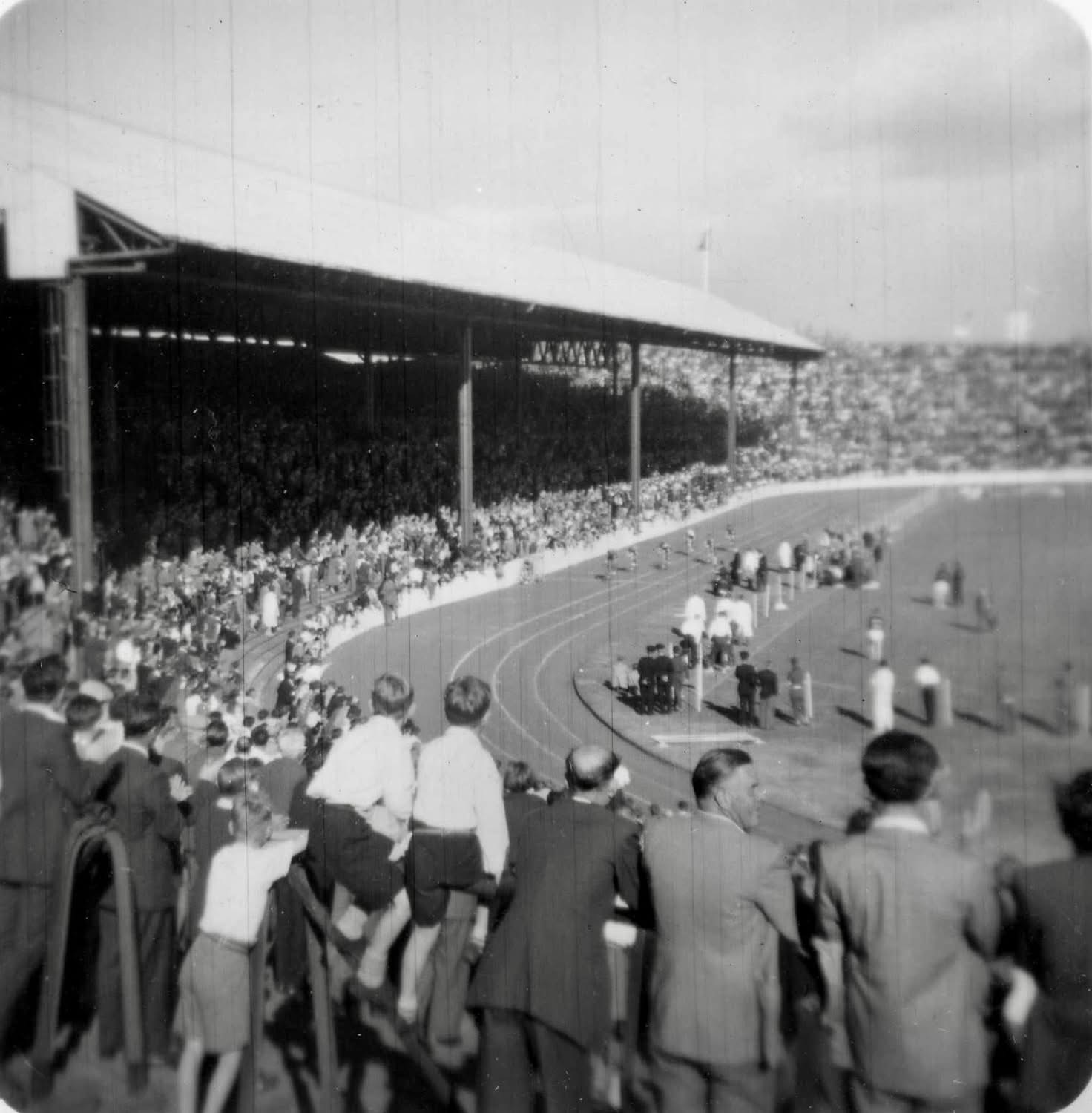
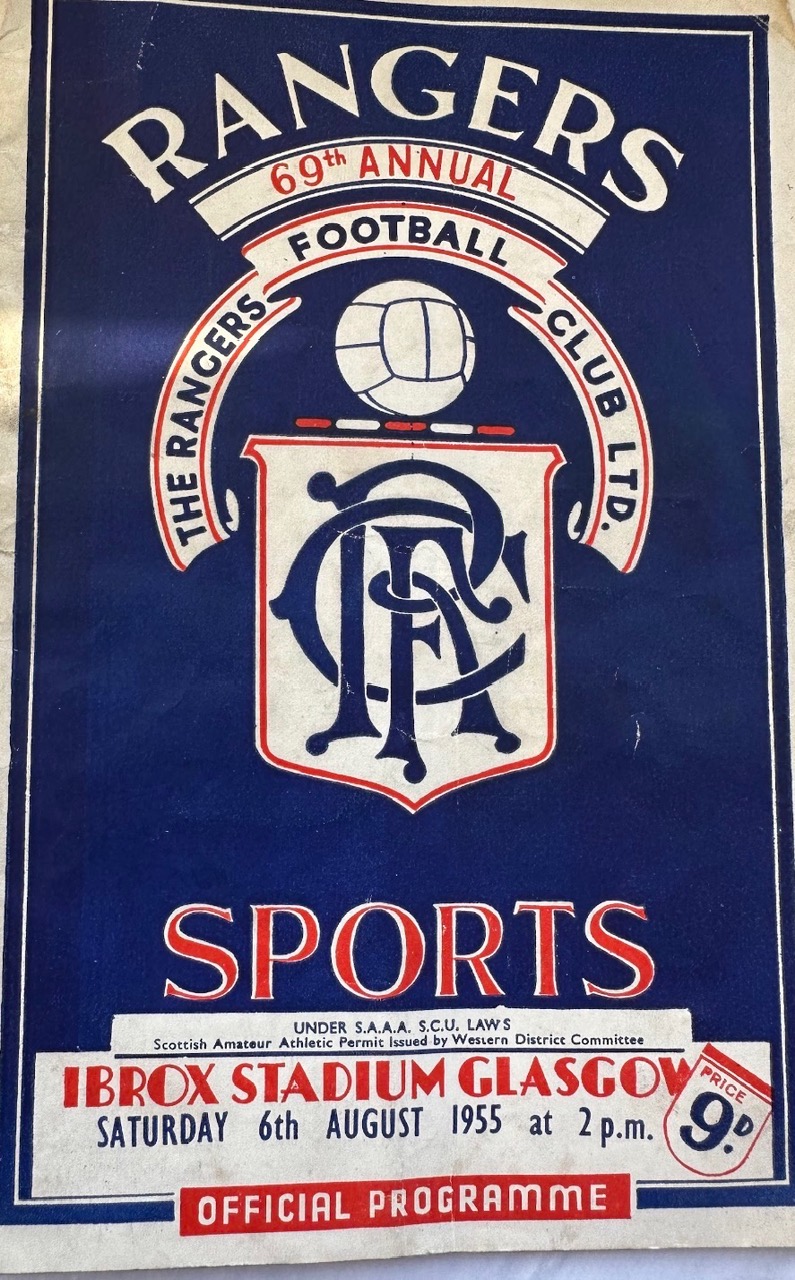
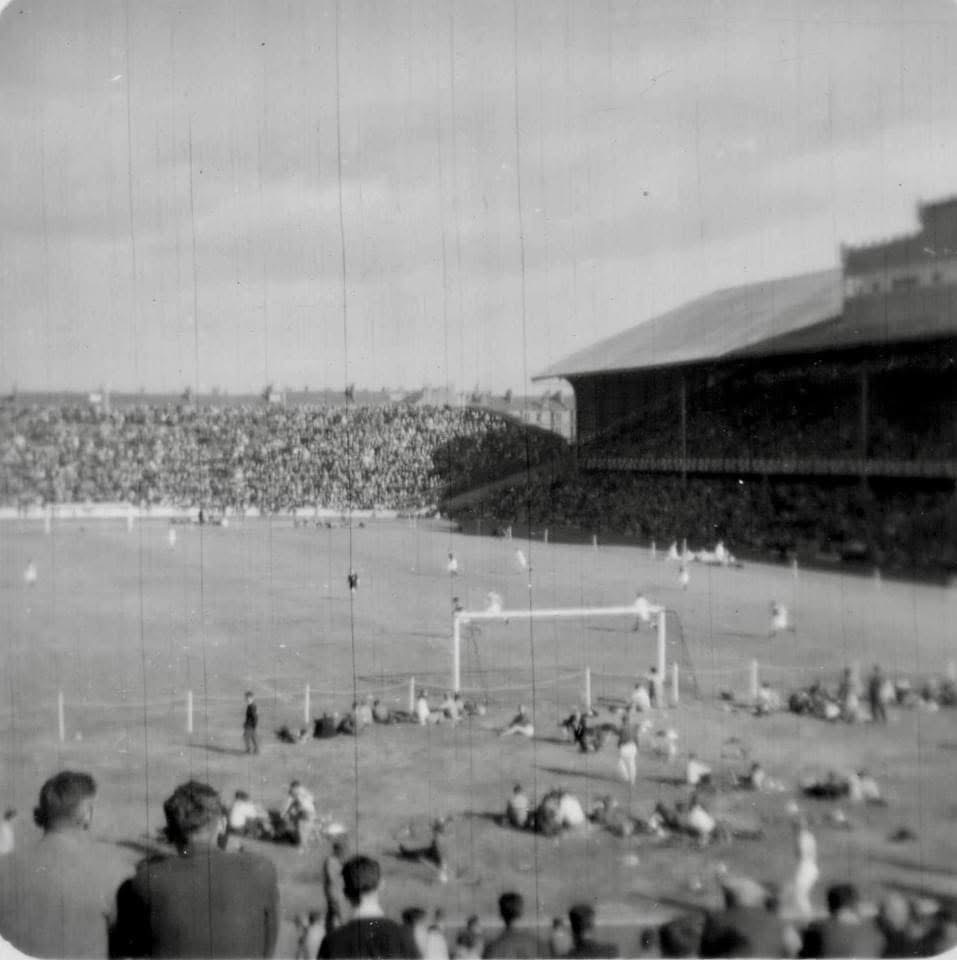
When I started running in the 1950’s there were three major athletics meetings held before big crowds in Scotland. There was the Edinburgh Highland Games which was held at Murrayfield on a short grass track. The crowds were big, there were many top ranked athletes taking part but it was on grass which could be slippery when wet. The short track made it difficult for distance runners to judge pace really accurately. Then there were two which were held on standard sized cinder tracks – Cowal Highland Games and the Rangers Sports. Cowal had the attraction of the trip doon the watter and the pipers practising on the boat on the way down and the really dramatic finish with the march of 1000 pipers coming over the hill from the houses above the start of the back straight. The really big one however was the Rangers Sports. It had everything – a super track well marked and a well laid out infield for the field events, the very highest class of athlete that you could wish to see – Olympians, World Record Holders – competing against each other and against the top Scots of the day, and there were many open events for locals to run in. Occasionally one of the international athletes would have a run out in an open race. For club runners and officials to compete on the same track and to brush against the shoulders of the mighty on the way on to or from the track was inspirational in a way that no other event on the calendar could manage. The picture above show just how big the crowd could be as well as the range of ages striving to get the best view possible of the race on the track. This meeting is the one held in 1955 before a crowd of 50,000.
Photograph from The Rangers Story Facebook Group
The race that grabbed all the headlines with the three main contenders in the finishing straight battling it out was the men’s half mile. The field included Tom Courtney of the USA, Brian Hewson of the AAA’s, Derek Johnston also of the AAA’s and Audun Boysen of Norway. All superb runners and record holders. Johnston had won the British Empire Games 800m in Vancouver in 1954, Courtney had won the NCAA 880 yards title in 1955 and would go on to win the Olympic 800m in 1956, Brian Hewson had won the AAA’s 880 in 1953 and 1954 and took silver at the 1954 Empire Games in Vancouver and Audun Boysen had set three Norwegian records over 1000m the last one being in 1955 when he ran 2:19. All champions and all went head to head – not as part of a three ring circus grand prix either. said the ‘Glasgow Herald’, and with some justice. The report on the race said –
“ Never has so brilliant a half mile been held in Scotland – eight yards covering the first four, three of whom returned times within the previous all-comers record of 1 min 50 sec. T Courtney (US), BS Hewson and DJN Johnston (AAA’s) and A Boysen (Norway) have all been in record breaking form in recent days so when the first lap, with S Oseid (Norway) in the lead ended in 52.8 sec, and Boysen, holder of the record, went to the front, a stirring finish was inevitable. Up the finishing straight it was still anybody’s race. Only over the last 30 yards did Courtney gain the front, and despite determined efforts by Hewson and Johnston the American held on and won by half a yard in the marvellous time of 1 Min 42.9 sec. His performance was rated even better than the time indicates for a troublesome wind faced the runners in the finishing straight and the track was very loose – factors that may well have added two seconds to the time and deprived Cortney of a world record.”
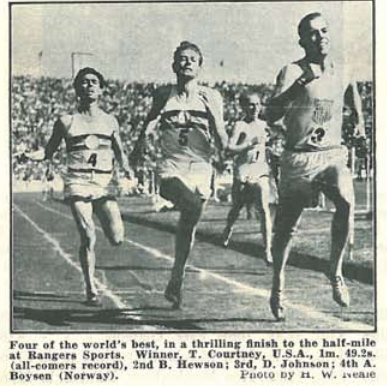
The “Scotsman” went one better the the “Herald” when they described the race as follows: “The 40,000 spectators saw what must surely have been the best and most thrilling half-mile race ever run in Britain, one that from the start was tense. Pacemaker was a Norwegian runner, Sven Olseid, closely followed by a compatriot, A Boysen the record holder. Over the last 200 yards there was a great struggle between T Courtney, USA, and the AAA’s runners B Hewson and DJN Johnston, In a race that was the very essence of athletics, the American won by half a yard, but the first three runners all beat the Scottish all-comers record. Courtney’s time of 1 min 49.2 sec was only 6-10ths of a second outside the world record.”
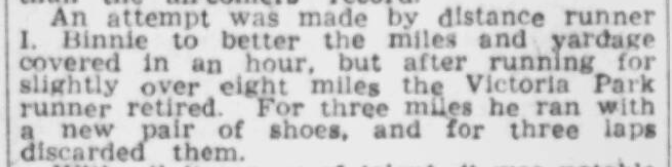
So many superlatives, and even if we take the “Scotsman’s” estimate of the attendance, tens of thousands of Glaswegians got to see these world stars in action, and many Scottish club athletes got to see them up close and walk beside them on the track or the infield. How much motivation was there for the young lads in that picture at the top of the page? Very top end of Primary School, first or second year secondary seeing a race like that and feeling the emotions of the crowd. As for the runners – from Victoria Park, from Monkland Harriers, from Clydesdale or Shettleston or Maryhill – they could tell all their stories to friends and club mates for weeks afterwards. The athletics events went from the sprints to an invitation One Hour Race which was won by George King of Greenock Wellpark Harriers from Hugo Fox of Shettleston Harriers with Dave Clelland of Falkirk Victoria Harriers with a distance of 10 miles 1625 yards. The race had been set up to help Ian Binnie of Victoria Park better the Scottish records for the hour run but he was forced to retire after eight miles. The Scotsman says:
Photograph from The Rangers Story Facebook Group
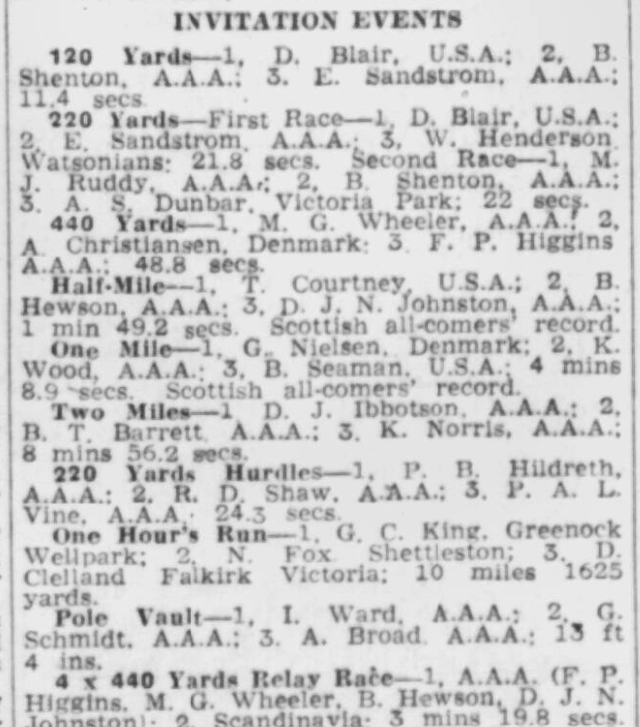
Although the half mile was the headline story in reports of the meeting, Rangers Sports were never about one top class event to bring in the crowds. The main point of this page – the whole meeting is covered elsewhere – is to illustrate the quality of the meeting. If we look at the results of the invitation events in 1955, we see this:
Now we should look at some of the athletes competing in the various events.
120 yards: 1st D Blair USA: Ran 11.4 in the Heat and then again in the Final. Would have been all-comers record but for following wind; 2nd Brian Shenton GB: won gold in 1950 European championship 200m, silver in Vancouver 1954 Empire Games; 3rd E Sandstrom GB: won the AAA’s 100 yards in 1955, two gold medals as part of a 4 x 110 relay team in the European championships in 1958, and in the Empire Games in Cardiff the same year.
220 yards: Two races including the best Scots sprinters against the international athletes –
First Race 1st D Blair USA; 2nd ER Sandstrom GB; 3rd W Henderson Watsonians 21.8 seconds;
Second Race: 1st MJ Ruddy AAA; 2nd B Shenton AAA’s; 3rd AS Dunbar Victoria Park 22 seconds
440 yards: 1st MG Wheeler AAA’s Member of the GB Olympics team in 1956 and won bronze as member of the 4 x 400 team; set many records over the distance including at schools level as well as being joint English record holder in 1955; 2nd A Christiansen Denmark; 3rd FP Higgins AAA: An English sprinter mainly at 440 yards, who was part of the bronze medal winning 4 x 400m team at the 1956 Olympics with Michael Wheeler, John Salisbury and Derek Johnston. .
880 yards: See above,
One Mile: 1st G Nielsen Denmark: Competed in two Olympics and one European Championships: in 1954 he was fourth in the 800m in exactly the same time as the third placed runner; in the Europeans that year he was second behind Roger Bannister and set a new Danish record, and in the 1956 Games in Melbourne he won his heat of the 800m, did not run in the semi final but chose to run the 1500 where he finished tenth; 2nd K Wood AAA: Wood won the Emsley Carr Mile four times, won the AAA’s Mile in 1956 and 1959, in 1956 he was second behind Sandor Iharos, Hungary, with both runners breaking the world record for the distance. He ran in the 1956 Olympic Games at 1500 finishing ninth in the final. 3rd B Seaman USA: In 1956 he set a UCLA record by running the Mile in 4:01.6 – the second fastest ever by an American. In 1962 in a star studded field in London he was fourth in 3:58.07 which made him the fourth American to break 4 minutes for the Mile.
Two Miles: 1st Derek Ibbotson AAA: What to say about Derek Ibbotson? He set a World Record for the Mile in 1956, won bronze in the Melbourne Olympics over 5000m; won the AAA’s one mile and three miles titles; ran several very fast times over the Mile and Three Miles in Scotland where he was a great favourite – too much for here but just check him out online. 2nd BT Barrett AAA: No information; 3rd K Norris AAA: British 6 Miles champion in 1955 and 1966; Olympic 10000m runner in 1956.
220 yards hurdles: 1st Peter Hildreth Won the AAA 120 yards hurdles in 1950 and one month later won bronze in the European championships. In June 1952 he was the first ever AAA champion at 220 yards hurdles, at the 1952 Helsinki Olympics he reached the semi final of the 110 m hurdles, he won three more AAA titles over the hurdles before heading for the Melbourne Olympics and also ran at the Rome OLympics, He broke the British record for the 110 hurdles five times. 2nd RD Shaw AAA Second in the AAA hurdles in 1954, he won in 1955. Running for Wales he was third in the hurdles in Vancouver Empire Games in 1954; he ran in the 400m hurdles at the Melbourne Olympics in 1956. 3rd PAL Vine AAA No information
Pole Vault: 1st I Ward AAA: British Pole Vault champion in 1956 and 1957; competed in the Empire Games in Cardiff in 1958; 2nd G Schmidt AAA: 3rd A Broad AAA No information on 2 or 3.
That is only at one of the Rangers Sports Meetings. 11 Olympians, numerous European and Empire competitors and national champions, plus national and world record breakers. And they were all there in Glasgow on the same day. Most meetings are lucky if there is one Olympian or world record breaker present and competing. This was exceptional and there are no such meetings on the calendar today. Times have changed, professional athletes – and that’s a change in itself – have managers and coaches telling them where and when to race. The question is – where do the wee boys like those seen in the photograph at the top of the page get that kind of inspiration? Truth is probably nowhere with the 2026 Commonwealth Games having only ten sports on display.
There was also the not inconsiderable effect on the runners, jumpers and throwers of seeing and rubbing shoulders with the ‘Greats’, and even in some cases competing in the same races (note the two races in the 220 yards for examples) and even jogging with some of them. I spoke to one who did a warm up jog with Arthur Wint, the superb West Indian some thirty years after it happened and he still remembered it very clearly. Among the club athletes were the winners of the open events. These were as follows:
| EVENT | NAME AND CLUB | PERFORMANCE | HANDICAP |
| 100 Yards | P Parlane, Springburn H | 9.8 seconds | 6 Yards |
| 220 Yards | G Rodger, Clydesdale H | 22.3 seconds | 10 yards |
| 880 Yards | W McBrinn, Monkland H | 1 min 55.6 sec | 60 Yards |
| Mile | W Mulroney, Cambuslang H | 4 min 14.5 sec | 165 Yards |
| Steeplechase (Eight Laps) | F Nelson, Bellahouston H | 9 min 32 sec | 205 Yards |
| Long Jump | M Jamieson, Springburn H | 25 feet 1 inch | 5 feet |
| Youths 100 Yards | AG Wilson, Shettleston H | 10.2 seconds | 1 Yard |
| Junior 220 Yards | JG Campbell | 22.7 seconds | 13 Yards |
These were not the very best that Scotland had to offer although they were all good athletes, they were good club men who made the best of their handicaps and who had in most cases naviugated their way through at least two round, in the case of the sprints it was probably through rounds. For the Mile and Steeplechase there was only the one race with handicaps up to 165 yards. For these athletes, going to their club on the following Tuesday, it was something to be talked about for many Tuesdays to come – what they ran, how they finished, what if anything they won – and what they often kept to themselves was what they saw of the top talent – what they wore (vests, T shirt, track suit or sweater and flannels, what kind of shoes they wore) what drills they did as part of the warm up, what their routine was before the race and how long they took to do it, and so on.
The Rangers Sports, and the Murrayfield HG too, were one of the best things to happen to athletics in the country and it is a tragedy that no one has found a way to replicate it\