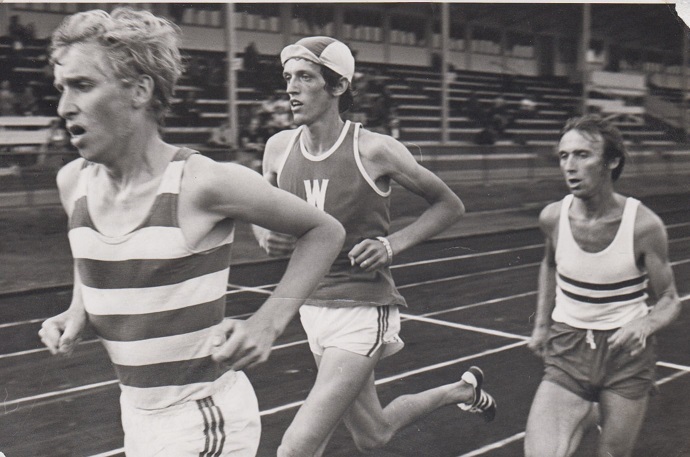
Above: Summer 1972, 10,000m. In Turku, Finland, Colin leads Pekka Paivarinta, who became 1973 World Cross Country Champion. Guess who won the sprint very easily?
Colin as we all know was a good quality Scottish International endurance runner on all surfaces – he was a ferocious competitor on the track, over the country and especially on the roads. This talent was best shown on the roads where he turned in record breaking performances at all distances from the various stages of the Edinburgh to Glasgow relay up to and beyond the marathon. We have covered most of his career elsewhere on the website but what we have here is detailed coverage of the years that he spent in Glasgow running in the colours of Victoria Park AAC. Everything done over this period is covered whether local races or national events with some insights into the way that clubs trained at the time. Also covered is Colin’s 10 months in Sweden where he had some memorable race: the picture above shows him in front of double Olympian and 1973 World cross-country champion Pekka Paivarinta in Sweden. What follows is in Colin’s own words.
Victoria Park days: 1971-1973
Victoria Park AAC was a traditional Glasgow club, heavily influenced by pre- and post-war training patterns. Tuesdays and Thursdays might feature club races or time-trials round the streets made familiar by the McAndrew Relay. Yet the usual system involved a slow pack and a fast pack, both with a ‘Pace’ to choose appropriate leg-speed and a ‘Whip’ to ensure that the pack kept together. However, by the early 1970s we were less amenable to regimentation. Ronnie Kane the coach would give stern instructions that the slow pack were to be given at least two minutes start, as a five-mile route like the ‘Shorter Knightswood Backward’ was tackled, but Alastair Johnston, Pat Maclagan, Ian Binnie, Albie Smith and co normally started chasing the moment their less talented clubmates were round the corner, swept past and bashed on mercilessly in the dim light of winter streetlights. No prisoners! On Sundays, only Pat and Alastair (and me) did long runs, which lesser men found ridiculously fast. The alternative was a testing cross-country effort out at Milngavie. Nearly all Vicky Parkers preferred the roads.
In late August 1971 I moved to Glasgow and started teaching English at Kelvinside Academy. Victoria Park AC was the club I joined and, as I built up some fitness, I first took part in the famous McAndrew Road Relay. The organisers VPAAC were very much a road-running team, and apart from Pat Maclagan, tended to underachieve on muddy cross-country courses. Winter club runs were all on short, fast, traditional pavement routes. It might be expected that the E to G would be the most important race of the season for such a club. Not at all. For it wasn’t even The McAndrew – it was the midweek Vicky Park Trial for that event! After trundling round disconsolately on a Tuesday night with a streaming cold, I could only finish eighth on the course which was just short of three miles.
Eleven days later on Saturday 2nd October I was feeling better and ready to give it a go for the VP second four-man outfit in the McAndrew Relay proper. 79 teams took part, including all the best runners from the West. There was quite an atmosphere as the first stage runners charged off and swerved left out of sight. A restless crowd of expectant team-mates jogged and strode up and down the hill outside Thomas Aquinas School, which was used for changing. Watches were checked constantly, then at last a lone figure swung into sight and sprinted up to the line, while the others jostled and made room for the incomer and the crowd yelled encouragement. Willie Day from Falkirk was first man home, although his team eventually finished fifth. Alastair Johnston did well to come in second, just behind him and four seconds clear of Bill Scally of the holders, Shettleston Harriers.
The fireworks exploded on the second stage as Lachie Stewart sped into the lead to record 13.39. However that young rocket Jim Brown (Monkland H) showed scant respect by closing Lachie down, sprinting from 12th to second in 13.22, which proved to be the day’s fastest time. He had achieved a similar feat the previous year.
On the third stage, I took over for the VP second team in eleventh position and ran as hard as I could, up the little hill, swing left then right, along a residential street, hard left onto busy Crow Road (keeping to the pavement) and round past Anniesland Cross, over a long gradual hill, down to the entrance to Danes Drive, past Scotstoun track entrance, up a short hill, down again and then the final effort to the line. I could only record 14.21 but this was enough to take my team up to seventh. Eventually, Shettleston (Scally, Stewart, Henry Summerhill, Dick Wedlock) won by 21 seconds from VPAAC (Johnston, Innis Mitchell, Pat Maclagan, Hugh Barrow), with Monkland third and VP Two tenth. Wow! What a dramatic event!
The Allan Scally Memorial Relay at Garrowhill was named in honour of Shettleston Harriers’ legendary coach. Traditionally it came after the Kingsway and McAndrew and before the Glasgow University Road Race. These events enabled selected teams to finalise their eight-man squads for the prestigious E to G. Despite usually running for good teams, I dreaded the Scally Relay and found it absolutely exhausting. The bustling start, followed by a long gradual downhill which endangered suspect hamstrings, was bad enough; the brutally steep hill after the sharp right turn was worse; and the energy-draining seemingly-endless back straight, usually into a headwind was torture; and then one had to hang on and hope to avoid being outsprinted on the way down to the changeover. The host club were, at the time, the fastest in the land, so a heavy defeat seemed inevitable!
On Saturday 30th October 1971 I faced up to this delightful prospect for the first time. Although Pat Maclagan (22.32) moved us into the lead on the second stage, Shettleston had gone into the lead just before the final changeover. Lachie Stewart (22.36) had no difficulty burning me off (23.27) but at least VP finished well ahead of third placers Monkland, for whom Jim Brown (22.09) was fastest of the day, with Ron McDonald (22.24) second-fastest.
On 13th November, I managed fifth place (25.28) in the Glasgow University Road Race. Pat Maclagan (25.05) won by one second from VP team-mate Alastair Johnston, in front of Colin Martin, Mike Bradley, me, Andy McKean, Dave McMeekin, Hugh Barrow, Don Ritchie, Jim Dingwall, John Ferguson, and others including Dave Logue, Albie Smith, Eddie Knox and Alistair Blamire ex 150. My diary comment was ‘Okay but chickened kick’.
The 1971 Edinburgh to Glasgow Road Relay on Saturday 20th November was described in the press as ‘one of the most exciting races of a long series’ and I remember it with an awful clarity. I had started work as a teacher in Glasgow, and joined Victoria Park AAC. Quickly I realised that this was a real ROAD-runners’ club – one sight of genuine mud and they chickened out immediately (apart from Pat Maclagan, who was, of course, different). As has been mentioned, the most important race of the year, I was told, was the TRIAL for the McAndrew Relay and then the McAndrew itself. However, in practice, the E to G team was a constant topic of conversation from the moment the previous race finished!
Naturally, after the 1970 race, most punters reckoned that only E.S.H. could provide the mighty Shettleston team with any kind of opposition. Yet, by the time that the baton got to me at the beginning of the Fourth Stage, it had turned into a contest between ourselves and the holders. Hugh Barrow, Pat Maclagan and Davie McMeekin had run exceptionally well to give me a twenty-one second lead over the young prodigy Paul Bannon (much later a Commonwealth Games marathon bronze medallist). I remember really belting off, full of determination and sure I was set for the run of my life. My hopes were shattered a few minutes later when, blind to the road signs, I charged straight ahead and didn’t turn right for Bathgate! Realising with horror what I had done (where was the bloody marshal?) I struggled across a patch of mud back onto the correct route. By then Paul had turned a lead of almost a hundred yards into nothing. Despite trying hard to retain some composure, I lost a further ten seconds by the end of the stage. Joe Reilly ran out of his skin to overtake Norman Morrison on the next leg, but Dick Wedlock timed his effort well on the long stage to draw clear of Alastair Johnston. Despite brave efforts by young Fraser Logue and Albie Smith, Shettleston finished with a 59 second lead. The rest of their fine team: Tommy Patterson, Lachie Stewart, Les Meneely, Tom Grubb and the inevitable Henry Summerhill. Probably they would have beaten us anyway, but I will always feel very guilty about my orienteering mistake, and frustrated because I really might have held Paul off. (Like John Robson in the future, I did my very best to make up for my grievous error by running exceptionally hard in subsequent Edinburgh to Glasgow Relays.)
On Saturday 27th November, I was a late selection to represent the Scottish Cross-Country Union team versus the very strong Northern Counties CC Association and the Army at Catterick Camp. The route was three muddy two-mile laps with two fences per lap. My notes read: ” Ran as hard as I could, finished 15th from 27 and sixth Scot. Sam Downie 9th, John Ferguson 10th, Allan Faulds 11th, Bill Stoddart 13th, Colin Martin 14th; beat Willie Day, Lawrie Spence, Paul Bannon. A minor disaster, almost three minutes behind winner David Slater. Interesting trip, nice people, despite bad run.” North won from Scotland and Army.
On 11th December, ran for SCCU Select versus Scottish Universities at Merchiston Playing Fields. A close team contest, with SCCU winning by only five points from SU. I finished 12th. Andy McKean, Ron Macdonald, Don Ritchie, Jim Wight, Alastair Johnston, Frank Clement, Jim Dingwall, Henry Summerhill, Bill Stoddart, Gareth Bryan Jones, Dave Logue. Beat David Lorimer, Allan Faulds, Alistair Blamire, Lawrie Spence. Comment: “Ran quite well until last lap. Should have beaten Gareth and Dave. Don Ritchie just took off two laps out!”
1972
Morpeth to Newcastle 13.6 miles road race on New Year’s Day
I first competed in this famous race in 1972, running for Victoria Park AAC. We travelled down by train. I remember reading the big build-up for the favourite Jim Alder, the Geordie Scot, in the local newspaper ‘The Journal’. There was an enormous field (for that era) of 209 runners, who had to be entered by 9th December. Most of us took the free bus from Central Station, Newcastle, out to the start, and then we left our kitbags in a van which departed for the finish, leaving us ‘warming up’ in the rain. The race started at 1.45 p.m. Once the fast men shot off, the rest of us struggled along as well as possible. My training diary noted: “Raining throughout and quite cold. Not 100% effort but legs and feet sore. Tried fairly hard. A reasonable run, considering my fitness.” Jim Wight from EAC outsprinted Jim Alder by seven seconds to win in 1.05.47. My team-mate Alastair Johnston was an excellent third in 1.05.56. I ended up 16th (1.09.11) and Willie MacDonald was 45th (1.13.23), well under the standard medal time of 1.14.30. Vicky Park finished third team and each of us won a frying pan worth £1! What I remember most is that the great Jim Alder, Commonwealth Marathon gold and silver medallist, modest, tough, honest and generous, actually walked his fellow Scots more than a mile to the train station, chatting away in his inimitable relentless fashion.
Saturday 19th February was the date of the SCCU 75th Annual Championships, held at Currie High School. In the Senior Race, I ran surprisingly well (for a road man) and was very pleased to squeeze into the top twenty in 19th place. Ian McCafferty won, from Jim Alder, Alistair Blamire, Andy McKean, Lachie Stewart, Jim Wight, John Myatt, Doug Gunstone, Gareth Bryan Jones, Eddie Knox, Colin Martin, Tommy Patterson, Don Ritchie, Sam Downie, Alex Wight, Pat Maclagan, Allan Faulds and Norman Morrison. Willie Day was 20th and I also beat Matt Paterson (Steve Ovett’s training mate), John Ferguson, Henry Summerhill, Martin Craven, Kenny Ballantyne, Alan Partridge, Bill Cairns, Alastair Wood, Steve Taylor, Sandy Keith, Martin Walsh, Graham Milne etc.
Saturday 4th March was the English National Cross-Country Championsips at Sutton Coldfield. Very very cold! This legendary chill-fest was won by tough Malcom Thomas. Three thousand took part in Arctic conditions. Heavy snow fell. I went fairly well for two 3 miles laps, then faded slowly. Finished 112th (still have the disc) but chose not to hand it in since the queue was long and I needed to get dressed to avoid death by hypothermia! Scots in front were Dick Wedlock (15th, Jim Wight (16th), John Myatt (78th), Doug Gunstone (89th) and Tommy Patterson. I out-survived: Allan Faulds, Lachie Stewart (fell in a ditch but finished 149th), Tom Grubb, Willie Allen, Ian Macintosh, Ian MacMillan, Colin Martin (187th). Hugh Elder, Ron Paton, Kenny Fyffe, Phil Dolan and Dougie Gemmell. Nine Miles in snow? Never again!
Also in March, the Glasgow County Cross Country Championship was held. Due to bad weather, this turned into a six miles road race! I won, thirty seconds clear of my hero and good friend Dave Logue. Glasgow champion? In name only!
From Sunday 9th April at 4 pm to for 80 hours, 25 minutes and 53 seconds, Aberdeen AAC (My second-claim club) tried to break the record for the John o’ Groats to Land’s End Relay (with a ten-man team). Despite a valiant attempt to speed up during the last hundred miles, we finished 45 minutes outside the record. Ours was the second-fastest-ever team time and the fastest north to south, but we were very disappointed. Yet we resolved to try again in 1973.
Then it was time for a series of 80 miles training weeks.
The Glasgow Corporation Parks Department Annual Championship Meeting (otherwise known as the Glasgow Highland Games) was held on the cinder track at Scotstoun Playing Fields. However one event only finished there – the gruelling Drymen to Scotstoun Road Race, contested over at least 15 miles. This was one of Vicky Park’s most important home fixtures. On 20th May 1972, recovering from a sore knee, I was ready for only a fairly hard session. It was very hot and sultry as the runners left the pleasant village of Drymen. Shortly after the start, the course ground painfully up a very long steep hill up the Stockiemuir road to the Queen’s View at the five mile point. Willie Day (Falkirk Victoria Harriers) was very fit and departed up the road, while I found myself isolated in second. After a pit-stop, I kept going downhill through Bearsden and into Glasgow, up and down some testing dips until the welcome flatlands of Danes Drive and the final lap of the track had been negotiated. Steady hard training, which meant that Willie (1.19.48) was more than four minutes in front.
Nevertheless, this race became a personal favourite, because the early uphill section suited my strengths, assuming I was up to the challenge on the day. Consequently I ran the Drymen another five times, even after I was based in Edinburgh.
By 1972, Colin Martin had become one of my main rivals. He was undoubtedly faster but I was gaining in stamina. Two races illustrate this. At Meadowbank on the 27th of May, we both had a go at the SAAA Ten Mile Track Championship. EAC’s Andy McKean went off with Colin in close attendance but then dropped him before going on to win easily. My training diary states: “Caught CM at three miles after a big effort and then we took two laps each until I made a break at seven miles and struggled to the finish. Andy 49.25, me 50.15, Colin 50.45.”
1972 saw the amazing Alastair Wood’s final victory (his sixth) in the Scottish Championship marathon – and a suitably crushing one it was too.
On Saturday 24th June, a tailwind produced a brisk pace and by eleven miles the leading group was down to five: Alastair Wood, Bill Stoddart, Willie Day, Davie Wyper (a marathon specialist from West of Scotland ) and Colin Youngson (Victoria Park AAC). The latter, an Aberdonian, was running his third marathon. Youngson was teaching English at Kelvinside Academy and training hard with the likes of Pat Maclagan, Alastair Johnston and that illustrious star of the fifties, Ian Binnie. Encouraged by second place to Andy McKean in the SAAA Track 10 (50.15), Colin was about to discover that marathons inflicted fresh levels of discomfort!
By the turn (and logically into a stiff headwind) Stoddart dropped back, followed in turn by Wyper and Day. Only the foolhardy Youngson sheltered behind the tough near-veteran Wood. This might have gone on for some time, but Wood glanced behind and barked imperiously something like, ‘Please do some work, you lazy good-for-nothing!’ Accustomed to being inferior to the great man, who had humiliated him so often (by tongue and leg-speed) during Sunday sessions back in Aberdeen, Colin obeyed instantly. After half a mile of battling the breeze he heard a brief derisive chuckle and could only watch vacantly as Alastair Wood, tactical mastermind, surged past and disappeared into the distance and out of sight.
Youngson’s training diary reads ‘Kept going fairly well till 21; cracked up from there. Curious shivery increasingly weak feeling – must do the ‘diet’ next time. Detached observation of crack-up. Must have lost at least 600 yards on Davie Wyper in last three miles. Innis Mitchell shouting a warning outside the stadium was no use – or losing silver on the track. Couldn’t have cared less – extremely careful walk/jog up the final straight. Albie Smith timed my last 200 metres at 80 seconds! Surrounded by blankets, old nurses and eager stretcher bearers. Hot very sweet tea. A. Wood’s ruthless but still very good. Determined but tired booze-up later.’
Finishing times were: first Alastair Wood in 2.21.02; second Davie Wyper (West of Scotland) in 2.26.14; and third Colin Youngson in 2.26.45 (a personal best, nevertheless). Athletics Weekly’ summed it up brusquely. ‘Alastair Wood (39) scored a decisive sixth victory in the marathon, and from all accounts is ready for more yet. He was home and dry for more than five minutes before the next man.’
Jim Logan, a good supporter of Victoria Park AC, was more dramatic in the ‘Bearsden and Milngavie Herald’. ‘Unfortunately in the stadium there was a complete absence of progress reports on the marathon. With an exhausted Colin Youngson being passed on the final circuit by David Wyper (reminiscient of Tom Richards similarly overtaking the late Etienne Gailly at Wembley in 1948), there must have been an exciting chase over the later stages.’
When interviewed by Brian Meek in the Scottish Sunday Express, ‘the most popular winner’ of the SAAA Championships, Alastair Wood ‘fresh and relaxed after the race’ said, ‘I took the lead after 15 miles and was on my own from then on. These youngsters are getting slow nowadays. This is the tenth anniversary of my first marathon win. I intend to go on running as long as I enjoy it.’
Saturday 8th July: Mamore Hill Race. First: Bobby Shields (1 hour 42 minutes 4 seconds); second Pete Duffy (1.43.31); third Colin Youngson (1.46.25); fourth Brian Finlayson (second in Ben Nevis last year) in 1.48.53. Comment: ” one mile road, medium long steep stony hill, long section of undulating very sharp and stony ‘path’ through burns, peaty mud etc. Then very long climb (too much chicken walking), and very treacherous descent (went wrong, semi-precipice, flat soles a mistake here, should have worn ripples), then seven miles of hilly road, caught BF, but too far behind, mainly due to descent. Not flat out but quite glad to finish. Soreish thighs, lift home with Pete Duffy and family. Not as tough as Nevis or marathon.”
12th July to 11th August: Finnish Trip with Don Ritchie. I ran two races in Finland. Their Olympic Trial Marathon (6th in 2.32.18) in Helsinki; and, on a famous running track in Turku, a personal best 10,000m (30.39). Here are the relevant descriptions.
Tuesday 25th July: MARATHON RACE DAY.
Lie-in, much eating of sugary foods and more. Into town and to Olympic Stadium for medical check – Finnish competitors a bit stand-offish but doctors helpful and our good friend Tapio turned up, which eased matters further.
We were taken into the ‘torture chamber’ two at a time – a fiendish den packed with cycling machines instead of racks – neither of which were used. Stage 1 was a series of questions about the state of our health, accompanied by various prods and taps and pulse and blood pressure. Stage 2 was a blood sample from left arm, inside elbow. The nurse was sympathetic, but no chocolate to mend the wound, just cotton wool and sticky tape.
We each received a big envelope with numbers, programme, instructions etc, and Don and I were considerably tickled to note that, in a little envelope marked ‘Great Britain’, we were given a formally phrased card: ‘We have the honour to invite You to the closing banquet of the inter-nation match Finland – G.B. – Spain at Restaurant Royal on July 26th, 1972 at 22 o’clock. Suomen Urheilulutto r.y. Finnish A.A.A.’
Back to Hiekkaharaju, more food and drink and rest, fixing numbers to vest etc. Into the stop before Helsinki and a slow stroll to the stadium – attracting the usual amused/incredulous attention due to the kilts. The crowds streaming to the match were very large – football is minor here compared to athletics, and one can understand why the Finland-Sweden ‘derby’ athletics contest is reputedly sold out three months in advance.
We got past the guard dogs with no difficulty, due to little green tickets, and then changed into kit. Many of the British team were recognisable at once, both those parading in the arena while the anthems were played, and those warming up on the indoor tartan strip. Les Piggot (Scottish sprinter) seemed particularly worked up for the start – not of the sideshow marathon trial – but of the main event: a triangular international athletic contest between Finland, GB and Spain.
Soon our turn came, and we marched round the outside lane, looking at the colourful crowd stacked in tiers around us. Jogging about at the start went on for a minute or two, while 100 metres and high jump continued, then we were lined up, checked, instructions given (ours spoken aside by the doctor). The command was given, gun fired and we were off! Four laps of the track (we held back) and then exit, down an incline, and into the first lap of 14 round the environs of the stadium – mainly flattish, first half probably uphill, second downhill. A fair amount of people surrounded the route, which was cordoned off from traffic, marshalled by policemen, with two sponge and drink stations. Some heckling went on, especially from little kids – all rather good-humoured.
In the race itself, we held back, established a group which began to catch some of those who dropped off the leading bunch (bent on Olympic selection). On another day, we would have hung on, but were both conscious of inadequate preparation and basic non-recovery from previous races (Scottish Marathon and Mamore Hill Race for me – Forres Marathon for Don).
Unfortunately, just as things were progressing steadily, about 12 km Don contracted stomach cramp and, unknown to me, had to stop, indulge in a frantic search for a bog, sojourn there awhile, then start off again, by which time he had lost three minutes on our little bunch. After that he staged a great comeback and was catching everyone apart from the top three at the finish.
Meanwhile, at about 18 km, I lost patience and shot forward, gaining about 50 seconds in a lap, caught the lad that eventually finished in front of me in fifth, sailed past and felt good until 25 km. Then, from 30 km onwards, slowed considerably, especially from 35 km to 41 km. This ‘collapse’ can be put down to lack of fitness, lack of company in front or behind (no one in sight) and an overwhelming desire to finish above all, which led to conservation of remaining energy, some ‘chickening’ and getting stuck in a slower pace.
Tapio kept yelling out pace schedule, another lad practised his English on ‘laps to go’, kids chased, people added what sounded like cheerful insults, and the organisers of one sponge station smilingly got out of the way when I came past, grabbing a sponge in characteristically splashy fashion.
On entering the stadium, I felt better, strode out, and took the opportunity of waving to the ribald crowd, on being announced as Colin Youngson from Scotland!
I finished sixth (2.32.18) with Donald eighth (2.33.37) not far behind. Twelve finished and eleven dropped out (mainly fast guys who did not make the three-man Finnish Olympic team). I felt rather weak afterwards, then made myself rain sweat and feel sick by rapidly consuming one bottle of orangeade and another of Vichy water. Tired in the shower, but managed to stagger from dressing room to station – en route meeting Tapio’s sunburned sister and being induced to sign some autographs – it was mainly because of the kilts.
Collapsed into bed when we eventually reached Hiekkaharju.
Wednesday 26th. Restless night, little sleep – but up at 6 a.m. for sandwich and three pints of liquid, watching a thunderstorm. Up again at 8 a.m. for breakfast and one litre milk, and rest of morning writing, reading, filling in results and listening to tape recorder – Scots dance music, mouth music and quavering genuine folksong. Tatties, eggs and yoghurt for lunch. Cleaned and tidied and into town – to the Old Stadium.
Jogged twice round sawdust path – nice and bouncy for bare feet – but unfortunately there are stretches of gritty sand, stones and tarmac – my poor old tootsies! Shower and wait for Don – search for coke and wait some more for Don – watching the immense Finnish crowds flocking to the stadium – running the gauntlet of insistent raucous programme sellers and one determined youth with lungs of steel and two feet tall, yelling something like ‘Korrvo’ and blowing a horn – he seemed to sell them all too!
The match, seen from the athletes’ section of the seats, was very exciting and of a high standard – umpteen records being set. Highlights included David Jenkins 200m – straining every fibre round the bend; the Javelin – with the entire crowd behind its heroes; Mariano Haro’s runaway 10,000m win, with castanet clapping from the Spaniards; a fine Steeplechase; Geoff Capes powerful record-breaking shot – his jubilation; and finally the men’s 4x400m relay, including the Swedish team and an extra British one as well as the Finns and Spaniards – GB2 barging and making David Hemery drop the baton – then Jenkins incredible 300m to close the gap, though he couldn’t quite do it – thrilling stuff.
After the National Anthems we were rather at a loss about what to do, since we could not see Tapio around, and did not know the way to the Restaurant Royal ourselves. However, we bumped into the useful doctor again and he courteously arranged for us to tag along with the Finnish team bus – after we had suggested that we could rather not announce our presence to the British team!
Consequently, we followed Markku Kukkoaho, who I presume was the captain, and who had snatched that thrilling 4×400 victory just before. He was still warming down, but afterwards we accompanied him and Ari Salin, the hurdler (13.8; 49.5) back to the hotel, where we got onto the bus, which eventually took us, with some of the team (including attractive blonde ladies) to the restaurant, which we found was near the station.
The crush was considerable – three teams, officials, hangers-on – but the place was rather plush (plus patio) and the buffet was magnificent – plates too small to try everything – though we tried, and I annexed some cheese. We sat quietly in a corner, enjoyed our meal, talked to a couple of English official-types, and departed about midnight, after the speeches (Finnish – polite, Arthur Gold – longwinded, Spanish – short) and the presentations, including long-service silver tea service to Jorma Kinnunen) and, during a thunderstorm, we had time to catch the ‘boozers’ train. Bed by 1 a.m.
Friday 4th August
Halfway through another large tea, Markko suddenly intimated that there was a 10,000m track race in the district championships that very night – if we felt like it! Stuffed with food (especially Don), legs ruined, the two mad Scotsmen found themselves accepting this lunatic challenge – at two hours notice! ‘We won’t have to train today if we race,’ said Don.
Slightly bemused by our own lack of sense, we sat around for a bit and vaguely prepared. I attempted a new packing system, then Don and I and Kullikkie and Markko walked down to Turku track.
After a few moments bickering with officials, we were allowed to run as non-counters. Warming up was half a mile stagger and then sit down again. We both felt useless – too much holiday and Finnish food, too little training! However, certain of the amused glances from the local spike-wearing athletes at the start, as we joined in, clad in unfamiliar kit and flat shoes, needled me a bit, and I promised myself that certain of the less fleet-looking individuals would not be allowed to beat me – at any rate they would at least be behind me when I dropped out!
Last night’s viewing of the 5000m had convinced me that there was only one first class athlete – Pekka Paivarinta, the Finnish International Steeplechaser (8.25.4, second versus GB and Spain behind his own man Kantanen). I guessed that I might be able to hang on to the rest for a while at least, fat and unfit or not, and that P.P. an angular though cheerful character wearing a jockey cap, might not push the pace, since he had already run a 400m hurdles (58.6 for second place) and a 1500m (3.53.6 for first) that night.
Therefore, when the starting gun fired, I tagged on to the leading bunch at the extreme end, finding the pace fastish but not unbearable. Don’s fruit-full tum put paid to him, unfortunately, though he was announced as me, and vice versa, till over halfway. At 8 laps or so, I was feeling tired but gradually moving up as the bunch decreased in number, and encouraged when one bloke stepped off the track in front of me! Luckily, the pace slowed about then, until the ten laps to go stage (i.e. 15 gone) – PP was just jogging, as I’d surmised.
Getting bored with standing on the heels of a fellow with a headband (the local Frank Shorter) as quoted later in the newspaper, I made a fairly ill-considered move into the lead, pushed for a lap, then reined it in again, waiting for someone to take over – nothing happened! PP sat on my shoulder, grinning in reply to my rude Scottish exhortations not to be so lazy.
However, I noticed a couple of the group of six were sagging so, at six laps out, delivered my ‘finishing kick’ which lasted about one and a half laps, enough to drop the third guy Risto Lindstrom by 20 yards or so.
Seeing that my legs were coming off, and hearing the grampus-like puffing noises, PP jogged past and away. Somehow, I managed to con RL into waiting too long to sprint – my last lap was truly pathetic, but the gap was held until the final straight, too late for him.
First: Pekka Paivarinta 30.24; Second CJY 30.39; Third Risto Lindstrom 30.40.6. For me, this was a marginal personal best! On a windless night on the fast coal dust track by a fat Youngson – sub 30 minutes must be on when I am fit and prepared. Exactly three minutes outside the world record – Ron Clarke breathes again….
(In early Spring 1973, Pekka Paivarinta became World Cross Country Champion!)
Having stopped blowing, and shaken hands, I didn’t stop laughing for half an hour afterwards. M and K had seen my ‘strategy’ and appreciated the joke, I think. There are advantages being an unknown from famous Britain – they don’t realise how bad you are!
Tuesday 22nd August: Victoria Park AAC 10,000m ‘championship’ on Scotstoun track. I won in 30.44, with Pat Maclagan finishing in 30.51. Very uneven pace, felt rotten but eventually got away. Innis Mitchell lapped.
By the 16th of September Colin Martin was much fitter. In the afternoon at the Grangemouth so-called Highland Games, he sprinted away in the 3000m to produce a PB of 8.21.4, five seconds clear of me (in my PB 8.26) and young Lawrie Spence. According to the SATS Yearbook, that evening at Meadowbank in a 5000m, Colin set another PB in a time of 14.18.0. As I said, a hard man!
In Autumn 1972, VPAAC suddenly realised we had a good short relay team. Between 30th September and 4th November, we won one road relay (and achieved two second places and one third in three others) and finished first in two cross-country relays, one important.
The first victory, on 30th September, involved a trip across to the capital to contest the Edinburgh Southern Harriers Road Relay. This was based next to Fernieside, the home club’s small cinder track which nurtured many Scottish champions and one Olympic gold medallist – Allan Wells.
The course (2 and a half miles?) involved a right hand circle, a long gradual downhill and a vicious finish hill, followed by a lactic nightmare finishing straight. Incoming runners tend to collapse into the comforting embrace of a hedge. Davie McMeekin and Hugh Barrow gave us a good start; and then I put us into the lead with 11.53 (the day’s fastest time) and Pat Maclagan (11.58) held off a strong challenge from ESH’s Olympic marathoner Don Macgregor (11.59). The Western raiders accepted the cup and pennants and headed home, leaving the promoting club somewhat miffed.
In the 1972 McAndrew Relay, on the 7th of October, I was fitter and had qualified for the Vicky Park first four. Although Shettleston led from start to finish (55.22), once again the man of the day was Jim Brown. I ran the second stage, taking over sixth, but had moved through to second as the finish approached. Suddenly I had an uneasy feeling that I was being stalked and then Jim burst past and was five seconds clear at the line. Afterwards, I discovered that my time had been 13.36, fifth fastest, but Jim Brown had run 13.02, to break Lachie’s seven-year-old record by an astonishing 18 seconds! Ron Marshall reported: “Wearing the now fashionable hairband, and resembling some obsessed dervish, he thrashed his way round the course, dragging his club from thirteenth to an unbelievable second.” Shettleston (Norman Morrison, Wedlock, Tommy Patterson, Stewart) won by 25 seconds from VPAAC (Davie McMeekin, me, Albie Smith and Pat Maclagan) with ESH third and Clydesdale fourth.
On the 14th of October, Victoria Park won the Dunbartonshire XC Relay Championship. Over two and a half miles of fast grass, we raced well. I ran the first leg (in 12.39, second-fastest of the day to Paul Bannon’s 12.31). I handed over 19 seconds clear of Colin Martin. Innis Mitchell, Dave McMeekin and Hugh Barrow ensured victory.
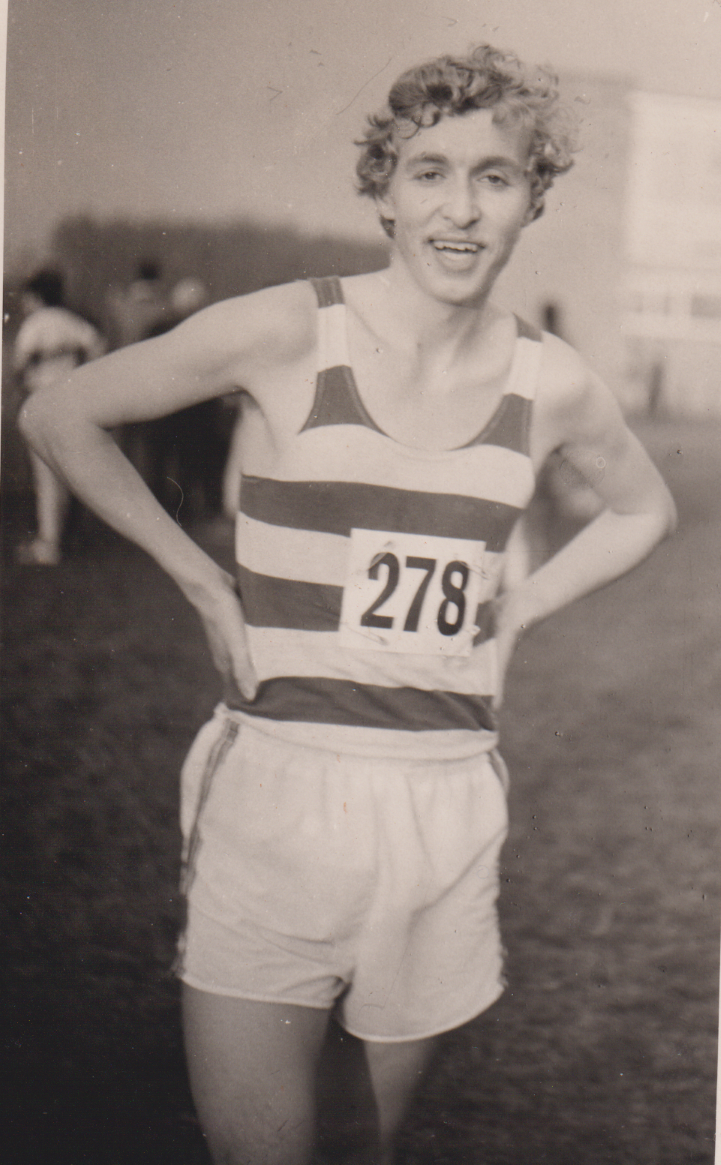
After Dunbartonshire Cross-Country Relays
1972 Kingsway Relays, Dundee, 21st October. I have a full set of results for the Kingsway that year. Edinburgh Southern (Allister Hutton, Martin Craven, Gareth Bryan Jones and Fergus Murray) won in 55.17; with VPAAC (Davie McMeekin, Colin Youngson, Hugh Barrow and Albie Smith) second in 56.15. However we led until halfway! Third in 56.34 were Clydesdale Harriers (Alan Marshall, Phil Dolan, Allan Faulds and Dougie Gemmell). Amazingly, my 13.32 was fastest of the day, one second in front of Gareth, and I was presented with the Brannen Memorial Cup. The engraved names of past winners seemed embarrassingly illustrious. The prize was a Boots token for, I believe, half a crown, and I still possess the Pears Cyclopaedia and Dictionary I bought with it. Professional Athletics, eh? [NB: £1 in 1972 has the purchasing power of £15:70 in 2026 so Colin’s 2/6d would be worth just over £1:40 today]
On 28th October, In the 1972 Allan Scally Memorial Relay, Shettleston won again, very easily from EAC and VP. At least I improved a little to 22.59 but that looked dismal compared to the amazing Mr Brown’s new record 21.52. Andy McKean (EAC) was only six seconds slower; and Norman Morrison of the host club ran 22.06.
On 4th November, Vicky Park achieved the club’s greatest victory for a long time. Dave McMeekin, Hugh Barrow, Pat Maclagan and Colin Youngson, having led from the start, won the Midland District Cross-Country Relay, well in front of Clydesdale and Law and District. It was the first victory for VPAAC in this event for twelve years. We received a big annual cup and S.C.C.U. plaques.
The Glasgow University Road Race, organised by the GU Hares & Hounds on 11th November, attracted many of the top Scottish runners and gave hopefuls a real opportunity to gauge improvement. It was a great race for ‘scalps’, since some stars were content with a brisk stride round. The Westerlands atmosphere was always carefree and somewhat bohemian, since university distance runners enjoyed their running almost as much as their beer.
On the 11th of November, a week before the 1972 E to G was my opportunity to win the race but I failed, due to lack of confidence. Having run very aggressively early on, and dropped nearly all the rest of a slightly substandard field, I really belted up the Cleveden hill and gained 20 yards on Doug Gunstone of Dundee Hawks. Then on the long downhill to Great Western Road, I fell prey to ‘leader’s doubt’ and Doug caught me up again. Eventually he sprinted off to win in 25.21, with me ‘kicking myself’ two seconds down.
The 1972 Edinburgh to Glasgow Road Relay on 18th November saw probably the best single performance in the fifty-year history of the event. I refer to the great Ian Stewart’s magnificent run on the second leg to smash the opposition and the record. Many who were spectating that day will remember Stewart, his feet barely skimming the ground, zooming up the hill to the finish, with no one else in sight. A bemused Fergus Murray came in a minute behind, with the third man a minute after him! Norman Morrison did well to run ‘only’ 40 seconds more slowly than Ian’s 27.14, which was never beaten and is the longest-lasting E to G record.
There were other very good performances, but they were put in the shade by Ian Stewart’s. Jim Brown sped to the best time on Stage Four; Dick Wedlock broke the record on leg five; Gareth Jones set a new standard on the Seventh Stage; and Albie Smith equalled the record on the last leg. Andy McKean came within six seconds of Fergus’s 31.07 on the long stage, way in front of Jim Wight, Lachie, Dave Logue and me. But I was faster than that man Macgregor! Shettleston Harriers enjoyed a crushing victory, two minutes clear of Aberdeen and E.S.H. Vicky Park finished an honourable fourth.
On December 2nd at Strathleven, I struggled round a dreadful hilly dangerous course (uphill fences held up by barbed wire etc) in the Dunbartonshire Cross-Country Championships. Only finished tenth to qualify narrowly for January’s Scottish Inter-Counties XC.
17th November was the SCCU training session at Cleland. 12 miles including fences and ploughed field, followed by a five miles jog and lots of free food (mince, sausage, soup, fruit – what more could be desired Even the pep-talks from Jim Morton and Ewan Murray seemed to be entertaining.
1973
27/1/73 won Scottish Inter-Counties XC at Irvine, on a flat seaside circuit adjoining a golf course. Four laps. Tiger cubs slippery at start but an advantage on 400m road alternative each lap. John Ferguson eleven seconds back, Ronnie Macdonald ten more. Dunbartonshire lost to Lanarkshire by only three points. A much more suitable course for me! This was reported in the Glasgow Herald by Ron ‘Unimpressed’ Marshall as “Youngson’s First Notable Victory”. Horrible former sprinter…..
The Scottish Senior National XC at Coatbridge on 17th February was over slippery packed snow. Unsurprisingly, I underachieved with 30th in 39.38, five seconds behind Hugh Barrow but four ahead of Pat Maclagan. VPAAC finished sixth team.
The Edinburgh University Ten Miles Open race:
On Saturday 3rd March 1973 Andy McKean won in 50.21. After a race-long contest with Martin Craven I just managed to escape before the finish. Our times were 50.43 and 50.49. My training diary comments: “Almost sick at the end. Very hard. Andy mucking about in front. At least I beat five who got me in the National including Jim Dingwall.”
Saturday 10th March 1973 was my first attempt at another West classic – the Balloch to Clydebank Road Race (12 and a quarter miles). I can only remember the course as quite flat and fast, with one decent uphill and a thoroughly inconvenient downhill from Bowling to the finish. On this occasion a group of six was intact until nine miles with EU’s Richard O’Brien leading most of the time. I made an effort up the hill, rested a bit and then went as hard as I could with two and a half miles to go. This got rid of Colin Martin and three others but I had no chance of countering the final sprint of Jim Dingwall (Edinburgh University). He won in a new record of 60.52, with me (VP, 60.57) getting a plaque as Dunbartonshire champ. Colin (Dumbarton) finished in 61.23; and Clydesdale Harriers Phil Dolan (61.39) and Dougie Gemmell (62.19) were next; followed by Richard O’Brien (63.26). 47 ran; and Clydesdale, with Ian Leggett seventh (63.44) won the team prize.
Betweeen noon on Saturday 7th April and eight minutes past seven pm on Tuesday 10th, Aberdeen AAC (my second-claim club) at their second attempt, broke the record (by half an hour) for the John o’ Groats to Land’s End road relay. (During this epic, having covered 110 miles myself), I needed five whole days with no running at all to recover, followed by two easy weeks to get back to 70+ training miles per week.
In May 1973, not long before I left Vicky Park for Sweden, I ran the Drymen to Scotstoun for a second time, recording 1.22.01 to win by seven minutes from weaker opposition. Jim Logan’s column in the local paper generously made me VP Athlete of the Week! Jim mentioned the distinguished history of the race. He wrote: “There are some good names inscribed on the Dunky Wright Trophy, including Commonwealth Games gold medallist Lachie Stewart and multiple Scottish marathon champion Alastair Wood. The greatest name on the cup, of course, is that of the man who made this race over the Stockiemuir his own, in the days when it finished at Firhill Park. It is fitting that the trophy for the modern race should bear the name of Dunky Wright, who was on familiar territory as he sped past Bearsden Cross: Dunky was a pupil of the school there when it was known as New Kilpatrick Academy.” I was pleased when the famous Dunky himself presented me with his trophy.
I also learned that the course record had been set by that exasperatingly good old champion, Alastair Wood, who ran 1.17.53 on the 24th of May 1969, to finish a minute clear of Pat Maclagan. Wouldn’t it be great to beat that record? Dream on ….
(My other Drymen to Scotstoun victories were recorded in 1975 (after an extremely hard battle over those nasty dips to hold off Willie Day and Sandy Keith and record just under 1.19); 1976, defeating Maryhill’s Bill Yate; 1977 when I finished a minute clear of my ESH friend Martin Craven; and 1978, when in scorching heat after breaking clear early on, I had considerable difficulty in fending off Garscube’s Tommy Wiseman by 28 seconds. This race in late May was always a real challenge and excellent preparation for the Scottish Marathon a month later.)
Sunday 20th May: Meadowbank, wet and windy 5000m (6th in 14.53, in front of Ian Elliot and Alastair Wood). Not too bad.
Saturday 26th May: West District Track Championships at Westerlands. 10,000m: Colin Martin (30.29, me 30.47). First mile 4.35, half way 14.50, then slow collapse. Extremely hot weather, sore legs, very tired. Good effort, though, followed by big party and a curry.
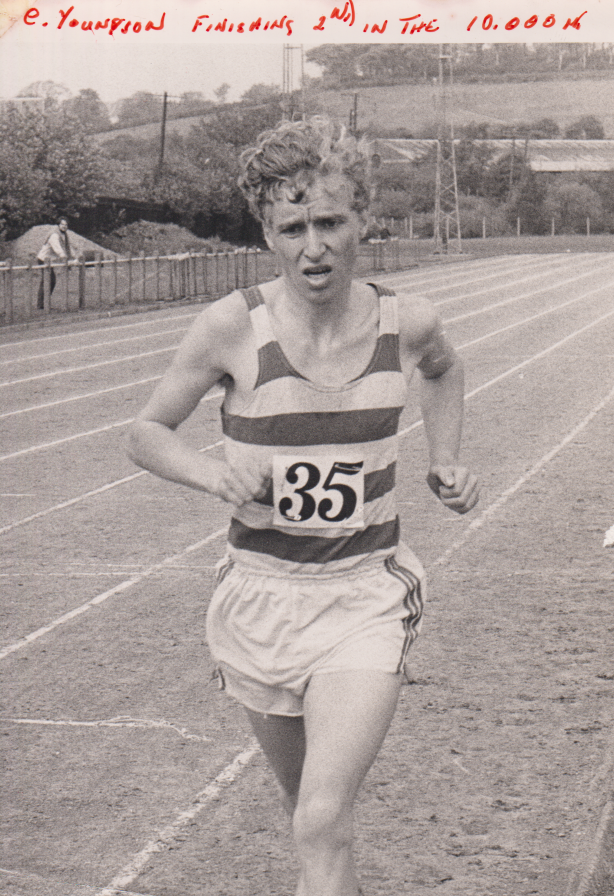
West District 10,000m. After Colin Martin moved away, I struggled to the finish. Afterwards, at least he seemed really tired as well.
Friday 1st June: Airdrie Highland Games ’13 miles’ road race. Hilly and sore legs, could be worse. Second in 62.36; to Colin Martin 62.06 once more.
1973 Personal Bests:
9/6/73 5000m 14.29.4 (‘lifetime best’ for me).
At Meadowbank, a hard, evenly paced, rather satisfying solid race. Don Macgregor won in 14.26.6, with Jim Wight second (14.29.2. Behind me were Martin Craven, Alex Wight.
16/6/73 SAAA 10,000m 29.54.8.
Meadowbank again. Hard (14.40/15.15 splits) but slipped back in final quarter – should have finished sixth. Good to break 30 minutes, though. Lachie Stewart (28.59.2), Jim Wight (29.22.2), Doug Gunstone (29.32.6, Fergus Murray (29.38), Alex Wight (29.38), Jim Dingwall (29.53.6), Don Macgregor (29.53.8). Then Tony Moore, Martin Craven – and Colin Martin.
A tragic occurence during this race was that a stray athletics hammer was hurled onto the track and smashed my friend and team-mate Alastair Johnston’s leg – just when he was about to win a silver medal. Although he did recover and race well again, he was prevented from fulfilling his excellent potential (for a 2.15 marathon, in my estimation).
23/6/73 Scottish Marathon, fifth in 2.24.01.
Meadowbank out and back. Very hot day. Went well for eleven miles or so, hanging on to leading bunch (Don Macgregor, Alex Wight, Jim Wight, Tony Moore, Rab Heron, Martin Craven, Bill Stoddart. Dropped Bill Stoddart. Then I let the leaders go and, still feeling strong, ran with Martin Craven. After the turn into the headwind, we were caught by Willie Day and Alastair Wood. At the same time my sore gut turned into an agonising stitch and cramp. (Wet vest and cold wind). Had to stop twice and run doubled over for five miles approximately. Then passed Martin again. At 20 miles, Alastair Wood (cramp). 23 miles: Alex Wight (blisters). 24 and a half miles: Willie Day (walking). Felt weakish but managed to keep running (pre-marathon ‘diet’ must have helped) and finished in considerably better shape than last year, though sunburnt and sickish from heat. Under Scottish Senior National Standard. Don won, from Jim, Rab and Tony Moore. End of serious season!
Before arriving in Stockholm, Sweden on 11th August, I did some ‘desultory training’ and managed a few wee races.
Elgin Highland Games: won 5000m from Pat Maclagan; and ran 1500m in 4.4.6, second to John Ferguson.
Lochaber Highland Games (after a week climbing hills near Glen Affric), fifth in 3000m (8.42) behind Frank Clement, Norman Morrison, Colin Martin and Gerry Hannon. Victoria Park won the team event and (later infamous) Games Chieftain Jimmy Savile presented the prizes. Then I finished fifth in the handicap 1500m, beating John Ferguson….Not sure of the date, but I also ran the 1973 Carnethy Hill Race and finished a decent 11th in 59 minutes 17 seconds, four seconds behind Martin Craven but nine seconds clear of Jimmy Jardine and 21 seconds in front of the legendary Joss Naylor. Dave Cannon won in 54.05 from Jeff Norman in 54.36 – both went on to be GB Marathon Internationals (Jeff an Olympian).
Sweden: Fredrikshof Idrottsforeningen 1973-974
Fredrikshof Idrottsforeningen, was a wealthy Stockholm club that provided free kit and paid my racing expenses during the ten months (1973-1974) I taught in Sweden. Sadly, since I lived in Orebro, a hundred miles away from the city, I was forced to train alone but managed that very well. When I did join up with the team, it struck me that the pace was a lot friendlier than back in Scotland. However, most of them were not very fast competitors!
From September 1973 to May 1974 I ran in Sweden for Fredrikshof IF and won eight races from fifteen in Sweden (plus two more in Finland, where I did not win).
Arrived in Stockholm on 11th August (short training course to teach English as a Foreign Language to Swedes for ten months). Moved to Orebro on 2nd September.
Race 1: Saturday 8th September 973. Rockhammersloppet. 17 or 18 km of sandy road, grit, path etc. Suicidal start to bridge, then gradually worked through and gave one ‘dig’ to finish 4th ex 150 in 57.35. (Winner 55.45). First run for Fredrikshof – lovely facilities, food and prizes, ‘expenses’ etc. ‘Bastu’ sauna. Rather stiff and sore afterwards. Beat Mike Rowlands (from Cardiff, 2.16 marathon man).
Race 2: Sunday 16th September. Ludvika Hogberg’s rundown of results and certificate. Worse than last week. Incredible sandy, sawdusty switchback ski-trail. A bit chicken and puffed. 9Th – beaten mainly by off-season cross-country skiers! Toaster prize.
Race 3: Sunday 7th October. Lidingoloppet – a very famous mass event. 20th ex 3000 starters! 30 km cross-country. Went off too fast – wooded paths, ten million treeroots, 1 hour 47 minutes 33 seconds. Autumn tints but did not see them! Mad rush at start, up to tenth then hang on – tired and puffing by 3 km! Constant ups and downs, boulders, ruts, branches and other obstacles. Thousands of spectators. “Heja Hofvet!” (Surprise). Started dropping at 10 km then moved up a little, towed by someone till 20 km – getting very tired – no sponges, just warm glucose water! Some fiendish gradients, slowing again but still 12th with five or six km to go. However very weak and had to walk up hill – then lost 8 places in last three miles – very sad but exhausted, so very glad to finish. Not too bad considering difficult terrain – as hard (or worse) than a marathon. Afterwards, drank pints of glucose drinks – medal and expandable fishing rod prize. Fine meal with team-mates and Stella.
*Race 4: Sunday 21st October. Nykoping BIS 16 km road. First in 47.41. 2nd Hans Jonsson 48.31; 3rd Hannu Partanent 48.41. Both in hats and tights! Sunny, slippery at times. Steady until ten minutes – one burst and they didn’t bother! Fast at times, not feeling too great, but first win in Sweden! Nice watch prize. Jog back to Chris’s flat. Then onto pre-marathon ‘diet’.
*Race 5: Saturday 27th October – my 26th birthday. Stockholm and Uppsala Combined District Marathon. First in 2.22.28 (Personal Best). Beautiful day, slightly undulating course, little wind, fairly warm yet cool. Broke away at 7 km – series of surges with Ulf Johansson (2.23.42). Then both settled down and he led most of the way to 30 km. Then a planned kick away and held on till the end (74 seconds up). Friendly bloke, very light on feet. He laughed at my attempt to kick at a drink station. Felt strong throughout until last km kick, despite sore feet. “Easiest” marathon ever since first half split almost exactly same as second half. Amazingly even pace. 3rd Dave Bendy 2.28.18 (PB); 4th Jan Ost 2.28.34 = three Fredrikshof runners in first four! A good day! (Received a Fredrikshof Cup for this).
Race 6: Saturday 3rd November. Kilsbergsleden. Orebro Karlslund. 1st: Leif Andersen; 2nd me; 3rd Bertil Larsson. Silver medal and tankard. Not recovered properly from marathon but tried very hard to get rid of LA in first four km – lost lead halfway and dropped, as expected, on very rough underfoot conditions – not bad though, considering everything – never could “win ’em all”.
*Race 7: After training/racing nine miles over an average of 62 for 14 weeks, I eased down for a more important marathon. Sunday 25th November: ‘Vintermaran 73’. First place from 200 starters. Time: 2 hours 26 minutes seven seconds. Minus five degrees centigrade – snowed half the time – loop plus seven times six km including a 2 km ‘beach’. Windy then sheltered course. Fastish start (tracksuits, hats, tights, gloves etc – self polo shirt and vest, track top, tights and shorts. Hat and gloves came off after half a lap! Hung on to sub-2.20 pace till halfway (group of 6, including Max Holmnas and Hans Jonsson) till gradually, surprise, down to Urban Larsson (2.27.16) and self. I had been ‘sitting’ most of the way, conserving energy in cold and wind, so kicked a little when he slowed and got away! Cautious, stiffening struggle round another two plus laps – hamstring solidifying, and home to victor’s wreath, interviews etc. Third was the redoubtable Leif Andersen (2.29.43). Swedes all rather surprised! Me too. Extremely satisfying to defeat so many rivals, including all the best Swedish Marathoners! Almost perfect. Newspaper headline: ‘Scottish Teacher Causes A Sensation!” End of Serious Winter Season.
In Finland by Thursday 20th December. Cross-country ski-ing tuition (not a natural…). Sunday 23rd, 3 miles ski-ing across a frozen lake to cottage! My hosts: Charlie Greenlees and Marja Ulpovaara.
Race 8: In Finland! Tuesday 1st January 1974. Korso Road Race (11 km). 4th ex 50 in about 35.40. First Matti Salonen (34.32 – record), second Antti Pasanen 35.15 (2.17 marathoner), third Seppo Tuominen 35.30. Start in middle of large drunken crowd on the stroke of midnight, outside Korso church (beside square, entertainments etc). Mad shoving at start – pools of darkness, candle-lit areas, some ice and slippery roads – sharp hills and descents. Four laps. Kept up as best I could for a lap but very tired by halfway. Cold in stomach and unused to speed. After Pasanen got away (2 and a half laps), I knew Tuominen would catch me – but enjoyed trying to outkick him twice before demolition on last hill. Hard run – fine Finnish glass bowl – beat Mikko Ala Lepilampi (Olympic Steeplechase finalist), a polite, modest lad. Back to Orebro by 5th January?
*Race 9: Sunday 10th February. Lidingo 15 km. First in 48.02. 2nd Rune Radestrom; 3rd Borje Israelson; 4th Stefan Johansson. Roads (snowy) and paths for a bit. Group of three got away – loose by 5 km but didn’t get too far in front – stitch last 4 km – could be worse!
16th and 17th February: watching World Nordic Ski-ing Championship in Falun. Very exciting 30 km cross-country ski-ing speedily through twisting forest paths and narrowly past spectators sheltering by trees.
*Race 10: Sunday 17th March. Sundyberg IK ‘Tva Sjoar Runt’ 11km race (road/paths). Tenth Jubilee event. First in 33.34 (course record). 2nd Max Holmnas (34.02); 3rd S. Johansson; 4th Hans Jonsson; 5th R Radestrom. Start very fast – wrong stance – fight and push up hill to front – slacken and follow until one and a half miles? Then noticed Swedish 3 km champ and gap behind (No Max yet!). So kicked and got away very soon. Puffing, but well up at halfway and held it quite ‘easily’. Satisfying race – perhaps surprised them (and me). Many cheers – interviews with Stockholm Radio and the main Swedish ‘Dagens Nyheter’ newspaper! Plaque, carnations, and large primus double ring cooker. Incentive for training at last????? Headline in newspaper: “Okand Skotte Bast i Terrangpremiaren” (plus good action photo).
*Race 11: Saturday 23rd. Race/Training. ‘Mogetorpsloppet’. Orebro local event. Tried to keep company but no oppo, so good training with racing bicyclist’s conversation for company. 22Km? First in 1 hour 14 minutes, 28 seconds (record). Bottletop puppet souvenirs! These were fashioned by Fritz Schreiber, a friendly multi-lingual German who later became World M80 200 metres gold medallist.
Saturday 6th April: paid hotel for guest runner in Kil. Coloured TV! ABBA won Eurovision!
*Race 12: Sunday 7th April. ‘Frykstaloppet’ in Kil. 25 km road. First in 1 hour 18 minutes 30 seconds (a record by 70 seconds). 15 and a half miles approximately = average of 5 minutes seven seconds per mile pace). 2nd Leif Andersen 79.20. Five km splits: 4.50, 15.20, 15.05, 17.20. 15.55.
L.A. started fast, I sat in, then Lars Enquist (previous record holder) surged and we dropped L.A. so I kicked to get rid of Enquist. Stretched it until past 15 km, but then felt bad on the hilly stretch, before rolling home with Leif closing slightly. Rather too tired for pleasure but good training although feet hurt in thin shoes. Briefcase, interviews, umpteen photos, plaque (Snabbast Herr!) and most obscene and enormous annual trophy, bedecked with Varmland Eagles! With thanks, after accepting a photo of me holding this monster, I gave it back. Pleasant rest with Jan Ost and Tommy Mattson, wife and kids before Stella and I went off on holiday.
Thursday 11th weekend in Copenhagen.
Race 13: Sunday 21st April. Palma Relay in Lahti, Finland. First leg: first Pekka Paivarinta (1973 World XC Champion). I was a very poor 12th, two minutes behind. Felt rough, hurt foot on cobbles, off too fast and gave up too fast. Fredrikshof only 15th in team race. Finns seem much faster than Swedes or indeed Scots.
Race 14: Sunday 28th April. Samstags Varterrang 11km. Bumpy paths and some sandhills. First: Nedo Farcic. I was second. Ran a stupid race – off too fast and felt poor when the winner caught up – but good training when not at my best.
Race 15: Wednesday 1st May. Vaxjo 24 km XC plus road race. Mainly bumpy country and roughish paths. 4th in 79.32. First: Ivan Jocic, Yugoslav 78.45 (13.30 5000m); second Leif Andersen 79.15; third Ove Malmquist 79.26; fifth Lars-Erik Stahl; sixth Max Holmnas.
Revenge on last two names for Finland relay disaster but Leif certainly going well! Sensible start for 5 km on rough roads but quick break-up when hit bumpy country. Eventually I.J. got well away. L.A., O.M. and I together for half race, only breaking up in final km, when I was too tired to compete. Getting away on road but lost on country. Very hard and good training. 300 kronor and glass vase plus teeshirt. Tour of Sweden in Jan Lind’s car before and after – very beautiful.
Race 16: Saturday 11th May. Fredrikshofs own Stadtsloppet. Team nowhere, self third on first leg (2900 metres). Seemed very fast. 8.15 for me?
*Race 17: Sunday 12th May. Koping 14 km. First in 45.17. 2nd Leif Andersen (sore gut) 45.40, Lars Wallin 45.57, Bertil Rehn 46.12. Dusty ‘A’ roads and undulating paths, fast start, got away about 4 km and increased lead in second circuit, easing off a bit near the end. Would have won anyway, I think, since L.A. had the same complaint at Vaxjo and it did not slow him there! 8th win in Sweden. 200 kronor prize – very useful.
Left Orebro on Saturday 25th May. After Stockholm, train to far north and Lapland. Kiruna, Jukkasjarvi, Riksgransen, Narvik in Norway, Trondheim, Oppdal (climbed snowy 5000 feet hill), repetition session on Oppdal hostel running track, Oslo, jog round Vigelandpark, inspecting sculptures, Bergen jogged up vertical road to famous track where Gordon Pirie broke a world record, then ferry to Britain and eventually home to Aberdeen on Tuesday 11th June.
Sunday 16th June: more than 22 miles followed by low carbs ‘diet’ then onto stodge by Wednesday, followed by two days totalling merely six miles jogging
Saturday 22nd June 1974. Scottish Championship Marathon out and back to Meadowbank. Third place/bronze medal in 2.21.36 Personal Best. First Don Macgregor 2.18.8; second Rab Heron 2.19.18. Beat Alan Partridge, Gordon Eadie, Sandy Keith, Alex Wight, Don Ritchie etc. Started into wind, so stuck behind leaders (Don Mac, Rab, Don R, Sandy and Tony Millard). Dropped Tony and Don R on hill (six miles). Lost Sandy when Rab H surged about ten miles, stuck until 14 miles (very fast pace on return). Knee increasingly bad so took great care on way back – or else sub 2.20? Four minutes clear of fourth finisher. Surprisingly good considering injury. Steady improvement continues. Swedish good form was no fluke!